




Abstract
Like other workplaces, bullying occurs in academia. Additionally, women report more frequent and severe forms of bullying than men. The purpose of this qualitative study was to unearth women academics’ learning because of being bullied. We discuss the learning context and explore the learning that occurred. Understanding these factors can augment the literature on bullying in academia. As a result of being bullied, women fundamentally changed their perceptions of themselves, others, their respective institutions, and their priorities. This study reveals how women can gain skills and have negative and positive changes in worldview. We offer practical suggestions for faculty, administrators, and institutions to promote learning from the experience of being bullied.
“The positive changes in worldview because of bullying add to the literature on bullying as most articles discuss the negative impact and bullying behaviors.”
Women Academics’ Learning as a Result of Being Bullied
Higher education is no longer an idealized workplace (Johnson-Bailey, 2015; Valverde, 2013), in part due to bullying. We define bullying as “harassing, offending, socially excluding someone or negatively affecting someone’s work tasks” (Einarsen, et al., 2003, p. 22). Women report more frequent and severe bullying than men (Anjum & Muazzam, 2018). Hollis (2015) found 62% of the 401 faculty and administration surveyed reported experiencing bullying in the past 18 months. For women, this figure was 71%.
Intra-gender bullying occurs more often than cross-gender bullying (McCormack et al., 2018). Women reported more contrapower harassment, when individuals from a lower status bully those from a higher status (Lampman et al., 2016). After being bullied or verbally abused, behavior changes included losing confidence (Dentith et al., 2015; Valverde, 2013) and becoming more strategic (Valverde, 2013). There are changes in worldview.
This study adds to the literature concerning bullying in academia by framing experiences through the lens of adult learning theory. Rather than describing the types of bullying that women experience, we critically examine the context in which women work and what they learn from their experiences. Findings present the learned skills that served participants well, and bullying experiences that influenced their worldviews.
Conceptual Framework and Literature Review
We frame our study using Collins and Bilge’s (2020) intersectionality (a critical social theory), and transformative learning (Mezirow, 2012). We include literature on bullying as regards learning and gender differences.
Intersectionality
Collins and Bilge’s (2020) theory of intersectionality shows how oppressed positionalities overlap. The power relations of various positionalities “build on each other and work together; [and]. . . affect all aspects of the social world” (p. 12) Using intersectionality as a heuristic illuminates the complexities of one’s identity and subjectivity and the power relations associated with various identities (Collins & Bilge, 2020).
The core constructs of power, social inequality, and social context are especially relevant in analyzing the experiences of women academics who are bullied. Domains of power include structural power, or the power of social institutions (Collins & Bilge, 2020), cultural power such as the belief that everyone has access to the same opportunities, and disciplinary power which shows how rules are applied to individuals based on different positionalities (Collins & Bilge, 2020). Interpersonal power is how individuals use structural, cultural, and disciplinary power. Relationality examines looks at how positionalities and power intersect (Collins & Bilge, 2020). These intersecting positionalities and power produce social inequities. Social context helps us understand how knowledge production is organized and how particular disciplines are hierarchical (Collins & Bilge, 2020).
Transformative Learning
Mezirow’s transformative learning is also a constructivist theory that considers “reflection on experience for transformation” (Fenwick, 2001, p. 21). Transformative learning occurs when there is a change in our beliefs or attitudes or “meaning scheme” or a “perspective transformation” (Mezirow, 2000, p. 34). Mezirow delineates a 10-phase process and argues this type of learning involves experience, critical reflection on that experience, talking with others, and acting on the experience (Mezirow, 2000). The process begins with a “disorienting dilemma” (p. 22), which can be an event or series of events that prompt reflection. For example, a professor’s colleagues indicate that her research is of no consequence and “anyone” could teach her classes (disorienting dilemma). She critically reflects on these experiences. Previously, she spent 60 hours a week on teaching, and research activities. She reconsiders her priorities (reflection). She talks to others and decides to prioritize socializing with family and friends over work (talking with others, action). She forms an advocacy group for bullied faculty (action).
Scholars have examined transformative learning through a feminist lens. Factors that promoted transformative learning particularly among women included relationships such as “role models, mentors and critical friends” (English & Peters, 2012, p. 112). Power relations and context were integral to understanding the transformative learning process as was a reflection on experiences (English & Peters, 2012). For women, transformative learning often occurs under oppressive conditions and emotions such as anger are part of the process (English & Irving, 2012). The importance of the body in the transformative learning process is also noted.
Learning from Being Bullied
Research on bullying in higher education has described how women were bullied without closely looking at the skills learned or the changed perspectives, although some articles briefly mention learning occurred. Dentith et al.’s (2015) article reveals three women professors’ experiences. When upper administration told an untenured assistant professor that her research was not valid and advised her to discontinue international collaborations, she learned “not to attract too much attention” or “look too ambitious” (pp. 31–32).
Johnson-Bailey (2015), an African American professor, describes her racialized and gendered experiences of being bullied, including having her competence and authority questioned by students. She is addressed as “Miss,” “Ms,” or “Mrs” while her male colleagues and students are addressed as “Dr.” She learned that academia was not “sacrosanct, but an American workplace that did not exist apart and superior to the outside world” (p. 42). Sedivy-Benton et al., (2014) briefly mentioned “survival strategies” that women used to counteract bullying, from “protesting.... documenting and reporting incidents, to avoidance, and ultimately to leaving an institution” (p. 40). Emotional detachment is another learned coping strategy (Hollis, 2015; Lester, 2009; MacIntosh et al., 2010; Sedivy-Benton et al., 2014).
Gender Differences in Bullying Behaviors
Women academics’ experiences of being bullied differ from men’s. Women “reported a more serious incident of student incivility, bullying, aggression or sexual attention during their careers” (Lampman, 2012, p. 184). Women were more often targets of bullying (Simpson & Cohen, 2004, p. 179) and also experienced more “academic counterpower harassment” (ACPH), which is when a person lower on the hierarchy, such as a student or administrative assistant, bullies a faculty member (Lampman et al., 2016).
Valverde (2013) details her personal experiences as a woman of color in academia and the discrimination she faces based on “gender, race, ethnicity, class, disability, and motherhood” (p. 372). Valverde (2013) advocates for self-care by seeking mental health professionals if needed, getting exercise, sleeping, and saying no to projects. She encourages individuals to “recognize you are not alone,” (p. 405) “tell your story,” (p. 406), “learn their rights,” and “mobilize for change” (p. 417).
Method
For this qualitative study, we used purposive sampling and conducted semi-structured interviews with 11 women professors. They were full-time tenured (10) and non-tenure-track faculty (1). One participant retired 2 months before her interview and was a Professor Emerita. Participants worked at various 4-year higher education institutions between 5 and 44 years. Their disciplines included Education, Psychology, Biology, Mathematics, International Studies, Economics, and Anthropology. Women identified as White (8), Indian (1), White/Jewish (1), and African American (1). Ten of 11 possessed PhDs and one obtained a master’s degree.
The interviews lasted 45–90 minutes. Questions included: What kinds of things help you feel valued in your academic work life? Describe how your decision-making has changed because of bullying in the workplace, if at all. How have your professional relationships with other women academics helped you? How has your perspective changed as a result of being bullied, if at all? All participants provided informed consent and all data were collected in accordance with a protocol approved by the lead author’s Institutional Review Board. We assigned pseudonyms to participants.
We read the interview transcripts multiple times. We used the constant comparative method to analyze data based on Strauss and Corbin’s (1990) grounded theory methods, looking within and between interviews for themes. We utilized a 2-stage coding technique in which we conducted the first round of deductive coding and then engaged in more focused coding to create categories, and subsequently, themes. We ensured trustworthiness and consistency using triangulation and inner-rater reliability measures to ensure the multiple individuals examining the transcripts were aligned. We had adequate engagement in data collection as we interviewed people until we reached saturation.
Findings
We explored the learning context through lenses of intersectionality and critical experiential learning, noting how the social and cultural capital of various positionalities, including gender, program affiliation, and physical ability, affects women’s work experiences (Fenwick, 2003). We also examined how women’s ideas about themselves changed using transformative learning theory (Mezirow, 2000).
Power and Gender
Women mentioned the patriarchal system affected the work environment, including exclusion from decision-making. Hiring committees preferred men for faculty positions, men spoke more at meetings, and were the decision-makers. Nan stated that in department meetings, “Most of the people who speak are men and the same old men. Nobody dares say anything… Just noticing, by what kind of people speak, is a suggestion, almost, of who can and who cannot.” Sarah understood that program decisions were made behind closed doors. “It’s happening in so and so’s office where the four guys get together ….but the biggest struggle is to just know that, oh, the script has been written. If you go in and you are trying to do deviate from that script, then you’re putting a mark on your back.” Dr X stated that men needed to assist women in being heard in meetings. She said, “Two men in my department….very quickly noticed that I had good ideas that nobody even heard. So, they started suggesting them and got told, ‘Oh, John, what a good idea.’ After a year of this. . . they started their comments, ‘As [Dr X] just said….’” In addition, Sarah noticed that men exclusively staffed the editorial boards of all the journals in her discipline.
Two women mentioned gendered socialization and gendered expectations in their workplaces, in effect academic housekeeping. Nan believed women were anxious to please and were more likely to see themselves as less competent than men. She stated, “Males. . . have a lot more trust that they are competent, and they are delivering what needs to be delivered even if they are not.” Dinah noted, “Women end up doing a lot of academic housekeeping. Doing the administrative roles and things like that.” Dinah explained that women “feel like we should be… the dutiful daughters at the meetings. There are a lot of associate female professors who haven’t gone up for a promotion because they’ve been doing all the administrative work at the department.”
Women’s bodies were also the subject of bullying. From a health-related discipline, Den had undergone multiple surgeries and gained weight. She reported, “My comments on my evaluation said, ‘Why should I be learning from this person who is obviously not physically fit?’” Her boss told her she “should go do more teaching and not physical work out classes.” Den noted, “I’d had nonstop headaches for over, about a year at that point. I was just dealing the best I could.”
Power and Academic Discipline
Women in small programs felt especially marginalized. Sarah said, “Within my own department we have a strong applied micro [economics] group, and these guys, they stick together, they have agendas…. There are times in meetings where I feel marginalized because I’m a macroeconomist because they tend to place students well in the job market and somehow that makes them feel that they’re better. . . so they deserve all the resources.” Lori added, “I’m in the program that has the smallest number of faculty members. But when we vote for new hires, everybody has an equal vote. We were not given the autonomy to make choices about how our part of the department should grow.” Sally echoed the concern, describing the program paired with hers as, “The bullying force of my time here at my [institution]. It has felt as though we are an unworthy group.”
Transformative Learning
Women’s experiences of being bullied resulted in changes in perceptions about oneself, others, and one’s institution, which resulted in shifts in priorities. They emerged from these experiences having learned more deeply about themselves and others and had changes in their worldview.
Women recognized how to value themselves and use their energy. Participants became empowered when they learned how to pick their battles. Sally noted, “I stand up for myself more than I did in the past. . . But I also tried to be aware of when the fight is worth it or when it’s easier to just not...move into spaces where that’s going to happen.” Sarah added, There were so many people in the group that were indifferent...I can’t be indifferent...That I cannot be but just take one step back so that I’m not as [emotionally] involved. Like if so-and-so did this, this is not a battle worth fighting.
Lori noted, “My husband always says, ‘You can’t change other people but you can change your reaction to them’...I have tried to focus really on what’s important… and to try not to let the stuff get to me.” Martha felt disrespected by colleagues and stated, “You have to build some type of tough skin—in a very professional way. You cannot explode every time somebody makes a comment, every time someone says something, micro-aggressions.” Sarah stated, [I learned] just to have a thicker skin, I guess. One of my colleagues, for instance, he was talking he turned to me, and he’s like ‘Don’t interrupt me when I’m talking.’ In that moment I was just so shocked. But anyway, now I have limited interaction with that person, for instance. I have now classified some people as I don’t need to waste my energy on them.
Participants also became more self-reliant and self-protective. Flora stated, “I’ve learned to rely a lot on my own resources… [and] to always be open to opportunities to learn new ways of thinking and doing things. I’ve learned to be true to myself.” Sally also acknowledged that because of being bullied, she learned to better protect herself.
In some cases, women’s perceptions of themselves changed for the worse. Kathi questioned her perception of herself after learning that her colleagues thought of her as difficult. She said, “And you hear stories, right? I didn’t think I’d be one of them. Because I also think of myself as a very likable, personable person. Amicable. Am I difficult? . . . Most people tend to like me, so it’s made me kind of challenge that perception of myself.” Char indicated, “I thought I was stronger than I am. I thought that someone accusing me of something so heinous would just … I could laugh it off easier. I wasn’t able to. I learned I’m not as strong as I thought.” Nan stated, I didn’t respond in a way that suggested that I have trust in my own value as a professional. I didn’t fight back. . . I didn’t basically communicate how appropriate or inappropriate that was. Also, internalizing it to a degree. That I should’ve internalized it a lot less. It basically taught me that I might not be somebody who can fight for her own rights.
The women’s views of others and institutions also worsened. Char and Sarah’s comments indicated their change in the perception of others. Sarah realized that everyone had a strategy, stating, “Now I think, ‘Oh, OK. Everyone’s playing some sort of strategic game’…. It’s so sad, but I feel like I’ve become more cynical and more doubting of other people.” Char recognized that not everyone was friendly; I’m one of those people. I think the best of everybody. I’m just inherently trusting, and it’s gotten me screwed too many times…. I’d like to think the best of people. That people will do the right thing…. What I’ve learned is they will do whatever they can to make themselves seem better than they are.
The most prominent theme was learning there was a lack of support from colleagues, departmental staff, or the institution when they sought help regarding being bullied. Dinah observed, “This profession rewards bad behavior, and [I learned] how few mechanisms there are to ensure stability within the department.” Sally explained, “I get bullied, and they don’t do much in the way of protection. They talk a lot, but the actions that one would hope could rectify situations that they’re too afraid of being sued to actually respond appropriately.” Nan defined it as, “Punitive. Yes, that’s the word. It’s a punitive institution…. On a personal level that’s not my experience [but] when you put them together in that culture it results in a different experience.” Char reflected, “[Bullying] is hidden, . . . nothing will ever change. You either deal with it in the department or you leave.”
Women also experienced changes in priorities. They found work/life balance and started to enjoy life more as well as gaining compassion for others. Lori got married and had children. She said, “I reassessed my whole life and decided that my self-esteem shouldn’t come from my job. We married in 2006, and we had twins in 2008. Since then, life has been more important than my career.” Sarah was pregnant while experiencing being bullied and realized that stress was not good for her, and she needed to focus on herself. Den’s health issues precipitated a change. She said, “When my medical issues happened… yeah, that’s when I first started changing and then I just made a conscious decision. I am to promote myself to get healthy, to reeducate. It’s for me and it’s for me to be happier here.” Kathi said, “Like why am I working so hard to get these publications and investing so much of my life, and then nothing really happens? I don’t really feel valued here. I’m constantly working. . . . at the detriment of work-family balance. I am paying more attention to what I enjoy and gives me joy.”
Despite being bullied, another growth-producing meaning scheme change included developing compassion. Sally’s journey taught her compassion. She stated, Everybody has their own story and makes the world in what they think it’s supposed to look like. I’ve been reading a little bit about Buddhist teachings of suffering and fear and trying to understand how people cope with the world that they live in, whatever that is. My empathy toward people I hope has improved and that suffering is part of the life we have and everybody makes that… show up differently… I tried to be more forgiving but also more cautious.
In summary, women engaged in deep learning as a result of being bullied. This learning changed women’s views of themselves and relationships with others. Women learned how to protect their emotional energy, questioned previously held perceptions of themselves of themselves and their abilities, recognized the limitations of support for those bullied in academia, found a better work/life balance and had more compassion for others.
Discussion
Women’s learning occurred in a social context where power was unequally distributed (Collins & Bilge, 2020; Fenwick, 2003) between men and women. Women’s silence at faculty meetings and relegation to “academic housekeeping,” and discipline’s marginalization shows the patriarchy’s power in women’s work lives. These power issues transcend programs and departments to instances of all-male membership in professional journals. Collins and Bilge’s (2020) social inequity issue emphasizes women are not inferior but are treated that way. Although our participants were highly accomplished in their respective fields, the women described incidents that showed men possessed more social and cultural capital, resulting in women’s marginalization. This study confirmed the literature concerning women as the “housekeepers” of academia (Harford, 2018).
Within this culture, individuals learned to value their time and energy and to pick their battles, develop a thick skin, and become more self-reliant. Our findings on the role of emotion in transformative learning resonate with the literature (Dirkx, 2006; English & Irving, 2012; Mälkki, 2019). Sarah now takes “one step back so that [she’s] not as [emotionally] involved.” This emotional distancing confirms previous research (Hollis, 2015; Lester, 2009; MacIntosh et al., 2010; Sedivy-Benton et al., 2014).
We also saw perspective changes regarding the perceptions of self and others. Women’s self-perceptions changed for the worse. They saw themselves as less able, less likable, and weaker because they did not stand up for themselves. This loss of confidence is confirmed in the literature (Valverde, 2013) as the “dark side” of transformative learning (Morrice, 2012). Women may personalize bullying more than men who see it as organizational (Misawa et al., 2017). However, several participants understood the structural department power dynamics that accounted for the bullying.
Unlike other literature on bullying in academia, we found women also had positive lessons and changes in worldview. Some participants learned compassion for others because of being bullied. Typically, this type of positive reaction occurred after individuals had time to reflect on their experiences; some mentioned the importance of meditation or spirituality in their lives. Additionally, individuals learned a better life/work balance because of being bullied. They focused on others’ importance of family and friends in their lives and put work in the proper perspective. The positive changes in worldview because of bullying add to the literature on bullying as most articles discuss the negative impact and bullying behaviors. While bullying is never acceptable, this finding suggests the power of emerging from a negative experience with a positive perspective.
Implications and Conclusions
Practical Actions to Mitigate the Negative Effects of Bullying.
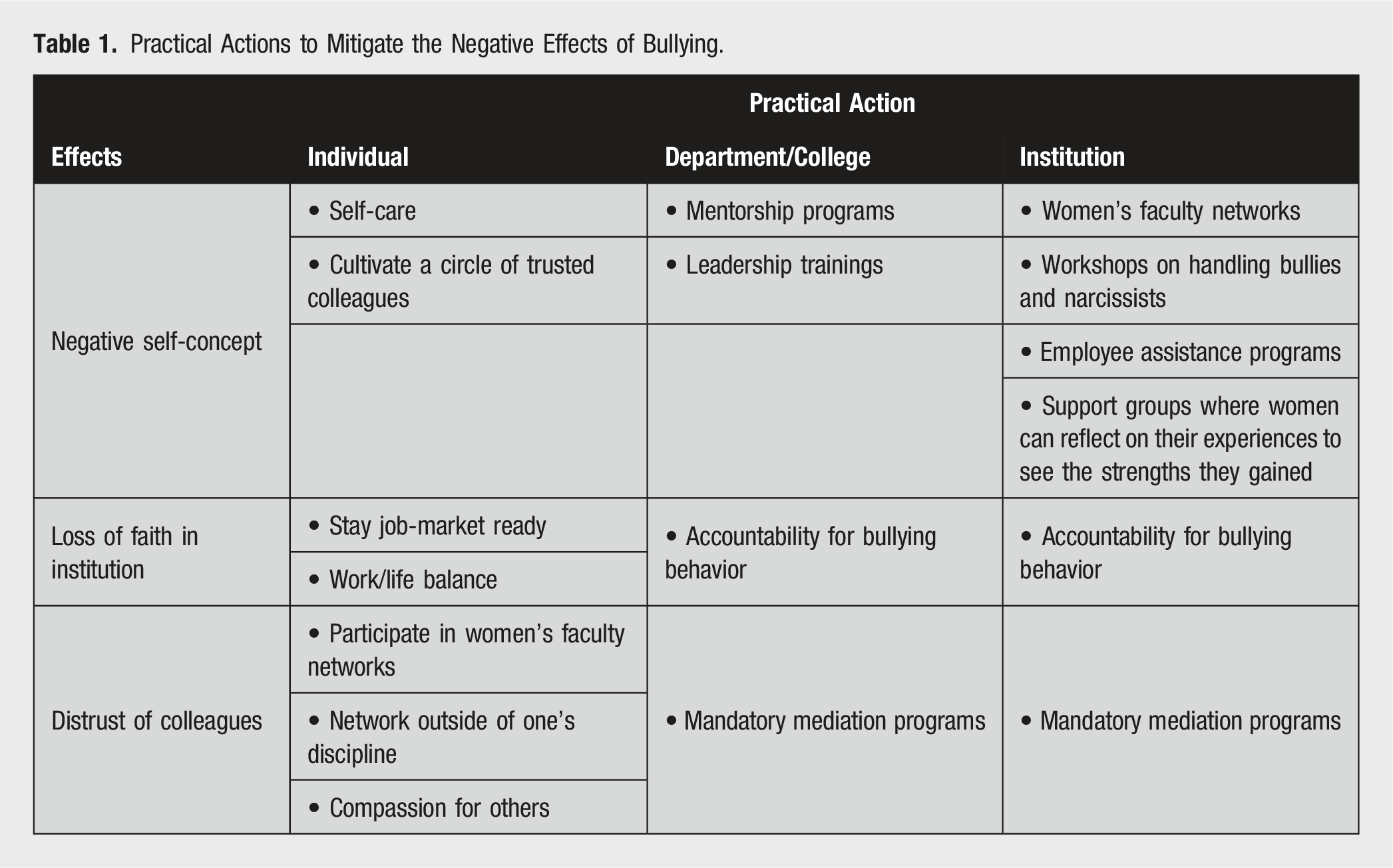
Yet, we acknowledge Table 1 does not do full justice to the untapped power of women in academia. While women academics do need to learn how to navigate a system that disproportionately bullies them, that navigational skill ultimately needs to be used to fix a broken system. The positive lessons learned from these experiences of being bullied suggest this study’s participants are poised to transcend the experience for the benefit of those who follow them. Bennett (2016) frames an anti-bullying, anti-sexism strategy in this way: “We needs skills, hacks, tricks, tools, battle tactics to fight for ourselves while also advocating for change within the system…. This is not a solo task. We need other women by our side” (p. xxvii).
We now ask, how can we as adult educators promote spaces for women who are bullied so they can reflect, reframe, and transform? And then, how can we help women and women-identifying individuals protect each other, recruit, and educate men as allies, and collaborate to fix our broken academic workplaces?
Footnotes
Declaration of conflicting interests
The author(s) declared no potential conflicts of interest with respect to the research, authorship, and/or publication of this article.
Funding
The author(s) disclosed receipt of the following financial support for the research, authorship, and/or publication of this article: Catapult Triad and Seed Grant from the College of Education and Human Development at Texas A&M University.
