



Abstract
This qualitative study explores whether providing families a guaranteed income (GI) payment can reduce parents’ perceived economic stress and increase investments in their children. Participants were recruited from the Los Angeles County Breathe GI pilot. Fifteen GI recipients and 17 GI nonrecipients (N = 32) participated in semi-structured interviews. About 40% of participants worked full time, 93.8% were female, 56.3% were single, all had at least one child younger than 5, with average monthly income of $2,183. Participants were 59% Latino, 34% Black, 31% white, 3% Asian, and 3% American Indian. Compared with nonrecipients, GI recipients reported reduced economic stress and greater investments in their children. While both groups described informal activities (e.g., visiting the park), recipients reported more formal activities, including structured programs like martial arts and gymnastics and enrichment experiences like visits to the zoo or aquarium.
Introduction
Poverty is a pervasive problem affecting 11.5% of the U.S. population, including over 10 million children every year (Shrider & Creamer, 2023). With a child poverty rate of approximately 20.4%, the United States has one of the highest rates among wealthy countries in the world (OECD, 2024). The fact that poverty is so prevalent for children in the United States is highly problematic due to its association with adverse outcomes in education, cognition, behavior, and health (Brooks-Gunn & Duncan, 1997; Chaudry & Wimer, 2016; Cooper & Stewart, 2021). Childhood poverty is also linked to adverse economic outcomes in adulthood, including reduced work hours, lower earnings, and an increased likelihood of prolonged poverty (Duncan et al., 2010; Tilahun et al., 2023).
Guaranteed income (GI) programs—recurring, unrestricted, and unconditional cash transfers—have recently gained attention as a potential poverty-reduction policy (Resilient Families Hub, 2024). While some forms of direct cash payments have always existed in U.S. social welfare policy (Resilient Families Hub, 2024), current anti-poverty and income support policies largely follow restrictive, means-tested models (e.g., Temporary Assistance for Needy Families [TANF]); contributory, social insurance models (e.g., social security); or earnings-linked, tax credit models; e.g., Earned Income Tax Credit [EITC]). Contemporary GI programs differ substantially from most of these safety net programs in their lack of recipient earnings, behavior, and spending requirements. 1 As GI programs swiftly expand, and their potential place in the broader social welfare state is debated, foundational research is essential to evaluate their impact on families with young children. This study addresses this need by using qualitative methods to explore the experiences of families with young children participating in a GI program.
Theoretical Frameworks: Family Stress and Family Investment Models
Two prominent theories help to explain how poverty can affect families with young children: the family stress model and the family investment model. The family stress model argues that economic hardship is indirectly related to children’s outcomes through economic stress, or the psychological response to the daily difficulties and burden that parents experience when they are struggling to meet their families’ basic needs (Masarik & Conger, 2017). Economic stress can increase parents’ depressed mood and marital conflict, which can then lead to an increase in parent hostility to their children and a decrease in parenting quality, negatively impacting children’s development. In a second pathway, economic stress caused by economic hardship can lead to conflicts between parents and children over finances, which also adversely affects children’s development (Conger et al., 1994). From the family stress model perspective, by increasing families’ economic resources, GI programs can reduce parents’ economic stress. This reduction has the potential to improve marital relationships, alleviate depression, enhance parenting practices, and ultimately lead to better child outcomes.
Another model, the family investment model, suggests that parents try to maximize their earnings and assets to benefit their children’s well-being. Parents use their resources to make investments in their children, which primarily take the form of time and money (Magnuson & Votruba-Drzal, 2009). Parents invest in their children’s development through time by engaging with them directly in activities and through money by paying for formal enrichment activities, such as piano lessons or tutoring (Conger et al., 2010). Investments in children’s development, such as accessing learning materials, stimulating language, and providing learning experiences outside the home are associated with healthy child cognitive development (Liang et al., 2024; Linver et al., 2002). According to the family investment model, children from economically marginalized families have worse developmental outcomes because due to structural stressors, their families have less time and money to invest in their development, since most of their resources are devoted to meeting basic needs (Magnuson & Votruba-Drzal, 2009). Thus, from the perspective of the family investment model, GI programs as a structural intervention may improve children’s outcomes by boosting families’ economic resources, allowing them to increase the amount of time and money parents can invest in their children’s development. This study contributes to the extant literature using both the family stress and family investment models to explore how economically marginalized parents describe their experiences of economic hardship in the context of a GI pilot.
Literature Review
Drawing on the family stress and family investment models, this study qualitatively examined the meaning of a GI program for parents’ economic stress and investments in their children. Many GI pilot studies have examined parental outcomes, such as their employment, physical health, and mental health. For example, the Stockton Economic Empowerment Demonstration pilot found that GI payments increased parents’ full-time employment, improved their sense of stability by reducing monthly fluctuations in their income, and better prepared them to pay for an unexpected emergency expense (West & Castro, 2023). That study also found that GI allowed participants to set future, long-term goals and take more immediate financial risks—for example, quitting a job for an internship that may lead to better opportunities (West & Castro, 2023). By contrast, the Baby’s First Years study, a randomized controlled trial examining the causal impact of an unconditional cash transfer program on children’s development and family life (Magnuson et al., 2022), found that a modest ($333) unconditional monthly cash transfer had no statistically significant effects on maternal labor force participation over 4 years (Sauval et al., 2024). Furthermore, a GI program in Spain found that participants in the treatment group were 20% less likely to be employed after 2 years of the program compared with participants in the control group (Verlaat et al., 2023). Notably, the researchers found that the decreases in employment were primarily driven by participants with children (Verlaat et al., 2023). The family investment model would suggest parents might have used the cash to substitute paid work for investments in quality time with their children. In fact, a recent study by Gennetian et al. (2022) found that mothers receiving GI spent more time with their children engaging in early-learning activities compared with mothers in the control group. Aligned with the family investment model, some GI pilots have also demonstrated increased parental spending on child-specific goods, such as toys and books, as well as on recreational experiences like movies, sports, extracurricular activities, and tutoring (Amorim, 2022; Gennetian et al., 2022). Other studies have found that, compared with children in control groups, children of GI recipients demonstrated improved educational outcomes (DeYoung et al., 2024) and were more likely to participate in extracurricular activities, such as sports and after-school lessons (Kim et al., 2024).
Of particular relevance for the family stress model, additional studies have focused on GI’s effects on parental stress and other mental health outcomes. Two recent reviews of GI programs found that participants reported lower levels of psychological distress (West et al., 2023; Wilson & McDaid, 2021). In the SEED (Study of Early Education and Development) study, participants who received $500 in GI had less anxiety and depression than participants in the control group after 1 year (West & Castro, 2023). In addition, a quasi-experimental study of the expanded 2021 Child Tax Credit, which similarly provided a monthly cash transfer to families with children, also showed that it reduced parent’s anxiety and depression (Kovski et al., 2023). Studies across the globe have found similar positive results on parents’ mental well-being. A qualitative study that examined a subsample of participants in the Dutch Social Assistance Experiments showed that participants who received GI payments reported less stress (Verlaat et al., 2020).
However, a few recent GI studies did not find consistent results for parents’ stress. The Baby’s First Years found that although unconditional monthly cash of $333 decreased participants’ poverty, it did not improve their psychological distress (Magnuson et al., 2022). While Jacob et al. (2022) found that a one-time lump sum unconditional cash transfer of $1,000 similarly did not have any effect on participants’ mental health. Another found that a one-time lump sum payment of $500 or $2,000 negatively impacted participant’s psychological well-being (Jaroszewicz et al., 2024).
Several other studies have also examined the effects of GI programs on children’s outcomes. For example, the Great Smoky Mountains Study began in 1993 to study mental illness in children (Costello et al., 2003). Three years into the study, a casino opened on a nearby reservation and began distributing a portion of its profits to every American Indian individual on the reservation. This quasi-experiment allowed researchers to examine the effects of this income boost for American Indian children compared with the rest of their study population. Researchers found that the American Indian children who received the additional income from the casino were more likely to graduate from high school, had a lower rate of minor criminal offenses (Akee et al., 2010), and had lower rates of conduct and oppositional defiant disorders (Costello et al., 2003). The effects of the income boost continued into adulthood. American Indian participants who received the casino payments during childhood had fewer psychiatric disorders in adulthood than non-Indian participants (Costello et al., 2010). The Baby’s First Years study also found that the cash gifts positively impacted infants’ brain activity in areas that are commonly associated with cognitive skills (Troller-Renfree et al., 2022). However, the Baby’s First Years study did not find significant differences on children’s language and socioemotional development (Hart et al., 2024), parent–infant interaction quality (Magnuson et al., 2024), infant-directed speech (Egan-Dailey et al., 2024), or improved child sleep and child health (Sperber et al., 2023).
The overall mixed results found across the literature may represent differences in the amount of cash provided, the duration of the cash transfer program, and the short- versus long-term measurement of outcomes. To positively impact child development, additional research is needed to understand how GI programs influence parental stress and investment in children.
Current Study
This study adds to the literature in several important ways. First, much of the research on GI programs’ effects on parental stress and mental health use quantitative, self-reported survey measures (West & Castro, 2023). This is consistent with other research on the family stress model, which typically uses self-reported surveys of parents’ economic stress and psychological well-being (Magnuson & Duncan, 2019). Given the mixed results of quantitative studies on the impact of GI on parental stress and mental well-being, it is critical to use qualitative methods to explore how parents describe the significance of GI in their own words. To our knowledge, this is the first U.S.-based qualitative study to examine how GI influences parents’ experiences of economic-related stress.
Few studies have also examined how GI programs influence parents’ investments in their children. As previously noted, the Baby’s First Years study used quantitative data to show that cash transfers of $333 increased parents’ spending on educational items for their infants and the time they spent engaging with them in learning activities (Gennetian et al., 2022). The quantitative Alaska Permanent Fund study also showed that a universal GI program increased low-income parents spending on recreation and extracurricular activities but not their children’s education (Amorim, 2022). Finally, the qualitative arm of the SEED study showed that the GI payments gave participants more time to spend on their own interests as well as time to engage with their children (West & Castro, 2023). This study adds to the literature on parental investments by qualitatively examining how GI influences parents’ investments in both formal and informal activities for their young children.
Finally, few studies have examined the effects of the family stress and the family investment models in the same study. While each model describes distinct pathways through which poverty affects children’s development, it is important to consider how they operate concurrently rather than separately. This study furthers our theoretical knowledge by qualitatively exploring how these models operate simultaneously for economically marginalized families.
Method
The present qualitative study uses data from the Los Angeles County (LAC) Breathe GI pilot. LAC Breathe randomized 1,000 applicants to receive $1,000 in unrestricted monthly income for 36 months, starting in June 2022. An additional 2,000 applicants were randomly selected to serve as control group members, receiving no monthly payments. To be eligible for the intervention, participants had to be 18 years of age or older, an LAC resident, have an annual household income ≤ area median income (AMI) for a one-person household or 120% of AMI for a two or more-person household, and could not be enrolled in any other GI program. A longitudinal quantitative evaluation is in progress to assess the impact of GI on participants’ health, well-being, and economic stability.
Study Setting and Sample
This study was conducted in LAC, California, which houses just over 9.5 million residents. LAC is ethnoracially diverse: 49% Hispanic or Latino, 25.2% white (non-Hispanic/Latino), 15.8% Asian, 9% Black or African American, 1.5% American Indian and Alaska native, 3.4% two or more races, and 0.4% Native Hawaiian and Other Pacific Islander (U.S. Census Bureau QuickFacts, n.d.). In 2023, more than 1.3 million (13.9%) residents lived below the federal poverty line (U.S. Census Bureau QuickFacts, n.d.), giving LAC the highest poverty rate of any county in California (Bohn et al., 2023).
The present qualitative study drew on the aforementioned Breathe randomized controlled trial (N = 3,000) to recruit participants. The research team started with a list of 392 individuals who completed the first Breathe quantitative survey on its launch day. This decision was based on the assumption that prompt survey completion indicates interest and availability for research-related activities. Next, the list was narrowed down to 88 individuals using the following three inclusion criteria: (a) English or Spanish speaker (removed n = 37), (b) not having previously taken part in another qualitative study related to Breathe (removed n = 7), and (c) having at least one child aged 5 or younger (removed n = 260). Parents with young children were the focus of this study for several reasons. First, a significant body of research indicates that birth to age five is one of the most critical time periods for child development, when receiving a GI and exposing children to enrichment activities could have the most impact (Britto & Pérez-Escamilla, 2013; Brooks-Gunn & Duncan, 1997; Lee, 2023; National Research Council Institute of Medicine, 2000). It is also a stressful and costly time for many parents. In fact, parents spend the most money on their children when they are younger than the age of 7 (Kornrich & Furstenberg, 2012). Finally, this age precedes the period when most children attend school full time, making it a stage when caregivers play the most significant role in their development.
Of the 88 individuals who met the inclusion criteria, the researchers aimed to recruit 15 participants who were receiving GI and 20 participants who were not receiving GI. This sample size is consistent with qualitative methodological recommendations (Creswell & Poth, 2017; Guest et al., 2006), previous studies (Perrigo et al., 2022), and would allow for saturation (Morse, 1995; Saunders et al., 2018). Potential participants were recruited via telephone, text messages, and email using a script and were provided with a research information sheet that described the purpose and potential risks and benefits of the study. Twenty-six individuals were unresponsive to three outreach attempts, seven agreed to participate but were unable to schedule an interview, and five refused to participate due to a lack of interest in the study, an inability to commit, and a sense of injustice in helping a program that did not provide GI for everyone. In total, 32 participants were enrolled into the study. Figure A1 in the appendix summarizes the sample selection process.
Participants
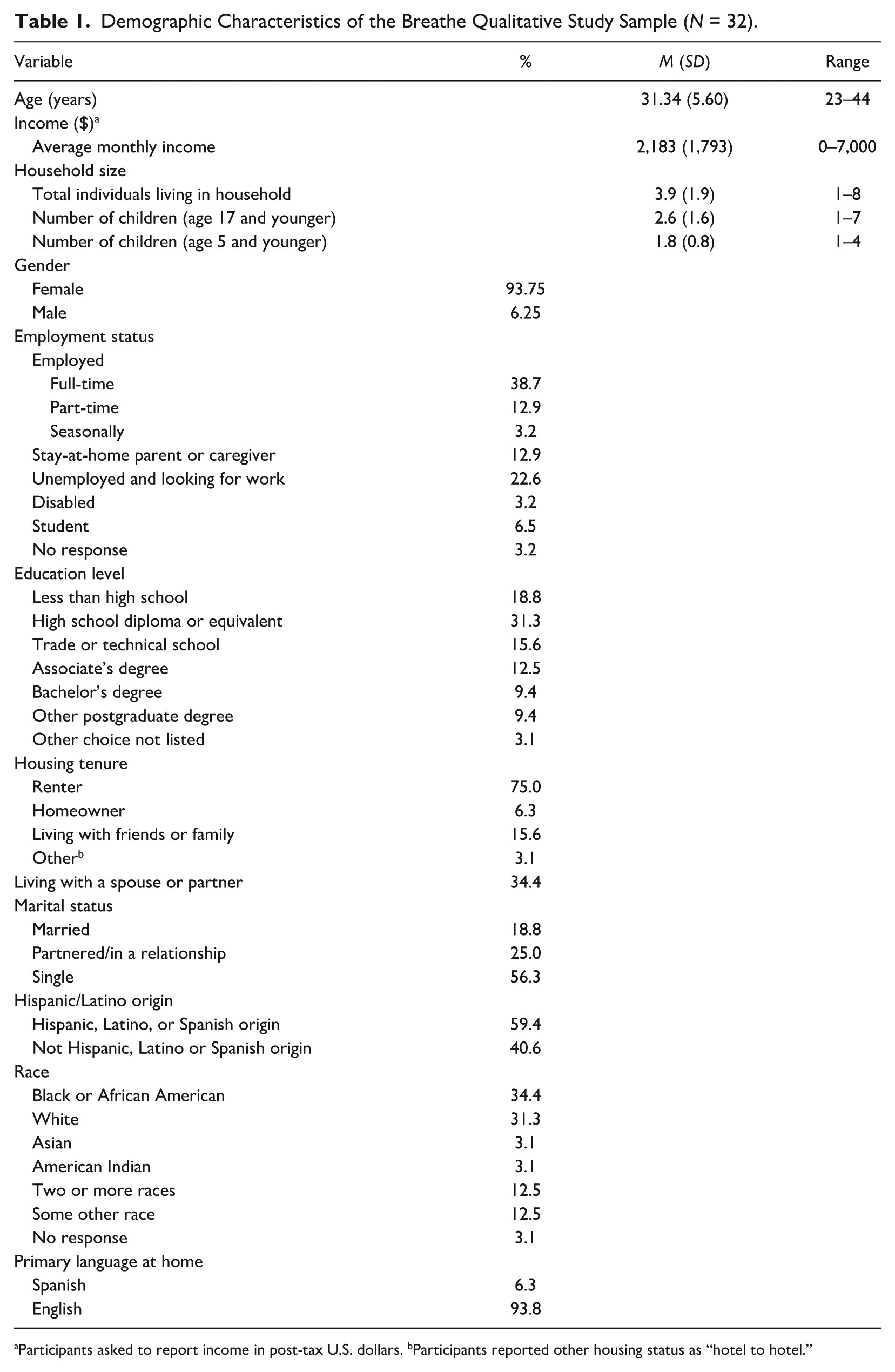
Table 1 presents sociodemographic characteristics of the study sample. The majority (94%) of participants were female and reported English as their primary language spoken at home (94%). Approximately, half of participants were employed either full-time, part-time, or seasonally, and nearly one quarter (23%) were unemployed and looking for work. The remainders were either stay-at-home parents or caregivers, students, or had a disability that precluded them from working. The average age of participants was 31 years. Approximately, one fifth (19%) of participants held a bachelor’s degree or beyond; nearly one third (31%) had a high school diploma; and almost one fifth (19%) reported less than a high school diploma or equivalent.
Demographic Characteristics of the Breathe Qualitative Study Sample (N = 32).
Participants asked to report income in post-tax U.S. dollars. bParticipants reported other housing status as “hotel to hotel.”
The average monthly household income ranged from $0 to $7,000 with a mean of $2,183 (SD = $1,793). Few participants (6%) were homeowners, while most rented (75%) or lived with family or friends (16%). Fifty-six percent of participants were single, and the remainders were either married (19%) or partnered (25%). The sample was ethnoracially diverse with approximately one third of participants who identified as Black or African American, nearly one third of participants who identified as white, and 13% of participants who reported two or more races. Over half of participants (59%) identified as Hispanic, Latino, or Spanish origin.
Data Collection
Thirty-two qualitative interviews, 15 with GI recipients and 17 with GI nonrecipients, were conducted by a team of five researchers between May and June of 2023. Thirty-one participants chose to complete the interviews in English, whereas one participant chose to complete the interview in Spanish. Semi-structured interviews were scheduled for 60 to 90 min and lasted an average of 63 min. The interviews were conducted in the participants’ homes, a public setting (e.g., coffee shop, parks), or via Zoom video.
The interview guide consisted of four primary domains with 14 total questions, each with multiple probes. After completing the informed consent protocol, researchers situated the interviewee by discussing their backgrounds, their family composition, and their perspectives on residing in LAC. The researchers also asked participants to share their perceptions about GI programs, their experiences raising young children, and their potential experiences with material hardship. While most questions were consistent across both GI recipients and nonrecipients, some questions were only asked to one group. For example, questions about GI receipt were only asked to the GI recipients. All participants were provided with a $75 gift card as a token of appreciation for their time, insights, and contributions. All interviews were audio-recorded with the participant’s consent. Study data were stored in files that were password-protected and only accessible by the research team. This study was approved by the Institutional Review Board at the affiliated university.
Data Analysis
All audio recordings of the interviews were transcribed using professional transcription services. The research team reviewed each transcript to check for accuracy. The research team consisted of doctoral students and professors who identified as white or Latina. Team members wrote memos immediately following each interview to document the contexts in which the interviews took place, explore their initial hunches, and reflect on their positionality.
Researchers then engaged in a rigorous process of first- and second-cycle coding as recommended by Saldaňa (2015). During the first cycle, three researchers independently open coded three transcripts to identify initial concepts and themes that emerged from the data. They then engaged in a second cycle of coding during which they revisited their code list, grouping similar codes together and reducing the overall number of codes that emerged during the first cycle to build an initial codebook. Researchers then independently coded an additional two transcripts using the initial codebook and met biweekly over the course of 6 months to refine the codebook and come to an agreement on the meaning and consistency of codes. This process of consensus coding, in which researchers initially code independently and then come together to discuss discrepancies and integrate codes, increases the validity and rigor of qualitative research (Padgett, 2008).
Once the final codebook was developed, the transcripts were uploaded to the Dedoose qualitative research platform where each transcript was double coded by two members of the research team. As researchers coded the remaining transcripts, they used an iterative process during which they continued to modify the codebook, allowed for new codes to emerge as novel topics arose, and met biweekly over several months to discuss any differences in the application of codes. The one Spanish transcript was not translated to English; instead, it was double coded by two fluent Spanish-speaking members of the research team. Artificial intelligence was not used to analyze the data.
Findings
Qualitative Themes
GI recipients received payments for 11 months prior to the qualitative interviews, and nearly all participants reported that they experienced some level of economic hardship. These experiences varied, ranging from struggling to meet their family’s basic needs, including some instances of homelessness, to being unable to afford extracurricular activities for their children. Through qualitative analysis, we identified two overarching themes related to economic stress and investments in children. Parents’ economic stress was primarily related to meeting their families’ basic needs, paying off debts, making difficult financial decisions, and lacking a sense of stability. Parents’ investments were divided into formal (paid enrichment activities) or informal (free enrichment activities). Within each theme, we were able to explore how the experiences of GI recipients differed from nonrecipients.
Reduced Economic Stress
Although the researchers did not ask about economic stress, more than half of GI recipients reported that the additional income had reduced their economic stress. This theme emerged organically, which adds to its power. They attributed this reduction in economic stress to a decrease in debt, fewer difficult financial decisions, and an increased sense of stability and security. Many GI recipients specifically reported using the payments to catch up on overdue bills, particularly for rent and utilities. Being able to decrease their debt reduced their economic stress. For example, one participant said, “Once we caught up on everything, we were able to buy [our children] more things or go out and do more things. It’s like a stress relief.” Similarly, another participant used the payments to “catch up over the bills.” As a result, she stated:
That’s the best thing that happened cause if we didn’t have the money, we were really behind right now. So right now, we’re getting like—like the [program] name is called Breathe. We [could] breathe about it.
Reflecting on the program name, Breathe, several participants described “breathing room” by being able to catch up on bills.
Furthermore, many participants reported that experiencing economic hardship often forced them to prioritize which bills to pay each month and which to defer due to insufficient resources to meet all their needs. Receiving GI reduced the mental burden associated with these decisions. One participant explained:
I feel like it’s changed my decision making and the anxiety that comes with having the money to pay the bills. It helps release the stress on those thoughts, so I’m not as anxious as I used to be spending the money or having to choose between this bill and that bill.
Several GI recipients said that the extra income meant they no longer had to choose between items for their families, such as toiletries or cleaning supplies, because they could now afford to purchase both. Another participant said, “Now I don’t have to basically think too much of this or that, so I could just go ahead and buy it now. So, it’s a great feeling.”
In addition to reducing the economic stress related to these financial decisions, the GI payments also provided a sense of security and stability for some GI recipients, which improved their subjective financial well-being. For some participants who had previously experienced housing instability, this meant a consistent place to sleep each night. One participant explained, “we’re not hopping from place to place or from shelter to shelter. We are finally somewhere stable.” In addition to providing stable housing, several participants said the extra money took a weight off their shoulders because it provided them with security in case of an emergency. For example, a participant stated, “I feel a little relieved . . . Now that money is there; it is like a backup. That is for an emergency.”
Finally, several parents who received the GI discussed the effects that the reduced economic stress had on them. One participant who previously worked 6 to 7 days a week said that the extra income reduced her stress about working excess hours to make ends meet. She stated, “it has helped me be more calm. I don’t have to worry so much.” Another participant shared that economic stress had previously strained her relationship with her children, but the GI payments helped improve it. She stated:
When you’re stressed out because you’re always worried about money, you do project it on your kids whether you want to or not, whether you realize it or not. You do project it onto your children. So, knowing that at least the rent is paid, it is a weight off of your shoulders. At least for me, I’m not as stressed as I normally would be.
In addition, most participants who were not GI recipients reported experiencing economic hardship, including stress. When reflecting on their hypothetical use of GI, their responses were remarkably similar to the actual responses reported from the GI recipients. First, many parents who did not receive the GI said that they would use the extra money to catch up on bills. For example, one participant said, “Just to get back on track with the bills being paid and not having to worry about that.” Another participant explained that catching up on bills and reducing their debt would decrease their economic stress:
I wanted to use the funds to be able to pay off one of my credit cards that I have been paying off slowly. Just to get that off my shoulders would have been perfect . . . paying things little by little, it does become something that you just can’t stop thinking about.
Many parents who did not receive the GI also said that receiving the extra income would mean that they no longer had to worry about meeting their family’s basic needs. One participant said that they would not have to stress about being able to afford their rent, explaining, “I would not have to worry about paying for those basic things.” Another participant discussed the anxiety she currently felt trying to pay off her car. She stated that she would use the GI to pay off her car, which would relieve this burden and allow her to pay for other necessities.
GI nonrecipients most commonly said that GI payments would have given them a sense of stability and security they currently lack. One participant stated that when he found out he was not selected to receive the GI, he “felt a little bit disappointed because I really needed it . . . if I got it, it would be an opportunity to stabilize.” Another participant who worked in catering said it was common for his family’s income to fluctuate, depending on the demand for his services. Therefore, receiving a consistent GI every month “would have helped us at least stabilize a little more.” Similarly, another participant shared how a recent medical emergency had prevented him from working at times. He described himself as “always stressed out” and shared that receiving a GI when he was in the hospital and unable to work, “would just take a lot of stress off.” Finally, participants also shared that receiving a consistent income would reduce the stress they felt related to other emergency expenses. For example, one participant explained,
Just in case if I can’t work again next month or, you know, tomorrow I break my leg and I can’t work . . . I wouldn’t be as stressed out. It would be more peace of mind if I knew that I had a consistent income coming every month.
Increased Investments in Children
Parents who received the GI often reported that they spent the money on rent and bills. A majority of GI recipients also shared that they used a portion of the money to invest in their children. One way GI recipients invested in their children was by purchasing material goods. This included essential items to meet their basic needs, such as clothing and diapers, as well as items they considered “wants,” like brand-name, high-quality shoes. Some parents also used the money to buy educational materials or art supplies:
Just making my home comfortable, making my kids comfortable, getting them things that can further develop their minds. A lot of coloring and art supplies. We do painting a lot.
In addition to buying material goods, many parents used the extra money to invest in extracurricular activities for their children. These extracurricular activities included sports like soccer and swimming, art programs, such as piano and ballet, and child development opportunities like speech therapy. Several parents stated that if it were not for the GI, they would not be able to afford these opportunities for their children. For example, one participant stated, “You don’t always have to say no to them . . . if they wanted to play baseball, I would have never done it without the extra income. I can finally say yes!”
Parents who received the GI not only invested in ongoing extracurricular activities for their children, but they also spent money on one-time enrichment experiences that many of them otherwise would not be able to afford. Some of these experiences included going to Disneyland, the zoo, and museums. A few parents also used the money to provide birthday parties for their children. One participant described what these experiences meant to her family. She stated:
We went to the zoo for the first time. I’ve never been to the zoo. [Son’s name] has never been to the zoo. And my daughter has never been to the zoo . . . But that was like the best experience ever. And [son’s name] loves animals. So, when he sees the giraffe, he said he’s like so, so, so, so excited. That was like one of the prime-time moments that I had that I was able to do.
When we asked another participant if the GI had affected her material hardship, she replied, “Material-wise, nothing has changed, but experience-wise, yes. My kids have been able to do way more things than they would have if I didn’t have [guaranteed income.]”
Similar to the GI recipients, a majority of parents who did not receive the GI said that if they had received it, they would have used some of the money to invest in their children. For example, when we asked parents how they would have spent the extra money, one participant replied, “Oh, the kids. Easily the kids. I mean, it is always about the kids.” While some participants spoke in general terms about spending money on their children, others were specific in the ways they would use it. Like the GI recipients, some GI nonrecipients stated that they would invest in extracurricular activities, such as piano lessons, art classes, a variety of sports, and therapies to assist with development. They explained that these classes are expensive and some reported that cost is currently a barrier. One participant discussed what it would have meant if she had been selected to receive the GI. She said,
I think as far as like my daughter, she’ll be able to be in her gymnastics, have some more enriching things . . . and not be limited to the things that she can participate in.
In addition to extracurricular activities, some GI nonrecipients also discussed wanting to use the funds to provide one-time experiences for their children. Some of the enrichment experiences they discussed included Disneyland, traveling, or visiting a water park. Again, cost was sometimes a barrier that prevented these parents from investing in enrichment experiences. One participant explained:
I used to get passes for this little water park that’s by the house. It is not that expensive, but now that he is older, he needs to get [his own] pass. So, this year we won’t be able to afford to do it because now it is for four people instead of three. And the prices did go up, so it’s gonna be a little pricier than it usually is. So, we wouldn’t be able to do that.
Finally, some parents who did not receive the GI reflected on how it could have positively impacted their children, enabling them to afford more activities and experiences. Most parents said that the extra money would not change their parenting style or their relationship with their children, but it would allow them to do more with their children or buy them more things. One parent did state, however, that receiving the GI likely would have made her relationship with her son better because “we probably would have been able to travel more.” A father said that the GI would have provided his children with more opportunities. He said, “I would use that money towards opportunity if there was another program for them to learn something and experience something new that would benefit them.”
Formal Versus Informal Enrichment Activities
During interviews, we asked all parents whether their young children participated in any formal (paid) or informal (free) enrichment activities. A majority of both GI recipients and nonrecipients reported engaging with their children in free, informal activities. Many parents expressed that it was important to them to engage with their children and provide learning opportunities. However, parents who received the GI reported using some of the money to enroll their children in formal enrichment activities while parents who did not receive the GI often expressed that they could not afford to put their children in formal activities. Some of the formal activities parents discussed included extracurricular activities, such as martial arts and gymnastics or enrichment experiences, such as going to the zoo or aquarium. One mother stated,
Now I can think of activities for us to do . . . that, you know, that might cost a little extra money weekly or whatever. I can probably say, okay, I get the GI, I can probably put a hundred aside for this swimming activity for us to do.
Discussion
This study examined experiences of economic stress and investments in young children among parents receiving and not receiving GI payments. Drawing on qualitative data from a sample of participants in the LAC Breathe program, we explored whether experiences of GI receipt reflected tenets of the family stress and family investment models. Furthermore, the design of the Breathe study allowed us to compare the experiences of parents receiving GI payments with those of parents not receiving GI.
From a family stress model perspective, the results indicated that GI programs have the potential to reduce economic stress for some economically marginalized families with young children. This finding stands out as arising spontaneously from numerous participants and as underscoring both a positive outcome but not one that may be unduly influenced by social desirability bias. For instance, while parents may have felt pressure to report spending GI funds “responsibly,” for instance on their children’s needs, sharing spontaneous narratives of stress relief may reflect a strong emotional experience they felt secure in sharing with researchers. When asked a general question about GI, many GI recipients volunteered that the GI payments decreased their economic stress by allowing them to decrease their debt, reduce the number of difficult financial decisions they had to make, and feel more financially secure. Similarly, some GI nonrecipients reported believing that GI payments would have had similar effects if they had received them, anticipating such payments would have decreased their anxiety about meeting their families’ basic needs, paying off their debts, and preparing for emergency expenses and fluctuations in their income. Again, this narrative may suggest both the salience and relative social acceptability of discussing stress, when other financial and parenting challenges can feel more stigmatized. Since the researchers did not explicitly ask participants whether GI payments impacted their economic stress, we could not determine whether the remaining GI recipients experienced similar reduced stress. It is possible that the GI payments reduced the economic stress of additional participants who did not raise this topic independently. This remaining question reflects one of the current gaps in GI research, that of understanding for whom and under what circumstances GI payments are effective. Future research should explore explicitly for whom GI may reduce economic stress.
The economic stress results are consistent with some previous literature on unconditional cash transfers, which has shown that they reduce participants’ stress and improve their mental well-being (Verlaat et al., 2020; West & Castro, 2023; West et al., 2023; Wilson & McDaid, 2021). However, this study is unique because it adds to the limited qualitative literature on GI’s influence on parents’ emotional well-being by highlighting some of the ways in which income reduces parents’ economic stress. Specifically, participants stated that they felt less economic stress because they were able to reduce their debt, decrease the number of difficult financial decisions they had to make, and improve their sense of financial security. Some parents also stated that the GI helped them stabilize, even preventing recurring homelessness for a few participants. This result is consistent with a recent report from the California Statewide Study of People Experiencing Homelessness, which found that 70% of unhoused individuals surveyed believed a monthly subsidy of $300 to $500 would have prevented their homelessness (Kushel & Moore, 2023).
Not all GI research has found reductions to stress. Two recent studies showed that one-time lump cash transfers of $500, $1,000, or $2,000 did not have positive impacts on participants’ mental well-being (Jacob et al., 2022; Jaroszewicz et al., 2024). The authors proposed multiple reasons that this might have occurred, such as participants in both treatment groups ($500 and $2,000) reported thinking about money more, felt that they needed substantially more money in the next 30 days to pay for everything their household needed, reported more stress from making spending decisions, and felt more overwhelmed by the financial needs of people outside their household (Jaroszewicz et al., 2024). It also seems likely that receiving a one-time lump sum transfer may have a different psychological effect on parents than receiving 3 years of monthly payments. In addition, however, the Baby’s First Years study found that monthly unconditional cash gifts of $333 did not improve parents’ psychological distress (Magnuson et al., 2022). That study found that participants in both the treatment and the control group had elevated stress levels. Participants in that study were recruited from hospital wings following the birth of a child, which is a stressful time period for many families. It is possible that the elevated stress levels found reflect the recent transition they experienced in family composition (Magnuson et al., 2022). Furthermore, it is possible the larger payment ($1,000) received by Breathe participants reduced parents’ psychological distress by allowing them to pay off more debt, afford more necessities, reduce difficult financial decisions, stabilize their income, and cover emergency expenses. In addition, unlike the Baby’s First Years study, which relied on pre-determined survey answer choices, the qualitative nature of our study allowed families to describe in their own words the impact of GI payments on their lives, perhaps eliciting more nuanced responses about stress.
From a family investment model (FIM) perspective, most participants who received GI reported that these payments allowed them to invest more in their children. They reported being able to buy their children more material goods, put their children in extracurricular activities, and take them on experiential outings. Most of these parents reported that they would not have been able to afford these investments without the GI. Furthermore, many GI nonrecipients stated they could not afford formal investments in their children. Many of these parents said that had they received GI, they would have spent some of it on extracurricular activities and enrichment experiences for their children.
These results are in line with more limited previous research on GI programs’ influence on parents’ investments in their children. Through parental self-reports, the Baby’s First Years study showed that unconditional cash transfers increased parents’ paid investments in child-specific goods and increased the time mothers spent engaging in learning activities with their children (Gennetian et al., 2022). Our results showed that most parents who received GI reported not only increasing their investments in child-related goods but also in their children’s activities and experiences, even without any messaging from the GI program that implied the payments should be directed toward their children (Halpern-Meekin et al., 2024). The salience of investing in formal enrichment activities in the present study may be influenced by the focal children’s age. This study interviewed parents with children up to 5 years old, in contrast to, for instance, the focus on parents of infants in the Baby’s First Years study, and preschool-age children are likely to participate in more formal enrichment activities than infants.
In addition, our study uniquely explored parents’ investments in both formal, paid enrichment activities, and informal, free enrichment activities. We found that both parents who did and parents who did not receive GI reported engaging in informal activities with their children, such as going to the park or doing educational activities in the home, such as reading. However, we also found that GI-recipient parents used some of the GI payment to invest in paid, formal activities for their children, while many GI nonrecipient parents reported wanting to put their children in paid activities but being unable to do so. This finding may reflect direct impacts of GI on available resources for activities, indirect impacts of GI on parents’ access to instrumental needs like transportation, and could include individual differences in information about available activities. Our findings support Amorim’s (2022) findings that low-income parents increase annual investments in their children’s recreation and extracurricular experiences when they receive an unconditional cash transfer. These results are aligned with functional independence measure (FIM) theoretical expectations, suggesting that boosting parents’ incomes may increase their investments in their children. Extant literature on formal enrichment activities among a general population of young children suggests some developmental benefits, including some evidence of improved behavioral and academic outcomes as well as some null findings, for instance, on vocabulary (Allen et al., 2022; Covay & Carbonaro, 2010; Simoncini & Caltabiono, 2012). Additional research is needed, however, to determine whether additional investments among GI recipients lead to improved development outcomes for children, given the null results of several studies on the effects of cash transfers on children’s outcomes (Hart et al., 2024; Magnuson et al., 2024; Sperber et al., 2023).
Limitations
This study represents the experiences of 32 participants in the LAC Breathe GI program. The findings are specific to this temporal and geographic context, where the high cost of living may shape participants’ experiences, and therefore are not intended to generalize to all GI recipients. Participants were primarily female, low-income, single, and caring for at least one child younger than 5. It remains unclear whether these results generalize to parents with older children, those in different regions facing distinct stressors, or other diverse populations differing by race/ethnicity, immigration status, or housing status. In addition, the relatively small sample size limited our ability to examine subgroups, such as single mothers or those with prior housing instability. Future research should explore the experiences of these key subgroups. Also, the findings should be interpreted with caution given the potential for selection bias in who chose to participate. Furthermore, it is important not to quantify qualitative findings, and we do not claim any causal impact of GI payments or generalizability. While qualitative data are not meant to be causal or generalizable, we identified themes related to parents’ experiences with GI, which may apply to other populations with careful consideration of context and cultural differences (Padgett, 2016).
The structure of the LAC Breathe GI program also represents an important context within which to interpret these findings. GI recipients in this study received $1,000 monthly, representing one third or more of their monthly income for 75% of participants. As eight participants did not report income, this proportion may differ slightly from our estimate. These monthly payments, therefore, provided a substantial boost to their economic resources. Many other GI pilots that have launched since 2020 provide payments of $500 a month or in some cases less (The Guaranteed Income Pilots Dashboard, n.d.). For example, the Baby’s First Years study provided participants with $333 a month. In contrast to our findings, they found that this amount did not reduce parents’ self-reported levels of psychological distress (Magnuson et al., 2022). Therefore, it is important to examine whether these modest payment amounts, which are more common in GI pilot programs, are as effective as larger payments. Future research should examine the effects of various GI payment amounts on participants’ stress levels as well as other outcomes to determine which amount is most impactful for participants, while considering practical cost limitations.
Implications
This study compared the experiences of GI recipients and nonrecipients. Recipients reported that the payments reduced their economic stress and increased their ability to invest in their children. Notably, when nonrecipients were asked about the hypothetical impact of receiving GI, their responses were strikingly similar to the actual experiences of recipients. This consistency reinforces the potential value of increasing families’ incomes through GI, with plausible benefits to parents, in terms of reduced stress, and children, in terms of enhanced access to parental and material resources. From a policy perspective, expanding GI programs may benefit economically marginalized families nationwide. Parents’ explicit narratives of investing GI funds in their children and their GI nonrecipient counterparts’ desire to invest in their children in ways they felt they could not afford underscore the potential of such flexible cash benefits to both increase investments in child development and reduce parenting stress. Where political will exists, policymakers at the local and state levels should consider issues of implementation feasibility and sustainability, drawing on the growing body of evidence from recent GI program studies to inform strategies that reduce child and family poverty in the United States and promote improved child development outcomes. As evidence develops around nuances of GI programs, for instance, clarifying differences in the effects of payment amount for child outcomes, building that evidence into existing anti-poverty policies, such as a renewed Child Tax Credit or a state-level TANF waiver, offers the potential to capitalized on existing administrative infrastructure to distribute GI benefits to families who can most benefit from them.
From a theoretical perspective, the present study’s findings support the pathways described in both the family stress and family investment models, indicating that these models may operate simultaneously for economically marginalized parents. Qualitative methods are ideal for generating such hypotheses. The evidence presented here suggests that GI can reduce economic stress and increase investments in children. Future quantitative research should test these pathways with larger and more diverse samples across different geographic contexts. As this study did not examine the effects of GI on children’s developmental outcomes, future work should address this gap by investigating specific research questions, such as how GI influences child behavioral outcomes or school readiness. Advancing this line of inquiry would help to clarify whether parents’ subjective experiences with GI translate into measurable benefits for children. Overall, the results of this study suggest that GI programs hold promise as a policy strategy to support young children (ages 0–8) in families experiencing poverty.
Footnotes
Appendix
Disposition editor: Cristina Mogro-Wilson
Declaration of Conflicting Interests
The authors declared no potential conflicts of interest with respect to the research, authorship, and/or publication of this article.
Funding
This research was supported by the Center for Guaranteed Income Research (CGIR) at the University of Pennsylvania School of Social Policy and Practice. Award info: Subaward to Contract Number AO-21-412. All opinions are those of the authors and not of the funding agency.
