




Abstract
This instrumental case study examines how policy devolution shapes the social and economic rights of families through Connecticut’s implementation of Temporary Assistance for Needy Families (TANF). Using interviews with administrators, advocates, and legislators as well as publicly available documents, including public hearing transcripts, the study frames TANF in Connecticut through the human rights principles of human dignity, equity and nondiscrimination, participation, transparency and accountability, and adequacy. Findings highlight that administrative decisions often prioritize state budgetary needs over the program’s intended purpose of supporting families in poverty. The study demonstrates the need for increased federal oversight to ensure equity in social welfare provision and emphasizes the need for transparent, participatory policymaking processes that respect the dignity and rights of families.
Introduction
The United States has historically responded to poverty using a devolved, or decentralized, policy design that relies on implementation at the state, rather than the federal level (Popple, 2018). This response generates a tiered system of social protections, with residual, limited benefits for those in poverty administered at the local level, and more robust, responsive protections for the middle class distributed at the federal level (Katz, 2010). This paper focuses on Temporary Assistance for Needy Families (TANF) as a devolved program affording residual benefits to families in poverty by examining its implementation and related decision-making. Specifically, it uses a case study of TANF in Connecticut to understand the social and economic rights implications of devolved decision-making in social welfare programs.
TANF, Devolution, and Human Rights
As a signatory on the International Covenant on Economic, Social, and Cultural Rights (ICESCR) and the Convention on the Rights of the Child (CRC), the United States indicated its intention to comply with the stipulations outlined in these treaties (Libal & Neubeck, 2013). Under the CRC, Article 26 stipulates that “every child has the right to benefit from social security, including social insurance.” Furthermore, Article 27 declares that countries must “recognize the right of every child to a standard of living adequate for the child’s physical, mental, spiritual, moral, and social development” (CRC, 1989). While policy devolution is not noted as a violation of human rights norms and principles, these treaties do outline an obligation by the federal government to ensure that rights apply to everyone, regardless of where they live.
The CRC and other human rights treaties include common set of human rights principles, which authors like Gatenio Gabel (2016) and Androff (2016) have defined for use in social work. This paper uses a framework adapted from these authors, which includes human dignity, nondiscrimination and equity, participation, transparency and accountability, and adequacy as indicators of human rights. Adequacy has been added as a key indicator and the indicator of equality has been changed to equity to incorporate equality in both access and outcomes. These indicators will be discussed further in the sections that follow and are defined in Table 1.
Policy Analysis Framework.
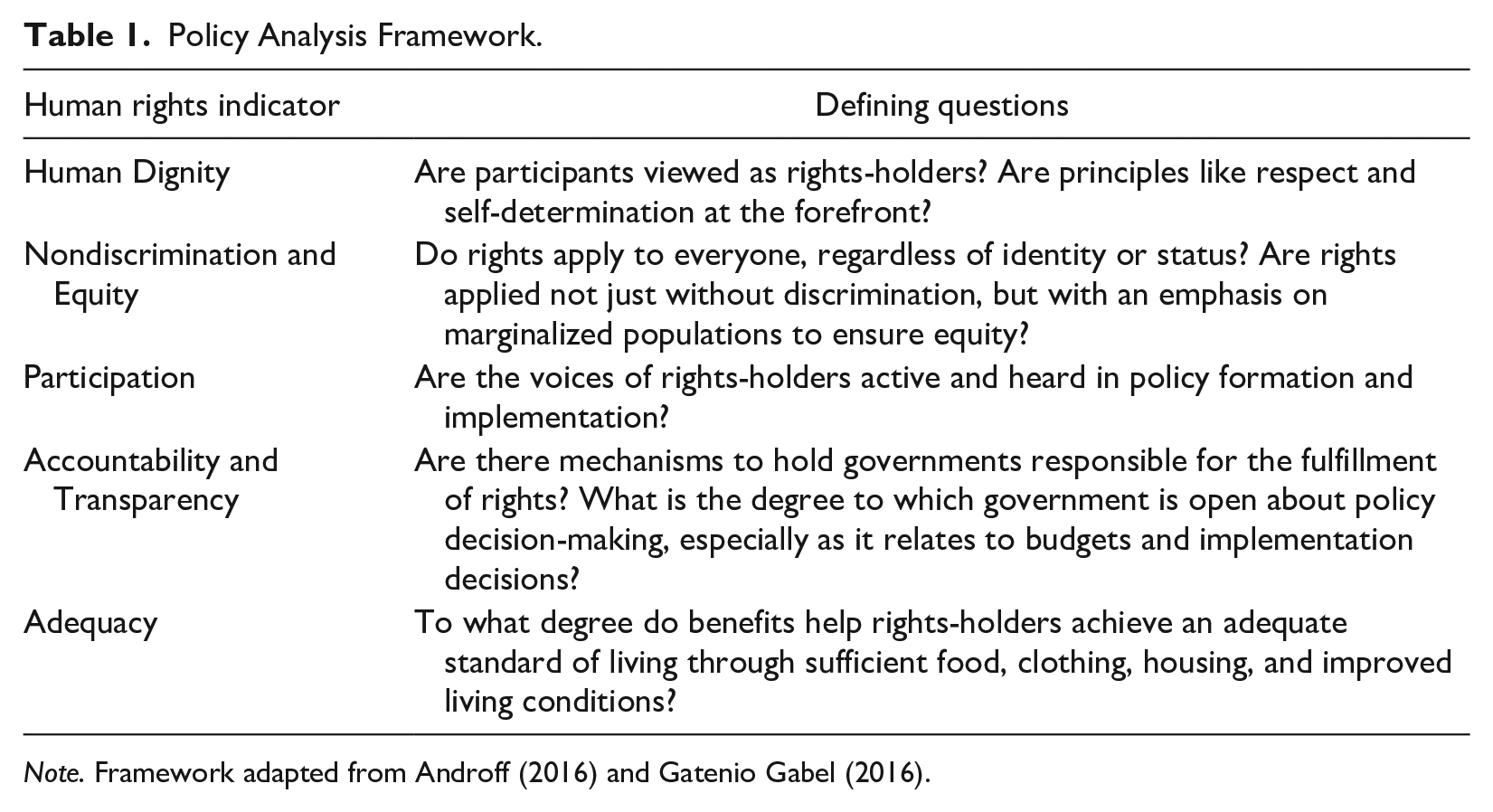
Note. Framework adapted from Androff (2016) and Gatenio Gabel (2016).
The obligation by the federal government to ensure an adequate standard of living to everyone is not being met through TANF. Under the Personal Responsibility and Work Opportunity Reconciliation Act (PRWORA), which established TANF, the goals of the program are centered on the provision of assistance to families with children, promoting work and marriage, and the reduction of “out-of-wedlock pregnancies” (Personal Responsibility and Work Opportunity Reconciliation Act of 1996, Sec. 401). PRWORA transformed the federal entitlement to cash assistance that existed under TANF’s predecessor, Aid to Families with Dependent Children (AFDC), into a time-limited benefit funded by a fixed block grant issued to states. The funding granted to each state is determined by the state’s spending levels on AFDC prior to 1996, and this calculation remains unchanged today (Congressional Research Service, 2021). States may impose benefit reductions, known as sanctions, and time limits to mandate compliance with their own TANF program rules (Center on Budget and Policy Priorities, 2021). States must also submit plans periodically to the federal government to outline how their TANF program works toward the stated goals of the policy. The federal government does not mandate that states provide a minimum set of benefits or that they serve all who fall below a certain income level (Personal Responsibility and Work Opportunity Reconciliation Act of 1996).
Since 1996, TANF has assisted fewer families in poverty with each passing year, leading to the program currently only serving an average of 23 out of every 100 families in poverty across the United States (Meyer & Floyd, 2020). Much of this program retrenchment can be attributed to restrictive policy rules that vary between states and often make the program inaccessible to those who need it (Meyer & Floyd, 2020). The variability of restrictiveness between states causes this ratio of TANF recipients to families in poverty (also known as the TANF to Poverty Ratio, or TPR) to range “from 70 in California down to just 4 in Louisiana” (Meyer & Floyd, 2020, p. 2). This has important ramifications for equity and nondiscrimination in social and economic rights fulfillment, as the state someone lives in determines their level of access to TANF benefits. A family’s state of residence also impacts their dignity through restrictive participation requirements and administrative burdens that vary by state, or what some have called “ceremonial degradation” (Gustafson, 2013).
The low TPR is concerning given that most states spend a small fraction of their TANF block grants on the core program areas of cash assistance, work supports, work activities, and child care (Center on Budget and Policy Priorities, 2022b). Connecticut, for example, spends less than five percent of its block grant on direct cash assistance (Administration for Children and Families Office of Family Assistance, 2022), and has a TPR of 27 to 100 (Meyer & Floyd, 2020). This low TPR stands in contrast to the 82 out of 100 Connecticut families in poverty who received AFDC in 1996 when PRWORA was passed (Meyer & Floyd, 2020). Because of the high level of state discretion in spending today, it is not possible to generalize about how all or most states spend their TANF money. Spending varies significantly across states, which again raises the concern of equity of social and economic rights for all citizens, regardless of geographic location.
A primary conclusion from existing research is that, because of devolution and fewer federal protections, where a person lives often determines the level of social protection available through TANF (Bruch et al., 2022). Women and children are predicted to be more economically disconnected (i.e., not receiving welfare benefits and not working) in states with shorter TANF time limits (Hetling et al., 2015). Children are more likely to face maltreatment like neglect when TANF time limits are shorter or sanctions are stricter (Maguire-Jack et al., 2021). Families in states with limited access to TANF cash assistance are also more likely to experience homelessness (Parolin, 2021).
These findings indicate that state TANF spending and implementation varies widely, and the devolved decision-making that leads to this variability creates inequality in program access and outcomes. What is less clear, however, is how state and local decision-making processes occur that lead to this variability. Some have focused on the role of frontline bureaucrats, or those who implement public policy (Gross et al., 2018; Lipsky, 2010; Pipinis, 2017), but research about the public managers who make larger program implementation decisions is scant and not specific to TANF or devolution (Jennings & Hall, 2012; Kelleher & Yackee, 2009; Stenstrom & Haycock, 2015). Thus, a focus on how states make decisions about the structure, funding, and eligibility of TANF and its impact on human rights could yield important insights into how inequality is created and perpetuated through policy implementation for this program and others.
Social policy literature rarely examines the administrative implementation decision-making related to TANF at the state level. Notable exceptions are qualitative studies about TANF implementation in Oregon (Morgen et al., 2010) and California (Lanfranconi et al., 2020). In their account of TANF implementation decisions made by state administrators in Oregon in the late 1990s, Morgen et al. (2010) focused on how administrators justified and framed their decisions but did not address in depth how and why key decisions were made. Federal reporting requirements shaped the focus of program assessments and measures of success. Administrative data collection, for example, centered on work, self-sufficiency, and fraud among TANF recipients, all requirements for federal reports. Administrators did not collect data on participant poverty rates, and distance from clients shielded administrators from the negative effects of their policy. The neoliberal politicized environment that these administrators worked in shaped their decisions, despite their claims of ideological neutrality (Morgen et al., 2010).
Through a critical discourse analysis of the TANF program in California, Lanfranconi et al. (2020) assessed whether state and county administrators center equity or equality in the program. The authors found that state-level administrators preferred an equality centered approach (i.e., same treatment) as opposed to an equity centered approach (i.e., differential treatment to correct for systemic inequality) when administering TANF in their state. While state officials acknowledged that outcomes were not equitable, attempts to address this were limited by their own definitions of and emphasis on equality in treatment (Lanfranconi et al., 2020).
The current research study builds on these findings, especially related to understanding how frames of equity, equality, and concepts of justice and human rights, may figure in implementation and outcomes and how they impact the social and economic rights of TANF recipients. The lack of clarity surrounding policy implementation decision-making at the state level has important human rights implications, specifically related to factors like participation and transparency (Androff, 2016; Gatenio Gabel, 2016). A lack of transparency about implementation decisions may prevent advocates and citizens from participating in or impacting budgeting and program decisions at the state level. The devolved model of policy implementation that leads to this lack of transparency has been addressed by human rights monitoring bodies. Both the UN Committee on the Rights of the Child (2003) and the UN Committee on the Elimination of Discrimination against Women (2010) conclude that devolved implementation of policy does not absolve federal governments of the responsibility to respect, protect, and fulfill the social and economic rights of its citizens.
Limitations of Existing Research and the Utility of a Human Rights Framework
While the body of literature outlined above provides an important foundation for future research, there are important limitations in this research. None of the recent empirical assessments of TANF address the social and economic rights of the low-income families who participate in the program. They point to important impacts on participant wellbeing as a result of how TANF is implemented but frame these impacts as unfortunate results of policy implementation, not violations of rights. Also, this research does not view TANF recipients as rights-holders entitled to specific social protections related to social security, housing, food, and health. Adopting a rights-based approach to TANF implementation can question the program norms that often go unchallenged.
The literature also lacks methodological diversity. The quantitative scholarship places TANF into a national context by comparing the structure and outcomes of different state-level implementation decisions. A program with as much variability as TANF, however, requires a deeper understanding of its implementation at a state level, including how decisions are made, and how individual state programs are structured. It can also be difficult to obtain accurate data for a program with such substantial differences between states, leading to calls for deeper investigations of individual states to understand how TANF funds are being spent (Fusaro, 2021).
Applying a human rights framework to the current state of TANF decision-making can reveal gaps in a realm of policy implementation that are underexamined. Some research has addressed the impact of these implementation decisions on human rights (Libal & Neubeck, 2013; Neubeck, 2006), but a focus on the human rights implications of the decision-making process itself can build on these findings. The findings from this study can yield important insights to guide policy makers, social work educators, and advocates working to develop a contemporary understanding of social and economic rights in a U.S. context (Albisa, 2011). By examining the role of participation, human dignity, accountability and transparency, nondiscrimination and equity, and adequacy in administrative decision-making and budgeting processes, the paper illuminates policy implementation norms that often go unquestioned.
The Connecticut Context
Connecticut is a useful case to develop an understanding of devolution and its impact on decision-making and social and economic rights because of its unique position as a progressive state that initially adopted several TANF policies associated with more conservative states. Like many states in the 1990s, Connecticut applied for a federal waiver to pilot a more restrictive form of cash welfare focused on self-sufficiency. In what would later become Temporary Family Assistance (TFA), Connecticut adapted their AFDC program in 1995 under Republican Governor Rowland by introducing a 21-month lifetime limit on assistance, a reduction in benefits if a family was already receiving housing assistance, and a limit on additional benefits a family could receive if they had more children while on the program (known as a family cap) (Cohen, 2006). They also introduced an earned income disregard for families in the program, which allowed the state to disregard additional earned income up to the federal poverty level (FPL) to allow participants to earn more income without losing benefits (Cohen, 2006). These changes also set the maximum monthly TFA benefit for a family of three at $543 in 1995 (Cohen, 2006).
When PRWORA was passed in 1996, the law included a provision to allow states to continue many of the programs designed under AFDC waivers. Connecticut elected to keep the program rules outlined above, including a 21-month time limit, with the option of 6-month extensions for certain families. Early research after the implementation of these changes highlighted Connecticut’s restrictive program when compared to other states (Simmons et al., 2001). As early as 2002, some scholars noted that devolution would impact the money allocated to TANF, specifically in Connecticut, because states were not mandated to spend their grant on assistance to poor families (Bok & Simmons, 2002).
Initially, families could qualify for unlimited extensions to the time limit based on their “barriers to work” and other circumstances. By 2003, state legislation limited families to two 6-month extensions (Cohen, 2006). The Connecticut Department of Labor created the Jobs First program in response to the work requirement portion of TANF. Unless granted an exemption from the work requirement, families were expected to participate in work activities within the first 2 years of receiving TANF assistance. Education through 2- and 4-year colleges did not qualify, meaning participants were not eligible for supports like child care and transportation assistance if enrolled in college degree programs (Cohen, 2006).
In 2019, advocates and a few legislators supported efforts to make the TFA program more generous. Several pieces of legislation were introduced from 2019 to 2023 to eliminate the family cap, expand the time limit, increase asset and income limits, and increase cash benefits. In 2021, the legislature repealed the family cap (John T. & Gorman Foundation, 2024). In 2022, they tied program eligibility and benefit amounts to the FPL, which automatically increases benefits based on inflation. Income eligibility levels were set to 55% of the FPL, and benefit levels are set to 73% of that amount (An Act Adjusting the State Budget, 2022). In 2023, the legislature also increased the earned income disregard, allowing families to stay on the program longer while earning more income, and increased the asset limit from $3,000 to $6,000. Finally, the legislature expanded the time limit from 21 to 36 months, still below the federal maximum of 60 months (An Act Concerning the State Budget, 2023). While these changes made the program slightly more generous, time limits and income eligibility levels still remain low.
Methods
The research question guiding this study is: How does the devolved TANF model and state-level decision-making impact the social and economic rights of families in poverty in Connecticut? This study was approved by the Institutional Review Board at the University of Connecticut.
Research Design
To answer the primary research question, an in-depth case study of the TANF program in Connecticut was conducted. The human rights framework outlined above guided and framed the case study. Yin (2016) notes that case studies are well-suited to answer “how” questions that seek to understand processes and decision-making. A case study adds methodological diversity to an area of inquiry that is heavily quantitative and predominantly focused on the national level (Basseches et al., 2024). Case studies can highlight important processes and mechanisms within individual states. As Basseches et al. (2024) note, “Even when policy design and policy content look similar on the surface, qualitative case studies are attuned to variation in the meaning of policy design and content choices within different state contexts” (p. 2). An in-depth case study of TANF in Connecticut develops an understanding of state-level decision-making mechanisms that shape this important welfare program.
A variety of data sources were used in this study, including interviews, archival data, and documents to “produce contextually rich and meaningful interpretation” (Padgett, 2017, p. 36). The purpose of a case study is to develop a deep understanding of a particular topic, in this instance the TANF program in the state of Connecticut, also known as TFA (Rubin & Babbie, 2016). In this case study, Connecticut was used to illustrate the impact of devolved decision-making on anti-poverty policy, making it an instrumental case study that develops an understanding of a larger concept (Stake, 1995).
The Connecticut Case
By operating a TANF program with one of the shortest time limits in the country and mostly stable benefit and eligibility thresholds for more than 25 years, Connecticut saw a drastic decline in the number of families served through the TFA program. This also led to a decrease in the share of the Connecticut TANF grant being spent on TFA cash assistance. This decline in the number of families served did not correspond to a similar decline in poverty, as evidenced by the TANF to Poverty ratio displayed in Figure 1. Figure 1 illustrates this decline in families in poverty served by TFA and the ratio of the TANF grant that was spent on TFA cash assistance.
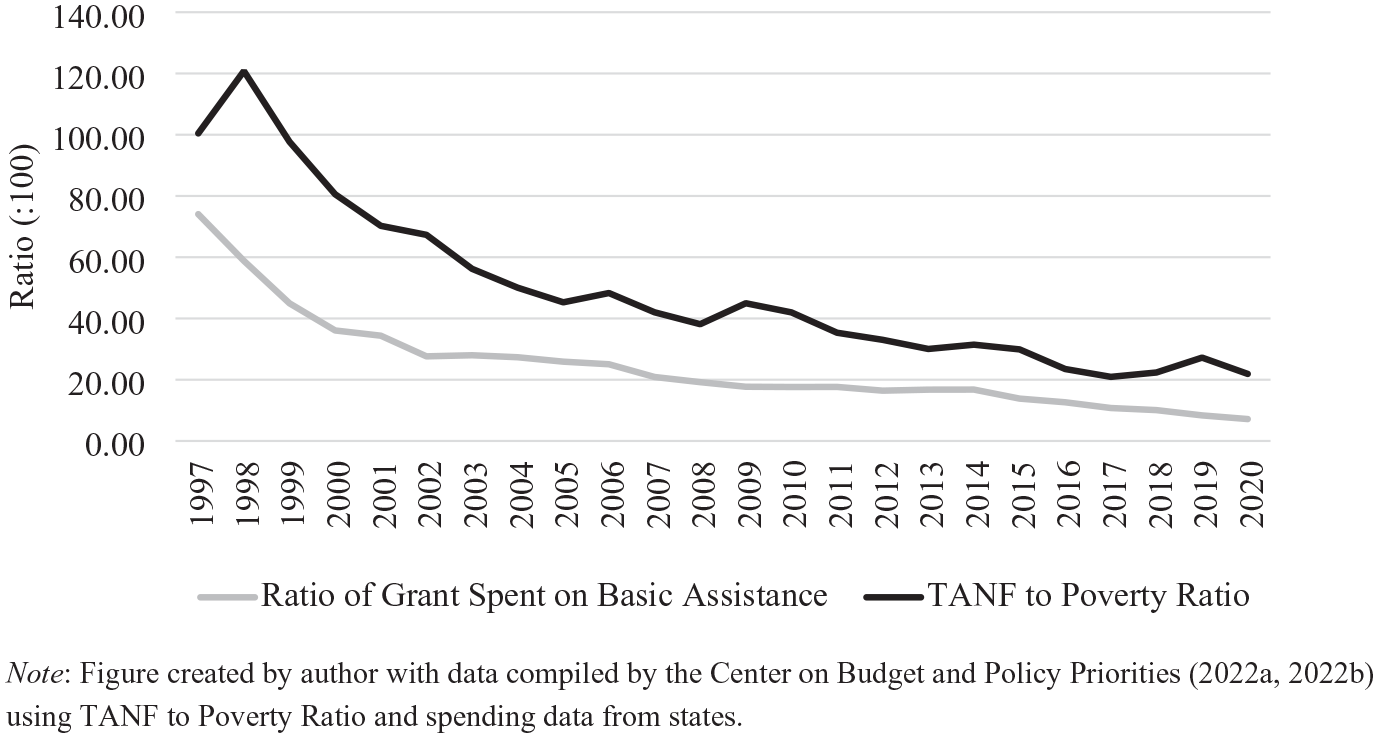
Connecticut TANF to Poverty Ratio and TFA Spending Over Time.
The restrictive implementation decisions and resulting advocacy in the last 5 years make Connecticut an important case to understand both the impact of decentralized policy implementation on social and economic rights and the efforts of advocates to advance social and economic rights through policy design and implementation.
Sample
A purposive sample was constructed using snowball sampling and key informant referrals. The study included interviews with seven current and former advocates and seven current and former executive agency administrators and legislators beginning in early 2022 and ending in mid 2023. Current and former advocates were recruited based on their work on TANF, including public statements and testimony about the program. Administrators were recruited if they were part of administering the cash assistance or work requirement portion of the program. Legislators were recruited if they displayed a specific interest in TANF, specifically in expanding or making the program more generous. Interviews were semi-structured and conducted on a videoconferencing platform for 45–90 minutes. With permission, interviews were recorded and transcribed verbatim. Demographic data were collected via a follow-up questionnaire sent to interviewees; however, due to the low response rate and small sample size, inclusion of sample demographics could compromise participant confidentiality and is therefore not included in this analysis. Conceptual areas explored in the interviews included questions related to administration of TFA as well as how policy makers and advocates conceptualized social and economic rights in TFA.
Publicly available documents and data were also an essential source of information to understand the Connecticut case. TFA budget documents from Connecticut’s Department of Social Services and the most recent state TANF plan were reviewed to understand program structure and priorities. Connecticut Department of Social Services annual reports and program expenditure data submitted to the Office of Family Assistance at the U.S. Department of Health and Human Services (HHS) were used to place Connecticut in a national context. Thirty-seven public hearing, House, and Senate transcripts from the Connecticut legislature between 2019 and 2023 and one advocacy report were included with the 14 interview transcripts in the data analyzed for key human rights indicators.
Analytic Approach
The variety of documents and data included in the case study required a holistic approach to analysis to contextualize the information within the case being studied. Documents used to understand the TFA program and place it in a national context, for example the Connecticut state TANF plan and HHS reports, were read and memoed about multiple times over the study period. Memo writing is defined as “the connective tissue binding disparate activities and helping to coalesce decisions that propel the analyses forward to conclusions. Memos inscribe thoughts, reactions, and linkages. They help crystalize inchoate hunches about what is going on in the data.” (Padgett, 2017, p. 150). The author conducted and audited all interviews and wrote memos after each interview while referring to the human rights framework. Public hearing transcripts were searched for all TFA related content, and some public hearings were also watched as they took place, and the transcripts read later. Memoing and quotation identification was done throughout this process, as well. Transcripts from interviews and public hearings were then coded deductively to identify the human rights indicators from the study framework. Through multiple rounds of memoing and deductive coding, key themes and connections to the framework were identified, and illustrative quotations were pulled out. While only one person conducted the analysis, reflexivity took place through consultation with the author’s dissertation committee chair as well as through academic conference presentations about the findings.
Results
The interviews and public hearing transcripts revealed key ideas related to the human rights indicators framing this case study. Interviews with advocates and policymakers took place between 2022 and 2023, with the legislative changes outlined above and their accompanying public hearings forming the background context for the interviews. The results below focus on this period of change in the TFA program between 2019 and 2023.
Human Dignity
The human dignity concept asks if principles like respect and self-determination are placed at the forefront of policy and program implementation. This study found that participant dignity was undermined by public officials’ reluctance to trust poor families to use cash assistance responsibly as well as through demeaning application processes. Interviews and public documents showed that the design of TANF in Connecticut undermined participants’ dignity and self-determination, especially when compared to other forms of assistance that have fewer barriers and requirements. The stringent participation requirements and short time limits of the TFA program were illustrative of an orientation by policymakers that diminished self-determination. One advocate explained,
People don’t trust poor people to know what to do with cash. And I think if you look at the last year and the advanced child tax credit and all the research that’s been done—people who get cash know what to do with it to help their families. (Advocate interview, 2022)
A legislator framed Connecticut’s restrictive TANF program as intentionally structured to deter families in poverty, saying,
It’s very deliberate that we criminalize and create barriers for poor people, which perpetuates poverty. And that’s a policy choice. That’s all policy choice. It’s not at all inevitable. We know how to do this, but could we ever see ourselves as a public saying yes, universal basic income makes sense to lift people out of poverty? That’s basically what TANF could be. Is a form of that, too. (Legislator interview, 2022)
This legislator noted that the flexibility given to states through TANF could allow Connecticut to design a more generous program that provides (increased) cash support to families in poverty, but that a lack of political will and respect for the self-determination of families in poverty by many policymakers prevents this from happening.
The reluctance, and in some cases refusal, by policymakers to prioritize respect and self-determination in policy design was also highlighted in public legislative debate about using the TANF grant to fund the Connecticut Diaper Bank in 2019. Legislators were made aware of the issue of diaper scarcity among families in poverty, and initially debated increasing the TANF cash benefit to cover the cost of diapers. During public floor debate, however, one legislator explained why this approach was abandoned: “I know the good chairwoman tried to work to get this out in TANF cards so that there would be a cash advantage for people, but we wanted accountability” (Conn. House of Representatives. House Session Transcript, May 20, 2019. Statement by Representative Case). The chair of the Human Services committee then explained that the TFA program had unspent funds totaling $12 million in 2020 and $14 million in 2021 due to declining caseloads, and that this was money they planned to use for TFA families to purchase diapers. Ultimately, however, that approach was abandoned, as she explains,
Through the talks with the Department of Social Services (DSS), DSS thought that there wouldn’t be a way for them to guarantee that that money was spent on diapers. They thought it would be more efficient to do it through the diaper bank and here we are with this bill before us. (Conn. House of Representatives. House Session Transcript, May 20, 2019. Statement by Representative Abercrombie.)
In the end, it was more acceptable for the legislature to grant money, without a bidding process, to a private organization who would then distribute diapers to families throughout the state than to give cash to families directly. During an interview, an advocate who previously worked with a national diaper advocacy organization summarized this tension between diapers as in-kind benefits versus cash assistance:
You know, there’s overwhelming evidence that shows . . . if you give people money, cash money, they know how to spend it. This is one of the reasons I left [diaper organization] is because giving diapers makes people who have diapers to give feel good. And yes, they’re useful. But they may not be exactly what the family needs, right? The family knows what things they need. I mean, there are so many things they can’t buy, you know, they don’t have cash. (Advocate interview, 2022)
Another advocate highlighted an important piece of the TFA application process as a violation of participants’ human dignity. TFA has provisions that allow exemptions from the time limit and work requirement for parents experiencing domestic violence and other “barriers to work,” like mental health diagnoses. To qualify for those exemptions, applicants must disclose many personal details to eligibility workers, case workers, and legal assistance advocates to demonstrate that they are truly experiencing these barriers. This requirement to disclose deeply sensitive information is important considering a report published by the Connecticut Legislature’s Commission on Women, Children, Seniors, Equity, and Opportunity (CWCSEO) in 2023. The report includes interviews with TFA eligible families, including this quote from a participant:
The problem that I have is just like, when you are calling them, they kind of give you an attitude and . . . they kind of belittle you because you asking for help, and you shouldn’t be belittled because you need help. You know I feel like we’re all human beings and we’re all in different stages in our lives . . . we should feel good talking to you and not feel bad. (CWCSEO, May, 2023, p. 8.)
This hostile environment can make it difficult for participants to share sensitive personal information while applying for TFA. This points to the importance of designing programs that value the human dignity of all participants without a requirement that they prove they are deserving of assistance through dehumanizing processes.
Nondiscrimination and Equity
Nondiscrimination and equity are centered on the principles that rights should apply to everyone, with a specific focus on groups that have been marginalized. The most salient violations of nondiscrimination and equity in the TANF program occur between states due to devolution, as discussed in the review of literature above. Results from this study demonstrate that inequity exists both between Connecticut and other states and within the state itself. Advocates testified that all surrounding states adopted the 60-month time limit for benefits, meaning residents of Connecticut had significantly reduced access to cash assistance when compared to their neighbors (Conn. Human Services Comm. Public Hearing, March 1, 2022). Legislators noted in interviews that it was difficult to make TANF a priority in a state with such vast income inequality. One lawmaker stated that despite representing a wealthy district, their experience working in poorer neighborhoods and commitment to advance equity made TANF a central priority. They clarified, however, that this was not the position of most legislators:
I really think starting with the underlying subconscious, basically incredibly racist, attitudes that so many of our policy makers are really just perpetuating is important to understand. I advocate for policy that impacts the most vulnerable communities . . . But I am not a policymaker that just advocates for those within their district . . . which makes it really hard for the chairs who are, you know, appointed in these powerful positions that are representing communities or that are not impacted. If you’re representing a wealthy community like mine, why would you prioritize Temporary Aid to Needy Families? So, we have to be counterintuitive as policymakers, because this strengthens the entire Connecticut community and economy . . . They just don’t understand, and they never spend any time [in these communities]. (Legislator interview, 2022)
This view may explain why TANF rules remained stable in Connecticut until the push from advocates between 2019 and 2023 to expand program access. In many wealthy areas of the state, legislators had little motivation to address a program that serves those in deep poverty. One advocate echoed this idea, stating that Connecticut “has 169 fiefdoms (towns), each with their own government” (Advocate interview, 2023). They explained that this structure undermines efforts to advance progressive legislation despite a strong Democratic majority. This fragmented structure leads to competing priorities in a state with high wealth and income inequality, making expansion of a program that serves a small fraction of those in deep poverty unlikely.
Participation
Participation asks if the voices of rights-holders are active and heard in policy formation and implementation. This study finds that the economic status of TANF participants prevented them from being able to actively participate in the policymaking process, though there was a promising initiative from administrators to meaningfully engage participants. Many interviewees also noted that there was no constituency in Connecticut to advocate for TANF because the income thresholds are so low. The number of TANF participants had declined so much that only a fraction of families in extreme poverty remained in the program, limiting its reach and its advocates. They also touched on the interconnectedness of dignity in this process, and the ethics of asking people to talk about their lowest points to convince legislators that they are deserving of assistance. An advocate explained,
Why are they not here? Well, they’re trying to get their kids to bed. They’re trying to support their families. They’re probably worried out of their minds about something. Transportation or . . . losing their job. Or can they pass this test? Or . . . I’m being kicked out. When you’re in that sort of an environment, it’s really pretty awful then to say, “and now empower yourself and come up here and tell us all all of this so that they believe you.” (Advocate interview, 2023)
One legislator echoed this idea while also noting the importance of advocacy: “And the other thing is, who is going to advocate for it? . . . Who are the advocates? . . . There are none. There are none because they’re busy surviving . . . legislators and the governor always respond to public pressure” (Legislator interview, 2022).
To address the difficulty of TFA eligible families participating in the policymaking process, advocacy organizations worked with the legislative CWCSEO to interview eligible TFA families and present their findings in a written report and through legislative testimony in 2023. During a public hearing for legislation to expand the TFA time limit, a legislator asked one of the authors of this report to discuss these findings, stating “I think it’s really important for us to understand where a lot of this information came from” (Conn. Human Services Comm. Public Hearing, February 14, 2023, Statement by Representative Johnson). The advocate highlighted several key findings:
It’s hard to actually get people to come here, because it’s a very, very difficult situation for many of them . . . Some of the top themes were that participants were actually extremely grateful for the cash assistance, extremely grateful. True gratitude . . . While the assistance was helpful and [they] appreciated the cash, it was not enough to stabilize the family and every day was a struggle . . . And they spoke very clearly about the stigma and prejudice attached to receiving TFA. Not just by others, but because of their own early experiences and societal prejudices. (Conn. Human Services Comm. Public Hearing, February 14, 2023, Statement by Elizabeth Fraser.)
This illustrates an intentional effort to highlight participant voices by advocates and some legislators, and the difficulty TANF recipients face in advocating for themselves. It also shows how participant voices require support from those in power to be heard in these settings.
While legislative participation by TANF recipients was seldom seen, a promising piece of the employment services program in Connecticut’s TANF program did prioritize participation. One administrator described a new initiative that will engage parent participants around the state to serve in an advisory capacity to the employment program, thereby shaping implementation: “So as we contemplate different policy changes, we would go to them and say, this is what we’re thinking about. Tell us if you think we’re on the right track here or are we barking up the wrong tree?” (Administrator interview, 2023). To address advocate concerns about TANF participants not having time or resources to participate, this program will compensate parents for their time and pay for child care when they meet as an advisory board, as well. This participation initiative is limited to the punitive work requirement component of TANF, however, and does not extend to cash assistance. The interviewee did note, however, that they will seek feedback to shape supports like child care and transportation for families to help them participate in the workforce.
Accountability and Transparency
The block grant structure of TANF also limits accountability and transparency on the state level. Accountability, which asks if there are mechanisms to hold governments responsible for the fulfillment of rights, and transparency, which asks if government is open about policy decision-making, are both limited by how Connecticut policymakers view and spend their TANF grant. A director of one of the TANF programs admitted that the budgeting process was unclear to them, stating “It has always seemed like kind of a much too big of a mystery to everybody. It doesn’t feel like a very transparent process” (Administrator interview, 2023). This was reflected in publicly available documents, as well. In Connecticut, there are no yearly public legislative hearings for TANF as there are for other block grants. Transparency budgeting websites for the state list the grant as “general fund” dollars without clarifying where the money is being spent (Connecticut Office of the State Comptroller, 2023). The state does have to report their spending to the federal government, but there is limited public state-level communication or authorization about where the money is being spent. Similarly, the decision-making process that determines this spending is not transparent. While the legislature must approve the final state budget, it is not presented with a specific breakdown of the TANF grant for approval (at least not in a way that is visible to the public). Furthermore, the negotiation processes on the final budget often occur on the last days of the legislative session behind closed doors. One advocate explained, “But the final [budget] resolution of it is this just black box thing that happens in the very wee hours in the morning on the last day of the session and nobody ever quite gets what happened” (Advocate interview, 2022).
Just as the process that determines TANF grant spending lacks transparency and accountability, so do the spending outcomes. The state outlines programs that receive TANF funding in its TANF plan, but the connections to the TANF goals as outlined in federal statute are weak and require little in terms of both transparency and accountability. For example, the TANF grant funds programs like the one described below under the purpose of preventing out-of-wedlock pregnancies:
The State Department of Education (SDE) funds the Leadership, Education, Athletics in Partnership (LEAP) program. This program provides neighborhood-based education and mentoring programs that match children, ages 7 to 14 from high poverty urban neighborhoods with trained high school and college student counselors, to help children develop their academic skills, self-esteem, improve their ability to succeed in school, and to be involved in their community. The children meet with their mentors after school and during the summer. There are no income guidelines for this program. (Connecticut Department of Social Services, 2023)
The TANF plan creates an impression that states like Connecticut map out their TANF grant spending for the next few years based on programs that will advance the goals of the program. In practice, however, the process occurs on the back end and is driven by state budget administrators who decide what they can charge to the TANF grant based on loose connections to program goals. As one advocate explained,
The way it works . . . it’s budgeted after the fact. We sat with a woman who was with the fiscal office, DSS, fiscal office of the state in charge of the DSS portion, and she was sort of explaining to us how it all works, which is they just sort of look at you know what they’ve spent their money on, and they look at what the TANF rules are, and they say oh, yeah, this would fit. This would fit. (Advocate interview, 2022)
This description was repeated in an interview with an administrator, who explained that DSS does have to report to the legislature how the TANF grant is being spent, but then noted:
And . . . there’s always been really a misunderstanding of how the block grant and the budget interplay. And the way that the block grant really functions . . . is . . . very different than budgeting a program specifically with TANF in mind . . . What DSS does is they look at the requirements of TFA and TANF against all of the other federal awards that they are required to submit eligible expenditures to. And they and their sister agencies, you know, DDS (Department of Developmental Services), DMHAS (Department of Mental Health and Addiction Services), OEC (Office of Early Childhood). You know, housing (Department of Housing) is definitely a lot bigger in this space than it used to be. They look across their expenses and they say, okay, based on the type of expenditure and what you are supporting . . . we can claim a TANF draw down to that award. And so that allows us to entirely draw down the federal block grant. (Administrator interview, 2023)
By claiming spending after the fact instead of designing a program that meets the core purposes of TANF, policymakers in Connecticut undermine transparency and accountability. The TANF plan requires public comment before it is finalized to ensure transparency and accountability through participation; however, this claiming and spending process seems to override any planning and accompanying public comment done through the TANF plan.
Adequacy
The adequacy indicator asks to what degree TANF benefits help participants achieve an adequate standard of living. The devolved structure of TANF has significant implications for program adequacy in Connecticut. Interviews clearly demonstrated that policymakers in the state view TANF as a revenue stream that is part of the state’s general fund, which limited advocate efforts to make the program more generous (i.e., improve adequacy). One participant, a TANF administrator in the early 2000s, described a directive by the Governor’s office to use TANF as a “revenue enhancer” to the state budget (Former administrator interview, 2022). Interviews with current administrators echo this idea, with a current administrator explaining, “You know, in many ways it gets treated like general fund dollars. So, it is just a piece of the big pot of money. Rather than necessarily being looked at as a distinct and specialized bucket” (Administrator interview, 2023). A former advocate clarified that “we were a state that didn’t really have a TANF budget. We had a state budget. And the Office of Policy and Management . . . would use the TANF money in places that was legal and appropriate” (Former advocate interview, 2022). An interview with a current administrator corroborates this view,
[What] we’ve always tried to explain to [legislators] too, is that all of the funds, general funds, federal funds, it all goes into a pot that the state can spend on covering all of its expenses, program expenses and administrative support expenses. (Administrator interview, 2023)
Policymakers in Connecticut thus view the TANF grant as money that belongs to the state and not necessarily to families in poverty. When speaking about spending on work supports for families, an administrator agreed that while the state is technically following the letter of the law, officials are not following the spirit of the law: “It’s used as like this sort of slush fund to fill these gaps in funding that agencies experience, and it’s not really used for its expressed intent” (Administrator interview, 2023).
This view of the TANF grant as general fund dollars and not specifically as money dedicated to support families in poverty limited the attempts to make the program more generous in Connecticut. One advocate described the tension as “robbing Peter to pay Paul” (Advocate interview, 2022), while an administrator explained,
So they, as a legislative branch, could make a policy decision not to support the way the state is operationalizing this block grant, but they would then have to find the resources in the budget from other pots to still pay that expense (Administrator interview, 2023).
A former advocate explained that this approach to the grant was built into its structure early in its implementation:
Some legislators would say, well, we’re hardly spending anything on cash assistance anymore because the caseload has fallen so much. So why can’t we do X for the people who are getting cash assistance? And . . . the real answer was in order to do that, you’d have to take money out of Department of Children and Families, or you’d have to take money out of some other program that you like. And eventually lots of states figured out how to do this . . . Connecticut administrators were geniuses at doing this early. (Former advocate interview, 2022)
By decoupling the TANF grant from the TANF program, administrators were able to frame caseload reductions or benefit reductions as cost savings to the state (Conn. Joint Comm. on Appropriations, Human Services Subcomm., Public Hearing, March 5, 2019). This approach made additional funding for the TANF program seem scarce or unavailable, limiting advocates’ attempts to create a program that ensures an adequate standard of living for participants.
Strengthening TANF in Connecticut
Advocates and policymakers offered several suggestions to improve the TANF program in Connecticut that has implications nationwide. Some favored a universal basic income approach as a solution to a retrenched TANF program, noting that a reduction in administrative burden and an increase in unrestricted cash can be an impactful way to aid families in poverty that values their inherent dignity. Interviewees also mentioned the expanded advance child tax credit as an example of a successful approach, both federally and at the state level. A senior administrator noted that more spending restrictions on TANF from the federal government would help ensure states spend the grant on the intended population:
And they (the federal government) should also seriously consider lightly telling the states what to do with the money . . . because . . . it’s so vague and so high level and gives states so much discretion, that there’s a temptation to be able to use it for all sorts of other things. Now, these are not bad services that are being funded. They’re all really important, valuable services. But, you know, it’s easy to take the view that it has come at the expense of the cash assistance program. (Administrator interview, 2023)
Additional federal restrictions on spending could help ensure that program benefits provide an adequate standard of living by targeting resources more directly to TANF-eligible families.
Participation in policymaking by social workers and TANF recipients was noted by a legislator as an important solution, as well:
And that’s where . . . social worker policy advocates can be so impactful because . . . we should be at the table wherever policy is being made. We see firsthand the impact . . . We should start there with resourcing the most impacted and go out from there . . . It’s a pretty simple approach to policy making. (Legislator interview, 2022)
The report of TFA participant experiences compiled by the Connecticut legislature’s Commission on Women, Children, Seniors, Equity, and Opportunity (2023) serves as a good example of this type of participation. By centering participant voice in this report, advocates brought TFA recipients directly into the policymaking process. Overall, interviewees agreed that the TANF program should have fewer administrative burdens and more generous participation requirements and benefit levels and that spending should be prioritized to serve TFA recipients.
Discussion
This study contributes to the existing policy implementation scholarship in social work by questioning dominant frames of policy and poverty centered on deservingness through a human rights-based framework. It examines how the social and economic rights of families in poverty are impacted by the devolved nature of social welfare policies. This research also has a novel focus on the decision-makers at the state level who shape social welfare policies. Existing research on the predictive factors that influence TANF policies (Bentele & Nicoli, 2012; Filindra, 2013; Fusaro, 2020, 2021; Soss et al., 2011) demonstrates that state-level factors shape the variability in these programs. The research on frontline bureaucrats who implement TANF shows that the significant discretion available to social service workers can lead to unintended consequences (Gross et al., 2018; Pipinis, 2017; Taylor et al., 2016). This study adds to this literature by examining how those state-level factors that shape this discretion operate in the case of a TANF program in one state.
The purpose of this study was to understand the social and economic rights implications of devolved policy implementation in one state-level case. The unrestricted nature of the TANF block grant has important implications for transparency, accountability, and participation, with interviewees noting that many decision-making processes related to grant spending are vague. Interviews and documents demonstrate that grant funds are used wherever budget administrators can make weak linkages to the TANF goals, without public input or accountability for those decisions. The lack of transparency in much of the decision-making process limits opportunities for accountability and participation. This case study also shows that the block granted nature of TANF diffuses program intent in Connecticut, leading to reduced program adequacy.
By viewing the TANF grant as general revenue dollars, Connecticut policymakers have reframed TANF as cash assistance to their overall state budget, rather than support for families in poverty. This use of TANF constitutes what Headworth (2024) terms preemptive stategraft, or “a variety of stategraft in which authorities bolster treasuries through unlawfully retaining resources that otherwise would have flowed to citizens.” (p. 504). While the use of TANF funds in Connecticut adheres to the letter of the law, the findings here demonstrate that they are not adhering to the spirit of the four main purposes of TANF, which also constitutes preemptive stategraft (Headworth, 2024). For example, by using TANF funds for a wide array of programs unrelated to pregnancy with no income guidelines through the Department of Education under the purpose of pregnancy prevention, Connecticut is diverting funding away from cash assistance for families in poverty, which is a core purpose of TANF.
Implications for Social Work Practice
This research can inform advocates and social work educators by generating a better understanding about how state-level officials make key decisions in this essential program. This understanding could yield more impactful advocacy strategies to make the program more supportive and generous. The findings also demonstrate the need for advocacy at the federal level to strengthen program standards across the country to ensure equity and adequacy despite implementation flexibility. The Biden Administration took steps toward this goal by issuing a proposed rule that more clearly defined the term “needy” and restricted the range of activities states can fund with their TANF grants (Strengthening Temporary Assistance, 2023).The issuing of this rule appears to support this idea that states were not spending their TANF grants in accordance with the spirit of the law. The justification for issuing this proposed rule indicated that Connecticut is not alone in its diversion of grant funds away from the core purposes of TANF:
Instead of a focus on cash assistance, work, and critical work supports like child care, states are spending TANF and MOE funds on a wide range of benefits and services, including some with tenuous connections to a TANF purpose and, in some instances, providing supports for families with incomes up to 400 percent of the federal poverty guidelines. (Strengthening Temporary Assistance, p. 67699, 2023)
The important step of issuing this rule to ensure states were spending their grants appropriately should be met with additional improvements to the program to ensure an adequate set of benefits to all who qualify for TANF with less punitive participation requirements. The Biden Administration ultimately withdrew this rule without implementing it before the Trump Administration took office (Strengthening Temporary Assistance, 2023)
This case study highlights the importance of including participant voice in the shaping and implementation of policy. At the micro level, findings related to participation indicate that there is room for case-level advocacy on behalf of clients to ensure their voices are heard by policymakers. Micro-level social workers should use their practice experience to inform crucial policy changes to TANF at the state and federal level. Micro-level practitioners can also use these human rights-based principles to guide their practice, especially if their work is centered on benefits eligibility determination and administration. Participants highlighted the need for a cash assistance program that reduces administrative burdens and values the human dignity of families in poverty. Unrestricted cash grants to families in poverty were named as a better alternative to the existing punitive structure of TANF, which all social workers can advocate for.
Findings from this study related to adequacy have important implications for larger efforts to turn programs like SNAP and Medicaid into block grants (Republican Study Committee, 2024). Both programs serve as vital supports to families in poverty, even more so after TANF replaced AFDC (Parolin & Luigjes, 2019). Connecticut’s view of TANF as a “revenue enhancer” would likely be adopted in Medicaid and SNAP block grants, as well, leading to program retrenchment and increased inequality. In addition, that Connecticut policymakers were some of the first in the country to adopt TANF as a revenue stream leads to questions about how policymakers in other states view their grant and how it shapes the program’s adequacy. Additional case studies of more states are needed to understand how this framing operates across states and how it impacts families in poverty.
Limitations
The role of the researcher in qualitative work and the accompanying potential of bias can be considered a limitation to this study methodology. The presence of the researcher in interviews, for example, may have influenced participant responses and their willingness to disclose information about TFA decision-making in Connecticut. The human rights-based orientation of this study also explicitly connects it to a framework that centers a rights-based approach, which narrows the lens of analysis. Several steps were taken, however, to mitigate bias in this work to the extent possible. Reflexivity was a key component of this study, with analytic memoing used throughout to document assumptions and interpretations. In addition, consultation with mentors and other scholars through conference presentations provided external feedback. The use of multiple sources of data in the form of interviews, public documents, and public hearings also increased the rigor of the results.
As a case study of TANF implementation in Connecticut, the findings of this study will be limited in their generalizability to other states. Generalizability to other populations, however, is not the intent of this methodology, and this research builds on the knowledge base of public policy implementation through a deeper understanding of how policy devolution impacts social and economic rights. Future research can build upon this case study by investigating these decision-making processes using a human rights framework across different states. The interview sample size is relatively small, which could limit the depth of the case study. The population this work drew from for the sample, however, is also small, so there were a limited number of people available to recruit as interviewees. This was also why publicly available documents and data were used to augment interview data.
Conclusion
The human rights framework used in this study highlights the importance of including indicators like human dignity, nondiscrimination and equity, participation, transparency and accountability, and adequacy in devolved social welfare programs like TANF. Findings show that the program design and requirements of Connecticut’s TFA program undermine the dignity of participants. Policymakers demonstrated a mistrust of poor families’ ability to use direct support in ways they would deem appropriate, leading to a reluctance to provide cash assistance. The program structure also required the disclosure of sensitive personal information to deem a person “worthy” of an exemption from work obligations, which violated their human dignity. Advocates noted that families in Connecticut had less access to cash assistance than those in neighboring states, creating inequity. The broad wealth and income inequality within Connecticut made it difficult to make a program like TFA a priority, since it served such a small portion of families in deep poverty. In terms of participation, TFA families were rarely heard in policymaking spaces. There was a promising initiative through the work requirement portion of the program, however, to include TFA participants as advisors who are compensated for their time to help shape the program. The budgeting and spending process for the TANF grant lacked transparency, which in turn limited accountability. The TANF grant in Connecticut was spent by looking at all social services and related spending and loosely connecting those programs to the core TANF goals to justify using TANF dollars for those expenses. This back-end spending limited public participation in defining spending priorities and lacked transparency. Finally, the framing of the TANF block grant in Connecticut restricted the adequacy of benefits in the program. Policymakers viewed the grant as part of the state’s overall general revenue, which limited advocates’ ability to expand benefits and eligibility.
The utility and value of a human rights-based framework is demonstrated in the nuanced results presented in this paper. By assessing the role of devolved decision-making on human rights principles, this work builds a holistic understanding of policy devolution. While inequity has been noted as a consequence of devolved implementation (Bruch et al., 2018), principles like transparency, dignity, participation, and especially adequacy, remain largely unexamined. These principles build on important prior work that investigate the impact of devolution on the reach of TANF or spending on cash assistance (Center on Budget and Policy Priorities, 2022a, 2022b) by offering guideposts for improvements. Increasing participation in policymaking, for example, could lead to a more responsive program that recognizes the dignity of its participants. This research also suggests a need to understand more deeply how devolved policy impacts these principles for families across the entire United States. Ultimately, by emphasizing these principles, this analysis underscores the potential of a human rights-based framework to inform more equitable and effective policy implementation in social welfare programs like TANF.
Footnotes
Acknowledgements
The author thanks Drs. Kathryn Libal, Scott Harding, and Amanda Sheely for their valuable and constructive feedback on this manuscript.
Disposition editor: Cristina Mogro-Wilson
Declaration of Conflicting Interests
The author(s) declared no potential conflicts of interest with respect to the research, authorship, and/or publication of this article.
Funding
The author(s) disclosed receipt of the following financial support for the research, authorship, and/or publication of this article: This work was supported by the Gladstein Family Human Rights Institute at the University of Connecticut and the Social and Economic Rights Associates (SERA).
