




Abstract
The transition to school is challenging for families of children with autism, especially in the context of socioemotional and behavioral challenges. This study focuses on the needs of 64 parents of children with autism in Montreal during the transition from early behavioral services to school through the lens of the family needs assessment model. The research team collected data on family needs and socio-behavioral profiles at two critical periods during the school transition: the beginning and end of the first school year in kindergarten. Results indicated that the support needs expressed by parents to facilitate their child’s school transition are evolving and time-sensitive, particularly concerning children’s complex needs, education, and disability-related services, with family needs decreasing over the course of the year. The study underscores the necessity for diverse support throughout the transition period.
School entry is a critical period for all families. It can be especially challenging for those with children who have special educational and social needs, such as those on the autism spectrum (Girard et al., 2019). Indeed, the transition to kindergarten can be particularly demanding for children with autism, as it introduces increased social demands on one hand and developmental (or curricular) expectations on the other (Gaspar & Jahromi, 2024). The complex nature of communication and interaction in children with autism may lead to difficulties in forming friendships, experiences of peer rejection, and a heightened risk of emotional and behavioral issues (Kasari et al., 2016; Rotheram-Fuller et al., 2010). While numerous studies have highlighted that many young children with autism demonstrate notable skills in areas related to academic performance and the demands of the school curriculum (Courchesne et al., 2016; Samson et al., 2012), it is also recognized that specialized support measures and interventions are often needed, particularly at the onset of school (Hamrick et al., 2021; Jellinek et al., 2023). Consequently, systematic interventions to enhance preacademic and social skills are recommended throughout each stage of the school transition (Dockett & Perry, 2002; Fleury et al., 2014). Specifically, early behavioral interventions (EBIs) before kindergarten that target these skills and consistent support at the start of school and throughout schooling are often crucial and requested by parents, for better academic and educational success for these students (Nuske et al., 2019).
Parents of children with autism describe the school transition as a significant milestone in their family’s journey, characterized by a collection of excitement, apprehension, and considerable effort to ensure their child receives the necessary support for a smooth transition (N. Chen et al., 2020). Multiple studies have shown that parents report positive experiences and perceive EBI programs as highly effective and valuable (Rivard et al., 2017; Rivard, Millau, Mello, et al., 2021). However, the abrupt cessation of these services upon entering school is perceived as hindering their children’s developmental progress. In addition, this period can be particularly challenging for them, as they have to adapt to major discontinuities associated with changes in specialized services (one adult and one child versus a collective setting), new educational programs (individualized development-based curriculum versus preacademic goals), and different models of collaboration with providers (family-centered versus school centered approach; Camard et al., 2020; Chatenoud et al., 2019; Fontil et al., 2020). Consequently, the family’s needs—such as support related to their child’s diagnosis and the family’s quality of life—change when transitioning to school (Alberque & Matthews, 2024). Studies show that parents of children with autism often experience significant dissatisfaction during this transition, particularly in addressing educational and social needs and in their interactions with professionals (Boucher & Des Rivières-Pigeon, 2023; Fahmi & Poirier, 2020). For example, parents report limited opportunities for involvement in their child’s Individual Education Plans (IEPs; Janus et al., 2008; Nuske et al., 2019). They also emphasize a lack of collaboration between early intervention services and school professionals, which results in insufficient information and discontinuous support for their child’s behavioral and socioemotional challenges as they transition from early intervention to school (Boucher-Gagnon & Des Rivières-Pigeon, 2016). This situation often involves a shift in the type of parental involvement, necessitating support to assist both the child and the family in maintaining balance during this transition, which can imply parents’ receiving help while advocating for school placement options, interventions, and support services (Fontil et al., 2020). However, the scientific literature lacks a focus on the specific support needs of parents in their educational role and the broader needs of families during this period (Bérubé et al., 2018).
To better document the needs of families of children diagnosed with autism during this crucial transition from EBI services to school, the present study examines the needs perceived by parents at two critical points in this transition: (a) at the end of EBI services and the entry into kindergarten and (b) at the end of the first year of schooling (kindergarten). This goal was achieved by using a scientifically validated, structured model of family needs (International Family Needs Assessment Team, 2013), a theoretical framework, and a consistent tool that has been validated in numerous studies across different populations of families. Furthermore, we aimed to explore whether parents’ perceived family needs were associated with child characteristics and school placement—whether in a mainstream or self-contained class, given that in Quebec (the Canadian province where this study has been conducted), as in other regions, each educational setting provides different opportunities for socialization and specialized support (Boucher-Gagnon & Des Rivières-Pigeon, 2016; Camard et al., 2020). In this sense, mainstream classrooms allow children with autism to learn alongside typically developing peers, promoting a sense of belonging and providing opportunities for social interaction. However, this setting can also present challenges due to the diverse needs of students and the need for high-quality professional, tailored, and specialized support (Garbacz et al., 2016). In contrast, self-contained classrooms are explicitly designed for students with special needs, providing a more structured environment, small class groups, and easier individualized attention and support, which may benefit children requiring more intensive interventions. However, it can also limit opportunities for social interaction with typically developing peers, potentially affecting the development of social skills and social competency (Fahmi & Poirier, 2020; Larcombe et al., 2019).
Family Needs During School Transition
Research highlights various challenges parents face as they seek support to maintain family balance in daily life while acquiring their own adaptability and competencies (Girard et al., 2019; Marsh et al., 2017), especially when their children demonstrate challenging behavior (Mestari et al., 2024). In addition to enhancing skills to support their child’s development in partnership with early intervention professionals (Villeneuve et al., 2014), many parents experience social isolation and distance from their usual support networks, such as friends or neighbors (Cappe et al., 2012). They also encounter difficulties participating in family leisure activities (Dionne et al., 2016) and have limited access to specialized support services (Rivard, Mello, et al., 2020). Furthermore, some parents face financial challenges, as maintaining financial stability can become more complex when a child requires specialized services that are often subject to long wait times in the public health system (Järbrink, 2007; Sharpe & Baker, 2007).
In Quebec, when a child can benefit from EBI services before starting school, public health and social agencies encourage parents to engage in partnership with a therapist, who typically provides 20 hours of family-focused intervention in the natural environment of the child (i.e., at home, in daycare; see MSSS; Ministère de la santé et des services sociaux (2003) for a more detailed description of EBI as offered in public services in Quebec). Parents who access EBI services then actively participate in their child’s educational plan, which is typically reviewed with the parent and updated bi-monthly. However, it’s important to point out that waiting lists for EBI services in Quebec currently average 2 years, necessitating sometimes adjustments in the number of hours of intervention delivered. As a result, families sometimes receive less than 20 hours (Rivard, Mello, et al., 2020).
Nevertheless, the collaborative decision-making process regarding the child’s educational plan and the type of intervention and support offered differ significantly between EBI and school settings, inevitably leading to significant changes for families (Gaspar & Jahromi, 2024). Families must adapt to a different educational approach based on the school curriculum, with objectives focused more on preacademics and less on developmental and social learning, as in EBI services offered during preschool. School curriculum involves group learning that is often less individualized and takes place in a collective educational environment less tailored to an individual child’s needs (Boucher-Gagnon & Des Rivières-Pigeon, 2016). Parents must also adjust to a new mode of collaboration with professionals, which requires support to navigate and understand the new educational cultures and practices (Fontil & Petrakos, 2015; Gaspar & Jahromi, 2024; Nuske et al., 2019).
These changes impact parents’ adaptability, stress levels, and demands for support and services to cope to the reality of the new educational system (Rivard, Magnan, et al., 2020). The manifestation of family needs during this period also appears to stem from the lack of continuity between specialized services provided before and after school, as well as an autism service trajectory that seems less well-defined in the school setting compared to the preschool period (Gaspar & Jahromi, 2024; Mahurin-Smith, 2022). There are few clear guidelines regarding interventions to be implemented at school (for example, quantity and intensity of disability-related specialized services), leading to significant variability in educational practices (Fahmi & Poirier, 2020). Furthermore, parents do not often feel well-informed about how services are generally set up at school to meet their child’s needs, and this lack of information and communication is described by parents as an obstacle to a successful transition (Alsem et al., 2016; J. Chen et al., 2019; Sands & Meadan, 2024). Many families have expressed their frustration with the lack of transparency in their child’s school placement selection process, whether in a regular class, a specialized class, or a specialized school (Lilley, 2014; Segall & Campbell, 2014). Obtaining this type of information often requires considerable effort on the part of the families, sometimes using advocacy methods to defend their children’s rights (Chatenoud et al., 2019; Thommen et al., 2009).
The Family Needs Assessment Model
Several definitions and assessment tools for family needs exist in the early education literature (e.g., the Parent Needs Survey (Seligman & Darling, 1989), the Family Needs Survey (Bailey & Simeonsson, 1988), the Family Resource Scale (FRS; Dunst & Leet, 1987), and the Family Needs Questionnaire (FNQ; Siklos & Kerns, 2006). These tools share the common denominator that family needs encompass not only the child or the parents individually but the family as a whole and address various needs. Thus, according to this perspective, defining the needs of families with children with autism requires documenting parents’ multiple daily responsibilities in promoting the growth, well-being, and balance of each family member across different life stages, including early childhood, childhood, adolescence, and beyond (Rivard, Millau, & Chatenoud, 2021).
The International Family Needs Assessment is based on Turnbull and colleagues’ (1984) family systems model, which has been used for nearly 40 years. The International Family Needs Assessment has been administered in five countries—Taiwan, China, Turkey, Spain, and the United States—and has revealed striking similarities in family needs that are contextually related to family characteristics and life cycle (International Family Needs Assessment Team, 2013). Family needs in this model encompass various aspects such as physical and emotional health (including self-esteem and stress management), daily care (such as hygiene and sleep), social relationships, recreational activities, and financial stability (Chatenoud et al., 2014). Scientific research has validated these needs, including education, access to specialized services like speech therapy, audiology, and occupational therapy, and inclusive educational settings (Chiu et al., 2013). As the first step exploring family needs during the transition from early intervention services to school, this tool is particularly relevant for understanding family needs during the transition for children with autism because of its comprehensiveness. It is designed not only for research but also to facilitate collaborative reflection with professionals and among professionals, enabling concrete actions oriented toward addressing forthcoming needs (over the next six months) while considering each family member.
Study Objectives
The general goal of this study was to use the Family Needs Assessment Framework to longitudinally document the family needs of parents of children with autism during the transition from early intervention to school in Montreal, Quebec, Canada. Specifically, the objectives of this study were to: (a) describe family’s needs as perceived by parents at the beginning and end of their child’s first school year in kindergarten; (b) compare these needs according to the type of educational placement of the child (general education or self-contained classroom); and (c) document the relationship between the family needs expressed during their child’s transition and their socio-behavioral profile at school entry, while considering the type of placement.
Method
This study was part of a larger research project designed to document the systematic evaluation of parents’ perspectives on the quality of autism services during the transition to kindergarten, using a repeated-measures design (for more details, see Rivard et al., 2024), and to develop tools to support parents in sharing their perspectives and shaping research and services. The following section provides information about participants, instruments, data collection, and analyses. The protocol was approved by the institutional review boards of the university and three public health and social services agencies in the province of Quebec.
Participants
In the present study, 64 parents of children diagnosed with autism, as confirmed by a multidisciplinary evaluation team at a children’s hospital or an evaluation clinic, participated in the research. Parents were recruited between August 2018 and August 2020. More specifically, 14 families had both parents respond, four families had only the father respond, and 32 families had only the mother respond (46 mothers, 18 fathers).
To be eligible for this study, parents had to speak either French or English and have a child diagnosed with autism at a specialized children’s hospital or evaluation clinic. In addition, their child had to have received EBI services from a public regional health and social service agency for at least a year and must have started school (kindergarten, first year of education in Quebec) for at least 1 month. In Quebec, public health and social agencies provide 20 hours of weekly EBI services to children under the age of six diagnosed with autism. However, not all children receive 20 hours per week due to limited resources and long waiting lists. In this study, children were selected based on receiving a minimum of 10 hours of EBI per week (33 children received 20 hours per week, while others received between 10 and 19 hours per week). For all families, EBI was delivered in the child’s daycare or preschool setting. A special education technician, supervised by a clinician with a master’s degree in psychoeducation/doctorate in psychology, delivered these services (Ministère de la santé et des services sociaux, 2003).
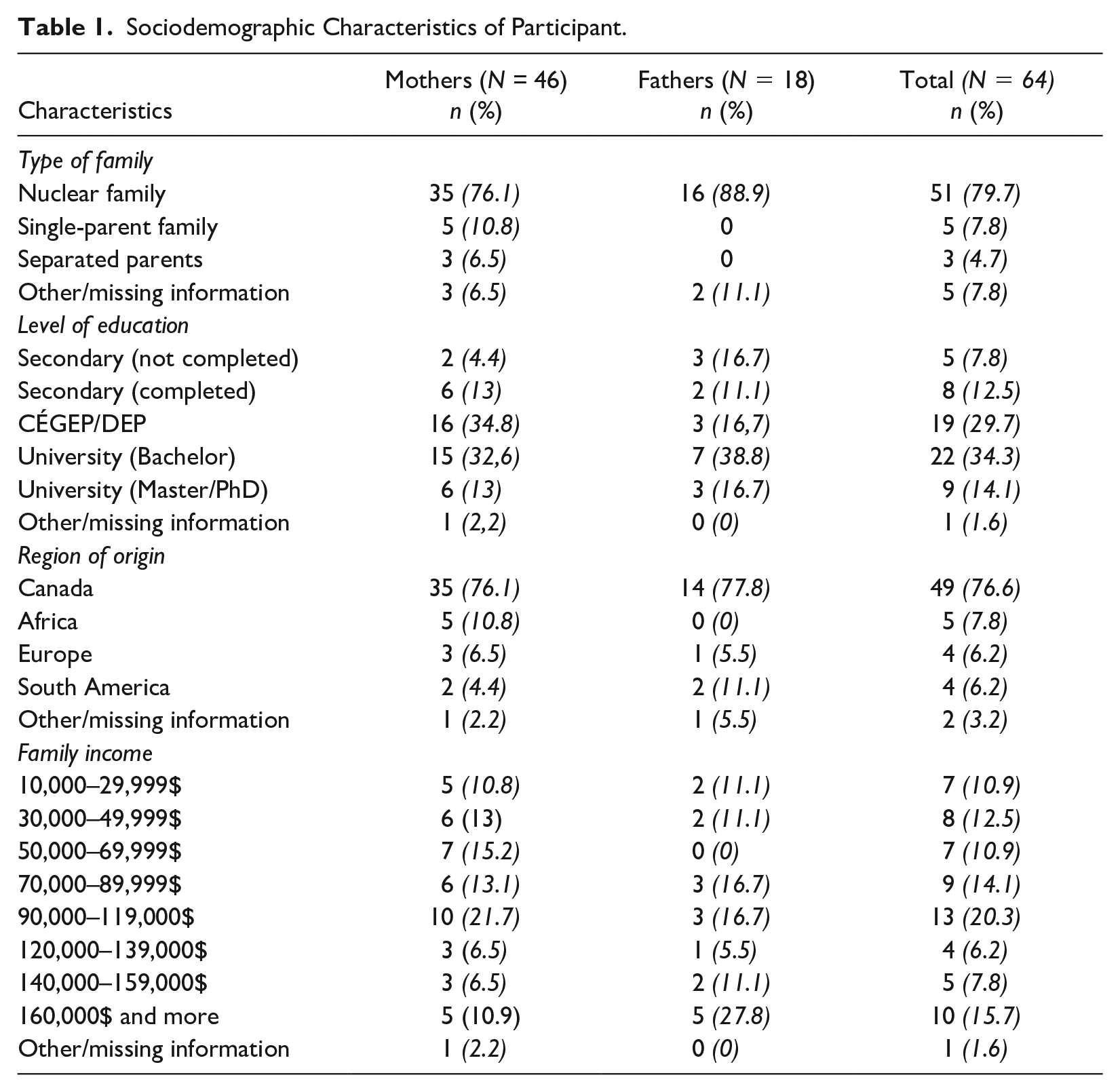
The vast majority of families participating in the study were nuclear families (76.1%), originally from Canada (76.6%), and had either a college diploma (29.7%) or a bachelor’s degree (34.3%). Household income ranged from $30,000 or less (10.9%) to $160,000 or more (15.7%). Table 1 provides additional sociodemographic information on these families.
Sociodemographic Characteristics of Participant.
Instruments
To achieve the study’s objectives, participants completed three distinct questionnaires. In families where both parents participated in the study, each parent independently completed their questionnaires.
Sociodemographic Questionnaire
The families completed a sociodemographic questionnaire in which they provided information regarding their children (diagnosis, comorbid conditions, etc.), the services received throughout their transition to school (e.g., types of early childhood services, types of services received in kindergarten), and details about their own family (parental employment, household income, country of origin, number of siblings, etc.).
The Developmental Behavior Checklist
We used the French and English versions of the Developmental Behavior Checklist (DBC) to assess behavioral and emotional problems observed in children and adolescents with developmental disorders, as perceived by their parents (Einfeld & Tonge, 1995). The DBC for ages 4 to 18 consists of 96 items categorized into six domains: (a) disruptive behavior, (b) self-absorbed behavior, (c) communication disturbance, (d) anxiety, (e) social relating, and (f) antisocial behavior. Parents were asked to indicate the extent to which each statement reflected their child’s behavior over the past 2 months using a Likert-type scale ranging from 0 (not true as far as they know) to 3 (very often or always true). Possible scores range from 0 to 288, with higher scores indicating more pronounced emotional and behavioral difficulties. The tool demonstrates satisfactory internal consistency, with a Cronbach’s alpha of 0.941 (Einfeld & Tonge, 1995).
The Family Needs Assessment
The FNA questionnaire comprises 77 items divided into 11 subscales addressing various aspects of family functioning, including: (a) health (e.g., ensuring education conducive to children’s progress, providing adequate support during leisure and vacations, accessing essential medical services such as speech therapy, physiotherapy), (b) daily care (e.g., washing, brushing teeth, dressing, eating, going to the toilet, accessing child care, having adequate transportation), (c) recreational and leisure activities (e.g., participating in various activities both within and outside the community, including family vacations and relaxing at home), (d) social relationships (e.g., facilitating social interactions, promoting friendships, knowing how to respond to questions about ASD), (e) transitions across life stages (e.g., professional support at the time of diagnosis, planning life transitions, developing long-term goals), (f) education (e.g., facilitating family members’ development by collaborating on learning objectives, tracking progress, and teaching a variety of skills), (g) access to social, educational, and health services (e.g., accessing services that promote development, adequate support for leisure activities, specialized services, and maintaining partnerships and trust with professionals), (h) family interaction (e.g., fostering relationships that help understand each member’s strengths and needs, promoting open communication to share feelings and challenges, solving problems together, adapting to, and ensuring inclusion of all members in family activities), (i) emotional well-being and self-esteem (e.g., managing stress, having hope for the future, promoting self-esteem for each family member), (j) values, spirituality, and religion (e.g., transmitting religious or spiritual values or beliefs to family members, understanding family challenges through these values), and (k) economics and finances (e.g., meeting basic needs, covering costs for therapies, leisure activities, specialized materials, saving for the future). Total scores can be calculated for each subscale or the entire questionnaire, with higher scores indicating greater support needs. Needs are rated on a Likert-type scale from 1 (no need) to 5 (very great need), providing health professionals with information on parental priorities. The FNA demonstrates excellent psychometric properties, with internal consistency ranging from 0.85 to 0.97 for the subscales and high overall internal consistency for the entire assessment (Cronbach’s alpha > 0.80; Chiu et al., 2013).
Procedure
Recruitment of participants was conducted with the assistance of administrators from the three participating public EBI providers. The initial contact was made with families who met the established inclusion criteria, namely, a diagnosis of autism and receipt of EBI services for a minimum of 1 year. Following this initial contact, the research team proceeded to obtain consent from these families to participate in the study. The families who had consented to participate were subsequently contacted by research assistants (seven undergraduate students and 10 doctoral students), who presented the project, elucidated the particulars of potential participation, clarified the consent form, discussed confidentiality aspects, responded to parental inquiries, and scheduled a preliminary interview. They also scheduled the initial interview either in person or online. Subsequently, participants engaged in two distinct interviews, with an 8-month interval between them. The first interview (T1) took place 2 months after the child started kindergarten between October and November (consequently after the cessation of EBI in August). The second interview (T2) took place during the last trimester of the school year (between May and June). All participants completed the same questionnaires at both time points, in discussion and assisted by researcher, with the exception of the sociodemographic questionnaire, which was only completed during the initial interview. Also, when both parents of the same child participated (n = 14), each completed the questionnaire independently, providing their own perspective.
Data Analysis
To achieve the first objective, we employed paired-sample t-tests. These analyses were used to detect significant differences between the two measurement points (T1 and T2) regarding family needs for all participants. For the second objective, independent-sample t-tests were performed. These analyses allowed us to compare the family needs expressed by parents based on the type of schooling provided (regular class versus specialized class/school) at T1 and T2, as well as to evaluate the differences between T1 and T2. Regarding the third objective, correlations were employed to examine the relationships between the expressed family needs and the children’s socio-behavioral profiles. Furthermore, a logistic regression was conducted to determine whether the family’s expressed needs and the children’s behavioral patterns could predict school placement. This logistic regression model was conducted with both the DBC and FNA total scores entered as independent variables to predict the probability of being in a specialized class (dependent variable) at Time 1. Both predictors were included in the same model to assess their unique contributions while accounting for shared variance. All these analyses were performed using the JASP software (JASP Team, 2023).
Results
Expression of Needs at the Beginning and Mid-School Year
The results of the paired-sample t-tests, which were conducted to compare the measurements taken at T1 and T2 for all 64 participants, regardless of whether they were in a mainstream or self-contained class, are presented in Table 2.
Differences in the Needs of 64 Parents Between Two Measurement Times for the Subscales of the Family Needs Assessment.
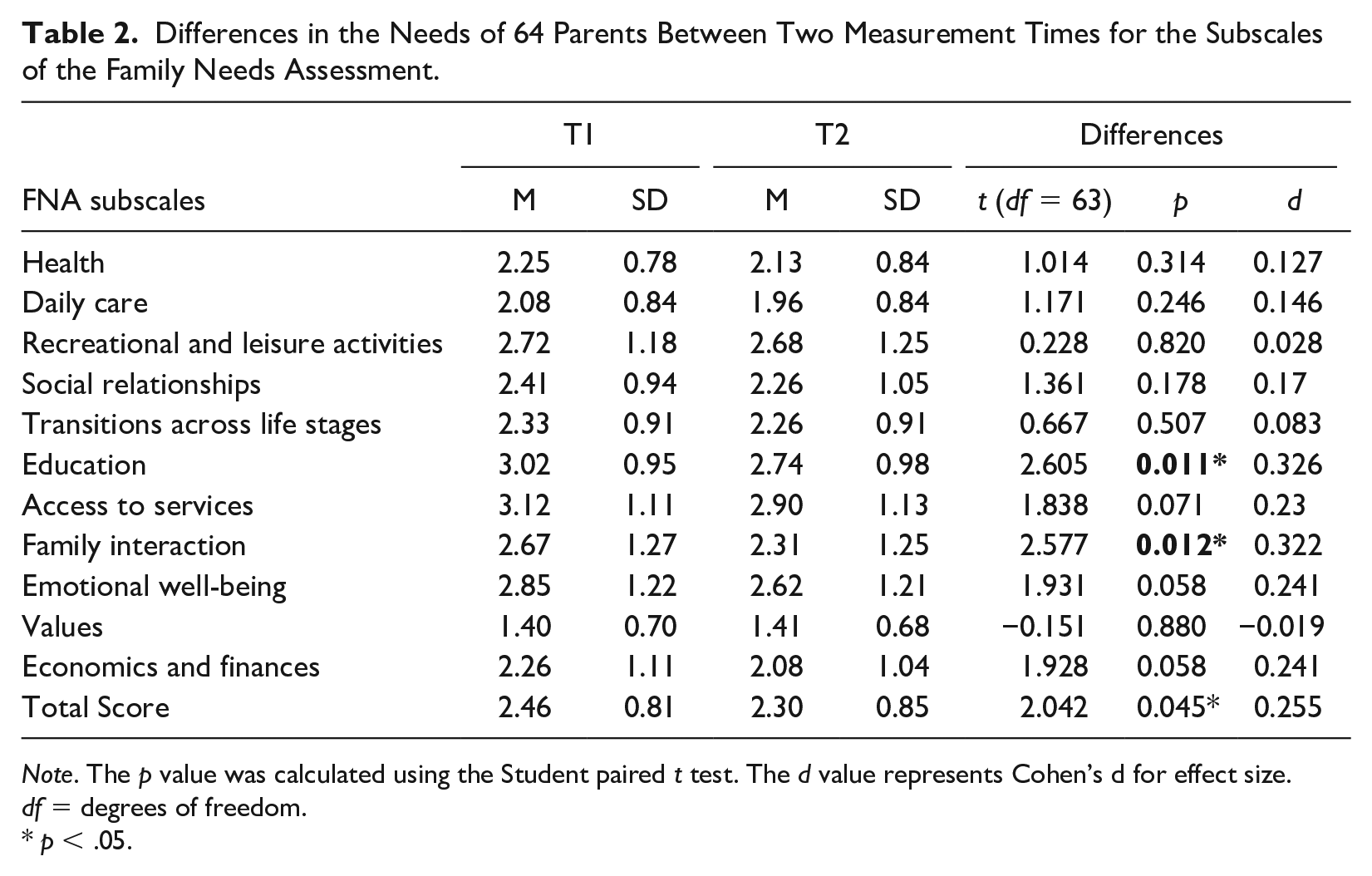
Note. The p value was calculated using the Student paired t test. The d value represents Cohen’s d for effect size. df = degrees of freedom.
p < .05.
The results demonstrate that, at both time points, the most frequently expressed family needs (as indicated by higher scores) were related to education. These needs included, for instance, the desire for assistance in setting and achieving goals for the child, the experience of educational success, the observation of the child’s progress, and the development of skills and abilities in various developmental areas. Furthermore, families expressed a need for the provision of disability-related specialized services, including access to social, educational, and health services. They also emphasized the importance of establishing a collaborative relationship with professionals from these services to facilitate their child’s development.
Conversely, parents indicated a reduced need for assistance in providing home care, including support with daily routines or medication management, and the management of daily life challenges. Similarly, they indicated a reduction in the number of needs related to values and spirituality, including those associated with religion or spiritual beliefs, as well as health-related needs, such as medical care and balanced lifestyles, at both T1 and T2.
The data also indicated a notable decline in the overall FNA score over time, with a higher score denoting more pronounced and substantial needs. While the needs expressed by families are lower at the end of the academic year (M = 2.30, SD = 0.85) compared to the beginning (M = 2.46, SD = 0.81), it is essential to acknowledge the relatively large standard deviations in both groups. This overlap in scores suggests that, while there is a statistically significant decline (t = 2.042, p = .045), the effect may not be as pronounced when considering the variability within each group. The findings revealed a significant decrease in educational needs between the beginning (M = 3.02, SD = 0.95) and the end of the academic year (M = 2.74, SD = 0.98; t = 2.605, p = .011). Similarly, a significant reduction in family interaction needs—including the desire for harmony among family members and stronger emotional bonds—was observed between the beginning (M = 2.67, SD = 1.27) and the end of the school year (M = 2.31, SD = 1.25; t = 2.577, p = .012).
Differential Needs Based on Educational Placement for Children
Table 3 presents the results at T1 and T2 for participants’ total FNA scores and the different subscales, distinguishing between regular and self-contained or classes dedicated to children with ASD. The findings demonstrate that the needs articulated by families of children enrolled in specialized classes consistently exceeded those expressed by parents of children in regular classes at both time points.
Results for the Family Needs Assessment Subscales and Total Score at T1. T2. and T1-T2 Differences for Participants in Regular Classes and Specialized Classes.
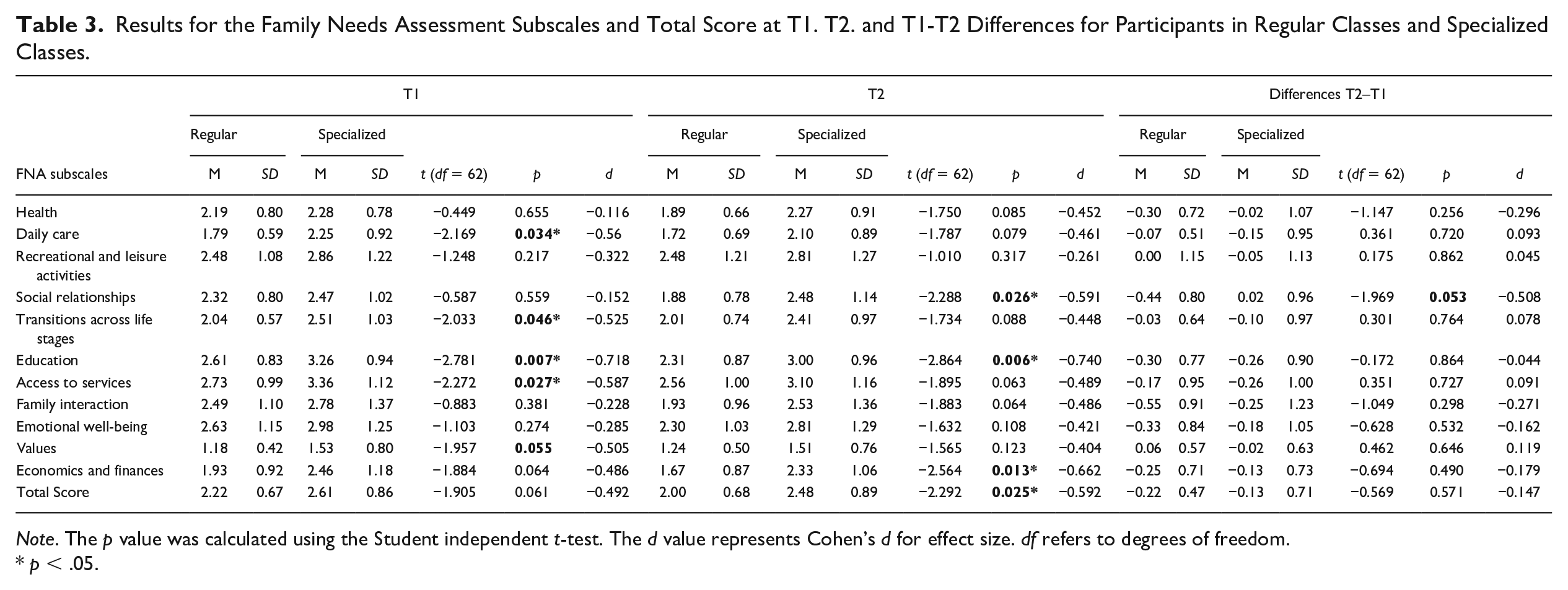
Note. The p value was calculated using the Student independent t-test. The d value represents Cohen’s d for effect size. df refers to degrees of freedom.
p < .05.
In particular, at the initial measurement (T1), parents of children in self-contained classes indicated higher needs in some subscales, than those with children in regular classes, with statistically significant differences observed in several areas, including needs related to daily care (t(62) = −2.169, p = .034), needs related to life transitions or preparation for subsequent family cycle stages (t(62) = −2.003, p = .046), educational needs (t(62) = −2.781, p = .007), and needs related to services (t(62) = −2.272, p = .027). These differences are not reflected in the global FNA scores, as there is no statistically significant difference between the two types of educational placements at the beginning of the school year (T1).
At the time of the second measurement (at the school year’s conclusion), family needs remained consistently higher for parents whose child was enrolled in a self-contained class. Subscales reflecting social relationships, such as the ability of family members to develop friendships and camaraderie with others (t(62) = −2.288, p = .026), educational needs (t(62) = −2.864, p = .006), and financial and economic stability to meet the family’s basic needs (t(62) = −2.564, p = .013), demonstrated significantly higher levels for families whose child was in a self-contained class. Furthermore, when considering the entire school year, the total FNA score, which represents general family needs, was significantly higher for families with a child in a self-contained class at T2 (t(62) = −2.292, p = .025). A comparison of the differences between measurements at T1 and T2 based on educational placement (see the third section of Table 3) reveals that no FNA subscale demonstrates a statistically significant difference. This indicates that the subscales of both groups evolved similarly over time (p > .050).
Links Between Parental Needs and Children’s Special Educational Needs
The analysis examined the relationship between children’s socio-behavioral problems (measured by the DBC total score) and family needs perceived by parents (measured by the FNA total score). The results revealed a significant positive correlation between the two variables, with higher socio-behavioral problem scores associated with more significant family needs. Specifically, strong correlations were found at both time points (T1: r = 0.581, p < .001; T2: r = 0.575, p < .001).
The logistic regression model demonstrated an acceptable fit with a moderate explanatory power (Nagelkerke’s R² = 0.174), suggesting that the predictors accounted for approximately 17% of the variance in the dependent variable. The results (Table 4) indicate that the child’s socio-behavioral difficulties significantly predicted school placement. Specifically, the total DBC score at the beginning of the academic year (T1) emerged a significant predictor of class type (z = 2.620, p = .008, r = 0.328). In other words, a higher DBC score at T1 predicted placement in a self-contained class. For each additional point on the DBC, the probability of being placed in a self-contained class increases by 2.7%. In contrast, the results indicate that FNA total score did not yield a significant prediction regarding educational placement choice (z = 0.045, p = .964, r = 0.006). In other words, the needs expressed by families were not identified as predictors of class type.
Logistic Regression on the Total Scores of the Developmental Behavior Checklist (DBC) and the Family Needs Assessment (FNA) as Predictors of Being in a Specialized Class at Time 1.
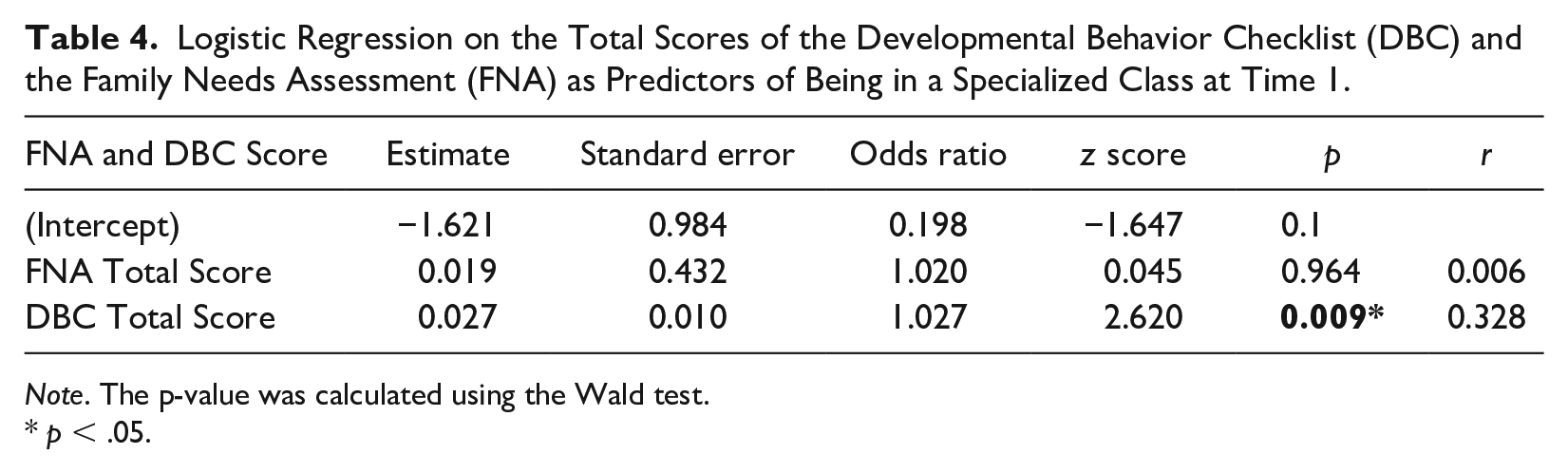
Note. The p-value was calculated using the Wald test.
p < .05.
Discussion
As evidenced by the scientific literature (see Marsh et al., 2017; Ruel et al., 2018) and numerous government directives (Ministry of Education, Recreation, and Sports, 2010), there is a clear imperative for the implementation of initiatives aimed at enhancing the continuity of services provided to children and their families during the transition to a new educational setting. A preliminary step in this direction is to utilize an evidence-based assessment to comprehend the diverse needs articulated by parents throughout the school transition process from a familial perspective. To that end, this study aimed to deepen our understanding of the needs expressed by families of children who have received EBI at the beginning and end of the first year of kindergarten. Moreover, it sought to identify potential correlations between these family needs and the child’s profile and educational placement, as those have been associated with the quality of this transition and family experience as perceived by parents (Alberque & Matthews, 2024). With those objectives in mind, the present study portrayed the variability in family needs from a longitudinal perspective, both at the beginning and during the last trimester of the first years of kindergarten. This approach allowed for identifying sensitive school contexts where different types of support should be provided.
The varying educational needs of children directly influence the type and extent of support required by parents in their child and family journey. Professionals involved in school transitions must adopt both specialized and individualized practices for families of children with autism, who may have needs ranging from simple to complex. In this vein, four key implications for practice emerged from the analysis of family needs as perceived by parents participating in this study. These implications provide valuable insights for professionals and initiatives focused on enhancing service continuity and quality during this critical transition.
Strengthening Professional Empowering Practices to Enhance Child’s Holistic Development and Family-School-Community Partnership
All participating parents expressed significant needs regarding education and access to disability-related services to promote their child’s development at both the beginning and end of the first school year. Regardless of their child’s pre-academic performance or behavioral challenges, parents sought assistance from the start of schooling to implement appropriate interventions that would enhance their child’s pre-academic and social skills. In accordance with other studies on school transitions (Connolly & Gersch, 2016; Marsh et al., 2017; Montes et al., 2009), the primary concern of parents in this study was promoting their child’s optimal development. This highlighted a clear need for professional support to establish objectives with parents and implement appropriate strategies to foster the child’s holistic development, including socioemotional skills, communication, interactions, motor skills, and homework support.
Parents of children with autism expressed a strong desire for high-quality, long-term collaboration with school staff, as they play a pivotal role in managing their child’s transition (Fahmi & Poirier, 2020; Tissot, 2011; Tucker & Schwartz, 2013). They want to ensure the best possible progress in their child’s educational journey and want to be included in the educational decisions and plan to achieve this goal. However, collaboration with the school can be challenging and put pressure on families, especially at the start of the school year (Boucher & Des Rivières-Pigeon, 2023; Iadarola et al., 2015; Poirier & Vallée-Ouimet, 2015). Families are required to share information about their child with school staff, participate in various meetings, encourage communication between professionals in the development of educational intervention plans, and sometimes advocate for services (Fontil & Petrakos, 2015; Jellinek et al., 2023). All these factors can become burdensome, placing strain on family dynamics and influencing the overall needs expressed by families.
Parents of children with severe disabilities express a need for both support and information that empower them to feel more capable and competent (Kyzar et al., 2012). This includes providing direct, individualized specialized support to assist them in caring for their children, as well as sharing general information about the school system to help families make informed decisions regarding educational options (Dunst et al., 2002). Implementing accessible informational tools for families, such as a school welcome guide, along with actions like preschool visits, a warm and flexible reception, and support from experienced parents, is a valuable means of fostering transparent collaboration (Forest et al., 2004; Sands & Meadan, 2024).
These measures respond to the needs expressed by families, not only in relation to the changing educational needs of children when they enter school but also more broadly to the needs of parents to understand how to adapt to the new environment (Rivard et al., 2024). By offering a variety of supportive school transition activities, the goal is to help parents of children with ASD and other parents actively engage in their child’s education based on their families’ preferences and needs (Bérubé et al., 2018; Chatenoud & Odier-Guedj, 2022). In addition, these partnership activities aim to foster a sense of ownership in the school (Goodall & Montgomery, 2014). By engaging with new professionals through various activities, parents may redefine their role—distinct from the preschool setting—by adopting an agentic position alongside school staff (teachers, principals, special services therapists, etc.) as they navigate their child’s school transition. Indeed, capacity-building support practices that foster collaboration between staff and families are essential in empowering parents and enhancing their ability to support their child’s development during school transition.
Addressing Family Needs During an Extended Transition Period as Parents Adjust
Another notable finding is the decline and modification of the need over time. Indeed, these results highlight that parental needs are dynamic and change throughout the first year of school. These results provide a fresh perspective on a topic frequently explored by other researchers, namely the evolving nature of the transition experienced by young children. Specifically, needs related to education and family interactions are more pronounced at the beginning of the academic year compared to the end. This suggests a shift in parental concerns regarding their child’s schooling over several months, reflecting changes in services and family stability. Given these findings, it is crucial to consider the child’s school transition over six to ten months (Ruel et al., 2018) and to examine parental adaptation over a similar timeframe. During this period, parental needs evolve and change in response to the services provided and the family’s overall adaptability. Moreover, our findings reveal significant differences, particularly in the levels of support expected for all family members in areas such as social relationship development and financial management, especially for families of children entering self-contained classes or schools. This suggests that the needs of these families extend beyond specialized, child-centered services and include broader support for parents and family members in other areas.
Considering Distinct Family Needs of Parents of Children in Specialized or Self-Contained Classrooms
Beyond the evolving and time-sensitive nature of the support needs expressed by parents to facilitate their child’s school transition, our findings revealed a perceptual discrepancy between parents of children in general education settings and those whose children attended self-contained classrooms or special schools. Specifically, the data consistently showed that parents of children in special classrooms expressed higher levels of need especially in education subscales (both at the start of the year and later), compared to those with children in general education. This outcome may seem somewhat surprising, as parents of children entering special education programs are typically expected to benefit from more intensive transition practices (e.g., individual transition planning, transition meetings, phone calls with the classroom teacher), especially in smaller, specialized classes where professionals are usually trained specifically (Sands & Meadan, 2024). Nevertheless, despite the additional support likely provided by specialist professionals, families of children with more severe behavioral issues consistently appear to have more significant needs than parents of children with less pronounced disabilities. This raises the question of how parents perceive the validity and continuity of services, in line with complementary findings on parents’ perspectives on the quality of the autism services trajectory during the transition from the same research (Rivard et al., 2024) and prior reports of parental concerns regarding school transition services (Nuske et al., 2019). It suggests that parents found the school’s information, interventions, and services unsuitable, even in a more specialized educational context. These observations also emphasize the importance of incorporating key adaptive elements and interactional strategies from similar evidence-based interventions throughout the school transition (see Marsh et al., 2017; Nuske et al., 2019; Starr et al., 2016). This is particularly necessary as follow-up studies on the long-term maintenance of EBI benefits after one to three years of schooling reveal a decline in developmental gains after school enrollment (Kovshoff et al., 2011). Some research has focused on the effectiveness of behavioral group approaches, primarily in preschool settings (Tupou et al., 2022; Vivanti et al., 2017). While these strategies have significantly affected preschool environments, their impact in school settings remains limited. Research on adapting Applied Behavior Analysis (ABA) for school settings is sparse. Still, it highlights the importance of training school staff in teaching strategies that align with previous interventions, particularly in promoting language development, attention management, and motivation. This continuity could help parents feel more secure and could reduce their perceived educational needs for their child at school entry.
Navigating Change: Capturing Family Adaptability During School Transitions and Enhancing Professional Support
As a transversal observation, this study underscores the multiple dimensions and challenges of supporting family adaptation during school transition. Parents’ responses revealed a broad spectrum of needs at this stage, similar to other phases in the family life cycle (Painter et al., 2020). Therefore, defining family needs requires a thorough understanding of parents’ experiences in maintaining family cohesion and identifying the types of support that can help each family member achieve their goals (Turnbull & Aldersey, 2014). This includes providing resources that enhance the family’s adaptability—the capacity to stay flexible in the face of daily challenges and develop strategies for managing stress (Rivard et al., 2014). Moreover, while this article’s primary aim was not to analyze families’ perceptions of their service journey before and after school entry, it highlights a dynamic relationship between parents and the school. Parents do not have static needs; instead, they engage in continuously evolving interactions with school staff, seeking resources, information, and support tailored to their changing circumstances (Chatenoud & Odier-Guedj, 2022). The parents in our study have experienced intensive early intervention for their child before entering school and anticipate the need for continuity in both educational and specialized support during this critical stage. Their pursuit of support during this period seems grounded in their prior experience, where they gained a deep understanding of their child’s diagnosis and their own needs as parents working with professionals and specialized services (Rivard, Magnan, et al., 2020). This evolving relationship between parents and schools highlights the importance of acknowledging that family needs are dynamic and change over time in response to the child’s schooling and the services provided. Parents actively seek out resources and information, often through social networks, emphasizing the need for schools to maintain open communication and provide ongoing support that adapts to families’ shifting needs (Gaspar & Jahromi, 2024).
Limitations
The findings of this study should be considered in light of its methodological limitations, including small sample size, data collection restricted to a specific region, and the recruitment of parents whose children all received intensive early intervention before entering school. Consequently, the results may not generalize to all families in Quebec or other countries. The restricted sample size limited our ability to explore a broader set of variables, such as the number of children in the family, daycare attendance, parental stress, and coping strategies. While the logistic regression model demonstrated an acceptable fit and indicated that children’s socio-behavioral difficulties contribute to explaining school placement, a significant portion (83%) of the variance remains unexplained. This suggests that other factors not included in the model may also play a role in predicting school placement. Incorporating variables that influence family adaptability during transitions and parents’ needs could provide a more nuanced understanding of this issue. These aspects represent important avenues for future research, particularly as the dataset expands and allows for the inclusion of additional variables and more complex models. Data analyzed from other questionnaires conducted during the interviews will also be utilized to understand better the practices parents desire to support their children’s school transition. It will also help reinforce the findings. A more detailed exploration of school factors, such as integrating child disability services within educational contexts, could also have been beneficial. For example, a survey could have been conducted with schools on the activities and practices concretely offered to support school transition, differentiating between high- and low-intensity interventions, and examining how these practices were linked to parents’ perceptions. This underscores the necessity for a more comprehensive and in-depth understanding of the evolving and diverse needs of families both before and after school, especially concerning the quality of educational contexts, whether in regular classrooms or specialized self-contained settings. Using different research methodologies can provide a more specific understanding of families’ needs at this crucial time of their trajectory, to give answers and find concrete solutions. Indeed, the quantitative method is a proper way to explore change across the year in service as the first step. Nevertheless, to understand why and how to support families better, the logical next step would be to follow-up with qualitative data collection. This would provide more information to give answers and concrete solutions. Moreover, this analysis did not factor into consideration the setting wherein families received EBI services prior to entry to kindergarten (e.g., daycare or preschool). Further investigations might take the EBI service setting into account.
Conclusion
This study emphasizes critical elements that offer valuable insights for optimizing practices aimed at supporting parents during their children’s school entry with ASD. The findings underscore the importance of equipping families to understand the education system’s structure and common school practices, thereby better preparing them for their child’s school entry. In addition, it is vital to allocate substantial comprehensive and individualized support to families and implement high-intensity transition practices at the beginning of the transition period (Sands & Meadan, 2024), when family needs are at their peak. Gradually tapering or reducing the intensity of support and services as parents adapt to their new circumstances and their perceived needs decrease is equally important as their needs are dynamic and change over the time. Concurrently, promoting low-intensity transition activities for parents—such as preview nights, large group meet-and-greet events, and school visits (Sands & Meadan, 2024)—is essential. These activities facilitate parental engagement with the school community, allowing them to assume their roles as school parents in alignment with their preferences and needs, as suggested by other researchers studying the transition of children without developmental disorders (Conus, 2015; Fahrni & Ogay, 2022).
Footnotes
Disposition editor: Cristina Mogro-Wilson
Declaration of Conflicting Interests
The author(s) declared no potential conflicts of interest with respect to the research, authorship, and/or publication of this article.
Funding
The author(s) disclosed receipt of the following financial support for the research, authorship, and/or publication of this article: This study was funded by an Insight Development Grant from the Social Sciences and Humanities Research Council of Canada. Additional financial support was provided to Mélina Rivard by the Quebec Health Research Fund (Junior Researcher) and by the Institut Universitaire en Déficience Intellectuelle (Montreal, Canada).
