



Abstract
As disparities in health and well-being outcomes continue to widen in the United States, despite good-willed investments in programs and services, a revolutionary shift in how we support families before they are in crisis is necessary to ensure they have what they need to be happy, healthy, and economically secure. To address these challenges, Prevent Child Abuse America developed a theory of change to address the root causes of child abuse and neglect, and balance the use of programs and systemic interventions to bring about a Primary Prevention Ecosystem to advance equitable outcomes for all children, youth, and families. As this Primary Prevention Ecosystem is realized in communities across the United States, there will be less need for the formal child welfare system as it exists today. This article describes the theory of change, the participatory methods used to develop it, and its implication for use within the broader primary prevention field.
Keywords
Introduction
We each share the responsibility for ensuring all children and families are living a purposeful and happy life with hope for the future. More than two decades of research has concluded that the early years of life are critical for establishing the building blocks for happy, healthy, and productive members of society (Shonkoff et al., 2021; Shonkoff & Phillips, 2000). We now know that positive childhood experiences (PCEs) in addition to adverse childhood experiences (ACEs), such as child abuse or neglect, have a profound effect on lifelong health and well-being. For example, nearly 60% of individuals with four or more ACEs and only zero to two PCEs reported depression or poor mental health in comparison to 20% with four or more ACEs and six to seven PCEs (C. Bethell, Jones, et al., 2019). Positive childhood experiences include things like the ability to talk to family about feelings, family standing by in difficult times, feeling a sense of belonging in high school, and feeling safe and protected by an adult in the home (C. Bethell, Jones, et al., 2019). In a recent study published in Morbidity and Mortality Weekly Report, researchers looked at the prevalence of positive childhood experiences in four states (Kansas, Montana, South Carolina, and Wisconsin) and found that individual PCEs varied from nearly 60% to over 90%. In addition, there were significant differences in the number of PCEs by race and ethnicity, age, and sexual orientation (Sege et al., 2024).
However, we also know that many factors can impede PCEs and exacerbate ACEs, placing children at elevated risk for negative outcomes lasting well into adulthood. When families face an overload of stress, including poverty, structural racism, and other oppressive conditions, it can affect a caregiver’s capacity to provide the supportive relationships and environments children need to thrive and put children at risk for child abuse and neglect and other adversity (National Research Council et al., 2000). Conditions such as a lack of affordable and safe housing, community violence, systemic discrimination, and limited access to opportunities for social and economic mobility compound one another and further add to the stress and harmful effects of individual ACEs (Ellis & Dietz, 2017; Higgins et al., 2024). It is not surprising then that children living in poverty or in families with low incomes are at the highest risk for ACEs related to child neglect (Berger, 2004; Fortson et al., 2016). According to the federal Child Maltreatment 2022 report, an estimated three million children were investigated for child abuse and neglect in this country, with most involving concerns of neglect (U.S. Department of Health and Human Services et al., 2024). Because of structural racism and other inequitable conditions, children and families of color are more likely to be affected by poverty and, thus, come to the attention of the child welfare system for child neglect (Kim et al., 2017).
Researchers around the world argue that to prevent individual ACEs, such as abuse and neglect, and alter the negative outcomes often associated with childhood adversity, it is imperative to improve the contextual environments and systemic conditions in which people live, work, and play (Ellis & Dietz, 2017; Higgins et al., 2024; Merrick et al., 2019). Unfortunately, despite taking great strides in understanding and preventing child abuse and neglect, the primary prevention field in this country continues to focus more on shifting individual behaviors instead of transforming the multiple, interdependent contextual and systemic conditions affecting population-level outcomes (Rutter et al., 2017). For example, the existing “best practice” evidence base for public health is almost exclusively focused on individual-level programs and, as a result, irrelevant to guiding interventions into complex social ecosystems (Parkhurst & Abeysinghe, 2016). Compounding this problem, research suggests that “downstream” individual-level focused interventions (e.g., parenting skills training programs), even when evidenced-based, are more likely to exacerbate disparities in outcomes if not strategically paired with “upstream” systemic interventions (e.g., efforts to create more equitable policies, priorities, decision-making processes, and information flows; Hall et al., 2016). As disparities in health and well-being outcomes continue to widen in the United States, despite good-willed investments in programs and services (DeSantis et al., 2019), a revolutionary shift is needed to build social ecosystems that can support families before they are in crisis to ensure they have what they need to be happy, healthy, and economically secure.
In the past decade, several primary prevention frameworks have emerged attempting to balance a focus on shifting individual behaviors and contextual conditions, primarily through policy change (e.g., Fortson et al., 2016). While representing significant progress, these frameworks are not yet sufficient to effectively guide primary prevention change efforts as they do not fully address the comprehensive array of interacting ecosystem conditions affecting health and well-being highlighted in the literature (Elias & Feagin, 2020; Watson & Collins, 2023) nor the complexity inherent within most social ecosystems (Rutter et al., 2017). In addition, even when social ecosystem conditions are acknowledged in primary prevention models, they are often not clearly operationalized and aligned in ways that enable strategic decision-making and action (Wutzke et al., 2016).
To address these challenges in the prevention field, Prevent Child Abuse America (PCA America), the oldest national organization committed to preventing child abuse and neglect before it happens, developed a theory of change (Watson et al., 2023) to address the root causes of child abuse and neglect and balance the use of programs and systemic interventions to advance equitable outcomes for all children and families. Models such as PCA America’s theory of change can help to conceptualize outcomes and interventions within complex ecosystems and are valuable for planning and evaluating systems-level change (Doherty et al., 2022; Funnell & Rogers, 2011). The PCA America theory of change is not only designed to guide internal efforts within the organization and associated networks, but the model can also be used to inform strategies and action within the broader primary prevention field as well. The purpose of this article is to describe the PCA America theory of change and the implications for the field of primary prevention. The following sections describe the participatory methods used to develop the theory of change and the theory of change elements.
Methods
The PCA America theory of change was developed through a review of the primary prevention and systems change literature and a range of participatory approaches. The literature review focused on existing theoretical frameworks related to the primary prevention of child abuse and neglect (e.g., Fortson et al., 2016) and equity-focused systems change (e.g., Watson & Collins, 2023); search terms and expert recommendations were used to identify these frameworks. The participatory methods included a series of highly interactive design sessions (virtual and in-person), interviews, and surveys that engaged nearly 500 individuals representing key interest holders engaged with PCA America, including youth and families, individuals with lived experience in the child welfare system, PCA America staff and board, Healthy Families America staff and other affiliated home visitors, PCA America State Chapter Executive Directors, national thought leaders, and experts in the fields of systems change, prevention, and equity. A random survey through YouGov was also conducted with more than 1,200 adults across the United States who provided further insights on the theory of change. In addition, through a “Zooming Out Speaker Series,” experts and national thought leaders presented on a variety of topics about the contexts and environments that affect the prevention field to our PCA America network (state chapters, Healthy Families America sites, staff, and board members) and key partners, including sessions on systems change, policy, race equity, engaging youth, and centering families with lived experience. Following each session, discussions were held to make sense of the information shared during the sessions and understand how it will affect the primary prevention field.
These methods were used as part of an adaptive planning approach where new insights gained from the literature and participatory methods were continually used to modify the theory of change model and guide new questions for inquiry and sense-making throughout the process. The first phase of the theory of change development process engaged individuals from the groups listed above in defining outcomes to operationalize what it means for children, youth, and families to experience well-being. See the Appendix for the question prompt used to elicit these outcomes. The resulting list of outcomes was cross-walked with the literature to address any gaps. Participants, including those engaged in the random YouGov survey, prioritized the full list of outcomes according to which they viewed as most important to defining the well-being of children, youth, and families. In the second phase of the theory of change development process, participants were asked to identify conditions within the broader “ecosystem” context that need to be in place to advance the prioritized well-being outcomes. This process used a set of question prompts based on the following leverage points from Watson and Collin’s (2023) systems change framework: mindsets, goals, decision-making, policies and practices, connections, human resources, program components/opportunities, and environments. See the Appendix for the question prompt used in Phase 2. The qualitative data gathered about these conditions through this process was content analyzed and the resulting list of themes was again cross-walked with the literature review. In Phase 3 of the development process, participants were engaged in interactive sessions to design and prioritize strategies to address the identified ecosystem conditions, drawing on their own experiences as well as examples provided to them from the literature review. The following sections describe the theory of change that resulted from these methods in more detail.
Theory of Change Model
The PCA America theory of change includes a north star, that all children and families are living a purposeful and happy life with hope for the future, and three core areas: (a) aspirational impacts and outcomes for children, youth, and families; (b) an aligned and comprehensive Primary Prevention Ecosystem affecting these impacts and outcomes; and (c) PCA America strategies to build and enhance the Primary Prevention Ecosystem. The sections below summarize the main theory of change elements within these three core areas. See Figure 1 for a visual of the theory of change.
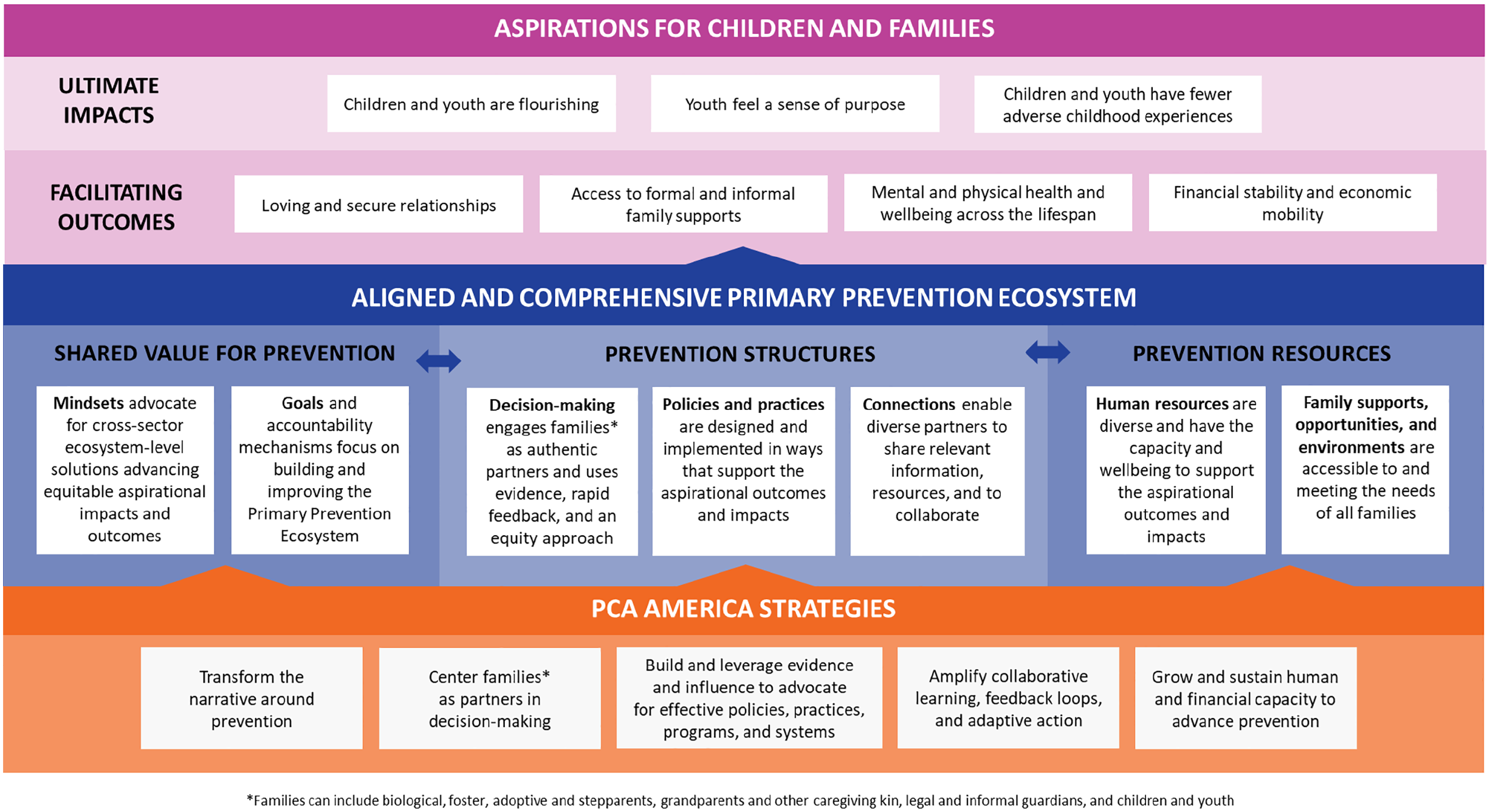
PCA America Theory of Change Elements.
Impacts and Outcomes for Children, Youth, and Families
The PCA America theory of change is grounded in a series of aspirational impacts and outcomes for children, youth, and families, reflecting key facets of health and well-being. The theory of change includes three ultimate impacts that represent the population-level changes the model aims to bring about including child and youth flourishing, youth feeling a sense of purpose in their life, and children and youth experiencing fewer adverse childhood experiences. These impacts were selected because of research showing their significant effect on lifelong health and well-being (C. D. Bethell, Gombojav, & Whitaker, 2019; Hill et al., 2016), their connection to the north star, and because participants in the theory of change development process defined them as the ultimate success of primary prevention. In addition to these impacts, the theory of change also includes nine facilitating outcomes that research shows can promote flourishing and prevent ACEs (C. D. Bethell, Gombojav, & Whitaker, 2019; Fortson et al., 2016). The nine outcomes are organized into the following categories: (a) loving and secure relationships; (b) access to formal and informal family supports; (c) mental and physical health and well-being across the lifespan; and (d) financial stability and economic mobility. See Table 1 for a list of all impacts and outcomes. Indicators were selected from existing national-level surveys for each of these impacts and outcome areas based on the recommendations of external experts in prevention research, participants in the theory of change process, and research conducted through the development of the National Survey of Children’s Health (Bethell et al., 2022; Bethell, Gombojav, & Whitaker, 2019).
Theory of Change Aspirational Impacts and Facilitating Outcomes with Associated Indicators.

Note. ACS = American Communities Survey; YRBSS = Youth Risk Behavior Surveillance System; NSCH = National Survey of Children’s Health; NCANDS = National Child Abuse and Neglect Data System.
The theory of change is designed to promote these aspirational impacts and facilitating outcomes and reduce disparities across intersectional demographics (e.g., race/ethnicity, geography). Data sources for indicators like youth purpose in life and positive childhood experiences will be added to the theory of change over time as data systems are put in place to consistently gather needed data at a population level. For example, currently there are only four states that collect data on positive childhood experiences in their state Behavioral Risk Factor Surveillance Systems and no nation-wide data collection on youth sense of purpose (see Hill et al., 2016 for example measure). The next section describes how these ultimate impacts and facilitating outcomes are advanced through an aligned and comprehensive Primary Prevention Ecosystem.
Aligned and Comprehensive Primary Prevention Ecosystem
To improve the impacts and outcomes described above and profoundly change the trajectories for future generations of children and families, the PCA America theory of change calls for the creation of an aligned and comprehensive Primary Prevention Ecosystem in the United States, which provides services and supports to families before they are in crisis thus eliminating the need for a child welfare system that typically punishes parents in need by taking away their children. Although current child welfare reform efforts call for a greater emphasis on prevention, this Primary Prevention Ecosystem is not, nor should it be part of the current child welfare system. A fully aligned and comprehensive Primary Prevention Ecosystem in communities across the country will remove the need for the child welfare system to expand into areas it is not designed or equipped to address like primary prevention and poverty reduction. Many of the fundamental aspects of this framework align with the current abolitionist arguments that call for a reimagined way to support families that keeps children and families together. A Primary Prevention Ecosystem is a collection of actors and conditions that function together to advance the well-being of children, youth, and families. Primary Prevention Ecosystem actors represent individuals, settings, and organizations (Foster-Fishman et al., 2007), including families, communities, elected officials and policymakers, and cross-sector organizations and institutions. See Figure 2 for details. Primary Prevention Ecosystem conditions represent contextual elements that affect opportunities for well-being, such as shared mindsets, goals, decision-making processes, policies, practices, and connections. These ecosystem actors and conditions exist across vertical ecological layers (e.g., local, regional, state, federal/tribal) and horizontal ecological layers (e.g., across sectors, departments within an organization). The actors and conditions within an aligned and comprehensive Primary Prevention Ecosystem interact in ways that disrupt the systemic root causes of child abuse and neglect and associated disparities and advance equitable access to opportunities and environments that all children, youth, and families need to thrive.
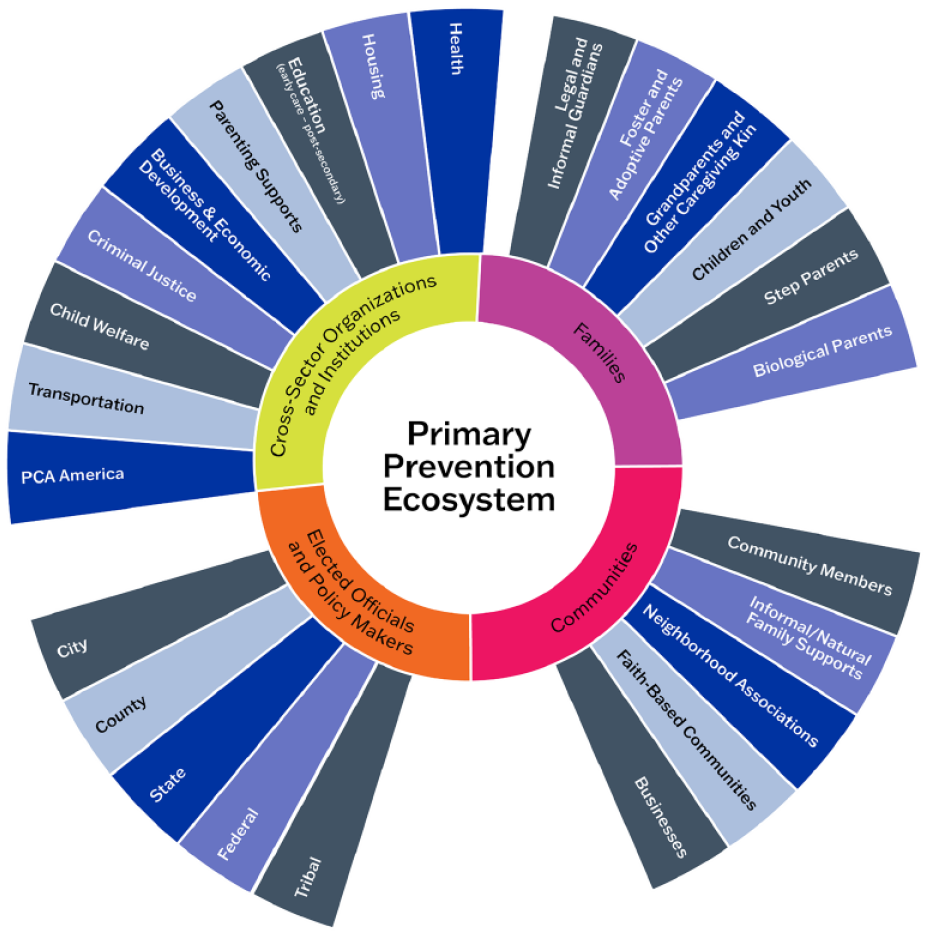
Ecosystem Actors Within the Primary Prevention Ecosystem.
Building an aligned and comprehensive Primary Prevention Ecosystem requires transforming how actors and conditions function and interact across vertical and horizontal ecological levels to bring about more equitable outcomes and impacts for children, youth, and families. The theory of change specifically focuses on seven interacting Primary Prevention Ecosystem conditions or “leverage points” based on the framework developed by Watson and Collins (2023). Leverage points are places within an ecosystem where shifts in one condition (e.g., decision-making) can lead to changes in multiple other conditions (e.g., policies, connections, resources) because of its direct and indirect influences across the ecosystem (Meadows, 1999). The seven theory of change leverage points are grouped into the following three categories: shared value for prevention, prevention structures, and prevention resources. Each of the leverage points within these categories are described below.
Shared Value for Prevention Leverage Points
Mindsets
Mindsets refer to the attitudes, values, assumptions, and beliefs that create a worldview for those who share them. They influence our interpretation of reality and shape how we make decisions and take action (Watson & Collins, 2023). This worldview in turn influences all other elements of the ecosystem, such as which goals are adopted, what decision-making processes are used, and what policies are developed and implemented (Meadows, 2008). Drawing on research and participant input, the PCA America theory of change posits that a Primary Prevention Ecosystem is more likely to advance the aspirational outcomes and impacts when three types of shared mindsets are in place. First, a diverse array of actors across ecological layers hold shared mindsets valuing the importance of pursuing cross-sector “upstream” ecosystem-level solutions (i.e., initiatives focused on shifting multiple conditions within the Primary Prevention Ecosystem) alongside individual-level interventions (e.g., parenting programs) to nurture positive childhoods and prevent child abuse and neglect (Holt et al., 2007; Lakoff, 2008). As noted above, mindsets are not the norm among many social and public service sectors in the United States. The theory of change also identifies two additional shared mindsets that can help trigger positive changes in other conditions across the Primary Prevention Ecosystem: beliefs about the need to advance equity (Elias & Feagin, 2020; Omi & Winant, 2012) and narratives that promote collective responsibility for keeping all children and families safe, healthy, and connected to the resources and supports they need before experiencing a crisis (Grier & Bryant, 2005; Horsfald et al., 2010). Different approaches can be used to influence shared mindsets such as these, including narrative framing (Kalra et al., 2021), social marketing (Lee & Kotler, 2011), and strategic messaging through multiple communication channels (FrameWorks Institute, 2020).
Goals
Goals are the collective aims, outcomes, and purposes driving the actions of individuals, groups, and organizations (Watson & Collins, 2023). For example, formal goals are often captured in strategic plans, political platforms, or mission statements. Other ecosystem leverage points such as policies, practices, connections, and resources often naturally become aligned to bring about these goals, even when the goals are informal and outside of individuals’ awareness (Meadows, 1999). Drawing on research and participant input, the theory of change argues that an aligned and comprehensive Primary Prevention Ecosystem includes cross-sector actors—organizations, institutions, governmental agencies, and funders—that have adopted goals and accountability mechanisms explicitly focused on aligning ecosystem conditions in ways that advance the aspirational impacts and facilitating outcomes (Martin et al., 2014; Meadows, 2008). The goals that funders adopt and require as part of their proposals and contracts are particularly important within this leverage point category, as funding entities have historically been found to reinforce a prioritization of individual-level interventions over ecosystem-level interventions (Hunter et al., 2009; Rutter et al., 2017). Example approaches for shifting this leverage point include using collaborative processes to develop shared goals among actors (Foster-Fishman et al., 2001) and advocacy strategies (Van Riel, 2012).
Prevention Structures Leverage Points
Decision-Making
Decision-making refers to the way decisions are made, including what information is used and who does and does not have influence over the decisions (Meadows, 2008; Watson & Collins, 2023). Decision-making processes have large ramifications within an ecosystem as they affect what goals are prioritized, what policies are written, how data and information are gathered and shared, what resources are allocated, which staff are hired and trained, and how programming is designed. Drawing on research and participant input, the theory of change identifies four types of decision-making processes that are needed across multiple ecological levels for the Primary Prevention Ecosystem to advance the aspirational impacts and facilitating outcomes. This includes decision-making processes that: (a) authentically engage diverse youth, families, and individuals with lived experience as partners with influence over final decisions (Ishimaru, 2019; Watson & Foster-Fishman, 2013); (b) utilize research and practice-based evidence (Miller & Shinn, 2005); (c) integrate rapid feedback cycles to gather real-time information on outcomes and context (Bowie & Inkelas, 2014); and (d) embed equitable approaches such as the use of an equity impact assessment (Agic, 2019). Example approaches for how to shift the decision-making leverage point include creating new decision-making roles for excluded groups (such as youth, families, and individuals with lived experience; Rowland, 2016), community organizing and power building (Christens & Speer, 2015), equity impact assessments (Agic, 2019), and community benefits agreements (Policy Link, 2024).
Policies and Practices
The policies and practices leverage point refers to the formal and informal regulations, laws, standards, procedures, protocols, and norms that incentivize and disincentivize behavior (Foster-Fishman & Watson, 2017). Policies and practices are often not designed or implemented in ways that advance the theory of change outcomes and impacts, and throughout history many policies have intentionally and unintentionally created stark advantages for certain groups more than others (Harris, 1993). Drawing on research and participant input, the theory of change argues that an aligned and comprehensive Primary Prevention Ecosystem must include policies and practices across vertical and horizontal ecological layers that are designed and implemented in ways that advance equity in the aspirational outcomes and impacts (Delgado & Stefancic, 2017; Kendi, 2019). It should be noted that sustainably changing policy and practice leverage points often entails simultaneously changing other leverage points (e.g., mindsets, goals, decision-making) that will exert an influence on the design and implementation of those policies and practices (Meadows, 2008). Similarily, there is evidence that policy wins can simultaneously fuel mindset shifts (FrameWorks Institute, 2020), further demonstrating the importance of strategy approaches that take into account the interactions between multiple leverage points. Example approaches for how to shift the policies and practices leverage point include policy advocacy, community organizing (Christens & Speer, 2015), and co-designing more effective and equitable policies, practices, procedures, and processes with individuals with lived experience (Rowland, 2016).
Connections
Connections refer to the channels through which information, referrals, and resources flow between individuals, groups, and organizations within an ecosystem (Senge, 2006). These channels also form networks through which ecosystems can diffuse ideas and behaviors (Rogers, 2010), enable access to opportunities and resources (Burt Ronald, 2000), and promote collaborative action (Feinberg et al., 2005). Drawing on research and participant input, the theory of change states that an aligned and comprehensive Primary Prevention Ecosystem will include connections that enable diverse partners to share information, resources, and collaboration in ways that enable them to advance equity in the aspirational impacts and facilitating outcomes (Foster-Fishman et al., 2007; Neal et al., 2011; Rogers, 2010; Senge, 2006). Example approaches for how to influence the connections leverage point include creating or enhancing collaborative community partnerships (Roussos & Fawcett, 2000), cross-sector wraparound service teams (Suter & Bruns, 2009), and universal resource referral infrastructures (Rollins et al., 2024).
Prevention Resources Leverage Points
Human Resources
Human resources refer to the people who are available to carry out different roles within the ecosystem and their skills and knowledge. Studies show that the quantity, quality, and diversity of human resources within an ecosystem can determine the successful implementation of policies, programs, and primary prevention initiatives (King-Sears, 2001). Drawing on research and participant input, the theory of change argues that a Primary Prevention Ecosystem is more likely to advance the aspirational impacts and facilitating outcomes when organizational staff and leaders: (a) represent the demographics and lived experiences of the diverse communities and families they aim to support and engage (Rosenkranz et al., 2021); (b) have the skills and knowledge to advance primary prevention approaches (Brashears et al., 2012; Livet & Wandersman, 2005), including trauma-informed approaches and “structural competency” (Metzl & Hansen, 2014); and (c) are given the tools and resources necessary to avoid burnout (Oyeleye et al., 2013; Whittaker et al., 2018). Example approaches for how to build the human resources leverage point include creating job pipeline systems (Massey, 2019), embedding needed training content into higher education curriculum, and developing HR hiring practices that include lived expertise as an optional substitute for formal education attainment (Rollins et al., 2024).
Family Supports, Opportunities, and Environments
This leverage point refers to the character, quality, location, accessibility, and array of formal and informal family supports (e.g., home visiting programs), opportunities (e.g., living wage jobs), and relevant aspects of the built and natural environment (e.g., affordable housing, green space, and playgrounds) that enable families to thrive. These supports, opportunities, and environments are typically highly stratified across the United States, with white communities often having significantly greater access to these prevention resources compared with their Black, Indigenous, and/or People of Color (BIPOC) counterparts (Davis et al., 2016). Even when these resources are in place, they often do not reach or benefit individuals experiencing the greatest social inequities (Phelan & Link, 2013). Drawing on research and participant input, the theory of change posits that a Primary Prevention Ecosystem is more likely to advance the aspirational impacts and facilitating outcomes when family supports, opportunities, and environments are equitably accessible (Feagin & Bennefield, 2014; Powell et al., 2009) and meeting the needs and preferences of diverse children, youth, and families before they are in crisis (Hirsch et al., 2010). Example approaches for how to build and enhance family supports, opportunities, and environments include co-location of cross-sector supports (Rollins et al., 2024), Shared Services Networks to reduce operational overhead costs (Opportunities Exchange, 2024), and repurposing vacant or underutilized buildings and spaces into usable resources.
PCA America Strategies
Research shows that strategy interventions are more likely to change the form and function of an ecosystem when they simultaneously bring about changes in multiple ecosystem conditions that interact to maintain the status quo (Bezrukova et al., 2016; Diez Roux, 2011). Strategy interventions are also more likely to bring about transformative change when they focus on more “powerful” ecosystem leverage points that, when changed, are more likely to create reverberating effects on many other conditions across the ecosystem (Meadows, 2008; Watson & Collins, 2023). In the theory of change framework, these more powerful ecosystem leverage points include mindsets, goals, decision-making, policies and practices, and connections. In contrast, many primary prevention strategies, even those aiming to impact “upstream” social determinants of health, primarily focus on leverage points that are considered less powerful, such as expanding evidence-based programs and increasing human or financial resources. While these leverage points are necessary, they are insufficient to transform a Primary Prevention Ecosystem because they have relatively little power to influence changes in other ecosystem conditions and their effects are often “washed out” over time as the ecosystem self-organizes itself in ways to maintain the status quo (Carey & Crammond, 2015). For example, strategies to expand evidence-based family support programs may help to promote the well-being of a set number of individuals within a bounded geographic and temporal space, but these programs do very little to disrupt the larger ecosystem context that continues to reinforce inequities in well-being outcomes. Strategies that also simultaneously aim to affect more powerful ecosystem leverage points, such as policies impacting families’ financial stability (e.g., paid family leave, child tax credits, and child care subsidies) and the extent to which individuals with lived experience have influence in regional and state decision-making, could have a wider and more sustainable impact on ensuring the success of the Primary Prevention Ecosystem in ways that advance more equitable well-being outcomes for entire populations (Meadows, 1999). Over the years, the prevention field has developed strategies in accordance with the research and knowledge available and accessible at the time, and largely focused on individual-level interventions. The Primary Prevention Ecosystem model draws on additional multi-displinary research and knowledge to expand the focus of primary prevention interventions that affect multiple leverage points.
The third section of the theory of change describes a package of five interdependent strategies PCA America is taking at the national level to help build a comprehensive and aligned Primary Prevention Ecosystem to advance the aspirational impacts and facilitating outcomes. The strategies include (a) transforming the narrative around prevention; (b) centering families as partners in decision-making; (c) building and leveraging evidence and influence to advocate for effective policies, practices, programs, and systems; (d) amplifying collaborative learning and adaptive action; and (e) growing and sustaining human and financial capacity to advance prevention. See Table 2 for a more detailed description of these strategies. When implemented together, these five theory of change strategies are intentionally designed to collectively address all seven types of ecosystem leverage points within the model, including the leverage point categories the literature considers most powerful for bringing about transformational change.
Theory of Change PCA America Strategies and Related Components.

Many types of strategies can be used to enhance the Primary Prevention Ecosystem at local, state, and national levels. In fact, research suggests transformational ecosystem change requires multiple strategies taken by multiple actors across ecological layers (Patton, 2011). Therefore, the PCA America strategies listed in the theory of change are meant to complement strategies initiated by other ecosystem actors that together can contribute to building the Primary Prevention Ecosystem across the country. The next section describes implications for how this theory of change can guide complementary actions within the primary prevention field.
Using the Theory of Change to Transform the Primary Prevention Field: Implications for Practice
The PCA America theory of change is poised to transform the field of primary prevention in several ways. First, the concept of a Primary Prevention Ecosystem with networks of multiple interacting actors and conditions draws on current system and complexity theories and more accurately represents the reality of what the emergence of transformative change involves (Morell, 2023). The bold and innovative idea of building a comprehensive and aligned Primary Prevention Ecosystem to advance outcomes related to child and family well-being represents a much-needed contrast to the field’s overreliance on programmatic approaches to change (Rutter et al., 2017). While some prevention efforts in the field do focus on systems change, they are often confined to secondary or tertiary prevention strategies focused on specific systems, like child welfare. In contrast, this theory of change moves beyond a narrow focus on reforming or transforming the child welfare system to higher “upstream” ecosystem conditions that can create the conditions that all children, youth, and families need to thrive and truly prevent individuals from ever encountering the child welfare system in the first place. This Primary Prevention Ecosystem is intended to provide community support and services to families when they need them, accessible in the communities where they reside, before they are in crisis, and will greatly reduce the overreliance on the child welfare system in this country.
Second, the theory of change can help multiple and diverse change agents aim their prevention efforts at more powerful leverage points that together can transform the contexts affecting child and family well-being. For example, organizations, initiatives, and community groups can use the theory of change to identify powerful leverage points affecting child, youth, and family well-being in their unique region or state and then insert their own strategies to help build the conditions of a comprehensive and aligned Primary Prevention Ecosystem. This flexibility is crucial, as one-size-fits-all approaches to change are inadequate to address the variation of complex ecosystem conditions across contexts. The “plug and play” nature of the theory of change not only helps to build actors’ capacity and ownership to create change but it also works to unify and align diverse entities and efforts around a shared vision; this engagement and alignment plays a critical role in the success of a change initiative (Martin et al., 2014). Because ecosystems can include a wide range of actors, sectors, and settings, the theory of change also inherently “expands the bench” within the field of prevention by inviting new types of actors to engage in building their local Primary Prevention Ecosystem, including representatives from business, economic development, technology, faith-based communities, community organizing, and non-mainstream organizations.
Third, the theory of change can help to transform the prevention field by explicitly centering families as decision-makers. In practice, most collaborative prevention initiatives do not consistently engage nor center families in decision-making—especially families with lived experience and who represent the diverse demographics of the community—or engage them in authentic and empowering ways (Wolff et al., 2017). Even when lived experts are engaged, they are typically confined to system-involved individuals, like foster youth, or biological parents involved with child welfare. The exclusion of the full spectrum of families with lived experience as decision-makers has significant implications for the success of primary prevention change efforts as it can increase the risk that solutions do not meet local needs and at worst exacerbate local inequities (LeChasseur, 2016). The theory of change can expand the boundaries around which voices are centered in decision-making by promoting more authentic engagement of youth, families, and caregivers across a wide range of lived experiences, including those who have never touched the “deep end system” but have used formal or informal supports to keep their families strong and thriving. In addition, the theory of change can advance youth agency by building on efforts from organizations like Annie E. Casey Foundation and Cetera to authentically include youth-centered approaches as part of the Primary Prevention Ecosystem.
Fourth, the theory of change equips primary prevention change agents with a framework that includes possible strategies, assessment tools, and other resources to advance equity more effectively. While many prevention initiatives over the years have attempted to promote greater equity in outcomes for children and families, these efforts have failed to transform the multiple, interconnected, and evolving ecosystem conditions that continue to reinforce inequities across generations (Boddie, 2016; Elias & Feagin, 2020). This has occurred because of the tendency of primary prevention efforts to mainly use data on population-level outcome disparities to guide their strategies instead of coupling that data with a systematic understanding of the interdependent ecosystem conditions driving those inequities (Watson & Collins, 2023). The PCA America theory of change provides the vision and framework to lead the next generation of primary prevention efforts in the United States and support prevention leaders and partners to understand and address the ecosystem conditions that have reinforced and maintained generational inequities.
Finally, the theory of change can inform primary prevention practice by promoting the use of adaptive action and learning. Typically, the translation of research into primary prevention programs and practices can take years or even decades. For example, the original ACEs study was published in 1998, yet it took over a decade until the field began talking about how this research affected prevention services, interventions, and policies. This delay in learning and action is incompatible with the types of flexible, context-responsive strategies needed to shift evolving ecosystem conditions (Patton, 2011). Instead, the theory of change calls for the use of more real-time adaptive learning and action practices. These practices go beyond quality improvement cycles focused on isolated program or policy components and instead enable primary prevention efforts to nimbly respond and adapt their strategies to the complex and evolving ecosystem dynamics affecting outcomes for children and families.
Every model has its limitations, this theory of change included, that should be taken into consideration when using it to guide planning and implementation. For example, the theory of change highlights ecosystem leverage point conditions that may not describe every possible factor driving well-being outcomes for children, youth, and families. Thus, change agents must diligently assess their own unique ecosystem context to identify which conditions are affecting their prioritized outcomes. The theory of change model is also unable to articulate exactly how the different leverage point conditions are interacting within a given ecosystem to inform prioritization or strategy design. Here again, change agents can engage diverse perspectives within their unique ecosystem context to understand how different leverage points are interacting together to influence outcomes and impacts; causal loop diagramming and participatory system mapping are common methods for mapping out these interacting ecosystem conditions (Barbrook-Johnson & Penn, 2022). Ecosystem conditions will also evolve and adapt over time, which will require users of the theory of change to continually update their understanding of the Primary Prevention Ecosystem. Another limitation was the lack of full youth participation in the development of the theory of change. As mentioned in the methods section, we intentionally sought feedback and input from youth, families and caregivers, staff, and key partners, but we were narrowly focused on seeking input for the model, instead of actively engaging youth in helping to develop the Primary Prevention Ecosystem. As we embark on implementation of the theory of change, we intend to work in partnership with youth-based organizations to intentionally include youth-centered approaches in the Primary Prevention Ecosystem.
Conclusion
Changing the way our society values and cares for our children and families so that we may achieve shared prosperity and economic inclusion for all requires us to deeply partner with one another, center families as key decision-makers in programs and policies, disrupt long-held beliefs about prevention services, take risks by experimenting and rapidly testing new ideas, measure progress in real time, and launch and advocate for policies, structures, and budgets that truly create more equitable, responsive, and effective systems in the United States. By addressing the ecosystem conditions affecting social and structural determinants of health, poverty, and systemic racism, not only can we prevent child abuse and neglect, and reduce the number of children and families coming to the attention of our nation’s child welfare system, but we can ensure that all children and families are living a purposeful and happy life with hope for the future.
PCA America’s Theory of Change for Primary Prevention in the United States represents a new comprehensive approach to guide primary prevention practice and the broader field and change the way it functions and supports the well-being of children and families. This shift involves moving from individual-level interventions that help children and families “beat the odds” to building an aligned and comprehensive Primary Prevention Ecosystem that can “change the odds” for current and future generations (Pittman et al., 2006). We believe this is the moment in our history where collectively we can achieve the aspirational outcomes for children and families that we all desire and have worked so long for and change the trajectories for children and families who have been left out for generations.
Footnotes
Appendix
Disposition editor: Cristina Mogro-Wilson
Declaration of Conflicting Interests
The author(s) declared no potential conflicts of interest with respect to the research, authorship, and/or publication of this article.
Funding
The author(s) received no financial support for the research, authorship, and/or publication of this article.
