



Abstract
Care-dependent people are increasingly expected to actively participate in an accelerating society. This metasynthesis provides insight into how contemporary society complicates the pathways to self-actualization for disadvantaged young people. Giddens’ concept of self-identity was used to analyze the experiences of disadvantaged young people in three participatory projects. These initiatives enable network governance where young people and professionals work together, to better match their care needs and support. Participants often feel that they need to magnify their capabilities to get opportunities for self-actualization and to magnify their disadvantages so they can be acknowledged as “care dependent”, a prerequisite to receive professional support. They call upon professionals and policymakers to recognize their multilayered self-identities and to provide a supportive environment that is adjusted to their own pace, so that they can belong and genuinely participate as their true selves.
Keywords
Introduction
Worldwide, people have to keep up with a highly technological, modernizing world and therefore have to deal with an accelerating pace of social change. This social acceleration affects the lives of all, from the most privileged to the most disadvantaged, regardless of their ability to adjust to changes (Chambers, 2017; Rosa, 2013). In the Netherlands, one of these changes was the shift from a welfare state to a “participation society” as proclaimed by the cabinet in 2013: “everyone who can, must take responsibility for their own life and environment.” 1 The refocus from welfare state to participation society was driven by people’s desire for self-actualization, involvement, and social interaction, but also by the government’s wish to reduce costs (cf. Harbers & Hoeymans, 2013; Kooiker, 2011). Consequently, current policies give mixed messages: Participation is now both a right and an obligation. Disadvantaged people need to build on “societal resilience,” which boils down to increased dependence on active citizens in their community who support them in their participation (Blijleven & Kooiker, 2022; Van der Steen et al., 2015). In 1969, Arnstein already challenged the way disadvantaged people, whom she called “have-not citizens,” are expected to participate. She opposed the simplistic, rhetorical, and misleading concept of participation, and emphasized that it should focus on enabling: “[citizen participation] is the redistribution of power that enables the have-not citizens, presently excluded from the political and economic processes, to be deliberately included in the future” (p. 216).
In practice, young people often feel limited in their power to participate, such as their ability to enjoy adequate education, to transition to work, to find housing in the tight housing market, and to live up to expectations of social media (Harbers & Hoeymans, 2013; Rijssenbeek & Jonker-Verkaart, 2017; Sociaal-Economische Raad, 2021). Furthermore, accessing social support and care has become a complex bureaucratic process that increasingly requires digital tools and skills (Goedhart et al., 2019; Goyette, 2019; Schmidt et al., 2020). Disadvantaged young people—having a higher risk of poverty, social exclusion, discrimination, and violence than the general population (EIGE, 2016)—encounter additional challenges in their transition to independent living. This includes finding alternatives for the care support available for minors when they reach adulthood (Sattoe et al., 2021). They need access to information and caregivers who can assist them at their pace (Beudaert & Nau, 2021). When they miss such support and rely on themselves, they must learn even faster to independently participate in society (Goyette, 2019; Tuenter et al., 2022).
In The Consequences of Modernity (1990) and Modernity and Self-Identity: Self and Society in the Late Modern Age (1991), sociologist Anthony Giddens addressed how people with less access to forms of self-actualization struggle to participate due to the rapid social changes in society. He compared their struggle to riding a juggernaut (an unstoppable destructive force) while they attempt to “minimize the dangers and maximize the opportunities which modernity can offer” (Giddens, 1990, p. 151). When people encounter such overwhelming forces, with marginalization and exclusion as a result, they struggle to be “ontologically secure.” Giddens’ argument built on Laing, who perceived an ontologically secure person as someone who can “encounter all the hazards of life, social, ethical, spiritual, biological, from a centrally firm sense of his own and other people’s reality and identity” (Laing, 1965, p. 39). An ontologically insecure person, Giddens pointed out, seeks ways to work around the complications of the accelerating changes. One of the responses toward ontological insecurity, he suggests, is that people conceal their inabilities to mitigate discomfort for themselves and others. Giddens built his concept of self-identity not only on theoretical explorations, but also on empirical studies in communities, such as Rites of Passage (Van Gennep, 1909/2019), The Presentation of Self in Everyday Life (Goffman, 1959), and The Divided Self: An Existential Study in Sanity and Madness (Laing, 1965). Conceptual and theoretical insights like those of Giddens can enrich empirical research and vice versa, especially when they are put in dialectical relation with each other.
Participatory action research (PAR) is often used to strengthen the political influence of people who in one way or another are oppressed in society. Scientists and experiential experts co-create knowledge through collectively learning by doing and working together (Dedding et al., 2023). The aim of PAR is to bring about positive change by strengthening people’s agency, enabling their societal criticism through uniting their perspectives (while allowing space for differences), and to achieve meta-communication on the required changes for better opportunities (Abma et al., 2019; Bradbury, 2015; ICPHR, 2013). PAR’s strength as well as its weakness is its local situatedness. Local situatedness enables stakeholders to bring about change in the situation it concerns. On the other hand, the outcomes are still seldom used for macrolevel reflections on society (Abma et al., 2019) or a more thorough theoretical and societal dialogue. This is a missed opportunity because exactly these situated, in-depth findings—the perspectives of experiential experts with different backgrounds but a shared desire for self-actualization—could enrich abstract societal debates about their participation in society. Therefore, we decided to take up this challenge by bringing the perspectives of disadvantaged young people from three different PAR projects together: commercially and sexually exploited girls living in secured facilities (Aussems et al., 2020), children with juvenile idiopathic arthritis (JIA; Aussems et al., 2021), and young adults with developmental language disorder (DLD; Aussems et al., 2023). Their challenges resonate strongly with Giddens’ theory on people’s difficulty to stay true to their authentic selves in late modern society.
The purpose of this article is thus to provide insight into how contemporary society complicates pathways to self-actualization for disadvantaged young people, and in doing so to help align policies and interventions with their daily realities and needs. We begin by expanding on Giddens’ concept of self-identity in late modernity. Next, the three PAR projects are introduced, as well as the methodology of the metasynthesis that serves for macrolevel reflections on these projects. Subsequently, we present the main findings of the three participatory projects and reflect on their significance. We close with recommendations for further practice and research.
Giddens’ Theory on Self-Identity in Late Modern Society
In Modernity and Self-Identity: Self and Society in the Late Modern Age (1991), Giddens recognized the interplay of the individual and the society as an alternative to the functionalist perspective of social and governmental institutions controlling people’s lives. He presented the paradox of late modern society giving individuals more power—as they have more choice than ever—while social and governmental institutions have also gained more control over them. These so-called “external agencies” (p. 191) deliver “abstract systems” such as “machines and markets” (p. 80) that people must use to sustain themselves. These systems are constantly and rapidly changing. People who struggle to quickly learn the new skills needed to adjust to innovations may experience these modern systems as “encroaching forces from the outside” (p. 193), leading to a feeling of powerlessness and repression. Giddens posited that the modernizing world creates “particular asymmetries of power, and in varying degrees consolidates the rule of some groups or classes over others” (p. 149).
Giddens further addressed people’s difficulty to remain authentic when society expects them to fit in to late modern society. People are expected to independently make responsible choices with little help from social and governmental institutions. This includes lifestyle choices that shape one’s identity, such as where to live and work, what to wear, and whom to interact with. According to Giddens, these are “decisions not only about how to act but who to be” (p. 81). When people cannot make lifestyle choices in a manner that is socially accepted, they must conceal this to avoid other people’s discomfort (called “sequestration of experiences”), or else they could be physically sequestrated from the so-called “normal” population, for example, by being imprisoned or being admitted to a secured mental health facility. People therefore mainly see examples of what society expects from them. This is often different from their self-identity, which can trigger feelings of “ontological insecurity.” Giddens built on Laing (1965), who introduced the term “ontological security” that concerns a person’s confidence about their self-identity in relation to the society they live in. Furthermore, Giddens followed Goffman (1959) in his position that people attempt to look equal and like “competent agents.” People “must avoid lapses of bodily control, or signal to others by gestures or exclamations that there is nothing ‘wrong’ if such events should occur” (p. 56). While most people can easily pretend, for some it is hard work to keep up such “normal appearances” (p. 58).
Giddens further pointed out that people seek active mastery to survive when they feel powerless and repressed in their attempt to be competent agents: Someone who concentrates on surviving in personal relations, as in other spheres of life, cannot be said to have abandoned all autonomy over his or her life’s circumstances. . . . The individual clearly seeks active mastery: to survive is to be able in a determined way to ride out the trials life presents and overcome them. (p. 193)
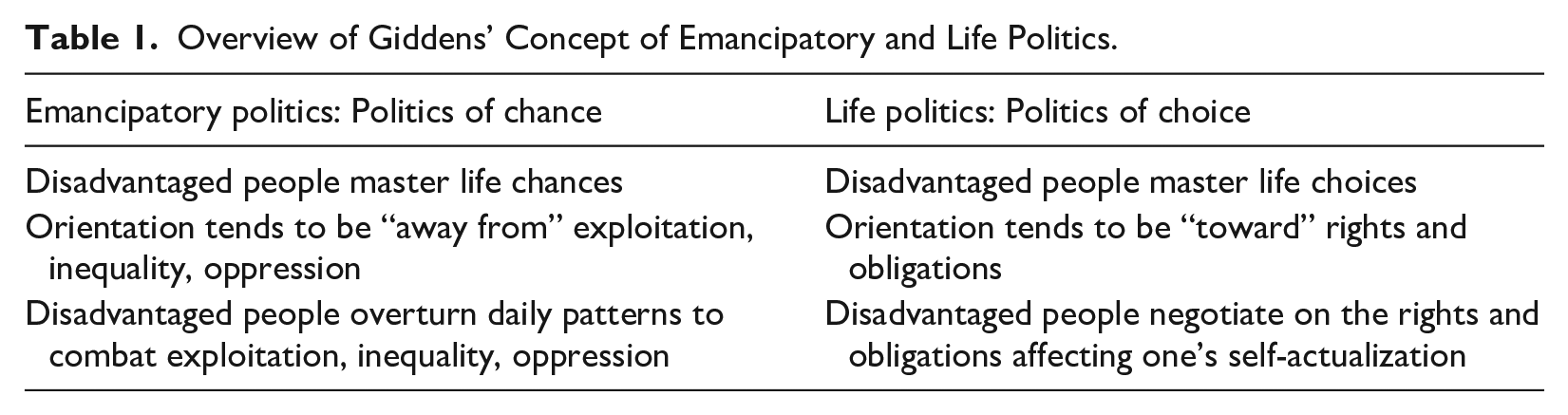
He introduced the terms emancipatory politics for the politics of chance and life politics for the politics of choice, to conceptualize how people continuously shape, alter, and reflexively sustain their self-identity while encountering social acceleration and change.
Emancipatory politics focuses on “overcoming exploitative, unequal or oppressive social relations; its main orientation tends to be ‘away from’” (p. 213). To do so, people make the personal political by using “lifestyle patterns as a means of combating, or sublating, oppression” (p. 216). As an illustration, he referred to the student movement calling for free speech. The students held actions such as “sit-ins” and ignored demands to leave venues where they were not welcome. Giddens explained that “by overturning ordinary daily patterns they could actually threaten the power of the state” (p. 215).
When people go beyond resistance, and start negotiating lifestyle choices, they are involved in life politics. This is a politics of choice and self-actualization and concerns issues on the rights and obligations that affect one’s self-identity. The narrow concept of life politics involves “processes of decision-making within the governmental sphere of the state” and the broad concept involves “any modes of decision-making which are concerned with settling debates or conflicts where opposing interests or values clash” (p. 226), both these orientations tend to be “toward.” See Table 1 for an overview of the differences between emancipatory and life politics.
Overview of Giddens’ Concept of Emancipatory and Life Politics.
In sum, Giddens believes in people’s power to master their life chances and choices. They build their self-identity as they take part in debates and contestations to grasp and influence these quick changes, even on a global scale: “in forging their self-identities, no matter how local their specific contexts of action, individuals contribute to and directly promote social influences that are global in their consequences and implications” (p. 2). Giddens called for forms of political engagement, as moral choices “cannot simply be pushed to one side” (p. 9).
Case Descriptions of the Three Participatory Research Projects
During three Dutch participatory research projects that took place between 2018 and 2022, the participants were invited to exchange experiences with JIA or DLD, or with residing at a secured facility for sexually exploited girls. The three research projects followed a participatory paradigm. Although the level of participation and the purpose of each project were slightly different, we refer to them as participatory (see Table 1 for an overview). The participants prepared themselves for dialogue through reflection by first jointly exchanging experiences and views, as this helped them to consciously form perspectives on their daily realities. Afterward, they presented these perspectives in dialogue with the professionals, researchers, and policymakers to create mutual understanding and to allow new meanings to emerge. The role of the researcher as a facilitator is to ensure safe communicative spaces (Habermas, 1984; Kemmis, 2001) for epistemic justice (Fricker, 2007) where the young people can express themselves well and their opinion is respected. This can be disruptive and transformative as it challenges existing structures (cf. Cook, 2009; Pattison, 2020; Zaidi, 2023). Table 2 provides an overview of aims, research approaches, participants, and the role that the authors of this article had in the research projects.
Overview of Aims, Research Approaches, Participants, and Authors’ Roles.
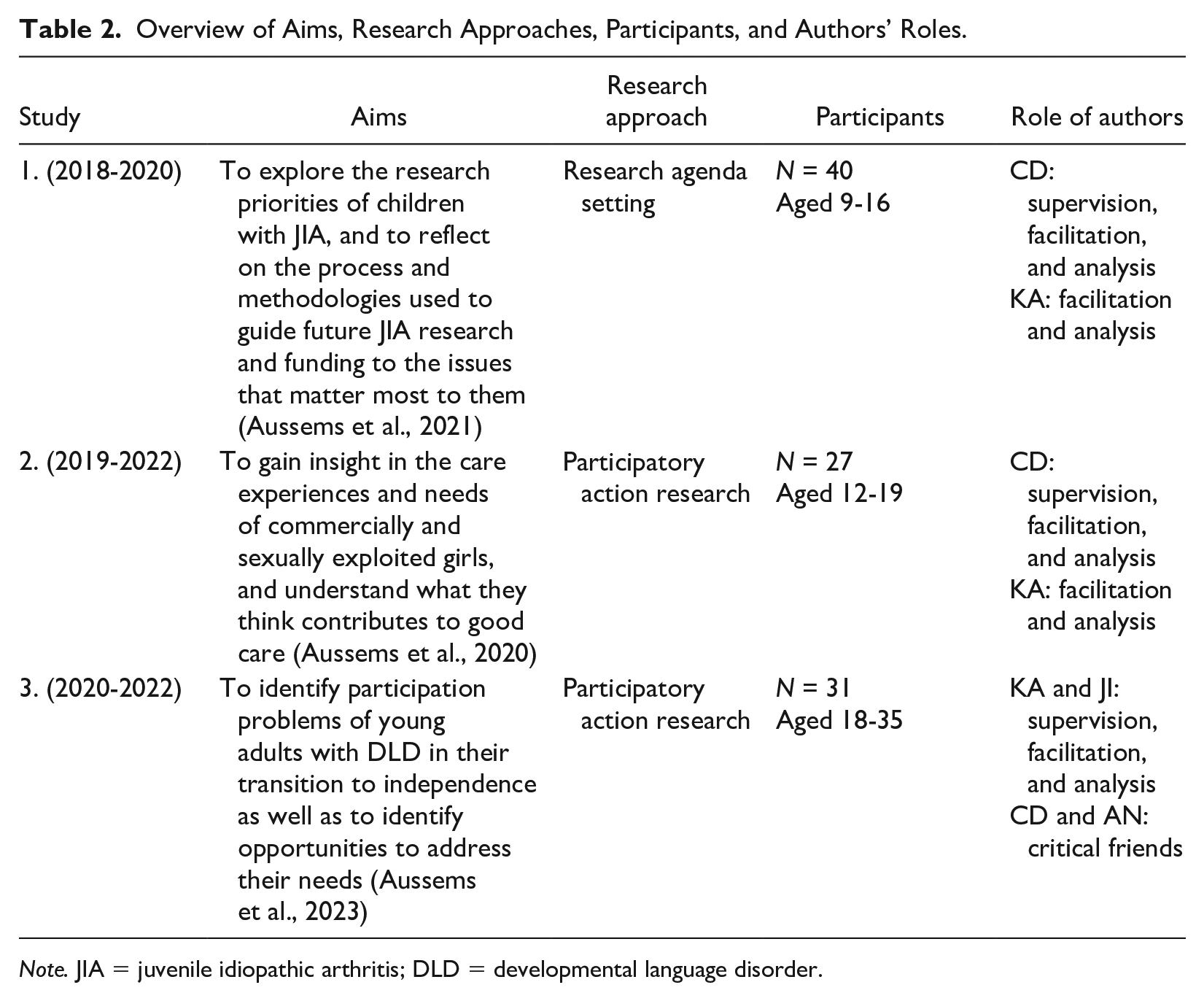
Note. JIA = juvenile idiopathic arthritis; DLD = developmental language disorder.
Research Agenda Setting With Children With JIA
JIA is an autoimmune disease that mainly affects the joints, and impairs children’s capacity for social participation (Tong et al., 2012). In this study, children were invited to join a nationwide James Lind Alliance approach to formulate and prioritize research questions for future research (Schoemaker et al., 2018). Besides exploring the research priorities of children with JIA, the aim was to reflect on the process and methodologies used to guide future JIA research, as well as to improve understanding of how to meaningfully involve children in agenda setting processes. To hear the voices of children, four focus groups and six small (group) interviews were held with children in an exploratory, creative, and conversation-like manner. For more information on the methodology, see Aussems et al. (2021).
PAR With Commercially and Sexually Exploited Girls
In the Netherlands, an estimated 5,000 to 7,500 people are sexually exploited or at high risk, with an estimated one third being girls under the age of 18 (Bolhaar, 2018). The purpose of this study was to gain insight in their care experiences and needs as they live in secured facilities, and to understand what they think contributes to good care. The research project consisted of a 3-day creative program and a local dialogue with the professionals working at the facility. Creative methods were used, such as photography and making artworks from crockery, to create an open atmosphere in dialogue with the professionals and policymakers. For more information on the methodology, see Aussems et al. (2020).
PAR With Young Adults With DLD
DLD causes both immediate and long-term difficulties in learning and using language. In this study, young adults with DLD were invited to reflect on their ways of reaching independency and to call attention to the issues most important to them. Three coresearchers with DLD and three scientific researchers used an iterative learning process of data collection, analysis, and reflection. Besides interviews, various creative means were used for generating data, such as participants sharing drawings, pictures, poems, or any other forms of expression. For more information about the methodology, see Aussems et al. (2023).
Ethical Considerations for the Participatory Research Projects
The researchers used the principles of the International Collaboration for Participatory Health Research (ICPHR, 2013) as a framework for good ethical practice. We refer to Aussems et al. (2022) for an elaboration on how these principles can be used. Furthermore, for the research project with children with JIA, the Medical Research Ethics Committee of University Medical Center Utrecht approved the study and confirmed that it was exempted from the Medical Research Involving Human Subjects Act (WMO). For the research project with girls at the secured facilities, the Medical Ethical Committee of Amsterdam UMC approved the study and confirmed it was exempted from the WMO. For the research project with young adults with DLD, the Netherlands Code of Conduct for Research Integrity (2018) was upheld, as it is integrated in Dutch Royal Kentalis (an organization for persons with communicative and auditory disorders) as guiding principle. Furthermore, the data management plan was approved by the examination board of Deelkracht (a national collaboration of 16 organizations for people with sensory disabilities).
During the research projects, the involved researchers asked participants for their informed consent, either verbally or with a form. In case the participants were minors, their parents were additionally asked for consent. The researchers regularly reminded the participants that they could withdraw their participation and consent at any time without having to give a reason. Furthermore, during the research projects, the researchers were attentive of signs of discomfort and regularly stressed that the participants were free not to answer questions.
As the metasynthesis contributes to the objectives of the research projects, we built on the informed consent that the participants had provided during these projects. We did this with the verbal consent of participants who were still engaged in the (follow-up) projects (children with JIA and young adults with DLD). The girls of the secured facilities could no longer be approached for their engagement, as they were no longer at the facilities.
Positionality of the Authors
As authors, we are conscious of the profound influence that researchers’ positions, roles, and identities exert on participatory research (cf. Milner, 2007). The first author (KA) brings experiential expertise in disadvantaged transition to adulthood and an (inter)national professional background in youth work and policy development, care ethics, and youth participatory action research (YPAR). The coauthors contribute as critical friends (cf. Kember et al., 1997) to the reflective and learning capacity from their professional expertise in disability studies (JI), care ethics (AN), and YPAR (CD). Notably, we identify as white and diligently acknowledge our privileges and biases. We commit to recognize and address our positionality and to pursue inclusive research to the best of our ability.
Metasynthesis
During the metasynthesis of the data of three PAR projects, we aimed to do justice to the unique capabilities, circumstances, and dreams of each participant, while seeking overarching themes of how society complicates their pathways to self-actualization, and in doing so to help align policies and interventions with their daily realities and needs. Metasynthesis is a dynamic and inherently challenging process that includes thorough analysis of the theoretical, methodological, and contextual aspects of multiple research reports (Barroso & Powell-Cope, 2000; Bondas & Hall, 2007; Thorne et al., 2002). Synthesizing multiple qualitative research projects can provide more profound insights and understanding that may not be recognized in a single study (Erwin et al., 2011).
The first author (KA) started by bringing together all open-coded data of the three research projects (which included coded transcripts, Jamboards, WhatsApp messages, and fieldnotes for each of the research projects). These open codes were used for axial coding using Word documents and comments and led to the first identified themes: disadvantages, labeling, survival tricks, and needs for self-actualization. During the axial coding of the research data, relevant literature on the identified themes was consulted. KA shared the first themes with CD, JI, and AN. The research team compared the identified themes to Giddens’ concepts of self-identity, emancipatory politics, and life politics and selected these as sensitizing concepts for the thematic coding. These phases were not a linear process, but were done iteratively with the support of monthly Zoom meetings lasting 1 hour and one-on-one dialogues (September 2022-February 2023).
While the participants’ citations have previously been included in publications of each separate PAR project, the research team decided to integrate these again in the results section of the metasynthesis. The citations provide vividness for the perspectives of the participants, deepen the readers’ understanding, and confirm the accuracy of the analysis (Corden & Sainsbury, 2006). The results and discussion were shared with three coresearchers with DLD as well as a young adult with JIA to ensure critical analyses from the perspectives of disadvantaged young people.
Results: Young People Navigate Between Self-Identity and Stigma
The metasynthesis helped to illuminate disadvantaged young people’s navigation between self-identity and stigma toward self-actualization. To define how these young people seek to remain authentic in their transition in contemporary society, Giddens’ concepts of emancipatory politics and life politics needed two additional concepts: identity politics (“this is how you should know us”) and care politics (“this is how you should treat us”), see Table 3 for an overview.
Overview of Giddens’ Concepts on Self-Identity and Two Additional Concepts That Emerged From the Metasynthesis.
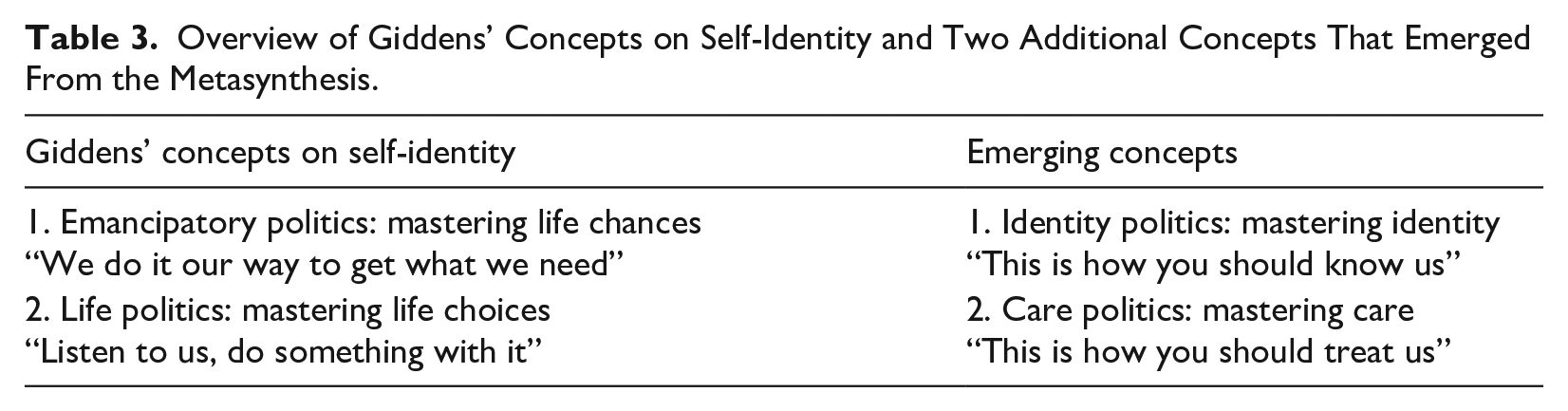
For both identity politics and care politics, we first formulate the difficulties that the participants encounter in daily life as a consequence of either JIA, DLD, or sexual exploitation. Next, we present how they master their life chances through emancipatory politics and how they master life choices through life politics. This includes their advice how others can understand and help them to take part in an accelerating society as their true selves.
Identity Politics: “This Is How You Should Know Us”
In all three research projects, the participants discussed how JIA, DLD, or sexual exploitation has affected their interaction with others, how these others look at their disadvantages, and how they personally practice identity politics in their navigation between self-identity and stigma. They provided insights into how they work around stigma (emancipatory politics: mastering life chances) and how they prefer to be identified (life politics: mastering life choices).
The young people often feel disadvantaged in their socialization with others, as they are expected to participate at a pace that that they deem too fast. The young adults with DLD struggle to understand others and to express themselves, as Maaike explains: “Our brain is constantly at work because language is everywhere. People without DLD don’t have to think about what they say. People with DLD do this all the time.” For children with JIA, the environment is not always well adjusted to their pace, like for Thijs (15) at school: “You have three to five stairs. . . . At the end of the day you feel your knee. [I don’t use the lift] because . . . it takes long before the lift arrives.” Their social interaction is also challenged by pain. Bas (10): “I’ve quit playing soccer. . . . Every week crying on the sideline because I felt so much pain.” The girls at the secured facility regret they are only permitted limited time to speak with people who are close to them. They feel tense when they are closely watched in their social interaction. Shalina (15) explained: “Closed [facilities] make people worse . . . it makes you crazy and aggressive, then you are ten times worse.” 2
Most participants referred to feeling stigmatized because of people’s misjudgment and underestimation of their capabilities and disadvantages. Children with JIA spoke of people who make unsolicited comments and blame them for attention seeking and laziness. Eline (16): “I’ve been told that I’m an attention seeker. They didn’t understand that I suffered a lot and that I was sick very often.” Janet (12) added: “If you’re firstly in your wheelchair and then you get out, people look strangely at me, think it’s fake. . . . Sometimes people say that I’m lazy.” Young adults with DLD often addressed they missed other people’s awareness and understanding for their disorder. Mea (29) is pessimistic: “DLD will always remain something misunderstood.” They feel underestimated, like Evelien (34): “People think you’re ‘stupid’ . . . while we just need some more time to process information.” The girls at the facilities also addressed how they feel misjudged. They disapprove of being called “victims of loverboys” (a Dutch term often used for commercially and sexually exploited girls) and “criminals”. Saïda (17) feels like a prisoner because of being locked up and because of her negative image: “When I go home, local people look down on me. They think we’re criminals. . . . [The facility] is too much like a prison.” They blame people’s ignorance for their negative image, even among their group leaders. Hayat (14): “They can have an opinion about it [i.e. having been involved in sexual exploitation], but they don’t know what it is about, because they haven’t walked in our shoes.”
Mastering Life Chances: Working Around Stigma
The participants discussed how they work around stigma, such as withdrawal by keeping quiet about their difficulties and staying away from people who misjudge them, and by socializing with people who are patient enough to try to understand them instead. Children with JIA, to begin with, often fear that opening up about JIA in their lives could work against them. They have the feeling that to avoid criticism, they need to pretend as if JIA does not affect them. Tessa (15) reflected: “I’m quieter at school, can’t really focus, find it very difficult to speak with friends about it. I don’t want to seem like I want attention.” Furthermore, young adults with DLD often struggle to take up space in company. Mikan (32): “If it’s an uncomfortable situation, then I put myself in the background. I don’t leave but I do block myself very much. Then I’m quiet.” Some girls at the facilities also remarked that to keep strong, they must hide their true selves. Khadija (16): “We don’t cry, we don’t show our emotions.” Some also mentioned they withdraw, feeling unsafe to mingle because group leaders discourage their interaction. Saar (15) recalled a comment by her mentor: “You are bad together and must not interact, you are a bad influence [on each other].”
To work around stigma in their socialization with others, most young people seek to socialize with people who are patient enough to listen and to show understanding and support: I usually relate very well with people who have gone through the same [experience]. . . . [Like my mentor] Vera. She often comes to my room before I go to sleep and then we talk for a long time, and then she also tells me her stories. (Sterre, secured facility, 13)
Eline (16, JIA) values her friend’s support: “She always asks how I’m doing and what I’ve done. . . . I’ve always appreciated it.” According to Mikan (32, DLD), understanding is required for respect: “Only people who will understand me, they are open to me, they at least respect me.”
Mastering Life Choices: Dialogue on Identity
Participants often expressed—from wishes to strong demands—that people need to acknowledge and understand who they truly are. For the children with JIA, this starts with their need to understand JIA better themselves, as they had a lot of unanswered questions, including whether JIA will determine their future, and how one can cope with pain and fatigue in daily life. They called for more research to be done that can help them understand the influence of JIA on their lives. The participating young adults with DLD and girls in the secured facility, on the other hand, seemed more convinced how DLD or their history of sexual exploitation is part of their self-identity. Most young adults with DLD could explain well what DLD is and how it affects their lives. One thing they discussed often is how they themselves and others should call them. Who really has DLD? Is verbal dyspraxia also a form of DLD? And if you are diagnosed with DLD, are you a DLD’er (TOS’er in Dutch, written by a participant as “tosser”)? Or is it only something one has? Meike (30) was outspoken: “I’m not only my DLD. I’m not a DLD’er, but I’m Meike.” The girls at the facilities expressed similar sentiments in their dialogue with professionals. They did not want to identify themselves as “being” a specific group. Lea (17) proposed: “Call us by our name” because “everyone is different” (see Figure 1). The only thing they share, according to Khadija (16), is that they all have “problems”.
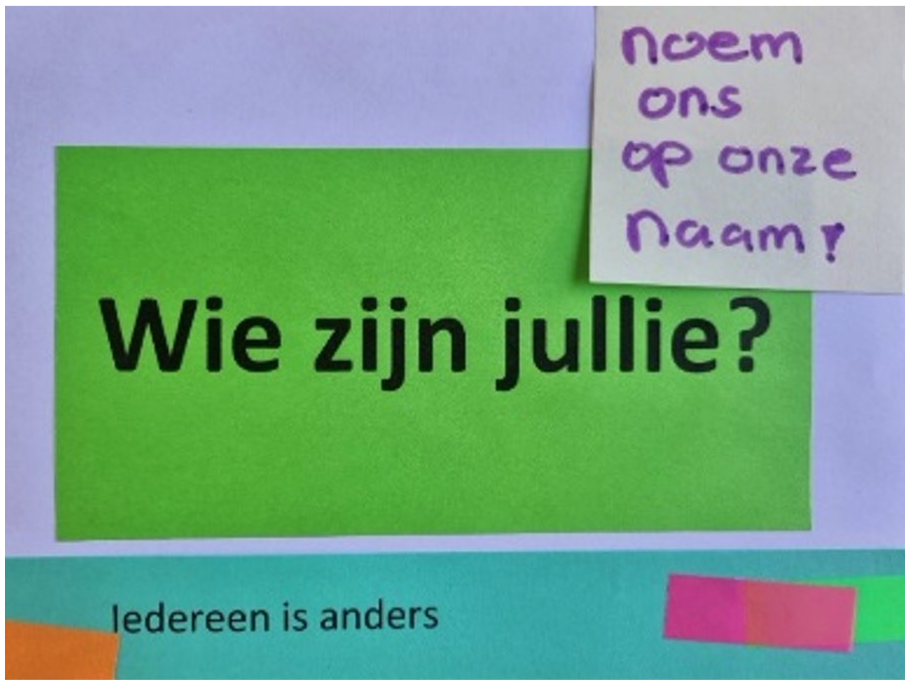
During a Validation Session, Girls at the Secured Facilities Expressed How They Want to Be Seen (“Everyone Is Different”) and Named (“Call Us by Our Name”).
In sum, the young people practice identity politics when they feel that others underestimate their capabilities and disadvantages, and expect them to “act normal”. First, identity politics includes their mastering of life chances by pretense and withdrawal to avoid discomfort and criticism. Second, identity politics also includes their participation in the research projects where they master their life choices by speaking up how they want others to know them.
Care Politics: “This Is How You Should Treat Us”
The participating young people felt limited to be themselves by both explicit and implicit rules and regulations, and practice care politics in their search for support so that they can be more authentic in their self-actualization. They gave examples of how they work around disadvantages in difficult situations (emancipatory politics: mastering life chances), as well as how they call for improvements in dialogue with officials (life politics: mastering life choices).
They often expressed regret that their environment is not helping them to independently manage their daily lives. The girls at the secured facilities, to begin with, expressed frustration that they have to obey strict rules and regulations, and that group leaders do not allow them to make decisions for themselves. Sterre (13): “They decide what we wear, they decide what we eat, they decide what tasks we do, they decide when we clean, they decide when we go outside, and they decide where my bed is in my room.” The children with JIA also talked about how they feel limited in their weekly planning, partly because of fixed school schedules. They wished for longer weekends to recover from school and an alternative for missed classes due to their regular hospital visits. Bo (11), for instance, disliked her monthly IV-drips: “I have to miss the whole school day and that isn’t so nice.” Last, the young adults with DLD often grappled with their administrative issues while trying to live independently. Maartje (25) wanted to manage her administration herself, but got lost on the local council’s website: “The website of Rotterdam council has too many choices. You have to go through complicated steps, with DigiD [digital identification], with many diversions, to get an answer to your question.” Accessing professional support was often experienced as too complex: I’ve been registered [for professional support] for over six months now. . . . We wait for another two weeks and then we have to call the local council again . . . Then we have to go to MEE, the foundation that can help me. . . . But there is a waiting list for that, too. (Cindy, 29)
As an alternative, they often rely on parental support. Jérôme (29) disliked his parents’ involvement with his finances: “[My parents] can also look at my account . . . and that is not always fantastic. . . . They don’t need to know when I buy a present for my partner.”
The participants often narrated situations in which they were limited to be themselves because others were not attentive, did not adjust to their pace, and made decisions for them. The children with JIA mentioned that their parents often decide what they can do, for example, on education and sports. Freek (12): “I’m not allowed to try out many things because my parents don’t want that. They also don’t want me to do the gymnasium [grammar school].” They felt confused about what the reasoning behind such decisions is, like for Jesse (10): “I was allowed to do judo and it hurt a lot and I quit. I don’t understand why I was allowed to do judo but not soccer.” The young adults with DLD regularly addressed that others go too fast for them to keep up. Simone, for example, believes that “The speed of the world is like a rocket.” Jérôme (29) had to quit his bachelor studies because of the fast pace: “It [went] just a bit too fast for me. It’s often difficult to say this.” Girls at the secured facility also grapple with the fast pace. They felt that their group leaders were too impatient to let them practice skills. Hayat (14): “Group leaders don’t listen, don’t let you finish your sentence. . . . I’ve learned that [group leaders] . . . prefer to [avoid our] mistakes.” Also in their locked private bedrooms, they feel restricted. Sterre (13): “Sometimes you’re in your bed, listening to music, and then the group leader starts talking through the intercom and then you’re just terrified . . . . Then they say be more quiet.”
Mastering Life Chances: Working Around Disadvantages
The participants regularly mentioned how they work around their disadvantages, such as by pretense and resistance. They felt that they need to pretend, either to avoid criticism or to get something done. Children with JIA spoke up how they sometimes feel that others push them to pretend that JIA does not affect them, just to avoid negative responses. Julia (12): “I have problems with my arm if I write; they say I do it on purpose because I don’t want to write.” The girls at the secured facilities often brought up they need to pretend, not only to avoid criticism, but even more to earn their freedom. Saar (15): “You just act like a lapdog, then they give you more freedom . . . If you cry and act like a victim, you get out of here sooner. If you are honest, you won’t get out.” And Hayat (14) felt that having the space to lie is important for the relationship: “Professionals should trust us, even if we lie, because we need to feel they believe in us.” Some young adults with DLD also felt they need to pretend to get the support they need, including social support from their local council. One of the participants with DLD recalled: “I looked neat and tidy in high heels. Little did I know that I shouldn’t come in like that. . . . The job coach said: Are you applying here? Because you don’t need any help.” During the focus group discussion, the young adults with DLD joked that they should avoid making a good impression: “If you want to apply for support, don’t do your hair up and wear sweatpants, that way you will get it done faster” (see Figure 2). According to co-researcher Meike (30), this is not about being honest, but about deciding what you say and what you keep to yourself.
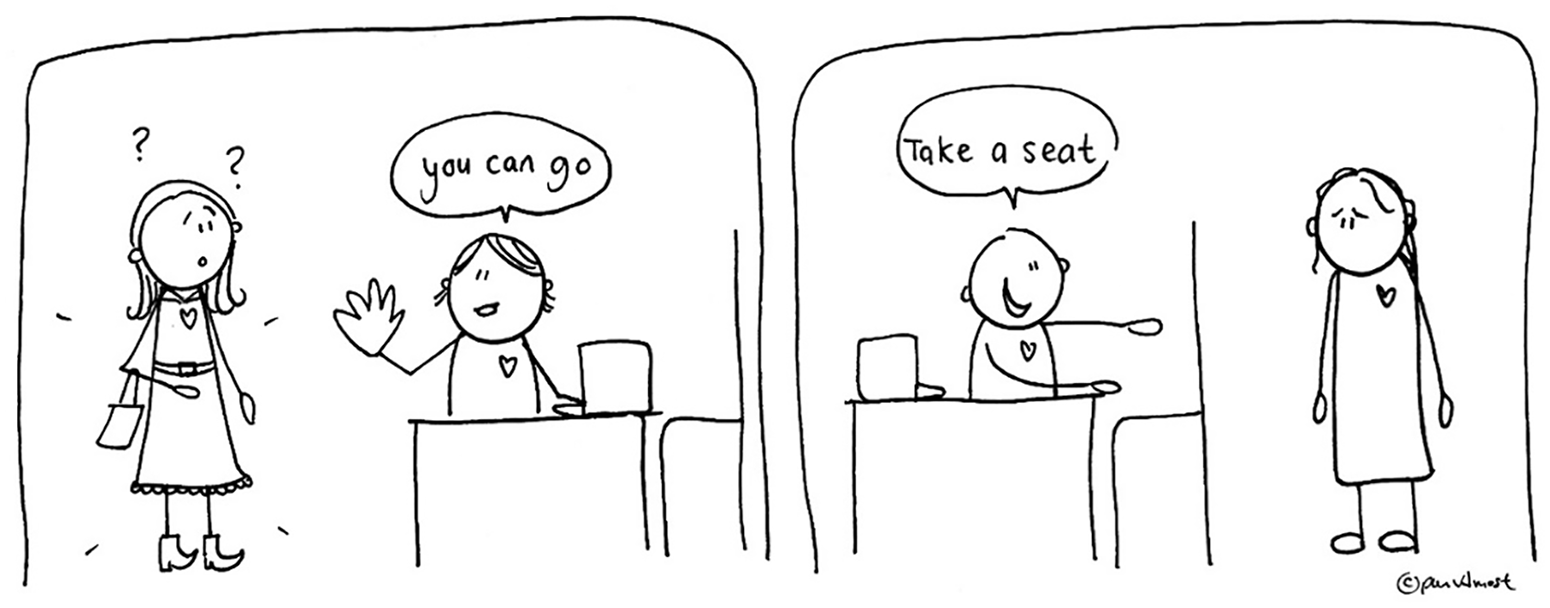
Young Adults With Developmental Language Disorder: Experience They Should Avoid Making for a Good Impression When Applying for Support (Graphic Storytelling by Pien van der Most).
In some cases, the participants chose resistance over pretense. A few times the girls at the facility and the young adults with DLD expressed how they rejected other people’s attitudes and actions toward them. Sterre (13), for instance, ignored instructions of her mentors: “They say: at home you must work and stick to your daily schedule, but let me be honest . . . [During my leave] I don’t wake up at the time you wake me up here.” Furthermore, several young adults with DLD mentioned they walk away from people when they feel disappointed. Selma (34) often does this when she feels misunderstood: “I explain three times first and then if you still don’t understand, I go and see someone else. . . . Then I don’t need you in my life.” Maartje (25) was furious when a foundation for people with low literacy refused to involve her in advising the local council how to improve their website: “They say DLD doesn’t have to do with reading and writing. . . . I don’t get it that they’re not willing to talk with us. Do they think people with DLD aren’t smart enough?” She refused to give up and felt even more determined to find ways to bring the needs of people with DLD to the attention of the local council. The children with JIA, on the other hand, did not speak of moments at which they resisted limits that others imposed (such as not being allowed to play soccer), but some mentioned situations in which they worked around their physical limits. Erik (13), for example, chose to play computer games and to take the worsening pain for granted: “[Afterwards] I lay on my bed or do something else.”
Mastering Life Choices: Dialogue on Dependency
During the research projects, participants often criticized the limited power they have in their daily lives. Diva (16), for instance, expressed that she did not feel heard at the secured facility: “Nobody listens to me. Or if they listen to our plans, then they say that it’s nice. But how does it help? Afterwards nothing’s done with it.” In each research project, the participants were all invited to propose solutions to professionals and policymakers. Hayat (14) advised group leaders of the secured facilities to give more room for young people to practice: “I do think that it’s wise when a youth still makes a mistake, so they learn how to deal with it instead of everything going perfect.”
How the girls wanted to be seen and treated was situational. Saar (15), for instance, criticized “children’s bedtime” as a punishment at the secured facility, because “we are not 5-year-olds.” But in discussion about their duties, she exclaimed that “[professionals] should not forget we are still children.” Such dialogues with professionals, Springer (15) reflected, enabled her to negotiate with them. She proposed less strict clothing rules, such as allowing shorter skirts that reach five instead of three fingers above the knee. Afterward, she felt satisfied for being heard: To be honest, some things, I think, won’t get done. But I liked speaking [to the professionals], because then they can consider it. But some things, looking at [the professional], I see some things can change. . . . It is a proposition, and asking is allowed, asking doesn’t hurt. You get an answer or you don’t get an answer. But you can always try, right?
The children with JIA proposed solutions for their limitations, to begin with more research to gain insights into JIA and its impact on their lives, including their future opportunities and how their lives could be made easier. Ruba (15): “Could they invent a way that enables me to open the lockers at school more easily?” They jointly presented their top priorities for research to the board of the Dutch JIA Patient and Parent Organization, who integrated their priority list in the final research priority setting. Finally, the young adults with DLD participated for 3 years in various activities to reflect on their experiences and to express how others can be more supportive. They contributed to making a brochure about DLD and how others can offer support. For instance: “Accept that it can be difficult for us to have a good conversation. Take time to understand us, and ask questions if you don’t get what we say.” Maartje (25) posited that society must take up this responsibility so that she is not made vulnerable: We’re not vulnerable, but it’s society that makes us vulnerable. I’m Maartje. I have a disorder, but that doesn’t make me a victim. It’s society that makes life with DLD difficult. Because I know how I can help myself in society, tips and tricks, you know. It’s only that society must be flexible to support young people so that they can take part.
In sum, the young people practice care politics when they feel that society does not provide an environment that enables their self-actualization. First, care politics includes their mastering of life chances by pretense to get the care they need. Second, care politics also includes their participation in the research projects where they master their life choices by speaking up how they want others to treat them.
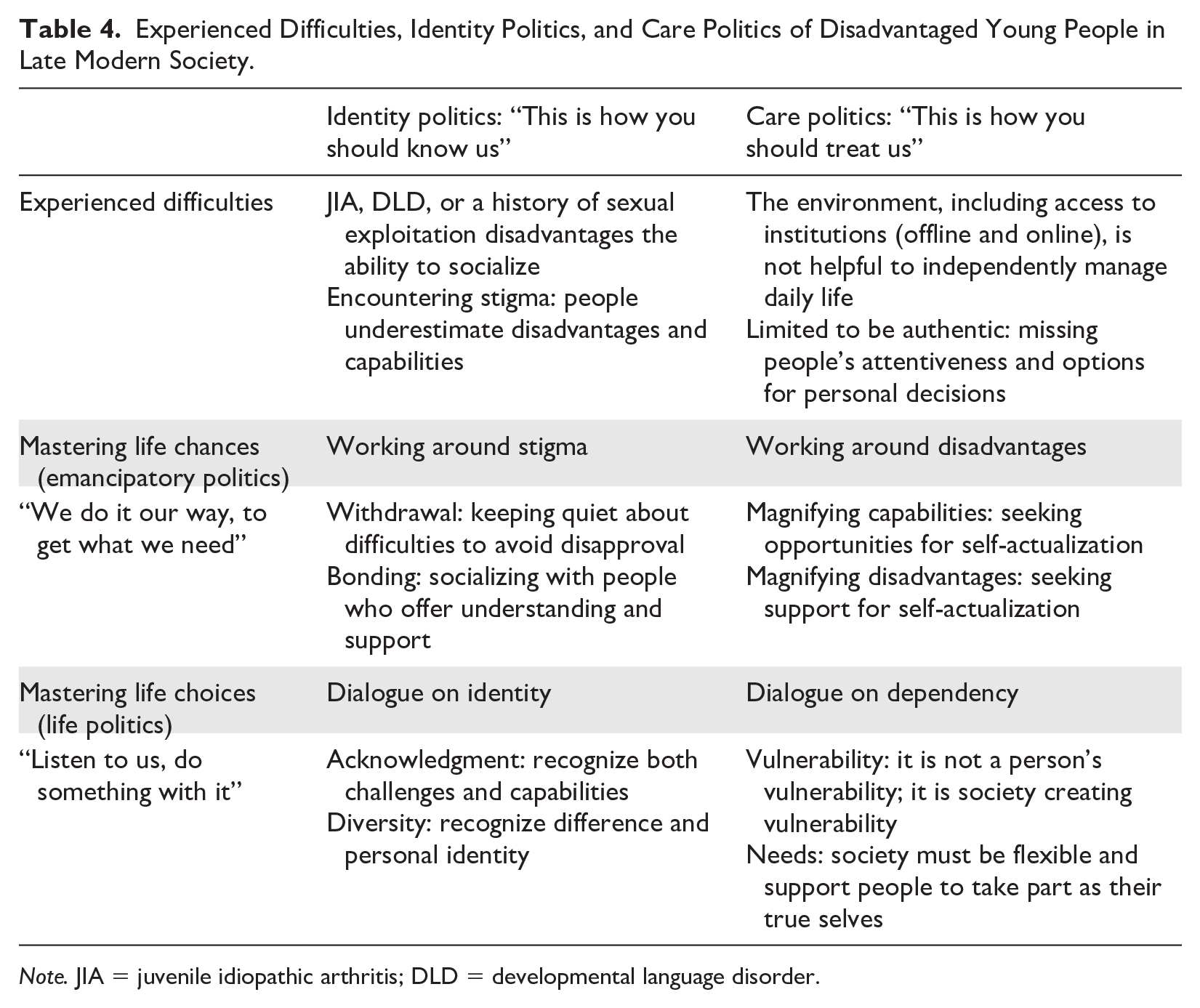
Table 4 provides an overview of the experiences of the 98 disadvantaged young adults with their difficulties, and their identity politics and care politics for their pathways to self-actualization.
Experienced Difficulties, Identity Politics, and Care Politics of Disadvantaged Young People in Late Modern Society.
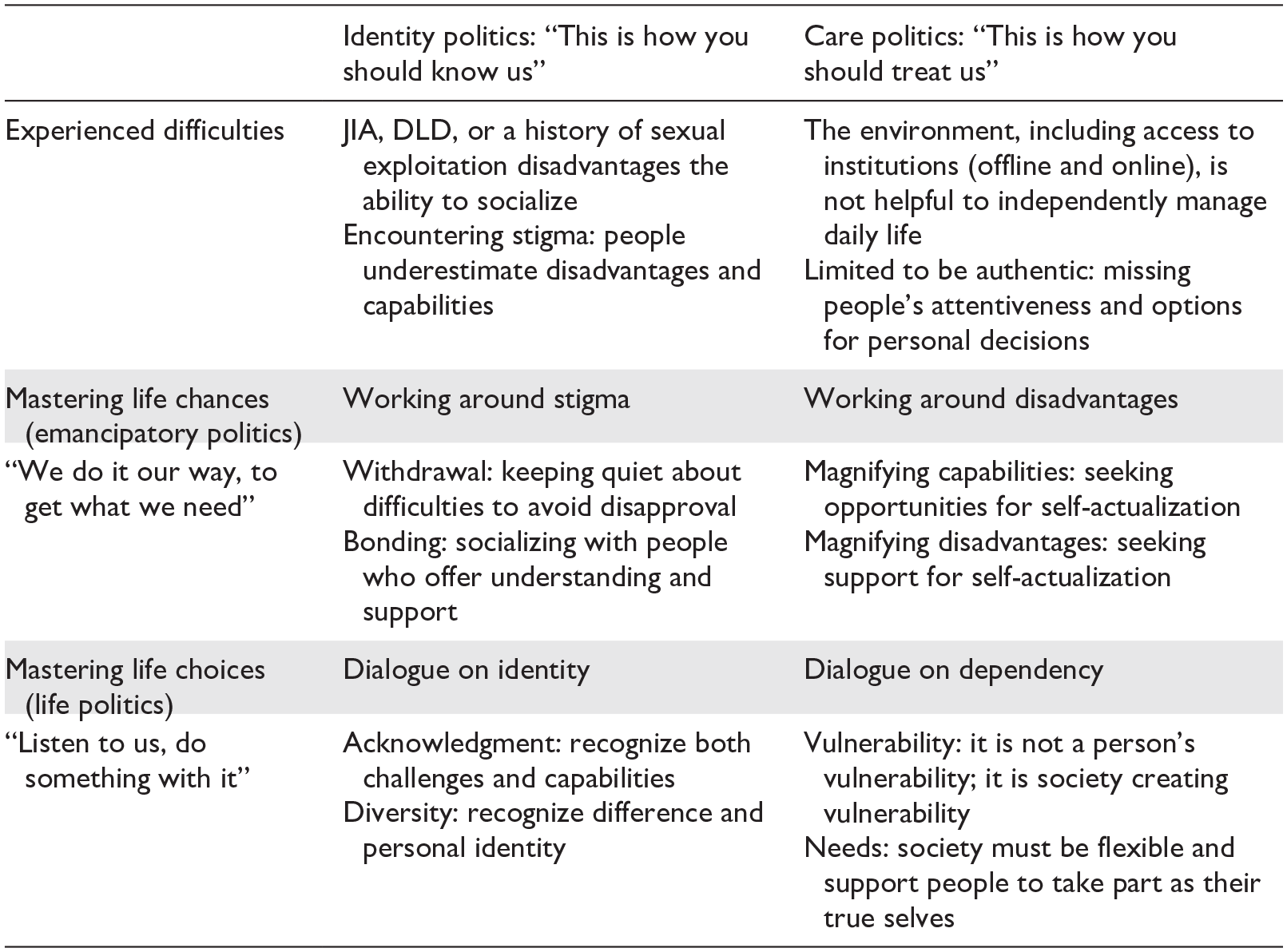
Note. JIA = juvenile idiopathic arthritis; DLD = developmental language disorder.
Discussion
The purpose of this article was to provide insight into how contemporary society complicates pathways to self-actualization for disadvantaged young people, and in doing so to help align policies and interventions with their daily realities and needs. For the metasynthesis of three PAR projects with 98 young people with JIA, DLD, or a history of sexual exploitation, Giddens’ (1991) concept of self-identity in late modernity was used for the recognition of the paradoxical interplay between individuals (with increasing choices) and institutions (with increasing control). The identified themes of identity politics (mastering stigma and identity) and care politics (mastering disadvantages and dependency) portrayed two dominating paradoxes of the “participation society” in which disadvantaged young people must function.
The first paradox of the participation society concerns the social acceleration that disadvantaged young people are facing, while they prefer a slower pace. They are confronted with expectations of participation and self-actualization at a pace that they deem too fast. For example, girls at the secured facility miss time and space to make mistakes for practicing life skills, children with JIA feel that the weekends are too short to recuperate after the school week, and young adults with DLD miss people’s patience for them to express themselves well. Giddens, building on Laing (1965), defined this as ontological insecurity, the difficulty to confidently live and socialize. These young people feel confronted with the imposed contradicting labels of “being independent” and “being incapable.” Neither label fits them, nor the demand to participate in contemporary society. They feel they need to magnify their capabilities to get opportunities for self-actualization (such as more freedoms in a secured facility), and to magnify their disadvantages to be acknowledged as “care-dependent,” a prerequisite to be eligible for professional support.
Giddens’ concept of sequestration of experiences (people’s need to conceal their realities) was useful to recognize the paradoxical predicament of feigning both capabilities and disadvantages to get what they need to be their authentic selves in the fast-paced society. The young people often recounted both felt stigma and enacted stigma (Scambler & Hopkins, 1986): They feared that others would stigmatize them and narrated lived experiences of discrimination that they assumed were “solely on the grounds of their social unacceptability” (Jacoby, 1994, p. 270). On a daily basis, they practice, as we call it, identity politics: They navigate between self-identity and stigma. Scholars have formulated a multiplicity of meanings on identity politics before. Sociologist Anspach (1979), for instance, defined identity politics of “the disabled and former mental patients” as “social movements which seek to alter the self-conceptions and societal conceptions of their participants” (p. 765). The additional value of our concept of identity politics is that it builds on empirical research, unlike Anspach’s work that she defined as “exploratory and speculative in scope” (p. 766). Moreover, our concept sheds light on young people’s conscious effort to be seen in a way that could help them to get what they need to keep up in the fast-paced society.
Development scholar and advocate for citizen participation Robert Chambers (1997) calls upon powerful people in accelerating societies to improve their appreciation of the realities of disadvantaged people. In Whose Reality Counts? Putting the First Last, he proposes “a high ground of reversals of the normal” (p. 190), in which policymakers and professionals are no longer the first but last to speak. People in powerful positions need to be patient and build trust in communities for the disadvantaged, so to feel comfortable to share their realities. Only then can policymakers and professionals learn from the realities of the disadvantaged, and learn how to remove obstacles in bureaucratic institutions to enable positive change. Even though Chambers wrote his work 25 years ago, the same call strongly echoes in the works of more recent social scholars (cf. Abma et al., 2019; Dedding et al., 2023; Fricker, 2007) and matches with the desire among disadvantaged young people that was identified in the metasynthesis of the PAR projects, namely to disclose their realities, their identity, at their pace.
Next, disadvantaged young people are having to face a participation society that paradoxically creates both moral and bureaucratic barriers for self-actualization. The transfer from a welfare state to a participation society was supposed to encourage people’s involvement and to reduce expenses (Blijleven & Kooiker, 2022), but has become costly for people without stable social capital (Centraal Bureau voor de Statistiek, 2021). Our metasynthesis highlights the issues that disadvantaged young people face in mastering chances and choices, with limited moral and financial support. They do not only pretend, but also socially withdraw to conceal their realities to control their problems. For instance, the girls in secured facilities keep their thoughts to themselves so that professionals cannot use them against them, children with JIA stay silent about pain to avoid being blamed for seeking attention, and young adults with DLD withdraw socially to avoid misunderstandings and bullying. In other instances they negotiate, like the girls who negotiate for more freedoms at their institutions, the children with JIA who propose more flexible school schedules, and the young adults with DLD who negotiate for more personal guidance in independent living. Here these young people practice, as we dub it, care politics in their search for authenticity and self-actualization.
While Giddens appreciates the mastery of disadvantaged people in an accelerating society to control their lives, policymakers cannot expect the disadvantaged to master these challenges solely with the support of their private social network. Giddens’ concept of individuals’ mastery and government control has faced criticism for its dualism (cf. Archer, 2010; Seguin et al., 2020; Stones, 2017). Scientists have shifted toward perceiving society as an open and indeterminate social network where citizens continuously and mutually shape their identities through interactions (King, 2010). Indeed, young people cannot just solely master their challenges, and policymakers cannot solely develop rules and regulations that match with the realities of the disadvantaged young people. Instead, policymakers need to create platforms for dialogues where the realities of the disadvantaged are taken seriously.
Therefore, dialogues must extend beyond private networks—from care institutions, local councils, the Dutch parliament, the European Commission, all the way to the UN general assembly in New York. Suitable policies call for participation from “societal resilience,” where community members depend on one another, toward involvement in “network governance” where citizens and (government) institutions work together on shared public aims (Blijleven & Kooiker, 2022; Osborne, 2006; Torfing et al., 2020; Van der Steen et al., 2015). Policymakers should not just tick “the empowerment box” in their reports (Chambers, 1997), but aim for cocreation of policies that shape the lives of disadvantaged people. This requires policymakers to be sensitive to the perceptions, feelings, and concerns of these people, and to understand that their actions contribute to the (absence of) stigma in the lives of disadvantaged people. Bringing about change requires empowerment as an ongoing interactive learning process between the most powerful and the most disadvantaged (Chambers, 1997; Dedding et al., 2023; ICPHR, 2013). This means slowing down the pace of the interplay between policymakers, professionals, and disadvantaged people, rather than discouraging them with unrealistically high demands. Only this can prevent them from being trapped by the so-called juggernaut of a social accelerating society.
Giddens’ call for more political engagement as a solution to the juggernaut requires investment in possibilities for meaningful youth engagement, not only locally but also (inter)nationally. In this case, the metasynthesis of three local projects served for macrolevel reflections on the complicated pathways to self-actualization in an accelerating society. The situational character, time-consuming learning process, and financial limitations of participatory studies (Dedding et al., 2020) formed barriers to overcome, especially for a metasynthesis, as it was an intense and challenging process within the available timeframe of the research team (Barroso & Powell-Cope, 2000; Thorne et al., 2002). Social and governmental institutions therefore need to consider a stronger investment in local PAR projects and metasyntheses to enrich abstract societal debates about the participation of disadvantaged young people, and for policymakers and professionals to utilize these as constructive sources for their responsiveness to their realities.
Certainly, all three projects were, in their own way, a step toward doing justice to the self-identity of disadvantaged young people, to acknowledge them as they are. While we aimed to do justice to the unique capabilities and dreams of each of the 98 participants, they have been approached and analyzed as a constructed group. We recognized similarities within each group and between all three groups. Acknowledging the limitations of different levels of participation, the metasynthesis of the three research projects clearly shows that the participants want their realities to be recognized rather than sequestrated. Disadvantaged young people long for more space for authenticity: for who they are, what they can and cannot do, and what support they need. They call upon professionals and policymakers at all levels to recognize their multilayered self-identities and to provide a supportive environment that is adjusted to their pace, so that they can belong, and genuinely participate as their true selves.
Implications for Practice
People need to take time to familiarize themselves with the daily realities of young people and appreciate the way they want to be known and treated.
Professionals must include young people more in decision-making on topics that touch upon their contextual support needs for self-actualization.
Authorities depend on young people’s experiential expertise to understand how they can build on their capabilities for genuine engagement and self-actualization in the participation society.
Authorities must invest in local PAR projects and meta-reflections with young people for meaningful societal dialogues about their support needs to bring about positive change at various levels.
Footnotes
Disposition editor: Cristina Mogro-Wilson
Declaration of Conflicting Interests
The author(s) declared no potential conflicts of interest with respect to the research, authorship, and/or publication of this article.
Funding
The author(s) received no financial support for the metasyntesis, authorship, and/or publication of this article.
