



Abstract
Child abuse and neglect (CAN) is a complex issue that is subject to both under- and overreporting; yet, research into the underlying neighborhood-level drivers of these practices remains limited. The current study gathered perspectives from 30 child protective service (CPS) workers and agency leaders in Southern California neighborhoods to identify perceptions of social and contextual neighborhood factors that might influence over- and underreporting of CAN. The data were analyzed using a grounded theory approach, which revealed five themes: (a) neighborhood conflict, (b) neighborhood fear and mistrust, (c) neighborhood norms, (d) poor CAN reporting knowledge, and (e) mandated reporters’ discretion. These themes highlight the potential impact of neighborhood contexts and social dynamics on CAN reporting practices, emphasizing the need for prevention and early intervention neighborhood-level initiatives that improve CPS relationships within their local community.
Keywords
Introduction
Child abuse and neglect (CAN) is a grave public health and social issue in the United States. Recent data from the U.S. Department of Health and Human Services (USDHHS et al., 2021) show that about 1,800 children and adolescents died from child maltreatment, with an additional 600,000 who were victims of abuse or neglect. Research indicates that child maltreatment is closely associated with an elevated risk of various mental health disorders, suicidal tendencies, physical health problems, cognitive impairment, drug use, and risky sexual behavior, all of which can severely hinder healthy child and youth development (Irigaray et al., 2013; Norman et al., 2012; Vilariño et al., 2022). The long-term impact of CAN experiences results in a “cascade of consequences” (Widom, 2022) that increases the likelihood of subsequent revictimization (Coid et al., 2001; Perrigo et al., 2018), harms long-term economic well-being (Currie & Widom, 2010), and can also result in epigenetic profiles for post-traumatic stress disorder (Mehta et al., 2013).
Child protective service (CPS) agencies in the United States receive a significant volume of reports, also referred to as referrals, about suspected cases of child abuse or neglect. In 2021, CPS agencies received approximately three million referrals of suspected CAN affecting children (USDHHS et al., 2021). While referrals to CPS agencies are made with the intent of protecting children from abuse and neglect, not all claims are substantiated. Despite the possibility that child abuse or neglect may have occurred, there may be insufficient evidence to confirm specific allegations. Conversely, some referrals may be made for situations where abuse or neglect has not actually taken place. In fact, 48.5% of referrals across 46 states reported to the federal government were screened out (USDHHS et al., 2021), raising questions about potential contributions of inaccurate CAN reporting. Of additional concern, referral rates vary significantly along the lines of race, class, gender, and immigration status (Putnam-Hornstein et al., 2013). These discrepancies highlight the need for a more nuanced understanding of how to properly identify and report situations of CAN.
Due to the importance of intervening in situations where CAN has occurred, it is critical to assess why instances of child maltreatment are not always accurately captured. Historically, researchers have raised concerns about both under- and overreporting of CAN in the child welfare system (Lane & Seltzer, 2023; Webster et al., 2005). Underreporting occurs when abuse or neglect fails to be reported when it is occurring, and thus does not receive intervention. In contrast, overreporting occurs when abuse and neglect are reported but have not actually occurred. In both situations, imprecise reporting of CAN poses significant challenges both to families and to the child welfare system itself. Despite studies showing that CAN is both under- and overreported (Sedlak et al., 2010), there is limited research on underlying drivers of this phenomenon. Further investigation is necessary to address this gap in the literature.
The inherent subjectivity in how an individual defines child maltreatment may complicate how child maltreatment is not only understood but also how it is recognized and reported (Coulton et al., 2007). In addition, there is great variation in who makes a CAN report. Although all citizens can make a child maltreatment referral, the majority (67%) of CAN referrals were submitted by professionals who are mandated reporters such as educators, physicians, mental health practitioners, law enforcement officials, and social services personnel. In contrast, nonprofessional reporters such as parents (6.5%), other relatives (6.2%), and friends and neighbors (3.9%) make up a much smaller percentage of reports. The remaining 16% of reports come from anonymous sources (USDHHS et al., 2021).
CAN Overreporting Drivers
Studies indicate that heightened surveillance of certain groups, such as children and youth from ethnic and racial minority groups, and specific geographic areas, can contribute to child maltreatment overreporting practices (Cort et al., 2010; Coulton et al., 2007; Fluke, et al., 2023; Font et al., 2012; Pelczarski & Kemp, 2006; Putnam-Hornstein et al., 2013). Factors like residential instability, poverty, high percentage of single-parent households, and unemployment have been linked to increased neighborhood-level CAN referrals (Coulton et al., 2007; Klein & Marritt, 2014). When CAN is reported in situations where referrals are not warranted, families who are the subjects of CAN overreporting may suffer serious negative consequences. This is particularly true for Black families who are already overrepresented in the child welfare system (Putnam-Hornstein et al., 2013). CPS overinvolvement can interfere with parental authority, hinder children’s ability to form social relationships, and reduce neighborhood cohesion (Roberts, 2008). Families may undergo unnecessary screening and interviews, experience discrimination, and develop a negative perception of the CPS system. Furthermore, the CPS system itself may be unduly burdened by overreporting, making it more difficult for CPS workers to respond to genuine CAN concerns in a timely manner. This results in the consumption of valuable resources, including monetary resources and CPS workers’ time. Therefore, it is crucial to address the issue of CAN overreporting to ensure that families receive the necessary support and resources while also preventing the consumption of valuable, needed resources in the CPS system.
CAN Underreporting Drivers
Most research on the drivers affecting CAN reporting has focused on underreporting by mandated reporters (Eads, 2013; Gubbels et al., 2021; Lazenbatt & Freeman, 2006; Mathews et al., 2013; Mostovoy et al., 2022; Webster et al., 2005). These studies indicate that mandated reporters use their professional discretion in weighing the decision of whether or not to report CAN, and may also lack confidence in the effectiveness of CPS. Studies have found that mandated reporters are less likely to report abuse for cases involving children over age 5, and families with higher socioeconomic status (Besharov, 2000). For example, pediatricians, who are mandated reporters, are two thirds less likely to investigate head injuries for evidence of child abuse in high-income families (Wood et al., 2010).
The underreporting of CAN is not limited to mandated reporters; children and caregivers also play a critical role in identifying maltreatment. However, many are reluctant to come forward due to fear and uncertainty about the consequences of involving the child welfare system (Font & Maguire-Jack, 2020). This reluctance is often driven by a lack of confidence in CPS’s ability to appropriately intervene and ensure child safety when warranted (Kirk & Matsuda, 2011; Toros & LaSala, 2018).
Moreover, CPS workers may underreport allegations of emotional abuse due to the difficulty of substantiating such claims (Font & Maguire-Jack, 2020). Empirical data highlight the impact of these biases: In a sample of 303 youth who had been reported for maltreatment, a coding system within CPS found that 50% had experienced emotional abuse, a much higher percentage than the 9% who were identified at the time of referral by CPS workers (Trickett et al., 2009). Addressing these barriers to CAN reporting is critical to ensure that as many children as possible in need receive the services and protection they require. Importantly, when CAN is underreported, the child welfare system may miss crucial opportunities to intervene on behalf of at-risk or victimized children. Underreporting mostly hurts the child who is experiencing child maltreatment. In addition to enduring abuse or neglect (or both) in their current situation, these children are also then at risk of a host of adverse long-term consequences, including increased risk for subsequent revictimization (Chiang et al., 2022; Perrigo et al., 2018).
Neighborhood Drivers of Over- and Underreporting
Few studies have explored neighborhood-level social and contextual drivers that may be correlated to CAN over- or underreporting practices. One quantitative study examined whether collective efficacy or social cohesion among neighborhood residents could predict CAN reporting (Wolf et al., 2018). The study found that higher collective efficacy scores were associated with higher odds of neighborhood residents intervening after witnessing an act of harsh discipline toward a child in a public setting, but not necessarily of reporting the incident to CPS. The authors noted that collective efficacy may increase residents’ willingness to intervene, but their reluctance to report CAN may suggest that enhanced neighborhood trust does not extend to social institutions like CPS. In addition, a mixed-method study found that increased collective efficacy was associated with an overall higher likelihood of contacting the authorities, addressing the person involved directly, or both, in cases of suspected CAN, but did not disaggregate types of response actions (Spilsbury et al., 2022). These findings provide preliminary results about how neighborhood contexts may relate to CAN over- and underreporting, but more research is needed. In particular, there is a dearth of prior qualitative literature exploring how social and contextual neighborhood factors might influence over- and underreporting of CAN, which would help identify other social and contextual factors beyond collective efficacy.
Current Study
CAN reporting rates are influenced by various social and contextual factors at the neighborhood level, yet few studies have explored these factors and their relationships to under- and overreporting practices. Considering the significant impact of child maltreatment on youth outcomes, understanding factors that may affect the accuracy of CAN reporting is of paramount importance. Identifying potential drivers behind under- and overreporting practices within neighborhoods can provide valuable and practical insights for effective interventions. To address this research gap, the current study used qualitative methods to explore the opinions of CPS workers or community agency leaders regarding their perceptions of under- and overreporting practice drivers in their local neighborhoods. Qualitative methods were deemed appropriate because they enable “how” and “why” research questions, and facilitate a deeper understanding of experiences, phenomena, and contextual factors (Cleland, 2017). In particular, this study was informed by grounded theory, an inductive approach that seeks to develop new understandings and explanations of social processes and phenomena through theory-building (Charmaz, 2003). Grounded theory focuses on uncovering relationships and information in the data rather than imposing any type of a priori idea, theory, or hypothesis (Charmaz, 2003), and as such there was not an organizing theory that framed this study. The overarching research question in this study is, “What do local community stakeholders perceive as important social and contextual neighborhood factors that may influence over- and underreporting of CAN?” The goal of this study is to contribute to the development of neighborhood-level interventions that improve the accuracy of CAN reporting and, ultimately, promote child and youth welfare.
Method
Overview
The SoCial Neighborhoods Child Well Being (SNCWB) study is a comprehensive and iterative mixed-methods research project that consists of three phases, each building upon the previous one. Study phases included (a) identifying census tracts with child welfare referral rates much higher or lower than expected after controlling for a variety of census-based population predictive variables, such as child poverty levels and adult education levels. Neighborhoods with outlier (high or low) CAN referral levels had an average deviation of at least three referrals more or less than predicted per 100 child residents; (b) qualitative interviews with neighborhood informants knowledgeable about the selected areas; and (c) structured survey interviews with local residents living in census tracts identified as having high or low rates of child welfare referrals. The work presented here focuses on data drawn from the second study phase, in which semi-structured interviews were conducted with key informants, that is, CPS workers and community agency leaders, from selected neighborhoods with high and low rates of CAN. Methods for this study were approved by the Institutional Review Board of the affiliated university.
Study Setting
Los Angeles and San Diego counties have a highly diverse population. In Southern California, near the border with Mexico and in general proximity to other Central and South American countries, these areas include a high percentage of immigrants. Both areas have county populations that are some of the largest in the United States. San Diego County has approximately 3.2 million residents and includes both urban and rural areas, some of which are contiguous with the southern border of the United States. Los Angeles County has approximately 10 million residents and it also contains a mixture of dense urban development across the Los Angeles basin as well as less densely populated areas on its eastern and northern perimeters.
In 2012, CAN report rates per 100 children were constructed for every census tract in these two large counties. Utilizing a collection of census variables with strong known correlations with CAN reporting rates (child poverty rate; adult education levels; median home value, etc.; Coulton et al., 2007), linear models of CAN report rates at the census tract level were developed within each county and specific census tracts were identified that had much higher or lower reporting rates than predicted (i.e., outliers). All had report rates of plus or minus three reports per 100 children higher or lower than predicted by census data. These census tracts were confirmed as outliers using data from 2013.
Recruitment and Participants
A purposeful snowball sampling strategy was used to identify 30 professional key informants who were CPS providers or community agency leaders in the identified census tract areas in Los Angeles and San Diego. Inclusion criteria included neighborhood informants who were mandated reporters, had worked in the identified neighborhood for at least 2 years, and reported having strong familiarity with their local neighborhood and residents. Participants were contacted via phone and email in the spring of 2015 for recruitment to the study. Each participant received a study summary sheet via email, informed consent, and map of the neighborhood, that is, census tract, for discussion prior to participating in the qualitative semi-structured interview.
Data Collection
Semi-structured qualitative interviews were conducted in-person from May to August of 2015 and focused on 14 census tracts in Los Angeles County and five census tracts in San Diego County. Most of the 30 participants were interviewed about one specific census tract, but three were interviewed about two census tracts. Qualitative interviews were conducted until data saturation was achieved. Up to three qualitative interviews were conducted per census tract, resulting in 32 interviews that represent 19 census tracts. The semi-structured interview guide included 11 primary questions regarding participants’ knowledge of organizational collaborations, the experience of immigrants, and other neighborhood characteristics and social dynamics that contribute to high or low rates of CAN reporting in their local neighborhood. All participants were asked the same questions. Sample questions included (a) “As someone who knows this area well, are there things about it that you believe make it particularly [protective against/risky for] child maltreatment?” and (b) “Are there things about this area that you believe or that would substantially [decrease/increase] maltreatment reporting?” The questions were open-ended and interviewers encouraged informants to speak openly. All interviews lasted approximately 1 hour and they were digitally recorded and professionally transcribed. Participants received US$25 gift cards for their time.
Qualitative Analysis
Neighborhood key informants were not asked specifically about the drivers that motivate under- or overreporting practices. However, the key informants described these incidents as they considered the questions related to child maltreatment. The analysis of the data was, therefore, based upon Charmaz’s (2003) grounded theory approach and occurred in three stages. The first and second authors collaboratively reviewed 10 transcripts and developed working analytic codes, or nodes, using an open coding procedure. Testimonies that either implied or explicitly stated under- or overreporting drivers were coded for analysis. The themes of under- and overreporting drivers were refined and a codebook was collaboratively developed. The remaining 22 transcripts were independently coded using the codebook developed for the current study. The researchers then used related codes to examine the concepts, conditions, and paths between them (Strauss & Corbin, 1990). From this iterative process, five primary themes were identified and the codebook was further revised to reflect these themes. In the third and final step, the first and second author recoded all the transcripts using the five primary themes and related subthemes. Disagreements were resolved through discussion and the third author was available to weigh in on discrepancies in coding between the first and second author throughout the qualitative analysis.
Results
Sample
Participants ranged from 27 to 69 years old (
Qualitative Themes
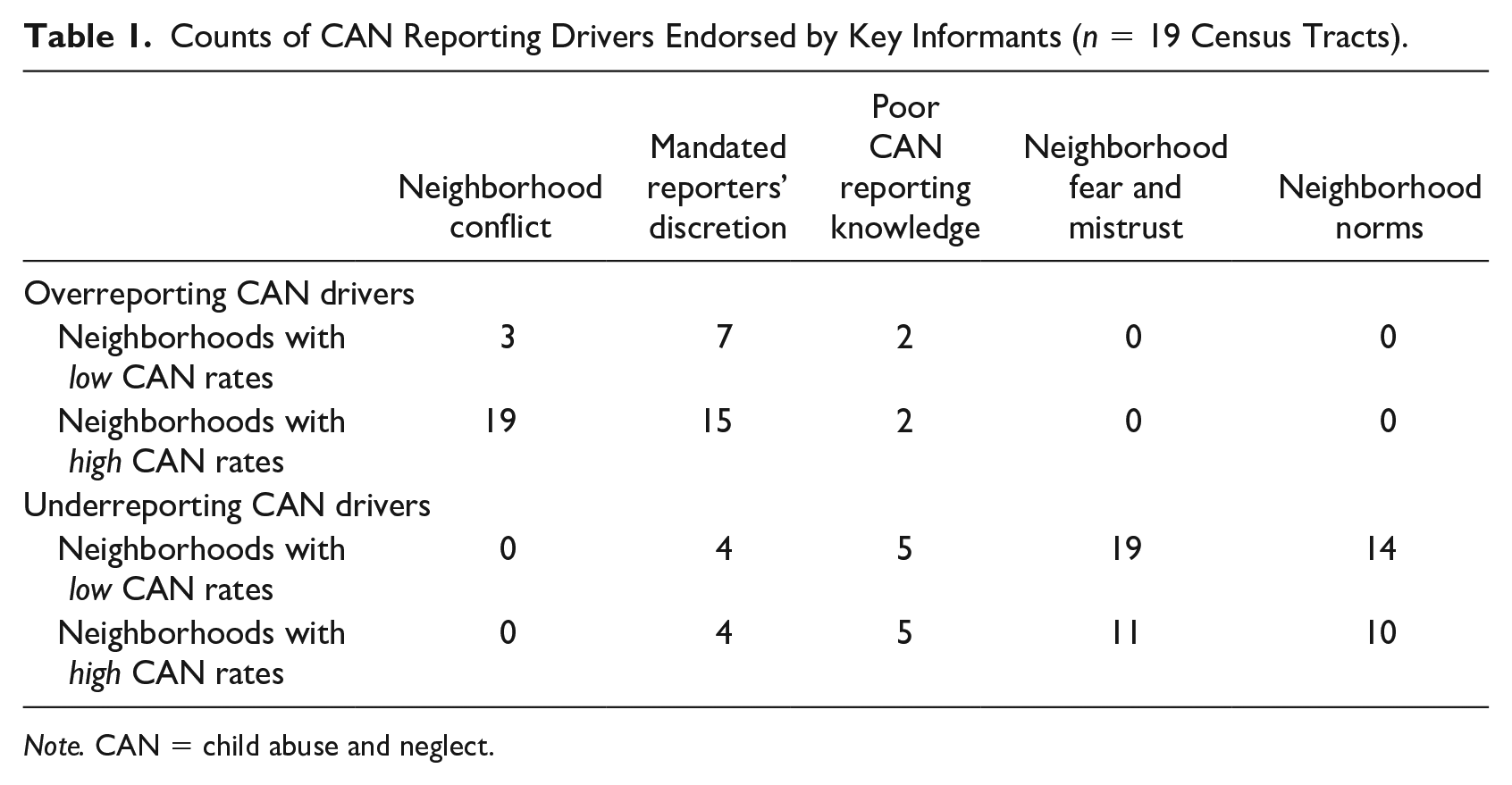
Key informants’ perceptions of child maltreatment under- and overreporting practices offered five primary themes that emerged from the qualitative data. Thematic patterns of CAN under- and overreporting appeared to vary between neighborhoods with low and high rates of CAN referrals. For instance, respondents perceived that overreporting practices were primarily driven by neighborhood conflict and mandated reporters’ discretion, and were more likely to occur in neighborhoods with high rates of CAN referrals. On the contrary, respondents perceived that neighborhood-level CAN underreporting practices were driven by neighborhood fear and mistrust and neighborhood norms, and were slightly more likely to occur in neighborhoods with low rates of CAN referrals. Poor CAN reporting knowledge seemed connected to both CAN over- and underreporting practices, and to be identified as relevant in neighborhoods with low and high rates of CAN referrals. See Table 1.
Counts of CAN Reporting Drivers Endorsed by Key Informants (n = 19 Census Tracts).
Note. CAN = child abuse and neglect.
Neighborhood Conflict
According to neighborhood informants, conflict within a neighborhood emerged as an important contributing driver behind CAN overreporting. Neighborhood conflict affected both low and high rates of CAN referrals, but it was identified related to neighborhoods with high rates of CAN referrals more prominently. Neighborhood conflict was described in a number of ways. For example, informants stated that landlords may inaccurately utilize CAN reports to settle unrelated disputes with tenants: Sometimes there is a bogus report, depending on if somebody doesn’t like somebody, and a lot of times they’ll find a landlord that doesn’t like a tenant, and so they will report them and it’ll be a bogus report. There won’t be any maltreatment.
Other times, neighborhood conflict was described between family members inaccurately using a CAN report to resolve their problems, or conflict between neighborhood residents. A key informant described conflict between neighborhood residents that influenced CAN overreporting practices: Well, sad to say some of our referrals, I wouldn’t say the majority of them, but a lot of them are spite referrals. So if I don’t like my neighbor, she pissed me off. And I’ve had clients say when I go out on a referral, “Oh, I know who called. It was that person over there because we had a beef and they said, “Yeah, [child protective services] is going to have your kids.” So it’s not always that they’re genuinely concerned about the welfare of the child, it’s that they’re all into their own thing, their own head, and their own feelings. And it’s like let me do something to aggravate and get back at this person.
Neighborhood informants also shared that, at times, racial tension or cultural differences created conflict and also resulted in CAN overreporting. For instance, during times of heightened racial tension, neighborhood informants reported incidents of conflict between Black/African Americans and Latinx/Hispanic residents, where a CAN report was allegedly used as a threat: “There is a lot of suspiciousness between [Black and Hispanic] neighbors that probably leads to that kind of increase in reporting.” Another informant described tension toward immigrants as driving CAN overreporting: I think that you have a number of people that have been in the U.S. for a longer time, and they see the newcomers sometimes as encroaching, and so they call CPS or whatever, thinking they will take these people out of the area.
Neighborhood Fear and Mistrust
Neighborhood fear and mistrust was identified as an important potential driver for CAN underreporting, mostly among neighborhoods with low rates of CAN referrals. All 30 informants reported mistrust toward CPS, government officials, and police officers that can at times result in CAN underreporting: It’s like an inherent distrust of the system. It’s like especially if you were born in that particular area, the police, they’re not like a positive force . . . So I think that’s the major problem; that you have to report it to an outside person who doesn’t live in that community, who doesn’t understand, who looks nothing like you, who hasn’t experienced anything that you’ve experienced.
Informants also described a fear of retaliation as a cause for CAN underreporting. Even when residents want to intervene, it is possible that intervening can result in physical threats or violence; therefore, residents do not report CAN even when they witness it: A lot of people don’t feel comfortable [reporting CAN] because it’s a backlash. You run out, you see somebody socking on their woman or they’re out in the street fighting and you’re like, “Hey, stop that.” That person is [capable] to turn around and shoot you or he’s going to knife you or something like that. So that’s where the leeriness comes in, the caution.
In addition, both counties in the study sample have large immigrant populations and informants also perceived immigrant families as being fearful of reporting child maltreatment due to their immigration status. For instance, one neighborhood informant shared the following: “Depending on the immigration status of everyone living in the household, you may not want a government agency knocking on your door. If you know their grandma is undocumented or whatever then you might be less likely [to report CAN].”
Neighborhood Norms
Another prominent potential driver of CAN underreporting identified by respondents was neighborhood norms, mostly implicit neighborhood norms, among neighborhoods with both low and high rates of CAN referrals. Informants speculated that loyalty, insularity, and cultural beliefs about CAN were the most influential neighborhood norms in the current study sample. Loyalty, or a strong feeling of support, was described when a resident sees child maltreatment, but does not report it to the appropriate authorities. One informant speculated that “maybe they have this allegiance that what happens in [their neighborhood] stays in our [neighborhood].” Another informant shared the following example to describe how sometimes residents talk with one another in lieu of activating formal interventions by institutions like CPS, law enforcement, or local schools: I think maybe if neighbors feel protective of each other, then they see maybe a mom slapping the kid. Instead of calling [CPS], they get involved and they go and they talk to [the parents] and say, “Listen, I saw you and you don’t want a police officer to see you, or a teacher,” because they know teachers are mandated reporters.
Another informant summarized it, by stating, “Because neighbors really know each other here and so I think they might be less likely to report [CAN].”
Similarly, insularity was seen as a neighborhood norm that influenced CAN underreporting. An informant shared that one of the core family value systems for most minority families are you don’t involve someone outside of the home with what happens in the home. That stays within the family. That’s for the family to deal with and to work it out. And that’s something that’s present in most of the people in this community.
Respondents also commented on their experience that cultural beliefs about CAN also affect neighborhood norms that lend themselves to overall neighborhood-level CAN underreporting. Informants described residents who understand the official working definition of child maltreatment, but disagree with the official definition due to cultural differences. For instance, some informants perceived neighborhood members as holding the belief that spanking, under certain circumstances, was okay: Because in this community a lot of the African American population come from a framework of generations of family members feeling that it is okay to discipline a child by spanking them. So you get a lot of incidents where children are spanked, perhaps not the appropriate way that DCSF would say is appropriate, hands open to bottom. But you may have a mom who grabbed a belt and whooped that kid, someone else may have observed that. In our line of work that would be considered abuse and reportable as a mandated reporter. But as a family member or a neighbor witnessing that, they may not feel that that is a reportable incident because they could clearly see the intent of it was discipline, not abuse. So they wouldn’t report.
As described below, another neighborhood informant details how cultural differences, as part of neighborhood norms, can drive underreporting practices: Perceptions of how maybe [immigrants] view maltreatment coming from a different country and what may be considered maltreatment in their culture compared to what we consider here in the US as maltreatment. I think especially some things maybe around discipline and physical discipline probably are underreported.
Poor CAN Reporting Knowledge
While the themes described above (i.e., Neighborhood Conflict; Neighborhood Fears and Mistrust; and Neighborhood Norms) influenced either CAN under- or overreporting practices, the remaining two themes (i.e., Poor CAN Reporting Knowledge and Mandated Reporters’ Discretion) were described as influencing both under- and overreporting practices.
The theme poor CAN reporting knowledge not only influences both CAN under- and overreporting practices, but it was also identified as equally relevant in neighborhoods with low and high rates of CAN referrals. This theme pertains to the lack of clarity among some neighborhood residents regarding the definition of CAN and the reporting process, that is, the procedures on how to report suspected cases of CAN. Several informants perceived neighborhood residents as unaware of how to report child maltreatment, as well as having diverse definitions of what constitutes actual child maltreatment. In instances of CAN overreporting, an informant provided the following example: Teachers, I felt were very mal-informed about what [CPS] was about. Many would report the most simplest and craziest thing that’s not necessarily reportable. But they’re calling the hotline and we’re out there investigating things that may not be child abuse. So their definition of child abuse is very different from ours.
On the contrary, a different informant described how poor CAN reporting knowledge can also contribute to CAN underreporting practices: “I start thinking about how many older people we still have in the area; they may not even know what to do if they were to suspect that a child was being maltreated.”
Neighborhood informants acknowledged that reporting child maltreatment can sometimes be unclear, particularly for immigrants who may not have exposure to CPS policies and procedures: I could also imagine, I mean, depending on the country where people are immigrating from, I would imagine they don’t have like a [CPS] hotline number or things like that. So I could imagine maybe they might not even be aware that you can contact this number to report something.
Overall, it was observed that the unfamiliarity with the reporting process for child maltreatment drove CAN underreporting practices.
Mandated Reporters’ Discretion
The final theme, mandated reporters’ discretion, was described to mostly influence CAN overreporting practices. However, in some instances, it was also identified as influencing CAN underreporting practices. Neighborhood informants reported that neighborhood surveillance, discrimination, and low cultural sensitivity influenced CAN reporting practices in neighborhoods with both high and low rates of CAN referrals. For instance, one informant described mandated reporters’ discretion and increased surveillance as a potential scenario for overreporting child maltreatment: We used to get a lot of reports from teachers, and I feel that in these particular areas . . . because there’s so much poverty, there’s so much crime—it’s almost like our children are targeted. Where the child showed up with holes in their socks, let me call in a referral. Would that really happen in a school not in this [neighborhood]? Probably not. I just feel that they’re more readily able to just get up and call the hotline. They’re less tolerant of things that may not really be child abuse. You know, they’re just quick to call it. So I think that that definitely contributes to the overreporting.
To a lesser extent, mandated reporters’ discretion was also perceived to influence underreporting practices. One informant described a school teacher (i.e., mandated reporter) whose positive relationships with families in the local neighborhood may have decreased her likelihood to report child maltreatment, even when it may be suspected: “If it’s at the elementary school level, you may have mandated reporters such as teachers who sometimes don’t want to report on a child because they may have met that child’s parents.”
Mandated reporters were identified as sometimes practicing their discretion in a discriminatory manner as well. Informants postulated that bias toward “caregivers that have mental health issues,” “foster children,” and “poor families.” In addition, “racism” all contribute to mandated reporters’ discretion to over or underreport CAN. As one example, an informant described mandated reporters who lacked knowledge on diverse cultural practices that resulted in CAN overreporting: A few years ago [CPS] had a great concentration of Cambodians and a Southeast Asian population. [Asians] have their holistic beliefs, medically. So one of the traditions they had is called “cupping” . . . The kids would go to school and they would have these red marks on them. And then first thing that would happen is that the teachers would overreact and they were doing all of this reporting about child abuse with these marks on these kids.
Discussion
This study addresses a gap in the literature by exploring key informants’ perspectives about CAN under- and overreporting drivers in their local neighborhoods. Considering the significant impact of maltreatment on the well-being of children and youth, it is important to gain a better understanding of inaccurate CAN-reporting drivers. Examining the social environment in which CAN reporters operate can clarify how practices of under- and overreporting may occur within a neighborhood, and provide insights into potential targeted interventions.
The study identified 19 neighborhoods in Los Angeles and San Diego Counties with significantly higher or lower rates of CAN reporting per 100 children than would be predicted based on a suite of census variables known to link strongly with reporting rates. Thirty key informants from those census tracts participated in semi-structured interviews to assess CAN-reporting practices. The informants had each worked in the area about which they were commenting for at least 2 years and reported high levels of familiarity with the local community. Although not explicitly targeted, the issues of under- and overreporting CAN surfaced repeatedly during the coding of the interviews and became the central focus of this study.
Analysis of the interviews suggested that community norms may significantly contribute to CAN over- and underreporting practices. Informants described how these practices were developed at the neighborhood level based on their shared understanding of the role of CPS within the community as well as their observations of previous interactions between CPS and families involved in CAN reports. The study findings suggest that a reframing of CPS’s engagement patterns that align with the specific needs and concerns of the neighborhood may help to improve CAN-reporting outcomes.
For instance, in neighborhoods with both high and low CAN rates, informants reported that overreporting often stemmed from efforts to use the CPS report as a form of social punishment within the neighborhood. From landlords using CAN reports as a way to harm tenants or neighborhood residents engaging in “spite referrals” as a form of retaliation, key informants described CAN overreporting as a tool to advance neighborhood conflict. These overreporting practices also, at times, were perceived to result from racial tension within a community as well as interpersonal conflict. Although a new finding with regard to CAN, similar phenomena have been increasingly documented online in regard to the police and other emergency services. These actions are known as “swatting” and refer to false reporting intended to deceive an emergency service like the police into sending an emergency response (e.g., a SWAT team) to a victim’s house (Scott et al., 2023). Conversely, neighborhood fear and mistrust of CPS and other government institutions was associated with underreporting of CAN cases, especially in neighborhoods with low rates of CAN. The informants also noted that this trend could be more pronounced in neighborhoods with large immigrant populations, as families without immigration documentation expressed fear of government agencies intervening in the home.
Both practices reflect how neighborhood residents perceive the effects of a CAN report on families—as an intrusion of the state into the family and a potential source of difficulty or violence against the family. Previous experimental studies have shown that improved community trust does not necessarily extend to child welfare institutions such as CPS (Wolf et al., 2018), even when it results in improved trust in other community interventions. These findings underscore the need to improve CPS’s relationships with local communities. Increased investment in CPS programs that prioritize family strengths rather than tying the agency’s therapeutic role to community surveillance and coercion may reduce family apprehensions (Fong, 2020).
Key informants also indicated that they saw neighborhood norms such as loyalty, insularity, and cultural beliefs as major contributors to CAN underreporting in neighborhoods with both high and low CAN rates. According to the informants, residents would often rely on each other to address potential incidents of child abuse or neglect, rather than involving formal institutions such as CPS or law enforcement. The interview data also revealed that families place a high value on maintaining strong boundaries around household affairs and are generally disinclined to share such information externally. In some cases, residents were perceived to have strong knowledge of child maltreatment, but to disagree with official definitions because they were not congruent to their cultural norms.
The potentially strong influence of cultural and local social beliefs in neighborhoods, identified by reporters commenting on neighborhoods with both high and low rates of CAN reports, suggests that neighborhood-based family support initiatives should avoid a one-size-fits-all approach to child abuse prevention and strategically consider the ethnoracial make-up of targeted communities (Higgins et al., 2022; Klein & Merritt, 2014). However, the appearance of these factors in neighborhoods with both high and low CAN rates, unlike other underreporting drivers such as fear and mistrust of public institutions, may indicate that these trends simply represent commonly held community beliefs rather than strong social responses to the child welfare state. The common assumption across these neighborhood norms that CPS involvement means a reduction in family privacy and autonomy also strengthens the policy argument for CPS community outreach efforts that clarify CPS’s role in the community and its potential for less intrusive forms of child welfare assistance. And for system reform in how and when CPS intervention is introduced.
Lack of clarity around the definition of CAN and the CAN-reporting process were perceived to contribute to both over- and underreporting practices that, according to informants, could potentially reduce the fidelity of CAN reporting across neighborhoods. First, neighborhoods with high or low CAN rates were both characterized by poor community knowledge around how CAN is defined and how CAN should be reported. Second, the complexity of CAN-reporting practices is suspected to influence underreporting, especially for immigrant communities, while overly flexible definitions of CAN affect overreporting practices. Both of these findings point to the need for improved community education around CAN institutions and norms. Public awareness of differences in CAN definitions may facilitate accurate and timely referrals, minimize the under- and overreporting of cases, and encourage early and preventive interventions (Calheiros et al., 2016; Gross-Manos et al., 2022). Accurate reporting can also reduce the continued use of CAN reporting as a corollary to neighborhood conflict or its association with needless community surveillance.
Finally, key informants examined the application of the aforementioned themes in CAN under- and overreporting trends for mandated reporters. The informants suggested that mandated reporters, in some cases, tend to overreport CAN due to racism, bias, and stigmatization of mental illness. Social cohesion and loyalty were suspected as guiding mandated reporters’ underreporting of CAN, as informants noted that mandated reporters might underreport CAN if those reporters held existing positive relationships with families in their neighborhoods. These findings provide qualitative support for existing findings that mandated rep-orting does not impact communities in neutral ways, but instead reinforces existing social inequalities by over-surveilling marginalized community members and under-supporting core community members (Putnam-Hornstein et al., 2013). Improved reporting practices for mandated reporters, especially sensitivity training around issues of potential racism and bias (Cox et al., 2022; Lane & Seltzer, 2023), could improve community maltreatment prevention, reduce the number of frivolous reports, and most significantly improve community perceptions of the role of mandated reporters within neighborhoods.
Study Limitations
This study’s understanding of under- and overreporting come from the perceptions of key informants rather than from any direct ability to differentiate between genuine and inaccurate CAN reports. The difficulty of correctly measuring the “accurate” CAN incidence rate in any given neighborhood also limits the precision of this paper’s selection of neighborhoods. Several major themes appeared in both neighborhoods with high and low CAN rates, but greater examination of actual reporting practices would help to establish a clearer causal relationship between identified drivers and reporting rates. In addition, future research should seek to gather understanding of CAN-reporting practices from family members, youth, children, mandated reporters, and CPS workers directly to corroborate (or reject) the perceptions of key informants in this study sample. For instance, such analysis could add depth to broaden the informant’s concept of “cultural beliefs” to be more responsive to distinct CAN-reporting practices across racial and class lines. Another noteworthy limitation is that these findings are specific to the small number of environments and people. It is challenging to assert that the conclusions and findings can be universally applied to other communities. However, it is important to note that qualitative research findings do not aim for the same level of generalizability as quantitative findings (Padgett, 2016). Nevertheless, the identified themes hold the potential to transfer to other samples, highlighting the need for further research in the future.
Implications for Practice and Policy
This investigation sheds new light on possible complex neighborhood social processes that could affect CAN-reporting practices and residents’ perceptions of CPS. Any effort to address disparities or inequities within CPS must include neighborhood or community initiatives focused on educating residents on the support that CPS can provide to families. Initially, drivers of both CAN over- and underreporting in neighborhoods appear to suggest that community members may conceive of CAN reporting as poorly aligned with their family or cultural needs. However, these findings invite opportunities to more closely examine systematic factors that influence CAN-reporting rates and further disaggregate general trends in CAN reporting from significant neighborhood or local differences in attitudes toward CAN.
This study provides three clear implications for practice and policy. First, the CPS system should improve its relationships with communities by (a) refocusing the CPS systems on family strengths and support rather than punitive interventions, and (b) conducting more community outreach efforts to clarify the role of CPS. Second, the CPS system needs to invest in efforts to improve community knowledge of CAN by educating community members about CAN definitions and processes. Third, the CPS system needs to actively work to combat the impact of racism and bias among its staff and all mandated reporters by funding and implementing sensitivity training regarding implicit bias. Such changes may also assist child welfare systems to more consistently and effectively intervene in cases of genuine welfare concern. These interventions have the potential to reduce bias and discrimination in the CPS system (Letson & Crichton, 2023). Our findings suggest that effective functioning of CAN reporting may require the disassociation of CPS systems solely from conceptions of social punishment to encourage more neighborhood and community buy-in for processes designed to protect children at all levels of American society.
Footnotes
Disposition editor: Cristina Mogro-Wilson
Declaration of Conflicting Interests
The author(s) declared no potential conflicts of interest with respect to the research, authorship, and/or publication of this article.
Funding
The author(s) disclosed receipt of the following financial support for the research, authorship, and/or publication of this article: This research was supported by grants from the Children’s Bureau, Administration for Children and Families (HHS-2014-ACF-ACYF-CA-0803) and the Price School of Public Policy at the University of Southern California.
