



Abstract
In our increasingly paced society, a lot is expected from care-dependent people. In the Netherlands, everyone is expected to live independently with the help of their social network, but this has proven challenging. In the participatory action research project TOSKoploper, young adults with developmental language disorder (DLD) opened up about their struggles on their way to independent living, including keeping up with the pace at school and work as well as addressing traumatic experiences without family support. They prefer professional assistance in overcoming their problems, but their support needs are hardly acknowledged by professionals in the social domain. They call for people’s patience, appreciation, and support for their capabilities so that they can live an active social life.
Keywords
Introduction
In the Netherlands, a lot is expected from care-dependent people. They need to keep up with a highly technological, modernizing world where people perform at an increasing pace, also known as social acceleration (Chambers, 2017; Rosa, 2013). What is more, the Dutch government proclaimed the so-called “participation society” in 2013: “Everyone who can, must take responsibility for their own life and environment.” 1 Aiming for more cost reduction and participation, people are expected to build on “societal resilience,” meaning that they have to take care of themselves and each other (Blijleven & Kooiker, 2022; Van der Steen et al., 2015). Care-dependent people, however, often find it hard to ask and receive help from family members, friends, and neighbors. They can feel guilty and embarrassed to (over)burden their family members as they prefer reciprocity, and simultaneously miss a support system they can turn to. People’s discomfort with having to support their care-dependent family members often remains unspoken (Bredewold et al., 2020).
Furthermore, people need to be able to keep up with digitization to access government support. Information and procedures are mainly provided online (Rosa, 2013; Vosman & Niemeijer, 2017). Some people miss the means and skills to get a grip on digital systems and grapple through complex bureaucratic language and consequently fail to receive appropriate support (Goedhart et al., 2019; Green et al., 2014; Rosa, 2013; Schmidt et al., 2020; Sibilla & Gorgoni, 2023). Schmidt et al. (2020) showed that lack of appropriate help can lead to problems getting worse such as feeling rejected and forgotten, less trust in the institutions, and more hesitance to ask for (additional) help. All this relates significantly to the lives of young adults with developmental language disorder (DLD). DLD refers to persistent linguistic difficulties without known biomedical or environmental risk factors (Bishop et al., 2017, p. 1068) and is characterized by difficulties in learning and using language. This concerns difficulties communicating with oneself (inner language) and others, leading to socio-emotional problems such as a lack of confidence, extreme shyness, depression, anxiety, and strong emotional outbursts (Isarin, 2012, 2021; Conti-Ramsden et al., 2017; McLeod et al., 2013; Vissers et al., 2021). “Purely linguistic accounts of DLD” only acknowledge the language difficulties as part of the disorder, while more recent accounts of DLD also report the accompanying neuropsychological problems (Tomas & Vissers, 2019). According to these new accounts, people with DLD need support in various “areas of functioning” which cannot be met by a speech and language therapist alone (Durkin & Conti-Ramsden, 2010). While mental health support on top of language support is often required, people with DLD regularly experience miscommunication with the mental health professional when they are not well informed about DLD (Cohen, 2001; Cross, 2011). Furthermore, young people with DLD tend to have more difficulties in their self-actualization toward independent living, such as managing their finances and socialization without parental support (Botting et al., 2016; Conti-Ramsden et al., 2008; Durkin et al., 2017; Winstanley et al., 2018).
Bonder and Elsendoorn (2008) have inventoried the quality of life of Dutch adults with DLD (former special education pupils, aged 18–42). While the questionnaire (n = 22) gave a positive perspective of their social independence, additional interviews (n = 6) revealed more complex and serious problems, such as feeling insecure because of language difficulties and consequently struggling to socialize (p. 26). This was the reason for Isarin (Isarin, 2012; Isarin & van Genugten, 2018) to follow up with several participatory action research (PAR) projects to get a better understanding on the vulnerabilities and opportunities of youth with DLD. In the PAR projects, the young people with DLD (n = 30, ages 12–28) participated as co-researchers and co-creators, starting from formulating the research questions and methods. The researchers facilitated collective learning by doing and working with the young people as experts in their own lives (Freire, 1982). Together they exchanged perspectives and needs, aiming for a positive change between them and the influential people in their lives (Abma et al., 2019; Dedding et al., 2022; International Collaboration for Participatory Health Research [ICPHR], 2013). During the trajectory, they gained an awareness that they often felt excluded, frustrated, or overwhelmed in their transition to adulthood.
In 2019, fourteen experiential experts with DLD (including five young adults with DLD and nine parents) spoke about their difficulty to detach and let go: a struggle to set each other free. Young people with DLD pointed out that they missed insights on how to transition to a more independent way of living, and how professionals can be of support, including the officials in the social domain. Parents spoke of their difficulties to get access to professional support for their child transitioning to adulthood (Kentalis, 2019). The bottom-up development of the research question of how young adults with DLD can transition to independent living was the start of the PAR project TOSKoploper (DLDFrontrunner) in which young adults with DLD reflect on their ways to independency, share their experiences, call attention to the issues most important to them and get their voices heard by the people in their day-to-day lives, including the officials in the social domain to bring about change for a more accessible society.
The aim of this article is therefore to identify participation problems of young adults with DLD in their transition to independence as well as to identify opportunities to address their needs, considering they live in a socially accelerated society. For this, we wanted to answer three questions. First, what is DLD from the perspective of young adults with DLD? Second, what experiences do they have in their transition to independent living? This includes how they start standing on their own feet as they have to take care of themselves while also attempting to become financially independent and develop relationships. Third, what is good care in their transition to independent living, according to young adults with DLD?
Method
In January 2020, three co-researchers with experiential expertise in DLD and three researchers with scientific expertise took up the role of PAR for TOSKoploper. The research team made use of their expertise in the field of disability work. This included informing people with DLD about the research process with accessible language, often supported by visuals. The research process consisted of an ethnographic content analysis (Altheide & Schneider, 2013), in which the researchers and participants moved together through iterative cycles of action to jointly list the main problems, look for their causes and possible solutions, regularly assess its development, and use research results to invoke action (Abma et al., 2019; Dedding et al., 2022; De Winter & Noom, 2003, p. 336; Gibbs et al., 2018; Hollinrake et al., 2019; Lyons & Roulstone, 2018).
TOSKoploper started during the COVID pandemic and its ensuing restrictions and was therefore mainly done online. The research team invited respondents from all over the country with the help of experiential experts and professionals in care and education. For this, the team made a visual invitation that was shared via email as well as via WhatsApp and Facebook where the participants could join the closed TOSKoploper group and invite their own relations with DLD. The inclusion criteria were for the respondent to have been formally diagnosed with DLD (previously defined as “specific language impairment”), to be a young adult (without fixed age bracket) and willing to participate in the research project.
In the closed groups of Facebook and WhatsApp, the research team regularly invited young adults with DLD to exchange experiences related to living independently with the help of drawings, pictures, poems, or any other forms of expression. Further, the researchers developed an interview guideline with questions on living independently, for example, “What do you need to live independently?,” “How do you keep your house in order?,” “How do you manage your finances?,” and “How important are social contacts to you?” The respondents were individually interviewed, using Zoom as the medium, by pairs of one co-researcher and one researcher with scientific expertise. Before the interview, the researchers showed the respondent the “TOSKoploper safety web,” a visual model depicting the ethical approach for the interviews, including the respondent’s option to take all the time they need to answer a question, and the option not to answer a question.
Moreover, the respondents were asked whether they wanted their own names or a (self-chosen) pseudonym to be used. For the respondents to feel comfortable to open up, the researchers informed them that all that mattered were their personal experiences and how they wanted others to be responsive to their needs. After the eighth interview, the researchers adjusted the interview guide to include emerging themes such as “bullying and abuse.” In addition, respondents who spoke up about traumatic experiences during the interview were welcomed to work together with an illustrator on graphic storytelling. Graphic storytelling was meant to make it easier for the respondents to convey these confronting memories to a wider audience.
The transcribed interviews (verbatim), online posts, and graphic storytelling were inductively analyzed through open, axial, and thematic coding to identify the key themes. The analysis was done iteratively during the weekly work sessions on Zoom by marking the text with colors as well as using Microsoft Word comments (October 2020—April 2021). To deepen and validate the analysis of the research team, the respondents were invited for a Zoom member check for each emerging theme. The co-researchers, with the support of the researchers with scientific expertise, presented the first insights on a Jamboard (a digital whiteboard) to the participating young adults with DLD. The respondents were invited to add supporting or contradicting examples that were collectively discussed (Bradbury, 2015, p. 3). After each validation session, the co-researchers wrote, on a rotational basis, their reflection and shared this on social media. The participants were also invited to share additional information after their interview and the validation session, in case they had not yet been able to share this, due to lack of time, being unable to find the right words, or feeling uncomfortable in the presence of others.
After the data analysis, the research team created a written report for each theme, shared these again with the respondents for validation, and then published these. As a follow-up, KA analyzed the outcomes of all themes with team member JI, and critical friends (cf. Kember et al., 1997), namely, CD (youth PAR expert) and AN (care ethicist). These critical friends were not involved in the facilitation of the research project but did take part in general analysis and reflection on findings, thereby contributing to the reflective and learning capacity of the project. The spoken and written Dutch language of the respondents was literally translated to English, including mistakes, to stay close to their expression. For example, a respondent wrote “een volle hoofd.” In correct Dutch, this should be “een vol hoofd,” meaning “being overwhelmed.” To reflect the spelling mistake, the text was translated in English as “a ful head.” The co-researchers remained involved by being updated and invited to give their responses, and to jointly present the outcomes during conferences through a PPT presentation, a poster presentation, and improvisation theater.
During the project, time was taken for reflection on the learning process, using seven ethical principles of ICPHR (2013), which aims to collectively learn and improve the quality of participatory research. The principles involve (a) mutual respect, (b) equality and inclusion, (c) democratic participation, (d) active learning, (e) making a difference, (f) collective action, and (g) personal integrity. Reflection on these principles has been published in a separate article (see Aussems et al., 2022).
Results
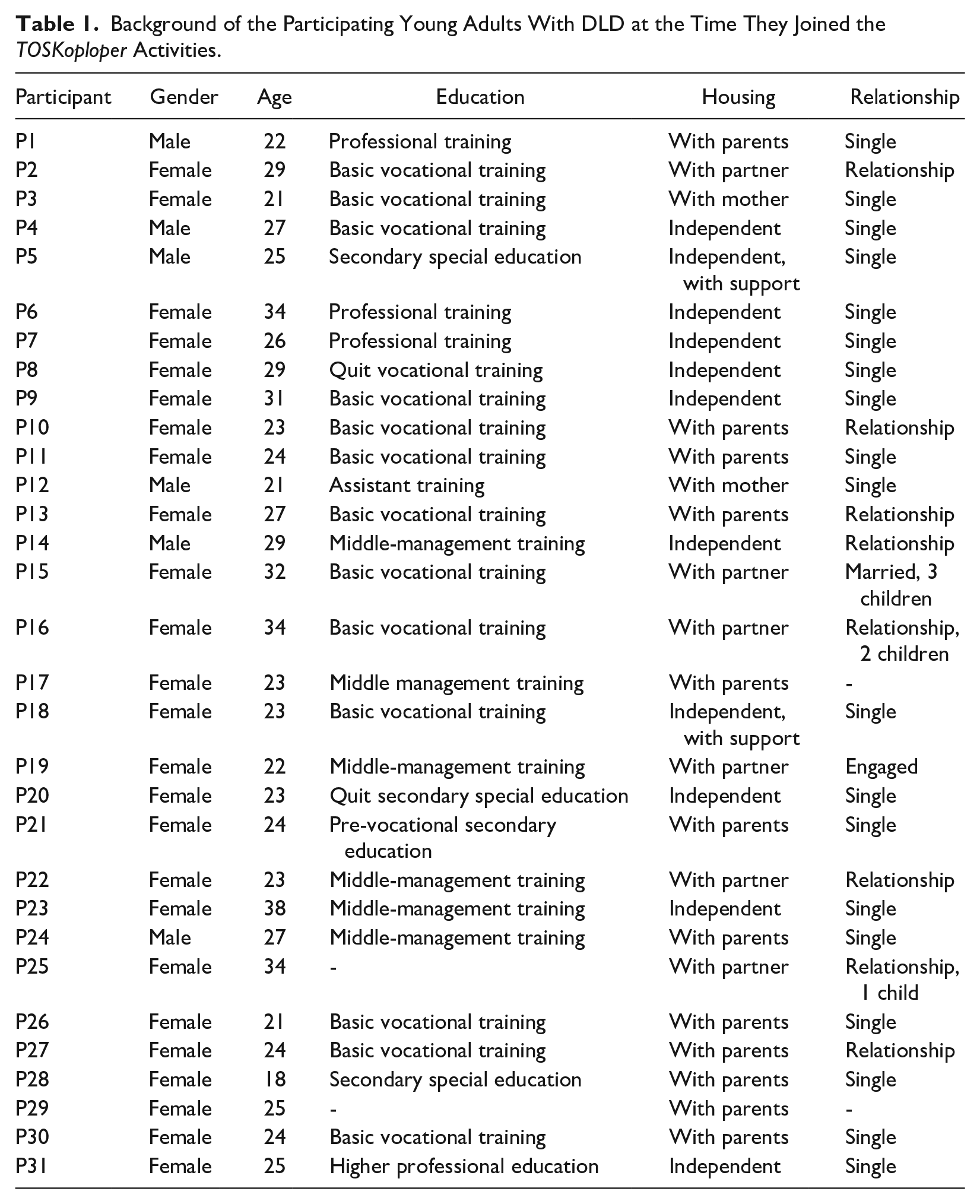
In response to an invitation to participate in TOSKoploper, in total 31 young adults with DLD responded and took part (April 2020 to July 2022), aged 18 to 38. They were interviewed (n = 15), participated in the WhatsApp group (n = 27), and/or Facebook group (n = 23). Five of them only took part temporarily and therefore insights into their background such as education and work are limited. Table 1 presents the background of the participating young adults with DLD, and Table 2 shows an overview of their attendance during the TOSKoploper activities. In two cases, the participants temporarily left the WhatsApp group—each with the argument of wanting less stress—and later came back again. Five respondents requested a second interview to share additional experiences. In the interaction with the respondents, they explained what DLD is and shared their personal experiences in their transition to independence.
Background of the Participating Young Adults With DLD at the Time They Joined the TOSKoploper Activities.
Participation of Young Adults With DLD During TOSKoploper Activities (April 2020—July 2022).
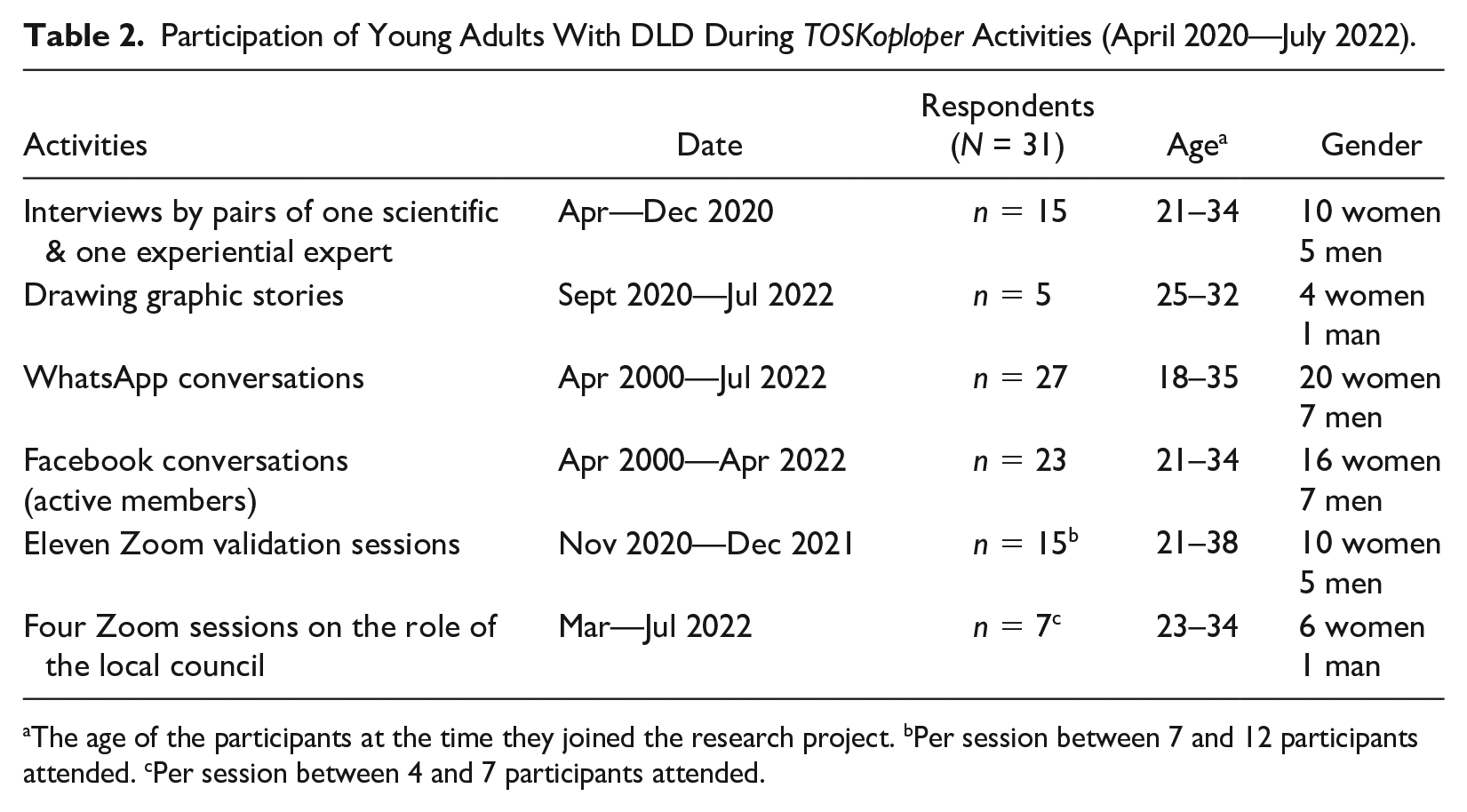
The age of the participants at the time they joined the research project. bPer session between 7 and 12 participants attended. cPer session between 4 and 7 participants attended.
Explaining DLD, Living With “a Full Head”
When asking the young adults what DLD is, they point out that they struggle to communicate, both to understand others and to make themselves understood. To understand others, Evelien clarifies, they “just need a little more time processing the language.” And they often lack the words to make themselves understood, like Sara: “I want to say so many things and express so many things, but it is just locked away. Even though I try, it gets stuck.” And if they find the words, they struggle to express these. Mark: “I notice that I can’t speak my words.” Mikan adds, “In my head it is okay, but once I start talking or typing, it comes out messy.” Maaike suggests that people with DLD always work harder: “Our brain is constantly at work because language is everywhere. People without DLD don’t have to think about what they say. People with DLD do this all the time.” Conflicts make it even harder, according to Evelien: “When I’m insecure in conflicts or discussions. . . I easily shut down and then it looks like there’s short-circuit.”
Second, DLD can make it a struggle to oversee and manage things, like for Wesley: “My head sometimes seems like a garbage dump where there are no walls.” It is more challenging to process information when more things happen at once. Jérôme: “Many things happened at the same time. I just couldn’t structure it anymore.” Maaike explains they easily get a full head: “I can get tired when I have to process a lot of information. . . . You can understand that the head of people with DLD sometimes quickly fills up and it doesn’t work for a while.” Meike feels stressed when she has “a ful head” (see Figure 1). Such challenges make it hard to keep up with others: “The speed of the world is like a rocket” (Simone) and “I notice that I just work more slowly and that is a pity” (Mark). Their struggle with DLD varies per day, notices Yara: “If I have a good day, then the stimuli are . . . almost non-existent. But if I have a bad day, then those stimuli are . . . very intense, . . . then I really have to fight.”
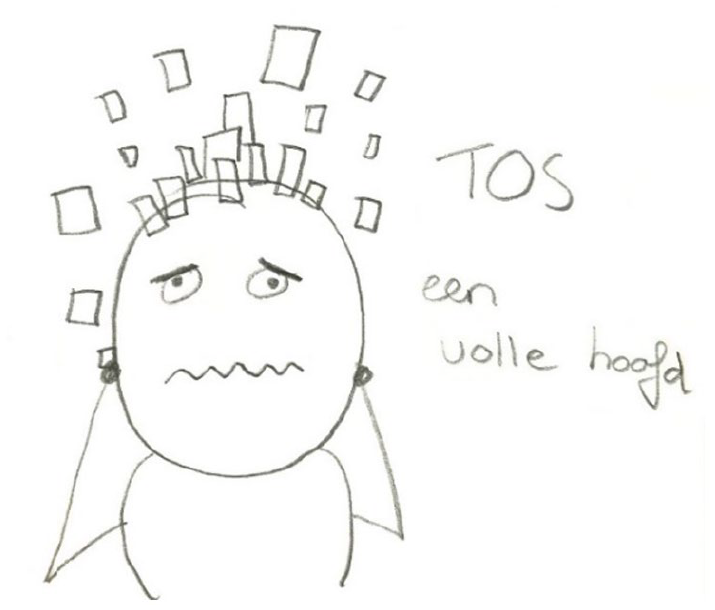
Drawing of Co-Researcher Meike. Translation: “DLD, a Ful Head”.
Experiences in Their Transition to Independence
DLD affects the participating young adults in many ways in their transition to independence. First, in their desire to socialize. Second, in the attempt to live independently, and finally, in their struggle to overcome traumatic experiences such as bullying and abuse. For each of these, they share their stumbling steps and blocks, survival tricks, and (desired) stepping stones. The stumbling steps are conceived of as their own efforts upon which they stumble. The stumbling blocks concern the environmental hindrances they face. The survival tricks entail their own strategies to cope with these stumbling steps and blocks. Finally, the stepping stones concern their proposed solutions for the people in their environment.
We Want to Socialize and Need to be Alone
In their transition to adulthood and independent living, young adults with DLD look for ways to have their own social network. While some mainly socialize with family without a rush to live independently, two of the participating young adults started a relationship and quickly moved out to emancipate from their parents. Of the 31 participating young adults with DLD, 14 live with their parents, 11 live independently (one of them moved out during the research project) and 6 live together with a partner.
Stumbling Steps: Feeling Lonely and Insecure in Company
Young adults with DLD often point out that they want to socialize, and simultaneously need to be alone, leading to their stumbling steps to social interaction. Yara regrets, “All the people around me that gives me tension and stress because there are irritations. But on the other hand, I need them because I can’t be alone, because then I really feel very lonely.” Conversations often create discomfort as they are either too quiet or too fast. “You tell them how you’re doing . . . but at some point you have nothing more to say. . . . So then the silences begin,” Yara clarifies. Jérôme rather welcomes silences, “It [went] just a bit too fast for me. It’s often difficult to say this.” Processing language is more of a struggle in company than in solitude: I’m also thinking about it 24 hours a day. . . “How should I say it? . . . What do they mean by it?” and when I’m alone I process this faster than with stimuli around me. And then I feel quite alone. (Evelien)
Jérôme reflects, “It’s a sad subject because you do want to have friends.” Cindy realizes that it is not people excluding her. Instead, “DLD excludes me.” The struggle to socialize includes their struggle to start a relationship. Five participants without a relationship miss a partner or are afraid to stay alone. Three others are used to being single and three say that they are afraid to commit to a relationship because of their unpleasant experiences. However, two young adults with DLD quickly moved in with their partner to emancipate from their parents.
Stumbling Blocks: Our Disability Is an Invisible Secret
Their struggle to connect with others is compounded by the stigma surrounding DLD, which is perceived as a stumbling block to socialize. Mikan is disappointed: “Many people don’t understand me.” Some feel misjudged, like Evelien: “People think you’re “dumb..” . . while we just need some more time to process information.” People’s ignorance makes conversations difficult, according to Cindy: “I’ve also had boys who didn’t know DLD, they just sat there talking, talking, talking.” Mikan feels disapproved of: “To an outsider you’re just an annoying person. You’re looked at strangely or not taken seriously or ignored!” For example, her teacher was skeptical about her ability to work with children: “My old mentor said: [Mikan,] I don’t see you as a teacher, we’re afraid you’ll pass on your language delay to the children.” Yara is pessimistic for positive change: “DLD will always remain something misunderstood.” While Mikan perceives DLD as an “invisible disability” that works against her, Coen looks at the bright side: “We look more normal than people who . . . have another kind of disability. Actually, our disability is an invisible secret, an invisible disability, actually.”
Survival Tricks: Withdrawal and Accepting Loneliness or Conflicts
Young adults with DLD search for survival tricks when they experience misunderstandings. Selma, for example, walks away from people who do not understand her: I come into the shop and then I just get angry very quickly. . . . I also don’t feel like putting energy in people who don’t understand me. I explain three times first and then if you still don’t understand, I go and see someone else. . . . then I don’t need you in my life.
Mikan rather takes as much time as she needs to prepare conversations, to prevent such misunderstandings: “I sit there all day thinking . . . how can I prove myself and discuss things properly? . . . That people understand me clearly. . . . I’m not doing it for me alone . . . I also do it for others.” Some have learned to accept misunderstandings, including Esther: “I’ve had a few scuffles with friends and so on, but that was also due to miscommunication. You’ll always keep that.”
The young adults with DLD take space to “empty their heads” by leaving a gathering earlier (Sam); by taking some “relax time . . . to be alone for a while” (Selma) and by canceling appointments: “Sometimes I want too much, then I have to cancel . . . one friend this weekend, it had just become too much” (Cindy). Consequently, some learned to accept the difficulty to make friends: “It’s actually quite normal for me now, actually, that I don’t have any friends, actually. I just accept that it’s not there. I just adapt to it, actually” (Wesley). Claudia recognizes this, “I don’t have any friends, but my family is my solution. I go out with my sister.” Mikan rather missed support at home and therefore rushed to start her own family: I was single after all. And my mother didn’t notice me anyway. So you’re going to look for love somewhere. . . . My husband and I unexpectedly got a little baby . . . and later we had twins . . . But I had that fear that my children would take over my talking. Fortunately, it’s not so.
Stepping Stones: Patience for Understanding
As a stepping stone in their social interactions, the young adults with DLD want people to accept them as they are, and to help them in making the conversation easier. They prefer people to avoid using difficult, “expensive” words, and to repeat what they say when they cannot follow it: If it goes a little too fast, then I say, “I don’t understand.” Then I ask: “Do you want to repeat it and say it more clearly to me, say what the assignment is?” But I don’t really struggle. I am just what I am and I do try to be as good as possible. And so far, so good. (Cindy)
And to understand what someone with DLD is saying, the respondents recommend patience and support: “Take time to understand us and ask questions if you don’t get what we say.” Mikan: “My father always listens to me and helps me figure out what I mean and understands.” Maaike feels most comfortable when people do not mind her mistakes, “My colleagues must not look strangely when I make errors in app/mail or reports. Fortunately, they don’t do that.”
We Want to Live Independently and Can’t Manage Without Our Parents
The respondents mention various reasons for their need to live independently, such as having more privacy, freedom and confidence. Cindy, for example, enjoys her freedom since she moved out, “I’m still attached to my parents, but less so. I can just do what I want, I like that.” Wesley built more confidence since he lives independently: “At least then you value yourself more.”
Stumbling Steps: Hesitant Efforts
In most cases, young adults with DLD who wish to move out take stumbling steps to manage their lives without parental support. Creating their own social network, finding a job, registering for a house, and financial and practical matters require skills and confidence that they do not easily develop. Some hesitate to do things themselves because of their low self-esteem. “Ten years ago, I felt very insecure. At the time, I didn’t dare to take that step to independence,” remembers Jérôme. Xiao also feels she needs more patience: “I would have liked to be independent, because I’m already 21 and I can’t cook and so on, I find that a bit strange, because I think I’m quite old.” However, she is not in a rush to move out: “I think after 10 years . . . with people who take good care of me.”
Maartje, on the contrary, was eager to move out for more privacy in her life, but felt less confident than her parents about her ability to live independently: “My parents think I’m more independent than I see myself. . . . It’s time to live on my own. It’s invisible, but I can feel that living at home isn’t possible anymore.” A year later, she has moved to a supported living house: “I’m now living independently.” Like Maartje, most of the respondents still need help after moving out: “I should be able to tidy up more, I should keep it tidy, but I just don’t have that insight” (Selma). Meike and Cindy worry that their parents cannot help them forever. Cindy clarifies, “Dad is going to be 70 next year . . . he’s still going to come and clean here, but it’s just not possible anymore.”
Furthermore, the respondents often struggle to make it at school and work. Mark, for example, regrets he missed the qualifications to study for his dream job: “I wanted to be a psychologist, but these are universities. That’s a pity.” For Anouk her struggle at school led to the diagnosis of DLD: “When I [had learning problems and] started studying at a lower level, I still ran into the same problem. They did some tests and I was diagnosed with DLD.” Wesley encountered the same: “The counsellor said that I was actually a bit under stimulated in learning at school. . . . It’s all the hustle and bustle with other people. That just blocks it.” Moreover, the respondents often struggle to find a job that is not too boring or too demanding. Wesley felt bored at work: “I put together parts of lamps. Since then, I’ve had a burn-out or a bore-out.” For Cindy, her job was too demanding: “I had just moved out and . . . started working more hours. . . . I was tired, but I thought . . . I have this [fatigue] more often. Yes, until I couldn’t get out of bed.”
Stumbling Blocks: Searching for a Needle in a Haystack
The respondents encounter various environmental stumbling blocks in their transition to living independently, such as managing their finances. Mikan once filed tax returns and afterwards learnt that the application system was too complex: “I got a fine of € 14,000. I think: huh? But yes, because I filled in the wrong details.” Her father had to sort her out. Furthermore, they struggle finding professional and financial support to live independently. “It’s a needle in a haystack that I’m looking for,” regrets Selma, “I thought, you should be able to figure it out when you’re an adult. Finding the right help is quite difficult.” Their search for social support is also challenged by complicated online forms and passwords: I wonder what help I can apply for. I’m too late for Wajong [social support for young people with disabilities], which has been abolished, I can’t apply for it anymore. . . . I tried to register on a website [for social housing] . . . but I can’t get in anymore with my password. . . . Some say: that’s not difficult at all. And others say that you just don’t understand it. (Maartje)
Besides complicated online procedures, social support officials often speak difficult language to them. “All those words and abbreviations, I don’t know what it’s about,” Yara exclaims, “they just talk horrible!” Xiao recalls the complicated talk of a council officer: “I find the [social support], how they explain it, difficult because they talk in difficult language.”
Furthermore, the respondents are confronted with slow application procedures: I’ve been registered there for over 6 months now. . . . We wait for another 2 weeks and then we have to call the local council again. . .. Then we have to go to MEE, the foundation that can help me. . . . But there is a waiting list for that, too. It used to be something like 6 weeks. But I don’t know now, because of the Corona time, whether that has increased again. (Cindy)
When young adults with DLD are finally seen by the council officers, their capabilities are often overestimated, and their support needs not acknowledged. Marieke, for example, wanted to apply for social support, “I looked neat and tidy in high heels. Little did I know that I shouldn’t come in like that. . . . The job coach said: ‘Are you applying here? Because you don’t need any help.’”
Survival Tricks: Parental Support
The respondents reveal their survival tricks toward independent living. Esther suggests that it starts with their desire: “You also have to take the initiative to do things and want to do them yourself.” Others learned that they cannot manage without support. They struggle to decide when to seek help. Jérôme questions, “When should I ask for help and when do I do it myself?” Once you can ask for it, you’re independent, according to Meike, “Yes, I find that a bit difficult.” Selma knows how helpful it is: “Sometimes you struggle with something for a week, and someone else has done it very quickly. It feels like Mount Everest, but once you ask, you easily walk off the mountain.” For example, she asked for help when looking for a speech therapist: “Someone asked on the Facebook group for speech therapy for me . . . and then I found a speech therapist who understands me very well.”
Most young adults with DLD depend on parental support in their transition to independent living. Some practice together with their parents to do things themselves. Pieter: “I learnt how to cook because I did it before. And ironing and cleaning I learn from my mother now.” Their need for parental support sometimes causes tension, as it affects their desired privacy: My parents now do the administration. Yes, I sometimes do it partly for myself. But they can also look at my account and then they can see what I do, and that is not always fantastic. . . . They don’t need to know when I buy a present for my partner. (Jérôme)
To get the council officers’ approval to receive professional support to be less dependent from their parents, the respondents joked that it would be best to avoid making a good impression: “If you want to apply for support, don’t do your hair up and wear sweatpants, that way you will get it done faster.” Despite their need for support, they lack the confidence that they have access to it. Wesley, for example, perceives independent living not as a choice, but his only option: I try to do a lot myself, actually, because I usually learnt that I can’t count on anyone else, actually. That, in principle, you’re completely on your own as a person. That there’s nobody else who can help you further, that you have to do it yourself.
The young adults often speak of ways how they hang on despite their difficulties, like Pieter: “Because of my DLD, I’ve built up a little man in my head who says: you’re worthless, you still can’t do this. But I can. Every year, this little voice [saying that I can do it] becomes stronger.”
Stepping Stone: Someone Who Watches With Me Sometimes
The respondents point out they need both assistance at home and at work as a stepping stone to keep track of everything. This includes someone who provides information. Wesley remarks: “People are actually more the information to be able to help you further. It’s basically up to me to change the problem, actually.” They stress the need for understandable language. And if language is complex, that someone translates: “Actually, a coach would be nice . . . that someone might explain in other words what’s in the letter, or how something works. That you ultimately take action yourself, but that someone translates for you,” suggests Meike.
In case they also struggle to personally undertake action, they prefer someone who helps them or watches them while they practice. Maartje, for example, wants to learn how to apply for social housing and support: “I want to learn to understand [how I can] fill in a huge form to apply for help, you need help for that.” And Pieter prefers help with his household chores: “In principle I can do it, but . . . I would appreciate it if someone would watch with me sometimes.” Xiao feels she is independent once she does things herself, also when others watch with her: [I’m independent if I] can do things myself, but with a little help, so that they look at how you did it, and that I can cook and iron and do the laundry and so on a bit better, and that I need less help with that, because now I need help with everything.
Selma learnt that she needs this support even after several years of independent living: “I catch myself asking my mother for a lot of confirmation.” But she, like Meike and Esther, remarks that everyone needs help, “I also need help now and then, but when I look at my environment, they also get help.” Some are already satisfied with the help of family, like Anouk: “When I need help, I go to my sister, like to discuss my tax return with her first, then I do it myself.” Selma, Jérôme and Pieter, on the other hand, emphasize they rather get help from people who are not close to them: I do think I need someone to look at the insurance with me every now and then, or how do I go about this and how is it going now. . . . I think maybe someone I don’t know, but someone who does this from time to time and more often, who often visits other people’s homes. (Pieter)
They also wish their colleagues to be more supportive: “the company has to cooperate a bit” (Esther). Yara recommends her peers with DLD to speak with their employer: “Look together at what lies at the heart of what you’re struggling with . . . and brainstorm which tools suit you.”
We Want to Open up About Trauma and Can’t Talk About it
During the research project, nine participants took the initiative to talk about experiences with bullying or abuse. They often did this after trust was created between them and the co-researchers. Four respondents mention they have endured physical bullying; being pushed, hit, or threatened. Moreover, five of the fifteen interviewees talk about having endured sexual abuse, two of them in childhood. Five participants chose to work with illustrator Inger to use graphic storytelling to share their ordeal. During the online validation session, some participants opened up even more, some of them anonymously, by writing about their experiences on the digital whiteboard Jamboard. Afterward, Meike wrote: “A lot of emotions were released, including tears, that we even took a break. This way they could let it sink in, and then switch to the tips and solutions.”
Stumbling Steps: Feeling Unsafe
Young adults with DLD spoke about their stumbling steps to stop people from bullying and abusing them. This is especially challenging when they are bullied at home, as experienced by Mikan: “I could hardly pronounce pepper or locomotive. And that’s what [my mother] been bullying me with . . . deliberately imitating me: ‘This is not pepper, Mikan, you pronounce it differently.’ . . . Imagine, my own mother not accepting me.” Others speak of the threats at school and at work, like Sam at his vocational school: “First they started bullying me, giving me nasty remarks, and eventually they started pushing me around a bit, physically, so to speak. That is a bit annoying in a workplace with machines. I felt unsafe.”
Sometimes the respondents are not sure if someone is deliberately treating them badly. Mea at work, for example: “I wish my colleagues wouldn’t laugh about my mistakes, . . . that they don’t make jokes. Sometimes I don’t know if they mean it. . . . You hear the other person laugh again, and then you feel insecure.” When it comes to sexual abuse, it can take years before one realizes it happened to them: From the age of eight until I was 22, I kept it to myself. Only when I was educated did I realize that it was rape. At eight, you don’t know what sex is. Only when you’re 14 or 15 you learn. . . . Then I sent my parents an email, because I really didn’t dare tell them, I found that too difficult, because then the tears started and I really couldn’t talk.
Another respondent explained a man drugged and sexually assaulted her. Afterward, she reported the abuse with the help of her parents. Another time, an acquaintance sexually crossed her boundaries: “At first I said ‘no,’ but after he insisted, I said ‘yes’ with the thought of not disappointing the other or try to enjoy it anyway.” Others knew straight away someone crossed their boundary but still preferred to keep quiet.
Stumbling Blocks: Ignorance and Disbelief
The young adults often experience a hostile environment as a stumbling block in their attempt to socialize well with their peers, as Mark encountered at school: My classmates really liked my presentation [about DLD]. “You said it well and fine.” . . . It was nice, but after two weeks it was over. . . . They shut me out. They all ignore me. For example, if I want to do something in practice, they say “No, I don’t want to go with you.”
Furthermore, bullying and abuse often remain invisible to people in their environment. Some young adults found it too dangerous to ask for help. Jérôme’s classmates, for example, threatened to stab him with a knife unless he would give them € 50. Out of fear, he hid himself at home in his closet. Reporting felt too risky, also for Wesley when a fellow student grabbed him by the throat: “He said to me: ‘Don’t move or I’ll kill you.’ I remembered that well, I didn’t discuss it with the teacher after that.”
Some take the step to report the invisible intimidation but encounter disbelief. One woman recalls that her partner’s abuse was not taken seriously: “Nobody noticed, nobody saw it happen. I told my parents, but they said it wasn’t true.” Skye encountered the same disbelief and wonders indignantly, “How can you share it if you can’t talk about it? . . . At school I told them about the [abusive] taxi driver. Why didn’t the teachers believe me?” In adulthood she struggled telling her psychologist about the sexual abuse: “I don’t easily talk about my own life, because who can I trust? She even just didn’t understand me.” Another survivor sought help by a psychologist who did not see the use of tackling her trauma: “Yes, it is too long ago, she then says. . . . [My mother] said you just leave this psychologist.”
Survival Tricks: I Put Myself in the Background
A survival trick after having endured traumatic events, is withdrawal to avoid the same to happen again. Jérôme, for example, confesses he withdrew as a consequence of the experienced bullying: “I was afraid for a long time and I was very quiet. My self-esteem was gone and I didn’t dare to do anything anymore.” Three participants talk about being “blocked” in a difficult situation, like Mikan: “If it’s an uncomfortable situation, then I put myself on the background. I don’t leave but I do block myself very much, then I’m quiet.” When Wesley feels “blocked,” he acts indifferent: “I try to give everything to keep other people happy, actually. . . . And there have been certain moments that it was just blocked . . . when I just don’t care about anyone at all.”
Four women who opened up about sexual abuse, also withdraw from intimacy: I’m really a stress chicken, I’m really over-insecure. I panic a lot, really a lot. . . . Therefore I’m just not strong in my shoes. I’m always negative, always. . . . Now I just don’t have sex. . . . Down there, everything is ruined by that. . . . Touching is not done. I immediately get locked up. (Mea)
While Mea is in a relationship, Skye cannot allow that yet: “Around my heart is a ditch and around it I’ve built a wall. . . . I can’t talk easily, but I can say no very well. That’s how I keep love at bay and can’t be hurt.” Her survival trick is to ask for support when she meets someone new: “I don’t feel comfortable near people I don’t know. Even on my way to the supermarket. If I have to meet someone new, I ask someone I trust to accompany me.”
Stepping Stones: Break the Taboo
To overcome difficult experiences, most respondents perceive it as a stepping stone to meet fellow youth with DLD at the initiative OPSTAP (stepping stone): When my studies weren’t going well. . . I also wanted to have some kind of a stepping stone . . . especially because I didn’t know many people around me who were my peers. . . . It was a good thing for me that I could go to [OPSTAP] . . . to make that step towards . . . my acceptance of my DLD. (Jérôme)
Moreover, the respondents who opened up about their experience with sexual abuse, also mention their desire for better professional support to heal from the trauma. All of them also would like their traumatic experiences to be openly discussed. For one it is to break the taboo: “I just knew, also from experience, that especially with the target group DLD, that [bullying and abuse] is often a sensitive subject and somewhat of a taboo. So I knew, you just have to do something with it.” Skye wants to make the invisible visible: I think it’s important that we also talk about mental abuse. An unsafe environment is already mental abuse without me realizing it and without someone else being able to see it. We need to address . . . it’s not always visible. I want the invisible side to be visible.
While all the respondents wanted their stories to be shared, they also felt anxious about it: “If they criticize my story, then you can really sweep me away. But if it’s positive, then maybe that makes me happy” (Mea).
To summarize the lived experiences of young adults with DLD in their transition to independence, Table 3 gives an overview of three main challenges, and for each challenge, the corresponding stumbling steps, stumbling blocks, survival tricks, and stepping stones. The formulation is as close as possible to the language of the respondents and has been approved during a member-check.
Challenges and Needs of Young Adults With DLD on Their Road to Independence.
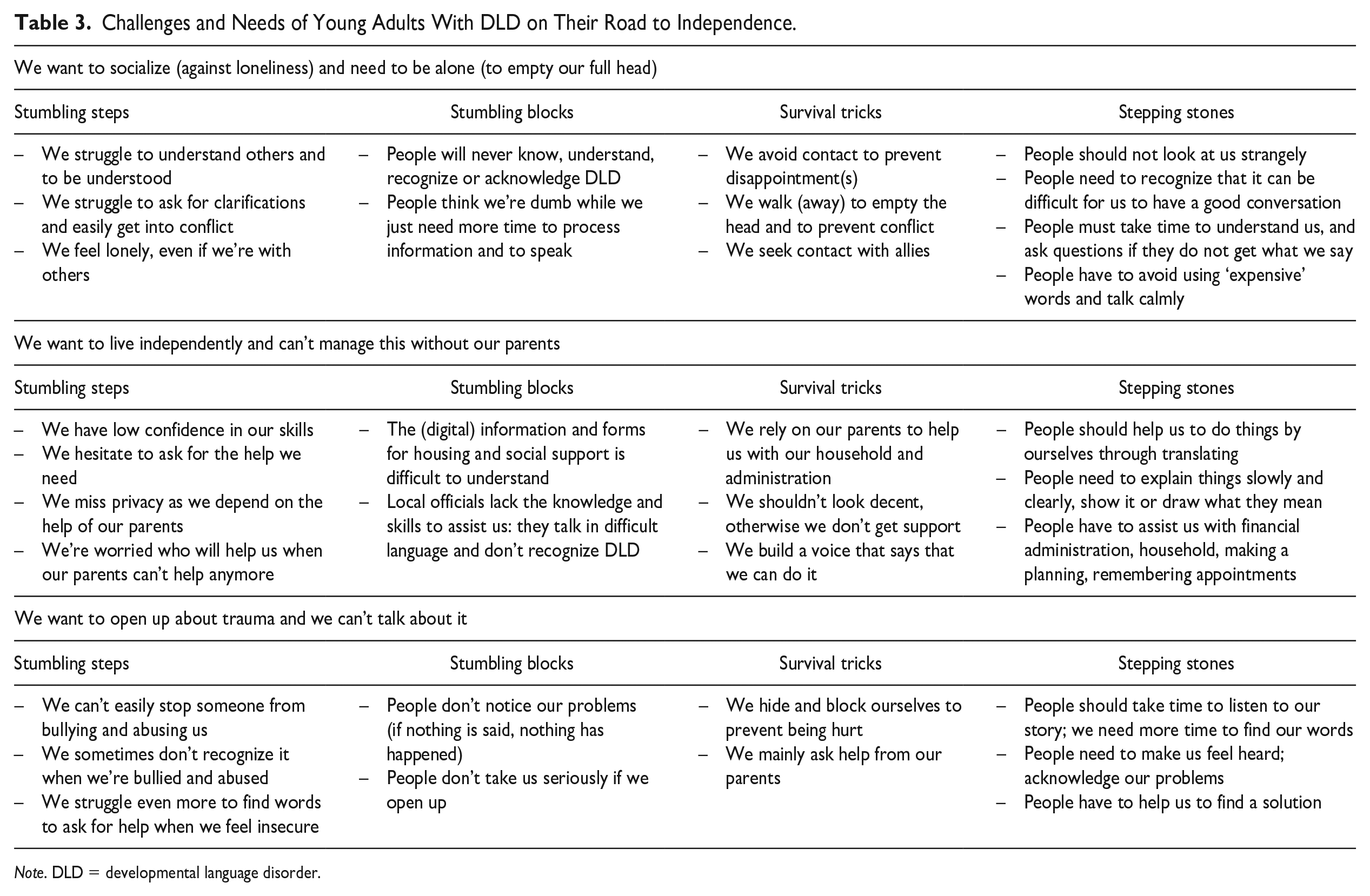
Note. DLD = developmental language disorder.
Discussion
The aim of this article was to identify participation problems of young adults with DLD in their transition to independence as well as to identify opportunities to address their needs, considering they live in a world where events take place in an escalating tempo, the so-called “socially accelerated society” (Rosa, 2013). For this, we wanted to answer three questions. First, what is DLD is from the perspective of young adults with DLD? Second, what experiences do they have in their transition to independent living? This includes how they start standing on their own feet as they have to take care of themselves while also attempting to become financially independent and to develop relationships. Finally, we wanted to identify what young adults with DLD perceive as good care in their transition to independent living. The PAR study TOSKoploper shed light on the stumbling steps and blocks, survival tricks, and desired stepping stones of young adults with DLD in their attempt to live independently. In our analysis of their experiences and desires, we identified three key lessons.
First, the desire and difficulty of young adults with DLD to be like others without being judged by their DLD. On the one hand, they prefer to be treated like anyone else, to be given the same opportunities. Similarly, with the young adults with DLD in our research, Sanders (2019) noted that youth with DLD want to take part, be heard, seen, understood and feel valued (p. 252). On the other hand, however, they constantly have to work harder as language is everywhere. To them, using language is a “fight” rather than self-evident. In their struggle to manage their day-to-day activities, little time and attention is left to express their abilities and needs. Therefore, they often encounter situations in which people expect too much. To avoid disappointments and anxiety, they “work around” people’s expectations. For example, they withdraw themselves from social interaction and consequently feel lonely. Hartmut Rosa (2013) points out that “slowdown and stoppage” are “dysfunctional responses” of people who are unable to keep up with social acceleration (p. 84), leading to alienation and increased precariousness (Vosman & Niemeijer, 2017). The participating young adults with DLD expressed their need for more time to process things, both individually and in company to avoid their withdrawal.
The second key lesson is that the Dutch participation society presumes that people with DLD are able to be as autonomous and included as anyone else with the help of their social network. However, young adults with DLD experience challenges in their “rites of passage” (Van Gennep, 1909/2019), and their transition to independent living. Young adults with DLD often feel too old to have their parents involved in their daily routine but miss the ability to live independently. They feel uncomfortable about their dependence on parental support and sometimes try to do things on their own, without the required knowledge and skills. On top of that, they are often not aware that they are eligible for social support. And when they do apply for support, they often encounter local officers who do not recognize and acknowledge their support needs. Consequently, young adults with DLD remain dependent on parental support despite their desire to set themselves free and have more privacy. While access to support systems may vary cross-culturally, a stronger dependence on the family was also recognized among British young adults with language impairment compared with others in the same age (Botting et al., 2016, p. 550).
The last key lesson is that the participants of TOSKoploper prefer a professional who stands by them, instead of taking over in the sense of Schmidt et al. (2020), as they learn to manage their contradictory needs and options. Their contradictory needs (a) to be with and without people, (b) to live independently and to have a support system, and (c) to open up about trauma while missing the capability, all concern “liminal spaces” in their rites of passage (Turner, 1969; Van Gennep, 1909/2019). “Liminal entities,” Turner (1969) formulates, “are neither here nor there; they are betwixt and between the positions assigned and arrayed by law, custom, convention, and ceremonial” (p. 95). In a more general way, young adults with DLD wish for what Hartmut Rosa dubs as an “emergency brake” to get some sort of control of the social pace (Rosa, 2013, p. 79, 321). In their practice to independently balance their conflicting needs and options, they wish for a patient and understanding professional that supports them in for example, expressing themselves, translating difficult language, making their daily planning, moving out, and looking for a job.
Some people may say that the stumbling blocks that young adults with DLD address are rooted in “ableism” (cf. Wolbring, 2008). The Dutch society is designed for non-disabled people, even by policymakers of the social services who should rather enable them to participate in their own way. However, the young adults also give nuance to this thought, noting that in some cases, it is not the environment, but rather DLD itself that excludes them from socialization. Nevertheless, they also regularly point out how much they miss people’s adjustment to their capabilities, such as in a talk with officers who decide whether they are eligible for professional support. The professionals need to “resonate” more with the young adults with DLD. This means that the person with DLD and the people in their environment form a mutually responsive relationship without one of them having to give in for the benefit of the other (Rosa, 2019). In the sense of Beudaert and Nau (2021), it includes that people synchronize their available time more with the needs of people with DLD.
The need to synchronize available time with the pace of the respondents is well-known in participatory research (cf. Schneider et al., 2019) and also experienced with young adults with DLD. The respondents regularly showed their appreciation for TOSKoploper as a platform where they could finally take enough time to be understood or make use of alternative, creative means, such as Jamboard and drawing graphic stories with an illustrator, to bring their stumbling blocks of living with DLD in the limelight. One participant mentioned she needed five work sessions (half a year) before she felt secure enough to open up about her trauma on sexual abuse. She needed time, not only to find her words due to DLD but also to overcome her distrust in others. Nevertheless, also in this research project, we felt the friction between having to deal with certain deadlines and the need to slowdown for the co-researchers and respondents living with DLD. This meant that we also had to seek understanding from our colleagues when we needed more time than agreed upon to deliver the expected results. Good participatory research, we learned, certainly calls for a committed mutually responsive relationship between all people involved.
Implications for Practice
The implications for practice as formulated with the young adults with DLD:
People should adjust to the pace of young adults with DLD, including taking time to listen to them and talking calmly for more understanding in their conversations.
Parents and professionals need to take the lived experiences of young adults with DLD more seriously, including sensitive and traumatic experiences and support needs.
Policymakers have to improve access to professional services and support for young adults with DLD in their transition toward independent living.
Researchers need to facilitate committed mutually responsive relationships between all people involved, which also entails that urgent and sometimes confronting topics are discussed.
Footnotes
Acknowledgements
This research has been made possible by the financial support of ZonMw (637003001). We owe many thanks to the members of the TOSKoploper research team (Bea, Jérôme, Iris, Maartje, Meike), all the young people with developmental language disorder who worked with us in this project, and were willing to share their time, energy and experiences with us. Further, we are thankful for the contributions of all the professionals who have contributed to the implementation of this research project. We recognize the value of your collegiality and critical attitudes.
Disposition editor: Cristina Mogro-Wilson
Declaration of Conflicting Interests
The author(s) declared no potential conflicts of interest with respect to the research, authorship, and/or publication of this article.
Funding
The author(s) disclosed receipt of the following financial support for the research, authorship, and/or publication of this article: This research has been made possible by the financial support of ZonMw (637003001).
