




Abstract
This study explores mothers’ experiences during the COVID-19 pandemic with a focus on stressors, parenting roles, and work expectations. Qualitative analysis of open-ended interviews with a diverse group of 44 mothers in the United States generated two main themes: adjusting parenting roles and career concerns for mothers. Findings reveal that mothers have internalized strong intrafamily expectations to shoulder the primary responsibility for domestic labor and child care in addition to completing their work obligations and experienced institutional gender bias in the expectations that employers have for female employees. The interviews highlight lower expectations for fathers’ contributions to parenting under pandemic conditions. Implications for research and policy are discussed with a particular focus on critiquing structures that may perpetuate gender disparities.
Keywords
Background
The COVID-19 pandemic has altered the day-to-day lives of parents around the world. Stay-at-home orders, school and daycare closures, and changes in work routines have disrupted parents’ work and family lives (Shafer et al., 2020). Both qualitative (Cannito & Scavarda, 2020; Donoso et al., 2021) and quantitative (Collins et al., 2021) studies have found that COVID-19 has disproportionately affected women in terms of navigating challenges of work–life balance and increased mental burdens at home, exacerbating gender inequality in the division of household labor (Yerkes et al., 2020). For example, Boca and colleagues (2020) found that during the pandemic, 68% of women compared with 40% of men spent more time on housework. These increased burdens have intensified existing disparities for women in U.S. households and offer a unique opportunity to interrogate parenting roles and expectations under changing circumstances.
Theoretical Framework and Literature Review
This study is guided by a critical feminist perspective (Clark, 2007; Kushner & Morrow, 2003). Critical feminism rejects the notion that biological differences between males and females account for differences in “nature” and assumed roles in society. In contrast, gender disparities are viewed as reflective of oppressive external (e.g., policies, labor system, education system) and internal (e.g., internalized traditional gender roles) structures (Butler, 1990). To advocate for more equity, critical feminism requires women to examine their own lives and identify sources of oppression, including a critique of the traditional family unit, which may cause women to be “trapped into choosing between subordination and abandonment” (Willis, 1984, p. 99). Much of the critical feminist perspective has focused on traditional gender norms and expectations, including “values, attitudes, preferences, conventions, assumptions, ideologies, traditions, customs, culture, rules, laws, beliefs, or even rights” that may be internalized by individuals and socialized through interaction (Pearse & Connell, 2016, p. 34). Despite activism to challenge traditional gender norms, disparities in the division of household labor and external employment continue. From a critical feminist perspective, these disparities reflect the deep social embeddedness and reproduction of gendered expectations of roles and behaviors (Cooke, 2020).
Pandemic parenting provides a new lens through which to examine gendered parenting roles as the unexpected, exogenous shock of workplace, school, and daycare closing forced parents to make rapid adjustments in household labor and employment. By observing how the gendered parenting roles adapt to current social and economic circumstances, we can gather new evidence about how the critical feminist theory applies to contemporary parenting, and how this perspective can guide policy to improve the well-being of parents and families. Within the critical feminist perspective, three bodies of literature align with pandemic parenting: disparities in the division of household labor, disparities in employment, and literature on work–life balance.
Gender Disparities in the Division of Labor in the Household
The literature on gender disparities in the division of household labor supports the critical feminist framework and suggests that pandemic parenting will tend to increase inequity in household tasks for women. Within the home, there are three main forms of unpaid labor: household labor, child care, and mental labor. Historically, an unequal burden of responsibility for all three of these forms of unpaid labor has fallen on women. While recent trends toward more egalitarian distributions of labor have been noted, the disparities continue to exist across countries and social groups of all income levels (Daminger, 2020).
Household labor is “the set of unpaid tasks performed to satisfy the needs of family members or to maintain the home and the family’s possessions” (Lachance-Grzela & Bouchard, 2010, p. 769). In their review of the literature from 2000 to 2009, Lachance-Grzela and Bouchard (2010) identified three primary micro-level mechanisms for the perpetuation of gender inequity in household labor: relative resources, time availability, and gender ideology. These perspectives posit that men are less likely to take on household labor because (a) they bring greater resources (e.g., income, education) to the parenting role through which they justify greater decision-making power; (b) they have less availability for household labor due to more time spent working outside the home; and (c) traditional gender roles do not call for an egalitarian division of household labor (Lachance-Grzela & Bouchard, 2010). Observation of pandemic parenting presents an opportunity to witness new behavior in response to an exogenous shock which can shed light on the operation of these mechanisms in household labor and the potential to alter them, particularly as pandemic circumstances may challenge some of the justifications for gender inequity in household labor, such as the lessened availability of men due to time spent working outside the home.
Child care is the second main form of unpaid household labor. Further underscoring labor disparities for women in U.S. households, Kamp Dush et al. (2018) found that among highly educated, white, dual-earner U.S. couples, men were more likely than women to be at leisure while their partners were performing child care or unpaid household labor, particularly on non-workdays. Craig and van Tienoven (2021) found similar results internationally, noting that fathers in full-time, dual-earner couples were more likely to be at leisure while mothers were completing unpaid work; however, the disparity occurred most often in the early evening on weekdays, a period of time referred to as “family rush hour.” The changed circumstances of pandemic parenting, with more men, women, and children sharing around-the-clock time at home provides an opportunity to observe whether this disparity persists when work and school activities all shift to the home arena and the “family rush hour” disappears.
Mental labor is the third form of unpaid household labor. In addition to performing a greater share of household labor, mothers are more likely to bear a greater burden of mental labor in dual-earner families, which may contribute to their greater emotional stress (Offer, 2014). Robertson et al.’s (2019) qualitative study of mothers of young children (N = 25) found that mental labor was separate from household labor, child care, or emotional work. Their analysis shows that parents perform six forms of mental labor: (a) planning and strategizing, (b) monitoring and anticipating needs, (c) meta-parenting, (d) knowing (learning and remembering), (e) managerial thinking (including delegating and instructing), and (f) self-regulation (Robertson et al., 2019).
Gender Disparities in Employment
A second body of literature documents gender disparities in employment. A critical feminist perspective predicts that pandemic adjustments to women’s employment would be expected to exacerbate disparities for women. Before the pandemic, women in the United States earned 20% less per hour on average than their male counterparts (Adams-Prassl, 2020). In addition, women in the workplace face gender stereotypes that result in workplace bias which can ultimately impede their advancement (Heilman, 2012). One of the most concrete demonstrations of bias facing mothers specifically is the motherhood wage penalty, in which women’s wages have been shown to decrease with the presence of each additional child, even after accounting for work experience and number of work disruptions (Yu & Kuo, 2017). In addition, Henle et al. (2020) found that primary caregiving parents were less likely to be hired, were offered lower wages, and were viewed as less competent and committed than non–primary caregiving parents.
According to several reports, women were more likely than men to be laid off or have their work hours reduced during the COVID-19 pandemic (Center for American Progress, 2020b; Collins et al., 2021; Dias et al., 2020). In addition, the pandemic has increased the gender gap in employment rates, with mothers’ rates declining more dramatically than fathers’ rates (9.3% and 7.4%, respectively; Dias et al., 2020). Collins et al. (2021) calculated a 20% to 50% growth in the gender gap in work hours in the early months of the COVID-19 pandemic. Petts et al. (2020) found that when child care was no longer available, mothers were at greater risk for job loss while fathers’ employment was more secure.
These disparities in employment and domestic responsibilities may contribute to the increase in stress that mothers have reported during the COVID-19 pandemic. For instance, Sevilla and Smith (2020) found that the closure of almost all child care facilities intensified the stress levels of mothers because they had to assume the added responsibility of caring for their children during work hours. Another recent study found elevated rates of maternal depression and anxiety during the pandemic (Baiden et al., 2021; Childress et al., 2022). The literature on gender disparities in employment confirms the critical feminist theoretical perspective and suggests that changing pandemic circumstances are likely to negatively intensify disparities for women.
Work–Life Balance and Child Care During the Pandemic
A third body of literature on work–life balance is relevant to pandemic parenting under a critical feminist perspective. The literature on work–life balance posits that women in the United States are subject to two conflicting norms—that of the nuclear family as the main provider of child care and the norm of the “ideal worker” who is always available to work full-time, imm-une to child care responsibilities or other demands (Martucci, 2021).
Evidence suggests that the pandemic has intensified the work–life balance conflict for employed mothers more than for fathers, with mothers performing more of the unpaid domestic chores and fathers prioritizing paid employment (Crook, 2020; Shafer et al., 2020). Women also took on a greater share of child care during the pandemic in light of daycare and school closures. Arntz et al. (2020) found that regardless of whether both parents were employed full-time or part-time, mothers spent more time on child care each week than fathers. During the pandemic, mothers reduced the time they spent working and increased the time they spent on child care; fathers made parallel but much smaller adjustments (Arntz et al., 2020). Without the support of institutional child care, some women were forced to reduce their working hours and others to leave working altogether (Craig & Churchill, 2020; Zamarro & Prados, 2021). In addition, mothers took on the majority of virtual learning and homeschooling responsibilities (Petts et al., 2020).
Martucci (2021) argued that a partner’s perception of a woman’s greater “flexibility” with her job led to an unbalanced allocation of child care responsibilities, specifically among academic mothers. Yavorsky et al. (2021) pointed to a larger systemic problem, positing that gender disparities in the division of paid and unpaid household labor are interrelated with gender disparities in the labor market itself. Boca et al. (2020) examined several aspects of women’s experiences with work and home life during the pandemic and found that working mothers with children under 5 reported having difficulty maintaining work–life balance due to the unequal distribution of domestic duties. Working mothers have also shown significantly higher levels of so-called “work-family guilt” than fathers, which refers to a sense of guilt related to the negative impact of one’s work on one’s family (Borelli et al., 2017).
Cumulatively, this emerging body of research suggests that COVID-19 work and domestic arrangements have reinforced and exacerbated existing gender disparities with negative consequences for women. To sum up, the critical feminist theoretical perspective provides an interpretive lens through which adjustments in parenting behavior under the exogenous shock of the pandemic can be understood. Aligned with this perspective, the bodies of literature on gender disparities in labor within the household, gender disparities in employment and work–life balance provide a basis for understanding and analyzing pandemic parenting. With these perspectives as a basis for interpretation and analysis, the next sections of the article turn to the new data and results from our study.
The Current Study
The current study builds on this body of literature by exploring mothers’ experiences during the COVID-19 pandemic from a qualitative perspective with a focus on parenting roles and work expectations. The qualitative approach fills a gap in the literature to deepen understanding of pandemic mothering beyond the limitations of quantitative research (see Collins et al., 2021). The present authors believe qualitative methodology is well-suited for this task because analysis of mothers’ narratives permits inclusion of reasoning and motivation for observed behavior directly from subjects and aligns with literature that calls for in-depth interviews to provide deeper insight into families’ experiences with shifts in responsibilities during the pandemic (Shafer et al., 2020).
This methodological approach aligns with a critical feminist perspective to researching families and family processes (Allen & Jaramillo-Sierra, 2015) by giving agency to women to describe phenomena in their own terms. This critical feminist perspective is well-aligned with a constructivist grounded theory approach to qualitative data gathering (Charmaz, 2006). Using this approach, our interviews were guided by a critical feminist framework to explore gendered norms, roles, and expectations among mothers during the COVID-19 pandemic. Elevating women’s voices who are directly experiencing the phenomenon of parenting under pandemic conditions and unique ways of knowing are central to our study (O’Shaughnessy & Krogman, 2012).
Method
Data for this analysis came from a longitudinal, mixed-methods study that examined family stress and resilience among parents of children ages 0 to 5 during the COVID-19 pandemic in the United States. Between June and August 2020, the research team interviewed 71 mothers who had at least one child between ages 0 and 5. The research team recruited families through licensed child care centers in a large, Southern state, and via social media. Through social media, the research team contacted the administrators of 107 Facebook parenting groups in a large Southern state and an additional 180 administrators of Facebook parenting groups across the United States. In addition to statewide and national parenting groups/pages, efforts were made to request participation from groups representing the largest and smallest counties within the Southern state and to contact at least three moms or parenting groups in each state nationally. The research team also made purposeful efforts to recruit from social media groups for single parents, fathers, and parents of color (e.g., groups for Black, Asian, or “Melanin” moms); however, it is unknown the extent to which these particular groups did or did not post information about the study. Interview participants were recruited from those who completed the online survey. Ultimately, 72 interviews were conducted (n = 71 with self-identified mothers and n = 1 with a self-identified father). The research team used a subsample of n = 44 for the current study, deciding to stop coding transcripts after saturation had been achieved and the transcripts from the theoretical sample had also been included. Interviews ranged in length from 30 to 60 min. All interviews were conducted via Zoom and were recorded and transcribed verbatim. All transcripts were de-identified. To maintain the confidentiality of participants, we replaced real names with pseudonyms. Prior to recruitment and data collection, the institutional review board (IRB) at the lead author’s institution reviewed and approved the study.
Sample
The analysis presented in this study is based on data from n = 44 interview participants. Table 1 displays the sociodemographic characteristics of the sample. The majority of respondents identified as non-Hispanic white (n = 30) followed by Hispanic (n = 4), multiracial (n = 4), Black (n = 3), or Other/preferred not to answer (n = 3). All interviewees identified as the mother of at least one child under age 6 at the time of the interview. Approximately two thirds of the sample (64%) had a household income of US$80,000 per year or more, and 81% had a bachelor’s or master’s degree. Most participants worked full-time (59%). Participants represented 18 states.
Sociodemographic Characteristics of Participants (N = 44).
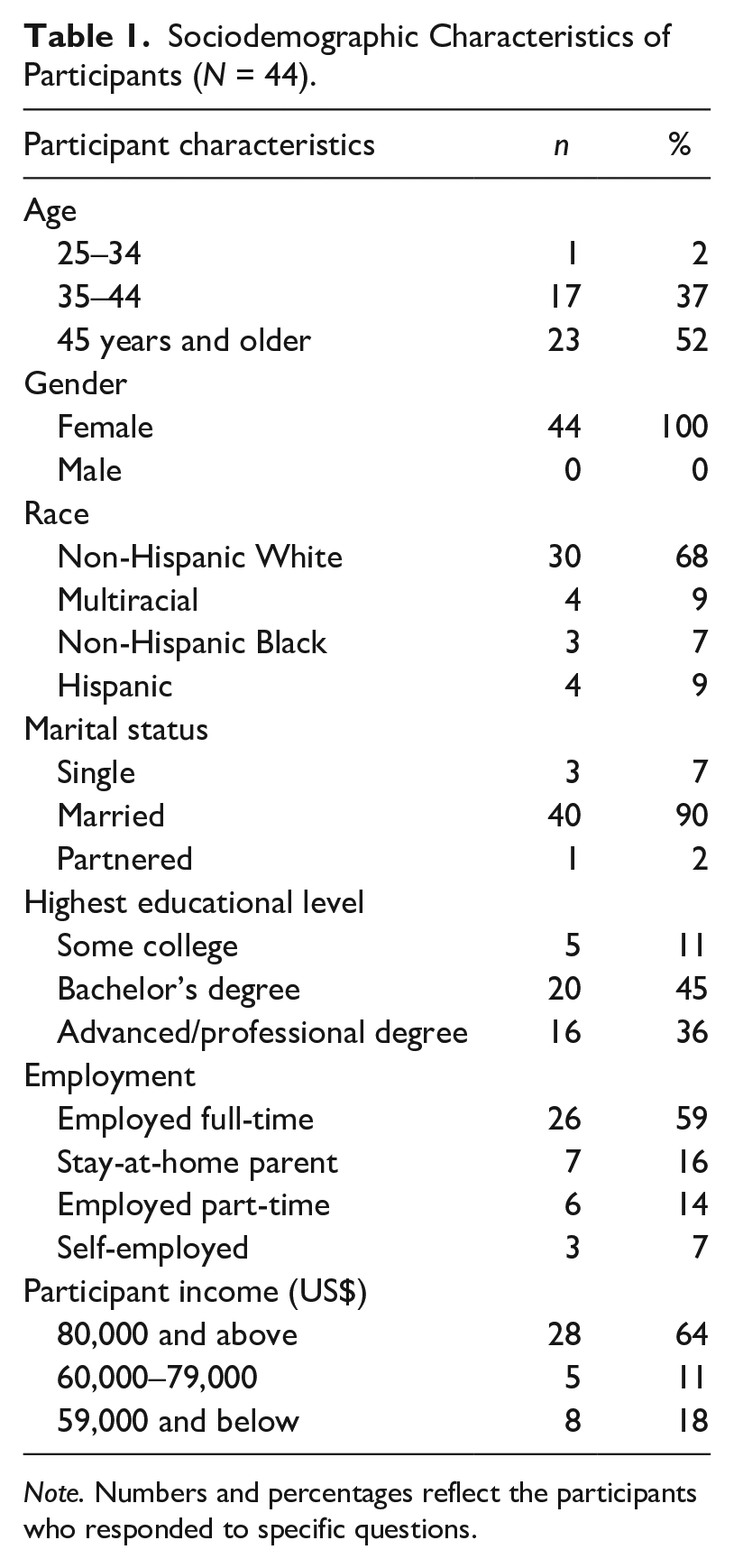
Note. Numbers and percentages reflect the participants who responded to specific questions.
Data Analysis
Grounded theory methodology (Glaser & Strauss, 1967) was chosen for this study as it allows for the development of explanatory frameworks or themes that are grounded in the data and reflect the perspectives and experiences of participants. Researchers employed theoretical sampling to select a subsample of interviews for analysis. Theoretical sampling is a key component of grounded theory and involves selecting participants and data sources that can contribute to the development of emerging themes. The researchers began by analyzing the initial set of interviews and identifying key themes and subthemes that were emerging from the data. Based on these initial findings, the researchers then selected additional participants that allowed them to further explore and refine the emerging themes. Due to the homogeneity of the sample (in terms of age, race, socioeconomic status, and family structure), the team purposefully selected interviews that provided rich and diverse data on the key themes that were emerging from the analysis. This process continued until the team reached saturation, which is the point at which no new information emerges from the data that are relevant to the main themes (Oktay, 2014).
In our study, we used a team-based approach to coding the transcripts. The team consisted of four researchers, three of whom were trained in grounded theory methodology and had experience with qualitative data analysis. To ensure the reliability and validity of the coding process, we used a double-coding approach, where each transcript was coded independently by two members of the research team. After the initial round of coding, the team met to review and compare the codes and resolve any discrepancies through discussion and consensus building. Once the team had completed the initial round of coding and had identified the main themes and subthemes that were emerging from the data, we used axial coding to further explore the relationships between these themes. This process involved breaking down the data into smaller, more manageable groups of data and reassembling them to give coherence to the emerging analysis. The final stage of our coding process involved selective and substantive coding, where we identified the most salient themes and subthemes that were grounded in the data. This process was carried out by the two researchers who analyzed the transcripts line-by-line, in close consultation with the rest of the research team.
To ensure the trustworthiness of the findings, data analysis was enhanced through analytic triangulation, peer-debriefing, and the provision of examples of raw data in the presentation of findings (Lincoln & Guba, 1985). Congruent with other grounded theory research, we conducted a more extensive literature and theoretical review after conducting data analysis and identifying salient themes.
Findings
Based on the coding, analysis, and enhancement processes, two main themes of women’s lived experience under COVID-19 emerged from the interview transcripts: (a) Adjusting parenting roles and expectations—This theme contains the subthemes “I Am the One” and “Managing Children’s Education, Health, and Development”—and (b) Career concerns for mothers. This theme contains the subthemes “Stress from Balancing Work–Life Responsibilities” and “Employment Expectations.”
Theme 1: Parenting Roles and Expectations of Mothers
I Am the One
The first theme focuses on parenting roles and expectations of mothers during the pandemic. Confirming the ideas of critical feminist theory and the body of literature on gendered roles in the household, mothers felt responsible to be the primary caretaker of their children regardless of how many other household and employment tasks they were also expected to manage, a sentiment summarized by the frequently used phrases like “I am the one,” or “all on me.” For example, Dominique, who had a 1-year-old, 6-year-old, and 10-year-old, commented that she was stressed with all of her extra work such as helping her children with virtual learning while her husband experienced no differences: In March, April, May, it was very stressful because I had a lot more on my plate. I had all the stuff I had before and then also e-learning. But my husband said, “My life hasn’t changed at all.” For my husband, literally, everything was the same. I guess, he picked up a little bit of slack with dishes and that kind of thing. But for the most part, I did feel like it was
For Molly, who had a 1-year-old and a 3-year-old, family responsibilities fell mainly on her shoulders: In my household,
Mothers who were coparenting also experienced an uneven division of child care labor. For example, Alicia, who has a 3-year-old son and lives separately from his father, said, “I’ve been working from home and having a toddler pretty much full time cause his dad works evenings and the majority of the day.”
Several mothers specifically noted that the household and family duties were not evenly distributed, and that the pandemic exacerbated the disadvantages of unfair division of labor that already existed in the home. Erika, the mother to a 2-year-old daughter, described shouldering almost all the expanded responsibilities in the home and receiving neither physical nor emotional support from her spouse: When I try to talk to him about it, he’ll be like, “I don’t understand why this is such a problem. Like other people don’t need to hire a maid . . . or use a lawn service.” The only people that I could possibly conceive [of] that he’s talking about are friends of his, where the woman doesn’t work.
Erika continued, noting that she was remote-working while also having to do the mental work of planning out groceries and mealtime. She explained, In our case, an added layer that’s difficult is whoever’s been helping with the baby has not been working. So, it’s hard for me to staff a meeting and then immediately shut off [the computer] and be like, “Okay, what should everybody eat for lunch? What did my baby eat for snack?” Well, do we even have [snack]?
When mothers discussed the division of labor, many mentioned the lack of emotional support from husbands who did not handle stress well. Lack of spousal support placed pressure on these women to maintain their mental equilibrium for the sake of the family while taking on more stress themselves. Crystal, whose children were 4 and 7 years old, offered a typical description of this pattern: I’m more of the grounding point in the family. My husband gets more stressed; he doesn’t do so well with transitions. So, definitely when he gets stressed, there is more fighting I would say than we normally have in our household. And that gives me anxiety.
Although some mothers reported receiving support from their husbands with child care and household duties, most participants described managing their household obligations in addition to their jobs, while their spouse only stepped in when they reached their breaking point. Emily, mother to 2-year-old twins and a 9-year-old, described her husband getting involved in the child care and household labor when she reached the point of exhaustion: [My husband] is really good about if he can tell that I get to the point where I’m mentally and physically so tired I cannot even function some days. When he sees that I’m kind of hitting a point where I really need a break, he’ll jump in there and say, “Hey, take a break.”
These narratives demonstrate the rigidity and durability of gendered roles and expectations of mothers. Even when the changing circumstances of the pandemic simultaneously increased the demand for household labor (particularly for child care and mental labor) and the availability of fathers to contribute to these tasks (because of homeworking), most women in the sample increased their efforts to shoulder the additional responsibilities relative to men. This finding in this theme supports notions that these gendered roles and expectations of mothers are widely internalized by both women and men and were not immediately open to renegotiation when the external shock of the pandemic increased the overall parenting burden. The narratives tend to depict fathers as relatively unmoved by these increased burdens on mothers until mothers reached a crisis point.
Managing Children’s Education, Health, and Development
The narrative also reveals that mothers experienced a high level of anxiety about their children’s education, health, and development, feeling largely responsible for handling the impacts of the changing pandemic circumstances on their children. Some of this anxiety focused on managing remote schooling and public messages about education. Courtney, whose children were 5 and 8, summarized her worries about her children’s education: The main concern is just that they are missing out on a whole half a year. I have no idea how my teaching stacks up to what she would be actually receiving in school. The pandemic has amplified all of the struggles of being a parent. It’s [a] much more intensive type of parenting I feel.
Mothers who were trying to work while keeping up with their children’s schoolwork described feeling pressured because these dual responsibilities were so draining and challenging. Crystal, a working mother of a 4-year-old and a 7-year-old, explained, “I had to homeschool my first grader and work with her. My husband was working. So, I would have her play by herself for a lot of the day. That was hard.” Dominique, whose children were 17 months, 6, and 10, recalled how difficult this balancing act was, even with help from a nanny: My husband and I are both essential workers. His work schedule has not changed at all, and I’m still working the same amount. My son did not want to do schoolwork with our nanny, so, we were trying to cram all the schoolwork with my son into my days off.
Even Tamara, who was herself a teacher, found it difficult to balance work and teach her five children, “Doing all the distance learning and trying to get my own children to get all their work done was stressful, but we pushed through and got it done.”
These findings lend support to critical feminism’s view that families have retained internalized patriarchal values that give men the prerogative to continue to assume the role of breadwinner and inhabit a privileged status of less household labor responsibility, even when they remain in the house during the workweek, and even when their wives have their own paid work responsibilities.
Theme 2: Career Concerns for Mothers
The second theme that emerged from the mothers’ narratives about life during the COVID-19 pandemic was the career concerns experienced by mothers who had to adapt their parenting roles during the pandemic. The mothers described having to identify new ways to navigate their work schedules and child care responsibilities and experiencing anxiety and negative impacts in their working lives. Many mothers reported high levels of stress and feelings of being overwhelmed. Brittany explained that her husband worked all day, so she had to watch the couple’s four children, ages 4 months, 2, 3, and 9, who needed constant attention, by herself. She said she needed support and rest, “I wish someone could have come and helped me, be it a nanny or in-laws or my mother or just somebody else to deal with kids. My husband was working all day long, so it was really
Many of the mothers in the study described feeling that they were expected to be the parent who did most of the child care, even if it meant sacrificing time spent on their career. They reported that within their families’ normative frameworks, it was more acceptable for their husbands to focus primarily on work while they (the mother) took care of most of the parenting. Ashley, mother to a 1-year-old, explains that she has to hold off reentering the work force so she can care for her child, “If my daughter’s not able to go to school, I will have to put off reentering the workforce, and that sucks.” Amber who has an 8-month-old, 2- and 5-year-old, recognized the burden that is being put on women and commented, “So much is put on the individual to adapt and change and handle these challenges. The reality is we’re pushing families, and really women, to their breaking points because there are no supports.”
A few mothers, in contrast, had supportive spouses, and described experiences of gratitude and less stress. For example, Katelyn, mother to a 3-month-old baby, explained how she was working with her spouse as a team, “We tag-team as much as we’re able to. It’s been so great having a partner to work through all of this with and seeing him grow as a father.” Tara, who has a 1-year-old and 5-year-old, also reported that having her husband home has strengthened their relationship and parenting because now he understands what it is like to be home with the children, “I’m really grateful that he can be home and kind of shoulder some of the responsibilities. I needed him to experience what my days are like. So that’s been really helpful, because we’re more on the same page.”
These findings about how the shock of adapting to pandemic parenting disproportionately affected mothers make sense from a critical feminist viewpoint and lend further support to the bodies of literature that suggest that gendered roles in labor markets tend to primarily hurt women, and that tensions and contradictions in the conflicting norms of work–life balance in the U.S. society are primarily borne out by increased effort and increased stress on working mothers. The few narratives of increased father involvement and parental cooperation under the new strains of pandemic parenting reveal a sense of satisfaction for both mothers and fathers from more equitable parenting.
Stress From Balancing Work–Life Responsibilities
As critical feminist theory predicts, the narratives of family adaptation to the shock of adjustment to pandemic parenting show that mothers assume the main burden of child care while continuing to work (often from home) during the COVID-19 quarantine, creating stress. The mothers’ descriptions show that it is stressful to sustain these multiple obligations, and women feel like they are not doing any of these things well. One mother explains the emotional toll in this way: I felt like I was grounded . . . I’ve gone through a range of emotions since March of just feeling depressed and not accepting it . . . And there is just waves of emotions because you don’t know what’s gonna happen.
The mothers emphasized that they were facing significant expectations to shoulder professional and domestic burdens with little to no support. Due to isolation orders, some mothers were expected to juggle full-time employment, round-the-clock child care, and domestic labor. For example, Jocelyn, who had a 2-year-old daughter, described her struggle to balance work, child care, and spousal care as the COVID-19 pandemic emerged, “We were both trying to work full-time online, so, caring for her became a burden. It’s been this constantly shifting situation . . . none of it has resembled a normal schedule for us at all.” The unprecedented demands on families generated by the COVID-19 pandemic add evidence to the literature on work–life balance that supports the notion of con-flicting and often unreconcilable norms on working mothers in the United States. When increasing child care and work expectations clashed under pandemic conditions, mothers paid the price in increased stress and anxiety.
Employment Expectations
Another issue related to pandemic parenting was workplace expectations. The narratives about workplace expectations during the shock of the pandemic bear out the literature on gendered employment expectations in a critical feminist framework. Mothers reported that their employers expected them to put in a conventional workday, even if they could finish their normal workload in less time, and regardless of the new demands created by at-home schooling and child care. This expectation kept them from being able to adequately attend to nonwork responsibilities such as child care and household labor. Jaclyn, mother to a 20-month-old and a 5-year-old, emphasized the need for more flexible arrangements that would allow her to balance these multiple responsibilities: I wish there would be a shift from “You have to be at your desk from nine to five” to “Get the work done when you can, because we know you’ve got other responsibilities.” It doesn’t matter if they get eight hours of work done a day, [what matters is] are they getting that work done?
Natalie, the working mother of a 2-year-old commented on these expectations that mothers are supposed to try to work the same amount at home while keeping up with their children, “Mothers are just breaking themselves, trying to fit these roles that you can’t do. You cannot work and have a young child around you all the time. It’s impossible.”
Even in families where both parents worked, mothers were often expected to adjust their work schedules to accommodate their children’s schedules because their spouse’s jobs were viewed as less flexible. Such was the case for Danielle, working mother to a 5-year-old and 7-year-old, whose husband was unable to make room in his schedule to take on child care during the day. Instead, Danielle had to watch the kids while also working: My husband has a nine-to-five job where he’s often on conference calls during the day. So, we knew really quick—and I happened to be on sabbatical last term—that my job was much more flexible than his, and that I would be on kid duty during the workday.
The narratives of mothers coping with COVID-19 reveal that mothers have both internalized strong intrafamily expectations to shoulder the primary responsibility for domestic labor and child care in addition to completing their work obligations and experience institutional gender bias in the expectations that employers have for female employees. Danielle, whose children were 5 and 7, links together both the sexist assumption that mothers will take on most of the domestic responsibilities and the institutional biases and absence of public supports that support this assumption: I think a lot of it is this kind of sexist assumption, “Oh, the moms will just figure it out.” Well, no, figuring it out means just stop working, and that’s not a solution. My priority [recommendation] for the government [would be] to figure out how to make schools work and get very creative, simultaneously forcing businesses to say, “You cannot fire someone if they don’t work a certain number of hours or you need to have flexible policies in place.”
In sum, these findings confirm a critical feminist theory about the gendered implications of work–life balance and parenting roles, showing that even in situations where fathers have flexibility, women end up doing the major part of child care and domestic work. As Martucci (2021) shows, the perception that a working mother has greater flexibility in her work, may often result in her being charged with a greater domestic burden under the adjustments of pandemic parenting.
Discussion
This study examines the adaptations made by working mothers of young children during the COVID-19 pandemic. The unprecedented, rapid adjustments forced on parents by school and child care closures and the movement of many jobs to at-home arrangements created a type of vast social experiment in pandemic parenting which provides an opportunity to better observe and understand the gendered role expectations of parenting and employment that may be taken for granted in nonpandemic conditions or hidden under the surface of nonpandemic institutional arrangements. The qualitative analysis of the narratives of mothers about these adjustments offers a unique opportunity to listen to the people engaged in making these adjustments and hear what they reveal about gendered expectations of household labor, child care, mental labor, employment, and the reconciliation of these in work–life balance. The narratives offer direct explanations about how these mothers readjusted their lives to pandemic conditions.
Critical feminist theory is deployed as an interpretive framework for the study which utilizes prepandemic and new pandemic-era literature on gender differentiation in household labor, employment, mental labor, and work–life balance to frame analysis of the mothers’ narratives. The study’s two main themes—the adaptation of parental roles and expectations and career concerns for mothers under adjustments to pandemic conditions—largely support the prepandemic and other pandemic-era literature in finding that women bear the main burdens of increased labor in the household and adjustment to increased demands for handling contradictory work–family responsibilities. These results align with other recent studies that have found traditional gendered division of work to be “widely practiced” despite calls to challenge traditional norms (Crook, 2020; Liu & Dyer, 2014, p. 1). This study’s findings also show that these practices often persist even when fathers became more physically present in the home as a result of at-home work adjustments. The narratives of mothers both rising to shoulder the increased challenges of pandemic parenting while also questioning their spouses’ roles, reflect the tension between a degree of female empowerment in U.S. society, and ongoing “manifestations of gendered inequality” in which the desire for equality within and outside of the home is impeded by ongoing structural and internalized persistence of patriarchal values (Baker, 2012).
The findings about mothers’ lived experiences confirm prior evidence that mothers are experiencing significant stress during the outbreak (Baiden et al., 2021; Boca et al., 2020; Childress et al., 2022; Sevilla & Smith, 2020). This stress can be viewed as an intensification of the stress implicit in prepandemic “work-life balance” with its implicit expectation of resolving conflicting norms in contemporary U.S. society which situate child care as a responsibility of the nuclear family while also expecting mothers to operate as “ideal workers” in the labor market (Martucci, 2021; Williams, 1996).
The narratives of the mothers in the current study highlight two issues that merit extensive social discussion and policy reform: (a) increasing father involvement in household labor and (b) shifting expectations about the role of women in household labor, child care, mental labor, and employment. Both of these issues reflect the intersection of social structural factors and individual agency in perpetuating or, alternatively, actively critiquing gender norms (Kabeer, 2000). Attention on the need for both structural- and individual-level change in gender roles aligns with the critical feminist perspective that sees a need for systemic change at both structural levels (i.e., nature of the economic system, employment policies) and changes in the beliefs, ideologies, and expectations of individual women and men.
The findings about how parenting roles adjusted under pandemic conditions reveal a need to intensify discussions about expectations of and social protection for working women (Gavrilovic et al., 2022). The current results indicate that women with children were expected by spouses, employers (and in some way by themselves) to prioritize being caretakers and fulfilling household responsibilities over their careers. Many women who have children and are employed are still expected (based on the demands of employers and assumptions of spouses) to take responsibility for both employment and family life. This study’s results indicate that dual-earner families generally divide tasks along conventional gender lines (Bartley et al., 2005). Our research supports that women face more work disruptions from their children than men, which may have worsened because of COVID-19.
Implications for Theory
The findings from this study can be understood as supportive of a critical feminist theoretical perspective. The challenges and stress experienced by mothers during the pandemic are reflective of patterns of dominance and oppression as they relate to gender (Chibucos & Leite, 2005). Although studies have found egalitarian expectations for caregiving (Milkie et al., 2002), women continue to experience a greater caregiver burden than men (Swinkels et al., 2019). Through a critical feminist lens, household labor, child care, employment, and mental labor remain gendered and are often considered the primary responsibility of the mother, even when both parents work outside the home (Ribbens, 1994). The patterns of behavior and the explanations for these patterns given by mothers in the study suggest that women in the United States continue to face expectations that they provide the bulk of household labor, child care, and mental work in the family while also maintaining employment. The findings suggest that spouses and employers resist changing these norms, even when circumstances like the pandemic school closures create obvious hardships to working mothers.
The lens of critical feminist theory also holds out the possibility that events like the pandemic can be triggers for radical social and individual change through processes of conscientization of both women and men about the inadequacy of patriarchally based socioeconomic relations. As the pandemic leads to blurring boundaries between work, home, and school, there is also a potential to transform oppressive structures and identify more equitable policies and practices for women who are navigating multiple roles (Cohen & van der Muelen Rodgers, 2021; Stevano et al., 2021). However, the narrative in our sample only mentioned aspirations for systemic change in passing.
Implications for Research, Policy, and Practice
Identifying the unique strains placed on families by the pandemic highlights structural vulnerabilities in the social protection system in the United States, and reveals problems with resilience in employment, child care, and education systems. These results expose a particular lack of support for working women with children. One potential source of additional support for working mothers in heterosexual relationships which the study participants identified is the desire for the increased involvement of fathers. Educating fathers about supportive norms and socializing or incentivizing men to take a more active role in fulfilling domestic responsibilities may stimulate greater involvement.
A second possible source of support is policy reform that favors working mothers, such as recognizing child care as a right, expanding paid leave for child care, and supporting flexible work arrangements. While some countries provided working mothers extended leaves of absence of unemployment insurance to take care of children during pandemic closures (Gavrilovic et al., 2022), the United States was less supportive in its policies, forcing working mothers to juggle work and child care simultaneously. The current results also suggest the need for more flexible homeschooling and educational options that would allow child care to be more holistically integrated into family life and remote-working. The study’s findings indicate that support must be provided to parents who cannot or will not send their children to daycare, to decrease the stress of these mothers (Center for American Progress, 2020a; Tanaka & Lowry, 2013). The lessons of the COVID-19 pandemic emphasize the structural vulnerability of working mothers in the U.S. work, child care, and education systems.
The current findings reveal a need for more research, policy, and practice to advocate for and implement coparenting education (Feinberg, 2002, 2003; Feinberg et al., 2021, 2022) to relieve stress among mothers. Studies show that cooperative coparenting may reduce parental stress and improve parent–child relationships (McRae et al., 2021). The results highlight the potential benefits of research, education, and advocacy related to father involvement that addresses the importance of mothers and fathers working as a team or as coparents. Some of the mothers in this study expressed concern about the minimal or nonexistent support they received from their spouses. Although others reported having some spousal support, the major theme was that mothers felt overwhelmed by the dual responsibilities of work and family life. Research and practice on potential ways to build or strengthen partner support could help to address this need.
Limitations
The diversity of study participants is somewhat limited because the research team employed a convenience sampling method that relied on social media (Facebook) parenting groups as a primary recruitment vehicle, meaning mothers without a social media account or who do not participate in social media groups were systematically excluded. Still, purposeful efforts were made to increase the diversity of the sample by presenting information about the study to single parents, fathers, and parents of color via specific affinity groups on Facebook. While the diversity of the initial sample was limited, the team made additional efforts to increase the diversity of the subsample used in this study. In addition, although we did not specifically ask or probe whether those who were married or partnered were in same-sex or heterosexual relationships, many women referred to their partners as “husband” or “he” in the interviews. Therefore, future research could ask for partner demographics and compare/contrast themes between same-sex and heterosexual couples. Future research could also target fathers, same-sex couples, and single parents through methods outside social media, as the present efforts yielded a rather homogeneous sample of affluent, married white women. Moreover, findings were based on self-reported perceptions of parenting and other responsibilities; future research could also interview both parents in two-parent households to compare experiences. The findings suggest that additional research would be useful to further explore the impact of the gendered division of labor on women’s earnings and career paths. Specifically, researchers could explore both specific outcomes and potential alternative working arrangements that might reduce the negative impact of pandemic-induced stresses on women’s employment and career events.
Conclusion
This study explores mothers’ experiences during the COVID-19 pandemic, focusing on gender roles and work expectations. Qualitative analysis of open-ended interviews with a diverse group of 44 mothers in the United States generated two main themes: adjusting parenting roles and expectations, and career concerns for mothers. Findings indicate that the COVID-19 pandemic has resulted in heightened stress for mothers due to increased demands to balance domestic work and employment. The interviews reveal lower expectations for fathers’ contributions (relative to mothers’ contributions) to parenting children in two-parent households under pandemic conditions. The lived experiences of mothers during quarantine highlight the need to take steps to increase spousal support and paternal involvement and the ongoing need to dismantle rigid, traditional gender norms that place more of a burden on mothers than fathers. The findings from this study and previous research suggest that the COVID-19 pandemic may be perpetuating and possibly exacerbating societal expectations that mothers should prioritize their children and families and be willing to sacrifice their professional goals to fulfill family roles, while men can focus almost entirely on their careers and take on a smaller share of household and family responsibilities.
Footnotes
Disposition editor: Cristina Mogro-Wilson
Declaration of Conflicting Interests
The author(s) declared no potential conflicts of interest with respect to the research, authorship, and/or publication of this article.
Funding
The author(s) disclosed receipt of the following financial support for the research, authorship, and/or publication of this article: We would like to thank the mothers who graciously took the time to participate in this study. This project is supported by the Health Resources and Services Administration (HRSA) of the U.S. Department of Health and Human Services (HHS) under the Life Course Intervention Research Network (LCIRN) grant, UA6MC32492. The information, content, and/or conclusions are those of the authors and should not be construed as the official position or policy of, nor should any endorsements be inferred by HRSA, HHS, or the U.S. Government.
