




Abstract
In the last reauthorization of the U.S. Individuals with Disabilities Education Act (IDEA), families of individuals with disabilities provided less than 4% of the public comments. Given that families are equal partners in the decision-making process for students with disabilities, it is critical to understand their suggestions for IDEA. To this end, we analyzed the testimonials of 65 families of individuals with disabilities. Specifically, after completing a civic engagement program, participants provided video, audio, and/or written testimonials focused on their suggestions for the next IDEA reauthorization. Participants suggested strengthening existing IDEA provisions, increasing federal funding of special education, addressing personnel issues in special education, improving accountability, and increasing family knowledge and empowerment. Participants’ suggestions were further analyzed by examining patterns within the data; families of children with (vs. without) autism were significantly more likely to request that the next IDEA reauthorization increases knowledge and empowerment. Implications for future research and policy are discussed.
The Individuals with Disabilities Education Act (IDEA, the federal special education law) was last reauthorized in 2004, presenting a long overdue opportunity to improve education for over 6 million children with disabilities (Yell, 2019). During an IDEA reauthorization, the Office of Special Education Programs (OSEP, the federal office that oversees special education) strives to include stakeholders in the legislative process (Gartin & Murdick, 2005). The OSEP is particularly interested in contributions from individuals with disabilities and their families—key stakeholders of IDEA (H. R. Turnbull, Shogren, et al., 2011). Families are experts on their children—the primary recipients of IDEA’s mandates (Turnbull et al., 2023). Their knowledge of their children and their children’s experiences receiving special education services is important as their feedback can help improve IDEA to be more effective. Indeed, when families feel they are meaningful partners in their children’s education, students demonstrate improved school and post-school outcomes (Barger et al., 2019; Boonk et al., 2018; Sheridan et al., 2019). Yet, during the last IDEA reauthorization, families provided only 3.82% (n = 288) of the public comments (York, 2005) and comprised only 18% (n = 65) of the witnesses at Congressional hearings about IDEA (H. R. Turnbull, Shogren, et al., 2011).
Few prior studies have examined the suggestions of families of children with disabilities for the next IDEA reauthorization. Burke and Sandman (2014) conducted a civic engagement program in which 49 families of children with disabilities provided testimonials for legislators and OSEP about their suggested changes for the next IDEA reauthorization. Altogether, 44.90% of participants wanted to add specificity to existing supports (e.g., requiring that transition specialists and job coaches participate in transition planning), 28.57% wanted to add supports (e.g., requiring applied behavior analysis [ABA] as a related service), and 26.52% advocated to keep or increase IDEA stipulations that are already in place but not being met (e.g., increasing the federal funding of IDEA to 40%). Their study was only conducted in one Midwestern U.S. state; thus, the generalizability of these suggestions is unclear given the variability in states’ implementation of IDEA. Building on their study, Rossetti and colleagues (2020) elicited testimonials from 95 families of children with disabilities across four states. Like Burke and Sandman (2014), they found that participants wanted to expand IDEA to address specific concerns (e.g., increase professional development opportunities for educators), have greater specificity (e.g., operationally define the requirements to be an interpreter at special education meetings), and be implemented with fidelity (e.g., increase the federal funding of IDEA to 40%). Notably, both studies were conducted prior to the COVID-19 pandemic. Because of the shift to online learning during the pandemic, family involvement became even more common and important (Albright et al., 2024). Families have had opportunities to be their children’s in-person teachers. Previous research has documented the tremendous impact of COVID-19 on student well-being (Asbury et al., 2021) and families (Averett, 2021). Because of these newfound experiences, it may be that families have different suggestions for changes to special education.
Furthermore, it is important to determine whether there are patterns in family suggestions for the next IDEA reauthorization. Burke and Sandman (2014) found that families of children with autism (vs other types of disabilities) were more likely to desire ABA as a required service in IDEA. Considering issues in race and income (in)equity in special education (Strassfeld, 2016), it may be that families of color (vs. White families) or families from lower (vs. high) socioeconomic backgrounds have different suggestions for the next reauthorization of IDEA. Furthermore, families of color may have a vested interest in voicing their suggestions about special education given issues with disproportional disciplinary procedures for students of color (Fisher et al., 2021; MacSuga-Gage et al., 2021). To that end, it may be that families of color can contribute to an understanding of issues surrounding disproportionality (Bell, 2020), over-representation in segregated placements (Cologon, 2022), poor transition planning and post-school outcomes (Achola & Greene, 2016; Hasnain & Balcazar, 2009), as well as broader issues in special education. In a study of family advocacy, Trainor (2010) found that families with more formal educational backgrounds were more likely to conduct systemic advocacy. Similar to families of color, families from lower socioeconomic backgrounds may have an interest in sharing their perspectives for the next IDEA reauthorization. Given the inequity in child find policies among children from low-income households (Grant, 2020), the input from families of low-resourced backgrounds may be important in improving equity in special education. Yet, it is unclear whether family educational background influences the goal of systemic advocacy—including suggestions for IDEA. A family’s special education experience may be related to their background; if so, it is important to understand how suggestions for the next IDEA reauthorization differ in relation to participant characteristics.
For any policy, it is critical to have consumer input to inform needed changes. As the IDEA reauthorization looms, consumers include families of youth with disabilities. Families of children with disabilities report wanting to share their suggestions about special education with policymakers (Burke & Sandman, 2014; Rossetti et al., 2020). By hearing directly from individuals impacted by special education policy, IDEA can be revised to meet the needs of its intended constituents. Furthermore, by identifying patterns in relation to family background and feedback, we can develop targeted interventions for certain populations, as needed, to ensure that IDEA promotes equity. Thus, for this study, we had two research questions regarding families of individuals with disabilities:
Method
Participants
Participants include families of individuals with disabilities. To participate in this project, the inclusionary criteria were having a child with a disability and attending a civic engagement program. Altogether, 65 participants (specifically, 57 mothers and 8 fathers) contributed to the testimonials. The participants reflected six sites across the United States: Illinois (15.3%, n = 10), Louisiana (7.7%, n = 5), Maine (13.8%, n = 9), New Mexico (10.8%, n = 7), South Carolina (40%, n = 26), and Washington, DC (12.3%, n = 8). The sites were selected to reflect the geographic diversity of the United States, and Parent Training and Information Centers (PTIs) interested in partnering in the project. Among the participants, 38.5% reflected racial minority backgrounds. On average, participants were 46.1 years of age (SD = 9.10). Most children of the participants were male (73.9%, n = 48) (see Table 1).
Demographics of Parent Participants.
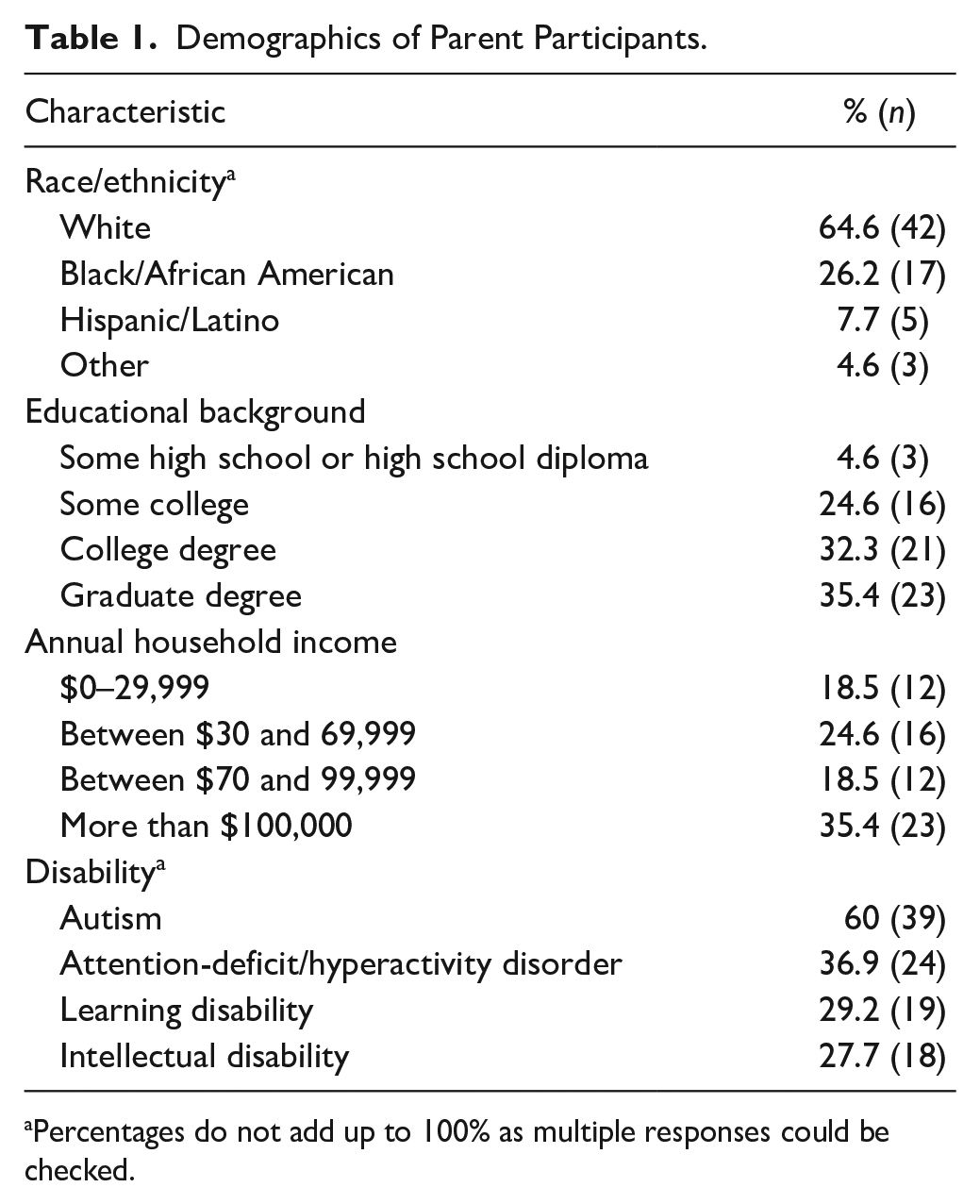
Percentages do not add up to 100% as multiple responses could be checked.
Recruitment
We utilized several methods to recruit participants. In each site, we partnered with one PTI, a federally funded agency designed to educate and empower families of individuals with disabilities about their special education rights. With the PTI, we distributed recruitment flyers to disability agencies, family support groups, and community organizations. Each participant received a $25 gift card for completing the civic engagement program. All participants were recruited during 2022 to 2023.
Procedures
Upon learning about the program, participants completed a screening form to ensure they met the inclusionary criteria. If the individual met the inclusionary criteria, then they completed a consent form (which was approved by the Institutional Review Board). After completing the consent form, they completed a pre-survey asking question about themselves and their children. Participants completed a 6-hr civic engagement program about special education and ways to talk to legislators (for more information about the program, see Rossetti et al., 2020). The program was facilitated by the PTI staff. Specifically, all trainings were facilitated by families of individuals with disabilities employed at the PTI. The research team trained the PTI staff to conduct the program via six, 1-hr meetings to review the curriculum. Fidelity to the program was 100%; inter-rater reliability for the fidelity checks was also 100%. During the first half of the program, the facilitator reviewed past IDEA reauthorizations and IDEA mandates, prompting discussion of possible changes to IDEA; during the second half, the facilitator discussed ways to impact systemic change through advocacy. At the end of the program, participants completed testimonials about their suggestions for the next IDEA reauthorization.
Measures
Participants developed their own testimonials. Specifically, the participants wrote 3-min testimonials detailing their suggestions for the IDEA reauthorization. To write their testimonials, they followed a “Hook, Line, and Sinker” approach (Walsh & Kuriansky, 2009); this approach has been used in prior civic engagement programs with great success (e.g., Burke & Sandman, 2014). This approach was taught during the civic engagement program. For example, during the program, the participants watched existing testimonials and read testimonials; they identified the hook (i.e., introduction of the person providing the testimony), line (i.e., the presentation of a problem), and sinker (i.e., the request for a change in IDEA). At the conclusion of the program, each participant received a “Hook, Line and Sinker” worksheet. Participants had 30 min to write their testimonials. Their testimonials were either video recorded or audio recorded. The research team transcribed the recordings; the transcripts were used for data analysis. On average, the videos were 1:44 min long (SD = 47 s, range from 0:23 s to 3:33 min). In total, we recorded 57 video testimonials, seven voice recording testimonials, and three written testimonials (two participants created two testimonials each).
To characterize the sample and identify patterns in the themes for the IDEA reauthorization, we used the participant pre-survey data. Specifically, participants were asked about their: educational background (e.g., did the participant complete high school or have some college education?), socioeconomic background (e.g., did the participant make more or less than $50,000 per year), their race/ethnicity (e.g., did the participant identify as White or another race/ethnicity?), and the type of disability of the child (e.g., did the child of the participant have autism or another type of disability?).
Analysis
We analyzed the content of the testimonials using a conventional content analysis (Hsieh & Shannon, 2005). Also, we created a specific coding protocol to identify the type and content of suggested changes to the IDEA (Rossetti et al., 2020). Participants could report more than one suggestion in their testimonial. The coding protocol used a multistage coding process including (1) identifying the participants’ suggested changes, (2) creating descriptive codes from the participants’ suggestions, and (3) identifying categorical codes (Rossetti et al., 2020). To identify the suggested changes, two independent coders listened to the testimonials and coded the first 16 separately. Together, they created a codebook using the participants’ words as descriptive codes. Then, independently, each coder coded another 19 testimonials using the codebook. The codes were then compared for the 35 testimonials. Discrepancies were discussed until an agreement was reached. The coding process proceeded with multiple meetings to discuss the codes, reach a consensus on code discrepancies, and to categorize the codes. Because consensus coding was used for discrepancies, we did not conduct inter-rater reliability.
Across the testimonials, 134 suggestions were made. Thus, many of the testimonials included multiple suggestions for the next IDEA reauthorization. The 134 suggestions were clustered around 16 categories (funding, inclusion/least restrictive environment, behavior and mental health support, teacher training and support, staff shortages, extended supports/childcare, state/local accountability, advocacy/navigation/family support, Child Find, independent evaluations, Individualized Education Program (IEP) team participation, federal consistency, outside of school providers, preferred school (neighborhood, school choice), transition supports, free appropriate public education [FAPE], and other). These 16 categories were then organized into six themes that were developed by grouping similar suggestion categories (e.g., teacher training and support combined with staff shortages to create the theme of Personnel Issues). Specifically, themes included Increasing Funding, Strengthening Existing IDEA Structures, Personnel Issues, Accountability, Family Knowledge and Empowered Choice, and Other. The “Other” category encompassed suggestions that did not fit into any of the identified five categories, such as the inclusion of food allergies or feeding disorders in IDEA and increasing the frequency of IDEA reauthorizations.
Patterns were identified by creating cross-tabulation tables per participant characteristic (i.e., income, education, race and ethnicity, the child’s type of disability) and themes (i.e., Funding, Strengthening Existing IDEA Structures, Personnel Issues, Accountability, Family Knowledge and Empowered Choice). Each table consisted of the frequency of topics and the corresponding within-group percentages. Inferential statistics were conducted to determine whether there were any significant patterns.
Trustworthiness
Several methods were used to ensure the trustworthiness of the data analysis (Brantlinger et al., 2005). First, we used investigator triangulation as several team members were involved in data analysis. Team members conducted weekly peer debriefing to check their biases and agree upon codes, categories, and themes. Second, as a form of first-level member checking, each of the testimonials were sent back to each participant; if the participant disagreed with their testimonial or wanted to change what they shared, they could do so.
Positionality and Reflexivity
The research team is comprised of seven practitioners, one parent of a child with a disability, and two siblings of adults with disabilities. Each of the team members had extensive experience working with youth with disabilities. Their familiarity with the experiences of families of children with disabilities was a strength in conducting this study and analyzing the data. In addition, each research team member had knowledge about IDEA policy and advocacy. Also, each team member also brought their own lived experiences and perceptions to the study. To address potential biases of the team members, each team member recorded notes and engaged in peer debriefing to identify and mitigate their biases.
Findings
Strengthen Existing IDEA Structures
The most common theme (n = 36) was a desire to strengthen existing IDEA structures. This theme included strengthening: inclusive education and the least restrictive environment (LRE), behavior and mental health supports in schools, transition support for students ages 18 to 21 years, and Child Find (i.e., each state’s systematic process to identify and locate children with disabilities and determine which ones are receiving special education services). See Table 2.
Suggestions for the Next IDEA Reauthorization.
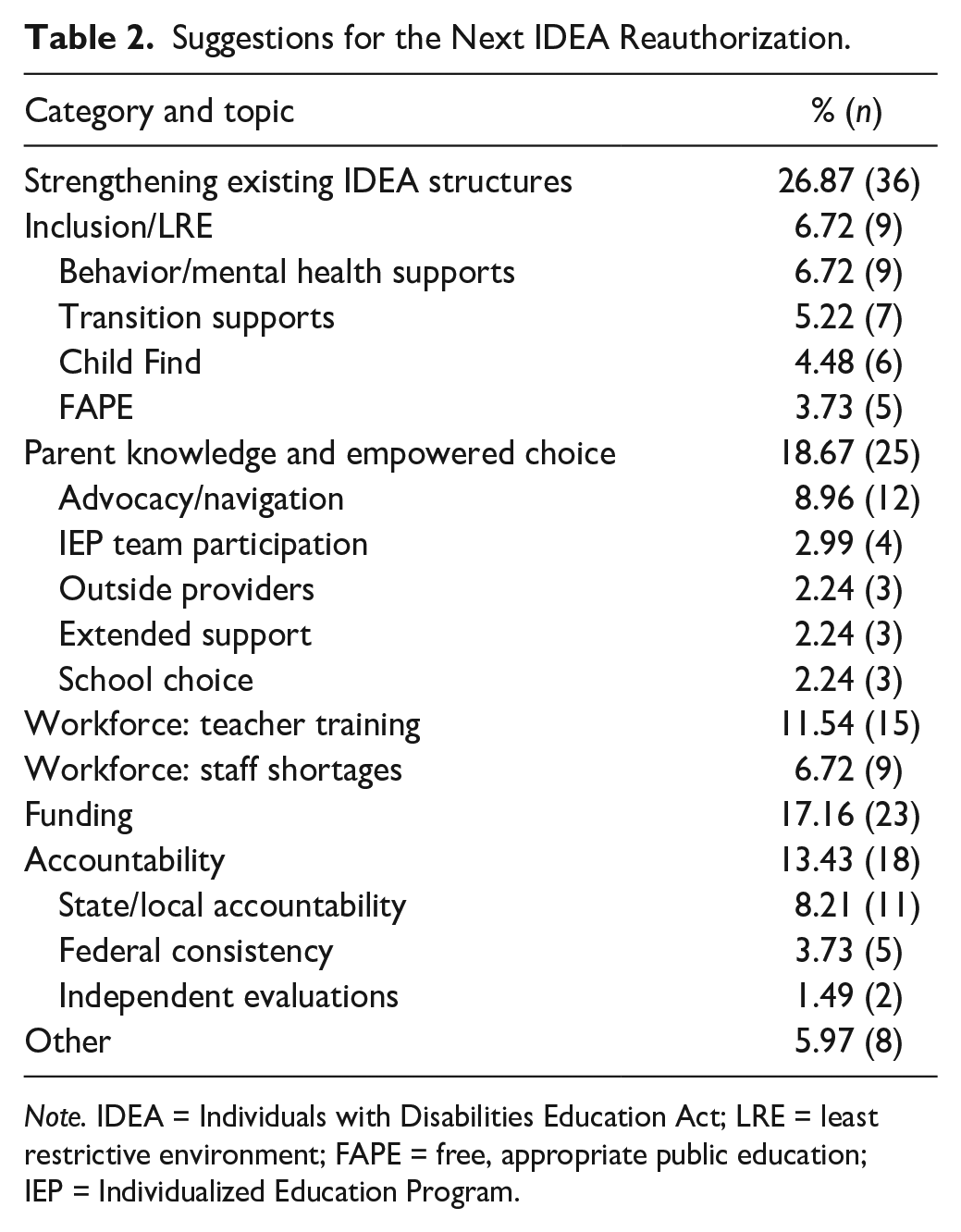
Note. IDEA = Individuals with Disabilities Education Act; LRE = least restrictive environment; FAPE = free, appropriate public education; IEP = Individualized Education Program.
Inclusion and LRE
While nine participants reported wanting to modify the provision of LRE regarding inclusive education, there were different suggestions. Some participants wanted more rigorous procedures to determine a child’s LRE rather than assuming the general education environment was inherently appropriate (i.e., as is) for most children. A participant wrote, “The approach to LRE must be expanded to include guidelines and protocols to assess whether the environment may need to change in order to be least restrictive for them [children with disabilities].” Similarly, some participants reported that the LRE should be geared toward an inclusive environment in the general education classroom. A participant stated, If the school district properly implemented least restrictive environment, all children would benefit from peer modeling, positive self-esteem, high academic outcomes, gen[eral] ed[ucation] students gain empathy and acceptance, and the best is early financial investment with less intervention services needed later in life.
Their suggestions reflected greater guidance from IDEA regarding the provision of inclusive education in the LRE.
Behavior and Mental Health Supports
Nine participants shared a desire to improve the behavioral supports for students with disabilities and include mental health support. One participant described their desire for schools to focus on teaching skills rather than rewards for good behavior. She shared, “No child likes to disappoint a teacher or a parent, and when it happens, we need to check our expectations and increase support and teach those skills.” Another participant requested that IDEA be amended to restrict the use of seclusion and restraint: “Please consider adding a resolution to IDEA that prevents isolation or other types of discipline that are cruel for children with disabilities. Our children should have access to a safe learning environment that promotes their education.” Still further, two participants requested to increase access to ABA for students with challenging behaviors. A participant wrote, “The law should ensure that students who can’t access the curriculum due to disabilities that affect behavior have access to ABA therapy in the form of direct one-on-one behavior technician support in the classroom.” In regard to mental health support, one participant asked for support for her child who had “made self-harm statements during reading.” Another participant asked for “mental health support” for her child with anxiety. Neither participant provided clarification of what was meant by “mental health support.”
Transition Supports
Seven participants of transition-age students with disabilities requested strengthening transition planning (i.e., the process for each youth with a disability starting no later than age 16 wherein they plan for post-school goals in employment, post-secondary education, and adult living), including the transition from school to adult life. A participant stated, “I am concerned that communication and inclusion of other providers such as voc[ational] rehab[ilitation], physicians, and mental health providers is not required.” Other participants echoed this desire for improved coordination of services and stronger provision of life skills training: I would also like for a more robust plan and strategies for those who at some point will transition out of high school and into adulthood. As those kids turn into adults, they need assistance with life and vocational and trade skills and the development of life and trade skills. These children need support through all steps of life.
One mother stated that her daughter is on the Prioritization of Urgency for Needs of Services (PUNS, the waiting list for the Home and Community Based Services Medicaid waiver in Illinois), which has caused a delay in services when transitioning from high school graduation into adult life: She is still waiting on funding for or relies on, you know, her parents or family members help her access and get her to and from places. She is more at the mercy of our schedules than living her life as independently as possible.
Child Find
Six participants reported wanting improved Child Find procedures. A parent of two children late-identified with multiple learning disabilities discussed one of her children being 3 years delayed due to his late diagnosis, which caused her son undue stress and depression. She stated, “I would like the Congress to mandate penalties and compensation for students who are determined to be previously eligible as a student with a disability.” Another participant made a very specific request of her legislators: “What I would like to see is for schools to be required to provide all kids with a dyslexia screener to include both phonological and orthographic processing.” Participants reported that their schools had failed their children by failing to identify the child’s disabilities in a timely fashion and spoke out against this by advocating for the improvement of Child Find mandates.
Increase Federal Funding
The second most frequently requested change (n = 23) was to increase federal funding of IDEA so that states, districts, and schools could have more resources for special education services. Specifically, participants reported that the federal government should fund 40% of all special education expenditures. Participants expressed frustration that IDEA has been funded at such a low level. A participant emphasized, It [IDEA] also is not, nor has ever been, fully funded. Ever. I find that very concerning. I feel very strongly that if it were funded appropriately and had the updates it greatly needs, my family and so many other families wouldn’t struggle to obtain appropriate services, because I know my family is not alone in our struggles.
While some participants couched their requests for funding in personal (i.e., individual) stories, others spoke to the societal needs (i.e., systemic) that may be addressed by fully funding IDEA at the federal level. One participant explained, All children deserve to live in a world that encourages diversity and allows them to achieve their full potential. When we bankrupt our schools, we hinder our children’s ability to meet the challenges of the future. Please fund IDEA at the full 40% rate needed for our local schools to run programs for children with disabilities efficiently. Schools need the resources to ensure that children have their educational needs met.
Offer Resources to Improve Family Knowledge and Support Families
Altogether, 25 participants requested that IDEA should offer resources and supports so families can meaningfully participate in the special education process. Such supports included advocacy and navigation support, IEP team participation, access to outside providers, support outside of the school day, and school choice.
Advocacy and Navigation
Many participants (n = 12) reported a desire for support in navigating the special education system. Suggestions included the proactive provision of accessible information, as well as guidance and advice from individuals with knowledge and experience in special education. A participant sought a centralized location for information regarding family rights to better understand the special education system: I think that there should be resources for us to understand these laws and rights and agencies and who we should contact. . . . I’d like to see change where resources are made accessible in one area for parents to know whom to reach out to.
To help improve their advocacy and service navigation, some participants suggested that IDEA include special education family liaisons at the district or school levels, district advisory boards consisting of families of children with disabilities, and case management. A participant described, I would like to have the consideration of an advocate, or a case manager being assigned to each student and family to assist them in educating, recommending, advocating, and coordinating these services in conjunction with us and on our behalf.
IEP Team Participation
Four participants reported that IDEA should strengthen mandates about membership and participation on the IEP team. Specifically, participants suggested: requiring all team members to be present for IEP meetings, and having IEPs better explained to families to increase their ability to participate meaningfully. In addition, a participant requested increased transparency from the school members of the IEP team to ensure she has the knowledge to make educational decisions for her child: My second ask is that parents are provided with all of the available options that are for services and placements in the district instead of just the ones that the IEP team brings to the table and that they are comfortable sharing with us.
Outside Service Providers
Three participants had suggestions regarding the provision of services by outside providers. Specifically, they requested that when schools are unable to provide therapy supports due to staff shortages, the school should pay for outside providers to meet their child’s needs. One participant wanted his grandchild to be allowed to leave school to access private therapies in the community because the school would not provide them under the child’s IEP. Two participants made requests for ABA services to be provided in schools with one requesting, “I’d like to ask you to update the IDEA to include language under services and research-based interventions stating that schools must permit ABA therapists to conduct therapy at school if the school cannot or will not provide these services.”
Extended Support
Some participants (n = 3) requested that IDEA make after school programs or summer programming accessible for students with disabilities. Multiple participants noted that they are unable to find childcare for their children with disabilities and that school-based extended support would be beneficial. A participant reported, In reality, the school does not offer services after school hours and the summer program is reduced because of a lack of funds. I would like for you to consider allocating the budget for this goal so that our children with disabilities have the opportunity to receive these services and this would give parents the ability to maintain our jobs without problems.
School Choice
Three participants reported that IDEA should expand school choice. One participant reported moving to a new home and new school district so that their child would be able to access a specialized certified program. She reported, “Parents should be able to send their child, at district expense, to a school district who has a certified special education teacher in place for their program.” Another participant requested that children be able to attend schools closer to home by having services available at all schools: “IDEA needs to take into account the distance children are traveling to school and if they are part of their community by taking them out of the schools closest to them.”
Improve the Special Education Workforce
Many participants (n = 24) reported that IDEA should address personnel issues in special education. Specifically, participants reported that IDEA should offer professional development for educational professionals and reduce staff shortages.
Teacher Preparation
Many participants (n = 15) reported that IDEA should offer more preservice and in-service education and ongoing support for teachers. A participant specified that special educators need specialized preparation to teach students with high support needs: I am honestly terrified in the lack of expertise current teachers have in special education and the damage it does and will continue to do to our most vulnerable students. . . There needs to be more funding and access to teacher preparation programs in severe disabilities. These shifts are needed if we are going to make a difference in our students’ lives.
Some participants acknowledged the challenges that special educators face with rising caseloads and high paperwork demands. A participant remarked that teachers are joining the workforce unprepared to handle the volume of paperwork, caseloads, and student needs; accordingly, teachers are overwhelmed: I think that it would make a really big difference if we put more resources into our special education teachers. They’re tired and they’re doing the really important job of educating kids who might be a little different but that are very, very valuable to our society.
Another participant identified that poor outcomes for children with disabilities can be a result of inadequate teacher preparation, including the provision of services to children who are in the general education setting: It seems like the shortage on teachers and the lack of preparation for teachers under the special education is really hurting children with disabilities . . . I would like the teachers in general education and special education to have the training to assist and support children with disabilities in any setting.
Staff Shortages
Nine participants reported that IDEA needs to address the shortage of special education personnel. Specifically, participants reported that IDEA needs to address the shortage of teachers, therapists, and support staff. A participant reported a 6- to 12-month wait for his child to be assessed for assistive technology: “Where students are deemed eligible for services, the school may be understaffed to meet their needs, as well as unable to provide the necessary services to support their needs.”
Another participant noted that teachers do not have the tools or the staff necessary to accommodate her daughter’s needs. She is unable to stay in her classroom for a full day and is struggling to meet her academic requirements due to this lack of supports: “I would like to see things change for my daughter and hundreds, if not even thousands, across our state that I know have suffered similar fates as my daughter.” This participant, along with other participants, reported that more funding of IDEA to increase teacher pay is one solution to the staff shortages. One mother shared, I would like the schools also to pay more to these teachers to make this career more attractive for younger generations, to avoid this shortage on teachers and also support the teachers to not also struggle to do many things to support our children.
Improve Accountability
Altogether, 18 participants suggested that IDEA include greater accountability to underscore consistent IDEA implementation at the local, state, and federal levels. Suggestions included changes to enhance and ensure that IDEA is implemented as intended. The suggestions also reflected situations in which participants were participating or attempting to participate in the IEP process, as IDEA mandates, yet school professionals were not held accountable for a perceived failure to implement IEPs or to provide adequate services upon moving to a different school district.
State and Local Accountability
Some participants (n = 11) suggested greater accountability mechanisms within IDEA. Examples of accountability mechanisms included consequences for failure to follow IEPs including fiscal penalties. A participant stated, Oversight to ensure that people at all levels are doing the best that they can for the students which they serve and that we also provide potentially some kind of monetary consequence when that doesn’t happen. Something to ensure that compliance is put in place so that these people fulfill the obligations that they have for the students which they serve.
Participants shared their frustrations that when their children’s IEPs were not followed, they felt unable to hold the school districts accountable due to the imbalance of power in the relationship. As an exemplar of these suggestions, a participant stated, It is concerning that we have federal mandates, we have FAPE, we have ESSA, we have case law, but they are not being followed and they don’t have to be by the districts. Because ultimately, the biggest problem that I think we need to work on is that districts have more money, and they have more power, and they know it.
Federal Consistency
Some participants (n = 5) requested that IDEA have greater consistency. Specifically, participants reported that there needs to be more state-to-state consistency. Two participants shared that their children lost services upon moving to a new state. One of them stated, What we’re asking for is for IDEA to be fully funded at the federal level at 40%, with the inclusion of oversight and accountability. And we’d like for that to be included for consistency in services that are provided across all districts, regardless of where the student lives. We feel like the services a student receives should not depend on their geographic location, should not depend on their school district. They should be able to expect to receive consistent services regardless of where we live.
One mother shared that the state she originally lived in gave her the supports to be successful, but in the new state they live in, participants are not being supported in the same, effective way: As a parent, I was taught about visuals. I was taught about different tools that could help my child succeed. And I was able to provide that consistency in school as well as at home. However, when we did move, that wasn’t available for me at the new state, which made it very difficult, and it’s helped me because I had the previous knowledge. But a lot of parents don’t have that in the new state. So I believe changes should be made in the federal law.
Independent Evaluations
Two participants suggested that IDEA require evaluations from professionals outside the school system to eliminate bias and improve service delivery to children with disabilities. One participant requested, I would like the IDEA legislation changed to require an outside evaluation. First and foremost, I think it’s a conflict of interest for the school to evaluate a child when they have an incentive to underserve the child due to costs of services.
Required independent evaluations would allow families to ensure a checks and balances system to hold schools accountable when determining eligibility and qualifying students for services.
Other Testimonials
Suggestions or requests that were sorted into the “other” category (n = 8) were those which did not fit within the categories that were seen within the data. For example, one participant’s written testimonial was a personal story describing her stress as a parent supporting a child with a disability, but the participant did not make a specific request or suggestion for changes within the school system. One participant asked for more frequent reauthorizations for IDEA, while another requested that eating and feeding disorders be a qualifying category for service under IDEA. One participant wanted to change IDEA to ensure that families are able to be involved in educational decision-making after the child turns 18. A participant whose child had attended a school run by the Bureau of Indian Education shared a desire for complaints to be resolved locally rather than being sent up the chain to an office out of their home state. One participant requested that all students with IEPs get functional life skills training in high school, not just students with significant support needs.
All testimonials captured in the “other” category are valid and important to consider. However, they reflect experiences or opinions that were not shared by other participants in the group of families who took part in the training and therefore did not fit well into a category with other testimonial requests or suggestions.
Patterns of Family Feedback for the Next IDEA Reauthorization
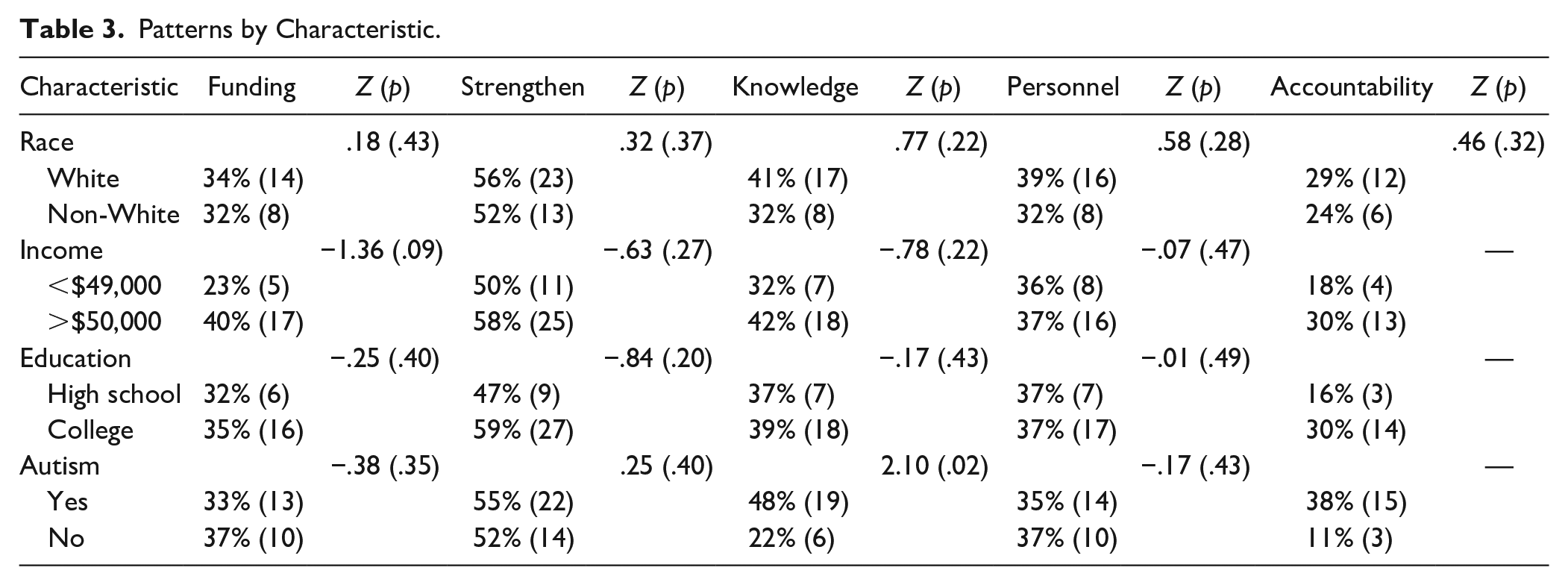
Demographic characteristics, including income, education, race, the child’s type of disability, and location, were used to identify patterns. The only statistically significant relation between a demographic characteristic and a theme for the next IDEA reauthorization was in relation to whether the child had autism. Specifically, 48% of participants with children with autism (vs. 22% of participants of children without autism) were more likely to request that family knowledge and empowered choice be addressed in the next IDEA reauthorization (see Table 3).
Patterns by Characteristic.
Discussion
Given the important roles of families of individuals with disabilities in special education, it is critical to elicit their feedback for the next IDEA reauthorization. While prior studies (e.g., Burke & Sandman, 2014; Rossetti et al., 2020) have examined family suggestions for IDEA, their studies were conducted prior to the COVID-19 pandemic. Because of the pandemic, family involvement became even more critical as families often became their children’s primary teachers (Albright et al., 2024). In this study, we collected data from families of individuals with disabilities in 2022 to 2023 (post-pandemic) to explore their suggestions for the next IDEA reauthorization. We had three main findings.
First, in alignment with prior studies (Burke & Sandman, 2014; Rossetti et al., 2020), many participants wanted to strengthen the implementation of IDEA as currently written. Suggestions related to clarifying and improving current IDEA mandates, as well as ensuring that monitoring procedures effectively held schools and districts accountable for implementing IDEA services and procedures. This finding suggests that the current structure of IDEA may be acceptable but in need of some minor changes and consistent accountability practices. To this end, calls to overhaul special education entirely (e.g., Taylor & Sailor, 2024) do not align with this study’s findings. Rather, this study suggests that the current form of IDEA should not be entirely thrown away but rather have incremental changes to improve its strength.
Relatedly, several of the recommendations align with current research. For example, suggestions related to having protocols to determine the least restrictive environment, restricting the use of restraint and seclusion in schools, including adult service providers involved in transition planning, and mandating dyslexia screeners have empirical support (e.g., considering supplementary aides in determining the least restrictive environment, Kurth et al., 2019; limiting restraint and seclusion in schools, Carlson et al., 2021; including Centers for Independent Living in transition planning, Plotner & Walters, 2023; sharing the accuracy of dyslexia screeners, Burns et al., 2023). A next step is to determine how each of the suggestions could be actualized in the statutory reauthorization of IDEA. For example, it could be that a decision-making tree for determining the least restrictive environment is mandated in the statute. Such a tree could include requiring the IEP to reflect a statement of how supplementary aids were considered and a rationale for why such aids could not be used to support inclusion in the general education classroom. For restraint and seclusion, the IDEA statute could include language stating that restraint and seclusion are the “last resort” and can only be used when restraint and seclusion are listed as strategies in a student’s behavior intervention plan and/or when a student demonstrates the potential to commit serious bodily harm. For the adult service providers, the IDEA statute may mandate that an adult service provider for each of the post-school outcomes relevant to the student (e.g., education, employment) must be invited to the IEP meeting. Finally, for dyslexia screeners, the IDEA statute may require dyslexia screeners as part of the pre-referral process.
Second, unlike prior research about families’ suggestions for the next IDEA reauthorization (Burke & Sandman, 2014; Rossetti et al., 2020), participants suggested wanting IDEA to focus on increasing family knowledge and empowered choice. Suggestions such as educating families about their rights make sense within the context of knowing that, on average, procedural safeguards are written at the 16th grade reading level (Gray et al., 2019). Some participants suggested requiring schools to conduct independent evaluations. Extant research about the need for evaluations, more generally, aligns with this finding showing that evaluations can help inform the needs and supports for a student with a disability (Brigham et al., 2021). Other findings should be considered within current state policies. For example, school choice should be considered within the context of some states having voucher programs for students with disabilities to choose to attend schools outside of their local public school. The overarching finding of family knowledge and empowered choice may be an artifact of the pandemic when families were often their children’s primary teachers (Lipkin & Crepeau-Hobson, 2022). Indeed, in a study of eight mothers of children with extensive support needs, Rossetti and colleagues (2023) found that families reported receiving little guidance and support from educators, causing them to recognize their lack of knowledge and to feel disempowered. In light of our findings and the extant research, it may be that the pandemic brought to light the need for greater family knowledge and empowerment.
While family involvement with their own children increased during COVID-19, family advocacy in systemic change is often low, especially when compared to advocacy for one’s own child and/or for other families (Author et al., submitted; Taylor & Sailor, 2024). It is important to note that, even before the pandemic, family knowledge, empowerment, and advocacy were critical to special education. Indeed, since the 1970s, Congress has funded PTIs to educate and empower families of children with disabilities about their special education rights (Strassfeld, 2019). Yet, in this study, a focus on family knowledge and empowerment rose to the top as a frequent suggestion for the next reauthorization. As the pandemic becomes an event of the past, it will be important to discern whether family knowledge and empowerment continue to be a frequent suggestion for the next IDEA reauthorization.
The finding about family knowledge and empowerment may reflect how one’s current or recent context influences their systemic advocacy suggestions. Most prior research has focused on the low levels of systemic advocacy among families of children with disabilities (e.g., Trainor, 2010; Wright & Taylor, 2014). This study contributes to the literature by showing how a single event could impact the goals of systemic advocacy. Accordingly, longitudinal research is needed to discern how suggestions for the next IDEA reauthorization may change over time. Furthermore, researchers should more closely consider the context within which families are making suggestions, as recent events may impact their suggestions.
Third, out of all of the participant characteristics, it seems that families of children with autism (versus other types of disabilities) were significantly more likely to suggest improved family knowledge and empowered choice for the next IDEA reauthorization. While families of children with all types of disabilities often advocate (Bennett et al., 2020), families of children with autism are the most frequent advocates (Burke et al., 2016; Pearson & Meadan, 2018). Such advocacy includes legalistic forms of advocacy. Indeed, families of children with autism comprise one-third of all special education court cases (Zirkel, 2011). Many families of children with autism have reported their frustrations with advocating for their children (Kurth et al., 2020; Pearson & Meadan, 2018). Thus, it is unsurprising that families of children with autism (vs. other types of disabilities) are more likely to request changes related to knowledge and empowered choice.
Unlike prior studies (e.g., Burke & Sandman, 2014; Rossetti et al., 2020), this study systematically examined potential patterns between the participants and their suggestions for the next IDEA reauthorization. With the exception of one pattern, all patterns were non-significant. On one hand, this finding may suggest that a family’s background does not influence their suggestions for changes to special education (i.e., IDEA). This finding may be encouraging, suggesting that there is some uniformity among families; such uniformity may help foster a collective advocacy effort given their shared goals. On the other hand, one must be cautious with non-significant findings. Other patterns may exist that were not explored in this study. Thus, we suggest exercising caution when considering our patterns and encourage future research to garner a larger sample and systematically probe for patterns between the participant background and their suggestions for the next IDEA reauthorization.
Limitations
While an important extension of prior research, this study had a few limitations. Given that this study was a research-practice partnership with PTIs about civic engagement programs, participants were recruited through PTIs or other disability organizations. Thus, the sample may not be generalizable to the population. Also, this study was limited to families interested in attending a 6-hr advocacy program. Childcare was not provided for the program. Thus, single caregivers and/or families without childcare may have faced greater barriers in participating in the program. Also, the program was held in English, thereby also limiting the generalizability of the sample. Furthermore, other patterns (e.g., child age) may relate to the type of family feedback for the next IDEA reauthorization. Future research may consider exploring the relation between other factors and family feedback.
Implications for Future Research
Future research should reflect a sample more reflective of the population of families of children with disabilities. Prior research has suggested that different methods are needed to engage with culturally and linguistically diverse families of children with disabilities (Cioe-Peña, 2021). Especially given this study’s finding about knowledge and empowered choice, it is important to garner a more linguistically diverse sample to understand whether suggestions differ in the ways in which school professionals should educate and empower families. To include more diverse families in future research, researchers should make studies available in different languages to attract linguistically diverse families. Researchers should also consider offering multiple ways for families to participate in research (e.g., culturally responsive ways such as storytelling).
Further research is also needed about the perspectives of students with disabilities. Aligned with the “nothing about us without us” mantra of the self-advocacy movement (Charlton, 1998), it is critical to elicit the feedback of students with disabilities. Their lived experiences as users of special education services can help inform the next IDEA reauthorization. Indeed, as the population most directly impacted by IDEA, their self-advocacy should be amplified. Researchers should consider recruiting students with disabilities to participate in research projects and ensuring that research procedures are accessible to facilitate their participation.
Implications for Policy
There are several implications for policy. First, in combination with prior studies (Burke & Sandman, 2014; Rossetti et al., 2020), this study suggests that families have suggestions for the IDEA reauthorization. Across the collective studies, there are more than 200 families who have participated in a civic engagement program to learn how to voice their concerns to policymakers. Yet, in the last several reauthorizations, families are infrequent participants (A. A. Turnbull, Turnbull, et al., 2011; York, 2005). Policymakers should reconsider the ways in which they offer opportunities to participate in the next IDEA reauthorization. Offering training or working with PTIs (as suggested by this study) could help improve family participation. It is not because of a lack of will or interest that families have had low levels of involvement in prior reauthorizations; rather, policymakers need to find new and accessible ways to incentivize their participation. Such ways could include offering multiple ways (e.g., in-person hearings, written feedback, zoom) for families to provide feedback in multiple languages with interpreters present.
Also, policymakers may consider the suggestions from families of children with disabilities. These themes may be helpful in informing areas to improve IDEA for the next reauthorization. Specifically, policymakers may use the themes to focus their efforts on refining and strengthening IDEA (rather than overhauling the policy). The themes may also be helpful for policymakers to probe when they travel the country, eliciting feedback about the proposed IDEA regulations. To this end, policymakers may ask specific questions to families who testify in the reauthorization hearings about their suggestions for strengthening IDEA, improving family knowledge and empowered choice, reducing personnel issues, addressing funding, and improving accountability.
Footnotes
Declaration of Conflicting Interests
The author(s) declared no potential conflicts of interest with respect to the research, authorship, and/or publication of this article.
Funding
Funding for this study was received via a Large Research Grant from the Spencer Foundation.
