




Abstract
The field of special education stems from the efforts of parents, adults and children with disabilities, invested policymakers, and other civil rights advocates within legal and policy forums. Yet, over time, as intervention- and scientific-based research within special education were moved to the forefront, the focus on how special education practices are shaped by law and policy were siloed within academic discourse in special education journals. To better understand the use of legal and policy analysis as a methodology within special education journals, the authors systematically analyzed the submission criteria for the top-10 U.S. -based special education journals. Stemming from these findings, this article argues why it may be necessary to consider expanding the field of special education research to include more peer-reviewed academic journals with a predominant focus on special education and disability law and policy, as an understanding of how law and policy shape the academic and personal lives of students with disabilities and their families remains pertinent. Finally, the article offers a framework for creating new academic journals in this space that may offer opportunities to generate dialogue between academics, practitioners, and policymakers across an interdisciplinary discourse.
Along with the civil rights movement for racial integration of U.S. public schools, the field of special education emerged first as a movement for advocates and policymakers to push for inclusive schooling, disability rights across the age spectrum, and codification of rights for students with disabilities (Yell, 2018). Ultimately, this advocacy led to the creation of public interest groups (e.g., “The Arc”) with a focus on policy implementation and national councils on disability (e.g., National Center for Learning Disabilities, National Council on Disability) (Itkonen, 2009). These advocacy groups were instrumental in securing the right to a free, appropriate public education (FAPE) for students with disabilities via the then-named Pennsylvania Association for Retarded Children (PARC) v. Commonwealth of Pennsylvania (1972) and Mills v. Board of Education of District of Columbia (1972) decisions. Relatedly, as the field of special education grew during the civil rights movement, special education journals emerged to provide high-quality research to a field developing professional standards and programs for teacher education. Furthermore, these journals and that research created a knowledge base across prekindergarten to grade 12 (PK-12) and higher education and established a training ground for future leaders in the field.
This research and professional development base became even more pertinent and necessary with the passage of legislation ultimately known as the Individuals with Disabilities Education Improvement Act (IDEA, 2004). That is, as U.S. public schools saw an influx of students with disabilities who now had access to public school education (National Center for Education Statistics, 2021), relevant stakeholders (e.g., faculty and researchers, policymakers, advocates, school leaders, teachers) needed academic outlets that examined education practices. Relatedly, the field also needed research to explore relevant issues in special education policy and law, including IDEA compliance, IDEA reauthorization and amendment, due process and procedural safeguards for IDEA-eligible students with disabilities, and relevant precedential shifts in recent U.S. Supreme Court and appellate court case law that directly shaped special education. For example, the leading special education and disability policy and law journal, Journal of Disability Policy Studies, has consistently served as the primary outlet for academic research that addresses topics in ethics, policy, and law pertaining to the lives of individuals with disabilities. Yet, the number of pertinent and topical law- and policy-relevant issues have only increased in scope, which parallels the number of IDEA-eligible students legally covered under IDEA (Brady et al., 2020; National Center for Education Statistics, 2021). Moreover, the scholarly component of the field has, over the past two decades in particular, moved toward advancing a scientific evidence-base whereby research is primarily used to “identify effective practices on the basis of multiple, high-quality studies that use experimental research designs and demonstrate robust effects on student outcomes” (Cook et al., 2015, p. 220). With this push for experimental and scientific research within special education, the focus on how those practices and positionalities are shaped by law and policy seemingly decreased within academic discourse in special education journals (Pazey & Cole, 2015).
Historical Expansion
Historically, the foundations of special education stem from the championing of parents, adults and children with disabilities, invested policymakers, and other civil rights advocates within legal and policy forums. Special education has unique origins in that “special education history is a chronicle of the efforts of advocacy groups” (Whitby & Wienke, 2012, p. 193). For example, advocates spearheaded efforts to de-institutionalize children with disabilities (Whitby & Wienke, 2012). Stakeholders brought forth federal litigation claims that led to eventual rulings that afforded FAPE regardless of disability status (Yell, 2018). This early stage of advocacy culminated in the passage of the 1975 Education for All Handicapped Children Act (subsequently reauthorized as the IDEA) (Yell, 2018).
However, as the IDEA conferred an increasing number of rights to IDEA-eligible students and their families across decades of reauthorizations and amendments (e.g., right to FAPE, due process and procedural safeguards, non-discriminatory evaluation, and ability to be placed into the least restrictive environment), many of those who advocated for civil rights for students with disabilities highlighted continuing disparities (Voulgarides, 2018), insufficient opportunities for advocacy within legislative and policy mechanisms that undergird special education (Burke & Hodapp, 2016), and a lack of adherence to and fulfillment of special education policy and law (Voulgarides, 2022). Over time, stakeholders’ viewpoints further shifted regarding perceptions of special education and related services, even as to the necessity and value of special education itself (Cook & Schirmer, 2003; Francisco et al., 2020), shifting notions on (dis)ability, equity, and disability rights (Voulgarides, 2022), and approaches to areas of increased litigation within special education practice (e.g., lack of FAPE, evidence of minority disproportionate representation [MDR], exclusion of students with disabilities from inclusive classroom settings identified as general education classrooms) (Brady et al., 2020; Voulgarides, 2018).
In addition, entirely separate movements, such as the Disability Studies in Education (DSE) movement emerged post-IDEA in response to the need for interdisciplinary scholarship that responded to ongoing civil rights, social, political, and legal issues for students with disabilities (Baglieri et al., 2011). This movement centered on the assertion that even though IDEA provided FAPE access, there are remaining “debates surrounding the provisions of this legislation [that] endure” (Baglieri et al., 2011, p. 270). DSE specifically posits that law is directly linked with disability advocacy and encourages work that addresses the “oppressive nature of essentialized/categorical/medicalized naming of disability in schools, policy, institutions, and the law while simultaneously recognizing the political power that may be found in collective and individual activism and pride through group-specific [claims]” (Connor et al., 2008, p. 448).
Yet, recent research suggests that even within the expanded number of special education peer-reviewed journals that welcome special education research and acknowledge the necessary and growing interdisciplinarity within the field, only a few select types of articles are published within any given outlet (Gage et al., 2017). For example, recent research by Gage et al. (2017) found evidence of publication bias within special education journals in that “studies with large, statistically significant findings predominate the published research base” (p. 428). This particular study tested for publication bias within meta-analyses regarding inclusion (or not) of gray literature (e.g., white papers, technical reports) and studies with large effect sizes (Gage et al., 2017). Other literature reviews have analyzed the types of peer-reviewed articles published in leading special education journals, with data-driven research articles deemed most publishable (Mastropieri et al., 2009). Specifically, a review by Mastropieri et al. (2009) found that non-quantitative data articles decreased over the years of examination. This review’s premise is also illuminating—namely, because the premise asserts that special education policy and law are not the drivers of special education research and that, instead, “articles in professional journals [are] frequently consulted in policy discussion[s]” (Mastropieri et al., 2009, p. 96). This creates a scenario where research influences policy. Yet, a critique of special education policymaking and school-level compliance is that policy work and implementation and compliance are often done without meaningful consideration to research, because evidence-based research can often be too technical to inform that work that stakeholders, such as policymakers and school leadership do (Sleeter, 2014). So, there is a legitimate question regarding the degree to which highly technical special education research is translatable or used to shift policy, and further questions arise when considering whether technical and quantitative research fully addresses the legal and policy-relevant issues that students with disabilities often face.
These questions not only have important implications for the field as it contends with a multi-dimensional special education landscape (e.g., issues that arise from IDEA rights and procedural safeguards, civil rights for students with disabilities, monitoring of discrimination by race or ethnicity), but it may also limit the types of articles that scholars submit for publication. That is, the lack of submission outlets for special education policy- and legally relevant work may lead scholars to think that this type of scholarly inquiry is not valued by the field of special education itself (e.g., practitioners, policymakers, advocates). For instance, in an article examining how researchers share and disseminate research and knowledge, Sleeter (2014) noted that a “big problem is that generally academic researchers write for each other, rather than for practitioners or policymakers” (p. 147). Furthermore, with limited outlets for publication, law and policy analysis not done in conjunction with quantitative analysis (due to the nature of the research questions and relevant analysis) may also be deemed unsuitable for a majority of special education academic journals. Finally, there are issues within the field of special education that affect students and adults with disabilities across the life spectrum that are often only law- and policy-related (e.g., social security benefits and eligibility, access to higher education, employment, and training) (Honeycutt et al., 2017).
Legal and Policy Analysis as Methodologies
As mentioned, as the field of special education emerged and evolved, a push to conduct more evidence-based research developed in conjunction (Cook et al., 2018). Furthermore, many of those who called for more empirical, evidence-based work posited that only empirical work could answer the broad array of special education- and disability-related topical issues. Therefore, what has emerged is a discipline that encourages manuscripts that meet the goal of “using highly effective, evidence-based practices in special education” (Cook et al., 2018, p. 112). Yet, legal research and analysis, wherein scholars use various non-empirical methodological techniques, including doctrinal legal analysis of judicial opinions and statutory authority, law and society research, and legal theory, are often viewed as non-relevant and the associated methodologies are often disregarded or under-valued within social science (Nolasco et al., 2010). That is, within a social science context, legal research and analysis are often seen as subordinate to empirical analysis. Scholars have asserted, however, that: “legal research is not inferior to nor more prestigious than social science quantitative research; legal research is simply different” (Nolasco et al., 2010, p. 2).
Moreover, law and policy are inherent underlying mechanisms of special education practices and related service delivery. Therefore, legal and policy analyses are necessary methodological tools to interpret the law’s expectations and to build the knowledge base within special education and the broader social sciences. In fact, due to the civil rights nature of special education- and disability-related service delivery, some answers are only found within legal precedent or statutory regulation or within analyses regarding how judicial rulings and judicial interpretation of rules or policy impact students with disabilities and their families (Pazey & Cole, 2015). This further indicates that it is imperative that the field of special education continue to expand its notion of what is considered an important methodological lens for inquiry.
Accordingly, first, this article asks which leading U.S.-based special education journals specifically cite legal and policy analyses as research methodologies or research designs that are appropriate for peer-reviewed manuscript submissions? Furthermore, this article argues why, regardless of the number of journals specifically accepting law- and policy-relevant submissions, it may be necessary to consider expanding the field of special education to include more peer-reviewed academic journals with a predominant focus on special education and disability law and policy. That is, as law and policy shape the academic and personal lives of students with disabilities and their families, it may be necessary to broaden the research landscape to address the lived experience influenced by legal and policy contexts. Second, this article asks if there is a framework for creating new academic journals in this space that may offer opportunities to generate dialogue between academics, practitioners, and policymakers. Finally, this article asks which recommendations are necessary for creating new academic journal spaces that ask and encourage authors to consider the multidisciplinary issues and multisystemic needs (e.g., education, health, mental health, social welfare) of students with disabilities.
Method
To better understand the use of legal and policy analysis as a methodology within special education journals, the authors systematically analyzed the submission criteria for the top-10 U.S.-based journals within special education. While research pertaining to special education is conducted extensively in other academic spaces (e.g., educational leadership, sociology, economics, multicultural education, legal journals), special education journals were selected for examination as these journals are often viewed as being representative of the field’s interests across a broader range of issues (e.g., education, related services, disability/employment, advocacy, and legal rights and responsibilities). Many of the leading special education journals also serve as the flagship journal for prominent special education associations and groups, such as the Council for Exceptional Children (Fisher & Miller, 2020). Accordingly, the journals selected were in the top-10 ranked U.S.-based journals (h5-index) within the field of special education during 2022. The journals included in this analysis are: (a) Journal of Learning Disabilities, (b) Remedial and Special Education, (c) Exceptional Children, (d) Gifted Child Quarterly, (e) Teacher Education and Special Education, (f) Journal of Positive Behavior Interventions, (g) Behavioral Disorders, (h) Focus on Autism and Other Developmental Disabilities, (i) The Journal of Special Education, and (j) Career Development and Transition for Exceptional Individuals. It should be noted that the h5-index is a measure tabulated by Google Scholar (2022) Metrics, and it only serves as a relatively nimble metric to gauge the visibility of individual authors and journals. That is, this metric functions as only one journal ranking indicator.
The authors examined each journal’s submission guidelines (available to the public via the journal’s website) for the following information components: (a) evidence of submission guidelines or accompanying link on the journal’s website, (b) evidence of a peer-review process for journal article submissions, (c) evidence of methodological criteria for journal articles that specifically cite legal or policy analysis as a valid methodology within a journal’s overview of preferred manuscript research design for “original research,” and (d) inclusion of policy or position papers as acceptable article formats.
The authors coded independently twice and then convened to review their coding of submission guidelines. The authors compared their decisions for each of the aforementioned information components (A–D) across each journal listed above. Similar methods for examining mission statements have been used across qualitative research (Creamer & Ghoston, 2012). After discussing the coding, the authors had 100% agreement across components A to D for each examined journal.
Results
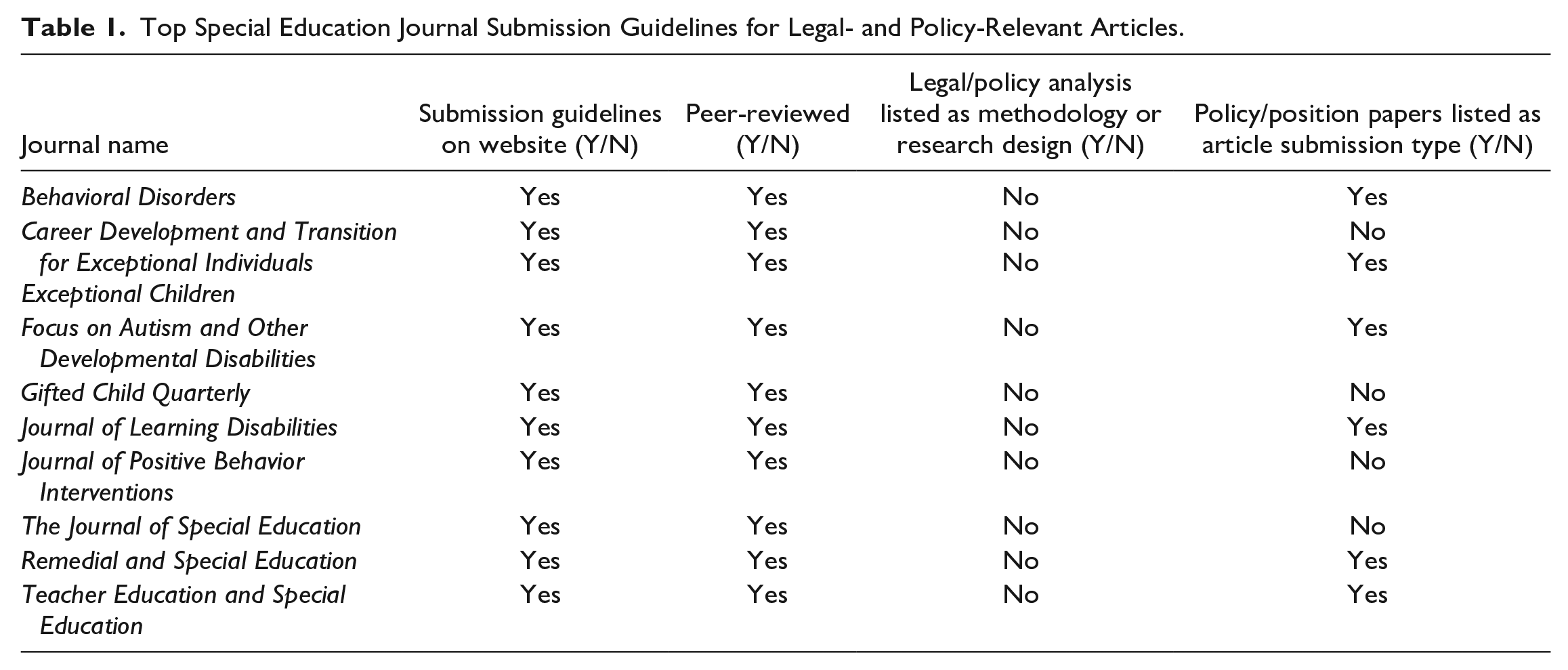
This section discusses the results found within an analysis of identified special education journals. Of specific interest in this analysis are each journals’ articulation of the submission guidelines, specifications for the peer-review process, criteria for types of methodology, and inclusion of policy or position papers within the types of encouraged journal submissions. This next section discusses each of these submission guideline components in greater detail. Also, see Table 1 for a review. Finally, it should be noted that submission guidelines do not necessarily preclude the publication of articles with legal or policy methodologies.
Top Special Education Journal Submission Guidelines for Legal- and Policy-Relevant Articles.
Peer-Review Guidelines
Within this review, each journal reviewed clearly outlined a commitment to the peer-review process for journal submissions. That is, each journal, within its description, conducts peer-review for each submission within the journal. For instance, journals outlined the “blind” or “double-blind review” process for peer reviews, described the process for manuscript submission review by peer reviewers along within an editor’s review of the peer reviewer comments, and provided an estimated timeline for the peer-review process for that journal.
Submission Guidelines
Within the journals reviewed, the submission guidelines across the examined peer-reviewed special education journals signal both the types of manuscript submissions that journals are interested in publishing and the “[influence of] the publisher or society to which they are associated, the subject matter, the technical aspects of submission, or age and pedigree of the journal” (Giofrè et al., 2017, p. 10). In addition, within this examination of publicly available submission guidelines for the leading, peer-reviewed special education journals, a clear picture emerged—namely, that legal- and policy-based submissions are encouraged, but the research design for a manuscript must also employ quantitative or qualitative methodologies. For instance, within the analysis of submission guidelines, the authors found that no journal specified that “legal or policy analysis” serves as an acceptable research methodology listed in the journal’s respective list of specific methodology examples for “original research.” On the other hand, nearly, all of the journals (n = 6) specified that policy reports or policy position papers (i.e. manuscripts that will likely employ legal or policy analysis) were acceptable article submission types, with one journal noting that even policy reports or position papers had to be data- or evidence-based.
Policy/Position Article Submission Type Guidelines
Journals included within this review varied as to whether or not they listed policy/position articles as an encouraged manuscript submission type. That is, six of the 10 journals reviewed specify that policy or position papers are a manuscript submission type that will be accepted by the respective journal. Moreover, of the journals that did specify that policy or position manuscript submissions were acceptable submission types, some (n = 3) did not provide a definition or explanation as to what constituted a policy or position paper for that particular journal. Moreover, journals that accepted policy or position manuscript submissions did not provide greater guidance regarding pertinent special education law or policy topics that the journal is particularly interested in (e.g., Individuals with Disabilities Education Act and related topics, disability and accommodations law or policy). Finally, of the journals, which specified that policy or position papers were acceptable manuscript types, one journal specified that submitted policy or position papers must be based on quantitative data.
Legal/Policy Analysis as Specified Methodology Within Submission Guidelines
Finally, no journal within this review listed legal or policy analysis as a specified methodology or design within a list of research methodologies or designs for original research studies. While a majority of journals specified that policy or position papers were acceptable submission format types, the methodological design guidelines (e.g., guidelines that encourage qualitative, quantitative, single-subject, or mixed-methods design) did not specifically list legal or policy analysis as a methodology for proposed manuscripts.
Discussion
The field of special education continues to grapple with topical law and policy issues across a variety of subtopics, including legal compliance to IDEA (Voulgarides, 2018), disability rights and equity within disproportionality monitoring (Cooc, 2019), and enforcement of the array of civil rights afforded to students with disabilities (Strassfeld & Voulgarides, 2022). These legal and policy issues are far from tangential and are often directly pertinent to the education and well-being of students with disabilities (Voulgarides, 2018). Moreover, certain aspects of these special education-related issues can only be answered via legal or policy analysis (Strassfeld, 2019a; Voulgarides, 2018; Woulfin & Jones, 2023).
While the leading special education journals offer some space for legal- and policy-relevant article submissions, it is evident from the journal submission guidelines that the space for non-empirical methodologies is limited. That is, while policy reports or position papers may be welcome as submission types, many methodological tools traditionally employed within those types of submissions are not included within the listings of generally accepted methodologies for submissions across the leading journals within the field.
Accordingly, it is necessary to consider a new framework for journals that will provide both access to authors engaging in high-quality, original research and show that the field has expanded its ability to address the panoply of education-, service-, and civil rights-based inequities that students with disabilities encounter from pre-kindergarten to adulthood. This framework for new journals in this field should not only center law- and policy-relevant analysis within relevant academic discourse in special education, but also aim to include more voices within that discourse (e.g., researchers, policymakers, advocates, special education attorneys for districts and families, IDEA hearing officers). Moreover, due to the difficulties with disseminating research from a relatively small field, it is also necessary to consider how greater access to law- and policy-relevant research and findings is shared with broader audiences who need this type of practice- and policy-driven research to inform their own work. The following section discusses five potential framework components for the development of new law- and policy-relevant journals within the field of special education.
Framework Component Considerations
Recognize Legal and Policy Methodologies
What constitutes law and policy analysis is multi-faceted (Brady et al., 2020). While this type of analysis can incorporate qualitative or quantitative analysis (or both) depending on the type of research, this analysis often does not rely on quantitative or qualitative legal or policy analysis (Lingard, 2013). Moreover, scholars have consistently noted how important legal and policy research is to a field where law directly influences and shapes education, related services, and civil rights for students with disabilities, and there have been calls within the field to recognize this distinction and center legal research within the range of acceptable research methodologies that scholars and practitioners use to address questions (Brady et al., 2020). Moreover, PK-12 students and adults with disabilities often have an array of multisystemic social welfare-, health-, and education-related needs (Skaar et al., 2021). Accordingly, examining topics within the field should not be viewed solely through a quantitative, social science lens. This is particularly true when discussing special education- and disability rights-related statutes, regulations, and judicial interpretation of codified law and policy. Given the field’s origins in law and policy, legal and policy analysis is not just a legitimate mode of special education inquiry, but also a necessary one.
For instance, in deciding cases involving claims of racial discrimination in violation of the 14th Amendment of the Constitution and IDEA policy on MDR of racialized and ethnic minority students with disabilities, courts have considered whether to order remedies when violative levels of overrepresentation occurred (Strassfeld, 2019a). In these types of cases, judges have produced precedential standards that shape how and if future plaintiffs are likely to have successful MDR claims (Strassfeld, 2019a). While many scholars use quantitative tools to answer questions regarding the underlying phenomena of MDR within the field of special education, only legal analysis can help scholars interpret judicial standards and provide guidance to stakeholders regarding MDR practices (Strassfeld, 2019a). By limiting opportunities within special education scholarly outlets to examine issues from a multiplicity of methodological forms, the field itself may hinder development of practical responses to major issues within the field.
Therefore, one framework component for future special education journals is to actively center empirical and non-empirical legal research within special education journal scholarship. One way this can be achieved is by explicitly identifying legal research as an acceptable research methodology within actual submission guidelines. By doing this, scholars with potential submissions will have a clearer understanding of the research methodologies preferred by the journal. This type of centering also signals the journal’s perspectives on the types of research valued by the broader special education and disability rights community. By centering legal research within special education academic discourse, there is also the opportunity to provide more easily translatable research directly to practitioner stakeholders. Special education research typically only considers teachers as practitioners (Voulgarides, 2018). Yet, there is an array of practitioner stakeholders (e.g., special education hearing officers, attorneys, administrators) who need to understand how real-time shifts and changes within law and policy occur. Recent research has also suggested that stakeholders are more capable of responding to research when it is easily understood with clear, explicit implications for teachers and broader school communities (Strassfeld, 2019b). As the law- and policy-relevant aspects of special education continue to deepen, it is imperative that special education journals make explicit their commitment to those issues that only legal research and analysis can answer.
Support Interdisciplinary Analysis
The field of special education is interdisciplinary and research relevant to this field occurs across disciplines (e.g., medicine, sociology, law, education, psychology, social work, juvenile justice) (Voulgarides, 2018). Thus, it is critical that there is a journal that bridges disciplines to encourage interdisciplinary discussions to provide practical support and guidance for students with disabilities and their families. Few journals provide space for the experiences of the hearing officer to be seen within the same “journal home” as those of the physician and social worker collaborating on legal or policy guidelines to provide services. For example, professionals working with a formerly incarcerated student with multisystemic needs due to a traumatic brain injury may benefit from knowledge and guidance across disciplines (e.g., special education, mental health, juvenile justice, and law), and forthcoming journals should recognize that interested stakeholders seeking information may need research to be even more cross-cutting.
In addition, school leaders have responsibilities to other stakeholders (e.g., families, students with disabilities, educators, community members) who may have a variety of responsibilities or entitlements buttressed by federal- or state-level civil rights. When there are few scholarly outlets to engage in discourse about these topics, particularly as they pertain to the lives of PK-12 students with disabilities, the discourse is incomplete. That is, if most academic journals with special education or disability as a focus only include a few, narrowly drawn legal- and policy-relevant articles any given year, the field itself risks being deemed dated or, worse yet, untimely and not responsive to pertinent issues in real-time. Accordingly, it is necessary to consider expanding the number of journals that will publish work that centers law and policy in academic research across a variety of topics.
Provide Open Access to Journals
Recent research has found that school personnel (e.g., school principals, educators, or other staff) often lack legal knowledge to help school teams as they navigate important civil rights-related issues alongside parents and students with disabilities (Brady et al., 2020). Due to the availability of easily searchable, disability-accessible, indexed, and well-regarded online sources, it is now easier and less cost-prohibitive for interested stakeholders to gain access to sources of legal information. Furthermore, there is now the opportunity to change how broad audiences access legal research (Brady et al., 2020). Therefore, open-access, online journals that specialize in special education and policy issues and provide peer-reviewed, cross-cutting innovative research can fill important research gaps for interested stakeholders. These types of journals may also supplement and broaden the information base.
Increase Legal Literacy
In addition, scholars at the intersection of law and education often cite the lack of legal literacy as a serious problem within school systems (Brady et al., 2020; Pazey & Cole, 2013). Legal understanding has been viewed as a necessary skill set because it is “ vital for school administrators to possess a basic understanding of the legislative and judicial decisions on the teaching profession as well as recognize how their actions can lead to litigation” (Tie, 2014, p. 193). A deficit in legal literacy is particularly acute in the field of special education (DeMatthews & Edwards, 2014; Decker & Pazey, 2017). Specifically, research suggests that a majority of school personnel receive limited or no training on how to handle the broad array of legal issues within the field of special education and related services (Brady et al., 2020). In addition, a majority of U.S. college- and university-level school administrator or school leader preparation programs do not require school principal candidates or school leaders to complete any level of extensive formal coursework in special education law or policy (DeMatthews & Edwards, 2014; Pazey & Cole, 2013). The same has been found for teacher candidates within special education teacher preparation programs (Strassfeld, 2019b).
Unfortunately, this lack of legal literacy has possible negative consequences, including the possibility of disparate treatment and discrimination against students with disabilities due to a lack of knowledge on legal compliance and responsibilities (Strassfeld, 2019a). Moreover, when scholarly academic outlets publish few articles that highlight or advance legal literacy in journal publications, school personnel in special education and related fields are at an even greater disadvantage, if they are in reliance on the field to advance research that addresses a wide range of pertinent issues. Accordingly, Brady et al. (2020) assert that special education legal literacy should be highlighted within academic discourse to help prepare school personnel, ensure that students with disabilities receive and have full access to their federal- and state-level legal civil rights protections and entitlements, and guide school personnel to fully understand the links between special education, civil rights, and procedural safeguards under the law. Accordingly, new or future academic journals can also inform audiences about legal shifts in areas such as these and guide potential future law- and policy-relevant practice, compliance, and service delivery in PK-12 and higher education for students with disabilities.
Encourage Authors to Submit and Review Legal- and Policy-Relevant Submissions
Finally, for new journals that include law and policy research submissions, those journals must make efforts to be explicit in the encouragement of these types of submissions. The encouragement of law- and policy-relevant manuscript submissions can take many forms, whether it occur via explicit submission guidelines that include law- and policy-relevant research both as a submission type and as an estimable methodology or via targeted indexing and advertising of the journal to scholarly audiences who examine law and policy using legal or policy analysis. By creating more scholarly spaces that encourage submissions that center civil and legal rights of students with disabilities, the field of special education has the potential to be additionally enriched (Brady et al., 2020). In conjunction, the field can expand additionally by developing a base of peer reviewers who have expertise in reviewing these types of manuscript submissions, so that, there is the development of a steady pipeline of submissions and reviewers with the expertise to review submissions for possible journal acceptance.
Conclusion
To expand the field of special education and disability law and policy, it is necessary to have new outlets for information dissemination. Perhaps more important, however, is the need to have scholarly outlets forefront policy and law within research examining the full lives of students with disabilities. In addition to the call to broaden the field in terms of the number of journals devoted to law and policy, the field itself necessitates the inclusion of research employing a variety of methodological tools (e.g., legal and policy analysis, quantitative and qualitative legal and policy research). Moreover, the ongoing, legal- and policy-relevant topical issues within special education and disability rights call for collaborative, interdisciplinary discourse and dialogue between researchers, practitioners, students, families, and policymakers.
Footnotes
Declaration of Conflicting Interests
The author(s) declared no potential conflicts of interest with respect to the research, authorship, and/or publication of this article.
Funding
The author(s) received no financial support for the research, authorship, and/or publication of this article.
