




Abstract
The importance of interagency collaboration to support the postschool outcomes of youth with disabilities is underscored in many ways. Perhaps one of the most important among them is the place of interagency collaboration as an evidence-based predictor of postschool success. Although Centers for Independent Living (CILs) receive U.S. federal funding to serve people with disabilities across the lifespan, little research exists to map the nature of their collaboration with local education agencies (LEAs) to this end. The current survey-based study examined perceptions of professionals in both settings (i.e., LEAs and CILs) on their current level of collaboration with one another and the value-based principles they believe influence their work as they support transition-age youth with disabilities (n = 581). Findings indicate a widespread belief in the importance of CILs in youth transition service delivery, a stark contrast between CIL and school-based transition professional perceptions of current collaboration, and a dynamic landscape of shared and divergent ratings of importance across value-based principles of transition practice. Practical implications are outlined to inform CIL and LEA collaboration to support youth with disabilities alongside directions for future research.
Compared with their peers without disabilities, students with disabilities (SWDs) transitioning from high school to their lives after are more likely to face a host of dismal outcomes in the United States (Cheng & Shaewitz, 2021). This harsh reality of exiting high school begins with roughly 40% of students leaving without a diploma are SWDs (DePaoli et al., 2018). In kind, the rate of participation in postsecondary education is similarly lacking. Although nearly 40% of U.S. adults under 35 will earn a bachelor’s degree or greater, that figure drops to just 16% for people with disabilities (Houtenville & Rafal, 2020). These factors, among others, contribute to a troubling climate of post high school community participation for working-age Americans with disabilities. Furthermore, these bleak postschool outcomes exist within a landscape of federally legislated rights and services for young adults with disabilities that are intended to bridge such gaps.
The Individuals with Disabilities Education Improvement Act (IDEA) carries mandates to state and local education agencies (SEAs; LEAs) regarding the transition of SWDs from school to their postschool lives. In short, SEAs and LEAs are charged with “improving the academic and functional achievement of the child with a disability to facilitate the child’s movement from school to post-school activities” (34 § 300.43(a)(1)). No later than age 16, a student’s individualized education program (IEP) must contain both “appropriate measurable postsecondary goals based upon age-appropriate transition assessments related to training, education, employment, and, where appropriate, independent living skills” and “the transition services (including courses of study) needed to assist the child in reaching those goals” (34 § 300.320(b)).
By these mandates, educators work to support students with disabilities in transition, yet it is important to highlight the fact that a school alone cannot and should not bear the responsibility of meeting all of the needs of SWDs (Morningstar et al., 2017). Public education systems are just one of many public entities with a charge to support the successful transition of SWDs. Other entities include, but are not limited to, American Job Centers, vocational rehabilitation (VR) agencies, developmental disability agencies, and Centers for Independent Living (CILs). Given the breadth of public investment in supporting people with disabilities, the Individuals With Disabilities Education Improvement Act (IDEA, 2004) itself directs SEAs and LEAs to ensure that the offerings of such agencies are leveraged effectively, requiring that schools “must invite to the IEP meeting a representative of any participating agency that is likely to be responsible for providing or paying for transition services” (34 CFR §300.321(b)(3)).
This confluence of publicly funded agencies sharing a stake in the results-focused support of SWDs holds great potential. Therefore, the work that these agencies collectively engage in to support the successful transition of SWDs is of critical importance. Interagency collaboration continues to be identified as an evidence-based predictor of postschool success; however, the exact nature of effective collaboration across agencies remains somewhat elusive (Mazzotti et al., 2021). Over the years, collaboration initiatives and collaborative structures have been forwarded to support teaming efforts across disciplines, but overall, transition teaming efforts are still underwhelming and insufficient (Magee & Plotner, 2021). There is still much to be understood about the types of relationships between agencies that most reliably predict successful postschool outcomes for SWDs.
Centers for Independent Living as Collaborative Partners for Schools
A key collaborative partnership that has received minimal attention from researchers is the partnerships of LEAs and Centers for Independent Living (CILs; Plotner, Oertle, et al., 2017). CILs are “consumer-controlled, community-based, cross-disability, nonresidential, private, nonprofit agency that is designed and operated within a local community by individuals with disabilities and provides an array of independent living services” (Administration for Community Living [ACL], 2021; Rehabilitation Act, 1973). The existence of CILs in the United States is an outgrowth of the civil rights-oriented independent living (IL) movement (Wilson, 1998). The IL movement has been characterized as “both a grass-roots effort on the part of the disabled to acquire new rights and entitlements” and as a purposeful “reshaping [of] the thinking of disability professionals and researchers” (DeJong, 1979, p. 435).
Early in the IL movement’s history, disabled advocates’ recognition of the need for collectivizing toward meeting the needs of the disability community led to the establishment of the first CIL in Berkeley, CA, incorporated in 1972. The Rehabilitation Act of 1973 and subsequent amendments in 1978 provided the groundwork for CILs to begin spreading throughout the country (DeJong, 1979). At current, there are over 400 community based CILs in the United States (NCIL, 2020). Many of these receive federal funding whereas others rely solely on state funding (Patnaik & Honeycutt, 2022). In 2019, the Administration for Community Living (ACL, 2021), the federal entity who oversees CILs, provided over 90 million to 284 CILs. The general form and structure of CILs and their programs and services are dictated by the Rehabilitation Act of 1973 as amended and the federal regulations for Independent Living Programs (Independent Living Research Utilization, n.d.; see 45 CFR§1329.4).
CILs may be particularly impactful in the lives of SWDs in transition due to their structure and programmatic offerings (i.e., primarily lead and staffed by people with disabilities) (Wilson, 1998). With the passage of the Workforce Innovation and Opportunity Act (WIOA) in 2014 and its amendments to the Rehabilitation Act of 1973 that dictate federal mandates for CILs, CILs added youth transition services to their core service offerings of peer support, individual and systems-level advocacy, information and referral, and independent living skills training (Plotner, Oertle, et al., 2017). Following the advent of this new core service, Plotner, Oertle, and colleagues (2017) surveyed 198 CIL professionals from throughout the United States, exploring the nature of their collaboration with LEAs. In that study, the authors found that 98% of CIL professionals surveyed perceived CIL and LEA coordination to be “important” (25.8%) or extremely important (72.7%). Nevertheless, more than half of those surveyed rated that coordination to be simply “adequate” (34.8%), “poor” (16.7%), or nonexistent (5.6%). Survey respondents affirmed the importance of seven facilitators of transition collaboration between CILs and LEAs: (a) overarching entity supporting transition, (b) adult agency presence in school, (c) signed memorandum, (d) administrative support, (e) professional knowledge, (f) specific contact for partnering agencies, and (g) agency funding.
More recently, (Plotner & Walters, 2022) interviewed eight dyads of CIL administrators and staff members across various regions of the United States to examine their perspectives on why CIL involvement in transition is critical.Using a narrative inquiry approach to analyze content yielded from interviews, the authors uncovered that CIL professionals believe the unique principles that drive CIL service delivery are paramount when serving transition-age youth. In total, five value-based principles were found to be held as critical to transition service delivery. They include a programmatic focus on (a) empowerment, autonomy, and independence; and services that are (b) youth-led and individualized; (c) strengths-based and goal-driven; (d) driven by peer support; and (e) disability pride driven. Although this work is helpful for better understanding CIL professional perspectives on their values and their potential impact on youth transition services, it does not contribute to a larger vision of what value-based principles professionals believe are most impactful. Furthermore, although these various stakeholders often share the same mission and goals (i.e., support youth to achieve positive outcomes), there are potentially stark differences in the principles that guide their work. Given the complimentary aims of CILs and LEAs as publicly funded agencies supporting people with disabilities, it serves to reason that the postschool outcomes of young adults with disabilities stand to be improved through collaborative partnerships with CILs and LEAs. Moreover, better understanding of the value-based principles driving service delivery can only support collaborative efforts.
Influence of Value-Based Principles of Disability Service Delivery
Value-based principles are akin to the attitudes and beliefs that dictate professional decision-making. Most professional groups have a set of primary standards called professional values or standards that guide professional behavior for members of a certain profession. Such values are sometimes agency driven or driven by one’s professional field and operate as the gauge by which members of a profession evaluate ideas, actions and situations as either worthwhile or undesirable (Toker Gökçe, 2021; Shaver & Strong, 1976). Unlike personal values (e.g., empathy, honesty, and fairness) which may be highly variable in nature, value-based principles point to the commonly held beliefs of a professional body at large. For example, the Council for Exceptional Children (CEC, 2015), an international professional organization for special education professionals, provides insight into the ethical and value-based propositions of the field in its Special Education Professional Ethical Principles. In brief, these principles include items such as providing challenging expectations, facilitating inclusive environments, maintaining relationships with families, and making decisions based on research and data. Thus, value-based principles are the result of values that a general field believes should drive service delivery with an expectation that professionals are to model and uphold such professional standards.
On the whole, discourse about the value-based principles that drive disability service provision often occurs through the lens of how one views disability and how to support individuals with disabilities. This is frequently discussed through the various models for understanding disability (Harper, 1991; Llewellyn & Hogan, 2000; Oliver, 1983; Smart, 2009). Although ideological arguments for and against specific models abound, they are, nevertheless, highly useful for illustrating the ways in which professionals “define disability, determine which professions serve people with disabilities, and help shape the self-identities of those with disabilities” (Smart, 2009, p. 3). When considering the value-based propositions of disability professionals, two models of disability have primarily been discussed: the medical model and the social model. Within the medical model of disability, professional orientations to disability center on clinical diagnosis and treatment (Brisenden, 1986). Critics of the medical model argue that such positions reduce disability to an issue of “biological deficit” (Shakespeare, 2006) and may ignore the complicated landscape of social structures that mediate how disability is understood and how people with disabilities are treated within society (Oliver, 1983).
In response to the perceived shortcomings of the medical model, the social model of disability details a key distinction between disability and impairment. Within the social model, an impairment is part of the condition of an individual, but a disability is “structural and public” (Shakespeare, 2006, p. 216.). For example, one’s mobility impairment may impede them from using stairs to reach their university classroom, but the true disabling condition arises from the complex milieu that influences that class’s physical inaccessibility in the first place. In other words, within the social model, “it is the disabling environment, the attitudes of others as well as institutional structures that need to be changed, not the person’s disability” (Kanter, 2003, p. 247).
Critiques have been made of both models within the landscape of disability policy and services (Anastasiou & Kauffman, 2013; Shogren et al., 2021). Scholars have argued that the medical model of disability is a fundamental driver of the special education landscape in the United States, triggered by the categorical eligibility requirements of the IDEA (Triano, 2000). On the other hand, others have asserted potential harm stemming from social model of disability and its reduction of disability to the singular dimension of social oppression (Anastasiou & Kauffman, 2013). Still others have outlined the necessity of understanding the ways in which understanding the limitations and leveraging the strengths of inherent to different models of disability (Smart, 2009). As Smart (2009) states, “[s]uch cross-model service provision will open opportunities for interdisciplinary and consistent interagency collaboration and interdependent professional services (p. 10).
In highly simplified terms, such cross-model service provision is an inherent aspect of CIL and school collaboration. While the onus for and context of the work of special education professionals is often characterized within a clinical understanding of disability (Gomez & McKey, 2020; Triano, 2000), the work of CILs has historically been driven in terms of the social model of disability. As such, differences in professional values are to be expected, yet they need not be barriers to collaboration. In fact, these varied views could complement each other. With training in the various value-based orientations to disability elucidated by models of disability, professionals across agencies like CILs and schools may come to recognize the importance of ideological differences and similarities as a means for providing more comprehensive support to youth with disabilities in transition. This study offers an exploration of CIL and special education professionals’ perceptions of shared and divergent values driving their respective professional practices. Thus, the purpose of this study is to examine the value-based principles that drive school-based and CIL transition professionals and is based on the pragmatic need for increasing collaboration between agencies supporting young adults with disabilities. In particular, the researchers set out to answer the following research questions:
Method
Procedures
Recruitment for online survey participants occurred through a snowball sampling strategy to reach both special education and CIL professionals currently working with transition-age youth with disabilities (Biernacki & Waldorf, 1981). A list of email addresses for state unit presidents of the Council for Exceptional Children (CEC) was obtained from CEC’s (n.d.) website. In total, email addresses were obtained for representatives from all 50 states and the District of Columbia, apart from Delaware. A list of 698 CIL contacts for every U.S. state and territory with an active CIL was obtained from the Independent Living Research Utilization’s (n.d.) website. An email tailored to each group was sent with a request to forward information to any CIL or special education professional, respectively, that were actively supporting young adults with disabilities in transition. To incentivize participation, two US$500 donations were offered to the CEC state unit and two US$500 donations were offered to the Statewide Independent Living Council for states with the most responses. In total, 581 valid survey responses were collected across March, April, and May of 2021. Survey responses were considered valid if respondents indicated in the first survey item that they were currently professionally involved in supporting youth or young adults with disabilities.
Participants
A total of 541 professionals completed the survey from 41 states. Most of the sample population came from one state (n = 143), which equates to almost 25% of the sample. Two other states had the next largest proportion at 12% (n = 70) and 11.2% (n = 65) participants, respectively. Of the participants, 82.8% identified their gender as female and 15.5% of participants identified themselves as male; a small portion identified themselves as gender-nonconforming and as a trans male, whereas 1.2% of participants (n = 7) preferred not to disclose their gender. As seen in Table 1, 28.6% of participants were between the ages of 41 and 50 and approximately 22% of participants were between the ages of 31 and 40 and 51 and 60. A minority of participants (35.3%) identified as a person with a disability and/or disabled, and a majority (60.6%) of participants did not identify as a person with a disability and/or disabled. A majority of participants had spent 6 to 10 years supporting youth and/or young adults with disabilities, followed closely by those who had spent 11 to 15 years and 2 to 5 years supporting youth and/or young adults with disabilities. Overall, over 50% of participants had spent 5 or less years working in their current role. Almost 50% of participants who completed the survey had obtained at least a master’s degree. Finally, almost 75% of participants identified as White or Caucasian (n = 435) with 12% identifying as Black or African American (n = 70). Slightly more than half of the respondents (50.1%, n = 291) indicated they were currently serving in special education-related roles, and slightly less than half of the respondents (46.6%, n = 271) indicated they were currently serving as professionals within a CIL.
Demographics of LEA and CIL Participants.
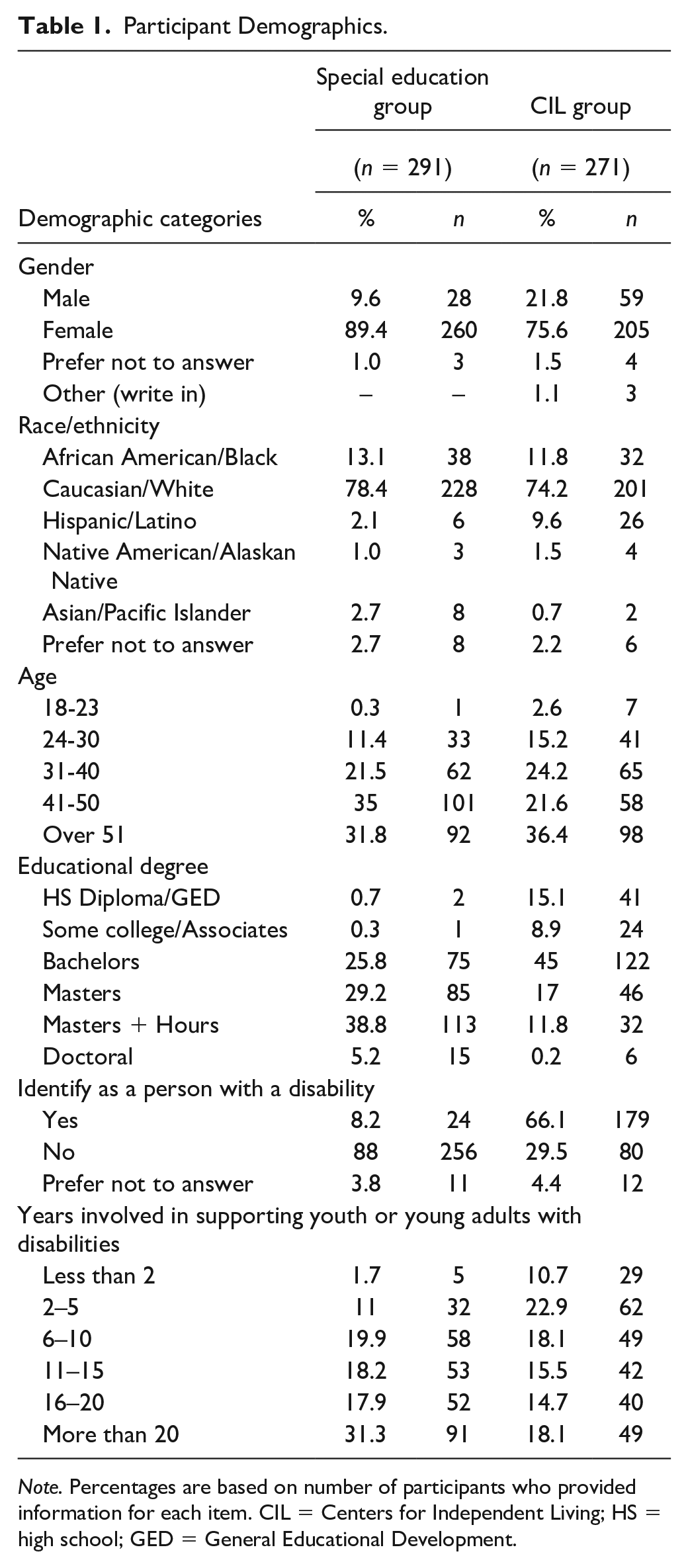
Note. Percentages are based on number of participants who provided information for each item. LEA = local education agency; CIL = Centers for Independent Living; HS = high school; GED = General Educational Development.an = 291. bn = 271.
Instrumentation
Using existing literature on disability services, special education, and transition collaboration (e.g., Mazzotti et al., 2016; Oertle & Seader, 2015; Plotner, Oertle, et al., 2017; Plotner, Shogren, et al., 2017), professional standards and principles in special education (CEC, 2015), and a previously conducted study on CIL youth transition services (Authors Redacted), a survey was created by the research team. Once drafted, the instrument was sent to four expert reviewers, two special education researchers and two administrators at a Center for Independent Living. These reviewers provided feedback to the research team on the usability and content of the instrument which informed refinement. In its final form, the survey consisted of three sections: (a) demographic items, (b) general collaboration items, and (c) items related to value-based principles for a total of 37 survey items. The first section included 11 items regarding participant demographics such as gender, job title, and year experience. The second section included 15 Likert-type items regarding respondent perceptions of collaborative domains. This section included one question asking participants to rate their perception of how important it is for schools to collaborate with CILs. Additionally, participants were asked to rate their perceptions across three collaboration domains. Specifically, respondents were asked to rate their understanding of their counterpart’s roles on a four-point scale of “1 = No understanding,” “2 = Weak/minimal understanding,” “3 = Moderate understanding,” or “4 = High understanding.” Furthermore, respondents were also asked to rate their frequency of communication with other counterparts on a 4-point scale of “1 = No Communication,” “2 = Weak/Minimal Communication,” “3 = Moderate Communication,” or “4 = High Level of Communication.” Finally, respondents were asked to rate their level of collaboration with their counterparts on a 4-point scale of “1 = Do not collaborate,” “2 = Weak/minimal collaboration,” “3=Moderate collaboration,” or “4=High level of collaboration.”
The third and final section of the survey included 11 value-based principles. These value-based principles were derived from existing literature on CIL professionals (e.g., Authors Redacted) and values from special education practice (e.g., CEC, 2015). Participants were asked to rate the principles that drive their professional service delivery using a 4-point Likert type scale. The anchors were as follows: “0 = Does not drive my practice,” “1 = Low impact on driving my professional practice,” “2 = Moderate impact on driving my professional impact,” “3 = Significant impact on driving my professional practice,” and “4 = One of the main principles driving my professional practice.” The intent of using this latter response anchor was to ensure that the measurement of these phenomena was sensitive enough to distinguish between value-based principles of import for respondents and those important enough to influence the professional practice of respondents. The instrument was administered online using the web-based survey platform Survey Monkey.
Data Analysis
All data were exported to SPSS and descriptive statistics (i.e., mean and standard deviation) were computed for all responses to answer RQ1 and RQ2. To further answer RQ2, the research team split up the sample into two groups of professionals (i.e., special education professionals and CIL professionals). The special education group consisted of all special education teachers, transition specialists, and special education administrators whereas the CIL group consisted of direct-service and administrative personnel currently working in a CIL. Then, following an affirmation of conditions for valid inference, the research team conducted an independent sample t-test to determine if there was a significant difference between the two groups of participants regarding which values are important to them when providing services to youth and young adults with disabilities. Hedges’ g was used to determine the effect size as there was variability in the samples across these two groups of professionals.
Findings
When asked to rate the importance of coordination with CILs to support youth with disabilities in transition, less than 1% of respondents chose to identify such coordination as “Not at all important” (n = 1) or “Unimportant” (n = 2). The vast majority of respondents, 82.5%, identified coordination with CILs as “Extremely important” (n = 454) while 17% of respondents such coordination as “Somewhat important” (n = 93). Subsequently, survey participants were asked to rate their understanding, frequency of communication, and level of collaboration with one another. An analysis of their respective responses is provided below alongside Table 2, which provides the means and standard deviations for each of these three domains of collaboration.
Perceptions of System Understanding, Communication Frequency, and Levels of Collaboration.
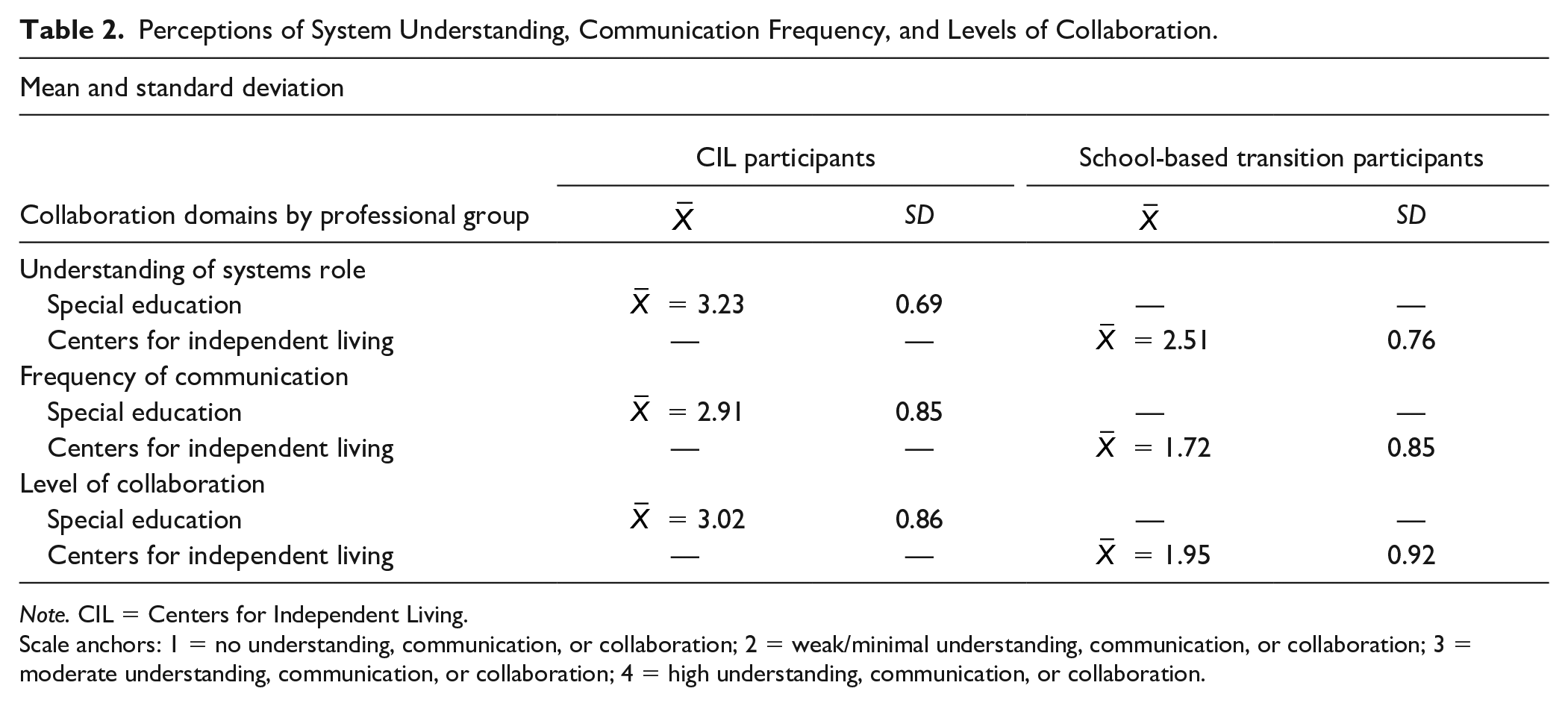
Note. CIL = Centers for Independent Living.
Scale anchors: 1 = no understanding, communication, or collaboration; 2 = weak/minimal understanding, communication, or collaboration; 3 = moderate understanding, communication, or collaboration; 4 = high understanding, communication, or collaboration.
Role Understanding
Most school-based transition professional respondents, 48.3%, indicated a high level of understanding of the role of CILs (n = 125), followed by 38% that indicated a moderate understanding of the role of CILs (n = 103). Twelve percent of school-based transition professionals (n = 31) reported no or weak/minimal understanding of the role of CILs. In contrast, 52.8% of CILs reported no or weak/minimal understanding of the role of special education (n = 144) with only 10% that reported a high understanding (n = 27).
Frequency of Communication
The majority of school-based transition professionals, 41.3%, reported moderate communication with CILs (n = 107), followed by 27% that reported a high level of communication with CILs (n = 70). Thirty-two percent of school-based respondents reported weak/minimal or no communication with CILs (n = 82). In contrast, 82.4% of CIL survey participants reported weak/minimal or no communication with their counterparts in special education (n = 225). Thirteen percent of CIL respondents reported a moderate level of communication with their colleagues in special education (n = 36), and 4.4% reported a high level of communication (n = 12).
Level of Collaboration
The majority of school-based transition professionals, 40.5%, indicated a moderate level of collaboration with CILs (n=105), followed by 33.6% that indicated a high level of collaboration (n = 87). About 25.8% of school-based transition professionals reported weak/minimal or no collaboration with CILs (n = 67). In contrast, 75% of CIL professionals reported weak/minimal or no collaboration with their special education colleagues (n = 202). Eighteen percent indicated a moderate level of collaboration (n = 50) and 7.7% indicated a high level of collaboration (n = 21) with their colleagues in special education.
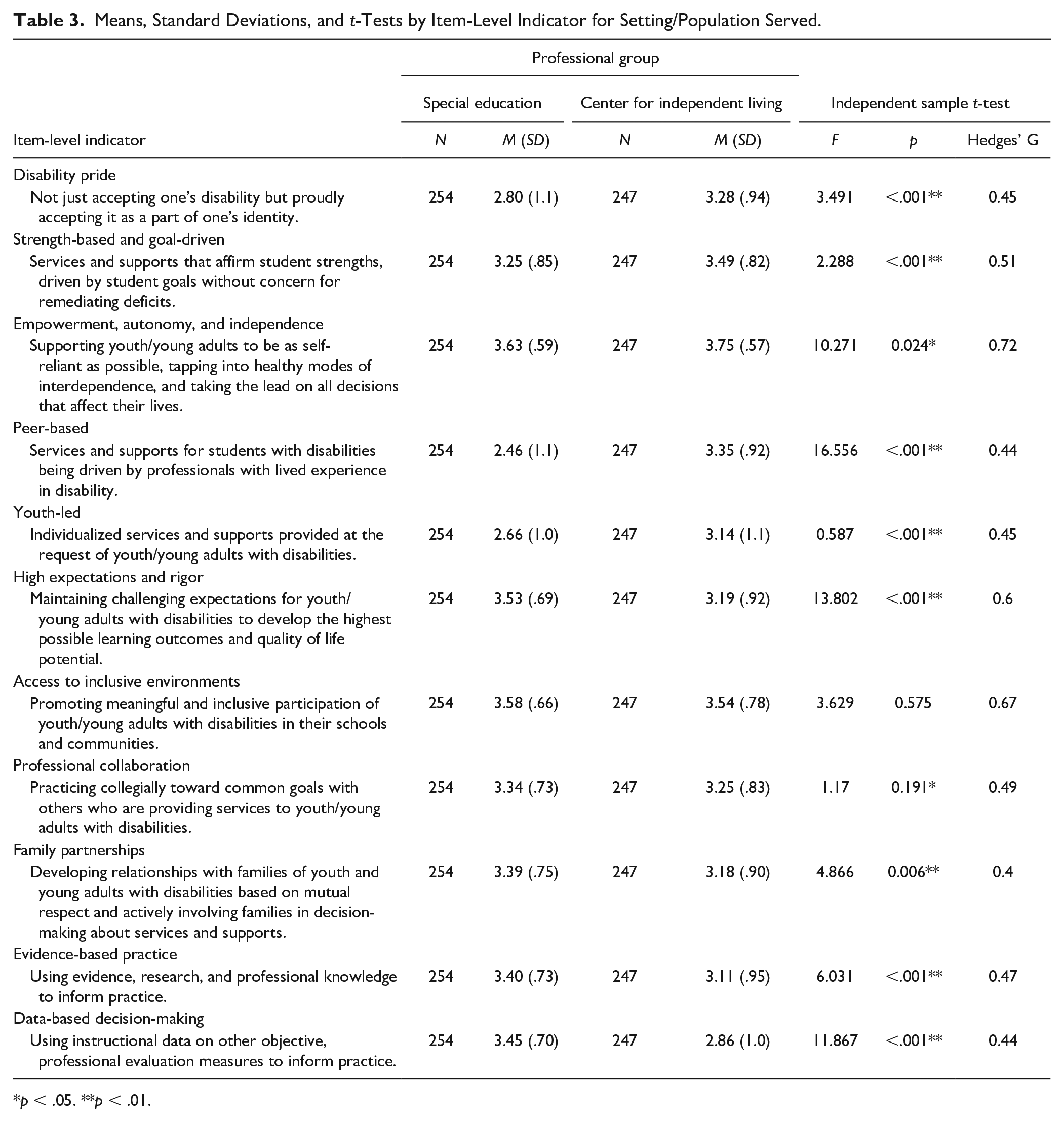
An examination of the means across both groups of professional ratings of all 11 values yielded an overall mean range between 2.90 and 3.69, which reflects that participants tended to hold each of the listed values as important to their work. The highest ranked values were, “Empowerment, Autonomy, and Independence” (
When exploring both groups of professionals separately, there was some variability across means. The range for the mean of the special education professional group was 2.46 and 3.63 and the range for the CIL group was 2.86 and 3.75, showing that the CIL professional group reported a slightly higher mean (
Means, Standard Deviations, and t Tests by Item-Level Indicator for Setting/Population Served.
p < .05. **p < .01.
When examining if there were significant differences between both groups, the independent sample t-test showed statistically significant differences across 9 of the 11 value-based principles. In fact, seven of the nine value-based principles differed at the <.001 level. Furthermore, the effect sizes for of these differences were in the moderate range. These effect sizes ranged from .40 to .72. The only two value-based principles without statistically significant differences were Access to Inclusive Environments and Professional Collaboration. Table 3 shows the means and the results of the t test for the items across both groups of professionals.
Discussion and Implications
This study aimed to examine school-based and CIL transition professionals’ beliefs about collaboration with one another and the value-based principles that drive their service delivery efforts. Furthermore, we explored if the two professional groups identified different principles as those that are more impactful in their own service provision. Although most respondents from these two professional groups affirm the importance of CIL involvement in the support of SWDs in transition, their reported understanding, frequency of communication, and level of collaboration with one another illustrate a striking disconnect between these two groups. In short, school-based transition professionals were much more likely to report favorably regarding their understanding, communication, and level of collaboration with CILs. Responses from CILs, however, largely indicate the inverse. These findings are consistent with previous research that indicated agreement regarding the importance of collaboration between CILs and schools alongside reports of significantly lacking collaboration between these two professional groups (Plotner, Oertle, et al., 2017). It was somewhat surprising that nearly half (46%) of the CIL participants who support at least some youth and young adults in transition do not understand the role of schools in the secondary transition process. Furthermore, the majority (75%) of CIL participants report weak or no collaboration with schools.
The importance of understanding roles of partners is critical to ensure a seamless and efficient process without the duplication of services (Noonan et al., 2008). Plotner and colleagues (2020) found that transition stakeholders (teachers and direct-service transition professionals) who understood their partners’ roles had more frequent communication as well as higher perceived overall collaboration. Although we agree that this is a crucial element of building a strong foundation to a partnership, a deeper understanding of stakeholder’s potential contribution is needed. A recent study by (Plotner & Walters, 2022) explored the scope of CIL services in supporting SWDs finding that CILs provide services under three primary areas: college and career preparation, personal development, and independent living. These areas are primary areas for most (if not all) transition providers; thus, transition collaborative partners need to know specific contributions (e.g., approaches, strategies, and activities) of each partner and how professionals from different fields complement transition service delivery.
In terms of the value-based principles across both groups, the fact that access to inclusive environments and empowerment, autonomy, and independence were ranked the highest is encouraging as these principles are foundational and underpin larger goals that cut across various disability service providers. Across both professional groups, mean scores of value-based principles indicate broad support for all 11 principles. Despite this broad support of the 11 value-based principles included, differences between means for CIL-based and school-based respondents were statistically significant. This was not entirely unexpected as the principles generated for the survey instrument were based on literature specific to each group of professionals; thus, some of the values are primary to special education and some to CILs. For example, CILs have core services that include “peer support”; therefore, one would expect this value to be ranked higher by CIL professionals. In addition, with CILs rooted in the Independent Living Movement, disability pride is a common value among these professionals. Conversely, special education professionals often have more rigid expectations based on legal mandates. It is not surprising that school professionals placed a greater emphasis on values such as data-based decision-making and family partnerships as these are central to transition planning processes (Shogren & Plotner, 2012). Additionally, outside of the two agreed upon most impactful principles to their service delivery, the special education professional group ranked the following four value-based principles as those that play a significant impact on their transition service delivery: (a) high expectations and rigor, (b) data-based decision-making, (c) evidence-based practices, and (d) family partnerships. Each of these areas are evident in the CEC ethical principles (CEC, 2015).
Limitations
There are several limitations of this research that merit consideration. Although this study spoke about issues related to the collaboration of CIL and school-based transition professionals, the respondents in this survey may not have been fully representative of this larger population. Notably, while many states were represented in this sample, most responses were clustered within just three states and came from respondents that identified chiefly as White or Caucasian. Given the lacking variability in participant characteristics, both those observed and possibly unobserved, there is a case to be made for selection bias and subsequently lacking sample validity (De Man et al., 2021). These limitations together may reduce confidence in the generalizability of the findings in this study to an unknown extent. Finally, the COVID-19 pandemic has affected many aspects of professional practice in fields like special education and disability-related services. It serves to mention that these data were collected during the pandemic, and the ways in which this may have biased respondent responses are unclear. As is the case with all empirical research, true confidence in the findings of this study should come from future replication (Schmidt, 2009).
Beyond Role Understanding: A Case for Role Alignment and Value-Based Principle Informed Collaboration
Beyond understanding each other’s purpose, roles, scope of practice, and professional expertise, we posit that perceived value and strategic role alignment is needed for effective transition collaboration and service delivery. This study showed that value-based principles that drive service delivery vary among CIL and special education professionals. A question could be: is this a good thing? Secondary transition delivery is a multi-faceted, complex process that changes with time for each individual student; therefore, diverse approaches and perspectives to principles that drive services can be beneficial. All the value-based principles discussed in the current study are important and more than one can certainly drive service delivery efforts as were found in this study. Although there have been efforts on transition collaboration, a better understanding of how principles support the strategic approaches and activities of transition partners might allow for more efficient, robust, and relevant planning and support should be explored further. For example, how are roles (strategic partners) aligned to best provide support and problem-solve in the transition process? Transition stakeholders should have discussions to ascertain not only their goals and roles but to also strategize on how fundamental principles can be incorporated into practical activities aimed at maximizing opportunities and experiences necessary for goal achievement.
On the whole, the CIL and school-based transition professionals surveyed for this study are to some extent driven by similar value-based principles of professional practice. This is an important understanding for the field and the future collaboration between CIL and school-based transition professionals that may have otherwise perceived less alignment in values. The value-based principles that CIL and school-based professionals share most consistently offer insight into catalysts for collaborative activities. For example, with a knowledge of their commonality in professional values, CIL and school-based professionals may discuss the ways in which their shared belief in student empowerment, autonomy, and independence may be operationalized through collaborative activities. New relationships between CILs and school-based professionals may be formed not just from a desire for mutual benefit but from an explicit aim to maximize the empowerment, autonomy, and independence of students with disabilities. Furthermore, from the very outset of collaboration, this common orientation in professional values may help to provide foundational insight for planning, coordinating, and evaluating their work together.
In kind, the value-based principles that CIL and school-based transition professionals’ rate as important with more variability may provide insight into potential barriers to collaboration that may need to be addressed explicitly. For example, school-based transition professionals in the current study rated data-based decision-making as an important element of their support of youth with disabilities. Although rated as important by many CILs, this value-based orientation to practice is not nearly as predictable for this group of professionals. As a demonstration of goodwill in collaboration, CIL professionals may do well to thoughtfully consider how objective data collection in the youth transition services they provide may promote transparency and a common language to collaborative service delivery with school-based professionals. With the knowledge of such a prospective divergence in professional values, school-based professionals may also simply recognize the need to purposefully plan with their CIL professional counterparts for ensuring that data-based decision-making is incorporated into collaborative service delivery.
CIL Policy, Practical Implications, and Increasing Collaboration
The current state of collaboration between CILs and school-based transition professionals, as detailed in this study, provides a rich context for discourse about policy. Many barriers to leveraging the unique skill sets, overlapping federal mandates, and value-based perspectives of special education and CIL professionals together may present themselves within this policy landscape. Although professionals may be well acclimated to the policy landscape of transition as framed by the IDEA, some may be less familiar with the policy driving the work of CILs. For this reason, policy considerations to increase meaningful collaboration between CIL and school-based transition professionals have been collected here from the vantage of specific CIL mandates.
Defining youth transition for CILS
Throughout the country, many CILs are already collaborating with educators to provide a whole host of valuable transition services in the domains of personal development, college and career preparation, and independent living skill development (Authors Redacted). Since the WIOA-based amendments to the Rehabilitation Act in 2014, CILs are now required to serve youth with disabilities in transition. However, it is important to understand that this federal mandate (a) did not come with any additional funding for CILs to provide these services and (b) offered a definition of youth in transition that concentrates on youth with significant disabilities that have excited high school (Hammond et al., 2018). To provide support for in-school youth with disabilities, many CILs have shown great flexibility in both securing additional funding for serving in-school youth and serving in-school youth as a pathway to also providing ongoing support to them once they have exited high school. Special education professionals should be aware of the ways in which federal policy alone may not have catalyzed CIL support for in-school youth in a given area of the country. Especially for CILs currently lacking robust youth transition programs, CIL and special education professionals may need to respond creatively to address issues of funding and the coordination of collaboratively facilitated youth transition services.
Understanding consumer control
Special education professionals should also understand what the CIL requirement of consumer control means for serving in-school youth with disabilities. In adhering to their federal mandates, CILs must ensure that they provide services directed by the consumer of those services regardless of the age of the person (Hammond et al., 2018). For instance, a school-based transition professional might see great alignment between a student’s current support needs in independent living and the offerings of their local CIL and choose to invite a representative of that CIL to that student’s Individualized Education Program (IEP) meeting to discuss service coordination. Yet, to adhere to the federal requirement that CIL services remain consumer-controlled, the CIL may first need to discuss the goals and wishes of that student with the student themselves to ensure consumer control. Special education professionals may be accustomed to collaborative activities with agencies that are driven by professional communication, but CIL and special education professionals may need to find novel ways to ensure that student voices are driving their work together.
Navigating CIL planning mechanisms
At the state level, CILs work in tandem with their respective Statewide Council for Independent Living (SILC) and in accordance with their respective Statewide Plan for Independent Living (SPIL). The SPIL, through the authority of the SILC, outlines the priorities of CILs in a given state, typically as a result of statewide needs assessment for people with disabilities residing there (Usiak et al., 2004). To be sure, these priorities may vary from state to state and may not reflect the current service needs of youth in transition as observed by school-based transition professionals. For this reason, although special education professionals at the state and local level may see an immediate need for collaboration with CILs, it is also highly important that they work together with CILs over time to prioritize ongoing dialogue that may help to influence CIL goals and priorities vis-a-vis the SILC and SPIL.
Future Research Directions and Conclusion
This study provides evidence from both CIL and LEA transition professionals on the extent certain value-based principles drive their service delivery, which showed overlap as well as divergence. Evidence from other fields like healthcare (Berry et al., 2017) and manufacturing (Tjosvold & Tsao, 1989) has demonstrated the importance of shared values to people acting collaboratively. Johnson and colleagues (2003) outlined factors associated with healthy collaboration in transition, and in part, came to a similar conclusion for professionals supporting SWDs in transition. In their study, the authors found seven factors to be critical to interagency collaboration: (a) commitment, (b) communication, (c) strong leadership, (d) understanding collaborating agency culture, (d) preplanning, (e) the provision of adequate resources for collaboration, and (f) limiting turf issues. Particularly salient here, Johnson and colleagues (2003) asserted that a shared understanding of collaborating agency culture allowed transition professionals the foundation needed to “seek solutions that were sensitive to the unique cultures of agencies involved in the collaboration” (p. 206). At present, little has been done toward a general, empirical comparison of CIL and LEA cultures and the professional values and principles. This area is worthy of more exploration.
Although the findings in the current show that each of the reported principles are held in high regard by the participants, a better understanding of value-based principles and how they drive decision-making could support the importance and practical importance of certain principles. Additionally, how experiences and professional development may affect professional values and dispositions is also worthy of exploration. The findings gleaned from this study also suggest that collaboration could be enhanced due to divergent values. Future research should explore how students benefit from how divergent and shared values could potentially complement each other. A more in-depth examination into how professionals are trained and what shapes professional values is important. Furthermore, there are some professions that have yet to determine what characterizes a good transition professional or CIL professional? Are some competences/qualities more important than others? The notoriously challenging nature of understanding effective collaboration due to the many complexities (e.g., all students being served are different, collaboration styles and expectations vary, and professional values do not always mesh) presents challenges to cracking the “collaboration” code; however, this study sheds some light on perspectives of two critical transition collaborators and how divergent value-based principles could be potentially leveraged for optimal service delivery.
Footnotes
Declaration of Conflicting Interests
The author(s) declared no potential conflicts of interest with respect to the research, authorship, and/or publication of this article.
Funding
This research was supported in part by the U.S. Department of Education, National Institute of Disability, Independent Living, and Rehabilitation Research, Mary E. Switzer Fellowship Program (90SFGE0025-01-01)
