




Abstract
This study investigates the use of corporal punishment among Czech parents in the years 2013 and 2023, drawing on data from the third and fourth waves of the International Self-Report Delinquency Study (ISRD3 and ISRD4). The Czech Republic provides a unique case, having recorded the highest levels of parental violence—both minor and severe—among European countries participating in ISRD3. The article examines changes in the prevalence and incidence of parental violence over the past decade and explores its association with adverse family environments, including parental conflict, substance abuse, and economic disadvantage. Findings reveal a significant decline in the prevalence of minor corporal punishment, suggesting a gradual cultural shift away from its normative acceptance. However, the intensity of parental violence and the prevalence of its severe forms have remained stable. While risk factors related to adverse family environments are associated with severe parental violence in both ISRD waves, their impact on minor violence is weaker and has become more pronounced in disadvantaged neighborhoods over time. The results suggest that as corporal punishment becomes less socially accepted, its continued use may increasingly reflect deeper familial and structural vulnerabilities.
Introduction
Corporal punishment of children and adolescents has been consistently linked to a range of adverse outcomes, including psychological and developmental disorders, aggression, low self-confidence, impaired moral internalization, increased risk of delinquency, and a higher likelihood of continuing violence in later life (Gershoff, 2002; Gershoff & Grogan-Kaylor, 2016; Heilmann et al., 2021; Straus & Donnelly, 2017). Despite the substantial body of evidence documenting these harms, a few European countries have yet to legally ban the use of physical punishment, especially in the home (Global Initiative to End Corporal Punishment, 2024a). Although the Czech Republic has ratified key international human rights instruments—namely, the European Social Charter and the United Nations Convention on the Rights of the Child—a legislative ban on corporal punishment by parents has long been absent from its legal framework. While Czech representatives reaffirmed their commitment to legally prohibit all forms of corporal punishment of children as recently as 2023 (Global Initiative to End Corporal Punishment, 2024b), it was not until 2025 that the Civil Code was finally amended, with the change taking effect in 2026.
Previous research has shown that corporal punishment is widely practiced among Czech parents. According to the International Self-Report Delinquency study from 2013, nearly two-fifths of Czech children in grades 7 to 9 (ages 13–16) reported experiencing milder forms of physical punishment, while one-tenth reported more severe physical violence (Podaná, 2016). These figures represented the highest rates among all surveyed European countries (Enzmann et al., 2018). In a Czech public opinion survey from 2011, nearly three-quarters of Czech adults considered physical punishment acceptable, provided it was not excessively harsh (Podaná, 2018). Although findings from a recent survey indicate a decline in the acceptability of minor corporal punishment, support for it remains substantial; for instance, only 47% of adults consider slapping to be unacceptable (Stem/Mark, 2024).
Such a tolerant attitude among Czechs toward the use of corporal punishment in child-rearing can be attributed not only to the absence of legal prohibition (see Bussmann et al., 2010), but also to deep-rooted historical and cultural factors. During the communist era, child-rearing was based on an authoritarian model emphasizing strict discipline and control, where the child was a passive recipient of commands, with minimal opportunities for dialogue or emotional expression (Volejníčková, 2024). Corporal punishment was therefore not perceived as violence but rather as a legitimate tool of “firm upbringing” (cf. Gershoff, 2002).
As stated by several studies, the authoritarian parenting model is likely to persist through the intergenerational transmission of disciplinary norms and values (e.g., Clemens et al., 2020). The use of corporal punishment has thus been shown to be particularly prevalent in families where parents themselves experienced physical punishment during their own childhood (Bussmann et al., 2010; Hellmann et al., 2018; Pears & Capaldi, 2001; Poljak Lukek, 2015; Wang & Xing, 2014). According to the Adverse Childhood Experiences framework (ACE) (Felitti et al., 1998; Oláh et al., 2023), child maltreatment frequently co-occurs with intimate partner violence (cf. Herbert et al., 2023). Moreover, it is more frequent in families facing socio-economic hardship and those living in disadvantaged communities characterized by high crime rates and poverty (Button, 2008; Cronholm et al., 2015; Pearson et al., 2023). These cumulative disadvantages not only increase the prevalence of corporal punishment within families but may also intensify its frequency and severity (Conrad et al., 2019; English et al., 2009; Lee et al., 2020; Podaná, 2018; Zolotor et al., 2007), thereby reinforcing a broader cycle of family adversity.
Nevertheless, recent research indicates that a socio-cultural shift is underway, as young adults—including those with personal experience of corporal punishment—are increasingly less likely to view it as a normal aspect of parenting. For instance, Love et al. (2025) found that only one fifth of surveyed American university students agreed that children sometimes need to be spanked. This suggests that, although personal experiences with discipline may continue to influence young people’s attitudes toward corporal punishment of their own children, many appear open to considering alternative approaches to child-rearing (see also Policastro et al., 2024).
This article examines how the prevalence and incidence of parental violence (PV) have evolved in the Czech Republic over the past decade. Drawing on the ACE framework (Felitti et al., 1998; Oláh et al., 2023) and its expanded conceptualizations (Cronholm et al., 2015), it also investigates the relationship between corporal punishment and various family-related stressors. This perspective allows for understanding physical punishment not merely as a disciplinary practice but as a potential indicator of childhood adversity embedded within a broader context of family dysfunction and cumulative stress. Specifically, the study asks whether the use of corporal punishment in the Czech Republic is following the declining trend observed in other European countries (Lansford et al., 2017) and to what extent it is associated with adverse family conditions—namely, parental antisocial behavior and economic disadvantage. It is hypothesized that as mild corporal punishment loses social acceptance as a normative parenting practice, it will increasingly resemble its more severe forms by becoming more strongly associated with adverse family environments and mirroring the risk factors typically linked to child abuse.
Methods
Data
This study draws on data from two waves of the International Self-Report Delinquency Study (ISRD) conducted in the Czech Republic in 2013 (ISRD3) and 2023 (ISRD4). Since the target populations of the two surveys were not fully identical, the analysis focuses on comparable subsamples: students in grades 8 and 9—typically aged between 13 and 16 years—from two major Czech cities, Prague and Pilsen. In both waves, random sampling of school classes was employed to ensure representative coverage of this student population. Data collection methods differed between the two waves. ISRD3 used a paper-and-pencil questionnaire, while ISRD4 was administered online. In both waves, surveys were conducted during a single school lesson and supervised by an external interviewer to minimize teacher interference and enhance respondent anonymity.
Both surveys were conducted in accordance with the ethical standards of the ISRD project and complied with Czech ethical guidelines. For ISRD4, ethical approval was obtained from the Research Ethics Committee of the Faculty of Arts, Charles University (No. 13765/2023). Although no formal ethical review was conducted for ISRD3—since such reviews were neither required nor commonly practiced for social science research in the Czech Republic in 2013—the study nevertheless adhered to the same core principles as ISRD4, including voluntary participation, anonymity, and data protection. Detailed descriptions of the methodology for both sweeps are available in the respective ISRD publications (Enzmann et al., 2018; Marshall et al., 2022).
The final samples used in this study consist of 1,077 respondents from ISRD3 and 1,030 from ISRD4. To enhance comparability, the data were weighted to match the population proportions of school types and to ensure an equal distribution of respondents by grade, gender, and city. Age was not included as a weighting variable, as grade-based weighting resulted in nearly identical mean ages across the two samples (14.44 in ISRD3 and 14.36 in ISRD4).
Measures
PV, the outcome variable in this study, was assessed in the ISRD using two items that distinguish between minor and severe forms of abuse. Minor violence includes hitting, slapping, or shoving, while severe violence encompasses hitting with an object, forceful punching or kicking, or beating up (including when used as a form of punishment). Both items captured lifetime prevalence and incidence in the last 12 months (“last-year”). For the purposes of this study, the primary focus is on last-year prevalence, which was derived by dichotomizing the incidence items (coded as 1 = some PV, 0 = no PV). An additional variable, “minor PV only,” was constructed to identify respondents who reported experiencing minor PV but no severe PV (coded as 1 = yes, 0 = no PV).
Adverse family environment was evaluated using five indicators related to parental antisocial behavior and family economic disadvantage. Parental antisocial behavior was measured through students’ reports of the following experiences: (a) a parent’s problems with alcohol or drugs, (b) physical fights between parents, and (c) heated arguments between parents. Each of these variables was measured using a binary scale (1 = yes, 0 = no). Economic disadvantage was captured through two measures. The first assessed relative economic deprivation by asking students how well-off their family or household is compared to others. Responses of “much worse off,” “worse off,” or “somewhat worse off” were coded as 1, while more favorable evaluations were coded as 0. The second measure assessed whether the family lived in a disadvantaged neighborhood. Respondents who fully or somewhat agreed that at least one of the following negative phenomena was present in their neighborhood—high levels of crime, frequent drug selling, or frequent fighting—were coded as 1; all others were coded as 0. All five measures related to parental behavior and family conditions were based on students’ self-reports, capturing their subjective perceptions of their family environment.
Finally, two control variables were included in the analysis. Gender was coded as female (1) and male (0), and age ranged from 11 to 17 years.
Analytical Procedure
The analysis begins with descriptive statistics for the indicators of PV and the adverse family environment, presenting results separately for both ISRD waves and testing for differences between them. Next, bivariate associations between family-related indicators and PV are examined within each wave, along with tests for differences in the strength of these associations between ISRD3 and ISRD4. Finally, multiple regression analysis is used to evaluate the combined effects of family-related variables on PV, while controlling for gender and age. In this analysis, PV is treated as a three-category outcome variable with the following levels: no PV, minor PV only, and severe PV. Accordingly, multinomial logistic regression is employed. A series of models is estimated on the merged dataset, combining both ISRD waves. The first model includes all main effects; interaction terms between family-related indicators and the ISRD wave variable are then added to assess whether the effects of predictors on PV differ across waves.
All analyses account for weighting and sample clustering, as the data were collected using clustered sampling of school classes.
Results
Table 1 presents measures of last-year PV in 2013 and 2023. It shows a substantial and statistically significant decrease in the prevalence of minor PV—that is, hitting, slapping, or shoving (39.4% vs. 26.1%)—while the prevalence of severe PV—that is, hitting with an object, forceful punching or kicking, or beating up—remains virtually unchanged (7.0% vs. 6.6%). The prevalence of experiencing only minor PV—excluding cases that also involved severe PV—declined by a similar margin of 14 percentage points (36.1% vs. 21.8%). Additional analysis revealed that severe PV is very often accompanied by minor forms of PV. The incidence of PV—calculated only among those who experienced the respective form during the last 12 months—remains relatively stable across the two waves.
Last-Year Prevalence and Incidence of Parental Violence in 2013 and 2023.
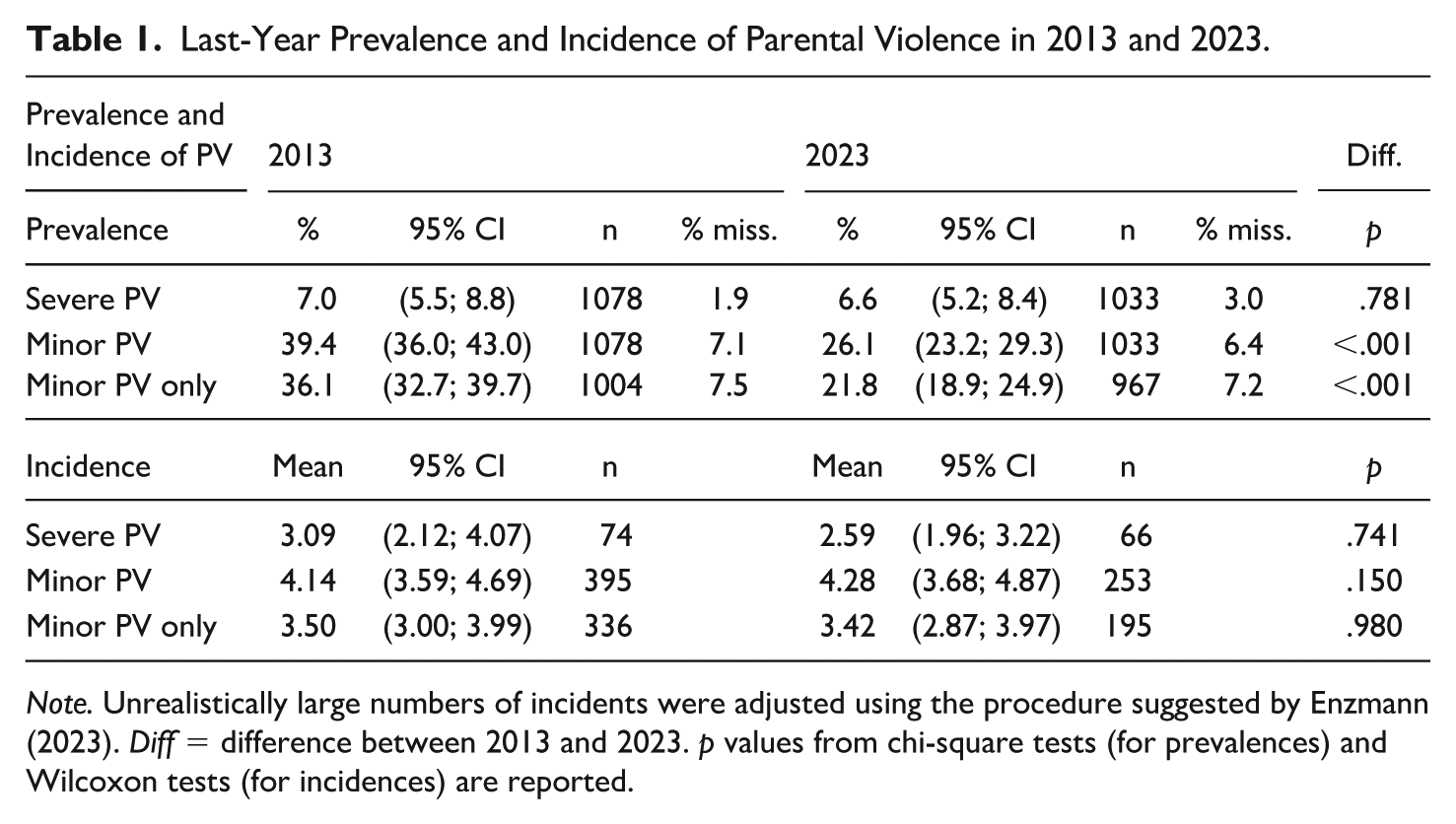
Note. Unrealistically large numbers of incidents were adjusted using the procedure suggested by Enzmann (2023). Diff = difference between 2013 and 2023. p values from chi-square tests (for prevalences) and Wilcoxon tests (for incidences) are reported.
The distributions of family-related variables across both ISRD waves are presented in Table 2. A slight increase is observed in the reports of parental problems with alcohol or drugs (8.8% in 2013 vs. 11.7% in 2023) and serious conflicts between parents (30.4% vs. 36.7%), while relative economic deprivation is reported somewhat less frequently (11.6% vs. 8.7%). The other two variables—intimate partner violence between parents and living in a disadvantaged neighborhood—do not differ significantly between the two waves.
Descriptive Statistics for Family-Related Variables.
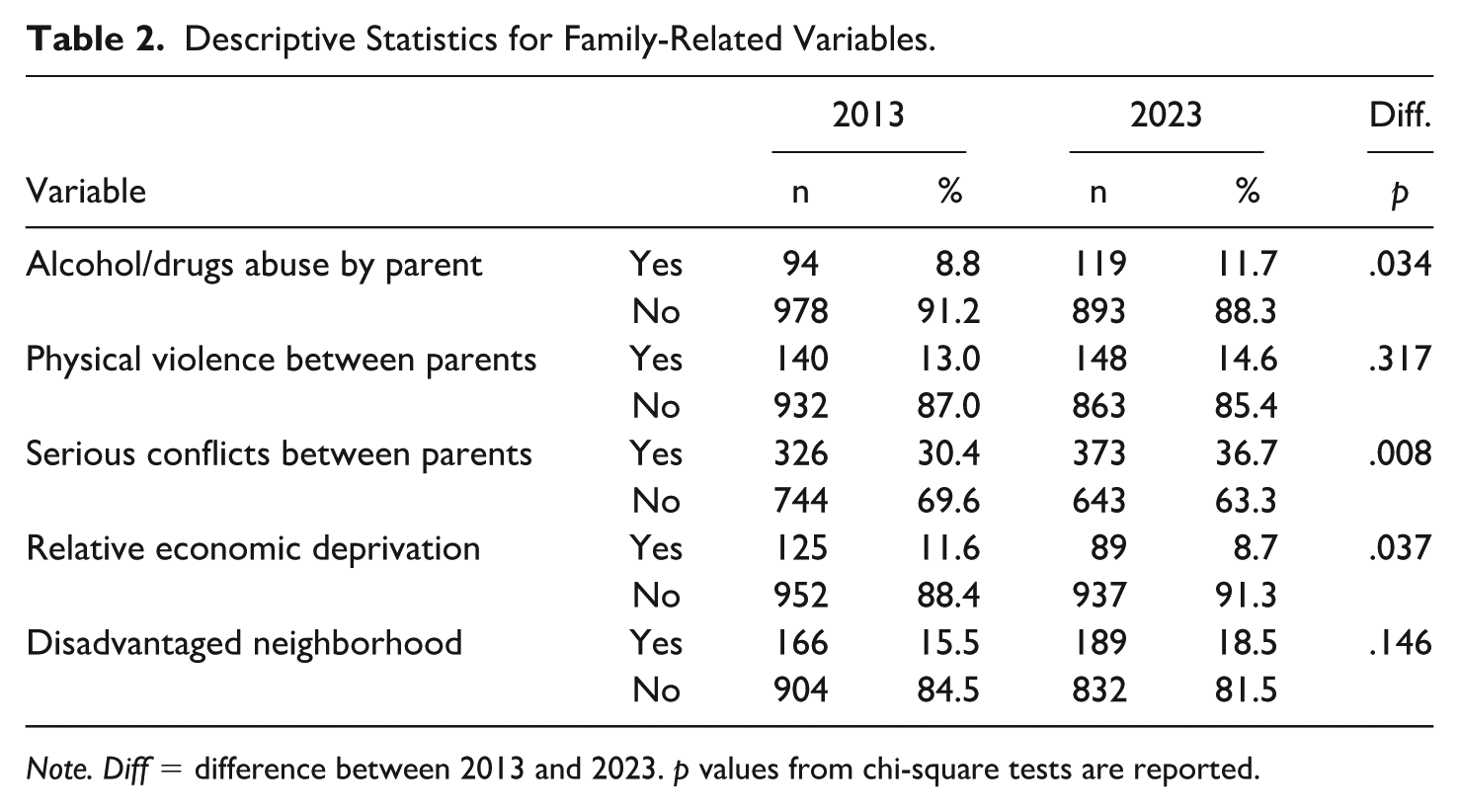
Note. Diff = difference between 2013 and 2023. p values from chi-square tests are reported.
The examination of bivariate relationships (Table 3) shows that all family-related variables are significantly associated with severe PV, and the strength of these associations does not differ between 2013 and 2023. The odds ratios (ORs) for all variables are greater than 2.0, with the strongest effects observed for the three indicators of parental antisocial behavior (all ORs > 3.1). However, the results differ somewhat in the case of minor PV only. Variables related to parental antisocial behavior show significant effects in both ISRD waves, with no significant differences between them. Nevertheless, the ORs are smaller compared to those for severe PV, ranging from 1.7 to 2.9. While relative economic deprivation is not associated with experiencing minor PV only, living in a disadvantaged neighborhood emerges as a significant risk factor only in 2023. This is the only indicator that exhibits a differential impact on PV across the two waves.
Bivariate Associations Between Family-Related Variables and Parental Violence.
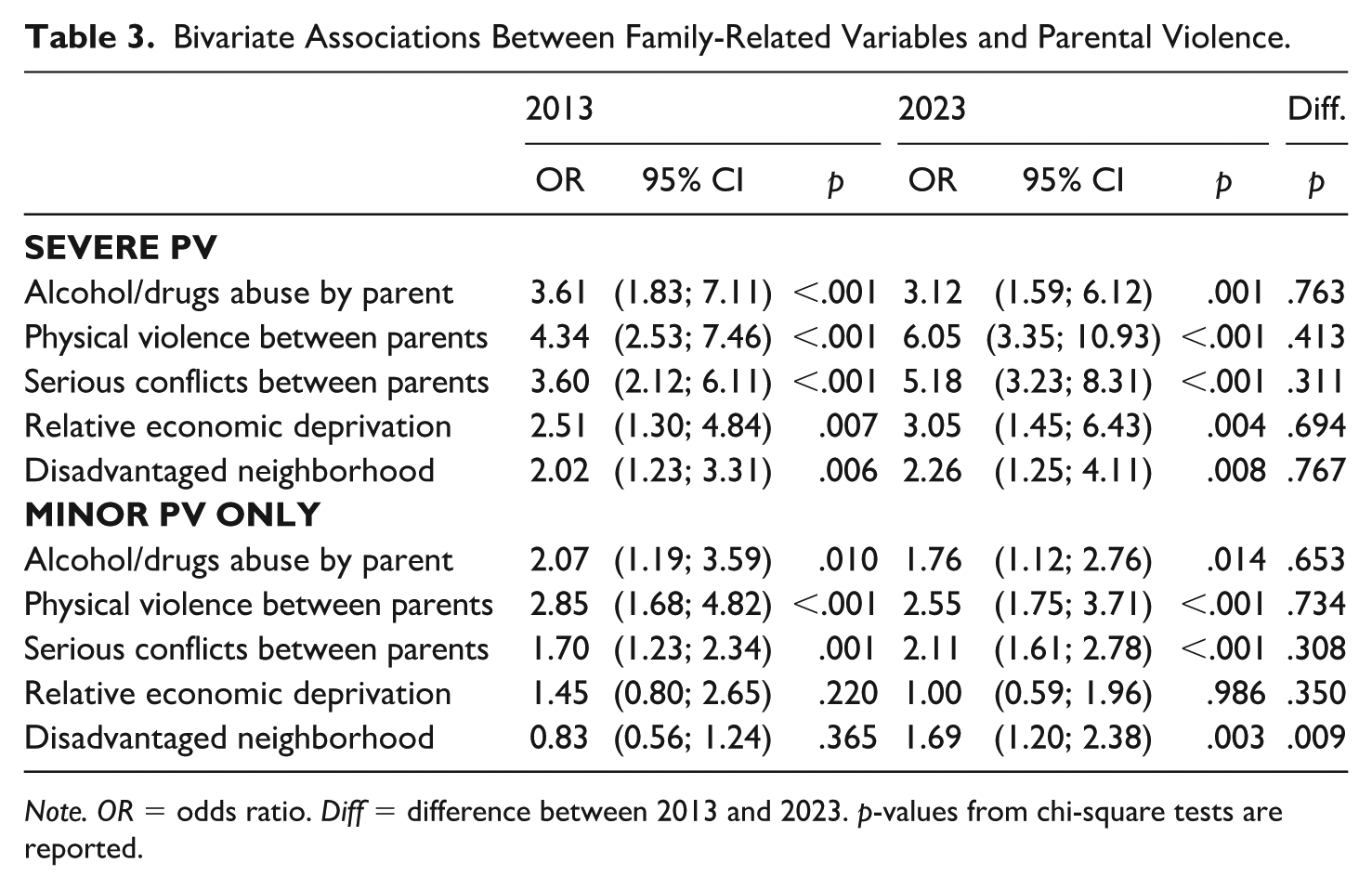
Note. OR = odds ratio. Diff = difference between 2013 and 2023. p-values from chi-square tests are reported.
Finally, the results of the multinomial regression analysis of the three-category PV measure—distinguishing between no PV, minor PV only, and severe PV—are presented in Table 4. The model includes all family-related variables and controls for gender and age. Model 1, which includes all main effects, shows that only two family-related variables are significantly associated with both severe PV and minor PV only (compared to no PV): physical violence between parents (aORs = 3.5 for severe PV and 2.1 for minor PV) and serious conflicts between parents (aORs = 2.8 and 1.5, respectively). In addition, living in a disadvantaged neighborhood increases the odds of experiencing severe PV compared to no PV (aOR = 1.9), but shows no significant effect in the submodel for minor PV only. Furthermore, the odds of experiencing either severe PV or minor PV only (compared to no PV) differ significantly over time, confirming a decrease in PV in 2023.
Multinomial Logistic Regression of Parental Violence Using Three-Category Measure (Levels: Severe PV, Minor PV Only, No PV).
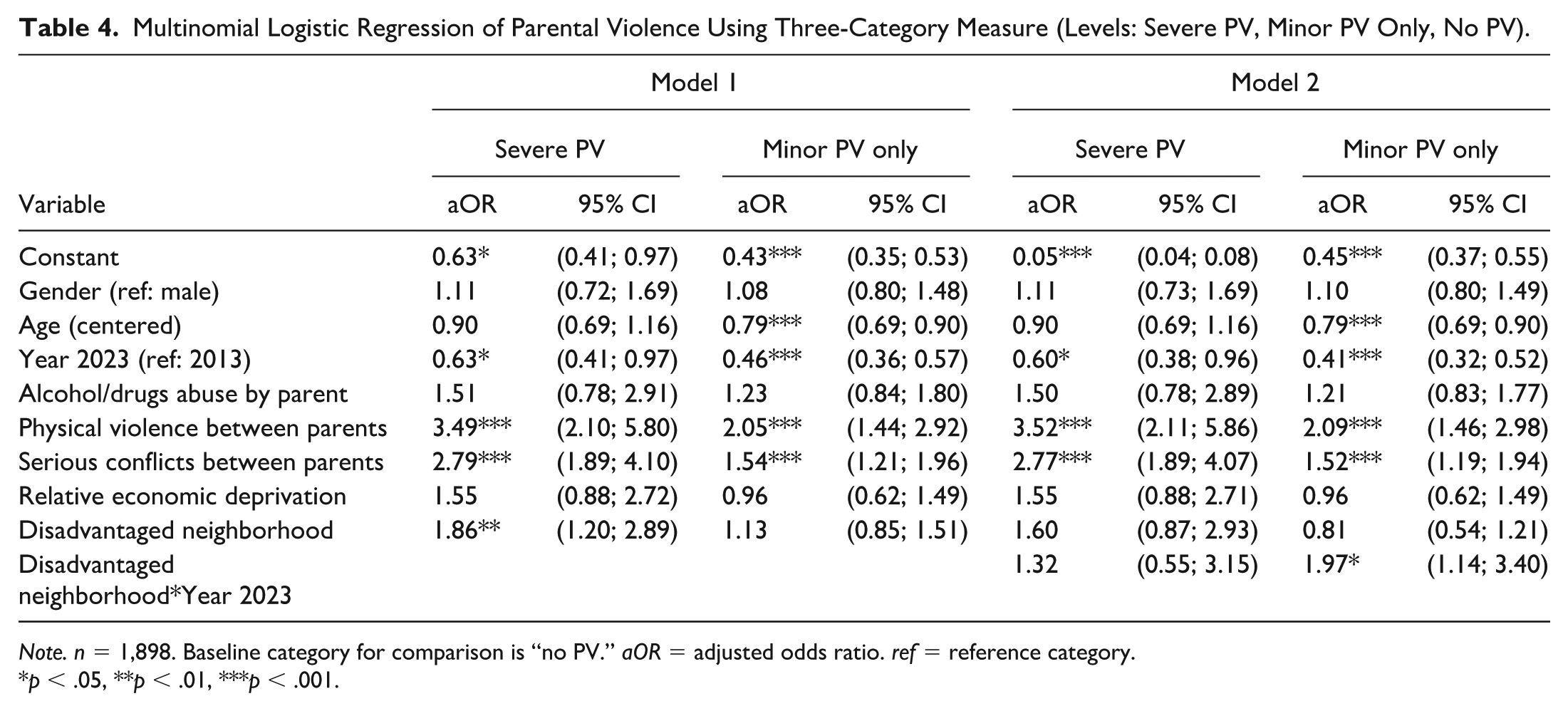
Note. n = 1,898. Baseline category for comparison is “no PV.” aOR = adjusted odds ratio. ref = reference category.
p < .05, **p < .01, ***p < .001.
In the next step, interaction terms between family-related measures and the wave variable were tested individually, and only the interaction for neighborhood disadvantage was found to be significant (Model 2, Table 4), consistent with the bivariate analysis (cf. Table 3). The results of the submodel for minor PV only confirm a stronger association with neighborhood disadvantage in 2023 compared to 2013, with estimated aORs of 0.8 (95% CI: 0.5–1.2) in 2013 and 1.6 (95% CI: 1.1–2.3) in 2023. The interaction term was not significant in the submodel for severe PV.
Discussion
A substantial body of research has confirmed the harmful outcomes of corporal punishment of children (e.g., Gershoff, 2002; Heilmann et al., 2021), and most European Union countries have already banned its use in all settings (Global Initiative to End Corporal Punishment, 2024a). The Czech Republic, however, had long been one of the few exceptions. As ISRD3 findings indicated, physical punishment was still a common practice in the Czech Republic in 2013 (Enzmann et al., 2018). Nevertheless, with developments in neighboring countries and increasing pressure from international organizations (Global Initiative to End Corporal Punishment, 2024b), societal attitudes in the Czech Republic appear to be shifting. This is reflected in the gradual decline in the public acceptability of corporal punishment (Stem/Mark, 2024) and in the recent adoption of a legislative ban.
Our analysis confirms signs of this cultural shift: the proportion of adolescents reporting experiences of minor PV declined markedly from 39% in 2013 to 26% in 2023. However, this decrease did not extend to more severe forms of PV, nor did it reduce the intensity of PV among those still affected. Thus, the data suggest that the proportion of parents who use mild corporal punishment in child-rearing has decreased by roughly one-third over the past decade. Despite this positive trend, the prevalence of minor PV remains high, and preliminary international comparisons from ISRD4 indicate that Czech adolescents still report the highest rates in Europe (Marshall et al., 2025).
Furthermore, this study examined the role of adverse family environments and found substantial associations between family stressors—such as inter-parental conflict, intimate partner violence, and economic strain—and the likelihood of severe PV, underscoring the need to view it within the broader ecology of adversity rather than in isolation (Cronholm et al., 2015; Felitti et al., 1998). In addition, these associations did not differ across the two ISRD waves. Thus, virtually no changes were observed in the case of severe PV between 2013 and 2023, with respect to either its occurrence or its relationship to family-related risk factors.
In contrast, the effects of family stressors on minor PV were weaker than those on severe PV in both survey waves. In 2013, mild corporal punishment was still largely regarded as a socially acceptable disciplinary practice, and its use was not strongly influenced by adverse family conditions (Podaná, 2018). It was expected that as social norms shift and the acceptance of minor PV declines, its risk factors would begin to resemble those associated with severe PV. Our findings provide only partial support for this hypothesis. Of the family stressors examined, only economic strain—measured by residence in a disadvantaged neighborhood—showed a stronger association with minor PV in 2023 than in 2013. Nevertheless, this limited shift may be explained by the still relatively high prevalence of mild PV, which continues to be practiced across a broad spectrum of families despite its declining acceptance.
These findings highlight the need for policymakers and practitioners to further intensify public education efforts—such as media campaigns, school-based programs, and outreach through health care and social services—aimed at raising awareness of the harms associated with PV, including its “milder” forms. At the same time, at-risk families—particularly those living in disadvantaged communities—should be provided with appropriate support, including guidance on stress regulation, positive parenting practices, and conflict resolution.
While ISRD data offer a valuable perspective on adolescent victimization and longitudinal trends in PV, several limitations must be acknowledged. As a cross-sectional, self-report study, ISRD cannot establish causality and may be affected by inaccuracies in students’ reports. Family-related variables are also based solely on students’ subjective perceptions. Furthermore, changes in questionnaire content and the shift from paper-based to online data collection between 2013 and 2023 may affect comparability.
In conclusion, this study provides evidence of a welcome decline in minor PV in the Czech Republic, suggesting a gradual cultural shift away from the use of corporal punishment in child-rearing. However, this trend has not yet extended to more severe forms of abuse. While public and political discourse on the harms of PV is emerging, significant efforts are still required to dismantle long-standing social norms and to support parents in adopting non-violent disciplinary practices. In this respect, even a modest legislative ban on corporal punishment—such as the one recently approved—represents an important societal statement that all forms of violence against children are harmful and unacceptable.
Footnotes
Declaration of Conflicting Interests
The authors declared no potential conflicts of interest with respect to the research, authorship, and/or publication of this article.
Funding
The authors disclosed receipt of the following financial support for the research, authorship, and/or publication of this article: The study is from the project “Research of Excellence on Digital Technologies and Wellbeing CZ.02.01.01/00/22_008/0004583” which is co-financed by the European Union. It was further supported by the Cooperatio Program provided by Charles University, research area Sociology and Applied Social Sciences, implemented at the Faculty of Arts, Charles University.
