




Abstract
The context of the carceral environment is based on the logic of surveillance and relies on cameras to act as the ever-present eyes of the institution. We explore the investigative roles that cameras play in the institution from the perspective of correctional staff and residents. A qualitative study was conducted in a medium-security institution in the Midwest region of the United States as part of the Prison Research and Innovation Initiative (PRII). The findings are based on semi-structured interviews with people who are incarcerated and correctional staff (including custody and noncustody staff). Upholding accountability was a perceived benefit of reviewing footage from prison cameras during investigations, yet the harms of selective enforcement against the resident population and the perceived misuse of cameras for staff disciplinary actions thwarted the benefits of having and using cameras.
Introduction
Surveillance is a central pillar of carceral institutions, evidenced by Bentham’s panopticon (Bentham, 1995). Prison culture and architecture, like watchtowers, reflect the penal reliance on surveillance for the control and management of people who are incarcerated (Moran & Jewkes, 2015). As technology has developed, surveillance cameras have become the new eyes within correctional institutions. Camera surveillance is expected to monitor the behaviors of all parties, instill obedience from individuals who are confined, and maintain control of the correctional facility (Allard et al., 2006; Moran & Jewkes, 2015; Van Hoven & Sibley, 2008). When expectations for control and obedience are not met, and incidents occur inside prison walls, the notion of visibility (vis-a-vis camera surveillance) is expected to be used during investigations and to help satisfy the correctional interest to hold individuals accountable for any perceived wrongdoings (Debus-Sherrill et al., 2017; Dodd et al., 2020). Although the use of cameras within correctional institutions is typically focused on the confinement and control of people who are incarcerated, recent interest includes responding to misconduct by correctional staff who are tasked with upholding safety and security (Dennehy & Nantel, 2006; Santo et al., 2023; Shukla et al., 2021a).
Based on interview data from correctional staff and residents 1 in a Midwest correctional facility, this article seeks to understand the role of cameras, specifically closed-circuit television (CCTV) cameras, as a surveillance tool within penal institutions and how these perspectives differ between those who work and live in these environments. We find that CCTV cameras are consistently implicated in how institutions enforce punishment and uphold accountability. The findings demonstrate that staff perceived upholding accountability as a benefit of reviewing prison cameras during investigations. However, this benefit was complicated by the double-edged sword of accountability, whereby CCTV cameras were seen as appropriate tools for punishing facility residents but were perceived as a misuse of power to discipline staff for misconduct. As such, this article has important implications for understanding the role of CCTV cameras within carceral environments and their function in upholding accountability.
Camera Footage for Investigations
In the aftermath of altercations inside correctional facilities, institutions rely on cameras to gather evidence and enhance transparency of what occurred. The ability to review camera footage provides some investigative benefits to observe incidents and investigate complaints to resolve issues retroactively. As such, the presence of cameras and the review of camera footage imply that the involved parties will be held accountable for misconduct.
Detection and the Accountability of the Resident Population
Much of the discussion regarding the use of prison cameras to encourage and uphold accountability is focused on the resident population as the targeted and primary recipients of this accountability (Dodd et al., 2023; Gill & Loveday, 2003). Accountability for violent or serious infractions, like assault and forcible sexual abuse, may result in placement into restrictive housing—more commonly known as “solitary confinement.” Other forms of accountability may be more modest, such as verbal warnings and written reprimands (i.e., “ticket” or “write-up”) administered for rule violations like an excess of allowed personal items in their cells, nonhygienic behaviors (e.g., not showering), and interpersonal encounters like verbal threats or “disobeying an order.”
Notwithstanding the several ways correctional institutions may opt to respond to conduct violations, reactive decisions are shaped by the power that staff possess and exert over people who are incarcerated as well as staff discretion in how accountability is practiced. There is an understanding that when actions are observed, be it in person or via live camera surveillance, “some CO’s [correctional officers] don’t care” about minor indiscretions while others “will write you up” in response to the same actions (Van Hoven & Sibley, 2008, p. 1014). In other words, in some situations, staff exercise discretion to turn a blind eye or give residents a verbal warning compared with moving forward with a written reprimand and formal punishment as a form of accountability (Van Hoven & Sibley, 2008). When, where, and in what situation officers exercise discretion depends on several factors such, as a “forward looking” mentality that considers the impact of discretionary practices on staff-resident interactions, policy enforcement, interstaff relationships, and the facility itself (Haggerty & Bucerius, 2021; Liebling, 2000). In addition, discretion shapes staff decision-making practices in “picking their battles” (i.e., choosing to respond) and how they fight these battles along a spectrum of policy enforcement (Haggerty & Bucerius, 2021). Staff also have discretion regarding whether they review camera footage for accountability purposes, with an understanding that the visibility gained from closed-circuit television (CCTV) cameras may be limited (Van Hoven & Sibley, 2008). Thus, the use of cameras for investigative purposes and, thereby, in upholding accountability is contingent upon the discretion held by correctional staff and an arbitrary exertion of power that can influence the investigative outcomes of prison cameras.
Furthermore, carceral interests in maintaining accountability for people who are incarcerated, in turn, motivate institutional interests to have camera footage when needed. Poor image quality from CCTV cameras, however, impedes the use of camera footage as supporting evidence and can hinder institutional attempts to uphold any sought-after accountability (Gill & Loveday, 2003; Lawrence et al., 2022). People who are incarcerated may be motivated to plead their innocence (despite potential involvement), given institutional knowledge of poor CCTV image quality and, therefore, insufficient evidence to prove otherwise (Gill & Loveday, 2003). In addition to poor image quality, some infractions may remain unseen due to camera blind spots. As such, correctional facilities may direct their attention to adjusting CCTV camera positions and increasing the number of cameras to reduce blind spots, with the expectation that this will increase the likelihood of detecting and responding to wrongful activities (Peterson et al., 2024; Shukla et al., 2021b). For instance, Lawrence and colleagues (2022) found that after the installation of new cameras to enhance visibility in correctional facilities, there was an increase in the number of residents who were found to be at fault for infractions. As Lawrence et al. (2022, p. 862) noted, “While guilty dispositions are not a perfect measure of successful investigation outcomes, they can serve as a proxy of whether there was enough evidence to hold someone accountable for an infraction.” Thus, despite the imperfections of cameras, when blind spots are minimized, cameras can help detect infractions and determine culpability.
Overall, camera footage may provide evidence on who is to be held accountable for conduct violations; however, cameras alone do not decide how this accountability is practiced. Decisions about what accountability looks like in practice remain up to the correctional staff, which sparks some concerns because cameras may reinforce the “us versus them” mentality in correctional decision-making (Dennehy & Nantel, 2006). For instance, Trammell and colleagues (2021) found that cameras allowed staff to keep some physical separation and maintain a power-based detachment, making it easier to punish correctional residents with minimal communication. The correctional residents in their study noted that the carceral reliance on remote camera surveillance minimized staff’s in-person interactions to understand the full scope of altercations, increased staff’s likelihood of punitive responses, and reinforced the dehumanization of people who are incarcerated (Trammell et al., 2021). This suggests that after correctional institutions use camera footage to determine who should be on the receiving end of accountability measures, the power dynamic within institutions influences decisions about how people who are incarcerated are held accountable. This article explores the differences in upholding accountability using footage from CCTV cameras, as it relates to residents and staff.
Transparency and Staff Accountability
Although cameras are often installed to enhance the transparency of interactions within correctional institutions and to uphold accountability for any transgressions committed by people who are incarcerated (Dodd et al., 2023), cameras may also subject staff to accountability measures (Shukla et al., 2021a). The legal ideology of imprisonment, albeit disputed by community members and at times contradicted in practice, is that people are “sentenced to prison as [sic] punishment, not for [sic] punishment” (Dennehy & Nantel, 2006, p. 184). As such, there are established regulations that correctional staff must abide by to ensure a professional code of conduct and prevent any cruel and unusual punishment of the resident population. As said by Commissioner Dennehy and Chief Nantel from the Massachusetts Department of Corrections, “If staff members are not held accountable, we demonstrate that there is no consequence for bad behavior” (Dennehy & Nantel, 2006, p. 177). Given that the deterrent effect of prison cameras remains questionable (Allard et al., 2008; Debus-Sherrill et al., 2017), cameras are expected to retroactively enhance transparency of what occurred and to hold staff accountable for misconduct.
It is important to note that camera footage can be crucial when correctional institutions are investigating allegations of staff misconduct. Interestingly, both correctional residents and staff believe in the usefulness of cameras in investigating staff misconduct (Debus-Sherrill et al., 2017). Sydes and colleagues (2022) found that correctional officers perceive cameras to be beneficial in discrediting inaccurate claims made by residents about officers’ misconduct. In fact, they find that 79% of correctional officers believed cameras helped reduce the number of “frivolous” complaints against staff that were filed by residents (Sydes et al., 2022, p. 333). Overall, extant literature suggests the usefulness of cameras for verifying and disproving allegations of staff’s inappropriate behaviors (Sydes et al., 2022), enhancing transparency, and demonstrating some investigative benefits of prison cameras.
Despite information on cameras within carceral institutions, less is known regarding how cameras are used to uphold staff accountability when they engage in unauthorized behavior. The limitations of CCTV cameras could be complicit in a lack of staff accountability. For instance, CCTV camera surveillance is ineffective when correctional staff have the advantage of knowing where blind spots are located and exploiting this knowledge to engage in inappropriate behavior out of camera range (Venters, 2019). In this way, the opportunity to remain unseen (Van Hoven & Sibley, 2008) is not limited to the strategies performed by people who are incarcerated but also applies to correctional staff.
Although CCTV cameras are the most common camera surveillance technology within correctional facilities, there is an emerging body of literature exploring the use and role of body-worn cameras in prisons for surveillance and accountability purposes (Lawrence et al., 2023, 2024; Peterson et al., 2023). Correctional institutions in many countries have recently introduced body-worn cameras to complement conventional surveillance technology, allowing for a field of vision within close proximity that differs from traditional CCTV surveillance (Sydes et al., 2022). Compared with CCTV footage, the availability of and access to close-proximity camera footage is expected to improve evidence-gathering mechanisms, enhance transparency of what occurred, and encourage accountability for wrongdoing. Although correctional officers do not perceive body cameras to improve the accuracy of investigation outcomes for people who are incarcerated (Peterson et al., 2023), increased camera surveillance, by way of body-worn cameras, may imply increased accountability for staff behaviors (Dodd et al., 2020). A recent randomized controlled trial noted a significant reduction of 58% in residents’ injuries during incidents of resistance in jail after the adoption of body-worn cameras (Lawrence et al., 2023, p. 7). These findings indicate a potential benefit of enhancing surveillance capabilities for increasing staff accountability, but such accountability is contingent upon body-worn cameras being turned on during incidents. Dodd and colleagues (2020) found that correctional officers expressed concern about body-worn cameras and felt stressed about recordings, fearing disciplinary action for inappropriate language and excessive tone with facility residents. The discretionary power of agencies in shaping camera policies and of officers in manually recording interactions limits the evidence-gathering ability of cameras to respond to misconduct (Murphy & Estcourt, 2020; Thomas, 2016).
Still, cameras alone are insufficient to ensure that correctional officers are held accountable for misconduct. Staff accountability relies on footage being available during investigations and reviewed and considered in any decision-making regarding the administration of punishment. Yet, there is emerging evidence that camera footage is often used selectively during investigations. Debus-Sherrill and colleagues (2017) reported that although staff and upper-level management believed cameras to be a valuable tool in investigating incidents and monitoring staff behavior, the custody staff found cameras to be useful only when investigating incidents that involved the resident population. This study suggests a selective use of camera footage to direct attention to cases involving residents and not all types of incidents or complaints against officers. As such, the investigative functions of cameras in staff misconduct are not without limitations as they relate to the discretionary decisions about when footage will be reviewed, incorporated into reports, and addressed in practice (Debus-Sherrill et al., 2017; Dodd et al., 2020).
All things considered, cameras can be a tool to control and surveil people who are meant to be controlled and surveilled. Power operates hierarchically within prisons such that those in leadership positions hold power over lower-ranked staff, and all staff, regardless of rank, hold power over residents who are the targets and primary focus of camera surveillance. As authorities have the power to review camera footage, there is a vague understanding of whether and how this relative power influences the purpose and use of cameras in correctional institutions. The current study explores the role of CCTV cameras in correctional institutions by analyzing the perspectives of correctional staff and residents. Findings will help advance our understanding of how CCTV cameras are used in surveillance from the perspective of both residents and staff as well as whether and how camera footage influences accountability measures.
Method
The data presented in this article were collected as part of a larger mixed-methods study conducted in a medium-security institution in the Midwest region of the United States. The larger project was initiated in 2020 as part of the Prison Research and Innovation Initiative (PRII) to explore the culture and climate of carceral institutions across five states. Interview guides contained questions regarding the living and working environments of prisons, including questions about the use of security cameras. At the time of data collection, the correctional institution did not use body-worn cameras; CCTV cameras were used as the camera surveillance tool in the facility. The current article is based on 56 interviews conducted with prison staff and 39 interviews conducted with residents.
Study Participants
Staff participants were recruited via email, and residents were recruited through messages sent to their tablets. Participants were scheduled for interviews in order of when they contacted researchers. Participants were enrolled in the study until researchers perceived that saturation had been reached. Interviews with staff were conducted between April and June of 2020, ranging in length from 25 min to 1 hr and 27 min. Interviews with residents were conducted between January and April of 2021, and ranged in length between 38 min and almost 2 hrs. Interviews with residents occurred via Zoom; staff interviews occurred in a variety of formats including Zoom and phone. No interviews were performed in person due to safety restrictions during the COVID-19 pandemic. All interviews were audio recorded and transcribed.
The semi-structured interviews with staff asked about the quality of relationships between coworkers, the quality of relationships with residents, prison culture, work environment, safety and security, policies, COVID-19, and work–life balance. The semi-structured interviews with residents inquired about the quality of relationships with staff, their relationships with other residents, life in prison, safety and security, policies, COVID-19, and rehabilitative programming. To inquire about cameras specifically, correctional residents were asked, “Do you think having cameras inside correctional facilities impact how staff members interact with those living here?” The staff were asked, “Do you think having cameras inside correctional facilities shape feelings of safety? Or impact how staff members interact with those living there?” Beyond these targeted questions, the semi-structured nature of the interviews allowed participants to discuss cameras as they related to other facets of prison culture and climate, including policies and work environment. Prior to the start of interviews, the research team obtained verbal consent from the residents and signed consent from the staff. To maintain privacy, participants selected their pseudonyms, which were used throughout the interview and in the dissemination of findings. To distinguish between staff participants who selected the same pseudonym, we added a common last name associated with their racial-ethnic background. As compensation for their time, staff participants were entered into a raffle with a chance to win one of three items: a $50 gift card, an iPad, or a Fitbit. Residents were compensated with goodie bags of snacks and three names were randomly selected to receive $20 in their commissary account.
Table 1 describes the demographics of the 39 residents. Their ages ranged between 21 and 62 years old, with an average of 43 years old. Regarding racial background, 58.9% of participants identified as white and 38.4% of participants identified as Black. 2 The remaining 2.6% of participants identified as another racial category. All except one person identified as male, with the remaining individual identifying as a transgender female. The residents in the sample had sentences that ranged from 7 to 55 years, with an average sentence of about 19 years. Relatedly, they had spent an average of 12 years at the facility where we interviewed them.
Residents Demographic Characteristics (N = 39).
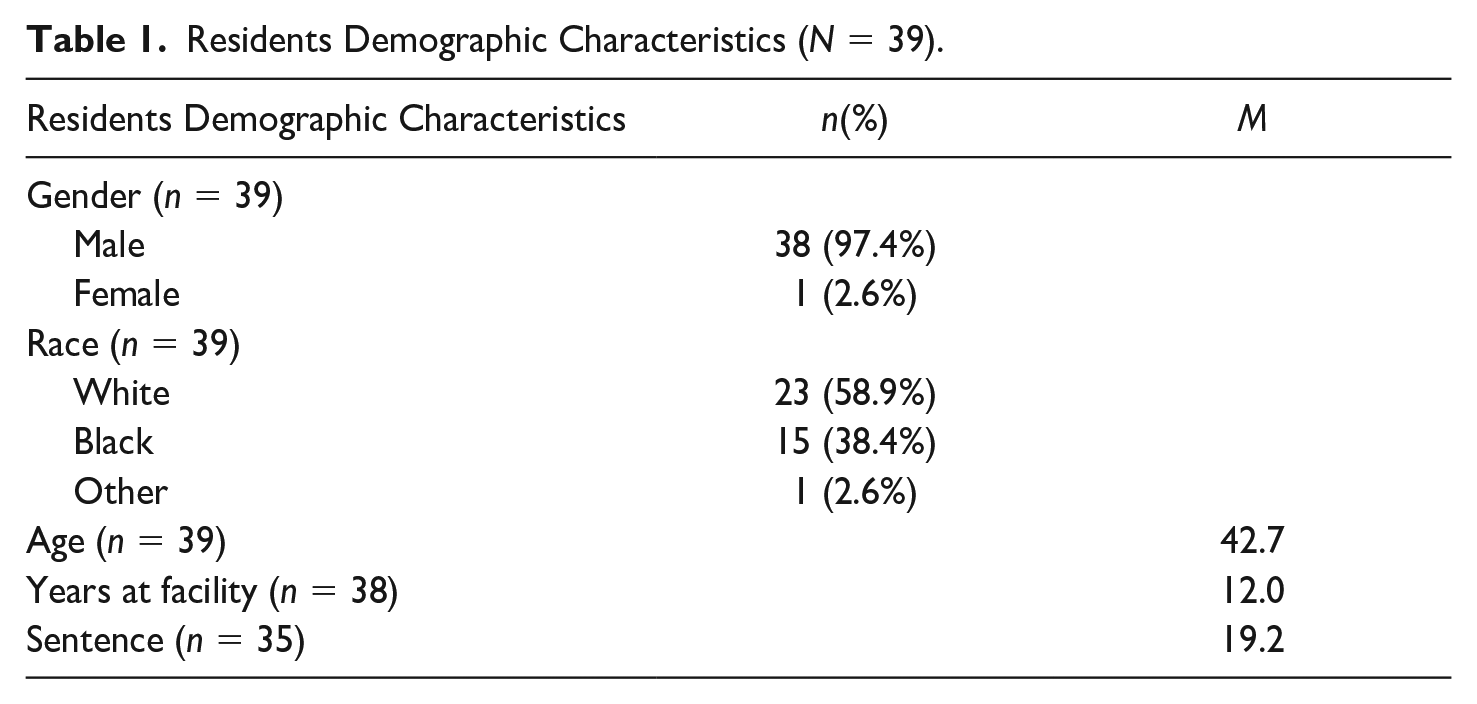
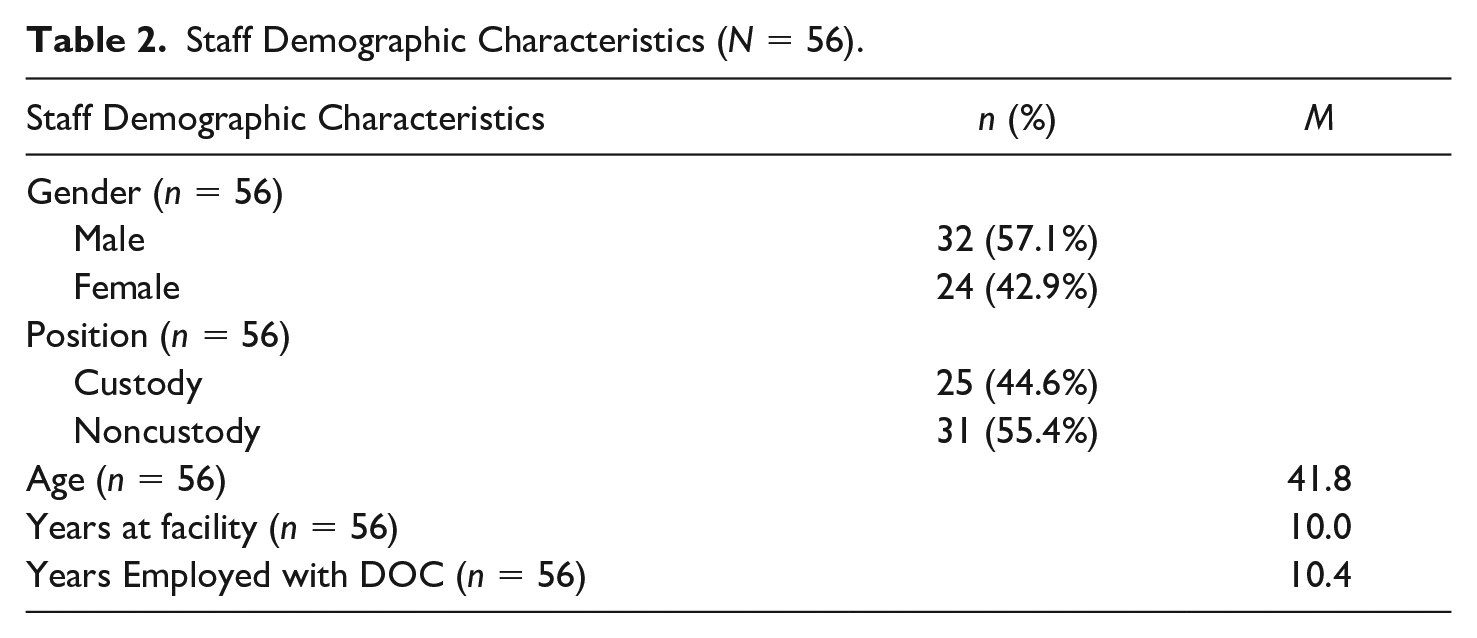
Table 2 describes the demographics of the 56 staff participants. The ages of staff participants ranged from 22 to 68 years, with an average age of about 42 years old. All staff identified as white, including one person who identified ethnically as white and Hispanic. A majority (57.1%) of the interviewed staff identified as male. Staff worked for an average of 10 years at the facility, with a minimum of 3 months and a maximum of 39 years. Of the staff participants, 55.4% worked in a noncustody position (such as administrative, health care, educational, and programmatic roles), while the remaining staff (44.6%) worked in a custody position in which they were responsible for overseeing and managing residents’ daily movements inside the facility.
Staff Demographic Characteristics (N = 56).
Although these data are based on a convenience sample and are susceptible to limitations of generalizability, the strengths of this study are valuable and cannot be understated. Rather than focusing solely on either the working or living experiences in a correctional institution, this sample allows for a comparative analysis of both perspectives on cameras. This depth of understanding is crucial for producing knowledge on what it means to live and work in a carceral setting where cameras may reinforce power dynamics and influence interpersonal interactions and vice versa, where hierarchical interactions may also guide how cameras are used within correctional spaces.
Data Analysis
This research study utilized NVivo software to conduct a thematic analysis (Braun & Clarke, 2006) of more than 2,000 pages of interview transcripts. To begin, research team members read through interviews, line-by-line, to pinpoint common threads across the transcripts. By reading through transcripts several times, we organized common threads with subthreads or specific examples to create a conjoined codebook of emergent themes (Braun & Clarke, 2006). We then coded across and within interviews for these themes, searching for evidence of patterns and deviant cases (Glaser & Strauss, 1967). Each transcript was coded by two members of the research team, who then met to discuss any coding discrepancies and come to a consensus. The research team created a short video, a written summary, and a two-page infographic to present the findings from staff interviews. To conduct member checking (Lincoln & Guba, 1985), we shared these findings with the staff we interviewed and invited them to provide feedback after reviewing the preliminary findings discussed in the video, summary, and infographic. Similarly, the research team created a short video and written summary of the residents’ interviews to share findings with the residents and request their feedback.
In this article, we draw from codes specifically related to the perceptions of cameras within the institution. For the residents, the themes included the “extent to which cameras are used (or not used) to answer residents’ questions or resolve their issues” and “the extent to which cameras increase or uphold accountability for poor behavior.” For staff, themes related to their “perceptions of the investigative limitations” and “perceptions of investigative benefits” of cameras. What follows describes the insights that this analysis produced.
Findings
The Resident Population: Weaponizing Cameras to Convict, Not Exonerate
In the aftermath of the incidents, residents believed that cameras should aid in addressing their concerns and resolving their issues. Unfortunately, many residents felt that cameras were used in a disparate manner—often to enforce correctional policies and inflict punishment upon them, but not used to exonerate them or support their grievance reports.
Participants noted that cameras were used as an institutional tool to aid correctional officers in punishment avoidance, but they believed that cameras did not serve the same purpose for residents. Namely, when correctional officers are accused of noncompliance with prison policies or procedures, residents believed cameras are used to demonstrate staff adherence to protocols; however, when residents of the facility faced similar allegations of noncompliance, they felt as though they were not able to rely on cameras as an instrumental tool to prove their innocence or support their side of the story.
Residents explained how prison cameras represent a double standard, such that they help resolve staff problems, but do not provide the same benefit for people who are incarcerated. For example, Azazel imitated a conversation with prison staff: “you can use the same camera to convict me, but you don’t use the camera to exonerate me, the same camera? That’s not right.” Azazel feels resigned toward the cameras since staff “only use the damn cameras when it is beneficial to them.” Paul echoes this sentiment: “the cameras are only for their benefit [. . .] it’s not for our benefit.” C-Breeze commented on the reliance on cameras for punishment, stating: they won’t rewind the cameras to prove your innocence, but they will rewind the cameras [to] prove your guilt. Like, if they think you did something, and they can prove it by rewinding the cameras, they’ll do that. But if they know that rewinding the cameras will prove your innocence, they won’t even look at [it].
Thus, individuals expressed how prison cameras were used to increase punishment for residents, rather than seeking an objective truth of all interactions. Mr. S succinctly describes the double standard use of cameras, stating: “it’s more or less just to protect them. And watch us.”
Participants commented on the “benefit” of cameras for correctional officers in wielding institutional tools to enforce policy through punishment. Rodney provided a concrete example of how cameras apply and enforce punishment. He shared, they will use the cameras to convict you of a conduct violation. But if the cameras will prove that you didn’t do something, they’re less likely to review them . . . [T]hey want to use to punish you, but they don’t want you to get you out of trouble.
Having conduct violations has serious implications in the personal journey toward rehabilitation, according to Mr. Green, as it reflects negatively on perceived conduct, hinders placement into prison programming, and imposes external barriers to making individual progress: “[It’]s one of those things holding me back from tryna better myself. That [violation] is holding me back to try to better myself and other people that’s trying to do the same thing.” Thus, the institutional reliance on cameras to punish people currently residing in the institution is unbalanced in two ways (a) in terms of its punitive application and (b) in its ability to serve institutional goals. First, the use of cameras for the application of punishment is unbalanced such that punishment is primarily applied toward residents rather than both residents and correctional staff alike. Second, the reliance on cameras is unbalanced in its ability to serve institutional goals. In general, correctional goals include punishment, rehabilitation, incapacitation, and retribution. However, using cameras to enforce punishment practices that bar individuals from accessing rehabilitative resources and programming suggests that cameras are instrumental in upholding punishment to the detriment of rehabilitation.
The residents described how the double standard of punishment influences and relates to correctional policy. During Clyde’s interview, he recalled how he helped a fellow resident file a grievance through an Informal Resolution Request (IRR), requesting the review of camera footage supporting his grievance report. Clyde noted that footage was not reviewed even after appeal; he believed the IRR process was “totally flawed” and such outcomes discourage individuals from following the grievance procedures due to the belief, “there’s no reason for me to file it because I’m never going to get when I’m asking for.” Ultimately, Clyde describes the takeaway from this experience as the futile search for justice: “if I tried to adhere to the policy and followed all the channels you have, I’d still never get treated fairly. So, what is the purpose of the policy in place?” This speaks to resident expectations of camera usage for investigative purposes. Mike, for instance, believed cameras could have been useful in recovering his lost property, “All they had to do is rewind the cameras and see where my stuff went and punish that person, get my stuff back, or at least try to value it at a good enough price to make me happy enough.” Another participant, Matt, notes the systemic reliance on someone getting “caught” on cameras to substantiate a response from the facility: “[B]ecause the only time [staff] can address it, is when they catch somebody doing it.” However, notwithstanding the specifics of each grievance case or when cameras are reviewed in practice for investigative purposes, Clyde, Mike, and Matt suggest that any available evidence that could resolve their problems does not appear to be used when decisions to review cameras rest on staff discretion.
Although cameras could be used in multiple ways to help residents with their concerns (like locating lost property) and grievances about correctional officers, participants perceived that they are not used in practice for these purposes. Instead, it is perceived that cameras are being used for the control of residents while simultaneously disregarding staff who are equally culpable in breaking policy. Residents believed that this was an unbalanced use of cameras, in which they were being denied full access to due process while they believed correctional officers were the ones breaking policy and, therefore, should be receiving punishment instead. Mike described grievances that concerned staff who were not adhering to prison policy around public health mandates, which could have been observed if camera footage was reviewed: “have [DOC] review the cameras and see that the staff are not wearing their [N95] masks [. . .] That is spreading the Covid.” George also commented on how policies are impacted by the use of cameras, to the detriment of residents: [I]f [corrections officers] violate one of [DOC’s] policies, and you complain about it through the proper channels, which would be the grievance process, you will get a standardized answer that states, ‘It is up to you to provide sufficient evidence to state your claim. You have not provided sufficient evidence to state your claim, therefore your grievances [are] denied.’ [T]hey will tell you that you’re not allowed to use cameras or anything else, as your witness, but yet they’re allowed to use their cameras to prosecute you. But you’re not allowed to use them to show them an officer did something wrong.
Thus, from the perspective of the correctional residents, cameras are central to punishment decisions in seemingly working toward justice, but there is a double standard in the administration of institutional punishment in which the residents largely believed that cameras were selectively reviewed when it pertained to punishing those residents and not the correctional employees. Ultimately, the perception of an unbalanced use of camera footage contributes to residents’ distress and anxiety about their due process rights and their ability to voice concerns.
The Staff Population
An essential role of correctional employees, including custodial and noncustodial staff, is to maintain the safety of the institution. The use of cameras has been cited by staff as incredibly important for doing their job given that cameras are the primary resource for revealing wrongdoing and providing evidence to punish individuals. Yet, the staff discussed the investigative limitations of cameras for ensuring accountability is upheld for the residents, and staff narratives suggest a double-edged sword as it concerns staff accountability.
Cameras for Fact-Finding and as Evidence
Overall, staff participants believed that cameras were helpful for uncovering the “truth.” For example, Bob Johnson described cameras as “helping out tremendously” by revealing who was responsible for incidents, like physical assaults, when others “are too scared to come out and say who it was.” Highlighting that “cameras do work,” Bob Johnson described a theft in the facility and shared, “Without the camera system, I would’ve never figured that out.” Thus, cameras provide answers to incidents that would have otherwise gone unsolved. Kendall shares that cameras are essential for verifying the details of the occurrence, particularly if the case goes to court: “they know, at court, if there was no cameras, it’s one word against another. Whereas now, you got the video [surveillance] and they’re like, ‘Oh, well here’s a video of you clearly closed-fist striking an officer.’” This concern of “one word against another,” without the presence of cameras, was reiterated by other staff. Rebecca, for instance, shared a scenario with a resident in which she was “concerned that it was going to be my word against his word, and sometimes that’s not enough.” As a staff member, she believed cameras “verify what we’ve said” and serve as “an added factor to let them [know] that that’s what really happening.” While reminiscing on past times, Bob Smith shared: “in the past, oftentimes it was my word against an inmate” but the implementation of widespread cameras allowed staff to review surveillance footage and protect themselves against false accusations: “with the camera, when we can go back and review it, we can actually help protect ourselves if an inmate’s accusing us of doing something that we did not do.” Bob Smith highlights that this protection against false accusation is also possible for the resident population. More specifically, Bob Smith states, “if an inmate can be proven innocent of [an accusation]” from another confined person, this demonstrates to residents that staff actually investigate allegations among the residents and he believes this “build[s] a rapport” and “keep[s] the tensions a little bit lower” between the staff and residents.
In the quest for truth, staff believed cameras contributed to the safety of the institution as an accountability measure. Jane Doe, a case manager, shared, “I think [cameras] will help us in correcting behaviors, or supporting us in other things that an offender did really do this, and just providing more evidence.” She continues, describing how cameras are pivotal for maintaining institutional safety, particularly in the visiting room: “anytime you can take an extra measure to help knock any type of illicit substance coming into an institution is better safety and security for us and offenders.” According to Jane Doe, this safety and security was tied to the staff’s ability to provide “evidence” and “correct” behavior caught on camera. Claire, another case manager, also discussed how camera footage was instrumental for institutional safety: “I wouldn’t be able to investigate half the things that I do on a daily basis without camera access . . . The cameras are absolutely imperative to me being able to do what I do. And keeping both staff and offenders safe.” Claire elaborated on this investigative benefit of cameras, describing an incident where cameras were helpful: “I wouldn’t have been able to know who stole his TV if we didn’t have these cameras. But now we do, and he’s being held accountable.” In this way, staff largely viewed cameras as “an accountability measure because you can always go back to look on what happened.”
Investigative Limitations of Cameras for Accountability
While prison cameras could provide reliable information regarding institutional infractions, correctional staff noted problems that undermined cameras’ ability to provide a safe and secure environment for both parties working and living in the institution. For example, participants denote that access to review footage is rare. Anna shared that reviewing camera footage usually occurred after an altercation has already happened to “see who started it.” However, Anna notes that for staff to obtain access, “you have to go through all these chains [of command] to get the camera reviewed for something.” Bob Johnson similarly commented on the restrictions regarding who had access to review video footage, “I have pretty much a live feed camera system that I’m able to look at, but I cannot rewind it. I have to ask for help from a lieutenant or a captain or a case worker.” He continued, noting how access to review camera footage would allow him to “be more independent” in the workplace, but “only certain people are allowed to operate them.” Thus, reviewing camera footage is restricted even among correctional staff and, as Bob Johnson suggests, impacts their independence within the workplace such that staff are unable to handle issues without requesting assistance from staff in leadership positions.
Even when staff went through the chains of command to have camera footage reviewed, they noted some limitations with using camera footage for investigative purposes. Staff highlighted a lack of sound that may complicate their ability to fully understand what was occurring, conjoined with a weakness in camera coverage (i.e., blind spots) that limited their ability to see the full scope of the physical area. Kay Williams discussed how camera coverage could be improved by including audio as leadership “can’t hear what we’re saying. Um, or like, hear what they’re saying.” However, Carl cautioned that including audio in the cameras might not be the key to resolving camera limitations: “I wouldn’t improve the sound because [. . .] people can say whatever they want. But the cameras are there for people’s actions.” From Carl’s perspective, including audio might allow correctional staff to hear verbal threats or an intent to act, but because no action has been committed, they cannot administer any formal punishment. Therefore, while audio might help to clarify situations and determine intent during investigations, as noted by Kay Williams, including audio may not necessarily help to spur an institutional response for accountability purposes.
Audio complications were not the only limitations of cameras; investigations were also thwarted due to blind spots. Blind spots were mentioned during staff interviews as common barriers to utilizing camera footage for investigations. Namely, cameras were explicitly used to identify individuals who engage in conduct violations. As Anna explained, I had one guy that was stealing the linen from the hospitals and taking it back out on the hill and selling it [. . .] And I couldn’t get him caught. When I asked them to review the camera, [the sergeant] said [the sergeant] couldn’t see anything. She couldn’t even see me.
Anna’s narrative describes the intent of “catching” individuals in the act of violating correctional policies, to administer punishment. This sentiment is reflected in the narratives of residents discussed earlier when they expressed that cameras were explicitly used for “convicting” those that they “catch.” Yet, despite a strong belief that a resident was involved in illicit behavior, the cameras were unable to verify this perceived behavior due to blind spots. Anna also suggested that misconduct was knowingly done out of camera coverage because residents were aware of blind spots, noting: “these guys know where the blind spots are. They know where they can stand to hand something off to another one. So, we can’t catch everything.” Like Anna, Mike Taylor also believed the resident population could decipher where the blind spots were located and, thus, where to conduct misconduct undetected: “we can put up a million cameras, and the offenders are going to know exactly where that one blind spot is.”
Due to the blind spots of stationary CCTV cameras and their inability to provide complete and accurate visual information, Kendall and other staff members anticipate a move toward body-worn cameras, “I’ve talked to other officers, and they said that they wouldn’t be surprised in the next few years if we don’t go to body cameras.” Kendall continued, “you might have a camera 30 feet away, but it’s different when you got a camera on the chest of the officer that’s running toward a fight or something.” The move towards body-worn cameras may provide one solution to the investigative limitations of stationary CCTV cameras because they can provide audio and real-time video footage. However, body-worn cameras are not without their faults, including, but not limited to, discretionary decisions to record interactions (see Andreescu & Kim, 2022; Huff et al., 2020), and should be implemented with caution.
The Double-Edged Sword of Accountability
Staff noted that cameras could be used to ensure accountability from other staff by way of disciplinary action. In some cases, staff would briefly note that accountability was like a two-way street, directed at both staff and residents: “It helps us to actually hold the inmates accountable and it helps us hold staff accountable.” Others provided more context like Jane Doe, a case manager, who described the multipurpose nature of cameras “to address complaints, monitor things, catch things that we might not’ve, in regards to the offender population, but also in regards to staff, to bring attention to some behavior.” Compared with noncustody staff, however, custody staff appeared to be more critical of camera usage to investigate and respond to staff behavior, associating it with a “a love-hate relationship type deal.”
Custody staff shared that some supervisors used cameras to unjustly monitor them and micro-manage their actions, which contributed to staff irritation with disciplinary actions directed toward them that surfaced due to camera surveillance. Jim succinctly described the staff relationship with cameras, stating: “Cameras help, but hurt [. . .] It’s easier to help hold [residents] accountable for their actions, because you actually found out who did it, but they hurt because you have supervisors that abuse the cameras.” Jim shared an example, “Say a supervisor gets upset with me, so then he’ll get on the cameras, and he’ll just sit there and watch me, and every time I do something that he don’t like, he’s starting to get onto me.” Jim believed personal vendettas led to camera footage being used to push staff out intentionally, but also indirectly push other staff out as well: “when they do that, they’ll start basically running staff off. If a supervisor don’t like a certain staff member, they’ll do that to run them off.” Custody staff saw this surveillance of their activities as a misuse of the cameras and an abuse of power from higher-ranked staff members. Scott juxtaposes the investigative benefits of cameras with their “unintended” use to monitor staff in situations where there are no interpersonal interactions between staff and residents: We’ve gotten a lot of supervisors and other people that are just watching the rotundas of the housing units when movement’s closed and there’s no offender movement in the rotunda. You know? They’re watching [cameras], they’re using it to watch staff instead of watching the overall well-being of the whole camp.
Given that the prison supervisors were observed watching cameras when the residents were restricted from movement in the facility, Scott shared that “a lot of people feel like the cameras are being used for not their intended purposes.” Within this narrative, the intended purpose is to observe the “overall well-being of the whole camp.” Observing staff alone was not deemed as being for the well-being of the correctional institution and was instead understood as an “abuse” of the cameras—as described by Jim earlier.
As Bob Johnson noted, compared with the newer staff, the long-term staff felt some resentment toward cameras being used to monitor their workplace behaviors. A lot of the senior staff—people that are veteran staff that have been there—don’t like it because they know that if they’re doing something wrong, they’re going to get caught because it’s just as simple as rewinding cameras back on somebody.
Mike Baker was one of the more senior staff who “was there before the cameras were there.” Given the time he had spent working within the facility, he touched on staff concerns about cameras and the staff response to camera installations: [W]henever we found out that they were going to install the camera system, a lot of people that have worked there a lot longer than me tried to retire as quickly as possible, because they knew that footage from those cameras would be used against them. And they turned out to be right.
Although Mike Baker continued working at the institution, he believed the senior staff were correct to believe cameras would be “used against them.” He argued that using the institution’s cameras for disciplinary actions against staff was problematic because “that was not what that was intended for, but that’s what it’s used for.” Mike Baker elaborated, sharing: “the people that installed that camera system didn’t mean for it to be used for ways of seeing things that have nothing to do with staff safety or inmate safety or anything like that.” Therefore, although staff deem cameras as central for the safety of residents by monitoring their behaviors, they believe that utilizing cameras to monitor staff’s workplace behavior is overstepping a boundary.
Discussion and Conclusion
We find that cameras are instrumental to perceived notions of accountability within correctional facilities; however, these notions operate differently for residents living in the institution compared with the staff employed in these institutions. For residents, cameras largely act as a punishing tool, rather than as a source of solutions to their grievances. For staff, given the correctional system’s focus on holding people who are incarcerated accountable for wrongdoings, access to camera footage is a prized possession that holds the power to initiate or justify an institutional response. Staff also discussed the inability of cameras to contribute to their omniscience. However, rather than relating this limitation to the safety of staff and residents, the staff talked about this restriction in practical terms, noting how constraints on the use of cameras (such as reviewing footage, lacking audio, and having blind spots) weakened their ability to administer punishment vis-a-vis written reprimand (i.e., “ticket” or “write-up”). Finally, cameras and surveillance were consistently associated with “those in power” who can administer punishment and enforce accountability; staff hold power in relation to residents and the supervisory staff possess the relative power among correctional staff.
The “us versus them” mentality surfaced during discussions with both groups about how and for whom accountability should be upheld. A perceived benefit of cameras was in “catching” wrongdoing to hold individuals accountable for their actions, yet this accountability was mainly in response to behaviors by the resident population compared with staff behavior. The narratives of residents consistently described how cameras were used to prove their guilt and administer punishment, but there was no use of camera footage to prove their innocence. When the camera spotlight was turned onto staff behaviors, the staff believed they were being micro-managed and were critical of cameras to enforce policies related to workplace behavior. Moreover, the “us versus them” mentality was also found in more subtle cues, as when staff cited the perceived benefits of cameras as a visual record of events rather than “one word against another.” Institutional power dynamics are shaped by the kinds of camera usage, such as when staff use camera evidence to their benefit, but residents do not have the means of doing the same. Such reliance on cameras becomes ubiquitous with the punishment of residents, rather than accountability more broadly, and reinforces the “us versus them” mentality. Although the “us versus them” mentality is engrained within carceral institutions and embedded into correctional training to encourage boundaries between staff and residents (Dennehy & Nantel, 2006), we caution that these boundaries can influence such extreme divisiveness that reinforces dehumanization and misconduct.
If the attention of camera surveillance were directed toward correctional staff as much as it is directed toward the resident population, then expectations for accountability would equally apply to staff who engage in wrongdoing. Yet, the correctional staff believed the purpose of cameras was to ensure compliance from the resident population and uphold accountability when they are noncompliant with institutional demands or expectations. As said by Michel Foucault (2016, p. 22), the “social laws are made by people for whom they are not intended and applied to those who did not make them.” The double standard of institutional punishment perceived by residents has a multitude of effects on the carceral environment. Specifically, if residents are continually experiencing undue punishment, they are less likely to rely upon the established grievance process for resolving their problems and may resort to other means. Despite the notion that “prosecution of staff who abuse authority is a must” for upholding the integrity of correctional agencies (Dennehy & Nantel, 2006, pp. 182–183), staff are rarely punished or fired (Santo et al., 2023). Staff perceptions of cameras secretly being “used against them” may create a workplace environment where staff feel unable to perform their jobs with integrity and autonomy, making the workplace more difficult to navigate. If cameras are not used to equally uphold accountability between residents and correctional officers, the divide intrinsic within the “us-versus-them” mentality may grow, reinforcing a prison culture that does not promote rehabilitation as a shared priority.
Although we cannot speak about institutional practices that take place daily regarding the use of cameras for staff accountability, we can illustrate staff perceptions that cameras were being used to monitor staff and could be used against staff for disciplinary action. We encourage the administrators of correctional facilities to consider if and how they communicate the purpose of camera surveillance to their staff and residents. The participants’ narratives demonstrate that there is some discrepancy in how both groups perceive the purpose and use of CCTV cameras, and further discrepancy was found among the staff according to power differentials. Open communication from administrators about the purpose of cameras and their usage to observe the facility and uphold accountability, for both residents and staff, could clarify any misconceptions or assumptions about cameras from an operational standpoint.
We propose some suggestions for future research. Although no interviews were conducted in person as part of the current study, we do not believe this to be an overly concerning shortcoming of the study given the depth of information we received from participants. Nevertheless, a suggestion for future research is to consider examining staff and resident perceptions of cameras utilizing in-person interviews in a private setting, which may enhance trust, build rapport, and provide richer data. Despite interviewing staff across a wide range of rank, position and time working in the facility, one nuance in our findings demonstrates that staff perceptions of cameras may differ depending on employment type. Namely, we find that custody staff are more concerned about being on the receiving end of punishment as compared with noncustody staff. This is consistent with research indicating that custody staff express concerns about cameras monitoring staff activity (Debus-Sherrill et al., 2017). Heightened concerns from custody staff regarding cameras may be due to various reasons, including respective workplace duties with differential staff-resident interactions (which center around punishment versus administration or rehabilitation), or differential internalization of the “us versus them” mentality. Regardless, this is an area ripe for future research. Given that this theme was primarily held by lower-ranked staff with relatively less power, future research could comparatively explore how those in power perceive cameras, camera surveillance of staff, and camera usage for staff accountability. Moreover, we find that staff may be uncomfortable with cameras monitoring and punishing staff behavior but find cameras appropriate for monitoring and punishing residents. While our data cannot speak to how participants reconcile these conflicting viewpoints, we highlight this contradiction as an important aspect for future research to consider. It would also be worthwhile to examine how staff and resident perceptions of camera usage compared with the frequency and circumstances in which cameras are actually reviewed during investigations, whether during informal investigations or more formal investigations of reported grievances. However, to examine how camera footage is used, correctional facilities would need to collect this information and be open to sharing these data.
As technology around cameras is evolving, another avenue for future research would be to replicate this study to understand staff and resident perceptions of body-worn cameras within correctional institutions. For instance, Dodd and colleagues (2022) report that officers are more likely to activate body cameras in scenarios where people who are incarcerated manifest threatening behavior toward officers and are less likely to record interactions in which officers’ behavior is threatening toward people who are incarcerated. Such selective recording of interactions limits the investigative ability of cameras to reveal the entire chain of events, which is a form of staff power that controls the existence of camera evidence and its use for upholding accountability. The recent move toward implementing body-worn cameras within correctional facilities may seem like a solution to balancing the double-edged sword of accountability, but if implemented, they should be implemented with caution. Body-worn cameras have been pitched to “watch the watchers,” but as Anthamatten (2015) warns, this does not necessarily result in justice due to the hierarchical power dynamics between correctional staff and residents. It is possible that, if introduced, body-worn cameras could continue to replicate the current power dynamics within the facility as staff will still largely control the access and ability to record, thus reinforcing the notion that institutions of power always prevail.
Ultimately, we find that surveillance remains a mainstay of correctional institutions, however, the power dynamics of the institution shape how cameras are used to uphold notions of accountability. Power is relative: staff hold power compared to residents, and the supervisory staff possess relative power compared to lower-ranked staff. Thus, residents perceive staff as using cameras to uphold accountability against them, meanwhile, lower-ranked staff perceive supervisory staff (i.e., those in leadership positions) as using cameras to uphold accountability against staff with relatively less power. In essence, regardless of who is perceived to be in power, the consensus among participants is that those in power use cameras as an additional tool in administering punishment. The ramifications of this consensus can contribute to inhospitable living and work environments; as a tool of the powerful, cameras can reinforce power structures and resulting biproducts (the “us versus them mentality”) without providing the adequate means of recourse. Cameras within correctional institutions can be instrumental in facilitating a more equitable working and living environment. As such, our findings have practical implications for how correctional institutions make decisions about including and utilizing camera footage within investigations. Cameras should be incorporated and reviewed in all decisions, without reinforcing hierarchical power dynamics that may further punish residents and shield staff from accountability. As such, there should be clear policy and transparency around when and how cameras are used.
Footnotes
Acknowledgements
This work was completed under the Urban Institute’s Prison Research and Innovation Initiative, supported by Arnold Ventures—a 5-year effort to leverage research and evidence to shine a much-needed light on prison conditions and pilot strategies to promote the well-being of people who are confined and work behind bars. The views expressed here are those of the author/authors and should not be attributed to the Urban Institute, Arnold Ventures, its trustees, or its funders.
Declaration of Conflicting Interests
The author(s) declared no potential conflicts of interest with respect to the research, authorship, and/or publication of this article.
Funding
The author(s) disclosed receipt of the following financial support for the research, authorship, and/or publication of this article: This work was supported by the Urban Institute.