




Abstract
This article briefly reviews the difficulties of predicting and preventing domestic homicide. It considers the evidence on offender prior suicidal behaviour as a precursor. It includes findings from the 1950s and 1960s as well as the most recent findings on links between suicide ideation and domestic homicide intent. It also reviews ways in which these links can be further explored and operationalised to prevent future harm. It concludes with reflections on the effect of Covid on femicide trends.
In the public imagination and in the views of many activists is an assumption that every domestic homicide is foreseeable. In retrospect, it is supposed that there must always have been escalating violence in the relationship between victim and perpetrator with homicide as the logical end point. It is assumed as well that the abuse would have been known to the police, or at least to health or social service agencies and that there must have been dereliction on the part of those agencies in not intervening in time to prevent a death.
In reality, neither of these assumptions can be relied upon. An analysis of 36,000 calls for service for domestic incidents to the police in the United Kingdom (Bland & Ariel, 2015) found that escalating violence in successive calls was uncommon and that in more than three-quarters of all incidents reported for the first time there was no subsequent call. Furthermore, 80% of all the harm suffered by the victims in this cohort took place in fewer than 2% of cases, but in over half of these high harm cases there had been no prior calls at all to the police concerning domestic abuse.
British police have often been criticized for failing to act in the half of all high-harm cases where there had been previous contact with victims. It turns out, however, to be extraordinarily difficult for the police to predict from the vast number of domestic abuse calls received (the British domestic abuse charity, Refuge, estimates one call every 30 seconds), which of them is likely to lead to further calls for ever more serious incidents.
Attempts have been made to quantify risk of serious future harm on the basis of past harm. British police commonly use a risk assessment instrument known as DASH (Domestic Abuse, Stalking and Harassment) for any domestic incident they attend. It consists of 27 questions to victims on the basis of which each case is assigned a risk level of standard, medium or high for future harm. The unreliability of this tool for prediction, however, is revealed in an examination of 118 cases of domestic homicide, attempted homicide and grievous bodily harm in the Thames Valley Police area over a 3-year period. Thornton (2017) found that only six of all these cases with prior contact had been rated as “high” risk and that not one of the 13 murders with prior police contact had been assessed as “high.”
Nonetheless, research continues on precursors to domestic homicide that can be used as markers for special vigilance for prevention. This research has a lengthy history in British criminology. Donald West, in his landmark book “Murder Followed by Suicide” (1965) which examined murder-suicides from the 1950s, quotes an estimate by Interpol’s International Crime Statistics that in England and Wales in 1959–1960, 33% of homicide offenders killed themselves. In West’s data set of 148 homicide/suicides, 134 were domestic incidents, many including child victims. 1 The more recent pattern of domestic homicides in England and Wales, however, looks rather different, as Table 1 shows: numbers remain fairly stable over the past decade though with an indication of falling numbers of female victims in domestic homicide.
Total Homicides and Domestic Homicides England and Wales.
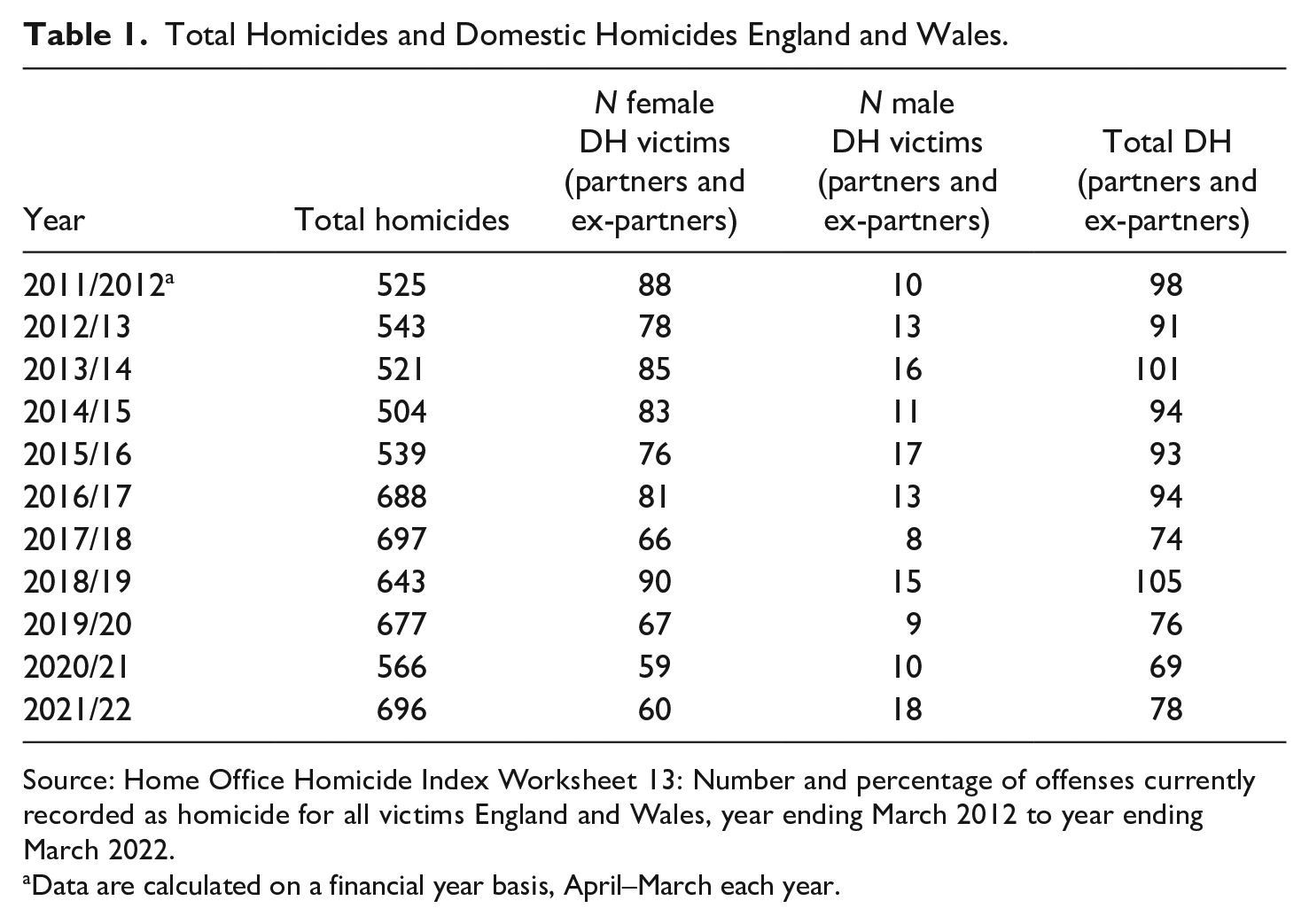
Source: Home Office Homicide Index Worksheet 13: Number and percentage of offenses currently recorded as homicide for all victims England and Wales, year ending March 2012 to year ending March 2022.
Data are calculated on a financial year basis, April–March each year.
The concentration of homicide-suicides in domestic incidents continues to be observed. Flynn et al. (2009), for example, found that in England and Wales between 1996 and 2005, 89% involved family members. This has provoked interest in the prospect of employing suicide ideation and self-harm as indications of domestic homicide/suicide intent, and this has been the subject of increasing research interest over the past 20 years. In a 2018 narrative review of suicidal ideation as a predictor of domestic homicide, Neyroud (2018) located 26 studies of this subject covering events from 1953 to 2015 involving 6,287 cases of attempted and completed domestic homicide. Most of the studies were conducted between 2007 and 2018 and were mainly from the United States and Canada, but also from several European countries including the United Kingdom. All these studies were retrospective, most were observational, and the data originated from various sources, all of which explain the wide range of findings on the prevalence of suicide and suicide ideation.
To make sense of the findings about prevalence of suicide after domestic homicide, we need a baseline of suicidal behavior in the population as a whole. Nock et al. (2008) conducted a study across 17 countries of lifetime suicidal behavior: they found a prevalence rate of 9.2% for ideation and 2.7% for attempts. Neyroud (2018) found that across the studies, she identified, for perpetrators of domestic homicide, there was an average of 30.4% for ideation, three times higher than the estimated global prevalence, while for attempts, the average was 18.8% which was seven times higher.
Furthermore, Neyroud’s review indicates that this higher prevalence was often combined with contact with health services. For example, Flynn et al. (2016) found that 26% of offenders in their data set of domestic homicide-suicide cases had previously attempted suicide up to four times, and doctors had recorded suicidal ideation in more than half of these cases. Likewise, a Swedish study of all domestic homicides perpetrators between 1990 and 1999 (N = 164) (Belfrage & Rying, 2004) found there was a four times higher suicide rate among the intimate partner homicide perpetrators compared with the perpetrators in a control group of other types of homicide; furthermore, if an additional 50 serious suicide attempts were included, the total would consist of almost one third of all perpetrators. Three recent studies using police data from various regions in England have similar findings. Button et al. (2017) used Leicestershire Police records to conduct a case–control study design comparing domestic homicide perpetrators known to have reported suicide ideation prior to their crimes with non-domestic arrestees who also had reported suicide ideation. They found that it was three times more likely that domestic homicide/suicide perpetrators had prior suicidal warning markers than other kinds of arrestees.
The question of what police knew about these perpetrators and when did they know it is central to the issues of prediction and prevention from the criminal justice perspective. It is tackled directly by Thornton in her 2017 study. The case–control design of her study revealed that males in these cases were over three times more likely than other violent offenders to have had markers held by the police indicating suicidal tendencies. She suggests that given, as is so often the case in a variety of jurisdictions, that half of cases had no prior police victim contact, a more useful predictor for domestic homicide than is provided by any existing tools available to British police may be prior markers for suicide ideation. This information is actually available through the otherwise limited DASH risk assessment tool which asks every victim whether their offender has ever threatened or attempted suicide. She cautions, however, that more research is needed on the use of these markers, whether from police or other sources, and how they can feasibly be used to prevent the fatal violence.
A replication of Thornton’s work was conducted using Dorset police data by Chalkley and Strang (2017). It also uses a case–control design to compare deadly domestic violence cases in Dorset to a sample of all violence cases during the same time period. They found male offenders in deadly cases were 120% more likely to have their police records note a self-harm warning, 20% more likely to have a suicide warning, yet only half as likely to have a mental health warning as control males. The last point reveals the complexity of unraveling these risk factors: mental health warnings are much more general than suicide markers and are often associated with offenders with repeated police contact, whereas a picture emerges of many who ultimately become domestic homicide/suicide perpetrators being less likely, rather than more likely, to be involved with the police than other violent offenders.
A more general and complete picture of domestic homicides in England and Wales is revealed by the official domestic homicide reviews (DHRs), carried out after each incident, under the auspices of the U.K. Home Office. These are multiagency reviews that combine data from multiple official sources beyond police data with the aim of learning about each incident and preventing future homicides. Bridger et al. (2017) found that the most disproportionately prevalent characteristic in 188 cases over a 2-year period (2011–2013) was that 40% of the male offenders were known by someone—health or social services agencies, friends, and family but often not police—to have experienced suicidal ideation, self-harm, or attempted suicide.
Bridger’s work highlights the central issue here. It seems plain from many studies in many locations that suicide indicators prior to the deadly event are important predictors of future harm, but who knows about them and what should be done? These issues are underlined powerfully in a study of DHRs conducted by MacInnes et al. (2023), where the objective was to examine the patterns of mental health services use by domestic homicide offenders in England and Wales. They found that almost two-thirds (64.5%) had accessed mental health services before the homicide and the most frequent diagnoses were depression and anxiety; furthermore, almost half (43%) of these offenders had a history of self-harm or suicide ideation prior to the homicide, and half of those (21.5%) attempted or completed suicide after the homicide. A study by the National Police Chiefs Council (2021) found that among the cases examined, in 57% either the victim or the perpetrator, or both, had been known to an agency other than the police: furthermore, in 44% of cases not known at all to the police, one or both parties was known to another agency.
It is likely that contact with mental health services may not be as frequent as contact with general practitioners (GPs). Flynn et al. (2016) found that 40% of the perpetrators in the 60 cases they identified in England Wales in the period 2006 to 2008 had visited a GP within a month before the incident, for reasons of emotional distress, though most had not had recent contact with mental health services. They concluded that this high level of primary care contact emphasizes the fact that these perpetrators are often known to services other than the police. Although GPs cannot necessarily prevent these events directly, they do appear to have opportunities to intervene. Shortfalls in mental health services may be partially compensated by alerting GPs to the importance of signs of distress associated with domestic violence, which may in turn reduce risk by recognizing the need for treatment.
Despite the mix of methods employed in the studies discussed here and their varying findings, it seems clear that there is at least a strong correlation between suicide ideation and serious harm, especially in domestic incidents. But we do not know the extent to which it may be predictive. Establishing its predictive capacity would require large data sets and a random forest forecasting model, for example (Barnes et al., 2012).
There remains a great deal to be done on the best way to predict these events, though several observations can be made:
These findings strongly suggest the need for more engagement of nonpolice agencies in predicting serious harm. It seems more likely for health and social service agencies to first become aware of precursors to domestic homicide and other serious harm than for police.
Much more interagency cooperation is needed to identify high-risk individuals and families, for police can only act when they have evidence of likely or actual harm. Individual doctors, for example, may legally break confidentiality if they fear their patient may commit a serious crime. Health and welfare agencies are understandably concerned about issues of client confidentiality, but recent collaboration between Kent Police and Kent health authorities is leading to important work on the overlap, or lack of it, between victims of violence known to the police and those attending A&E.
The proportion of perpetrators who see their personal doctor about their depression or other emotional issues may be quite high, thus providing an intervention opportunity for GPs who are aware of the risk factors and know who to inform. More needs to be done to engage them on this, especially when mental health specialists are stretched beyond capacity.
Finally, domestic homicide in the United Kingdom remains mercifully rare, though even one death is too many. It is also exceptionally difficult to predict, given the volume of domestic abuse calls to police and the unknown volume of unreported incidents. Suicide ideation and self-harm by perpetrators as precursors to domestic homicide are at the least an important signal for close attention by everyone in touch with them.
Coda on Trends in Femicide Before, During, and After COVID
The severe restrictions on movement (the “lockdowns”) imposed on all of us at the beginning of the Covid pandemic in March 2020 and lasting intermittently through 2021, caused enormous alarm about potential additional risks of harm to victims of domestic abuse. Charities such as Women’s Aid, for example, were outspoken about the greater risks of harm faced by isolated victims. Concerns grew greater when Karen Ingala-Smith (2020) reported on her blog “Counting Dead Women” that there had been 16 domestic killings of women and children in the United Kingdom in the first 3 weeks of the first lockdown. Meanwhile, the Crime Survey for England and Wales estimated that 1.6 million women and three quarters of a million men had suffered domestic abuse in the first year of the pandemic, with a 7% increase in domestic abuse incidents recorded by the police. Furthermore, there was a 65% increase in calls to the National Domestic Abuse Helpline in the 3 months April to June 2020 (House of Commons Library, 2021).
Yet the picture over the entire period of lockdowns was more complex than it first appeared. The lockdowns seemed to change the type of reporting and the kinds of relationships where abuse occurred: abuse reported to London Metropolitan Police perpetrated by current partners increased by 8% while abuse by ex-partners reduced by 11% (Ivanic et al., 2020).
Furthermore, calls in London about domestic abuse during this time were more often from third parties than from victims themselves (House of Commons Library, 2021). This may have been due to fewer opportunities for the victims to contact police, but equally may have been due to neighbors having more, given that people were mostly at home and able to see and hear their neighbors. It may also be related to improvements in police recording of these offenses (Office for National Statistics, 2020). All these possible explanations provide a window into the “dark figure” of unreported domestic incidents, though we must be mindful that a proportion of the neighbor reports might have been noise complaints that may not otherwise have provoked a call to the police.
Despite the level of concern legitimately expressed in the UK through the lockdowns about the vulnerability of domestic abuse victims, there was no significant increase or decrease in the number of homicides in the years 2019 to 2022 (see Table 1). The NPCC report (2021) concurs that the figure was similar to the 15-year average but concludes that COVID acted in some cases as an “escalator and intensifier of existing abuse.” We need to learn about increases in risk to those already vulnerable but be mindful that social upheaval such as that caused by the COVID lockdowns may be more complicated in its impact that first appears.
Footnotes
Declaration of Conflicting Interests
The author(s) declared no potential conflicts of interest with respect to the research, authorship, and/or publication of this article.
Funding
The author(s) received no financial support for the research, authorship, and/or publication of this article.