




Abstract
We examine whether Covid-19, which is widely believed to have originated in China, negatively affected the environment for Chinese people in London leading to an increase in hate crimes toward this group relative to others. With data from the Metropolitan Police for the whole of the Metropolitan area of London, we use a difference-in-differences approach to examine what happened to hate crimes against Chinese people in London in the months before (October to December 2019) and the months after the Covid-19 pandemic (January to March 2020) relative to other ethnic groups, to other crimes, and to other time periods. Our methodology utilizes the fact that Covid-19 came as an unexpected shock, which very quickly changed the environment for crime, and did so differentially across ethnicities. We argue that this shock is likely to negatively affect attitudes and behaviors toward Chinese people, but has no effect on other ethnicities. Our results show that in the months after Covid-19, there was an increase in hate crimes against Chinese people, but this increase was not seen among the other ethnic groups, other non hate crimes, or in any other time period. This leads us to conclude that Covid-19 led to an increase in hate crimes against Chinese people in London. That Covid-19 changed behavior toward Chinese people highlights an intrinsic link between Covid-19 and racism. Unfortunately, the rise in hate crime that we identify adds to a growing list of ways in which ethnic minority groups disproportionately suffered, and continue to do so, during the pandemic.
Introduction
Coronavirus disease (or Covid-19), although not officially named by the World Health Organization (WHO) until February 2020, first appeared at the end of 2019, with a number of people showing pneumonia-like symptoms in Wuhan, China. The disease quickly spread beyond China, so by the time the world knew it as coronavirus, the disease had already spread to other countries. The World Health Organization intentionally gave the virus a generic name that does not refer to a geographical area, an individual, or group of people to avoid any stigmatization. 1 The WHO made a conscious decision not to reference the disease by its virus strain, severe acute respiratory syndrome coronavirus 2 (SARS-CoV-2), to avoid creating unnecessary fear of Asia which was worst affected by the SARS outbreak in 2003. 2 Despite this, the fact that the pandemic is widely believed, at the time of writing, to have originated in Wuhan, China, and is commonly believed to be associated with Chinese wet markets, meant it was not long before we started to see reports of Chinese people being discriminated against, subject to abuse, and even violence in a number of different countries. In the United Kingdom, the most well publicized is the case of Jonathan Mok a student from Singapore who was attacked in Oxford Street, London, on February 24 by perpetrators who shouted “coronavirus” at him (Busby & Gidda, 2020a; Duncan, 2020). 3
In this article, we explore the impact of Covid-19 on hate crimes against Chinese people on a much larger scale, using data from the Metropolitan Police for the whole of the Metropolitan area of London. We use a difference-in-differences (D-in-D) approach to examine what happened to hate crimes against Chinese people in London before and after the Covid-19 pandemic relative to other ethnic groups, other crimes, and other time periods. Using this methodology allows us better to establish a causal link between the Covid-19 pandemic and hate crimes against Chinese people in London.
Background
Hate crime is a crime directed at a particular group because of their membership of that group. A lot of research has used this idea to empirically examine crimes against the lesbian, gay, bisexual, and transgender (LGBT) community (Berrill & Herek, 1992), different racial or ethnic groups (Hanes & Machin, 2014), and religious groups (Abu-Ras & Suarez, 2009; Ivandic et al., 2020) or to generate theories that focus on hate crimes as violence directed toward marginalized groups (Chakraborti, 2010; Perry, 2009; Walters, 2011). Prior to Covid-19, research has tended not to focus on hate crimes against Chinese people who, as a group, have often been referred to as a “model minorities” both in the United Kingdom (Gillborn, 2008) and United States (Wong et al., 1998). Overall, the Chinese community in the United Kingdom has a record of high academic achievement, and the second highest household income among demographic groups, after British Indians (GOV.UK, 2020a, GOV.UK, 2020b).
However, it is clear that world events can influence views of, and attitudes toward, racial groups (Sheridan & Gillett, 2005). Indeed, history has shown us that particular events have led to the stigmatization or whole groups of nations, religions, ethnic, racial, or other identifiable groupings. Studies of the aftermath of wars show unfavorable attitudes and behaviors to the losing sides (Dudycha, 1942; Poynting, 2002; Sinha & Upadhyaya, 1960; Zeligs, 1954), and studies of acts of terrorism show unfavorable treatment of people of the same race, religion, or nationality as the terrorists (Bar-Tal & Labin, 2001; Hage, 1991; Hanes & Machin, 2014; Ivandic et al., 2020; Newell, 1990; Panagopoulos, 2006; Poynting & Nobel, 2004; Swahn et al., 2003). Research on the HIV/AIDS epidemic identifies links with the vilification of gay men (Herek & Capitanio, 1993; Herek & Glunt, 1988), and while we could find no empirical evidence on the 2003 SARS epidemic, there are newspaper reports that link SARS with an increase in racist behavior toward Chinese people in North America (Lee & Murphy, 2003; Sorenson, 2003). And Muzzatti (2005) offers a good discussion of how xenophobia has historically increased after pandemics, especially when the pandemics involve major loss of life.
Disha et al. (2011) argue that in instances such as these, a specific event triggers intergroup prejudice and in some cases even violence. It does so because when people are anxious or under threat, they fall back on stereotypical beliefs and attitudes (Bodenhausen, 1993; Smith, 1993) which they apply without careful consideration and assessment (Bar-Tal & Labin, 2001). Importantly, the stereotyping and social judgments are not made at the individual level but to whole groups (Hamilton, 1981; Hamilton & Sherman, 1996) who are somehow seen as responsible for the event, a type of collective blaming that holds all members of a group responsible transforming them into convenient targets for retribution and justifying any negative behavior toward that group as a whole, which is now seen as a type of justifiable revenge or “vicarious retribution” (Lickel et al., 2006).
Drawing on this evidence, we argue that the unexpected event created by Covid-19 might alter the situation for Chinese people in the United Kingdom raising the possibility that they would experience an increase in hate crimes. As the virus escalates, receives more media coverage, 4 and claims more lives in the United Kingdom, we hypothesize that hate crimes against Chinese people will increase, until lockdown is instigated on the evening of March 23, 2020. However, very importantly, Covid-19 only changes the environment for Chinese people and has no effect on the environment for other ethnic groups. This provides us with a control group against which we can measure the impact of Covid-19 (the treatment) on Chinese people (the treated). To preempt the results, this is exactly what the analysis finds: Covid-19 leads to an increase in hate crimes against Chinese people in London, rising across the first 3 months in 2020, until lock down was initiated. But Covid-19 has no impact on hate crimes against other ethnic groups.
Covid-19 Time Frame to U.K. Lockdown
To help us think about when we would expect to see a rise in crimes against Chinese people as a result of Covid-19, it helps to consider a time line of events, starting from December 31, 2019, when China reported a cluster of cases of pneumonia in Wuhan, Hubei Province, through the worldwide spread of Covid-19 until March 24, the first full day of lockdown in the United Kingdom, after the lockdown order given by Prime Minister Boris Johnson on March 23.
On December 31, 2019, Wuhan Municipal Health Commission, China, reported a cluster of pneumonia-like cases in Wuhan, Hubei Province. The next day (January 1, 2020), the WHO set up the Incident Management Support Team, putting the organization on an emergency footing for dealing with the outbreak. By January 4, 2020, the WHO reported on social media that there was a cluster of pneumonia cases—with no deaths—in Wuhan, Hubei province. 5 The first death occurred on January 11, 2020. By the end of January, the virus had spread to Taiwan, Japan, South Korea, Thailand, the United Kingdom, and the United States. The first two people (both Chinese nationals) tested positive for Covid-19 in the United Kingdom on January 29, and their positive test results were publicly announced on January 30. On the same day, the WHO declared a global health emergency amid thousands of new cases in China. By February 4, the United Kingdom directs its citizens to leave China if possible, and on February 11, the first British victim dies of coronavirus onboard the Diamond Princess. On the same date, the U.K. authorities confirm that the first case of the illness has been passed on inside the country.
In early March, cases of Covid-19 begin to surge in the United Kingdom. By March 10, Nadine Dorries, a junior health minister, becomes the first MP to test positive for coronavirus, and by this time, six people in the United Kingdom have now died of the illness. By March 11, the WHO declares the virus a pandemic, stock markets plunge, and U.K. Chancellor Rishi Sunak announces a £12bn package of emergency support to help the United Kingdom cope with the fall out from the coronavirus. By March 13, a number of U.K. sporting events announce their postponement including the London Marathon and Premier League football matches are suspended.
Boris Johnson begins daily Covid-19 press briefings on March 16, urging everybody in the United Kingdom to work from home and avoid pubs and restaurants to give the National Health Service (NHS) time to cope with the pandemic. By now, the U.K. death toll has by risen to 55. On the same day, U.S. President Donald Trump stops referring to the disease as coronavirus and starts calling it the Chinese virus. 6 Back in the United Kingdom on March 17, Rishi Sunak adopts the largest package of emergency state support for business since the 2008 financial crash, including £330 billion of government-backed loans and more than £20 billion in tax cuts and grants for companies threatened with collapse. By March 18, the U.K. government announces most schools across England will be shut down from Friday until further notice. This is closely followed by announcements that schools in Wales and Scotland will also be closed. By March 20, all pubs, restaurants, gyms, and other social venues across the country are told to close and the chancellor announces the government will pay up to 80% of wages for workers at risk of being laid off. On the evening of March 23, Boris Johnson institutes lockdown; Britons should only go outside to buy food, to exercise once a day, or to go to work if they absolutely cannot work from home. People breaking these new rules will face police fines.
Drawing on this time line, we would expect to see little change in the hate crime victimization of Chinese people in the early days of Covid-19; by February, we might expect to see a small increase in hate crimes against Chinese people, but we hypothesize that, as set out in this time line for the United Kingdom, most of the Covid-19 escalation happens in March 2020, so this is the month we would expect to see the largest increase in the victimization against Chinese people in London.
Data
The data we use follow what happens to hate crimes against Chinese people in London across the time line detailed above (January 1, 2020, to March 23, 2020). In a double differenced framework, we compare it with hate crimes against Chinese people prior to Covid-19 (October 1, 2019, to end of December 2019) and compare with other ethnic groups across the same time frame. We also look at non hate crimes over this period as we want to make sure any rise in crime against Chinese people during this period is restricted to hate crimes. We set up a placebo test to ensure any differences we find are not due to seasonal trends in crime by comparing hate crimes against Chinese people and other ethnicities across the same months in the previous year (October 1, 2018, to end of March 2019). Finally, we use data from March 24 through to the end of August 2020 to examine what happens to hate crimes through lockdown and beyond.
The data we use come from the Metropolitan Police Crime Reporting Information System (CRIS) data, which are all recorded crimes within the Metropolitan Police Area of London. Crimes can be reported in a number of ways 7 and are recorded as crimes by the responding officers. If the way the crimes are recorded changes over the period we examine and does so in a way that would differentially affect ethnic groups, this would pose a problem for our D-in-D approach. However, we can see no reason why policing or the recording of the crimes would change over the 6-month period we examine. Policing priorities clearly change once lockdown starts (on 24 March 2020), but our analysis is prior to this period. Even in the situation where there is some pre-emptive change in policing procedures and/or priorities in the buildup to lockdown, there is no clear reason why this would affect the reporting or recording of crimes differentially by ethnicity of the victim.
The data are recorded crimes, by the day, by crime type, by London borough, and for the majority of observations, by the ethnicity, gender, and age of victim. We analyze only data where the ethnicity of the victim in known. 8 The group we are particularly interested in is identified as “Oriental” in the data set; for the remainder of the article, we refer to this group as Chinese. The “Oriental” category in the data set will include individuals from areas of East Asia outside of China, but this does not compromise our analysis as we are concerned with the ethnic group the victim is perceived to belong to by others.
We examine these data in monthly periods with 3 months before and after January 1, 2020, 9 which we use as the start date of Covid-19 as this is the date the WHO was put on emergency footing to deal with the situation that prior to January 2020 had been confined to Wuhan, China, and after January 1, 2020, things very quickly escalated. We compare the trends in hate crimes across these periods in a number of different ways. We compare the change in the probability of being a victim of hate crime for Chinese people in the months before and after Covid-19. We compare this with changes in hate crimes against other ethnic groups that we expect not to be affected by Covid-19—those of White, Black, and Arab ethnicity. 10 As robustness checks, we later compare the situation with non hate crimes against Chinese people and hate crimes against the different ethnic groups the year prior to Covid-19 (October 2018 to March 2019). This way, we are more convinced that any patterns we are seeing over the Covid-19 period are really attributable to an increase in hate crimes against Chinese people due to Covid-19.
In various models, we add controls that account for the demographic characteristics of the victim (age, ethnicity, and gender), and these data are part of the CRIS data. In some specifications, we also include crime fixed effects and area fixed effects using dummy variables for crime types and the 12 Basic Command Unit areas using the CRIS data. In addition, we add in area-level controls which include the percentage of males younger than 25 years, the percentage of the population with no qualifications, the percentage of the population economically active, and the percentage of the population who are non-White which come from the Office for National Statistics 11 at the London borough level which we aggregate to the 12 Basic Command Unit areas. 12
During the initial 6-month period, we examine (October 2019 to March 23, 2020) there are 4,825 recorded hate crimes against the ethnic groups in the London Metropolitan area. The Metropolitan Police record hate crimes on the grounds of race, faith, or religion; transphobia; homophobia; or disability. Most hate crimes are race related. In this period, there are 3,855 race-related hate crimes committed against people of Chinese, White, Black, and Arab ethnicity in the London Metropolitan area. On average, race-related hate crimes make up almost 80% of all hate crimes. But this varies by ethnicity, with race-related crimes accounting for a higher percentage of total hate crimes committed against Chinese people than other groups. This is due to the fact that hate crimes against Chinese people on the grounds of faith or religion, transphobia, homophobia, or disability are very rare (less than five cases in any category for the period we are examining). The majority of both hate crimes and race crimes are violent (94% and 92%, respectively). Table 1 shows that Chinese victims only account for 5.2% of all hate crimes and 6.3% of all race crimes across the 6-month period we are looking at. But when we examine the crimes as rates per 1,000 people of the same ethnicity in the London Metropolitan area, the rates (1.62 and 1.55 crimes per 1,000 of the population) are considerably higher than the rates of crimes against Whites (0.42 and 0.27, respectively).
Numbers of Hate- and Race-Related Crimes in the London Metropolitan Area by Ethnicity and Crime Type.
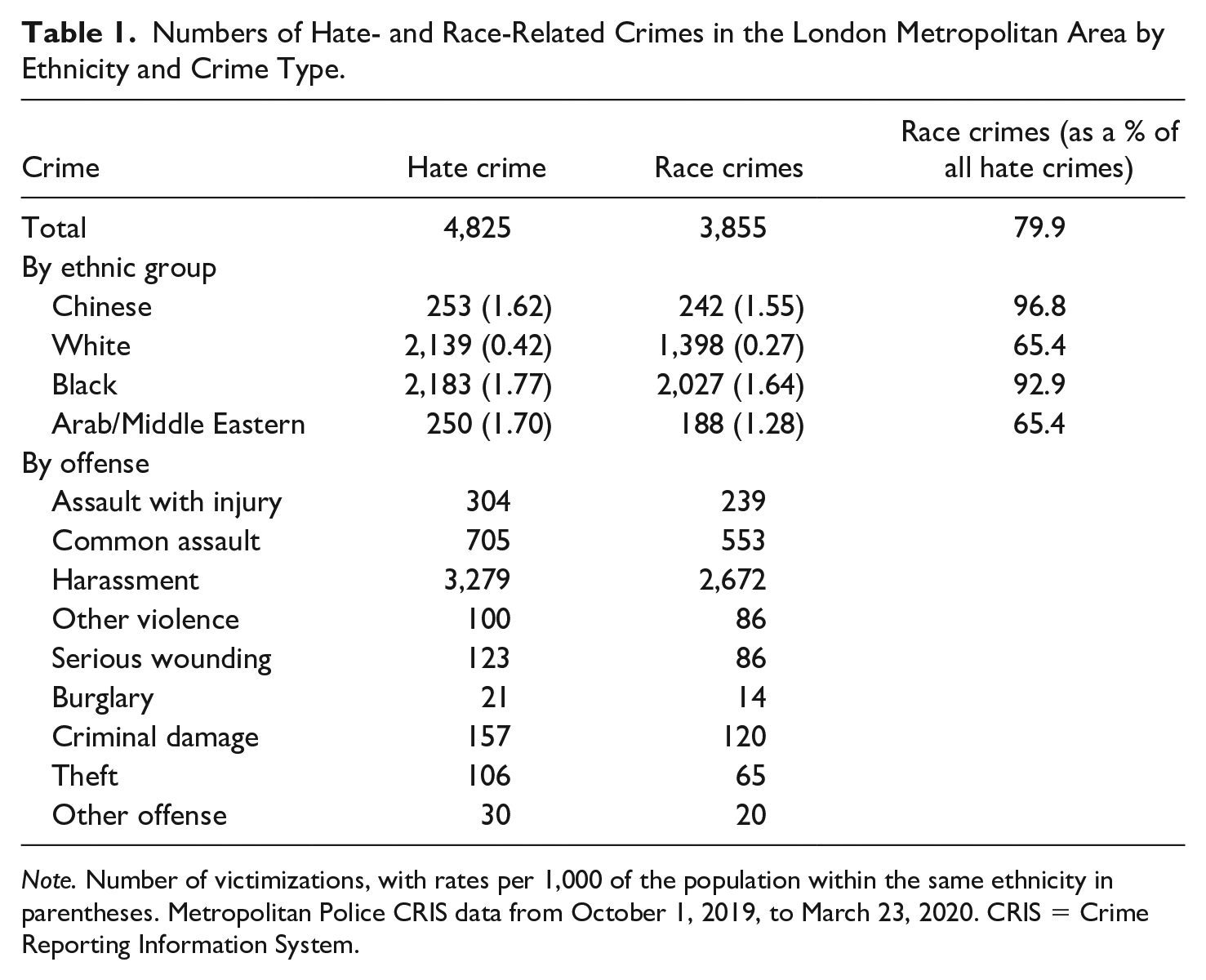
Note. Number of victimizations, with rates per 1,000 of the population within the same ethnicity in parentheses. Metropolitan Police CRIS data from October 1, 2019, to March 23, 2020. CRIS = Crime Reporting Information System.
What we are really interested in is whether Covid-19 led to an increase in race-related hate crimes (referred to as hate crimes for the rest of the article) against Chinese people relative to other groups. We examine this descriptively in Figure 1 which plots the number of victims of hate crime among Chinese people compared with the other ethnic groups. We can see very clearly that hate crimes against Chinese people go up to almost 0.6 hate crimes per 1,000 of the Chinese population compared with a relatively flat but slightly declining rate of victimization for all other ethnic groups after January 2020.
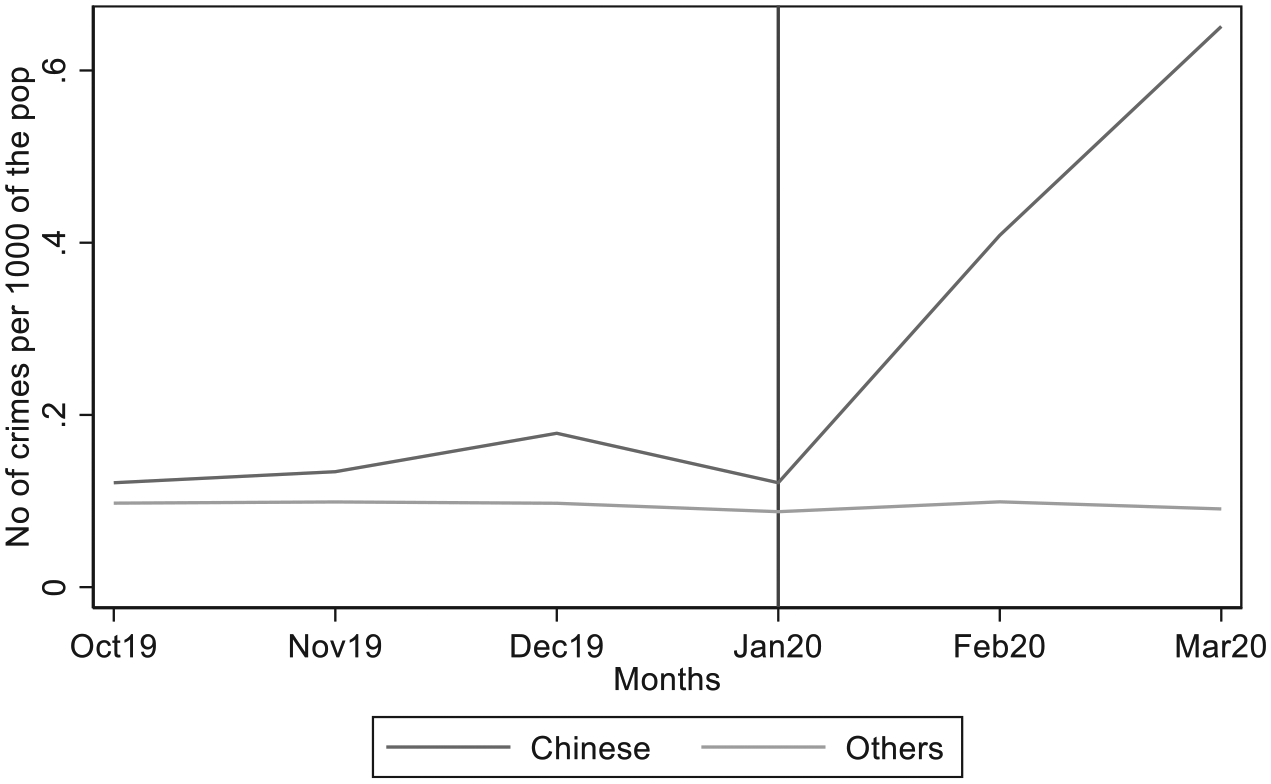
Number of hate crimes per 1,000 of the population for Chinese compared with other ethnic groups.
Methodological approach
The graph suggests that hate crimes against Chinese people increased after Covid-19, but the victimization of other groups did not. To test this more formally, we employ a D-in-D approach which utilizes the fact that Covid-19 came as an unexpected shock, or a “treatment” which very quickly changed the environment for crime, and did so differentially across ethnicities. In this scenario, Chinese people become a “treatment” group, those we expect to be affected by Covid-19, and other ethnicities the “control” group, whose victimization rates we expect to remain unaffected by Covid-19.
Our model takes the simple form of:

where Y is the probability of being a victim of hate crime, α i is a dummy variable where 1 indicates whether the victim is Chinese, γ t is the time treatment dummy variable = 1 in the 3 months after Covid-19 compared with the 3 months prior to that. β i is the interaction between our treated group (Chinese) and the treatment dummy (after). The interaction essentially captures the effect of the treatment (Covid-19) on the treated (Chinese victims), or the causal impact of Covid-19 on Chinese hate crimes as long as there is nothing else going on at the same time that would affect hate crimes against Chinese people. What we are looking for is whether the coefficient on the interaction is positive and significant in the post-Covid period, indicating that hate crimes against Chinese people rose relatively compared with crimes against other ethnic groups over this period.
We run this model and show the average marginal effects of being a victim of hate crime in the months before and after Covid-19 in Table 2. The results show quite clearly that for Chinese people, the probability of being a victim of hate crime increases significantly in the months after Covid-19, increasing by 5.2 percentage points. But for the other ethnic groups, there is no significant change in the probability of being a victim of hate crime across the 6 months before and after Covid-19. 13
Average Marginal Effects on the Probability of Being a Victim of Hate Crime for Chinese People Compared With Other Ethnicities Before and After Covid-19.
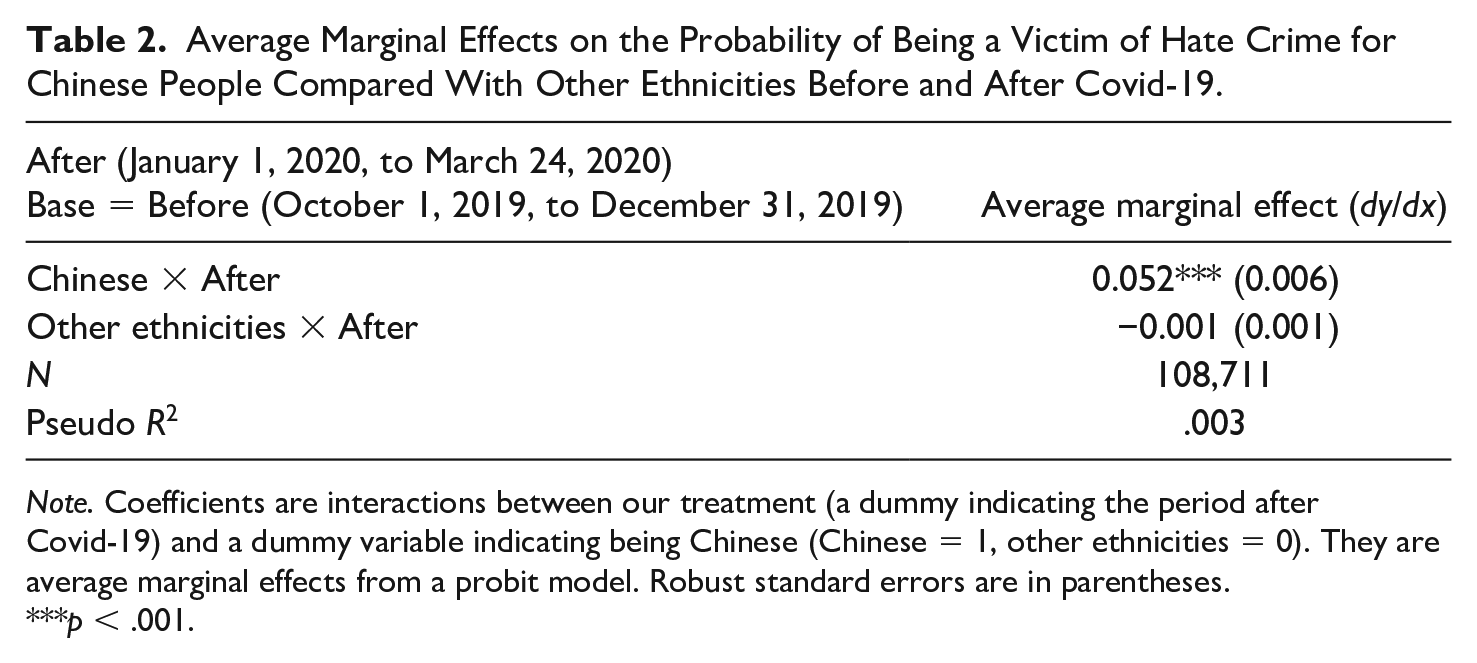
Note. Coefficients are interactions between our treatment (a dummy indicating the period after Covid-19) and a dummy variable indicating being Chinese (Chinese = 1, other ethnicities = 0). They are average marginal effects from a probit model. Robust standard errors are in parentheses.
***p < .001.
The initial results suggest that Covid-19 led to an increase in hate crimes against Chinese people but not other ethnic groups; however, our hypothesis is also concerned with the timing of events, predicting that Covid-19 would have a heterogenous impact on hate crimes against Chinese people in the months after January 2020, increasing after January 1, 2020, until lockdown on March 24, 2020. So we expand our model specification from a simple before and after Covid-19 to allow Covid-19 to have a differential impact on hate crimes in each of the 3 months before and after January 2020. For the remainder of the analysis, the D-in-D specification is generalized into an event study featuring three pre- and post-Covid-19 time periods. We exclude the last month prior to Covid-19 as the base in our amended models.
Using this approach, rather than having one before and after group, allows us to see differences in the timing of events after Covid-19 as it is likely the impact on Chinese victims will not be immediate, but will increase over the post-Covid period as the pandemic has a greater impact on the United Kingdom. Referring back to the time line above, during most of January 2020, Covid-19 had little impact in the United Kingdom. February saw the first death of a U.K. citizen onboard the Diamond Princess, but it was not until March that cases began to escalate within the United Kingdom and the lives of residents began to be affected by the closure of schools, sporting events, and stock market falls.
The results of a probit model of the probability of being a victim of hate crime in the months before and after Covid-19 for Chinese people compared with other ethnicities are shown in Table 3. The table is read chronologically from left to right. The base period is the last pre-Covid-19 month (December 2019), and the predicted probability for being a victim of hate crime for Chinese people in this month is 0.031 and for all other ethnicities, it is 0.037. The top panel of the table shows coefficients for the treatment effects on the treated (the interactions between month and being Chinese), whereas the lower panel shows the treatment effects on the nontreated (the non-Chinese ethnicities).
Average Marginal Effects of Being a Victim of Hate Crime in the Months Before and After Covid-19 for Chinese People Compared With Other Ethnicities.
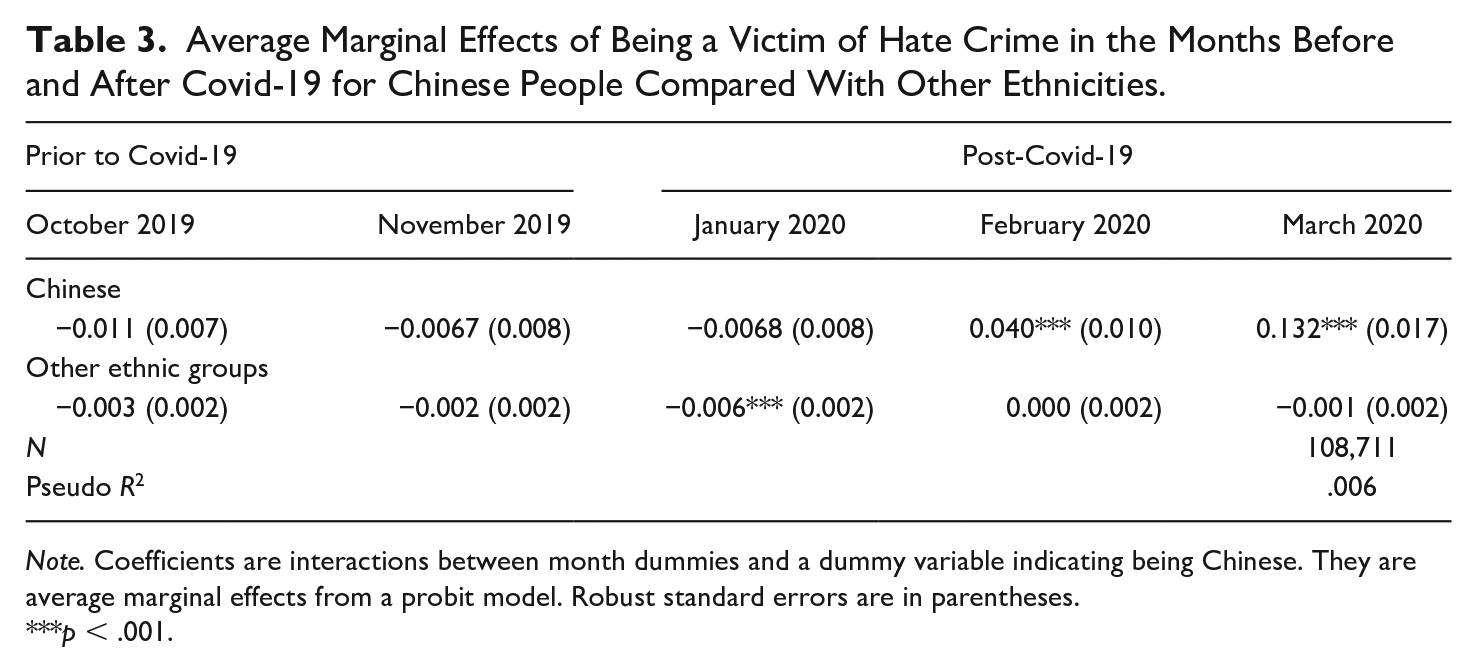
Note. Coefficients are interactions between month dummies and a dummy variable indicating being Chinese. They are average marginal effects from a probit model. Robust standard errors are in parentheses.
***p < .001.
Reassuringly, none of the pre-trend coefficients are statistically significant indicating that in the pre-Covid-19 periods, the trends in hate crime victimization for Chinese people and non-Chinese groups are not statistically significant, which satisfies the pre-trend assumption required for D-in-D estimates to be credible. But a clear pattern emerges in the post-Covid-19 period. For the Chinese group, the increase we were seeing in the after period in Table 2 is not spread evenly across the post-Covid-19 months; instead, what we see here is that there is no significant increase in hate crime toward Chinese people in January 2020, but by February, the probability of being a victim of hate crimes increases by 4 percentage points. During March 2020, the increase is even higher at 13 percentage points compared with December 2019. This means that for Chinese people, the probability of being a victim of hate crime increases after Covid-19 from around 3% to just more than 7% in February 2020 and to more than 16% in March 2020. However, there is no significant increase in hate crime against other ethnic groups after Covid-19. In fact, for these groups, there is a very slight decrease (of 0.6 of a percentage point) in hate crimes in January 2020.
Incorporating Other Controls and Crime and Area Fixed Effects
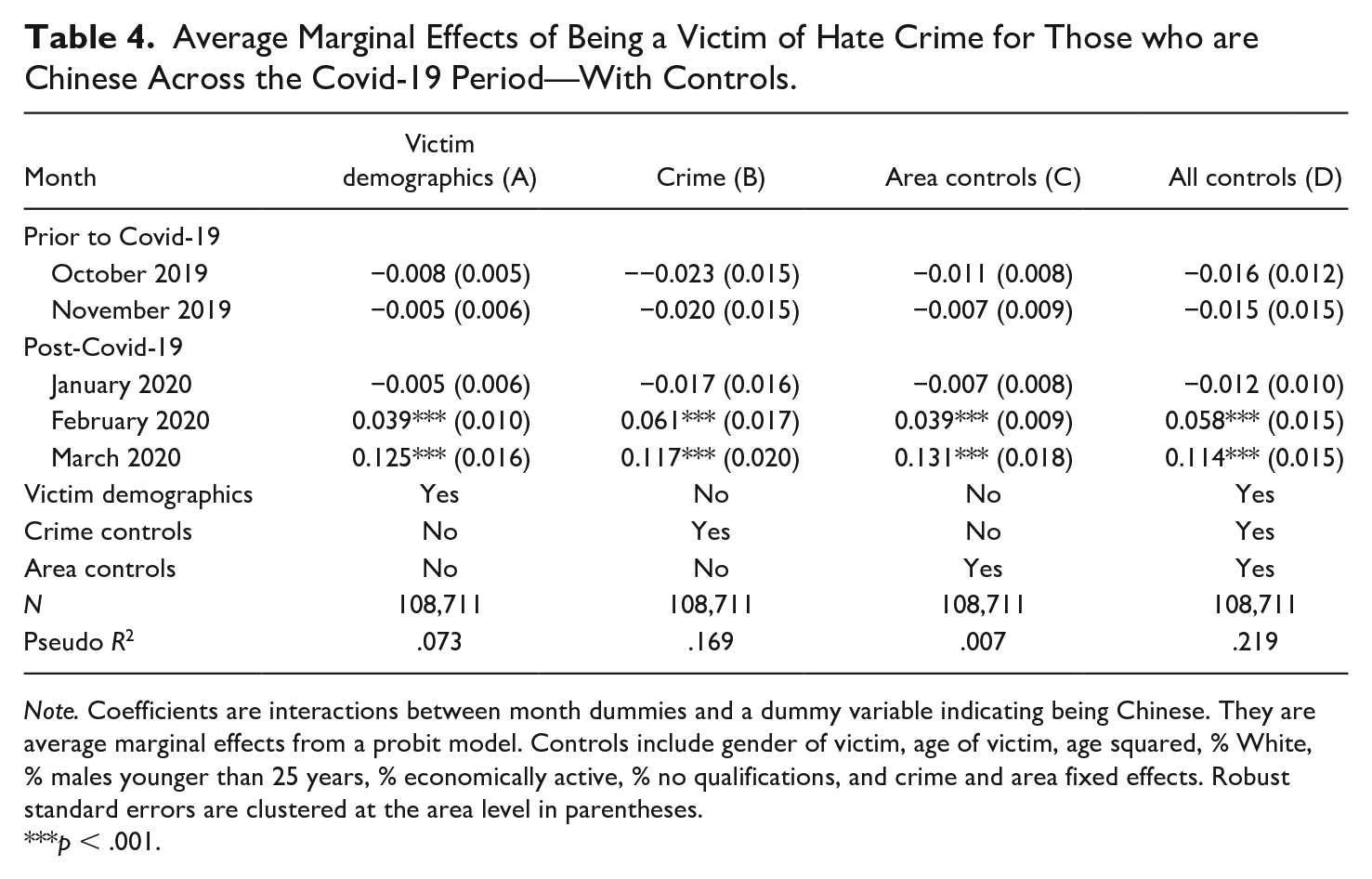
The results so far indicate that hate crime victimization against Chinese people increased in the second and third months after Covid-19 first appeared. However, our model does not control for demographic differences in the victims such as age and gender nor differences in crime types or differences across the areas that make up the London Metropolitan crime area. So in Table 4, we run the same model as in Table 3, but this time controlling for other demographic characteristics of the victim (gender, age, and age squared; Model A), crime type (Model B), area-level demographics (percentage of males in the area younger than 25 years, percent with no education, percent non-White, percent economically active), and area fixed effects (Model C) with all controls are included in the final model (D).
Average Marginal Effects of Being a Victim of Hate Crime for Those who are Chinese Across the Covid-19 Period—With Controls.
Note. Coefficients are interactions between month dummies and a dummy variable indicating being Chinese. They are average marginal effects from a probit model. Controls include gender of victim, age of victim, age squared, % White, % males younger than 25 years, % economically active, % no qualifications, and crime and area fixed effects. Robust standard errors are clustered at the area level in parentheses.
***p < .001.
Model A allows us to consider different characteristics of the victim in line with evidence that shows that in general males are more likely to be victims of crimes than females and young people (aged 16–24 years) more likely to be victims of crimes than older people (Ministry of Justice, 2020). A set of crime fixed effects are added in Model B which control for observable and unobservable differences in crime type, which is important as we have seen in Table 1, certain crime types are more associated with hate crimes than others. In Model C, we add a set of area fixed effects to control for time-invariant features of an area; for example, if for historical reasons there are differences in attitudes toward criminal activity, this will be captured in this model. We also include in Model C time-variant area population characteristics (% males younger than 25 years, % no qualifications, % White, and % economically active) as we know these are differentially associated with crime. A recent Ministry of Justice (2020) publication showed that males are more likely to commit crimes than females, criminal activity varies significantly by age, and young offenders are considerable less likely to achieve school qualifications than the overall population. In addition, all ethnic groups are more likely to be arrested and prosecuted than Whites (GOV.UK, 2020 14 ), and employment status is differentially associated with crime, with a number of studies showing small but positive relationships between unemployment and crime both in the United Kingdom and United States (Levitt, 2004; Raphael & Winter-Ebmer, 2001; Reilly & Witt, 1996). All controls are considered together in the final model (D).
By including these controls, we are not so much interested in their coefficients but rather the effect that adding these controls has on our coefficients of interest, the interactions between month dummies and a dummy variable indicating being Chinese. In other words, our primary focus is on whether the relationship we have seen between Covid-19 and hate crimes against Chinese people remains even after controlling for these other factors. The results, which are now read chronologically down the rows of the table, show that including these other characteristics makes little difference to our key finding; the magnitude of effects is slightly reduced, but the results tell the same story. Even after controlling for a range of other factors, February 2020 sees an increase in the probability of being a victim of hate crime for a Chinese person of between 4 and 6 percentage points depending on model specification, while March 2020 sees an increase of between 11 and 13 percentage points compared with the pre-Covid-19 period.
Comparing With Non hate Crimes
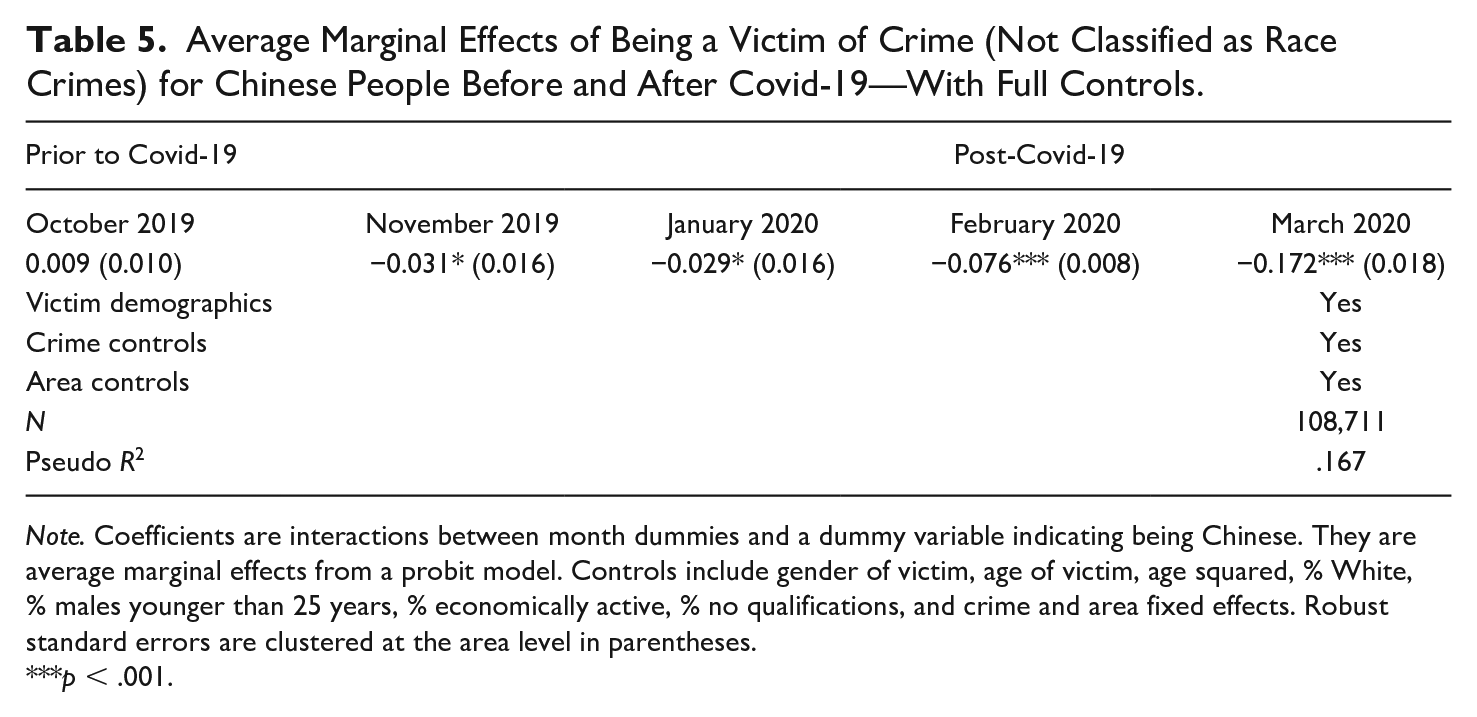
The results indicate that Covid-19 is associated with an increase in race-related hate crimes against Chinese people in London, but that it had no impact on other ethnicities over this time. But we need to make sure that the increase in hate crimes against Chinese people does not reflect a general increase in crimes against Chinese people over this period. To test this, Table 5 examines the likelihood of being a victim of crime, where crime is defined as the same crime types as those identified as race crimes in Table 1 but this time focusing on only those crimes that are not recorded as hate crimes to do with race. Otherwise, the model is the same as previously, controlling for victim and area demographics as well as crime type and area. Like Table 3, this table is laid out horizontally rather than vertically so the coefficients are read chronologically from left to right across the columns of the table. What we are concerned with is that if the post-Covid-19 period also sees an increase in other crimes against Chinese people, our results may reflect a general upturn in all types of crimes against Chinese people and not as a result of our hypothesized increase in hate toward Chinese people as a result of Covid-19. However, when we look at the results in Table 5, we can see this is not the case. In fact, there is a decline in non hate crimes toward Chinese people across most of the period we are looking at. The significant negative coefficient in November 2019 indicates that the decline started prior to Covid-19 and shows this model violates the parallel trends assumption behind D-in-D methodology. So while this decline is not associated with Covid-19, these results highlight that the post-Covid-19 increase in hate crimes against Chinese people that we have identified in this article is a rise confined only to hate crimes against Chinese people.
Average Marginal Effects of Being a Victim of Crime (Not Classified as Race Crimes) for Chinese People Before and After Covid-19—With Full Controls.
Note. Coefficients are interactions between month dummies and a dummy variable indicating being Chinese. They are average marginal effects from a probit model. Controls include gender of victim, age of victim, age squared, % White, % males younger than 25 years, % economically active, % no qualifications, and crime and area fixed effects. Robust standard errors are clustered at the area level in parentheses.
***p < .001.
Comparing With Previous Time Periods
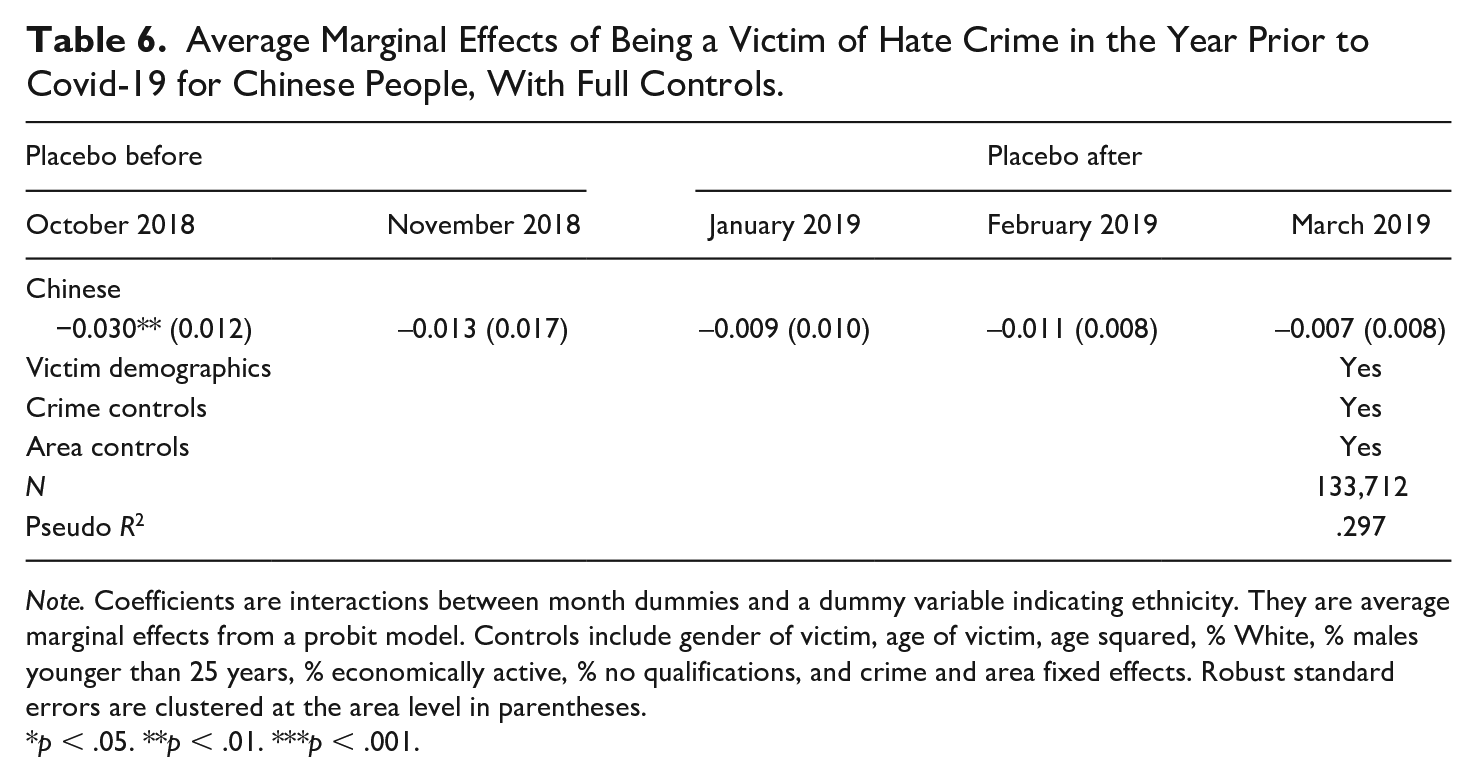
The results point to significant rises in hate crimes against Chinese people relative to other groups and in line with our hypothesis that the probability of them being a victim of hate crime would increase over the post-Covid-19 period as hatred increased as the virus spread in the United Kingdom. But what if such a relationship existed in periods prior to Covid-19? Our finding would turn out to be spurious if the same kind of link did exist. Indeed, were it the case that hate crime against Chinese people also rose in relative terms and by a similar magnitude in time periods when Covid-19 was not present, then our results could not be attributed to Covid-19. To examine this possibility, we run the same model but for an earlier time period that was not subject to Covid-19. Thus, Table 6 shows the same analysis as our full model (D) in Table 4 but this time examining the exact same months in the previous year. We can think of this as a placebo test, examining a before and after period when no treatment existed. If the results show an increase in crimes against Chinese people in the January to March period in 2019 relative to the months before, then the results we have seen for the post-Covid-19 period in 2020 may reflect some seasonal trends rather than the results of a changed crime environment due to Covid-19. Examining Table 6, we can see this is not the case. Our placebo test shows no significant difference in the probability of being a victim of hate crimes for Chinese people in the 3 months after December 2018. There is a decrease in October 2018 compared with December but no significant change from November 2018 to March 2019. Therefore, we can be confident that the results showing increases in hate crimes against Chinese people seen over the Covid-19 period relative to other ethnic groups can be attributed to Covid-19.
Average Marginal Effects of Being a Victim of Hate Crime in the Year Prior to Covid-19 for Chinese People, With Full Controls.
Note. Coefficients are interactions between month dummies and a dummy variable indicating ethnicity. They are average marginal effects from a probit model. Controls include gender of victim, age of victim, age squared, % White, % males younger than 25 years, % economically active, % no qualifications, and crime and area fixed effects. Robust standard errors are clustered at the area level in parentheses.
p < .05. **p < .01. ***p < .001.
During and After Lockdown
Having showed that Covid-19 led to a clear increase in hate crimes against Chinese people in the early months of the pandemic, we can now examine what happened to hate crimes against Chinese people after the first Covid-19 national lockdown was announced on March 23, 2020, through the seven full weeks of lockdown to the easing of conditions on May 10 when people were allowed to return to work and take unlimited exercise, to the reopening of non-essential shops and primary schools on June 15 and beyond (our data extend to the end of August 2020). We might expect that after the initial fear of Covid-19, hate crime rates against Chinese people would settle down through lockdown and return to the lower levels of the pre-Covid-19 period. An initial look at Figure 2, which shows the predicted probability of being a victim of hate crimes for Chinese people and other ethnic groups in a model with full controls from October 2019 through to the end of August 2020, shows slight tendencies toward this pattern we might expect. The predicted probability of being a victim of hate crime peaks in March 2020 prior to lockdown at 16%, then declines during lockdown to 15%, then 14%, and seems to settle after lockdown around 13%. However, closer inspection of the 95% confidence intervals shows that these probabilities are not significantly different from the 16% in March, indicating that the predicted probability of being a victim of hate crime for Chinese people remains high throughout lockdown and after lockdown, never falling significantly from the March high point. This compares with probabilities of around 5% to 6% for people from other ethnic backgrounds. 15 These results suggest that the rise in hate crimes against Chinese people is not a short lived phenomenon provoked by immediate fear of the pandemic, but that the pandemic has led to an increase in targeted hate crime against Chinese people that has endured throughout lockdown and the months after.
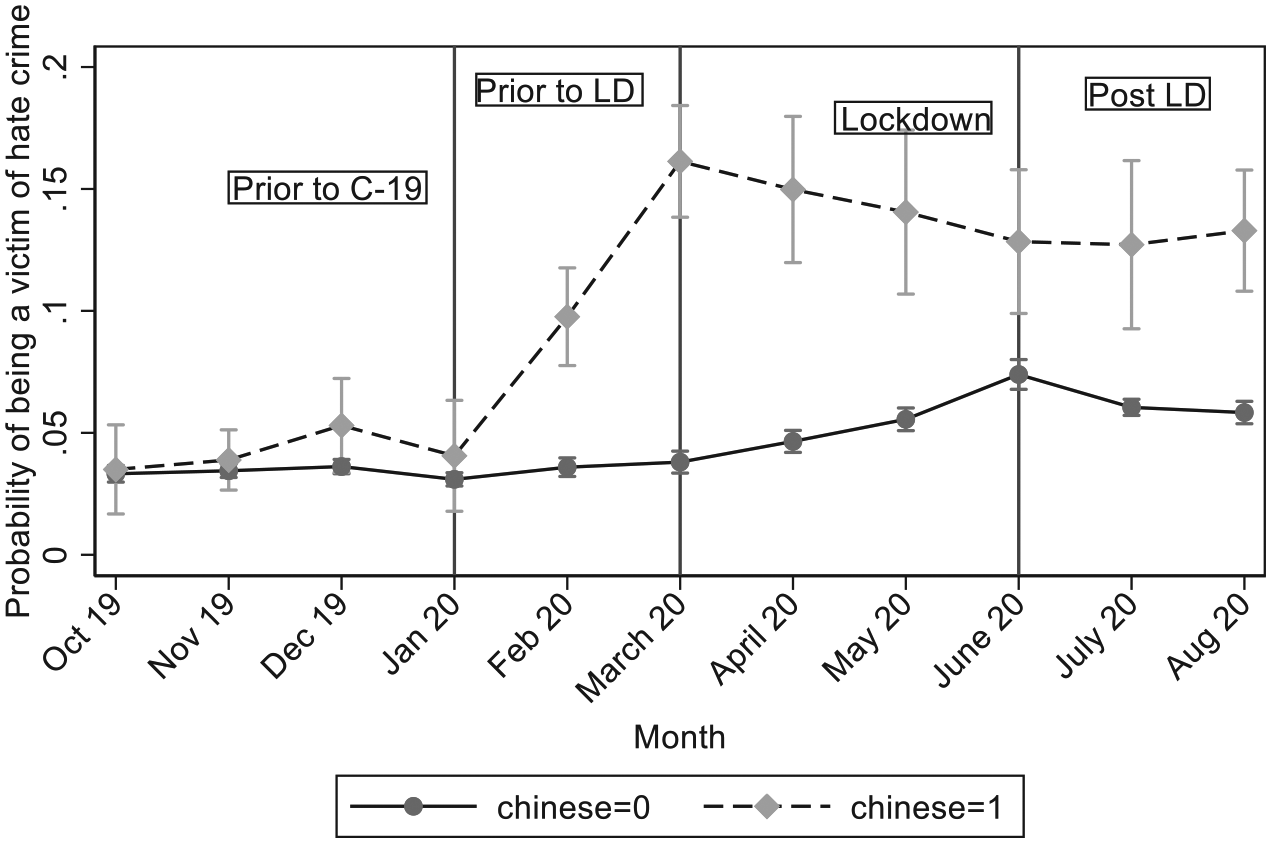
Predicted probability of being a victim of hate crime for Chinese people and others before, during, and after the U.K. national lockdown (LD).
Discussion and Conclusion
This article set out to test the hypothesis that Covid-19 may fuel hostility toward Chinese people resulting in an increase in hate crimes toward this group. To do so, we utilize the fact that Covid-19 came as an unexpected shock, which very quickly changed the environment for crime for Chinese people yet left the crime environment for other groups unchanged. This provides us with a D-in-D methodological approach where those of Chinese ethnicity become a “treatment” group and those we expect to be affected by Covid-19 and other ethnicities the “control” group, whose victimization rates we expect to remain unaffected by Covid-19. This methodology lets us better attribute any changes in hate crimes to the causal impact of Covid-19.
The results show that hate crimes against Chinese people did indeed increase between January and March 2020, after the emergence of Covid-19 and up to the national lockdown. However, the model is defined, whether it is the simple before and after, an event type structure or whether the models control for the demographics of the victims or areas, or include crime and area fixed effects (Table 4); the coefficients remain robustly similar, indicating that the probability of being a victim of hate crime for Chinese people increases by between 4 and 6 percentage points during February 2020 and by between 11 and 13 percentage points during March compared with the pre-Covid-19 period. These are sizable changes, taking the probability of being a victim of hate crime from around 3% to 4% prior to Covid-19 up to 10% in February and to more than 16% in March 2020. There is no increase in hate crimes after Covid-19 for any other group or for other (non hate) crimes against Chinese people. When we examine changes over the same months but in the previous year (when Covid-19 did not exist), we find no equivalent increase in hate crimes against Chinese people. This allows us to conclude that Covid-19 is associated with an increase in hate crimes against Chinese people in London during the first 3 months of 2020.
These findings are in line with other research that suggests world events have the power to change the way particular groups are seen (Sheridan & Gillett, 2005) and empirical work that shows that after an event, whole groups of nations, races, or religions become subject to hate (Bar-Tal & Labin, 2001; Hage, 1991; Hanes & Machin, 2014; Ivandic et al., 2020; Newell, 1990; Panagopoulos, 2006; Poynting, 2002; Poynting & Nobel, 2004; Sorenson, 2003; Swahn et al., 2003). In addition, these results, while not a direct test of the theories, may also indicate that the theoretical work suggesting that people fall back on stereotypical, xenophobic, or racist views in times of fear (Bodenhausen,1993; Disha et al., 2011; Smith, 1993) may have played a role here in the transmission of prejudice that ultimately resulted in the increase in hate crimes we have seen.
Examining the later months, through lockdown and beyond, the results show the pandemic has had an enduring effect on hate crimes against Chinese people beyond the immediate months in which Covid-19 first appeared. Unfortunately, the rise in hate crime against Chinese people after Covid-19 through to the end of August 2020, when our data end, adds to a growing list of ways in which ethnic minority groups disproportionately suffered, and continue to do so, during Covid-19. In addition to the rise in hate crime identified in this article, Public Health England (2020) found that ethnic minority groups were more than 4 times more likely to die from Covid-19 than British White people. Ethnic gaps in Covid-19 contagion and mortality rates are even greater in the United States (Karan & Katz, 2020) than the United Kingdom, where in addition to being more likely to die, ethnic minority groups were also 54% more likely to be fined for breaking lockdown rules than White people (Busby, 2020; Rawlinson & Quinn, 2020b). The results presented in this article add to the growing evidence that Covid-19 and racism are intrinsically linked (Coates, 2020; Egede & Walker, 2020; Godlee, 2020; Newburn, 2020) and highlight a clear need for further work to unpick the mechanisms that lie behind this connection so that future interventions can be put in place to protect the vulnerable in crisis situations like Covid-19.
Footnotes
Acknowledgements
The authors would like to thank the Metropolitan Police CC for access to the data that were used in this analysis, particularly to Ben Linton and Ben Parnell who secured and accessed the data for us. Thanks too to Jo Blanden, Alex Bryson, Tim Newburn, Stephen Machin, Sandra McNally, Emma Wisby, and both editors and two anonymous referees for helpful comments made at various stages of this research.
Declaration of Conflicting Interests
The author(s) declared no potential conflicts of interest with respect to the research, authorship, and/or publication of this article.
Funding
The author(s) received no financial support for the research, authorship, and/or publication of this article.