



Abstract
Introduction:
Nursing home websites are critical resources for older adults and their families in making care decisions. This study examines the content of Canadian and Korean nursing home websites, focusing on how these messages reflect each country’s distinct values.
Methodology:
A content analysis of 102 Canadian and 102 Korean nursing home websites was conducted, examining message valence, regulatory focus, cultural values, target audience, and beneficiaries.
Results:
Canadian websites emphasized positive, promotion-focused messages that highlighted individual choice, with more individualistic statements targeting residents and mentioning personal benefits. Korean websites used more negative, prevention-oriented messages that alluded to risks, collective responsibility, and family benefits. Despite these differences, both cultures showed a similar overall frequency of positive and promotion-focused messages.
Discussion:
These findings reveal culturally congruent messaging strategies that align with each country’s cultural norms, illustrating how nursing home websites use culturally specific messages to appeal to older adults and their families.
Keywords
In Canada and Korea, older adults aged 65 and above represent significant portions of the population, accounting for 18.9% and 19.0%, respectively (Statistics Canada, 2024; Yoon, 2024b). As this demographic grows, the demand for long-term care services also increases, driven by the need for specialized care (Khan et al., 2024; Sun et al., 2021). In Korea, elder care has shifted from a familial to a societal responsibility, supported by long-term care services (Chon et al., 2024; Jeon & Kwon, 2017). This trend is expected to lead more older adults to transition into nursing homes (United Nations, 2015). As the need for nursing home services grows, nursing home websites play a crucial role in communicating messages to older adults and their families within specific cultural contexts. These websites, like other cultural products, embed cultural messages that reflect shared values and attitudes. Such cultural products serve as tangible representations of culture and as channels through which shared knowledge is communicated (Lamoreaux & Morling, 2012; Morling & Lamoreaux, 2008). Previous research has examined messages in cultural products such as newspaper articles (Hong et al., 2008; Lück et al., 2018), magazine advertisements (Erbas, 2014; Furner, 2018), television advertisements (Chen, 2015; Kalliny et al., 2011), business emails (Richard & McFadden, 2016), corporate annual reports (Hooghiemstra, 2008), and crisis coverage of nonprofit organizations (Schwarz & Diers-Lawson, 2024). These studies collectively demonstrate how cultural values influence communication across organizational contexts, from routine business correspondence to high-stakes institutional messaging. Notably, this body of work has yet to systematically examine long-term care institutions, where cultural values may be particularly salient given their dual role as health care providers and family decision-making aids.
To understand the cultural messages embedded within nursing home websites, it is crucial to first acknowledge that cultural products, in general, offer valuable insights into societal perceptions of older adults. For instance, Lee et al. (2006) found that older individuals were represented more positively in Korean than in U.S. television advertisements, reflecting local cultural values. Similarly, Chen (2015) noted that Taiwanese advertisements depicted older adults in authority roles more frequently than U.K. advertisements due to Confucian influences. However, no studies have yet examined the content of nursing home websites across cultures to elucidate the cultural messages contained within these platforms. Investigating nursing home websites cross-culturally will enhance understanding of how shared cultural meanings appeal to older adults and their families during important life transitions. The current study compares the contents of Canadian and Korean nursing home websites by examining message valence (positivity vs. negativity), regulatory focus (prevention vs. promotion), and cultural values (individualistic vs. collectivistic), as well as the target audiences of these messages and the beneficiaries of nursing home services.
Message Valence
People from different cultures value and experience positive and negative emotions to varying degrees (Heine, 2015). In Western cultures, there is a tendency to idealize and maximize positive emotions (Miyamoto et al., 2010). This focus on positivity can lead to the perception that purely positive emotions are more desirable. In contrast, Eastern cultures, such as those found in many Asian societies, often view purely positive emotions as less favorable and tend to emphasize balance in emotional experiences and are more comfortable with mixed emotions—positive and negative feelings simultaneously (Sims et al., 2015; Spencer-Rodgers et al., 2010; Tsai, 2007). In addition, studies have shown a strong negative correlation between positive and negative feelings in Western samples (Spencer-Rodgers et al., 2004), but East Asian samples have been found to exhibit a weaker negative association or even a positive relationship between these emotions (Bagozzi et al., 1999; Kitayama et al., 2000; Perunovic et al., 2007). These cultural differences lead us to anticipate that Canadian nursing home websites may prioritize positive messaging to attract residents, whereas Korean nursing home websites may incorporate messages that reflect a more balanced perspective on elder care, potentially including neutral or negative elements that acknowledge the complexities of aging and caregiving. Based on this reasoning, we propose the following hypotheses:
Hypothesis 1a (H1a): Canadian nursing home websites would contain more positive messages than Korean nursing home websites.
Hypothesis 1b (H1b): Korean nursing home websites would contain more neutral or negative messages than Canadian nursing home websites.
Regulatory Focus
According to Regulatory Focus Theory, individuals may prioritize maximizing positive outcomes (promotion orientation) or minimizing negative outcomes (prevention orientation; Higgins, 1998). Promotion orientation emphasizes advancement, while prevention orientation focuses on safety and avoiding losses. Elliot et al. (2001) found that Asian Americans adopted more prevention-oriented goals than non-Asian Americans and that South Koreans and Russians exhibited stronger prevention goals than Americans in various contexts. In addition, Higgins et al. (2008) found that people from traditionally collectivistic cultures like Japan, India, and China displayed balanced promotion and prevention orientations, whereas those from individualistic cultures like the U.S. showed a stronger promotion focus. Based on these findings, we propose the following hypotheses:
Hypothesis 2a (H2a): Canadian nursing home websites would convey more promotion-focused messages than Korean nursing home websites.
Hypothesis 2b (H2b): Korean nursing home websites would contain more prevention-focused messages than Canadian nursing home websites.
Individualism versus Collectivism
Individualism-collectivism is a key dimension for understanding cultural values (Triandis et al., 1988). Individualism involves an independent model of self and relationships, while collectivism involves an interdependent model (Markus & Kitayama, 1991). Individualistic cultures prioritize personal goals over group goals, whereas collectivistic cultures emphasize collective goals (Triandis et al., 1988). Hofstede (1984) noted that individualism is high in most English-speaking nations, whereas collectivism prevails in Europe, Africa, Asia, and Latin America. Cross-cultural studies have shown differences in advertising messages between individualistic and collectivistic cultures. Han and Shavitt (1994) found that U.S. magazine advertisements emphasized individual benefits and success, whereas Korean advertisements focused on in-group benefits and family integrity. Calabrese et al. (2012) observed that Scandinavian websites reflected individualistic values, whereas Malaysian websites emphasized collectivistic values. Accordingly, we hypothesize the following:
Hypothesis 3a (H3a): Canadian nursing home websites would emphasize individualistic values more than Korean websites.
Hypothesis 3b (H3b): Korean nursing home websites would emphasize collective values more than Canadian websites.
Target Audience
A target audience is a specific group most likely to be interested in a message (Kotler & Keller, 2009). Effective communication hinges on understanding the audience’s needs, motivations, and decision-making processes (Bartlett, 2008). Cultural variability in decision-making roles has been observed in previous research. In individualistic cultures, decisions are often driven by personal goals, whereas collectivistic cultures emphasize group goals and the involvement of family or community members (Savani et al., 2008). For instance, research shows that Indians perceive influencers as having altruistic motives, whereas Americans view them as self-serving (Savani et al., 2011). In addition, Iyengar and Lepper (1999) found that European-American children were more motivated when they made their own decisions, whereas Asian-American children were more motivated when decisions were made by their in-group. Given these cultural dynamics, we propose the following hypotheses:
Hypothesis 4a (H4a): Canadian nursing home websites would target residents and older adults in their messaging more than Korean websites.
Hypothesis 4b (H4b): Korean nursing home websites would target family members more than Canadian websites, reflecting the collectivistic emphasis on family involvement in decision-making.
Beneficiary
In individualistic cultures, personal goals are prioritized, whereas collectivistic cultures emphasize group objectives (Triandis et al., 1990). Research by Triandis et al. (1986) shows that individuals from collectivistic cultures focus more on in-group obligations than personal pleasure, with social norms guiding behavior (Davidson et al., 1976). In contrast, individualistic cultures are more driven by personal preferences and perceived costs and benefits, as supported by previous research on decision-making and motivation (Markus & Kitayama, 1991). Han and Shavitt (1994) further illustrate these cultural differences, showing that U.S. advertisements emphasize individual benefits, whereas Korean ads highlight in-group advantages. Based on these cultural differences, we propose the following hypotheses:
Hypothesis 5a (H5a): Canadian nursing home websites would emphasize individual residents’ and older adults’ benefits more than Korean websites.
Hypothesis 5b (H5b): Korean nursing home websites would emphasize family benefits and collective well-being more than Canadian websites.
The present study compared Canadian and Korean nursing home websites to examine how cultural values were reflected in their messaging. The selection of five characteristics—message valence, regulatory focus, cultural values, target audience, and beneficiary—was grounded in prior cross-cultural research. Message valence (positivity/negativity) reflects well-documented cultural differences in emotional expression (e.g., Miyamoto et al., 2010; Sims et al., 2015). Regulatory focus (promotion/prevention) draws from Higgins’ (1998) Regulatory Focus Theory, applied cross-culturally by Elliot et al. (2001) and Higgins et al. (2008). Individualism-collectivism (Markus & Kitayama, 1991; Triandis et al., 1988) and target audience and beneficiary distinctions (Han & Shavitt, 1994; Savani et al., 2008) are established markers of cultural variation in communication, decision-making roles, and motivational appeals. By integrating these dimensions, we investigated whether Canadian and Korean nursing home websites used culturally congruent communication strategies. We employed content analysis, a method commonly used in consumer research (Kassarjian, 1977; Kolbe & Burnett, 1991), to systematically examine these patterns. Despite the importance of nursing home websites in the decision-making process for selecting care facilities, limited research has explored their cross-cultural messaging. This study filled this gap, offering insights into how cultural values play a role in elder care communication.
Method
Sampling Procedure
To ensure comparability, we selected nursing homes from Ontario and Gyeonggi Province, which are demographically similar, both being the most populous provinces in their respective countries (Canada and South Korea) with steadily growing populations (Statistics Canada, 2022; Yoon, 2024a). These provinces also have the highest number of nursing homes (Long-Term Care Insurance of Korea, 2024; Yang, 2024).
Google Maps was used to search for nursing homes. Google Maps was used due to its popularity among smartphone users, with more than 77% using navigation apps regularly, and 67% preferring Google Maps (Panko, 2018). For Ontario, the keyword “nursing homes in Ontario” was used, and for Gyeonggi, “nursing homes in Gyeonggi province, South Korea” (in English and Korean) was used. From these searches, we gathered 163 nursing homes in Ontario and 128 in Gyeonggi. Seven Ontario homes and 18 Gyeonggi homes lacked website information. For these, we searched Google (Ontario) and Naver (Gyeonggi), the most used search engines in Canada and Korea (Bashir, 2024a, 2024b), to find the websites. This process led to locating all the websites. Of the 163 Ontario nursing homes, 123 were franchises. To ensure that all the websites were independent of one another, we included only 66 franchised nursing homes. They were the nursing homes either chosen through random selection (among the nursing homes sharing the same branch websites) or recognized as managing independently. Fifty-seven franchised nursing home websites were excluded. Among the 106 Canadian nursing homes, four nursing homes closed. The final Canadian sample consisted of 102 Canadian nursing home websites. Among the 128 Korean nursing home sample, 20 nursing home websites were down, and six nursing homes closed. The final Korean sample consisted of 102 nursing home websites. Hence, the entire samples consisted of 102 Canadian and 102 Korean websites.
Webpage Selection
For each selected website, we examined every webpage that contained information reflecting the characteristics, philosophies, and values of each nursing home website. For Canadian websites, we included Welcome, About Us, Our Mission, Vision and Values, and Our Homes. For Korean websites, we included Greetings, Objectives, Facilities Introduction, Vision, and Characteristics. Webpages that included advertisements, contact information, maps, photos, and simple lists of facilities, activities, and services were excluded. For chosen webpages, all contents were included except for subtitles, contact information, videos, advertisements, newsletters, privacy policies, and images. On average, 1.78 Canadian webpages (ranging from 1–10 per website) and 1.62 Korean webpages (ranging from 1–8 per website) were included for analysis. The two countries did not differ in number of webpages included for analysis per website, t(202) = −1.07, p = .284.
Coding Procedure
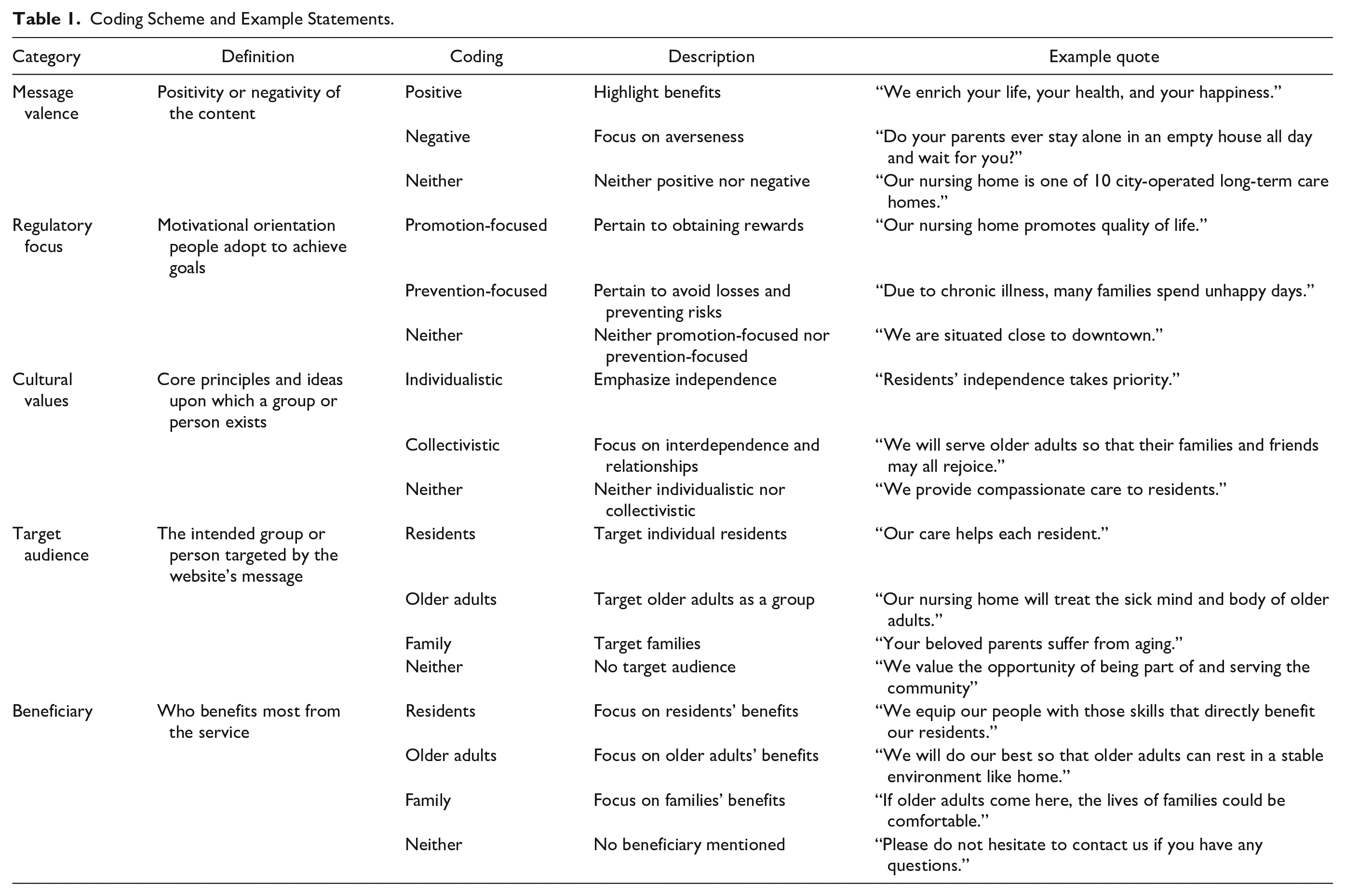
Korean materials were translated into English through a structured process. The first author, who is Korean-Canadian bilingual and proficient in both English and Korean, initially translated the materials using Google Translate. She then reviewed the translation sentence by sentence, correcting grammatical errors and awkward phrasing. A second bilingual Korean-Canadian research assistant verified the translation accuracy, and any disagreements (1.38%) were resolved through discussion. The websites were copied and pasted in random order into an Excel file to ensure that coders remained blind to the websites’ country of origin. Each webpage was parsed so that each row contained only one statement. One trained independent research assistant served as the main coder, coding all materials, and a second coder coded 15.34% of the data. Overall, inter-rater agreement was 92%. The coders coded the website statements using a predefined coding scheme, categorizing each statement across five key characteristics: message valence, regulatory focus, cultural value, target audience, and beneficiary (see Table 1 for coding scheme and illustrative example statements.)
Coding Scheme and Example Statements.
Results
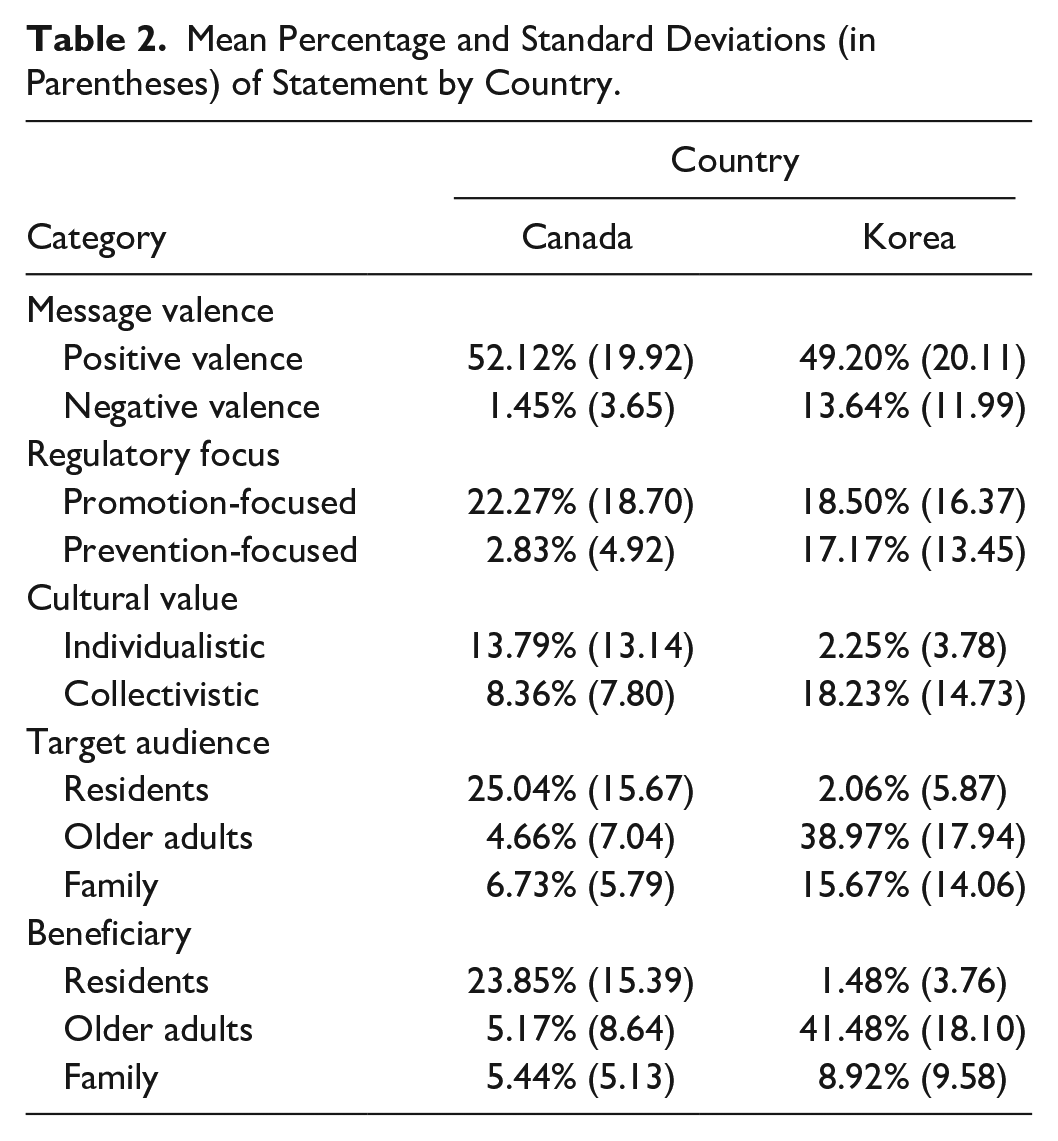
A one-way analysis of variance (ANOVA) revealed that Canadian nursing home websites contained significantly more statements (M = 27.60, SD = 19.93) than Korean websites (M = 17.74, SD = 9.82), F(1, 202) = 20.11, p < .001. To control for these differences, frequencies were normalized by dividing by the total number of statements and multiplying by 100 for all types of coded statement categories (Table 2 for percentage of each type of statement).
Mean Percentage and Standard Deviations (in Parentheses) of Statement by Country.
Message Valence
A repeated measure ANOVA was conducted on the number of statements coded as positive or negative, with valence (positive vs. negative) entered as a repeated measure variable and country (Canada vs. Korea) as a between-subject variable. The main effects of valence, F(1.202) = 656.16, p < .001, partial η2 = .77, and country, F(1, 202) = 11.53, p = .001, partial η2 = .05 were significant, and qualified by a Country X Valence interaction, F(1, 202) = 20.14, p < .001, partial η2 = .09. Separate one-way ANOVAs for positive and negative statements, with country as the independent variable showed that contrary to H1a, the two countries did not differ significantly in the number of positive statements, F(1.202) = 1.08, p = .299, partial η2 = .005. But, supporting H1b, Korean websites contained significantly more negative statements than Canadian websites, F(1, 202) = 96.50, p < .001, partial η2 = .32. In addition, separate repeated measure analyses for each country revealed that, despite the interaction between country and valence, both Canadian and Korean websites contained significantly more positive than negative statements, F(1, 101) = 615.45, p < .001, partial η2 = .86; and F(1, 101) = 176.61, p < .001, partial η2 = .64, respectively.
Regulatory Focus
A repeated measure ANOVA was conducted on the number of statements coded as promotion or prevention-focused, with regulatory focus (prevention-focused vs. promotion-focused) entered as a repeated measure variable and country (Canada vs. Korea) as a between-subject variable. The main effects of regulatory focus, F(1.202) = 52.43, p < .001, partial η2 = .21, and country, F(1, 202) = 14.54, p < .001, partial η2 = .07 were significant and qualified by a Country X Regulatory Focus interaction, F(1, 202) = 39.27, p < .001, partial η2 = .16. Separate one-way ANOVAs for promotion-focused and prevention-focused statements, with country as the independent variable, showed that contrary to H2a, the two countries did not differ significantly in promotion-focused statements, F(1.202) = 2.26, p = .135, partial η2 = .01. But, supporting H2b, Korean websites contained significantly more prevention-focused statements than did Canadian websites, F(1, 202) = 103.69, p < .001, partial η2 = .34. In addition, separate repeated measure analyses for each country showed that Canadian websites contained significantly more promotion-focused than prevention-focused statements, F(1, 101) = 102.68, p < .001, partial η2 = .50; Korean websites did not differ in number of promotion-focused and prevention-focused statements, F(1, 101) = .43, p = .515, partial η2 = .004.
Individualistic Values versus Collectivistic Values
A repeated measure ANOVA was conducted on the number of statements coded as individualistic or collectivistic, with the cultural value entered as a repeated measure variable (individualistic vs. collectivistic) and the country as a between-subject variable (Canada vs. Korea). The main effect of country was not significant, F(1, 202) = .65, p = .422, partial η2 = .003. The main effect of value was significant, F(1.202) = 22.62, p < .001, partial η2 = .10, and qualified by a significant Country X Value interaction, F(1, 202) = 93.12, p < .001, partial η2 = .32. Separate one-way ANOVAs for individualistic and collectivistic statements, with country as the independent variable, showed that Canadian websites contained significantly more individualistic statements than did Korean websites, supporting H3a, F(1.202) = 69.96, p < .001, partial η2 = .26; and Korean websites contained significantly more collectivistic statements than did Canadian websites, supporting H3b, F(1, 202) = 35.77, p < .001, partial η2 = .15. In addition, separate repeated measure analyses for each country revealed that Canadian websites contained significantly more individualistic than collectivistic statements, F(1, 101) = 11.77, p = .001, partial η2 = .10, whereas Korean websites contained significantly more collectivistic than individualistic statements, F(1, 101) = 105.62, p < .001, partial η2 = .51.
Target Audience
A repeated measure ANOVA was conducted on the number of statements coded as targeting residents, older adults, or families as the audience, with the target audience (residents vs. older adults vs. families) entered as a repeated measure variable and country (Canada vs. Korea) as a between-subject variable. The main effects of target audience, F(1.846, 372.848) = 36.81, p < .001, partial η2 = .15, and country, F(1, 202) = 70.42, p < .001, partial η2 = .26, were significant, and qualified by a Country X Target Audience interaction, F(1.846, 372.848) = 247.29, p < .001, partial η2 = .55. Separate one-way ANOVAs for each target audience, with country as the independent variable showed that, consistent with H4a, Canadian websites contained significantly more statements targeting the residents than did Korean websites, F(1, 202) = 323.45, p < .001, partial η2 = .62; interestingly, contrary to H4a, Korean websites contained significantly more statements targeting older adults than did Canadian websites, F(1, 202) = 192.35, p < .001, partial η2 = .49. Also supporting H4b, Korean websites contained significantly more statements targeting families than did Canadian websites, F(1, 202) = 36.83, p < .001, partial η2 = .15. In addition, separate repeated measure analyses for each country showed a significant effect of target audience for Canada, F(1.397, 141.127) = 112.32, p < .001, partial η2 = .53, as well as Korea, F(1.476, 149.092) = 157.08, p < .001, partial η2 = .61. Because we did not have a prior prediction regarding differences in target audience within country, we decided to use the most conservative approach, Bonferroni correction, for multiple comparisons. Pairwise comparisons with Bonferroni correction revealed that Canadian websites contained significantly more statements regarding residents as the audience (M = 25.04, SD = 15.67) than both older adults (M = 4.66, SD = 7.04) and families (M = 6.73, SD = 5.79), both ps < .001, with the latter not differing from one another, p = .478. For Korean websites, all three categories significantly differed from one another; there were significantly more statements targeting older adults (M = 38.97, SD = 17.94) than residents (M = 2.06, SD = 5.87) and families (M = 15.67, SD = 14.06), both ps < .001, and significantly more statements targeting families than residents, p < .001.
Beneficiary
A repeated measure ANOVA was conducted on the number of statements coded as residents’ benefits, older adults’ benefits, or families’ benefits with beneficiary (residents vs. older adults vs. families) entered as a repeated measure variable and country (Canada vs. Korea) as a between-subject variable. The main effects of beneficiary, F(1.677, 338.694) = 100.15, p < .001, partial η2 = .33, and country, F(1, 6777, 338.694) = 100.15, p < .001, partial η2 = .33 were significant, and qualified by a significant Country X Beneficiary interaction, F(1.677, 338.694) = 321.47, p < .001, partial η2 = .61. Separate one-way ANOVAs for residents, older adults, and families, with country as the independent variable showed that, consistent with H5a, Canadian websites contained significantly more statements mentioning residents’ benefits than did Korean websites, F(1, 202) = 203.39, p < .001, partial η2 = .50; but, contrary to H5a, Korean websites contained significantly more statements mentioning older adults’ benefits than did Canadian websites, F(1, 202) = 334.27, p < .001, partial η2 = .62. Also supporting H5b, Korean websites contained significantly more statements mentioning families’ benefits than did Canadian websites, F(1, 202) = 10.45, p = .001, partial η2 = .05. In addition, separate repeated measure analyses for each country revealed a significant effect of beneficiary for Canadian websites, F(1.396, 140.962) = 98.17, p < .001, partial η2 = .49, as well as for Korean websites, F(1.331, 134.436) = 297.18, p < .001, partial η2 = .75. Because we did not have a prior prediction regarding differences in mentions of beneficiary within country, we used Bonferroni correction for the multiple comparisons. Pairwise comparisons with Bonferroni correction revealed that Canadian websites contained significantly more statements regarding residents’ benefits (M = 23.85, SD = 15.39) than older adults’ benefits (M = 5.17, SD = 8.64) and families’ benefits (M = 5.44, SD = 5.13), both ps < .001, with no significant difference between families and older adults, p = 1.000. Korean websites contained significantly more statements stating older adults’ benefits (M = 41.48, SD = 18.10) than residents’ benefits (M = 1.48, SD = 3.76) and families’ benefits (M = 8.92, SD = 9.58), both ps < .001, and significantly more statements targeting families’ benefits than residents’ benefits, p < .001.
Discussion
This study offers a nuanced analysis of how cultural values influence the valence of messages communicated about elderly care through nursing home websites from Canada and Korea. Our findings indicate that both Canadian and Korean websites predominantly feature positively framed messages, but there are significant differences in the overall positivity. Canadian websites exhibit a higher positivity ratio compared with Korean websites, which tend to incorporate a more balanced mix of positive and negative content. This observation aligns with prior studies highlighting cultural differences in emotional expression, wherein North Americans often minimize negative emotions, whereas East Asian contexts embrace a broader emotional spectrum (Bagozzi et al., 1999; Kitayama et al., 2000; Sims et al., 2015). Our findings suggest that regarding communication about elderly care, Canadians may prefer communications that focus on positive aspects and find negative valence discomforting, whereas Koreans might be more accepting of mixed valence content.
Moreover, our analysis reveals distinct regulatory focuses in the communication strategies employed by Canadian and Korean nursing home websites. Canadian sites predominantly utilize promotion-focused messaging, emphasizing the benefits of nursing home residence. In contrast, Korean websites present a more balanced approach between promotion and prevention-focused content. This pattern is consistent with previous research indicating that North Americans prioritize achieving positive outcomes whereas East Asians focus on avoiding negative consequences (Hamamura et al., 2009; Lee et al., 2000). These insights extend our understanding of how cultural values shape communication strategies in elderly care and suggest that practitioners should adapt their messaging approaches accordingly.
The stark differences in individualism and collectivism observed in our analysis further contribute to the existing body of knowledge on cultural orientations. Canadian websites predominantly feature individualistic statements, whereas Korean sites emphasize collectivistic values. This pattern is consistent with prior research suggesting that individualism is more pronounced in Western societies while collectivism characterizes Eastern cultures (Hofstede et al., 2010). By demonstrating how these cultural orientations manifest in the context of elderly care communication, our findings reinforce the necessity for culturally sensitive approaches when addressing diverse populations.
Moreover, our results indicate significant differences in target audiences and beneficiary mentions between the two countries’ websites. Canadian sites primarily target individual residents, whereas Korean sites focus more on older adults as a collective group alongside their families. This distinction reflects broader cultural values regarding individual versus collective identities (Triandis et al., 1988). Similarly, in examining beneficiaries, our findings reveal that Canadian websites prioritize benefits for individual residents, whereas Korean websites focus on collective benefits for older adults as a group. This observation aligns with existing research indicating that individualistic cultures emphasize personal benefits (Markus & Kitayama, 1991), whereas collectivistic cultures highlight group or family benefits (Han & Shavitt, 1994). By illustrating these patterns in targeted audiences and beneficiaries, this study adds depth to our understanding of how cultural values influence messaging strategies in elderly care.
Admittedly, the coding conducted by Canadian research assistants for both Canadian and Korean websites is a potential limitation of this study. However, the involvement of a bilingual, bicultural Korean-Canadian researcher on the research team helped mitigate this limitation by ensuring a more accurate understanding of cultural nuances, strengthening the validity of our findings by reducing the risk of cross-cultural misinterpretations.
All in all, this study contributes to cross-cultural research by providing a comprehensive content analysis of nursing home websites from Canada and Korea. By examining various dimensions—message valence, regulatory focus, individualism versus collectivism, target audience, and beneficiary—our findings offer valuable insights into how deeply ingrained cultural values shape online communication about elderly care services. The insights gained from this analysis underscore the necessity for practitioners in the global health care industry to design culturally appropriate communication strategies that cater to diverse populations’ needs and preferences. Overall, this research not only extends existing literature but also provides practical implications for practitioners seeking to design effective communication strategies that resonate with diverse populations in elderly care settings. Furthermore, these findings carry strategic value for nursing home businesses. Culturally tailored communication can improve resident recruitment by aligning with local decision-making norms, whether targeting independent older adults in individualistic cultures or families in collectivistic contexts. Investing in cultural expertise for marketing teams may prove essential for organizations operating in multicultural markets or expanding internationally.
Conclusion
In the global landscape of health care, cultural perspectives profoundly shape our understanding of aging, dignity, and care. Nursing home websites serve as more than mere digital platforms; they are intricate narratives that reflect societal values, revealing how different cultures conceptualize elder support and human worth. Our comparative content analysis illuminates how cultural dimensions manifest in communication strategies, from individualistic approaches that emphasize personal benefits to collectivistic perspectives that prioritize group welfare. These nuanced differences in messaging reflect deeper cultural philosophies about aging, autonomy, and social responsibility. As our world becomes more interconnected, recognizing cultural differences in elder care is crucial. Transcultural nursing calls for a blend of clinical expertise and understanding of how various societies approach aging. By appreciating these distinctions, we can enhance our care strategies, ensuring they resonate with the values and needs of diverse populations while promoting dignity for all individuals.
Footnotes
Acknowledgements
We thank Sarah Liberty and Daylee Vickers-Cortes for coding the research materials, Naomi Levins for proofreading the manuscript, the anonymous reviewers, and the editor for their insightful comments on earlier versions.
Data Availability
Raw and coded data of this research are available from the corresponding author upon request.
Declaration of Conflicting Interests
The author(s) declared no potential conflicts of interest with respect to the research, authorship, and/or publication of this article.
Funding
The author(s) disclosed receipt of the following financial support for the research, authorship, and/or publication of this article: This work was supported by an Insight Development Grant from the Social Sciences and Humanities Research Council of Canada to the second author.
Ethical Approval and Informed Consent
This research was conducted in accordance with ethical guidelines and involved publicly available content from websites. As no human participants were involved, ethics clearance was not required.
