




Abstract
Introduction:
Cultural diversity among nurses in the Kingdom of Saudi Arabia poses problems in communication management to ensure optimal patient care. This study explored and described the perceptions of communication among nurses in a culturally diverse workforce.
Methodology:
A qualitative approach was used; a sample of seventeen (n=17) nurses was purposively selected. Data obtained from semi-structured interviews were analyzed using Braun and Clarke’s six steps of thematic qualitative analysis.
Results:
Key themes were (1) nurses’ perceptions of communication in a culturally diverse workforce, (2) barriers to communication in a culturally diverse workforce, and (3) facilitators of effective communication in a culturally diverse workforce.
Discussion:
Nurses have recognized the importance of communicating in a culturally diverse environment to provide optimal care. Strategies such as cultural competence training, open communication forums, and mentorship programs are recommended to improve cross-cultural understanding and collaboration in care teams.
Introduction
Nurses play a critical role in healthcare facilities’ overall performance, contributing significantly to the overall wellness of the patient, health promotion, patient education, and patient satisfaction (Hughes, 2018). Nursing and communication are intricately linked, forming a critical aspect of every aspect of patient-centered care. Effective communication in nursing is essential for building professional relationships with patients and collaborating within the nursing teams, and thus ensuring the delivery of optimal patient care (Kourkouta & Papathanasiou, 2014).
Nursing in Saudi Arabia has historically been viewed as a less prestigious career that faces a variety of challenges influenced by cultural perceptions, stigma, educational barriers, public perception, and recognition (Almalki et al., 2011). However, the increasing cultural diversity in these healthcare settings, with a workforce comprising a large percentage (70%) of nurses from countries such as India, the Philippines, Malaysia, and other nations, is a testament to the value and integral role of each individual in the healthcare system. This diversity presents unique challenges for effective communication among nurses, but it also enriches the healthcare environment (Almutairi et al., 2015; Alsufyani et al., 2021). The hospitals face challenges requiring a more detailed understanding of communication dynamics among a multinational workforce, with an explicit focus on nurses’ communication (Horvath & Molnar, 2021).
Cultural diversity can add value to nursing by contributing different work experiences, perspectives, and skills. However, cultural diversity may also contribute to misinterpretation, misunderstanding, and conflict among the nursing teams and patients due to the distinct cultural perspectives in communication (Almutairi et al., 2017). Non-native nurses often face obstacles in adjusting to Saudi culture, particularly in understanding Islamic beliefs and morals. These cultural and religious aspects are not just incidental, but integral to nursing care in Saudi Arabia. The focus on the psychosocial and spiritual needs of the patient and family, rather than on integrity, accountability, honesty, and confidentiality, underscores the importance of this cultural and religious understanding (Lovering, 2012). According to Woldemichael (2021), communication becomes intense in a culturally diverse environment and is a source of conflict. The information shared may need to be better understood, thus leaving one of the parties feeling negative or not valued. How nurses from different cultures manage conflict is different; conflict resolution can vary across cultures. Certain cultures may prefer direct countermeasures, while others may value indirect or peaceful conflict resolution (Ahmed et al., 2021). These dissimilarities can lead to predicaments in resolving conflicts among nurses (Aljuaid & Alkarani, 2023).
In culturally diverse environments, nurses face unique challenges that extend beyond clinical expertise and need to acquire cultural competency and sensitivity in communication. Cultural sensitivity or awareness deficiency may result in disrespect or misunderstanding of nurses’ values, beliefs, and work rules (Almutairi et al., 2015).
A lack of respect or misunderstanding among nurses can negatively impact professional collaboration. Understanding communication complexity within a culturally diverse work environment is essential for fostering collaborative nursing teams and improving patient care. Miscommunication and misunderstandings among nurses can lead to errors in treatment, compromised patient safety, and diminished overall healthcare quality. Understanding the cultural contexts that shape communication is thus crucial for mitigating these risks within a multi-national workforce (Brunton & Cook, 2018).
A multinational nursing workforce has different problem-solving dimensions, such as approach-avoidance, personal control levels, and perception of problems, and is for essential effective communication. Effective communication is needed to coordinate problem-solving Aririguzoh (2022). While diverse problem-solving skills can be supplemental, they may also cause problems in reaching an agreement due to different values, beliefs, and communication styles, influencing their problem-solving methods. Cultural practices control different communication styles, such as direct versus indirect communication, high context versus low context communication, and non-verbal communication. Awareness of these differences can result in team dynamics, quality patient care, and work efficiency (Falatah et al., 2022). Non-verbal gestures during interaction among the nurses, such as body language, eye contact, and facial gestures, can have different meanings in diverse cultures (Scotta, 2018). Misapprehension of these gestures may cause ambiguity and poor communication in the team (Xiao et al., 2013).
Multinational nurses from countries where English is not the primary language often need help speaking and understanding English. Despite this, English is a common language for communication among the nursing workforces. Switching between Arabic and English, depending on the patient’s language preference, is valuable (Alsadaan et al., 2021). However, English proficiency is particularly crucial in nursing documentation and nurse communication. Albagawi and Jones’s (2016) research in KSA further supports this, highlighting the importance of English and Arabic proficiency among the nursing staff for effective patient care, professional communication, and job satisfaction. Therefore, expatriate nurses must be proficient in English and Arabic and culturally competent to contribute to better patient outcomes. The difference in pronunciation, vocabulary, meaning of words, medical terminology, doctors’ orders, and patient information may cause misinterpretation, hinder communication, and cause medical errors (Al Shamsi et al., 2020). The role of language proficiency in reducing medical errors is crucial, as it reassures the audience about the importance of their skills in patient safety. Almutairi et al. (2017) contended that unconscious biases may affect nurse communication and interaction. Stereotyping or preconceived opinions about fellow nurses based on cultural backgrounds may lead to assumptions regarding the nurse’s communication style, language ability, and work practice that can harm effective communication and teamwork. When there are preconceived ideas among nurses, the team members feel judged because of their cultural background, and trust and respect will be diminished, harming open communication (Hilel et al., 2023).
In conclusion, the literature underscores the critical role of effective communication in culturally diverse nursing environments. Addressing challenges, fostering cultural competence, and promoting supportive organizational cultures are vital factors in enhancing nurse communication and improving patient outcomes in culturally diverse healthcare settings. Shopo et al. (2023) asserted that midwives working with diverse patients must acquire practical communication skills to provide quality healthcare. Cultural competence is one of the strategies used to improve health outcomes in diverse healthcare settings, such as the multinational workforce in the setting of this study, the Kingdom of Saudi Arabia. Therefore, this study aimed to explore the perceptions of communication among nurses in a culturally diverse workforce to understand this phenomenon better. The research questions posed for this study were as follows:
What are the nurses’ perceptions regarding communication among nurses in a culturally diverse hospital in the Southern Region of Saudi Arabia?
What recommendations can be made to enhance communication among nurses in a culturally diverse regional hospital in the Southern Region of Saudi Arabia?
Materials and Method
This study was conducted at a regional military hospital in the Southern Region of Saudi Arabia. A qualitative, exploratory, descriptive design was applied following a phenomenological approach to explore perceptions of communication among nurses. The nurse was recruited after a letter was sent inviting the nurse to attend a voluntary information session regarding the overview of the research in the hospital auditorium and then express their interest in participating in the research. A non-probability, purposive sampling method was used to recruit seventeen (n=17) nurses from the target population (N=121) who provided rich data until saturation was declared (Doyle et al., 2020). The sample included all the eligible categories of nurses according to the inclusion criteria that represented the entire population of nurses (Brink et al., 2018, p. 206). The participants, representing different nationalities and nursing units, were selected for their diverse perspectives, which were crucial for the study’s overall aim (Brink et al., 2018). Participants signed an informed consent form before data collection commenced.
The study was approved by the Health Research Ethics Committee of University X, followed by permission from the Hospital Director and the Regional Ethics Committee of Military of Defence for Health Services (MODHS) Southern Region. Ethical principles of beneficence, justice, respect, autonomy, and confidentiality were applied throughout the study. Semi-structured interviews were conducted via Zoom in English in an administrative office with limited access to obtain insights from a diverse sample of nurses. Data from the participants were collected over two weeks in January 2024. The research team consisted of the researcher, gatekeeper (hospital director), interviewer, mediators, an independent and impartial person responsible for recruiting nurses, and co-coder.
The researcher formulated a set of five interview open-ended questions in a manner that allowed participants to respond and explain how they perceived communication among nurses from their understanding (Bradshaw et al., 2017). Interviews were conducted by a neutral interviewer with expertise in the field of qualitative research, due to the position of the researcher in the hospital, which could influence the responses of the participants The interview started with background information to gain insight into the participants’ culture, home language, and country of origin. This information allowed the researcher to understand the participant better and provided context and description during data analysis (Reinisch & Karimi, 2020). The five questions that lead the interviews:
Please tell me what your understanding of communication is within the context of your profession.
The unit that you are working in has a culturally diverse workforce, so please share your perception of working in such an environment.
Kindly share with me your experiences in communicating with your colleagues in the hospital.
Please share your perception of how communication with your colleagues influences patient care.
What do you think are the barriers and facilitators to communication with your colleagues in your hospital?
After the interviews, recordings were transcribed verbatim and checked by the researcher to ensure accuracy.
The information obtained from open-ended exploratory questions during the individual semi-structured interviews was analyzed by applying Braun and Clarke’s (2006) six-step thematic analysis to understand the participant’s perspective. Thematic analysis method consists of six steps: (1) familiarization with the data, (2) code generating, (3) generating themes, (4) reviewing themes, (5) defining and naming themes, and (6) locating exemplars.
Confidentiality was maintained by numerical numbering each transcript and ensuring it was not linked to personal information (Kaiser, 2009). Trustworthiness was established by applying strategies to improve the findings’ credibility, transferability, dependability, and confirmability. To enhance the credibility of the findings, during the interview process, the interviewer and the participant engaged through thoughts and conversation to elicit perceptions of communication and follow-up questions to delve deeper into the perceptions shared. Member checking was performed by asking participants to review the findings and verify that it is consistent with their perceptions shared. Furthermore, the researcher ensured the quality of the data analysis by sourcing an expert in qualitative research who independently conducted the analysis following Braun and Clarke’s steps and co-coded the data, providing a high level of expertise and reassurance in the research process. Reflexivity was used as a strategy for confirmability by not conducting the interviews due to the researcher’s position in the hospital and by taking great care to avoid influencing the participants’ responses during the interviews. The dependability of the data was achieved by maintaining detailed records of all steps in the research process, including developing interview guides, recruitment of participants, data collection procedures, and data analysis techniques.
Results
The findings of the study are presented in this section, commencing with the demographic data of participants, as illustrated in Table 1 below.
Demographic Data of the Interviewed Participants (P) (n=17).

Demographic Data of the Participants
Seventeen (n=17) participants were interviewed from the various units within the hospital under study. These participants were a mix of foreign nationals (Indian, Malaysian, Philippines) and national nursing staff working in the various units of the selected hospital. Regarding participants’ gender, fourteen (n=14; 82%) were female and three (n=3; 18%) were males. Five (n=5; 29%) of the participants were aged 25–34 years, six (n=6; 35%) were in the 35–44 age group, five in the 45–54 age group (n=5; 29%), and one was in the >55 age group (n=1; 0.06%). The experience levels measured in the years of service in the nursing profession ranged as follows: One (n=1; 0.06%) participant had <1 year experience, eight (n=8; 47%) between 1 and 5 years, three (n=3; 18%) between 6 and 10 years, four (n=4; 24%) between 11 and 15 years, zero (n=0; 0%) between 16 and 20, and 1 (n=1; 0.06%) had >20 years of experience within this organization under study. The participants were selected from the designated unit care specializations, including general and specialized units, to better understand the effects of nurses’ communication in a broader context. The units included the following: Nursing Education Department, Nursing Administration, Emergency Room, Outpatient Department, Neonatal Intensive Care Unit, Male Ward, Family & Community Centre, the Operating Room, Obstetrics & Gynaecology Unit, Labour & Delivery Unit, Paediatric Ward, and the Nursing Education and Labour & Delivery Unit.
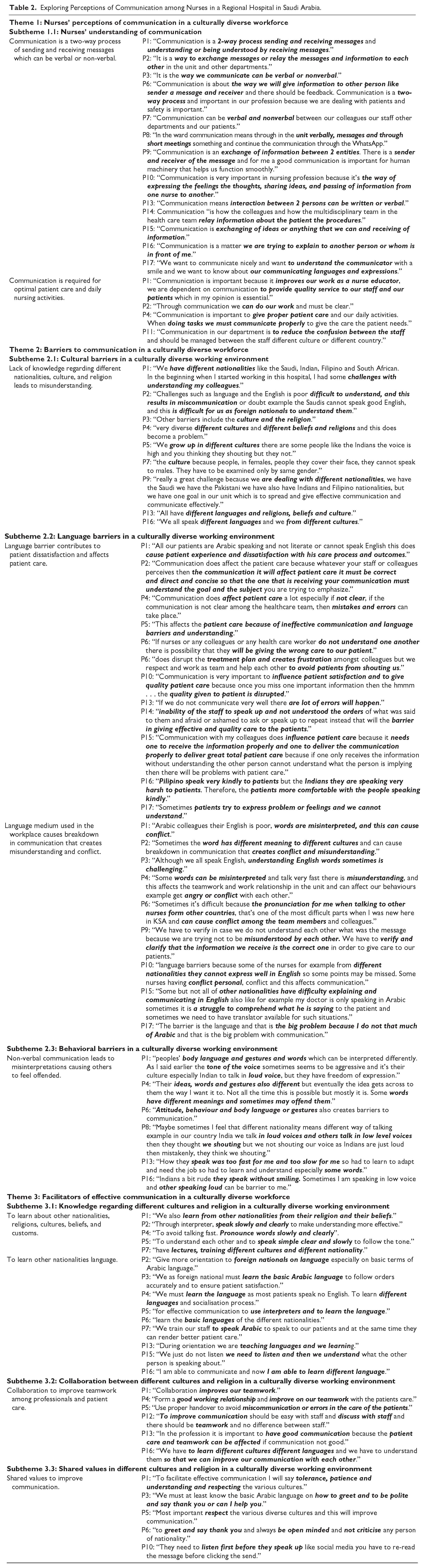
Data analysis for exploring the perceptions of communication among nurses in a regional hospital in Saudi Arabia yielded three themes with respective sub-themes, as illustrated in Table 2 & 3 below.
Exploring Perceptions of Communication among Nurses in a Regional Hospital in Saudi Arabia.
Themes and Sub-themes.

THEME 1: Nurses’ Perceptions of Communication in a Culturally Diverse Workforce
Perceptions of communication in a culturally diverse workforce among nurses can have a variety of different elements. They can vary based on individual experiences, backgrounds, and contexts, as evidenced by the quotes in the next section of the themes derived from the data analysis. Nurses working in a multicultural environment need to understand the communication process and be aware of the challenges they may encounter in comprehending messages due to differences in culture, languages, and communication styles to ensure quality patient care and effective teamwork. The sub-theme that came up is the nurses’ understanding of communication, as discussed below.
Sub-theme 1.1: Nurses’ Understanding of Communication
Participants viewed communication as a two-way process of sending and receiving messages, which can be verbal or non-verbal. The following participant quotes support this sub-theme:
“Communication is a
“Communication is very important in the nursing profession because it’s the way of
Participants felt strongly that communication is required for optimal patient care and our daily nursing activities, as evidenced by the following quotes.
“Communication is important because it
“Communication is important to
THEME 2: Barriers to Communication in a Culturally Diverse Workforce
Communication in a culturally diverse workforce can encounter various barriers due to differences in language, communication styles, cultural norms, and values. In theme 2, three sub-themes emerged, namely (1) cultural, (2) language, and (3) behavioral barriers in a culturally diverse working environment, as discussed below.
Sub-theme 2.1: Cultural Barriers
The study revealed that a lack of knowledge regarding different nationalities, cultures, and religions leads to misunderstanding, as is evident in the following quotes.
“We
“The
Sub-theme 2.2: Language Barriers
Participants reported that the language barrier contributes to patient dissatisfaction and affects patient care. This sub-theme also highlights the negative impact of the language barrier, which is the impact on patient care.
“All our patients are Arabic speaking and not literate or cannot speak English. This
“Challenges such as language and the English is poor,
Participants also emphasized that the language medium used in the workplace causes a communication breakdown that creates misunderstanding and conflict. The following quotes support this:
“Some
“Sometimes it’s difficult because
Sub-theme 2.3: Behavioral Barriers
Participants also reported that non-verbal communication leads to misinterpretations, causing others to feel offended, as evidenced by the following quotes:
“People’s
“Maybe sometimes I feel that different nationalities mean different ways of talking. For example, in our country, India, we talk
THEME 3: Facilitators of Effective Communication in a Culturally Diverse Workforce
Facilitators of effective communication in a culturally diverse nursing workforce are fundamental to supporting interprofessional collaboration, improving patient care, and promoting a supportive work environment. Three sub-themes emerged, as discussed below.
Sub-theme 3.1: Knowledge Regarding Different Cultures and Religion
Participants stated that a facilitator will include learning about other nationalities, religions, cultures, beliefs, and customs. The following participant’s quotes support this:
“We have to learn to adapt and work as a team. Collaboration improves our teamwork, and through this diverse culture, we also
“So, for me, so we have
Another facilitator reported by participants includes learning other nationalities’ languages, as evidenced by the following quotes:
“Facilitators . . . ways to improve these barriers for me maybe being open-minded and can be firstly
“We must
Sub-theme 3.2: Collaboration between Different Cultures and Religions
The participants in the interviews claimed that collaboration between different cultures and religions improves teamwork, facilitates effective communication, and enhances patient care, as evidenced by the following quotes:
“We have
“
Sub-theme 3.3: Shared Values in Different Cultures and Religion
The participants report that acknowledging and respecting shared values while also being sensitive to cultural and religious differences is essential for fostering effective communication, promoting inclusivity, and building strong relationships among team members. The following participant’s quote supports this:
“To facilitate effective communication, I will say
“We must at least know the basic Arabic language on
Discussion
This study contributes to a more comprehensive understanding of nurses’ perceptions of communication in a culturally diverse nursing workforce and informs future research and practice in healthcare communication worldwide.
The first theme found that nurses’ understanding of communication in a culturally diverse nursing team is central and critical to patient care. This finding is similar to studies confirming that communication in a culturally diverse team is essential for high-quality, patient-centered care (Kourkouta & Papathanasiou, 2014; Noviyanti et al., 2021). Noviyanti et al. (2021) stated that by practicing practical communication skills in culturally diverse care teams, nurses can promote positive outcomes, improve patient experiences, and uphold the core principles of compassionate care. All participants in this study clearly understood that human communication is a two-way transactional process in which people create shared meanings during interactions through verbal or nonverbal communication, as Santos et al. (2012) suggested. In a multicultural work environment, nurses perceive communication differently due to cultural incompatibility; the communication process becomes challenging and leads to adverse incidents with patients (Alsufyani et al., 2021).
Furthermore, Ashipala and Matundu (2023) state that effective communication is important to ensure optimal patient care in a culturally diverse nursing workforce, which is evident in this study. Clear communication helps nurses to build trust and relationships within the care team. Nurses are more likely to feel comfortable sharing important information about the patient’s health when they feel understood and respected by their colleagues (Isakov et al., 2023). Effective communication between nurses in a culturally diverse nursing workforce promotes teamwork and adherence to patient care plans (Horvath & Molnar, 2021).
According to Hartung and Miller (2013), communication in a multicultural nursing team is essential to ensure quality patient care, collaboration, and team cohesion. However, various barriers can hinder communication in such culturally diverse care teams. The results showed that various behavioral and language differences as well as a lack of knowledge about different cultures, communication styles, and shared values, such as respect and hierarchy, affected communication among the nurses in the study. These barriers can lead to misunderstandings and misinterpretations, affecting team performance and ultimately jeopardizing patient safety and care outcomes (Aboshaiqah & Alharb, 2020; Al Shamsi et al, 2020; Thomas et al, 2021; Xiao et al, 2013). Most participants in the current study indicated that some communication practices rely on nonverbal methods because they do not speak a common language, which often results in a need to better understand the meaning of the communication. In some cultures, direct eye contact is a sign of trust and honesty, while in others it is perceived as disrespectful or confrontational. Some nurses may unintentionally make offensive or inappropriate remarks or gestures in another culture (Xiao et al., 2013). This can hurt feelings, cause tension and disrupt communication (Hilel et al., 2023). The participants in the current study confirmed that their lack of knowledge about the differences in language and culture was a factor that led to misinterpretations and misunderstandings and thus to disruptions in communication within the care team. Poor communication can affect care coordination, handovers and teamwork (Thomas et al., 2021).
Furthermore, Lin et al.’s (2021) findings relate to the factors that facilitate effective communication in a culturally diverse workforce, which can create an inclusive and culturally competent nursing workforce capable of providing patient-centered care. As the study participants noted, cultural awareness and sensitivity can equip nurses with the knowledge, skills, and attitudes necessary for effective communication and collaboration in the care setting. The literature emphasizes that cultural awareness helps to avoid misunderstandings, promote active listening and adaptability, and create close relationships and an inclusive work environment (Caldwell, 2015; Henderson & Kendell, 2011). Subramanian (2016) found that learning different languages ensures that all nurses can effectively communicate and understand important information, reducing the risk of misunderstandings and errors in patient care. According to Almutairi et al (2017), understanding different cultural norms, customs, religions, and traditions enables nurses to communicate with sensitivity and respect and to apply communication strategies when interacting with other nurses from different cultures. To build a trusting relationship, one must understand the nurses’ language skills, the meaning of the words they speak and their behavior, as stated by some of the participants. (Subramanian, 2016). One participant pointed out that shared values are essential in shaping cross-cultural and cross-religious communication in nursing. This statement aligns with Scotta’s (2018) assertion that shared values create mutual understanding and respect between caregivers from different cultural or religious backgrounds. Sharing values between nurses facilitates communication; it provides a framework to clarify messages and behaviors and enables an open approach to communication and a willingness to understand each other’s perspectives (Albalawi et al., 2020).
Limitations
The study sample represents only a portion of the culturally diverse nursing staff in KSA, as the study was conducted in only one hospital in KSA, which limits the generalizability of the results. The language barriers in this study hindered effective communication between the researchers and the participants as the hospital is culturally diverse. Most nurses do not speak English as a first language and are not fluent in English. The Arabic staff needed help in understanding the questions; the interviewer had to rephrase the questions so that they were better understood. The above factors could limit the depth of the data collected or lead to misunderstandings in interpretation. Finally, despite efforts to include a culturally diverse sample, certain cultural groups or perspectives may be underrepresented in the study, as there were only two Arab participants. The comprehensiveness of the findings in relation to some aspects of communication could be overlooked.
Conclusion
The barriers, challenges, and facilitators that influence communication dynamics in a culturally diverse nursing team were identified by exploring nurses’ perspectives, as the Saudi Arabian regional hospital employs predominantly foreign nurses. Prioritizing communication in culturally diverse nursing teams improves patient outcomes, strengthens teamwork, increases job satisfaction, and advances healthcare in Saudi Arabia. Addressing these areas, the research can significantly contribute to the nursing literature, particularly in the context of culturally diverse hospitals. It provides practical insights and recommendations grounded in nurses’ lived experiences, thereby helping to improve communication, teamwork, and patient care in culturally diverse healthcare environments and making all stakeholders feel included and part of the solution.
Implications for Practice
The implications for nursing practice, the hospital should prioritize training nurses in cultural competence to improve their understanding of different cultural backgrounds and communication styles (Almutairi et al., 2017). This training should promote cultural sensitivity, reduce prejudice, and support effective communication in cross-cultural interactions. The healthcare organization will invest in language access services, such as interpreters and language classes, to facilitate communication between caregivers with limited English proficiency (Ashipala & Matundu, 2023). Ensuring language access improves communication between staff and patients to ensure patient safety, team collaboration, and overall quality of care. The nursing department will demonstrate its commitment to diversity, equity, and inclusion by implementing team-building activities and initiatives to improve nurses’ knowledge and awareness of the differences between various cultures through team collaboration (Reinisch & Karimi, 2020).
Footnotes
Acknowledgements
The authors acknowledge the participants who took part in the study, as well as the co-coder, Dr. K. Froneman, and the fieldworker, Dr. K. Chetty who assisted with data collection.
Author contributions
All authors contributed to the manuscript to merit authorship. The submitted manuscript is approved by all authors. LT, KDS, and ON conceived and planned the study. LT was a Masters’ student and collected the data. KDS and ON were the study supervisors and ensured that the study was of good quality and was conducted ethically. LT and KF analyzed the data. LT, KDS, and OG interpreted the data. LT, KDS, and OG drafted and revised the manuscript. All authors provided critical feedback and helped shape the research, analysis, and manuscript.
Data availability
All analyzed data supporting the findings of this research are included in the manuscript.
Declaration of Conflicting Interests
The author(s) declared no potential conflicts of interest with respect to the research, authorship, and/or publication of this article.
Funding
The author(s) disclosed receipt of the following financial support for the research, authorship, and/or publication of this article: This research study was self-funded, and no sponsor or additional source of financial assistance was received.
Disclaimer
The views and opinions expressed in this manuscript are those of the authors and they do not necessarily reflect the official policy or position of any affiliated agency of the authors.
