




Abstract
Introduction:
Despite declining birth rates and improvements in maternal health care, the number of unwanted pregnancies and unwanted births in Turkiye remains high. The aim of this study was to determine women’s attitudes and preferences regarding family planning and the factors influencing them in the postpartum period.
Method:
A descriptive and correlational study was carried out. Data were collected using a personal information form and the Family Planning Attitude Scale in the online environment.
Results:
According to the results of this study, the number of women who did not receive family planning counseling during pregnancy (42.6%) and the postpartum period (36.9%) was considerably high. Women’s family planning attitudes change positively when they move from the east to the west of Turkiye.
Discussion:
According to the results of the study, it was observed that a person’s education, economic status, and cultural values are effective in family planning method selection and family planning attitude.
Introduction
Family planning includes all practices related to preventing unplanned pregnancies, planning the interval between pregnancies, and deciding when a woman wants to have a child and how many children she wants (World Health Organization, 2020). These practices have an important place among primary health services. Numerous health issues and social problems occur when family planning services are not received adequately (Millogo et al., 2019). Turkiye pursued a pronatalist policy after 1923. One of the main reasons for this was the high number of casualties during the war. From the years following this policy, the birth rate began to rise between 1955 and 1960. However, in order to reduce the negative effects of excessive fertility and prevent unwanted births, cases of illegal abortions began to increase. As a result, an anti-natalist policy was pursued and with the law passed in 1983, citizens had the right to use contraceptive methods (Soysal et al., 2022).
The World Health Organization (WHO) stated that every day in 2020, 800 women died due to pregnancy or labor-related complications (WHO, 2024). Family planning is also a key factor in meeting the Sustainable Development Goals. The Sustainable Development Goals (SDGs) call on countries to “ensure universal access to sexual and reproductive health services, including family planning, information and education, and integrate reproductive health into national policies and programs by 2030” (United Nations, 2019). In this context, it is important to improve the quality of care and continuity of services in order to reduce the unmet need for family planning. Despite this, the unmet need for family planning increased between 2013 and 2018, doubling across Turkiye (UNFPA, 2020).
Women are in frequent contact with healthcare professionals during the prenatal and postpartum periods. These periods are ideal to determine the mothers’ health-related needs and discuss their attitudes (Floyd, 2020). In Turkiye, women are cared for by nurses and midwives in family health centers during pregnancy and after childbirth. For this reason, it is very important for nurses, who have the closest contact with women in the postpartum period, to know women’s attitudes toward family planning and the factors that influence them during this time so that they can plan the care and health services they provide. The 2018 Turkish Demographic and Health Survey (TDHS) revealed that 12% of married women had an unmet need for family planning, 4% of them wanted to postpone their next birth and 8% did not want to give birth (Inci et al., 2020; Hacettepe University Institute of Population Studies, 2018). For all these reasons, this community-based study was conducted to determine women’s attitudes and preferences toward family planning and the factors influencing them in Turkiye.
Research Questions:
What are the participants’ mean Family Planning Attitude Scale and subscale scores?
What are the factors affecting the participants’ attitudes toward family planning?
Methods
Design
This study adopted a descriptive and correlational study design to determine the women’s attitudes toward family planning in the postpartum period and the affecting factors.
Participants
Women in their early postpartum period generally postpone their sexual activities due to various problems such as changes in their reproductive organs, vaginal bleeding, the fear of infection, maternal attachment period, sadness, stress, fatigue, concern for being pregnant again, dislike of physical changes, breast tension, loss of sexual attraction and desire, and dyspareunia (Floyd, 2020, Gebremedhin et al., 2018). Therefore, this study was conducted from the sixth to twelfth month after childbirth, in which period of time the participants’ problems related to early postpartum period decreased, they started becoming sexually active, and their risk of becoming pregnant increased (short IPI) (Gebremedhin et al., 2018). In this regard, this study tried to reach all women whose last pregnancy was 6 to 12 months before the start of the study and to examine in detail their attitudes toward family planning and related factors. Women who were living in Turkiye, whose last pregnancy was 6 to 12 months before the start of the study, gave birth at 20 or more weeks of pregnancy, and were older than 18 years old were included in the study. Women who were illiterate, visually impaired, and did not have access to the Internet were not included in the study.
Data Collection
The known population sampling method was used to determine the study sample. The target population of the study consisted of 1,248,847 women whose babies were born alive according to the report of the 2018 TDHS. The 2018 TDHS report revealed that 12% of women had unmet family planning needs in Turkiye (Hacettepe University Institute of Population Studies, 2018). The known population sampling method was used (a 5% margin of error, a 95% confidence interval) and 246 women were calculated to be included in the sample group. A total of 862 women were included in the study. The decision to include 862 women in the identified research sample was based on the goal of maximizing diversity and representativeness. The larger sample size increases the ability to generalize the results of the study and allows for a more detailed understanding of the population. We believe this approach strengthens the validity and applicability of our research findings. All data was collected in the online environment and maximum diversity was sought. This study was announced through social networks such as Facebook, Twitter, and Instagram. A Google form was sent to the contact address of the participants who met the inclusion criteria. Participants were informed in writing about the purpose and content of the study, and their consent was subsequently obtained online. The data were collected online from October 2020 to March 2021 using a personal information form and the Family Planning Attitude Scale via a Google form. The snowball sampling method was used to collect the study data. It took roughly 15 minutes to fill out the forms.
Measures
Personal Information Form
This form was prepared by the researchers after reviewing the literature (Calıkoglu et al., 2018; Simmons & Jennings, 2020). It has 13 questions and includes the participants’ sociodemographic, obstetric, and fertility-related characteristics, their family planning method preference, their levels of satisfaction with the method they preferred, where they acquired this family planning method, and when and from whom they received a family planning consultancy in the postpartum period.
The Family Planning Attitude Scale (FPAS)
This five-point Likert type scale was developed by Orsal and Kubilay in 2007. It has 34 items and each item is scored from 1 (totally agree) to 5 (totally disagree). There are no reverse-coded items in the scale (Orsal & Kubilay, 2007). The absence of reverse-coded items in the FPAS raises concerns about the potential for response bias. While it is true that the absence of reverse-coded items can sometimes lead to response bias, the high reliability scores indicate that participants engaged critically with the scale items. The lowest possible score is 34, and the highest is 170. The higher scores obtained from the FPAS implied that the attitudes toward the use of FP were positive. The FPAS has three subscales: Attitudes of the Society Toward Family Planning (ASTF), Attitudes Toward Family Planning Methods (ATFPM), and Attitudes Toward Childbirth (ATC). The attitudes of the ASTFP subscale has 15 items. The lowest possible subscale score is 15, and the highest is 75. ATFPM subscale has 11 items. The lowest possible subscale score is 11, and the highest is 55. The ATC subscale has 8 items. The lowest possible subscale score is 8, and the highest is 40. The Cronbach’s alpha coefficient was 0.90 for this scale. The items in scale were found between the minimal point of 0.31 and the maximal point of 0.59. The scale also has been shown to be discriminative to person to person (F=105,0418, p=0.000) (Orsal & Kubilay, 2007). The Cronbach’s alpha coefficient of this scale was 0.93 in this study. The Cronbach’s alpha coefficients of its subscales were: 0.87 for the attitudes of the society toward family planning, 0.93 for the attitudes toward family planning methods, and 0.78 for the attitudes toward childbirth.
Ethical Considerations
Ethical committee approval was obtained from XXXX Ethics Committee (Date and Number: 12.03.2021-51530, Approval No. 2020/113). The volunteer form was completed online by each participant. The Google survey was prepared so that participants could access the data collection forms after clicking the “I have read and understood the study and am participating voluntarily” option in the informed consent text, which was prepared in accordance with the Declaration of Helsinki. The data collected online will be stored in encrypted form on the drive linked to the researcher’s company e-mail address. The data will be deleted from all virtual environments after publication of the study. The study was conducted in accordance with the Principles of the Declaration of Helsinki.
Data Analysis
In this study, data collected from participants using online data collection tools were transferred to the computer environment. All data were analyzed using SPSS 21 software. Since the data were collected in the online system, there was no missing data, but the data that did not meet the research criteria (age range, period after birth, etc.) were removed from the main data set. The study first determined whether the data collection instruments met the normal distribution hypothesis by looking at the skewness and kurtosis coefficients. The data set was cleaned of outliers, and non-parametric tests were preferred if the data did not show a normal distribution. Descriptive analyses (numbers, percentages, means, and standard deviations) were used to analyze the participants’ sociodemographic characteristics. The Kruskal–Wallis test was used to compare the variables by their distribution. The Bonferroni post–hoc analysis was used to determine the significance level between the groups. The threshold for statistical significance was p<0.05.
Results
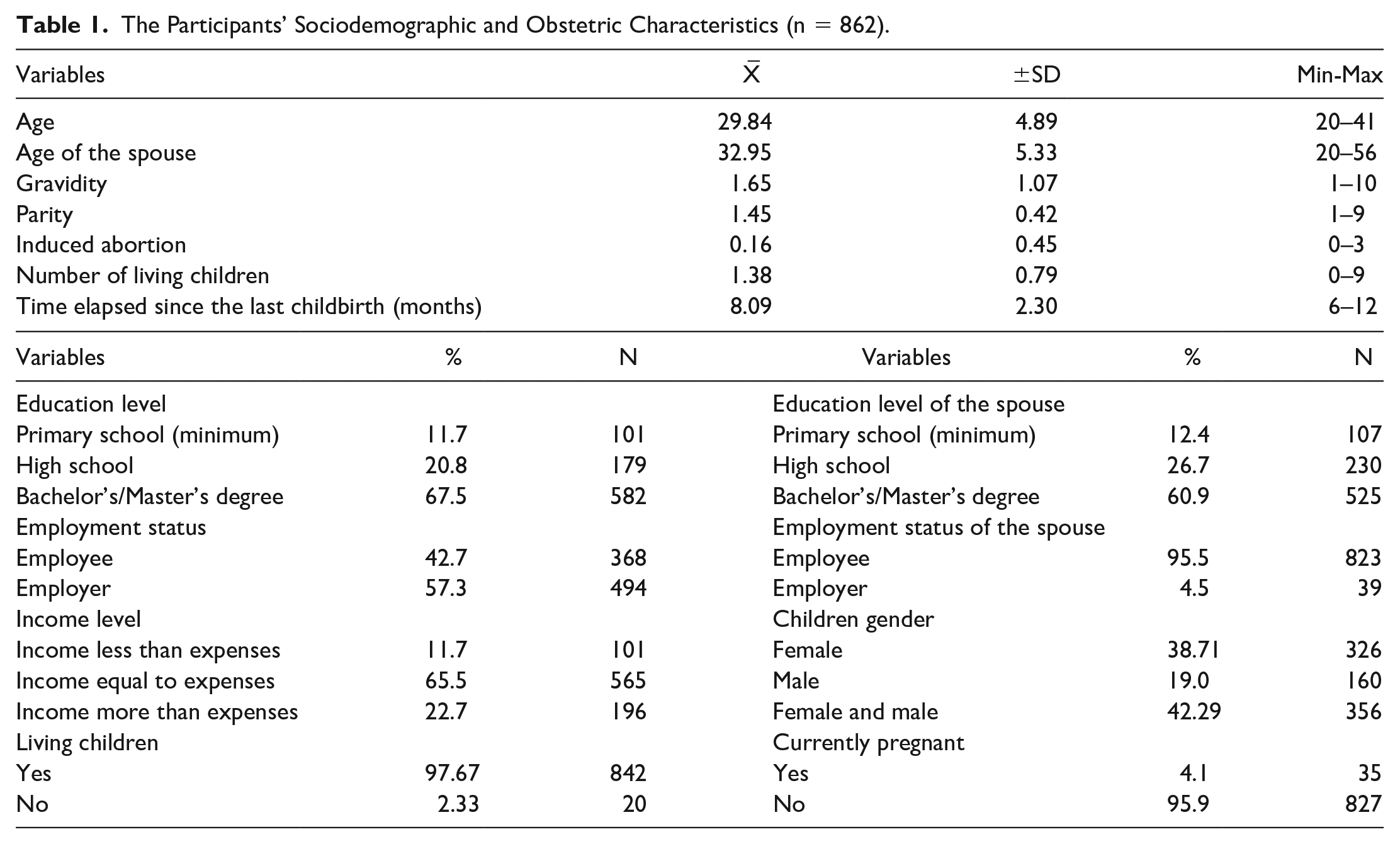
The participants had a mean age of 29.84±4.89 (ranging from 20 to 41 months’ years). The last pregnancy of the participants occurred on average 8.09±2.30 months ago (ranging from 6 to 12 months), with 76.9% (n=662) having planned their last pregnancy. Additionally, 4.1% (n=35) of the participants became pregnant again within 6 to 12 months, and the last pregnancy for those who were pregnant again was on average 8.37±2.37 months ago (Table 1).
The Participants’ Sociodemographic and Obstetric Characteristics (n = 862).
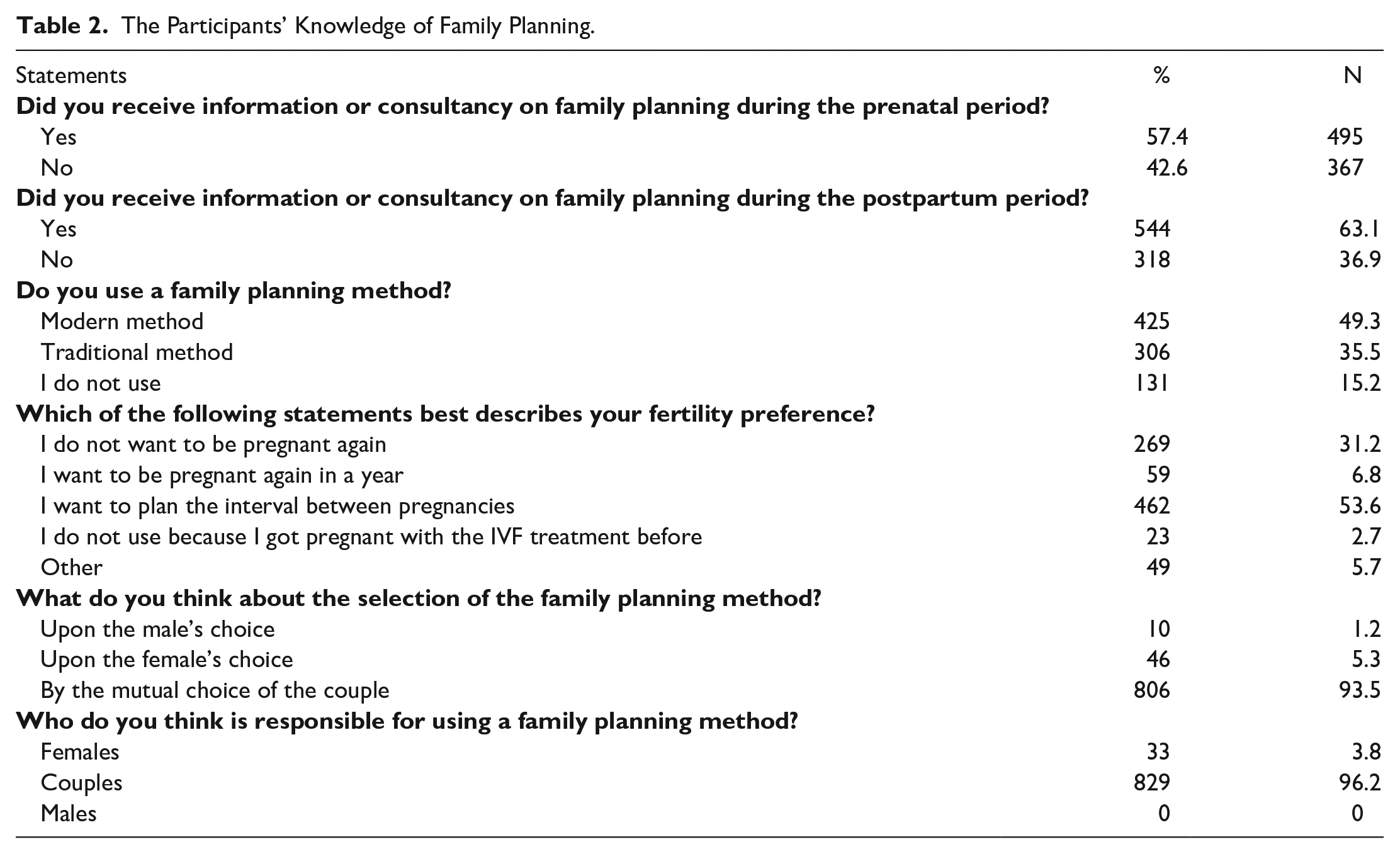
Among the participants, 84.8% (n=731) used a family planning method, either traditional and/or modern, to prevent pregnancy. Condoms were the most common modern family planning method, used by 32.8% (n=283) of participants. Nearly half of the participants who used traditional methods such as withdrawal (33.2%, n=286) and lactational amenorrhea (2.3%, n=20) also used vaginal douching (45.45%, n=130). Table 2 illustrates the participants’ knowledge of family planning. Additionally, 82.5% (n=711) of the participants reported being satisfied with the method they used, with a satisfaction level measured at 7.00±3.11 on the VAS scale (ranging from 0 to 10).
The Participants’ Knowledge of Family Planning.
The participants’ mean FPAS score was 137.24±18.86 (Table 3). There were no statistical differences in mean FPAS and subscale scores between pregnant and non-pregnant participants. Participants living in eastern Turkiye had significantly lower mean scores on the FPAS (z= −2.728, p=0.006), social attitudes toward family planning (z=−4.277, p<0.001), and attitudes toward childbirth (z=−2.296, p=0.022) compared to those in the west. A higher level of education among participants and their spouses was associated with significantly higher FPAS and subscale scores (p<0.001). Employment status and middle or higher income were also positively correlated with higher FPAS scores (p<0.001). Participants with one or two children scored higher on the FPAS than participants without children or with three or more children (p<0.001). In addition, the use of modern family planning methods was associated with significantly higher FPAS scores than those using no method or traditional methods (p<0.001) (Table 4).
The Participants’ Mean Family Planning Attitude Scale Score.

Relationship between the FPAS, Its Subscales, and Sociodemographic Variables.
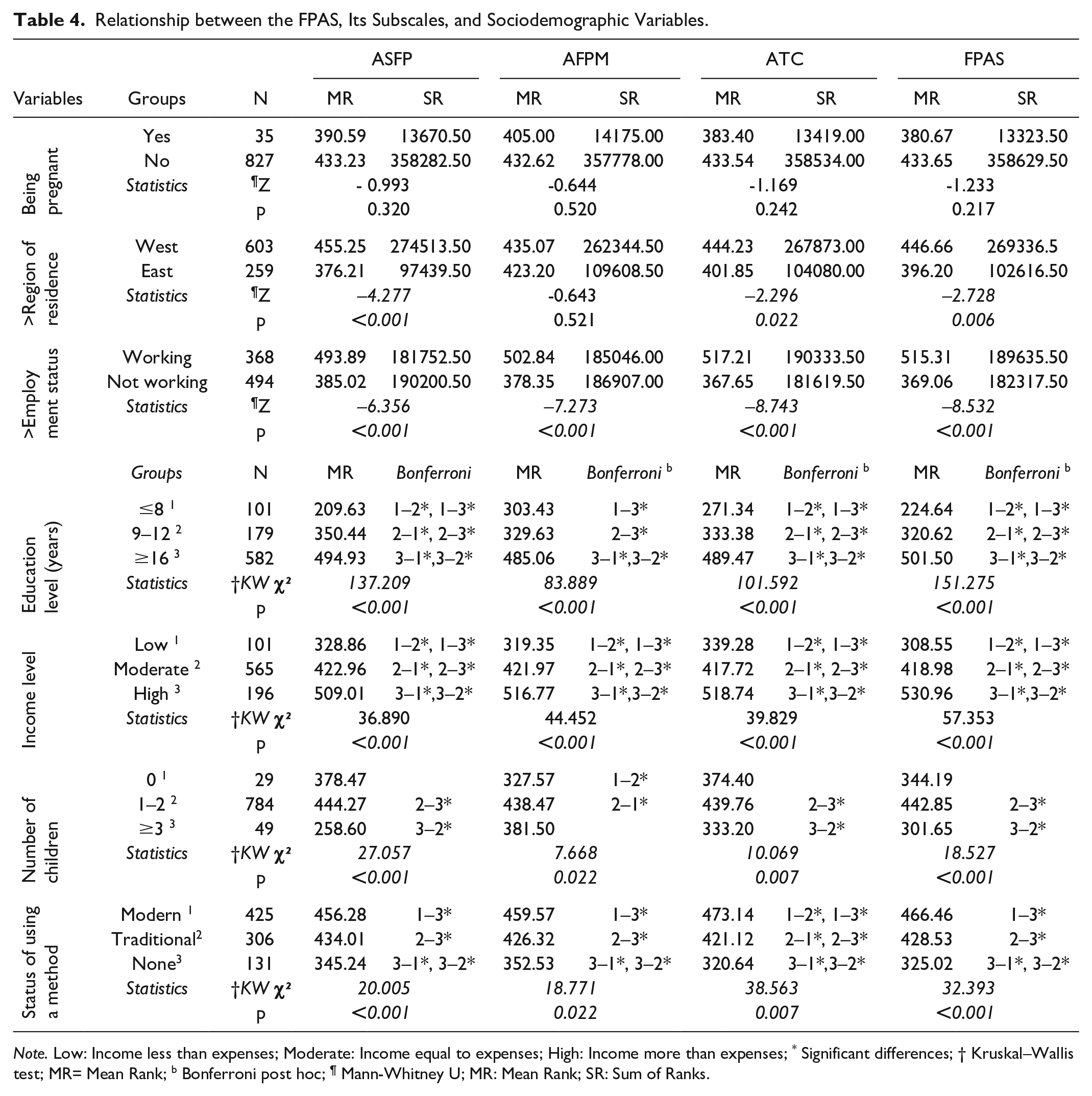
Note. Low: Income less than expenses; Moderate: Income equal to expenses; High: Income more than expenses; * Significant differences; † Kruskal–Wallis test; MR= Mean Rank; b Bonferroni post hoc; ¶ Mann-Whitney U; MR: Mean Rank; SR: Sum of Ranks.
Discussion
The antepartum, during delivery, and postpartum periods are when women receive services from healthcare providers the most and are the most important time for women receiving family planning counseling (Zimmerman et al., 2019). There are an estimated 214 million women of reproductive age worldwide with unmet family planning needs. In undeveloped and developing countries, 60% of women’s family planning needs are unmet during the postpartum period (Moore et al., 2015). The Turkish Demographic and Health Survey (TDHS) regularly provides nationwide data on family planning. According to the previous report of the TDHS, the unmet need for family planning was 6%; however, its latest report shows that this has doubled to 12% (Hacettepe University Institute of Population Studies, 2018). This community-based study aims to determine the attitudes of women in the postpartum period toward family planning and the factors affecting these attitudes in Turkiye.
Improving reproductive health services and family planning counseling can help prevent unwanted pregnancies and help couples plan the timing and number of their children. However, economic funding for these services has been reduced in many low-income countries, and there are insufficient supplies to cover them. In particular, the accessibility of the method to be used, the cost of the method, or the suitability of the method for the individual represent an obstacle to the use of the FP method. The unmet need for family planning services has been increasing over the years in many undeveloped and developing countries. In this study, 57.4% of the women reported that they had received family planning counseling in the antepartum period and 63.1% in the postpartum period. Most of the women participating in the study (93.5%) reported that choosing the family planning method is a decision that couples should make together. According to the results of this study, in a developing country like Turkiye, the number of women who did not receive family planning counseling during pregnancy (42.6%) and the postpartum period (36.9%) was considerably high. The results of studies conducted in low-income countries show that family planning counseling provided to women during pregnancy and the postpartum period is inadequate (Puri et al., 2020; Joshi et al., 2020: Gür & Sohbet, 2017; Zivich et al., 2019).
Family planning services are often the only health initiative that has a wide impact on areas such as lowering poverty, reducing maternal and child mortality rates, empowering women, and ensuring a sustainable environment by limiting the world population. However, the share allocated to empower women from the budget of the Ministry of Family and Social Services in Turkiye in 2024 (8.6 per thousand) is low (Ministry of Family and Social Services, 2024). Factors such as women’s empowerment, support, high education levels, and economic freedom positively affect women’s access to health services and increase the use rate of family planning methods. The results of the present study showed that women who are employed and have an economic level of the middle class and above had a positive attitude toward family planning. In addition, as the educational level of women increased, their attitudes toward family planning also positively increased. In their study of women of reproductive age in six South Asian countries, Sreeramareddy et al. (2022) reported that poverty and a low level of education have a negative impact on women’s use of modern family planning methods (Sreeramareddy et al., 2022). Many studies have reported that the attitudes of women who perceive their economic status as good have positive attitudes toward family planning. Likewise, when the educational level of women increases, their attitudes toward family planning methods also change positively (Abdulreshid & Dadi, 2020; Gözükara et al., 2015; Karaçalı & Özdemir, 2018).
Choosing an appropriate family planning method is one of the most sensitive decisions that can be made by couples, and their education level, religious beliefs, and cultural values play a role in this decision. In some cultures, in Turkiye, that male partner’s decision is effective in the use of family planning, couples perceive natural contraception methods to be more effective, couples have fears and negative views on the use of modern methods, and culturally, when a woman gets married, she is not allowed to use a contraception method until she has a few children. The possession of children in particular is an important indicator of status in society. In addition, the basis of discourses on the sanctity of motherhood with religious references plays an important role in the status of women as wives and mothers in society. Modern contraceptive methods include the pill, injectables, male and female condoms, emergency contraception, implants, intrauterine contraceptive pills (IUCD), female and male sterilization, the standard daily method (SDM) and the lactational amenorrhoea method (LAM) (Roga et al., 2023). According to the most recent TDHS data, the most commonly used modern contraception method in Turkiye is using condoms (19%), and the most commonly used traditional method is withdrawal (20%). The present study found that condoms were the most common method among the modern family planning methods (32.8%), and about half of the participants (49.3%) used modern contraception methods in the postpartum period. A review of the literature showed that this rate was higher in developing countries (Ahissou et al., 2022; Ayiasi et al., 2015). The present study also determined that women who used modern family planning methods before pregnancy had a more positive attitude toward them in the postpartum period than those who did not use these methods or used traditional methods. This result is similar to the results of studies in the literature (Lori et al., 2018; Juma et al., 2015).
Turkiye is a country with a high level of cultural diversity and many people from different religions and sects live side by side. This diversity has an impact on reproductive health behaviors through cultural transmission. Women transmit information to each other across generations. Mothers share their experiences with their daughters on many issues such as marriage, sexuality, childbearing, or motherhood. Therefore, women’s attitudes toward family planning and their use of family planning methods differ as a result of this sharing. As a result, spousal-family control, the desire to have a male child, and religious views are influential in the choice and use of family planning methods (Soysal et al., 2022). In the east of the country in particular, when women have many children, especially sons, they are seen to have important power and social status. For this reason, the Eastern Anatolia Region has the highest pregnancy and fertility rates in Turkiye. One of the most striking results of this study is that women’s family planning attitudes change positively when they move from the east to the west of Turkiye. Similarly, there are studies in the literature showing that family planning attitudes arise from cultural and ethnic differences (Alomair et al., 2020; Joshi et al., 2020; Schummers et al., 2018). However, studies conducted in eastern and western Turkiye have shown that the fulfillment of women’s family planning needs is influenced by cultural characteristics such as religion, fatalistic tendency and privacy (Yıldırım et al., 2021; Dal and Beydağ, 2021). For this reason, in family planning counseling, it is important to provide counseling appropriate to the culture of women, taking into account the characteristics and beliefs of the region in which they live.
Conclusion
The family planning services should be accessible and high-quality and should meet the different preferences of people. Only then can individuals choose the most appropriate and reliable methods for their needs and use these methods regularly. The study found that women’s attitudes toward family planning changed positively when they moved from the east to the west of Turkiye, about half of the participants used a modern method in the postpartum period, and about half of them received family planning counseling in the pre- and postpartum periods. In addition, most of the participants stated that the FP method should be chosen by a joint decision of the couples. Regarding women’s education in the postpartum period, health professionals should plan counseling and education in the prenatal and early postnatal periods, taking into account the factors that influence attitudes toward FP. As a result, it may be advisable to conduct intervention studies that demonstrate how counseling women on FP methods before birth influences their preferences for postpartum methods.
Limitations
The study was limited to women with social media accounts who had seen the announcement and were literate. In addition, the study did not include women with visual impairments. Furthermore, the study began with a snowball method, starting with a single person, and data collection was conducted online. These limitations limit the generalizability of the results to the wider population. However, the online nature of the study facilitated the collection of data from a diverse sample.
Recommendations
Considering the results of this study, policies and programs should be developed to help eliminate the differences between rural and urban areas. It is recommended that education programs and consultancy services on family planning be planned and implemented to increase the positive attitudes toward family planning.
Footnotes
Acknowledgements
The authors would like to thank the women who participated in the study.
Data Availability Statement
Data are not publicly available, reasonable requests will be considered by the authors.
Declaration of Conflicting Interests
The author(s) declared no potential conflicts of interest with respect to the research, authorship, and/or publication of this article.
Funding
The author(s) received no financial support for the research, authorship, and/or publication of this article.
