




Abstract
Introduction:
Intercultural sensitivity in health care improves health care quality due to effective communication, intervention, and increased satisfaction. The present study aimed to compare the intercultural sensitivity of undergraduate nursing students in two different countries and identify predisposing factors of intercultural sensitivity.
Methods:
A predictive correlational study was conducted with 980 undergraduate nursing students at a university in Turkey and the United States. A questionnaire and the Intercultural Sensitivity Scale were used for data collection.
Results:
Multiple linear regression revealed that the country in which nursing students were studying, and speaking a second language were found as significant predictors of intercultural sensitivity in the current study. The findings of the two-way variance analysis indicated that the interaction effect between nursing students in two schools and sociodemographic variables was not statistically significant (p > .05).
Discussion:
Nursing students from both universities presented a moderate level of intercultural sensitivity. This level is low compared with previous results reported in the literature. The study findings may help faculty administrators make new arrangements in the nursing curriculum and contribute to providing equal, and non-discriminatory health services to people. Intercultural education programs within the curriculum should be offered as independent courses and/or integrated within courses to develop culturally competent knowledge, awareness, and skills throughout undergraduate nursing education.
Introduction
Culture consists of values, beliefs, attitudes, and abilities acquired from one’s community. People with different cultural, ethnic, and religious characteristics live together due to migration, technological advances, ease of transportation, student exchange programs, and employment opportunities abroad (Kaya et al., 2021). The American Association of Colleges of Nursing (AACN; 2008) identifies that nurses work in multicultural settings and thereby must be prepared with the knowledge and skills to offer culturally sensitive care. Therefore, cultural competence has become an important topic in nursing education to help graduates provide effective and culturally safe care to a diverse population (Ho & Oh, 2022).
Cultural competence is described as “the dynamic and evolutionary process of acquiring the ability to provide effective, safe, and quality care to individuals from different cultures, along with considering the different aspects of their cultures” (Sharifi et al., 2019). Cultural competence is a vital component of nursing care. AACN (2021) recommended that cultural competence should be integrated into the nursing curriculum. However, in recent studies, cultural competence of nursing students was not at a sufficient level (Antón-Solanas et al., 2021; Lee et al., 2020). A study conducted in five European countries found that cultural competence perception level of nursing students was variable (Antón-Solanas et al., 2021). In another study, the cultural competence level of nursing students was found to be low (Lee et al., 2020). Therefore, each of the components of cultural competence, cultural awareness, cultural knowledge, cultural sensitivity, cultural skill, cultural proficiency, and cultural dynamicity with their determinants should be studied in detail among nursing curricula (Byrne, 2020).
Intercultural sensitivity, one of the components of cultural competence, is defined as the active desire to motivate oneself to understand, accept, and appreciate cultural differences (Chen & Starosta, 2000; p. 3). Intercultural sensitivity improves the health care quality due to effective communication, intervention, and increased patient satisfaction (Valizadeh et al., 2017). Health care professionals need to understand cultural differences and values, evaluate individuals and groups from a different perspective from their own traditions and customs, understand patient needs, and adapt their responses beyond their own culture (Kaihlanen et al., 2019). Enhancing intercultural sensitivity is an important component in nursing education. However, it has been reported that nursing students have been unprepared and nursing curricula are being reviewed for inclusion of content addressing intercultural sensitivity (Çingöl et al., 2021).
Given changes in higher education, learner expectations, and the rapidly evolving health care system—new approaches to nursing education have necessitated the need to cultivate the future nursing workforce (AACN, 2021). AACN endorsed and published a report of the Re-envisioned Essentials include the core expectations and standards for future nursing education (Welch & Smith, 2022). There are featured concepts associated with professional nursing practice that are integrated within the Essentials. One of the featured concepts is Diversity, Equity, and Inclusion. This concept refers to “a broad range of individual, population, and social constructs and is adapted in the Essentials as one of the most visible concepts” (AACN, 2021).
One of the major changes to the Essentials is the adoption of a competency-based approach to education (Giddens et al., 2022). The new framework that support the transition from concept-based education models to competency-based models may contribute to achieving program-level outcomes (Welch & Smith, 2022). Nursing education programs could implement a cultural competence objective in all courses as a first step to increase students’ cultural competence which consists of sensitivity, knowledge, and skills (Ugarte Gurrutxaga et al., 2020). The most common approach to cultural competency education is to integrate the topic across the curriculum (Beser et al., 2021; Creech et al., 2017; Unver et al., 2019).
Cultural competence education is recognized as a comprehensive topic with various teaching concepts, learning strategies, and training standards (Ho & Oh, 2022). This education positively enhances key student outcomes such as learning, skills, satisfaction, and confidence (Arruzza & Chau, 2021). The cultural competence education is a combination of lecture and practices (Ho & Oh, 2022). The use of simulation, for example, is an effective strategy that could be integrated into the curricula to evaluate a student’s cultural competence skills (Byrne, 2020). Simulations are learning opportunities for all nursing students to obtain real-life experiences, and to provide an actual, safe environment for learning and demonstrating competencies (AACN, 2021; Creech et al., 2017) to meet the required outcomes of intercultural sensitivity.
Several studies examining the intercultural sensitivity among nursing students (Göl & Erkin, 2019; Kaya et al., 2021; Kılıç & Sevinç, 2018) have found that students have a high level of intercultural sensitivity. There are limited studies investigating its predictors (Akca & Ayaz-Alkaya, 2023; Beser et al., 2021; Kaya et al., 2021). Intercultural sensitivity is important in caring for individuals with different cultural characteristics (Kaihlanen et al., 2019). However, there is a gap related to comparing the intercultural sensitivity between different cultures.
The immigrant population of Turkey has significantly increased because of the wars in neighboring countries in recent years (Çingöl et al., 2021). Turkey is the world’s largest host country housing numerous refugees and immigrants, particularly Syrians (Çingöl et al., 2021; McAuliffe & Ruhs, 2018). The United States is a cosmopolitan country where people of different races, ethnic origins, ages, socioeconomic levels, and languages live (San, 2015). Therefore, Turkish and the U.S. nursing students experience people with different cultural characteristics.
The current study contributes to revealing similarities and differences in intercultural sensitivity of nursing students living in different cultures and provides the opportunity to compare students’ intercultural sensitive skills. In addition, comparing the intercultural sensitivity of nursing students from different cultures can help prepare educational programs that consider cultural differences, thereby providing positive responses such as curiosity, willingness to recognize, and acceptance of these differences.
The aim of the present study was to compare the intercultural sensitivity of undergraduate nursing students in two different countries, and to identify predisposing factors of intercultural sensitivity. Research questions were as follows:
Research Question 1 (RQ1): What is the intercultural sensitivity level of undergraduate nursing students in Turkey and the United States?
Research Question 2 (RQ2): What are the factors that predict the intercultural sensitivity of undergraduate nursing students?
Method
Study Design and Participants
The study was conducted using a predictive correlational design. The population consisted of undergraduate nursing students in one university in Turkey and one in the United States (N = 1,087). All nursing students at both universities were invited to participate in the study. Participation was on a voluntary basis. The sample consisted of 980 students in total (797 students from Turkey, 183 students from the United States). The participation rate was 90%.
Inclusion criteria were (a) being 18 years and over and (b) agreeing to participate. Exclusion criteria were (a) declaring that she or her has any disease, which can cause communication problems.
Settings
The present study was conducted at nursing schools of the two universities. The university in Turkey was located in Ankara, the capital of Turkey. The mission of the nursing school is to educate professional nurses who use a holistic approach and think critically. In the nursing curriculum, students learn basic cultural contents in some courses such as community health nursing, anthropology, and sociology. However, there is no course-specific course related to intercultural nursing in the nursing education program.
The second university where the research was conducted is located in the Upper Midwest of the United States. The mission of the nursing school is to educate caring nurse professionals committed to excellence, who will serve the health needs of diverse communities throughout the state and the region. The Nursing education program of this school includes the course titled “Cross Cultural Nursing and Global Health.”
Instruments
Data were collected by a questionnaire and the Intercultural Sensitivity Scale. The questionnaire contained questions such as age, gender, academic level, place of the residence, and willingness to work as a nurse in a foreign country. Also, there were questions related to cultural characteristics such as the opportunity to be with people of different cultures, speak a second language, caring for patients from different cultures, giving care to a patient who has a different culture than their own culture, and experiencing cultural differences in giving care.
The Intercultural Sensitivity Scale developed by Chen and Starosta (2000) was used to explore the concept of intercultural sensitivity. The Turkish adaptation of the scale was performed by Bulduk et al. (2011) and Cronbach’s alpha reliability coefficient was found as 0.72. The Intercultural Sensitivity Scale is a 24-item, 5-point Likert-type scale, and has five sub-groups: Respect for Cultural Differences, Interaction Confidence, Interaction Enjoyment, Interaction Engagement and, Interaction Attentiveness. The total score ranges between 24 and 120. A higher total score indicates a higher level of intercultural sensitivity (Bulduk et al., 2011; Chen and Starosta, 2000). Cronbach’s alpha reliability coefficient of the Turkish and English versions were 0.82 and 0.76, respectively, in the current study.
Data Collection
The study was carried out simultaneously at nursing schools in two countries. Researchers from each country administered the instruments to nursing students in their own country. The nursing students in both countries were invited to participate in the study. Students were recruited from all 4 years of their undergraduate nursing program. Researchers explained the objectives of the study and assured that participation or nonparticipation would not affect their standing in their respective nursing programs. After reading the informed consent, instruments were completed by students willing to participate. The instruments were administered and collected during their course period. It took 15 to 20 min to complete the forms.
Ethical Consideration
The study was conducted by two co-principal investigators. The research study was approved by the Institutional Review Board of both universities. Written permission was obtained from the directors of both nursing schools. After reading the informed consent including disclosure of information, competency of the individual to make a decision, and voluntary participation, permission was obtained from the students.
Data Analysis
The research data were analyzed using SPSS (Chicago, Illinois) for Windows version 25. Frequencies and percentages were used for categorical variables. Mean and SD were used for continuous variables. Normality distribution of data was evaluated by Kurtosis and Skewness values ±2. The independent sample t-test was used in two groups that had continuous variables. The two-way analysis of variance was used to explore the interaction between the two independent variables (nursing schools in which nursing students are studying and sociodemographic characteristics) on the total and subgroup scores of the intercultural scale. Categorical variables were coded as 0 and 1 for the regression analysis. Because age and academic level are interrelated variables, only academic level was included in the model. Linear regression analyses were used to determine the associations between the total mean scores of the intercultural sensitivity and the independent variables with backward selection method. A two-sided p values < 0.05 and < 0.001 were considered significant for analyses.
Results
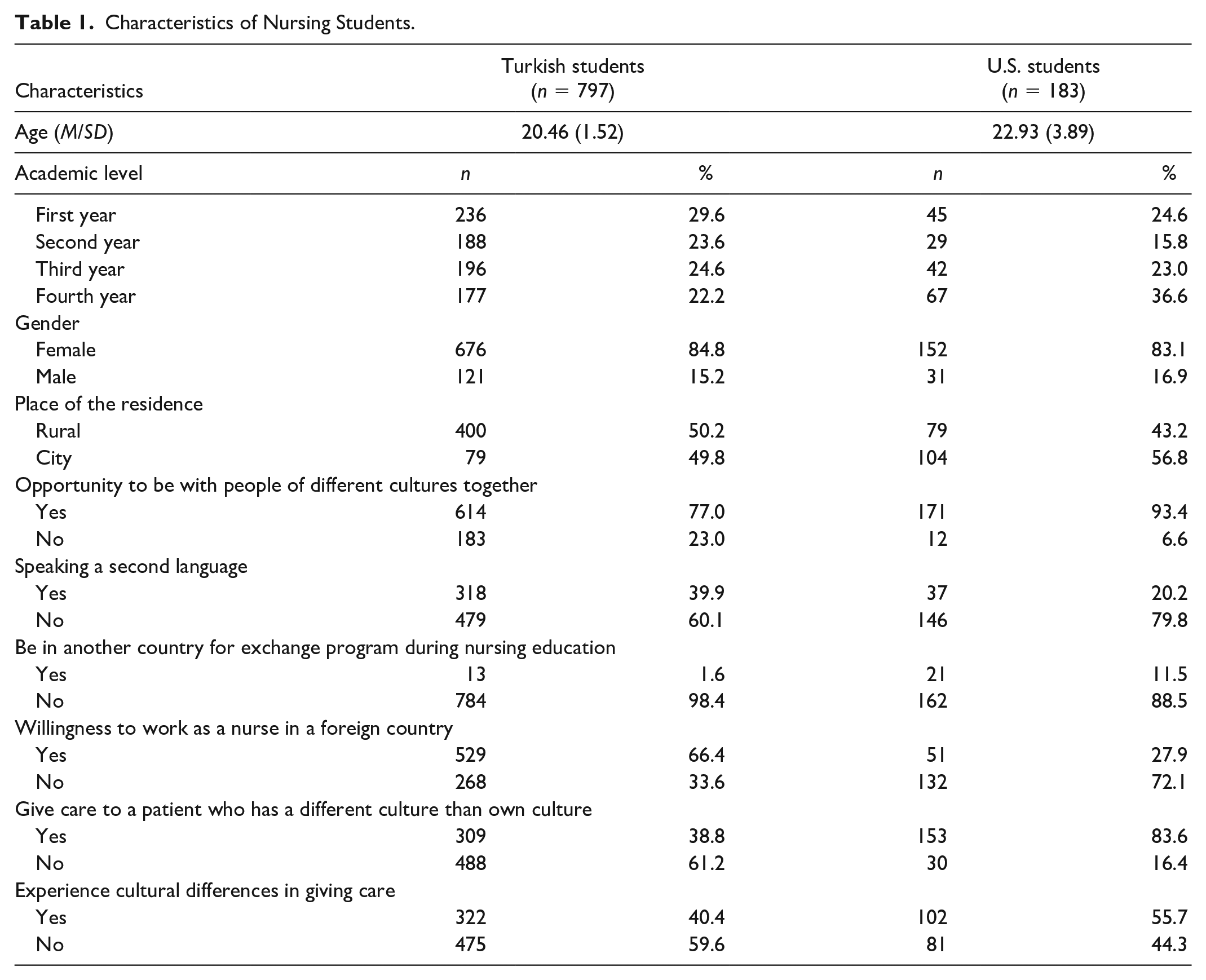
Both Turkish and U.S. students were most often female and had an opportunity to work with people of different cultures. In contrast, Turkish students were more likely to speak an additional language and plan to work in another country. Additional demographic data are presented in Table 1.
Characteristics of Nursing Students.
Intercultural Sensitivity Level of the Nursing Students
The intercultural sensitivity mean scores of the Turkish nursing students were significantly lower than the mean scores of the U.S. nursing students. When the mean scores of subgroups were compared, the mean score of the Turkish students on Interaction Engagement and Interaction Attentiveness subgroups was significantly higher than the U.S. students. Additional data are presented in Table 2.
Mean Scores on Intercultural Sensitivity Scale and Subgroups.
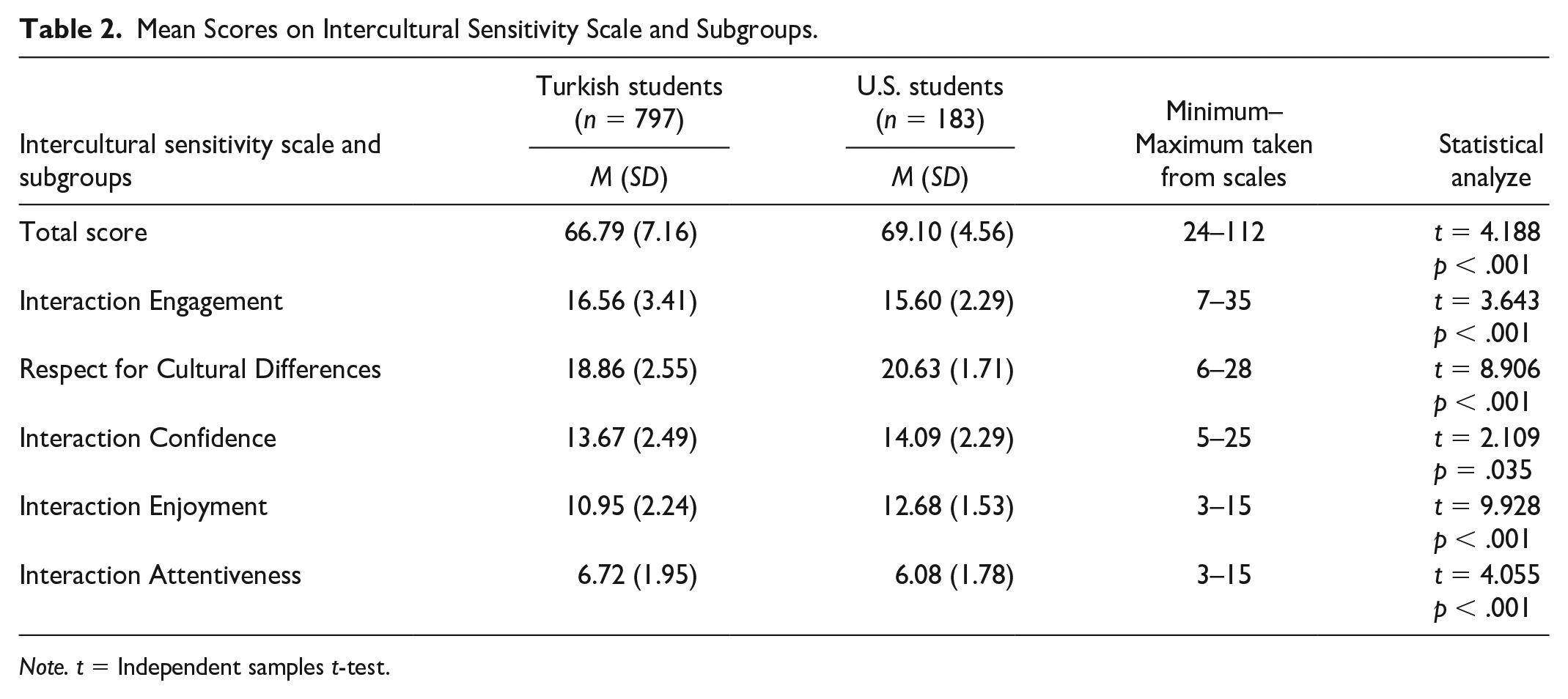
Note. t = Independent samples t-test.
Intercultural Sensitivity and Associated Factors
Multiple linear regression analysis results are presented in Table 3. All independent variables were included in the model. The independent variables which were significant in the univariate analysis (country in which nursing students are studying, speaking a second language, willingness to work as a nurse in a foreign country, give care to a patient who has a different culture than own culture, experience cultural differences in giving care) were included in the multiple linear regression model. Accordingly, it was determined that the model consisting of significant variables explained 2% of intercultural sensitivity variance (Adjusted R² = 0.02, F = 8.438, p < .001). The country in which nursing students are studying (β = 0.108), and speaking a second language (β = 0.069) were associated with intercultural sensitivity (Table 3).
Predisposing Factors of Intercultural Sensitivity.
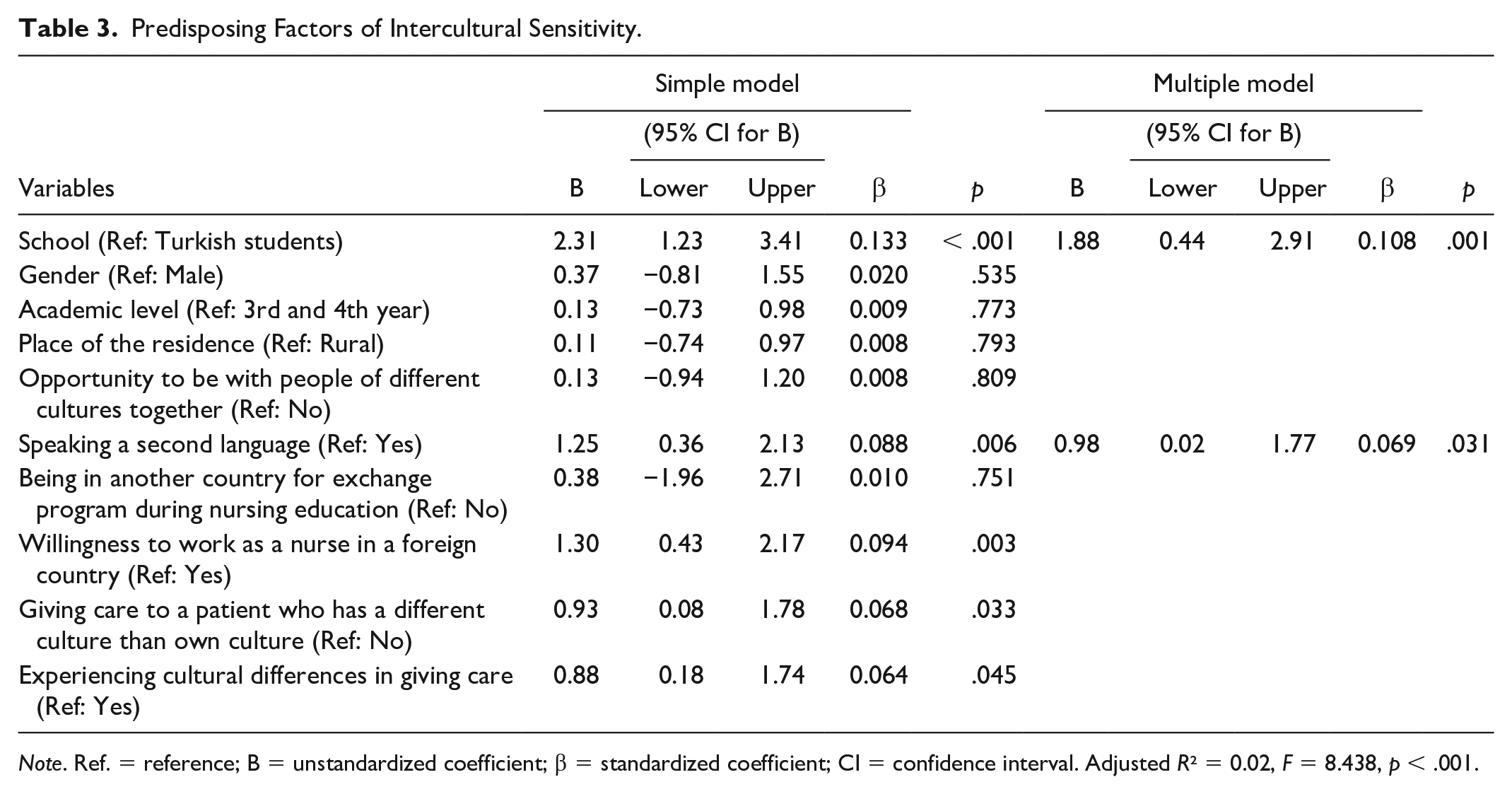
Note. Ref. = reference; B = unstandardized coefficient; β = standardized coefficient; CI = confidence interval. Adjusted R² = 0.02, F = 8.438, p < .001.
The two-way ANOVA was conducted on the total and subgroups scores of the intercultural scale to explore the impact of the schools, in where nursing students are studying, and variables such as gender, academic level, place of the residence, opportunity to be with people of different cultures, speaking a second language, be in another country for an exchange program during their nursing education, or willingness to work as a nurse in a foreign country. The findings of the two-way ANOVA indicated that the interaction effect between nursing students in two schools and sociodemographic variables was not statistically significant (p > .05).
Discussion
Health professionals including nurses need to understand health care needs, backgrounds, and beliefs of individuals to provide culturally sensitive health care. Being with people from different cultures can help increase their intercultural sensitivity level. The present study found that the intercultural sensitivity of nursing students from both universities was at a moderate level, and the cultural sensitivity of the U.S. students was significantly higher than Turkish students. This finding may be explained by the fact that the majority of the U.S. students cared for individuals with different cultures from their own culture. Less than half of Turkish students gave care to people from different cultures. In the literature, nursing students’ intercultural sensitivity scores were found to be higher than the present study (Göl & Erkin, 2019; Kaya et al., 2021; Kılıç & Sevinç, 2018). These studies reported that the nursing students’ mean score of intercultural sensitivity scale ranged between 89.42 and 91.36, whereas in the current study, the U.S. students’ mean score was 69.10 and the Turkish students’ mean score was 66.79. This difference may be due to many factors affecting the culture such as geographical position, experiences of individuals, economic and social environment, and education. Intercultural sensitivity can be shaped with the interpretation and evaluation of cultural differences. The fact that the studies were conducted in regions with different cultural characteristics may have affected cultural sensitivity.
Intercultural communication competence needs to be developed to recognize, respect, tolerate, and communicate effectively with different cultures (Chan & Sy, 2016; Henderson et al., 2016). In the current study, the U.S. students’ mean scores of sub-groups of Respect for Cultural Differences, Interaction Confidence, and Interaction Enjoyment were higher than the Turkish students. This finding may be due to the fact that U.S. students had more opportunities to be with people of different cultures, give care to patients who had a different culture than own culture, and experience cultural differences in giving care more than Turkish students. Also, taking the course of “Cross Cultural Nursing and Global Health” may have increased their sensitivity. One of the learning outcomes of this course is to develop information and recognition of the cultural beliefs and values needed to promote health, well-being, and provide culturally competent care and healing. Contrary to this, there is no course related to intercultural sensitivity in the Turkish nursing education program where the study was conducted. Courses related to Intercultural Nursing can valuably contribute to the understanding of cultural structure and values of society, and to the development of techniques that can provide nursing care accordingly (Ayaz et al., 2010; Çingöl et al., 2021).
Intercultural sensitivity requires one to have positive emotions before, during, and after interaction with people from different cultures. Nursing students recognize similarities and differences between cultures and try to reduce inequalities in providing culturally sensitive care. One of the basic components of intercultural care is intercultural communication (Chan & Sy, 2016). It was found that the mean scores of the Turkish students regarding Interaction Engagement and Interaction Attentiveness subgroups were higher than the U.S. students. The unique cultural perceptions, beliefs, values, and traditions of each culture directly affect the communication of the individual (Zhang, 2010). It is thought that the Turkish students felt more responsible and careful in communication because they may have faced difficulties or obstacles such as language differences, dialect and pronunciation differences, traditions and customs of the individuals, and religious belief and sect while caring for individuals from different cultures. Knowledge alone is not enough to ensure component cultural care (Roberts et al., 2014). Nursing students need education and experience to improve their cultural competence and to provide culturally sensitive care (Akca & Ayaz-Alkaya, 2023; Thomas & Konieczny, 2018). Therefore, nurse educators should contribute to the development of nursing education programs to improve students’ cultural sensitivities and cultural competencies.
The country in which nursing students were studying, and speaking a second language were found as significant predictors of the intercultural sensitivity in the current study. Students who were studying in the United States, and who spoke a second language were found to have more intercultural sensitivity. It is thought that since U.S. students encounter people from many different cultures in their country, and students who speak a second language may communicate more with people different from their own culture, thus their cultural sensitivity may be higher. Different from the significant determinants in this study, factors such as ethnocentrism (Beser et al., 2021; Kaya et al., 2021), age, having friends/relatives with different cultural backgrounds, and moral sensitivity affected nursing students’ intercultural sensitivity (Kaya et al., 2021). This difference may be due to the inclusion of nursing students from a different country in the present study.
Implications for Practice
The cultural values of an individual can influence their perspectives about health care and health care providers. Intercultural education programs within the curriculum should be offered as independent courses and/or integrated within courses. The study findings may help faculty administrators make new arrangements in the nursing curriculum and contribute to providing equal, and non-discriminatory health services to people. Nursing school administrators could integrate foreign language learning activities into the curriculum. Nursing school administrators and educators could utilize a variety of instructional methods into nursing programs to improve cultural competencies of the students. Nurse educators could develop courses specific to intercultural sensitivity comprised of cultural competence, prejudice, bias, stereotyping, health disparities, ethical values, and principles for nursing education programs. Nurse educators could support students at different academic years of the curricula to become aware of their prejudices against culturally diverse groups. Also, role-playing case studies and simulations could be performed in the courses. Nursing school administrators can also take initiatives to increase exchange program opportunities for the students, such as the Erasmus + Program.
Strengths and Limitation
A strength of the study is the comparison of the intercultural sensitivity of nursing students studying in different countries. The results obtained from this study may provide basic information for future interventional studies on this subject. A limitation of the study is that the research results were based on self-reports from the students in the study. This study was based on voluntary participation of those students willing to participate in the research. The study was conducted in only one school from each country and included a more limited number of students in the United States. A cross-sectional design may limit exact causal relationships.
Conclusion
The study concluded that both nursing students from Turkish and U.S. schools presented a moderate level of intercultural sensitivity. The country in which nursing student were studying and those speaking a second language were found as significant predictors of their intercultural sensitivity. Intercultural education programs within the curriculum should be offered as stand-alone courses and/or integrated within courses. The current study recommends that opportunities should be given to students to experience interactions with different cultures to increase their intercultural sensitivity level. Future interventional studies could be planned to increase the intercultural sensitivity of nursing students.
Footnotes
Acknowledgements
We would like to thank all nursing students who took part in the study.
Declaration of Conflicting Interests
The author(s) declared no potential conflicts of interest with respect to the research, authorship, and/or publication of this article.
Funding
The author(s) received no financial support for the research, authorship, and/or publication of this article.
Ethical Statement
The study was approved by the ethics commission (10/04/2018-03) in Turkey and the Institutional Review Board (SCSU IRB# 547—2217) at the university in the United States.
