



Abstract
There are different theories that aim at explaining the emergence of norms (defined as statements about oughtness). It is not known which theory is superior. This paper is a first attempt to propose a new integrated norm theory, based on two plausible and widely accepted theories: James Coleman’s and Robert Ellickson’s theories about the origin of norms. After discussing methodological issues referring, among other things, to arguments for integrating the theories, the new theory is proposed. Among other things, it does not only explain norms as effects of externalities (as Coleman’s theory), but also as signals to express distinctiveness and group commitment (with the example of the Hells Angels motor club). Coleman’s theory is further modified by integrating from Ellickson’s theory a set of variables that intervene between the exogenous variable “close social relationships” and the origin of norms. The model includes transaction costs and cooperation as intervening factors. Furthermore, “overarching norms” (from Ellickson’s research) is added as a new condition for the origin of norms.
Introduction
There is a vast literature in the social sciences and in sociology in particular that aims at explaining the origin of norms. The norms concept has different meanings. Many writings define norms as statements about oughtness (such as “one must not kill” or “one should help others in need”). This definition is used in this paper as well. 1 “Sanctioning” is not part of the definition. It is preferable to employ sanctioning as a separate dependent or independent variable. This makes it possible to explain when norms emerge and, separately, which norms are associated with which sanctions.
A question that is not addressed in the literature is which theory is best suited to explaining the origin of norms. Take as examples the theories by James Coleman, Harold Demsetz, Robert Ellickson, Thomas Hobbes, Elinor Ostrom, and Edna Ullmann-Margalit. It is not known which of these (and other) theories is superior.
This paper is a first attempt to provide a detailed comparative analysis of two of those theories and to propose a new theory which is assumed to be superior to both theories. We chose the theories by James Coleman 2 and Robert Ellickson. 3 The new theory is called the integrated norm theory.
Why is the emergence of norms an interesting topic at all? This question is addressed in each of the different schools in sociology such as functionalism, conflict theory, and rational choice sociology. Most other social sciences address norm emergence as well such as economics, history, political science, and social psychology. The question not answered is which theory offers the best explanation. It is more than astonishing that comparing and integrating theories of norm emergence is not considered one of the major research programs in the social sciences.
Before the two theories are dealt with, we discuss why it is important to compare and integrate theories of norm emergence, why it is useful to start with the theories of Coleman and Ellickson, and how to proceed when integrating theories.
Why compare and integrate theories of norm emergence?
A common procedure in the social sciences is the analysis of single theories. The major problem of this procedure is aptly summarized by Lakatos (1970: 119): “There is no falsification before the emergence of a better theory.” Regarding the explanation of norms, it is not meaningful to analyze, for example, only Coleman’s theory. As will be seen below, Ellickson’s theory suggests new variables and new relations between variables that are missing in Coleman’s theory. The focus on a single theory thus dispenses with the opportunity of the growth of our theoretical knowledge. This is best illustrated by comparing Figure 3 (the Coleman’s model) and Figure 4 (the Ellickson’s model) with the integrated norm theory in Figure 5. The comparison indicates that the integration provides new theoretical ideas that are not included in the two single theories. Even if it turns out that the new theory is wrong, we know more than before. Knowledge of falsified theories is a growth of knowledge as well.
It might be argued that the first step before integrating the theories should be a detailed critical analysis of each of the theories. However, trying to formulate a new model based on the variables of each theory alone is not useful because one of the theories could reveal problems of the other theory. It thus seems recommendable to analyze first how one model could be used to improve the other model. Then the problems of an integrated norm theory should be analyzed.
Note that integration does not only claim that certain new factors are relevant. An integrated theory consists of new relations of variables. This new variable structure is not only based on the two integrated theories but on the existing literature and on new ideas as well.
The integration of previously unconnected theories is a research program pursued in several social science disciplines. Instead of “integration” also the terms “unification” or “synthesis” are used. Gigerenzer (2017) outlines such a program for psychology. An example is Newell’s (1990) attempt to “unify” theories of cognition. Urhahne and Wijnia (2023) suggest an “integrative framework” for motivation theories in education research. There is further the goal of a “grand synthesis” in sociobiology and evolutionary science in general (see, e.g., Laszlo, 1987: 3; Wilson, 1975; see Schnettler and Huinink, 2026 for sociobiology and sociology). The general concern of all this work is to overcome the fragmentation (or, one might say, the chaos) of existing scientific theories and achieve unification to arrive at new superior theoretical knowledge.
Reasons for selecting James S. Coleman’s and Robert C. Ellickson’s theories
It is not possible to deal with all the existing theories about norm emergence simultaneously. We first suggest that one should start with two theories. This is useful because, as the following analysis indicates, this is already relatively complicated. Therefore, a start with three or more theories is not to be recommended for practical reasons.
Which theory should be selected? Selecting the two best theories is useful because it is more likely to find a superior theory when we start with relatively fruitful theories. These are, first, theories which are empirically relatively well confirmed. Secondly, a theory is considered “fruitful,” if it has a relatively high informative (or empirical) content (see, e.g., Popper, 1965: 215–252). In this context this means in particular that a theory can correctly explain what the specific norms are that originate in a situation. An integration of theories that are largely falsified and have a low informative content will probably not lead to a new superior theory and thus to theoretical progress.
The problem of selecting the best theories that explain norms is that we do not know which theories are best. A solution is to apply criteria that allow us to choose theories that are relatively satisfactorily and are thus worth being analyzed and integrated.
A first indicator for the fruitfulness of theories is that they are widely cited and valued positively (see the previous references). For example, Lindenberg (1994: 104) regards Ellickson’s theory as “the most complete theory of norms to date.” Frequent citations of a theory are often due to researchers’ assessment of a theory as fruitful.
However, researchers may erroneously accept a theory that later turns out to be wrong. Even if this is the case, the selection and analysis of such a theory is recommendable because a comparison with another theory will probably show that the accepted theory is false. In this case it is useful to invest resources to search a new and superior theory. As has been noted before, knowing that a theory is incorrect increases our knowledge because we know more than before.
A second indicator for the fruitfulness of a theory is that it consists of a set of several interrelated variables and not of simple hypotheses with one or two unrelated explanatory variables. Our knowledge about norm emergence suggests that a valid norm theory should consist of several explanatory variables and causal relations between these variables, as the following discussion and our integrated norm theory (see Figure 5) indicates. A recent review of the literature on norm emergence (Gelfand et al., 2024) lists numerous separate variables but does not indicate how they are related.
A third indicator for the fruitfulness of the selected theories is that both authors apply a general behavioral theory which is a version of the rational actor model. Coleman calls the theory he applied a “theory of purposive action” (1990: 16, see for a detailed exposition 11–44). Ellickson applies game theory for which the underlying theory is the rational actor model as well (1991: 156–166). Both authors use a thick model that includes motivations to comply to norms, altruistic motivations, and biased beliefs as incentives, in contrast to a narrow neo-classical economic model. The former is meanwhile a widely applied model for explaining real social processes.
A fourth indicator for the fruitfulness of the two theories is that each theory is supported by empirical data. There is a direct empirical test of some hypotheses from Coleman’s theory (Opp, 2002; Piskorski and Gorbatâi, 2017), but there is no test of a full theoretical model like the one proposed in this paper. The evidence is anecdotal such as the plausible explanation of the Judaic pig ban (Leeson et al., 2024). Ellickson analyzes several studies in his book (1991: 15–122, 184–206) that serve to “provide intuitive support” for his theory. He further describes in detail various specific kinds of norms that are considered illustrations of the hypothesis of welfare-maximizing norms that are the concern of Ellickson’s book (see chapters 11 to 14). There is thus some empirical evidence for the validity of the two theories.
A comparison of the two theories is further of interest because their authors come from different social sciences: from sociology (Coleman) and law and economics (Ellickson). It is plausible that the integration of such theories is particularly fruitful because the different traditions might yield different hypotheses that may then be integrated.
We have applied four indicators or criteria for the selection of the theories. We are aware that their application to the two theories raises problems. However, it is difficult to see which other criteria, or which other procedure could or should be applied to select theories. Recourse to an intuitive procedure without specifying criteria is no solution.
The procedure to integrate theories of norm emergence
Assume it is intended to integrate the two theories of norm emergence. It is recommendable to proceed in several steps.
Step 1: Clarification of the concepts and of the structure of the theories
Coleman’s theory is presented in two long chapters (1990: 241–299), and Ellickson’s theory covers an entire book (1991). It is not clear which statements are components of the theory. To clarify the theories the procedure of reconstruction, or, equivalently, explication (Carnap, 1950: 1–18; Hanna, 1968; Wagner, 2012) is applied as a first step of further analysis. This means that a clarification is proposed that does not contradict the analyzed texts. However, it may occur that assumptions of a reconstructed model are implausible, and a scholar has ideas of improving it. This is acceptable because a modification of a reconstruction may lead to theoretical progress.
It could be argued that the ambiguity of a theory prevents any judgment about its quality, because we do not know what the theory asserts. We can thus not judge their validity. Selecting the most fruitful theories is thus not possible.
This argument is not tenable. Denoting a theory as “ambiguous” does not mean that we do not know at all what the theory asserts. “Ambiguity” is a quantitative concept. To illustrate, assume a theory consists of clear concepts with one exception: One of its concepts is “society” and it is not clear what exactly is meant. However, it is clear that collectives such as the USA or Sweden are societies. But whether a small autonomous group in the Amazon is to be called a society is not clear. Despite this ambiguity one may discuss problems of the theory and test it. Only if a theory is completely unclear, no meaningful discussion is possible. This is certainly not the case for the two theories selected.
The claim that an ambiguous theory – regardless of the amount of ambiguity – cannot be discussed has the following consequence: We must give up any discussions of social science theories. The reason is that there is hardly a perfectly precise theory.
Step 2: Homogenization of the vocabulary of the theories
It is possible that two theories seem to consist of different variables but that only the names of the variables differ. For example, in one theory the “resourcefulness” of actors and in another theory the “power” of actors may be a variable. An analysis of the meaning of these variables could indicate that their meaning is identical (see below). In this case the same term should be used in the two theories.
Step 3: Analyzing logical relations
Theories could be in a deductive relation, or they could be contradictory. In the former case the theories are already integrated in the sense that they are no longer competing. One theory is part of the other theory. If theories are contradictory, this means that the theories cannot simultaneously be true. An integration is thus recommendable.
Step 4: Theory integration and test of the integrated theory
Now the theories are in a state that a new theory, based on a fruitful combination of the assumptions of the selected theories, could and should be formulated. It is easiest to begin with an attempt to combine the variables of the theories. In addition, researchers should try to add new variables and new relations between the variables.
What the variables and the relations between the variables are the integrated theory should consist of, cannot be formulated as rules. It is a creative process of the scholars. Any heuristics can be applied.
The researcher then decides to test the integrated model. If the test is not too complicated, the integration with another theory could be useful. The process described before starts again.
James S. Coleman’s theory: Norms as solutions of collective action problems
The meaning of “norms” and “sanctions”
A social norm is defined as actions that are regarded “as proper or correct, or as improper or incorrect” (Coleman, 1990: 242 – here and further in this section page numbers refer to this book). A norm thus exists if an actor has a “socially defined right to control the action” of others. This is the oughtness definition mentioned before (see also, e.g., Coleman, 1988: S104). The expression “social system” refers to three elements (132): actors, resources, and the “initial distribution of control of resources among the actors.” Most of the time Coleman uses “social system” in the sense of a set of (at least) two interacting individuals.
On the collective level, a norm exists if “there is a relatively high consensus in the social system … that the right to control an action is held by others” (243, emphasis added, see also 54). “Consensus” thus refers to agreement about a norm held by the members of the entire social system. A “consensus” about a norm is an aggregation of norms held by individuals (e.g., the variance of individually held norms). This macro variable influences “the behavior of individuals at a microsocial level.” The macro-to-micro relation “provides a convenient device for explaining individual behavior, taking the social system as given” (241).
Norm acceptance is a quantitative variable (e.g., 293). Internalization of a norm refers to a high degree of acceptance and is given, if there is an “internal sanctioning system which provides punishment when he [the individual] carries out an action proscribed by the norm or fails to carry out an action prescribed by the norm” (293).
Sanction refers to “an action on the part of a norm beneficiary that has some effect in moving the focal action in the direction intended by the sanctioner” (242–243). In the theoretical argument “sanction” is used as actions that are intended to change others’ behavior. This implies that there can be sanctions that do not bring about the desired effects. In what follows this definition is used.
The explanatory strategy
Coleman proceeds in two steps. He first explains the demand for a norm. This is an interest in the existence of a norm or a regulatory interest. If there is a demand for a norm, then as a second step Coleman explains when the realization of a norm occurs. This means that the demand is “realized by bringing into being a norm and a sanction,” i.e., “the actual existence of a norm backed by sanctions” (266). Note that “realization” refers to the acceptance of norms by all members of a group (i.e., by the targets who should change their behavior and thus follow the norm and by the beneficiaries of a norm). The strategy thus is to explain the demand and the realization of a norm (see, e.g., 241): This is the theory that is the concern of this article.
Coleman mentions other factors such as group solidarity or group identity (258), but they are not included in explicitly stated theoretical hypotheses. The possible relevance for norm emergence will be discussed later after the reconstruction of the demand and realization hypothesis and in the final section.
Explaining the demand for norms
Let us start with Coleman’s first hypothesis: Demand hypothesis: “The condition under which interests in a norm, and thus demands for a norm, arise is that an action has similar externalities for a set of others, yet markets in rights of control of the action cannot easily be established, and no single actor can profitably engage in an exchange to gain rights of control. Such interests … create … a demand for a norm on the part of those experiencing certain externalities” (250–251).
Externalities (249–250) are “events that have external consequences … for actors who have no control over them” (249). These events may be actions that are harmful for others. These are negative externalities. Smoking in the presence of nonsmokers that hurts nonsmokers is an example. If actions are beneficial for others, positive externalities exist. Coleman’s example is a householder who removes snow from a sidewalk that benefits passersby.
In the following we concentrate on negative externalities because they are most problematic in social relationships. The externality is, in terms of Coleman’s theory, the focal action (such as smoking). Those who cause the externalities are the targets of a norm, whereas those who are affected by the externalities are the beneficiaries of a norm.
The condition of similar externalities suggests that the more people are affected by an externality, the more likely there is a joint interest in the existence of a norm among the beneficiaries of the norm.
A market in rights of control of an action means that a “single actor can profitably engage in an exchange to gain rights of control.” Externalities can thus be removed by “wholly individualistic means” (250). Assume very few people smoke and there is no nonsmoking norm. A nonsmoker could easily engage “in an exchange with the actor whose action imposes the externalities, offering or threatening something to bring about the outcome he desires” (250). There is thus a market of control rights for an action.
The quotation of the demand hypothesis sounds as if there is an additive effect of the two variables. However, it implies that the impact of externalities on the demand for a norm depends on the existence of a market of control. Strong externalities generate the demand for a norm only if there is no market for control. There is an interaction effect in the sense that the impact of one variable depends on the values of the other variable.
Explaining the realization of norms by applying the theory of collective action
The explanation of the realization of norms consists of an application of the theory of collective action. 4 For readers who are not familiar with this theory, we will provide a short outline of this theory in Supplemental material at the journal’s website. Coleman’s theoretical argument is as follows.
The elimination of externalities is a first-order public good. This means that not being exposed to negative externalities is a joint benefit for those exposed to the externalities. Norms and sanctions are second-order public goods: If those norms and sanctions exist, they are expected to reduce the externalities. The norms and sanctions are thus instrumental for reducing the first order public goods. For both kinds of public goods individual contributions require special (i.e., selective) incentives. The reason is that there are incentives not to contribute because the contribution of others can provide the public goods. Coleman hypothesizes: Realization hypothesis: If there are social relationships between the beneficiaries and the targets of a norm, the provision of the second-order public good becomes likely. This increases the likelihood of the provision of the first-order public good (e.g., 262, 270–273).
Coleman also mentions that there are norms for which targets and beneficiaries coincide (e.g., 247). But assume targets and beneficiaries of a norm are different as in the case of the nonsmoking norm. There may be separate networks of targets and beneficiaries. However, both groups may have social relationships. In friendship groups there might be relationships between smokers and nonsmokers. If there are such “inclusive social relationships” (Opp, 2018: 180), sanctioning is less costly than in networks consisting only of norm beneficiaries.
Why are social relationships the decisive factor for the realization of the norm? Coleman argues that social relationships “facilitate the employment of sanctions” (270, see also 273). Thus, if social relationships exist, then sanctioning the non-contributors to the first-order public good (and sanctioning those who do not sanction non-contributors) increases the likelihood of the provision of the first-order public good.
Social relationships may be “primordial social ties, relations of friendship, ‘informal’ social relations of all sorts, and authority relations such as those of master and servant or father and son” (43). In the exposition of the realization hypothesis Coleman only mentions that “communication that allows the possibility of joint action” is relevant (270). When he discusses the importance of “closure” of a network he refers to “close-knit, highly connected social networks” (285). Thus, “close” relationships exist if each actor in a group has ties – directly or indirectly – to each other actor. In general, networks refer to relations between at least two actors.
Let us illustrate the realization hypothesis with Figure 1 (based on Figure 11.1 on p. 269; see also Coleman, 1988 for a discussion of the impact of social relationships on sanctioning). Panel A shows a situation in which A1 causes externalities to A2 and A3. Assume first that A2 and A3 have no relationship with each other (assume they do not know each other). Each can separately sanction A1 (see the dotted lines). Next – see panel B – let A2 and A3 have a social relationship with each other (see the solid line between A2 and A3). Assume the two actors are neighbors or friends. This allows “some form of joint action” (270) or to “combine forces” (Coleman, 1988: S105) such as joint sanctioning. This is more successful and also more costly to the sanctioned individuals than isolated sanctioning. It is further possible that A2 and A3 sanction each other for not sanctioning. This may happen if one does not sanction the actor who causes the externalities. Social relationships thus promote the provision of the second-order public good. Social relationships, externalities, and sanctioning. Modified version from Coleman (1990: 269, Figure 11.1).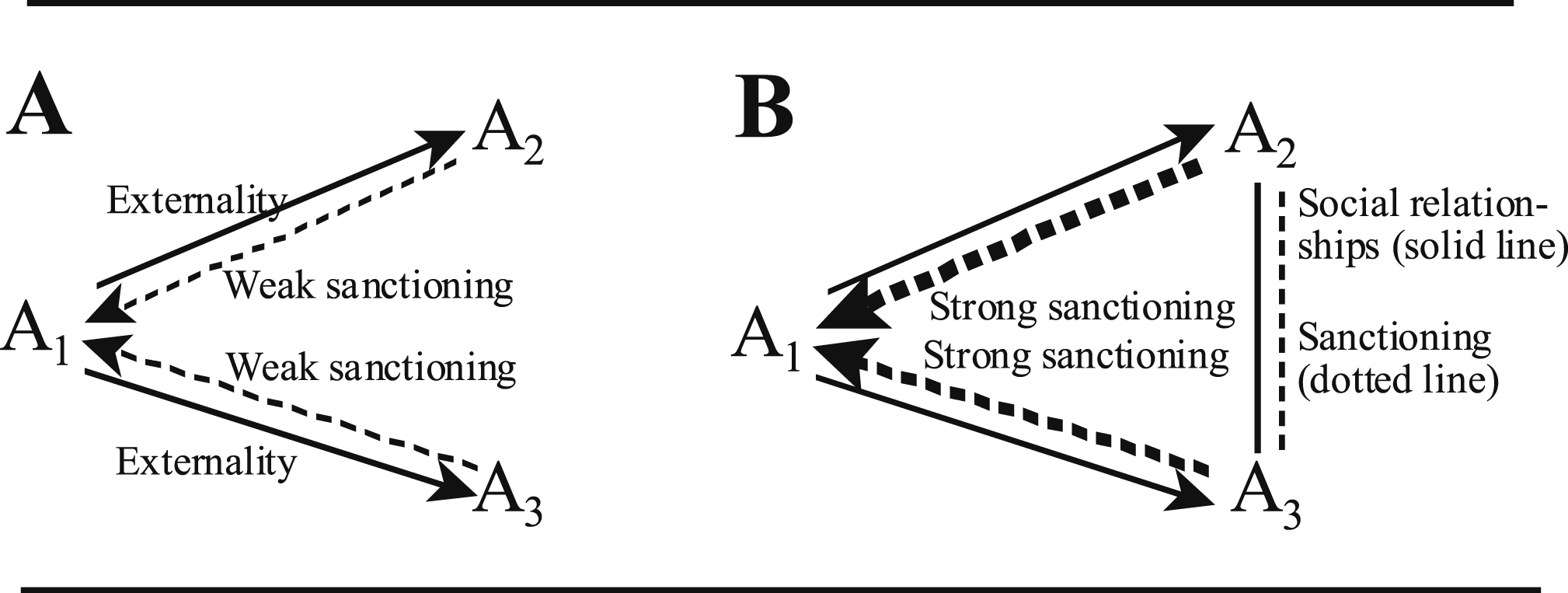
We summarize the argument referring to the application of public goods theory in Figure 2. Close social relationships between the norm beneficiaries and targets diminish the costs of sanctioning the targets (those who impose externalities) and those who do not sanction non-sanctioners. The sanctioning brings about the realization of the demanded norms and has an indirect causal effect on contributions to the first order public good. The norm has an indirect positive causal effect on the solution of the first-order public good as well. The latter is the primary goal of those exposed to the first order public good. Coleman’s model explaining contributions to the provision of first- and second-order public goods.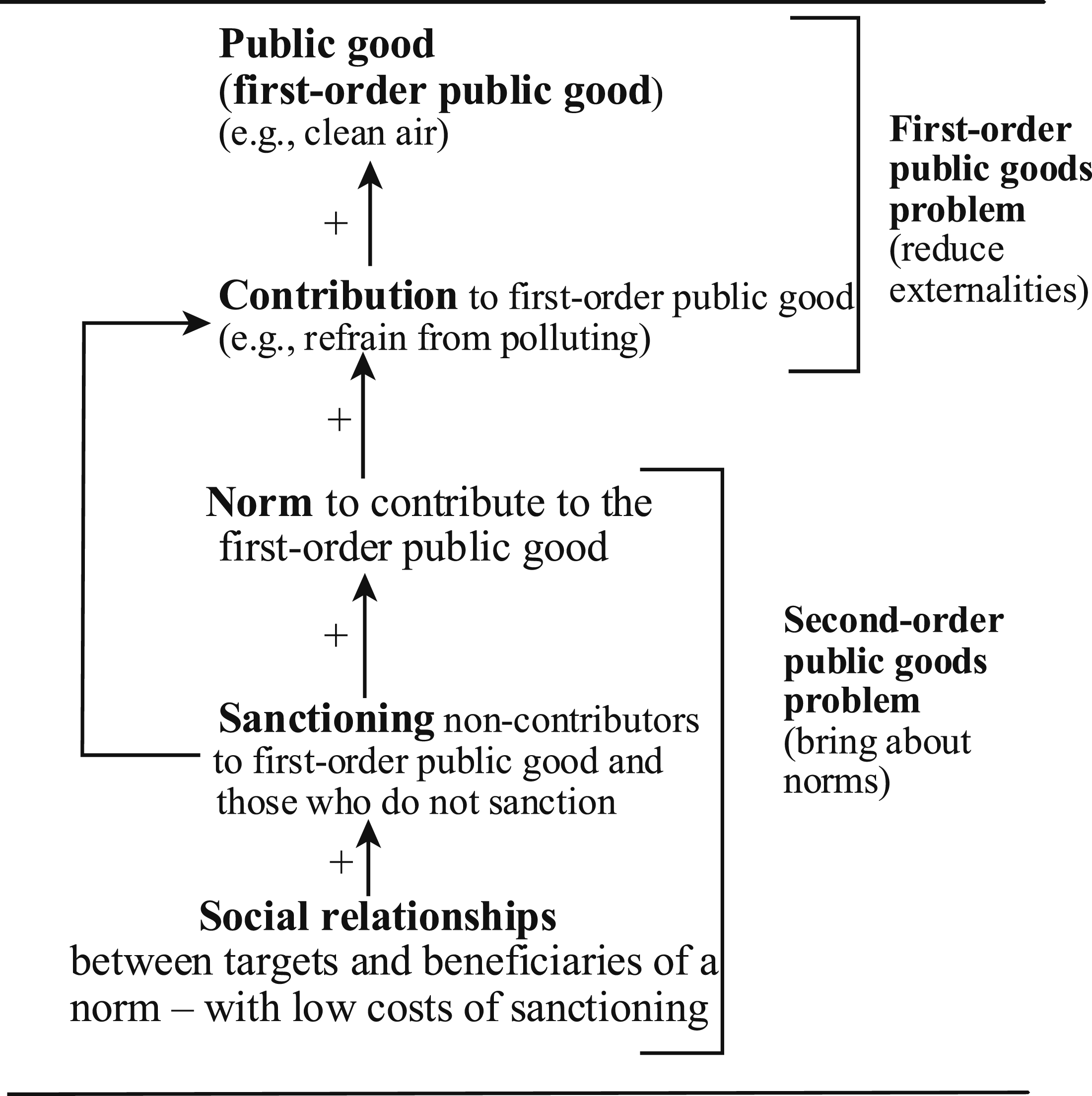
Why do A2 and A3 sanction at all? Sanctioning is costly. It could be argued that sanctioning will not occur because it is a public good and individuals can free ride (see Voss, 2001). There is thus no benefit of sanctioning. However, in close relationships sanctioning has many benefits. One is achieving status in a group. An advantage of joint sanctioning is that it increases the likelihood of providing the first-order public good (see Figure 1). Furthermore, as will be seen later, in the extended model social relationships are related to norms of sanctioning whose abidance is beneficial by leading to a good conscience. In addition, following the “norm of neighborliness” that normally holds within close relationships yields benefits.
Let us now return to Coleman’s theory which is summarized in Figure 3. As was said before, “similar externalities” and “no market for control rights” affect the “demand for a norm” which is a condition for the “realization of a norm.” The last line of the figure summarizes the part of the theory based on public goods theory (see Figure 2). “Social relationships” are an exogenous variable that diminish the costs of sanctioning (but the costs are not zero). Low costs of sanctioning increase sanctioning activities. “Social relationships” thus have an indirect causal effect on sanctioning. Note that there are benefits from the norm, namely the reduction of externalities so that sanctioning is beneficial. A reconstruction of James S. Coleman’s theory of norm emergence. Based on Opp, 2018: 176. The * symbolizes an interaction effect.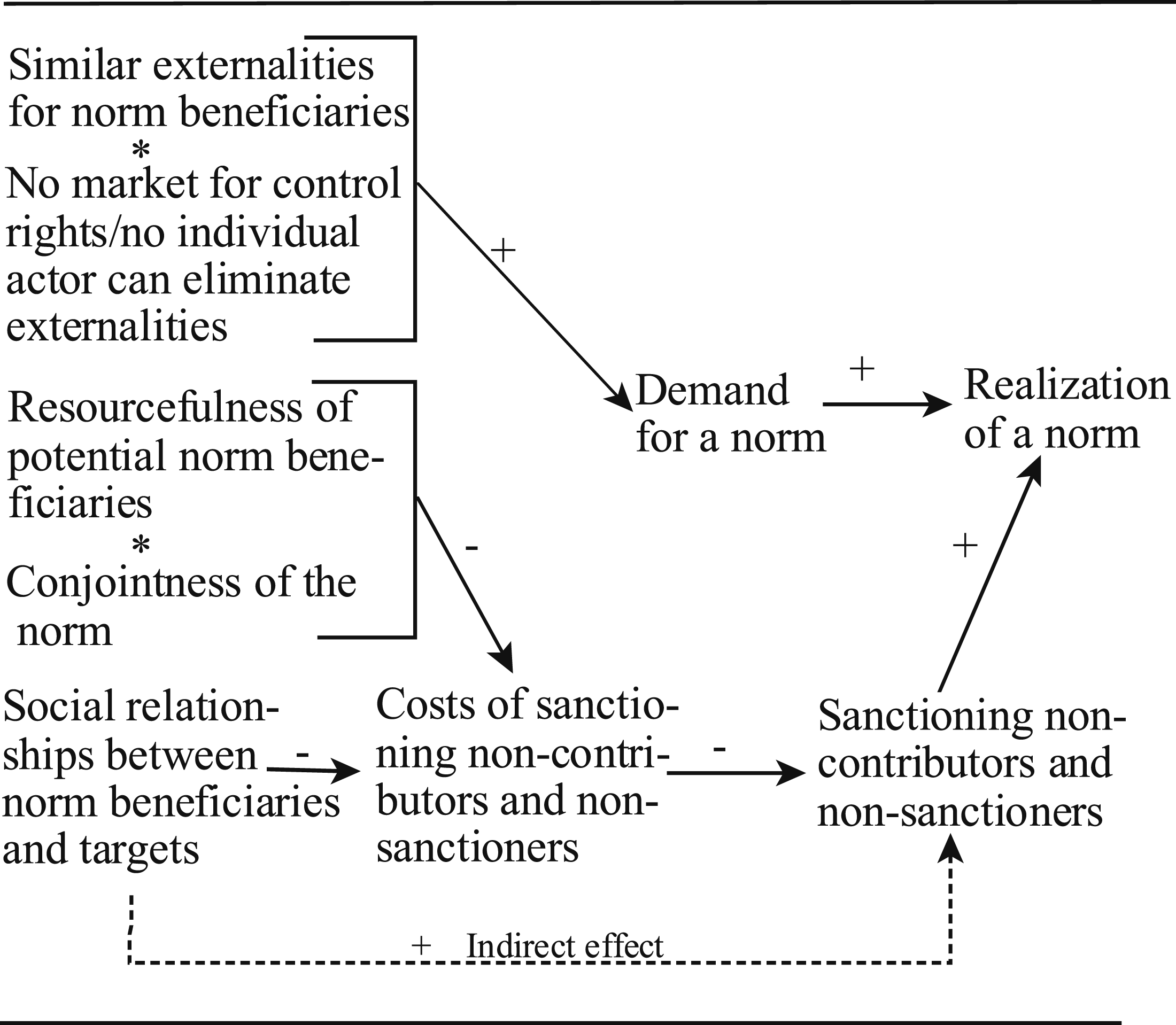
Another factor (implied by the general theory Coleman applies, see, e.g., 28) is the resourcefulness of actors (262–264). Coleman defines “things” as “resources over which [actors] have control and in which they have some interest” (28). These “things” may have a different “character.” They may be rights (such as the right to sanction), material objects (such as property), intellectual abilities (including creativity or social skills to negotiate), or status (such as being the boss of a department – Coleman’s example). Note that a relatively equal distribution of power in a close-knit group (called high “reciprocal power” by Ellickson – see 1991: 181) means that the resources of actors to realize their goals are relatively low. If a resourceful actor is interested in the provision of a public good and, thus, is a norm beneficiary, he or she incurs lower costs of sanctioning than a less resourceful (or less powerful) actor.
Coleman also uses the concept of power (see, e.g., 39, 262). When he addresses the “distribution of rights and resources” he calls the availability of those rights and resources “power”. In what follows we employ the concept of resources which has less connotations than the concept of power.
When Coleman discusses resourcefulness of actors he addresses the impact of two kinds of norms. There are situations in which “the targets of the norm and the beneficiaries are not the same persons” (247). Coleman calls such norms disjoint norms (247). An example is the norm which prohibits smoking in the presence of nonsmokers. In other situations beneficiaries and targets are the same. If individuals catch a contagious disease (such as Covid-19) and infect others, the infections are externalities. There is a common interest to remove the externality. The norms in those situations are called conjoint norms. Between these extremes there are numerous inclusion relations between beneficiaries and targets (see 248, Figure 10.2).
It is plausible that resourceful (i.e., powerful) actors who benefit from a norm have higher chances to get a norm realized, even if there is a high disjointness of interests in a group. “Those actors having more power will be able to impose disjoint norms to govern the actions of those having less power” (262). This imposition of the norms is achieved by means of sanctioning.
Resourcefulness is more effective for bringing about norms in situations with a high conjointness of norms. As has been said, in a situation with conjoint norms the targets of a norm are also its beneficiaries (remember the contagious disease as an example for a conjoint norm and the smoker-nonsmoker situation as an example for a disjoint norm). If actors are relatively resourceful, the costs of sanctioning are lower if there is conjointness. Sanctioning is thus more likely. This, in turn, promotes the realization of the norm. In other words, high consensus in a group on the desired norm makes sanctioning more effective to realize the demanded norm.
This is compatible with the hypothesis that if there is agreement in a group “which norm to follow, punishment typically helps push low contributors towards more cooperation” (Rauhut and Winter, 2017: 240). Accordingly, high disagreement about which norm is most beneficial reduces the effectiveness of punishment to bring about a norm.
Do norms arise only when there are externalities of actions?
This is the headline of a short section in Coleman’s book (257–259). One of his examples for norms that are not caused by externalities are dress codes which existed, for example, in American high schools. Coleman assumes that “a member’s action in conformity with the particular norm creates a positive externality for other members of the group” (258), i.e., benefits for others. This hypothesis presupposes that the respective norm exists already. Its origin is not explained. Perhaps creating or maintaining a positive externality is a goal that has brought about the dress code. If – as the headline asserts – there are norms without externalities, those positive externalities should not bring about norms. But even if positive externalities are a cause for the origin of norms, mere externalities are not sufficient for the realization of norms, as Coleman’s theory implies. But the heading assumes that there are norms without externalities.
Coleman further argues that the members of certain groups “want to differentiate themselves from others.” For achieving this goal “common dress constitutes a very efficient means of doing so” (258). This implies that the emergence of the norm presupposes the existence of a group. Obeying a norm further strengthens “group solidarity” and “will declare one’s group identity” to other members of a group. It is not stated how these variables are related to the emergence of a norm. A clear causal model is missing.
Compared to the demand and realization hypotheses, these assumptions are rather orienting statements that could be used to formulate a clear theoretical model. Coleman seems to be aware of this when he writes: “This is more conjectural than much of the theory in this book and clearly requires empirical study, in order to test the theory and elaborate its details” (259). We will return to those ideas when we discuss Ellickson’s theory which includes some of Coleman’s ideas.
Robert C. Ellickson’s theory of the origin of welfare-maximizing norms
In what follows we focus on Ellickson’s “hypothesis of welfare maximizing norms” (1991: 167–183 – here and further in this section page numbers refer to this book). For limitations of space, other hypotheses in Ellickson’s book cannot be analyzed and must be left for further research.
Norms are defined in the same way as in Coleman’s theory as statements about oughtness. Ellickson gives the following summary of his theory: “ ... members of a close-knit group develop and maintain norms whose content serves to maximize the aggregate welfare that members obtain in their workaday affairs. … Stated more simply, the hypothesis predicts that members of tight social groups will informally encourage each other to engage in cooperative behavior with one another” (167, emphases added).
An illustration is the explanation of a norm in a group such as the Hells Angels that is discussed in detail later: This is a “close-knit” motor club. Assume the members want to create some visible signals such as wearing certain tattoos to show that they are members of this group. A norm to wear such signals could “maximize aggregate welfare” – assuming that such a norm refers to “workaday affairs” (see below).
Let us look at the meaning of each factor and how it affects – directly or indirectly – the origin of norms. Figure 4 depicts Ellickson’s theoretical model as a causal diagram. A reconstruction of Robert Ellickon’s theory of norm emergence.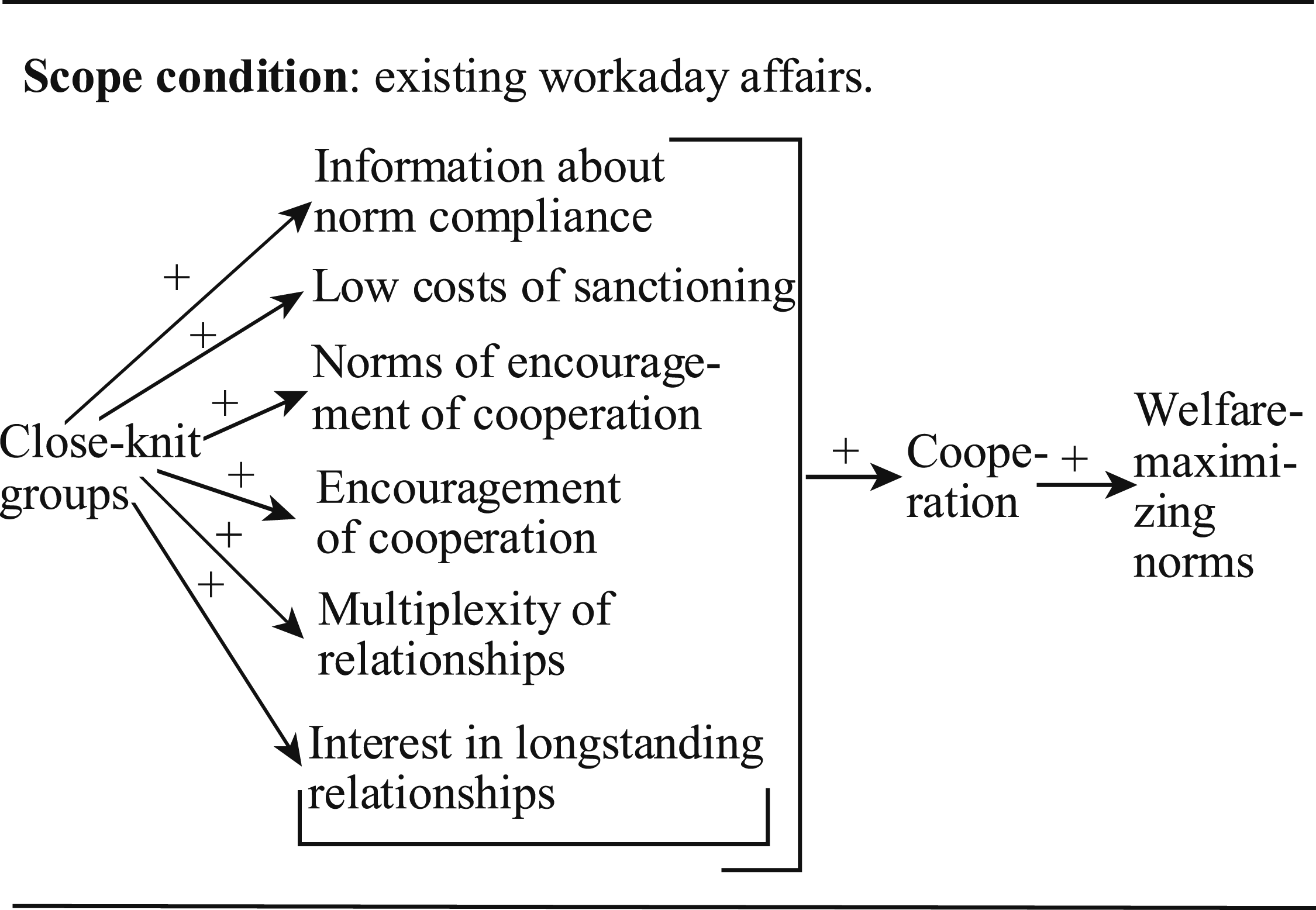
Close-knit groups
A group is defined as close-knit “when informal power is broadly distributed among group members and the information pertinent to informal control circulates easily among them” (177–178). There is thus relatively high equality of informal resources (i.e., power), and there is high closeness in the network. This means that there are direct or indirect ties between all members of a group. Ellickson mentions as examples of close-knit groups a small remote island and Shasta County in California (178) – see below. A “transient environment such as a singles bar at O’Hare Airport” (169) is not a close-knit group.
There is one component of close-knittedness that has an impact on the other characteristics: “cross-cutting webs of dyadic relationships” (181), i.e., direct or indirect ties between all members of a group. This is compatible with the hypothesis that the “existence of these networks contributes to informal control in several ways” (181).
Ellickson’s theoretical argument regarding close-knittedness resembles Coleman’s hypothesis about the impact of social relationships. Close-knit groups are relevant because they affect factors that influence norm emergence. It thus seems that “close-knittedness” means “closeness of ties” (i.e., there are direct or indirect ties between the members of a group). Ellickson’s hypothesis thus reads (the arrows symbolize causal effects): Close-knittedness (closeness of ties) → Intervening variables → Norm emergence.
Ellickson’s theoretical argument suggests the following intervening variables. Close ties lead to (1) an easy spread of information about norm compliance; (2) a decrease of the costs of sanctioning which is identical with increasing sanctioning possibilities; (3) norms to encourage cooperation; (4) actual encouragement of cooperation; (5) multiplexity of relationships – e.g., neighbors in Shasta County “interact on water supply, controlled burns, fence repairs, social events, staffing the volunteer fire department and so on” (55); (6) an expectation that those interactions “continue far into the future” (55). It is thus assumed that close ties have an effect on those six intervening variables. They, in turn, influence cooperation (see below). This is a cause of the emergence of those norms that are welfare maximizing.
Maximization of aggregate welfare
Norms develop whose “content serves to maximize the aggregate welfare” (167). The expression “serves to” suggests that the individuals whose actions contribute to the emergence of the norm have the goal of maximizing aggregate welfare (170). Welfare “is measured by objective values, not subjective utilities” (170). However, norm-makers first employ “appraisals” (170). They thus assess the situation. This is also implied by Ellickson’s underlying theory which is a wide or thick rational actor model (as has been said before). Even if norm-makers assume that objectively no better situation can be achieved by a norm, they may be mistaken.
The first step of the process of “objective” welfare maximization is thus subjective utility maximization. This is in line with Ellickson’s argument when he writes that welfare “includes not only commodities but also other outcomes that people might value as much or more, such as parenthood, leisure, good health, high social status, and close personal relationships” (170). These are (subjective) preferences or goals that people want to achieve by applying their beliefs (which may be wrong).
We reconstruct the theory so that it includes subjective “maximization of aggregate welfare” as a first step of the process of norm emergence. Whether objective welfare originates is another step of the explanation that is not addressed by Ellickson and will not be discussed in this article either.
Workaday affairs
Norms about workaday affairs refer „to norms that govern such things as trade practices, sports etiquette, and relations among neighbors” (173). The hypothesis “does not apply to … foundational rules” such as charity rules (174). The reason for restricting the hypothesis to workaday affairs seems to be that only norms in workaday affairs originate spontaneously (174) – the explanandum of Ellickson’s theory (see especially 4–6).
Cooperation
This is an endogenous variable that is indirectly influenced by close-knittedness. What exactly “cooperation” means is not clear. Ellickson refers several times to the Prisoner’s Dilemma where “cooperation” means joint behavior that yields the most beneficial outcome for all actors. In general, cooperation in a close-knit group could refer to a behavior that leads to relatively satisfying resolution of disputes (e.g., VIII).
Note that cooperation directly facilitates the emergence of norms and not vice versa. It could be argued that there is a reciprocal effect of norms and cooperation. We will discuss such an effect in more detail in the section “Relations between the general norm and the specific norms.”
A comparison of Coleman’s and Ellickson’s theories
The previous discussion resulted in two causal models: one is Coleman’s theory (Figure 3), the other Ellickson’s theory (Figure 4). How can and should we proceed to formulate a new theoretical model that combines variables of the two theories and that is superior to each of the theories? In other words, how can we integrate both theories?
A comparison of the meaning of the concepts of the two theories
As has been said before, the first step of integrating the theories should be homogenization of their concepts. Two variables of the theories have at least a similar meaning: “close social relationships” in Coleman’s theory and “close-knit groups” in Ellickson’s theory. “Close-knittedness“ in Ellickson’s theory (see the definition described before) implies that there are direct or indirect ties among the members, or, in other words, actors are highly connected. Close-knit social groups thus “contain cross-cutting webs of dyadic relationships” (1991: 181): According to Coleman, social relationships are “close-knit,“ if networks are “highly connected“ (1990: 285). Note that Coleman uses Ellickson’s term “close-knit.” It thus seems justified to assume at least similar meanings of the two concepts and treat them as one variable.
Network analysis could be applied to further clarify “closeness” of relationships (e.g., Centola, 2018). For limitations of space we only make a suggestion that should be further analyzed. “Closeness” means that everybody can be reached – directly or indirectly – by everybody else. If some actors have relationships to a relatively large number of actors, this makes the spread of information easier. In network analysis this is a closeness centrality measure (e.g., Evans and Chen, 2022; Scott and Carrington, 2011: 365–368; see Centola, 2018: 13–33 about networks that are relevant for diffusion). What exactly the best measures for closeness are needs to be clarified if the model is empirically tested.
As was seen before, “costs of sanctioning” are also identical in the two models (see Figures 3 and 4).
The logical relations between the two theories
There are no deductive relations between the theories. They are so different that due to formal logic no deductive relations are to be expected. The theories are not contradictory either. To demonstrate this we formalize them in the following way. Let the identical variables of both theories be called “i,” the variables that occur only in Coleman’s theory “c,” and the variables that occur only in Ellickson’s theory “e.” Let “n” be the explanatory variable “norms.” The formalization is as follows: Coleman’s theory C: [If (c and i), then n] Ellickson’s theory E: [If (e and i), then n].
Truth tables show that the conjunction of the two theories (C and E) can be both true and false (for the possible truth values of the single component statements). Because both theories can be true simultaneously there is no contradiction; because they can both be simultaneously false, there is no deducibility either.
The integration of the theories: A new integrated norm theory
We start with the more complicated Coleman’s theory and analyze whether it is plausible to extend this theory by integrating factors from Ellickson’s theory. We expect that fewer changes in the Coleman’s model are necessary than when we start with the Ellickson’s model.
In the remainder of this section, it will be shown step by step how the Coleman’s model will be changed by integrating variables from the Ellickson’s model. The final model is summarized in Figure 5. The changes of the original Coleman’s model from Figure 3 are printed in bold in Figure 5 so that the reader can easily follow which variables have been added in which way. The final integrated model.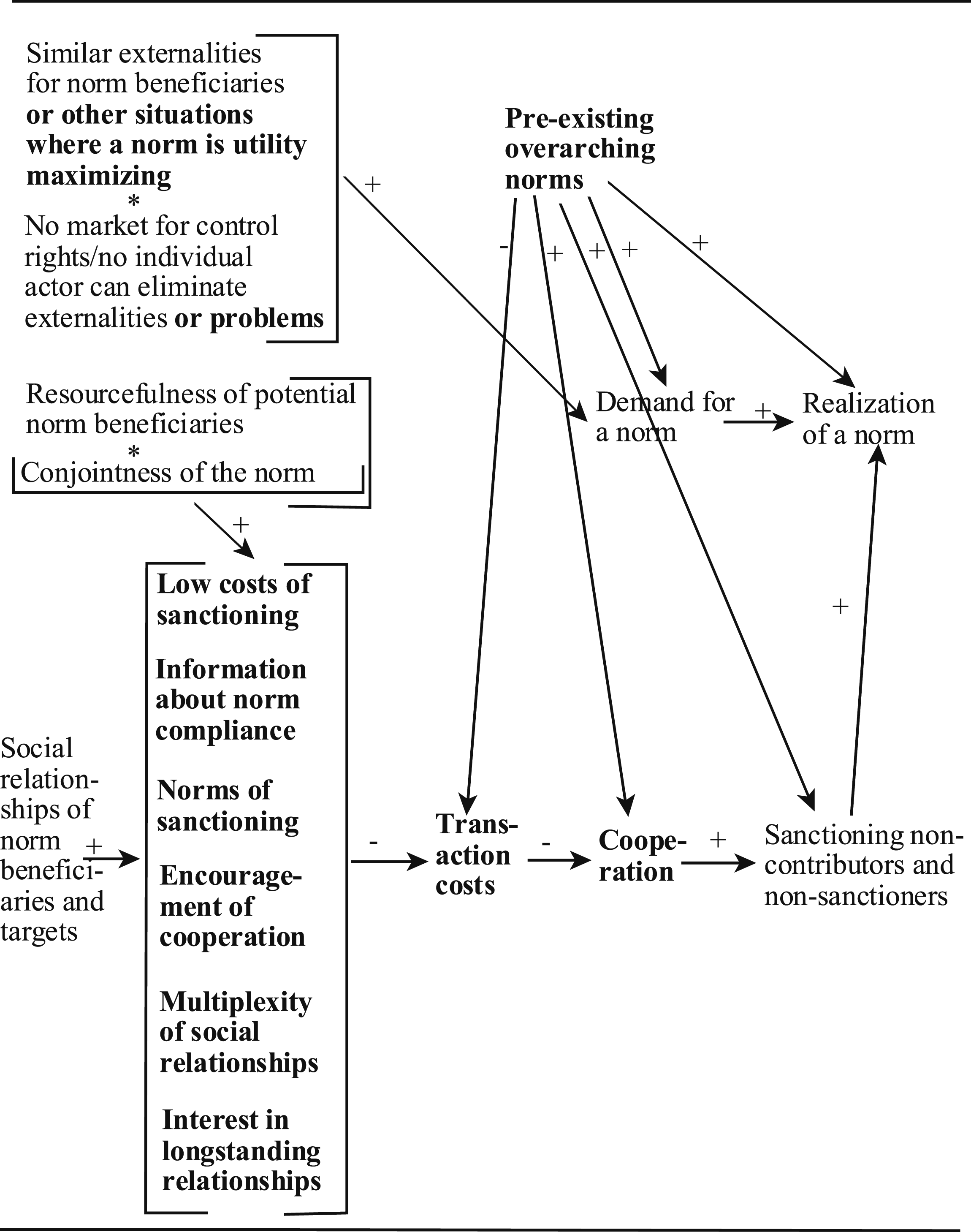
The impact of close-knittedness in Ellickson’s theory
In our explication of Ellickson’s theory, we assumed that there are causal effects of close-knittedness on the factors in the second column of Figure 4. Another possibility is that these variables are defined as properties of close-knittedness. This means that close-knit groups are those groups in which costs of sanctioning are low, in which there is information about norm compliance and so on. These factors are determinants of norm emergence – with some intervening variables that will be discussed below.
It is not clear whether Ellickson assumes causal effects of close-knittedness or definitional relations. For an initial formulation and test of the integrated norm theory the definitional explication is useful: The research only needs to measure the features mentioned, and there is no need to examine the causal effects of social relationships on these features. But assuming causal effects would extend our knowledge about the impact of networks in general and would thus be – in the long run – preferable.
“Cooperation” in Ellickson’s theory
Although this variable is not part of Coleman’s model, he assumes that individuals interact to bring about a social optimum (as he puts it). We therefore include “cooperation” as an intervening variable between the effects of “social relationships ” (the new column printed in bold in Figure 5) and “sanctioning the non-contributors.” The latter is the major variable that influences the realization of a norm. “Transaction costs” are discussed later.
“Workaday affairs” in Ellickson’s theory
Coleman’s model can be applied to all kinds of situations. This implies that the model may also explain fundamental norms. One of Ellickson’s scope conditions is thus not included in the new theory. Coleman’s arguments suggest that the new model holds for any kind of norms so that it is justifiable to drop “workaday affairs” from the theory.
Externalities in Ellickson’s theory
This is a major variable in Coleman’s theory but not explicitly included in Ellickson’s theory. Nonetheless, Ellickson’s theory implies that externalities may influence the emergence of norms. In Ellickson’s case study of Shasta County in California the major problem of the residents was an externality, caused by straying cattle. This externality is reduced by the emergence of a set of norms (see below). Ellickson’s model thus implies that externalities are relevant for norm emergence.
Norms without externalities in Ellickson’s theory
As has been seen, Coleman mentioned that there are norms without externalities, but he does not formulate a clear theoretical model. We will combine Coleman’s and Ellickson’s ideas so that norms with and without externalities can be explained.
Let us proceed from the example of signaling norms (e.g., Macanovic et al., 2024; Przepiorka, 2025; Przepiorka and Diekmann, 2021). Coleman mentions dress codes (1990: 257–259). Members of certain groups wear long hair, have piercings and tattoos to signal distinctiveness or, as one may put it, a special group identity. Such signals often become a norm: Members must have long hair etc.
This is the case for members of the Hells Angels motor club (e.g., Bosmia et al., 2014). They display death heads with wings and a helmet as a tattoo on their skin and on clothes (see the pictures online by searching in Google “hells angels”). Such patches signal “aggressiveness, impulsivity, and intense personal loyalties that typify the culture of the outlaw biker” (Bosmia et al., 2014: 523). Sharing such patches is a club rule (see also the Wikipedia entry “Hells Angels”). Ellickson’s theory implies that signaling norms originate if they raise the aggregate welfare of a group. In this case the goal is not to remove an externality, but to show distinctiveness (i.e., membership in a certain group with certain properties).
Such signals may also symbolize commitment to or identification with a group. 5 For those who perform the behaviors there are “straightforward benefits of comfort, familiarity, and easy communication in one’s group” (Hardin, 1995: 77). This is compatible with Coleman’s assumption that such behaviors create positive externalities in the group. According to Ellickson, such behaviors become norms if they increase the welfare of the group.
Ellickson’s theory can thus explain norms that maximize (subjective) utility in situations in which problems exist that are not externalities. The factor on the upper left in Coleman’s model (Figure 3) needs to be changed accordingly (see the addition in the factor on the upper left of Figure 5, printed in bold): We extend the first factor in the upper left of Figure 5 by adding “or other situations where a norm is utility maximizing.”
Is the existence of a market for control rights of actions also relevant for norm emergence if no negative externalities exist? Assume a “Hells Angels” group just formed, and a member suggests wearing costly tattoos and new clothes with the death head on the back. Because this is costly for the members the general acceptance of wearing those signals cannot be brought about by “individualistic means” by “offering or threatening something to bring about the outcome” desired (Coleman, 1990: 250). There would thus not be a “market for control” so that a demand for norm originates.
Figure 6 shows in more detail the difference between the situations with and without externalities. Assume first there is the goal to reduce externalities (see the left panel of Figure 6). If there is the possibility to achieve this goal by individualistic means, there is no demand for a norm. Now assume that the goal is to show distinctiveness or group commitment (see the right panel of Figure 6). Again, if this goal can be achieved by individualistic means (i.e., by individual actions), there is no demand for a norm, and there will not be the realization of a norm. Comparison of the role of a market of control for reducing externalities and other goals.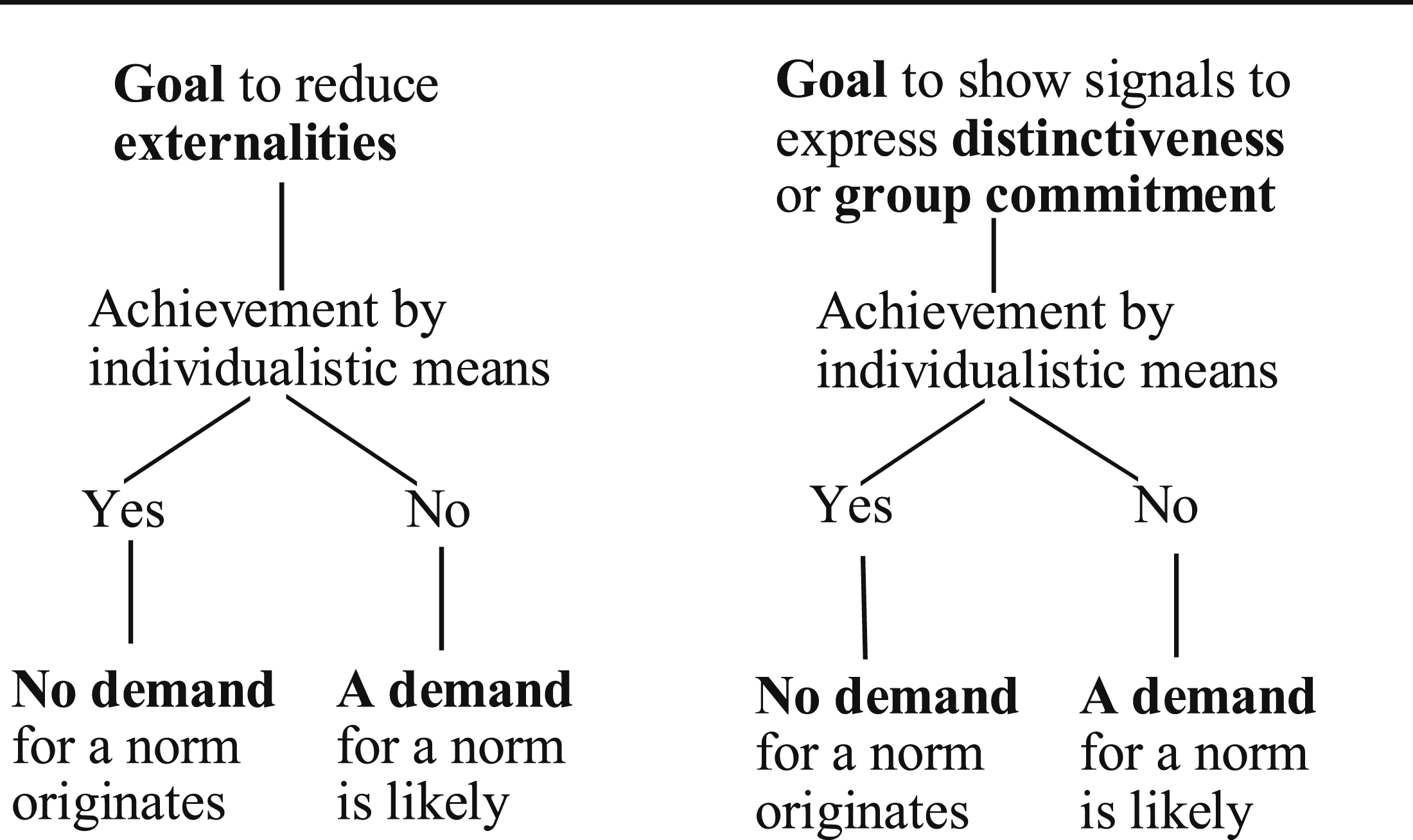
We add an extension of the Coleman’s theory (Figure 5): The second variable on the left (“No market for control…”) should be reformulated by adding “or problems” (see Figure 5, the reformulation of the two upper left variables).
The “overarching” norm of neighborliness in Ellickson’s study of Shasta County: An extension of the integrated norm theory
As has been said before, one of Ellickson’s case studies was conducted in Shasta County. This county is a close-knit group and developed welfare-maximizing norms referring to workaday affairs (1991: 184). The problem the residents face is trespassing cattle: Livestock of ranchers sometimes invaded the land of other rural residents. For example, the victims’ vegetation and fences are damaged. Although such incidents are unpleasant, they happen rarely and are regarded as “minor irritations” (47). Nonetheless, trespass incidents are costs, i.e., negative externalities.
A “principal finding” of Ellickson’s study is that “Shasta County neighbors apply informal norms … to resolve most of the issues that arise among them” (1). There is a general norm that Ellickson calls a norm of neighborliness. This is “an overarching norm of cooperation among neighbors” (48, see also 52–53). The goal of all residents is “to resolve disputes” (VIII) about the existing externalities. This goal is realized by the acceptance of and conformity to the general norm that one “should be a ‘good neighbor’” (185). A pre-existing general norm is thus relevant for the emergence of specific situational norms that refer to the situation in Shasta County. Such a hypothesis is missing in the Coleman’s model.
Coleman does not formulate explicit hypotheses about the existence and impact of pre-existing norms. However, he assumes that such norms exist. For example, he mentions norms about sanctioning (1990: 273). It can thus be assumed that the introduction of pre-existing norms does not contradict Coleman’s theory.
Several questions arise. (1) What exactly does the general norm of neighborliness demand? (2) What are the demands of the specific norms referring to reactions to straying cattle? (3) What is the relation between these types of norms: Is there a logical relation – do the specific norms follow from the general norm? Is there an empirical relation – does the general norm have a causal effect on the specific norms? Or do both relations exist? Let us discuss each of these issues.
The contents of the norm of neighborliness
Ellickson does not describe this norm in detail. The reason might be that his interview partners “never articulated a general formula” for their behavior (1991: 53). Perhaps interviewees are not aware of the existence of such a general norm. It seems plausible that the general norm of neighborliness resembles the neighborliness norm of residents of rural areas described by Heberle (1960). One norm is to aid (without compensation) a neighbor when his or her resources are not sufficient to deal with a certain problem. For example, when a child of a neighbor is born, one is obliged to “help to relieve the housewife of her daily duties” (Heberle, 1960: 4). Furthermore, “joyous events” must be shared: When a child is baptized, neighbors must be invited. In general, the norm is to help neighbors in case of negative externalities and to provide positive externalities to neighbors. The conditions under which this should happen are not specified.
The contents of the specific norms to reduce cattle straying
There is a more detailed description of the specific norms referring to straying cattle. A norm “adhered to by all but a few deviants, is that an owner of livestock is responsible for the acts of his animals” (Ellickson, 1991: 53, for details see 53–64 and 185–189). This implies, e.g., that a rancher “should keep his animals from eating a neighbor’s grass” (53). Another rule is that one should not react to every damage but “put up with (‘lump’) minor damage stemming from isolated trespass incidents” (53). Sanctioning should be “an exchange of civilities. A trespass victim should notify the animal owner that the trespass has occurred and assist the owner in retrieving the stray stock.” (53). For serious norm violations there are more severe “countermeasures” (57–64). The mildest form is negative gossip. Another measure is complaints to public officials. Extreme measures are the exception. There are thus norms that regulate sanctioning.
Relations between the general norm and the specific norms
It happens that the overarching norm is too uninformative for the deduction of a specific norm. Assume the general norm is to be a good neighbor. Let the special norm be neighbors should lump minor damages. The latter norm cannot be logically derived from the former. As Ellickson puts it, the general norm is “vulnerable to conflicting interpretations” (1991: 185). Nonetheless, the general norm excludes some specific norms. For example, “be a good neighbor” cannot be “interpreted” as “kill the owner of straying cattle.” This is not in line with the meaning of a “good” neighbor.
In general, if the normative content of a general norm is relatively low, the number of specific norms that can be derived from or are compatible with the general norm are relatively small. Compare the following two general norms: (1) One must not impose externalities on individuals; (2) one must not violate the dignity of a person. The former norm has a much more specific content because we know at least roughly what “externality” means, but the meaning of “dignity” is much more ambiguous.
Why is a logical relation between the general and specific norm empirically relevant? A perceived logical relation might have an empirical effect: The more an actor believes that a specific norm follows from a general norm, the more likely the specific norm is accepted.
This suggests that norms can be more or less embedded in more general norms. There is thus a hierarchy of norms. Hypotheses about the relations of general and specific norms are missing in the Coleman’s model.
We add “Pre-existing overarching norms” to the integrated norm theory in Figure 5. It is plausible that accepting this norm has the following effects. Let us postpone the impact on transaction costs for a moment. If one accepts to be a good neighbor, this suggests cooperating to bring about more specific norms compatible with the general norm and sanction deviants. It is further plausible that acceptance of a general norm of neighborliness increases the demand for and realization of specific norms.
An implication of the integrated norm theory is a reciprocal effect of norms and cooperation. First, there is a widely shared norm of conditional cooperation (Fehr and Fischbacher, 2004: 186; see also Bicchieri, 1990: 848): One should cooperate as long as the other group members cooperate. It is plausible that such a norm of conditional cooperation is a component of overarching norm of neighborliness.
Second, it is plausible that in close-knit groups mutual rewards for contributing to establishing norms or punishing defectors are especially frequent. The consequence of such strong cooperation is that it is likely that the demanded norm is brought about.
If the overarching norms are a determinant of cooperation, they also influence the mechanism of norm emergence: Different kinds of overarching norms will influence the kind of cooperation. We can imagine that an overarching norm may also impede certain kinds of cooperation and will have an impact on different kinds of the demanded and realized norm.
Assume for a moment there are no overarching norms. It was assumed that cooperation affects norms (Figure 4). As has been said before, cooperation is behavior with the goal to bring about norms. If cooperation has been successful to bring about those norms, it is not plausible that this promotes new cooperation. However, if new norms are considered important, this leads to new cooperation.
Transaction costs
Ellickson’s research in Shasta County was inspired by the Coase theorem (Coase, 1960, 1988). It assumes, put briefly, that in case of externalities and different legal rules the results of negotiations about how to deal with the externalities are the same if transaction costs are zero. Transaction costs are “search and information costs, bargaining and decision costs, policing and enforcement costs” (Coase, 1988: 6). In contrast to what the Coase theorem asserts, Ellickson found: “Neighbors in fact are strongly inclined to cooperate, but they achieve cooperative outcomes not by bargaining from legally established entitlements … but rather by developing and enforcing adaptive norms of neighborliness that trump formal legal entitlements.” Although this is not anticipated by the Coase theorem, “the end reached is exactly the one that Coase predicted: coordination to mutual advantage without supervision by the state” (1991: 4).
This theoretical argument suggests that the ignorance of legal rules in Shasta County is due to low transaction costs for establishing the non-legal norms. It seems plausible that these low transaction costs make cooperation to establish those norms easier and, thus, indirectly lead to the origin of the norms in Shasta County and in general promotes the emergence of norms (see also Diekmann, 2022). Furthermore, the close-knittedness (indirectly) lowers transaction costs. It is further plausible that for the establishment of specific norms of neighborliness a pre-existing general norm of neighborliness reduces transaction costs.
Problems of the integrated norm theory and further research
This article is a first attempt to reduce the fragmentation of theoretical knowledge about the emergence of norms (and institutions defined as sets of norms). We outlined the methodology of theory integration, selected two well-known theories, and suggested a new theoretical model. This entire undertaking should be regarded as the beginning of a research program of integrating theories of norm emergence. The next step should be to test the proposed model and develop it further. In what follows we will outline some ideas that should be components of such a research program.
Conceptual issues of the integrated norm theory
A conceptual problem is how “norms” should best be defined. Our definition – norms as oughtness statements – is frequently used in social sciences. Note that “norms” in this sense are not identical with normative expectations of others or, similarly, injunctive norms (Cialdini, 2012). Others may normatively expect a behavior, but a person might not accept it. Norms are further not regular behaviors. These are sometimes called “descriptive norms” referring to “what most others do” (Cialdini, 2012: 295).
“Obligation” (or “morality”) is sometimes defined as a specifically intense acceptance of an oughtness statement. For example, according to Tomasello (2020: 1) an “obligation” is given, among other things, if there is a “peremptory, demanding force, with a kind of coercive (negative) quality … Failure to live up to an obligation leads to a sense of guilt.” A feature of obligations is thus that the norm is internalized. This is tantamount to an “internal sanctioning system” (Coleman, 1990: 293). Violating a traffic rule does normally not lead to a sense of guilt (or shame), in contrast to violation of the norm not to kill a person. Often the former norms are called conventions, and the latter norms are denoted as moral norms. The integrated norm theory does not explain when shame or guilt originate. There are only different degrees of acceptance.
There are many other definitions of norms. Coleman and Ellickson do not discuss which definition is theoretically most fruitful. We cannot take up this question due to limitations of space. References in note one discuss how the fruitfulness of definitions can be discussed.
It was assumed that the concepts of power and resources are identical. It would be desirable to further explore different possible definitions and discuss their theoretical importance. A starting point could perhaps be Max Weber’s definition of power as “the probability that one actor within a social relationship will be in a position to carry out his own will despite resistance, regardless of the basis on which this probability rests” (1978: 53).
Theoretical issues of the integrated norm theory
There are numerous explanations of norms. In our opinion, the most plausible factors are components of the model. Coleman (1990): 257–259) mentions two factors but does not include them in his model: group solidarity and group identity. Ellickson mentions group solidarity (see, e.g., 1991: 243) but does not integrate it in his model.
The problem of including solidarity in the model is that this variable is used in different ways (see. e.g., Hechter, 1987; Kastner and Matthias, 2023). It is defined, for example, as a motive or as a specific behavior. Ellickson seems to define “group solidarity” as relatively intimate relationships between individuals (see, e.g., 1991: 243). It is not possible for limitations of space to discuss the numerous meanings of “solidarity” and their relevance for the model. This must be left to future research. What could be explored is whether some meanings of “solidarity” are similar to variables in the model. This is indeed the case. For example, the goal to enhance the wellbeing of others could be a situation in which a norm is utility maximizing (see Figure 5, the factor at the upper left). “Intimate relations” are similar to “close-knit groups.”
The concept of (collective) identity has several meanings too (see, e.g., Opp, 2009: 216). One frequent meaning is group membership “together with the value and emotional significance attached to that membership” (Tajfel, 1978: 63). This is sometimes called a “we-feeling.” One could speculate that the set of the intervening variables in the Ellickson’s model (Figure 4) bring about some identification. However, we would argue that the intervening variables are the major factors for cooperation and, thus, indirectly determine norm emergence.
Sometimes instead of “identity” the concept of “identification” is employed. A person “identifies” with an agent if the person sees her or his interests as “identical to those of the agent” (Coleman, 1990: 289). A similar concept is loyalty (Coleman, 1990: 159) as a positive evaluation of emotional attachment to a person or group.
The model includes “common interests” several times. “Similar” externalities or conjoint norms refer to actors who have common interests. These are also given when actors want to signal group membership and commitment to a group. The factor at the upper left of Figure 5 “or other situations where a norm is utility maximizing” includes the possibility that other interests might be important for the demand for norms.
Reviews of the literature about norms could be explored to find other variables (see, e.g., Gelfand et al., 2024; Gavrilets, 2020). The previous short theoretical discussion suggests that other variables could be similar to meanings of variables in the integrated norm theory.
The integrated norm theory could be improved by specifying in more detail mechanisms (i.e., processes) that occur between the exogenous variables and norm emergence. One mechanism is spontaneous norm emergence (see the discussion in Ellickson, 1991: 4–6). One mechanism assumes “what is becomes what ought to be” (see, e.g., Homans, 1974: 98; see further Opp, 2004; Przepiorka et al., 2022). The emergence of a norm could begin with a regular behavior. Those affected by the trespassing cattle could talk to the owners in a polite way and point out the damage. These communications are regular behaviors. If some cattle owners do not care about trespassing residents begin expressing normative statements that cattle owners “should” respect the property rights of the owner. A regular behavior became a norm. The conditions under which this and other possible mechanism occur is not specified by the integrated norm theory and is an interesting task for further research.
The impact of general norms on specific norms is largely neglected in the literature. We focused on the neighborliness norm. Ellickson describes other norms in great detail to illustrate his welfare-maximizing norms hypothesis (see 1991: chapter 11 to 14). He describes, e.g., “substantive norms” which identify everyday behaviors that call for the “informal administration of rewards and punishments” (184). There are further “procedural norms” which “govern a member’s duties to transmit, to other members of the group, information whose circulation would help minimize internal disputing” (230). What is missing in Ellickson’s account is a detailed analysis of the embeddedness of these norms in more general norms. Is there a hierarchy of norms that influence the specific norms and what are these overarching norms? Perhaps many of these norms are among the neighborliness norm?
The causal relation of close relationships, sanctioning, and norm emergence requires further research. There is a “strength of weak ties” (Granovetter, 1973) or a “weakness of strong ties” (Flache, 2002; Flache and Macy, 1996). Coleman and Ellickson suggest a “strength of strong ties.” It seems that close-knittedness raises sanctioning only under certain conditions. For example, if there are strong friendship ties, it may be relatively costly to sanction close friends negatively (Opp, 2018: 179). This is a curvilinear relation: If the ties (x-axis) are relatively weak and become more intense, sanctioning (y-axis) might increase; then after an inflection point sanctioning decreases. Very strong ties thus reduce sanctioning and norm emergence – it is costly to impose negative sanctioning to relatively close friends. It is important to further explore those propositions.
A full explanation of norms requires a theory about the effects of norms. The reason is that there might be unintended side effects of a given norm such as externalities. They may be conditions for the origin of new norms. A full explanation of processes of norm emergence thus requires hypotheses about effects of norms.
Supplemental Material
Supplemental Material - How to integrate theories of norm emergence. The example of James S. Coleman’s and Robert C. Ellickson’s theories
Supplemental Material for How to integrate theories of norm emergence. The example of James S. Coleman’s and Robert C. Ellickson’s theories by Karl-Dieter Opp in Rationality and Society
Footnotes
Acknowledgements
For valuable comments on a former version of this article I am grateful to Andreas Diekmann, Andrea Maurer, Wojtek Przepiorka, and Jörg Rössel. I am also grateful for the extensive and extraordinarily fruitful comments of three anonymous reviewers (who deserve to have their names mentioned) and of the editor of R&S, Andreas Flache.

Funding
The author received no financial support for the research, authorship, and/or publication of this article.
Declaration of conflicting interests
The author declared no potential conflicts of interest with respect to the research, authorship, and/or publication of this article.
Supplemental Material
Supplemental material for this article is available online.
Notes
References
Supplementary Material
Please find the following supplemental material available below.
For Open Access articles published under a Creative Commons License, all supplemental material carries the same license as the article it is associated with.
For non-Open Access articles published, all supplemental material carries a non-exclusive license, and permission requests for re-use of supplemental material or any part of supplemental material shall be sent directly to the copyright owner as specified in the copyright notice associated with the article.
