




Abstract
Repeated interactions and contractual agreements are examples of different ways of organizing interactions in social and economic life and can foster cooperation in social dilemmas. Thus, when involved in social dilemmas, actors have incentives to form long-term relations with repeated interactions or to enter into contractual agreements. We analyze theoretically and experimentally the effects of repeated interactions and contractual agreements as well as their endogenous emergence. In line with earlier evidence, both ways of organizing interactions are found to foster cooperation. Our key contribution is twofold. First, with respect to theory, we derive conditions for investments in social organization. Second, empirically, we find that such investments are more likely when the costs are below a threshold that follows from a parsimonious game-theoretic model assuming equilibrium behavior, self-regarding preferences, and complete information. We find less experimental support for two additional conjectures on investments that are based on reasoning more in line with behavioral game theory.
Introduction
Social dilemmas, roughly, are situations such that actors can cooperate or defect. If the actors involved in the dilemma cooperate, each is better off than when everybody defects. However, actors have individual incentives to defect – the conflict between ‘individual’ and ‘collective rationality’ (Rapoport, 1974). Repeated interactions as well as contractual agreements can support cooperation in social dilemmas (see Raub et al., 2015 for overview). Therefore, in principle, actors have incentives to invest in establishing long-term relations that involve repeated interactions or to invest in contractual agreements. Theoretical models for the integrated analysis of the effects of repeated interactions and contractual agreements as well as the conditions under which actors set up such mechanisms of cooperation endogenously are, however, still scarce. Experimental and other empirical work testing hypotheses that follow from such models is even more scarce.
We consider repeated interactions and contractual agreements as modes of ‘social organization’. Coleman (1988) suggested ‘to import the economist’s principle of rational action for use in the analysis of social systems proper, including but not limited to economic systems, and to do so without discarding social organization in the process’ (1988: S97). While an explicit definition of ‘social organization’ is not needed for this paper, ‘repeated interactions’ as well as ‘contractual agreements’ can be considered as typical examples of different ways of the organization of interactions in social and economic life. 1
We derive hypotheses on social organization from a game-theoretic model and test hypotheses experimentally. Related work in experimental game theory is on the endogenous choice of institutions to solve cooperation problems (see Dannenberg and Gallier, 2020 for a survey). It is common to conceptualize institutions as the rules governing human interactions (for example, North, 1990). Thus, from a game-theoretic perspective, institutions are the rules of a game. The endogenous choice of institutions concerns changes of the rules of the game. More specifically, the rules are changed and implemented by the actors involved in the game themselves and ex ante, prior to playing the game. Roughly, one can then distinguish two main types of institutions (Dannenberg and Gallier, 2020: 719). One type are informal institutions. Having implemented an informal institution, the actors themselves need to subsequently enforce the institution. As will become clear, endogenously established repeated interactions exemplify this case. The other type are formal institutions. A formal institution, once established endogenously, subsequently requires exogenous enforcement. Contractual agreements exemplify this case.
Settings related to our case of endogenously established repeated interactions have been studied in earlier work in economic sociology and labor market research. A prominent example is Kollock’s (1994) experiment on the emergence of exchange structures that shows how actors cope with social dilemma problems through engaging in long-term relations with repeated transactions. Using survey data, DiMaggio and Louch (2016) show that economic exchange with social dilemma features induces actors to prefer exchange partners with whom they interact repeatedly because they share other and noncommercial relations. Employing experimental designs, Brown et al. (2004) study the endogenous formation of long-term employment relations as a means of mitigating principal-agent problems, a case of social dilemmas in the labor market.
Contractual agreements are another means of mitigating defection. Agreements can include negative sanctions such as fines for defecting actors as well as providing compensation for actors who suffer from being exploited by defecting partners. Closely related to investments in contracting is voluntarily incurring commitments through ‘hostage posting’ (Schelling, 1960; Williamson, 1996: Chapter 5). This case of social organization has been studied theoretically as well as experimentally (for overview, Raub, 2004).
Our study differs in three respects from much earlier work in experimental game theory on the choice of institutions to solve cooperation problems. First, much of that work is on the endogenous adoption of sanctioning institutions and on effects of such institutions. Gürerk et al. (2006; see Lo Iacono et al., 2023 for a careful replication largely in line with the Gürerk et al. findings) is a prominent example for research along these lines, showing that actors, over time, tend to adopt a sanctioning institution. More specifically, this happens in a game comprising three stages. The game with social dilemma characteristics is a public goods game that is played in the second stage. In the first stage, actors can implement a sanctioning institution that allows for rewarding or punishing behavior in the public goods game in a third stage after the public goods game is played. This is similar to our case of repeated interactions in that the institution is informal: the actors themselves need to enforce, namely, in Gürerk et al., to apply rewards and punishments. But other than in Gürerk et al. and in quite some similar studies, enforcement in our case is due to conditional cooperation in a repeated game rather than direct positive and negative sanctions.
Second, much of the earlier work in experimental game theory on the choice of institutions to solve cooperation problems does involve costs of punishments and rewards. In a sense, these are costs of enforcing the institution. However, setting up the institution in the first place is typically assumed to be for free and not associated with costs (for a rare exception, see Markussen et al., 2014). Our study, in contrast, focuses precisely on costs of setting up the institution in the first place. For example, in the case of social organization through contractual agreements, negotiating and designing such agreements and ensuring their subsequent enforcement requires investments such as actors’ time and effort or the costs associated with involving legal experts and legal enforcement.
Third, the connection between theoretical modeling and the experiment is a core feature of our study. More specifically, we test hypotheses derived from parsimonious assumptions on strict game-theoretic rationality, complete information, and purely self-regarding preferences. In addition, we test some additional conjectures based on reasoning more in line with behavioral game theory. As we discuss in more detail further on, this requires a focus on few key characteristics of repeated interactions and contractual agreements, abstracting from more specific features of social organization of interactions in social and economic life. At the same time, we contribute to theoretical pluralism in a research field where theoretical assumptions such as ours are less common than approaches trying to account, for example, for variants of bounded rationality or other-regarding preferences.
Our model captures well-known effects of social organization on cooperation in a social dilemma. Our experiment can be seen as a conceptual replication of earlier work in this field. Our key contribution is to likewise model what these effects imply in the first place for investments in social organization and to experimentally test hypotheses on such investments. We thus address whether actors also (behave as if they) anticipate the effects of social organization (see Prendergast, 1999: 8, 56 for similar arguments in a related field, namely, the governance of employment relations).
In the following, we first introduce the game-theoretic model and derive hypotheses for investments in as well as effects of social organization. We then describe our experimental design and procedures, measurements, and analytical strategy. Results concerning tests of hypotheses follow. We conclude with a summary and some suggestions for further research.
Theory and hypotheses
Our theoretical results cover a reasonably broad class of games that model social dilemmas (Raub, 2021; Raub et al., 2019). For simplicity and since generalization is straightforward, we focus on special cases, with parameter values corresponding to those chosen for our experiment.
Prisoner’s Dilemma, repeated Prisoner’s Dilemma, and Prisoner’s Dilemma with contractual arrangements
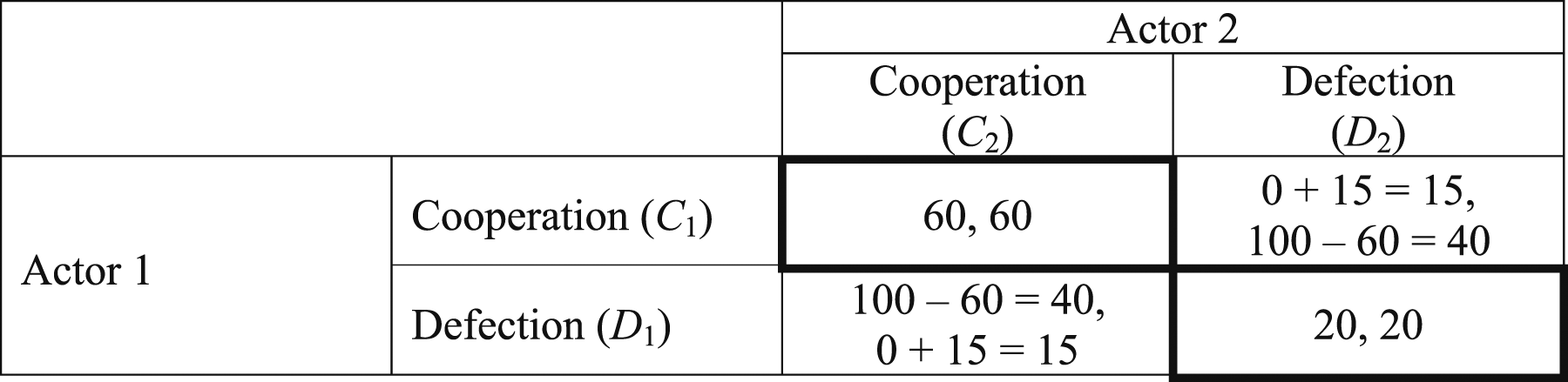
As a canonical model for a social dilemma, we employ the one-shot Prisoner’s Dilemma (PD), with payoffs as in Figure 1. Defection (D
i
) is the dominant strategy for each actor i (i = 1, 2) and, hence, mutual defection D = (D1, D2) is the unique Nash equilibrium. Mutual defection is associated with a Pareto-suboptimal outcome: both actors are better off when they cooperate (C
i
). However, while mutual cooperation C = (C1, C2) is a Pareto-improvement compared to D and a Pareto-optimal strategy combination, it is not an equilibrium. The PD with payoffs as in our experiment; the bold-faced cell indicates the unique equilibrium.
We introduce two further games that represent simplified features of social organization. First, PDrepeat models social organization in the sense of long-term relations and repeated interactions. In PDrepeat, an actor plays the PD from Figure 1 repeatedly with the same partner in rounds t = 1, 2,…. After each round t, each actor is informed on the behavior of the other actor in round t and the next round t + 1 of PDrepeat is played with a constant probability 0.75. PDrepeat stops after each round t with probability 0.25. It follows that PDrepeat is an indefinitely often repeated PD with an expected length of four rounds. For simplicity and tractability, the end of repeated interactions is thus exogenously determined: actors cannot decide themselves to exit from PDrepeat. 2 We define payoffs for PDrepeat as the average payoff from all rounds played. Using the average payoff, one can compare the payoff from PDrepeat with the payoff from the one-shot PD. For example, when PDrepeat ends after the fourth round, with mutual cooperation in two rounds and mutual defection in the other two rounds, an actor’s payoff would be (2 × 60 + 2 × 20)/4 = 40. Note that for our parameter values the equilibria for PDrepeat include (but are not restricted to) equilibria such that both actors cooperate (conditionally) throughout all rounds as well as equilibria such that both actors defect throughout all rounds (see Appendix A).
Second, PDcontract is a variant of the PD that is likewise a one-shot game and models social organization in the sense of contractual arrangements. When playing PDcontract, an actor who defects unilaterally is fined and an actor who is unilaterally exploited receives a compensation. Namely, if actor i defects unilaterally, actor i’s fine is 60, to be subtracted from the payoff of 100 for unilateral defection in the PD as in Figure 1. On the other hand, actor j (j = 1, 2 and j ≠ i) receives a compensation of 15, to be added to the payoff of 0 for being unilaterally exploited. We explain below and in Appendix A, why the values of fine and compensation are chosen in this way. If the two actors make the same choices in PDcontract by either both cooperating or both defecting, they obtain the same payoffs, either each 60 or each 20, as in the one-shot PD from Figure 1. For PDcontract in Figure 2, mutual cooperation as well as mutual defection are equilibria. We focus on fines for opportunistic behavior as well as compensation for an actor suffering from such behavior as highly stylized and simplified features of contracts. Our analysis abstracts from many other features that may be addressed in contracts such as, for example, specifications of a product or service to be exchanged, deadlines for delivery and payment, or procedures for conflict resolution. We also abstract from issues that arise due to incompleteness of contracts or due to problems of contract enforcement (see, for example, Salanié, 2005; Williamson, 1996 for further discussion). The PD with contractual agreements, PDcontract; bold-faced cells indicate equilibria.
3
Modeling effects of and investments in social organization
To analyze effects of and investments in social organization, we embed the PD in more complex games Γ. These are games of n ≥ 2 actors 1, 2,…, i, j,…, n, with i ≠ j and n even (in the experiment, n is the number of participants in a session). We consider different games Γ. Each of these is played in two stages, Stage 0 and Stage 1. In Stage 0, actors can invest in social organization. In Stage 1, depending on behavior in Stage 0, actors play either the one-shot PD or one of the two games resulting from social organization, PDrepeat or PDcontract. 4 Playing PDrepeat or PDcontract rather than the one-shot PD is costly. Actors, therefore, face a trade-off between expected beneficial effects of social organization and the costs of arranging for such beneficial effects. This avoids that setting up social organization with beneficial effects becomes a trivial affair: as we will see, with beneficial effects ‘for free’, it would be no longer surprising that actors do prefer social organization when choosing in Stage 0. 5
Investments in and effects of social organization: Repeated interactions
We use Γrepeat for modeling and analyzing effects of and investments in repeated interactions. In Stage 0 of Γrepeat, each actor decides whether to play PDrepeat or the one-shot PD in Stage 1. Actors decide simultaneously and independently in Stage 0: each actor i, when deciding, does not know about the decisions of other actors j in Stage 0. After the actors’ decisions in Stage 0 and before Stage 1, dyads of actors are formed as follows. Each actor who has chosen in Stage 0 to play PDrepeat in Stage 1 is randomly matched with another actor who has likewise chosen to play PDrepeat. In Stage 1, each of these dyads plays PDrepeat. Likewise, each actor who has chosen to play the one-shot PD is randomly matched with another actor who has likewise chosen to play the one-shot PD. In Stage 1, each of these dyads plays the one-shot PD. It can happen that an uneven number of actors has chosen PDrepeat and an uneven number has chosen the one-shot PD in Stage 0. Then, two actors cannot be matched so that both have made the same choice in Stage 0. In such a case, an ‘irregular dyad’ is formed so that one actor who has chosen PDrepeat in Stage 0 is randomly determined and is matched with a randomly determined actor who has chosen the one-shot PD. Actors in an irregular dyad play the one-shot PD in Stage 1. All actors are informed on the complete matching protocol before choosing in Stage 0. Before playing the game in Stage 1, each actor i is informed on the choice of the actor j in Stage 0 with whom i interacts in Stage 1.
Choosing the one-shot PD does not involve investments, while investment costs are associated with choosing PDrepeat. These costs are the same for each of the n actors. There are no investment costs for actors in an irregular dyad. An actor’s payoff at the end of Γrepeat is the actor’s payoff from Stage 1 minus investment costs, if any, incurred in Stage 0. We distinguish between games Γ with low, medium, and high investment costs of, respectively, 5, 15, and 45. Therefore, an actor’s payoff at the end of Γrepeat is the payoff in the one-shot PD, if this actor plays the one-shot PD in Stage 1. If the actor plays PDrepeat, the payoff is the average payoff from rounds 1, 2,…, t,… minus the costs from Stage 0 of choosing to play PDrepeat. Hence, for example, if the actor chose to play the one-shot PD and subsequently defected in the one-shot PD just as the partner, the actor’s payoff in Γrepeat would be 20. If the actor plays PDrepeat under medium investment costs, with PDrepeat ending after the fourth round, mutual cooperation in two rounds and mutual defection in the other two rounds, the actor’s payoff in Γrepeat would be (2 × 60 + 2 × 20)/4 – 15 = 25. All actors are assumed to be informed on all arrangements concerning investment costs.
Investments in and effects of social organization: Contractual agreements
We model and analyze effects of and investments in contractual arrangement employing game Γcontract. In Stage 0 of Γcontract, each actor decides whether to play PDcontract or the one-shot PD. The extensive form of Γcontract, including arrangements on investment costs, is defined strictly analogous to the extensive form of Γrepeat, with PDcontract replacing PDrepeat. Consider actors i and j have each chosen Гcontract in Stage 0 of Γcontract, are then matched for Stage 1, and thus play PDcontract in Stage 1. Under low investment costs and with final payoffs that are again payoffs from Stage 1 minus investment costs, if any, from Stage 0, if actor i cooperates in Stage 1, while j defects, i’s final payoff is (0 + 15) – 5 = 10. The payoff of j would then be (100 – 60) – 5 = 35. 6
Game-theoretic assumptions and solutions for Γ
We now specify our assumptions for analyzing games Γ and for deriving solutions. We do not wish to claim that our assumptions are undisputed – for sure, they are disputed in theoretical as well as empirical work. However, these are parsimonious rational choice assumptions on behavior in social dilemmas and on conditions facilitating or, respectively, mitigating cooperation in social dilemmas (see, for example, Raub et al., 2015). In this way and in line with the approach sketched in the introduction, we can ‘import […] the principle of rational action for use in the analysis of social systems […] and do so without discarding social organization in the process’ (Coleman, 1988: S97). Our experiment can then contribute to gauging how useful our assumptions are when it comes to predicting behavior in games Γ.
We assume throughout that Γ is played as a non-cooperative game with complete information and common knowledge of the extensive form of the game. We also assume game-theoretic equilibrium behavior. More specifically, we assume that actors play subgame perfect equilibria. In the following, ‘equilibrium’ is always shorthand for ‘subgame perfect equilibrium’. Concerning equilibrium selection, we assume that the solution of a symmetric game is a symmetric equilibrium. We also assume payoff dominance as a criterion for selecting between equilibria. In addition, we assume self-regarding preferences in the sense of ‘utility = own payoffs = own money’. Our approach is parsimonious also in a further respect. Namely, assuming a game with complete information and common knowledge of the extensive form implies, theoretically, that actors do not have unobservable characteristics. Inferring such characteristics of an actor from the actor’s behavior in Stage 0 or in some round of PDrepeat is then not an issue and signaling effects are excluded. Likewise, we thus ‘assume away’ other effects that would imply that actors’ behavior in Stage 1, that is, in a game that results endogenously from choices in Stage 0, differs from their behavior in an exogenously imposed game that is otherwise the same as the chosen Stage 1 game, such as effects of group identity. 7
We apply backward induction for analyzing games Γ. In Stage 1, we have n/2 dyads. In Γrepeat, these dyads play either the one-shot PD or PDrepeat. In Γcontract, the dyads play either the one-shot PD or PDcontract. Mutual defection is the only equilibrium of the one-shot PD. Since an equilibrium exists for PDrepeat such that both actors cooperate conditionally throughout all rounds, such an equilibrium is the solution of PDrepeat under our assumptions. Also, PDcontract has an equilibrium such that both actors cooperate. Again, under our assumptions, this is the solution of PDcontract. 8
It follows that Γrepeat as well as Γcontract always have an equilibrium such that actors do not invest in social organization in Stage 0 and subsequently defect in the one-shot PDs in Stage 1. For low and medium investments costs, it is easily seen that Γrepeat also has an equilibrium such that all actors invest in setting up repeated interactions in Stage 0 and subsequently cooperate in all rounds of PDrepeat, while Γcontract also has an equilibrium such that all actors invest in contractual agreements in Stage 0 and subsequently cooperate in PDcontract in Stage 1 (see Raub et al., 2019: 501 for details). Under high investments costs, however, no equilibrium exists for games Γ such that actors invest in social organization in Stage 0 and subsequently cooperate in Stage 1. For low and medium investment costs, our assumptions concerning equilibrium selection then imply solutions such that actors invest in social organization in Stage 0 and cooperate subsequently in PDrepeat or in PDcontract. Under high investment costs the solution requires that actors do not invest and defect subsequently in the one-shot PD.
Note that all solutions are so that all actors adopt the same strategy and behave the same in Stage 0 as well as in Stage 1. This implies that no irregular dyads would be formed. Also, one sees that for zero investment costs, the solutions would be the same as for low and medium costs.
Hypotheses
While this is seldom made explicit, we follow rather common practice in experimental game theory and do not test deterministic point predictions. Instead, we employ a variant of a comparative statics approach and assume that the likelihood of investments in Stage 0 and cooperation in Stage 1 of games Γ is higher when investments and cooperation are equilibrium behavior according to the solution than when they are not (see Buskens and Raub, 2013: 119–120 for a general discussion and Dal Bó and Fréchette 2018 for an example, namely, the case of experimental research on cooperation in repeated games). This yields our hypothesis on behavior in Stage 0:
H1: The likelihood of investments in social organization in Stage 0 is higher under low and medium investment costs than under high investment costs. With respect to effects of social organization on cooperation, we obtain the following hypothesis:
H2: The likelihood of cooperation in Stage 1 is higher in PDrepeat and in PDcontract than in the one-shot PD. It should be clear that we consider it an important feature of our approach that H1 and H2 are theory-based in the sense that they are derived from general assumptions on behavior in non-cooperative games.
Two additional conjectures
In addition to H1 and H2, we test two further conjectures. These conjectures are not based on standard game-theoretic assumptions such as those underlying H1 and H2. Rather, they are more in line with behavioral game theory, loosely characterized by Camerer (2003: 3) as expanding ‘analytical theory by adding emotion, mistakes, limited foresight, doubts about how smart others are, and learning to analytical game theory […] Behavioral game theory is one branch of behavioral economics, an approach to economics which uses psychological regularity to suggest ways to weaken rationality assumptions and extend theory’. Both conjectures are related to our focus on investments in social organization and, therefore, are on behavior in Stage 0. One conjecture concerns an extension of comparative statics reasoning. The other concerns comparing the likelihood of investments in repeated interactions and investments in contractual agreements, while H1 addressed the likelihood of either kind of investments compared to no investments. 9
First, we extend a comparative statics approach by assuming not only that behavior becomes more likely when it is in line with game-theoretic equilibrium behavior and the solution of a game than when it is not. We now assume furthermore, again in line with quite some experimental work and with examples like Dal Bó and Fréchette (2018), that the likelihood of behavior according to the solution increases when the conditions for the existence of the respective equilibrium become less restrictive. In our case, the conditions for the existence of an equilibrium such that actors invest in social organization in Stage 0 are less restrictive under low than under medium investment cost. We then obtain the following conjecture: C1: The likelihood of investments in social organization in Stage 0 is higher under low than under medium investment costs.
Second, we consider the likelihood of investments in repeated interactions compared to investments in contractual agreements. We have chosen the fine and the compensation for PDcontract so that our experiment also allows for an exploratory analysis of this issue. In Appendix A, we explain in detail in which sense PDrepeat and PDcontract can be seen as ‘strategically equivalent’. In particular, both games have an equilibrium such that both actors cooperate as well as an equilibrium such that both actors defect. Moreover, each actor’s expected payoff from mutual cooperation (defection) in PDrepeat is the same as the actor’s payoff from mutual cooperation (defection) in PDcontract. 10 Under our game-theoretic assumptions, mutual cooperation is the solution of PDrepeat as well as PDcontract. Then, under our game-theoretic assumptions, one would not expect differences between the likelihood of investments in repeated interactions and the likelihood of investments in contractual agreements.
However, both PDrepeat and PDcontract are games with multiple equilibria. The solutions that follow from our game-theoretic assumptions imply actors’ tacit coordination on the symmetric and payoff dominant equilibria. From a behavioral game theory perspective, one could consider these equilibria as focal points in the sense of Schelling (1960). Explicit formal specification of conditions for the focality of an equilibrium is notoriously difficult (for example, Kreps, 1990a: Chapter 12.6, 1990b: 100–101, 143–145, 153; Myerson, 1991: Chapters 3.5 and 8.1). Yet, it follows from the folk theorem for indefinitely often repeated games that PDrepeat has many more equilibria than PDcontract. While the number of equilibria might not be an indicator per se for the ‘size’ of the coordination problem (for example, Kreps, 1990b: 100), given the strategic equivalence of PDrepeat and PDcontract, one might conjecture that in this specific case tacit coordination is indeed more difficult in PDrepeat than in PDcontract. In fact, empirical studies on repeated PDs show that far from all participants cooperate, even if mutual cooperation is equilibrium behavior (see, for example, the meta-analysis Dal Bó and Fréchette, 2018). Assuming that actors anticipate, at least to some degree, on such coordination problems when choosing in Stage 0 of games Γ, one might expect that, controlling for investment costs, actors will be more likely to invest in contractual agreements rather than repeated interactions. This leads to the following conjecture: C2: Controlling for investment costs, the likelihood of investments in contractual agreements in Stage 0 is higher than the likelihood of investments in repeated interactions.
This conjecture can be tested by analyzing, for the same investments costs, the likelihood of choosing PDrepeat in Stage 0 of Γrepeat compared to choosing PDcontract in Stage 0 of Γcontract. To also test the conjecture when actors can directly choose between PDrepeat and PDcontract, we introduce the game Γrepeat/contract. In this game, actors decide in Stage 0 whether to play PDrepeat or PDcontract in Stage 1. Each choice in Stage 0 is associated with investment costs and these are the same, irrespective of whether PDrepeat or PDcontract is chosen. 11 As much as possible, dyads are formed so after Stage 0 that each actor choosing PDrepeat (PDcontract) in Stage 0 plays PDrepeat (PDcontract) in Stage 1 with another actor who has chosen PDrepeat (PDcontract). An irregular dyad plays PDrepeat in Stage 1. Otherwise, the extensive form of Γrepeat/contract is defined analogous to Γrepeat and Γcontract. Payoffs at the end of Γrepeat/contract are payoffs from Stage 1 minus the investment costs of either 5, 15, or 45 from Stage 0.
Methods
Experimental design
In the experiment, we employ the three games Γrepeat, Γcontract, and Γrepeat/contract. Instructions for participants in one of the experimental conditions are in Appendix B in the Supplemental Material.
Each session in the experiment comprises five parts, with the timeline as in Figure 3. Part 1 familiarizes participants with the different versions of the PD. Participants start with playing a one-shot PD. Then, after reading instructions on PDrepeat, they answer control questions on earnings in PDrepeat and decide on their behavior in the first round of a repeated PD. Subsequently, they familiarize themselves with PDcontract and again make their decision for that game. With respect to Part 1, for the one-shot PD and PDcontract participants are matched with another participant in the lab. These decisions are incentivized, but participants are informed on the behavior of the other participant in Part 1 and on the payoffs related to these decisions only at the end of the experiment. Thus, such information cannot affect decisions in Parts 2–4 of the experiment. Since we do not want interactions in Part 1 to affect subsequent decisions, we cannot let participants play a PDrepeat in Part 1. Therefore, without incentivizing, we only ask them what they would do hypothetically in the first round of PDrepeat. Timeline for the experiment.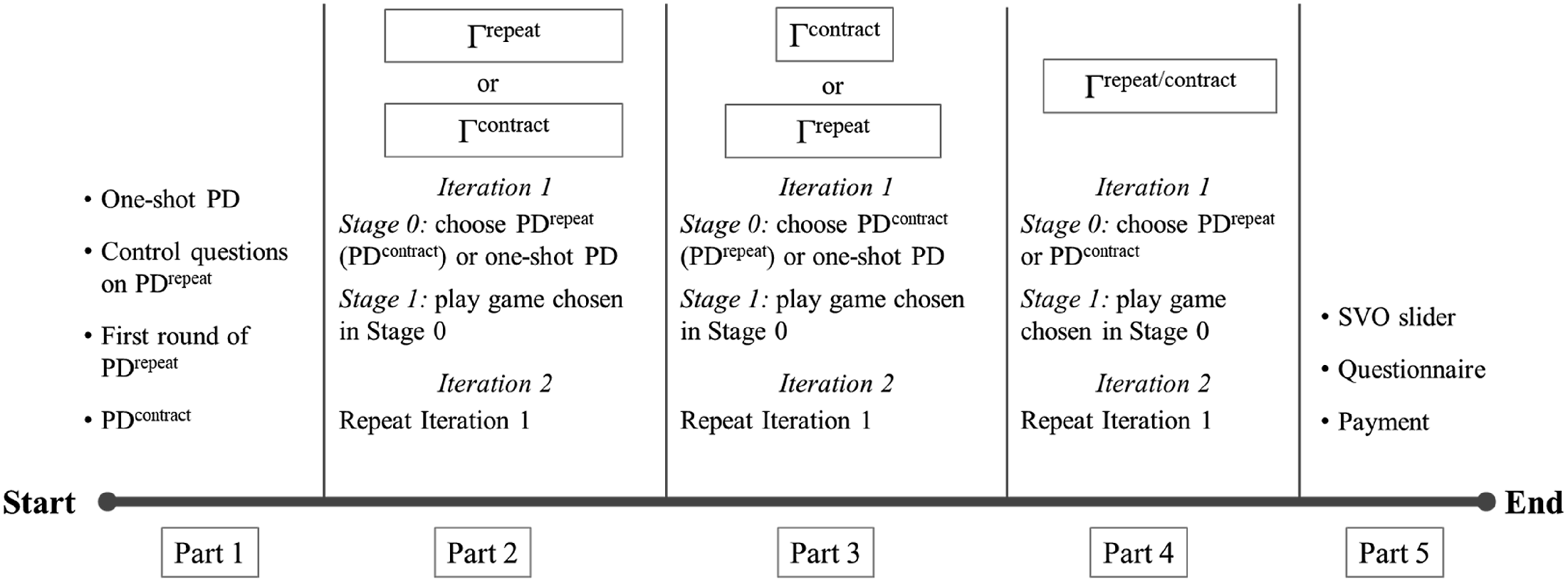
In Part 2, participants play either Γrepeat or Γcontract. Participants playing Γrepeat first decide whether to invest in playing the repeated PD or to play the one-shot PD. They then play the subgame of their choice with a random participant from the respective lab session who has made the same decision. If they play the one-shot PD, after having chosen between cooperation and defection, they are informed on the choice of their partner. If they play the repeated PD, after each round, they are informed on the decision of their partner in that round. After the Stage 1 subgame is finished, participants are informed on their final payoff for Γrepeat according to the rules above. The procedure is analogous for participants playing Γcontract. Note that PDcontract is a one-shot game, just like the one-shot PD, while the expected number of rounds of PDrepeat equals 4 (see above). 12
In Part 3, participants play either Γrepeat or Γcontract. More specifically, they play the game they have not yet played in Part 2. Whether a participant plays Γrepeat or Γcontract in Part 2 depends on the order condition a participant is in (see Experimental conditions). Since we vary conditions between sessions, all the participants within one session are exposed to the same order condition; for example, in one session all the participants are playing Γrepeat in Part 2 and Γcontract in Part 3. Otherwise, Part 3 is organized analogous to Part 2.
In Part 4, participants play Γrepeat/contract. They thus first choose between investing in repeated interactions or contractual agreements, with investment costs that are the same for both options. They then play the subgame of their choice.
Each of the Parts 2–4 has two iterations. Namely, participants decide twice in each of those parts whether to invest in repeated interactions or, respectively, contractual agreements and, subsequently, play a subgame of their choice. Each time, they are matched with a new randomly chosen participant who has chosen the same type of game.
In Parts 2 and 3, after a participant makes a choice whether or not to invest in repeated interactions or contractual agreements, this participant is matched with a random participant in the lab who has made the same decision. As explained above, if the number of participants choosing each option is not even, two participants cannot be matched with other participants who have made the same choice. In such cases, the participant who has chosen PDrepeat or, respectively, PDcontract, is matched with a participant who has chosen the one-shot PD and they play the one-shot PD. Investment costs are then not subtracted for the participant who had chosen to invest. In Part 4, a participant who has chosen PDcontract and is left without a match, plays PDrepeat with another participant who has chosen PDrepeat. Participants are informed on these arrangements and are always informed which subgame they are going to play. 13
In Part 5, participants first make a series of decisions in the incentivized six-item social value orientation (SVO) slider measure (Crosetto et al., 2019; Murphy et al., 2011) on how much they would be willing to give away to a random participant in the lab and how much to leave for themselves. After that, they fill in a post-experimental questionnaire (Appendix C in Supplemental Material), comprising measures for trust, risk preferences and tendencies for reciprocity, demographic characteristics, and open questions about the subjective motivation for the decisions they made in Parts 2–4.
Decisions of participants in the one-shot PD and in PDcontract in Part 1 and in games Γrepeat, Γcontract, and Γrepeat/contract in Parts 2–4 are incentivized according to the payoff structures described in the section on theory and hypotheses and introduced in the instructions for participants. From the SVO slider measure in Part 5, participants receive a payoff from one randomly chosen decision they made themselves and from a random participant’s decision. At the end of the experiment, final earnings in points are exchanged into euros at the rate introduced in the beginning of instructions for participants, namely, 30 points for 1 Euro. Answers to the questions in Part 5 are not incentivized.
A key feature of our experimental design is that Parts 2 and 3 of the experiment closely mirror Γrepeat and Γcontract. This establishes the close connection of our game-theoretic model and the experimental design, thus allowing for a rather strict test of our hypotheses H1 and H2.
Experimental conditions
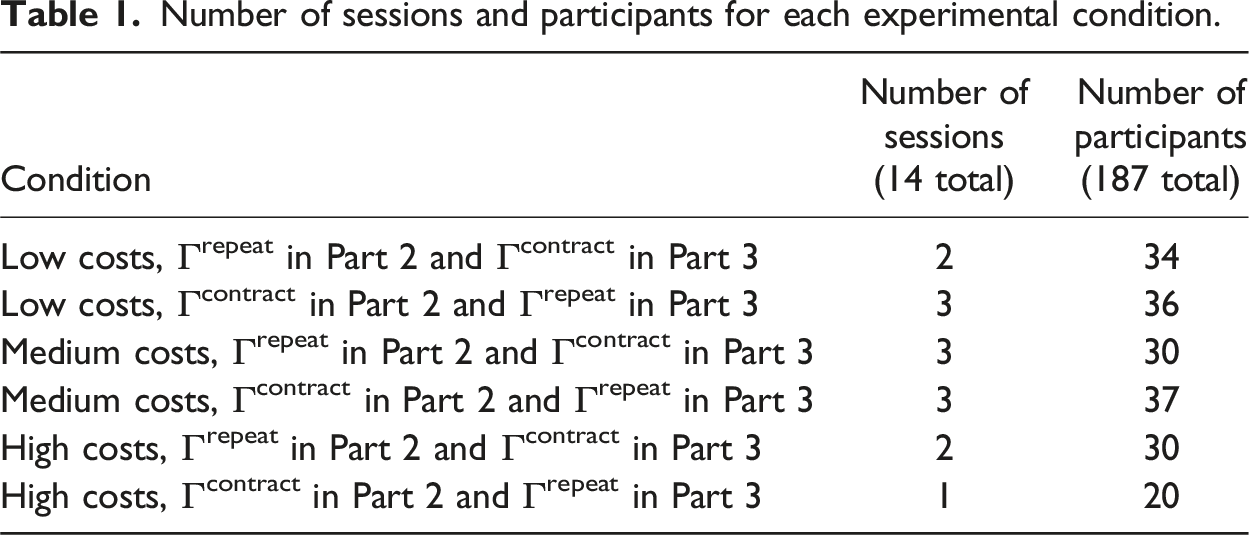
Number of sessions and participants for each experimental condition.
Procedure and participants
The experiment was programmed in z-Tree (Fischbacher, 2007). 187 participants 14 were recruited through the ORSEE recruitment system (Greiner, 2015) for 14 sessions in the ELSE lab at Utrecht University between December 5, 2019 and February 11, 2020. Note that the experiment took place before the COVID-19 pandemic induced contact restrictions and the like in The Netherlands. Participants were mostly students of Utrecht University, both Dutch and international (68% female; average age = 24.7, standard deviation = 6.7; 62% internationals). 49% of the participants had some experience with game theory, including having read literature and having taken classes on game theory. 26% of participants had attended more than five experiments in the past. The sessions lasted between 50 and 80 minutes and the average number of participants per session is 13.4 (minimum 4, maximum 22). Participants earned 16.6 euros on average (minimum 4.5, maximum 24.5 euros). Earnings were paid to participants in cash at the end of the experiment. Each participant received an endowment of 150 points at the start of the experiment.
Participants sat in separated cubicles and were given two rounds of printed instructions, at the beginning of the session and before the start of Part 3, to distinguish between the rather similar Parts 2 and 3. Throughout the experiment, participants needed to fill in numbers mentioned in the instructions on the computer screen before they could proceed. In this way, we ensure that participants read the instructions for each part closely. There was no deception and participants’ answers and decisions were anonymous. Participants were completely informed on the extensive form of the games and on the matching procedures.
Measurements
The binary dependent variable in our tests of H1, C1, and C2 is the participants’ choices between the subgames PDrepeat and the one-shot PD or, respectively, between the subgames PDcontract and the one-shot PD, operationalized as a decision whether to invest or not in Stage 0 of the games in Parts 2 and 3. To test H2 on the effects on cooperation, we employ the decisions whether to cooperate or to defect in the subgames in Parts 2–4 as the binary dependent variable in the models. We only use the decision in the first round of PDrepeat, since subsequent decisions are presumably affected by the behavior of the partner in earlier rounds. For the additional test of C2 when actors can directly choose between PDrepeat and PDcontract in Γrepeat/contract, the decision to choose PDrepeat or PDcontract in Stage 0 of the games in Part 4 is the binary dependent variable.
The key independent variable for testing the hypothesis and conjectures on investments (H1, C1, C2) is the investment costs condition to which a participant was assigned: either low, medium, or high investment costs. For tests of H2 on the effects of repeated interactions and contractual agreements on cooperation, the key independent variable is the subgame chosen by the participant in Stage 0 – PDrepeat, PDcontract, or the one-shot PD – in which the decision between cooperation and defection is made.
Analytical strategy
We use multilevel logistic regression models. Decisions throughout the experiment are nested in individual participants, with participants nested in sessions. To account for the multilevel structure of the data and participants’ repeated investment decisions, we include a random intercept on a participant level. Clearly, there are further dependencies due to participants jointly playing in the same sessions. We discuss various possibilities to control for this in the section on robustness analyses. Since controlling for these further dependencies does not affect results, we focus on the simpler model for the main analyses.
The predicted effects of investment costs conditions on the likelihood of investments and of effects of repeated interactions and contractual agreements on cooperation are analyzed through pairwise comparison of marginal effects. For the test of C2 employing the data from Parts 2 and 3, we check the effect of the type of game played (either Гrepeat or Гcontract) on the likelihood of investments in Stage 1. In this way, we can check if PDcontract is more likely to be chosen over the one-shot PD than PDrepeat to be chosen over the one-shot PD, controlling for investment costs. We also report predicted probabilities of choosing investments and cooperation to provide insight into effect sizes. For the additional test of C2 employing decisions in Part 4, we first run an ‘intercept-only’ model to identify the direction of the baseline value, and subsequently a model that includes investment costs levels.
The main analyses reported here include the data from Parts 2 and 3 for investment decisions and from Parts 2‒4 for cooperation decisions. Note that participants face a sequence of interactions throughout the experiment. Part 2 of the experiment allows for a pure between subjects comparison of all conditions, excluding effects of experience in one type of game Γ on behavior in the other type of game Γ. While the order of key conditions is balanced, Parts 3 and 4 provide additional statistical power. Therefore, for the main analyses, we employ the data on all relevant decisions for the respective tests. Since decisions in Parts 3 and 4 might depend on experiences in earlier parts of the experiment, we provide a series of robustness checks in Appendix D of the Supplemental Material. These checks include, first, analyses employing exclusively data from Part 2. Second, Appendix D includes an analysis of investment decisions in Parts 2 and 3 with controls for experience (previous earnings, the number of previous investments, and whether the investment decision takes place in Part 3). Third, we run additional analyses on investments and effects on cooperation with groups of further control variables. One group includes demographic characteristics (age, gender, and whether a participant is Dutch or an international). Another group includes social value orientations obtained from the post-experimental questionnaire (measures of trust, risk preferences, preferences for reciprocity, and the prosocial-individualist-competitive classification according to the SVO slider measure). A further group includes participants’ experience with game theory and experiments. A final group includes two session characteristics, namely, session size and the order condition of the session (either start with Гrepeat or Гcontract). Models with different groups of control variables are run separately, to prevent an overload of variables in one model (a model with all control variables simultaneously included does not lead to different results).
Finally, Appendix E includes a comparison of choices in Part 1 of the experiment in exogenously imposed games (one-shot PD, first round of PDrepeat, and PDcontract) with the endogenously chosen Stage 1 games in Parts 2–4 of the experiment. This analysis reveals whether participants’ behavior differs between exogenously imposed and endogenously chosen games. The analysis also allows for a check whether the results on cooperative behavior in the endogenously chosen games are robust to controlling for behavior in exogenously imposed games.
Results
We first present results on investments in social organization. Results on cooperation follow. We then briefly summarize results of robustness checks.
Results on investments in social organization
For the results on investments, we first provide a brief descriptive overview of participants’ investments decisions and then report statistical tests.
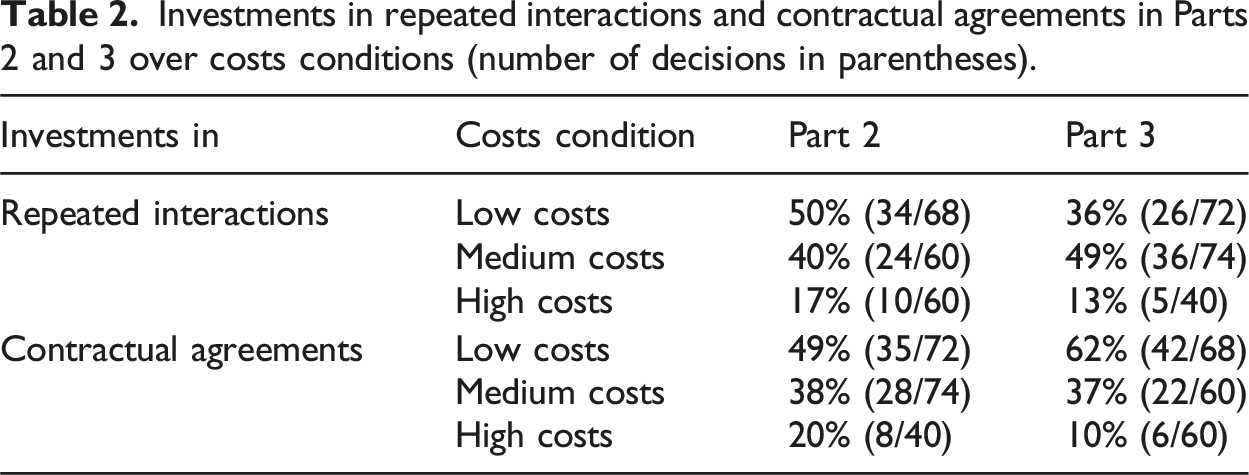
Investments in repeated interactions and contractual agreements in Parts 2 and 3 over costs conditions (number of decisions in parentheses).
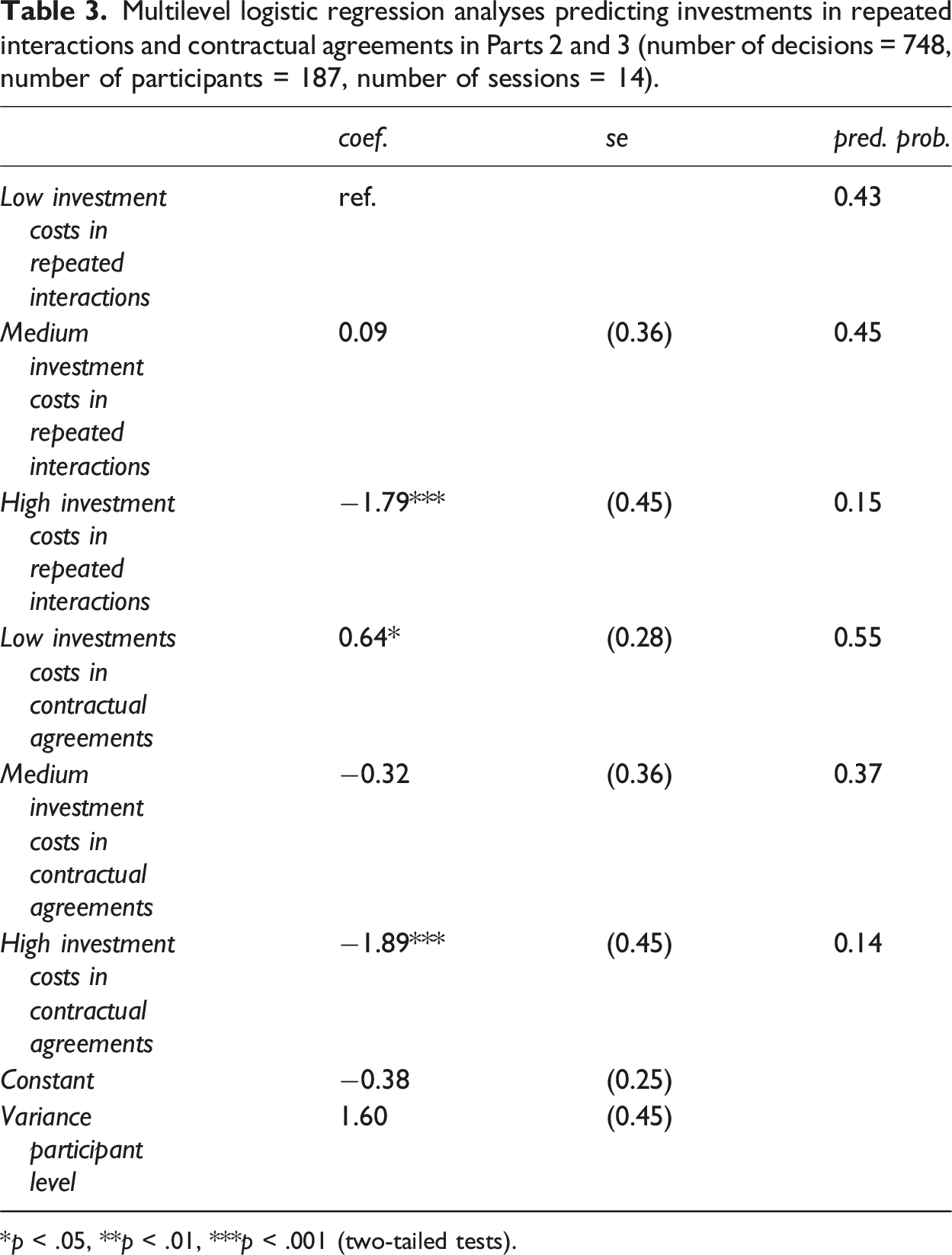
Multilevel logistic regression analyses predicting investments in repeated interactions and contractual agreements in Parts 2 and 3 (number of decisions = 748, number of participants = 187, number of sessions = 14).
*p < .05, **p < .01, ***p < .001 (two-tailed tests).
The model in Table 3 also provides support for hypothesis H1 on investments in contractual agreements: the likelihood of investment in contractual agreements is higher under low investment costs than under high investment costs (difference in effects: −2.53, p < .001) and is higher under medium investment costs than under high investment costs (difference in effects: −1.57, p = .001). In contrast to investments in repeated interactions, investments in contractual agreements provide evidence for C1, because investments in contractual agreements are higher under low investment costs than under medium investment costs (difference in effects: −0.96, p = .008). Effects are strong: the predicted probabilities that the investments are chosen decrease from 0.55 to 0.37 if costs increase from low to medium and decrease further to 0.14 when costs are high. Summarizing, evidence for H1 is unequivocal, with all four effects being strongly significant, while the evidence for C1 is ambivalent. Although one test is significant, the other test is not significant at all.
Finally, the model in Table 3 does not provide support for C2. For low costs, there seem to be slightly more investments in contractual agreements than in repeated interactions (b = 0.64, p = .021). However, investments in contractual agreements are not significantly more frequent than in repeated interactions for medium costs (difference in effects: −0.41, p = .155) and high investment costs (difference in effects: −0.10, p = .827).
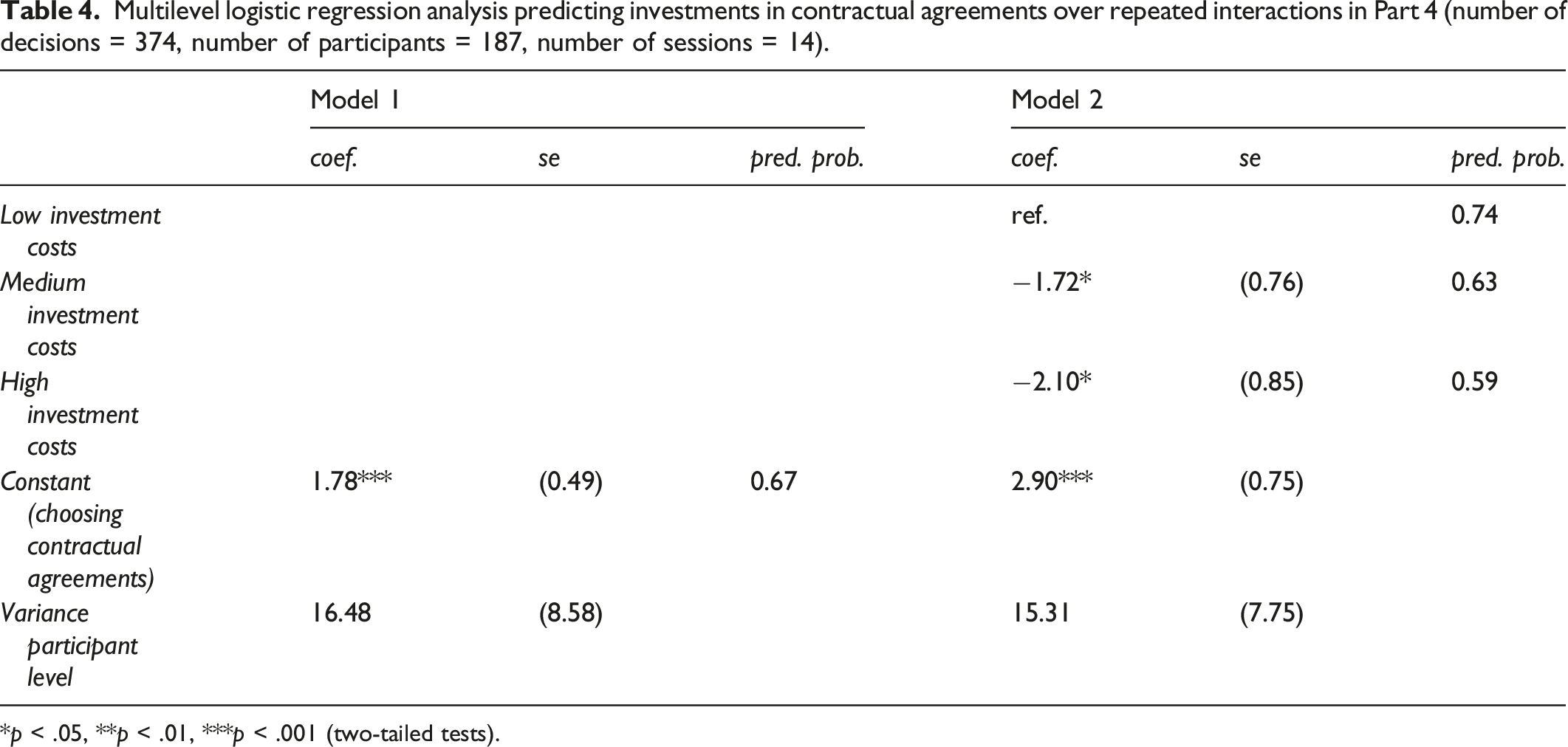
As an alternative test for C2, we use the choices in Part 4 in which participants directly choose between repeated interactions and contractual agreements. We consider this merely as an additional analyses, because decisions in Part 4 can considerably depend on experiences in Parts 2 and 3. If experiences of participants with repeated interactions have been more positive than experiences with contractual agreements, they might now prefer repeated interactions and vice versa. Therefore, we provide in Table D.5 in the Supplemental Material additional analyses controlling for experience with the different options in Parts 2 and 3.
Multilevel logistic regression analysis predicting investments in contractual agreements over repeated interactions in Part 4 (number of decisions = 374, number of participants = 187, number of sessions = 14).
*p < .05, **p < .01, ***p < .001 (two-tailed tests).
Results on cooperation
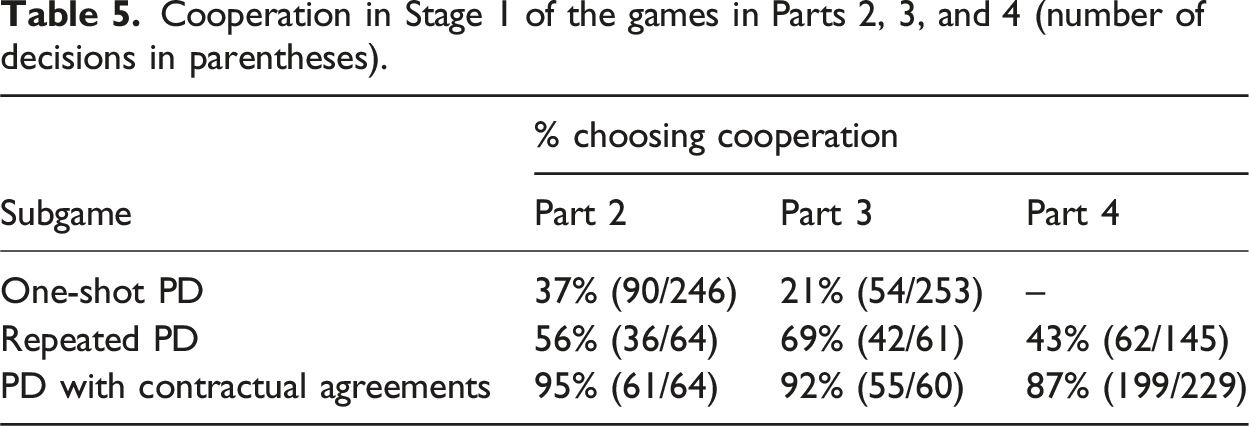
Cooperation in Stage 1 of the games in Parts 2, 3, and 4 (number of decisions in parentheses).
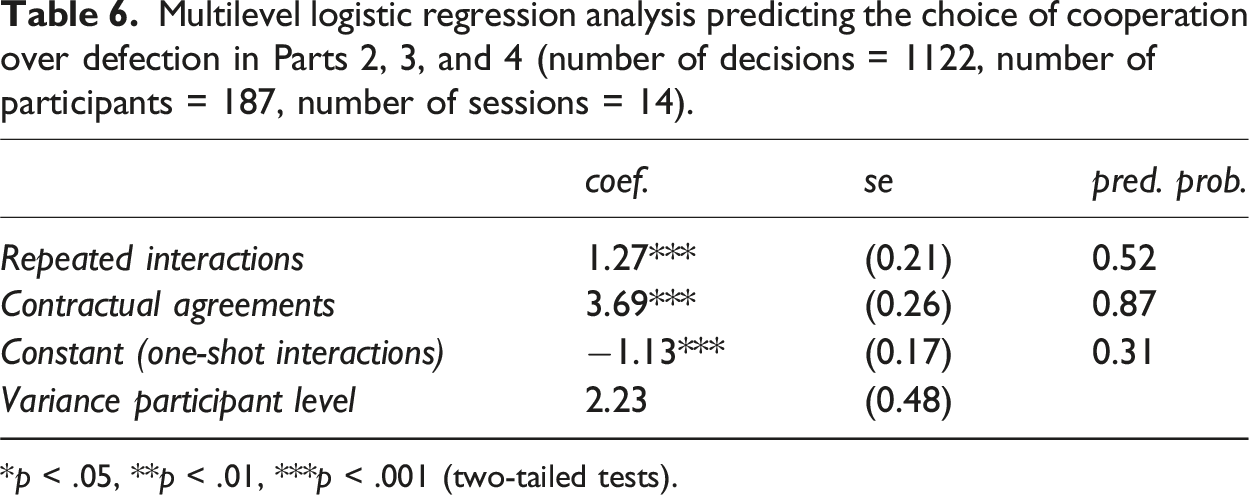
Multilevel logistic regression analysis predicting the choice of cooperation over defection in Parts 2, 3, and 4 (number of decisions = 1122, number of participants = 187, number of sessions = 14).
*p < .05, **p < .01, ***p < .001 (two-tailed tests).
Robustness checks
To account for additional dependencies between observations, we tried to estimate random effects for the sessions. This lead to estimation issues, because the number of sessions is limited. Also, the analyses suggest that random effects at the session level are negligible. In yet another analysis, we provided robust standard errors adjusted for clustering of observations within sessions. This is in a sense the most conservative way to run our analyses. This accounts for the concern that there may be specific session-level circumstances that intervene with our results. The results likewise corroborate the main findings presented.
Results for analyses employing exclusively data from Part 2 (see Table D.1 in Supplemental Material) are consistent with the results of tests of the hypotheses on investments in repeated interactions and contractual agreements as well as on cooperation in the previous sections. The only difference is the result for C1. The difference between investments in contractual agreements under low and medium investment costs is still in the expected direction but no longer significant. This might be due to less statistical power when restricting analyses to data from Part 2 only. 15 Robustness checks do provide evidence for some association of experience with investment behavior in Parts 2 and 3. Also, some personal characteristics are associated with investment decisions and cooperation. Knowledge of game theory has a positive association with the likelihood of choosing repeated interactions rather than the one-shot PD. This may indicate that such knowledge helps to better anticipate the effects of repeated interactions. Large experience in laboratory experiments, as well as higher trust levels and less risk aversion are positively associated with the likelihood of cooperation, while being male is negatively associated. There are no significant associations of session characteristics with these decisions. Importantly, results of the robustness checks do not affect the results of the tests of H1 and H2.
Conclusion and discussion
We studied social organization of cooperation in social dilemmas through repeated interactions and contractual agreements. We simultaneously considered effects of as well as the endogenous establishment of social organization, assuming, too, that social organization presupposes costly investments in the first place. Work on costly investments in establishing repeated interactions and contractual agreements, including simultaneous analysis of such investments and their effects, is scarce. We derived hypotheses from simple assumptions on game-theoretic equilibrium behavior, complete information, and self-regarding preferences.
We found unambiguous support for our hypotheses on conditions such that actors invest in social organization. In particular, we did find that investments in establishing long-term relations and in contractual agreements depend on investment costs: investments are more likely for low and medium costs below the theoretically derived cost threshold, compared to high costs above that threshold. We also replicated evidence from earlier studies that cooperation is fostered by social organization. We furthermore tested additional conjectures on investments in social organization that do not follow from standard game-theoretic assumptions but are rather based on assumptions more in line with behavioral game theory. We found some, but less convincing support for these conjectures: investments were not consistently more likely for low than for medium costs. Also, investments were not always more likely for contractual agreements than for repeated games in the comparable conditions.
Concerning further research, note that we varied the costs of investments in our study. Other parameters that could be varied are the payoff structure of the PD itself and the continuation probability for indefinitely often repeated interactions. Further experimental investigation along these lines would contribute to conceptual replication and provide additional tests of our model. Our model employs the PD as the canonical example of a social dilemma. Future research could employ other social dilemma games with two actors as well as n-actor social dilemmas. We also employ a symmetric PD in our study. It is straightforward to extend the theoretical analysis to a broader class of social dilemmas, including asymmetric games (Raub, 2021). One could then analyze, for example, the interplay of (a)symmetries in investment costs and (a)symmetry of the social dilemma. From a pure game-theoretic perspective one need not expect effects on actors’ willingness to invest when the social dilemma is asymmetric, while the investment costs are symmetric. It seems plausible, however, that asymmetries in the social dilemma such that one actor would benefit more from mutual cooperation than another actor would have implications for the actors’ willingness to ‘accept’ symmetric investment costs.
We focused on developing a model employing parsimonious assumptions, while testable hypotheses can be rigorously derived. We explicitly avoided a focus on more complex assumptions such as on bounded rationality, other-regarding preferences, risk-aversion, and the like, while conducting a series of robustness analyses showing that concerns with respect to such more complex assumptions do not affect the main results of our tests of hypotheses. Of course, one could try to develop alternative theory that does include assumptions such as on risk aversion and on ‘non-standard’ preferences to see whether this allows for understanding even more of the variation in our data. However, explicitly specifying such theoretical alternatives and deriving testable hypotheses in a strict sense, comparable to what we do with our simple model, would also require to explicitly specify and analyze games with incomplete information. This would be a daunting task, certainly when it comes to deriving hypotheses. As is not uncommon in much of behavioral and experimental game theory, one could circumvent such difficulties by abstaining from explicit game-theoretic modeling and from deducing – in a strict sense – hypotheses, rather relying on, for example, research on (social) psychological regularities of behavior. With respect to the ‘style’ of theory construction, this might resemble reasoning underlying our conjectures C1 and C2. This would be a valuable enterprise but would likely involve a less close connection between basic theory, hypotheses, and experimental design.
While there are various directions for presumably fruitful further theoretical and empirical work, our study shows how parsimonious and straightforward game-theoretic models can be employed to derive testable hypotheses on how social organization can emerge that facilitates cooperation in social dilemmas. Our experimental findings provide quite some evidence that actors indeed invest in such social organization if the costs of investments do not exceed their positive effects, largely supporting our hypotheses. Also, such social organization does indeed promote cooperation in the social dilemma.
Supplemental Material
Supplemental Material - Cooperation through rational investments in social organization
Supplemental Material for Cooperation through rational investments in social organization by Anna Sokolova, Vincent Buskens and Werner Raub in Rationality and Society.
Footnotes
Some details on the theoretical model and on the choice of parameter values
This appendix summarizes results for various features of the theoretical model and sketches how to derive implications we employ in the section on theory and hypotheses. We abstract from the assumptions on specific values of the various parameters employed in that section. With slight abuse of notation, we continue using the labels PD, PDrepeat, and PDcontract. The context indicates clearly when these labels refer to games with or without the specific values of the various parameters.
Acknowledgements
The Ethics Committee of the Faculty of Social and Behavioural Sciences of Utrecht University approved the study (19-163). The study is part of a research line on which VB and WR have collaborated over the years with Vincenz Frey. His contributions to earlier joint work are gratefully acknowledged. Ozan Aksoy, Hartmut Esser, Ineke Maas, Jeroen Weesie, and participants at various seminars and conferences (CRS seminar of Utrecht University, ISA 2021, INAS 2021, LSE workshop 2021, ACES 2021, Venice workshop ‘Analytical Sociology’ 2021, Collegio Carlo Alberto Turin 2022, and German National Academy of Sciences Leopoldina, Section 25–Economics and Empirical Social Sciences, Cologne 2024) offered helpful comments. We also acknowledge the useful comments by Andreas Flache, Editor in Chief of R&S, and two anonymous reviewers. Adrian Toroslu, Anastasia Menshikova, Julie Ulstein, Kevin Wittenberg, and Marissa Bultman provided assistance in running the experiment. While working on this study, WR has been a Fernand Braudel Fellow at the European University Institute, Florence. The hospitality at EUI is gratefully acknowledged.
Declaration of conflicting interests
The author(s) declared no potential conflicts of interest with respect to the research, authorship, and/or publication of this article.
Funding
The author(s) disclosed receipt of the following financial support for the research, authorship, and/or publication of this article: The Department of Sociology of Utrecht University funded the experiment.

Supplemental Material
Supplemental material for this article is available online.
Notes
References
Supplementary Material
Please find the following supplemental material available below.
For Open Access articles published under a Creative Commons License, all supplemental material carries the same license as the article it is associated with.
For non-Open Access articles published, all supplemental material carries a non-exclusive license, and permission requests for re-use of supplemental material or any part of supplemental material shall be sent directly to the copyright owner as specified in the copyright notice associated with the article.
