




Abstract
Given the information and beliefs about the possibility of repression, when will the civil society organize protests against the government? Under what conditions will the government repress popular protests? In this paper, I employ a novel signaling game to model the strategic interaction between the regime and civil society during the 2019 Anti-Extradition Law Movement in Hong Kong. I illustrate how information and beliefs influence whether the civil society mobilizes mass protests. Specifically, I examine how government actions shape the civil society’s beliefs about the government type, which in turn determine the protest turnouts and the government’s decision to repress.
Introduction
In recent decades, the world has seen numerous social movements that drew large swaths of protesters, and the outcomes of the protests typically depended on the strategic interactions between the regime and civil society. Faced with protesters’ demands, many regimes had to choose between repression and making policy concessions (Przeworski, 1991). Some repressions managed to quash the political opposition and deter dissents, while some resulted in conflict escalation and a spiral of violence between the police and protesters (Crescenzi, 1999). Under what conditions will the civil society organize protests against the government? Given the information and beliefs about the possibility of repression, when is it rational for the civil society to protest? If the government knows about the probability of successful repression, under what conditions will it repress popular protests? This paper employs a game-theoretic approach to explain the conditions under which civil society would organize mass protests and when government would mobilize its security apparatus to suppress citizen uprisings. Analyzing the 2019 Anti-Extradition Law Movement in Hong Kong as a case study, this study models the strategic interaction between the regime and the pro-democracy civil society during the protest movement. It illustrates how information and beliefs influence whether civil society organizes mass protests. Specifically, it examines how government actions shape the civil society’s beliefs about the government type, which in turn determine protest turnouts and the regime’s decision to repress.
Hong Kong’s Anti-Extradition Law Movement in 2019 originated from the government-sponsored Fugitive Offenders Ordinance that would allow the Hong Kong and mainland Chinese authorities to extradite fugitives and make them subject to trials in their respective legal jurisdictions (Charm and Lin, 2023). The Extradition Law sparked mass protests at record-breaking levels in Hong Kong. This study models the Anti-Extradition Law protests as a signaling game involving the Hong Kong government and civil society. Depending on the political pressure from the Chinese regime, a third party, the government could be a hardline or softline type. A hardline type implies Hong Kong government is under significant pressure from Beijing to implement the bill and handle political dissents, whereas a softline type implies minimal Chinese pressure. The government knows its type but the civil society has incomplete information about the government type.
The regime first decides whether to withdraw the Fugitive Offenders Ordinance or move the bill forward. The civil society then decides whether to organize protests or acquiesce. If the civil society organizes collective action, the regime will choose to mobilize the security apparatus to repress or withdraw the bill (Pierskalla, 2010). After observing government actions, civil society updates its beliefs about the government type, and chooses whether to organize protests. Through obtaining the Perfect Bayesian Equilibria from the signaling game, this study forms two competing hypotheses to predict the dynamics of the Anti-Extradition Law Movement. It tests the hypotheses by examining qualitative evidence from the movement. This study argues that the civil society was uncertain about the extent of Chinese pressure prior to the protests. Although the government moved the Fugitive Offenders Ordinance forward initially, the subsequent events led to the civil society’s mistaken beliefs in a softline government and the regime’s willingness to make concessions. The civil society organized protests with unprecedented levels of turnout. The Hong Kong government, at later stages, showed evidence of pressure from Beijing as it ramped up its repression against the protesters. With the police siege of the Hong Kong Polytechnic University in November 2019, the movement ran out of steam, until the COVID-19 outbreak brought the protests to an end in early 2020.
Third-party intervention in domestic protests is not uncommon. From the direct and indirect intervention of the United States and Soviet Union in domestic affairs of the smaller states throughout the Cold War, to the more recent Russian involvement in the 2014 Ukraine and 2024 Georgia protests, regional superpowers rarely let go of their interests within their spheres of influence (Chyzh and Labzina, 2018). As China emerges as a superpower, Beijing has tightened its grip on its periphery. Hong Kong, a Special Administrative Region of China, has enjoyed a high degree of autonomy under the “One Country Two Systems” arrangement. The territory has seen increasing Chinese interference in its domestic affairs. Many government policies and legislations were allegedly political orders from Beijing. Considering Hong Kong’s unique political system and encroachment of “One Country Two Systems” by the communist China, the 2019 protests serve as an exemplar of third-party influence in domestic crisis. This paper builds on the existing games of incomplete information to model the strategic interaction between the regime and civil society during the 2019 protests. It models information asymmetry in a sense that the Hong Kong government knows the extent of Chinese pressure, but not the people. It illustrates how information and beliefs about political pressure from Beijing influence the conditions for successful collective action and deterrence.
Protests and repression
The social movement literature has focused on the relationship between the occurrence of protests and state repression, also known as the protest-repression nexus (Leuschner and Hellmeier, 2024; Lichbach, 1987; Rasler, 1996; Shadmehr, 2021). The relevant literature can be characterized into two major groups. The first examines the effects of protests on repression, and the other examines the effects of repression on the incidence of protests (Carey, 2006). Concerning the former group, most studies point out that when popular protests occur, repression is generally the most preferred option for the governments (Ginkel and Smith, 1999; Shiu and Sutter, 1996). Alternatively, regimes sometimes alternate between repression and accommodation (Karavardanyan, 2021; Moore, 2000). Regime type is an important factor determining government response to mass protests. Some studies find that democratic institutions are more likely to accommodate the opposition rather than showing continuous repressive behavior towards dissents (Davenport, 2007). Other studies, nonetheless, argue for the “murder in the middle” hypothesis, expecting a higher level of repression in partly democratic or partly free countries than in democratic or authoritarian countries (Fein, 1995).
Regarding the latter group, there are two ways in which state repression influences subsequent protests. On one hand, repression is likely to raise citizens’ participation costs significantly, thus discouraging protests (Chiang, 2021; Tullock, 1971). On the other hand, repression might trigger moral outrage, resulting in escalation of protests (Ives and Lewis, 2020). Existing work shows mixed evidence concerning the effect of repression on subsequent protests (Curtice and Behlendorf, 2021). Studies suggest the effect is conditional on several factors, including violent and nonviolent protests (Lichbach, 1987), long-term and short-term effects (Rasler, 1996), and the level of democracy (Gupta et al., 1993).
Game-theoretic approaches
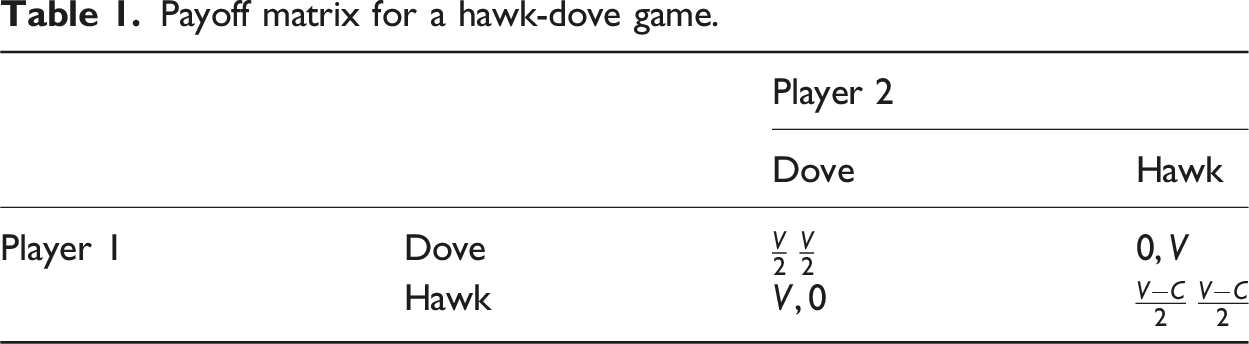
Payoff matrix for a hawk-dove game.
The game-theoretic literature then moved in the direction of sequential games when modeling protest movements (Crescenzi, 1999; Pierskalla, 2010). In sequential games, regimes and protest groups maximize their payoffs by choosing a tactic in response to each other’s action, or in anticipation of each other’s next action (Ash, 2011; Shellman, 2006). The strategic interactions between the civil society and regime can sometimes be viewed as iterated games, especially for large-scale movements (Axelrod, 1984). Protests might continue until protesters acquire policy concessions from the government, and the government might take different actions at different time points (Chong et al., 2016; Marks, 1992).
The availability of information plays a significant role in the decision-making of the government and civil society. Harsanyi (1967) introduces the concept of “nature” and contends that with incomplete information about the state of nature, political actors often have to assign prior beliefs about the types of the other players (Carroll and Pond, 2021; Shiu and Sutter, 1996). Extant literature has increasingly highlighted the critical roles that information and beliefs play in political interactions involving the civil society having incomplete information about the type of government it is facing (Ash, 1999; Casper and Tyson, 2014; Kim et al., 2015; Zielinski, 1995). Przeworski (1991), in his seminal book Democracy and the Market, uses games of imperfect information to model democratic transitions in Eastern Europe and Latin America. The liberalizers choose between opening up the political process, maintaining the status quo, or repression. The civil society, assigning beliefs about the liberalizers’ commitment to reforms, chooses to organize protests or enter into a pact with the regime (Gates and Humes, 2007). Crescenzi (1999) devises a signaling game to model the strategic interaction over political liberalization. The opposition does not know whether it is facing a hardline or softline government. Interpreting liberalization as a signal, civil society decides whether to cooperate, radicalize, or negotiate pacted transitions with the regime. In a similar vein, Pierskalla (2010) outlines various signaling games, where the opposition has incomplete information about whether the government is strong or weak, to explain the conditions under which successful deterrence or protest would occur 1 . Literature has also analyzed games where political opposition faces uncertainty regarding the relative payoffs of the status quo and revolution (Shadmehr and Bernhardt, 2017), as well as situations where autocrats are uncertain about the antigovernment sentiment in the society (Bueno de Mesquita, 2010; Lorentzen, 2013; Little, 2016).
Third-party involvement in domestic protests
Protests and repression are sometimes complicated by international factors. Specifically, strategic interactions among domestic players are often influenced by outside third parties. Amid the growing geopolitical competition, regional powers are expanding their spheres of influence rapidly, imposing political pressure on smaller states within their reach. Some smaller states choose to initiate a hierarchical relationship with major powers for economic and military security (Lake, 2009). In return, smaller states throw their weight behind the international policy agenda of their strategic partners (Machain and Morgan, 2013). Third-party involvement alters the payoffs of domestic players, as well as the outcomes of domestic crisis (Findley and Teo, 2006). In studying Ukraine’s anti-government protests and the Russian involvement, Chyzh and Labzina (2018) contend that it is not uncommon for a third party to “bankroll” repression against protests in order to deter future protests within their sphere of interest. Studies also find that international institutions have significant effects on domestic protests and repression (Shadmehr and Boleslavsky, 2022).
Civil society, political development, and the Anti-Extradition Law Movement in Hong Kong
Since the handover of Hong Kong from the United Kingdom to the communist China in 1997, the territory has enjoyed a high degree of autonomy under the “One Country Two Systems” framework (Chiu and Lui, 2000). The city can be categorized as a hybrid regime featuring both democratic and authoritarian elements (Ma, 2007). Ordinary Hong Kong citizens have limited electoral franchise for the legislative branch, and the city’s de facto constitution Basic Law guarantees a variety of civil and political rights for the citizens, including freedom of speech, religion, assembly, and press (Ma, 2008). However, ordinary people do not have voting rights for the executive branch, as the Chief Executive is elected by a 1500-member election committee dominated by pro-Beijing elites. The Hong Kong government relies on Beijing’s support to maintain effective governance. In return, the Hong Kong government provides support for Beijing’s policy agenda and if necessary, implement unpopular policies to express loyalty to the Xi administration. As China moved in the authoritarian direction, it strengthened its political control over Hong Kong in recent years (Toelstede, 2020). Perceiving the gradual deterioration of civil liberties and autonomy, many Hong Kong citizens felt the “mainlandization of Hong Kong” (Yew and Kwong, 2014). Amid the exacerbating political and social conflicts, the pro-democracy civil society organized several large-scale social movements in the 2010s, for instance the Anti-National Education protests in 2012 and the Occupy Movement in 2014.
The 2019 Anti-Extradition Law Movement stemmed from a Hong Kong resident Chan Tong-kai murdering his girlfriend in Taiwan and fleeing to Hong Kong in 2018. Since no extradition treaties exist between Hong Kong and Taiwan, the Hong Kong government has no legal means to extradite Chan Tong-kai to Taiwan nor charge him with murder (Yuen and Tong, 2021). As a remedy, the Carrie Lam administration proposed the Fugitive Offenders Ordinance which would allow the transfers of fugitives between not only Hong Kong and Taiwan, but also mainland China (Cai, 2021). The civil society had widespread fear that ordinary Hong Kong citizens could be extradited to the communist China for political reasons. Given the perceived lack of civil and political rights in China, the general public feared that the Extradition Law would spell the demise of the rule of law in Hong Kong. With the civil society’s accumulated grievances towards the regime, millions of Hongkongers participated in an unprecedented anti-authoritarian campaign, also known as the Anti-Extradition Law Movement (Charm and Lin, 2023). From June 9, 2019 to early 2020, the civil society mobilized mass protests on a regular basis. Most of the protests, nonetheless, were met with police repression. The protesters and police were often locked in intense conflicts (Lee et al., 2019). Drawing on extant game-theoretical models, this paper devises a signaling game, also referred to as a game of incomplete information, to model the strategic interactions between the regime and the pro-democracy civil society during the 2019 protests.
Game model: Anti-extradition law protests as a signaling game
The players
The first player is the Hong Kong government (G). The model assumes that the primary goal of the Hong Kong government is to stay in power with effective governance (Wong, 2015). The second player is the civil society (CS) 2 . The model assumes that the main goal of the civil society is to force the government to make concessions, especially the withdrawal of the Extradition Law. There is also a third party involved in the game: The Chinese government. There was widespread speculation that the Extradition Bill was a political order from Beijing, that Beijing wanted to use the bill to facilitate direct political control over the territory. There were also rumors that the People’s Liberation Army was disguising as Hong Kong police in quelling social dissents. For simplicity, this model incorporates Beijing’s involvement in terms of the government type. 3 Hong Kong government could be either a hardline or softline type. A hardline type suggests Hong Kong government is under significant pressure from China in drafting the Extradition Bill and the repression of protests, and the government favors hardline measures to appease China. In contrast, a softline type implies minimal pressure from China, suggesting the Extradition Bill is primarily Hong Kong government’s initiatives, and the regime does not favor heavy-handed repression measures.
The analytical model: Signaling game
Based on the above assumptions, this study models a sequence of moves by the two players, i.e. the Hong Kong government and civil society, under incomplete information. During the Anti-Extradition Law protests, civil society was uncertain whether the Hong Kong government was a hardline or softline type, i.e. the extent of Chinese pressure. On one hand, considering the increasing Chinese intervention in Hong Kong affairs in recent years, Hongkongers might anticipate Beijing to use force to suppress protests (Lee, 2020). But on the other hand, considering the fact that the People’s Liberation Army and Hong Kong police refrained from using heavy-handed tactics against protesters during the 2014 Umbrella Movement, Hongkongers might expect Beijing to take a similar approach in handling the 2019 Anti-Extradition Law protests (Lee and Chan, 2016). The game is outlined as follows: (1) The game begins with Nature N drawing the type of Hong Kong government, (2) In the first period, the Hong Kong government faces growing public concerns over the Extradition Bill. The government could choose an action (3) Civil society observes the regime’s action under incomplete information. If the government decides to move the bill forward, the civil society employs the Bayes’ rule to update its beliefs (4) If the government moves the bill forward and civil society organizes mass protests, the government will choose an action, (5) If the regime chooses repress, Nature determines the probability of successful repression m and that of unsuccessful repression
A hardline government is assumed to have a cost of repression
This study assumes that
This game is characterized by the Hong Kong government knowing its type but the civil society having incomplete information about the government type, or more generally, Beijing’s involvement in handling the bill and the subsequent protests. If the regime pushes the bill in the first period, the civil society then views that action as a signal about its type, and it forms updated beliefs, Signaling game.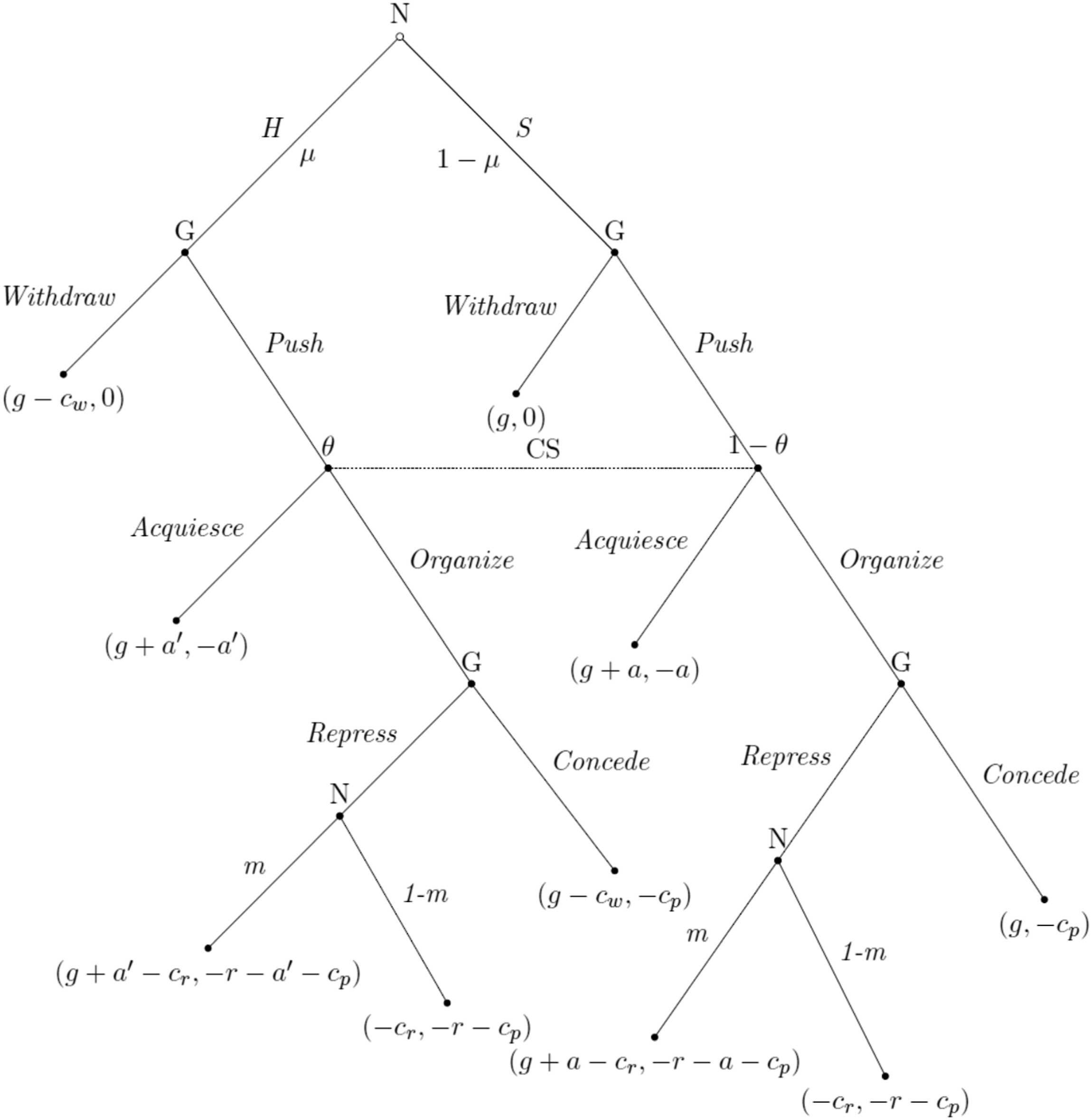
Perfect Bayesian equilibria
This model determines the Perfect Bayesian Equilibria in terms of separating and pooling equilibria. It argues that there are three separating and four pooling equilibria. In the analysis, it exhausts all possible equilibria and eliminate the non-existent equilibria. The mathematical proofs are presented in the Appendix.
There exists a separating equilibrium with the strategy profile This equilibrium separates the two types. The government reveals its type, as the hardline type plays Push bill and softline type plays Withdraw bill in the first period. Given the regime chooses to push ahead with the bill initially, the civil society knows that it is facing a hardline type. Civil society will risk protesting against the Extradition Bill, under the condition that the probability of successful police repression lies between
There exists a separating equilibrium with the strategy profile
There exists a separating equilibrium with the strategy profile
Proposition 2 suggests that the hardline type plays Push bill and softline type plays Withdraw bill in the first period, while Proposition 3 suggests the hardline type plays Withdraw bill and softline type plays Push bill. Given the regime chooses to move the bill forward initially, the civil society knows that it is facing a hardline (or softline) type, but it also anticipates sufficiently low chances of successful police repression. Civil society will organize protests. The government will then back down and withdraw the bill eventually.
There exists a pooling equilibrium with the strategy profile
There exists a pooling equilibrium with the strategy profile Here, hardline and softline governments both push the bill in the first period. Civil society knows that if it organizes protests, the hardline type will repress given it has a sufficiently high chance of successful repression, and the softline type will withdraw the bill eventually. Civil society will choose to acquiesce if it has sufficiently high belief of a hardline government,
There exists a pooling equilibrium with the strategy profile
There exists a pooling equilibrium with the strategy profile
Proposition 6 states that both government types choose to push the bill, while Proposition 7 suggests both government types withdraw the bill at the first stage. The civil society knows that if it organizes, the hardline type will withdraw the bill eventually given sufficiently low prospects of successful repression, and that the softline type will withdraw the bill in the end. Civil society hence chooses to protest and the regime will withdraw the bill eventually.
Repression or concession for a hardline government: Determinants of
and
Given the civil society organizes protests against the Extradition Bill, a hardline regime will evaluate the probability of successful repression before it chooses either to repress or concede. Such probability hinges on the cost of repression
On one hand,
In contrast, the cost of concession
Posterior belief
If the Hong Kong government moves the bill forward initially, the civil society will decide whether to organize protests based on their beliefs about the government type. Such beliefs are determined by the following factors:
First, prior beliefs,
Second, as illustrated in Lemma 2, changes in government actions lead to changes in the civil society’s coordination costs and costs of being repressed, which in turn change
Specifically, when Proof. See Appendix.
Conditions for protest and acquiescence
This study examines the PBE of the signaling game and explores when the conditions associated with the equilibria are attained. Specifically, the equilibrium can be attained at different values of the posterior belief Regions for the equilibria.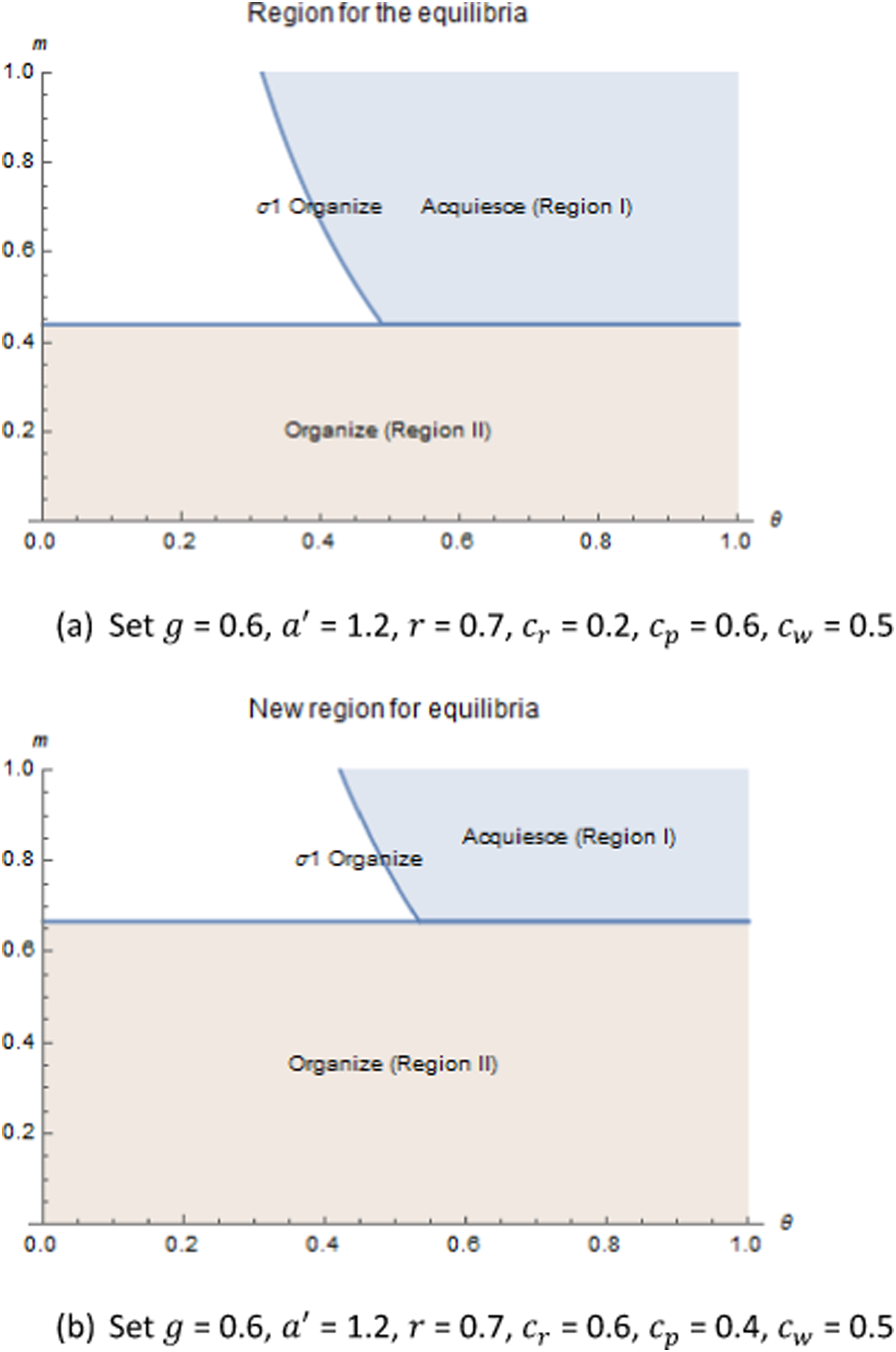
This study varies the values of
Likelihood of different PBE
As stated in the PBE, different values of
Civil society in Hong Kong has the mobilization capacity to coordinate protests efficiently. With the use of social media and international media coverage, the cost of coordination
That said, Propositions 4 and 5 are the two most likely equilibria that represent the outcomes of the strategic interaction between the regime and civil society during the Anti-Extradition Law Movement. Accordingly, this study derives two competing hypotheses that predict the movement’s dynamics. It hypothesizes that
(Derived from Proposition 4) The government pushes the Extradition Bill initially. The civil society has high posterior belief about a hardline government (high
(Derived from Proposition 5) The government pushes the Extradition Bill initially. The civil society has low posterior belief about a hardline government (low The two hypotheses speak to the classic hawk-dove game (McAdams, 2009). If Hypothesis 1 is true, the civil society will be dovish (acquiesce) and the government will be hawkish (repress). This imitates a chicken game with Nash equilibrium Dovish/Hawkish for the civil society and government respectively. If Hypothesis 2 is true, both the civil society and government will be hawkish. The regime will succeed in suppressing the rebellion. This game model is closer to a PD game, where both players defecting is the only Nash equilibrium (Axelrod, 1984).
Empirical analysis
As an empirical analysis, this research analyzes qualitative evidence from the dynamics of the Anti-Extradition Law Movement. It examines how government actions influenced the beliefs of the civil society regarding Chinese intervention, and how the beliefs changed the levels of protest participation and the government’s subsequent responses during the anti-authoritarian movement.
5
When the Carrie Lam administration first introduced the Fugitive Offenders Ordinance on February 13, 2019, the business community and ordinary Hong Kong citizens raised their concerns over the legislation. While the government made minor concessions to the business community, it failed to assuage ordinary citizens’ concern about political freedom. Faced with public opposition, the government announced its plan to resume the second reading of the Extradition Law on June 12, 2019. The civil society was uncertain about the extent of Beijing’s intervention in the legislation process. Ordinary citizens were uncertain whether the Hong Kong government was under Beijing’s pressure to quell any political opposition to the bill (neither high nor low
As the Carrie Lam administration moved the Extradition Bill forward initially, it was sending the civil society a signal about its type. Nonetheless, the civil society was unable to infer about the government type based on this signal alone.
6
The subsequent events led the civil society to hold false belief about the government type. As Carrie Lam later announced the suspension of the bill and Ambassador Liu hinted at the absence of Beijing’s involvement, the civil society mistakenly interpreted those events as a harbinger of further concessions by the government. The pro-democracy civil society formed low posterior belief of facing a hardline government, i.e. they had low posterior belief about Chinese intervention (low
Most of the protests were subsequently met with police repression, and protesters inevitably went into violent confrontations with the police. Since late August 2019, the Hong Kong authorities have taken a more hardline approach to social unrest and Beijing showed signs of increasing involvement in the handling of protests. Although the government finally withdrew the Extradition Bill on September 4, the regime showed no intention of addressing other demands from the civil society. Instead, the government ramped up its repression against protesters. The police repeatedly denied no-objection letters to protest organizers. Not only did the regime upgrade weapons and crowd-control measures against protesters, but it also arrested more protesters as the movement continued. There were numerous protesters’ allegations of brutal beatings and torture at the hands of Hong Kong police during detention (Mahtani, 2019). There were also reports of dead bodies found in Hong Kong’s waters, some of which were believed to be protesters killed by the police (Wong, 2020). In fact, there were anecdotes of the People’s Liberation Army disguising as Hong Kong police to quell the social unrest. The heightened crackdown on the rebellion was manifest in the police siege of the Hong Kong Polytechnic University in November. The incident demonstrated the regime’s unwavering commitment to impose heavy-handed measures on political dissents. As an aftermath, the opposition, especially the radical flank of the movement, suffered a devastating blow. With many radical protesters being arrested or fleeing the city in the midst of government crackdown, the protest movement demised, and protest participation declined significantly. Further dampened by the COVID-19 outbreak, the anti-authoritarian campaign was put to an end in early 2020.
The trajectory of the 2019 protests provides more support for Hypothesis 2 than Hypothesis 1. It can be summed up in terms of the hawk-dove game. The civil society was uncertain whether it was playing a PD or chicken game, and it had to guess this based on a signal from the government. The civil society held misinformed belief that they were playing a chicken game, where the government would be dovish (make concessions) if they were hawkish (protest). However, the regime turned out to be hawkish as it crushed the protests with iron fist. What happened in reality was closer to a PD game, with both players choosing to defect.
Conclusion and discussion
Under what conditions will the civil society organize protests against the regime? Given the information and beliefs about the possibility of state repression, when is it rational for the civil society to protest? If the government knows the likelihood of successful repression, under what conditions will it repress protests? To address those research questions, this paper uses a game-theoretic approach to derive the conditions under which the civil society would mobilize protests and the government would choose to repress. Employing a novel signaling game, this study models the strategic interaction between the regime and the pro-democracy civil society during Hong Kong’s Anti-Extradition Law Movement in 2019. While the regime knows its type, the civil society had incomplete information about the government type. The government reveals information about its type through its actions. Civil society then updates its beliefs about the extent of Chinese intervention. The political opposition chooses whether to organize collective action, and the regime decides whether to mobilize its security apparatus to repress. Deriving from the Perfect Bayesian Equilibria, this study forms two competing hypotheses that predicts the dynamics of the Anti-Extradition Law Movement. The government first moves the bill forward. If the civil society has a high (or low) posterior belief of facing a hardline government, it acquiesces (or protests). If protests occur, the hardline government will repress while the softline government withdraws the bill eventually.
Examining qualitative evidence, this paper finds that prior to the Anti-Extradition Law protests, the pro-democracy civil society was uncertain about the extent to which Beijing exerted pressure on the Carrie Lam administration. Although the government pushed the Extradition Law initially, the following events led the civil society to hold mistaken belief in the government’s willingness to make concessions to their demands. The civil society engaged in collective action with record-breaking turnouts. The regime then chose to repress dissenters, revealing evidence of the Carrie Lam administration appeasing Beijing. As police repression intensified and the COVID-19 pandemic hit, the movement eventually ran out of steam.
Notwithstanding the assumptions this paper makes on the Anti-Extradition Law protests, it is worthwhile to explore two alternative interpretations of the strategic situation. The first alternative interpretation is that the Carrie Lam administration was primarily concerned about signaling loyalty to Beijing through its decision to move forward the unpopular Fugitive Ordinance. This argument suggests that Carrie Lam was sending a signal to the civil society about its level of loyalty to Beijing, that a highly loyal type, compared to a moderately loyal counterpart, would be more determined to push the Extradition Law and, if necessary, seek help from the Chinese regime in quelling the protests. Given the levels of loyalty imply various extents of Chinese involvement in the strategic situation, the assumptions of a highly loyal type of government are somewhat similar to those of a hardline type. Assuming limited changes to the model’s parameters, this interpretation about the signals sent by Carrie Lam is unlikely to alter the conclusions of this study.
Another alternative interpretation is that Beijing had a strong interest in showing its ability to control the Hong Kong government and impose its will on the civil society. This viewpoint assumes that Beijing could be a strategic player in the game. As a third party, the Chinese government would first observe the actions by the Hong Kong government and civil society, and decide whether to repress or concede in the last period of the game. With the introduction of Beijing in the game model, the analysis is likely to produce additional equilibria and hence potentially different theoretical insights (Chyzh and Labzina, 2018; Pierskalla, 2010).
This paper makes two main contributions. First, it engages with the growing literature on third-party intervention in domestic crisis. As geopolitical competition is increasingly intense, regional powers are expanding their spheres of influence more than ever. Consequently, smaller states seldom act independent of foreign influence (Chyzh and Labzina, 2018). This study illustrates how information and beliefs about third-party involvement influences the domestic-level strategic interactions between the civil society and regime. Through a novel signaling game and empirical evidence from Hong Kong, this study outlines how the civil society’s beliefs and interpretation of government actions affected their propensity to mobilize. It also illustrates how the political pressure from Beijing affected the Hong Kong government’s decision to quash popular protests.
Second, this paper introduces a new perspective to the collective action problem. While the signaling game model treats the civil society as a unitary actor, a n-person collective action game could result in mixed equilibria in which some actors choose to protest and some do not. Depending on their beliefs, perceived values of the collective good and resources, individual citizens typically evaluate the payoffs for protesting as opposed to free-riding (Olson, 1965). Protesters also face the start-up costs and follow-up problems in collective action (Oliver et al., 1985). This study, assuming the costs of coordination and costs of being repressed for the protesters (Chong, 1991), adds nuances to the classic hawk-dove game by illustrating how, under uncertainty, beliefs and (mis)interpretation of government actions can affect the conditions for successful collective action among potential protesters. At the same time, this study demonstrates how actions of the government could be motivated by an attempt to influence the outcomes of the game among protesters. Some governments, in particular the hardline type, are incentivized to quell collective action at an early stage, so that the protests do not spiral out of control and force the government to make concessions.
With regard to generalizability, the empirical findings offer insights to popular protests and state repression in countries under the influence of strong regional powers. Some prominent examples include the mass protests and Soviet intervention in state repression in Hungary and Czechoslovakia, two states in the Communist Bloc, in 1956 and 1968 respectively. Among the many examples, the 2024 mass protests in Georgia, a former Soviet republic, serves as a timely comparison to the 2019 Hong Kong case. In 2023, the Georgia government proposed a “Foreign Agents” bill, requiring all non-governmental organizations to register as “agents of foreign influence” if they acquire more than 20% of funding from abroad. Widely viewed as a Russian-sponsored legislation, the bill sparked mass protests and the government withdrew the bill. In April 2024, Tbilisi reintroduced the bill and imposed more hardline measures against protesters (Vinograd and Nechepurenko, 2024). With potential political pressure on the part of the Putin administration, the game proposed in this study has explanatory power for the actions by the Georgian government and civil society.
Footnotes
Acknowledgements
Earlier version of the manuscript was presented at the 2022 annual meeting of the Midwest Political Science Association. I am indebted to Tse-min Lin, Stan Wong, Hope Dewell Gentry, the editor, and two anonymous reviewers for their valuable comments and suggestions.
Declaration of conflicting interests
The author(s) declared no potential conflicts of interest with respect to the research, authorship, and/or publication of this article.
Funding
The author(s) received no financial support for the research, authorship, and/or publication of this article.
