




Abstract
The ultra-Orthodox population in Israel demonstrates a higher natural growth rate compared to the general population, yet the employment rate among ultra-Orthodox men remains significantly lower. This phenomenon can be attributed to the concept of the religious club model (Berman, 2000), which posits that strict requirements and club goods foster a strong commitment to the religious community. By utilizing individual-level data collected from 256 ultra-Orthodox men and employing K-Means clustering analysis, we identified two distinct types based on their demonstrated levels of voluntary sacrifice which only partially overlapped the club’s formal admission criteria. Our findings illustrate the ultra-Orthodox religious club as inherently limited in its ability to enforce religious norms and prohibitions and as a result it is variably effective in filtering out ‘free riders’ and may not reward nonmembers despite their demonstrably consistently high adherence (‘wannabes’). Our findings also reveal a positive association between wage expectations and the likelihood of ultra-Orthodox men entering the labor market, implying a potential trade-off between earning potential and the extent of social fines. Interestingly, our results also offer insight into the increased adherence to Halacha (Jewish religious law), despite the rise in real wages. Furthermore, our simulation offers policymakers a tool to evaluate the necessary incentives to encourage greater participation of ultra-Orthodox men in the labor market. This has implications for both enhancing economic outcomes and understanding the intricate interplay between religion, social norms, and employment decisions.
Introduction
The ultra-Orthodox community currently comprises approximately 11% of the Israeli population, with expectations of its share growing to 30% by 2065 (Central Bureau of Statistics, 2017). This demographic trend raises concerns among policymakers due to the notably low employment rate among ultra-Orthodox men (around 51%, in contrast to 86% among non-Orthodox Jewish men) (Cahaner and Malach, 2022). The potential implications of this employment gap for Israel’s economy and the challenges it poses on its’ ability to sustain ultra-Orthodox lifestyle are of substantial importance (Soffer, 2016).
This study aims to illuminate the distinguishing characteristics of ultra-Orthodox men who opt not to participate in the labor market and explore the impact of economic incentives on their employment rates. Addressing this inquiry, our study adopts an individual-level sampling approach in line with the religious club model, initially introduced by Iannaccone (1992, 1994). Berman (2000) employs the religious club model to elucidate the limited labor supply among ultra-Orthodox men. According to this perspective, the high prevalence of ultra-Orthodox men studying in Yeshivot 1 can be seen as a form of sacrifice that signifies their allegiance to the religious club, thereby fostering its cohesion and identity. Berman contends that the effectiveness of the religious club in deterring individuals who take advantage of its benefits without contributing (free riders) hinges on enforcing significant sacrifices and social sanctions. These impactful sacrifices compel individuals with high earning potential to exit the club and enter the labor market—an issue of particular relevance as real wages increase, and income disparities widen between ultra-Orthodox and non-ultra-Orthodox households. Moreover, behavioral norms within the ultra-Orthodox community, such as prohibitions against using the internet or reading secular newspapers (Perelman et al., 2019), further exemplify the sacrifices and societal indicators associated with club membership. These norms not only represent a form of voluntary sacrifice but also cement community members’ association to and standing within the community.
Drawing on the theoretical foundations of Iannaccone and Berman, and in particular on Berman’s (2000) argument that the only requirement for joining the ultra-Orthodox religious club in Israel is to study at a Yeshiva and opting out of the labor market, namely, on a single formal criterion (employment status), we formulate two main research questions. Our first research question examines the effectiveness of the ‘screening effect’ within the ultra-Orthodox community: How effective is the ultra-Orthodox religious club in achieving uniform adherence to established social prohibitions and norms?
We hypothesize that (H1) the ultra-Orthodox religious club is inherently limited in its ability to enforce religious norms and prohibitions and as a result it is variably effective in filtering out ‘free riders’ and may disadvantage potential members despite their demonstrably consistently high adherence (‘wannabes').
The variation in adherence informs our second research question: How do earning potential and social fines interact to influence ultra-Orthodox men’s labor market decisions, thereby shedding light on the substitution effect of the Israeli ultra-Orthodox religious club?
This study proposes two research hypotheses in order to further investigate the issues arising from this research question. We first hypothesize that (H2.1): Higher potential earnings positively correlate with the likelihood of ultra-Orthodox men transitioning from religious club membership to the labor market. This hypothesis is grounded in the ‘substitution effect’ of the club-good model, which demonstrates how financial incentives may outweigh the benefits of club membership. Secondly, (H2.2), we hypothesize that the apprehension of social fines is negatively associated with the likelihood of ultra-Orthodox men transitioning to the labor market. This aligns with the club-good model’s focus on the indirect implied costs associated with leaving the club.
This study’s contribution encompasses three key aspects. Firstly, to the best of our understanding, prior explorations of the club model have predominantly utilized aggregated data (Berman, 2000; Berman and Laitin, 2008; Campante and Yanagizawa-Drott, 2015; Wang, 2009) or laboratory experiments (Aimone et al., 2013; Benjamin et al., 2016; Bursztyn and Jensen, 2015). Consequently, this study offers a pioneering opportunity to empirically explore the religious club model utilizing individual-level data. Secondly, it introduces novel insights into the role of earning potential in influencing individuals’ decisions to enter the labor market and leave the religious club. Lastly, it evaluates the effectiveness of government subsidies in increasing ultra-Orthodox men labor force participation and its’ economic contribution.
The next section reviews literature on the distinct characteristics of ultra-Orthodox society and the employment dilemma faced by Israeli ultra-Orthodox men. We then provide a concise theoretical review of the religious club model. The methodology introduces our distinct database and the variables contributing to the subsequent findings. The paper concludes by discussing the implications of this study for career development and labor force participation, particularly where economic and cultural explanations are insufficient.
Literature review
The ultra-Orthodox community in Israel
Ultra-Orthodox Judaism traces its origins to the 19th century in Europe (Carvalho et al., 2017; Friedman, 1991). The Enlightenment movement’s rise, combined with modernization and secularization trends in Central and Western Europe, prompted many Jews to embrace new customs, attire, and lifestyles diverging from traditional Jewish orthodoxy. A significant number were drawn towards secularism, with some even converting to Christianity.
In an effort to curb this shift away from tradition, orthodox Jews fortified their communities with a more conservative framework and minimized exposure to external influences that might weaken their faith and traditions. This steadfast adherence to tradition was a pivotal reason for the ultra-Orthodox leadership’s staunch opposition to Zionism and the establishment of the State of Israel. Yet, due to historical events that decimated and impoverished ultra-Orthodox communities, most ultra-Orthodox leadership found it pragmatic to collaborate with Zionist institutions and, indeed, since Israel’s establishment, the ultra-Orthodox have been active participants in its political sphere. Ultra-Orthodox parties have played a prominent role in most coalition governments since 1948, and this became especially notable after 1977 when a right-wing coalition replaced its left-wing predecessor. This political strategy provided ultra-Orthodox politicians the leverage to negotiate benefits for their community, such as exemptions from mandatory military service, reduced health insurance fees, government allowances, and financial support for Yeshiva students (Gal, 2014).
Indeed, the State of Israel has played a crucial role in nurturing an ultra-Orthodox autonomy, complete with independent judicial, communicative, and educational systems (Berman, 2000; Cahaner, 2009). The seclusive ultra-Orthodox education system, in particular, prioritized religious studies over secular ones. This emphasis soon led to educational disparities between the ultra-Orthodox and the broader Israeli populace, also resulting in a decline in professional competencies within the ultra-Orthodox community, which in turn affected their integration into the labor market (Berman, 2000; Cahaner, 2009; Friedman, 1991). Moreover, in a bid to maintain orthodoxy, men are incentivized to pursue religious studies within the Yeshiva framework for married men (“Kollel”). This pathway offers an alternative to conventional employment as Kollel students benefit from state-sponsored tuition and other exclusive financial perks and benefits.
Israeli ultra-Orthodox men employment dilemma
For many young ultra-Orthodox men, making career decisions is fraught with complexity. On one hand, departing from the Yeshiva to enter the employment market offers a pathway to improve their family’s financial well-being and fulfill personal aspirations. Conversely, given the strong emphasis on sacred studies from an early age, stepping into the labor market can be interpreted as a departure from devout religiosity. Such a move may also entail significant “costs”. Opting for employment over continued sacred studies might jeopardize their membership in a prestigious “religious club,” which offers its members numerous benefits. Additionally, this choice might subject them and their families to societal penalties and sanctions (Berman, 2000). The ensuing chapter delves deeper into the advantages of the ultra-Orthodox “religious club” and the potential repercussions of diverging from its path.
This internal conflict manifests in prominent employment disparities between ultra-Orthodox men and their non-Orthodox Jewish counterparts. In 2003, the employment rate for ultra-Orthodox men aged 25–64 stood at 35% (Cahaner and Malach, 2022), a stark contrast to the 78% rate for non-Orthodox Jewish men (Central Bureau of Statistics, 2003). As financial challenges within ultra-Orthodox families intensified, more ultra-Orthodox men ventured into the labor market. Yet, significant disparities persist between them and their non-Orthodox Jewish peers. Over the past two decades, while the employment rate for ultra-Orthodox men increased to 52.5%, it remains substantially lower than the 90% rate observed for non-ultra-Orthodox Jewish men (Central Bureau of Statistics, 2019).
Religious club goods model
The concept of a “club model” provides a theoretical framework explaining the social integration of groups that distance themselves from dominant cultural norms. This model is particularly relevant to cults and religious minorities (Carvalho and Sacks, 2021). The canonical religious club model was developed by Iannaccone (1992, 1994) and later expanded by Berman (2000). Within this model, rigorous social collectives, termed “clubs,” collaboratively generate goods and services benefiting their members, which include religious services, charitable activities, and communal insurance policies (Carvalho, 2020). However, this collective production faces the challenge of “free riders” – members of the community who benefit from the collective’s products without contributing to their production. In extreme cases, such behavior could lead to a complete cessation of production, causing the community’s fragmentation. To counteract this, religious clubs set higher admission criteria and necessitate significant sacrifices from their members. These stipulations, like investing time and resources or adhering to particular norms related to attire, ceremonies, and other restrictions, ensure that only genuine contributors join (Carvalho, 2019). Such constraints both act as a screening mechanism and to discourage engagement in non-club activities (substitution effect). The model further suggests that group-level sanctions amplify these effects (Berman, 2000; Carvalho, 2019; Carvalho et al., 2017).
The religious club model has been successfully applied to provide insight of various sects and denominations around the world, ranging from Catholics (Berman et al., 2018) and Mormons (McBride, 2015) to the Amish (Choy, 2016; Wang, 2009, 2020) and Muslims (Berman and Laitin, 2008; Campante and Yanagizawa-Drott, 2015). It’s also been applied to various Jewish sects, especially within Orthodox Judaism (Berman, 2000; Carvalho et al., 2017; Carvalho and Koyama, 2016).
The model postulates that a religious club’s ability to attract or retain members is limited. Individuals with higher earning potential might opt out of the club, forgoing its benefits (Berman, 2000). Some contend that earning potential relates to wage levels (Carvalho and Koyama, 2016). Berman (2000), for example, theorized that the rising demands for religious activities among Israeli ultra-Orthodox communities and their increasing avoidance of secular society stem from efforts to safeguard the community against rising real incomes. However, others associate earning potential with labor productivity, implicitly associated with personal capabilities. As Carvalho et al. (2017) noted, labor productivity is related to educational attainment. They demonstrated that curbing a club member’s education is logical when educational returns are minimal. They used the religious club model to show that the enlightenment and emancipation movements in the 19th century led some Jewish streams, especially in Eastern Europe, to, consciously, increase the sacrifice required from community members, to segregate and reduce the scope of secular education, and even to avoid secularism altogether.
Wang (2020) also found that imposing restrictions on children’s education in the Amish community was used to screen out high achievers and thus maintaining a cohort with relatively lower labor productivity. Intriguingly, like the Israeli ultra-Orthodox society, Amish children's education restrictions were facilitated by state support, which allowed the Amish to cultivate their segregated way of life and preserve their religious customs, exclude people with low religious participation, and even boosting their numbers through increased birth rates. 2
This study demonstrates the tension that exists in ultra-Orthodox society between individuals’ need to earn a living and their desire to belong to a supportive social club, in the spirit of the religious club model. That is, (personal) labor force considerations are mitigated by the community’s influence, as demonstrated by the Israeli ultra-Orthodox case. An Avrekh, which is an Israeli ultra-Orthodox man studying in the Yeshiva (i.e., member of the high-quality religious club), derives benefit from funded tuitions (state and Yeshiva) and other state funded financial support as well as from his religious activities, such as prayers and religious studies. This individual also enjoys external advantages in a variety of areas, merely by being a member of the high-quality religious club. These “external” benefits include, among other things, interest-free loans, free mortgage guarantees, assistance in finding a quality match, admission to prestigious educational institutions, priority entitlement in admitting his children to prestigious educational institutions and more. However, all these desirable benefits can be limited to club members, that are required to signal that they are behaving according to accepted norms of behavior. In the case of the Israeli ultra-Orthodox men, these signals include the amount of time devoted to religious activities, such as Torah studies, refraining from using the Internet, and reading secular newspapers (Perelman et al., 2019). Failing to properly signal may lead to the individual’s expulsion from the Yeshiva (i.e., banishment from the high-quality religious club), deny him of the benefits and, in addition, may incur other costs, such as social sanctions on him and his family. In this sense, signaling is an expression of club members’ voluntary sacrifice for being a member of the club.
Research design, data, and variables
The sample
Data from the Central Bureau of Statistics (2019) indicates that ultra-Orthodox men of working age predominantly fall into two groups: those who commit fully to religious studies, known as “Avrekh” (Avrekhim in plural), and those who participate actively in the labor market. For our study’s design, we selected a sibling sample - specifically brothers - to represent the ultra-Orthodox male population in relation to labor market participation. It is crucial to note that our focus is not on sociological aspects like family dynamics, peer influence, or status. Therefore, there was not a requirement for direct sibling supervision or pairing. Instead, our classification, detailed later, aims to typify participants not by their occupational choices but by the extent of their voluntary sacrifice within the ultra-Orthodox context.
The study population was sampled during 2019–2020 from among Haredi men. Recruitment was facilitated by ultra-Orthodox undergraduate students from the University of Haifa. Recruiters were diverse, spanning different ages, income levels, areas of residence, and affiliations with specific ultra-Orthodox streams. Each student was tasked with recruiting sets of male siblings from the same family for the study. Out of 389 completed questionnaires, 82 were screened out as they were not identified as ultra-Orthodox, and 57 had incomplete data, resulting in a total of 256 valid records.
Characterizing the ultra-Orthodox religious club
As posited by Perelman et al. (2019), within the ultra-Orthodox community, the exemplary man is seen as a religious scholar fully committed to Torah study. Consequently, ultra-Orthodox men are anticipated to dedicate considerable time to religious studies, both as an affirmation of their dedication to this ideal and as a signal to their membership within the religious community. In addition to spending time on religious studies, other behaviors signal an ultra-Orthodox man’s commitment to the religious club. These behaviors indicate a deliberate distancing from secular influences, such as refraining from reading the secular press and using the internet for non-livelihood purposes. Thus, religious club membership is not merely a one-off formality determined by a single criterion. Instead, it is an implicit amalgamation of factors that encompass the time dedicated to Torah study, abstention from secular activities, and adherence to religious norms. While this membership criteria might seem ambiguous, it facilitates varying degrees of commitment within the religious community.
The ambiguity of club membership criteria and the heterogeneity of commitment to religious and social norms offer valuable insights into the club’s dynamics. Building on Berman’s (2000) definition, which centers around non-participation in the labor market and indirectly implies significant sacrifices for club benefits, the club, in our view, faces inherent limitations in monitoring and enforcing its norms. This results in a spectrum of adherence levels among both members and non-members, with some Avrekhim not fully upholding the club’s dictates and becoming “free riders,” while some non-members stringently follow the norms in their aspiration to become members (“wannabes”).
Employing the K-means clustering method, we were able to unveil the intricate signaling patterns within the ultra-Orthodox community. This approach enabled us to identify distinct subgroups, offering a deeper understanding of the club’s dynamics, particularly the discrepancies between formal membership criteria (employment status) and actual adherence to religious norms (voluntary sacrifice).
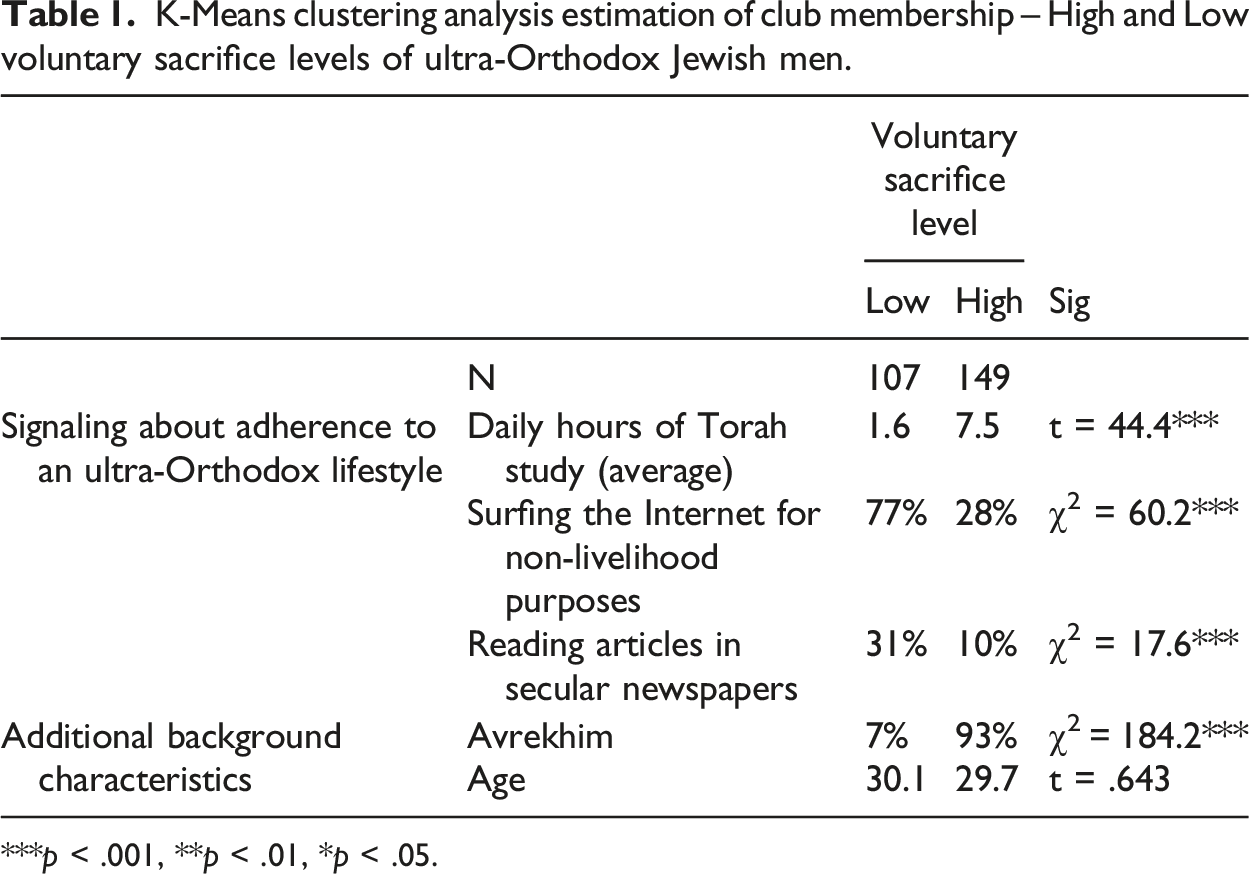
K-Means clustering analysis estimation of club membership – High and Low voluntary sacrifice levels of ultra-Orthodox Jewish men.
***p < .001, **p < .01, *p < .05.
This classification documents several interesting phenomena. At first, it is interesting to note that membership in the religious social club is implicit and vague in a way that allows “flexibility” in weighing accepted norms of behavior. That is, although ultra-Orthodox men characterized by a high level of voluntary sacrifice (i.e., club members) devote more time to Torah studies (7.5 hours per day), a significant proportion of them surf the Internet and/or read secular newspapers (28% and 10%, respectively). Similarly, although ultra-Orthodox men characterized by a low level of voluntary sacrifice devote less time to Torah studies (1.6 hours per day), many of them do not surf the Internet and/or avoid reading secular newspapers (23% and 69%, respectively).
The classification also discerns “free riders.” Our analysis reveals that 7% of those with a low voluntary sacrifice level are Avrekhim. Such individuals ostensibly associate with the social club but do not genuinely embody the typical voluntary sacrifice expected of this group. It’s conceivable that they might not sustain their Yeshiva association for an extended period voluntarily. Conversely, roughly 7% of those with a high voluntary sacrifice level aren’t Avrekhim (i.e., ultra-Orthodox men in the labor market). These individuals (“wannabes”), while not official club members, aspire to join and demonstrate this intent by embracing and signaling the ultra-Orthodox lifestyle, hoping to enjoy the club’s privileges.
Variables
As stated, one of the objectives of the present study is to demonstrate the tension between the level of voluntary sacrifice required of the religious club members and their earning potential. According to one interpretation (Hemi, 2019; Nevo et al., 2004), earning potential is an expression of individuals’ abilities and skills. Highly capable individuals will most likely receive higher compensation in the labor market. Abilities, in this sense, may express individuals’ cognitive capacity to solve problems, as well as their interpersonal and intrapersonal “softer” skills in the context of coping with challenges in everyday life. Others, for instance Perelman et al. (2019), interpret earning potential as an expression of individuals’ subjective wage expectations, whether related to abilities or not.
To this end, we’ll evaluate three measures of individuals’ earning potential aligned with these interpretations: 1. Earning Potential Based on Subjective Wage Expectations: Following Perelman et al. (2019), we estimated this by asking respondents to estimate the wages of non-academic ultra-Orthodox men. We used the logarithm of these estimates for our analysis. Our research model predicts that wage expectations are higher among individuals with lower levels of voluntary sacrifice. 2. Earning Potential as an Indicator of Cognitive Skills: We employed a formal series test to gauge the proficiency of ultra-Orthodox men, considering their customary avoidance of secular education from an early age.
3
Administered under monitored conditions and capped at 8 min, these tests typically produce average scores ranging from 15 to 17 correct answers (Hemi, 2019). It’s essential to point that this method does not attempt to measure the intelligence of ultra-Orthodox men but rather compares deductive and reasoning skills between groups. Within the parameters of our research model, individuals with a lower level of voluntary sacrifice will exhibit higher earning potentials, as indicated by higher scores on the formal test. 3. Earning Potential Reflecting Daily Ultra-Orthodox Life Coping Abilities: This measure focuses on expectations within ultra-Orthodox communities regarding resilience, earnest, and diligent learning, and managing inherent challenges in a conservative, demanding lifestyle. We assessed individuals’ self-efficacy perceptions related to religious studies and daily Haredi life challenges using a seven-statement, four-items scale (Appendix 1). Our measure of participants’ ability to cope with everyday challenges in ultra-Orthodox life was computed as a standardized average of the statements (α = 0.818). Our model suggests that higher abilities to cope with ultra-Orthodox challenges, which implies lower (labor force) earning potential, are more prevalent among individuals with higher voluntary sacrifice level.
Further, we probed into the concerns of ultra-Orthodox men about the potential ramifications of diverging from their religious lifestyle. Foremost among these concerns was the fear of being perceived as ‘lesser quality’ suitors, potentially discouraging high-quality women from considering them as marital partners. Other apprehensions included the risk of their children experiencing reduced social engagements and facing barriers when enrolling in educational institutions. We gauged the concerns of ultra-Orthodox men regarding the social fines tied to deviating from their religious lifestyle, using 5 statements on a 4-item answer scale (Appendix 2). Our measure of perceived personal and social fines was computed as a standardized mean of the responses (α = 0.807). Such social sanctions function as mechanisms for a central planner to ensure commitment intensity within the group and to manage its membership. Thus, our hypothesis posits that ultra-Orthodox men exhibiting a lower level of ‘voluntary sacrifice’ likely view these social fines with less gravity.
Findings
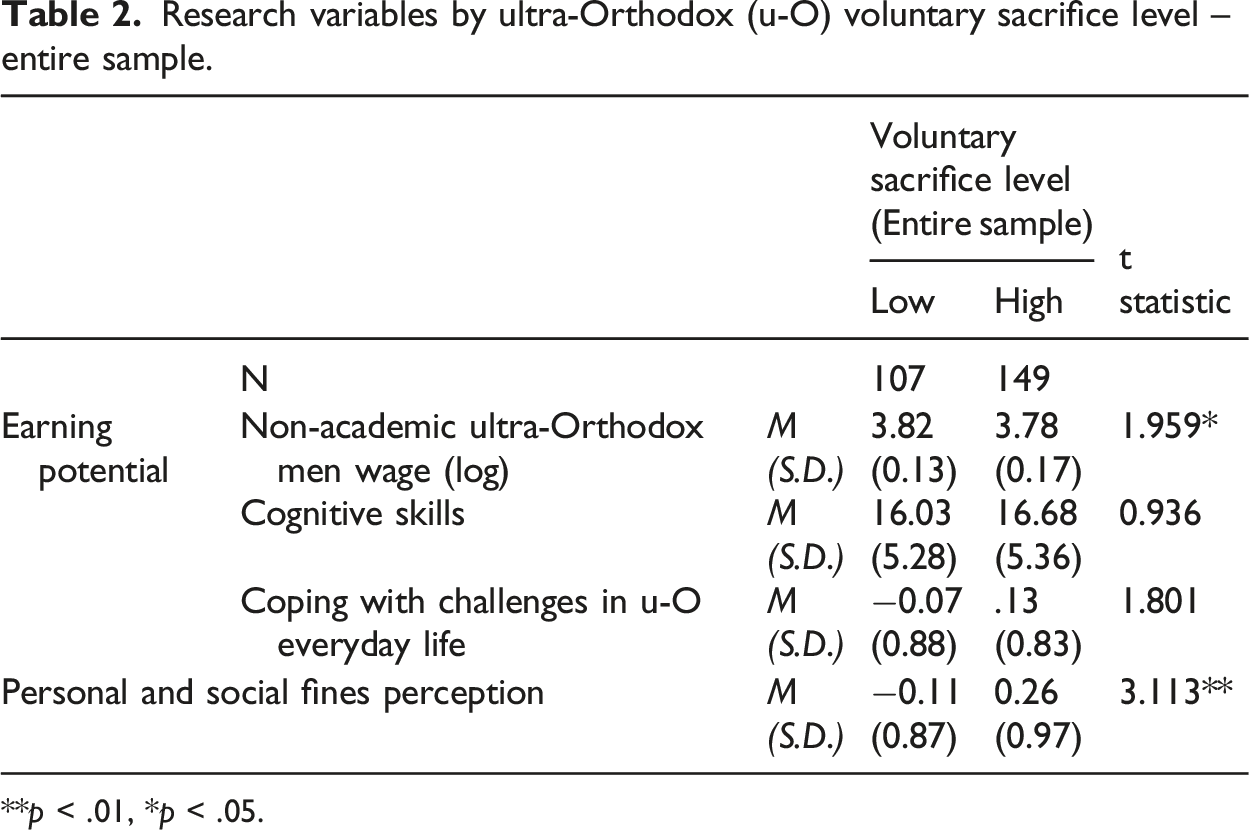
Based on the K-Means clustering of club membership (see Table 1), we examined how personal and social fines perception and earning potential indices relate to voluntary sacrifice levels among ultra-Orthodox Jewish men. We used t-test analyses to compare high and low voluntary sacrifice groups on these variables.
Research variables by ultra-Orthodox (u-O) voluntary sacrifice level – entire sample.
**p < .01, *p < .05.
Conversely, when earning potential estimation was based on non-academic ultra-Orthodox wage expectations, those with a lower level of voluntary sacrifice anticipated higher earning potentials.4 Further results indicated a notably higher perception of personal and social fines among those with a higher level of voluntary sacrifice.
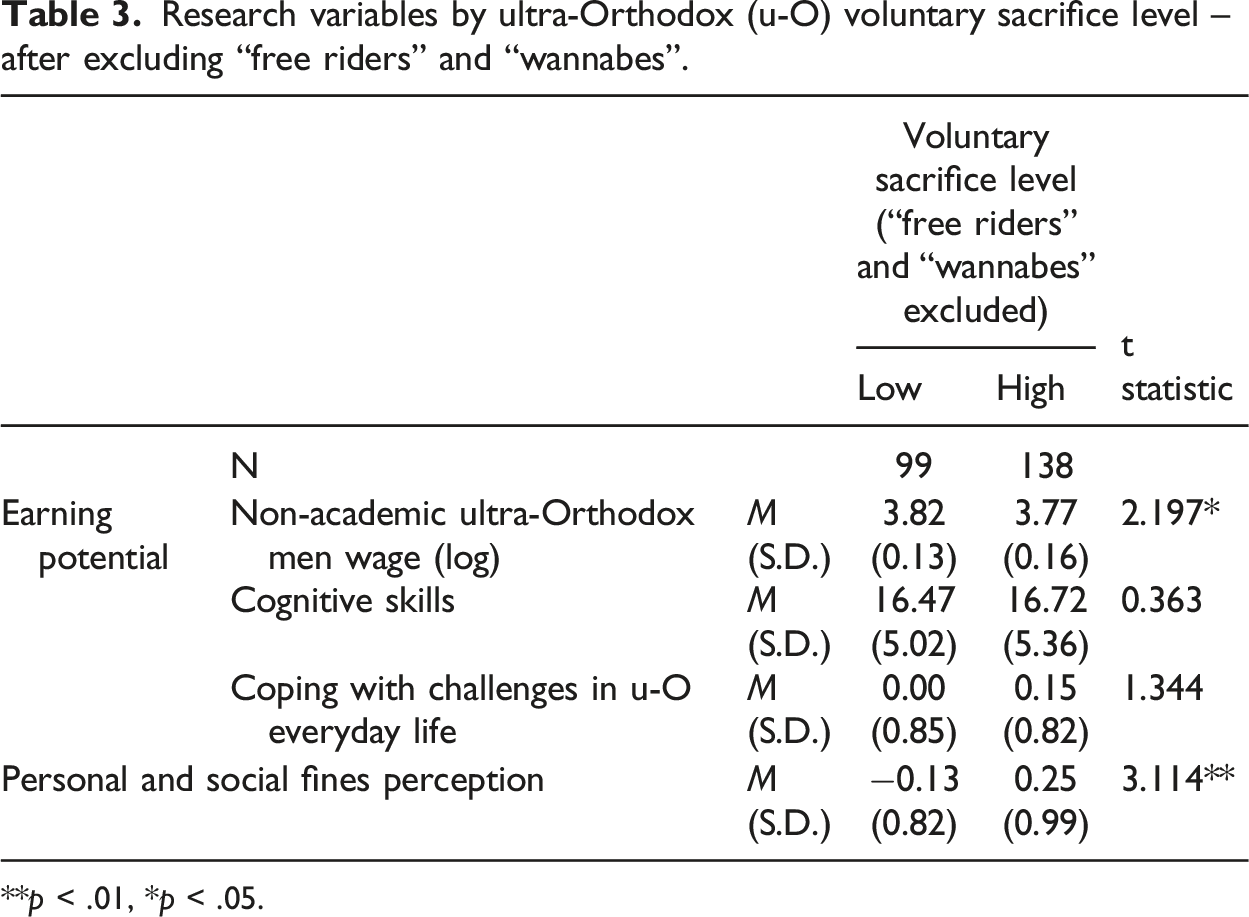
We can estimate the club’s substitution effect (as will be discussed in the next chapter) and explore how earning potential influences the likelihood of choosing the labor market. However, both formal membership criteria (employment status) and implied membership criteria (voluntary sacrifice level) present distortions to such estimate. For example, considering individuals in the labor market who demonstrate high levels of voluntary sacrifice (referred to as ‘wannabes’) or Avrekhim with minimal sacrifice (known as ‘free riders’) could obscure our understanding of the interplay between employment choices and voluntary sacrifices within the club. Therefore, by omitting ‘free riders’ and ‘wannabes,’ we can ensure a precise alignment between the two sets of criteria, allowing for an accurate evaluation of the dynamics of club membership and its effect on labor market decisions in the Ultra-Orthodox community.
Research variables by ultra-Orthodox (u-O) voluntary sacrifice level – after excluding “free riders” and “wannabes”.
**p < .01, *p < .05.
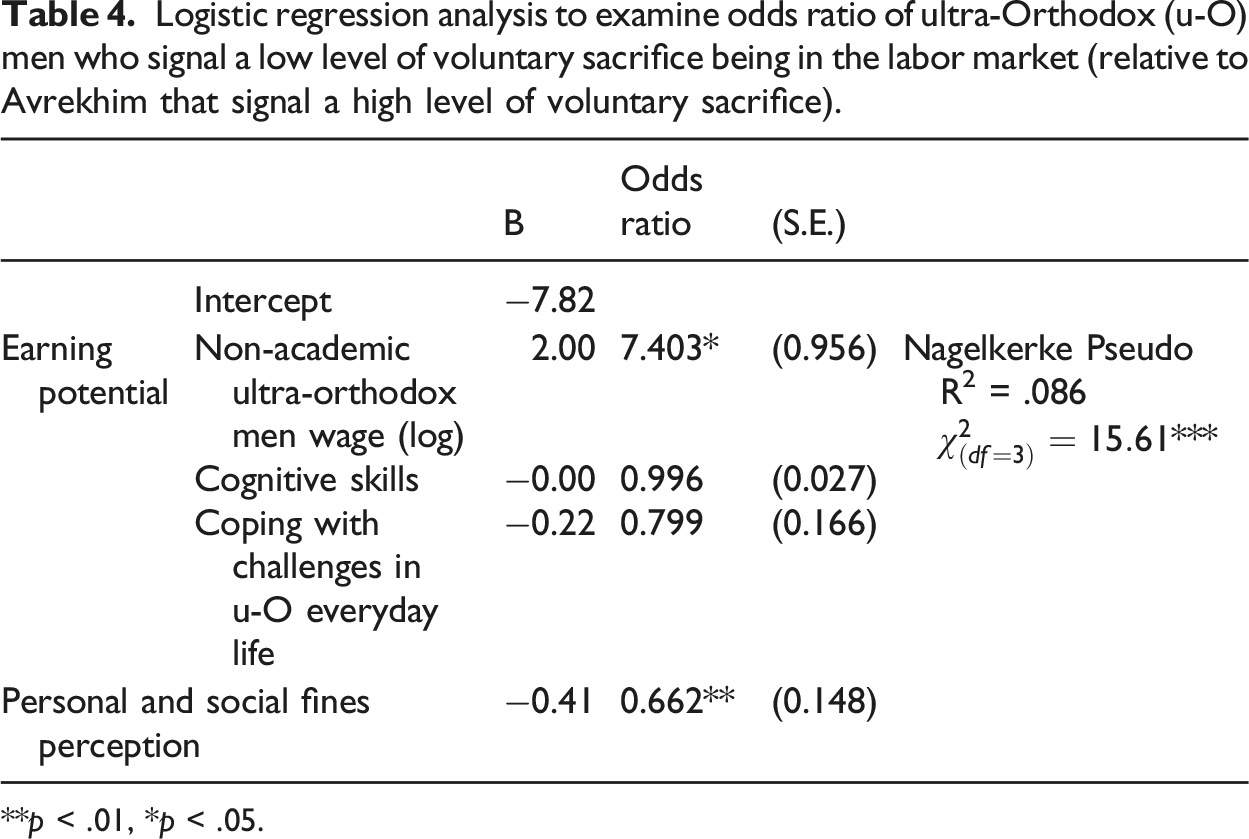
Consistent with our expectations, our results suggest that social fines discourage ultra-Orthodox men labor market integration while earning potential encourage such integration. These insights underlie the second research question we posed above, namely, how do earning potential and social fines interact to influence ultra-Orthodox men’s labor market decisions. To estimate this effect, we applied a logistic regression (logit) model (excluding both “hitchhikers” and “wannabes” from the analysis) which predicts the likelihood of labor market integration as a function of both social fines and earning potential. This method enables us to capture the binary outcome (employment/non-employment) and estimate how the odds ratio shifts with changes in independent variables. Specifically, coefficients greater (lesser) than one indicates an increased (decreased) likelihood of ultra-Orthodox men being in the labor market.
Logistic regression analysis to examine odds ratio of ultra-Orthodox (u-O) men who signal a low level of voluntary sacrifice being in the labor market (relative to Avrekhim that signal a high level of voluntary sacrifice).
**p < .01, *p < .05.
Our findings suggests that individuals with higher earnings prospects may be more willing to relinquish the benefits offered by the club. In a similar vein, the data suggest that Ultra-Orthodox individuals who are less deterred by the implied personal and social penalties are more inclined to join the labor market. This indicates that well-tailored financial incentives, which consider the impact of perceived social penalties, could effectively encourage greater participation in employment. As will be elaborated in the following chapter, both of these factors are crucial in crafting effective strategies to assist individuals in transitioning from the religious club to the workforce. 5
Earning potential and social fines substitution
We conducted a simulation to assess the interplay between earning potential (i.e., wage expectations) and perceptions of personal and social fines, in relation to the likelihood of belonging to either group.
As depicted in Table 2, of the participants, 139 (58.2%) are Avrekhim, signaling a high level of voluntary sacrifice. In contrast, 99 participants (41.8%) are ultra-Orthodox men in the labor force, signaling a lower level of voluntary sacrifice. Based on this distribution and the outcomes of our Logit regression model, we can calculate the earning potential corresponding to each degree of personal and social fines perception. For simplicity, our calculation accounted for median values of 0 for coping with challenges in everyday ultra-Orthodox life and 17 for cognitive skills test results. Given our aim to assess whether financial incentives could improve labor force participation of ultra-Orthodox men, we can also simulate an alternative scenario where ultra-Orthodox labor force participation is 10% higher, representing 52.4% of all ultra-Orthodox men. The outcomes of both simulations, along with the differences in wage expectations, are visualized in the subsequent figure (Figure 1). The salary increase required to reduce the group of ultra-Orthodox Avrekhim with a high level of voluntary sacrifice by 10% (for median values of life coping abilities level and cognitive skills).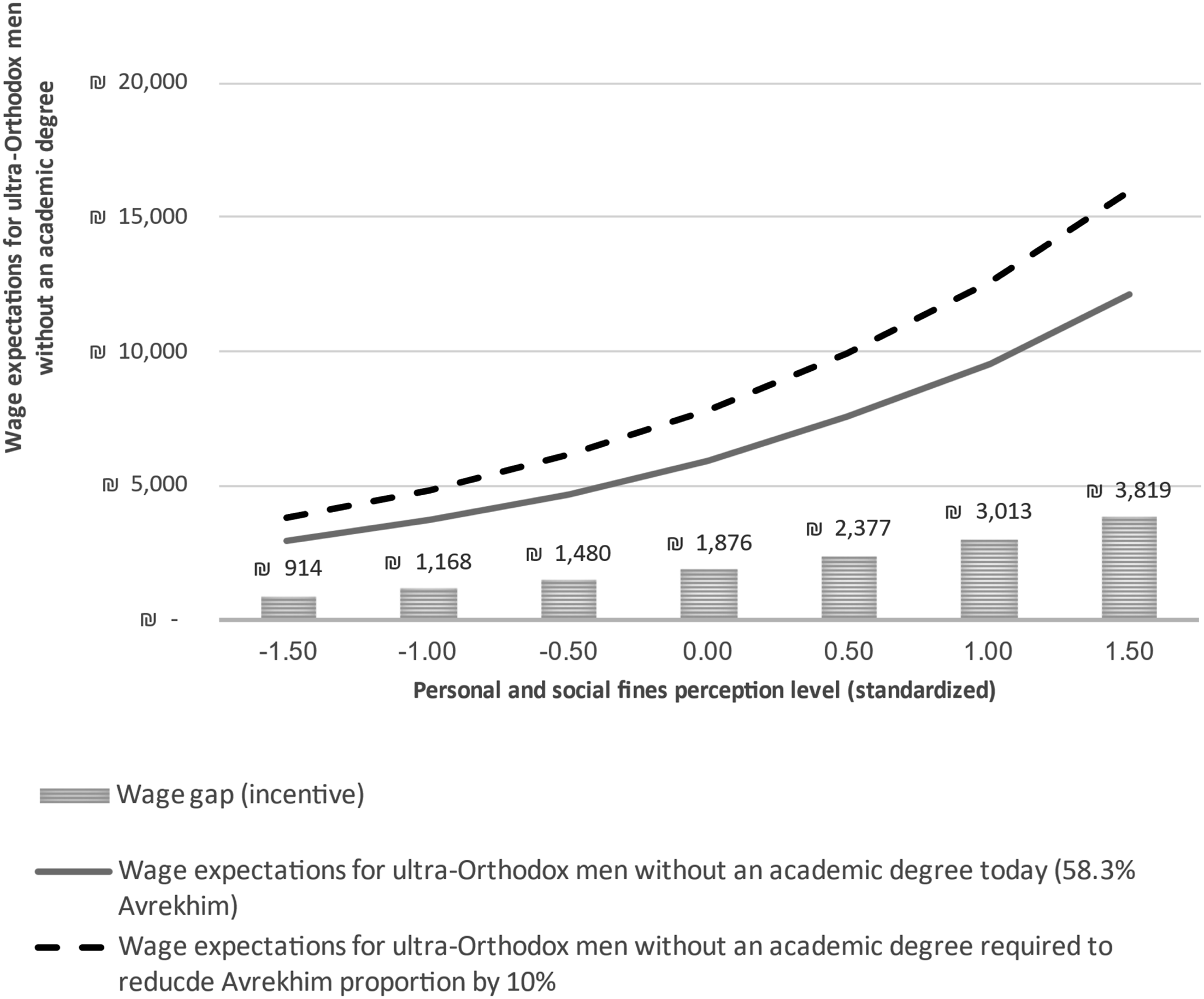
The simulations revealed that when perceived fines are extremely low, a NIS 914 incentive might reduce high-sacrifice Avrekhim population by 10%. However, with extremely high perceived fines, a NIS 3819 incentive would be necessary for a similar outcome.
From Yeshiva to workforce: Evaluating the financial impetus for ultra-Orthodox men
We utilized our simulation data to quantify the cost of a government program designed to reduce the number of Avrekhim. For reasons of convenience, we determine the goal of the program arbitrarily to a reduction of 10%. Also, for simplicity, the analysis ignores natural growth and development trends of the ultra-orthodox community. Currently, with an estimated Avrekhim population of 100,000 in Israel, the objective would be to transition 10,000 Avrekhim into the labor market. To achieve this, the government should consider financially incentivizing the Avrekhim, aiming to increase an average individual’s likelihood of transitioning by 10%. This proposed policy outlines a year-long initiative in which the government offers a monthly stipend for a span of 3 years to any Avrekh leaving the Yeshiva to join the labor force, under the condition they commit to at least 3 years6 in the labor sector (it is important to note that existing incentives are not addressed in this proposal). Considering the median levels of perceived fines and other individual attributes, our simulation indicates a required monthly subsidy of NIS 1876, which equates to NIS 22,510 annually.
The above calculation assumes that granting such a subsidy is unlikely to affect the Haredi social identity of the average individual. Berman (2000) argues that providing a subsidy to Avrekhim who remain to study in Yeshiva distorts the labor supply in Haredi society, since such a subsidy increases the benefit of belonging to the ultra-Orthodox religious club. Accordingly, an ultra-Orthodox individual who wishes to remain in the religious social club and enjoy its’ benefits must increase his signaling (i.e., voluntary sacrifice) and indicate his commitment to the community. Such a signal may be in the form of increasing his Haredi social identity (which consists, among other things, of devoting a lot of time each day to religious studies, avoiding surfing the Internet, etc.) According to the same logic, providing a subsidy to Haredi men entering the labor market is likely to achieve the opposite result, that is, to reduce the Haredi social identity of the average individual. Therefore, it can be assumed that the plan proposed above will increase the rate of Avrekhim entering the labor market even beyond 10% per year (beyond the growth rate expected under the proposed plan). Alternatively, the growth target can be achieved through a smaller annual subsidy.
The effect of a government program on Avrekhim joining the labor market, the scope of incentive grants paid as part of the program, and the discounted benefit to the Israeli economy when Avrekhim enter the labor market.
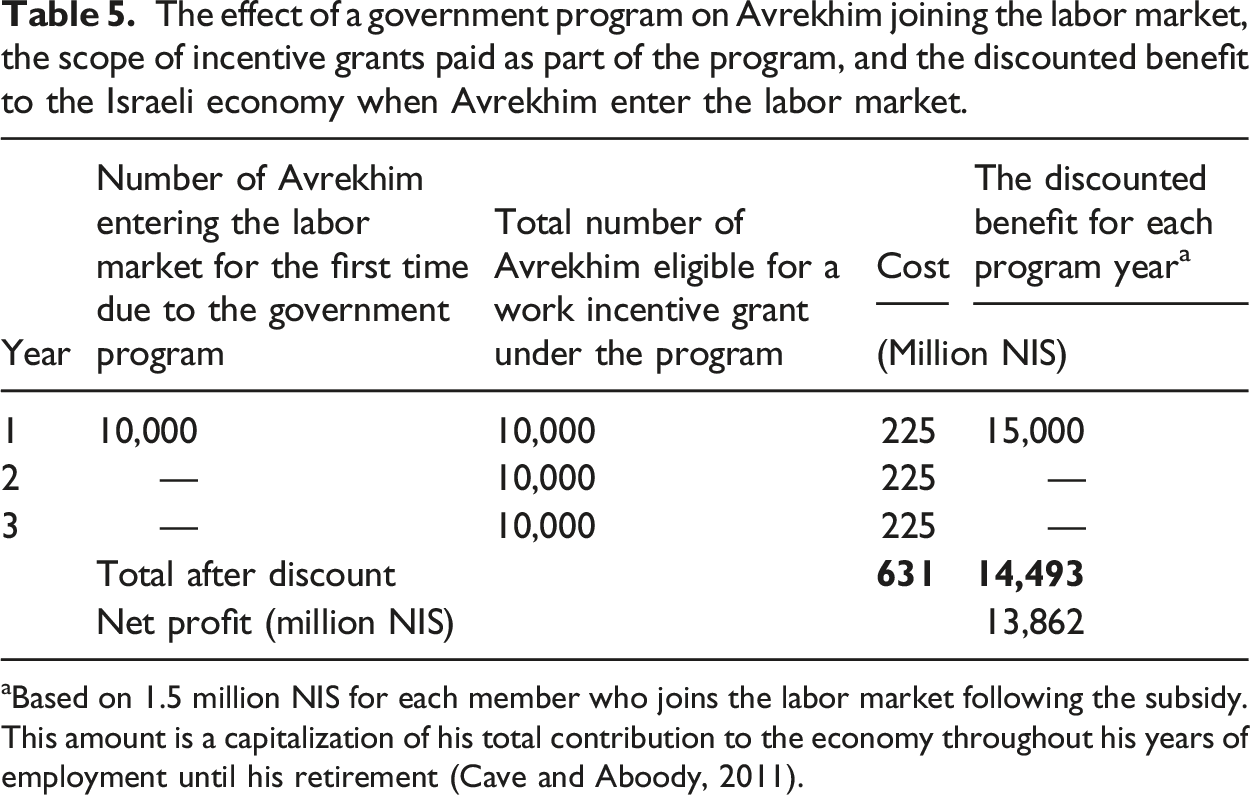
aBased on 1.5 million NIS for each member who joins the labor market following the subsidy. This amount is a capitalization of his total contribution to the economy throughout his years of employment until his retirement (Cave and Aboody, 2011).
The underlying assumption in our calculation is that, upon the program’s launch, 10,000 Avrekhim will enter the labor market. Consequently, each of these Avrekhim would be eligible for an incentive during their first 3 years in the employment market. The yearly subsidy amount can be determined by multiplying the number of eligible individuals by the annual subsidy, which stands at NIS 22,510 annually. The table above details our analysis results, indicating that the total discounted cost for the program in its inaugural year is projected to be NIS 631 million, based on a capitalization rate of 3.5%. This capitalization rate is used to evaluate the cost of the program and it is consistent with the discount rate used by Cave and Aboody (2011) to calculate the expected contribution of an ultra-Orthodox man joining the labor market.
As Cave and Aboody (2011) have previously noted, the Israeli economy gains a net profit of NIS 46,275 for every Avrekh who enters the labor market in his initial year of employment. Spread across 30 working years, this translates to a cumulative economic benefit of roughly NIS 1.5 million (considering a capitalization rate of 3.5%). Thus, the total discounted present value of all the Avrekhim joining the labor force due to the program is approximated at NIS 14,493 million, using the same capitalization rate. When the subsidy cost is subtracted, the program’s anticipated discounted profit for the economy stands at an impressive NIS 13.86 billion.
Discussion
Economists and policymakers widely agree on the urgent need to assimilate the ultra-Orthodox population, especially men, into the Israeli labor market (Bank of Israel, 2010; Soffer, 2016). This research, drawing from the religious club model, provides a quantitative examination of the ‘screening effect’ within the ultra-Orthodox community and the ‘substitution effect’ of the Israeli ultra-Orthodox religious club.
Initially, we hypothesized that the ultra-Orthodox religious club is inherently limited in enforcing religious norms and prohibitions. Religious adherence within the community extends beyond merely being an Avrekh—the sole formal criterion for club membership—and encompasses a broader spectrum of individual behaviors, such as prohibitions on internet usage and engagement with secular media. This inherent flexibility in religious adherence leads to varying levels of voluntary sacrifice, influencing individual decisions regarding labor market participation. Our study, utilizing individual-level data, categorized ultra-Orthodox men into two groups based on behavior consistent with established norms within the Haredi community. This classification acts as a gauge for the degree of voluntary sacrifice among ultra-Orthodox men, revealing that stringent adherence to these norms correlates with less engagement in the labor market. Yet, the required level of sacrifice doesn’t invariably deter free riders.
This study sheds light on the ultra-Orthodox community’s limitations in exerting control over its members, particularly regarding the enforcement of established norms. Ideally, the community aims to preserve its religious lifestyle, with strict adherence intended to deter ‘free riders’ and welcome compliant non-members active in the labor market (‘wannabes’). However, the community’s formal admission criteria—being an Avrekh—permit individuals who may not fully comply with these norms. This indicates a challenge in enforcing complete conformity and suggests a degree of tolerance for non-conformity within its ranks. Moreover, there is a risk of alienating members who adhere to desired norms but engage in the labor market, highlighting a tension between ideals and practical inclusivity.
This could be intentional. As implied by Berman, the desire to keep Haredi men out of the labor market may be the primary factor guiding the club’s decisions. Such a narrative could explain the ultra-Orthodox community’s willingness to accept 'free riders' and prioritize men’s commitment to Yeshiva studies (Avrekh) above full adherence to accepted norms. It is possible that such a viewpoint hinges on the premise that prolonged Yeshiva attendance (ideally for a lifetime) fosters religious commitment and minimizes the risk of religious weakening among Haredi men.
Furthermore, we hypothesized a positive association between higher potential earnings and the likelihood of ultra-Orthodox men transitioning from religious club membership to the labor market. Our findings indicate that ultra-Orthodox men with high earning potential generally exhibit a lower extent of voluntary sacrifice and are more likely to participate in the labor market, with restrictions and fines deterring them from labor market entry. In our study, ultra-Orthodox men’s anticipated earnings, specifically their subjective wage expectations, distinguished their likelihood of participating in the labor market. Despite similar cognitive abilities and self-efficacy across groups, those with lower voluntary sacrifice anticipated higher wages and thus were more inclined towards labor market participation. This key differentiator underscores the impact of perceived earning potential over other cognitive or self-perceptual factors in vocational decisions.
This implies a rational actor model where individuals consider a trade-off between religious commitment and secular employment, driven by the pull of increased earning potential. While the community leverages norms to incentivize adherence to religious practices in exchange for various benefits, individuals perceiving higher earnings and exhibiting less concern for social sanctions are more likely to forego the club’s benefits for secular opportunities.
In this context, it is vital to acknowledge that the ‘club’ might operate as a rational entity. When faced with increased earning potential, perhaps due to a rise in real wages, the community may adopt various strategies to ‘safeguard’ its members. One such strategy, not explored in the current study (see endnote 5), involves intensifying social penalties by amplifying the repercussions of non-compliance with social norms, affecting numerous economic and social facets of ultra-Orthodox families’ well-being, like housing, education, and social services. Historically, this approach has become a hallmark of ultra-Orthodox communities, not just in Israel (Berman, 2000; Carvalho and Koyama, 2016).
Furthermore, in reaction to the enticing ‘pull’ of higher wages in the secular workforce, the ultra-Orthodox community might reinforce its internal incentives to retain members. This involves not only reinforcing the ‘stick’—the costs associated with entering the labor market—but also enhancing the ‘carrot’—the benefits of remaining within the community. This can be observed in the significant increase in subsidies for Yeshiva students, especially in recent years, facilitated through the political leverage of ultra-Orthodox parties (Cahaner and Malach, 2022). Such measures are indicative of the community’s strategic efforts to boost its financial appeal and provide a counterweight to external economic incentives.
Our empirical results, bolstered by simulation findings, offer valuable insights for policymakers, highlighting the complex interplay between religious commitment, anticipated earnings, and social fines in influencing labor market decisions within this population. Understanding this dynamic balance is key to designing effective policies to encourage greater labor force engagement among ultra-Orthodox men.
Limitations
One cannot overlook the intricacies of causality when analyzing career choices. There’s a tangible possibility that deciding to venture into the labor market might reshape workers’ expectations concerning potential earnings, particularly for ultra-Orthodox men lacking academic qualifications. This potential shift also applies to their perceptions of personal and societal fines. Given the current research design doesn’t comprehensively address these dynamics, conclusions regarding ultra-Orthodox men’s likelihood of labor market entry should be approached with caution.
This study frames its analysis around the religious club model (Berman, 2000), positing that individuals within religious “extreme” groups also make labor market choices based on cost-benefit considerations. Nonetheless, while this economic perspective forms the core of our analysis, the study acknowledges, yet does not empirically explore, the significant role of longer-term sociocultural influences on these decisions. Such influences, as indicated by works like Perelman et al. (2019), merit recognition even if they fall outside the direct empirical scope of this research.
Finaly, employing closed questionnaires, particularly those probing into respondents’ past experiences, may inadvertently introduce biases. Respondents’ recollections are susceptible to memory distortions, post-hoc rationalizations, selective recall, among other issues. It's crucial for interpretations of the data to consider these potential biases in understanding the reported behaviors and attitudes.
Footnotes
Declaration of conflicting interests
The author(s) declared no potential conflicts of interest with respect to the research, authorship, and/or publication of this article.
Funding
The author(s) received no financial support for the research, authorship, and/or publication of this article.
