




Abstract
The “Stratification-of-Goods” expresses social ranking where the lower status group consumes almost exclusively coarse goods such as Rambo films while the upper status group consumes almost exclusively refined goods such as Shakespearean plays. The Stratification-of-Goods is an enigma for the social welfare function (SWF)—which also applies at the level of the individual utility function. It is an enigma because it makes SWF and individual utility function ill-defined: there is no single metric that allows us to compare the utility functions across groups, as well as the tastes across a single decision maker (DM), insofar as they are segregated by the refinement of taste. This paper proposes a model that promises to solve the Stratification-of-Goods Enigma. The model, consistent with rational choice theory, starts with DMs who have identical tastes but differ with respect to income level. If income inequality is non-trivial, DMs invest differently in what this paper calls “sophistication capital”—the education needed to appreciate refined goods. The difference in investment in sophistication capital sets in motion dynamics that generates hard-to-reverse status stratification. In this fashion, this paper offers a solid endogenous account that solves the Stratification-of-Goods Enigma.
Keywords
Introduction
In his Autobiography, John Stuart Mill (1989) describes the mental breakdown he had when he was twenty years old. He faced a crisis. On the one hand, he upheld utilitarian philosophy, which, with some modifications, is the basis of the social welfare theory of Bergson (1938; see Samuelson, 1977). The social welfare theory, generally, supposes a single metric, let us call it the classic “utility” concept, which allows the comparability of the utility functions across individuals, irrespective of the individual peculiarities of their tastes. At least theoretically, the utility concept allows the policy maker to compute the wellbeing of the different decision makers (DMs) included in the social welfare function (SWF). This allows the policy maker to compare different SWFs generated by different policy regimes.
Some economists have shown that under reasonable assumptions, the utility concept must be cardinal rather than ordinal in order to construct SWF (see Kemp and Ng, 1976; Ng, 1997). This issue should not concern this paper. Also, economists have shown that the utility concept must be expanded to include environmental quality, low crime rates, informed preferences that avoid myopic interests, and other hidden contributors to welfare (e.g., Harsanyi, 1997; Ng, 1999, 2003). Again, this issue should not concern this paper. What matters is that the utility concept, as a single metric, allows SWF to be well-defined. For instance, the utility of decision maker 1 (DM1) regarding William Shakespeare’s Hamlet is comparable with the utility of decision maker 2 (DM2) regarding Sylvester Stallone’s Rambo films. 1
To use an example from a thinker whose name is synonymous with utilitarianism, Jeremy Bentham, the pleasure of playing push-pin (an 18th-century child’s game) can be compared to the pleasure of poetry-reading. As he puts it, “the game of push-pin is of equal value with the arts and sciences of music and poetry” (Bentham, 1830: 206). For the utilitarian doctrine, there is no room for accommodating any difference between the two tastes.
On the other hand, to explain Mill’s crisis, the comparison of the pleasures of push-pin with poetry-reading is not possible because the two pleasures are incomparable. Hardly any adult derives pleasure from children’s toys and games. One need not be an elitist to notice the incomparability between child’s game and poetry. Indeed, elitism can be defined as deformed stratification, where the difference in tastes is expressed in an excessive manner. We can avoid elitism, but still acknowledge the incomparability of some tastes. 2
What is needed for two tastes, and correspondingly, for two goods to be comparable is, as Chang (1997) argues, that the two tastes share a common index. In the case of the same DM, the DM derives pleasures or utilities from the consumption of both goods—where the DM can compare such pleasures or utilities according to a common index. If this is not possible, rational choice theory at the level of the DM faces a problem.
Likewise, in the case of two DMs or more, these DMs derive pleasures or utilities from the consumption of both goods—where they can compare such pleasures or utilities according to a common index. If this is not possible, rational choice theory at the level of society, as captured by SWF, faces a problem.
Put differently, the incomparability of push-pin and poetry-reading is an anomaly for SWF and, more generally, for rational choice theory regarding private goods at the level of a single DM. This anomaly made Mill keenly aware that he cannot compare status-laden utilities and, corollary, goods. The inability to compare status-laden goods troubled Mill to the point of describing it as causing “a crisis in my mental history” (Mill, 1989: 111; see also Mill, 1859).
At first approximation, ignoring exceptions and other complications, this paper supposes that Shakespearean plays and Rambo films are divided along status line. This would mean that the DM who enjoys Shakespearean plays cannot usually enjoy Rambo films, and vice versa. And if the DM can, as pointed above, he or she still cannot compare the pleasures derived from each class of goods. The incomparability anomaly is at the root what this paper calls the “Stratification-of-Goods Enigma”:
Put differently, neither social nor private planners can use a single, clear metric allowing us to measure and compute benefits and, based on such measurement, to allocate different goods if such goods are incomparable. This Enigma is starkly clear in extremely stratified societies known as “caste” societies.
However, to repeat, even in societies that are not stratified along status lines, that is, desired higher stations in life, the consumption at the individual level can be omnivorous, that is, one can consume both coarse and refined goods. Thus, standard economic theory continues to face the Stratification-of-Goods Enigma at the individual utility function. In this case, the individual must have two separate budgets, where he or she maximizes each separately. This must be the case if, as assumed here from the observations made by Mill and others, one cannot measure and compute coarse and refined tastes. They stem from incomparable genera of tastes.
This paper aims to identify and solve the Stratification-of-Goods Enigma. It commences with a set of clarifications of the Enigma and the exposition of a set of concepts deemed key for solving it. The paper proposes a model where the Stratification-of-Goods, at first approximation, is the outcome of the divergence in investment in a particular kind of education. This paper calls this kind of investment “sophistication capital,” as the education effort aims to enlighten the consumer about the history, the effort, and the talent that went into the production of the good insofar as such a good is relatively considered more refined than a good that does not require the same level of investment. The divergence in investment can be explained as the outcome of, first, income inequality and, second, the non-reversibility of such investment. As a result of the proposed model, we can create an algorithm that translates coarse to refined utilities, solving the Stratification-of-Goods Enigma.
Three clarifications
1. This paper readily uses the examples of Rambo films and Shakespearean plays as if it is obvious that the former are lowbrow goods while the latter are highbrow goods. Indeed, it could not be obvious. In any case, it does not matter what goods are coarse and what goods are refined—as long as the refined goods require the extra educational investment associated with higher income (see Murphy, 2023). That is, Rambo films could be more refined than Shakespearean plays if the former required more sophistication capital than the latter. (a) The concept sophistication capital (hereafter: SC) needs clarification. SC is a particular kind of human capital, where the education enables the person under focus to develop his or her understanding of the object, how to use it, how to enjoy it, and so on. This may require the study of architecture, history, some engineering, how governments functions, how firms make decision, how cultural norms shape the interaction of the person under focus with other people, what motives people, and how emotions, morality, and reasoning are intertwined in the making of such motivations. (b) Defined as such, sophistication capital differs from the standard human capital concept (e.g., Becker, 1994). Human capital, as traditionally understood, is about the investment in skills, whether in schools or at work, that enable laborers to operate some tools and to manipulate some objects. Sophistication capital is rather about understanding the historical context of the object under focus, not how to operate or manipulate it. Further, sophistication capital differs from the capability concept of Sen (1993; Basu, 1987). The capability concept is about building institutions that nurture freedom that enables individuals to develop their capabilities to produce goods, get married, raise children, and prosper. Sophistication capital is rather the pursuit of understanding, whether of objects or people, for its own sake, not for the sake of developing capability to produce and prosper. 2. How does a researcher know that a person or a society upholds a norm facilitating the stratification of tastes into coarse and refined and, correspondingly, distinguish highbrow from lowbrow goods? The researcher could be projecting his or her norm on the person or the society under focus. While this question is legitimate, it is an empirical question. It is up to an empirical study to determine whether a person or a society upholds the norm that categorizes goods into coarse and refined. Such an empirical study is outside the scope of this paper. This paper takes as given, based on the work of many social scientists—for example, Veblen (2007); Boas, 1925; Bourdieu, 1984; Frank, 2010, 2016; Wilkerson, 2020—that the Stratification-of-Goods is evident in everyday life. 3. To identify the Stratification-of-Goods phenomenon, and analyze it properly, this paper abstracts from a few facts. While many of these facts, as discussed after the presentation of the model, are pertinent, it is necessary to abstract from them to identify the major conditions behind the Stratification-of-Goods phenomenon.
There are other conceptual clarifications, all undertaken in a section toward the end of the paper.
Two conditions
This paper offers a solution of the Stratification-of-Goods Enigma by showing that the preferences of people, even when stratified into incomparable camps, still have a common origin, namely, status-free non-stratified tastes. Such a common origin makes it possible to construct SWF as well as, at the individual level, the utility function of the person under focus.
This paper achieves this feat by offering a model whose entry-point is status-free, non-stratified tastes. It shows how non-stratified tastes could evolve into the Stratification-of-Goods phenomenon under these two conditions: (1) income inequality; and (2) the non-reversibility of capital investment.
These two conditions are sufficient to the task, that is, provide an account of the Stratification-of-Goods phenomenon. They offer a solid homogenous account, as the conditions do not appeal to some further conditions such as innate characteristics of the individuals. As detailed next, the two conditions can act as primitives. Income inequality can be the outcome of a stochastic process, luck. Capital investment, especially investment in SC, evidently cannot be reversed or, at least, cannot be reversed fully.
Income inequality
Let us suppose an initial state where differences in income are non-trivial but still the outcome of luck. That is, even when DMs are identical in every respect, one can observe non-trivial differences in income that are solely the product of some stochastic distribution. Once such an initial state occurs, it is easy for the higher income group to sustain the gap between itself and the lower income group. This requires some assumptions such as the higher income group has access to tools of power that allows it to sustain the income inequality for generations. It is possible for some families and dynasties to fall, and for others to rise, but the income inequality can continue forever.
There are other possible endogenous accounts of the Stratification-of-Goods phenomenon that seems more solid than the appeal to income inequality. However, after the presentation of the model, this paper shows that the alternative explanations are not as solid as they seem.
Non-reversibility of capital
Regarding the second condition, the non-reversibility of capital investment, and especially investment in education, is rather a fact drawn from the physics of action: once an activity is spent in developing an ability, the ability is usually specific to some extent. That is, the ability is not fully fungible to undertake any act of production. The specialization of ability rules out full reversibility in the sense of being transformed and fully used for another activity. For example, one who learns how to appreciate impressionism in painting cannot fully use such capital investment, that is, without further education, to appreciate abstract painting. The non-fungibility is greater between the capital investment in earning a PhD in sociology and a PhD in physics.
Such non-reversibility of capital per se is called “putty-clay” (see Hu, 1972). The DM starts with financial capital, which is considered “putty” capital. When the DM invests it, the outcome—e.g., an educated person, a building, or a machine—is considered “clay” capital in the sense that it is a specific-use capital. As clay, the DM cannot grind it and reconstitute it to its putty form, at least not fully. Once the putty hardens into clay, it is at least partially a one-way street. The capital investment is to some extent a sunken cost, that is, non-reversible.
In short, this paper uses the primitive of income inequality and how such inequality, given the non-reversibility of SC, sets in motion the status stratification process. There are simultaneously other processes. For example, new dynasties arise to replace along the status ladder old dying dynasties. However, it falls outside the scope of this paper to study such life-cycle processes. Such a study requires additional analytical tools such as understanding the role of entrepreneurship and aspirational goals over time. While this paper goes on to discuss entrepreneurship and aspirational goals, it does so as a static motive. The static motive is common to all DMs. This allows us to see that, despite all DMs having aspirational goals, they invest differently in SC as a result of income inequality. Along with the other condition, non-reversibility of SC, income inequality is sufficient to provide an endogenous account of the Stratification-of-Goods phenomenon.
The proposed model
Assumptions
The proposed model assumes: 1. There are two DMs who have identical preferences toward refined goods (R) (Shakespearean plays) and coarse goods (C) (Rambo films). 2. The two DMs live only for two periods, t, t + 1. 3. Each DM can invest in sophistication capital (SC) in the form of tutorials, with identical returns, for an out-of-pocket fee per unit of time (f > 0). 4. The only difference between the two DMs is income. 5. The two DMs fully spend their income on: refined goods (R), coarse goods (C), fees (f), and amenities (A) needed during the two days period, such as housing, clothing, and food. 6. The price of each good is the same for both individuals. 7. The SC investment takes place only in the last segment of the day. So, no investment takes place in t + 1. 8. The SC investment is measured by units of time—say, seconds—and it can be zero or the whole day. 9. If SC = 0, the two DMs would enjoy C more than R. Otherwise, the contrary is true: u(C│SC = 0) > u(R│SC = 0) u(R│SC > 0) > u(C│SC > 0) 10. The two DMs have an identical marginal utility of income (λ), which decreases with income, ceteris paribus. Thus, an interpersonal utility comparison across the two DMs is possible.
Given these assumptions, the DM can only have these options in each period: –In t, the DM demands either Ct, SC, or a combination of the two—where such a demand is specified at the start. –In t + 1, the DM demands either Ct + 1 if SC = 0 or Rt + 1 if SC > 0.
The decision
The DM chooses SC to maximize a present utility function (Ut), composed of intertemporal sub-utility functions,


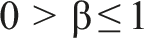
The consumption plan of coarse goods is represented by two vectors: Ct ∈ C ⊆ ℝL+ and Ct+1 ∈ C ⊆ ℝL+ (where C is some subset of L-dimensional reals denoting freely available coarse good space). Likewise, the consumption plan of refined goods represented by the vector Rt+1 ∈ R ⊆ ℝH+ (where R is some subset of H-dimensional reals of refined goods space). Finally, the consumption plan of amenity goods represented by two vectors: At ∈ A ⊆ ℝK+ and At+1∈ A ⊆ ℝK+ (where A is some subset of K-dimensional reals of amenity goods space).
Let us assume that the Lagrangian objective function behaves normally, especially regarding the first and second order conditions. The first order condition (FOC) then exists and expresses the optimal choice of SC investment:



Given the assumptions regarding identical preferences across DMs and decreasing λ, FOC entails:

That is, based only on the substitution effect, DML invests less in SC than DMH.
Any investment in SC, even if it is very close to zero, but not zero, triggers the DM to demand only R in t+1. Of course, the DM’s level of utility from consuming R would be higher the greater is the SC investment.
Even if DMs have identical preferences, a slight income inequality may trigger DML to have a sufficiently low income prompting him or her to demand zero SC and DMH to demand positive SC. This is sufficient to permit the rise of the Stratification-of-Goods.
Let us say that DML has a sufficiently high income to demand positive SC. Still, the income inequality entails a gap in SC investment between the two DMs. While the two DMs consume the same R, i.e., Shakespearean plays, DMH derives greater enjoyment than DML. The Stratification would not appear as a segregation of goods, but rather of tastes. Each DM would enjoy conversing with a peer, i.e., with a member of the group that invested the same SC as him or her. That is, he or she would shun non-peer DMs. We may call this segregation the “Stratification-of-Tastes.”
Reversing the stratification?
Let us modify one assumption of the proposed model. Let us suppose that income inequality unexpectedly disappears at the start of t+1. Does such a change prompt the two DMs to change their consumption in t+1?
To be sure, the DMs have already undertaken SC investment in t, in light of their income that was taken as given. The only change possible in t+1 is for the DM who has a plan to consume R to switch to C, and vice versa.
To keep the analysis simple, let us assume that in t, DML demands SC=0, while DMH demands SC > 0.
Let us examine the first scenario, where DML experiences a sudden rise of income to equal DMH’s. Given the former DML did not invest in SC, he or she would not enjoy R. He or she would instead opt for Ct+1, watching Rambo films. He or she also would not demand any R even if the price of R relatively falls. He or she would simply consume more coarse goods (C). As shown in Figure 1, the DM moves from C3 to C4 as income of the person of coarse consumption (IC) expands across the two periods, i.e., expands from IC1 to IC2–with zero consumption of R despite the fact the price of R relatively falls. The caste of coarse tastes.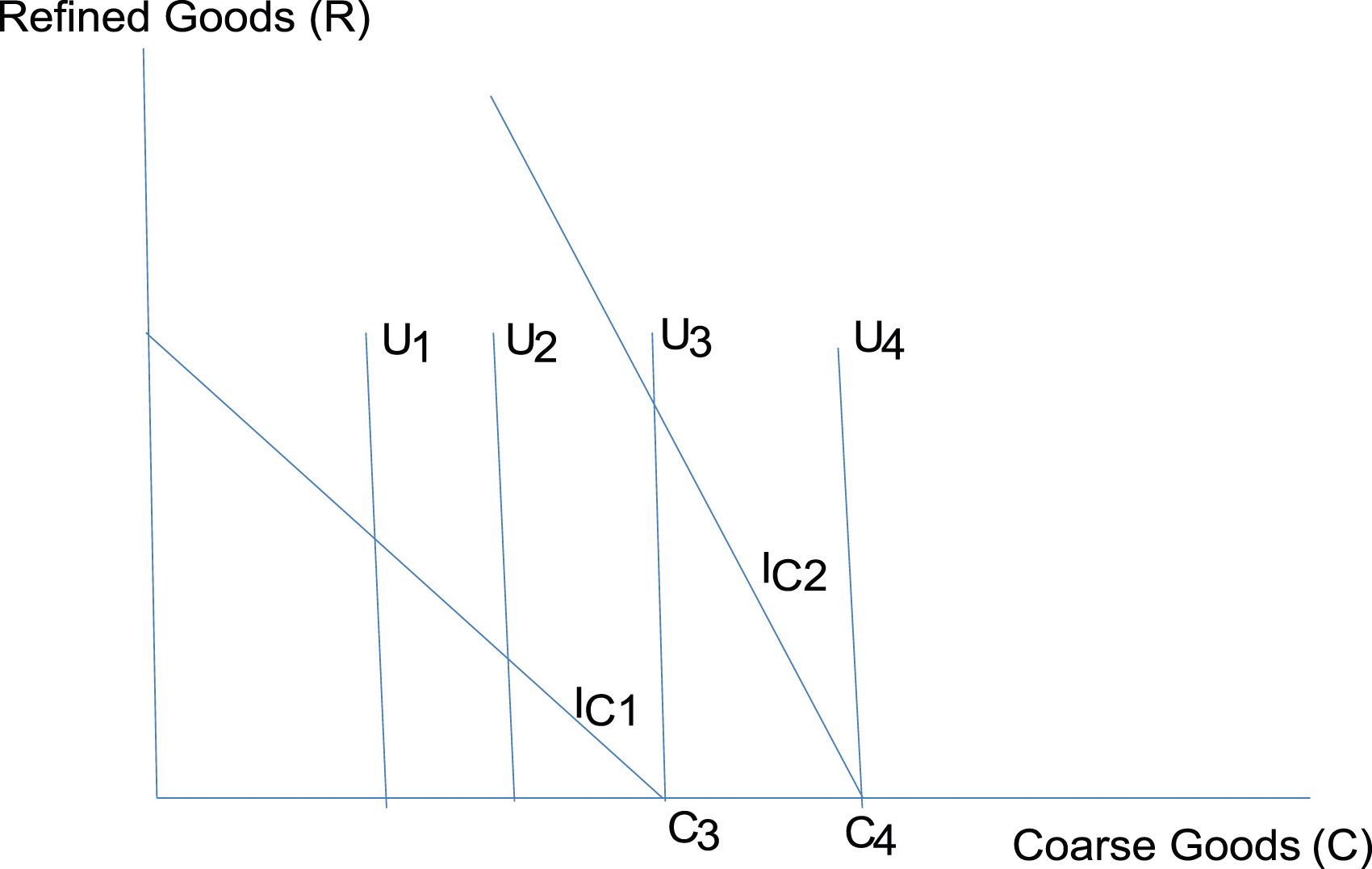
Let us examine the second scenario, where DMH experiences a sudden decrease of income to equal DML’s. Given that the former DMH invested in SC, he or she would still not enjoy C. He or she instead opts for Rt+1, watching Shakespearean plays. He or she also would not demand any C even if the price of C relatively falls. As Figure 2 demonstrates, the DMH moves from R3 to R2 as income of refined consumption (IR) contracts across the two periods, i.e., from IR2 to IR1–with zero consumption of C despite the fact the price of C relatively falls. The caste of refined tastes.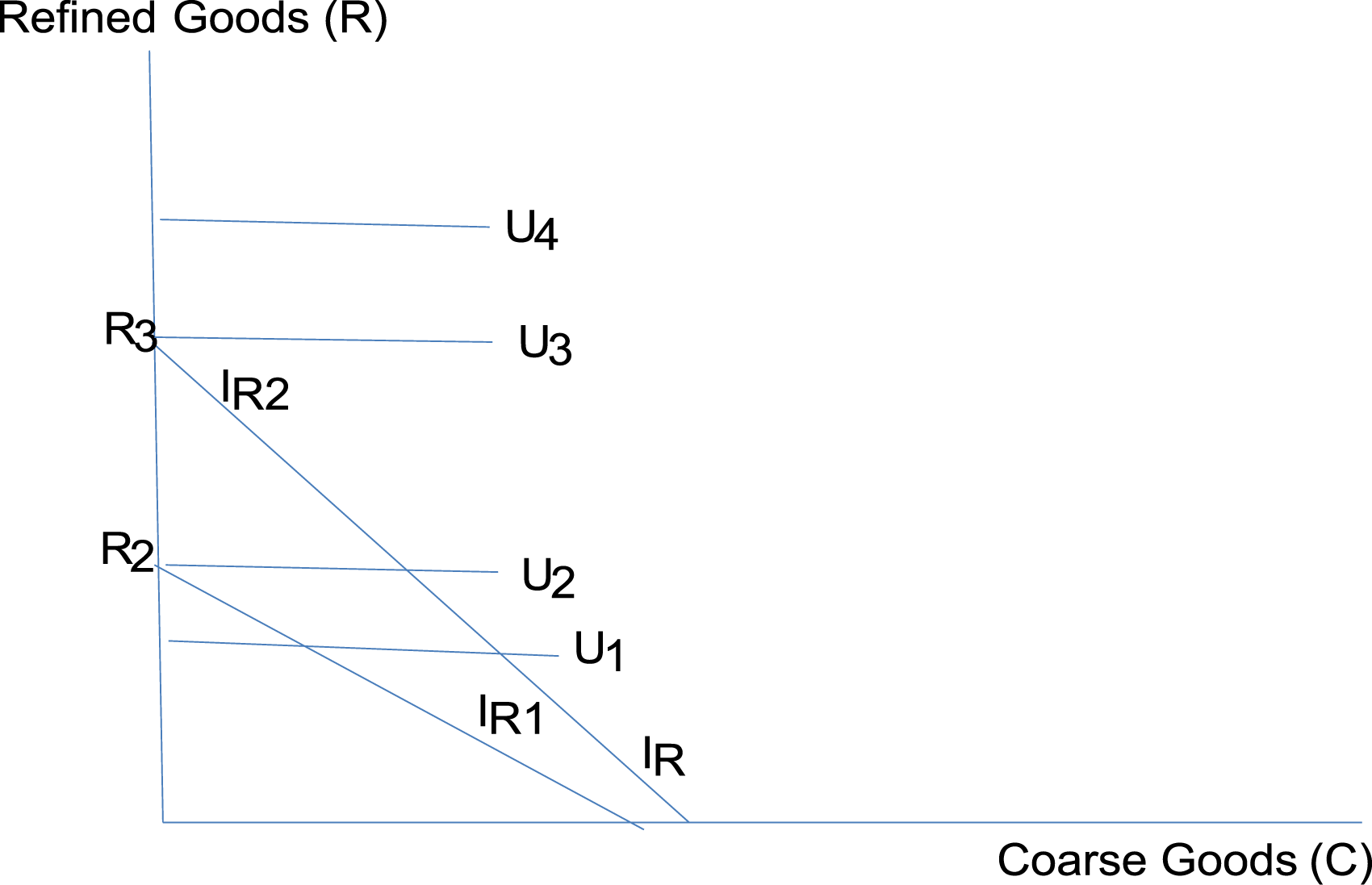
The crux: Putty-putty contra putty-clay capital
The income inelasticity of demand and the price inelasticity of demand just shown are not the outcomes of some artificial assumptions of the model. They are rather robust results that are the outcome of the nature of SC.
Let us suppose that the two DMs live for three and not two periods. Let us suppose that in t+1, income inequality vanishes suddenly along the first scenario, i.e., DML’s income level rises to DMH’s. It is then possible for both DMs to invest in SC investment in t+1. Even if both invest, the former DML cannot cram knowledge, i.e., cannot make up what was missed in t. A gap will persist between the two DMs. The Stratification-of-Goods would persist, although at a lower degree.
Let us suppose that in t+1, income inequality vanishes suddenly along the second scenario, i.e., DMH’s income level decreases to DML’s. Then both DMs abstain from SC investment in t+1. Still, the former DMH would demand R, as he or she cannot melt down and sell the knowledge already acquired in t. Thus, The Stratification-of-Goods would persist at the same degree as planned prior to the sudden shock.
The crux behind the persistence of the Stratification-of-Goods is the non-reversibility of SC investment. Since the investment in t is heterogeneous—i.e., reflecting income inequality—it engenders the Stratification-of-Goods along path dependence.
But why is SC investment nonreversible? The investment in knowledge affords alertness and enlightenment. The DM cannot, even if the low-income group in t+1 becomes high-income, cram, i.e., speed up, learning that produces alertness and enlightenment. So, the initial DML forever lags behind in alertness and enlightenment. Therefore, the gap between status groups would persist. To wit, the gap expands if either the income of the high-income status group rises, the income of the low-income status group falls, or a combination of both.
In the other direction, the DM cannot, even if the high-income group in t+1 becomes low-income, melt down and sell the acquired alertness and enlightenment. So, the initial DMH is forever ahead in alertness and enlightenment—assuming knowledge does not deteriorate. Of course, if knowledge deteriorates, the SC investment can afford enlightenment advantage only for a span of time—an issue that arises at second approximation of the model. At first approximation, as long as there is no deterioration of SC investment, the gap between status groups would persist—and can even expand for the reasons mentioned above.
The non-reversibility of SC investment arises from the fact that the DM can totally neither speed up comprehension nor shed away knowledge already acquired. Of course, at second approximation, the DM can speed up comprehension, but up to a limit. Likewise, the DM can shed away knowledge—but under the assumption of deterioration. At first approximation, analogous to the fact that the DM can neither speed up nor shed away physiological/psychological development, so is the case with knowledge capital investment.
The idea of the non-reversibility of capital investment is not new. Economists—as long ago as 1930s in the Knight/Hayek debate (see Cohen, 2003; Dorfman, 1959; Mehta, 2003) and the 1960s in the Cambridge capital controversy (see Solow, 1963)—have pointed out a weakness in the neoclassical theory of capital. Neoclassical theory assumes that investment in physical capital is reversible as if it is malleable, what is called “putty-putty” (Hu, 1972). The economists have more-or-less recognized that physical capital is putty-clay, i.e., cannot be reversible putty-putty. The disagreement was regarding whether, at first theoretical approximation, it is useful to assume that capital is reversible putty-putty.
Georgescu-Roegen (1970, 1971; see Khalil, 1990, 2004b) provides a refreshing view of the problem when distinguishing between two kinds of capital: “stock” and “fund.” The capital-as-stock can be consumed at will and at any rate. If a shock strikes, capital-as-stock can be melted down and reformulated. On the other hand, the capital-as-fund cannot be consumed at will. If a shock strikes, the capital-as-fund is destroyed. Examples of capital-as-stocks include the quantity of fertilizers used in agriculture or the amount of oil in the ground. Examples of stock-as-funds include the service rendered by land or by a machine, which cannot be compressed or reformulated.
As Hu (1972) sums up the controversy, the ex ante decision of the choice of capital involves the choice among an array of diverse techniques. So, ex ante capital is putty, i.e., it can be molded into any shape. But once the decision is implemented, ex post capital is clay, i.e., it cannot be melted down, sold, and molded to fit a new technique, if so required. So, physical capital is never usually putty-putty. It is putty-clay. Likewise, SC investment is putty-clay. It cannot be, at first approximation, putty-putty.
Solving the stratification-of-goods enigma
Is the proposed model capable of solving the Stratification-of-Goods Enigma? Can it allow the theorist to adjudicate coarse and refined utilities in SWF—and even further with respect to the utility of the same individual? The proposed model can allow the adjudication of the seemingly incongruent utilities—for the same reason that has given origin to the Stratification-of-Tastes phenomenon. Namely, while the SC investment is putty-clay that shows a barrier across status-laden preferences, such putty-clay is originally putty-putty.
The common origin of preferences, i.e., the putty-putty origin should allow us to measure the policy impact on SWF. The policy planner needs to consider not only the impact on current utilities, which are already bifurcated along the status-laden barriers. The policy planner needs to consider how welfare could improve by long-term investment in SC. The policy makers can proceed along two avenues, the indirect and the direct. As for the indirect path, policy makers can aim to reduce income inequality—i.e., through a policy that leaves it up to poor individuals, who are now richer, to make new allocations that invest greater amount in SC.
As for the direct path, policy makers can undertake direct expenditures in education that is directed at the low-income section of the population. This would greatly reduce the cost of SC investment for the low-income segment.
With regard to the indirect path, the reduction of income inequality cannot be absolute. The change of distribution via, say, taxes, would impact incentives and, hence, productivity, as textbook economics easily shows. So, the benefit of income inequality reduction must be weighted with respect to its cost, the reduction in productivity.
With respect to the direct path, the financing of SC investment must be paid by taxpayers—disregarding whether they are present or, via borrowing, future taxpayers. Disregarding the distribution issue with which the indirect path dealt, the higher tax across the board involves deadweight loss in terms of GDP, as textbook economics readily highlights. So, the benefit of SC investment must be weighted with respect to its cost, the deadweight loss of GDP. It also involves another cost. The subsidy of SC investment means that the low-income segment has to forego current coarse consumption.
Let us ignore the indirect policy and focus on the direct one. Let us assume the following: 1. There are only two classes, low-income whose number is l, and high-income whose number is h. 2. The policy to subsidize the SC investment is costly in three ways: the levied tax, the deadweight loss as a result of the tax/transfer, and administrative cost. 3. The subsidy is large enough to entice one member of the low-income class to attend the SC program, which means forego the pleasure of current coarse consumption. 4. All members of the low-income class are identical. Hence, if one member chooses to forego the coarse consumption and attend the SC program, all the rest of the lo-income segment make the same choice. 5. There are only two periods, t and t+1. 6. The intertemporal discount factor is unity, i.e., the enjoyment of one good tomorrow (t+1) equals the enjoyment of the same good today (t).
Given these assumptions, the policy maker undertakes the SC investment under this condition,

To state the condition of policy action (7) requires a host of other assumptions that are technical. The aim of this paper is to show how to overcome the Stratification-of-Goods Enigma. We can do so when we identify the origin of the barrier that stratifies goods along status. Namely, it is the SC investment, which is only capable of generating the observed bifurcation of investment because of income inequality. While policy makers are, because of the cost, unable to totally eradicate the Stratification-of-Goods phenomenon, this paper shows that the phenomenon is no longer an Enigma.
Scope limitations
The proposed pristine model of the Stratification-of-Goods phenomenon abstracts from many pertinent facts. To mention three, 1. Out of concern of preserving sustainable development, some people may opt to make consumption choices based on an egalitarian temperament (e.g., Lubowiecki-Vikuk et al., 2021). For the limited purpose of this paper, the egalitarian temperament, in contradiction to elitism (see Appendix 1), disavows status-laden cultural norms that categorize goods into coarse and refined. This paper abstracts from this trend of consumption. 2. This paper ignores the phenomenon of cultural omnivores, where people of higher status cross the barrier and consume goods usually regarded to belong to lower status group (e.g., Kwon and Kwon, 2013). This phenomenon certainly enriches the analysis but is not relevant at first approximation. 3. Status stratification usually varies in its sharpness. At one extreme, it takes the form of the caste system of some cultures. At the other extreme, it takes a form that is not openly acknowledged as in modern societies infused with modern liberal self-images—as Bourdieu (1984) documented with respect to France in the 20th Century, Veblen (2007) regarding the USA at the turn of the 20th Century, and Frank (2010, 2016) and Wilkerson (2020) concerning the USA at the turn of the 21st Century. Indeed, concerning modern societies infused with a liberal self-image, it is usually hard for outsiders to detect and identify the Stratification-of-Goods phenomenon, while it is relatively easy for outsiders to detect and identify such phenomenon in societies that do not profess the liberal ideology. However, the fact regarding ideological differences, i.e., the issue of self-image, can be ignored at first approximation. The ideological differences become important at second and third approximations. Thus, we may safely suppose at the entry-point of analysis that all societies, irrespective of its ideological self-image, are characterized by the Stratification-of-Goods phenomenon.
Alternative endogenous accounts
As mentioned at the outset, there seem to be alternative endogenous explanations of the Stratification-of-Goods phenomenon—explanations that do not take income inequality as the entry-point.
For example, as Piketty (2022) shows, diverse theories trace income inequality to other inequalities such as power differences arising from an unequal distribution of property. However, the unequal distribution of property suggests the question: what is the origin of the unequal distribution of property and, corollary, power differences? One would have to resort to the same reasoning regarding an initial state where the inequalities have risen from luck, a stochastic process.
Or, instead, one could hypothesize that power differences and, corollary income inequality, have arisen from genetic differences among DMs regarding the stamina needed to sustain an entrepreneurial zeal. We can start with an initial state where all DMs have equal income but differ with respect to such stamina. There can be a class of DMs who have the critical stamina enabling them to sustain great hardship in order to save resources in the current period, invest them, and use the returns to inch closer to a greater income than those who have low stamina.
Still, what is the origin of genetic diversity regarding such stamina? We could—similarly to the proposed income inequality entry-point—resort to some stochastic process to explain the genetic diversity of stamina. However, this would bring us, again, to the same entry-point: we need to start with the stochastic-based diversity of some primitive in order to explain the Stratification-of-Goods phenomenon. It seems that stamina diversity would be unnecessary, long detour. Since we have to start with some stochastic process regarding the primitive, to pose income inequality as the primitive seems to be the simplest, i.e., the most economical entry-point.
Another possible endogenous account that begs the question is the proposition that the Stratification-of-Goods phenomenon arises from a diversity of tastes. However, this answer is tautological: it explains the origin of the phenomenon by appealing to the phenomenon itself. To avoid the tautology problem, this account must trace the diversity of tastes to some other processes. The best candidate is the genetic diversity process. Obviously, DMs differ with respect to the alleles they carry, and this may entail alleles regarding the degree of refinement of goods.
Still, a question arises: What is the origin of the genetic diversity of tastes? One must explain it in terms of evolutionary optimization: Nature favors a certain composition of tastes. Consequently, if there are no frictions or obstructions in the operation of natural selection, the genetic pool of the population gravitates toward, say, x% of the alleles is biased toward coarse tases while the rest biased toward refined tastes.
However, and here is the problem, such an evolutionary optimization account suggests the question: what is the evolutionary benefit of the supposed optimum composition of alleles? One would have to invent, in an ad hoc manner, some supposed benefit. In contrast, the proposed income equality entry-point avoids such a problem.
A totally different candidate, namely, socialization, seems to explain the Stratification-of-Goods phenomenon. Simply put, upbringing and peer influence can be supposed to be solid primitives that originate the phenomenon. There is no doubt that insofar as the DM seeks to gain acceptance by his or her peer group, the DM feels that he or she should make choices that accord with the tastes and proclivities of the peer group. If the peer group favors refined tastes, the DM most like would be ready to engage and cultivate such tastes. If the peer group favors coarse tastes, the DM would likewise.
There are two problems with the socialization explanation. First, it presupposes the phenomenon that we are trying to explain. It supposes that higher and lower status groups already exist. Second, one can posit equally that the DM chooses the peer group according to his or her own tastes. If the DM finds refined tastes suits him or her better, he or she would associate with a group with similar tastes. Likewise, if the DM finds coarse tastes to suite him or her better, the selection of the group follows accordingly. Thus, at first approximation, socialization cannot perform the solid primitive.
It would enrich the paper to incorporate social interaction and peer influence, as such dynamics and influence definitely amplify the decisions taken by individuals. However, at first approximation, this paper ignores social interaction and peer influence.
To recapitulate, there are two classes of alternative accounts. The first class consists of the diverse socialization arguments, which ultimately are non-viable at first approximation as shown above. The second class consists of diverse accounts that are viable at first approximation—e.g., the appeal to power diversity, property inequality, genetic basis of ability/stamina differences, and genetic basis of taste differences. This second class ultimately must explain the inequalities in terms of a stochastic process. The proposed income inequality condition already uses such process. In addition, it uses it in a simpler and direct manner than the other candidates. Thus, following Ockham’s razor regarding theoretical economy (Khalil, 1989), the income inequality condition is the most efficient entry-point in comparison to the other inequalities to explain the Stratification-of-Goods Enigma.
The rest of the paper deals with implications and conceptual clarifications. The first clarifies the nouveau riche phenomenon which appears to disconfirm the proposed model. The second sheds light on the difference between the neoclassical economics practice of prohibiting interpersonal utility comparison, which is the pillar of the Pareto criterion, and status-based barrier between consumption goods. The third explains clearly that the status-based barrier, i.e., Stratification-of-Goods phenomenon, takes place at the level of the individual utility function as it does at the level of the social welfare function. The fourth shows how the standard neoclassical economic theory trivializes the Stratification-of-Goods phenomenon. The fifth and final clarification highlights the difference between two kinds of barriers among goods. One barrier, which we may call the “incomparability” of goods, is the focus of this paper. The other barrier, which we may call the “incommensurability” of goods, is about the prohibition of the commodification of some goods, such as the buying-and-selling of human organs, heirlooms from grandparents, and gifts signifying friendship-and-love.
Conceptual clarifications
The nouveau riche phenomenon
The nouveau riche phenomenon seems to invalidate the proposed thesis, namely, high income is a condition for refined tastes. The phenomenon consists of newly rich DMs who have a high income allowing them to purchase refined goods but who lack refined tastes and, hence, cannot be considered an upper status group. The nouveau riche DMs try to “buy” distinction and status via conspicuous consumption and ostentatious displays without having the tastes associated with such consumption.
The nouveau riche phenomenon rather lends support to the proposed thesis. It is not income per se that makes DMs have refined tastes. The income allows DMs to invest in SC, and with time, the sophistication capital gives origin to refined tastes.
Note, the rise of income need not entail that DMs totally abandon their coarse tastes. Even when people acquire refined tastes, a few of these DMs may cling to their old, coarse tastes and hence develop their own version of mixed coarse and refined tastes. However, it is equally possible that a few of these DMs may treat their old coarse tastes with total disdain, trying to hide their old identity as if it is shameful. This amounts to acquiring an elitist attitude, an attitude that allows them to affirm the new identity. Such an elitist attitude usually characterizes the nouveau riche phenomenon.
Put differently, the nouveau riche phenomenon illustrates why earning a higher income does not mean that the DM can acquire refined tastes by simply the purchase of refined goods. The nouveau riche are simply DMs in a hurry, not yet cognizant of the fact that it takes great effort to invest in SC and takes time to digest the pertinent education and, consequently, develop as a person of distinction and of refined tastes. Once the nouveau riche DMs undertake the path of investing in SC and allow for time to digest the new education, they can join the “old money” class. After all, today’s “old money” was yesterday’s nouveau riche.
Inter-group contra interpersonal utility comparison
The Stratification-of-Goods, at least at second approximation, entails a prohibition of inter-status utility comparison. DMs belonging to one status group cannot, at first approximation, enjoy the status good of the other status group.
This fact should not be conflated with the neoclassical prohibition of interpersonal utility comparison, a pillar of the Pareto criterion in welfare economics. The Paretian prohibition of interpersonal utility comparison is based on the theorist’s supposed inability to gauge the enjoyment of two different DMs. The Paretian prohibition is incidentally disputed by many welfare economists (e.g., Kemp and Ng, 1976; Ng, 1997, 1999, 2003). This Paretian prohibition is orthogonal to status stratification—i.e., stands even if the two DMs belong to the same status group.
Two kinds of egalitarianism
As mentioned above, the term “egalitarianism” in this paper is understood strictly as being about the rejection of cultural norms that sustain the Segregation-of-Goods phenomenon. As mentioned above also, such a phenomenon challenges not only the possibility of SWF, but also the individual utility function. The phenomenon, at first approximation, undermines the possibility of a metric needed to compare tastes, irrespective of inter- or intra-individual utility calculation.
In parallel, we can have two kinds of egalitarianism, as defined here. The first is the affirmation that people across classes have no status-based preferences. Hence, we can undertake an inter-individual calculation, as expressed in SWF. The second is the affirmation that the individual has no status-based preferences. Hence, the DM can navigate easily across tastes, i.e., substitute among different goods without any regard to some supposed status-based barrier between them.
A representation of the first kind of egalitarianism is simple,


Here, SWF is well-defined even if individuals can be categorized as either exclusively consuming X or exclusively consuming Y. That is, we can still compare the utility of individuals despite the apparent fact that one group only likes one good, while the other only likes the other good. However, if goods are status-laden, the SWF cannot be defined, as we cannot compare the utility of individuals where each is consuming a different status good—and for a reason other than the Paretian prohibition regarding interpersonal utility comparison as stated above.
A representation of the second kind of egalitarianism is simple,

Here, the individual utility function is well-defined as expressed in textbooks. However, if the two goods are status-laden, the individual utility function cannot be defined, even if the same DM consumes such goods. Such a DM cannot compare, and hence substitute, between the two goods. He or she would appear as setting a barrier between two styles of consumption, where each is segregated from other. The DM simply cannot formulate a single utility function.
Theorists have, for different reasons, argued against SWF. One main reason is questioning interpersonal utility comparison. Given the issue behind the Stratification-of-Goods Enigma is unrelated to such comparison, these theorists still, similarly to welfare economists who advance SWF, should find it difficult to construct the individual utility function. This function is the backbone of microeconomic textbooks regarding consumer demand theory and, hence the Stratification-of-Goods is not a trivial phenomenon.
How does standard economic theory trivialize the stratification-of-goods phenomenon?
Microeconomic textbooks, and standard economic theorists generally, ignore the Stratification-of-Goods phenomenon and the preferences that originate it, namely, the quest after distinction and status. More precisely, economists recognize status (e.g., Frank, 2010)—and even recognize how status in the form of “identity” influences the choice people make (Akerlof and Kranton, 2011). However, the incorporation of the desire of distinction and the pursuit of status in rational choice models has been difficult.
What standard economists have been, at best, able to accomplish is to reduce the desire of distinction and the pursuit of status to ordinary preferences, i.e., preferences that are comparable to the tastes for clothing, food, and automobiles that satisfy substantive preferences. Corollary, these standard economists tend to conceive refined goods as made of many characteristics, one of them status, failing to capture the status dimension as distinct from the usual list of characteristics.
Let us examine such a standard utility function (U), consisting only of two entertainment goods:



Given the usual assumptions regarding the first order and second order conditions, this model can identify the optimal choice of the DM. Also assuming, for simplification, that the model produces a corner solution. Given that DMs have different tastes for the features of C and R, the DM demands either C or R, even if they have the same income and face the same relative prices.
The standard model, that is, can easily recognize the difference between refined and coarse goods, as it supposes θR > θC in a non-trivial manner.
However, this standard model faces the Stratification-of-Goods Enigma. To see why, let us assume that the utility function is composed of two entertainment goods but of equal refinement:



In this neoclassical model, there is nothing distinguishing refined goods from coarse goods. Refinement is merely a characteristic giving rise to status satisfaction that is no different from other characteristics.
Let us suppose θR1 = θR2 and some restrictions regarding the tastes and prices so that both DMs choose the same quantities of R1 and R2. So, the DM who chooses R1 does not gain any status-based satisfaction over the DM who chooses R2. Both are enjoying the refinement feature purely as a substantive utility. For the status-based satisfaction to arise, the DM who chose R1 or R2 must be able to contrast their refinement with a third DM, the one who is choosing the coarse good, C, but missing from the model.
That is, contrary to the neoclassical model, status-based satisfaction is not an innate feature of the good. It is rather a relational feature. The status-based satisfaction arises when the DM contrasts the distinction that he or she achieved by consuming a refined good with the DM who cannot enjoy it as result of not having, for whatever reason, developed the refined taste. Thus, for the refined taste to give rise to the Stratification-of-Goods Enigma, there must be a contrast between coarse and refined consumption, a contrast that originates the sense of achievement, distinction, and status.
Let us take the example of the seminal model of Stigler and Becker (1977). At first approximation, the model supposes that preferences are homogeneous across DMs—as this paper does. Then it proceeds, at second approximation, to show how heterogeneous tastes arise from the homogeneous ones. The model takes the example of music and how investment in music education makes the DM’s marginal utility rise over time. In the lexicon of this paper, the model shows how music education produces a refined taste—a path dependent consumption that Stigler/Becker use to account for habits, which effectively amounts to an endogenous account of the heterogeneity of tastes (see Becker, 1996). 3
Let us extend the model for music and suppose that another DM invests in the education for painting. So, some DMs have a refined taste for music while others for painting. Both music and painting goods are refined goods. Their model, hence, cannot be used to explain status-based satisfaction—and they do not claim to do so. Their model is about symmetrical heterogeneity—e.g. whether the food is too sweet, a little spicy, and so on. It is not about the focus of this paper on the status dimension, what can be called “asymmetrical heterogeneity,” such as whether the enjoyment of the good depends on investment in SC.
The incomparability anomaly vs. the incommensurability anomaly
To recapitulate, all DMs are entrepreneurs in the sense of aspiring to achieve higher distinction and greater goals of refined consumption of plays, films, music, painting, and so on (see Khalil, 1997; Khalil et al., 2021). 4 However, as a result of income inequality and non-reversible SC investment, some DMs succeed while others fail in achieving their aspirational goals. The difference in performance allows DMs to compare and rank their achievements. Such ranking uncovers the relational aspect of status-based satisfaction, i.e., such satisfaction cannot be an innate feature of the good in isolation.
Note, the goal-aspiration motive can become excessive, making the Stratification-of-Goods an elitist institution, if not the basis of snobbery. However, this issue is better left to another discussion (see Appendix 1). Let us focus on the case when goal-aspiration is moderate, as another paper models aspiration via rational choice theory (Khalil, 2022). Goal-aspiration is a kind of longing that may remind readers of another kind of longing, the wanting to belong to community, family, friends, and loved ones. It is obvious that the two longings are different (Khalil, 2024a). Goal-aspiration is about the time dimension, where the decision maker derives pleasure from imagining a future-self and works assiduously toward it. The longing for friendship-and-love does not necessarily involve the time dimension. It is rather about merging the self with the selves of others, which also can be modeled via rational choice theory (Khalil, 2023).
While readers easily find the two longings to be different, this paper mentions them side-by-side only to alert the readers that there are two different kinds of barriers that prevent us from treating preferences along a unidimensional axis, as if they can be reduced to a single metric (see Khalil, 2024a). This paper focuses on the barrier that arises from goal-aspiration, which occasions status-conscious pattern of consumption, i.e., Stratification-of-Goods Enigma. This differs from the barrier that makes it repugnant or taboo to substitute friendship with substantive goods—such as reminding people of the cost of a birthday gift or the cost of a donated kidney (see Khalil, 2023). 5
To make the difference between the two barriers clear, this paper uses the term “incompatibility” of preferences regarding status-laden preferences. This paper suggests the term “incommensurability” of preferences regarding gift-laden preferences. 6
Conclusion
This paper offers a solution of the Stratification-of-Goods Enigma via a model based on two conditions: (i) income inequality; and (ii) the non-reversibility (putty-clay) of capital investment.
Basically, the proposed model corroborates Pygmalion, George Bernard Shaw’s most successful play (1994 (1913)). With sufficient investment in education, low-status DMs can become sophisticated, i.e., able to enjoy refined goods. 7
The proposed model solves the Stratification-of-Goods Enigma. If we think of refined utility as the outcome of SC investment, we can use such investment as the adjudicator of coarse and refined utilities. Thus, the social planner can plan and allocate funds for SC investment and use these funds to measure refined utility. A formula can translate such refined utility into coarse utility and, hence, social welfare can be well-defined. In this manner, we can maintain the egalitarian, status-free utility calculus, while adjudicating utilities that are set apart as if they are incomparable.
Supplemental Material
Supplemental Material - Refined tastes, coarse tastes: Solving the stratification-of-goods enigma
Supplemental Material for Refined tastes, coarse tastes: Solving the stratification-of-goods enigma by Elias L Khalil in Journal of Rationality and Society.
Footnotes
Acknowledgements
Earlier drafts of the paper benefitted from the comments of Nathan Berg, Matthew Nagler, Toru Suzuki, and participants of a seminar at Monash University. Later drafts benefitted from the comments of participants of a seminar at Doha Institute for Graduate Studies, Yew-Kwang Ng, Geoffrey Hodgson, and especially the extensive and generous comments of two anonymous reviewers and Andreas Flache, the editor. This paper was greatly improved with the editorial help of Maks Sipowicz. The usual caveat applies.
Declaration of conflicting interests
The author(s) declared no potential conflicts of interest with respect to the research, authorship, and/or publication of this article.
Funding
The author(s) received no financial support for the research, authorship, and/or publication of this article.

Data availability statement
The manuscript does not have any empirical data, including experiment-based data.
Supplemental Material
Supplemental material for this article is available online.
Notes
References
Supplementary Material
Please find the following supplemental material available below.
For Open Access articles published under a Creative Commons License, all supplemental material carries the same license as the article it is associated with.
For non-Open Access articles published, all supplemental material carries a non-exclusive license, and permission requests for re-use of supplemental material or any part of supplemental material shall be sent directly to the copyright owner as specified in the copyright notice associated with the article.
