




Abstract
Cooperation sustainability presents a complex social phenomenon. Two common approaches have been used to study the sustainability of cooperation in small groups: endogenous processes (dynamic) and exogenous factors (static approaches). The present study integrates existing research by investigating how the interplay between exogenous and endogenous conditions affects cooperation in small groups. To uncover endogenous group dynamics in an online Public Goods experiment (n = 353), we performed multilevel latent Markov models on Bayesian estimation that allowed us to estimate latent classes on the level of rounds, individuals, and groups. We studied exogenous factors by investigating the effects of situational tightness versus looseness, and monetary versus symbolic frames on cooperation sustainability. Our key findings show that both endogenous and exogenous factors are critical to explain the variation of cooperation sustainability between groups. Second, groups exposed to tight situations reveal higher levels of cooperation sustainability than groups exposed to loose situations. Money primes did not have an impact. Among the control variables, collective intentionality showed the strongest association with cooperation. Future research may develop a more sophisticated measure of tight versus loose situations and examine the causal relationship between collective intentionality and cooperation.
Keywords
Introduction
Cooperating in social groups is a fundamental element of society. Both small-scale (e.g. investing in potluck dinners) and large-scale cooperation (e.g. engaging in community work or farming collectives) play a pivotal role in ensuring societies’ economic, social, and environmental sustainability (Basiago, 1998; Ostrom, 1990). Yet, despite empirical research over the past three decades providing fundamental insights into how cooperation can be established or sustained (e.g. Fehr and Gächter, 2002; Fischbacher and Gächter, 2010; Fosgaard, 2018; Fu et al., 2008), between-group differences in cooperation sustainability are less well understood (Kocher et al., 2012). Substantial between-group differences in cooperation levels have been observed both across small groups (Gächter et al., 2017; Titlestad et al., 2019) and communities (Mamonov et al., 2016), raising the question on why some social groups succeed to keep cooperation going over time, while cooperation breaks down in others.
Two existing approaches shed light on the dynamics of the cooperation puzzle: exogenous and endogenous explanations. Empirical research has extensively studied exogenous ‘static’ factors of cooperation across different levels of analysis. ‘Static’ approaches point to stable differences in individual- and group-level conditions as the main predictors of cooperation sustainability. On the individual level, empirical studies provided substantial evidence of the importance of social preferences (e.g. Fischbacher and Gächter, 2010) or personality traits (e.g. Kurzban and Houser, 2001) for cooperation. For example, studies identify different types of participants that influence how people cooperate, such as strong free riders, conditional cooperators, or strong cooperators (Kurzban and Houser, 2001). On the group level, sanctioning systems (Fehr and Gächter, 2002) or cultural characteristics (Ghate et al., 2013) affect cooperation. The single most important structural predictor so far is the opportunity to sanction free riders (Fehr and Gächter, 2002) and, relatedly, the ability to access, exchange, and act upon reputational information (Fu et al., 2008). In such settings, social groups are commonly exposed to an institutional regime that allows sanctioning, partner selection, or access to reputational information in comparison to its absence. More recent explanations point to cultural differences as influential predictors of cooperation (Ghate et al., 2013; Henrich et al., 2005; Roos et al., 2015).
In contrast, research studying the endogenous process of cooperation focuses on the dynamic interaction in groups. Recent contributions advocate complementing current static explanations with a dynamic multilevel perspective on cooperation sustainability (Titlestad, 2019). According to the dynamic perspective, emergent group processes, such as the coevolution of social ties and cooperative behavior, or the inductive formation of shared social identities and related cooperation norms evolve during social interactions and substantially impact cooperation (Titlestad et al., 2019). Moreover, people frequently employ decision strategies in social interactions that follow, e.g., tit-for-tat or fairness principles (e.g. Axelrod and Hamilton, 1981). A tit-for-tat strategy, for example, cooperates at the beginning of the social interaction, and is followed by mimicking other peoples’ behavior (Chen et al., 2022). The interplay of different individual strategies presents a dynamic factor in group interaction. Besides the role of social identities and decision strategies, research also demonstrates the importance of learning dynamics and the dynamics of social control in cooperation situations (e.g. Macy, 1991; Kitts et al., 1999), which are also affected by exogenous factors such as network size or density (e.g. Macy, 1991). Adding to the research on the interplay between exogenous and endogenous processes, dynamic rational choice models show how external sanctions and intragroup normative control can strengthen or weaken one another (Heckathorn, 1990). The exogenous and endogenous explanations of cooperation and their interplay have contributed to the understanding of cooperation. However, a systematic understanding of how exogenous factors and endogenous processes interact and account for existing differences in cooperation trajectories over time is less understood. Building on these recent advances in static and dynamic perspectives on cooperation sustainability, the present study investigates the role of both exogenous factors and endogenous processes with regard to between-group differences in cooperation sustainability. 1 How do exogenous and endogenous factors interact to affect cooperation trajectories across groups? By studying exogenous factors as well as the endogenous cooperation process through an online Public Goods Game (PGG), we assess to what degree exogenous and endogenous factors jointly explain differences in cooperation trajectories between groups over time.
Theory
The endogenous process: Small group dynamics and cooperation
Sociology has a long tradition of studying small groups and the processes through which they produce sharedness of perceptions, knowledge, and memories, but also how they sustain feelings of belongingness and joint production motivation (Fine, 2012). One insight from existing research is that groups can develop their own unique culture (e.g. Fine, 1979). This so-called idioculture is “a system of knowledge, beliefs, behavior, and customs shared by members of an interacting group to which members refer and that they employ as a basis of further interaction” (Fine, 2012: 36). For example, idiocultures differ in the degree to which their members perceive their goals and needs to be congruent with those of some or all other group members (Fine, 2012: 740). A group’s idioculture endogenously co-evolves with the pattern of its emerging small-group interactions, including its (non-)cooperative relations (Fine, 1979). This means that through time, sequences of cooperative or non-cooperative interactions shape an idioculture, which in turn affects group members’ patterns of cooperation. Put differently, each idioculture is characterized by a specific cooperation trajectory, i.e. dynamically evolving behavioral patterns. During such unfolding cooperation trajectories, group members react to each other’s cooperative or non-cooperative behavior over time. Each individual can respond differently to the specific behavior of others, and the patterns of their reactions may also change through time. For example, some individuals may witness the non-cooperative behavior of some other group members and may nevertheless stick to cooperative behavior, whereas others may decide to be less cooperative. In turn, others may observe the cooperative or non-cooperative pattern, and orient their own behavior along these examples. Through time, these “micro chain reactions” result in path-dependent trajectories that may culminate in stable or unstable, high or low levels of overall contributions to the collective good. The notion of an idioculture applied to collective good production, therefore, captures the unique pattern of (non)cooperation as it emerges from micro-interactions between individuals who are mutually aware of and orient their own behavior towards the actions of other group members.
Against this background, we argue that cooperation entails unique group dynamics or idiocultures and that differences in the cooperation trajectories result from such unique within-group dynamics. For example, organizational teams can greatly vary in their nature of action, depending on the structure of the group or the type of people. Whereas much is known about how exogenous factors (e.g. resources or structures) affect collective good production, the emerging small-group dynamics and their interaction with static factors are less understood. Hence, more insight into the role of endogenous processes and their interplay with static factors will help to better understand between-group differences in cooperation and to answer the question of why some groups succeed in keeping up high levels of collective good production while others fail.
Our focus on endogenous cooperation dynamics and the resulting between-group differences (idiocultures) complements previous research, which emphasized exogenous antecedents of cooperation sustainability. Idiocultures have routinely been studied in Cultural Sociology and Ethnography. Despite the importance of social groups in social dilemma situations, the theoretical implications of idiocultures have been largely overlooked. Introducing the framework of idiocultures to the study of collective goods dilemmas enhances our theoretical understanding of within-group dynamics and between-group differences.
Studying endogenous group processes requires specific statistical techniques that are able to disentangle and capture the different layers of group interaction (i.e. different behavioral patterns of strategic decisions, individuals, and groups that emerge in social interactions). We argue that the dynamic group process of cooperation can best be understood theoretically and empirically by studying these three key components as distinct and complementary elements of the interaction process, rather than as isolated elements or factors of cooperation. In this regard, we study cooperation sustainability as a complex interplay between decision strategies, individual and group characteristics that endogenously evolve within small groups in situ. By using multilevel latent Markov models on Bayesian estimation, this study adopts an analytical perspective that combines both exogenous and endogenous mechanisms. We add to recent efforts to uncover dynamic group processes by using novel multilevel modeling techniques that allow disentangling latent classes as they endogenously emerge during group interactions.
Exogenous factors and cooperation dynamics
The strength of situations: Tightness versus looseness
Situations function as an organizing feature of social life (Fine, 2012; Goffman, 1976): “The ultimate behavioral materials are the glances, gestures, positionings, and verbal statements that people continuously feed into the situation, whether intended or not. These are the external signs of orientation and involvement-states of mind and body not ordinarily examined with respect to their social organization” (Goffman, 1976: 1). In his work, Goffman highlights the importance of situations that provide external signs of orientation or situational cues for people on how to behave in social interaction. Such situational cues can, for example, signal whether there is support or a lack of support for social norms on how to behave (Lindenberg, 2019).
Along this line empirical research shows that situational cues shape cooperation (e.g. Blandon and Scrimgeour, 2015; Gerkey, 2013). For example, an experiment found that the presence/absence of audits, tax inequity, and peer reporting behavior affect peoples’ tax compliance behavior (Trivedi et al., 2003). Likewise, an observational study showed the effects of situational impediments, such as other commitments, distance from home, and access issues, on volunteering and sustained volunteerism (Craig-Lees et al., 2008).
One theoretical framework that captures situational influences is the Tightness-Looseness (TL) theory (Gelfand et al., 2011). According to the TL theory, external threats introduced the need for societies to develop stronger norms to enhance social coordination, compared to societies with loose cultures that faced fewer threats (Gelfand et al., 2011: 1101). Between-group differences in PGGs may reflect a pivotal cultural contrast of tightness versus looseness as a reflection of two opposites on the dimension of a situational context. While strong situations (e.g. a job interview) exhibit a restricted range of appropriate behavior and stronger behavioral expectations, weak situations (e.g. a party) provide a wider range of permissible behavior (Gelfand et al., 2011: 1101). Individuals who are exposed to strong situations seem to experience a higher need for structure (Neuberg and Newsom, 1993) and display more conformity (Barry et al., 1959; Gelfand et al., 2011: 1101), whereas weak situations allow for more individual freedom and autonomy. The current study examines situational tightness and looseness as a condition that influences cooperation.
Situational tightness and looseness evoke different expectations of how to behave appropriately in social interactions. We argue that situational tightness influences an individual’s decision-making such that they perceive higher situational constraints and display more attentiveness towards their group to uncover what is appropriate. From previous research, we know that sanctions and constraints are closely linked to individuals’ compliance with their group and show higher levels of cooperation (e.g. Fehr and Gächter, 2002). Thus, we expect strong situations to positively influence cooperation sustainability compared to weak situations.
Strong situations increase cooperation sustainability. Cooperation sustainability will be higher in groups exposed to the tightness condition than in groups exposed to the looseness condition.
To test our hypothesis, we develop an experimental manipulation that captures the elements of tight versus loose situations and study how exposure to situational tightness influences people’s engagement in a public goods game. Our study is among the first to apply Gelfand’s theory of situational tightness-looseness to the study of cooperation sustainability in collective good experiments.
The strength of frames: Monetary versus symbolic
Research shows that the framing of social interactions critically influences cooperation. Cooperation levels were found to be significantly higher in social situations framed as a Community Game than as a Wall Street Game (Liberman, Samuels and Ross, 2004). People reminded of money avoid social interdependence, are less inclined to act prosocially and shift into a professional, business, and work mentality (Vohs, 2015). When money is involved, people tend to act more individualistically and display more socially insensitive behavior (Gasiorowska et al., 2016; Vohs et al., 2015), which hinders cooperation (Weber et al., 2004). With regard to cooperation sustainability, group members primed by money through monetary incentives are expected to act more selfishly and engage in less cooperation in groups compared to exposure to symbolic incentives.
Money prime decreases cooperation sustainability. Cooperation sustainability will be lower in groups exposed to the monetary prime condition than in groups exposed to the symbolic prime condition.
As norm strength draws attention to conformity and cooperation, we expect that framing with monetary rewards shifts the attention of norm strength to others’ gain-oriented behavior in social situations and thus tempers the effect of norm strength on cooperation.
Money prime moderates the effect of norm strength on cooperation sustainability. The positive effect of situational tightness on cooperation sustainability will be weaker for groups exposed to the monetary prime condition than for groups exposed to the symbolic prime condition.
Method
Participants
Five hundred eleven US Amazon Mechanical Turk workers (59% female; 74% White; Litman et al., 2017) participated in an online interactive experiment that lasted 10 min (SD = 3.76). Dropout and unsuccessful group matching reduced the final sample size to 353 participants and 118 groups (n = 353). Participants who completed the study in less than 4 min were excluded from the analysis (n = 0) to ensure the data quality. Based on prior research (Lodder et al., 2019), we assumed a medium effect size to achieve a power of 80% and estimated a sample size of a minimum of 288 participants (G*Power; Faul et al., 2007; a priori F-test, ANOVA: Repeated measures, between factors; the number of groups four; the number of measurements six). The analysis achieved 89% power to detect a medium effect size of f 2 = 0.15.
Procedure and experimental manipulations
In a two (tightness vs looseness) by two (monetary vs symbolic incentives) between-subject design, participants were randomly assigned to one of the four experimental conditions. The online experiment comprised three stages.
In stage 1, participants played a group game to entrain tight or loose expectations after being randomly assigned to groups of three participants. Participants were told that they are part of a group of three people who try to cross the street in three rounds. In each round, participants were presented with three movements of which they had to choose one movement per round to cross the street. Before the start of the game, participants exposed to the tight condition could choose one neutral avatar (out of three) to represent them during the game: a medical professional, construction worker, and law enforcement officer. Once participants chose their avatar, they had to follow the rules of traffic lights: wait when the traffic light is red, stride when amber, and walk when green. At the end of the game, all participants received feedback on their group success: “Each group member made the right choices. Your group followed the rules!”. In contrast, participants in the loose condition were free to choose between three neutral avatars: the adventurer (movements: observation, crawling, hopping), the dancer (movements: dancing in a circle, break-dance, waltz), and the athlete (movements: muscle-flexing, hopping, jumping). In each round, participants in the loose condition could choose any movement of their liking without having any rules to follow. At the end of the game, participants received feedback on their group success: “Each group member came up with a unique combination. Your group was very creative!”. Whereas in the tight condition participants’ aim was to follow the rules as a group and to make it safely to the other side, in the loose condition the aim was to be as creative as possible as a group. Both groups succeeded collectively by either following the rules or choosing unique combinations.
In stage 2, participants played a repeated PGG in the form of a farming game based on the materials of Titlestad et al. (2019). Participants could either earn a bonus that was converted into real money or played with symbolic tokens (i.e., incentive manipulation). Each group member i can contribute her own resources E to a shared pool ci, given 0 ≤ ci ≤ E. The sum of all group members’ contributions is denoted as C = ∑nj−1 cj (e.g., Kocher et al., 2012). Each group member i’s payoff is denoted by πi = E – ci + γ ∙ C. The marginal per capital return (MPCR) from the PGG contribution is γ given that 0 ≤ γ ≤ 1 ≤ n ∙ γ, suggesting a conflict between the individual and the group interests (Kocher et al., 2012). Participants were endowed with E = 20, and the MCPR of the shared pool was 0.5. Every group played six rounds of the repeated PGG with the same partners throughout the experiment. Participants received individual feedback on each member’s contribution after each round. Due to matching partners over time and disaggregated feedback on the individual level, the average contribution levels in our study might be higher compared to other standard PGGs (Cox and Stoddard, 2015).
In stage 3, participants filled in a self-reported questionnaire. Payment corresponds to $8.4 – 10.2 per hour. The study was programmed with SMARTQRIS (Molnar, 2019) and approved by the Ethics Committee of the Faculty of Behavioral and Social Sciences at the University of Groningen (18282-O).
Measures
Dependent variable
The dependent variable cooperation is the amount contributed by an individual per round.
Control variables
Based on the post-experiment questionnaire, six control variables were included.
Collective intentionality
Previous research (McClung et al. 2017; Titlestad, 2019) indicates that collective intentionality – the degree to which individuals think and act together as a “we” with shared interests (Tuomela, 2013) – can emerge through an interactive process. The groups with the highest sense of collectivity show higher levels of sustained cooperation. Based on Titlestad et al. (2019), three items measured collective intentionality: I was trying to coordinate my actions with those of others in the group, I was just focusing on myself and own outcomes and I was trying to encourage the group as a whole to act in the right way (α = 0.81; 95% CI [0.77, 0.84]). Participants could answer on a 7-point Likert scale, ranging from 1 = strongly disagree to 7 = strongly agree. An exploratory factor analysis (EFA) with Promax rotation and Maximum Likelihood extraction method yielded one factor based on Eigenvalues greater than one. The factor explained 60% of the variance with factor loadings ranging from 0.65 to 0.83.
Social identification
Individuals who identify with their social group to a greater extent show higher cooperation levels in PGGs (e.g., Brewer and Kramer, 1986). We, therefore, included the degree of social identification as a control variable. Measurement is based on eight items used from existing research (see, Titlestad et al., 2019) with 7-point Likert-type response categories (1 = Strongly disagree to 7 = Strongly agree; α = 0.91; 95% CI [0.89, 0.92]). An EFA with Promax rotation and Maximum Likelihood extraction method yielded one factor based on Eigenvalues greater than one. The factor explained 55% of the variance with factor loadings from 0.54 to 0.93. To assess to what degree social identification is a different latent construct than collective intentionality, an EFA with Promax rotation and Maximum Likelihood extraction method was carried out. It yielded two unique factors (i.e., social identification and collective intentionality) based on Eigenvalues greater than one. The factor solution accounted for 57% of the variance with a factor correlation of 0.41, suggesting that while social identification represents a unique construct, it is moderately and positively correlated with collective intentionality.
Punishment
Due to the fundamental role of punishment in the cooperation literature (e.g., Fehr and Gächter, 2002), participants were asked whether they were trying to sanction others during the PGG using a 7-point Likert scale (from 1 = Strongly disagree to 7 = Strongly agree), capturing perceived sanctioning.
Trust
Participants were presented with a generalized trust item on a 7-point Likert scale (from 1 = Strongly disagree to 7 = Strongly agree) to assess potential confounding effects.
Residence
Following existing research (Harrington and Gelfand, 2014), we measured participants’ place of residence with half of the respondents living in a US state with loose norms (52%).
Experience
Mturker’s previous exposure to research on social dilemmas was added by asking participants how often they have participated in a study on social decision-making (from 1 = Never to 5 = A great deal).
Statistical analysis strategy
The data comprises a hierarchical structure with longitudinal data because decisions per round (level 1) are nested within individuals (level 2) who are nested within groups (level 3). To capture both the underlying hierarchical data structure as well as endogenous processes, we applied multilevel latent Markov models on Bayesian estimation (MLMM) using the Latent GOLD software (Version 5.1; Vermunt et al., 2008). Other models, such as a multilevel model of longitudinal data, were not appropriate due to violations of the heteroscedasticity assumption and an inability to capture endogenous processes.
The latent Markov Model is a mixture model with dynamic categorical latent variables or classes (Nagelkerke, 2018; Otto and Lukac, 2021; Vermunt, 2010). A key assumption of the model is that the observed data originates from an unobserved process evolving over time (Nagelkerke, 2018; Otto and Lukac, 2021). The respondents are classified into several distinct latent classes (Nagelkerke, 2018). Possible transitions that the respondents make between these classes over time are described using a Markov chain, whereby the classes are generally referred to as states to stress the dynamic nature (Nagelkerke, 2018: 56). In the present study, level-1 decision rules can be classified into several latent classes, with each class representing one decision rule. The unobserved process describes the transition between decision strategies over time.
The multilevel extension of the latent Markov Model captures the hierarchical data structure of decisions per round, individuals, and groups. Incorporating parametric random effects allows for modeling a group-level time-varying effect on the transition structure (Otto and Lukac, 2021: 9). For longitudinal data, the MLMM method is particularly advantageous as it accounts for unobserved heterogeneity, autocorrelation, and measurement error (see Otto and Lukac, 2021; Vermunt et al., 2008).
In the present study, we first assessed the emergent latent profiles at the level of rounds (level 1), individuals (level 2), and groups (level 3), representing the endogenous process. While level 2 and 3 decision rules remain constant over time, individual decision rules can change over time. Following existing research, we aim to choose the model that reveals the best trade-off between model fit and parsimony (Otto and Lukac, 2021). Once we determined the final number of latent states across different levels, we re-estimated the model with the effects of the manipulations and control variables (Otto and Lukac, 2021). To test the effect of experimental conditions on the dependent variable, decisions about the contributions were represented as regression models (within the MLMM method) carried out per round (see Titlestad et al., 2019 for details).
Results
Manipulation check
Participants in the tight conditions reported significantly higher levels of conformity in comparison to the loose condition (t(351) = −2.05, p = .04). A set of sub-questions on the appropriateness of specific behaviors revealed no significant differences between groups: the importance of rules (t(289.27) = −1.04, p = .30), anticipating others’ behavior (t(350) = 0.23, p = .81), free-riding (t(351) = −1.03, p = .30), maximum contribution (t(351)= −1.16, p = .25), deviations (t(351) = −0.80, p =.42), free choice of contributions (t(351) = −0.63, p = .53). The results of the manipulation check are in line with the theoretical framework that tightness evokes conformity to adapt one’s own behavior to others’ behavior, independent of the type of the specific behavior.
Participants in the monetary conditions showed significant differences in their expectations of others’ contributions (t(351) = 2.15, p = .03). Participants in the monetary c onditions expected others on average to be less cooperative (M = 10.99, SD = 5.1) than participants in the symbolic condition (M = 12.24, SD = 5.61). There was no significant difference between monetary and symbolic conditions with regard to attempts of maximizing one’s money (t(351) = 0.53, p = .60) or perception of others’ attempts (t(351) = −0.97, p = .33). These findings suggest that TL manipulation shaped individuals’ sense of conformity, while money primes formed participants’ expectations of others’ contribution levels.
Preliminary analysis
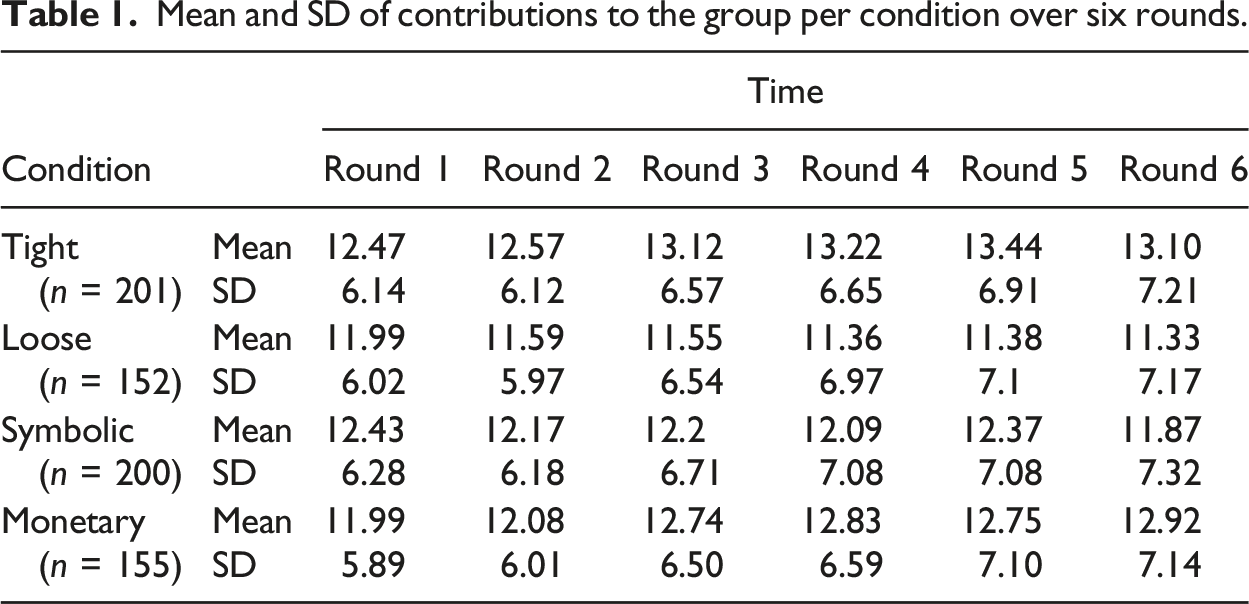
Mean and SD of contributions to the group per condition over six rounds.
Endogenous group processes
Model selection
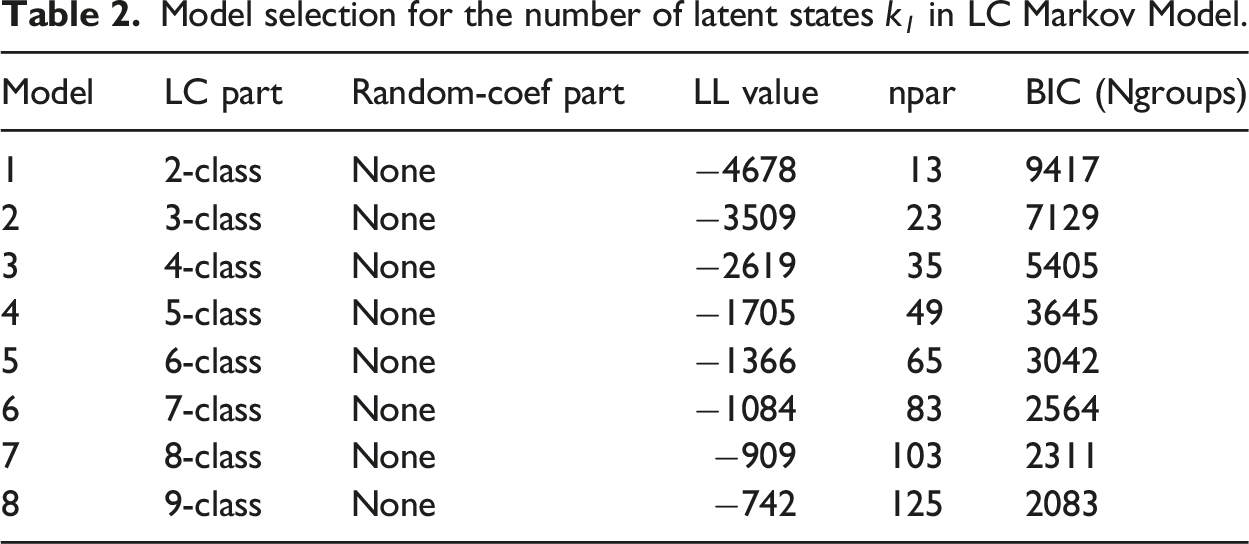
The model selection is concerned with the choice of the number of latent states k (Montanari et al., 2018). We first determined the latent states at level 1 for decision profiles (k 1 ), then at level 2 for individual classes (k 2 ), and lastly at level 3 for group classes (k 3 ). Following existing research, we avoided higher values of k to prevent overfitting the model (see Montanari et al., 2018; Titlestad et al., 2019). In Latent Markov analysis, assessments of the model fit and assumption testing prove difficult because “sparseness often inhibits the use of goodness-of-fit testing, and commonly used alternative fit measures, such as BIC, are not directly suitable to test specific model assumptions” (Nagelkerke, 2018: 55). For example, adding more states can continue to improve the BIC, but can lead to highly similar states, which points to the model fit improvement being mainly driven by having more transition patterns (Nagelkerke, 2018: 72). Thus, we fit models with k1 ranging from 2 to 7, k 2 from 2 to 4, and k 3 from two to four by comparing the different states within each level (i.e. interpretability and proportions), and using the Bayesian information criterion (BIC).
Model selection for the number of latent states k 1 in LC Markov Model.
Latent profiles of level-1 latent classes per state for k 1 selection.
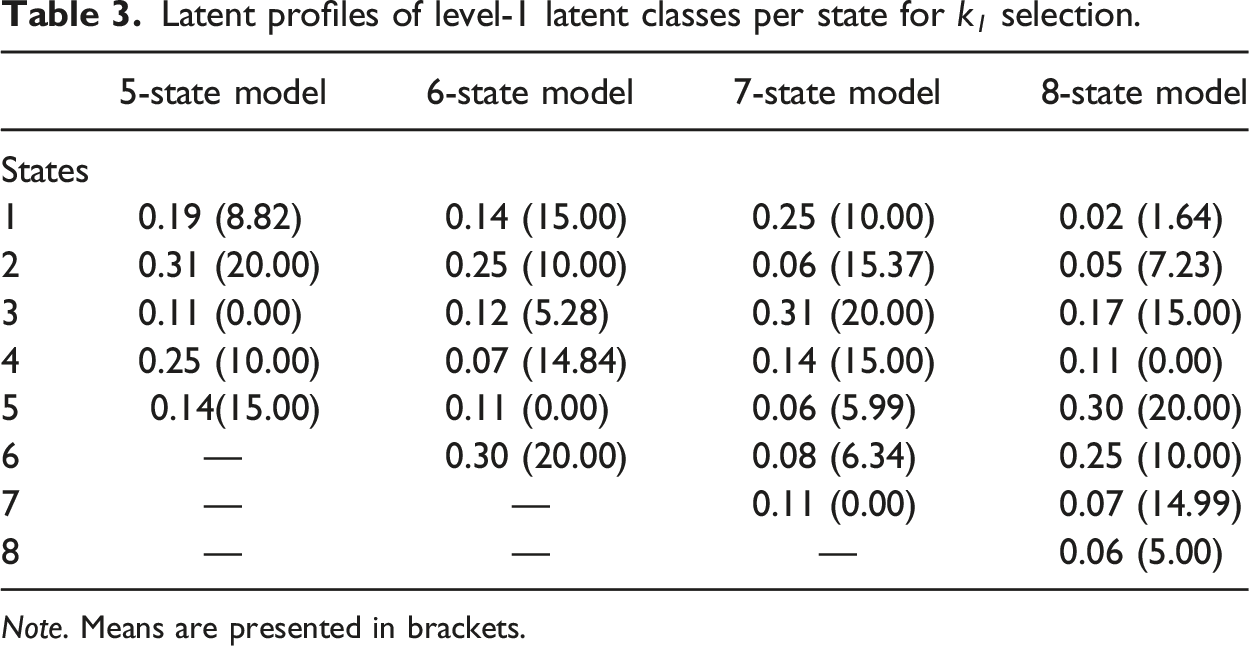
Note. Means are presented in brackets.
Level-1 latent classes (rounds)
Latent profiles, regression coefficients, and transition probabilities of decision rules.
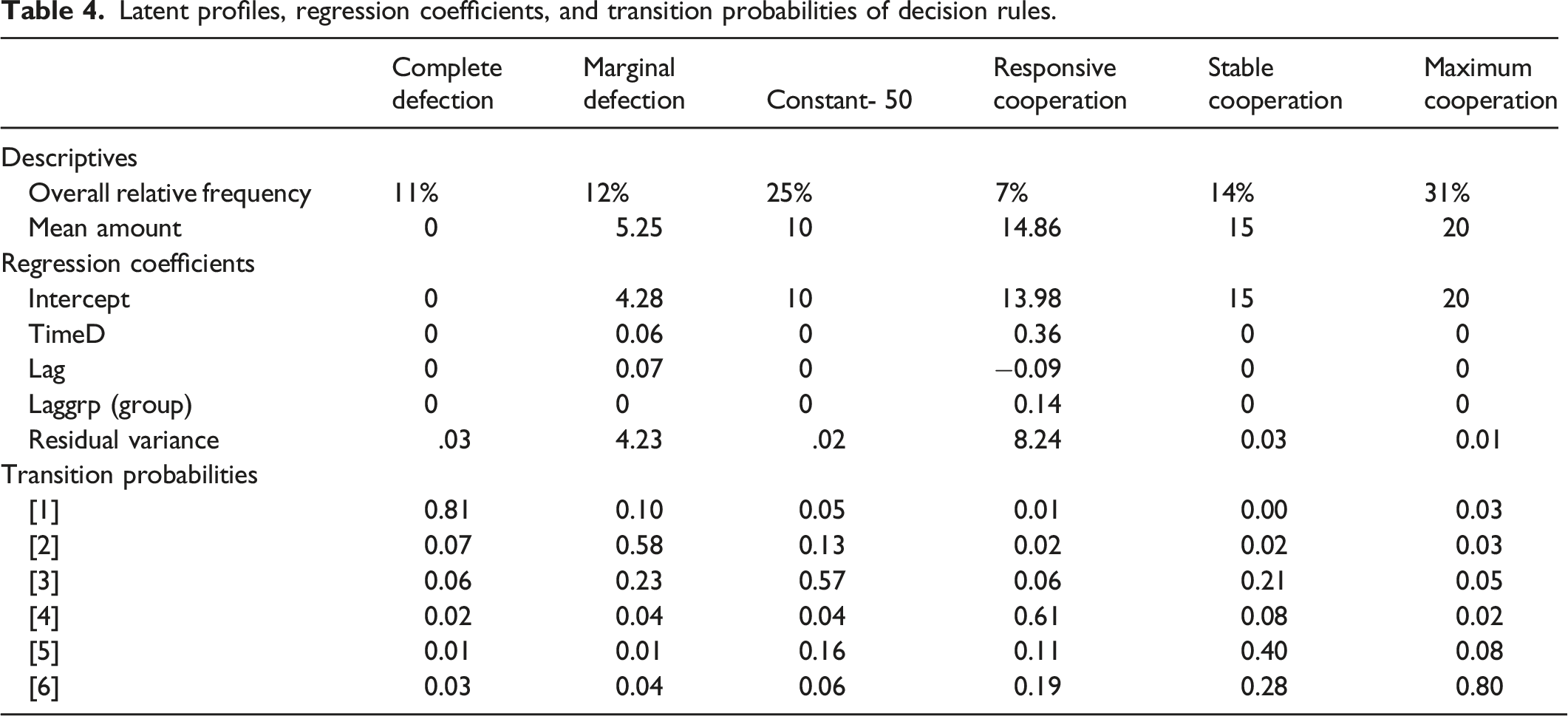
One decision rule, constant-50, describes contributions that correspond to 50% of the total units. Three decision rules are cooperative.
In stable cooperation, each contribution equals exactly 75% of the total units for each round. Responsive cooperation describes higher contribution rates (around 75%) with fluctuations over time. Maximum cooperation corresponds to stable contributions of the total amount (20 units) for each round.
These decision rules were from the first round onwards significantly different from one another, such that they predicted different amounts of contribution levels (X 2 (5) = 55.61, p = .00), and significantly varied in their probability to transition to another state in the following round (X 2 (30) = 101.38, p = .00). Neither participants’ (X 2 (6) = 10.14, p = .12) nor the groups’ average contributions of the previous rounds played any role in the six decision rules (X 2 (6) = 5.01, p = .54), but states significantly differed across individual classes (X 2 (1) = 76.77, p = .00) and individual classes significantly differed across group classes (X 2 (5) = 55.61, p = .00).
Cooperative decision strategies appeared most frequently (52%), followed by Constant-50 (25%), and strategies characterized by defection (23%; see Table 4). Participants who contributed the maximum (probstaying = 80%) or a minimum amount (probstaying = 80%) to the group were highly likely to stay on the same decision rule in the following round. Participants using constant-50, responsive cooperation, and marginal defection possess a two-thirds chance to remain on the same decision rule in the next round. Stable cooperation revealed a 40% chance to remain on the same decision in the following round, a 25% chance to switch to maximum cooperation, and a 21% chance to switch to constant-50.
Overall, complete defection (σ 2 = 0.03), constant-50 (σ 2 = 0.02), stable cooperation (σ 2 = 0.03), and maximum cooperation (σ 2 = 0.01) appeared to be most stable over time, whereas marginal defection (σ 2 = 4.23) and responsive cooperation (σ 2 = 8.24) revealed larger residual variance.
Level-2 latent classes (individuals)
Two individual classes were found based on their contribution levels in the PGG. We refer to them as committed (50%; M = 16.74, SE = 0.29) versus strategic players (50%; M = 8.00, SE = 0.32).
On average, committed players contributed around 85% of their units to the public good. Committed players had the largest probability to engage in maximum (55%) and stable cooperation (19%). In contrast, strategic players contributed on average 40% of their units to the public good and engaged mostly in Constant-50 (43%), marginal defection (21%), and complete defection (21%).
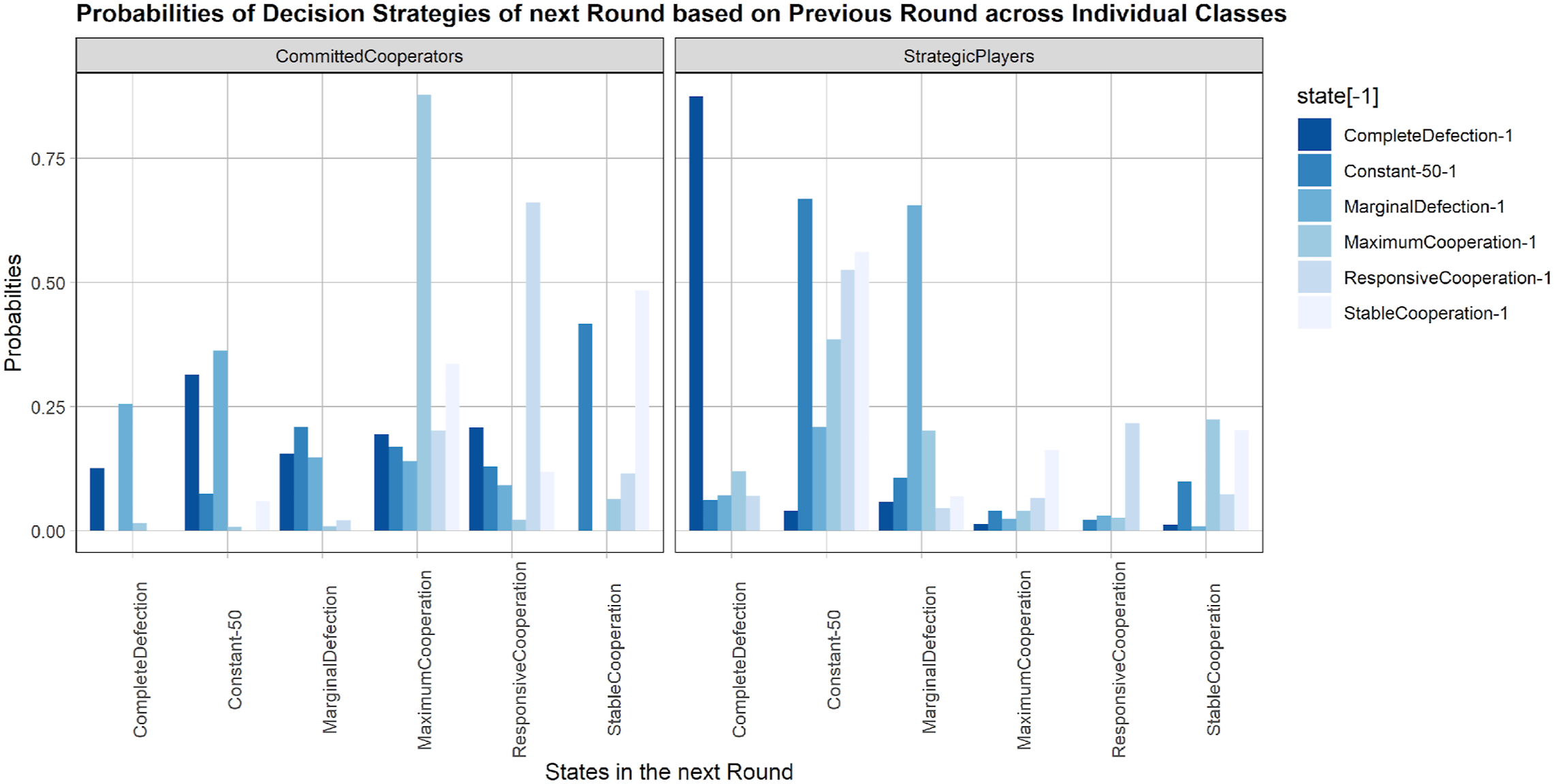
In the first round, committed players were most likely to start with maximum cooperation (41%), constant-50 (25%), and stable cooperation (22%; see Figure 1). Contrary, strategic players started with Constant-50 (45%), marginal defection (19%), and complete defection (14%). Given a prior decision rule of complete defection, committed cooperators still had a probability of 20% to use maximum cooperation in the following round, while strategic players only had a 1% chance to move to maximum cooperation (see Figure 2). Conversely, committed cooperators were less likely to remain on complete defection (13%) whilst strategic players were most likely to stay on complete defection (88%). These findings point to the importance of the first round of interaction: first, most of the decision strategies revealed small residual variances, pointing to the stability of most decision strategies over time. Second, Figures 1 and 2 reveal a path dependency such that once decision strategies across individual classes are determined in round one, there appear little fluctuations in transition probabilities thereafter. Starting probabilities of decision strategies across individual classes in round 1 (model: six-states two-individual and two-group classes). Probabilities of decision strategies based on previous round (state[−1]) across individual classes (model: six-states two-individual and two-group classes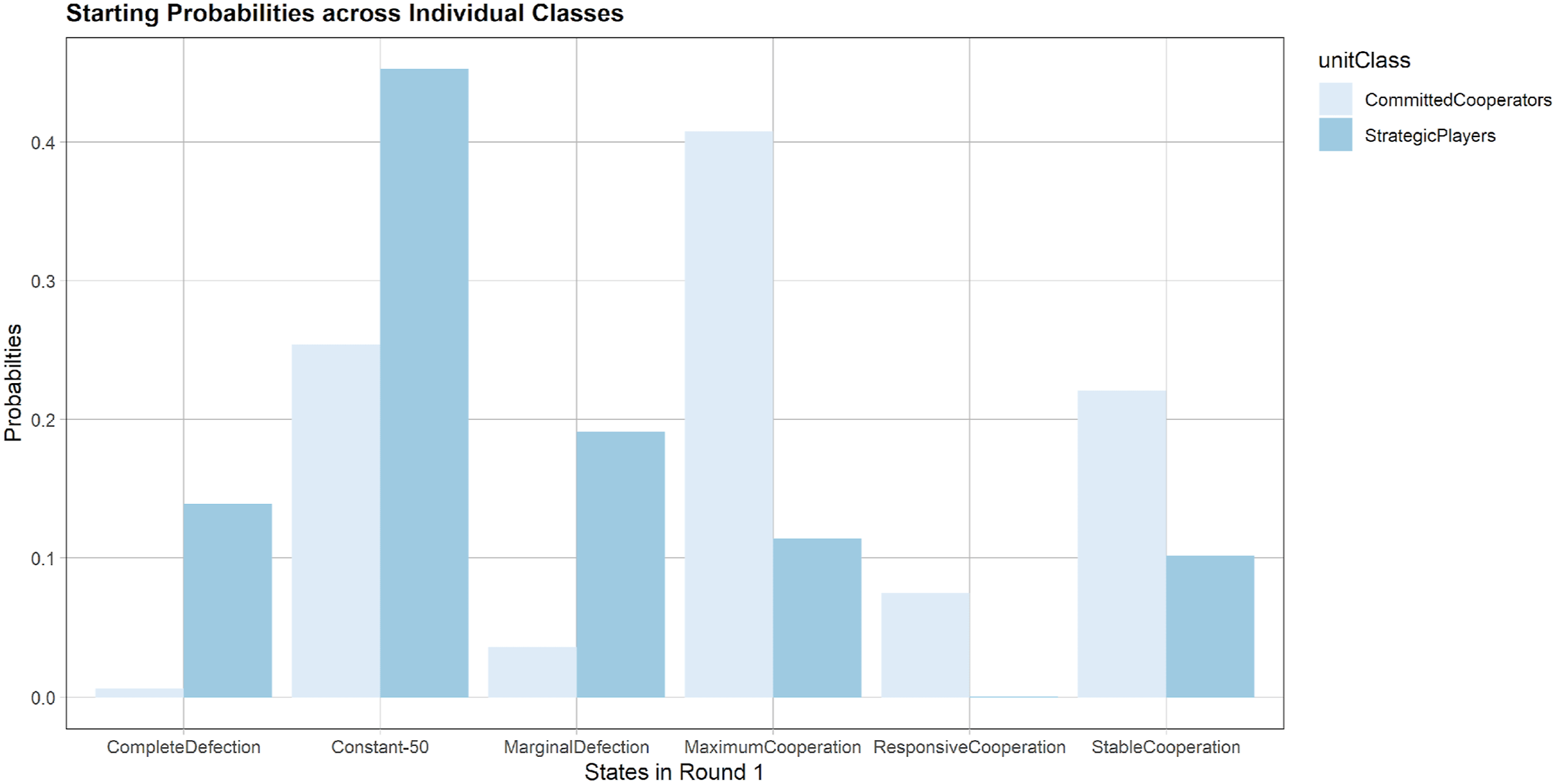
Level-3 latent classes (groups)
Two types of groups were detected. Based on their pattern of cooperation, we refer to them as committed (50%, M = 15.29; SE = 0.60) and strategic groups (50%, M = 9.50, SE = 0.60). Committed groups contributed around 80% of their units to the group, and strategic groups contributed 50% of their units.
On average, committed groups contributed around 80% of their units to the public good. Committed groups had the largest probability to engage in maximum (47%) and stable cooperation (17%). In contrast, strategic groups contributed on average 50% of their units to the public good and engaged mostly in Constant-50 (37%), marginal defection (18%), and complete defection (18%). Figure A1 provides an example of dynamic decision strategies within two groups and accordingly the contributions across individual and group classes.
Group and individual classes largely overlapped (see Figure 3): committed players possess on average an 83% chance of being part of committed groups, and only a 17% chance of strategic groups. Similarly, strategic players possess an 82% chance to belong to a strategic group and a 17% chance to a committed group. Thus, committed groups consisted mostly of committed players who engage in more cooperative strategies, while strategic groups consisted mostly of strategic players who engage mostly in Constant-50 or defective decision rules. Average contributions rates of individual and group classes in the six-states two-individual and two-group classes over time.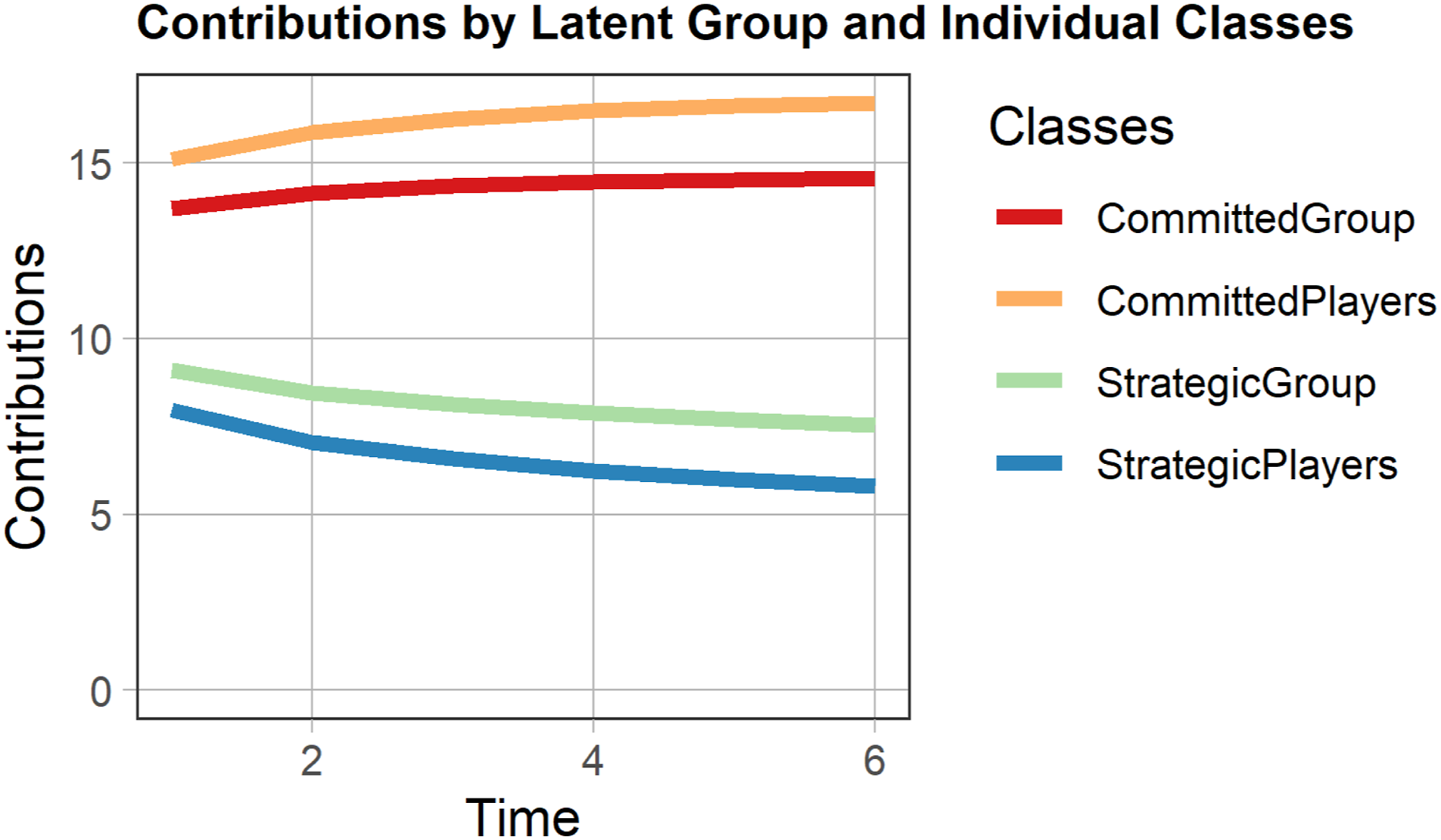
Exogenous factors
The final model estimates the six-state two-unit and two-group class model by adding the conditions of the manipulation as predictor variables into the model equation. Control variables were added as inactive covariates (i.e., they do not change the regression coefficients of the model predicting the decision rules; see supplementary materials of Titlestad et al., 2019: 7).
Situational tightness versus looseness
Situational tightness (vs looseness) has a positive effect on cooperation levels (H1) by predicting group classes (β = 0.72, X
2
(1) = 4.24, p = .04). Tightness resulted in an equal chance of committed (51%) and strategic groups (49%) to emerge. In contrast, looseness substantially increased the likelihood of strategic groups (68%), in comparison to committed groups (32%). Adding to the endogenous patterns that emerged, tightness strengthens the overlap between committed players and committed groups (87%), and looseness slightly reduces the overlap between strategic players and strategic groups (80%; see Figure 4). Average contributions rates of individual and group classes in the six-states two-individual and two-group classes over time, including explanatory variables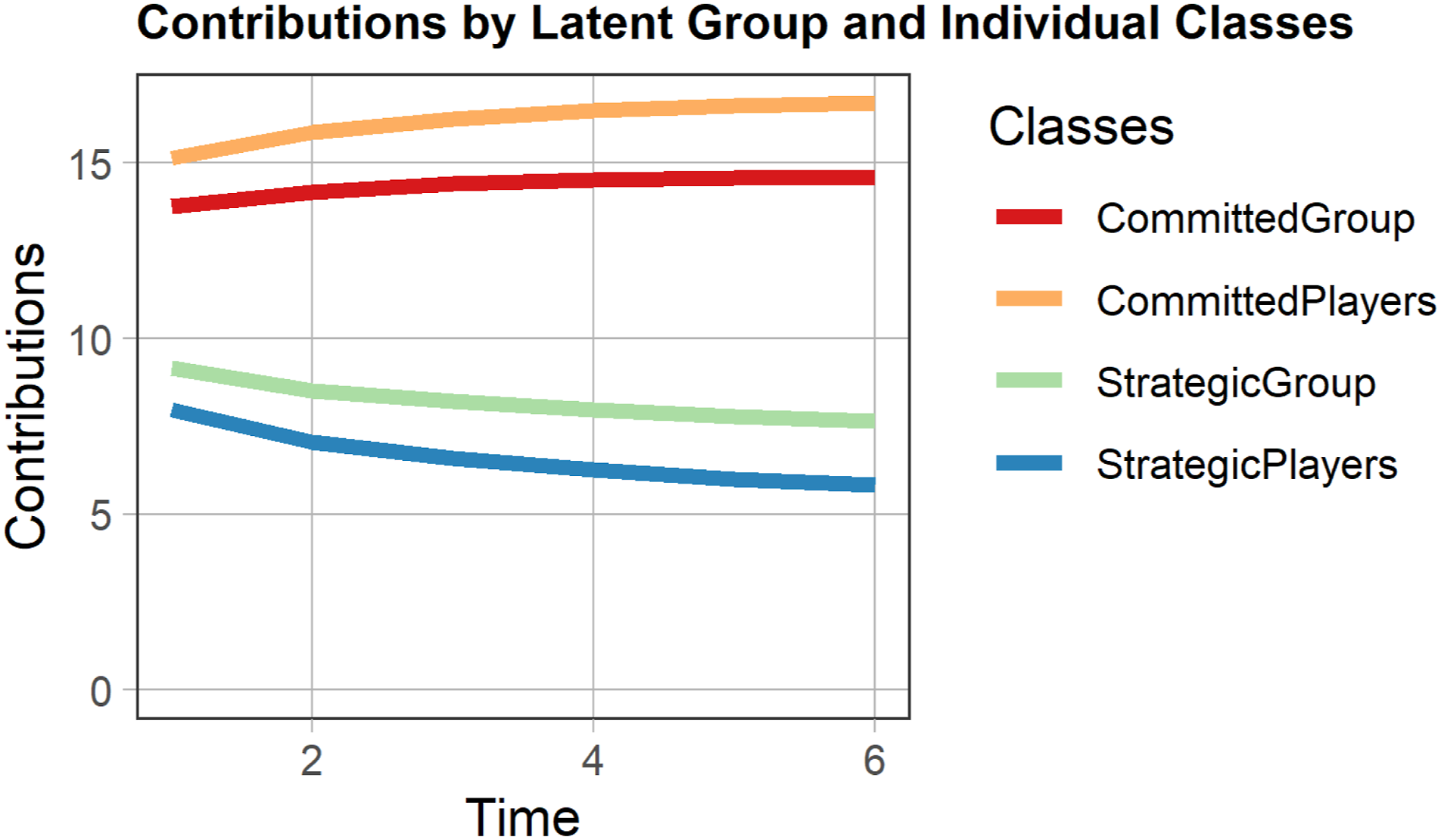
Monetary versus symbolic incentives
No main effects of money primes were found (β = .58, X 2 (1) = 1.96, p = .16), nor were the interaction effects with Tightness-Looseness significant (β = −0.75, X 2 (1) = 2.32, p = .13), leading us to reject H2 and H3.
Individual level covariates
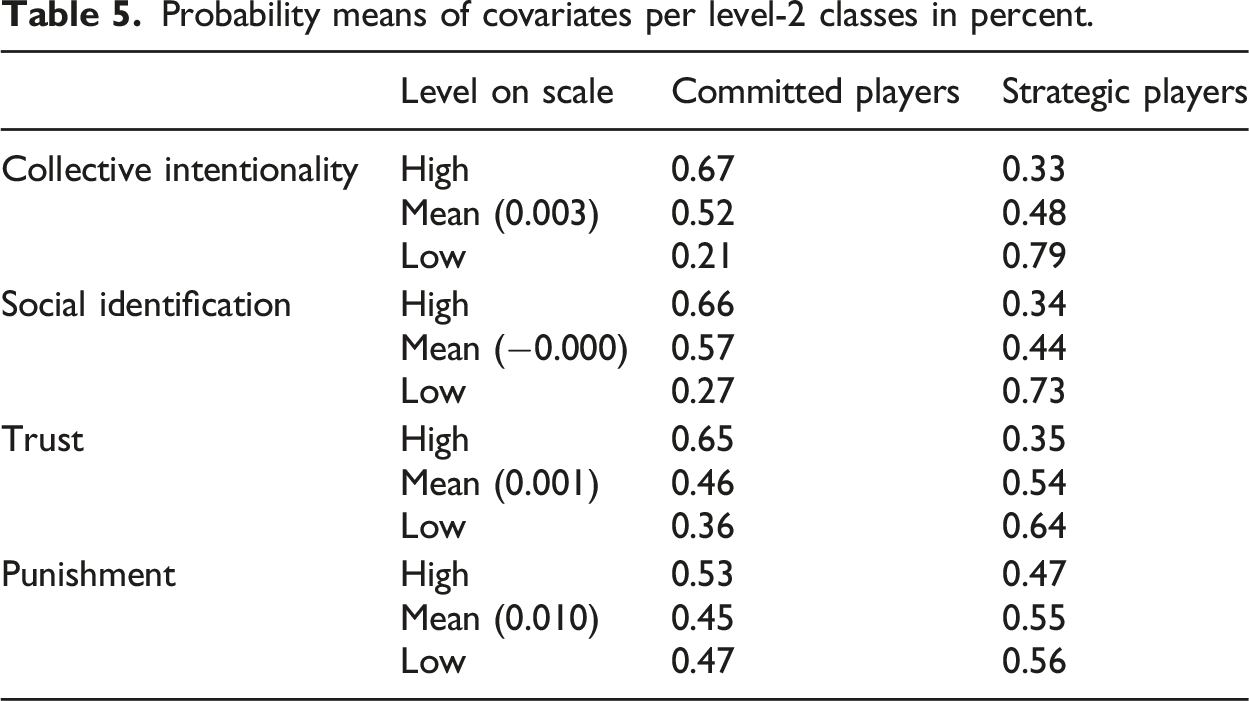
Individual level covariates are presented in a descriptive manner as the control variables are included as inactive variables (see supplementary materials of Titlestad et al., 2019: 7). Among all covariates, collective intentionality revealed the strongest association with cooperation. Note that we excluded two control variables from our analysis (i.e. experience and residence) due to a lack of correlation with cooperation rates (r = 0, p = .95, and p = .94 respectively).
Collective intentionality
Probability means of covariates per level-2 classes in percent.
Social identification
The majority of committed players (66%) revealed high levels of social identification, compared to strategic players (34%). Moreover, most strategic players (73%) reported low levels of social identification (27%), suggesting that high levels of social identification are associated with cooperation (see Table 5).
Trust
Two-thirds of committed players (65%) revealed higher levels of trust than strategic players (35%). Conversely, two-thirds of strategic players (64%) were less trusting than committed players (36%), showing a positive association between trust and cooperation.
Punishment
Lastly, punishment revealed no substantial differences between strategic and committed players.
Validation
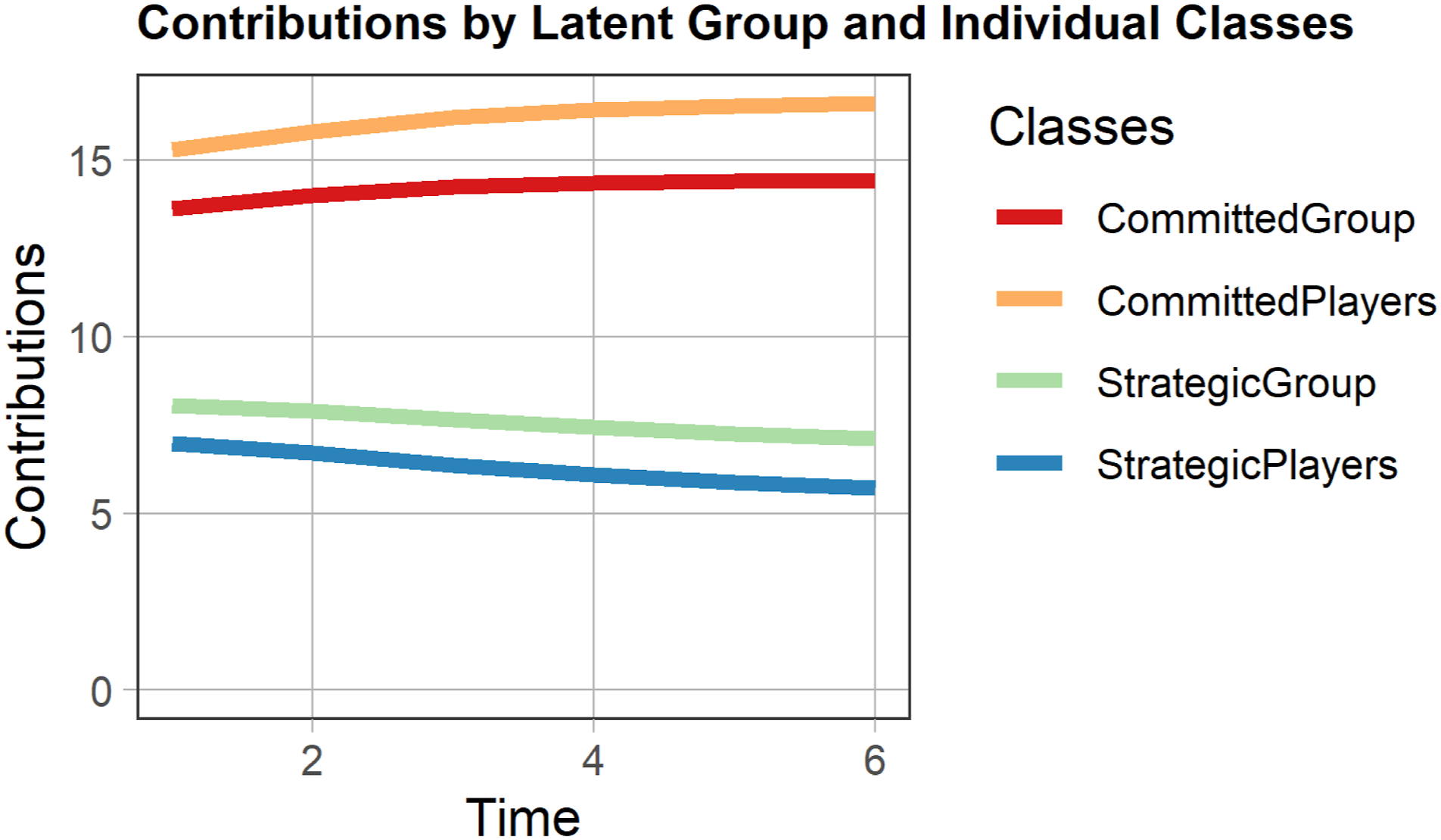
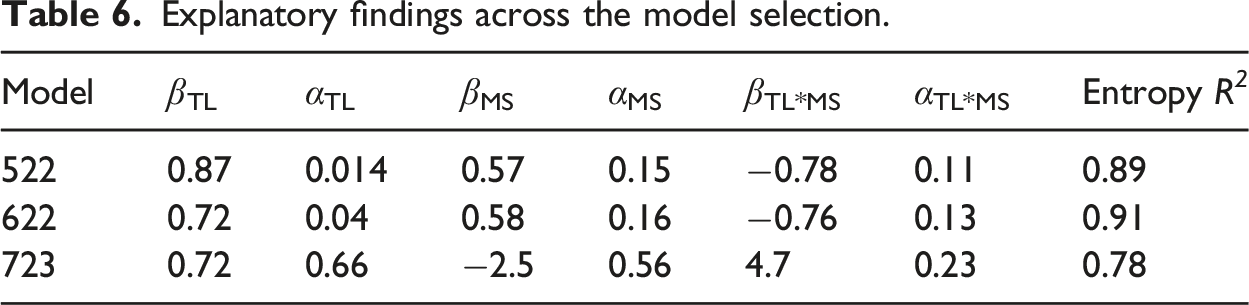
To validate our findings of the final model, we show the estimation of five-state two-individual and two-group classes (see Figure 5) and seven-states two-individual and three-group classes (see Figure 6). The figures show that the pattern of individual and group classes is highly similar to the six-decision two-individual and two-group classes model, suggesting robust findings despite varying classes. For instance, the seven-states two-individual and three-group classes model possess three group classes of which two are identical, suggesting an overfitting model. Average contributions rates of individual and group classes in the five-states two-individual and two-group classes over time. Average contributions rates of individual and group classes in the seven-states two-individual and three-group classes over time.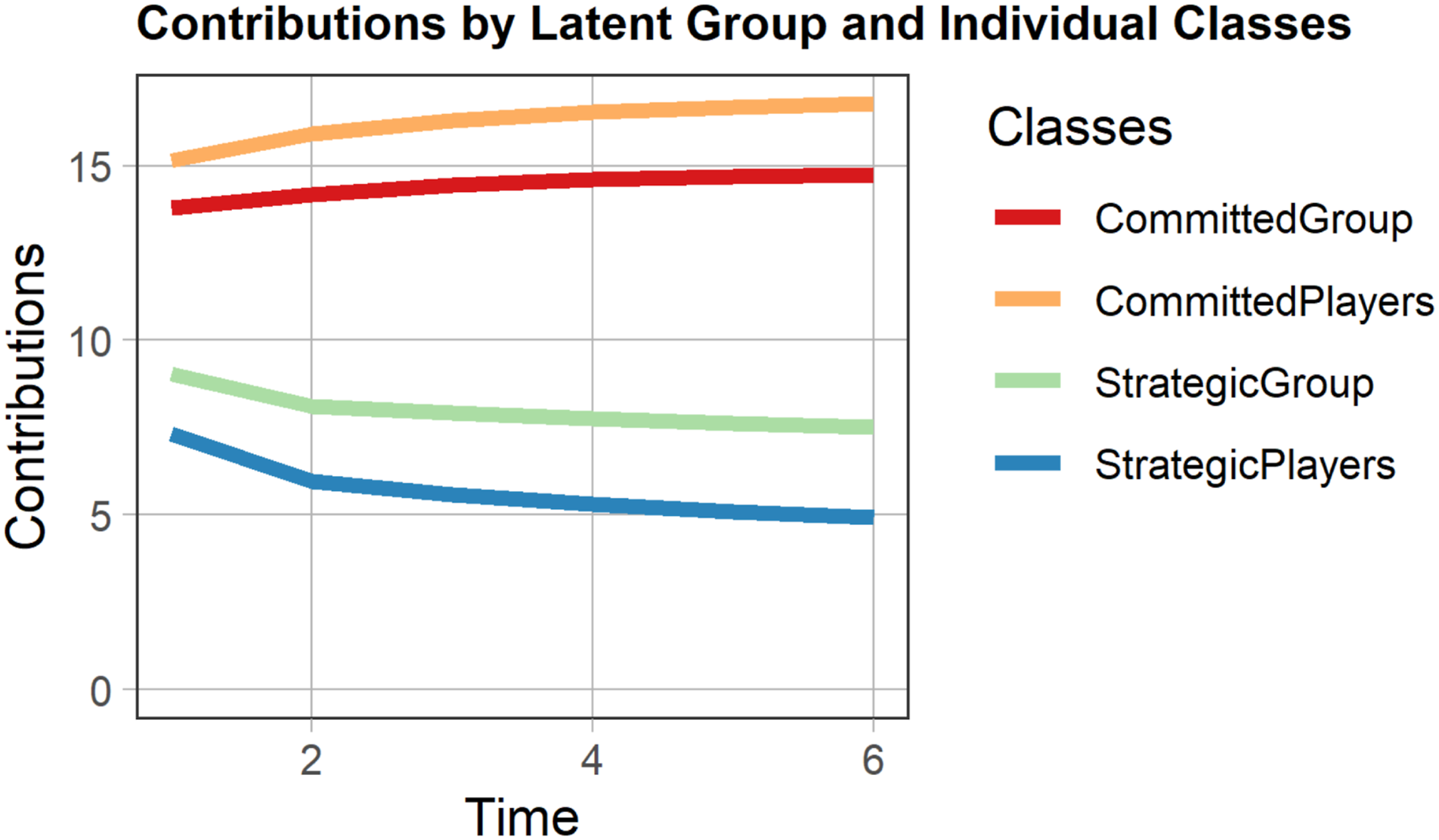
Explanatory findings across the model selection.
Discussion
We investigated the interplay between exogenous and endogenous factors and their impact on cooperation sustainability in small groups. To uncover endogenous group dynamics, we performed multilevel latent Markov models on Bayesian estimation that allowed us to estimate latent classes on the level of rounds, individuals, and groups. We studied exogenous factors by investigating situational tightness versus looseness, and monetary versus symbolic frames on cooperation sustainability. Participants played a tightness (vs looseness) game to endorse situational expectations prior to the PGG and received instructions with varying primes (monetary vs symbolic). We expected cooperation sustainability to be higher in groups operating under the tightness condition than in groups operating under the looseness condition (H1), and lower in groups operating under the monetary condition than in groups operating under the symbolic condition (H2). Moreover, we assumed an interaction effect between norm strength and frames on cooperation sustainability (H3).
Our key findings show that both endogenous and exogenous factors are needed to explain the variation of cooperation sustainability between groups. Between-group differences in PGG can emerge through different decision strategies of individual classes that are nested within group classes, and within different exogenous conditions, such as tight versus loose situations. Furthermore, groups exposed to tight situations reveal higher levels of cooperation sustainability than groups exposed to loose situations. For instance, loose situations (vs tight) strengthened the endogenous process by increasing the probability of groups who engaged mostly in Constant-50 (i.e. a decision rule in which contributions correspond to 50% of the total units), or defection. This finding is in line with our claim that to uncover the complexity of cooperation sustainability, more attention needs to be paid to the interplay between endogenous processes and exogenous factors.
Before addressing the limitations, we highlight some implications of our findings. First, introducing the theoretical framework of idiocultures to the study of collective good dilemmas enhances our theoretical understanding of within-group dynamics and between-group differences. Distinct group specific patterns of behaviors emerged through in-group interaction with varying levels of social identity and trust that can point to unique group cultures. Unique patterns of (non)cooperation emerge from micro-interactions between individuals who are mutually aware of their group and orient their own behavior towards the actions of other group members.
Second, our experimental manipulation adds to existing research on Gelfand’s Tightness-Looseness theory, extending it to the study of cooperation sustainability in collective good experiments. We provide a first approach to measure situational tightness versus looseness experimentally. While participants in the tight situation were exposed to a restricted range of appropriate behavior (i.e. following the strict rules of a traffic light), participants in the loose situation received a wider range of permissible behavior.
Third, our study presents novel empirical findings on cooperation sustainability in small groups. We added to recent efforts toward more fine-grained dynamic multilevel modeling of cooperation processes in groups. The related techniques uncovered interaction processes within groups by disentangling decision strategies and their development at the level of the group, the individual, and the round. Individual latent classes are in line with previous research that identified similar classes of strong free riders, conditional/strong cooperators (Kurzban and Houser, 2001), latent group classes (Titlestad et al., 2019), and 50% of contributions or maximum cooperation (Axelrod and Hamilton, 1981). Adding to existing research, our findings show that early interaction patterns are crucial for the evolution of cooperation trajectories in subsequent rounds. Additionally, committed groups and individuals show a strong tendency to engage in cooperative decision strategies even after defection in the previous round. Conversely, strategic groups and players are more likely to defect even after cooperating in the previous round. Thus, endogenous processes can explain the between-group differences in cooperation sustainability in small groups. Due to a large combination of latent profiles that can switch over time, a multitude of different cooperation trajectories can emerge. Capturing the complexity of cooperation sustainability with novel multilevel modeling increased our understanding of cooperation and group dynamics.
Fourth, our results also provide insights into the exogenous effects on between-group differences in cooperation sustainability. We examined two static conditions on cooperation sustainability: situational tightness versus looseness and monetary versus symbolic primes. Situational tightness positively affected sustainable cooperation compared to looseness. Our results suggest that tightness increases cooperation through conformity, which is in line with previous research. For instance, evolutionary models show that conformity-driven cooperators can increase cooperation (Hu et al., 2019; Zhang et al., 2021).
Finally, our findings suggest that collective intentionality plays a crucial role in cooperation sustainability. Collective intentionality revealed the strongest effect among the control variables, showing that successful groups developed a high sense of collective intentionality compared to unsuccessful groups. These findings are in line with a recent experiment (McClung et al. 2017) as well as ethnographic research that indicates that community sense is formed and sustained in social interaction (Wohl, 2015). Moreover, we add to the existing literature by showing that collective intentionality is associated with cooperation even in social dilemma situations without communication.
Our study faces at least four limitations. First, the self-reported questionnaire was measured after the PGG. As most items aim to capture participants’ attitudes during the game, the questionnaire at the end of the game may not reflect their actual attitudes. However, the experiment only lasted 9 minutes, leaving only a short time frame between the game and the questionnaire. Therefore, large discrepancies are not expected.
Second, while we measured the strength of situations and frames experimentally, we studied collective intentionality, social identity, and trust observationally via a post-experiment survey based on questionnaire items from existing research (Titlestad et al., 2019). Thus, these control variables present an observational finding only and do not provide any insights into their causality or the direction of the effect.
Third, the monetary incentives in the money prime conditions were very weak. Generally, weaker monetary incentives result in weaker efforts (Gneezy et al., 2011). However, the main purpose of our money prime was to increase the salience of the related gain frame, rather than incentivizing participants through the size of a monetary reward. This manipulation follows the lead of previous experimental research (Liberman, Samuels and Ross, 2004), which has shown that how a game is framed has a major impact on behavior: contribution levels were significantly lower when the game was labeled as the “Wall Street Game” rather than the “Community Game”. Nevertheless, unlike Liberman, Samuels and Ross (2004), our priming did not have a significant effect. The difference in results may be due to different framing approaches across studies. Whereas Liberman and colleagues (2004) used two different frames (Wall Street vs Community), the present study manipulated the primes within the single context of the farming game (i.e. money vs symbolic primes within the farming game). Thus, it appears framing effects matter when manipulations comprise two distinct names of the games, but not if different framings of incentives are used within one game.
Fourth, the experimental manipulation of tightness versus looseness was rather weak due to the simplicity of the interaction: Participants merely played a hypothetical game in which they crossed the street. We observed a significant difference in cooperation between tight versus loose groups, despite the low complexity of the interaction and the weak manipulation. In line with the theoretical framework, participants in the tight conditions reported significantly higher levels of conformity in comparison to the loose condition. Our findings demonstrate the value of further investigating the role of tightness versus looseness in cooperation sustainability. We introduced the first manipulation of tight versus loose situations to study its effect on cooperation sustainability, which can be developed into a more sophisticated measure by future research.
Fifth, we find varying behavioral patterns and trajectories across groups, as well as differences in social identities and levels of trust, which point to the emergence of idiocultures in the public goods game. However, we describe group-specific idiocultures mostly through the endogenous process (i.e. the emergence of committed vs strategic groups based on contributions) and do not assess their internal validity through a post-experimental survey. To determine the extent to which the observed behavioral patterns reflect idiocultures in the context of public goods, thus, requires further research.
Overall, this study has provided evidence that both endogenous group dynamics and exogenous factors, like situational tightness, are important antecedents of cooperation sustainability. To increase cooperation sustainability in small groups, early interaction patterns, situational tightness as well as collective intentionality appear to be important, though still understudied elements to overcome the public good dilemma.
Supplemental Material
Supplemental Material - Cooperation sustainability in small groups: Exogenous and endogenous dynamics of the sustainability of cooperation
Supplemental Material for Cooperation sustainability in small groups: Exogenous and endogenous dynamics of the sustainability of cooperation by Zeynep Melis Kirgil and Rafael Wittek in Rationality and Society.
Footnotes
Acknowledgements
We thank Tom Postmes, Kim Titlestad, Tom Snijders, and the Norms and Networks Cluster (NNC) at the University of Groningen for their crucial feedback on earlier versions. We thank the anonymous reviewers and the editor for their insightful comments and suggestions.
Declaration of conflicting interests
The author(s) declared no potential conflicts of interest with respect to the research, authorship, and/or publication of this article.
Funding
The author(s) disclosed receipt of the following financial support for the research, authorship, and/or publication of this article: R.W. gratefully acknowledges funding by the 2017 Gravitation Program “Sustainable Cooperation - Roadmaps to Resilient Societies” (SCOOP) of the Netherlands Organization of Scientific Research and the Dutch Ministry of Education, Culture and Science (grant number 024.003.025).

Supplemental Material
Supplemental material for this article is available online.
Note
References
Supplementary Material
Please find the following supplemental material available below.
For Open Access articles published under a Creative Commons License, all supplemental material carries the same license as the article it is associated with.
For non-Open Access articles published, all supplemental material carries a non-exclusive license, and permission requests for re-use of supplemental material or any part of supplemental material shall be sent directly to the copyright owner as specified in the copyright notice associated with the article.
