This paper develops a method to identify manipulation of custodial suspects who attempt to invoke the Miranda right to legal counsel during a custodial interrogation. The method, developed from a combination of framing theory and hypergame theory, first documents the point where custodial suspects’ preferences shift and second identifies the proximate cause of that shift using excerpts from legal cases. The method applies linguistic analysis within a hypergame framework to reveal rational behavior of custodial suspects who, despite owning an initial preference to invoke, waive their right to counsel without explicit pressure from police. The paper terms this shift in preferences “manipulation” adding the concept to hypergames and to the literature on noncooperative discursive exchanges.
In the United States,1 the police interrogation of a custodial suspect begins with the interrogator reading the custodial suspect their Miranda rights (Miranda v. Arizona, 1966).2 The custodial suspect then makes one of three choices: invoke the right to silence, invoke the right to legal counsel, or, knowingly and voluntarily, agree to talk to the police without legal counsel present. Per Miranda, once a custodial suspect invokes their Miranda rights by expressing a desire to remain silent, have counsel present, or both, the police must stop the interrogation.3
Case law post-Miranda acknowledges that custodial suspects may invoke legal counsel in an ambiguous or equivocal manner, albeit a definition for these types of invocations has not been established in the law. Courts have ruled that the invocation of Miranda rights must meet a clarity of statement standard as judged by the interrogator. This standard incentivizes an interrogator to flout conventions of speech for strategic purposes. This is observed in a large corpus of federal criminal cases that ruled on the legal standard that custodial suspects must meet to legally invoke the right to counsel (Mason, forthcoming).4 This corpus provides data that documents shifts in custodial suspects’ preference from having a lawyer present to a preference for an interview without a lawyer.
In the corpus, custodial suspects express a preference for an interview with a lawyer present but become sidetracked into conversation with the interrogator. During this conversation, the custodial suspect’s expressed preference changes to proceed with the interview without a lawyer present. This paper posits that the custodial suspect’s perception of the situation is reformulated during the intervening conversation.
Tversky and Kahneman (1989) discuss the process through which game form is understood in their theory of framing. This theory is an alternative to rational choice theory in which preference is established as the outcome of a subjective utility maximization process. Subjective utility maximization requires information about the probability of an outcome and its payout. In the corpus, outcomes are perceived as certain leaving only a change in the perceived payout to motivate a change in preference.
In framing the game, the custodial suspect understands the game as a choice of two outcomes as presented to them during the reading of the Miranda warnings which we refer to as the surface game. Consistently in the corpus, custodial suspects fail to see that conversation after they invoke the right to counsel, is a move into a hypergame designed to shift the custodial suspect’s preference.
This paper proposes that once a shift in a custodial suspect’s preference is identified, one can ascertain the proximate causes of the shift, and perhaps, gain insights about factors that motivated the custodial suspect to make the change. The paper puts forth an alternative analysis that is not founded on the traditional notion that all decisions a rational individual makes can be described completely as subjectively probabilistic perception of potential payouts to each choice. This paper will argue that the analysis of some types of games requires a model that captures discrepancies in players’ game form recognition.
In a police interrogation, perception and preference are subject to manipulation. Manipulation is the process by which a player alters another player’s preferences for the benefit of the first player. Although manipulation may take many forms, the corpus to which we apply our method of analysis was obtained in a controlled setting that limited forms of manipulation. Environmental conditions present during the legal process of our excerpts will vary as the corpus was not obtained under experimental conditions, but there are common rules governing behavior and environment that limit their influence on the discursive corpus.
The analysis of this paper focuses on the “invocation of rights stage” of a police interrogation which we call ‘the invocation game.’ This is a single move game where there is certainty in outcomes: a custodial suspect makes a decision to invoke or waive Miranda rights after they are read by an interrogator . This paper identifies shifts in revealed preference and explores possible explanations arising from police-custodial suspect exchanges. To that end, the paper develops a model, framed in hypergame theory, to analyze the linguistic acts that transpire during the invocation stage of a police interrogation.
Setting the invocation game
The invocation game models the legal process that begins with the reading of Miranda rights by to and concludes with successfully invoking counsel, or with waiving their rights and agreeing to an interrogation with . The outcome is mediated by two competing interests: society’s interest in investigation of criminal activity, and society’s interest in protecting legal rights (see Mason, 2013, 2016, 2020, 2024).
Cognitive awareness of the situation is not equal for and . In the United States, is often professionally trained in interrogation techniques based on behavioral analysis (see Inbau et al., 2005). As Leo (2008: 110) states: “Interrogators were not born but made.” The behavioral analysis approach to interrogation places a premium on obtaining statements from custodial suspects. Case law has granted much latitude to employ pressure, control, deception, and manipulation. This prosecutorial, guilt-presumptive, approach to questioning suspects shapes interrogators’ discursive strategies (Kassin and Gudjonsson, 2004; Mason, 2020).
The seminal post-Miranda case that facilitates work is Davis v. United States (1994). The Supreme Court (herein the Court) gave the ability to disregard post-waiver invocation for counsel if requests counsel in an equivocal or ambiguous manner:
…if a suspect makes a statement that might be a request for an attorney, this clarity and ease of application would be lost. Police officers would be forced to make difficult judgment calls about whether the suspect in fact wants a lawyer even though he has not said so, with the threat of suppression if they guess wrong. We therefore hold that, after a knowing and voluntary waiver of the Miranda rights, law enforcement officers may continue questioning until and unless the suspect clearly requests an attorney.
At present, case law has not provided a standard for what distinguishes a clear invocation of the right to legal counsel from an equivocal or ambiguous one. Hence, invocations for counsel that are not formulated directly (e.g., ‘I want an attorney’ or ‘Get me an attorney,’) yet are commonly employed by speakers in conversation, (e.g., ‘Can I get an attorney?’ or ‘I might need an attorney’) may be disregarded by the police without explanation owing to judgment of whether the invocation was sufficiently clear. Importantly, case law does not require to follow-up or clarify that is uncertain as to the meaning of a particular statement from .
The Court’s lack of guidance on what constitutes an unequivocal request for counsel creates and sustains asymmetry of knowledge between and , and bestows upon the role of gatekeeper of the Miranda rights (see Ainsworth, 1993, 2008, 2012, 2020; Leo, 2001; Mason, 2013, 2016; 2020, 2024; Mosteller, 2007; Weisselberg, 2008). This leads to a type of discursive game framed by manipulation.
Communication as a type of game
Linguists have employed game theory to understand how speakers strategically convey meaning and intent in communication. Players have preferences for outcomes that motivate the strategic linguistic choices made during the game. Theoretically, in communication as in other games, a player cannot control the outcome of the game just by their actions. Instead, a player must take the other player’s linguistic actions into account. This process has traditionally been studied in linguistics under rationalistic game theory (see van Rooij, 2008). Rationalistic game theory examines “when is it rationalizable to communicate at all” and “how can credibility of messages be established” (Jäger, 2008: 410).
Some common approaches to the credibility question include the application of costly signaling games and cheap talk. Rabin (1990), for example, takes a game theoretic approach that is reminiscent of Grice’s (1975) cooperative principles that all messages are credible assuming cooperativity. Rabin developed Credible Message Rationalizability (CMR) by combining Crawford and Sobel’s (1982) standard equilibrium analysis and Farrell and Gibbon’s (1989) rich language assumption that players are rational. Players tend to believe statements that are consistent with rationality, allowing for some meaningful communication to be predicted, including those that require implicature to derive the players’ intent.5
Other approaches predicting communication include Blutner’s (2000) Bidirectional Optimality Theory, and Parikh’s (1991) Strategic Discourse Model (SDM). Dekker and van Rooij (2000) reformulated Blutner’s theory as the exchange of information between sender and receiver characterized as a strategic signaling game of complete information. The actions of speakers are described as the choice of expressions and the actions of the hearers as the choice of interpretations. These models examine cooperative exchanges, focusing on form-meaning relationships.
Parikh (1991, 2000, 2001) expanded on the analysis of sender and receiver exchanges by adding the sequential features of a communication game of partial information with a unique solution. Parikh (1991) argues that most languages are “situated” which makes language an efficient system of communication: “Once we allow situations a role in the determination of content, it becomes clear that there are certain aspects of utterances that are constant across utterances and others that vary from one situation to another” (475). He notes that part of the task of a theory of communication is to explain how we can get from meaning to content. His model of strategic communication under conditions of ambiguity introduced the concept of “strategic inference” in communication. The central assumption of Parikh’s SDM is that the transfer of information between players involves a strategic interaction between them. When the strategic interaction is common knowledge between the players, that is, when it is a game with a unique solution, the flow will be communicative. Parikh notes “that this game-theoretic structure is situated somewhere, either in the ‘minds’ of players or in their ambient circumstances or both” (478).
Parikh’s SDM, as other models previously discussed, describes how players reach cooperative, meaningful communication, including situations where ambiguity may arise. These approaches, however, do not address non-cooperative situations, where players may not have complete information of the signaling strategies of other players (see Asher and Lascarides, 2013; Farrell, 1993; Rabin, 1990). As Pinker et al. (2008) note, models of conversation that only assume cooperative agents fail to explain the dynamics of strategic conversations.
Discursive games have also been modeled through game-theoretic constructs such as Bayesian games (Burnett, 2019; Frank and Goodman, 2012; Harsanyi, 1967; Stevens et al., 2015). In Bayesian games, an agent’s utility is determined not only by actions but also by types of the agents. In these types of games, “…the existence of private information leads naturally to attempts by informed parties to communicate (or mislead) and to attempts by uninformed parties to learn and respond” (Gibbons, 1997: 138).
In the analysis of reference, Stevens (2016) discusses, through a Bayesian and cognitive lens, whether strategic and non-strategic thinking play independent roles in explaining pragmatic behavior. Stevens notes that a model that explains interaction must account for why people think strategically and, alternatively, why they may not. Stevens argues that the failure of agents to work out the best strategy for themselves may be rooted in reconciling strategic considerations with situational or cognitive biases. Stevens adds that pragmatic behavior does not always tilt toward strategic optimality and, hence, may only provide partial explanations for complex (linguistic) situations where the choices of strategy may not be obvious.
Rational choice theory does not provide a framework for accounting for an agent’s action to change preference in another arising only from a change in the second player’s perception. According to Tversky and Kahneman (1989), the normative analysis in game theory makes four assumptions to develop expected utility theory: cancellation, transitivity, dominance, and invariance. Cancellation eliminates trivial outcomes in which action does not produce different results. Transitivity has a standard mathematical meaning (A ≻ B, B ≻ C → A ≻ C) in which A is preferred to B, and B is preferred to C, transitivity implies that A is preferred to C. Dominance postulates that if one option is better than another in one state and as good as other options in all other states, it is preferred.
Invariance, which assumes that different representations of the same choice problem should yield the same preference, creates a problem for rational choice theory. Because invariance and dominance are normatively essential, Tversky and Kahneman argue rational choice theory cannot provide a description of choice if an agent shifts their preference unless a fundamental change in perception arises. They find that the normative axioms of rational choice are often violated in situations lacking transparency. To illustrate this point, Tversky and Kahneman show that individuals respond differently to alternative frames of a risky choice, first as the prospect of gaining utility, and second as the prospect of minimizing loss. Even though the alternate statements yield the exact same utility, individuals in their study made different choices depending on how the choice was phrased.
Cason and Plott (2014) assert that the absence of an integrated theory of perception masks the existence of a specific form of misperception: the “failure of game form recognition.” Suffering this type of misperception causes a decision maker to fail “…to recognize the proper connections between the acts available for choice and the consequences of choice, which, by necessity, are associated with the method of measuring preferences” (1237). They warn that errors in utility maximization, owing to misperceptions of the game form, lose a separate identity when mistakes are considered generically as an error term, as do errors arising from misinformation, opaque rules, and misperceptions of a situated environment.
Parting from framing theory, differences in each player’s understating of the game and their choices may also be mediated by institutional power and asymmetric knowledge of the game. In these types of games, one player may not be able to recognize a second player’s manipulation of their preference to become that of the second player. Excerpt 1 shows linguistically how, in the invocation stage of a police interrogation, preferences are guided by discursive actions.
1. Officer: Okay. You know what, I have to read them to you anyway regardless of whether you know them or not. You have the right to remain silent, do you understand?
2. Rodriguez: Yes.
3. Officer: Anything you say can be used against you in a court, do you understand?
4. Rodriguez: Yes.
5. Officer: You have the right of the presence of an attorney before and during any questioning, do you understand?
6. Rodriguez: Yes.
7. Officer: If you cannot afford an attorney one will be appointed for you free of charge before any questioning, if you want, do you understand?
8. Rodriguez: Yes.
9. Officer: Okay.
10. The officers then questioned Mr Rodriguez about his involvement in the drive-by shooting… Eventually, Mr Rodriguez asked for an attorney:
11. Rodriguez: Can I speak to an attorney?
12. Officer: Whatever you want.
13. Rodriguez: Can I speak to an attorney?
14. Officer: You tell me what you want.
15. Rodriguez: That is what I want.
16. Officer: That’s fine bro we stop because we can't talk to you anymore, okay, so.
17. Officer: You’re going to be charged with murder today.
The discursive analysis of Excerpt 1 begins with reading the Miranda rights. The suspect affirms understanding of the rights and in turn 11 proceeds to invoke the right to counsel: “Can I speak to an attorney?” The invocation is phrased using a hedged indirect request, which may have linguistic moorings in politeness (Brown and Levinson, 1987), face (Goffman, 1967), risk aversion, as well as in cognitive frameworks and sociolinguistics (see Gibbs, 1983; Holtgraves, 1994; Holtgraves and Ashley, 2001). Regardless of the explanation, indirectly invoking the right to counsel shows preference to invoke counsel and does so in a manner that fits understanding of formulating requests in conversation, particularly asymmetric ones (Mason, 2013).6
The use of an indirect request, in light of the Davis ruling, places ability to invoke counsel in the hands of . As noted previously, is not required by law to inform that the invocation does not rise to the level of unequivocalness to end an interrogation. , however, cannot coerce into waiving rights. Statements must be provided voluntarily or have the appearance as such. This creates a situation in which does not provide information to the , but has to appear to address the indirect request.
The next turns of talk (turns 12-15) constitute repeated attempts at invoking counsel and restating preference which does not acknowledge. Of note, follow-up moves are commonly used in conversation to clarify, repair, and/or respond to a prior turn of talk. “whatever you want” or “you tell me what you want” does not address directly request for counsel or further ability to invoke counsel. , hence, continues to assert preference for counsel and repeatedly invokes counsel in turns 11, 13, and 15, albeit unsuccessfully.
In turn 16, changes stance to request by acknowledging it indirectly with “That’s fine bro we stop because we can't talk to you anymore, okay, so.” In turn 17, interjects with: “You’re going to be charged with murder today.” This statement leads to inquire “why?”, which is the moment enters hypergame designed to bring back to the interrogation table and away from initial, and sustained, preference for legal counsel.
In engaging in conversation (turn 18), if only to ask “why?”, reveals a preference shift arising from hypergame. reengagement arises from a failure to recognize that turns 16 and 17 are designed to direct attention to the consequences of invoking counsel (turn 16) rather than following the surface game by acknowledging the invocation and ending the interrogation. In turn 17, initiates a new discursive thread with a topic meant to evoke a response from the . Once initiated and engaged, continues the conversation until waives right to legal counsel. This is game guided by training: keep talking to get a statement from the .
In Excerpt 1, continued attempts to invoke counsel indirectly allows to use strategically follow-up moves to misdirect away from invoking counsel. The ultimate success of the strategy shows exhibiting what Gharesifard and Cortés (2010 p. 1077) note is an “…imprecise understanding about the objectives and true intentions of other players”. attempts to invoke counsel repeatedly, yet does not question the follow-ups by that do not address attempts at invoking counsel. Also, does not change strategy to use another type of request for counsel (e.g., invoke directly). These options, otherwise available in talk, are not pursued by because does not recognize that utterances were deemed equivocal and that by law does not have to accept these utterances as invocations for counsel.
The failure to consider preference leads to continue to participate as if the conversation were cooperatively situated wherein indirectly formulated request is understood as an unequivocal invocation. believes is merely following procedure with the reading of Miranda rights and is awaiting response. is unaware that is distracting into engaging with because does not see the situation as involving any strategic action. Instead, engages in talk as a cooperative conversational participant. is lured back into conversation because believes will (cooperatively) share information about why will be charged in the case. The information was not forthcoming, but its allure brought back to the invocation stage of the interrogation.
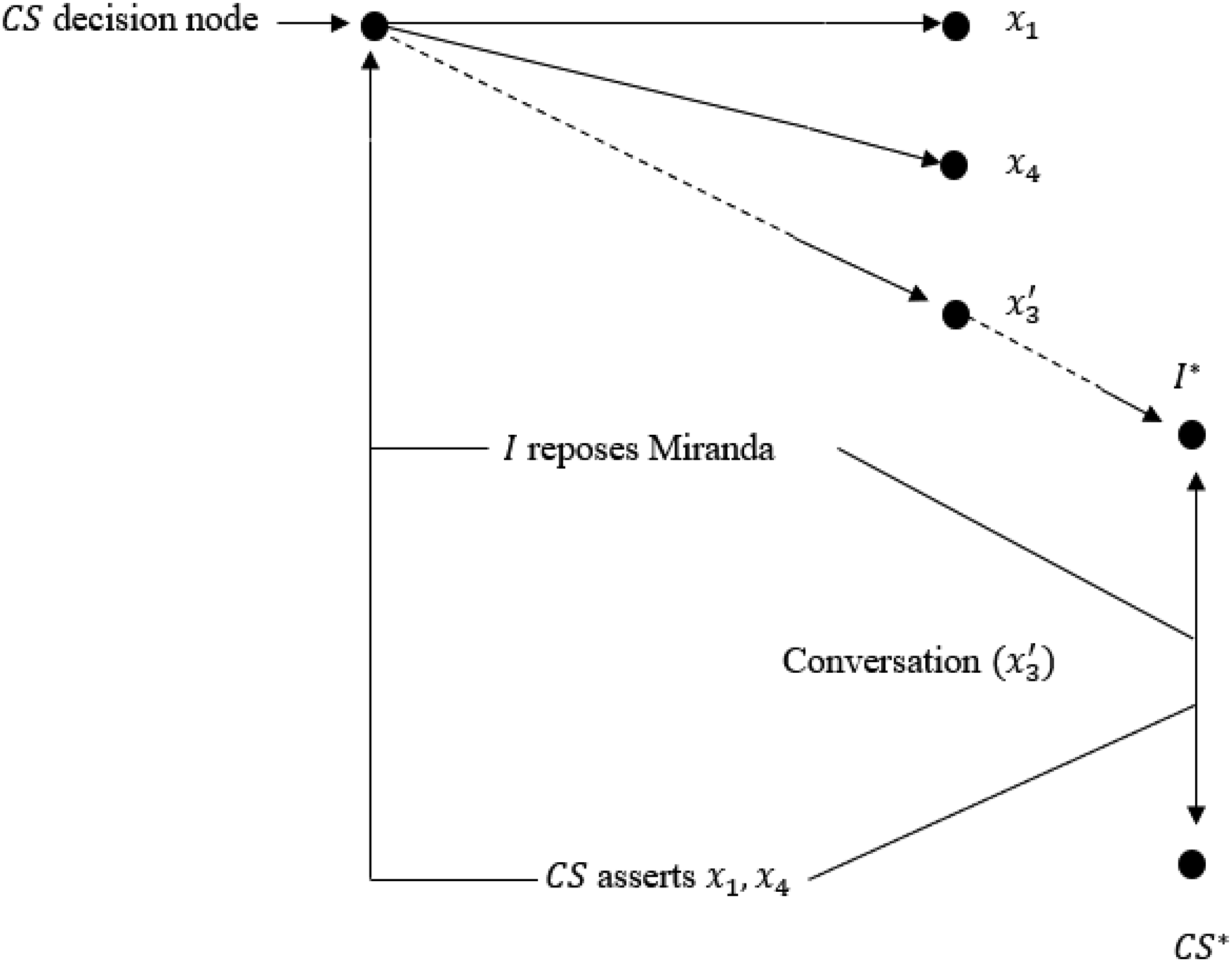
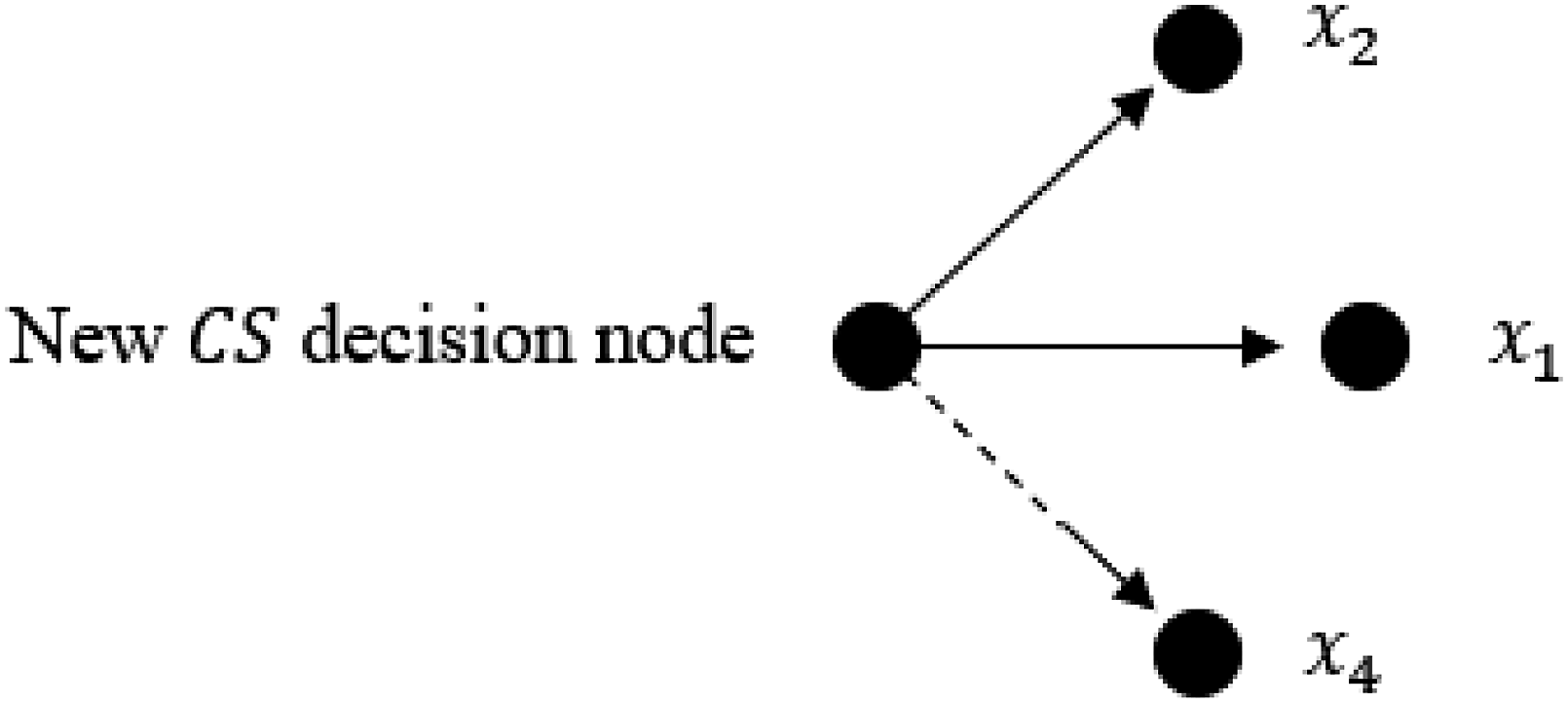
Incorporating perceptions into the analysis of discursive strategies prompts the question of whether Bayesian analysis, commonly used in linguistics, or an alternate model should be considered to describe the actions observed in Excerpt 1. Bayesian analysis is based on rational utility maximization measured as the sum of the subjectively assessed utility of each outcome weighted by the probability of its occurrence. In the surface game, depicted in Figure 1 (Mason and Mason, 2021), decision to invoke the right to counsel or to waive it is represented as the left node (solid circle ●). It is a simplified Bayesian model in which has 100% certainty of obtaining either outcome chosen: choosing to talk to an interrogator or invoking the right to counsel.
The Bayesian surface game.
If chooses to invoke the right to legal counsel, the arrow → pointing to the lower node on the right, whenever counsel arrives the invocation game becomes the interrogation game, and all future decisions will be generated from this lower node. has a preference for to choose the other node, and has strategies to shift preference to that node from which all future decisions will be made.
Setting aside the right to remain silent, the surface game above is the game as presented to the . However, as observed in the corpus (see Excerpt 1), something more than the surface game takes place. In this game, has institutional powers that grant limited control of outcome - the linguistic and procedural response in conversation with – which can use to shape perceptions. These powers include ability to limit discursive options to express preference; to control new information; and to cease communication.
Power is exerted in the excerpt with follow-up moves to equivocal invocations, but diverting into conversation is something altogether different even as it serves the same goal to have waive rights. The observed shifts in responses, from invoking counsel to talking to an interrogator without counsel may not be the product of individual free will, the standard cited in numerous legal cases, but as a product of “failure of game form recognition” that coexists with other misperceptions arising from psychological, discursive, and deceptive influences.
The nuances that institutional power brings to game theory, as summarized by Prates (2014), incorporates into game theory the power by one agent to alter the perceived game of other players:
It is important to emphasize that the power game does not invalidate the two main postulates of game theory: developing criteria for rational behavior and the assumption that players maximize their own utility functions. It should be emphasized that the only form of power is the exercise of power, not its mere possession. This means that an agent with power will always exercise it, as generates better results for him. It is also important to highlight that game theory usually encompasses different games when the action-environment changes. For instance, when power is incorporated into a specific game, the use of power by an agent generates a new game, which transforms the options set of the player subjected by the power relation. However, instead of different games, the model proposed in this paper understands it as a single or unique game (286).
Prates points out what is essentially applicable to any successful hypergame employed by and embedded within an invocation game: it reframes and restructures the game to alter perceptions and shift preference. Prates notes the exercise of power constrains free will causing a preference shift consistent with a shift into a new Bayesian game. Hypergame theory, however, keeps power and its shifts fully contained within a single game and model in order to analyze why the shift occurred.
A shift in preferences can be thought of as a new subjective threshold that must be met for to invoke a particular action owing to a change in the game’s form or environment. In Figure 1, the switch from the lower node to the higher node (i.e., from invoking the right to counsel to waiving that right) entails a different subjective risk environment for . As Prates notes: new game, new player, new standard. In an extensive form rendition of the game, subsequent action switches from the lower pathway to the higher pathway in Figure 1. The shift creates a new game separate from prior Bayesian sequential analysis. The hypergame integrates the shift observed in Excerpt 1 into its model to create a unified game.
This paper proposes an alternative to rational choice theory to investigate why discursive preferences shift in real world applications, such as police interrogations. The analysis this approach produces will provide insights into the effect of institutional power in framing ‘the invocation game’ as a type of hypergame:
Figuring out what strategy a player will use is dependent upon not only his or her observation of the game, but also how that player believes their opponent is viewing the game…The goal of hypergame analysis is to provide insight into real-world situations that are often more complex than a game where the choices of strategy present themselves as obvious (Kovach et al., 2015: 2)
Hypergame dynamics
Hypergame Theory (HgT) expands traditional game theory and non-cooperative game theory (see Fudenberg and Tirole, 1991) by incorporating players’ perceptions of other players’ preferences into their strategic action (see Basar and Olsder, 1999; Bennett, 1977; Fraiser and Hipel, 1984; Sasaki, 2014; Sasaki and Kijima, 2012; Wang et al., 1989). Within the invocation game, each turn of talk produces an ordered pair of ranked preferences for and defined as based on choice: (a) waive rights and agree to interrogation, (b) stay silent, (c) engage in talk, and (d) invoke the right to legal counsel. preferences are given initially by nature, are fluid to the situation, and are updated after each turn of talk.
HgT accommodates the situation in which a player has the power to shape the game, while it is being played, to shift another player’s preferences to conform with . preference of outcomes is informed from industry best practices and do not change in the game. For , it is easiest to obtain a statement if no legal counsel is present with the . Talk is preferred to an interrogation with a lawyer present because talk is an opportunity for to persuade to consent to speak without an attorney. It should also be noted that anything says can be used against in a court of law, making all conversation, by default, in the realm of an interrogation without legal counsel, the most preferred outcome of all. Lastly, an interrogation with a lawyer present is preferrable to silence.
The legal framework in which police interrogation operates creates two hypergames in which at least one player’s strategy is determined by their perception of the other player’s preferences. The first hypergame exists within conversation initiated by , and the second hypergame originates with conversation initiated by .
Hypergame notation of the invocation game
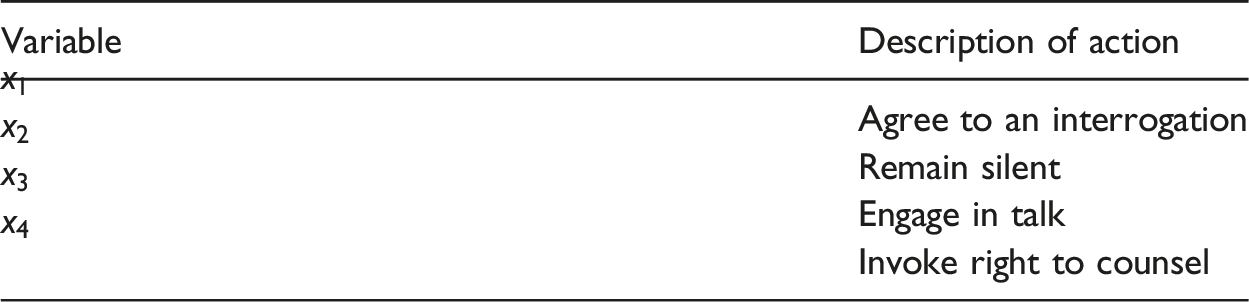
In a police interrogation, will read their Miranda rights and await response. prefers that consent to talk freely without legal counsel, but the decision (by law) is . If chooses to invoke, will initiate a hypergame to persuade to reconsider. This paper uses hypergame notation developed by Gharesifard and Cortes (2014) where a game , consists of a vector of two players , an outcome vector with cardinality , where is one of two outcomes arising from taking action :
Variable
Description of action
Agree to an interrogation
Remain silent
Engage in talk
Invoke right to counsel
will make a choice to invoke or waive, and both and will derive utility from choice generating a preference rank of outcomes for and : . Preference is observed through a sequence of events.
The surface game is a single move game. The game begins formulaically with the reading of Miranda rights. The choice by either to invoke or to waive generates the outcome preference rank . Within the game, two other moves (silence) and (talk) are allowed, but these additional moves do not substitute for ultimate choice: or . Since both and entail conversation , they are subsets of talk: so that discursive analysis can be applied to all talk. Given the specific inclusion of and as choices in the discursive game, we distinguish to be talk that excludes invoking and waiving the right to counsel: .
I’s preference of outcomes, , is assumed constant by training and will guide strategy when engaging with . most prefers an interrogation without a lawyer present because the absence of a lawyer makes obtaining a statement from easier. prefers any conversation to a decision by to invoke the right to counsel because it leaves open the possibility of persuading to talk without a lawyer. least prefers silence as it does not further investigation.
The invocation game situates discourse for . has exactly two powers: the right to remain silent and the right to have a lawyer present for questioning. The game’s discourse reflects the situated power dynamics between and who faces the possibility of imprisonment.
preference rank, , is fluid to the situation and is updated after each turn of talk which will number zero or more turns of talk: .7 For the willing to talk, preference rankings are given as a state of nature . Therefore, preferences manifest from nature as either or as . Both and are presumed to be preferred to because at best is irrelevant talk and at worst it provides incriminating statements. Therefore, is held in reserve until, for example, decides a need for clarifying information that warrants conversation. When initiates talk with the interrogator, it reflects a reranking of among preference outcomes.
A change in perception affects relative risk aversion – the willingness to accept risk that is situationally determined. Changes in perceptions can change threshold levels for which some risky action is deemed unacceptable. A shift is different from the reranking that causes to express or to engage to serve a functional need, whether the need is fulfilled or not. Such a reranking will eventually revert to the most recent preference ranking unless has induced a shift in preferences. In essence, makes discrete jumps from the third to first position and back to third when it is no longer functionally useful.8 A shift in preference, on the other hand, may be permanent.
Two hypergames
Type 1 hypergame: initiates
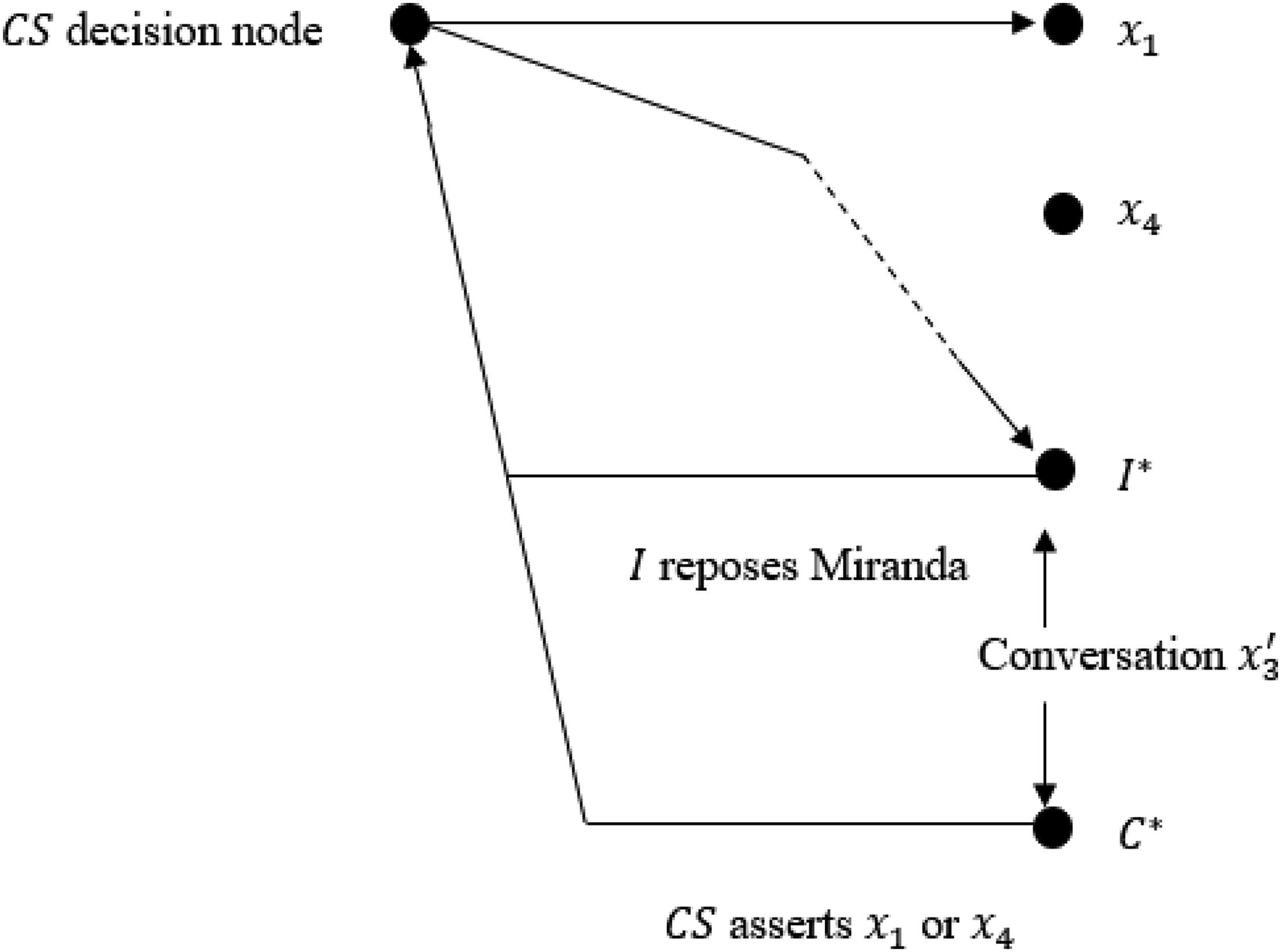
The Type 1 hypergame does not originate automatically if initiates conversation . The strategic value of for ranges from human need (e.g., a desire for water) to probing for information. The success or failure of initiative depends on the willingness of to grant such success. Leaving aside human rights violations (e.g., denying requested water), has the ability to shift the topic of . This topic shift is the initiation of the type 1 hypergame depicted in Figure 2 (Mason and Mason, 2021). In this subgame, the shifted conversation continues with the participants denoted as and until the game resets at decision node, either because reposes the Miranda question, or because declares or attempts to invoke .
Type 1 hypergame: initiates .
In Figure 2, the surface game is still present as starting from the decision node. can choose if stated unequivocally, or with an expression of assent: each shown as one-way arrows →. In this game, initiates . Trained in behavioral analysis techniques, assesses what motivates and tailors a conversation best chosen to shift preference, as shown in Figure 2 and herein, with the bi-directional arrow ↔ to represent the hypergame within . The dashed line indicates conversation outside of the surface game.
Type 2 hypergame: initiates
In the type 2 hypergame, makes an indirectly formulated assertion of , and initiates conversation to divert away from . The conversation continues until asserts unequivocally or waives rights in favor of , or until becomes convinced position has changed at which point reposes the Miranda question. The type 2 hypergame is depicted in Figure 3 (Mason and Mason, 2021):
Type 2 hypergame: initiates to divert away from .
Analyzing the invocation game and its hypergame components
The two hypergames illustrated in Figures 2 and 3 show the assertion of power in which takes footing9 from to influence the outcome of the game by controlling the topic of conversation. In a non-cooperative asymmetric exchange, the person who controls the talk may direct the exchanges without regard for mutuality of understanding. In the invocation game, , guided by perceptions of what motivates , works to influence to desired preference. will be handicapped from achieving discursive goals, such as invoking counsel, because does not recognize how the talk is situated while protects misunderstanding. Excerpts 2 and 3 illustrate this in, respectively, a type 1 and type 2 hypergame.
Excerpt 2: (Q: Police interrogator; A: Suspect)
1. Petitioner asserts that at some point in the questioning, which began after she received her Miranda rights, she stated “I think I may need an attorney.” Petitioner further asserts the following colloquy occurred:
2. Q: Do you want an attorney or do you not want an attorney?
3. A: I do but I don’t know what my circumstances are, I do not f–––ing know. And I …
4. Q: I’ll tell you what we can’t talk to you anymore okay because you said you do. And we’re gonna leave okay we’re gonna go to take care of business. If you want us, if you want to talk to me you can knock on the door or you can yell for me or whatever.
5. A: Well, I don’t want to sit here either so I mean…
6. Q: Well, you [‘re] not gonna sit here. Only you can make that decision. I can’t make it for you so if you decide you want to tell us your side that’s up to you.
7. A: I already did. I already just told you I didn’t.
8. Q: You don’t want to tell us your side?
9. A: No, I already just told you I didn’t want to tell you.
10. Q: Well the problem is if you want to tell me you either want to have an attorney or you don’t. If you want to have an attorney I can’t talk to you unless there’s an attorney here. If you want to tell me your side of the story I will be more than happy to listen. And try to understand it um I’m certainly going to ask you questions about it to clarify it in my mind. You understand what I’m telling you?
11. A: Yeah. That’s fine. I’ll tell you what happened.
In turn 1, comment ‘I think I may need an attorney’ suggests an initial preference ranking in which having a lawyer present is not less preferred to talking without a lawyer. In turn 2, initiates the invocation game by posing the Miranda question. in turn three refines the expression of preference , but then initiates as a probe for information revealing a preference rank .
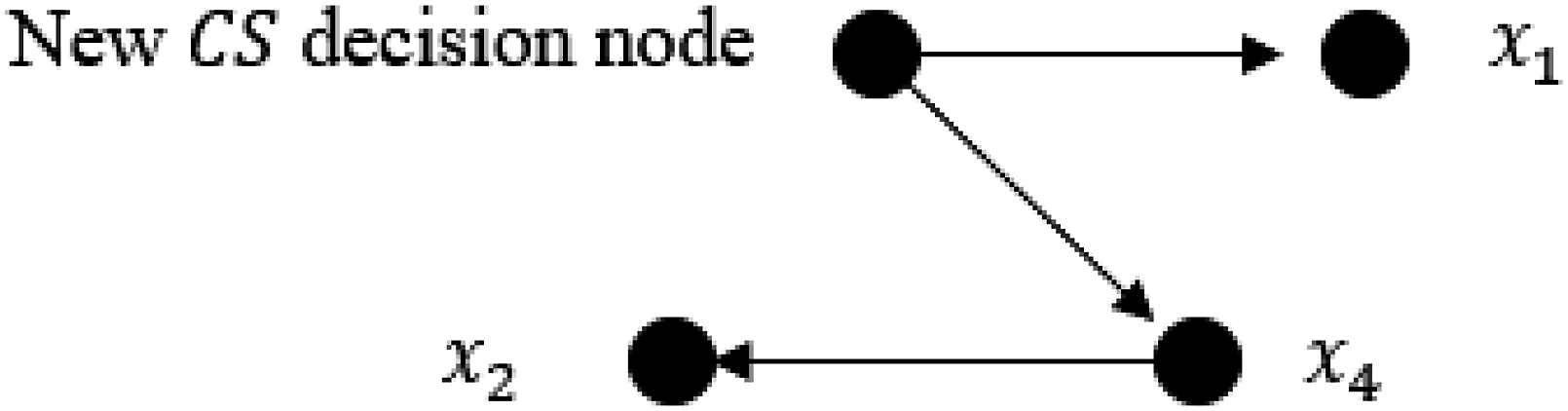
recognizes the move by and creates a type 1 hypergame by creating an unexpected outcome: . sought information, and instead moved to ignore unless signals a desire to engage in . The strategy invoked by in turn four modifies the surface game, as depicted in Figure 4.
manipulated surface game.
In turn 5, continues and reveals to that disprefers this outcome which now views as the equivalent of , remaining silent. In turn 6, reveals that is not following standard operating procedure because the procedure in turn six contradicts the announced procedure in turn four by saying would not sit in the room (a door is present). In the same turn in which reveals exercising institutional power, restores agency to by saying only could “make that decision,” as if the preference expressed in turn three that elicited imposing in turn four was now a matter of question in turn 6. In essence, tells that has the power to move from a dispreferred outcome to a more preferred one by doing what most prefers, .
Once more expresses a preference to invoke by echoing turn three in turn seven which becomes apparent after seeks clarification (turn 8) when reiterates to that does not want to tell “side” to . During these exchanges, receives no new information that informs the decision of whether to invoke. The same is true with turn 10, except after turn 10 has a different preference that conforms to preferred outcome.
In turn 10, shifts footing and modifies the surface game a second time. has restated the choice to invoke Miranda rights as explicitly a choice between and with choice legally present but unmentioned in this turn of talk as depicted in Figure 5 with a dashed line.
restated surface game.
It is also true that the alternative could include periods of , but has no comparable experience to draw upon from the invocation game that would associate with . may harbor an unsubstantiated belief of the expedience of because it avoids . frames decision as a choice between and with the hope that in turns four through 10 will have successfully shifted from to either or to in which considers a move to as a move to as indicated by the unidirectional arrows from to in the preference rankings. further nudges towards by framing as an opportunity for to act cooperatively with to clarify what tells . succeeds and the game ends.
The next excerpt provides an example of type 2 hypergames initiated by after invokes during the invocation game. The excerpt has been divided into sections for clarity and discussion purposes.
1. [Detective Presson]: You have a right to talk to a lawyer for advice before we ask you any questions and to have the lawyer present with you during questioning. Do you understand that? If you cannot afford to hire one, a lawyer will be appointed for you before your questioning if you so desire. Do you understand that?
In response to these questions, the Defendant initialed the form indicating she understood these rights. The questioning continued as follows:
2. [Detective Presson]: If you decide to answer questions now without a lawyer present, you will still have the right to stop answering questions at any time, for any reason. You also have the right to stop answering questions at any time until you talk to a lawyer, you understand that?
3. [Defendant]: No.
4. [Detective Presson]: What it’s saying is if you decide to answer questions now, without a lawyer present, you still have the right to stop answering questions at any time.
5. [Defendant]: Okay.
6. [Detective Presson]: Okay. And that’s for any reason. So basically saying you can stop talking to me at any time. Okay? What you’re, what you’re, when you’re initialing off, you’re saying you understand that, you’re going to be willing to talk to me, okay? But you know that you can stop at any time if you want to.
Discussion: Turns 1–6
Turn one is official reading of the Miranda rights to which, according to the court record, indicates understanding in written form. In turn 2, extends an invitation to to waive Miranda rights accompanied by a request for to affirm understanding. responds with “No” to convey to a desire for . restates turn two in turn four couched in explanatory language “What it’s saying is….” to make the exchanges appear to be cooperatively situated, but is merely being rhetorically cooperative while remaining officially bureaucratic. In turn 5, acknowledges the apparent clarification, and, in turn 6, restates the substance of the Miranda rights for a third time and asks for consent to an interrogation without a lawyer present. uses this exchange to invoke and reinvoke the right to legal counsel, as shown in turns 7-13:
7. [Defendant]: I’d rather appoint a lawyer.
8. [Detective Presson]: huh?
9. [Defendant]: I’d rather appoint a lawyer.
10. [Detective Presson]: Do you have a lawyer?
11. [Defendant]: No.
12. [Detective Presson]: Or are you trying to get one appointed for you?
13. [Defendant]: Yeah.
Discussion: Turns 7–13
In turn 7, shows . In context, “I’d rather appoint a lawyer” has a direct interpretation as indicating a preference to ‘talk with with a lawyer present’ over the option to ‘talk with without a lawyer present’. In turn 8 responds with “huh?” to express apparent confusion and to request repetition or clarification. Whether did not clearly hear or sincerely interpreted as expressing ‘wishful’ thinking and not an invocation of the right to counsel is unclear. Turn 9, however, clarifies intention as repeats the invocation word for word to convey that the statement is to be interpreted in an ordinary, straightforward manner. If, alternatively, had meant something other than an expression of preference, would have been better served by sending a signal to that the utterance as formed was not the intended meaning. Given that did not send any signal to suggest an alternative meaning, the invocation game should end if the interrogator were following a broad interpretation of the Miranda rights, rather than a narrow one per Davis. That, however, would not serve strategy.
The manipulative intent behind confusion in turn eight is revealed in turn 10 as denies invocations from turns seven to nine and instead pursues in what appears to be a clarifying procedural question: does have a lawyer? To warrant this question, would first have to ‘believe’ that utterances in turns seven and nine were indirectly stated and can be legally ignored. This interpretation allows to take the stance that wants to engage in unrelated talk, a conclusion that reflects a perception of preference as , in essence a belief by that was simply engaging in cheap talk.
The alternative interpretation to manipulative intent is that question posed in turn 10 - does have a lawyer - has procedural value in the execution of , the process to get legal representation. In such an interpretation, would accept the clarification by in turn 9 as a legally binding expression of . Subsequent action dismisses this interpretation.
In turn 11, responds that does not have a lawyer. asks another apparent procedural question in turn 12 regarding desire to have a lawyer appointed. The question moves the talk forward only if its answer is necessary to the invocation process based on the distinction between hiring a lawyer at own expense or obtaining a court appointed attorney. In turn 13, responds that prefers a court appointed attorney.
If is knowingly not asking procedurally relevant questions, the manipulative intent interpretation is that initiated three times to execute three type 2 hypergames (Figure 3) in turns 8, 10 and 12. Regardless of procedural relevance, after turn 13 had no outstanding procedural questions to inhibit the process of accommodating right to legal counsel, but this is not observed in turns 14–19.
14. [Detective Presson]: Okay, now, one getting appointed for you doesn’t happen like right now, okay? I want you to make sure that you understand that. We just don’t, I mean, if you’re going to have to get an attorney or someone appointed, that doesn’t just happen right now. Because you have to apply for an attorney, you can’t—
15. [Defendant]: I understand.
16. [Detective Presson]: Can you not afford an attorney? Is that what it is?
17. [Defendant]: No.
18. [Detective Presson]: Can’t afford one? Do you want me to read it out loud again to you?
19. [Defendant]: Hmm?
Discussion: Turns 14–19
Each time answers a question, initiates a new type 2 hypergame. executes this strategy in turns 14, 16, and 18 increasing the number of hypergames initiated by to six games in 10 turns of talk. In turn 14, with intent understood and no procedural matters to be resolved, presents self as cooperative by volunteering information about the procedure to obtain a court appointed lawyer. Under this cooperative guise, indirectly draws attention to the opportunity cost of time by echoing the phrase: “that doesn’t happen like right now” with “that doesn’t just happen right now.”
Despite awareness of opportunity cost, reaffirms in turn 15. This is a fifth opportunity (after turns 7, 9, 11, 13, and now 15) to start the procedure for to invoke counsel successfully and end the game. Instead, in turn 16 reinitiates talk by asking about finances, repeating an apparent procedural concern that financial condition has bearing on the invocation of the right to counsel.
response in turn 17 is an ambiguous “No” because, in turn 16, asked two questions creating an ambiguity as to which question “No” refers. In turn 18, asks two questions: first, regarding financial condition, and second, asking if wants to hear again the information initially provided in turn 2. The first question restates the question of turn 16, but the second question in turn 18 is new and creates the sixth type 2 hypergame as a branch of the fifth.10 This time, instead of an ambiguous single word answer, expresses confusion in turn 19.
The source of confusion may be the product of successive turns of talk that each include two questions. Within that context, turn 19’s “Hmm?” is implicit request for clarification revealing , prompting turns 20–26.
20. [Detective Presson]: Do you want me to read it out loud again to you?
21. [Defendant]: That’s fine.
22. [Detective Presson]: Okay. It says, “If you decide to answer questions now without a lawyer present, you still have the right to stop answering questions at any time, for any reason.” Okay? “You also have the right to stop answering questions at any time until you talk to a lawyer.”
23. [Defendant]: So I can talk to a lawyer at any time, just not right now? Cause you don’t have one.
24. [Detective Presson]: You can talk to a lawyer at any time. I was just trying to explain to you that to you have, for you to have an attorney appointed to you, they just don’t, we don’t have anybody down the hallway. Okay? That is something that, when you are trying to get an attorney, you have to show them that … you don’t have the financial stuff. So, for us to get you a—
25. [Defendant]: Can you appoint one for me?
26. [Detective Presson]: I can’t. You have to go down and apply through them, or you have to retain your own attorney. You can talk to an attorney at any time you want to, but I am just telling you.
Discussion: Turns 20–26
In turn 20, resumes hypergame number six initiated in turn 18 by only asking the second of the two questions posed in turn 18. This is a shift in game form as the topic shift engages a different perspective of utility maximization, from managing the financial cost of an attorney to a question of situational awareness. had not expressed a desire to hear the Miranda advisements, but volunteers to do so a second time (the second move in the sixth type 2 hypergame).
The ambiguity, created by , is resolved by in turn 20 to the effect of reengaging in talk along the lines of the second question of turn 18. Lost in the discursive sleight of hand is that assertion of has been replaced by a question about intent as implied by when asking whether wants a rereading of the rights. affirmatively responds in turn 21. In turn 22, affirms response, reads part of the statement, asks for affirmation, and finishes reading the statement.
In turn 23, initiates opening an opportunity for to initiate a type 1 hypergame. In turn 23, attempts to affirm awareness of the opportunity costs and end by answering a self-posed question. , however, does not acknowledge statement nor its intent, and instead in turn 24 repeats the opportunity costs and financial costs faces in choosing . expresses by asking “Can you appoint one for me?” in turn 25. In turn 26, responds negatively then explains the choices are to retain one’s own lawyer and ‘some’ application process for a court appointed attorney.
In turn 23, seems to view the conversation as cooperatively situated and has taken the initiative to explain to that understands the situation and will have to wait (be detained) for a lawyer to be present. Because fails to see the game as it is situationally formed (non-cooperatively), is unaware of the intent behind the moves. Functionally, apparent naïve persistence in keeps options open to ignore the existing invocation for counsel by inspiring rounds of misperceptions and apparent misunderstandings, as captured in turns 27–45:
27. [Defendant]: So I can talk to an attorney any time now?
28. [Detective Presson]: I’m sorry?
29. [Defendant]: You’re telling me I can talk to an attorney any time now?
30. [Detective Presson]: That’s correct, but I just, I just don’t want you to think we’re going to call somebody down the hallway
31. [Defendant]: I understand.
32. [Detective Presson]: Okay. They have to, that’s something you have to go apply for. Let me ask you, now, do you understand that?
33. [Defendant]: Not really, I don’t understand the question.
34. [Detective Presson]: Okay. And what it’s saying is, again, if you decide to answer questions now, without a lawyer, you still have the right to stop answering questions at any time. Okay? You also have the right to stop answering questions at any time, until you talk to a lawyer, at anytime until you talk to a lawyer.
35. [Defendant]: Well, what if I don’t get to talk to a lawyer?
36. [Detective Presson]: I’m sorry?
37. [Defendant]: Well, what if I don’t get to talk to a lawyer?
38. [Detective Presson]: What if you don’t get to—
39. [Defendant]: Mm-hmm to an attorney?
40. [Detective Presson]: Have you had a chance to talk to an attorney yet?
41. [Defendant]: No.
42. [Detective Presson]: You haven’t talked to one? Okay, I, I guess where I am trying to go, get to this is that you can talk to an attorney at any time, okay?
43. [Defendant]: Okay. Okay.
44. [Detective Presson]: And that you can stop talking to me at any time until you talk to an attorney.
45. [Defendant]: Okay, I understand that.
Discussion: Turns 27–45
Turns 27 through 29 are a series of alternating clarifying questions, perhaps posed argumentatively by who may be contesting the “any time now” proposition which resolves in turn 30, and is confirmed by in turn 31. This confirmation becomes the seventh opportunity to terminate the invocation game and institute the procedure of .
Instead of ending the game, initiates a type 2 hypergame for the seventh time in turn 32 by repeating information under a cooperative guise of clarifying that understands the cost. reverts to , expressing confusion about the meaning of question (turn 33), and hoping that will provide clarity. Noncooperatively, reverts to bureaucratic Miranda procedure, placing the conversation back at decision node while clearly pointing towards waiving the right to legal counsel in turn 34.
Sequentially from turn 35, asks a clarifying question about procedure. either does not hear or does not understand question, prompting to repeat the question. appears to seek clarification by partially repeating a modified form of the question (turn 38) which is then partially formulated by in turn 39 only omitting the word “talk” to complete paraphrase. In turn 40, ignores question about what happens if doesn’t get a lawyer, and instead poses a question previously asked and answered.
exerts power to control the conversation and initiates a type 1 hypergame by switching the topic of initiated to ask whether has had a chance to speak to an attorney (turn 40, the question previously asked and answered). responds “No” unambiguously in turn 41. In turn 42, asks a question previously formulated and answered. Then, in an apparent attempt at clarification, I begins to provide an explanation “I guess where I am trying to go” but switches to repeat information and asks for affirmation. affirms in turn 43.
In these exchanges (turns 32–43), has switched from seeker of information to one who provides information with the affirmation in turn 43. In this process, requests for information are dropped from the talk. Clarity appears to have been achieved since does not move to engage further, or, alternatively, has assessed the situation as futile, causing preference to shift, and expressed as a higher standard of need (threshold) that this particular must cross before it will be expressed in turn 43 as compared with turn 35. Perhaps the shift also applies to .
Turn 43 is the eighth occasion in which the procedure of could have commenced. Instead, in turn 44, engages in a type 2 hypergame for the eighth time in 23 turns of talk providing redundant information. Again, reaffirms a prior acknowledgement in turn 45. Then, in the narrative of the transcript, takes specific action to reveal that preferences shifted to .
Upon entering the hypergame initiated by in turn 8, preferences appear to be in a state of flux owing to the appearance of in all its forms. In the reality of the surface game, the only fluctuation in preference that matters is between and as in that environment does not exist. The fluctuation occurs much later than turn seven where the invocation for legal counsel should have ended the game. In the hypergame, beginning in turn 8, is able to exploit misperception of the conversation as cooperative. Over the course of the game, preference changed from invoking to waiving the right to legal counsel in turn 45, the only meaningful fluctuation in preference from perspective in the surface game.
Further manipulated perceptions
The final sequences of talk in Excerpt 3 show the manipulation of perceptions. Turns 46–55 illustrate how this manipulation unfolds in conversation.
46. At this point, Defendant initialed the form. Then the conversation continued as follows:
47. [Detective Presson]: Okay, this is the waiver. I understand what my rights are. I’m willing to answer questions and make a statement knowing I have these rights. I do not want a lawyer at this time. I understand and know what I am doing. No promises have been made to me. No threats have been made against me or my family. No pressure of any kind has been used against me. No promises of reward or immunity have been made. Do you understand that?
48. [Defendant]: But what if I want to talk to a lawyer? So you are saying I can’t talk to a lawyer because I don’t have one.
49. [Detective Presson]: No, I am saying you can talk to a lawyer any time you want to. Okay? What I am saying is that, for one, you have to qualify to get an attorney, unless you have one already that you paid or that you know and stuff like that, okay? I’m not denying you an attorney, okay? Umm, when I told you, you know that we had to verify and go over some of the things that you told us, okay? That was the whole point of us talking with you today.
50. [Defendant]: So the only reason why you are doing this is because of my rights.
51. [Detective Presson]: That’s correct.
52. [Defendant]: Okay, so you have to do it no matter what.
53. [Detective Presson]: Right, and like I said, you can have an attorney anytime you want to, you can stop talking to me anytime you want to, you can exercise any of these rights at any time you want to is what we are trying to get across here, okay?
54. [Defendant]: Okay.
55. [Detective Presson]: I’m not telling you you can’t have an attorney.
56. The Defendant initialed the waiver. Detective Presson then asked her “are you wanting to talk to me now?” Defendant responded that she did want to talk to him. Detective Presson then asked her to sign the form, which she did.
The shift in preference occurs in either turn 43 or 45 after eight occasions on which denied moves by to invoke the right to counsel. Collectively these eight missed opportunities could be called the “passive-aggressive” strategy. But the passive-aggressive strategy alone does not alter preferences. In Excerpt 3, the passive-aggressive strategy supports the primary strategy in both form and function.
In turn 46, initials the form to waive the right to counsel and reveals . The speed at which the process of is implemented stands in contrast to the hypergame delay tactics employed to support the primary strategy in the first 44 turns: the process is cost-free, worry-free, and expeditious. Process manifests in turn 46. The process tactically minimizes the time has for self-reflection on choices. , in this regard, is already disadvantaged without an equivalent to prompting to shift from back to . This process diverts attention to performing the tasks of waiving rights and away from self-reflection on the personal utility of doing so.
Tactically, learned that had financial concerns. tailored an economic argument by (a) repeatedly minimizing risk, “you can quit at any time”, (b) emphasizing opportunity costs, “we don’t have one here”, and (c) emphasizing financial cost “Can you not afford an attorney?” and “you have to show them that … you don’t have the financial stuff.” All these turns of talk serve to draw a contrast with the cost-free, lawyer-free, expeditious process of option . Note the difference in phrasing from “worry-free” to “lawyer-free”: this is the equivalence wants to make.
In Excerpt 3, perceives the talk as situated in an environment of a jointly held desire for mutuality of understanding. At some point in the talk, from clarity to confusion to clarity and around again, preference switched, but misperception of the environment did not. To make the switch in preference conform to laws, regulations, and procedure, in turn 47, asks for affirmation of the new interpretation of the events prior to turn 46. Of particular interest is the inclusion of the sentence “No pressure of any kind has been used against me.” eventually affirms it was a pressure-free environment, and in doing so attests to own failure of game form recognition.11
In turn 48, inquires again about , and then paraphrases understanding of the situation by posing and answering own question. Therefore, turn 48 casts ambiguity on preference rankings: either or .
responds to the inquiry about in turn 49 by repeating “you can talk to a lawyer any time you want to” and requesting affirmation which, in practical terms, was refuted earlier in the talk since “any time” includes “now” and no lawyer is “now” present (as may have indirectly argued earlier). Subsequently, repeats the costs of an attorney and adding other “stuff like that” costs, and asks for assent to its veracity with “Okay?”. then casts the impending interrogation as a pressure-less verification process of information previously given by .
, in turn 49, summarizes the choice to waive rights as an ordinary procedure brought about “because of my rights”, reducing the waiver to standard boilerplate similar to that which is routinely encountered and signed. affirms interpretation (turn 50) to perpetuate strategic disadvantage in misperceiving the situation. asks for confirmation that the documents being signed are a matter of routine (turn 51), and replies by minimizing risk “you can have an attorney anytime you want to, you can stop talking to me anytime you want to” (turn 52). agrees (turn 53) and reasserts that is not denying of the right to an attorney (turn 54). signs the waiver revealing in part because has come to believe that talking to with a lawyer present is just a choice within the general procedure of talking to without a lawyer present making a subset of : . The end of Excerpt 3 concludes the invocation game and commences the questioning phase of the interrogation.
Conclusions
This paper introduces the single-move invocation game and analyzes it with the aid of two types of hypergames. The analysis shows that strategic communication led to shift preference to conform with . The models expand hypergame theory to empirical linguistic data as a particular example of a more broadly identified mode of a game that recognizes many avenues by which perceptions may be disturbed causing change in preference. The models further integrate strategic action into linguistic analysis.
The excerpts in the paper feature s who, as a state of nature, prefer reaching mutuality of understanding with their addressees, , and excludes those who prefer silence. The natural preference has for achieving common ground in talk makes vulnerable to linguistic nudges that keep CS talking after taking action beyond what should have been the end of the single move game. accomplishes this through the application of power to alter strategically the form of the game to increase the probability that will obtain a statement from . The hypergame approach gives manipulation a coherent structure. Its distinct structure accommodates binary states consistent with discursive success or failure, and non-binary states consistent with stages in discursive persuasion.
For game theory, hypergame modeling integrates manipulative behavior to explain what is otherwise described as a change in the state of nature that causes an idiosyncratic change in individuals that reform competitive games into new games. Hypergame modeling provides the method to analyze the reason for the shift. To demonstrate that manipulation is the reason for a shift in preference, the approach must integrate fluid preference based on fluid perceptions, game form recognition errors, and an analysis of strategic action. Manipulation is a feature of any game in which free-form conversation is a feature. All conversation is strong edge manipulatable, and the presence of conversation expands the parameters of games to allow players opportunities to reshape other players’ perspectives and shift preference.
In the excerpts, failure of game form recognition blindly led to focus on the task of maximizing (perceived) utility while focuses on the task of shifting preference. Where is successful in shifting preference, hypergame theory explains what would otherwise appear as an act that violated an axiom of rationality. However, players continue to make rational decisions within their misperceptions while hypergame theory identifies the strategic act of manipulation.
Such a failure of game form recognition is glaringly present in Excerpt 3 where believes the conversation is cooperatively situated before coming to the view that waiving one’s rights is standard procedure while misperceiving the conversation as situated cooperatively.
The invocation game exists as an omnipresent subgame of the larger interrogation game. Within the invocation stage of a police interrogation, is presented with the surface game. In the excerpts presented in this paper, opportunities embedded in side conversations are taken by to open hypergames designed to manipulate preference through linguistic actions. sees only the surface game, and that is because if recognizes the manipulation present in the hypergame it is likely that would react noncooperatively in the surface game. Ultimately in our corpus, though, plays the surface game in accordance with the preference. Failure of game form recognition, hence, adds perception as a little circus wheel to every game in which conversation occurs. It is the avenue by which preferences can shift, and with fluid preferences an opportunity for manipulation arises.
Footnotes
Declaration of conflicting interests
The author(s) declared no potential conflicts of interest with respect to the research, authorship, and/or publication of this article.
Funding
The author(s) received no financial support for the research, authorship, and/or publication of this article.
ORCID iD
Robert D Mason
Notes
References
1.
AinsworthJ (1993) In a different register: the pragmatics of powerlessness in police interrogation. The Yale Law Journal103(2): 259–322.
2.
AinsworthJ (2008) You have the right to remain silent…but only if you ask for it just so: the role of linguistic ideology in American police interrogation law. International Journal of Speech Language and the Law5(1): 1–21.
3.
AinsworthJ (2012) The meaning of silence in the right to remain silent. In: SolanLTiersmaPM (eds) The Oxford Handbook of Forensic Linguistics. Oxford, UK: Oxford University Press, 287–298.
4.
AinsworthJ (2020) Miranda rights: curtailing coercion in police interrogation: the failed promise of Miranda v. Arizona. In: CoulthardM, et al. (eds) The Routledge Handbook of Forensic Linguistics. London, UK: Routledge, 95–111.
5.
AsherNLascaridesA (2013) Strategic conversation. Semantics and Pragmatics6(2): 1–62.
6.
BasarTOlsderGJ (1999) Dynamic noncooperative game theory. Classics in Applied Mathematics. Philadelphia, PA: Society for Industrial and Applied Mathematics, 23.
7.
BennettPG (1977) Toward a theory of hypergames. Omega5: 749–751.
8.
BlutnerR (2000) Some aspects of optimality in natural language interpretation. Journal of Semantics17(3): 189–216.
9.
BrownPLevinsonSC (1987) Politeness: Some Universals in Language Usage. Cambridge, UK: Cambridge University Press.
10.
BurnettH (2019) Signalling games, sociolinguistic variation and the construction of style. Linguistics and Philosophy42: 419–450.
11.
CasonTNPlottCR (2014) Misconceptions and game form recognition: challenges to theories of revealed preference and framing. Journal of Political Economy122(6): 1235–1270.
12.
CrawfordVPSobelJ (1982) Strategic information transmission. Econometrica50(6): 1431–1451.
13.
Davisv. (1994) United States.
14.
DekkerPVan RooyR (2000) Bi-directional optimality theory: an application of game theory. Journal of Semantics17(3): 217–242.
15.
FarrellJ (1993) Meaning and credibility in cheap-talk games. Games and Economic Behavior5(4): 514–531.
16.
FarrellJGibbonsR (1989) Cheap talk with two audiences. The American Economic Review79(5): 1214–1223.
17.
FraiserNMHipelKW (1984) Conflict Analysis Moves and Resolution. New York, NY: North-Holland.
18.
FrankMCGoodmanND (2012) Predicting pragmatic reasoning in language games. Science336(6084): 998. DOI: 10.1126/science.1218633.
19.
FudenbergDTiroleJ (1991) Game Theory. Cambridge, MA: MIT Press.
20.
GharesifardBCortésJ (2010) Evolution of the perception about the opponent in hypergames. IEEE Conference on Decision and Control49: 1076–1081.
21.
GharesifardBCortesJ (2014) Stealthy deception in hypergames under informational asymmetry. IEEE Transactions on Systems, Man, and Cybernetics: Systems44(44): 785–795.
22.
GibbonsR (1997) An introduction to applicable game theory. The Journal of Economic Perspectives11(1): 127–149.
23.
GibbsRW (1983) Do people always process the literal meanings of indirect requests?Journal of Experimental Psychology: Learning, Memory, and Cognition9: 524–533.
24.
GoffmanE (1967) Interaction Ritual: Essays on Face-To-Face Behavior. New York, NY: Random House.
25.
GoffmanE (1981) Forms of Talk. Philadelphia, PA: University of Pennsylvania Press.
HarsanyiJ (1967) Games with incomplete information played by ‘Bayesian players’: the basic model. Management Science14: 159–182.
28.
HoltgravesTM (1994) Communication in context: effects of speaker status on the comprehension of indirect requests. Journal of Experimental Psychology: Learning, Memory, and Cognition20: 1205–1218.
InbauFEReidJEBuckleyJP, et al. (2005) Criminal Interrogation and Confessions: Essentials of the Reid Technique. Sudbury, MA: Jones & Bartlett.
31.
JägerG (2008) The evolution of convex categories. Linguistics and Philosophy30(5): 551–564.
32.
KassinSMGudjonssonGH (2004) The psychology of confessions: a review of the literature and issues. Psychological Science in the Public Interest: A Journal of the American Psychological Society5(2): 33–67.
33.
KovachNSGibsonASLamontGB (2015) Hypergame theory: a model for conflict, misperception, and deception. Game Theory2015(2015): 1-20. DOI: 10.1155/2015/570639.
34.
LeoRA (2001) Questioning the relevance of Miranda in the twenty-first century. Michigan Law Review99(5): 1000–1029.
35.
LeoRA (2008) Police Interrogation and American Justice. Cambridge, MA: Harvard University Press.
36.
MasonM (2024) Police Interrogation, Language, and the Law: The Invocation Game. Cambridge, UK: Cambridge University Press.
37.
MasonM (2013) Can I get a lawyer? A suspect’s use of indirect requests in a custodial setting. International Journal of Speech Language and the Law20(2): 203–227.
38.
MasonM (2016) The ‘preparatory’ and ‘argumentation’ stages of police interrogation: a linguistic analysis of a criminal investigation. Language & Communication48: 79–87.
39.
MasonM (2020) The guilt-presumptive nature of custodial interrogations in the United States: the use of confrontation, appeals to self-interest, and sympathy/minimization in the Reid Technique. In: MasonMRockF (eds), The Discourse of Police Interviews. Chicago, IL: University of Chicago Press, 65–84.
40.
MasonMMasonRD (2021) The game of police interrogations [conference presentation]. In: Southern economics association, 91st annual meeting, Houston, TX, 20–22 November 2021.
41.
Mirandav. Arizona (1966).
42.
MostellerRP (2007) Police deception before Miranda warnings: the case for per se exclusion of an entirely unjustified practice at a particularly sensitive moment. Texas Tech Law Review39(4): 1239.
43.
ParikhP (1991) Communication and strategic inference. Linguistics and Philosophy14(5): 473–514.
44.
ParikhP (2000) Communication, meaning, and interpretation. Linguistics and Philosophy23: 185–212.
45.
ParikhP (2001) The Use of Language. Stanford, CA: CSLI Publications.
46.
PinkerSNowakMALeeJJ (2008) The logic of indirect speech. Proceedings of the National Academy of Sciences of the United States of America105(3): 833–838.
47.
PratesRC (2014) Power in game theory. Contributions to Game Theory and Management7: 282–289.
48.
RabinM (1990) Communication between rational agents. Journal of Economic Theory51: 144–170.
49.
Rodriguezv. Mcdonald (2017).
50.
SasakiY (2014) Subjective rationalizability in hypergames. Advances in Decision Sciences2014: 1–7.
51.
SasakiYKijimaK (2012) Hypergames and Bayesian games: a theoretical comparison of the models of games with incomplete information. Journal of Systems Science and Complexity25(4): 720–735.
52.
Statev. Harris (2010).
53.
StevensJS (2016) When do we think strategically?Zeitschrift für Sprachwissenschaft35(1): 97–108.
54.
StevensJBenzAReußeS, et al. (2015) A strategic reasoning model for generating alternative answers. Proceedings of the 53rd Annual Meeting of the Association for Computational Linguistics and the 7th International Joint Conference on Natural Language Processing1: 534–542.
55.
TverskyAKahnemanD (1989) Rational choice and the framing of decisions. Multiple Criteria Decision Making and Risk Analysis Using Microcomputers. Berlin, Germany: Springer, 81–126.
56.
van RooijR (2008) Games and quantity implicatures. Journal of Economic Methodology15(3): 261–274.
57.
WangMHipelKWFraserNM (1989) Solution concepts in hypergames. Applied Mathematics and Computation34(3): 147–171.
58.
WeisselbergCD (2008) Mourning Miranda. California Law Review96(6): 1521–1601.