




Abstract
Relative risk aversion (RRA) models explain social class inequalities in education with risk avoidance, i.e., the risky choice assumption (RCA). This assumption concerns risks related to more ambitious educational choices and has been subject to little explicit scrutiny. In this paper, we test whether or not vocational education is a safety net that protects from labor market marginalization. We present an empirical assessment of upper-secondary track choices in Sweden, contrasting the vocational and the academic tracks for those not pursuing tertiary educational degrees. We use Swedish administrative data for all siblings born 1972–1980 and fit sibling fixed effects models netting out unobserved time-constant confounders. The only evidence in favor of the RCA is that when considering selection, graduates of the academic track without a tertiary degree initially face higher risks of not being stably employed and registered as unemployed in their early 20s than their counterparts from vocational education. However, the academic tracks significantly protect men from the threat of entering unskilled routine occupations. We conclude that the support for the RCA is scant at best.
Introduction
It is well-documented that students from service class origins display higher enrolment rates than students from working-class origin in academic secondary tracks and tertiary education (Jackson, 2013). These educational differentials stay large when controlling for prior school performance and are only moderately explained by income inequalities (Barone et al., 2018; Stocké, 2007). Since working-class students and parents report lower educational and occupational aspirations, several sociological accounts suggest that their lower aspirations contribute to these educational differentials (e.g., Sewell and Shah, 1968). In turn, these aspiration gaps have been traced back to class differences in achievement values (Hyman, 1953), fatalism (Bourdieu, 1984), counter-cultures (Willis, 1977), enjoyment of education (Murphy, 1981), and similar sub-cultural factors. An alternative explanation for these aspiration gaps stems from the premise that any given success goal has an absolute and a relative dimension (Boudon, 1974; Erikson and Jonsson, 1996; Goldthorpe, 1996; Keller and Zavalloni, 1964). The absolute aspiration gaps reported in empirical research may reflect the fact that families assess prospective educational and occupational outcomes relatively to their point of departure. For instance, when considering positions in the middle of the class structure (e.g., administrative clerk) as potential class destinations, working-class families may assess this outcome more positively than service-class families: for the former, it entails a social promotion, for the latter a social demotion. 1 More generally, identical relative aspirations across social classes can result in different absolute levels of aspirations when the social class position of parents is taken as benchmark, without the need to invoke any sub-cultural factor.
Breen and Goldthorpe (1997) formalized this intuitive and straightforward argument in a Relative Risk-Aversion (RRA) model, later modified by Breen and Yaish (2006). These two rational choice models postulate that families assess the utility of different educational options (e.g., vocational vs. academic tracks) with regard to the chances of entering different class destinations (e.g., service- vs. working-class jobs). Crucially, these models assume that each prospective class destination’s utility is assessed relative to a reference threshold, defined by the parents’ class position. Moreover, RRA models assume that families care more about avoiding downward mobility than obtaining upward mobility. For instance, the motivation to avoid downward mobility from service-class positions to working-class positions is stronger than the motivation to be upwardly mobile in the opposite direction. This asymmetry in the preferences for gains and losses (loss aversion) is a core tenet of prospect theory (Kahneman and Tversky, 1979), which has received extensive empirical validation in laboratory and field experiments as well as in observational studies (Barberis, 2013).
These assumptions seem highly plausible. However, to explain educational inequalities, RRA models introduce an additional strong assumption: more ambitious educational options (e.g., taking academic tracks) are riskier than less ambitious ones (e.g., vocational education); that is, they entail higher risks of demotion into unstable employment and unskilled jobs. In other words, RRA models postulate that educational decisions always involve a trade-off between potential gains and losses. On the one side, taking academic tracks to enroll in tertiary education enhances the chances of reaching service class positions. On the other side, if students take the academic track but fail to attain a tertiary degree, those with academic diplomas outperform those with vocational diplomas in the labor market.
This risky choice assumption (RCA) is essential in RRA models because if more ambitious academic paths entailed no risk, every family should prefer them. Hence, RRA alone would not promote educational inequalities. Surprisingly, previous research paid scant attention to the plausibility of this critical assumption. RRA models currently represent the most influential sociological explanation for class differences in educational choices, and they have stimulated an impressive body of empirical research on educational inequalities. Unfortunately, this research has seldom investigated the plausibility of their assumptions. A recent, systematic review of the thirty most-cited empirical journal articles on RRA models reports that only eight articles mentioned the RCA and only three discussed under which conditions this assumption may be valid, and only one of them tested it (Barone et al., 2021).
This article presents an empirical assessment of the RCA for upper-secondary track choices in Sweden. We will thus compare the labor market prospects of secondary vocational and academic track graduates who did not obtain a tertiary degree (i.e., either by not entering the tertiary level or dropping out). Both these groups are elementary school graduates at the time of the educational choice. Both could eventually enroll in tertiary education programs after graduation, even though vocational graduates would need some labor market experience and often some additional theoretical upper-secondary courses for full eligibility (we explain the details in The Swedish Test Case).
RRA models assume that the former should outperform the latter. Besides their theoretical implications, our empirical results provide important indications for policy debates on vocational education. Indeed, these debates often revolve around the overrepresentation of students from the working class in these programs and the risk that vocational education is socially devalued if it cannot ensure sufficiently competitive labor market prospects relative to alternative educational pathways (Cedefop, 2009). Furthermore, while students aiming to pursue tertiary education may prefer academic education, vocational curricula may be an attractive option for students looking for a safety net if they do not attain a tertiary degree (Shavit and Müller, 1998). We examine this safety net hypothesis, which stipulates that vocational education facilitates access to stable, skilled jobs for students without a tertiary degree.
Theoretical background
Relative risk-aversion models
Across economically advanced countries, social inequalities in secondary track choice constitute a significant driver of later inequalities in tertiary education attainment (Barone and Ruggera, 2018; Jackson, 2013). According to RRA models, service-class children are overrepresented in the academic track because of their higher economic resources, occupational aspirations, and educational performances, which affect the relative costs, benefits, and chances of success associated with this option. The distinctive feature of RRA models vis-à-vis other rational choice models of educational decisions involves the assessment of employment and occupational benefits in relative terms.
According to the Breen and Goldthorpe (1997) model, educational decisions are driven by the goal of avoiding downward mobility. Service-class students more often take the academic track, which affords better training to succeed in tertiary education, minimizing their risks of downward mobility. Students from working-class origins more often choose the vocational track, which fosters the chances of entering skilled manual occupations rather than unskilled and unstable employment (the ‘underclass’, following the terminology of Breen and Goldthorpe).
Working-class families realize that the academic track fosters access to the service class, but this advantage has a limited appeal to them for two reasons. First, the Breen and Goldthorpe (1997: 283) model assumes that families are indifferent between immobility and upward mobility. For instance, working-class parents and children would not differentiate between working-class and service-class destinations. Second, the academic track would foster the risks of entering unskilled employment if students do not pursue (or fail to complete) tertiary education (RCA). Thus, working-class families refrain from taking the academic path to minimize the risks of demotion into unskilled employment.
The first reason for not preferring the academic track does not seem realistic. Working-class families do see a difference between skilled manual jobs and managerial or professional employment. Indeed, they aspire to these advantageous positions as much as service-class families (Barone et al., 2021). The RRA model proposed by Breen and Yaish (2006) replaces this delicate assumption with the more realistic assumption that all social classes differentiate between upward mobility, downward mobility, and immobility. In line with prospect theory, Breen and Yaish assume that avoiding downward mobility is more important than pursuing upward mobility.
Moreover, the Breen and Yaish (2006) model also partially relaxes the RCA. More specifically, families must perceive a trade-off between the occupational prospects of academic and vocational tracks. Still, this trade-off can take two alternative configurations: families believe either that graduates of the academic track (without a tertiary education degree) enter unskilled employment more often than vocational graduates (like in the Breen and Goldthorpe model) or that graduates of the academic track enter less often unskilled employment, but that they also less often reach the service class. If students with academic diplomas outperform those with vocational diplomas in both respects, RCA models are not applicable.
Theoretical predictions about the risky choice assumption
Being concerned with educational decisions, RRA models do not consider which mechanisms could drive the supposed patterns of occupational returns and the related trade-offs. Then, let us consider which predictions could be derived based on mainstream theories of returns to education. From the perspective of human capital theory, academic tracks foster the accumulation of general skills more than vocational tracks. General skills are more versatile and may help to generate on-the-job specific skills later in the career. Academic tracks also have higher academic standards; they select higher-performing students, and, at least in some countries, they employ more qualified or more experienced teachers (Abbiati et al., 2017). Moreover, among individuals with an upper secondary degree as their highest qualification, graduates of the academic track are more likely to have attended university education (without having completed it), which can be an additional source of human capital accumulation (Hungerford and Solon, 1987). Furthermore, from a signaling perspective, selection into the academic track may positively signal cognitive ability and motivation to achieve. It could also signal proximity with upper-class conventions (Collins, 1979; Korber and Oesch, 2019). Based on these arguments, we could expect that graduates of the academic track enjoy better occupational prospects regarding both access to service-class positions and protection from falling into the underclass. For instance, if they do not access the former, they could have privileged access to middle-rank white-collar positions rather than entering unskilled jobs.
However, graduating from the academic track, which is primarily designed to prepare for tertiary education, but not completing tertiary education is an incongruent pathway that may be taken as a negative signal of any disruptive event by prospective employers. As we show below in our descriptive analyses, this pathway is not uncommon. Moreover, from a human capital perspective, it can be argued that academic and vocational tracks provide different types of skills (Shavit and Müller, 1998). While academic tracks are more theory-oriented and thus mainly foster general cognitive and communication skills, vocational tracks more often promote manual skills and other applied skills directly relevant to employers. As employers more often contribute to developing their curricula, these tracks are more immediately instrumental. Hence, students with vocational diplomas could enjoy better prospects to enter skilled manual class positions with stable employment than unskilled occupations with unstable employment prospects.
Moreover, the competitive value of these two types of diplomas may evolve over the life course (Korber and Oesch, 2019). On one side, the general skills provided in academic tracks are more easily transferrable across occupations. In contrast, the ready-to-use skills developed in vocational curricula are less transferrable across occupations and more open to the risk of obsolescence. Hence, graduates of the academic tracks may be more protected from the risk of entry into the unskilled and precarious jobs of the underclass in the longer run. On the other side, vocational tracks’ ready-to-use skills may facilitate labor market insertion, thus promoting career prospects. At the same time, prolonged youth unemployment may have scarring effects on subsequent work experiences (Bäckman and Nilsson, 2016).
Review of empirical studies
Several studies have investigated the labor market effects of track choices among upper-secondary graduates. Their findings vary across the life course as well as between genders. Studies analyzing employment as their main outcome, by and large, report that the probability of being employed is higher for vocational education and training than for general education at the start of the career, but that this pattern reverses later (Forster and Bol, 2018; Forster et al., 2016; Hanushek et al., 2017). Moreover, Rözer and Bol (2019) establish that these differences reflect life course patterns rather than cohort or period effects. Korber and Oesch (2019) also find that vocational education’s payoffs are gender-specific: in Switzerland, they are observed only for men, while among women, vocational education enjoys neither employment nor earnings advantages. For socioeconomic status and earnings as outcomes, some studies find a marked advantage for academic education, particularly in the long run (Korber and Oesch, 2019; Rözer and Bol, 2019). For occupational attainment, Barone et al. (2021) have investigated the risk of ending up at the bottom of the occupational ladder. They study Italy and use controls for family background and student achievement to find an advantage of students with academic diplomas to avoid demotion into unskilled manual occupations.
It should be noted that these studies do not systematically differentiate results concerning secondary graduates without any TE and those with some TE. Moreover, results may not be genuinely causal but instead driven by self-selection into tracks. Golsteyn and Stenberg (2017) compare sibling pairs to handle selection. They find higher earnings for vocational education early in life, but a reversal in favor of academic education occurring before age 30. 2 Birkelund and Van de Werfhorst (2022) analyze Danish data using an instrumental variable approach that relies on random variation in school peers’ educational decisions. They find that vocational education diverts students on the margin to the academic track away from higher-status but not higher-paying occupations and protects students on the margin to leaving school from risks of non-employment and unskilled work, which leads to higher earnings. At age 40, they find no difference between tracks except in occupational status. Silliman and Virtanen (2022) use a regression discontinuity design focusing on applicants to secondary education who apply to both vocational and general tracks whose admission is determined by cutoffs to oversubscribed schools. They find that admission to the vocational track increases initial annual income and that this benefit persists at least through the mid-thirties. Present discount value calculations suggested that it is unlikely that life cycle returns will turn negative through retirement. 3
In sum, studies with more thorough causal identification show some initial advantages of vocational education and small differences among mid-career workers. These studies provide important contributions in terms of identifying causal effects, but it should be noted that some of them (Birkelund and Van de Werfhorst 2022; Silliman and Virtanen 2022) analyze local treatment effects concerning students on the edge of admission to academic education instead of track effects on the average student.
Finally, three studies have explicitly tested the RCA. In particular, Hällsten (2017) analyzes the choice situation for tertiary education and assesses whether university dropouts in Sweden experience higher labor market risks than upper secondary school leavers who do not continue to tertiary education, reporting small differences among the two groups in the risk of marginalization. Moreover, Breen and Yaish (2006) assessed whether the educational paths in the United Kingdom that are associated with higher chances of access to the service class also entail higher risks of access to the unskilled working class. Their conclusion is that the model assumptions are confirmed only for early career outcomes, while “for later jobs, the model’s predictions were not born out at all” (Breen and Yaish 2006: 254). It should be noted that all the studies mentioned so far have focused on actual labor market outcomes. In contrast, Barone et al. (2021) focused on subjective beliefs. They tested whether lower-secondary school leavers and their parents believe that academic tracks entail higher risks of demotion into unskilled jobs than vocational tracks if students do not complete tertiary education. With data from France, they report that neither students nor parents endorse this belief and that the evidence on actual returns confirms that the academic track is not a riskier option than the vocational track.
Overall, the reviewed studies point to a somewhat nuanced picture concerning the validity of the RCA, suggesting the importance of assessing multiple outcomes across the life course separately for men and women and of taking selection into tracks into account. Moreover, studies based on similar research designs and outcomes sometimes report different results across countries, thus challenging the generalizability of the RCA. Finally, we must stress that only a few studies are specific enough in operationalizing labor market outcomes to allow an appropriate test of the RCA.
The Swedish test case
Comparative studies report that vocational education enjoys more robust labor market prospects in more occupationally-specific educational systems (Müller and Gangl, 2003; Van de Werfhorst, 2011), i.e., with a strong school-to-work-linkage (DiPrete et al., 2017). Sweden is an example of the opposite, where vocational education is mainly school-based and weakly connected to firms and workplaces and may therefore be a more challenging test case for the RCA of RRA models. However, RRA models are intended to be generally applicable, at least across rich countries (Breen and Goldthorpe, 1997: 279). Hence, if the validity of one of their core assumptions turns out to be country-specific, their explanatory power would be significantly reduced. Sweden is also a conservative test case since intergenerational correlations in labor market outcomes are lower than in most other countries (Björklund et al., 2002; Corak, 2013). However, intergenerational correlations in education are relatively average from a comparative perspective (Hertz et al., 2007; Pfeffer, 2008).
Sweden is an example of a standardized educational system with little stratification (Allmendinger, 1989; Sweden is similar to Norway in her comparison). Education is free at all levels and has very few dead ends (Erikson and Jonsson, 1996), so both the academic and vocational tracks provide some opportunity for further education.
Since the early 1970s, elementary schools have had a standard curriculum followed by all schools. In grade 9, at age 15 or 16, pupils can choose to pursue upper-secondary education and choose a track in upper-secondary school, competing with their grade point average (GPA). While GPA affects chances of admission, it also leaves students with significant margins of choice. Upper-secondary education is stratified primarily by the academic-vocational divide. The academic tracks comprise the natural sciences and the social sciences curricula, plus the less common international baccalaureate, and they are typically 3 years long. The vocational track involves several occupation-specific curricula, focusing on trade, building and construction, children and leisure, music/art and media, tourism and catering, health care, etc. Vocational education is mainly school-based, and the apprenticeship system has a marginal role (Bäckman et al., 2015). The vocational tracks do, however provide specific vocational credentials demanded by employers, but this is rarely strictly formalized, i.e., you can work as a mason or carpenter without a specific vocational credential. Furthermore, these credentials can also be accessed via Municipality Adult Education (Komvux in Swedish).
Tertiary education comprises university institutions delivering academic and professional degrees at a bachelor’s or master’s level. The ‘25:4 rule’ introduced in 1977 gave everyone older than 25 with at least 4 years of work experience eligibility for tertiary education. Tertiary education is, therefore, accessible even for graduates of the vocational track. However, some tertiary programs require eligibility in certain upper-secondary subjects (e.g., math and natural science subjects for studying engineering programs), but this is accessible for a vocational graduate via Municipality Adult Education at no cost except foregone earnings (and is supported by study benefits). Following a reform approved in 1994 (i.e., only for the last cohorts we study), vocational education was upgraded to 3 years, theoretical content was enriched, and vocational graduates received full basic eligibility for tertiary education (see e.g., Hall, 2012; Hall, 2016: for studies on these changes). 4
Testing the risky choice assumption
Analytical strategy
Our analysis examines the RCA assumption focusing on track choice in upper secondary school. This involves comparing students who graduated in academic tracks and did not attain any tertiary degree (outcome ‘Fail’, following the terminology of Breen and Goldthorpe) with students who graduated from vocational education and did not attain any tertiary degree (‘Leave’). In the case of track choices, the RCA assumption implies that, while academic tracks outperform vocational tracks if their students complete tertiary education (‘Success’), the reverse is true if they fail to complete it. Hence, the main focus of the analysis is comparing the labor market outcomes of upper secondary graduates from the academic and the vocational track without any tertiary degree since this comparison involves the most dubious part of the RCA. However, for completeness, in some analyses, we also include the results for students that study further.
The educational trajectory groups.
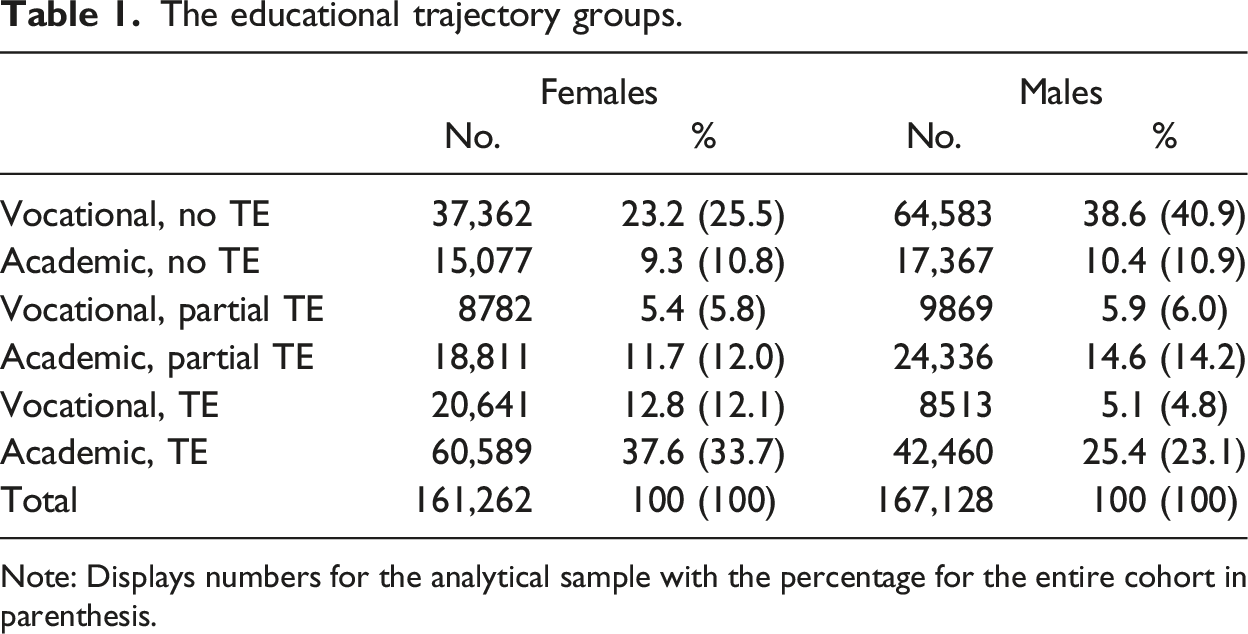
Note: Displays numbers for the analytical sample with the percentage for the entire cohort in parenthesis.
We test the RCA assumption by assessing the actual objective returns to secondary tracks. However, RRA models refer to subjective beliefs about occupational returns (Breen and Goldthorpe, 1997: 281) rather than actual returns. Hence, even if the RCA is rejected when considering the latter, it could still apply to the former. For instance, even if vocational tracks enjoy no labor market premium over academic tracks, parents may still believe that they do, for example, because they overestimate the importance of applied skills for employers. Conversely, families may overestimate returns to academic tracks because they do not consider selection processes (for instance, the family background and ability of students recruited in the academic track). Hence, RRA models could be applicable even if the evidence on actual returns to education contradicts their assumptions. However, such evidence would indicate that these rational choice models need to be reformulated to explain systematic and persistent biases in families’ beliefs about returns to education. RRA models are not primarily about information biases in beliefs but rather about differential responses to structural conditions. This possibly explains why even the authors of the Breen-Goldthorpe model collected or referred to evidence on the actual returns (Breen and Yaish, 2006; Goldthorpe, 2006: vol II, ch 3) when discussing the plausibility of the assumptions of relative risk-aversion models. Finally, two recent studies on beliefs about returns to upper secondary tracks report an overall consistency with actual returns (Barone et al., 2021; Di Stasio, 2017). Hence, examining objective risks and outcomes is central to RRA models and the RCA assumption.
As discussed in the literature review, a major methodological challenge is to handle self-selection into tracks. To address these concerns, we will use students’ grade point average (GPA) from elementary school, which is directly used to rank students in the admission process and is thus optimal to control selection into tracks based on student achievement (see the distribution of GPA rank in Figure 1). In addition, we will compare siblings using fixed-effects models, netting out any selection by shared family background. This will capture shared genetic effects and common exposure to parents, extended family, and neighborhood. However, it will not capture individual-specific experiences (such as unique relations to parents). Still, the controls for GPA should capture at least some of this heterogeneity. The combination of family- and individual-specific controls is a significant strength of our approach. Distribution of GPA rank by educational trajectory group.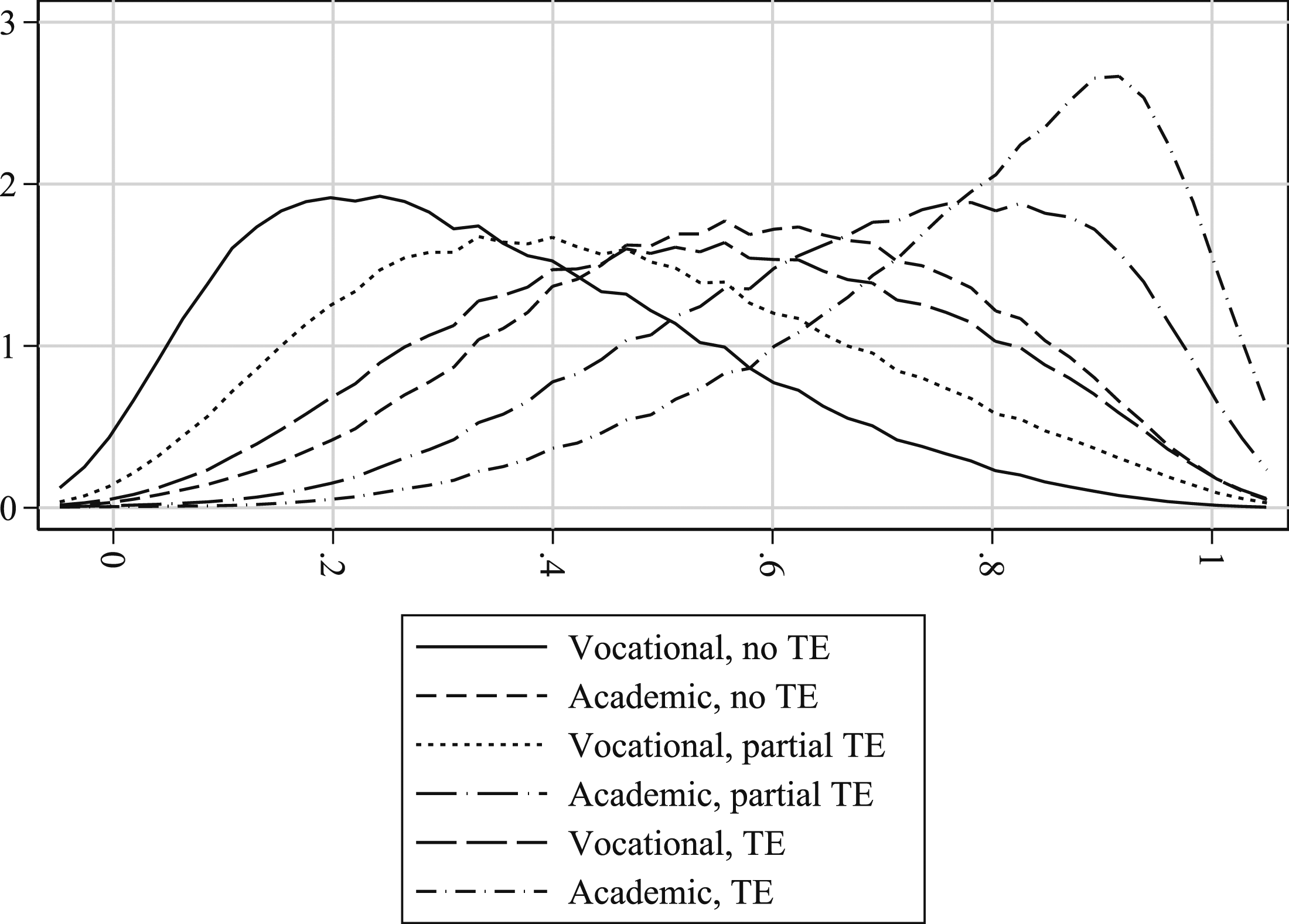
Since we are interested in risks following completed education, rather than earnings forgone related to study participation, we exclude observations for years when the individual either has study allowances (a good indicator of study participation at any level), or have any registration within a tertiary education institution.
Finally, we will consider heterogeneity in returns to upper secondary qualifications. Our primary analysis is done separately by gender and over the life course, as suggested by the previous research reviewed above. Furthermore, RRA models assume that returns to education are constant across social origin groups, but they can be reformulated to incorporate these interactions, which may represent an additional potential mechanism of educational inequality if returns to the academic track are higher for service class children (Breen and Goldthorpe, 1997). To address this concern, we will run some additional models disaggregated by class of origin (Online Appendix Figures A1-A3).
Data and variables
Time constant control variables.
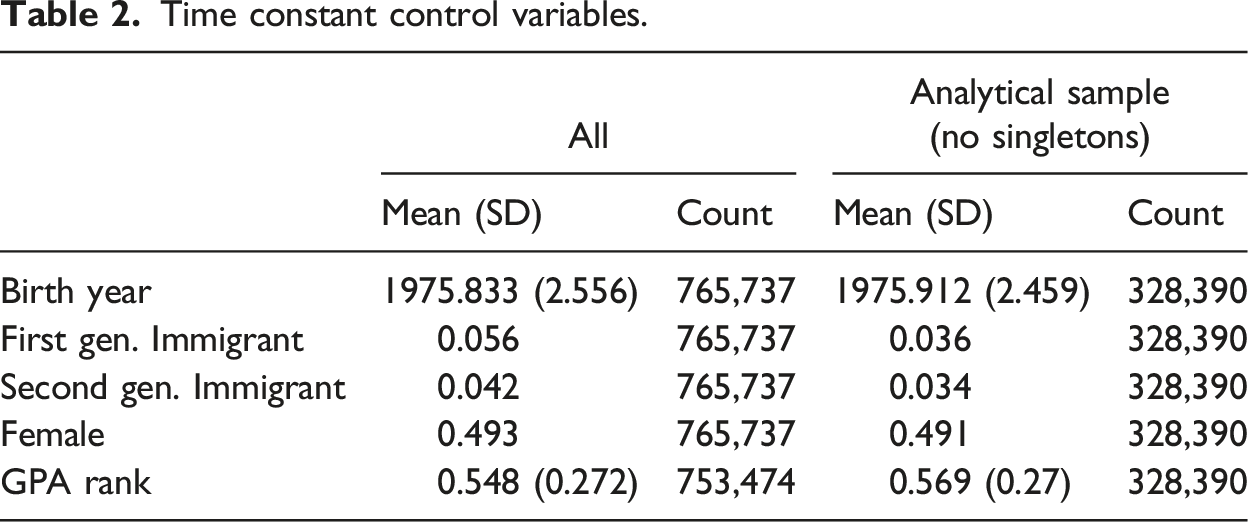
Our primary independent variable is the high school graduation track, recovered from the educational register data. We code different tracks into two categories: academic and vocational. The former consists of the natural science track and the social science tracks; and the other tracks are put in the vocational category. Given our focus on labor market outcomes, we assess the effects of the track of graduation rather than track choices or initial admission since the former are most strongly linked to formal qualifications and certificates rewarded by employers. Our conclusions thus cannot be extended to students who enrolled but then dropped out from upper-secondary school. We also measure three levels of education beyond the upper-secondary level: no points from tertiary education (no TE), any points from tertiary education but no degree (partial TE), and a degree from tertiary education (TE). We combine upper-secondary tracks with information on tertiary education to get six categories (see Table 1).
An empirical challenge is operationalizing the ‘underclass’ when assessing the labor market risks postulated by RRA models. This social class category located below the working class is not usually present in standard class schemes, such as EGP (Erikson and Goldthorpe, 1992). Still, it is necessary for RRA models because the working class would otherwise not face any occupational risk. Breen and Goldthorpe (1997) define it as “those with only a precarious place in the labor market and only in the lowest grades of employment if not unemployed” (p. 281). Following Breen and Yaish (2006), we argue that unskilled, routine occupations classified in category VII of EGP is our proxy for the ‘lowest grades of employment’. The source data are the occupation registers from 2001 to 2018 (Statistics Sweden, 2011). 5 The register reports the last known information for each individual, coded into a Swedish version of ISCO-88 with three digits (Statistics Sweden, 1998). 6 We use the routine of Ganzeboom and Treiman (1996) to build EGP from these occupational data. 7
However, the above definition of the underclass also refers to employment instability, and we have two different indicators for this second dimension in our data. The first one is not being in stable employment, which we operationalize as having annual earnings below half of the median earnings of individuals aged 44–46. 8 A previous study showed that this measure is a good proxy for not having stable employment, as very few jobs in the formal Swedish labor market pay less than this annually (Erikson et al., 2007). Hence, workers below this annual threshold are most likely to switch between unstable (or informal) low-paid jobs and periods of inactivity or unemployment. The data source is Swedish tax registers. The second indicator is unemployment, measured by the number of days the respondent was registered with the state employment agency (Statistics Sweden, 2009). Since Sweden uses the Gent system, this measure has some limitations. Unemployment benefits are conditional on membership in an unemployment agency and sufficient work experience; otherwise, benefits are only given on a small subsistence level. The incentives for registering are thus lower for youngsters, while this measure is more valid for gainfully employed older workers. Thus, it is a conservative measure of actual days of unemployment. We see these two measures of employment instability as complementary.
In some models, we will analyze whether the labor market returns to educational qualifications vary depending on parents’ social class (we use the dominance criterion, see Erikson, 1984). We recover this information from the census data, coded with the Swedish SEI scheme that resembles the EGP scheme (Erikson and Goldthorpe, 1992).
Statistical models
We present two model specifications. The basic model (1) includes birth year, being foreign-born, having foreign-born parents, and having children as controls. Model (2) then nets out selection into tracks with GPA and family identifiers as fixed effects.
Using a linear probability specification, we estimate age-specific regression models across ages 20 to 38. 9 Singletons threaten cluster-robust standard errors (Correia, 2015) and are thus dropped from all models (this has limited influence on our results). 10
We present the main results, first, for the risk difference at occupational maturity between vocational education without tertiary education and the five other study trajectory groups, and second, as growth curves comparing the difference between academic and vocational tracks without any tertiary education per age (with average marginal effects). In a supplementary analysis, we also describe class attainment for all six study trajectory groups and heterogenous effects on time trends by class of origin.
Results
Risks at occupational maturity
We begin by examining risks at occupational maturity (at age 38). Figure 2 displays the average marginal effects from the background model, i.e., controlling for grade point average and family fixed effects. Regarding the risk of not being stably employed, results for females show that graduation in the academic track in upper secondary school is associated with a slightly lower risk of unstable employment (about two percentage points). We also see a strong risk reduction for those with a degree from tertiary education. The pattern is somewhat different for males: graduating from the academic track entails the same risk as the vocational track, and a degree from tertiary education only implies a modest risk reduction. For registered unemployment, effect sizes are small, and we do not observe any substantial risk for the academic track, neither for females nor for males. In contrast, there are some large and substantial differences in the likelihood of having an unskilled job (EGP class VII), but these are mostly related to the level of education and less to the upper secondary school track. For both genders, a higher level of education is related to a lower chance of an unskilled position. Yet, for males, students from the academic track without tertiary education have a lower risk of an EGP VII position, corresponding to 5 percentage points. Thus, we conclude that there are no long-run risks associated with completing the academic track in upper secondary school, and this also holds when only graduates without a tertiary degree is compared. Difference between vocational education without tertiary education and other educational trajectory groups at age 38.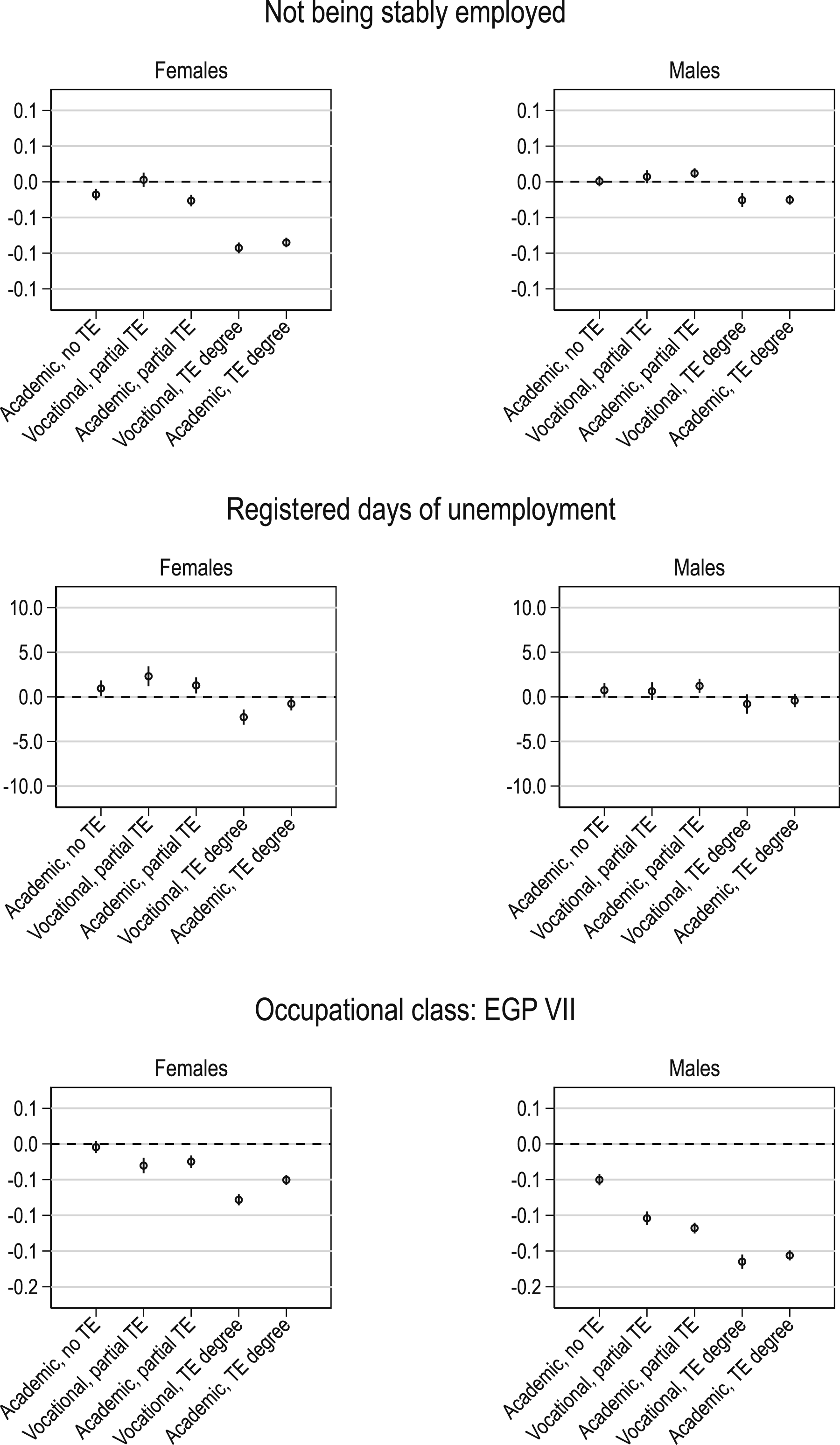
Life-course differentials between tracks in labor market risks
The previous section assumed that individuals when assessing occupational risks, care about long-term outcomes. In this section, we relax this assumption by evaluating risks over the early life course, comparing the background control model to a basic model closer to the actually observed risks for each group. Here, we focus on the main comparison of interest: students with academic qualifications relative to students with vocational qualifications among individuals with no tertiary education.
Figure 3 presents the average marginal effects of the risk of not being in stable employment by age. The point estimates for the two models are reported together with their confidence intervals. For both women and men, model 1 indicates that, at the age of 20, graduates of the academic track face higher marginalization risks than their counterparts from vocational education, roughly corresponding to a 10-percentage point difference in the probability of experiencing unstable job trajectories. Still, since not being in a stable labor market position is very common for this age group (68% at age 21, see Table A2), we consider this effect size as moderate. In model 1, this gap is almost eradicated at age 22 for females and is very small for males after age 23. In model 2, which considers selection, we see that the gap takes longer to close. For men, there is a small disadvantage for the graduates of the academic track throughout their 20s. This gap closes considerably faster for females and is only there for ages 20 to 24, corresponding to the first years after upper secondary graduation. For these years, the graduates of the vocational track preserve a significant advantage for both men and women. Overall, these results indicate that graduates of the academic track without a tertiary degree face a short-term disadvantage in access to stable employment. Difference between academic and vocational tracks in the probability of not being stably employed by age, conditioned on no tertiary education. Note: Estimates above zero reflect a higher risk for academic education. Shaded areas represent 95% confidence intervals. All models exclude singletons. Not being stably employed is defined as earnings smaller than half the yearly median income of a 44-46-year-old. Control set up: (1) Sociodemographic: Being a parent, year of birth, foreign background (2) Background: 1 + ability + sibling FE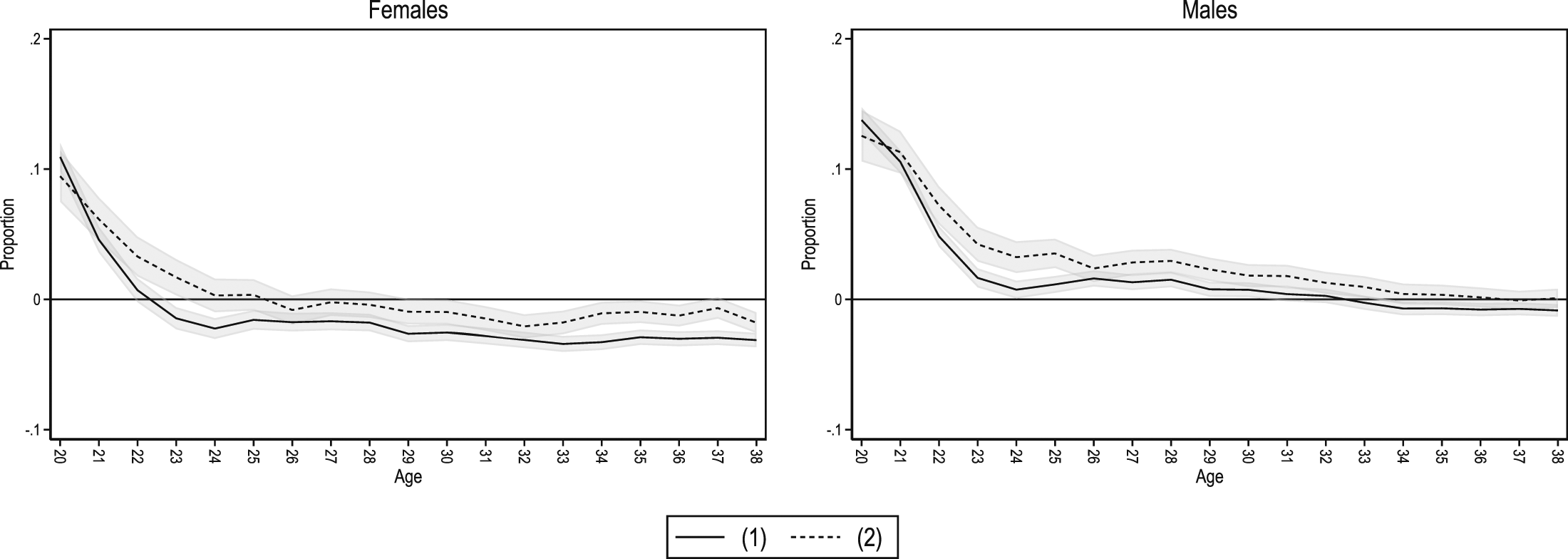
Figure 4 reports the results for unemployment risks, measured in the number of days per year when individuals were registered as unemployed. In both figures, model 1 displays an initial protection effect of the academic track that declines and becomes negligible at later ages. However, this initial advantage is reversed to a disadvantage when controlling for ability and sibling fixed-effects in model 2, since better performing and high-SES students, who are more likely to attend the academic track, are less exposed to the risk of being unemployed. In model 2, the higher initial unemployment risk for the graduates of the academic track amounts to 5 days, which should be interpreted in light of the average number of days of registered unemployment for a 21-year-old, which is 40 days (Table A2). Moreover, this gap closes quite rapidly and has disappeared entirely at age 24 for females and at age 23 for males. Overall, the evidence for this outcome also speaks for a moderate initial disadvantage for the academic track. Difference between academic and vocational tracks in the number of days per year of registered unemployment by age, conditioned on no tertiary education. Note: Estimates above zero reflect a higher risk for academic education. Shaded areas represent 95% confidence intervals. All models exclude singletons. Average marginal effects. Control set up: (1) Sociodemographic: Being a parent, year of birth, foreign background(2) Background: 1 + ability + sibling FE.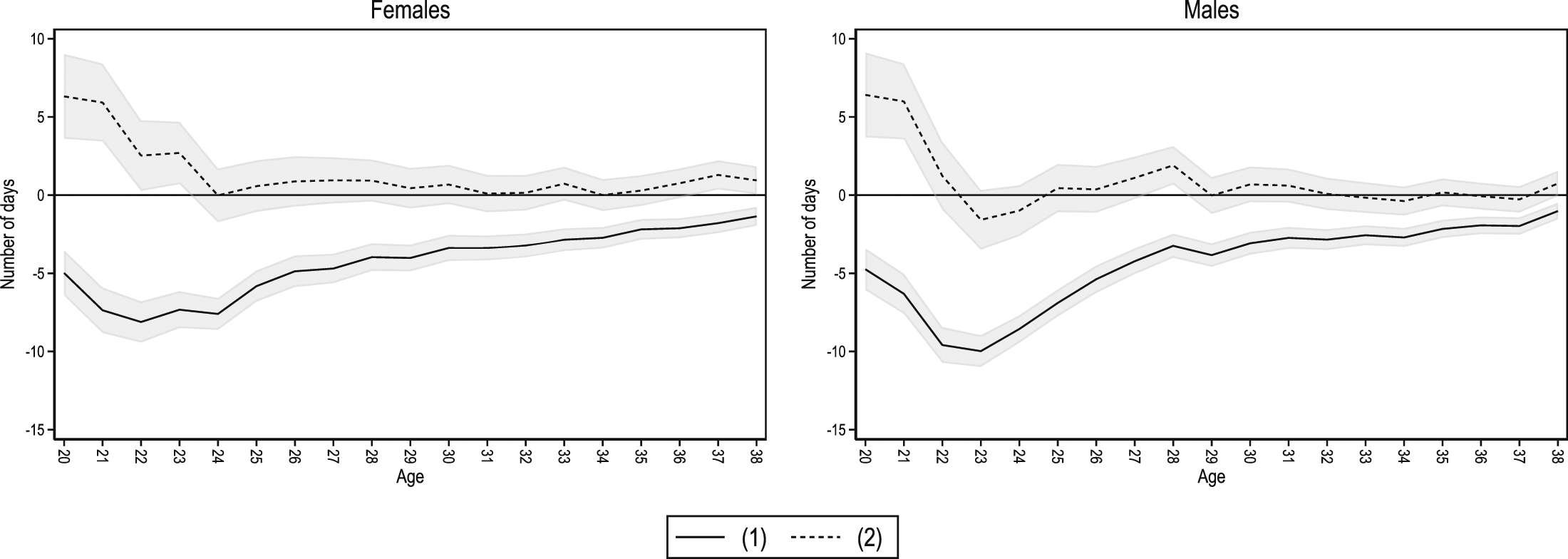
Figure 5 refers to track differences in the risk of being in unskilled occupations (category VII of the EGP scheme). Model 1 indicates that graduates of the academic track are less exposed to this risk for both genders throughout the whole observation window. Initially, this advantage amounts to approximately 10 percentage points for males and five percent for females. However, a large part of this is driven by selection. Model 2 instead shows a small initial disadvantage of the academic track for women in the younger cohort that completely vanishes by 33. As discussed above, we detect a moderate but stable advantage of the graduates of the academic track for men. Hence, also, for this outcome, there is limited evidence supporting the RCA. Difference between academic and vocational tracks in the probability of being in EGP VII by age, conditioned on no tertiary education. Note: Estimates above zero reflect a higher risk for academic education. Shaded areas represent 95% confidence intervals. All models exclude singletons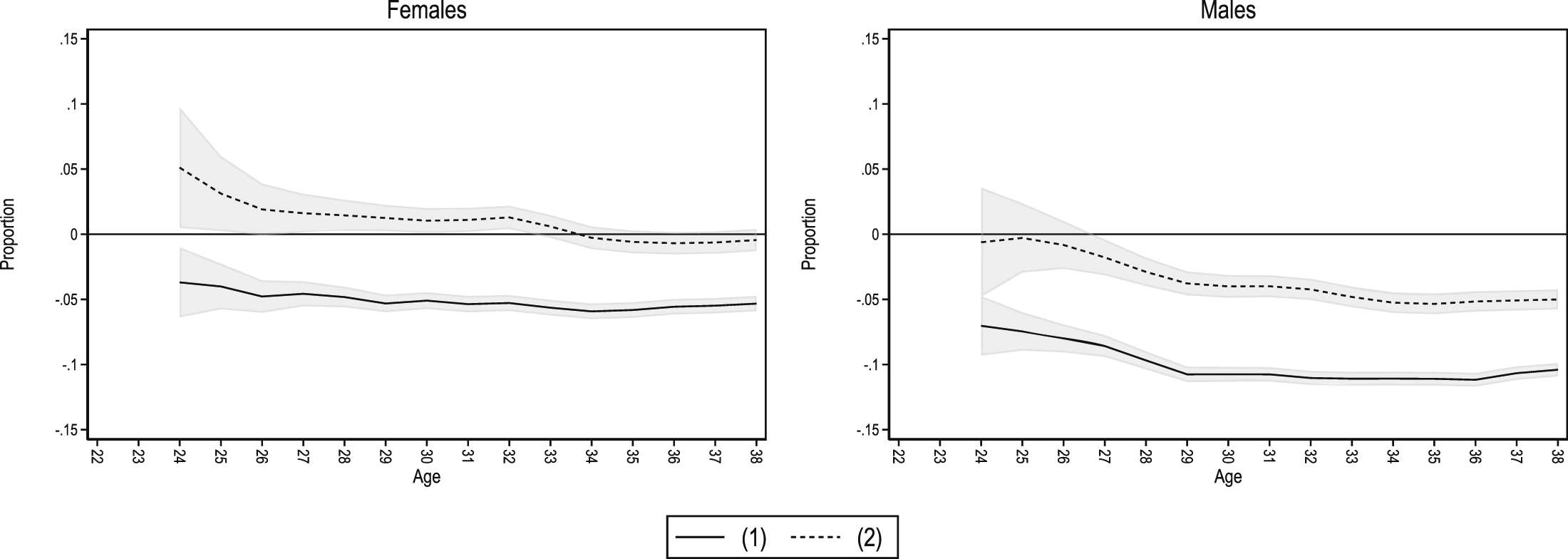
Supplementary analyses
In supplementary analyses reported in Online Appendix Table A1, we present predicted values, based on the background model, of class attainment at age 38 for all six analytical groups, separately for academic and vocational graduates with the three levels of education. We detect the expected pattern that a tertiary degree considerably fosters the chances of reaching the service class, particularly the higher service class and that the group with partial tertiary education is in between the other two in this regard. Moreover, comparing students without any tertiary degree, we observe that the academic track ensures a higher chance of entering lower service-class and routine non-manual positions, suggesting that academic secondary education provides advantages for these types of jobs even without tertiary education.
Finally, we addressed potentially heterogeneous outcomes across social class backgrounds by running separate models by class of origin, corresponding to the above specification of model 2 (Online Appendix Figures A1-A3). Results indicate very little heterogeneity for employment and unemployment, but some heterogeneity for social class attainment, with the academic track being relatively more protective for service class offspring.
Discussion
RRA models provide a compelling and influential explanation for educational inequalities that has inspired much empirical research in the past two decades. However, these models’ applicability is contingent on the validity of their assumptions, which have seldom been subject to systematic empirical scrutiny. In particular, these models rest on the assumption that vocational education is a safety net that protects students without tertiary education from labor market marginalization more than academic education. In Theoretical Predictions About the Risky Choice Assumption, we argued that the validity of this RCA is debatable on theoretical grounds: while some arguments based on mainstream theories of returns to education support it, others go in the opposite direction. As regards previous evidence examined in Review of Empirical Studies, the only study that measured perceived class returns to vocational and academic tracks rejected the RCA (Barone et al., 2021). Previous empirical studies on actual returns provide a mixed picture, suggesting that the labor market prospects of secondary track vary substantially across genders and over the life course, thus challenging the general applicability of the RCA. However, these previous studies were not designed to test this assumption and therefore seldom assessed the specific marginalization risks postulated by the RCA.
This work made two empirical contributions to this literature. First, we could select three outcomes directly relevant to the labor market risks postulated by RRA models. In particular, the educational disadvantage of students from the working class must be explained by RRA models with reference to the risk of falling below this class, that is, into an ‘underclass’ comprising individuals in unskilled occupations with unstable job trajectories involving high unemployment risks. Second, we explored the heterogeneity of labor market returns by comparing short- and long-run risks by gender and differentiating between upper secondary graduates without tertiary education from those with some tertiary education.
The main piece of evidence supporting the RCA in our analyses is that, when taking selection into tracks into account, graduates of the academic track without any tertiary education initially face higher employment instability risks (not being stably employed and unemployment) in their early 20s than their counterparts from vocational education. After the early twenties, however, these gaps are small. Hence, the safety net operates only in the short run in Sweden. Moreover, graduating from the academic track significantly protects men from the risk of entering unskilled, routine occupations corresponding to EGP class VII since the start of their occupational career. For women, the academic track involves a small initial disadvantage for this outcome that rapidly vanishes. Overall, the vocational track promotes a faster labor market entry after high school graduation, but other than this it has no edge over the academic track. It is possible that graduates from the latter compensate for the lack of ready-to-use skills with more significant endowments of general skills (e.g., reasoning, language and communication skills). The positive signaling value (e.g., in terms of ability or motivation to achieve) of their track may also play a role. Hence, our results challenge the applicability of the RRA assumption to the Swedish case.
However, these results do not necessarily imply that RRA models should be abandoned. Instead, they may be reformulated to incorporate time preferences (Breen et al., 2014; Sorensen, 2000): if vocational education provides a faster transition into adult life, it may be more attractive for families with stronger time-discounting preferences, that is, families placing more importance to short-term rewards than to more distant rewards. Moreover, if social classes differ in their time preferences (net of income constraints), this mechanism can fuel educational inequalities. For instance, Bellani and Ortiz-Gervasi (2022) report that sons of low-educated parents display stronger time-discounting preferences in Italy, but this is not the case for daughters. Breen et al. (2014) find that time-discounting preferences predict enrolment in the academic track in Denmark but do not mediate differentials by family background. Our results imply that the academic track is a risky option only at the start of the career and only for reducing unemployment risks. Then, the challenge to reconciling RRA models with strong time-discounting preferences is that we should assume a strong degree of myopia. RRA models focus instead on long-term outcomes as they take social class destinations at occupational maturity as the relevant decision-making criterion of students and parents. As noted by Breen and Yaish (2006): ‘to take the class position derived from their first job as their beliefs about the class that their educational choices will finally lead them to attain is to attribute to them an unreasonable degree of myopia’ (253). Another difficulty, from a rational choice perspective, is that this reformulation may introduce sub-cultural class differences in preferences that RRA models were supposed to avoid (Goldthorpe 2006).
A second potential reformulation relates to beliefs about education (Morgan, 2005). While our results concerning actual returns suggest that vocational education’s safety net is short-lived, families may overestimate its importance. More research is thus needed on perceived occupational returns to secondary tracks, particularly because RRA models focus on subjective beliefs. The challenge for rational choice models would then be to explain why wrong beliefs are widespread and persistent (Morgan, 2005). For instance, incorporating Bayesian learning models into cost-benefit models may be a way forward (Breen, 1999). However, considering that in many countries, vocational tracks do not seem to operate as a safety net relative to academic tracks nor enjoy a positive reputation (Polidano and Tabasso, 2016), it is possible that the RCA does not hold even at the level of subjective beliefs. Then, a third and perhaps most promising solution would be to reformulate RRA models to retain the well-established loss-aversion assumption while removing the RCA, whose validity could be contingent on the time frame (short-versus long-run returns), gender and type of outcome of interest. This would ensure a more general applicability of these models.
Our work is not without limitations. First, our operationalization of the underclass followed previous work and used the EGP scheme to measure occupational outcomes. However, this scheme has been criticized for overstating the manual versus non-manual divide (Oesch, 2003), which is of less importance for female jobs (Heath and Britten, 1984). Thus, gender differences in risks related to occupational class might reflect the extent to which EGP VII captures the lowest ranks among female and male-dominated occupations (Smallenbroek et al., 2022). Second, the issue of selection might still be present. Although we have improved on some previous attempts of measuring the returns to vocational education, educational choice is not a genuinely exogenous event but a choice that likely is done taking relative skill endowments (cognitive and non-cognitive) into account.
In conclusion, it appears that RCA cannot be regarded as a generally valid assumption: the safety net of vocational education is short-lived and, to some extent, gender- and outcome-specific. Besides the theoretical implications of this finding, our results question the value of vocational education for the average student, at least in the Swedish context, where the academic track seems like a win-win option for students who can complete it. On the one hand, this track provides better chances to attain tertiary education degrees and reach service-class destinations. But on the other hand, if students from this track fail to complete tertiary education, they only experience an initial delay in entry into the labor market. Hence, rational agents considering long-run income and employment prospects have little reason to prefer vocational education other than for constraints relating to academic achievement or family economic resources.
Supplemental Material
Supplemental Material – Supplemental Material for Are upper-secondary track decisions risky? Evidence from Sweden on the assumptions of risk-aversion models
Supplemental Material, Supplemental Material for Are upper-secondary track decisions risky? Evidence from Sweden on the assumptions of risk-aversion models by Anton B. Andersson, Carlo Barone,and Martin Hällsten in Rationality and Society.
Footnotes
Acknowledgements
We thank participants at the ECSR conference in Lausanne (2019), Participants at the LNU-seminar at SOFI, Stockholm University, Roujman Shahbazian, and Michael Tåhlin.
Declaration of conflicting interests
The author(s) declared no potential conflicts of interest with respect to the research, authorship, and/or publication of this article.
Funding
The author(s) disclosed receipt of the following financial support for the research, authorship, and/or publication of this article: This research was supported by grant 2015-01715 from the Swedish Research Council ( ), Grant 2017-02047 from Swedish Research Council for Health, Working Life and Welfare (FORTE).
Supplemental Material
Supplemental material for this article is available online.
Notes
References
Supplementary Material
Please find the following supplemental material available below.
For Open Access articles published under a Creative Commons License, all supplemental material carries the same license as the article it is associated with.
For non-Open Access articles published, all supplemental material carries a non-exclusive license, and permission requests for re-use of supplemental material or any part of supplemental material shall be sent directly to the copyright owner as specified in the copyright notice associated with the article.
