




Abstract
Decentralized sanctioning arises from a demand for governance that is not adequately provided by the state or another strong and centralized institution. While the dynamics of collective action and sanctioning have been well-examined theoretically, experimentally, and empirically, this work typically assumes community membership is a given. In selective or elite communities, pro-social behavior of one kind or another may be a prerequisite of community membership, which may create perverse incentives for the implementation of peer-sanctions. This article quantitatively examines this phenomenon in the case of professional ice hockey, a highly selective community where fist-fighting between players has long existed as a form of self-help for players to address rule infractions or violent play otherwise unaddressed by officials. An empirical examination of over 70 years of player statistics and play-by-play data from the National Hockey League shows not only the evolution of this system from one of peer-sanctioning to one of specialized-sanctioning, as might be predicted from experimental results showing the favorability and efficacy of more centralized punishment regimes, but also reveals how specialization has led to self-serving sanctions. Less-skilled players who are presumably hired to fight are disproportionately likely to participate in fights that appear to occur for non-retaliatory reasons, and more likely to fight one another in a bid to maintain their status and reputation as sanctioners, and consequently their membership in an elite community.
Introduction
The sport of ice hockey has long hosted a somewhat peculiar ritual: fist fights between members of opposing teams. These fights are an alleged part of an honor culture that initially rose in response to inadequate in-game officiating. Fighting is understood as a form of retaliation and informal punishment after an offending player endangers an opponent through an act of aggression or carelessness. Referees can impose formal penalties in games, but their ability to monitor can be limited (Colburn, 1986). Like other contexts that give rise to informal and decentralized control processes (Erikson and Parent, 2007), penalties can also be difficult to calibrate with infraction severity.
Fighting in hockey has been commonplace for generations and is part of a purported “code” shared by all players (Atkinson and Young, 2008; Bernstein, 2006; Robidoux, 2001). It is also the specialized domain of archetypical players, referred to as “enforcers” or “goons”, who participate in a disproportionate number of fights. This article examines how fighting manifests its honor code-based origins and justifications by examining over 70 seasons of National Hockey League (NHL) player statistics and play-by-play data, including over 25,000 fighting interactions.
This case provides a rare empirical and quantitative record of an evolving system of informal social control. There has been much simulation-based and analytical work exploring peer-sanctioning (Heckathorn, 1988, 1989, 1990; Macy 1993), laboratory studies of peer-punishments in groups (Baldassarri and Grossman, 2011; Fehr and Gachter, 2000, 2002; Sigmund, 2007; Yamagishi, 1986), and qualitative descriptions of informal control systems that exist in weak states or under-policed contexts (Ellickson, 1991; Gambetta, 1996; Varese, 1994). This data provides an unprecedented set of self-organized violent interactions within a structured setting. The analysis ultimately shows the gradual specialization of informal control and sanctioning behavior within a larger institution that provides some order but effectively permits vigilantism. This transition from peer-punishment to a system with designated sanctioners lends credibility to the experimental research that shows the increased efficacy or favorability of systems of centralized or specialized enforcement (Andreoni and Gee, 2012; O’Gorman et al., 2009).
This article not only introduces a highly detailed example of the evolution of informal social control within a controlled context, it also shows an interesting consequence of specialized punishment regimes within selective communities: individuals may end up delivering sanctions for the sake of retaining membership. With the NHL, the “enforcer” role gradually emerged in the later part of the 20th century and has changed the motives of fighting itself. Less skilled players fight not only to punish deviant opponents, but also to establish and maintain the reputation of an NHL-caliber enforcer, as well as the identity and salary that comes with a coveted NHL-roster spot. Specialized enforcement, however, has also accompanied a decline in fighting overall, suggesting that this set of seemingly perverse incentives may in this case prevent more fights than it causes.
After briefly reviewing the origins of retaliatory behavior and honor cultures, as well as their relationship to more specialized control regimes, the case of informal social control via fist-fighting in ice hockey is introduced. Quantitative analysis of both play-by-play data and player statistics shows the emergence of specialization and the enforcer role in the game. Network analysis then shows that this specialization gives rise to fighting behavior that is driven by signaling motives rather than retaliatory motives. The article concludes with a discussion of these analyses’ implications on our understanding of governance and collective action.
Collective action, retaliation, and honor cultures
The game of ice hockey presents a collective action problem: competing teams have an incentive to play in a manner that could physically harm their opponents but maximizes their own probability of winning. Dangerous play may give one team an edge, but if all teams play aggressively, the overall well-being of the players and quality of the game will suffer, especially over the course of a 9-month season. The ideal solution is a strong governing body that punishes infractions. All-powerful institutions align individual and collective interests by punishing (rewarding) selfish (altruistic) behavior (Oliver, 1980). Experimental work has shown that individuals prefer environments where institutions are in place to enforce pro-social behavior (Gürerk et al., 2006).
However, centralized solutions are not always possible or desirable, and cognitive impulses to punish and retaliate evolved long before the development of social institutions. Negative reciprocity is a common feature in many animal societies and deters parasitic or predatory behavior (Clutton-Brock and Parker, 1995). Retaliation may be irrational in the short-term, but signaling a willingness to impose costly sanctions can be rational in the long-term (Elster, 1990; Gambetta, 2009; Schelling, 1960). While the impulse to punish may have been naturally selected for because of the benefits of forward-looking deterrence, the proximate mechanisms may be driven by backwards-looking vengeance. Punishment in laboratory trust games persists even when recipients will not necessarily realize they are being punished, suggesting that punishment is driven by vengeance as opposed to explicitly forward-looking motives (Crockett et al., 2014). A universal “taste for vengeance” also turns the prisoner’s dilemma into a coordination game that rewards cooperative behavior (Friedman and Singh, 1999), and negative reciprocity is at the heart of the well-known solution to the repeated prisoner’s dilemma, “Tit-for-Tat” (Axelrod, 1981).
Beyond biologically evolved impulses to retaliate, certain contexts may promote cultures or norms that encourage retaliation. Legal scholars have emphasized the importance and prevalence of negative reciprocity, or “self-help”, as an alternative to centralized sanctioning (Black, 1983; Ellickson 1987, 1991). Criminologists, sociologists, and anthropologists have found various forms of self-help in areas that have an ineffective, weak, or absent central authority, from the Pacific to the Mediterranean (Boehm, 1987; Colson, 1953; Gould, 2000). Honor cultures, which are characterized by retaliatory norms, hyper-sensitivity to insult, and high rates of risk-taking (as a means of signaling) are found in both rural parts of the U.S. South (Barnes et al., 2012; Cohen et al., 1996; Cohen and Nisbett, 1997; Nisbett 1993) and portions of certain U.S. cities (Anderson, 2000; Stewart and Simons, 2010). In the U.S. South this culture was brought over from Scots-Irish herders, whose wealth came from a source that was especially vulnerable to predation (Cohen and Nisbett, 1994) and reinforced by the presence of weaker state institutions. In inner-city areas in the United States, such cultures are motivated by the belief that the state is unresponsive to acts of crime (Kirk and Papachristos, 2011). Simulation-based work has also supported the idea that honor cultures are evolved cultural responses to stateless contexts. (Nowak et al., 2016).
The second-order free rider problem and the origins of specialized enforcement
When collective resources are jeopardized by anti-social behavior, peer-punishment may be an effective solution, but the question of who punishes becomes a dilemma when a group rather than an individual is the victim of said anti-social behavior. Since punishment typically involves a negative cost to both punisher and punishee, the question of who delivers costly sanctions is referred to as a second-order free rider problem (Oliver, 1980).
Common solutions to this problem that have been considered are the designation of official ‘punishers’ who take on a disproportionate responsibility for sanctioning, or shared contribution to a publicly funded institution that is used to punish first-order free riders. The latter solution is commonly referred to as “pool-punishment” and is found to be superior for dealing with the second-order free rider problem (Sigmund et al., 2010), especially in situations where commitments to punishment are made before actors decide whether to invest in the public good (Schoenmakers et al., 2014). However, centralized punishing institutions may not always be possible in a given environment, and having designated individuals to sanction may be more effective in sustaining cooperation than purely decentralized peer-punishment (O’Gorman et al., 2009). Sanctioning is often framed as a ‘volunteer’s dilemma’, where the efficacy of sanctions is tied to whether at least one person sanctions, rather than the aggregate of individual decisions to punish. In these scenarios, the heterogeneity of actors can help coordinate sanctioning efforts and may serve as the origin of centralized punishment regimes (Diekmann and Przepiorka, 2015). If some individuals can sanction more efficiently than others, this can lead to better coordination and cooperation between punishers and non-punishers (Diekmann and Przepiorka, 2016; Przepiorka and Diekmann, 2013), and an impromptu division of labor between public good contributors and sanctioners (Perry et al., 2018).
In some experiments, heterogeneity is introduced by participants. Cooperation is better sustained when individuals can either transfer their sanctioning power to one another (Gross et al., 2016), or when sanctioners can be compensated by other members of their group (Andreoni and Gee, 2012). Heterogeneity in punishment behavior can also be introduced when certain individuals gain more from punishment, either because anti-social behavior disproportionately effects them (Przepiorka and Berger, 2016), because they stand to benefit more from pro-social behavior (Waichman, 2020), or because a ‘bounty hunter’-type system is in place where rewards are given to those who uncover and sanction anti-social behavior (Li et al., 2021).
While there is ample theoretical reasoning and experimental evidence for the embracement of either peer-sanctioning, pool-sanctioning, or designated-sanctioner systems, empirical examples of such systems tend to lack the number of observations necessary for extensive quantitative analysis. The case of violence and fighting in ice hockey offers a rare opportunity to study a real-world system of decentralized punishment in a thorough and comprehensive manner. Data on player deviation and sanctioning is available from nearly all games going back to the 1940s. While this case study lacks the theoretical sterility of formal analysis or the causal clarity of experimental research, the trends and patterns in the data allow us to identify several different patterns that both reinforce experimental findings and present new generative insights.
Fighting and the problem of social order in North American ice hockey
Ice hockey’s collective action problems predate the formation of the National Hockey League in 1917. In late 19th and early 20th century Canada, the elite level amateur hockey played between clubs around Montreal and across Canada transitioned from a ‘gentleman’s game’, to a highly competitive one (Barlow, 2009). Violent and ‘strenuous’ play became common in hockey and “the blood flowed freely” (Scanlan, 2002).
Early incidents of players swinging sticks at helmetless opponents ended in death, while others ended in criminal charges of assault (Lorenz and Osborne, 2009). In 1904 alone, four players died while playing in Ontario (Metcalfe, 1997). Fighting is perceived as a ritual outlet to curb the more extreme incidents of violence that frequently occurred during the sport’s early days, and thought a relatively safe way of retaliating against and therefore deterring dangerous or aggressive play. These fights occur because the speed of the game makes traditional punishment less effective, and because of “the cultural value placed on honor” within the sport (Colburn, 1986). Fighting is part of a larger unspoken ‘code’ among players that is thought to keep the game honorable and safe (Atkinson and Young, 2008; Bernstein, 2006; Robidoux, 2001). Fighting has also been approved of by younger players, their coaches, and their parents as both an appropriate reaction to violence and as a means of improving their teams’ success (Loughead and Leith, 2001; Smith 1979a, 1979b). Ironically, two of the more dangerous incidents in recent NHL history occurred when players who refused to fight were assaulted. 1
Alternative interpretations of fighting
Fighting is also understood by some as a cultural anachronism that maintains outdated norms of masculinity, a marketing ploy, or a way to shift momentum in a game.
Ice hockey is argued to perpetuate a violent and aggressive form of masculinity in a society with shifting gender roles (Allain, 2008; Gruneau and Whitson, 1993). Violent behavior is accepted and celebrated (Smith, 1974) and violent play is judged as competent play even amongst younger players (Weinstein et al., 1995). Approval of violence on the ice also may translate into violent behavior off the ice (Bloom and Smith, 1996; Pappas et al., 2004). Much attention has been paid to Don Cherry, a former NHL coach and television personality, who defends fighting and violence as both a means of deterrence and as a moral virtue during Canadian Broadcasting Corporation hockey broadcasts (Allain, 2015; Elcombe, 2010; Gillet et al., 1996; Knowles, 1995). Fighting’s decline in recent years has caused more people to defend the practice in public discussion (Sailofsky and Orr, 2020).
Fighting is also thought to generate popularity and revenue, but research on its profitability has been mixed (Rockerbie, 2015; Stewart et al., 1992). At the level of the league, the NHL and its feeder leagues have a standardized penalty for fighting, but these may not adequately deter fights. The NHL more aggressively forbids a third player from joining: this keeps fighting fair, and may encourage more fights to proceed (Collins, 2008). In contrast, other leagues have been able to curb fights through excessive penalization, including most European and North American Collegiate leagues.
Strategically, an individual fight could change the outcome of a game as a means of generating momentum or restoring “emotional energy” (Collins, 2008), but research on the influence of fighting and violence on winning is mixed (Engelhardt, 1995; Widmeyer and Birch, 1979, 1984). In the short-term, it is theoretically impossible for both teams to improve their odds of winning a game, so a purely short-term strategic explanation seems implausible given that fights are consented to by parties on both teams. However, there may be a long-term deterrence value for teams to signal their willingness to fight. The fights that do (and do not) occur are televised and visible to all other teams and players. A team that does not retaliate against predatory play may be quickly found out and seen as vulnerable.
While fighting may be a vessel of masculinity, a form of entertainment, or a means of inspiring teammates and intimidating opponents, fighting is still largely experienced by players and coaches as an element of a larger system of social control. There is little question that the NHL could reduce fighting by punishing it more severely. It is unclear that they could prevent the type of violent incidents that fights allegedly deter, and players and teams have long perceived the need to police the game themselves. Ultimately, fights occur because players find them situationally appropriate and culturally acceptable, and league officials permit them (Colburn, 1985).
The enforcer
While the culture of hockey seems to embrace what experimental collective action researchers would likely identify as peer-sanctioning, there is also strong rhetorical support for a designated-sanctioner system within the league. Fighting is often thought to be the primary domain of an informal subset of players known as “enforcers”. Enforcers participate in a disproportionate amount of fighting and are thought less skilled in other aspects of the game. In some cases, these players have had tragic outcomes. In 2011, Derek Boogaard, a well-known NHL enforcer, died of an alcohol and painkiller overdose likely mediated by brain damage from repeated head-trauma (Branch 2011a, 2011b, 2014).
The enforcer offers a solution that mirrors findings from experimental studies on the emergence of specialized enforcement: it emerges largely from player heterogeneity, results in an informal division of labor, and may give rise to egoistic (self-serving) punishment: an analysis of the 2011–12 season salaries found that enforcers are rewarded differently than their less-violent peers (Burdekin and Morton, 2015). However, designated enforcers in ice hockey, unlike the example of bounty hunters, are paid ahead of time. Furthermore, while fighting is still not rewarded as much as scoring, there is a surplus of available players who would eagerly take a position as an NHL enforcer.
The uncertainty of remaining on an NHL roster spurs a form of status-seeking egoistic punishment. Enforcers relish opportunities to fight one another in order to signal their continued ability to provide violence in an increasingly peaceful game. Like mafiosi who must continuously perform violent actions to maintain their reputation (Smith and Varese, 2001), enforcers should be concerned with their continued status as producers of violence. Status is especially important when underlying quality is difficult to ascertain (Podolny, 2001), and it is difficult to measure the exact influence an enforcer or a fight has on the outcome of a game or season. Status is also thought to “leak” across relationships (Benjamin and Podolny, 1999; Podolny, 2005). Furthermore, following the analysis of Gould (2003), players who are in a similar social position should have a strong incentive to resolve ambiguity in their rank. Two players seeking to maintain reputations as enforcers should therefore be highly motivated to fight one another.
Using over 70 years of play-by-play records and individual player statistics, this article outlines a history of hockey fighting with a multi-faceted set of analyses and models. After introducing the data and briefly summarizing the longitudinal and behavioral contours of fighting rates in the National Hockey League, the analysis proceeds in two parts. The first shows how rates of sanctioning behavior have shifted over time, as well as how fighting has become concentrated and specialized. The second demonstrates how the pairwise patterns of who fights whom reflect status consciousness amongst designated enforcers, suggesting that status acts as an informal bounty for sanctioning behavior. The results shed light on the evolution of fighting in hockey, provide a detailed quantitative portrait of an evolving system of social control, and reveal how specialized sanctioners may have egoistic motives in selective communities.
Data sources and analytic strategy
The analysis draws on regular season play-by-play data from the 1947-48 season through the 2018–19 season acquired via the NHL application programming interface (API). Data is available from 51,276 of 52,183 (98.2%) regular season games and 7046 individual players. The historical accuracy of fighting data is corroborated by two additional fan-driven websites: hockeyfights.com and the now defunct dropyourgloves.com. Data from dropyourgloves.com is available from 1960 to 2016, and data from HockeyFights.com is available from 2000–2019. These data sources are largely aligned in terms of year-to-year fighting rates (see Figure 1), indicating that notions of fighting are consistent between fans and officials. These temporal patterns are also consistent with other empirical analyses of fighting rates (Depken et al., 2019). Player-level performance records are also acquired via the NHL API. Rates of fighting per regular season game observed in the National Hockey League application programming interface, and fan-compiled websites ‘DropYourGloves.com’ and ‘HockeyFights.com’.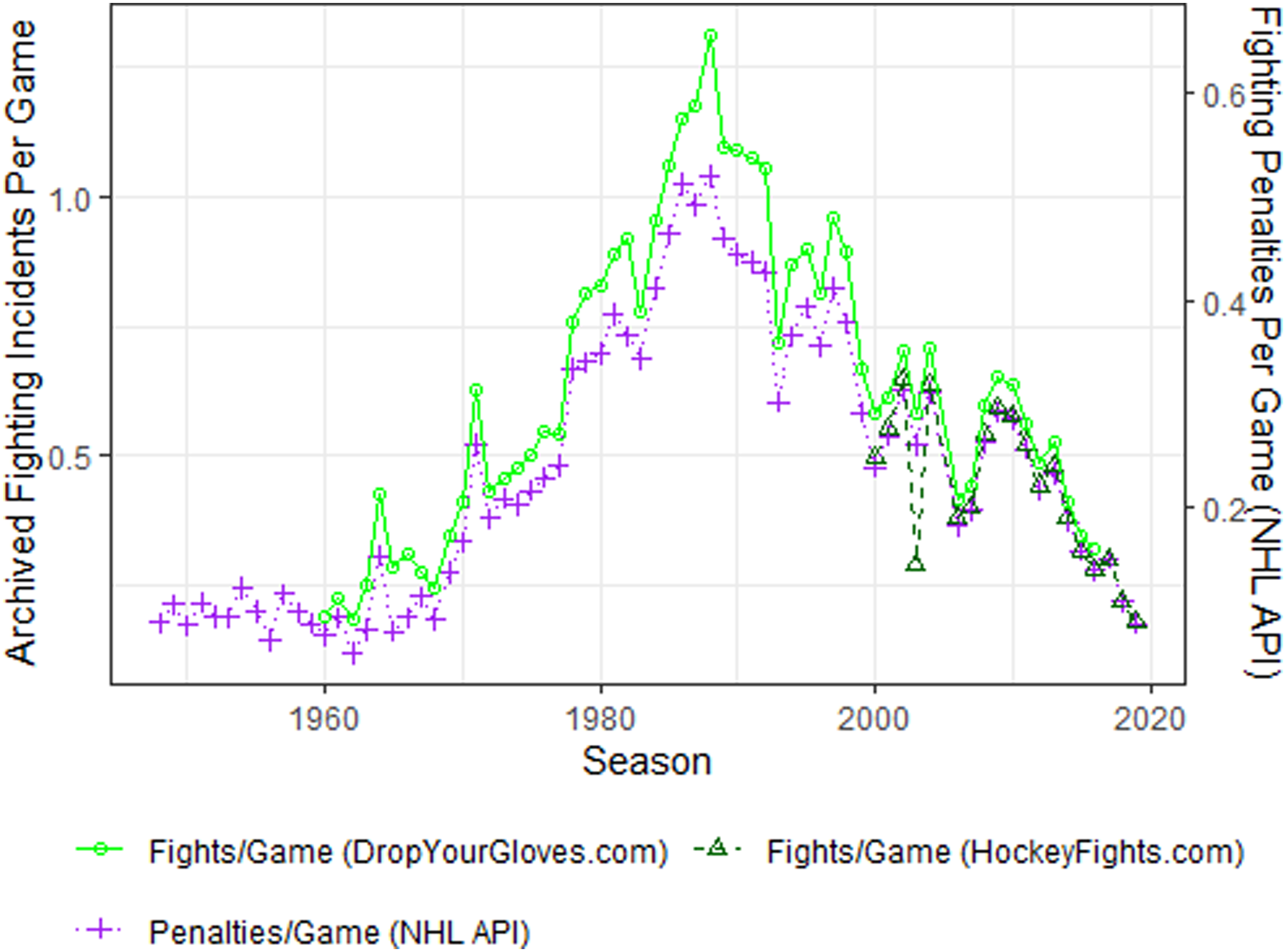
The situations that lead to fights reflect the broader norms that govern the outbreak of a fight. The time-stamped nature of the play-by-play data can also be used to generate a typology of fights based on their motives. Prior research has examined whether fighting in hockey is impulsive or calculated (Goldschmied and Espindola, 2013), but here it is assumed that both are possible. The analysis presented draws on play-by-play information collected from individual NHL Games, particularly the occurrence of penalties and stoppages in play, to label these two types of fights. Fights that co-occur with a penalty for another violent act (“roughing”, “slashing”, “high-sticking”, and “cross-checking” are the most common of such penalties) are referred to as retaliatory fights. It is assumed that these fights are likely to involve a situation where one player commits an illegal and violent act, and either the targeted player or one of their teammates immediately responds by initiating a fight with the offending player. Fights that occur within 10 s of a faceoff on the other hand, should be more likely to reflect the signaling motives of players, and are referred to as calculated fights. Faceoffs reinitiate play after a stoppage, so a fight that occurs very shortly after a playoff is less likely to be an act of immediate retaliation (Figure E in the online Appendix shows that penalties after a faceoff are disproportionately more likely to be from fighting rather than another violent act), and more likely to reflect a scenario where both players have decided to fight before play resumed.
Figure 2 shows the proportion of total fighting penalties per year that are associated with each of these two labels. We can see that while fighting was once nearly 40–50% retaliatory, in more recent years only about 15–25% of fighting penalties co-occur with penalties for other violent events. Identifying calculated fights is only possible since the 2003-04 season, as this is when time-stamped data on the occurrence of face-offs is introduced. The rate of calculated fights is roughly 15–25% for the period from 2003–2019, with some variation. The percentage of fighting which co-occur with another violent penalty (retaliatory) and the proportion of fights that occur within 10 s of a stoppage in play (calculated).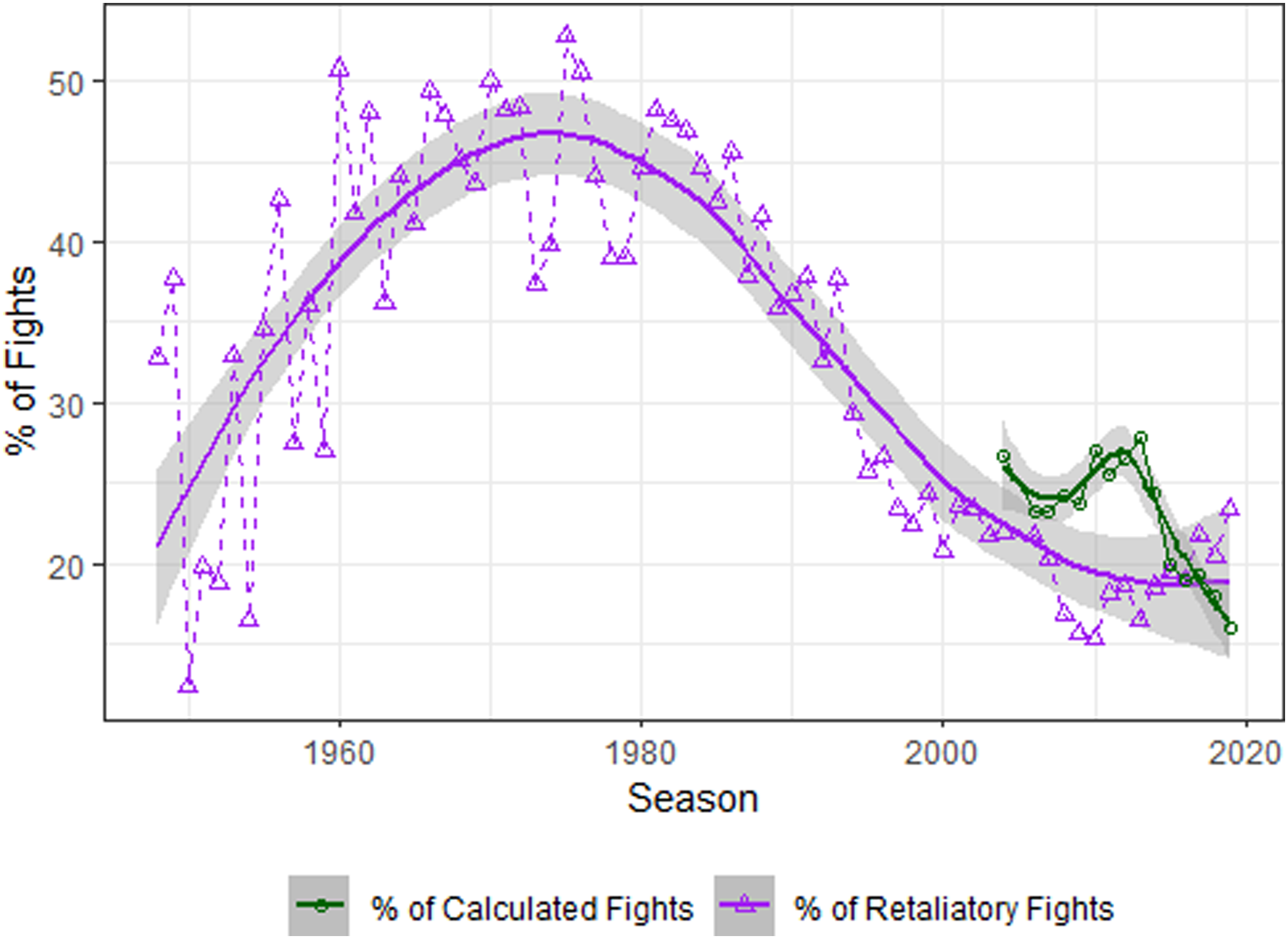
Distributional analysis and the emergence of the enforcer
The emergence of specialized fighting behavior is detected through substantial changes in how fighting incidents are distributed across players. Just as the frequency of fighting and its relationship to other in-game events has changed over time, the distribution of fighting across players has shifted drastically. There have been two main changes to this distribution over time, both of which support the notion that fighting has become more specialized. First, a larger portion of fighting penalties are concentrated in the hands of a smaller number of players. Second, fighting behavior has become negatively correlated with scoring behavior. These trends are illustrated in Figure 3 which shows the Gini Coefficient for fights (adjusted for differences in games played by each player), and the Kendall Correlation of rates of fighting per game and scoring per game for each season from 1947–2019. In the mid-1980s there is a clear acceleration towards both (1) specialization: fighting becomes inversely correlated with scoring, and (2) concentration: fighting becomes concentrated in the hands of only a few players. Somewhat surprisingly, this change occurs most rapidly during the 1980s, when fighting is most deeply embedded in the fabric of the National Hockey League. Changes in the concentration of fighting among players (Gini coefficient) and the specialization of fighting with scoring abilities (Kendall correlation) from 1947 to 2019.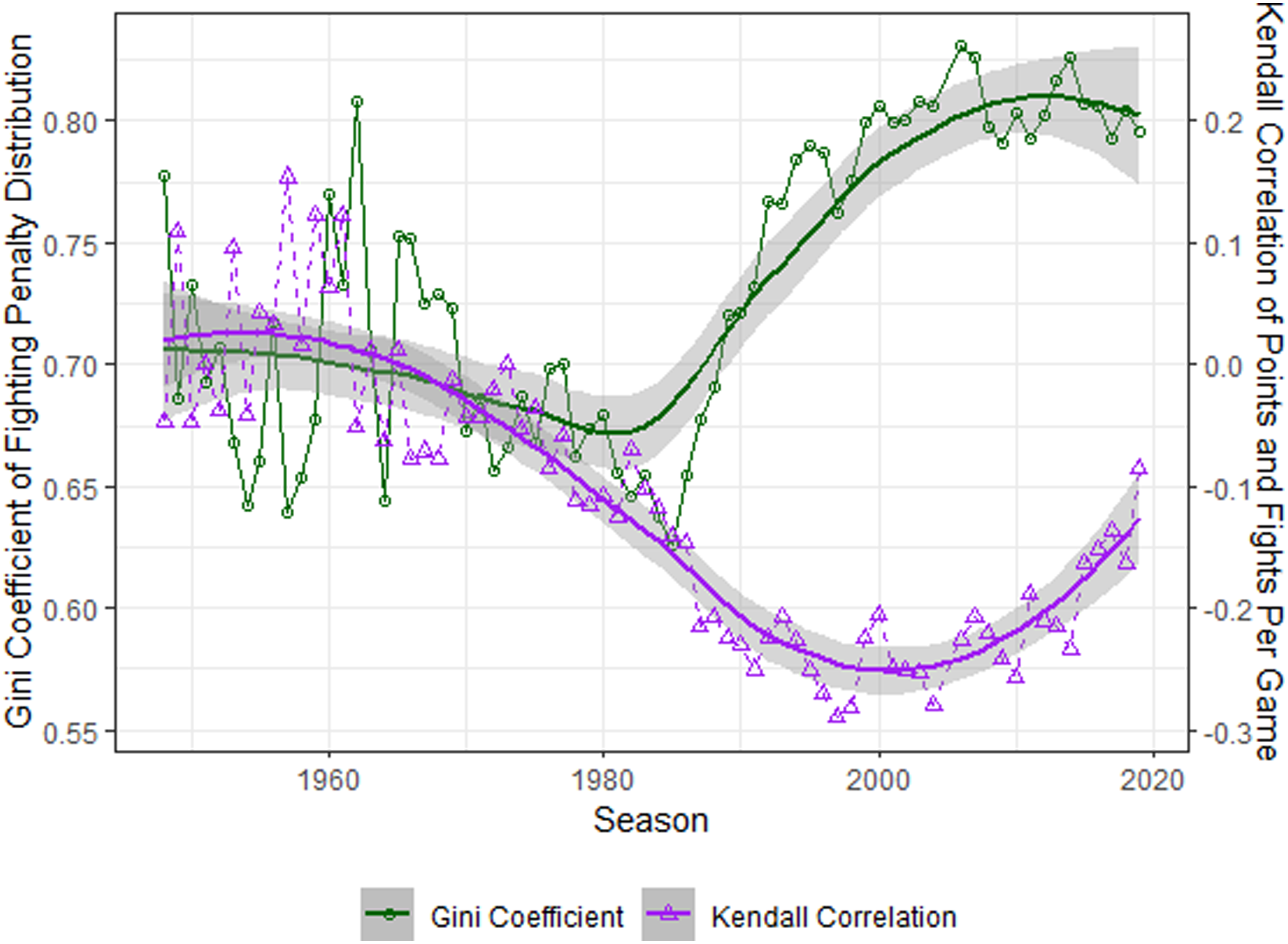
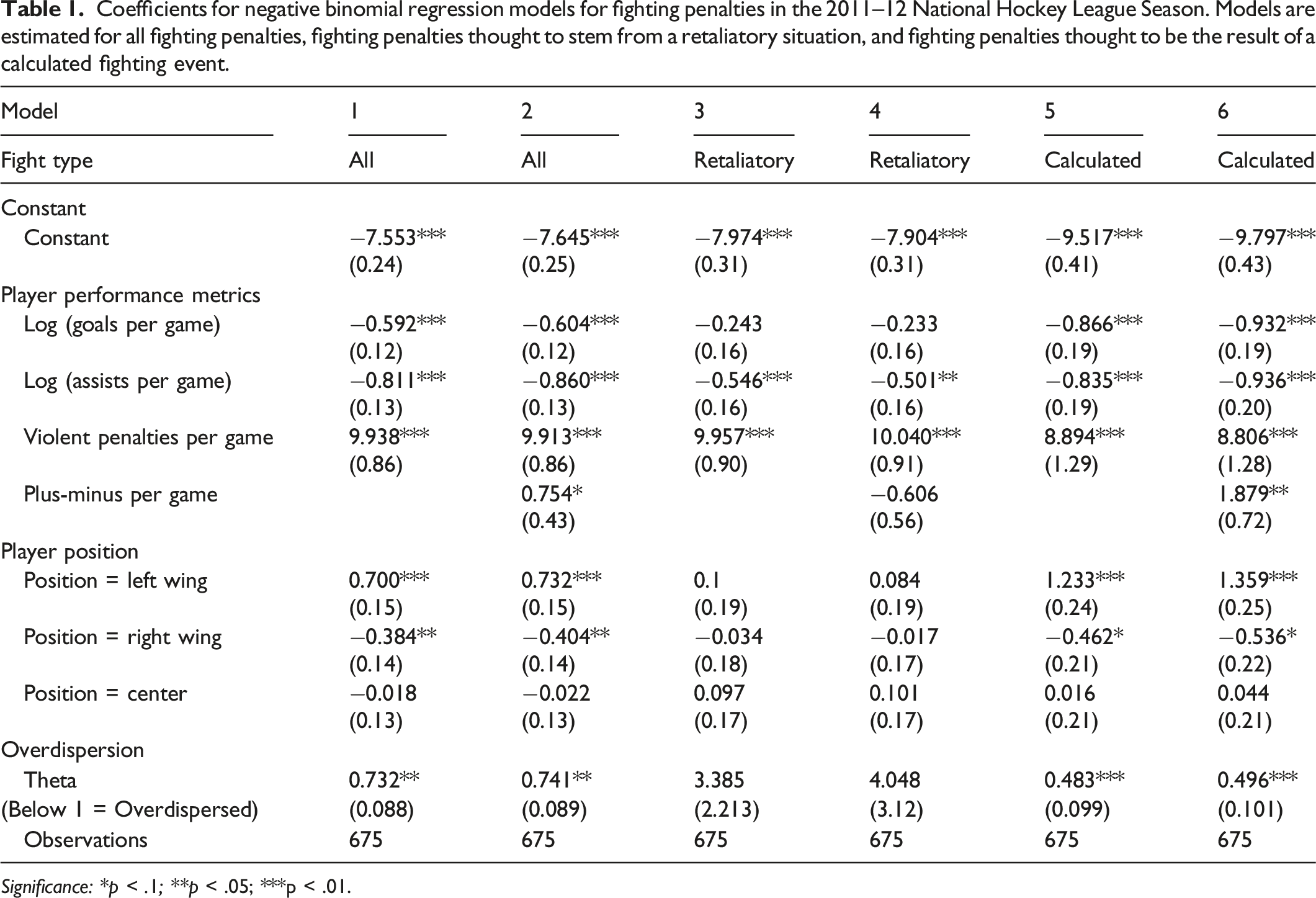
Separate sets of negative binomial regression models are estimated for each individual season to examine how fighting is a function of traditional measures of player success (goals, assists, plus/minus rating) and the rate at which players commit violent penalties, while holding player position (left wing, right wing, center, or defense – goalies are omitted) constant. The number of games played in a year is included as an exposure variable. Furthermore, separate sets of models are estimated for “retaliatory” fights, where fights occur at the same time as another violent penalty, and “calculated” fights, where fights occur within 10 s of a playoff. “Calculated” fights are only estimated for seasons from 2004 to 2019, when data on the timing of face-offs is available. Players who have played in less than 20 games, players who did not record at least one goal or assist, and goalies (who rarely fight and have different sets of performance metrics), are all omitted from the analysis.
For each year, separate models are estimated for all fighting penalties, “retaliatory” fighting penalties, and “calculated” fighting penalties. Two models are estimated for each fight type, one with and one without plus-minus ratings (a metric used to measure defensive success available from around 1960 onwards). The inclusion of binary variables for player position, as well as a defensive metric for success, account for the alternative explanation that fighting and violent play may be more concentrated in designated positions that are less inclined towards scoring goals and assists. The full form of the negative binomial regression models (including the plus-minus (+/−) term) estimated for each season can be expressed as

Negative binomial models also estimate an overdispersion term to account for whether variance in the fighting rate differs from the mean (the expectation in a standard Poisson model).
Figure 4 displays results in terms of the predicted number of fighting penalties for “high-skill”, “medium-skill”, and “low-skill” players for any given season and type of fight. Each of these six models for one season (2011–12) is shown in Table 1, and graphical summaries of all model coefficients across all years are included in the online Appendix, Section B. “High-skill” players are hypothetical players who have log-transformed goal-scoring and assist-scoring rates that are two-standard deviations above average, “medium-skill” players have average scoring rates, and “low-skill” players are two-standard deviations below average. Each hypothetical player has a mean-level of violent penalties, participates in 80 games, and is a ‘center’. As expected, the predicted number of fights is much higher for low-skill players. Furthermore, this tendency has a longitudinal component, with differences becoming more pronounced from roughly 1970 to 2000. Furthermore, we see that these differences are muted for fighting penalties given for “retaliatory” fights and exaggerated for fighting penalties given for “calculated” fights. This finding shows that specialized fighters are more likely to participate in premeditated fights immediately after play resumes. Enforcers do not only fight more and score less than their teammates, they also tend to participate in fundamentally different types of fights. (a) (Top) shows the predicted number of fighting penalties per 80 games and retaliatory fighting penalties, with 95% confidence intervals, for hypothetical high-skill, medium-skill (average), and low-skill players, based on two series’ of negative binomial models from 1947 to 2019. (b) (bottom) compares models for retaliatory and calculated fighting penalties from 2003 to 2019. Coefficients for negative binomial regression models for fighting penalties in the 2011–12 National Hockey League Season. Models are estimated for all fighting penalties, fighting penalties thought to stem from a retaliatory situation, and fighting penalties thought to be the result of a calculated fighting event. Significance: *p < .1; **p < .05; ***p < .01.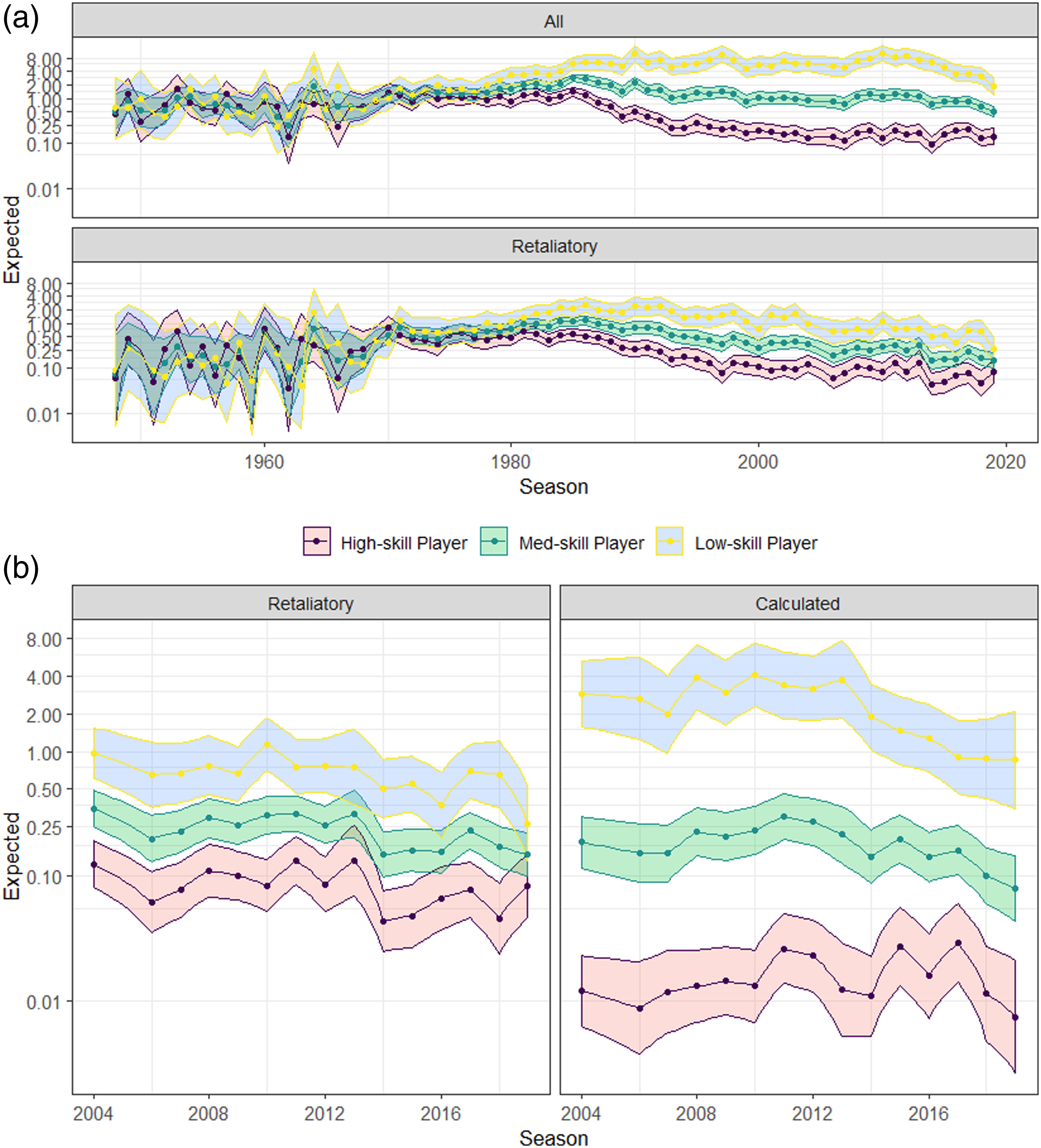
Pairwise and network analysis of fighting interactions
The evidence of enforcer specialization provided and prior research on status and conflict suggest that there should be meaningful patterns in who fights whom. Players who fight frequently should be disproportionately likely to fight one another, especially after the onset of specialized enforcement. To assess this, individual fighting penalties in the play-by-play dataset are transformed into a set of fighting pairs. A pair is identified when exactly one player on each team receives a fighting penalty at the exact same time in a game. Across 71 seasons of data there are 25,576 such pairs.
Two analyses confirm this tendency. At the dyadic-level, Kendall correlations in the fighting rates and scoring rates of opposing pairs of fighters are calculated. Once again, players who are in less than 20 games, have no goals or assists, and goalies are all excluded from analysis. The results for each season are plotted in Figure 5(a). In accordance with prediction, these correlations increase over time alongside the onset of specialization (from roughly 1970–2000). (a) (Top) displays the Kendall correlation of fighting pair scoring rates and fighting rates by season. Over time player rates more closely resemble the rates of their fighting opponents. Similarly, the bottom panel (b) shows exponential random graph model coefficients for the absolute difference term of fighting rate percentiles. More negative values indicate that, all else equal, fights are more likely between players with similar fighting tendencies.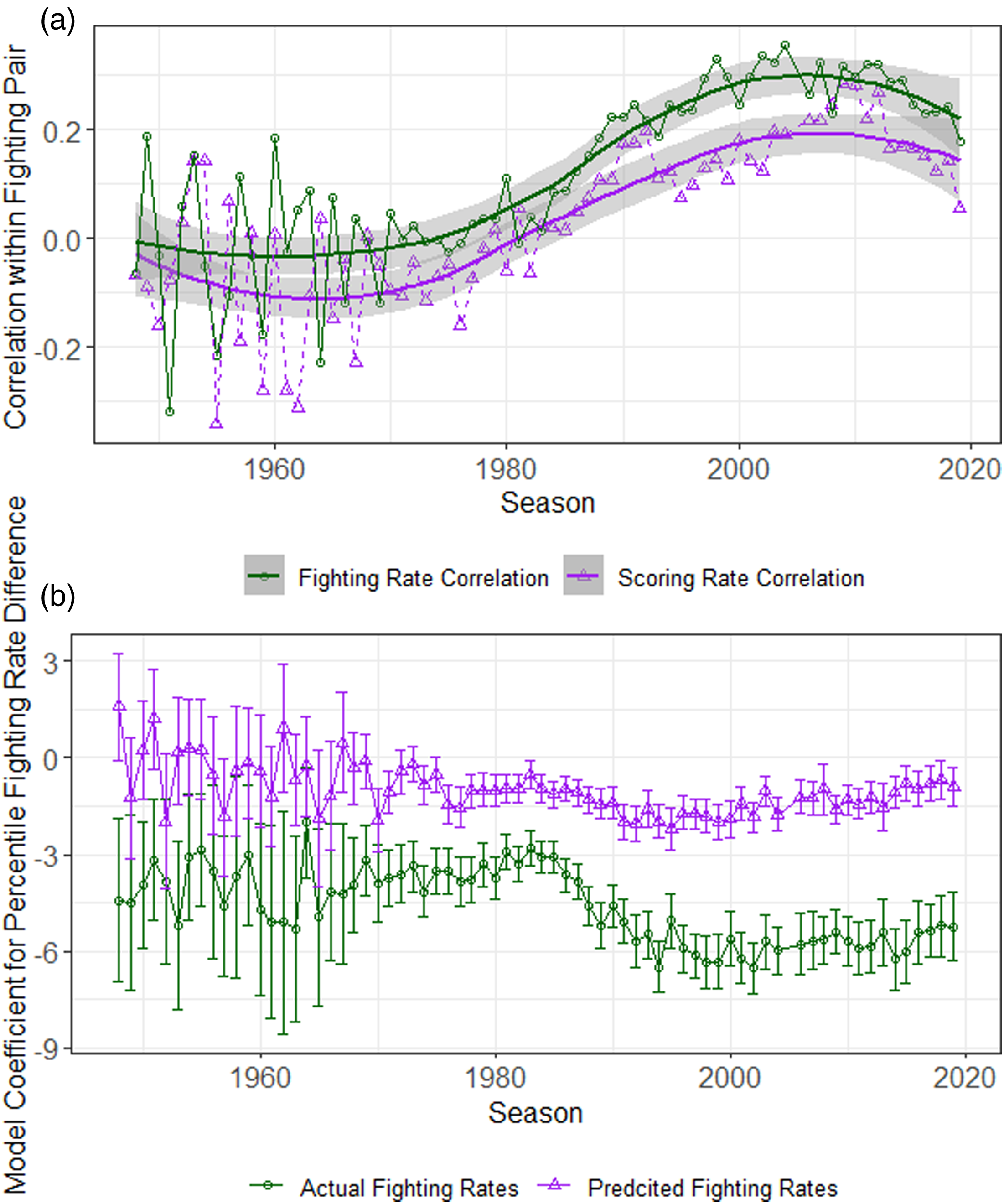
Each seasonal set of fighting pairs is also transformed into a large social network, as network analysis methods allow us to better account for the non-independence of fighting pairs (descriptive statistics for each network analyzed are provided in the online Appendix, Section D). Two sets of exponential random graph models (ERGMs), which estimate the predictors of edge (fight) formation given the properties of nodes, the properties of dyads, and structural features of the networks (Robins et al., 2007) are estimated for each seasonal fighting network.
The likelihood of each edge in the fighting network forming is estimated as a function of five elements. The first is a baseline constant for edge formation that will vary from year to year. This accounts for seasonal changes in overall fighting rates. The second is a term accounting for the number of isolates in any given network. The third is the fighting rate of each player, which absorbs variance in edge formation at the level of the nodes. Two sets of models are estimated. One where the fighting rate is simply the observed number of fights per game for each player, and another where set is estimated using the fighting rates are predicted for each player from the previously estimated negative binomial models. This allows us to separately consider both the observed level of fighting behavior, and a player’s predicted tendency towards fighting behavior given their skill and proclivity towards violent behavior. The models using ‘predicted’ rates of fighting act as a robustness check, to see how and if results hold when we do not use fights as both a component of a nodal predictor and the dyadic outcome of interest. The fourth, and the key variable of interest, is the difference in fighting rates (actual or predicted), between the two players. A large negative estimate for this coefficient indicates that players with vastly different fighting rates are very unlikely to pair up with one another. Differences in fighting frequency are expressed in terms of percentile-rank of fighting rates, making these terms independent from year-to-year changes in fighting distributions across players and comparable across models. Finally, a term for geometrically weighted edgewise shared partners (GWESP), a “curved” term (Hunter and Handcock, 2006) which broadly accounts for the level of triangle formation in the network, is included to account for the fact that opportunities for interaction may cluster along the lines of division or conference in certain years given the schedule of matches between teams. 2 Maximal likelihood estimations yield coefficients for each of these five parameters. These coefficients broadly inform the likelihood of any given edge being present, given the properties of the nodes and the presence of other edges in the network. For example, higher positive values for the isolates coefficient suggests that a network has a higher number of isolates than expected by chance given other features, but negative values for the absolute difference in fighting rate percentile coefficient indicate that ties are unlikely between nodes with different fighting rates compared to what we would see given the other features. (For more detailed examples of ERGMs in social networks, see Goodreau, 2007; Goodreau et al., 2009).
Coefficients for exponential random graph models for fighting edges in the 2011–12 season. The first model uses the actual number of fighting penalties given to each player and actual differences in fighting rates to estimate the likelihood of edge formation, the second model uses the numbers of fighting penalties predicted by the negative binomial models.
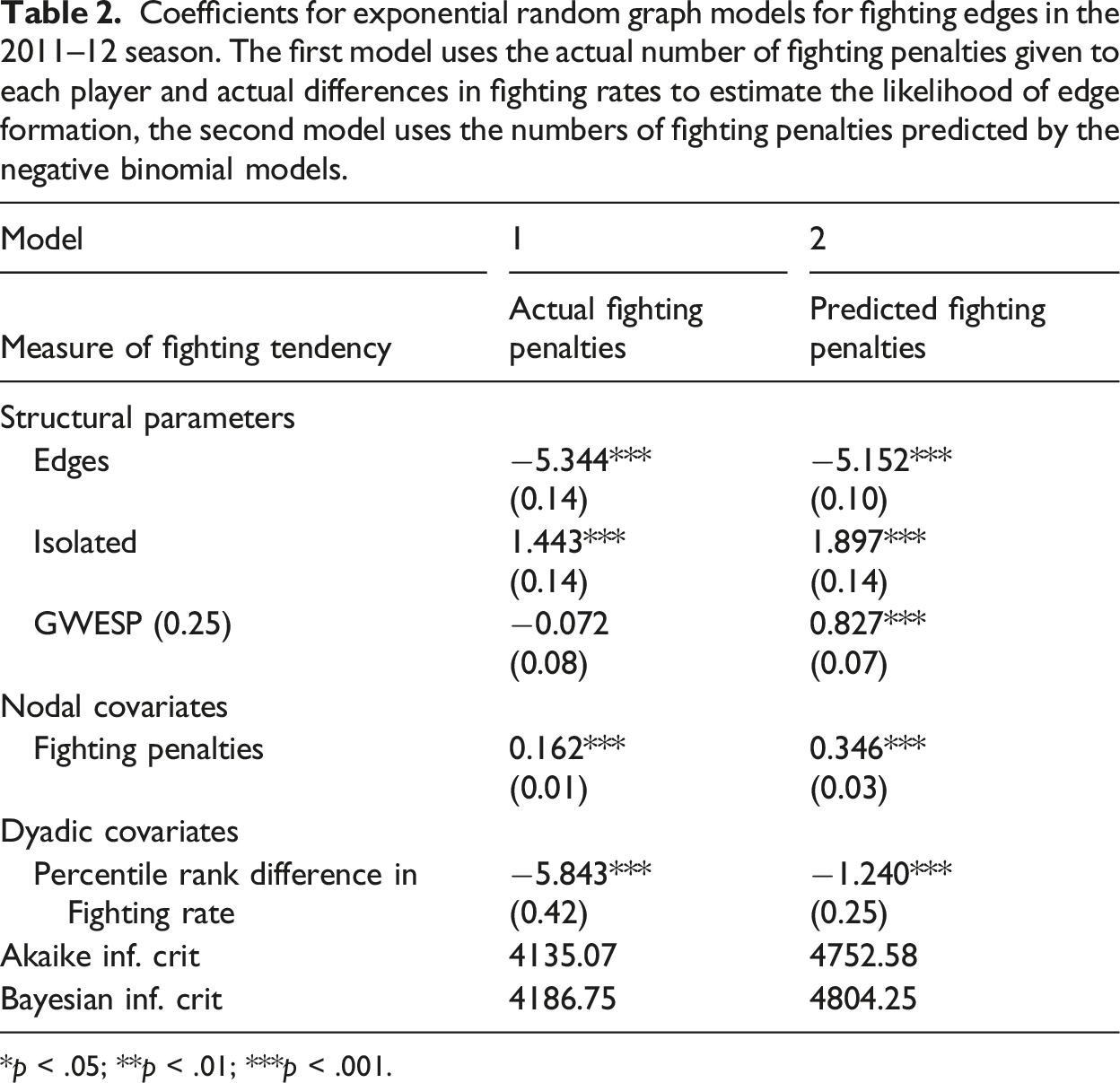
*p < .05; **p < .01; ***p < .001.
In summary, dyadic similarity in fighting rates (a proxy for enforcer status), is a large positive predictor of whether two players will fight. Probabilistically, enforcers should fight one another frequently given their collective proclivity to fighting behavior, but the ERGM coefficients reveal an additional level of attraction between enforcers and/or avoidance between enforcers and non-enforcers.
Calculated fights among enforcers and network visualization
Visualizations of the broader fighting network better illustrate how the situational, distribution, and interactional changes are intertwined. Prior models of fighting penalties per player and seasonal fighting networks suggest that the fighting network will have a dense core of enforcers/low-scoring players and a sparse periphery. It is also expected that the edges closer to the core of fighting networks will contain a higher rate of “calculated fights”, given that enforcers should appear more frequently in the center of the network, enforcers participate in more calculated fights, and enforcers should have sufficient career-driven motivation to fight one another.
Figure 6 provides a multi-paneled network visualization of fighting pairs during a 7-season period from 2005 to 2012, between the NHL labor disputes of the 2004-05 and 2012-13 seasons and when enforcer specialization is near its peak. The network includes 1306 players (goalies, players with no goals or assists, or players with less than 20 games during this period are again omitted) and 3891 fighting pairs. Network visualization focuses on the largest connected component, which contains 700 players and 3576 fighting pairs. Figure 6(a) shows the network layout with edges repressed to better highlight the nodes. It reveals the predicted core-periphery structure, with the core being mainly comprised of players who have lower scoring rates. (a) (top) -The largest connected component of the fighting network from 2005 to 2012, edges are repressed, and nodes are colored according to their percentile scoring rank. (b) (bottom) - the largest component of the fighting network with an identical layout to 6(a), but with nodes repressed instead of edges. (c) Fighters are divided into five adjusted quantiles based on fighting rate per game. Each cell shows the number of fights occurring between quantiles in parentheses, with squares sized proportional to fight counts and colored according to the percentage of calculated fights.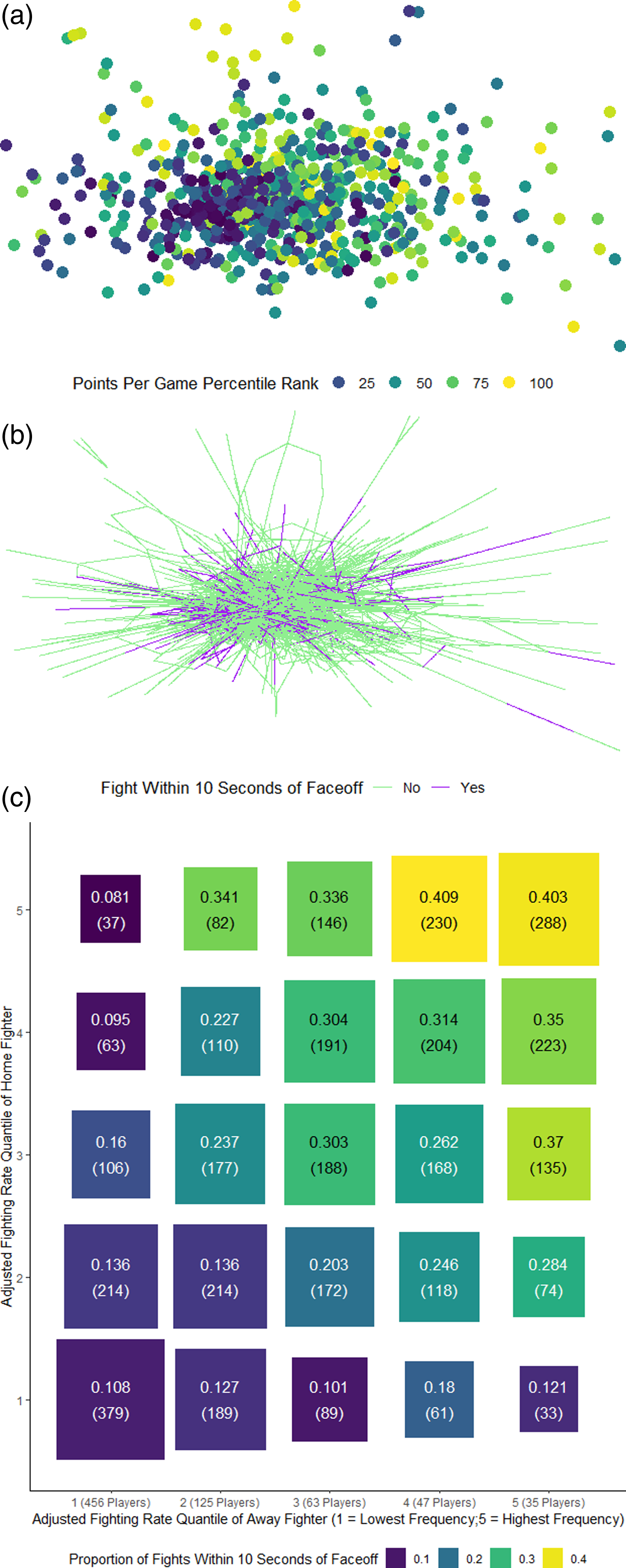
The network visualization in Figure 6(b) has the same layout as the network in Figure 6(a), but nodes are repressed instead of edges. The 963 edges (25.5% of all edges) that represent a “calculated” fight are highlighted in purple and are located disproportionately in the core. This is illustrated more clearly in Figure 6(c), which shows a tabular classification of fights based on the fighting rates of both fighters. Fighters are assigned to one of five adjusted quantiles based on their fighting rates, such that the players in each quantile participate in roughly 20% of the fights observed. The size of each square is proportional to the number of fights between members of each quantile. Each square is colored according to the percentage of those fights that are within 10 s of a faceoff. Confirming earlier findings, the squares along the diagonal of the graph tend to be larger than squares that represent lopsided matchups. Furthermore, the squares towards the top right corner of the heat map are lighter in color, again showing that fights between enforcers are more likely to occur after a faceoff.
In summary, from 2005 to 2012, enforcers tend to score less than their teammates, tend to fight one another, and are more likely to fight in a calculated manner. Specialized enforcement led to the emergence of a separate status contest populated by some of hockey’s otherwise least skilled players.
Discussion
On 9 January 2007, Eric Godard of the Calgary Flames and Derek Boogaard of the Minnesota Wild lined up across from one another during a face-off at the Calgary Saddledome, 1 minute and 26 seconds into the second period. Immediately after the puck is dropped, both players drop their sticks, fling off their gloves, and begin to exchange punches. On the television broadcast, one announcer declares: “And now we got a fight at center ice, the guys we’ve waited all night for, Boogaard and Godard, two former Western Hockey Leaguers that can be tough …. Eric Godard coming up from Omaha, there’s not a lot of reasons he’s here but to kinda watch over what the big guy from Minnesota is (doing) is one of them.”
The other announcer adds that the two players talked during the pre-game warm-up, and a slow-motion replay of the face-off then shows the two players discussing something, presumably the upcoming fight, right before the puck was dropped. After the fight concludes, a visibly dazed Boogaard skates to the wrong penalty box at first, and then eventually skates off to the locker room. 3 Eric Godard played 17 games for the Calgary Flames and 29 games for their main minor league affiliate, the Omaha Knights, that year. He participated in eight fights for each team, scored only two points for Calgary, and nine for Omaha. Boogaard played 48 of 82 possible regular season games for Minnesota, in which he earned one assist, no goals, and participated in 13 fights.
This is a prototypical example of a “calculated” fight between two big-name enforcers, and reinforces the story that hides in plain sight in the NHL’s play-by-play data. The shifting situational, distributional, and interactional nature of fighting reflect the ritual’s transition from a shared cultural norm to a specialized practice. While fighting originated as an arguably necessary and decentralized form of peer sanctioning, it proliferated as the game became more violent, and then concentrated in the hands of low-skilled players over time. The relational and temporal signature of these fighting interactions suggests that specialization fundamentally changed the nature of the ritual: peer-sanctions serve the function of allowing enforcers to signal their worthiness of membership on their team and in the league more generally.
While the career benefits (and hazards) of fighting certainly influence player decision making, other patterns, behaviors, or mechanisms at the organizational level may supplement this explanation. Fights that appear calculated may in some cases reflect incidents that happened much earlier in the game, or even in a prior game. Enforcers could stand in for other violators on their own team. Enforcers could receive implicit pressure from coaches or teammates to fight to signal toughness to the opposing team, or to other teams in the league more generally. There is likely some truth to each of these alternative mechanisms, all of which are worthy of further examination. Future quantitative work linking fights to past interactions between players or that can measure the deterrence value of having enforcers would illuminate these mechanisms further, as well as more ethnographic studies of the understood logic of fighting from the perspectives of enforcers, other players, and coaches.
The identification of additional mechanisms would not alter the fact that accumulating status as an enforcer appears to be a beneficial move for individual players. Analysis of data from Canadian Junior Leagues, which feature 16–20 year old players, shows that players who fight more are more likely to eventually earn spots on professional rosters (Sirianni 2019). Fighting at higher frequencies is not only rewarded, the notion of the enforcer has also been romanticized by many in the sport. One former player and high-ranking employee of an NHL franchise penned the following explanation in a USA Today opinion piece:
“But our game is improved tremendously by players' ability to police the game. It makes it more exciting and honorable. It allows skill players to focus on the skilled aspects of the game because someone else can watch their back. And it fundamentally makes our game safer.” (Burke 2013)
Enforcers are also highly regarded in fictional depictions of the sport: the recent ‘Goon’ movies (released in 2011 and 2017) center around a player filling the enforcer role for his teams, and the ongoing hockey-centric Canadian television programs ‘Letterkenny’ and ‘Shoresy’ repeatedly acknowledge the importance of having enforcers on a roster and the honor that role carries.
Beyond the world of ice hockey and the culture that surrounds it, the results presented in this article both support existing accounts of peer-punishment and collective sanctions and generate new directions and hypotheses for research on governance and social control. The shifting specialization and concentration of enforcement over time confirms what is expected from work on designated sanctioners and centralized punishment. These systems are found to be both more popular and more effective in experimental settings, and while it should therefore not be surprising that they have become commonplace in the NHL, it is still valuable to see that specialized sanctioning regimes take hold in a data-rich and “real world” environment. The exact causes of this shift in the nature of fighting are beyond the scope of the paper, but it is likely explained in part by a rapid expansion in the size of the NHL in the late 1960s, opening the game to more violent players, followed by a rapid increase in the availability of more skilled players from outside of North America in the 1990s, which concentrated violent play in the hands of a smaller number of players. This trend was an organizational strategy adopted largely in parallel by the member teams of the National Hockey League. This transformation is explained and analyzed in more detail in the online Appendix, Section A.
The case of ice hockey is unique in that it presents a larger problem of collective action, where the net public good is essentially the profits that are generated by a game that is fast and entertaining but free from injury and dangerous play. Fighting, while a violent act in and of itself, may deter other forms of violent play that diminish the game by endangering otherwise talented and entertaining players. This type of play, while hurting the game overall, may still confer more rewards upon the violent player and their team if it increases their odds of winning. It differs from conventional collective action problems, however, because being a member of a National Hockey League roster is not unconditional. Teams are incentivized to select high-skill players who play well or players who punish and deter violent and dangerous play that may provide one team or player an advantage at the expense of others’ safety. Over time, selectivity and excludability enabled member teams to develop a specialized approach to dealing with the perennial question of “who fights” in intergroup conflict. Fighting becomes less of a dilemma than costly out-group punishment is in traditional models of intergroup conflict (Bornstein, 2003). In fact, the rewards of team membership are strong enough that players may fight one another when it is unnecessary.
The collective action problem at the level of the team exists in a parallel form at the level of the league. Skilled players and skilled play are the primary way that teams maximize their success and the league maximizes its popularity, but skill may be vulnerable to dangerous or predatory play. Dangerous and aggressive play can offer advantages for team success and game popularity but left unchecked will damage the overall talent pool of the league. Fighting is a permitted ritual that allows for the sanctioning of such play, and enforcers have become a solution for organizations to offer the threat of sanctions without sacrificing too much skill.
The primary theoretical feature that distinguishes this case from current experimental research (games in laboratories) and theoretical research (formal mathematical modeling and agent-based modeling) is the inherent excludability of individuals from the resource pool. This threat of exclusion turns what might otherwise be considered altruistic sanctioning into rational behavior for certain individuals. Future models or experiments of social control may be wise to consider what happens when a popular consensus or designated agent can choose to exclude or “swap out” members of the population who are not perceived to be contributing. This could become more pronounced if heterogeneity is induced in agents, making them more efficient in their ability to contribute to public resource pools or sanction others. This would serve to generalize the findings beyond the unique organizational contours and contextual features introduced by the National Hockey League and the game of ice hockey. More generally, this case serves as a rational choice parallel to biological and hormonal (De Dreu et al., 2010) and socio-cognitive (Mäs and Dijkstra, 2014) explanations of how intragroup cohesion may inherently generate intergroup conflict.
The findings here also may inform empirical studies of deadly interpersonal violence. Prior studies of vendettas and gang violence note how individuals may commit violent acts to signal group solidarity to another group or seek revenge against another group (Gould, 2000; Papachristos, 2009) The results here suggest that violence may also be committed by individuals trying to establish membership in their own group. Violence may not only serve as a way for groups to signal their toughness to one another, it can be a signal of member value within groups. Members may accumulate status by participating in violent acts, particularly if they are otherwise seen as less valuable members of their group.
Another interesting problem highlighted in this case is what happens when sanctioning itself is rewarded. In contexts of both formal and informal control, problems stem from rewarding punishers, from receiving moral and social rewards for “call-outs” and “take downs” on Twitter (Bouvier, 2020) to for-profit prisons bribing judges for stronger sentences. 4 Those who are employed as agents of social control may have an added incentive to sanction explicitly. While in the case of ice hockey enforcers may advertise this ability by sanctioning one another, other agents of social control will likely not pick one another as targets. Criminologists and scholars of policing may be wise to build upon prior studies of how organization structure effects officer discretion (Chappell et al., 2006) and examine how rates of employee turnover and promotion criteria influence rates of officer enforcement.
Conclusion
The changing nature of fighting in the National Hockey League provides unique insights both on how informal systems of social control can subtly evolve over time, and how the nature of second-order collective action problems may change when the community is elite or selective. In other words, this is a rare look at what happens when sanctioning and punishment is necessary for certain people to retain membership in a community. While most research on peer-sanctioning considers group membership to be fixed and punishment to be an unwanted burden, the case of ice hockey and the NHL empirically demonstrates how informal social control may operate in a regime where group membership is a privilege, and the responsibility of punishment operates as an opportunity for those who might otherwise find themselves excluded.
Supplemental Material
Supplemental Material - The specialization of informal social control in a selective community: Fighting in the National Hockey League from 1947 to 2019
Supplementary Material for The specialization of informal social control in a selective community: Fighting in the National Hockey League from 1947 to 2019 by Antonio D Sirianni in Rationality and Society.
Footnotes
Authors’ note
Earlier versions of this work have been presented at the 2015 Conference for the International Network of Analytical Sociologists in Cambridge, Massachusetts, and the 2016 Meeting of the American Sociological Association in Seattle, Washington.
Acknowledgements
The author wishes to thank Benjamin Cornwell, Thomas Davidson, Daniel Della Posta, Josh Alan Kaiser, Sunmin Kim, Michael Macy, and Kimberly Rogers for helpful comments and suggestions.
Funding
The author(s) received no financial support for the research, authorship, and/or publication of this article.

Supplemental Material
Supplemental material for this article is available online.
Notes
References
Supplementary Material
Please find the following supplemental material available below.
For Open Access articles published under a Creative Commons License, all supplemental material carries the same license as the article it is associated with.
For non-Open Access articles published, all supplemental material carries a non-exclusive license, and permission requests for re-use of supplemental material or any part of supplemental material shall be sent directly to the copyright owner as specified in the copyright notice associated with the article.
