



Abstract
Caused by perceived norm violations, online firestorms confront organizations with large volumes of hostile-emotional comments on public social media leading to a damage to reputation or the cancellation of products and projects. Relying on social norm theory we analyze how people express perceived norm violations in their online comments and how this relates to their use of hostile-emotional online sanctions. We distinguish negative externalities; propriety judgements; excess of zeal, which combines negative externalities with propriety judgements; and no justification, meaning no speculations about why norm violations occurred, as four types of motive for hostile verbal expression. Using hostile-emotional sanctioning is differently associated with these motives: (1) weak association with negative externalities to maintain credibility; (2) moderate association with propriety judgements as a result of altruistic punishments; (3) moderate association with no justification, triggered by arousal; and (4) strong association with an excess of zeal because norm enforcers believe that a latent group exists which rewards them with positive sanctions for working toward the common goal and punishes them with negative sanctions for shirking. We analyze one specific online protest signed by 305,122 people that led to a massive hostile-emotional firestorm against an organization. We find that 37% of the 44,173 individuals who additionally commented their protest participation were hostile and/or emotional. As predicted, we find that compared to the other motives, the excess of zeal is most likely to motivate hostile-emotional sanctions. Overall, our theory and findings explain why most online firestorms are hard to stop: with an excess of zeal, a latent group of norm enforcers must be appeased.
Keywords
Introduction
The Internet and social media have changed the balance of power between the public and organizations significantly. Social media enable customers, employees, suppliers, citizens, and other stakeholders to express opinions and judgements about an organization at any time and at low cost. In extreme cases, this leads to online firestorms, in which organizations are confronted with large volumes of complaining and hostile-emotional comments on public social media (Pfeffer et al., 2014; Rost et al., 2016). Hardly any large organization has been spared in recent years, and many fear the potential harm of being targeted. A prominent example is that of Nestlé. On the morning of 17 March 2010, Greenpeace launched a broad-based international campaign against Nestlé showing a gory parody of a KitKat advert. Many of Nestlé’s products, such as the KitKat chocolate bar, used Indonesian palm oil from illegal deforestation, which threatens the orangutans living there. Nestlé did not like the parody that showed a KitKat made of bloodstained ape fingers. On the same evening, the video disappeared from the social media platform, allegedly for copyright reasons. This is the ideal climate for an online firestorm: waves of anger, insults, and rage started to sweep through social media, including online petitions, the temporary closure of Nestlé's Facebook page, and calls for a boycott.
The example shows that online firestorms are highly dynamic phenomena, making them challenging for organizations to predict and react to appropriately and, moreover, difficult for scientists to explain. Common to all online firestorms is that the trigger is an accusation of a specific misbehavior, regardless of whether this turns out to be true, false, or exaggerated in retrospect. In some cases, this misconduct leads to moral outrage and contagion, i.e. the spread of moralized-emotional content (Brady et al., 2020) and hostility towards the organization in online networks. Despite the great deal of attention that online firestorms have received, less scholarly attention has yet been directed to how micro-level behaviors unfold in online firestorms and may fuel them. The organizational literature often regards online firestorms as an objective outcome independent of the micro behavior of single actors (Baccarella et al., 2018; Einwiller et al., 2017; Johnen et al., 2017; Pfeffer et al., 2014). The few studies analyzing micro behavior in online firestorms concentrate on the spread of negative word-of-mouth in social media and thus neglect the dynamics of thousands of other people not engaging in hostile comments (e.g. Brady et al., 2020; Hauser et al., 2017; Herhausen et al., 2019; Stich et al., 2014).
Therefore, we analyze how people express perceived norm violations in their online comments, and how this correlates with hostile-emotional online sanctions. We will focus on online protests because they regularly involve accusations of norm violations (i.e. a specific misconduct) as well as emotional and hostile content. We rely on social norm theory to develop a categorization of how supporters of online protests verbally express perceived norm violations in their comments and how these types correlate with the use of hostile-emotional online sanctions. We will distinguish four types of motive for hostile verbal expression: negative externalities; propriety judgements; excess of zeal, which combines negative externalities with propriety judgements; and no justification. We discuss which specific type of sanction behavior, whether less costly, non-hostile and non-emotional sanctions, more costly, hostile-emotional sanctions driven by altruistic punishments, arousal, or positive sanctions for working toward a common goal, should be expected for each type of motive.
We will examine a specific online protest that led to a massive storm of moral outrage against the organization. The analyzed protest attracted 305,122 petition signers. In total, 44,173 of these signers posted an additional online comment. Using qualitative manual text analysis and automated dictionary-based content analysis we find 16,219 of these comments contain hostile-emotional content. We further categorize the 44,173 comments to the different types of motive for hostile verbal expression and analyze the occurrence of hostile-emotional behavior in these motive types. Results show that comments motivated by an excess of zeal are by far most likely to be hostile-emotional. In contrast, comments solely pointing to negative externalities of the organization’s norm violation are least likely to be hostile-emotional. Our theory and findings suggest that the most intense hostile-emotional firestorms are characterized by norm enforcers who believe that a latent group exists which rewards them with positive sanctions for working toward a common goal and punishes them with negative sanctions for shirking. In this case, norm enforcement not only contributes to the interest of the norm enforcer but is also rewarded by others for helping to achieve a collective outcome. An excess of zeal is hard to stop because the interests of all latent group members are realized by the same outcome.
The enforcement of social norms in online protests
The enforcement of social norms through hostile-emotional online sanctions
Hostile-emotional behavior in social media, in extreme cases leading to online firestorms can be theoretically explained from a social norm perspective (Rost et al., 2016). Social norms are socially shared mental representations of appropriate behavior in society, are sustained by others’ approval and disapproval, and consequently guide our behavior (Elster, 1989; Guth and Napel, 2006; Homans, 1950; Opp, 2002; Parsons, 1964). They are consciously designed because they promote the provision of public goods (Diekmann and Preisendörfer, 1992; Fehr and Schmidt, 1999; Opp, 2002; Rost & Weibel, 2013). This is not to imply that social norms are always beneficial for all people concerned: many norms exclude certain groups because they promote the interest of a specific subgroup, for example of Greenpeace but not of Nestlé (Elster, 1989). Social norms need to be enforced by sanctions because otherwise rational, self-interested people do not contribute to the group interest (Olson, 1965). Sanctions can take different forms, for example, feelings of guilt and shame in the case of internalized social norms (Elster, 1989) and actual bilateral and multilateral costly punishments and normative demands (Opp, 2002; Posner and Rasmussen, 1999). This suggests that norm enforcement is a second-order public good: sanctioning behavior is costly, and people may prefer free riding (Opp, 2002; Posner and Rasmussen, 1999). The theory predicts that sanctioning behavior is more likely if norm enforcement is cheap (Diekmann and Preisendörfer, 1992; Rauhut and Krumpal, 2008), if norm enforcers benefit additionally (Olson, 1965; Opp, 2002), and if altruistic punishment occurs (Fehr and Gächter, 2002; Fischbacher et al., 2001; Nowak and Sigmund, 2005).
It follows that hostile-emotional behavior in social media can be understood as a form of sanctioning behavior of one group of actors in response to the perceived norm-violating behaviors of another group of actors (Opp, 2019; Rost et al., 2016). Hostile-emotional online sanctions enforce social norms, for example fairness or distribution norms, by expressing public disapproval with the aim of securing public goods, such as biodiversity, animal protection, honesty, or social responsibility. Moreover, the characteristics of social media contribute exemplarily to the solution of the second-order public good dilemma of norm enforcement. First, sanctioning behavior in social media is relatively cheap: online criticism is monetarily inexpensive, requires little time, can be performed anywhere and anytime without fear of bodily harm, and gives ordinary people the power to reach very large audiences (Dennis, 2008; Harrington and Bielby, 1995; Pfeffer et al., 2014; Suler, 2004). Second, social media benefit norm enforcers disproportionately, particularly in the case of the public scandals that often trigger online firestorms; clear benefits can be expected from norm enforcement due to cross-media dynamics. Cross-media dynamics ensure the rapid spread of norm violations on the Internet and thus provide for a potentially large group of people who are willing to take sanctions upon themselves. Third, the technical features of social media such as newsletters, newsgroups, followers, friends, and echo chambers ensure that altruistic punishment is reinforced by social networks (Brady et al., 2020; McAdam & Paulsen, 1993).
Motives for hostile verbal expression during online protests
People engage in hostile-emotional online sanctions because of perceived social norm violations. However, not all people who perceive norm violations sanction it with hostile-emotional comments. Compared to other forms of sanctioning behavior in social media, online hostility is a costly, “heroic” sanction—it breaks standards of civility, and may thus lead to monetary and social costs, such as fines, termination of contracts, negative press, or hostility from the offended group (Rost et al., 2016). Less costly, incremental sanctions in social media include, for example, signing an online petition and/or writing non-hostile and non-emotional critical comments. In the following, we analyze the verbal statements of people who support an online protest against an organization. How do these people express perceived norm violations in their comments?
We will focus our discussion on the specific design of the social media platform on which we test the hypotheses. On this platform, online petitions can be signed and, once signed, additionally commented on. There is no possibility to like or forward other comments, but previous comments can be read. Previous comments strictly follow the chronological order in which they were posted. In this respect there is the possibility of collective contagion, but there are no self-amplifying effects due to algorithms. The design suggests that all individuals considered have perceived a norm violation and have sanctioned it, at least by signing the petition. Whether they additionally comment on the norm transgression depends on their personal involvement. 1 We will distinguish four types of motive for hostile verbal expression: negative externalities, propriety judgements, excess of zeal, and no justification.
Externalities
A demand for social norms arises because an action has similar externalities for a set of people but no market in rights of control of the action can easily be established (Coleman, 1994; Diekmann, 2022; Hechter and Opp, 2001). Most cases of online protest are clearly driven by externalities because the action of an out-group, for example an organization, has positive externalities for this group, for example higher profits, but negative externalities for another group, for example dismissals, the limited use of music, the deforestation of the rainforest, the violation of human or animal rights or the detriment of biodiversity (Einwiller et al., 2017: 1181). One popular example was the online protest that hit Domino’s Pizza in 2009 after two employees filmed themselves playing with food in the restaurant’s kitchen and posted it on YouTube. Domino’s Pizza was accused of harming consumer interest in healthy eating (Park et al., 2012). In their comments, protest supporters may thus point out the negative externalities for other groups, for example, customers, employees, club owners, self-employed farmers, people in developing countries, animals, future generations, or residents (Tost, 2011).
Propriety judgements
Hostile comments in social media may be further driven by the desire to maintain or enhance social status (Brady et al., 2020). In particular in situations when out-group members pose threats to the moral values of an individual, out-group derogation is a common response to uphold a positive self-image (Brady et al., 2020; Branscombe et al., 1999). In their comments people may thus evaluate the actions of the out-group as not desirable, not proper, and not appropriate within their internalized systems of norms, values, and beliefs (Bitektine and Haack, 2015; Haack et al., 2020; Suchman, 1995). They may express their out-group rejection (1) by sociopolitical propriety judgements, i.e. normative evaluations about the outgroup, its practices, and outcomes as inappropriate and wrong, given existing norms and laws, 2 (2) by category-based propriety judgements, i.e. presenting the out-group as a stereotypical immoral entity by extending criticism to entities which they consider unpopular or disapprove of, 3 (3) by reputational propriety judgements, i.e. by including a set of attributes inferred from the out-groups past actions to describe its overall appeal and to anticipate its future behaviors, 4 or (4) by status-order propriety judgements, i.e. by attacking the institutionalized social rank of the out-group that generates privilege for it 5 (Bitektine et al., 2020; Suchman, 1995). These feelings of moral superiority reinforce social status and a positive self-image by derogating the out-group. 6
Excess of zeal
Commentators may point to the costs of the norm-breaking behavior for other groups (i.e. refer to negative externalities) and devalue the actions of the norm-breaking out-group (i.e. include propriety judgments). We assume that this is not just an additive effect but that people who combine both statements in comments have a very different motivation from those who comment only on externalities or propriety judgments. Such a specification of several reasons indicates the strength of this group’s concern with the organization’s norm violation. Indeed, the organization’s behavior not only affects their self-perception as moral individuals but also generates costs for other affected people. In this respect, commenting is not just a matter of maintaining personal status or informing society of the true costs but of personal guilt if no action is taken.
To take effective sanctions against the organization, it is advisable to share costs: The more people that can bear sanction costs, the more harmful the sanctions can be made (Coleman, 1994: Vol. 1, 283 et seq.). People may thus associate with others who have similar feelings because zealous activity, and thus cost sharing, can be expected in close social structures (Coleman, 1994: Vol. 1, 283 et seq.). For example, someone who both points to the exploitation and suffering of animals and morally condemns animal testing is very likely to associate with animal rights activists. This suggests that such people are likely to perceive themselves as members of a latent interest group, for example as animal right activists, environmental right activists, or vegans, and thus as motivated by the same outcome, for example to punish capitalist enterprises for their inconsiderate behavior and to obtain justice on behalf of exploited groups. In an online context, latent interest groups form quickly by sharing group accounts, homepages, discussion offerings, and so forth. (Heaney, 2014; Simpson, 2015).
Latent interest groups are likely to establish (a) norms that encourage all people to work for the same outcome, because each person’s interest is satisfied by the same outcome, and (b) negative sanctions for shirking and positive sanctions for working toward the common goal. This mechanism results in two sources of satisfaction for each individual when they work for the outcome: an individual’s efforts directly help to satisfy the individual’s interests and provide them with the rewards from others for helping to satisfy the others’ interests. It leads to excessive zeal because small costs unleash exponential benefits (Coleman, 1994: Vol. 1, 283 et seq.). One example of the exponential benefits of small costs is the positive encouragement and recognition of other environmentalists, which even motivates individuals to illegal acts such as chaining themselves to the highway or occupying company buildings. Online, rewards provided by others may take several forms: Latent interest group members may like and share the sanctions of like-minded people. Negative sanctions may attract a lot of attention and applause, be noticed by other supporters, be confirmed and expanded, and thus spread in other media or social networks.
No norm justification
Finally, comments may be not related to externalities and in-group threat. One possible reasons is arousal (Storbeck and Clore, 2008), so that there is a lack of attention and time for longer, explanatory comments. Arousal is triggered by instinctual reactions (Berger and Milkman, 2012; Lindquist et al., 2015). In a state of strong arousals, individuals are very reactive and particularly susceptible to external danger stimuli. However, mental and physical performance is no longer optimal. In this respect, the cognitive capacities for formulating complex trains of thought are often lacking. A poor justification of norm violations may be also explained by educational level: in the age of social media, where images, voice messages or automatic text suggestions are often used, more and more people may find it increasingly difficult to compose their own written text. This is especially true for people with lower education, who have to write only a few texts themselves after compulsory schooling (Verheijen et al., 2020). Furthermore, lower educated people often score poor in moral judgement competence (Lind, 1998) suggesting that it can be difficult for these people to express why they disapprove a behavior.
Motives for hostile verbal expression and strength of hostile-emotional online sanctions
In the following we discuss how the four motives for hostile verbal expression correlate with the actual use of hostile-emotional online sanctions.
We hypothesize that among having any of the four motives for hostile verbal expressions, individuals who point out the negative externalities of one group’s actions on other groups are least likely to use hostile-emotional sanctions. The factual reference to the violation of social norms of other groups becomes untrustworthy if this information is overwritten by emotional-moral feelings and language. Hostile statements themselves break social norms towards the group to which norm violations are pointed out, namely norms of civility.
We further expect that among having any of the four motives for hostile verbal expressions, individuals who articulate propriety judgements and consequently express out-group rejection are moderately likely to use hostile-emotional sanctions. Emotion expression in language, i.e. the usage of specific culturally and contextually defined concepts that represent underlying feelings defined by valence (Lindquist et al., 2015), is a reliably signal to others and to the self, that something is relevant to the interests of society. Moral-emotional outrage indicates that the expresser perceives some transgression against one’s concept of right and wrong has occurred (Brady et al., 2020; Rozin et al., 1999; Tetlock et al., 2000). Individuals thus engage in costly norm enforcement if they have an intrinsic desire to “make the world a better place” (Lee and Tedeschi, 1996; Salmivalli et al., 1996; Van Stekelenburg et al., 2011). This type of norm enforcement has been intensively discussed as “altruistic punishment”, i.e. individuals punish, although the punishment is costly for them and yields no material gain (Fehr and Gächter, 2002). Altruistic punishment help to overcome the second-order public good by strong negative emotions towards the norm defector (Fehr and Gächter, 2002; Fischbacher et al., 2001; Henrich et al., 2001) and by people’s perception of a state of affairs as illegitimate (Feather and Newton, 1982; Klandermans, 2003; Tajfel and Turner, 1979; Van Zomeren et al., 2004; Weiss et al., 1999).
Further, we expect that among the four motives for hostile verbal expressions, excess of zeal is most likely to motivate individuals to use hostile-emotional sanctions. When group identities are salient, people begin to experience and express emotions that are relevant to their interest group (Brady et al., 2020; Mackie et al., 2004). Moral-emotional outrage conforms with the group norm to work toward the common goal, for example by punishing the organization for their inconsiderate behavior and obtaining justice. The latent interest group encourages moral-emotional outrage by rewarding this behavior because it satisfies the interests of all group members. These rewards work through various channels, for example, through comments in the online petition platform that make positive reference, thanking or expressing similar views, through compliments from similarly minded friends, or by referring to the petition and one’s own opinion in the social media of the interest group, which in turn is liked and motivates other people to participate. When successful, this dynamic leads to an excess of zeal. People do not fear the potentially negative consequences of their hostile-emotional behavior but are instead rewarded for it by the group. They receive a great deal of appreciation and social status from the other group members for working toward the common goal. It overcompensates for the individual’s effort, even if the individuals themselves break other social norms. In this respect, individuals motivated by an excess of zeal should also comment more hostilely-emotionally than those articulating propriety judgements. Propriety judgments lead to altruistic punishments which benefit an individual but are not expected or rewarded by anyone. In contrast, excess of zeal occurs when a latent interest group works toward a common goal and the closed social structure is used to convert praise that is inexpensive for the individual into exorbitant recognition from the group.
Finally, we hypothesize that among having any of the four motives for hostile verbal expressions, individuals not justifying norm violations, i.e. who do not mention externalities or in-group threat in their comments, are moderately likely to use hostile-emotional sanctions. Such poor justification of norm violations can be explained by people’s emotional arousal, which leads them to verbally express only their emotional state, such as moral outrage, contempt, moral disgust, shame, elevation (Hutcherson and Gross, 2011), which in turn serves as input to others’ evaluation of the organization’s behavior in question (Brady et al., 2020). Arousal is triggered by instinctual reactions which not only include emotional-aggressive reactions about moral misconduct but also anger and contempt about incompetence (Hutcherson and Gross, 2011), for example, due to a lack of foresight on the part of the organization’s leaders. Anger and contempt about incompetence may not only be expressed aggressively, but also as a negative, critical observation (Hutcherson and Gross, 2011). Furthermore, instinctual reactions benefit the person but are not expected by anyone, whereas an excess zeal is expected and rewarded by a latent interest group. Another explanation is the educational level. The symbolic use of language differs along educational level with the use of swear words tending to be more common in lower-educated groups (e.g. Wachs et al., 2021). In the context of this study, however, education is a control variable, as the non-justification of norm violations and the use of insults are caused by common underlying third variables, such as social background. Subtracting the effect of education, we expect the non-reference of norm violations in comments to be associated with an increase in hostile-emotional online sanctions but lower as compared to people motivated by excess of zeal.
An empirical study of the GEMA firestorm
The GEMA firestorm
We analyze the petition comments made during a firestorm that hit the German Society for Musical Performing and Mechanical Reproduction Rights (GEMA) in 2012. The firestorm started with an online petition initiated by the Federal Association of Music Organizers, a registered association, protesting against GEMA’s announcement of a licensing fee scheme to be applied from 2013 onwards
7
. Figure 1 entails the petition text of the initiators in detail. Petition text of the initiators of the GEMA online petition. Source: OpenPetition. Gegen die Tarifreform 2013 - GEMA verliert Augenmaß. Retrieved 1 November 2020, from https://www.openpetition.de/petition/online/gegen-die-tarifreform-2013-gema-verliert-augenmass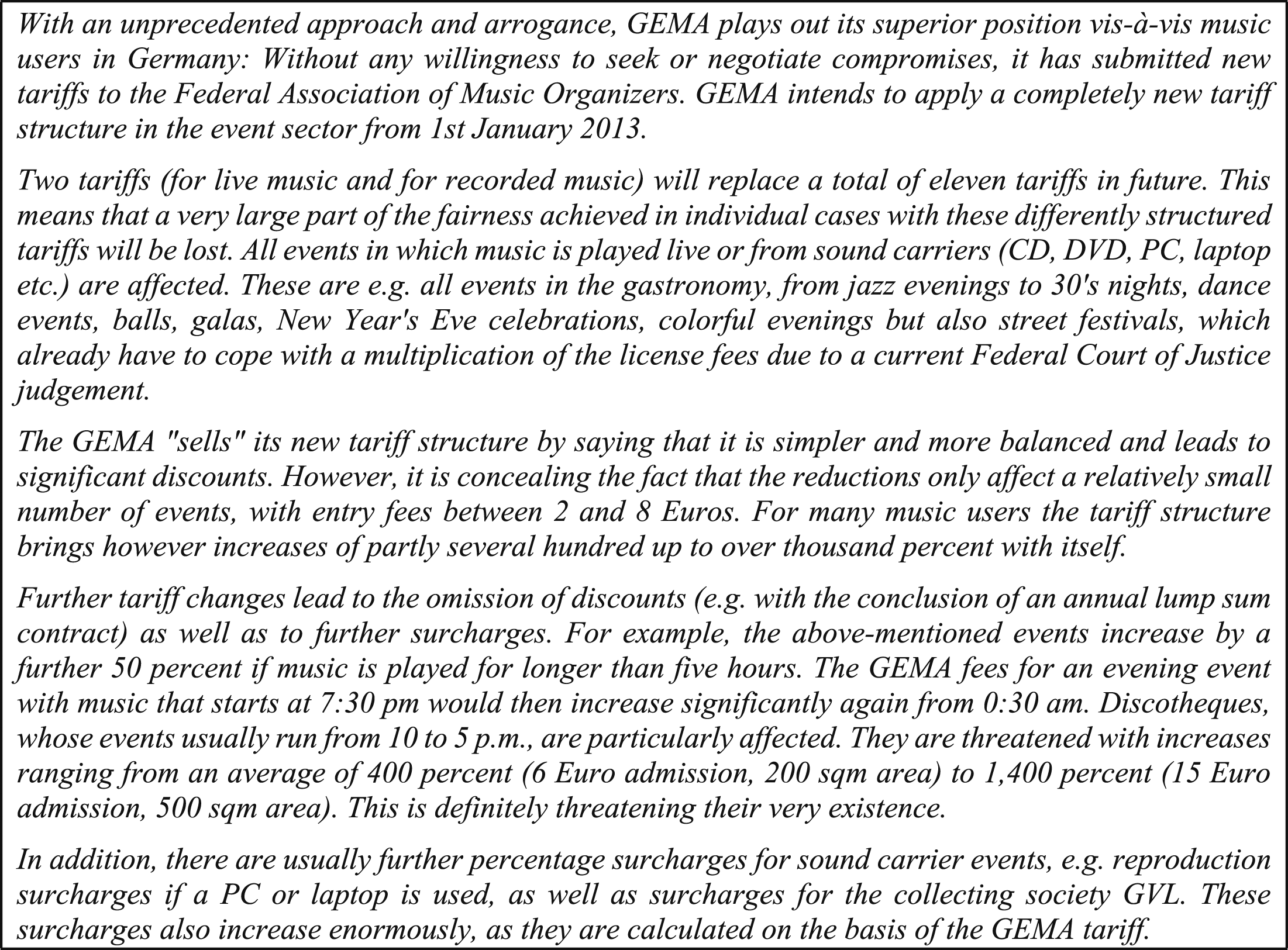
The GEMA petition attracted 305,122 signatures from all over Germany between April and October 2012 and was one of the largest petitions, measured by number of signers, on this platform. Signers came from approximately 9300 towns across all 16 German federal states. Figure 2(a) shows the number of signers during the GEMA petition process. The petition also attracted the attention of high-profile German news media and politicians and, like some other online petitions, developed into an online firestorm (Johnen et al., 2017; Pfeffer et al., 2014; Rauschnabel et al., 2016), in which GEMA was confronted with large volumes of complaining, emotional and hostile comments. In the GEMA petition, 44,173 online comments were submitted; 16,219 of these comments included hostile-emotional content. Figure 2(b) shows the number of comments made during the GEMA petition process. (a) Number of signers in the GEMA petition during the petition process. (b) Number of comments in the GEMA petition during the petition process.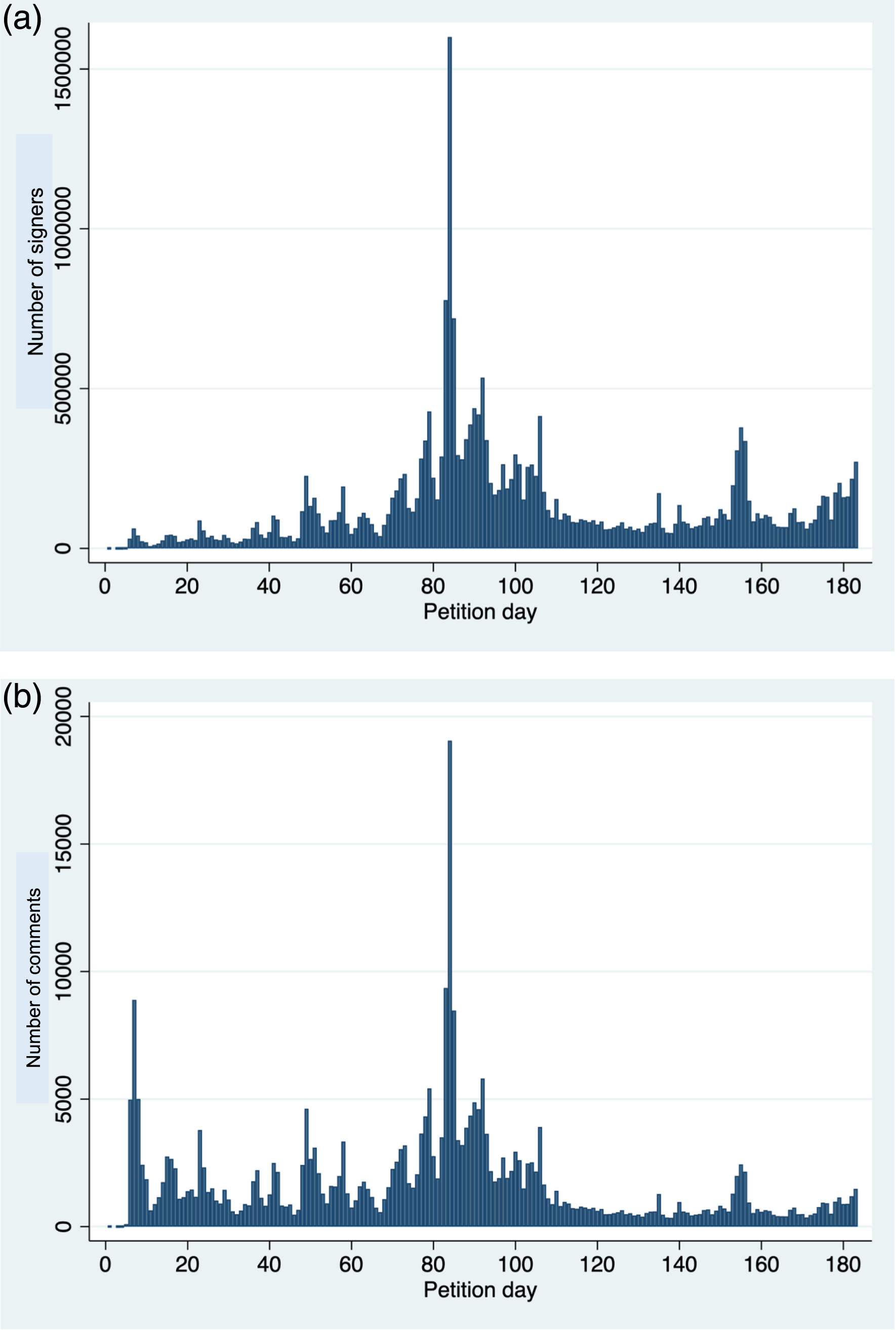
In contrast to many other petitions, the GEMA petition was successful. Two weeks after the petition’s submission to the German government, GEMA announced that it would stop the planned reform. In 2013, the event organizers and GEMA negotiated a new reform. The GEMA petition is thus not only a typical online firestorm but also indicates the potential of online firestorms for successful institutional change.
Empirical methods of manual text and automated content analysis
We do not rely on purely automated procedures, since - due to their explorative nature - they are not able to capture our theoretical constructs with the required level of detail. 8 Instead, we performed a qualitative manual text analysis and an automated dictionary-based content analysis. In the qualitative manual text analysis we combine thematic and content analysis (Vaismoradi et al., 2013). 9 We proceeded deductively by using existing typologies of the constructs of interest to learn which dimensions commentators may use and inductively by relying on the topics in which commentators express these dimensions to emerge from the comment data. After becoming familiar with a selected subset of 2000 comments (5%) of the randomized comment corpus, the main coder classified all the comments into the theoretical dimensions that seemed to fit the data best. 10 Coding rules were refined in a circular process of classifying and discussing with a second coder to ensure valid, unambiguous, and mutually exclusive categories. To validate these rules, both coders classified a further 300 comments, about 1% of the randomized corpus, into the topics to enable interrater reliability to be assessed.
After that, we applied automated content analysis to process the 44,173 online comments into quantitative data. Predefined categories enabled us to rely on a dictionary method (Grimmer and Stewart, 2013). Context-sensitive dictionaries, i.e. key word lists and word combinations that align closely with how the words are used in the specific petition and construct under investigation, are used to determine whether commentators are hostile-emotional or not and whether and how they express norm violations.11 To gauge the quality and validity of the automated content analysis, it was compared to human coding in a testing set of 300 comments (a different set from that used to create coding rules). The criteria achieve very good values: ø = 0.90 (min. = 0.74) for precision, ø = 0.83 (min. = 0.71) for recall, and ø = 0.95 (min. = 0.84) for accuracy (Lemke and Wiedemann, 2015). The automated classification is thus precise by excluding irrelevant data and exhaustive by including all the relevant data.
Measurements
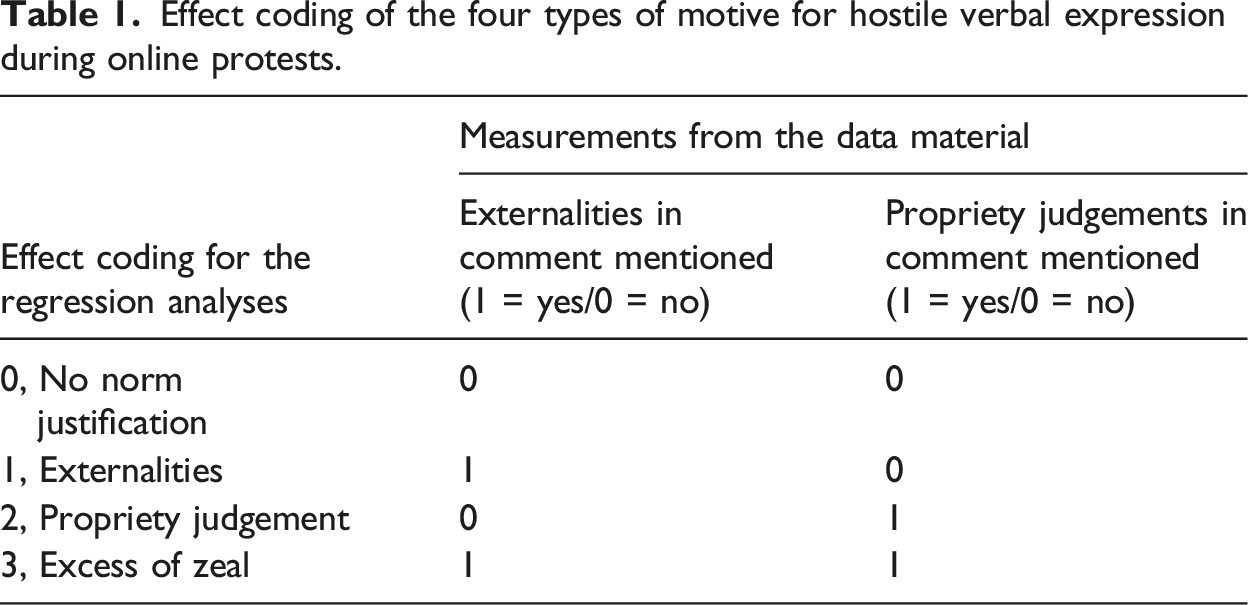
Effect coding of the four types of motive for hostile verbal expression during online protests.
Externalities measure if comments point out that the planned GEMA reform will create costs for other groups of actors, for example “Clubs will have to close, and music culture be destroyed.”, “Music and dancing should be accessible to everyone.”, “I am a DJ and will probably lose my job.”, “No regular consumer can pay this.”, or “Does not benefit the meeting of the generations.” The dictionary contains 158 expressions for externalities.
Propriety judgements consists of four subcategories, namely sociopolitical, category-based, reputational, and status-order propriety judgements, identified through the literature (Bitektine et al., 2020; Suchman, 1995) and derived from the content analysis. For the subcategories, Cohen’s kappa is ø = 0.80 with a minimum of 0.70. (1) Sociopolitical propriety judgements benchmark various characteristics of GEMA against prevailing social norms. They include normative evaluations of GEMA, its practices, and outcomes as inappropriate and wrong, given existing norms and laws, for example “The big ones try to fill their pockets and the small ones need to bleed. Rip-off!”, “GEMA acts excessively and without concern for society”, “No musician that GEMA ‘allegedly’ represents agrees with this”, “What GEMA does is against the constitution!”, “Corrupt, more corrupt, GEMA”. The dictionary for sociopolitical judgement contains 315 expressions. (2) In category-based propriety judgements, GEMA is evaluated as a member of a specific category, for example “monopolists”, “music industry”, “medieval times”, or “China”. Commentators present GEMA as a stereotypical immoral entity by extending their criticism of GEMA to entities which they consider unpopular or disapprove of. GEMA is accordingly equated with the greedy music industry, the badly governing Chancellor Angela Merkel, and the darkness of the Middle Ages. In turn, the established collective illegitimacy of a category has a delegitimizing effect on GEMA (e.g. “I am against the enrichment of monopolists”, “As greedy as GEZ and the whole music industry!”, “We do not live in medieval times”, “Almost as bad as in China!”). The dictionary for category-based propriety judgements contains 113 expressions. (3) Reputational propriety judgements include a set of attributes inferred from GEMA’s past actions to describe GEMA’s overall appeal and to anticipate its future behaviors. For example, “GEMA took away the free music from us on YouTube – and now this?”, “I have had only trouble with GEMA in the past.”, and “Now, it is getting too much with GEMA . . . I have been annoyed for years”. Commentators accuse GEMA of a history of illegitimate behaviors and outcomes and express their long-term dissatisfaction, growing impatience, and intolerance with it. The dictionary for reputational propriety judgements contains 110 expressions. (4) Status-order propriety judgements attack the institutionalized social rank of GEMA that generates privilege for GEMA and discriminates against other participants in the market: for example, “GEMA is an unnecessary institution.”, “GEMA has no right to exist.”, “One should abolish GEMA.”, and “GEMA should be prosecuted and forbidden”. Commentators also call for GEMA’s abolition by expressing the explicit wish that GEMA will dissolve itself, disappear, or be abolished. The dictionary entails 98 expressions. We created a composite summary index for each type of judgment, reflecting whether individuals provided at least one expression of each judgment in the comments or not.
Excess of zeal combines the combined measurements of externalities and propriety judgements. When a comment includes both externalities and propriety judgements, it is coded as excess of zeal.
No justification measures if comments are neither related to externalities nor in-group threat.
Table 1 illustrates the coding of the four types of motive for hostile verbal expression. We use effect coding rather than interaction effects; this has the advantage that the individual contribution of each type of motive is directly observable in the regression analyses.
Descriptive statistics.
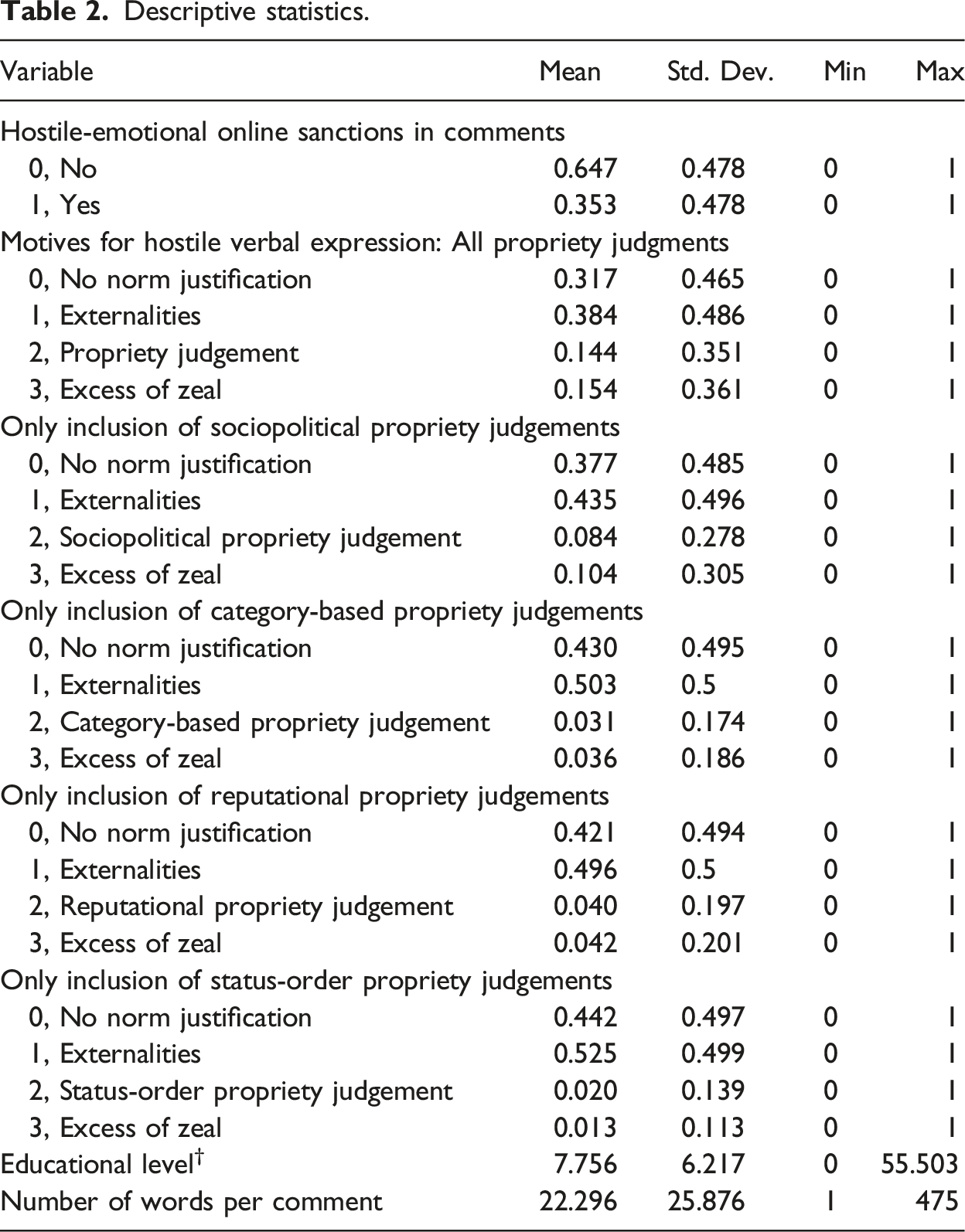
Although our dataset contains many potential control variables (e.g. anonymity, postcode, media coverage, size of town of residence, cognitive limitations), we keep the subsequent models as slim as possible and control only for educational level, comment length and time course. Many of these potential control variables are highly correlated with each other, increasing the likelihood of estimation problems. The models with and without these potential control variables however show similar results, suggesting that the findings are robust.
Educational level is proxied by the linguistic complexity of comments. For each comment, we use the Flesch-Kincaid-grade-level formula (0.39*(total words/total sentences) + 11.8*(total syllables/total words) - 15.59, see Kincaid et al. (1975) to calculate a score of how difficult it is to read (Ghose and Ipeirotis, 2011). Higher scores suggest higher literacy skills. The measure is only reliable for longer texts. Therefore, we assign the lowest score to the 27% of comments that include fewer than seven words. We will exclude these 27% comments from the main analysis in a robustness test.
Comment length measures the sum of words in a comment. The variable ranges from 1 word to 475 words with a median of 14 words. Comment length affects all measurements and is thus a major source of error in this study. For a robustness test, we will split the sample along the median of comment length into short and long comments. While long comments allow for more precise measurements, many insults are also found in short comments. In this respect, both types of commentary, while important, are to a limited extent comparable with each other and should be evaluated individually, at least for control purposes.
We control in all models for time course by including petition day dummies measuring in which day after the petition’s start a comment was submitted.
Empirical findings
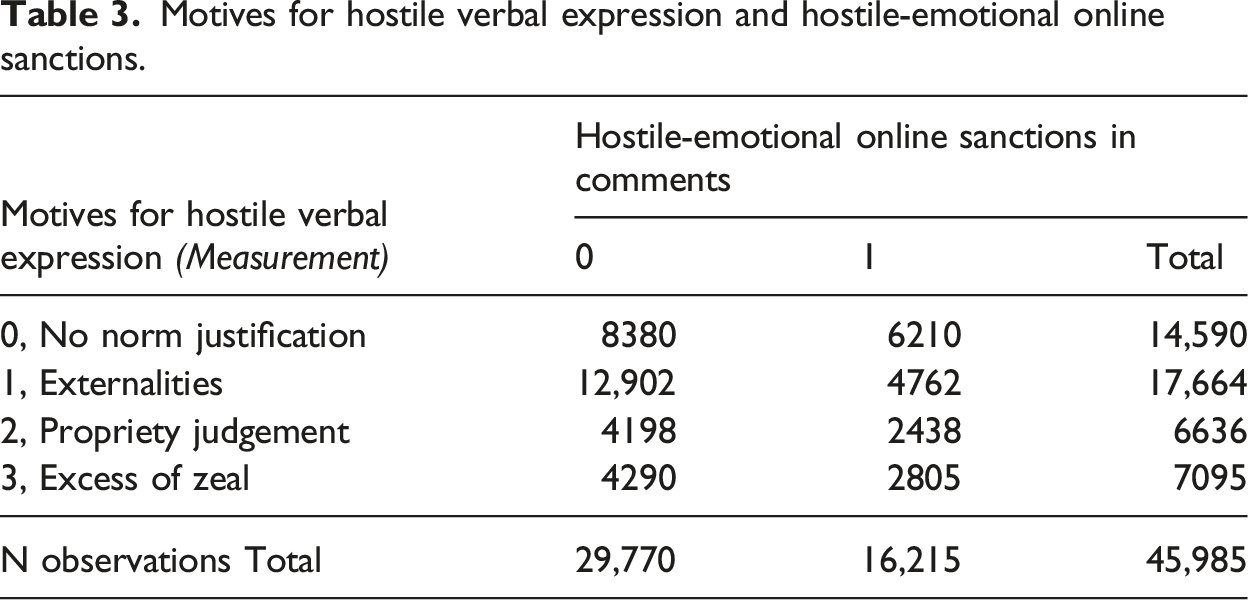
Motives for hostile verbal expression and hostile-emotional online sanctions.
Results of the logit regression of hostile-emotional online sanctions.
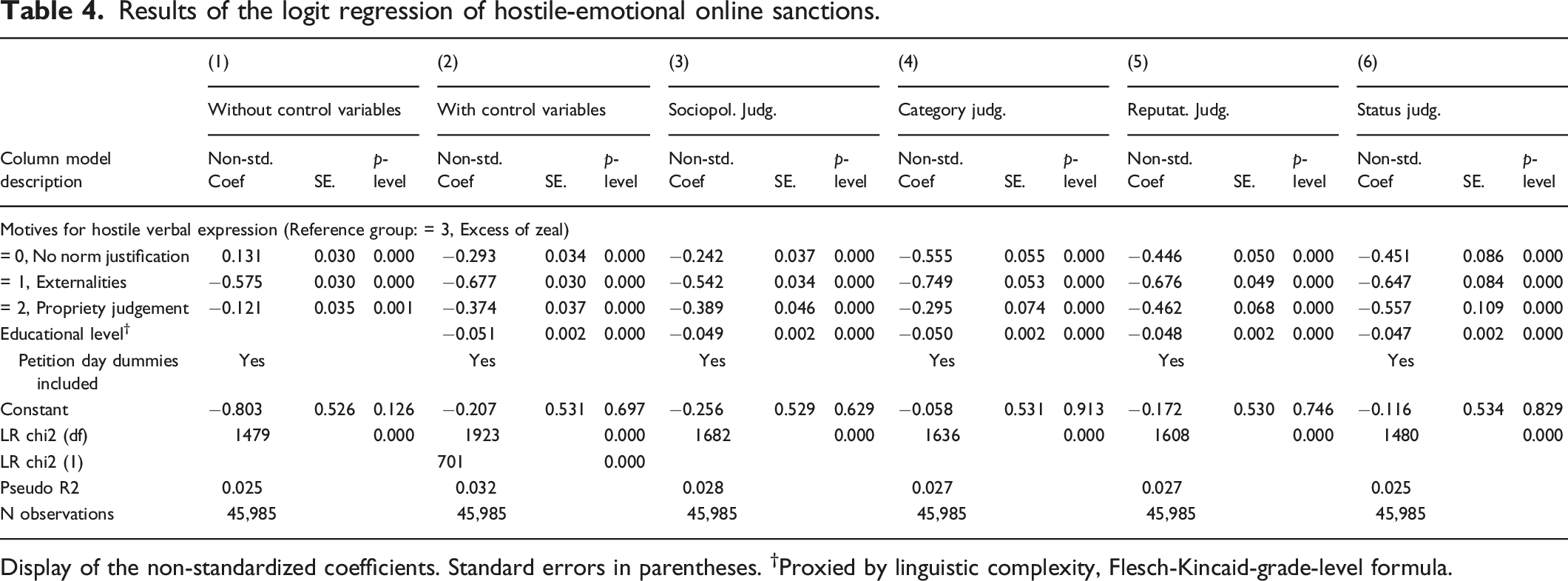
Display of the non-standardized coefficients. Standard errors in parentheses. †Proxied by linguistic complexity, Flesch-Kincaid-grade-level formula.
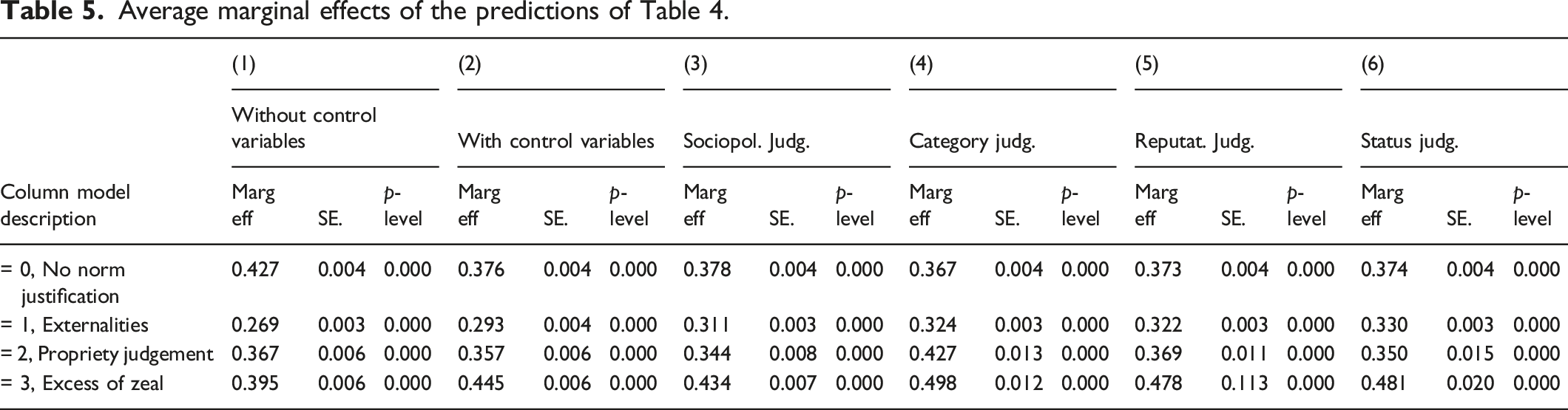
Average marginal effects of the predictions of Table 4.
Contrasts between the predicted marginal effects of Table 5.
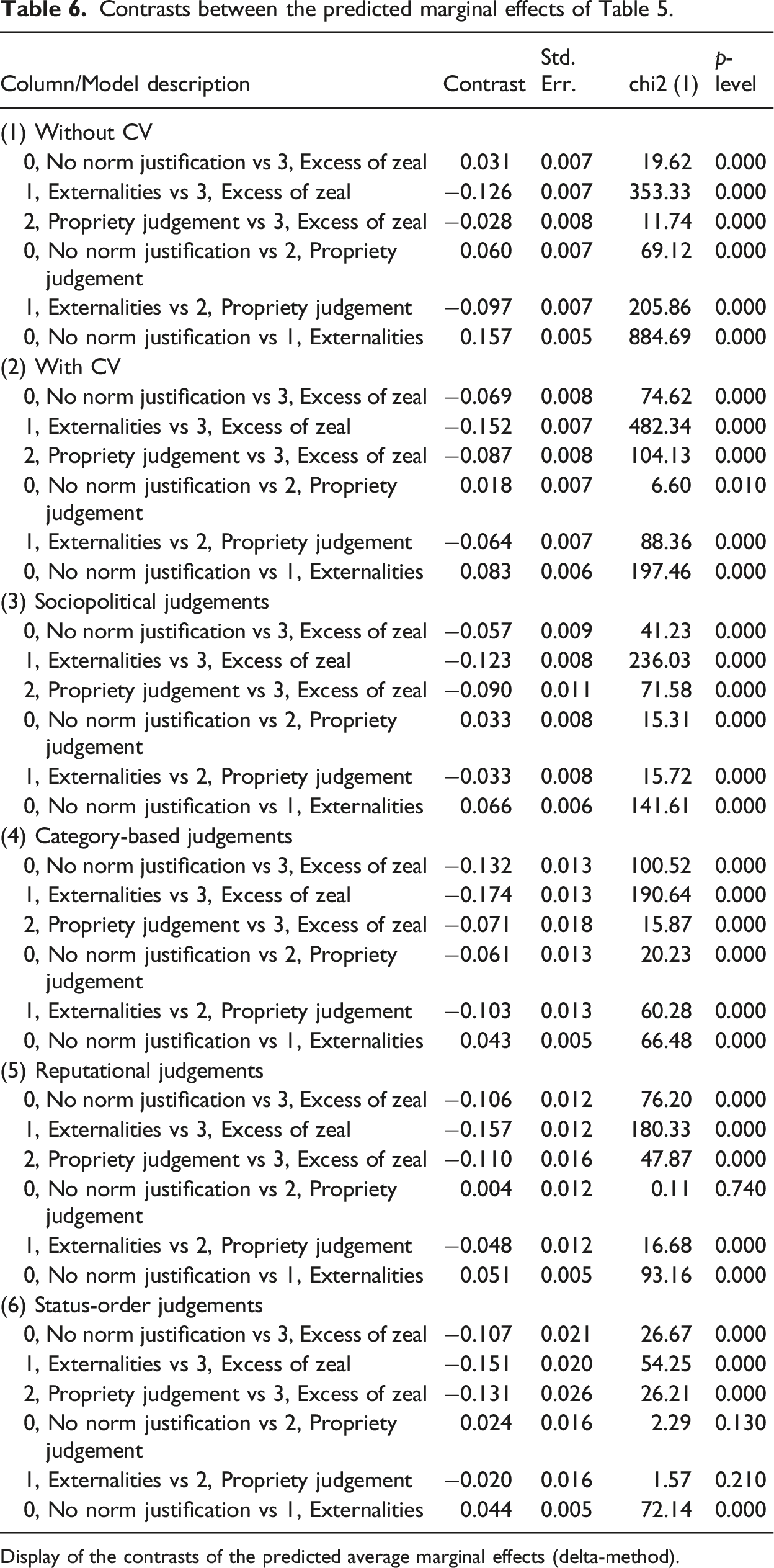
Display of the contrasts of the predicted average marginal effects (delta-method).
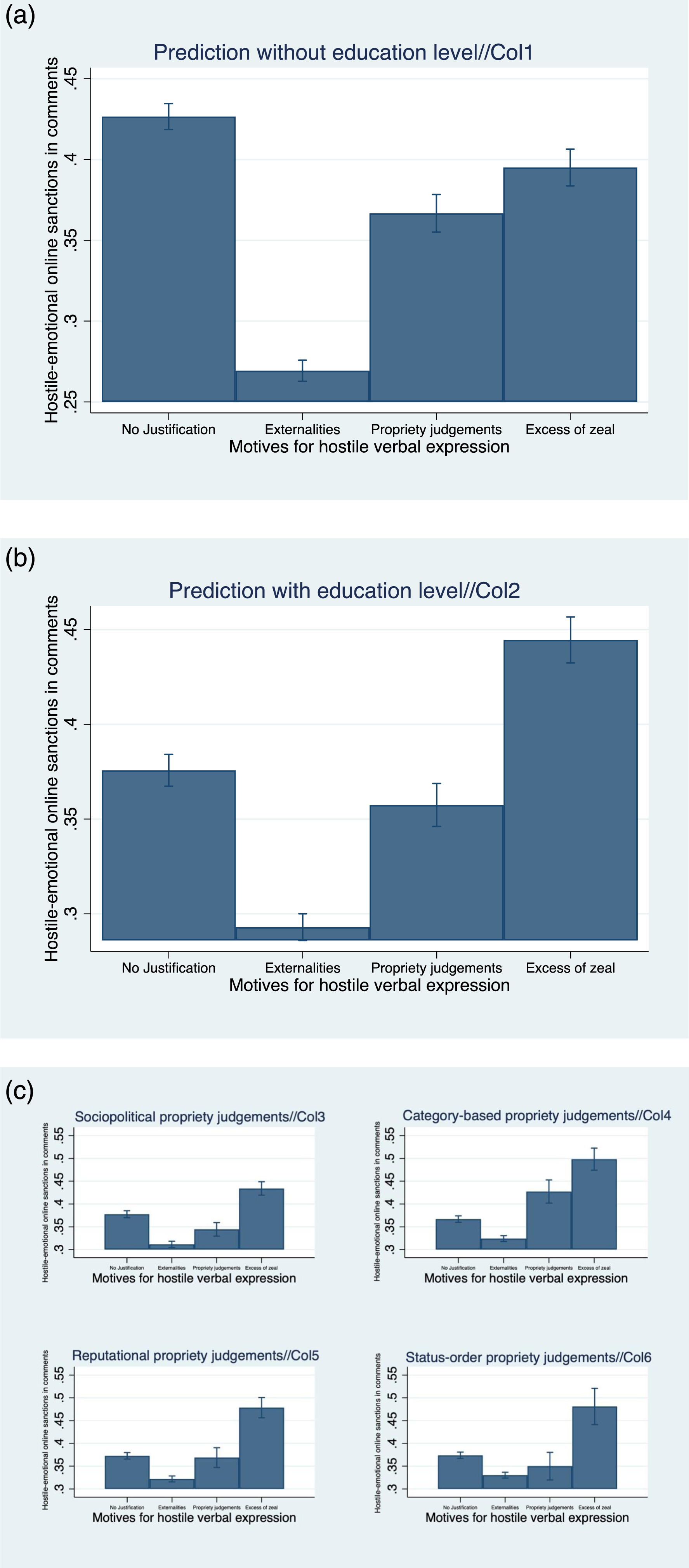
Column 1 in Table 4 displays the results of a model without controlling for educational level. The findings show that, in contrast to comments classified as excess of zeal, comments not justifying norm violations show a significantly higher estimated probability of emotional-hostile sanctions, and comments pointing to externalities or entailing propriety judgements show a significantly lower estimated probability of such sanctions. This is confirmed in Table 5, Column 1 and Figure 3(a) illustrating the average marginal effects of the four types of motive (predicted marginal effects: no norm justification = 0.427***, excess of zeal = 0.395***, propriety judgement = 0.367***, externalities = 0.269***). Table 6 also shows that the contrasts between the marginal effects of all four types of verbal expression are significant. This result suggests that, without controlling for education, we observe a clear order in which comments are most likely to be hostile-emotional: comments not justifying norm violations have the highest probability, followed by those motivated by an excess of zeal, followed by those entailing propriety judgements and finally by those pointing to externalities. This observation is not entirely consistent with our hypothesis, because we assume that excess of zeal is the strongest motivator for hostile-emotional comments.
Column 2 in Table 4 reports the results of a model that also controls for educational level. The results show that comments classified as excess of zeal show a significantly higher estimated probability of including hostile-emotional content than all other types. This is confirmed in Table 5, Column 2 and Figure 3(b) (predicted marginal effects: excess of zeal = 0.445***, no norm justification = 0.376***, propriety judgement = 0.357***, externalities = 0.293***). Table 6 confirms that the contrasts between the marginal effects of all four types of motive are significant, even though the difference between comments not justifying norm violations and comments entailing propriety judgements is rather small. This result supports our hypothesis. If we control for educational level, a clear order of who is most likely to provide hostile-emotional comment can be observed: comments motivated by an excess of zeal are most likely to be hostile-emotional, followed by those not justifying norm violations or entailing propriety judgements. Comments pointing to externalities are least likely to be hostile-emotional. In the model, educational level exerts a negative and highly significant estimated effect, supporting our assumption that the comments of less educated people contain more hostility than those of more highly educated individuals (see Table 4, Column 2).
Finally, columns 3 to 6 in Table 4 report the results for a model that only considers sociopolitical, category-based, reputational, or status-order propriety judgements. In general, the results confirm the order of effects found in the previous models: comments classified as excess of zeal show a significantly higher estimated probability of hostile-emotional sanctions than those not justifying norm violations, entailing propriety judgements, and pointing to externalities (see also Table 5, Column 3 to 6 and Figure 3(c)). Most contrasts between the predicted marginal effects are significant (see Table 6). Nevertheless, some interesting differences can be observed: hostile-emotional sanctions are most likely in comments where excessive zeal stems from a combination of negative externalities and category-based propriety judgements. We observe hostile-emotional content to be least likely in overzealous comments that point out negative externalities and make sociopolitical propriety judgments. Furthermore, category-based propriety judgments also have the highest estimated probability of hostile-emotional content. These results suggest that the combination of category-based propriety judgments with negative externalities may be one of the key drivers of overzealous, hostile-emotional group behavior in online media.
In the online appendix we include some additional robustness tests by excluding all comments shorter than seven words and by splitting the sample along the median comment length into short and long comments. The results show that our findings are robust.
The models’ goodness of fit of the estimated regression is satisfactory for secondary data (see Table 4). The prediction accuracy of the regression models ranges from 2.5% to 6.2%, implying that the four types of motive in response to norm violations explain 16%–25% of hostile-emotional online sanctions. Given the inclusion of so few variables, this explanatory power is good.
Discussion
Our study examined the relationship between perceived norm violations in online comments and the use of hostile-emotional online sanctions, potentially leading to online firestorms towards organizations. In contrast to previous studies, we concentrated not only on hostile-emotional online sanctions but also on people not engaging in these sanctions. Our theory and findings suggest that people only pointing to negative externalities of norm violations are least likely to provide hostile-emotional comment, whereas people motivated by an excess of zeal are most likely to do so.
We argue that with an excess of zeal, people do not fear the potentially negative consequences of their hostile-emotional behavior but expect to be rewarded for it by a latent interest group. The expected appreciation from and social status granted by the other group members for working toward the common goal overcompensates the individual’s effort. Furthermore, the results indicate that people who express propriety judgments or who do not explain why a norm infringement has occurred are more likely to comment hostilely-emotionally than people pointing to negative externalities. Also, all these commentators are less likely to use hostile-emotional sanctions than people motivated by an excess of zeal. We assume this is because in the first groups, hostile-emotional sanctions are motivated by the individual, thus by altruistic punishments or arousal, and not by a latent interest group as in the last-mentioned group.
In sum, our theory and findings offer a plausible explanation why online firestorms are difficult to stop: when hostile-emotional commenting is mainly motivated by an excess of zeal, a latent interest group of norm enforcers working toward a common goal needs to be appeased. Unlike single decision makers, who are not bound to any authority other than themselves, coordination costs arise within the group. The latent interest group must collectively agree that it accepts the organization’s apology for its misconduct and the solution it proposes for negative externalities. However, overzealous group members are often unwilling to comply and continue to inflame the firestorm. This insight opens perspectives for organizations in dealing with firestorms as well as questions for research.
Our contribution indicates that organizations need to better understand the causes of hostile-emotional behavior before responding to online firestorms. If a latent interest group of norm enforcers is involved, this group and their common goals should be identified. What opportunities are available for meeting the group’s common goals for action? If acceptable alternatives exist, the group as a whole, and especially its overzealous fringes, must be addressed instead of an anonymous mass of hostile individuals. According to our theory, organizational responses that do not address the common goals of the latent group will increase the group’s hostility.
These assumptions need to be tested by research. Is it true, as we claim, that organizations’ best course of action is to do nothing when the latent group of norm enforcers cannot be appeased by any measures available? Is it true, as we claim, that coordination costs within the group are responsible or the persistence of hostility despite apologies in many firestorms? What kind of measures can address latent interest groups and sustainably reduce an excess of zeal and hostility? Does excess of zeal indeed explain the success of some online firestorms in causing organizations to change their behavior? More generally, studying the dynamics of the emergence of an excess of zeal in social networks would be of great benefit for sociological theory. It may well be particularly interesting to see how latent interest groups organize themselves around daily topics. This topic is particularly relevant for the sociology of organization, as newer, temporary forms of organizing and organization are thus likely to be illuminated.
At this point, the limitations of our study should be mentioned: we analyze a case of a particularly hostile-emotional firestorm. Thus, we lack equivalent cases to check the robustness of our findings and cases with a different development. Moreover, our analyses are based on the comments of people; we know nothing about the demographics of these people or their self-assessed for hostile verbal expressions. Such data are usually rare, due to the preservation of anonymity and data security. But they would be very important, especially with a representative, large number of responses (including the mass of people who support a protest but do not comment), to better understand the phenomena of online firestorms. Finally, the performed qualitative manual text analysis and automated dictionary-based content analysis of the verbal expressions to capture our theoretical constructs also have disadvantages compared to purely automated procedures. Examples include the subjectivity of coders and the overlooking information in data that is not accessible to human perception. Despite these limitations, we hope that our contribution adds value to the explanation and better understanding of online firestorms.
Supplemental Material
Supplemental Material - Hostile-emotional excess of zeal in public social media: A case study of an online firestorm against an organization
Supplemental Material for Hostile-emotional excess of zeal in public social media: A case study of an online firestorm against an organization by Katja Rost and Lea Stahel in Rationality and Society
Footnotes
Acknowledgements
We thank Ann-Sophie Gnehm very much for her great support with the automated content analysis.
Funding
The author(s) received no financial support for the research, authorship, and/or publication of this article.

Supplemental Material
Supplemental material for this article is available online.
Notes
References
Supplementary Material
Please find the following supplemental material available below.
For Open Access articles published under a Creative Commons License, all supplemental material carries the same license as the article it is associated with.
For non-Open Access articles published, all supplemental material carries a non-exclusive license, and permission requests for re-use of supplemental material or any part of supplemental material shall be sent directly to the copyright owner as specified in the copyright notice associated with the article.
