



Abstract
Despite similar educational aspirations, black students persist in higher education at much lower rates than white undergraduates. This paper advances a theoretical explanation for the racial gap in persistence by examining whether the differential attrition in college reflects contrasting incentives for educational persistence. To account for the highly unequal hurdles faced by black men and women in college and in the labor market, we propose a method that addresses race-gender-specific opportunity structures in both institutions simultaneously. This approach is based on forward-looking estimates of outcomes where students draw information from their race-gender reference group ahead of them. The model estimates the earnings payoffs of persistence separately for each race-gender group at three consecutive educational decision nodes: at high school graduation, college entry, and after one year in college. We subsequently apply one version of this model to data from the American Community Surveys (2001–2017), calculating the absolute and relative incentives for educational persistence across racial groups. In addition to large dollar earnings differentials, the analyses reveal striking racial gaps of the relative incentives to stay enrolled: “incentive inequality.” This incentive race gap is largest at the earliest stages of the higher education career—high school graduation and college entry—where the black undergraduate dropout rate is highest. Our findings have substantive and methodological implications for situations where returns to investments are unequal across groups affected by discrimination.
Introduction
Based on then-current trends, Adam Gamoran (2001) predicted that the black-white degree attainment gap would substantially narrow in the following decades, and that the reduction should be clearly evident by 2010. Unfortunately, this substantial reduction in the race attainment gap has not happened. By 2015, the racial gap in high school graduation was relatively small (92% among blacks, 95% among whites), yet was larger in higher education access: in the 18–24 age category, 35% of blacks and 42% of whites were enrolled in college (Musu-Gilette et al., 2017). Racial gaps in degree completion have also remained substantial (Espinosa et al., 2019; De Brey et al., 2019). Not only are total completion rates of black undergraduates still far behind that of whites, but this gap has also remained virtually unchanged for at two decades and across several different stages (Shapiro et al., 2017): the transition from high school to higher education, persistence after the first year of college, and degree completion.
Class background can only explain some of the racial gap in college attainment. Moreover, there are virtually no differences in educational aspirations across race-gender groups. Empirical studies indicate that black students and their parents value education as much as other racial groups and have similar expectations about future educational pathways, as compared to whites. These similarities also persist after controlling for family background and other socioeconomic factors (Goyette, 2008; Hauser and Anderson, 1991; Morgan, 1996, 2005). Some studies show that black students are in fact more likely than white students to pursue college when they can (e.g., Bennett and Xie, 2003; Blake, 2018). The motivational equality between black and white students—or a possible “net advantage” of college-going black students—creates a paradox for race inequality scholars. Why then do black students persist in higher education at such dramatically lower rates?
In addition to the education attainment gaps, black school-leavers have much lower labor market rewards than any other group, even within the same levels of educational attainment (Musu-Gillette et al., 2017). These labor market inequalities are apparent in the white and black unemployment rates at each level of education. Blacks’ unemployment rates are almost twice as large as that of whites: 18.6% vs. 10% (high school graduates), 13.1% vs. 6.7% (some college), 5.8% vs. 2.9% (bachelor’s degree). Even early career stage (ages 25–34) black workers earn about 80% of whites with the same amount of education: $20,000 vs. $25,000 (high school graduates), $23,000 vs $30,000 (some college), and $36,500 vs. $44,000 (bachelor’s degree) (De Brey et al., 2019).
A considerable component of these unequal labor market outcomes is rooted in racial bias and racial discrimination. Research has documented substantial discrimination in job access (e.g., Kornich, 2009; McDaniel et al., 2011; Pager et al., 2009; Pedulla, 2018), despite similar job search strategies and practices (Pager and Pedulla, 2015). Black men and women earn significantly less than their white counterparts (Tomaskovic-Devey et al., 2005) and this gap appears to have grown since 2000 (Mandel and Semyonov, 2016). The earnings disadvantages of black men have been shown to accumulate across the career and life course, partially as a consequence of unequal access to the type of human capital that is typically acquired on the job (Castilla, 2008).
In this study we examine the implications of these structural labor market inequalities—the opportunity structure—for incentives to remain in college for blacks and whites. The goal of our approach is to advance a conceptual model to explain the persistence of racial gaps in college persistence and degree completion that emphasizes racial and gender differences in likely risks and rewards as undergraduates proceed through college. Our approach therefore differs from resource-focused models commonly used in the study of the black-white attainment gap. Instead, our method concentrates exclusively on inequalities faced by black students vis-à-vis white students that provide a context for educational decisions. We examine the combined monetary incentives to persist in college as a function of three successive layers of unequal “payoffs”: (1) the probability of reaching future educational destinations, (2) access to employment, and (3) earnings conditional on employment. In addition, we separately estimate the within-gender racial inequalities in incentives for three educational nodes: high school graduation, college entry, and after the first college year. We develop this approach because it highlights changes in incentives as students reach higher educational levels—a perspective that is typically ignored in the study of educational attainment inequality.
We first present a conceptual model—in combination with a methodology—for calculating incentives for race-gender groups separately. Its application is based on information about potential future pathways of educational persistence and labor market outcomes, which represent structurally unequal access and unequal returns (partially rooted in discrimination). The method proposed comprehensively calculates the race-gender-specific opportunity structure—that is, individuals’ joint educational and labor market prospects. Subsequently, we apply this method to the large-sample data from the American Community Surveys, demonstrating that college-enrolled black students have lower financial incentives to persist than white students because they gain less from continuing in college and from completing a degree. This black-white “incentive inequality” corresponds to the dropout pattern; it appears at all observed educational decision nodes but is much higher in the early stages of higher education.
Literature
Attainment differentials
Coleman’s study (1966) was the first large-scale study that examined the extent of racial inequality within U.S. education. In subsequent decades, researchers have closely documented the trends of racial gaps in achievement, attainment, and their combined outcomes. The test-score gap between whites and blacks narrowed drastically throughout the 1970s and 1980s, stagnated in the 1990s, and then further declined in the 2000s, albeit very slowly (Center for Education Policy Analysis, 2018). The racial gap in educational attainment initially followed a similar path, declining throughout the 1970s and 1980s in terms of the high school completion rate and the college completion rate (Lee, 2002). However, this narrowing of the attainment gap came to a standstill around 1990 (Lee, 2002).
By 2015, the gap in high school graduation rates between black students (92% graduate) and white students (95% graduate) was small (Musu-Gillette et al., 2017). However, a larger gap characterized college access: only 35% of black Americans between ages 18 and 24 were enrolled in college, compared to 42% of white Americans—a gap that has remained stable since 2005. Women enroll in college at significantly higher rates than men within both race groups: 38% (black women) vs. 28% (black men) and 46% (white women) vs. 39% (white men) (Musu-Gillette et al., 2017). Shapiro et al. (2017) reported that the 6-year graduation rate, conditional on college entry, was 62% for whites and 38% for blacks, using cohort data from the National Student Clearinghouse. By the 2000s, concern about this persistent college completion gap was evident among scholars, policy makers, and politicians (McDaniel et al., 2011), with many focusing on the disadvantage faced by young black men (Jackson and Moore, 2008). 1
The long-term trend of the black-white gap in higher education is not promising. A study by McDaniel et al. (2011) using 1940–2000 IPUMS data found that over the course of those six decades both black men and women had become increasingly likely to enroll in college. However, in the second half of the 20th-century, conditional on college enrollment, black students became less likely to graduate with a bachelor’s degree. Later, in their 2000–2007 analyses of the unconditional college completion rate, McDaniel et al. (2011) found increasing graduation rates for both black women and white women, but just slightly improving rates for black men, and stable rates for white men. They therefore argued that the net within-gender higher education racial attainment gap is still relatively large and stable, showing no sign of narrowing soon. More recently, Snyder et al. (2018), as well as reports by the National Center for Education Statistics (De Brey et al., 2019) and the American Council on Education (Espinosa et al., 2019), documented a substantial percentage-point gap in completion rates between white college entrants and black college entrants. Although there has been a slight increase in the sub-baccalaureate completion rate for black students, the overall trend has remained virtually unchanged between 1996 and 2016.
Persistence paradox
Why does the college completion gap between black and white students persist? Sociologists have drawn on a wide range of theoretical frameworks to answer this question. One explanation draws from socialization theory, which states that children of higher socioeconomic status (SES) families attend college at higher average rates as a direct result of the greater emphasis these families place on going to college, regardless of any rational or monetary cost–benefit analysis (see Haller, 1982; Sewell et al., 1970). Given the fact that black students are disproportionally more likely to grow up in lower-SES families, the observed racial attendance and persistence gaps in higher education may partly reflect variation in class-based educational expectations.
However, variations in educational expectations prove inadequate for understanding the racial attainment gap (Burke, 1989; Hout and Morgan, 1975). Kerckhoff and Campbell (1977) and Portes and Wilson (1976) showed that the relationship between educational expectations (i.e., aspirations) and actual educational attainment is weaker for black students than for white students. Later, Morgan (1996) found that black students’ educational expectations were in fact higher than whites’ after controlling for social background. Furthermore, most studies still find a substantial differential in degree completion between black and white students, even after controlling for family background, family resources, prior academic achievement, and financial aid (e.g., Hu and St John, 2001; Merolla, 2013; Perna, 2000). 2 Thus, college entry and college persistence gaps between black and white students are substantial and seem unlikely to be driven by differences in parental economic resources.
Some identity-theory scholars have argued that prior studies failed to include relevant identities in models of educational attendance variation. For instance, Burke (1989) and Burke and Hoelter (1988) argued that black students’ display a “particular kind” of school attitude, which is predictive of their behavioral choices. This leaves open the question of why both identities and educational decisions are different for blacks and whites. Michelson (1990) suggested that less positive attitudes toward educational attendance reflect “information constraints” about the returns to education among black families, suggesting that black students simply do not know how valuable a college degree is. Morgan (2005) similarly argued that educational persistence decisions may reflect misjudgments based on an incorrect expected value of college education, but he warned about measurement errors on the researcher’s side. 3
Nonetheless, considerable empirical research has shown a black-white aspiration paradox where black students have in fact higher average attainment aspirations than whites. For example, using data from the 1988–1994 National Education Longitudinal Study (NELS), Bennett and Xie (2003) compared black-white differences in enrollment following high school across different types of colleges in multivariate analyses. They found that black students have an advantage in enrollment among the lowest levels of parental socioeconomic status in any type of college. Using the 2000 follow-up of the NELS data, Downey et al. (2009) demonstrated that the association between education attitude and achievement is the same across racial groups. Concentrating on college attendance and using the 2002 NELS, Blake (2018) found that black students with similar SAT or ACT scores as white students are more likely to contact school sources about college applications and to apply for college.
More recently, Ciocca et al. (2018) focused on academic preparation and selection patterns at college entry to explain the lower average persistence rates of black students in higher education. Their findings suggest that the black-white gap in bachelor’s degree completion is partially rooted in the fact that black students are more likely to enroll in college than white students, given their pre-college resources (e.g., academic preparation and SES). Relative to these resources, black students “over-enroll.” These factors result in a black disadvantage in college persistence because weaker students are more likely to dropout. The authors also argued that despite the high black college dropout rate, the larger number of black students entering college (relative to their SES and preparation) leads to a narrowing of the racial degree attainment gap, compared to a situation where colleges admitted fewer black students, since more complete than would the case if they did not “over-enroll.”
Rational action theory
Rational action theory (RAT) economists typically ignore the social and familial influences on educational decision-making and instead focus on individuals’ own calculations of future outcomes and behavior. It is important to note a potential language confusion within this field. Sociologists use the term “expectations” to indicate the immediate social context of the actor, whereas economists generally refer to individual’s estimated future return to education. In its original formulation, RAT assumes that individuals have an accurate perception about the probabilities of their future outcomes—the true benefits of education (Morgan, 2005). Furthermore, it assumes that individuals maximize post-education “utility” (i.e., returns to education), such as lifetime earnings. If the benefits for achieving the highest possible utility outweigh the net costs, then a student enrolls and/or persists in education.
Three important advances in RAT theory have contributed directly to the sociology of education. First, an early application to attainment differentials draws on “prospect theory,” which states that decision-makers value outcomes against the background of a reference point (Kahneman and Tversky, 1979). This idea was further developed in a full “decision tree model” (discussed later in further detail) that can be used to estimate the influence of social origin on educational decision-making for any schooling stage using series of regressions (Mare, 1980). The Mare model has been used to estimate social origin effects, including maximally maintained inequality (Raftery and Hout, 1993) and effectively maintained inequality (Lucas, 2001).
Second, the RAT framework was combined with status socialization theory by Breen and Goldthorpe (1997), who argue that a family’s social class can explain inequality of educational attainment, without assuming class-specific norms or expectations. They suggested that all students are equally motivated by the goal to avoid downward mobility: “identical relative risk aversion.” Each student wishes to avoid completing less education than their parent. However, since parental SES is the point of reference for educational decisions in relation to future outcomes, children from middle-class families will “automatically” prefer higher levels of educational attainment than students from less-educated families and be more likely to enter and persist in college.
The “Breen-Goldthorpe” relative risk aversion (RRA) model of class differentials in educational persistence has been tested empirically with data from Denmark (Breen et al., 2014; Jæger, 2007), the United Kingdom (Breen and Yaish, 2006; Jæger and Holm, 2012), and the Netherlands (Need and De Jong, 2001). These studies confirmed the risk aversion hypothesis. Others found similar or partial evidence, such as its theorized equal effect across classes (Van de Werfhorst and Hofstede, 2007), the importance of anticipated educational persistence costs in decision-making Stocké (2007), and the extent to which students can realistically forecast their own destination chances, as well as personal costs and benefits (Abbiati and Barone, 2017).
A third theoretical advance in RAT, by Charles Manski (1993), states that one should not ignore the fact that educational attainment decisions take place under uncertainty. Some economists have therefore relaxed the assumptions of perfect information and of individual’s ability to accurately estimate the true returns to education. In doing so, RAT theory may still come to conclusions that are consistent with socialization theory if it places the rational process in relation to one’s family circumstances (Morgan, 2005). For instance, Cameron and Heckman (1999) argued that high-SES parents have more ability to assist and direct their children’s studies, compared to lower-SES families. This directly stimulates academic aspirations and indirectly improves educational attainment. In contrast, lower-SES students have fewer supportive experiences and therefore perceive their schooling as less useful compared to higher-SES students.
Opportunity structure
How does rational action theory explain the black-white attainment gap in higher education? Despite the aforementioned advances of RAT in the sociology of education, empirical work on the U.S. racial completion gap concentrates either on a theorized individual-level payoff (sometimes benchmarked against class background) or an empirical averaged payoff from educational attendance. We argue that this approach could benefit from a comprehensive empirical assessment and subsequently integration of structural racial differences in college students’ opportunity structure. More specifically, the expected future labor market outcomes of students are much affected by the substantial gaps in job access and earnings along racial (and gender) lines, which are rooted in structural discrimination in the labor market and unequal hurdles in the higher education system.
Scholars have suggested that the variations in opportunity structures between different race-gender groups are likely to influence college attendance or persistence incentives. For instance, McDaniel et al. (2011) argued that the trend of incentives and resources available to black men and black women (vis-à-vis whites) at least coincides with the actual college completion discrepancies. More precisely, black women’s earnings bonus from completing a college degree is higher than that of black men, which, according to McDaniel’s study, is why they complete higher education at higher rates. It also explains why black women have made the largest attainment gains over the past decades. Furthermore, structural inequalities in the opportunity structure are not entirely absent from rational action theory. Although differences in earnings primarily stem from a combination of general education and job-specific training (e.g., Becker, 1975), RAT also assumes that educational investments are a function of expected future incomes (Morgan, 1996). Not only are these individual-level “estimations” often uncertain and combined with preferences, they are also dependent on societal discrimination (Beattie, 2002; Schultz, 1961).
Drawing on these broader incentive mechanisms, Beattie (2002) argued that ignoring the influence of stark differences in educational and labor market outcomes leads to an underestimation of the structural forces shaping college enrollment variation. Her study indicates that students might act rationally on educational decision nodes—as “adolescent econometricians”—but that the extent to which this occurs varies across different groups. In order to estimate whether opportunity structures matter for different social groups she calculated the income returns of entering college by race, class, gender, and cognitive skills using the High School and Beyond data. Concentrating on race, the results indicated that black men’s decision to enroll in college is significantly (more) affected by returns to schooling compared to whites. These results echoed other evidence from studies on U.S. higher education that examine how undergraduate students perceive their employability and future earnings chances of financial well-being when making educational decisions (Donald et al., 2018; Hilmer and Hilmer, 2012; Stuart et al., 2014).
Moreover, a wide body of research points to the theoretical mechanisms by which racial, gender, and class background inequalities may contribute to educational decision-making (Breen and Goldthorpe, 1997; Morgan, 2005; Breen et al., 2014), as well as the heterogeneous economic returns of attending higher education (Brand and Xie, 2010; Hout, 2012). However, comparatively little is known about students’ perspectives on structural inequalities and how such factors contribute to their educational decision-making. One important exception is a study by Matthew (2011), which makes use of the NELS 1988–1992. That analysis indicates that, compared to white students, black students display significantly greater support for structural explanations for future socioeconomic prosperity, such as feeling that something or someone is holding them back and that luck is more important than hard work. Furthermore, a considerable share of the racial gap in optimism about one’s future is explained by the dissimilar attitudes about the social structure rather educational values (which does not vary across race).
Despite these theoretical and empirical findings, sociological studies of racial inequality in educational attainment would benefit from incorporating the structural and regionally varying racial-gender gaps in the opportunity structure in predictive models of student decision-making and educational trajectories. The current study will not predict or observe student decision-making either, but instead focuses on an important necessary first step. We provide a comprehensive measure of the opportunity structure by mapping the race-gender-specific and decision node-specific incentive inequalities for higher education persistence that are embedded in the current labor market. The goal is to reveal the incentive inequalities and demonstrate the potential value under different conditions and assumptions. Future research may subsequently integrate our nationally representative estimates in predictive models with longitudinal data.
Analytical approach
In this paper, we challenge the assumption of equal payoffs to (higher) education by race as implied in some empirical models of rational educational decision-making. We also question the argument that the racial attainment gaps result from an information deficit for black students vis-à-vis white students. Instead, we concentrate on the opportunity structure for high school graduates, college freshmen, and students who finished their first year of college: What if white and black students perceive their future educational attainment chances and their post-education labor market chances from the perspective of their own race-gender group?
In doing so, we expand on earlier models of racial gaps in the labor market by laying out a realistic measure of the comprehensive future risk in both the educational system and the labor market. We assume that, as individuals are uncertain about their academic abilities and educational hurdles, the best they can do is to estimate their own risk and benefits as being similar to that of their social group peers. Similarly, we also conceptualize educational incentives (i.e., the long-term relative payoffs of persistence) as situated in an opportunity structure that is fundamentally different for race groups as a result of racial discrimination. Consequently, we argue that individuals’ best guesses of post-education outcomes are found within the race-gender group who hold the educational level to which they aspire.
Finally, we improve on recent models that have simplified educational decision-making to college entry and then make a comparison of outcomes between high school graduates and college graduates. College students are far from guaranteed to complete the degree. Once enrolled, students are subject to intermediate academic, bureaucratic, and financial hurdles. So, in order to understand educational persistence, we argue that inequality comparisons need to be made at successive steps within college. Using cross-sectional data, we estimate what the incentive for educational persistence would be if students were applying a forward-looking vision about their sub-group-specific chances in education and the labor market.
The analytical sections of this paper are structured as follows. We will first expand the theoretical framework concerning incentives for students to persist in education (or not) using both socialization theory and rational action theory. We present a conceptual model to measure incentive inequality between white and black students for educational persistence, which is based on the race-gender-specific opportunity structure in the educational system and the labor market. In this theoretical argument, we advance the idea that one understudied component of expectation can be sought in “looking forward”—to one’s own social group members further along in education and in the labor market—rather than solely rooted in the family (peers and status group) or in the individual’s assessment of one’s own academic potential.
Subsequently, we provide an empirical test of this incentive inequality model using national data from the American Community Surveys. We document the size of racial incentive inequality at various educational decision nodes—high school graduation, college entry, and after 1 year of college. For each of these nodes, our model estimates the monetary payoffs for black men and black women (relative to whites)—in percentage gaps—and show how a decision based on their different incentives could explain persistence and/or a decision to continue to completion. The pattern we uncover corresponds to the observed racial gaps in college attendance at the same educational decision nodes.
The empirical analyses add an important nuance to our understanding of the incentive inequalities between black and white students. Several studies show that actors’ decision-making is limited by incomplete knowledge (Morgan, 2002; Simon, 2000). We therefore ask what a more ‘naive’ perspective on labor market chances would do to the incentive estimates for all subgroups; a calculation that excludes the (unequal) distribution of access to employment: a “bounded” rationality approach. A comparison of these results with the main analysis (which is simply our full model of forward-looking rationality)—analogous to a decomposition—yields the share of incentive inequality due to job access disadvantages of black men and women.
Measuring “incentive inequality”
Forward-looking
Rational action theory in sociology assumes that individuals try to maximize their utility, estimating the cost of remaining in education, and their own likelihood of success (e.g., Breen and Goldthorpe, 1997). Our approach asks what a forward-looking estimation of “success” would tell enrolled students from different race-gender groups about their choices to leave or stay in college. By forward-looking, we mean drawing information from the educational and labor market positions of recent school-leavers of the same race and gender as the student. This assumes that students’ incentives to persist or not partially stem from expectations, yet that their reference group lies ahead of them rather than within their family.
More specifically, we apply the idea of a forward-looking approach with imperfect foresight (Holm and Breen, 2016). Estimations of future outcomes are based on uncertainty of destination probabilities and payoffs, yet as students progress through the educational system—reaching successive educational “nodes” (e.g., HS graduation, completing the first year of college)—these expectations may be revised based on better or new information. Hence, we recalculate and re-estimate incentives at each node. This type of forward-looking should be distinguished from myopic decision-making, in which actors are only taking into account the payoff from the next educational node (and not beyond).
The forward-looking lens differs somewhat from the two main theoretical approaches to educational persistence. First, while socialization theory assumes that expectations about educational investment are primarily derived through interactions with one’s parents, peers, and significant others—we emphasize a much wider source of status socialization. We consider the education and labor market positions of slightly older individuals of the same race and gender as the student as influential in expectation formation. These reference points are vastly different between white and black students. The intersections between race and gender are the most important dividers of life chances in US society.
Second, by formalizing a forward-looking estimation of students’ outcomes we respond to an important critique of the Wisconsin model. Morgan (1996, 1998) and others have argued that traditional socialization theory ignores the opportunity structure that appears ahead of individuals—students and families. In this study of persistence incentives, we concentrate on the current observable opportunity structure of one’s own race-gender group: white men, black men, white women, and black women who have recently entered the labor market and are assumed to have completed their educational careers (discussed later). Thus, where RAT studies of educational persistence often assume that students’ projection of (educational) success is based on their own abilities (measured by prior academic performance), we concentrate on the outcomes and behaviors of others in the same race-gender group as indicative of the likelihood of success.
The proposed forward-looking perspective does not in any way contradict the theoretical arguments of racial attainment inequality being rooted in socioeconomic disadvantages or other class background differences. Nor does it reject the socioeconomic and racial inequalities in terms students’ academic preparation, resources, and family obligations that affect a variety of educational outcomes prior to the college entry. Instead, our forward-looking perspective calculates the “final” outcomes of these processes, as well as racial inequities in the labor market, by using prior cohorts’ labor market positions as benchmarks for the race-gender-specific opportunity structure.
In sum, our conceptual model involves a method that calculates the incentives for educational persistence by concentrating on race-gender group lenses of expectations (reference points), as well as race-gender group estimations of the opportunity structure (forward-looking). As known from countless studies of institutional barriers faced by black men and women in education and the labor market, individuals’ estimations of the opportunity structure must incorporate the cumulative inequalities in educational chances, labor market entry chances, and earnings levels that reflect racial bias and/or racial discrimination.
One-shot probabilities
The empirical application of the forward-looking model leads to an interpretable measure of relative incentive for each race-gender group at several different educational decision nodes. It is a comprehensive calculation because it jointly models the educational attainment probabilities and the corresponding labor market outcome probabilities. We will first discuss how conditional educational attainment probabilities are integrated using a so-called decision tree.
Figure 1 presents the pathway between high school and degree completion with the probability of persistence at each of the educational decision nodes. These race-gender-specific probabilities are conditional, which means that the dropout and persistence risks are recalculated at each consecutive node. The reported probabilities are drawn from subsamples of ACS cross-sections between 2001 and 2017 among 25–35 year olds who are not currently enrolled in education. In other words, the race-gender-specific conditional probabilities represent the educational opportunity structure for a population who recently completed their educational careers. We only include data from white and black respondents. This educational decision tree is similar to the one introduced by Breen and Goldthorpe (1997) to reflect the structure of attainment decisions. Persistence probability distribution at each educational decision node, by race and gender. Note: Sampling weights applied. Bold proportions indicate the average of white and black men and women. Source: Authors’ calculations of the American community surveys 2001–2017 (ages 25–34, not currently enrolled, US-born).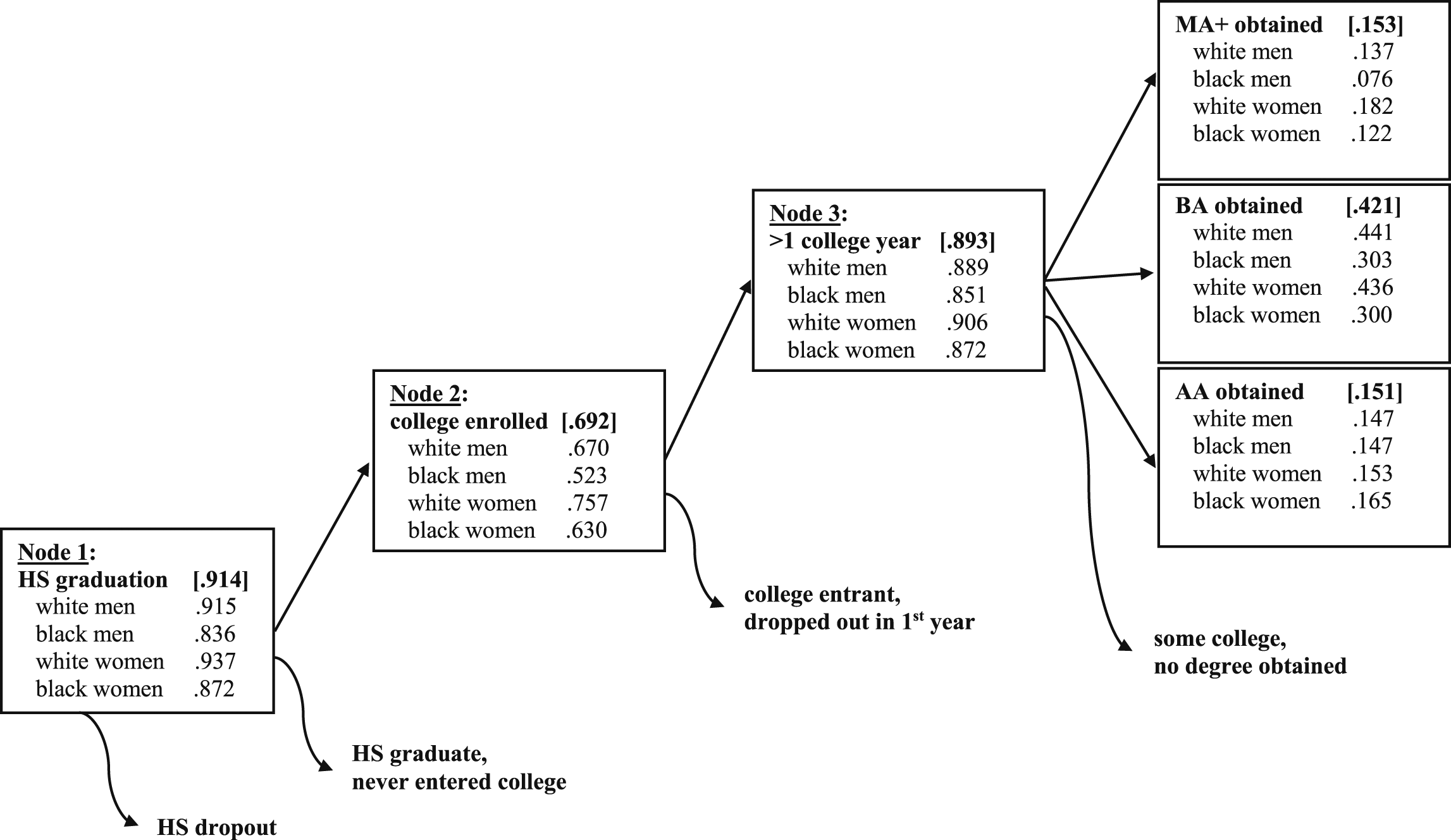
One strength of the decision tree model and its visual representation is the simplicity of decisions at each educational node. There are only two options: either dropout (considered equivalent to entering the labor market) or persist in education (aiming for the next decision node). At each node box, the probabilities can be interpreted as the chance of reaching that particular educational level: high school graduation (node 1), college entry (node 2), and completed first year of college (node 3). The straight arrows toward the next node box indicate educational persistence and the bent arrows its alternative: leaving education. By implication, a decision to persist at each of the three nodes leads to an associate’s degree, a bachelor’s degree, or an advanced degree (right-most side of Figure 1).
The distribution of probabilities of nodes can be used to calculate the average probability of reaching the next hurdle or any other future educational destination. We use the term “one-shot model” for the joint estimation these future outcomes connecting different nodes. For example, in the overall population (across both races and genders), one can follow the bold probabilities in each consecutive node to calculate the “one-shot” chance of graduating with any higher education degree. Thus, using ACS data, we calculate that in high school this probability is .914 (graduating high school) x .692 (enrolling in college) x .893 (attending beyond year 1) x .725 (AA + BA + advanced degree) = .409. These cumulative chances change with every consecutive decision node.
However, as shown by breakdowns of educational persistence probabilities in Figure 1, the chance of reaching any next node varies dramatically by race and gender, partially reflecting the uneven hurdles and disadvantages of white and black students in the educational system. There are already substantial racial gaps in reaching node 1: high school graduation. Only 83.6% of black men (vs. 91.5% of white men) and 87.2% of black women (vs. 93.7% of white women) reach high school graduation. Yet these racial gaps are most noticeable between nodes one and node 2, where 52.3% of black male high school graduates ever enroll in higher education, which is substantially lower than white men (67%). Among women, a gap of similar size is visible: 63% (black) compared to 75.7% (white). These within-gender race gaps reappear at each consecutive node, whereby substantially fewer black men and women attain a college degree (associate’s, bachelor’s, or higher).
In the empirical section of this paper, we use estimated probabilities of final educational destinations of the four race-gender groups as informative for educational opportunities (i.e., expectations) of currently enrolled students. Importantly, the same forward-looking method may be applied to approximate expectations about one’s chances of employment and earnings attached to each educational level and given the existing race-gender gaps in terms of job access distribution and earnings levels. Similar to educational expectations, we take the same generation of slightly older individuals—ages 25 to 34 who have left education—as the point of reference point for currently enrolled students. Given the discriminatory hurdles for black students and women in the labor market, and its variation across educational level, it is essential to also calculate these potential labor market outcomes separately for white men, black men, white women, black women.
Joint estimation
Our measures of forward-looking expectations combine the race-gender-specific opportunity structure in both institutions: the educational system and the labor market. We calculate these incentives by jointly estimating the educational risk pattern, the employment access risk pattern, and the earnings levels for each combination for each race-gender group separately. Two incentives should be considered at each decision node: the expected earnings level when dropping out (called the “base”) and the expected earnings level when persisting (called the “bet”).
For any node, and by race-gender group, we define the base as the average of the joint probability of employment vis-à-vis unemployment (i.e., job chances) and the earnings level conditional on employment among individuals who went no further than that “current” node. This is a rather robust estimation because the reference point is relatively nearby (the labor market position of peers who dropped out) and does not require a projection of future success in education. Formalizing this for an individual

The bet requires a more complex calculation because one has to incorporate the uncertainty about future educational destinations. At the same time, labor market positions of higher educational levels also become harder to guess. We account for this uncertainty by a one-shot model for any given node; calculating the average of the sum of all predicted probabilities of educational destinations, multiplied by the corresponding predicted employment probabilities, multiplied by the earnings level attached to employed individuals with that particular educational destination (all calculated separately for the race-gender groups). Following the incentive for an individual at node 1, the bet is defined as the race-gender average of the predicted probability of reaching any level in higher education
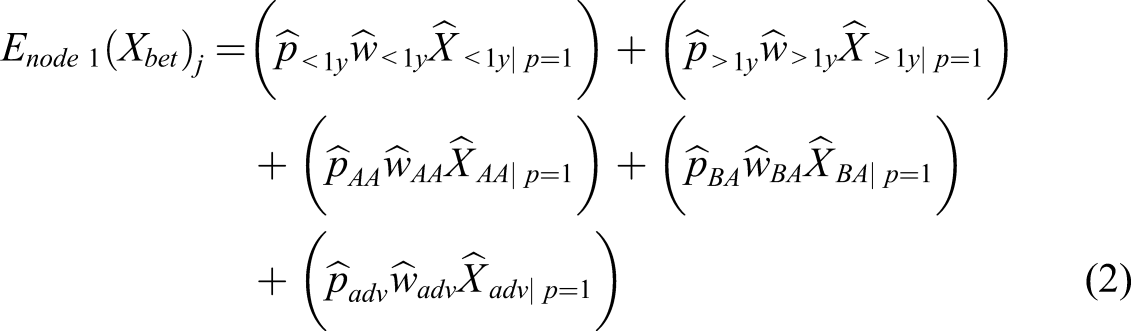
This can be generalized to the expected gain at any educational node (

Importantly, the models that are used to estimate the predicted probabilities by race-gender group contain coefficients to adjust for several contextual factors. With regard to the educational destination probabilities, we control for geographic region and year of observation. The labor market models also control for these two factors, as well as age in the year of observation. We discuss the data application below.
The proposed method will finally yield the relative incentive for white men, black men, white women, and black women, expressed as the percentage gain from educational persistence at nodes 1, 2, and 3. We obtain these incentives in three steps, all done separately for race-gender group and node. First, we calculate the mean predicted values of the bases (jointly estimating employment and earnings) and the bets (jointly estimating the educational destinations, employment, and earnings). Second, we subtract the base from the bet which is the expected gain from persistence. Third, we calculate the share of the expected gain (in dollars) of the base (in dollars) to produce the relative incentive of staying in education. A comparison of these incentives within gender and between race groups is the incentive inequality of persistence.
Application
Data and modeling
To measure relative incentives from further educational attainment, we use annual cross-sectional samples from the American Community Surveys (ACS) between 2001 and 2017 (U.S. Census Bureau 2019). The predicted values of educational and labor market outcomes are based on models run on a subsample of individuals between ages 25 and 34 who are not currently enrolled in education. We chose this age-group because it forms the most realistic reference for expectations and behavior of currently enrolled students—just above the typical age of higher education students. Furthermore, policy reports on labor market outcomes define the “early career” by this same age-group. Aside from this age selection, we omit foreign-born individuals and those who are currently enrolled in education. The study sample consists of 3,195,775 cases: 1,396,481 white men, 212,911 black men, 1,375,370 white women, and 210,013 black women. Sample weights are applied in all calculations.
We use ACS’ information describing highest educational attainment, organized as: less than high school, high school or GED, less than 1 year of college, more than 1 year of college (no degree), associate’s degree, bachelor’s degree, and advanced degree (master’s or higher). These attainment levels are used to create three educational nodes: (1) high school graduation, (2) college entry/less than 1 year of college, and (3) more than 1 year of college/no degree.
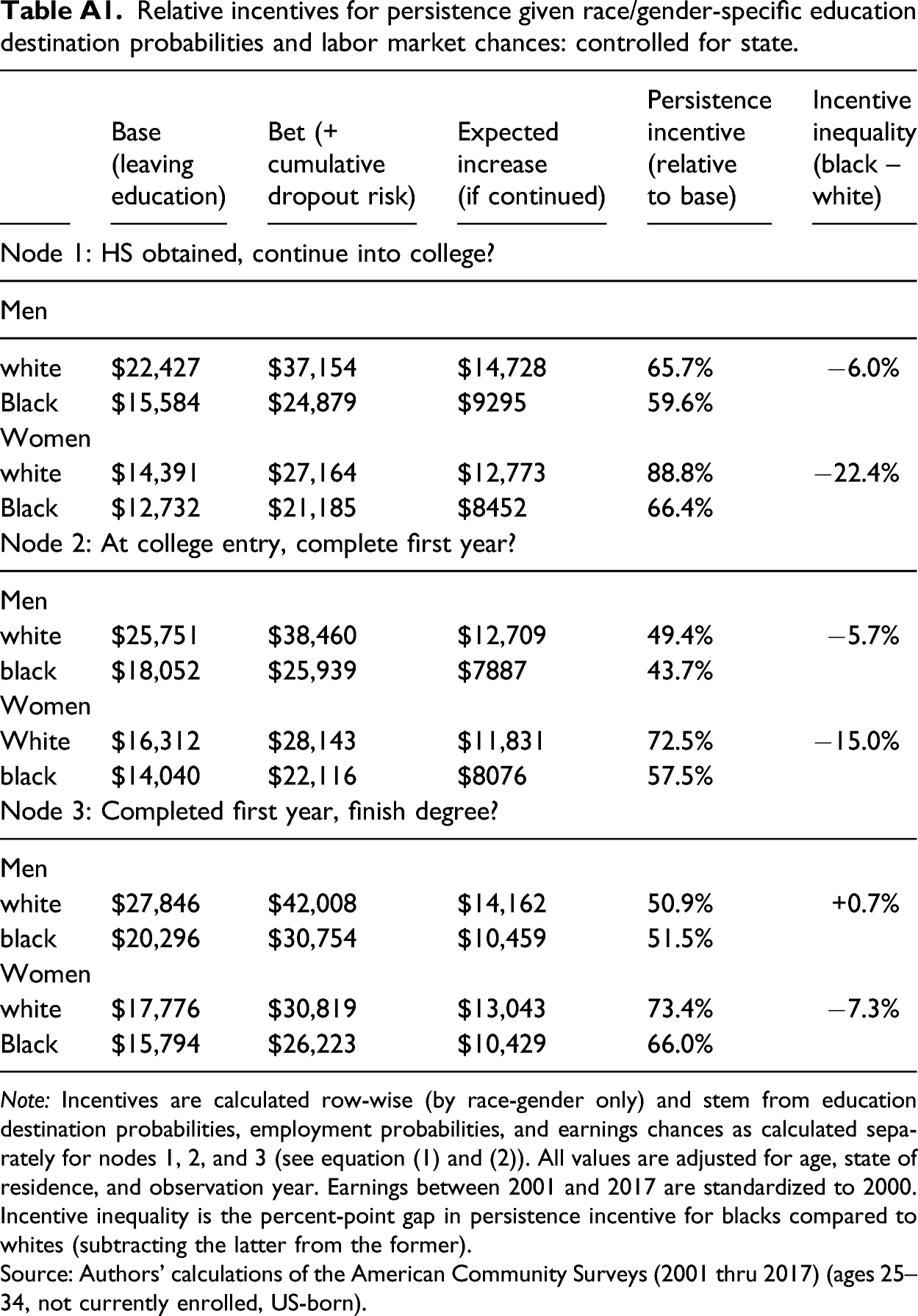
Among subsamples conditional on reaching each of the three nodes, the predicted probabilities are derived from regressions on educational level (logistic models for each subsequent level), having employment by educational level (logistic models), and earnings of employed individuals by educational level (OLS models). Employment is defined has being active in a job; regular, self-employed, or in the armed forces. This definition forms the condition for earnings level, standardized to 2000 dollars to account for inflation. All models control for geographic region and year of observation to account for structural and conjunctural variation in educational attainment and labor market structure. The geographic corrections are necessary given the substantial variation in labor market chances, in particular for black job seekers and workers (Cassirer, 1996). The regional divisions are New England, Middle Atlantic, Northeast Central, West North Central, South Atlantic, East South Central, West South Central, Mountain, and Pacific. A robustness check (Table A1) replicates our models using state of residence as control variable instead. In models that predict labor market outcomes, we also control for age.
Incentive inequality
Relative incentives for persistence given race/gender-specific education destination probabilities and labor market chances.
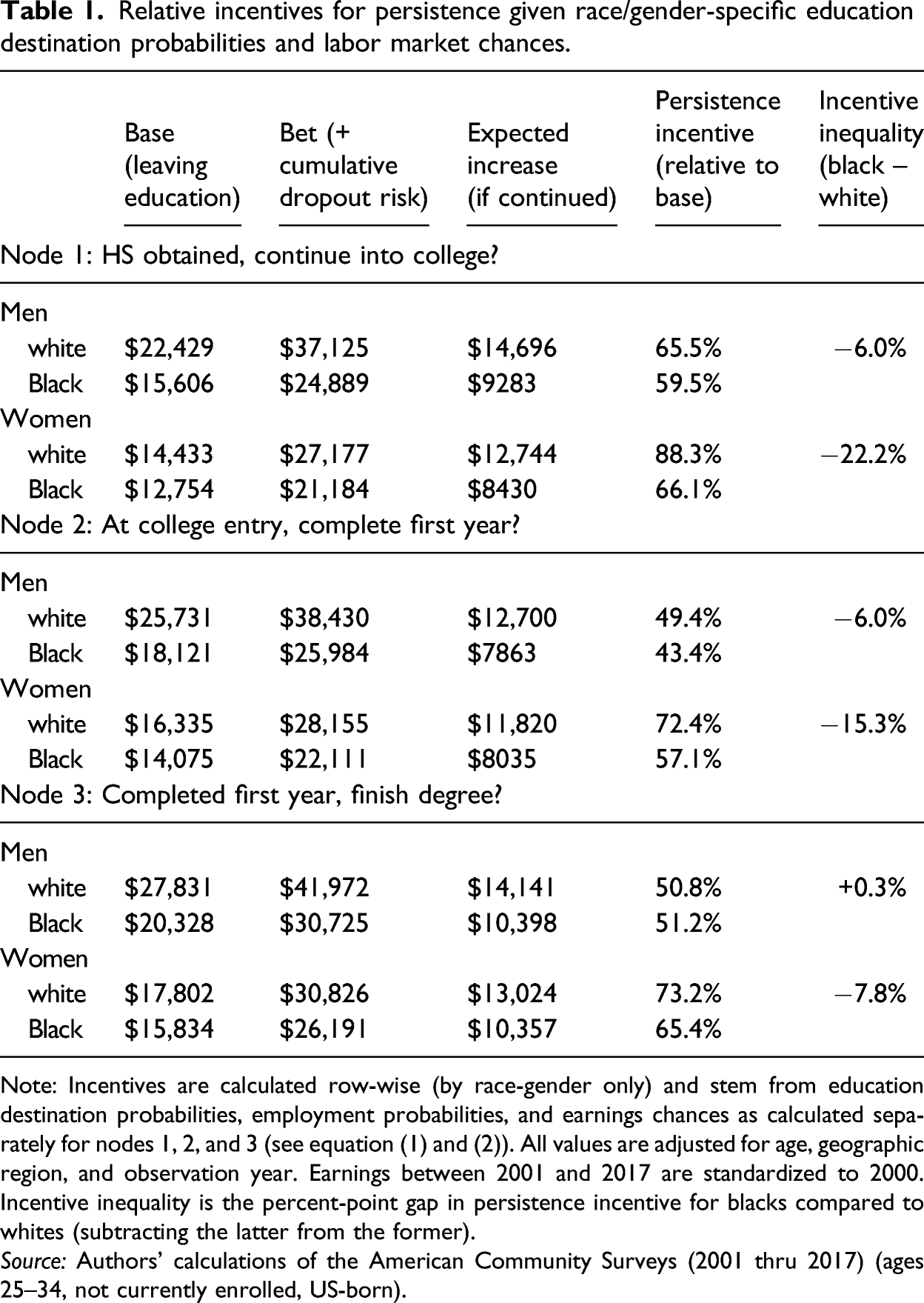
Note: Incentives are calculated row-wise (by race-gender only) and stem from education destination probabilities, employment probabilities, and earnings chances as calculated separately for nodes 1, 2, and 3 (see equation (1) and (2)). All values are adjusted for age, geographic region, and observation year. Earnings between 2001 and 2017 are standardized to 2000. Incentive inequality is the percent-point gap in persistence incentive for blacks compared to whites (subtracting the latter from the former).
Source: Authors’ calculations of the American Community Surveys (2001 thru 2017) (ages 25–34, not currently enrolled, US-born).
Focusing on the first three columns, these represent the absolute dollar values of either leaving education (“base”) or persisting in education (“bet”), each calculated while taking into account the uncertainty of job access and earnings. The “base” returns are the counterfactuals to continuing in education—that is, leaving at one of the nodes—for each race-gender group in the column “base.” For example, as shown in the first column, a black man who finished high school (node 1) has an expected income of $15,606 if he were to never enter higher education. This would be $22,429 for a white man making the same decision. Subsequently, the net expected increase (“bet” minus “base”) considers the dollar amount increase in earnings if one stays in school and attempts reaching the next node, compared to what one could earn if one left school immediately, at the current node (i.e., the base level). Note that the earnings levels and earnings boosts are lower than actual salaries and wages because they take into account the probabilities of having no employment.
The absolute returns (i.e., the “expected increase” column in Table 1) indicate a consistent pattern at all three college-related nodes: continuing in education yields a higher projected dollar return for white men and women than for black men and women. The black-white gap is several thousands of dollars for virtually all nodes and each race-gender combination. For instance, a decision to enter college at node one yields $14,696 for white men compared to only $9283 for black men. Similarly, white women can expect a boost of $12,744 in earnings, after accounting for uncertain educational and job access probabilities, compared to only $8430 more for black women. The ratio of absolute returns of black students and white students ranges between 0.62 and 0.80 when going from node one to node 3. Hence, a forward-looking perspective on current 25–34 year olds within one’s race-gender group indicates large inequalities for black students for college entry and college persistence.
However, we argue that the more relevant incentive for educational attainment is the relative or proportional gain from continuing in education at each educational node. We argue that columns four and five present the relative incentive to persist by race-gender group and the incentive inequality for blacks, respectively. These race-gender gains are reported in the right-most column of Table 1, as calculated using equation (2). This is the size of the expected gain if one stays in education (“continued”) relative to the base at each node (“entering the labor market instead of continuing in college”) by race-gender group.
The relative incentive for educational persistence for white men as opposed to black men is higher at node 1 (65.5% vs. 59.5% in Table 1); higher at node 2 (49.4% vs. 43.4%, respectively), and about the same at node 3. For black women, persisting at node 1 (entering higher education) pays off considerably less (a relative gain of 66.1%) than for white women (a relative gain of 88.3%). These gaps remain large at node 2 (72.4% vs. 57.1%) and node 3 (73.2% vs. 65.4%).
We call the within-gender race gaps incentive inequality (most-right column), which is the net cumulative disadvantage for black men and women at consecutive decision nodes. At high school graduation, black men and women face an unequal reward relative to whites for their decision to enter college (6% and 22%, respectively) and this incentive inequality does not disappear after college entry (yet slight reduced for women). For black women, inequality of incentive remains substantial throughout the higher education career. For black men, the “decision” to finish the degree, conditional on making it beyond the first year of college, is however equally rewarded; a net incentive inequality of +0.3%.
In sum, looking at steps or nodes on educational persistence provides another perspective on racial gaps and its cumulative mechanism. The absolute dollar gain that black men and black women receive for remaining in college is consistently lower than the gain enjoyed by whites. However, it is surprising that even the relative incentive remains highly unequal between the two race groups (within gender): incentive inequality. The consistent disadvantage of proportional gains is larger for black women vis-à-vis white women, but is still substantial for black men at decisive educational nodes: high school graduation (deciding on college entry) and college entry (deciding to complete the first year).
Bounded rationality
Another perspective on (educational) decision-making, grounded in behavioral models of social action, emphasizes the cognitive limitations of the decision-maker: bounded rationality. The boundedness of choice is rooted in the capacity of individuals to oversee and process information, partially due to obstructed vision on the decision problem and time constraints. We use the concept of (bounded) rational action to ask how relative incentives (and incentive inequality) shift when the unequal access to the labor market is ignored. More precisely, we are interested to assess relative payoffs beyond the labor market entry discrimination (bounded rationality), and how this contrasts with the full forward-looking model.
Relative incentives for persistence: “bounded rationality” (ignoring employment chances) vs main model.
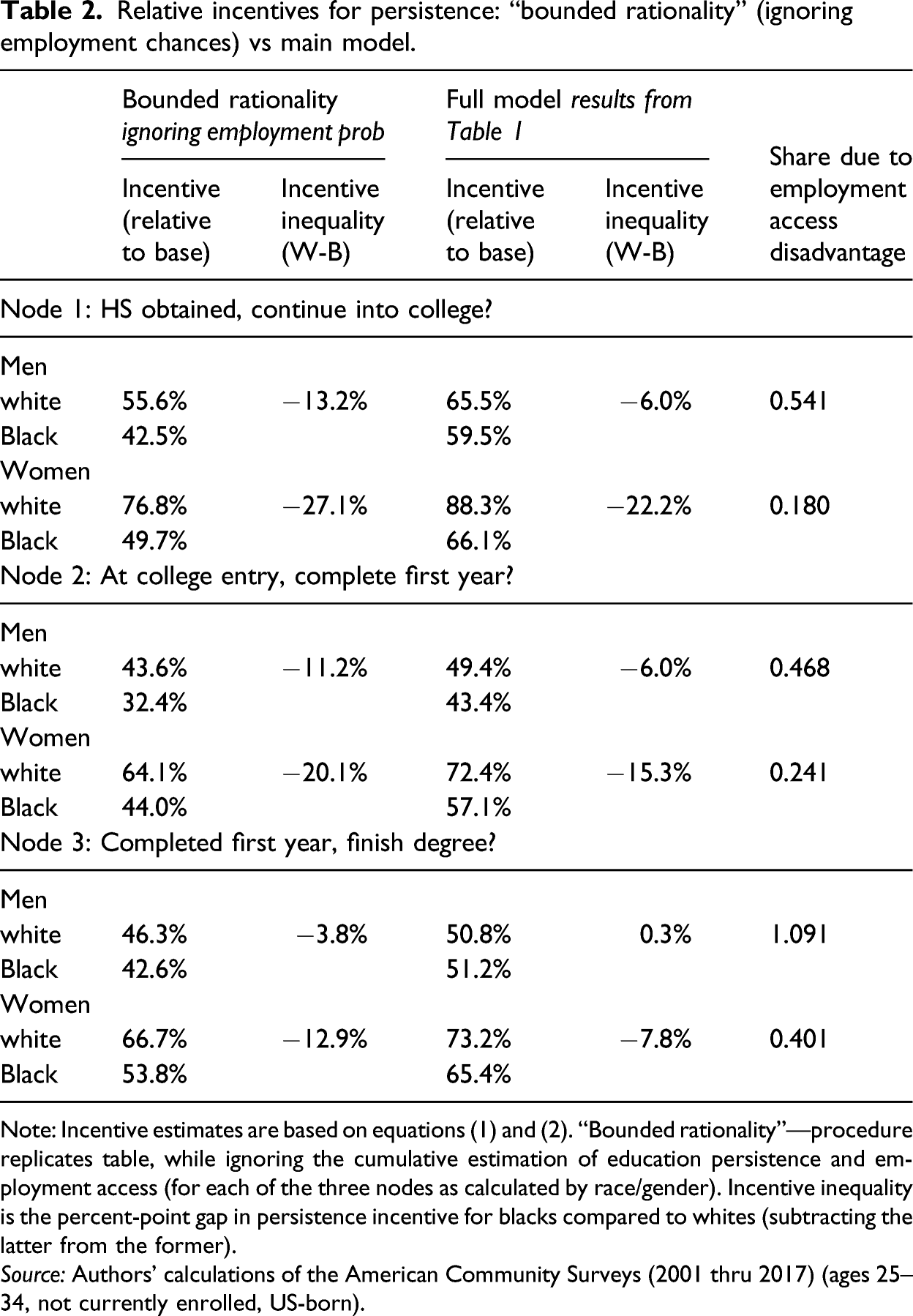
Note: Incentive estimates are based on equations (1) and (2). “Bounded rationality”—procedure replicates table, while ignoring the cumulative estimation of education persistence and employment access (for each of the three nodes as calculated by race/gender). Incentive inequality is the percent-point gap in persistence incentive for blacks compared to whites (subtracting the latter from the former).
Source: Authors’ calculations of the American Community Surveys (2001 thru 2017) (ages 25–34, not currently enrolled, US-born).
When contrasting the two approaches in Table 2 we can decompose the components of incentive inequality and deduce the share for black students that is due to employment access disadvantage. Put differently, a comparison between the incentive inequality estimates yields the influence of the education-specific employment chance in the total forward-looking model (of equation (2)). Consistent with earlier findings of racial gaps in labor market outcomes, the estimated proportional influences (most-right column) suggest that black men face the toughest hurdles to find employment throughout the educational attainment distribution.
Starting with high school graduation (node 1), more than half of the incentive inequality experienced by black men is due to unequal access to employment (vis-à-vis white men): .541. This share drops slightly to .468 among college attendees (node 2), which is despite the higher educational attainment level. At node 3, we did not find an incentive inequality for the decision to finish a higher education degree (Table 1). However, the bounded rationality approach in Table 2 reveals that there is an inequality at this educational node (−3.8%) that is completely rooted in unequal access to employment for black men, and is erased when taking into account the earnings levels of node three dropouts (base) and college completers (bet).
For black women, the picture of the role of employment access is the reverse. At node 1, the influence of unequal access is only one-fifth of the total incentive inequality. This suggests that most of the unequal relative reward of black women compared to white women stems from within-employment earnings differentials. The share of incentive inequality increases for the next consecutive decision moments: college entry (.241) and completed 1 year of college (.401). In other words, the further black women proceed in higher education, the more their relative incentive depends on employment access disadvantage.
Discussion
In Jencks et al. (1972), writing soon after the Civil Rights legislation, Jencks et al. assumed that once African-Americans achieved higher levels of education, racial earnings gaps would greatly diminish. In other words, the meritocratic power of the educational system would diminish the racial earnings gap. Although significant progress has been made since the early 1970s, the relationship between (improvements in) educational attainment and the racial earnings gap remains weak. 30 years later, Gamoran (2001) predicted that a considerable reduction in educational inequality could be visible by 2010—when the children of parents attending education in the 1980s are of college-age or older. However, black-white inequality in college completion rates have remained stable across the last couple of decades (Shapiro et al., 2017). For example, by 1996, 53.7% of black bachelor’s students and 61.7% of white bachelor’s students completed their degree, compared to 44.5% and 57.7%, respectively, by 2016 (Espinosa et al., 2019: p.106).
When addressing the persistence of the higher education attainment gap from a socialization theory perspective, or a RAT theory perspective, sociologists have focused on information deficits, varying status socialization processes, and relative risk aversion. All such factors are located in individuals’ social background, such as their parental home and its environment. These explanations fail to fully account for the disappointing progress of black students’ educational attainment compared to white students, which is particularly problematic given the narrowing path of the racial test-score gap.
In this paper, we propose a conceptual framework for estimating how educational attainment decisions, made under uncertainty, are perceived from the student’s perspective based on a different set of assumptions. Our forward-looking approach underscores the importance of taking into account the unequal opportunity structure for black students and white students when calculating their potential gains from attending higher education. We present a model for the calculation of relative attainment incentives, which is built on the accumulating educational persistence inequalities as well as the unequal labor market payoff structure. More precisely, when estimating the real educational persistence payoff by race-gender combination, one has to take into account complexity of the (1) possibilities of where one might end in the educational system and (2) link these probabilities to the opportunity forecast for each potential outcome’s labor market position (i.e., both employment chances and earnings levels). The model proposed in this paper yields a measure of within-gender and between-race “incentive inequality.”
When applying the full pay-gap and completion-gap distribution model to educational attainment and earnings data from the American Community Surveys, we concentrated on the relative incentives for black students to stay in education at several educational decision nodes: high school graduation (enter college?), college entry (continue?), and after 1 year of college (complete the degree?). These relative incentives should be interpreted as the percent-increase in expected gain from educational persistence, based on the full risk distribution that is jointly estimated using educational destination probabilities, employment probabilities, and earnings level estimates (equation (2)). When comparing these relative expected gains between black students and white students (within-gender), the analyses revealed striking racial contrasts: black students’ educational persistence is rewarded at a much smaller rate compared to white students. This is black-white incentive inequality for college persistence. Incentive inequality in relative returns to educational persistence is largest in the earlier stages of the higher educational career. The perspective of the combined chances in education and the labor market varied more between black and white students at the college entry decision point and at the first year in college. This is partly a function of progression through the educational system—the black-white variation in graduation probability declines due to selection—and the fact that job access and earnings inequality between blacks and whites is typically smaller for higher levels of education. Nonetheless, we believe that incentive inequality as “context explanans” is most relevant where observed black undergraduate dropout is highest, which is in the first couple of years in college.
The approach of forward-looking calculation of potential outcomes includes access to employment (i.e., job chances), which is known to be a large hurdle to income for black school-leavers (Pager and Pedulla, 2015; Pedulla, 2018). Once we apply a decomposition approach by adjusting the equation for ignoring this inequality—creating an analogy to a “myopic” actor or “bounded rationality”—we observed a large influence of unequal access to employment for black men’s incentive inequality and a much smaller influence for black women’s incentive inequality. Furthermore, as black men achieve higher educational nodes, the relative influence of unequal employment rates on their experienced incentive inequality declines. We find an opposite pattern for black women, where unequal unemployment probabilities play a larger role at higher educational levels.
The conceptual model and empirical application within gender yields an additional advance. Much of quantitative research on racial earnings inequality has been focused on men. Despite its theoretical gains in women’s and gender studies, empirical research of intersectionality remains less developed (McCall, 2005). Aside from our theoretical reasons to calculate labor market incentives, separately by race, and compare within gender, our approach also sheds light on the earnings inequality of black women vis-à-vis white women. Black women’s lower labor market outcomes were mostly due to gender rather than race until 2000. However, contrary to popular belief, the pay-gap between black women and white women has increased in the first decade of the 21st century (Mandel and Semyonov, 2016). Our comprehensive estimation of incentives through educational chances and labor market chances fits this story; within gender, black women’s incentive inequality is much higher than for black men.
Importantly, as argued by Lovett (2006), rational action theory in the social sciences should not be considered a unified theory of social behavior, but rather a framework providing research tools to understand mean effects resulting in inequality and stratification. Our focus on the relative payoffs of leaving or continuing in higher education provides a simple explanation of lower completion rates in higher education by race. Notwithstanding the overwhelming evidence for social origin (i.e., class) differentials at consecutive educational transitions, primarily established in behavioral models (e.g., relative risk aversion), our conceptual RAT model argues to expand on a forward-looking approach by integrating comprehensive measures of the opportunity structure in the study of the racial attainment gap in US higher education. This approach considers the opportunity structure lying ahead of any student at educational nodes and asks whether their race-gender-specific reference points may indicate relative payoff differentials.
The stark racial-gender incentive inequalities as presented in this study do not imply that the racial gap in college completion is fully explained by such dynamics. We find that these inequalities are largest in the early stages of the college career, which also aligns with prior research on college retention. Future research could integrate our (or similar) incentives measures that are empirically derived from large-N data in longitudinal studies on college persistence. One limitation of our empirical assessment is a shortage of several relevant individual-level variables, such as test scores and family background (class or income). As shown by Ciocca et al., (2018), there are large discrepancies in both academic and economic resources between black and white students who transition to higher education. It is important to note that after considering these dimensions of backgrounds, blacks students over-enroll in 4-year colleges. Concentrating on just individual-level factors, the pre-college dropout risk of black students is therefore higher, although many achieve performance levels (grades) in college that reduce this risk. However, we see reason to believe that educational decisions of black students are at least in part influenced by the drastically unequal incentive structure ahead of them, reflecting structural racial inequalities and discrimination. One empirical task for sociologists of education is to examine the individual background factors and role structural inequalities simultaneously. Hence, future research concerned with decomposition of educational attainment inequality may integrate the proposed measure of incentive inequality on decision nodes—as based on ACS data—into their predictive models, while retaining traditional social background regressors.
Footnotes
Declaration of conflicting interests
The author(s) declared no potential conflicts of interest with respect to the research, authorship, and/or publication of this article.
Funding
The author(s) received no financial support for the research, authorship, and/or publication of this article.

Notes
Appendix
Relative incentives for persistence given race/gender-specific education destination probabilities and labor market chances: controlled for state.
| Base (leaving education) | Bet (+ cumulative dropout risk) | Expected increase (if continued) | Persistence incentive (relative to base) | Incentive inequality (black – white) | |
|---|---|---|---|---|---|
| Node 1: HS obtained, continue into college? | |||||
| Men | |||||
| white | $22,427 | $37,154 | $14,728 | 65.7% | −6.0% |
| Black | $15,584 | $24,879 | $9295 | 59.6% | |
| Women | |||||
| white | $14,391 | $27,164 | $12,773 | 88.8% | −22.4% |
| Black | $12,732 | $21,185 | $8452 | 66.4% | |
| Node 2: At college entry, complete first year? | |||||
| Men | |||||
| white | $25,751 | $38,460 | $12,709 | 49.4% | −5.7% |
| black | $18,052 | $25,939 | $7887 | 43.7% | |
| Women | |||||
| White | $16,312 | $28,143 | $11,831 | 72.5% | −15.0% |
| black | $14,040 | $22,116 | $8076 | 57.5% | |
| Node 3: Completed first year, finish degree? | |||||
| Men | |||||
| white | $27,846 | $42,008 | $14,162 | 50.9% | +0.7% |
| black | $20,296 | $30,754 | $10,459 | 51.5% | |
| Women | |||||
| white | $17,776 | $30,819 | $13,043 | 73.4% | −7.3% |
| Black | $15,794 | $26,223 | $10,429 | 66.0% | |
Note: Incentives are calculated row-wise (by race-gender only) and stem from education destination probabilities, employment probabilities, and earnings chances as calculated separately for nodes 1, 2, and 3 (see equation (1) and (2)). All values are adjusted for age, state of residence, and observation year. Earnings between 2001 and 2017 are standardized to 2000. Incentive inequality is the percent-point gap in persistence incentive for blacks compared to whites (subtracting the latter from the former).
Source: Authors’ calculations of the American Community Surveys (2001 thru 2017) (ages 25–34, not currently enrolled, US-born).