




Abstract
This paper investigates strategic thinking in the fictional world of Edgar Allan Poe’s ‘The Purloined Letter’. This short story has been rightly celebrated for its explicit analysis of strategic reasoning in which players attempt to outwit one another, which involves accounting for how they are all attempting to outwit one another. I differ from previous analyses by examining how the actors can often be wrong in their explicit analysis and consider the strategic actions they take rather than those they claim to take. Using elementary game theory, I describe the five games (and suggest a sixth) that make up the strategic heart of the story. These include games of signalling, screening, negotiation, revenge and a unique game called the ‘pincer’. I consider how literary sources like ‘The Purloined Letter’ can provide insights into the applicability of strategic analysis in the ‘real world’.
This paper considers strategic behaviour by ‘fictional’ actors in a ‘fictional’ world. Those scare quotes emphasise how there can only be an arbitrary separation between the fictional and the non-fictional once behaviour has been filtered through an interpretive mechanism. The interpretation creates from all events a narrative whose purpose is to simplify and model the world in which those events occurred. The consumers of these interpretations – perhaps the reader of a paper like this – themselves carry out further interpretive processes, which can have different goals than those of the initial interpreter. One such goal is to derive some account of the underlying real world that is reflected by that interpretation, another is to determine principles of interpretation, or the motives of the behaviour being described, or simply to derive aesthetic enjoyment. Because all descriptions of behaviour are interpretations, the insights gained are themselves points of view. Their value comes from whether we find these points of view useful, or insightful, or clever, or charming, or whatever our criteria for goodness are (c.f. Rubinstein, 2006, for a similar account of the value of economic analysis). This paper contributes to all these dimensions of value.
Edgar Allen Poe’s ‘The Purloined Letter’ has long fascinated scholars from many disciplines. Although the setting and the events are fictional and abstract and perhaps even highly contrived, they achieve a striking degree of verisimilitude. This is testified to by the sizeable influence of the story, perhaps most notably in the role it has played in 20th century psychoanalysis (Bonaparte, 1949; Derrida, 1987; Lacan, 1972; see works collected and annotated in Muller and Richardson, 1988). Another field with almost as strong a connection to ‘The Purloined Letter’ is game theory and its analysis of strategic interdependence. This connection is summarised more extensively in the appendix, so I mention here only that ‘The Purloined Letter’ has often been used to illustrate puzzles in strategic thinking, especially related to Nash equilibria and mind-reading (e.g. Binmore, 2007; Eliaz and Rubinstein, 2011). The tale is also one of the central texts used to discuss how literature and game theory can mutually support one another (e.g. Brams, 1994, 2011; Swirski, 1996) – with Arthur Conan Doyle’s ‘The Final Problem’ being its only serious rival (e.g. Perea, 2014; Wainwright, 2012). This paper brings a new perspective to this old investigation. Most previous approaches have focused on how C. Auguste Dupin, the detective/protagonist of ‘The Purloined Letter’, explains why he succeeds when everyone else fails. But as I will show, Dupin’s own explanations not only do not make sense of what happens in ‘The Purloined Letter’, but also miss the great bulk of the sophisticated strategic thinking that actually occurs. Even whether Dupin succeeds is a question unanswered, depending entirely on how rational the other actors are.
I begin with a summary of ‘The Purloined Letter’, although the story is brief and this would be a good opportunity to read it in its entirety.
Summary of ‘The Purloined Letter’
The famous detective C. Auguste
The Queen had been reading this letter in her apartment when the
The Minister has since been blackmailing the Queen, and she has hired the Prefect to retrieve the letter. The Prefect assumes, apparently with good reason, that the letter is hidden either in the Minister’s home or on his person. The Prefect has spent some months on a meticulous search in which, during the Minister’s frequent absences from home, he has probed every cubic centimeter of the Minister’s residence, and has also had footpads (i.e. muggers) attack the Minister and search him methodically under the cover of an apparent theft. Despite all his efforts, the Prefect has come up empty handed and has come to Dupin for free advice, all the while insisting the puzzle of the letter is a trivial matter. Dupin agrees the letter is certainly at the Minister’s house, but the only advice he offers is for the Prefect to repeat his previously unsuccessful search.
Some few months later the Prefect returns, even more distressed than before. He has conducted the second thorough search with no success. He declares he would gladly pay a small fortune to anyone able to produce the letter. Dupin asks the Prefect to write out a check for this small fortune in exchange for the letter. The Prefect is dumbfounded but pays, Dupin immediately provides the letter and the Prefect departs.
Dupin describes how he retrieved the letter. He was an acquaintance of the Minister and paid him an apparently social visit. He wore dark green glasses which hid his eyes. Surreptitiously, he surveyed the Minister’s room and spied a letter in plain sight that looked completely different than the Queen’s yet had some telltale signs of alteration. He inferred this was a disguised version of the Queen’s letter. Dupin made a facsimile of the letter, in terms of external appearances, and during his return visit swapped the letters – re-purloining the original. He explains how the Minister, anticipating the methods of the Prefect, had disguised the letter in such a way that it could not be detected by those methods. He compares the interaction between the Minister and the Prefect to the strategic games of children or simple parlour games of hide-and-seek, and suggests the Prefect ‘lost’ because he failed to match his intellect to that of the Minister. Dupin also reveals that he and the Minister have long known one another, and that by thwarting him he has fulfilled a long-standing desire for revenge.
The five games
Shortly after the first appearance of ‘The Purloined Letter’, an unauthorised abridgement appeared in Chambers Edinburgh Journal (1844) with an introduction containing the following passage:
Mr Edgar A. Poe is evidently an acute observer of mental phenomena; and we have to thank him for one of the aptest illustrations which could well be conceived, of that curious play of two minds, in which one person, let us call him A, guesses what another, B, will do, judging that B will adopt a particular line of policy to circumvent A. (p. 343)
Such reflexive thought can continue indefinitely: What B expects A to do also depends on what B believes that A expects what B will do, and so on. Both A and B are striving to second, or third or fourth guess the other by thinking through a cognitive hall of mirrors to the strategically optimal set of beliefs about the others’ beliefs. A key concept in modern game theory is common belief in rationality, which entails that each participant in a strategic setting believes the others to be rational, each knows that the others believes them to be rational, and each believes that each believes the others are rational, and so on (Aumann, 1995; Chwe, 2013; Hargreaves-Heap and Varoufakis, 2004; Perea, 2012). To the degree these beliefs are invalid, as in if A incorrectly assumes B is irrational, or A does not consider B’s responses to possible actions by A, strategic situations can become resolved with one losing and the other winning because the first player has outsmarted, or gone one step beyond, the other.
In ‘The Purloined Letter’ Dupin illustrates his superior methods by describing two games in which one player outwits the other by intuiting their level of thinking and then going one step further. When introducing a hide-and-seek game played by choosing place names on maps, for instance, Dupin explains how an amateur player will choose both to hide and to seek in place names written in the smallest possible font, believing these small names will be invisible to the naïve player, and in response the better player will choose names written in the largest font spread over the whole page. 1 The story is full of such transactions, with the players (Dupin and/or the Minister usually at the center) striving to anticipate the thinking of the other party, and then to thwart it. As we will see, Dupin sees himself as being always one step ahead of the Minister, and the Minister one step ahead of everyone else.
I focus on five ‘games’ that make up the main strategic structure of ‘The Purloined Letter’. In ‘The First Theft’, the Minister steals the letter from the Queen, making use of screening and costly signalling. In ‘The Blackmail’, the Minister uses the letter to wrest concessions from the Queen, but why does the Queen give in to blackmail when the Minister has as much to lose as her? In ‘The Con’, Dupin deploys an information asymmetry to exploit the Prefect. In ‘The Pincer’, Dupin and the Prefect combine forces to outwit the Minister, yet Dupin (who benefits from a last mover advantage) attributes the success entirely to his own skill. Finally, in ‘The Big Game’ we discover there is a history and future to the conflict between Dupin and the Minister. It is not a one-shot game. I conclude by considering a possible sixth game, in which the Minister outwits everyone.
The first theft: Screening and signalling
The letter is purloined twice. First the Minister purloins it from the Queen, and then Dupin purloins it from the Minister. The Prefect’s description of the first theft is bookended by a claim that is repeated for emphasis. When the Prefect observes that possession of the stolen letter gives the thief ‘power’ over the Queen, the Narrator points out that this power ‘. . . would depend upon the robber’s knowledge of the loser’s knowledge of the robber [italics added]’. Minutes later, Dupin repeats the italicised phrase almost verbatim. The ingenuity of the theft is evidently that it ensures the Minister knows that the Queen knows that the Minister is the robber.
But can the manner of the theft be understood solely on this basis? Surely, once the letter is in the Minister’s hands, he could easily and credibly ensure the Queen’s knowledge of the robber in many ways. The Minister does not even need to steal the letter himself. To investigate, we will look in detail at how the theft is carried out. The Prefect starts his account as follows:
‘The document in question – a letter, to be frank – had been received by the personage robbed [the Queen] while alone in the royal boudoir. During its perusal she was suddenly interrupted by the entrance of the other exalted personage [the King] from whom especially it was her wish to conceal it. After a hurried and vain endeavour to thrust it in a drawer, she was forced to place it, open as it was, upon a table. The address, however, was uppermost, and, the contents thus unexposed, the letter escaped notice. At this juncture enters the Minister D–.’ (p. 227).
Observe the Minister enters the royal boudoir only after the letter has been placed on the table, and does not see the entrance of the King or the ‘hurried and vain endeavour’ to put the letter in a drawer. The Prefect continues:
‘His [the Minister’s] lynx eye immediately perceives the paper, recognises the handwriting of the address, observes the confusion of the personage addressed, and fathoms her secret.’ (p. 227).
The Prefect and/or the Queen here infer the thinking of the Minister. The Prefect goes on:
‘After some business transactions, hurried through in his ordinary manner, he [the Minister] produces a letter somewhat similar to the one in question, opens it, pretends to read it, and then places it in close juxtaposition to the other. Again he converses, for some fifteen minutes, upon the public affairs. At length, in taking leave, he takes also from the table the letter to which he had no claim. Its rightful owner saw, but, of course, dared not call attention to the act, in the presence of the third personage who stood at her elbow. The minister decamped; leaving his own letter – one of no importance – upon the table.’ (p. 227, italics added)
So, the Minister brazenly steals the letter under the eye of the Queen and the King. The trick with the false letter, of course, gives him some degree of ‘credible deniability’, even if he is caught in the act his actions can be explained away as a lapse of attention. This is how the Queen learns who the robber is, and this is how the Minister ensures she knows he is the robber. Dupin and the Narrator agree this is precisely why the Minister stole the letter in such an audacious manner.
Yet by openly stealing the letter in front of the two most influential people in the kingdom the Minister exposes himself to a great personal risk. As already mentioned, a more discrete theft followed by a short conversation with the Queen would work equally well. Indeed, the letter the Minister leaves behind would be enough to identify him as the thief, so there is no need for the Queen to observe the actual theft. Moreover, there is the possibility the letter is ‘innocuous’, in which case the Minister could face an embarrassing scene in front of the King. Why then, does he do this?
I suggest that, more important than merely letting the Queen know who stole the letter, the Minister’s ‘bold’, ‘ingenious’ and risky action serves two important functions: one is screening, taken up in this section, and the other is to ensure the Minister’s credibility, taken up in the next.
Despite the Minister’s ‘lynx eye’, any confusion or anxiety he perceives in the Queen could be due to something other than an incriminating letter. The letter could be innocent, or even ambiguous. Imagine it read: ‘Let’s meet for coffee again to follow up our previous discussion’. The words ‘coffee’ and ‘discussion’ could be euphemisms, or they could be intended literally and innocently. The innocence of the letter is determined, perhaps even defined, by how the Queen expects the King to react.
The Minister needs more information. He cannot ask the Queen directly if the letter is incriminating, but he can ask her indirectly, by placing her in a situation in which her actions will reveal how she expects the King to react were he to learn of the letter. This is screening (Riley, 2001), in which people are offered options where it is known that what they choose will differ depending on their ‘type’. The prototypical example is an insurance company that offers policies with both high and low deductibles at differing prices. High-risk clients who believe they have a good chance of collecting on the insurance will prefer the low deductible at a higher price. Low-risk clients who believe they are unlikely to collect will prefer the low deductible at a lower price. By charging a high price for the low deductible, insurers can thereby distinguish between high-risk and low-risk clients. High-risk clients will pay the premium for the low deductible, but low-risk clients (who do not expect to collect on the insurance) will not. We use screening when we ask customers to make a deposit on a purchase or ask our boss to put a promise in writing.
The open theft of the letter, under the eyes of the Queen, is the first ‘move’ in a screening game. The Queen can respond either by stopping the theft or allowing it. Stopping the theft will draw the attention of the king. An innocent Queen will have nothing to fear if the King sees the letter, but a guilty Queen does. Therefore, an innocent Queen will stop the theft, and a guilty Queen will not. The Minister, anticipating these preferences, can make an open attempt on the letter, which forces the Queen to ‘tell him’ by her actions whether the letter contains guilty information or is entirely innocent.
The theft also helps the Minister in other ways. By permitting the theft to occur in front of the King, the Queen not only reveals that the letter is compromising, but makes it more so. If it is discovered she had allowed the letter to be stolen rather than speak up, the same logic of screening would indicate the letter contained information she wished to conceal. Posner (1993), discussing blackmail – about which there is more in the next section – observed how by succumbing to blackmail, a victim makes the accusation credible. It becomes harder to ‘deny the truth of the blackmailer’s information should it ever be divulged’ (p. 1839). When the Prefect first consults Dupin, the Minister has been successfully blackmailing the Queen for 18 months. No matter how innocent sounding the text of the letter, by this point it will be well and truly damning.
The Blackmail: Making threats credible
The Minister is believed to have either implicitly or explicitly threatened to share the information in the letter with the King. As the Prefect explains in his typically roundabout way:
‘ . . . the disclosure of the document to a third person, who shall be nameless, would bring in question the honor of a personage of most exalted station; and this fact gives the holder of the document an ascendancy over the illustrious personage whose honor and peace are so jeopardized.’ (p. 227).
Blackmail involves the strategic move known as a threat and the associated problem of credibility. The simplest game of blackmail is a two-person game with three moves. First, the blackmailer decides whether to make coercive demands accompanied by threats. Next, the victim chooses whether to submit to those demands, and finally the blackmailer chooses whether to follow through on the threats. The victim must consider not just the threats, but also whether they will be fulfilled. In ‘The Purloined Letter’ the threat is to disclose a letter, perhaps to the King or to the public at large, and as the narrator observes, the blackmailer’s (i.e. the Minister’s) power comes from not yet having exposed the Queen, yet retaining the perceived ability to do so:
‘It is clear’, said I, ‘as you observe, that the letter is still in possession of the minister; since it is this possession, and not any employment of the letter, which bestows the power. With the employment the power departs.’ (p. 227).
Although the letter’s power departs once it is employed, the blackmailing Minister must nonetheless be believed to be prepared to follow through with his threat. The Prefect believes this is the case, and Dupin agrees. 2
But carrying out threats can harm the threatener as well as the threatened, and this often renders threats non-credible. Non-credible threats are ubiquitous in daily life. Perhaps a country threatens aggressive action if a second country undertakes human rights abuses, or annexes part of another, but once the offending action is taken, the threatening country concludes they do not want to bear the cost in lost trade or lost lives entailed by following through on the threat. Similarly, an employee might threaten to quit if she does not get a pay rise, but unless she has a better option she has no incentive to actually quit (and indeed if she has a better option has no incentive not to). We ‘call someone’s bluff’ when we believe a threat lacks credibility. 3 Blackmailers, like the Minister, must persuade the victim of the credibility of their threats.
Here is an informal description of the blackmail game between the Minister and the Queen as depicted in Figure 1. This figure shows a series of choices made by each party, one responding to the other. The first move is by the Minister who chooses between the strategies Blackmail (stealing the letter, and then implicitly or explicitly making some demands of the Queen), or Status quo, meaning to leave matters as they stand and neither steal the letter or make the blackmail attempt. If he chooses Status quo, the game ends with a payoff of 0 to both the Minister and the Queen. If the Minister chooses Blackmail, the Queen must choose between Submit (to the demands) or Defy, and the Minister follows with a choice between Expose (making the letter public or showing it to the King) or Not expose. If we know the payoffs for each party, then through backward induction we can determine the rational actions for both players. What the Minister will do depends on his payoffs at the terminal outcomes, and what the Queen should do depends on her payoffs and the Minister’s.
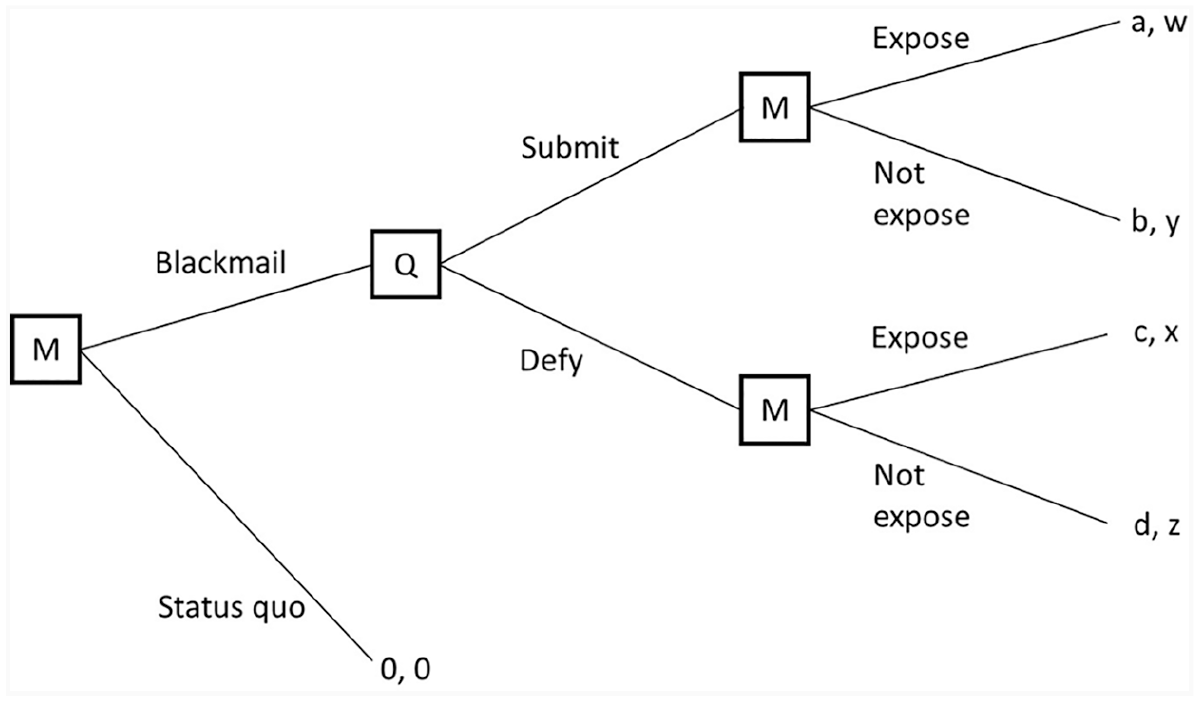
The blackmail game. The letters in the decision nodes represent the Minister (M) or the Queen (Q), who make the decisions. Values at the terminal nodes represent payoffs, the first payoff to the Minister, the second to the Queen. For instance, (a, w) indicates the Minister receives a and the Queen receives w. Payoffs should receive an ordinal interpretation.
The payoffs are shown at the end of the tree, with the blackmailer’s (Minister’s) payoffs first, so that (for instance) the payoff ‘d, z’ represents a payoff of d to the blackmailer and z to the victim (the Queen). The payoffs to the Queen are ordered as: z>y>x>w. The Queen is assumed to prefer not to submit to blackmail than to submit, and not to be exposed than to be exposed. We already know she has submitted rather than face exposure, demonstrating that for her being exposed must be worse than submitting (leading to y>x). Submitting and being exposed therefore is the worst outcome for the Queen (w), followed by not submitting and being exposed (x), submitting and not being exposed (y) and not submitting and not being exposed (z).
The Minister’s payoffs are denoted a, b, c and d. We know the Minister has chosen Blackmail, which entails that either one of a or b is his highest payoff (and that it at least is better than the status quo). Given this constraint, there are three relevant orderings for the payoffs:
I. b>a, c>d (the Minister prefers Expose only when the Queen chooses Defy)
II. a >b, c>d (the Minister always prefers Expose)
III. b>a, d>c (the Minister never prefers Expose)
IV. a >b, d>c (the Minister prefers Expose only when the Queen chooses Submit)
I will refer to each ordering as a type, so that (for instance) a Type I Minister is one for whom payoff b is greater than a, and c greater than d. Note that nothing else is specified meaning that, for example, a Type I Minister might have any of the following ordering of all outcomes: b>a>c>d, b>c>a>d, and b>c>a>b.
The only credible blackmailer is one who is perceived, by the victim, to be of Type I, so this is what the Minister will want the Queen to believe he is. For every other type, the Queen is better off defying the Minster. The Minister faces two challenges. First, he must reassure the Queen that if she submits, he will not expose her. So far, he has done all he can to reassure her: the blackmail has been going on for some time, the Queen has submitted, and the Minister has not (yet) exposed her. It is reasonable for the Queen to infer this will continue if she continues to submit. Since the Minister’s past actions are consistent with the condition b>a, he is either of Type I or Type III. We cannot vouch for his future preferences, but the Queen has good reason to believe that so long as she chooses Submit, the Minister will choose Not expose.
The greater part of the Minister’s challenge is to ensure the Queen believes he is of Type III rather than Type I, meaning that c>d. This is where the challenge of credibility comes in. Under any imaginable circumstances he will likely suffer if he exposes the Queen. In the best case he will suffer damage to his reputation, and it is possible his acts will be treated as criminal, especially since he has kept the knowledge to himself for so long and to secure his own interests: it is possible for both blackmailer and victim to share the same tumbrel to the guillotine. His ongoing blackmail attempt is known to the Prefect as well as the Queen, so it will be hard to keep it hushed up. The Minister has no rational basis for making the letter public, even if the Queen defies him. This may have already occurred to the Queen. If she believes he is rational, therefore, she will infer he is of Type III, and then choose Defy. This problem was stated by Posner (1993):
. . . [If] blackmail is a crime a rational blackmail victim will refuse to pay blackmail. Any offer to pay will lead the blackmailer to increase his demand and, more important, the victim knows that if he complains to the police, the rational blackmailer, in order to minimize his punishment, will refrain from divulging the blackmail secret. (p. 1841)
Since the Minister will not disclose the letter if he is rational, he will want the Queen to doubt his rationality. The challenge for blackmailers of appearing irrational to rational victims was given a penetrating analysis by Ellsberg (1959/1975). He examined real-world cases in which patently non-credible threats were nonetheless effective in eliciting compliance. In one case, a bank robber (‘a little old lady’) threatened to throw acid in a bank teller’s face unless he handed over £5000. The teller handed over the money. In fact, the glass contained water instead of acid, and even if it had contained acid a rational robber would almost certainly be ‘Type III’ and not throw the acid regardless of whether the money was produced or not. Did the teller make a mistake by giving in to the robber’s demands? Ellsberg observes that if there were any chance, practically no matter how small, that the acid was real and the robber would irrationally follow through, a prudent teller would hand over the money. A clever robber would therefore want to foster doubt and uncertainty about her rationality. Even threatening to throw acid might be enough. Selten (1988) similarly notes that the success of kidnapping or hostage-taking can come from the feared irrationality of the kidnapper, and so kidnappers will want their victim and their victim’s family to believe they might be crazy. A severed finger in the post, even if it is not that of the kidnap victim, will do wonders to enhance credibility (Shortland, 2019). The idea that negotiation success can be achieved by persuading the other party that you might be at least a little crazy, or to have irrational incentives, is sometimes known as the ‘madman theory’, and continues to be applied to modern diplomacy (Burr and Kimball, 2015; Kahn, 1962).
On what basis could the Queen come to believe that the Minister, well known as a man of reason, might act wildly and release the letter if she defies him? One possibility is that the Minister has carefully fostered a reputation for behaving in unanticipated ways: As the Prefect says, the Minister ‘dares all things, those unbecoming as well as those becoming a man’. Such a reputation can ensure that even apparently wild threats might be considered credible.
But the Minister does not only rely on his general reputation and enhances the credibility of his specific threats towards the Queen. Earlier we mentioned he gets two benefits from openly stealing the letter. The first benefit is to test the incriminating character of the letter. The second is to demonstrate his willingness to take great risks. The theft is so audacious that it might well lead the Queen and her advisors to think the Minister is a madman ‘capable of anything’, even of disclosing the contents of the letter when it appears to be not in his best interest. Dupin himself states that the Minister is ‘a desperate man . . . and a man of nerve’. It does not matter whether the Minister actually would expose the Queen and endanger himself, what matters is that the Queen and the Prefect (and Dupin) believe he is capable of doing so, and that the contents of the letter are compromising enough that even a small chance of exposure is sufficient to justify continuing to submit to the Minister while searching for the letter. It is this continued search, and the eventual discovery of the letter, to which we turn next.
The pincer: Adaptive strategies
Undoubtedly the most discussed passage in ‘The Purloined Letter’ is Dupin’s description of how his schoolboy friend mastered the game of ‘even and odd’. In this game one player takes up a handful of marbles and the other guesses whether the number of marbles is odd or even. The guesser wins one marble for a correct guess, and the holder wins one for an incorrect guess.
4
According to Dupin, his 8-year old friend won repeatedly by identifying with, or putting himself in the ‘mental shoes’ of his classmates. He likens the game between the Minister and the Prefect to a round of even and odd, and views the Prefect as an inferior player who fails for two reasons:
‘. . . first, by default of this identification, and, secondly, by ill-admeasurement, or rather through non-admeasurement, of the intellect with which they are engaged. [People like the Prefect] consider only their own ideas of ingenuity; and, in searching for anything hidden, advert only to the modes in which they would have hidden it.’ (p. 231).
That is, the Prefect has failed to properly identify with, or adopt the perspective of, the Minister. The Minister, on the other hand, has successfully adopted the perspective of the Prefect and so is able to anticipate his moves. Moreover, according to Dupin, the Minister’s intellect is superior to the Prefect’s. 5 Only Dupin can outwit the Minister by adopting the perspective of the Minister adopting the perspective of the Prefect, and thereby determine how the Minister will outwit the Prefect and therefore how he (Dupin) can outwit the Minister.
But there is a crucial difference between the search for the letter and the game of even and odd. To see this, consider a variant of the game but with different rules, and a different possible guessing strategy. In this game there are two marbles at stake, and three players: The Holder, and a team of two guessers. The Holder takes up a set of marbles. Guesser 1 makes a guess and receives the two marbles if correct. But if that guess is incorrect Guesser 2 – who remembers the first guess – has a go. If Guesser 2 is correct both guessers get a marble. If both guesses are incorrect the Holder gets two marbles. Obviously, the Holder is at a disadvantage. Here is a strategy that will ensure the guessers win every time: Guesser 1 chooses ‘odd’, and if he is incorrect Guesser 2 chooses ‘even’. Let us call this two-guess strategy the Pincer, because the Holder is invariably crushed by guesses coming from both sides.
The stolen letter game played in ‘The Purloined Letter’ is one with two searchers, both of whom have different skills and can individually find only some things, but collectively can find all. The game and its payoffs are shown in Table 1. We list two pure strategies available to the Minister (Hide and Disguise), and three available to the team of the Prefect and Dupin. The Prefect can go it alone and conduct a Hidden letter search. This corresponds to the Prefect’s particular set of skills, and is guaranteed to succeed if the Minister has chosen the Hide strategy, concealing the undisguised letter somewhere in his home or on his person. If the Hidden letter search succeeds, the Prefect will receive the full reward. But if the Minister has chosen the Disguise strategy, the Hidden letter search will fail and if the Prefect goes it alone the Minister will win.
The first two numbers in each cell are payoffs, respectively, to the Minister and the combined payoff shared by Dupin and the Prefect. For instance, in the strategy conjunction hide/hidden the Minister receives 0 and the Prefect and Dupin share 2. The numbers in parentheses give the distribution of any non-zero payoff to the Prefect and Dupin. In this example, the Prefect gets 2 and Dupin gets 0, since the Prefect gets it all if the hidden letter search is successful (he need not give Dupin a reward). Solving the game for Nash equilibria (e.g. Avis et al., 2010) reveals that the Minister can choose hide and disguise or a mixture of them with equal success – Dupin and the Prefect will always choose Pincer.
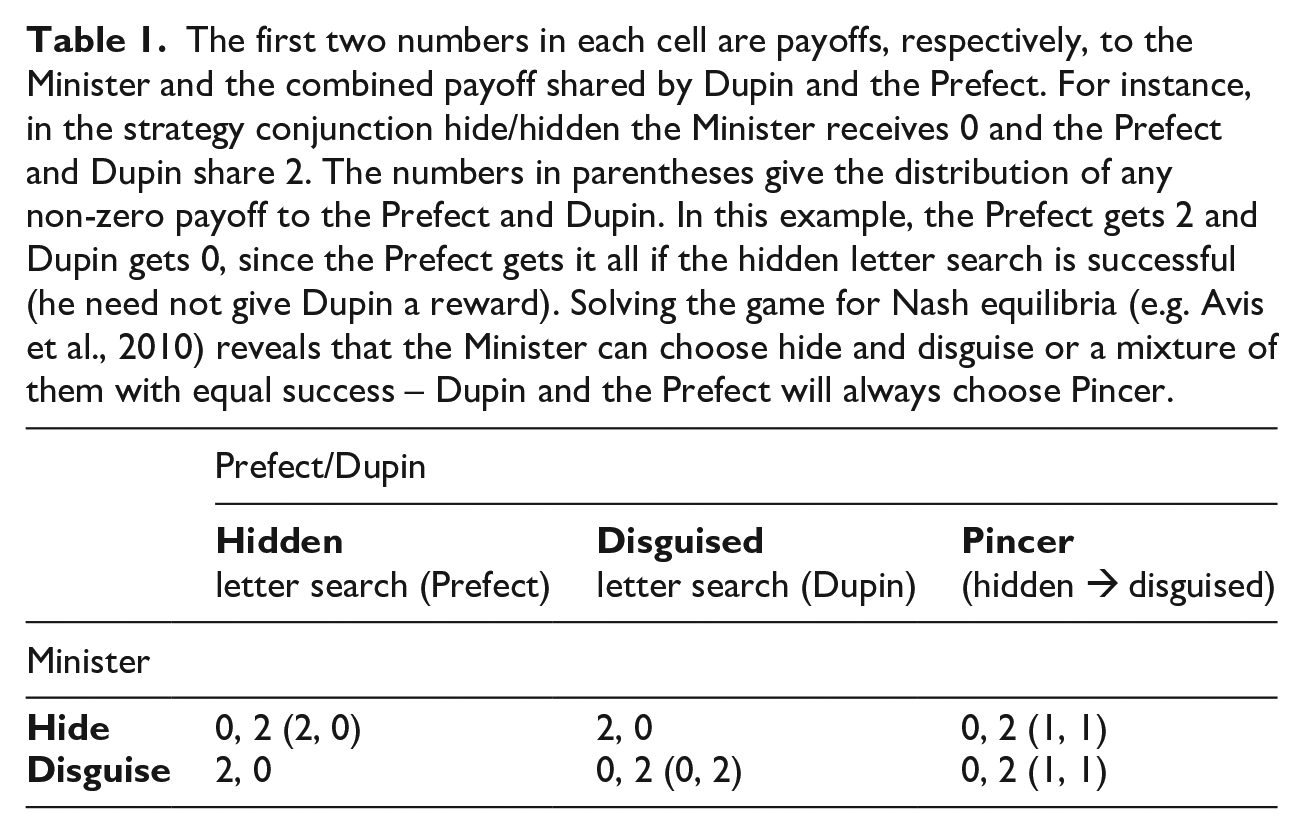
In the tale, Dupin does not have the opportunity to go it alone, but if he did, he would use the Disguised letter search since that is what he is good at. If the Minister had chosen Disguise, Dupin would succeed, and receive the full reward. He would identify those hiding places the Prefect’s Hidden letter search strategy did not. Dupin believes (and let us go along with him for now – although we will not end this paper without considering it further) that either the Hidden letter search or the Disguised letter search is the best (winning) response to all the strategies available to the Minister. They are the equivalent of ‘odd’ or ‘even’ in the children’s game.
The Prefect and Dupin choose the Pincer strategy. The Prefect first conducts a Hidden letter search and then Dupin takes up the case and conducts a Disguised letter search. This works. The letter is found by Dupin. If the Minister has only the two strategies of Hide and Disguise, then he is powerless against the Pincer, just as the Holder is in our modified version of even and odd.
Dupin mocks the Prefect’s strategy because it does not directly counter the strategy of the Minister, and believes he alone found the letter. But in fact, both play an equally important role. To avoid the Prefect, the Minister chose to disguise the letter, and Dupin was able conduct a Disguised letter search and find it. But imagine the Queen had first called in Dupin rather than the Prefect. The Minister, knowing Dupin was on the case would choose the Hide strategy, knowing that Dupin has none of the skills, equipment or (probably) patience to conduct a Hidden letter search. Dupin cannot, for example, find a letter hidden in a table leg or under a flagstone. Dupin would be obliged to call on the Prefect, who has all the resources needed to counter the Hide strategy. The Prefect would find the letter, but that discovery would be no less attributable to Dupin than to the Prefect. Nonetheless, an observer might conclude that Dupin’s initial approach (i.e. look for the letter on the surface of the room) was superficial and easily countered by the Minister, while the Prefect’s more in-depth approach represented true success.
As an aside, I suggest attribution of success to the ‘final’ strategy is commonplace. Perhaps a firm tries to market a new product or service in several ways, and each fail. Other firms observe the failure and learn from it, trying something new. Finally, a firm succeeds, and their success is attributed to their genius. But part of their genius, maybe even most of it, comes from knowledge of previous failures and sufficient sagacity to not repeat them.
Before we leave this topic let us consider another aspect of the Pincer. In our variant of even and odd, Guesser 2 does not need to guess. Her role is simply (in our example) to say ‘even’ whenever she is asked, which she will be whenever the initial guess of ‘odd’ is incorrect. Similarly, Dupin will be able to know, since the Prefect has come to him for advice, that the solution to the problem will be to search for a disguised letter (or, more generally, that the solution is one that can only be solved using the methods of Dupin). Dupin is aware of this, because when the Prefect first arrives, he immediately, before he even knows what the problem is, starts to sketch out the nature of the ultimate solution:
[Prefect:] ‘The fact is, we have all been a good deal puzzled because the affair is so simple, and yet baffles us altogether.’ [Dupin:] ‘Perhaps it is the very simplicity of the thing which puts you at fault’, said my friend ‘What nonsense you do talk!’ replied the Prefect, laughing heartily. ‘Perhaps the mystery is a little too plain’, said Dupin. (p. 226)
Here Dupin literally tells the Prefect that the solution might be ‘a little too plain’, and that the meticulous Hidden letter search strategy is likely misdirected. It is as if Dupin (and the Minister too) knows that the very fact the Prefect has comes to Dupin for advice means the answer must not be ‘even’ (as the Prefect always assumes) but ‘odd’. 6
While Dupin provides this hint, and more, to the Prefect upon their first meeting he does not specify how to find the simple solution to this simple mystery. The Prefect is in fact entirely unsatisfied following his first consultation with Dupin, and leaves ‘more entirely depressed in spirits than I [the Narrator] had ever known the good gentleman before’ (p. 229). The Prefect no doubt expected the brilliant Dupin to offer a stunning new insight but was disappointed. I will show that Dupin’s failure to provide this insight is part of a strategy, which was as much a confidence trick on the Prefect as a way of setting the stage for his own intervention.
The Con: Dupin screens the Prefect
We have seen that the Prefect dejectedly leaves Dupin’s apartment, yet Dupin obviously does have some ideas about how to solve the case. Why does Dupin not help the Prefect immediately? It is part of a ‘confidence’ game carried on by Dupin to ensure he shares in the profits from recovering the letter (i.e. that he gets his one marble).
Dupin immediately begins to solve the case before the Prefect even announces what it is. And he goes even further. He argues, despite the Prefect’s doubts, that that letter must still be in the Minister’s residence or on his person. He does this before the Prefect explicitly asks for advice, and indeed even while the Prefect is claiming he does not need advice. Dupin is at first willing to offer unwanted advice. But then his cooperation abruptly ends, and he sends the Prefect on the wild goose chase that leaves him so disheartened:
[Prefect:] ‘And now, Dupin, what would you advise me to do?’ [Dupin:] ‘To make a thorough re-search of the premises.’ ‘That is absolutely needless’, replied [the Prefect]. ‘I am not more sure that I breathe than I am that the letter is not at the Hotel.’ ‘I have no better advice to give you’, said Dupin. (p. 229)
Following this exchange, Dupin obtains from the Prefect a detailed description of the letter. The Prefect does not ask why Dupin wants this description.
Why does Dupin begin to cooperate, and then stop? We consider two explanations but leave one to the next section. The first is based on the mechanism of screening. As already discussed, screening is any action taken to separate or distinguish between types of people. Screening is part of the confidence trickster’s stock in trade. Maurer (1940/1999), historian of the underworld, discussed what we would call screening in terms of establishing a mark’s ‘honesty’. The big con typically involves the mark (the victim) accepting a golden opportunity that comes from dishonesty and cheating, such as receiving a message about which horse has won a race before the bookies even know the race has started. Very honest people will not agree to such cheating and so are poor prospects as potential marks. As Maurer observes:
Con men do not assume that dishonesty is fundamental in human nature. Any one of a number of simple tests will reveal to the grifter if his prospect likes ‘the best of it’ and enable him to judge the strength of this motive with uncanny accuracy. (p. 125)
The con man therefore screens potential marks for honesty and drops those with too much of it. 7
In Dupin’s initial interactions with the Prefect he screens him not for honesty, but for obliviousness. 8 The Prefect has not yet discovered the Minister’s strategy, but Dupin cannot be sure he will not. For Dupin to go to the trouble of conducting a Disguised letter search, he must be quite sure the Prefect will not stumble upon this method himself. Dupin can reassure himself of this by giving the Prefect some hints. If the Prefect does not pick up on those hints, Dupin can be sure he will never solve the case without Dupin’s help. If the Prefect picks up on those hints it is likely he would stumble on the solution himself, and Dupin (who lacks the resources of the Prefect) would simply be wasting his time by trying to help. The Prefect does not pick up on the hints, indicating that he is of the ‘oblivious’ type.
After giving the Prefect those fruitless hints and reassuring himself of the Prefect’s obliviousness, Dupin suddenly withdraws his cooperation and turns to learning everything he can about the search to date, as well as obtaining a thorough description of the letter. When the Prefect eventually makes a direct request for advice, he is advised to continue his search exactly as before. Dupin does not even try, as almost anyone would in such a situation, to encourage the Prefect by suggesting he ‘try something different’ or ‘consider if you have missed something’.
Dupin is using misdirection to ensure the Prefect does not inadvertently stumble onto what Dupin believes to be the solution to the case. If the Prefect’s energies are focused on a Hidden letter search, repeating his tried and tested methods, he will be less likely to discover onto any new angles to the problem. As a bonus, if the Prefect continues to search the Minister’s home in the usual way, the Minister is less likely to suspect that another front has been opened and a completely different assault on the letter is underway. Like any con man, therefore, Dupin first screens the Prefect to make sure he is a likely mark, and then uses misdirection to make sure he does not stumble on the truth.
Before leaving the con, we must consider how he negotiates his reward. In any negotiation, an effective way to achieve a good outcome is for your counterpart to reveal their position unguardedly, before they even know they are in a negotiation. Suppose you are interested in buying a house. You know the owner of the house, but she does not know you are interested in buying. One day the two of you have an apparently innocent conversation and you learn her reservation price. Perhaps she lets slip that ‘I would sell for $350,000 but I have listed it for $400,000’. She is telling you as a friend, but now you can use this information to make a low offer.
The Prefect unguardedly reveals his reservation price for the letter, without suspecting Dupin already has it. Dupin goads him with the story of a doctor who advises a would-be freeloader on his skill to ‘take advice’.
‘But’, said the Prefect, a little discomposed, ‘I am perfectly willing to take advice, and to pay for it. I would really give fifty thousand francs to anyone who would aid me in the matter.’ ‘In that case’, replied Dupin, opening a drawer, and producing a check-book, ‘you may as well fill me up a check for the amount mentioned. When you have signed it, I will hand you the letter.’ (p. 230).
At which point, as we know, Dupin produces the (re)purloined letter and the Prefect writes the check.
The long game: Revenge and relationships
Many strategic interactions found in textbooks involve isolated decision situations with the larger context left out. For instance, the prisoner’s dilemma is described as a single interaction between two prisoners, with the history of the prisoners and their future being suppressed for pedagogical purposes. 9 Yet that larger context is central to most real-world strategic situations, and understanding the contexts can rationalise actions that make no sense when the game is treated as a local or disconnected event. A famous example is the chain-store paradox (Selten, 1978). In this story the owner of a chain store is threatened by a new entrant in one of many markets it serves. Although it might appear rational to cooperate with the new entrant the owner might start a costly price war that leads to much worse outcome than cooperating. If we understand the context, that the owner is signalling to potential upstarts in other markets that she will not give in to competitors, the owner’s decision makes sense. The owner is developing a reputation for not backing down, just as the Minister developed a reputation for being unpredictable. Other examples include the possibility that in repeated games different equilibria can emerge than in one shot games, such as how sustained cooperation can be an equilibrium in infinitely repeated prisoner’s dilemmas (Axelrod and Hamilton, 1981; Sell and Wilson, 1999). A choice cannot be understood in isolation from other choices that have been made, could be made, or have yet to be made.
These examples depict rational behaviour in the face of repeated interaction, but it is also well established that people will seek to reciprocate their perceived treatment by others, even when it is not in their interest to do so (Fehr and Gachter, 2000, 2002). As Fehr and Schmidt (2006: 616) put it ‘people have a taste for mutual cooperation and for the punishment of norm violators’. People like revenge and are willing to take risks and pay to achieve it, even when revenge achieves no other end than itself (Rabin, 2002). They also show other-regarding preferences, deriving utility from the well-being of others (i.e. they are altruistic), but also from the suffering of others (they are spiteful or sadistic; see Abbink and Herrmann, 2011; Abbink and Sadrieh, 2009). It is impossible to understand behaviour by ignoring these apparently ‘non-rational’ preferences. To return to the prisoner’s dilemma, in any discussion of the rationality of cooperation versus defection students will invariably argue that if one prisoner defects, the other prisoner may come back and get revenge. While this argument is contrary to the spirit of the prisoner’s dilemma (in which all sources of utility are included in the payoffs) it is nonetheless undeniable that a major reason prisoner’s dilemmas are not a ubiquitous problem in real life is our knowledge that if we defect, we are likely to be punished even by those for whom the punishment yields no benefit.
‘The Purloined Letter’ illustrates these relationships with its ‘twist’ ending. We know that Dupin and the Minister know one another well, a fact on which hinges Dupin’s ability to visit the Minister and openly search for the letter. The nature of Dupin and the Minister’s relationship is not specified, but they are in some sense mirror images of one another (c.f. Babener, 1972). Recall that after the Prefect mocks the Minister for writing verse, Dupin observes that he too has written ‘some doggerel’. The Narrator also observes that the Minister is one of two brothers:
[Narrator:] ‘There are two brothers, I know; and both have attained reputation in letters. The Minister I believe has written learnedly on the differential calculus. He is a mathematician, and no poet.’ [Dupin:] ‘You are mistaken; I know him well; he is both.’ (p. 232)
This hints that Dupin is that brother, although it seems scarcely possible this would not be known by either the Prefect or the Narrator. 10 But we do know from the earlier tales involving Dupin that he comes from a wealthy family and is highly reclusive. We need not enquire into this too deeply. What matters is that the tale concerns part of an ongoing rivalry between Dupin and the Minister.
Dupin’s theft of the letter from the Minister is audacious and is designed not merely to get the letter into his hands, but to cause the Minister to suffer. He wants the Minister to discover the letter is a forgery when he tries to use it against the Queen. Dupin’s duplicate letter is deliberately made so faithfully that the Minister will not notice it is a forgery, so he will not hold back on his blackmail attempts. Dupin also has no desire to warn the Minister, even when the Prefect’s reward is in his hands, and even though the Prefect has at no time indicated that vengeance was on anyone’s mind. He also replaces the letter with a note containing a quote from Crebillon’s Atrée et Thyeste, about an exceedingly bloody feud between brothers. Part of Dupin’s reward for retrieving the letter appears to be the suffering he will impose on the Minister. What we thought was merely a series of games revolving around a single event, the first theft of the letter, is revealed to be elaborate revenge on the part of Dupin for some slight.
At its conclusion ‘The Purloined Letter’ comes to depict themes very close to Poe’s heart. The closest character to Dupin is that of Montresor in ‘The Cask of Amontillado’. Both Dupin and Montresor have previously suffered a perceived insult: Montresor from Luchresi, and Dupin from the Minister. Again, as in ‘The Cask of Amontillado’, we are not informed of what that insult is, but we do know two things. First, whatever the Minister has done to Dupin, or Luchresi to Montresor, neither of the transgressors understood the degree of their perceived transgression. Dupin observes that the Minister once ‘did me an evil turn which I told him, quite good-humouredly, that I would remember’. Both the Minister and Luchresi are still willing to engage on quite friendly terms with their ‘enemies’, and apparently do not fear revenge. Both Dupin and Montresor approach their enemies and engage quite happily with them, with the intent to betray them. Finally, both wish to ensure not only that they destroy their enemy, but that their enemy knows they are the author of the destruction. Montresor, in ‘The Cask of Amontillado’, insists that ‘a wrong is unredressed when the avenger fails to make himself felt as such to him who has done the wrong’. Dupin similarly takes pains to ensure that the Minister knows who has taken the letter by including the quote from Crebillon. As he says, rather cold-bloodedly: ‘as I knew he [the Minister] would feel some curiosity in regard to the identity of the person who had outwitted him, I thought it a pity not to give him a clue’.
The desire for revenge and sensitivity to insult also relates to our earlier discussion of why Dupin suddenly withdraws his cooperation from the Prefect and turns to misdirection. I suggested that by testing the Prefect, Dupin was screening him to ensure he will not stumble upon Dupin’s own solution, and so waste Dupin’s time. But there is an exchange which suggests an additional motive. The Prefect insults the Minister on the grounds that he is a poet, concluding that poets are ‘only one remove from a fool’. Dupin points out that by insulting the Minister he is also insulting him:
‘True’, said Dupin, after a long and thoughtful whiff from his meerschaum, ‘although I have been guilty of certain doggerel myself.’ (p. 228)
Immediately following this insult Dupin’s ceases to cooperate with the Prefect. Just like Montresor in ‘The Cask of Amontillado’, and just like Dupin in his relationship with the Minister, Dupin may have set out to get revenge on the Prefect for this insult.
Discussion
This paper has taken a specific interpretive approach to ‘The Purloined Letter’. I assumed the characters were strategic actors, with incomplete knowledge about each other’s motivations and preferences. I also took the view that just as we can explain an individual’s behaviour by invoking factors not known to that individual, so we can explain the actions of fictional actors by invoking factors not known by the author.
Can such an analysis of fictional worlds contribute to social science and especially to behavioural economics? Here is one view. The author of a narrative is an embodied empirical theory of behaviour. He or she is an observer of the world and has developed from those observations a theory of how the world works. Some authors, those we find most perceptive and careful in their observations, have developed coherent theories with as much to offer as the theories of great psychologists or economists or philosophers. These theories contain many elements and raise many questions. Questions raised by ‘The Purloined Letter’ include the following:
What types of people are there?
How does each type respond when in a given setting?
What do people believe about the thoughts of one another?
When will they act solely based on personal gain, and when do they care about the outcomes of others?
When do they prefer the outcomes of others to be positive or negative?
What actions are likely to be effective and which ones not?
The theory is not often described formally and explicitly as a scientist might. Rather, it comes out in the form of exemplars and narratives, and in the actions and thoughts of characters who personify the relationships in the theory. There will often be a disconnect between the theory implied by the work, and any explicit theory provided by the author.
‘The Purloined Letter’ is striking because it contains more detailed and explicit theory than other texts. That theory, in summary, is that success in strategic settings requires that you first deduce what others are thinking about what you are thinking, and then choose the best reply to the actions they would take given what they think you are thinking. An additional assumption is that your opponents are probably not thinking about what you are thinking about what they are thinking. In game theory this is related to ‘level-k’ and ‘cognitive hierarchy’ theories, which maintain that successful game play involves thinking ‘one step ahead’ of opponents who have limited strategic level acumen (e.g. Aumann, 1995; Camerer et al., 2004; Costa-Gomes and Crawford, 2006; Nagel, 1995). This reflexive thinking is also the central foundation of epistemic game theory (Perea, 2014). Poe’s explicit description of the game of even and odd is a good approximation of these theoretical approaches.
It is usually assumed that the events of the story themselves derive from the theory as laid out by Dupin, and often Poe is criticised for the limitations of his strategic analysis (e.g. Davis, 1970; Deloche and Oguer, 2006; Swirski, 1996). But while the games explicitly described in ‘The Purloined Letter’ alert us to the relevance of strategic thinking in general, they do not explain the specific thinking within the tale. In this sense, the games can be likened to gossipy explanations for unusual office behaviour, or the explanations of political activity given by TV pundits. They alert us to the need for explanations, but do not otherwise enlighten us.
To find a further disconnect between an explanation of behaviour and the behaviour itself we need look no further than Poe’s own writing about his writing. Poe wrote a celebrated account of his own thought processes during the composition of ‘The Raven’ – the work for which he was most celebrated during his lifetime. ‘The Philosophy of Composition’ describes how a poem should be composed using the most rational and even mechanical processes. Yet, as numerous readers have pointed out, Poe’s account of what he did in no way corresponds to a process that would have led to the poem in question. Eliot (1949), whose cruelty towards Poe is almost unbearable, nonetheless summarises a critical consensus about ‘The Philosophy of Composition’:
It is difficult for us to read [‘The Philosophy of Composition’] without reflecting, that if Poe plotted out his poem with such calculation, he might have taken a little more pains over it: the result hardly does credit to the method. Therefore we are likely to draw the conclusion that Poe in analysing his poem was practising either a hoax, or a piece of self-deception in setting down the way in which he wanted to think that he had written it. (p. 333)
Eliot assumes Poe was aware, or at least was capable of being aware, that his philosophy was an inadequate account of his composition. But an alternative view is simply that it is very difficult to observe our behaviour and perhaps impossible to observe our own thoughts (c.f. Chater, 2018). We certainly cannot readily generate a coherent account of our behaviour. Consequently, while the accounts we give may look plausible at first glance and so pass muster to the uncritical eye (meaning the eye that is not looking for inconsistencies, including our own eye), there will always be gaps and flaws in those accounts that a thorough scrutiny will reveal. Our explanations of observed behaviour are theories that map only imperfectly onto the events they are meant to explain. This perspective on explanation is a well-established one in psychology and philosophy, one that views personal explanations of behaviour as being quite literally derived from observing behaviour and inferring what black box must be operating to generate that behaviour (see, for instance, Bem, 1972; Chater, 2018; Ryle, 1949). Here I suggest that fictional players also cannot be understood by referring to the author’s own explanations. The disconnect between authorial explanations and the narrative is just like that between personal explanations and personal behaviour.
When we investigated Poe’s narrative without assuming it could be ‘explained’ by his own (or, perhaps, Dupin’s) theories, we discovered a complex network of strategic behaviours. This network reminds us not so much of the simple toy problems of a game theory text, but of our ‘real’ lives which are a maze of interrelated strategic problems. Consider, as a simple example, personal domestic relationships which are full of questions surrounding disclosure (what do we say, and how?), screening (how do I learn what my partner wants, when s/he may not even know herself?), signalling (how can I credibly indicate that something is important to me?), negotiation (how do we all get what we want, and how can I get more of what I want?), and the problem that each interaction is part of an ongoing repeated game, with the interpretation of each outcome being partly determined by the nature of the game (with nobody completely sure about which game everyone else is playing). Each problem can be examined using the language and tools of game theory, but which ‘games’ each actor perceives themselves to be playing, what options they have, and even what options they have chosen is far from obvious. Indeed, I will conclude by revisiting ‘The Purloined Letter’ and suggest some of the assumptions made earlier were not necessarily correct.
Afterword
‘The Purloined Letter’ has so far been treated as containing an accurate narrative of events, in the sense that a fictional story can be accurate. Yet it is told (to the Narrator) through the words of actors who often have only secondhand knowledge of events, or who cannot themselves have perfect knowledge. The Prefect’s account of the first theft is pure hearsay, and he also makes several inferences about the Minister’s thoughts before and during the theft. These inferences are sometimes augmented or bolstered by Dupin and the Narrator, and Dupin at least might want to mislead the Prefect. We also assumed the letter Dupin found was indeed the letter in question and in general that the tale ends when the Prefect left Dupin to give the letter to the Queen. By making these assumptions we were able to describe the game of the Minister versus the Prefect and Dupin as would be done in a standard game theory account, with the ‘Pincer’ strategy assuring the defeat of the Minister. But perhaps we have not yet thought deeply enough. Perhaps we have acted like real game-players do every day, neglecting to consider the possibility that the world we see is not the whole world and, in this particular case, that our counterparts have options which we have not taken into account. I will take one small step in the direction of considering such possibilities for ‘The Purloined Letter’.
At one point the Narrator speculates the letter is no longer in the Minister’s possession, but Dupin shuts him down:
‘But is it not possible’, I [the Narrator] suggested, ‘that although the letter may be in possession of the minister, as it unquestionably is, he may have concealed it elsewhere than upon his own premises?’ ‘This is barely possible’, said Dupin. ‘The present peculiar condition of affairs at court, and especially of those intrigues in which [the Minister] is known to be involved, would render the instant availability of the document – its susceptibility of being produced at a moment’s notice – a point of nearly equal importance with its possession.’ (p. 228)
Dupin’s argument is not compelling. The Minister does not need to brandish the letter to blackmail the Queen – she knows he has it. By displaying it he would likely risk arrest, and would have to ‘re-conceal’ it without being observed or apprehended in the process. Dupin gives no basis for his assertion other than some vague reference to ‘peculiar condition of affairs at court’.
Is it possible the letter is not in the Minister’s possession? If not, where might it be, or where might it not be? Let us start at the end of the first theft and consider the Minister’s options from that point. The Minister holds a letter that he has, through the screening process already discussed, established as compromising. He has also, through the nature of the theft, ensured that the Queen knows it is in his possession, and that he might be a madman capable of disclosing the letter if she does not submit to blackmail. These facts do not depend on the immediate possession of the letter. Similarly, the role of any peculiar conditions at court will depend not on the letter actually being produced, but on the Queen’s believing it can be produced. The Minister can achieve all his goals by keeping the letter from being found. Once the letter is found, his blackmailing days are over, quite possibly along with his days of liberty.
How best to ensure the letter remains hidden? The Prefect and Dupin consider the two possibilities we named Hide and Disguise. But there is at least one more. This is for the Minister to destroy the letter once he is safely away from the Queen. A destroyed letter can never be found, so the Minister will be able to blackmail the Queen so long as she is afraid of it being discovered. In addition, the Minister will have maximum deniability, since no evidence of his crime can ever be found. The only evidence of the theft would be the Queen’s testimony, and there is no reason for her to provide that testimony. And in any case, that testimony would surely have less weight if it is not backed up by a physical letter. Once this idea is entertained, it is impossible not to realise that destroying the letter is the Minister’s best course of action.
Table 2 adds this option to Table 1. Again, the Minister is the ‘row’ player, and the Prefect/Dupin the ‘column’ player. It is now 3 by 3 game, in which the Minister chooses between the options Hide, Disguise and Destroy. The Prefect and Dupin have the same three options as before. As previously discussed, if the Minister chooses either Hide or Disguise he will invariably be undone by the Pincer. But if he chooses to destroy the latter, he cannot be. This game has multiple Nash equilibria, but in every one of these the Minister chooses Destroy.
This table can be interpreted in the same way as Table 1. Nash equilibria (e.g. Avis et al., 2010) are indicated by asterisks (*). The Minister will always play destroy, and the Prefect/Dupin can choose any mixture of their pure strategies. If the Minister can destroy the letter, he should.
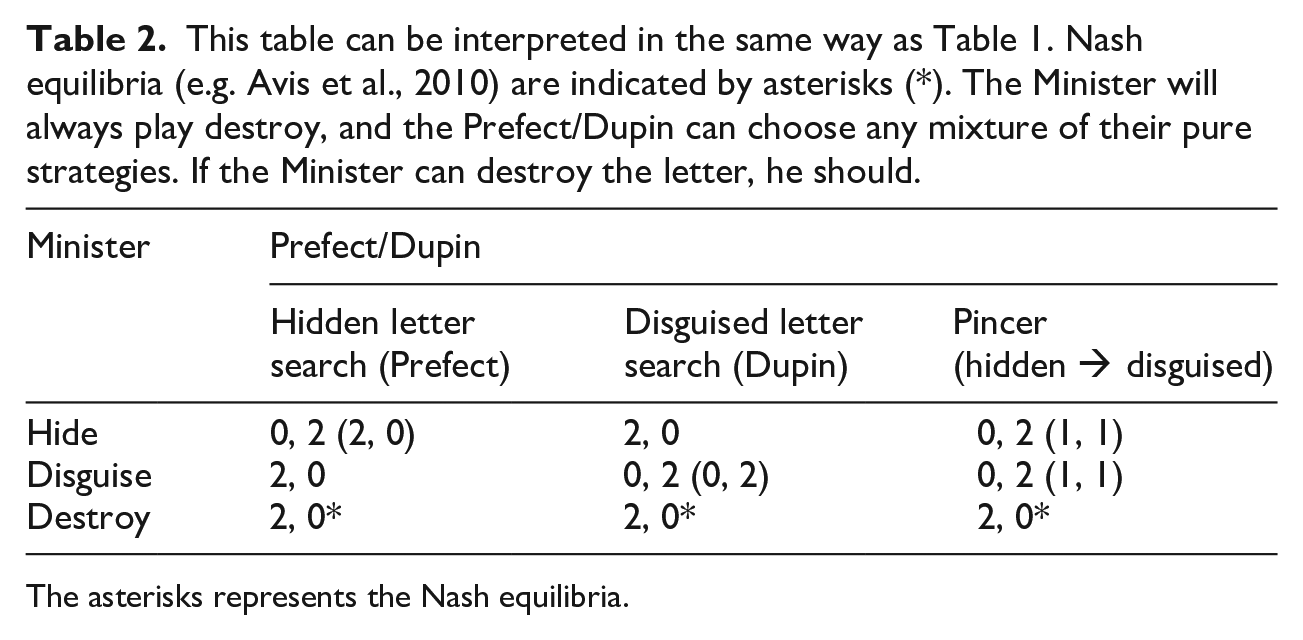
The asterisks represents the Nash equilibria.
There is a curious passage (really, only a word) which suggests that Poe may have entertained this possibility, perhaps only on the fringes of his consciousness. Immediately after the passage just cited in which Dupin brushes aside the possibility that the letter is not in the Minister’s possession, the Narrator asks what Dupin means by the document’s ‘susceptibility to being produced’. Dupin replies: ‘That is to say, of being destroyed’. What can Dupin mean by destroyed? He does not appear to be speaking of the Queen or Prefect destroying the letter, but of the Minister himself. He seems to be saying the Minister will want to destroy the letter if it is found in his possession. But, if so, there is no reason for him to ever keep the letter. He will surely want to destroy it even earlier – in fact, immediately.
Yet Dupin found the letter, so does this not rule out this possibility? Indeed, the Prefect looks at the letter Dupin found and is sufficiently convinced to pay him the reward. But this does not rule out the possibility the letter Dupin retrieved is not the letter the Minister stole. Neither the Prefect nor Dupin have ever seen the letter. The Prefect gives Dupin a ‘careful description’ of the letter, but the Prefect’s description can only be second hand, and so long as the letter Dupin produces looks like a letter that might lead to that description received the Prefect will not know the difference. It is unlikely, for instance, that the Prefect provided Dupin with the text of the letter, nor indeed that the Queen provided the Prefect with that text.
But how can Dupin steal a non-existent letter? This question warrants its own essay, but here is a sketch. First, when Dupin initially drops in on the Minister his careful search of the rooms and his prolonged attention to the document in the letter rack on the wall cannot have gone unnoticed. 11 Second, after Dupin takes his first leave of the Minister he leaves behind a cigarette case which he plans to retrieve the next day along with the letter. The cigarette case is a transparent ruse – transparent, that is, to someone looking for trickery. The Minister, therefore, could infer from Dupin’s behaviour during his first visit that (a) Dupin is searching for the letter (remember the Minister’s house is constantly being ransacked by police and the Minister surely knows what they are looking for), (b) Dupin believes the document in the letter rack is the letter and (c) that Dupin will return in an attempt to extract the letter. The Minister, as a countermove, forges a letter for Dupin to steal, and it is this forgery that Dupin presents to the Prefect. It is easy for the Minister to forge this letter because he is the only actor in the story, apart from the Queen, who has seen it. Indeed, it has been 18 months since the letter was stolen, so even the Queen might be taken in by a good facsimile.
The point of this analysis, and indeed the entire paper, is not only to consider a specific short story, but to use it as a broader consideration οf strategic thinking. This example points to one of the major limitations of applying strategic thinking to the real world. Usually, we do not know how different actors conceptualise their world, and we assume they believe themselves to have the same set of options we believe them to have. We might make unwarranted assumptions, with the result that our responses are inadequate. The study of narratives like ‘The Purloined Letter’ can show us these assumptions being made, by the actors in the story, by the authors of the story, by the readers of the story, and by commentators on the story. It is curious that while ‘The Purloined Letter’ has been the subject of prolonged critical debate – by psychoanalysts, literary theorists and economists – no one has previously entertained the possibility that the Minister would destroy the letter and that the letter Dupin steals is different from the letter the Minister steals.
Footnotes
Appendix
Acknowledgements
I have benefitted greatly from the outstanding comments of Despoina Alempaki and Valeria Burdea whose numerous detailed comments made the paper much more robust. I also received excellent advice from George Loewenstein and Nick Chater, as well as from the participants in Nick’s lab meeting at Warwick Business School. Two anonymous reviewers were helpful in clarifying many of my points.
Funding
The author(s) disclosed receipt of the following financial support for the research, authorship, and/or publication of this article: This work was supported by the Economic and Social Research Council [grant number ES/P008976/1].
