




Abstract
Social hierarchies exist in democracies as well as in authoritarian societies. However, their nature is different. Democratic hierarchies are built bottom-up through election while autocratic hierarchies are built top-down through domination. Both, however, have power asymmetries between the weaker citizens and the stronger politicians, which are amplified the stronger the hierarchies are. This manuscript introduces a model that combines pro-/anti-social behavior with different degrees of hierarchies. It is argued that this model has the power to categorize countries according to these criteria and indicate when and how societies move between democracy and authoritarianism. Importantly, I illustrate that the balance between power asymmetries and principal-agent chains is key for understanding when and why democracies sometimes transcend into authoritarianism.
Introduction
During the last decade, the people of several countries fought for freedom and democracy (e.g. in the Arab world or in Hong Kong). Their countries had different starting points and they took different courses. We could observe not only regime break downs (e.g. Tunisia/Libya), revolutionary threat-driven reforms (e.g. Morocco/Saudi Arabia), popular pro-democratic movements (e.g. Tunisia/Hong Kong) but also civil warfare and authoritarian restoration (e.g. Libya/Syria). These incidences motivated me to think about the movement of countries between democracy and authoritarianism depending on their respective degree of social hierarchy.
Recent approaches on this subject focus either on the distinction between hierarchical/horizontal societies or on the pro-/anti-sociality of the same. They describe social hierarchies as ambivalent (Van Vugt et al., 2008), divide them into productive or dominance hierarchies (DHs; Rubin, 2000) or functional and dysfunctional hierarchies (Anderson and Brown, 2010). Henrich and Gil-White (2001) distinguish between two behaviors, dominance and prestige. Democracies rather reward prestige and punish dominance meanwhile authoritarian systems do the contrary. Dubreuil (2010) writes that “the [hierarchical] state can be simultaneously the most efficient and most dangerous tool under human control” (p. 230). Magee and Galinsky (2008: 21f.) define hierarchies as “differentiation across individuals or groups on any (commonly) valued dimension” which can differ between cultures (Bowles, 2009; Dubreuil, 2010: 176). For Lake (2009: 264), hierarchies are any form of social differentiation and stratification as well as differences in authority over others (here: power asymmetries). All these approaches distinguish either between pro- and anti-sociality or between hierarchical and non-hierarchical societies.
The combination of both, the degree of pro-sociality and the degree of social hierarchy, can be found in Aristotle (2009: 100f.). He distinguished between governments whose objective is the “common interest” (pro-social) and those who are “directed to the [selfish] interest” (anti-social). Furthermore, he defined three degrees of social hierarchy between non-hierarchical and strongly hierarchical. In short, he combined different degrees of power asymmetries with the pro- or anti-social use of power.
The question about social hierarchies is also present in contemporary political discussions. When talking about democratic transitions, the common standpoint often endorses the (immediate) establishment or extension of institutions and hierarchical escalation. For example, Tharoor (2014) and Friedman (2019) claim the missing hierarchy in Hong Kong’s pro-democratic protest movement as the main reason of its alleged failure. Another example for the endorsement of more power asymmetries is France’s reaction on the 2015/2016 terror attacks. Immediately after the attacks, the country responded by increasing the number of security forces (Toelstede, 2019a, 2019b). The widespread endorsement of hierarchy-reinforcing responses on public goods problems justify a model that allows to categorize countries according to their degree of social hierarchy.
This article starts with the individuals and their capabilities to resolve the public goods problems themselves or to effectively check their elected representatives. The escalation of public goods problems from peer on institutional punishment level creates social hierarchies, power asymmetries and principal-agent chains. My model draws on the Aristotelian idea of uniting the two dimensions, the degree of pro-sociality and social hierarchy, into one model. Based on this combination, I will define four society types that jointly compose the so-called Structure-Behavior-Diagram (SBD). The model has the power to categorize countries according to these criteria, simultaneously. It allows to compare countries, understand their historic paths, and make predictions/recommendations for their future development. After presenting the model, I will theoretically discuss the level of hierarchical escalation in dependence of the country’s pro-sociality and examine the thoughts empirically, I will conclude proposing topics for future research.
The model
The SBD (Figure 1) unites two dimensions, the societies’ pro-sociality (x-axis) and power asymmetries (y-axis). I apply the reward&punishment (r&p) concept of behavioral science which ensures cooperation and public goods contribution (Balliet et al., 2011; Boyd and Richerson, 1988; Gächter et al., 2008). I further use the term “coordination” to describe all activities of the societies (including pro-social r&p) to manage their daily affairs, their private and public goods. I focus on public goods, as their non-rivalry and non-exclusivity are the reason for the creation of public institutions (institutional punishment). However, the privacy character of many private goods is just a result of social contracts (e.g. civil rights, property rights, taxation rules, commercial contracts). In anti-social societies like autocracies, post-revolutionary disorder, or civil war, the consensus about social contracts is lost. With this loss, many private goods become public and thus an object of dispute.
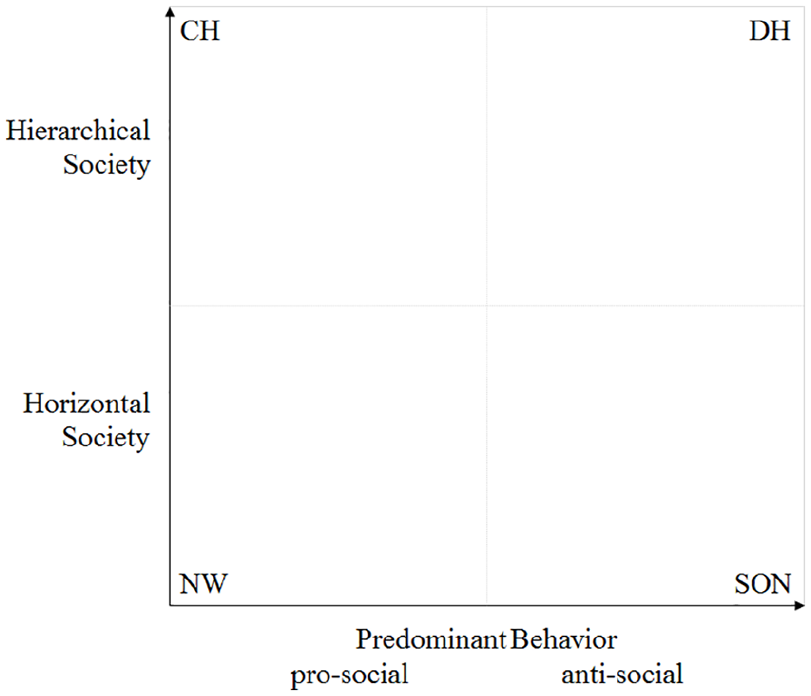
The Structure-Behavior-Diagram (SBD). It distinguishes between pro- and anti-social behavior (x-axis) as well as hierarchical and horizontal societies (y-axis). Thereby it creates a political room with four society types.
The pro-sociality in a democracy does not originally come to the people by well-intentioned institutions. For certain, democratic institutions have a positive impact on people’s pro-social behaviors in form of the democracy premium (Dal Bó et al., 2010; Kamei, 2016; Tyran and Feld, 2006). But pro-social institutions also follow from pro-social behaviors (Dal Bó, 2014; Inglehart and Welzel, 2005). Here, pro-sociality is a situation of “. . . dialogical morality, where all the affected parties have a voice in an open dialogue . . .” (Wenzel et al., 2008: 385 following Habermas’ discourse ethics). This situation is rather achieved in “effective democracies” than in “formal democracies” (Inglehart and Welzel, 2005). I argue that, in effective democracies, the pro-social spirit of institutions comes from the society who chooses and legitimizes the same (Marcin et al., 2019); in other words, “institutions follow from intuitions” (Cushman, 2015: 1 paraphrased; Eisner et al., 2017; Kim et al., 2019). Therefore, my approach starts with the citizens (bottom-up) and then look at the institutions above them.
In pro-social regimes (left side in Figure 1), social hierarchies and power asymmetries follow from the escalation of public goods coordination from citizens (principals) to politicians (agents). The power asymmetries between government and citizens results from the constitution, legal framework, the administrative instruments, the (in-)ability to depose politicians, the financial resources, the number of security forces, and so on. The more coordination is escalated to politicians, the more institutional punishment is present and the stronger the power asymmetries. Hence, the higher the society is situated in the SBD (y-axis). Pro-social hierarchies are a means for efficient public goods coordination. On the contrary, anti-social hierarchies (DHs) are an instrument of power sharing (Svolik, 2009, 2012) and oppression. In horizontal societies (network (NW) and state-of-nature (SON)), the coordination is handled by the citizens themselves (peer punishment) without any (significant) power asymmetries between them. Horizontal societies (NWs and SON) are spontaneous orders. They are the “result of human action, but not the execution of any human design” (Ferguson, 1767/2007, part III, section II). On the contrary, hierarchical societies (coordination hierarchies (CHs) and DHs) are structures made by “human design” (Ferguson, 1767/2007). Meanwhile NW is a pro-social society, in SON, anti-social behavior is predominant. The four society types of the SBD will be explained hereafter.
The social structures
NWs
Societies in the lower left corner of the SBD are called NWs. They have no hierarchies and coordinate public goods pro-socially on peer level. The related transaction costs of peer punishment are (regarded as) lower than the ones of institutional punishment. Hence, the citizens do not escalate problems to politicians. Each citizen has good observability of the other ones’ behavior what fosters peer over institutional punishment (Nicklisch et al., 2016). The public goods coordination exceeding the individuals’ capabilities are managed by spontaneous cooperative arrangements between the citizens (Williamson, 1991) without creating social hierarchies. NWs have no power asymmetries. NWs have consensually agreed upon r&p rules. So, there is no abuse or oppression. Differences between individuals (Kets et al., 2011) are not problematic if they do not imply (significant) power asymmetries.
Larger NWs result from groups of “random networks” (Barabási and Albert, 1999) or “dynamic networks” interconnected by “network-rewiring” (Rand et al., 2011) based on reputation (Fu et al., 2008). Good resolution of social dilemmas occurs when the interdependency between the groups is on intermediate level (Wang et al., 2013). The “weak ties” (Granovetter, 1973) between the groups turn them into a large NW allowing multilateral connectivity. So, nobody depends on indirect communication via others. This condition shall be called “secondary communication” and is shown by the curved lines bypassing the primary connections between the individuals (strait lines in Figure 2). That is important since information and connectivity burdens are one characteristic of anti-social societies.
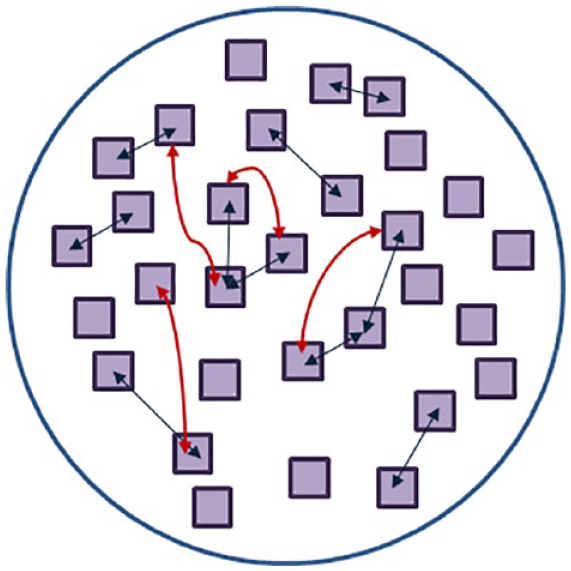
Networks are the combination of horizontal and pro-social societies.
In social reality, NWs or holacracies have problems with their self-management (e.g. Hutson, 2014; Lee and Edmondson, 2017; Schumpeter, 2014). See also the mentioned critique on the Hong Kong protest movement. However, we can observe a lot of NWs with small asymmetries, with central moderation or spontaneous institutional punishment (Williamson, 1991) with just enough power to keep them functioning. Those “moderated networks” are f.i. stock exchanges, social media platforms, citizens’ initiatives, and others. The principal-agent chains in NWs are from individual to individual and therefore short and non-hierarchical. Hence, there are no significant principal-agent problems like adverse selection or moral hazard and no power asymmetries between principals and agents. The NW concept is an important reference point of the SBD as it represents a society in its basic pro-social form without governmental institutions.
CHs
CHs are any pro-social vertical social structure based on cooperation, public goods contribution, and vertical escalation of public goods coordination. Humans prefer hierarchies (Nicklisch et al., 2016; Tiedens et al., 2007; Tiedens and Fragale, 2003) considering them to be more efficient (Ronay et al., 2012) and stable (Demange, 2004; Friesen et al., 2014) than horizontal societies. They generate better welfare results and overcome social problems easier (Halevy et al., 2011), especially in larger groups (Marlowe et al., 2008). CHs are meritocratic so that the hierarchical rank and the compensation of individuals correspond to their capabilities to coordinate public goods. The power asymmetries following from the rank differences are not used anti-socially; so, there is no abuse or oppression. Individuals are accountable for their actions what minimizes human rights abuses (De Mesquita et al., 2005). The individuals coordinate public goods to maximize the society’s and not any private welfare (Weber, 2006).
CHs are also needed to cope with the unequally complex tasks (Oedzes et al., 2018) in societies. Hierarchies require and offer different levels of human capital or “problem solvers” (Garicano, 2000). CHs are built bottom-up following the subsidiarity principle. So, the degree of social hierarchy follows from the task complexity (Zhou, 2013), the available human capital, and the citizens’ readiness to escalate public goods coordination to the government. The higher the citizens’ propensity to coordinate public goods themselves, the flatter the social hierarchy. CH is the area where most of our democracies are situated, as we will see later.
However, democratic policies do not always differ from policies in non-democracies (Mulligan et al., 2004). Democratic routines like elections can also occur in anti-social societies (DH). Furthermore, different to democracies, the (s)election process in CHs is not periodical in the form of elections, legislative terms, or party congresses. CHs allow a permanent process of appointing, confirming, or deposing of politicians in or from their positions. This implies that “[societies can always choose] institutions that achieve the best outcomes given their varying needs and requirements” (Acemoglu, 2003: 1 paraphrased). Furthermore, the CH concept comprises more than the governance-oriented democracy concept. It includes the day-by-day coordination activities of all citizens, which are necessary to run a society. The distinction between democracies and CHs/NWs allows evaluating and measuring the actual pro-sociality and power asymmetries of democratic regimes and its institutions which I will do later.
CHs are free from abuse or oppression in the sense that “. . . no one renders obedience to man, but to justice and to law . . .” (De Tocqueville, 2011: 66). This means that the people are ready to obey those above them if they represent the rules they all have agreed to. But people would never serve the higher ranked against the De Tocqueville statement. On the contrary, in a DH these principles are abolished. Deviations from this ideal can result from the inertia of social structures in adapting to the changing environment. Thus, they fulfill the criteria easier in the long than in the short term.
The vertical escalation of public goods coordination creates hierarchical structures and principal-agent chains. The process starts with the citizens who escalate public goods coordination from peer level to the (first-level) institutional punishment. This level, in turn, does the same with what it cannot resolve and so on. Each institutional punisher is the next lower one’s agent and finally the agent of the citizens. In the same way, each institutional punisher is the next higher one’s principal and, ultimately, the citizens are the principals of all (similar to Bernheim and Whinston, 1986). On the contrary to horizontal principal-agent chains, vertical chains are marked by power asymmetries between the weaker civil principals and the stronger political agents. Furthermore, principal-agent chains in hierarchies tend to be longer than those in horizontal societies following the larger group size (Marlowe et al., 2008). The higher the pro-sociality of the societies, the better they deal with power asymmetries and principal-agent chains (Tommasi and Weinschelbaum, 2007). Thus, the more the citizens trust their political agents, the more hierarchical escalation we should find (Cronin et al., 2015: 7, referring to Nowak and Sigmund, 1998). This will be discussed later in the empirical part.
CHs allow secondary communication (curved lines in Figure 3(a) and (b)) besides the strait official communication lines preventing any “systematically distorted communication” (Habermas, 1991: 245ff.). Secondary communication permits questioning the existing structures what makes CHs contestable. One of the key steps to drive a CH into a DH is, first, to make it incontestable before changing the r&p rules into anti-social ones. There are two variants of CHs. The “amorphous coordination hierarchy” (Figure 3(a)) is a monolith without subgroups. An amorphous CH is based on individuals with multilateral relations. The other CH is the “crystallized coordination hierarchy” (Figure 3(b)) which is composed by subgroups. It is more realistic than the amorphous one as group formation usually occurs by crystallization of small subgroups and through migration (Gürerk et al., 2006). The crystallized CH entails the risk of in-group preferences (DeAngelo et al., 2018; Fu et al., 2012), out-group discrimination (Tajfel, 1970), more inequality, and segregation (Tsvetkova et al., 2018). Thus, it bears a higher possibility of losing its pro-sociality.
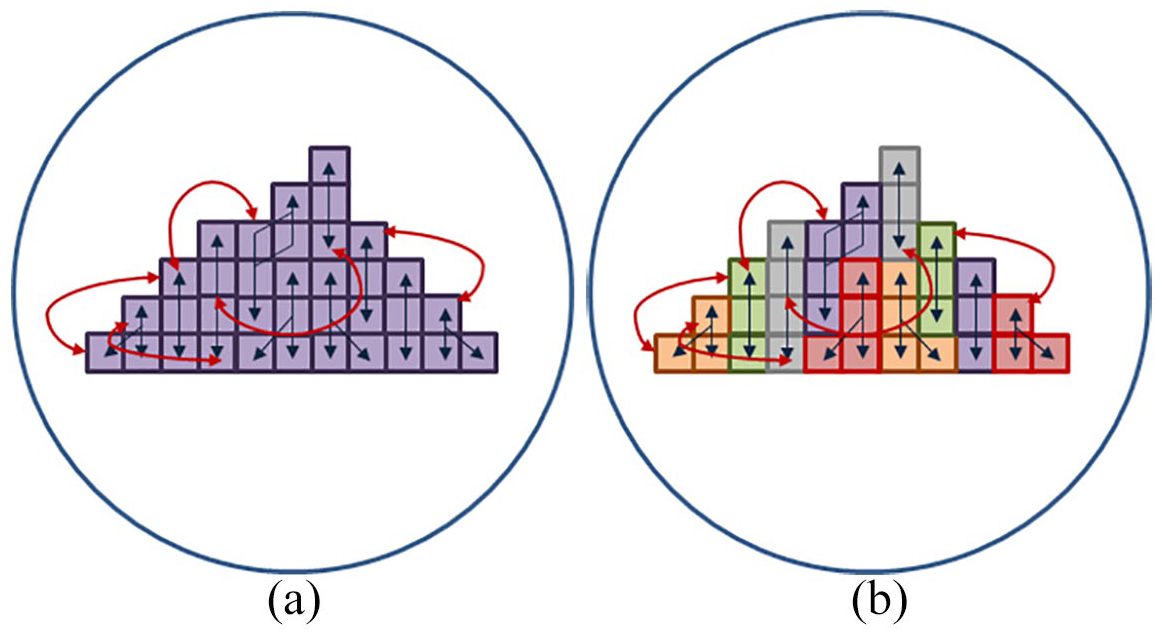
(a) Amorphous Coordination Hierarchies are the combination of a hierarchical and pro-social society without subgroups. (b) Crystallized Coordination Hierarchies are the combination of a hierarchical and pro-social society composed out of subgroups.
DHs
The upper right corner represents an anti-social and hierarchical society, the DHs. Meanwhile CHs follow from escalation of coordination (bottom-up), DHs are a result of power sharing; they are “system[s] of obedience and command” (Bookchin, 1982: 68). DHs are built top-down and aim to secure the elite’s position. They follow from an inverted subsidiarity principle where dominant individuals form coalitions and share power with intermediates to oppress lower ranked individuals. The lower level, in turn, does the same with the next lower level, and so on. This multilevel (top-down) power sharing forms a DH. Figure 4(a) and (b) shows two forms of DHs, the “segmented dominance hierarchy” and the “stratified dominance hierarchy.” In the segmented DH (Figure 4(a)), communication is limited to the vertical lines, communication between the subgroups is restricted or biased and secondary communication is not allowed. These DHs are composed out of hierarchically structured rivaling ethnic, religious, or ideological subgroups.
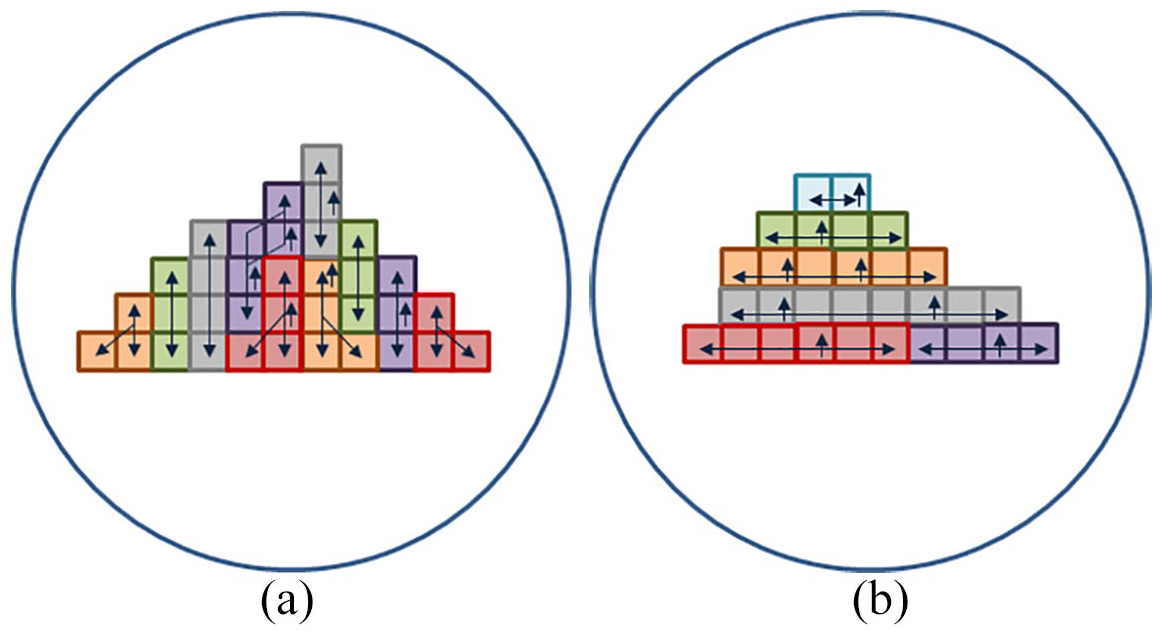
(a) Segmented Dominance Hierarchies are the combination of a hierarchical and anti-social society. They are composed out of vertically structured subgroups. (b) Stratified Dominance Hierarchies are the combination of a hierarchical and anti-social society. They are composed out of horizontally structured subgroups.
The “stratified dominance hierarchy” (Figure 4(b)) is based on horizontal subgroups, sealed of one from the other and vertically layered. Stratified DHs can result from group-based productivity differences. However, they can also follow from group-based discrimination (Henrich and Boyd, 2008) or segregation (Tsvetkova et al., 2018) like in caste and class systems or intergroup hierarchy beliefs (Shin et al., 2018). In stratified DHs, communication and interaction are rather inside than between the layers and secondary communication is not allowed. Stratified DHs are characterized by horizontal in-group favoritism and anti-social punishment against members of other layers (Anderson et al., 2015; Hoff et al., 2011). The stratified DH corresponds to the group-based social DH of Sidanius and Pratto (2001). An amorphous DH unlikely as coalition formation requires stratifications or segmentations. Finally, DHs have vertical arrows inside the squares (Figure 4(a) and (b)) indicating the individuals’ predisposition for social dominance.
The space between CH and DH is a continuum which is also known in political science (e.g. hybrid systems; Diamond, 2002), competitive-authoritarian regimes (Levitsky and Way, 2002), semi-authoritarian regimes (Ottaway, 2003), intermediate regimes (Petrova and Bates, 2012), non-tyrannical or electoral autocracies (Boix and Svolik, 2007), and others. Different authoritarian regime types (Ezrow and Frantz, 2011) can result in the similar (low) pro-sociality levels.
SON
The lower right corner in the SBD is called SON and is the combination of horizontal structures and anti-social behavior. It is a society (Figure 5) with alternating attempts of self-aggrandizements. The individuals engage in anti-social coalition formation but without establishing any persistent vertical structure before they get deposed by their peers—an “egalitarianism of countervailing power” (Seabright in Sterelny et al., 2013: 109).
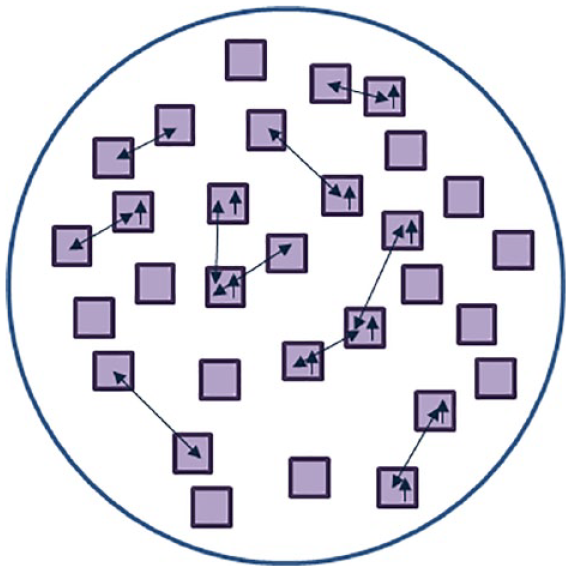
The State-of-Nature is the combination of a non-hierarchical and anti-social society.
Different to NWs, the coalitions in an SON try to prevent secondary communication. The individuals have a predisposition for anti-social behavior like social dominance (Sidanius and Pratto, 2001), rent-seeking, or Stackelberg reasoning (Bialas and Chew, 1982; Stackelberg, 1934/1951) symbolized by vertical arrows inside the squares. In this situation, “every man is enemy to every man” (Hobbes, 1651/1985: 186). They “endeavor to destroy or to subdue one another” (Hobbes, 1651/1985: 184) instead of forming pro-social cooperative relations (as in NWs). SON is the situation of civil war or post-revolutionary disorder like Libya after the fall of the Gadhafi regime.
Pro-sociality and the level of hierarchical escalation in societies
To raise and maintain pro-sociality is important for any society. Following Boyd and Richerson (1988), it is [pro-social] peer punishment that assures [pro-social] cooperation among people. Durham (1991: 182) criticized the absence of “structured asymmetries or power relations” in the Boyd and Richerson reasoning. Fracchia and Lewontin (2005) remarked that power would be needed to raise pro-sociality in a society. This discussion is basically about whether power asymmetries follow on pro-sociality in societies (Cofnas, 2018) or vice versa. In this section, I will discuss theoretically the relation between pro-sociality and power asymmetries. In the next section, I will examine this relation empirically.
Hierarchical societies have long vertical principal-agent chains. They get longer the more the societies escalate public goods coordination on higher levels instead of resolving them on peer level. There is a growing number of intermediates between the civil principals and the highest level of political agents. The longer the principal-agent chains are, the more fragile they become in terms of adverse selection and moral hazard. Furthermore, with the growing social hierarchy (institutional punishment), the power asymmetries increase, though power asymmetries and principal-agent chains should be in balance. Otherwise, the society increasingly depends on the political agents’ benevolence not to usurp the power rather than a strong accountability link with the civil principals. The agents can turn away from “principled agents” (Besley, 2006) and, thus, they would get decoupled from their principals’ control. The society risks drifting into authoritarianism.
On the contrary to steep CHs, in flat CHs and NWs, power asymmetries are low or inexistent. Second, the principal-agent chains are shorter which reduces the likelihood of moral hazard and adverse selection. The principals control their agents better. Third, in NWs, the citizens have many principal-agent relations and they are mutual. The relative impact of one failing relation is small. In NWs, each citizen is the other one’s principal and agent simultaneously what neutralizes possible principal-agent problems.
I argue that the citizens perceive these aspects which weaken their sovereignty in hierarchical societies. They hesitate escalating public goods coordination to political agents, whom they do not trust. Hence, we should observe lower escalations in less and higher escalations in more pro-social societies. Strongly hierarchical societies require high levels of pro-sociality to be safe from drifting into a DH; otherwise, they are better off lowering their hierarchical escalation (Tommasi and Weinschelbaum, 2007). Summarizing, the level of hierarchical escalation which a society can effort, keeping power asymmetries and strength of principal-agent chains in balance, should correlate positively with its pro-sociality level. As mentioned earlier, anti-social hierarchies (DHs) are built top-down. The power asymmetries do not follow from the escalation of public goods coordination but from power sharing.
For CHs, I argue that, first, there should be a continuously growing escalation over the time following the mentioned preference for institutional punishment. Second, the higher the escalation level is, the higher is the resistance of the citizens to escalate even more public goods coordination to their political agents. Third, the higher the escalation, the more difficult it is for the civil agents to rescind the coordination tasks once escalated to the political agents. This should result in different escalation and de-escalation patterns as well as different pro-sociality changes for societies with high or low escalation levels.
All this comes from the increasing power asymmetries and longer principal-agent chains and different effects within the hierarchical interaction. Magee and Galinsky (2008) identified three hierarchy-reinforcing aspects of vertical structures: the “effects of [perceived] power on psychological processes,” the “role of expectations in reinforcing status hierarchies,” and “hierarchy-enhancing belief systems.” Cognitive and psychological advantages of hierarchies (Van Berkel et al., 2015; Zitek and Jordan, 2016) let people unconsciously prefer institutional over peer punishment solutions. This drives societies upward in the SBD.
Furthermore, political agents are interested to stay in charge what supports the autopoietic character of political regimes. In other words, the higher the society is in the SBD, the harder it is for the civil principals to retrieve the tasks once escalated to the political agents (moving downward in the SBD). This vertical inflexibility can also result from administrative structures and planning processes. Hayek (2007) took a critical stand on political planning (here: institutional punishment). He argued that “the close interdependence of all [socio-]economic phenomena makes it difficult to stop planning just where we wish . . . beyond a certain degree, the planner will be forced to extend his controls until they become all-comprehensive” (Hayek, 2007: 137). This dynamic can drive societies into a “structural lock-in” (Toelstede, 2019b) where they become inflexible and lose their “dynamic capabilities” (Teece et al., 1997: 516). However, good governance provides good socio-economic results. Hayek (2007) admitted that the problems he raised were less severe in case of “good and foresighted planning” (p. 85), meaning: pro-social political agents. Furthermore, individuals show a higher acceptance of punishment institutions if they have been “chosen endogenously” (Marcin et al., 2019), and not by an exogenous dictator. Taking all this together, societies in the SBD should show a positive correlation between pro-sociality and hierarchical escalation (Figure 6). Since the vertical structure in anti-social societies works differently, as explained before, this correlation should fade out for countries with low pro-sociality levels.
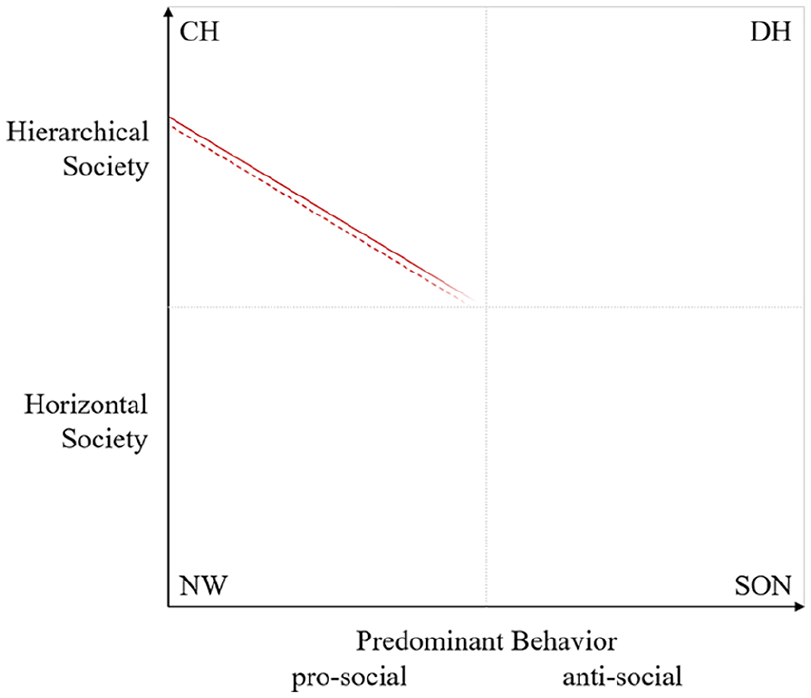
The figure shows the SBD and the correlation between pro-sociality and hierarchical escalation.
The application of the model
I will now examine empirically the correlation between pro-sociality and hierarchical escalation in a society. After this empirical analysis, I show, using the Arab Spring, how the SBD can be used to illustrate the countries’ move between pro- and anti-sociality when proper empirical data are rare.
Empirical correlation between pro-sociality and hierarchical escalation
Here, I examine the statement that hierarchical escalation and power asymmetries correlate positively with the pro-sociality levels of societies. While there are a few indicators available to measure the countries’ pro-sociality levels, it is more difficult to properly measure power asymmetries. That is because governments retrieve their power, as mentioned, from different sources like financial resources, the legal framework, the security forces, and so on. As explained, pro-social societies are formed bottom-up by coordination escalation, meanwhile anti-social societies are formed top-down by coalition formation. Hence, the suitable empirical indicators for power asymmetries are different and some of the parameters are difficult to measure. So, I concentrate on pro-social societies.
I have decided to use the Government Spending (GS) relative to the country’s gross domestic product (GDP) which shows the financial power of a government relative to the rest of the country. This value is available for most global countries what allows ample empirical analyses (International Monetary Fund (IMF), 2019a; OECD, 2019; Statistica, 2019). The GS indicates the citizens’ readiness to escalate public goods coordination and it shows the Governments’ financial resources—one source of power asymmetries. The more public goods coordination the citizens escalate to the government, the bigger the latter, and the bigger the power asymmetries between the two. However, this indicator does not state anything about how the power asymmetries are checked by the citizens. It implicitly assumes all these missing aspects to be equal between the countries. As an indicator for the societies’ pro-sociality, I take the Personal Freedom (PF) Index of the Cato Institute (CATO, 2017, 2018).
Figures 7 and 8 show the relationship of PF and GS for 130 countries. The values on the horizontal axis are inverted in analogy to the SBD with high pro-sociality on the left. I split the data set in high- and low-PF values separated by the median. As predicted, there is a positive correlation between PF and GS for countries with PF higher than the median (65 countries). That means, the higher the pro-sociality of a country is (measured by PF), the more coordination the citizens are ready to escalate to their political agents (measured by GS). As expected, there is no correlation between the two values for countries with low PF (anti-social societies). The correlation fades out toward the right of the SBD due to the mentioned differences between pro- and anti-social societies. The opaque nature of authoritarian systems (Boix and Svolik, 2013; Hong and Yang, 2018; Newson and Trebbi, 2018) requires other indicators to measure their power asymmetries (e.g. expenditure for security forces). I focus on the left side of Figures 7 and 8. All 65 pro-social countries (red) showed an average GS increase by ΔGS/GS = 3.8% (ΔGS = +1.1) between 2008 and 2011.
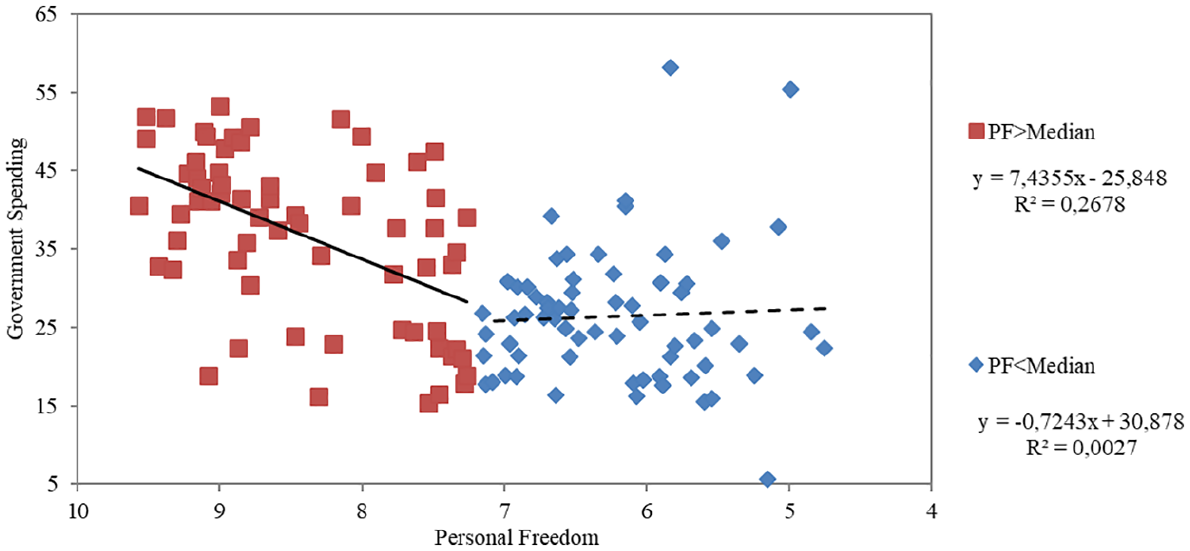
The Personal Freedom Index versus Government Spending in percentage of the GDP for 2008. The data set is divided in PF-values larger than the median and those smaller. The x-axis is inverted with high pro-sociality on the left corresponding to the SBD.
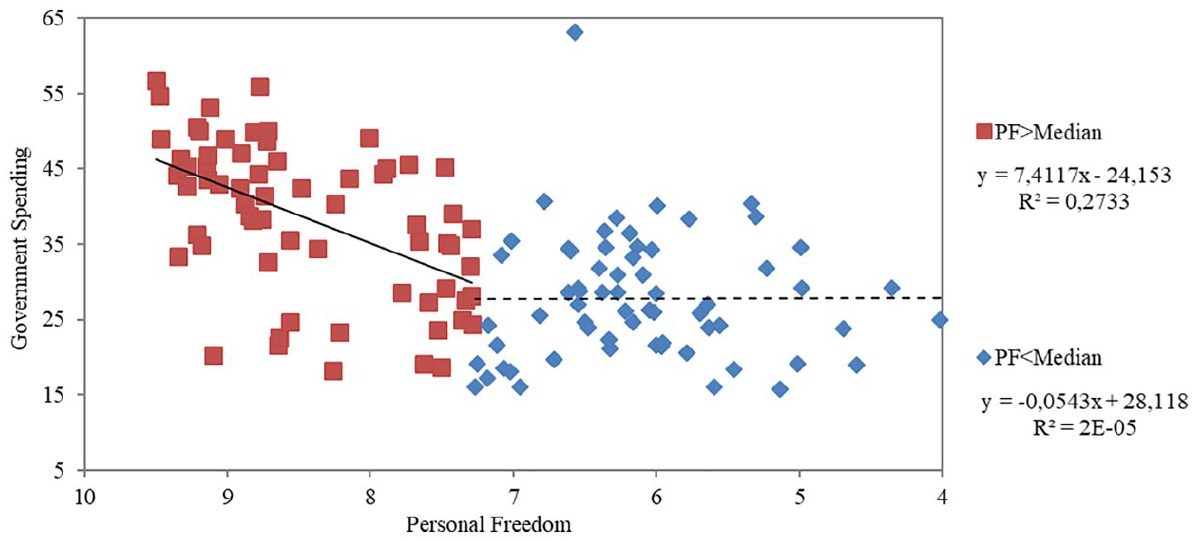
The Personal Freedom Index versus Government Spending in percentage of the GDP for 2011. The data set is divided in PF-values larger than the median and those smaller. The x-axis is inverted with high pro-sociality on the left corresponding to the SBD.
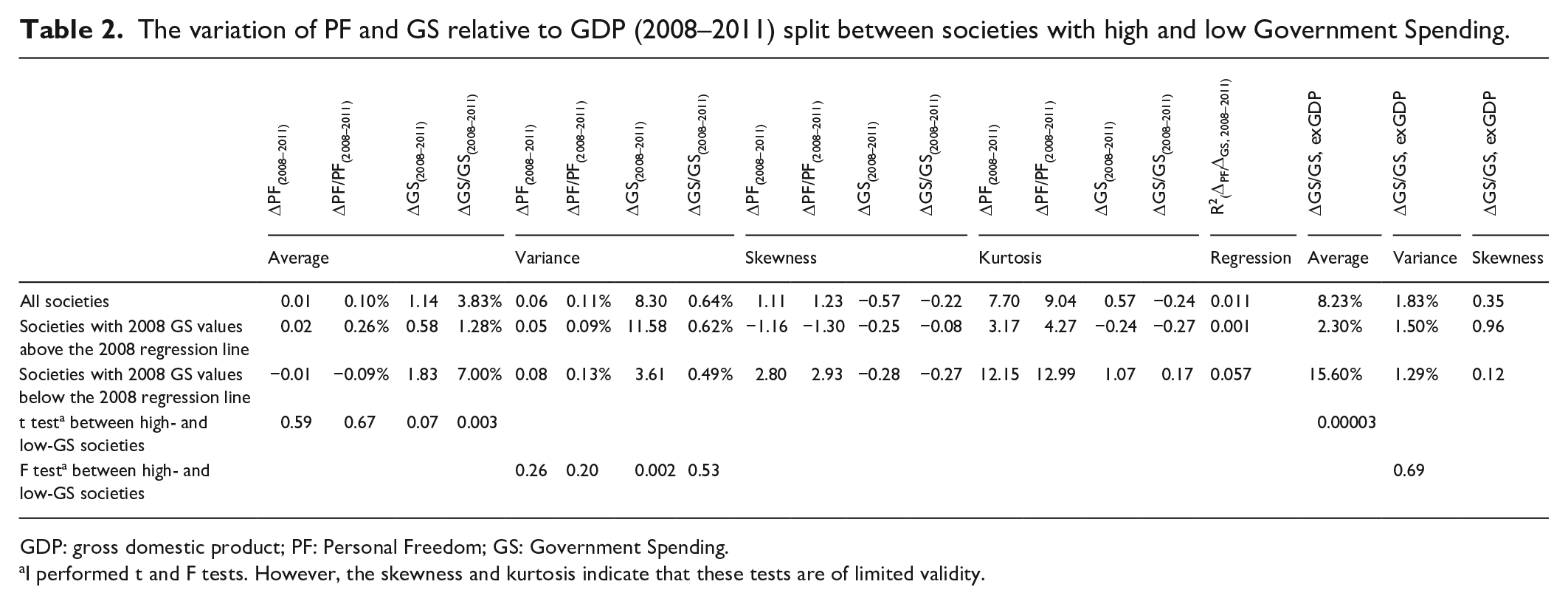
To continue, I separate the pro-social countries in those with high and low government spending divided by the 2008 regression line. This division along the inclined regression line pays attention to the positive correlation between GS and PF; it means that neither high nor low GS is good or bad per se. It depends on the pro-sociality level (PF) of the respective country. So, the red dots in Figure 9 represent countries with power asymmetries (GS) above of what is explained by their PF-values (high-GS countries); the blue countries have power asymmetries less than this (low-GS countries). High-GS countries increased the same on average by ΔGS/GS(high GS) = 1.3% (ΔGS(high GS) = +0.6) between 2008 and 2011 meanwhile low-GS countries increased it by ΔGS/GS(low GS) = 7.0% (ΔGS (low GS) = +1.8). Hence, low-GS countries increased their spending faster than high-GS countries (t(ΔGS/GS) = 0.003). High-GS countries had a higher variance in the relative GS changes (s2(ΔGS/GS, high GS) = 0.62%, s2(ΔGS/GS, low GS) = 0.49%, F = 0.53) then low-GS countries. This value shows the volatility of the power asymmetries in societies.
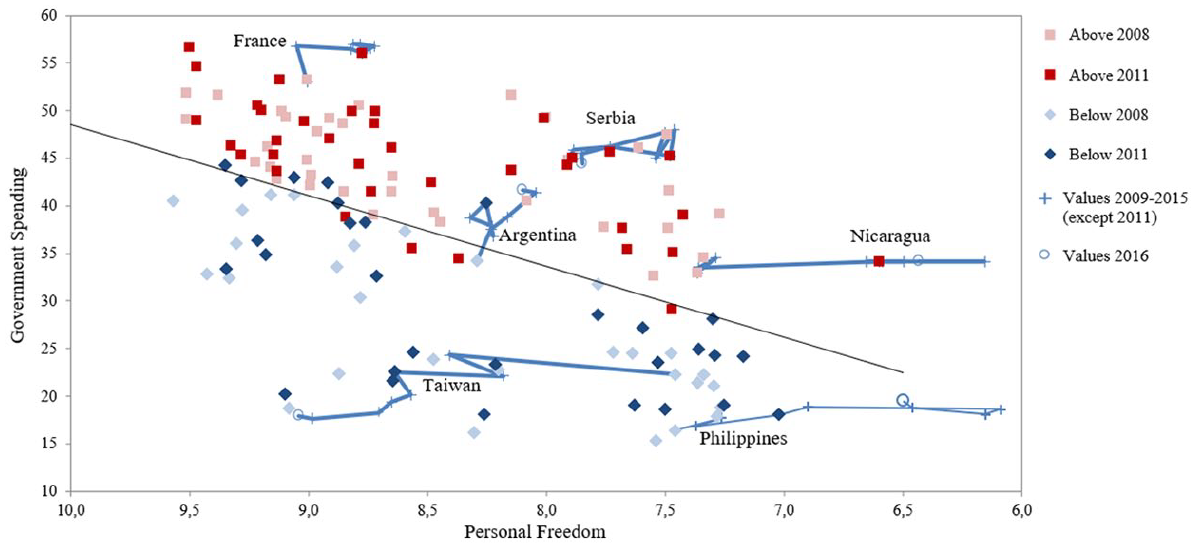
The figure shows the Personal Freedom Index versus Government Spending in percentage of the GDP for 65 countries in 2008 and 2011 with the 2008 regression line. The countries are split in those starting with GS values above the line (rose (2008), red (2011)) and blue (light blue 2008, dark blue 2011) for those below the line. Full data for all countries was only available between 2008 and 2011. For some countries, I retrieved data for the period 2008–2016 what allows following their development over a longer time span (OECD, 2019; Statistica, 2019).
However, if the absolute government spending remains constant and the GDP decreases as in an economic crisis, the GS raises. This neutralization provides useful data only on short term. Taking the GDP changes (IMF, 2019b) into account, the variances of relative GS changes are s2(ΔGS/GS, exGDP, high GS) = 1.50% and s2(ΔGS/GS, exGDP, low GS) = 1.29% (F = 0.69). In neither of the cases (with or without GDP changes), the variances differ significantly from each other, but the skewness does. Taking the GDP changes into account, the distribution of high-GS countries is positively skewed meanwhile the same distribution for low-GS countries is symmetric (skewness(ΔGS/GS, exGDP, high GS) = 0.96; skewness(ΔGS/GS, exGDP, low GS) = 0.12). Going back to the original GS setup, the skewness is symmetric for high-GS countries and negative for low-GDP countries (skewness(ΔGS/GS, high GS) = –0.08; skewness(ΔGS/GS, low GS) = –0.27). Taking the GDP changes into consideration, the skewness shifts from negative to positive.
Regarding PF, high-GS countries have shown PF changes of ΔPF(high GS) = +0.021, meanwhile the countries below the line decreased by ΔPF(low GS) = –0.014. The t-value (t = 0.59) shows that this difference is not significant. Furthermore, there was no significant difference in the variance of PF between high- and low-GS countries which is an indicator for the stability of the societies’ pro-sociality (s2(PF, high GS) = 0.052, s2(PF, low GS) = 0.078, F = 0.744). However, the distribution shape of PF changes is different between high-GS and low-GS countries (skewness(ΔPF; high GS) = –1.2, skewness(ΔPF; low GS) = 2.8, kurtosis(ΔPF; high GS) = 3.2, kurtosis(ΔPF; low GS) = 12.2). The slope of both regressions, 2008 and 2011, is with 7.44 (2008) and 7.41 (2011) relatively constant. This is important as it shows a stable relationship between the pro-sociality of a country and the society’s readiness to escalate public goods coordination to the government. It confirms the thesis that power asymmetries and principal-agent chains between politicians and citizens need to be in balance and that this equilibrium positively depends on the country’s pro-sociality.
Unfortunately, this 65 countries sample is limited to a 4-year period, 2008 to 2011 (following data availability), which did not allow to play much with periodicity. Despite the positive long-term correlation of the absolute PF and GS (R2(2008) = R²(2011) = 0.27), there is no correlation between the short-term changes of PF and GS between 2008 and 2011 (R2(ΔPF/ΔGS, 2008–2011, high GS) = 0.001, R2(ΔPF/ΔGS, 2008–2011, low GS) = 0.057). The average PF change in the same time span is significantly lower (ΔPF/PF2008–2011 = +0.1%) than the average GS change (ΔGS/GS2008–2011 = +3.8%). Importantly, these values show that pro-sociality changes in a society (here PF) occur slower than verticality changes (here GS).
Figure 10 shows the actual GS for 2008 and 2011 minus the spending which is explained by the regression for 2008 (GS*). On the left side are the countries that have the highest excessive spending indicating the highest excessive escalation of public goods coordination and power asymmetries. On the right side are those countries whose government size was less than their PF-values (=pro-sociality) would allow them—they have less hierarchical escalation of coordination and less power asymmetries.
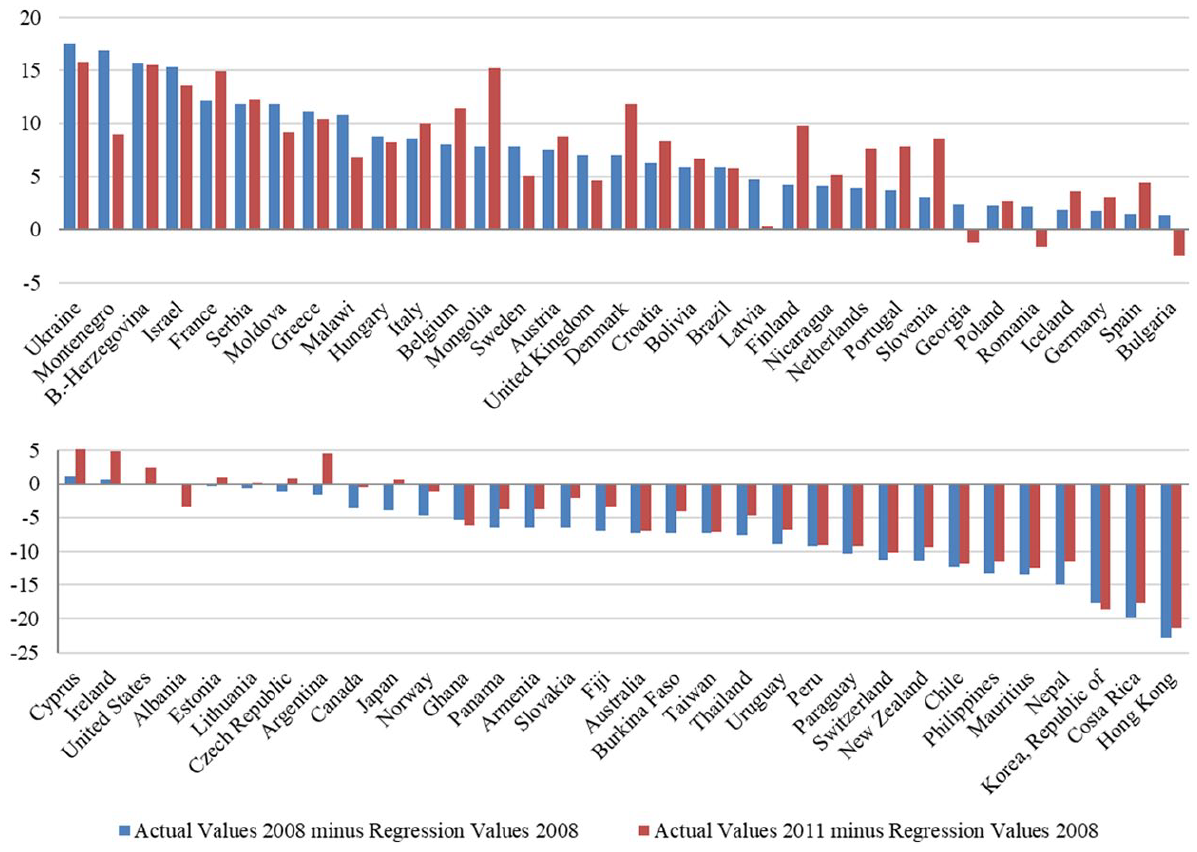
The figure shows in blue the actual Government Spending in percentage of the GDP for 2008 minus the Government Spending that is explained by the 2008 regression (Figure 9). In red are the corresponding 2011 values related to the 2008 regression.
Some countries showed big pro-sociality changes (PF) between 2008 and 2011 without showing GS changes (Figure 9). Nicaragua and the Philippines suffered sharp declines in PF meanwhile Taiwan has shown a big increase. Argentina experienced a combination of GS increase and PF decrease moving away from its GS*. Another interesting (already mentioned) case is France, which is the European Union’s (EU) country with the highest excessive GS relative to its PF (Figures 9 and 10). This means, it has the highest excessive power asymmetries relative to its pro-sociality. Between 2008 and 2016, it even increased its spending and the deviation from GS*. The increase in GS came along with political violence in 2015/2016 following from terror attacks and a state-of-emergency declaration. Both had a significant impact on civil liberties in France (Amnesty International, 2017; Toelstede, 2019a, 2019b). Curiously, the PF values in 2015 and 2016 as well as their sub-indicators (CATO, 2018) did not reflect these effects. The GS values do not show increasing power asymmetries following from the increase of security forces as in the case of France (Toelstede, 2019b). This is because it only provides the spending volume but not the spending structure. Only in 2019, a political debate emerged, and President Macron acknowledged a too high verticality (=too much hierarchical escalation) in France’s political system. He further admitted excessive police violence (Zaretsky, 2019). The government had to find an “equilibrium between verticality and horizontality” (Siraud, 2019); in other words, a new political consensus between hierarchical and non-hierarchical public goods coordination. The equilibrium between verticality and horizontality in dependence on the pro-sociality is the essence of the presented regression. The French people were basically complaining about too much centralization, meaning too much verticality. This phenomenon is well reflected in France’s excessive GS in Figure 10.
At the other end of Figure 10 are the countries with low GS relative to their pro-sociality levels. Among them is Chile, which has experienced civil discontent and uprising during 2019. Also here, as in France, a new political consensus between hierarchical and non-hierarchical public goods coordination had become necessary. On the contrary to France, the Chileans demanded the government to assume more responsibility in public goods coordination (Bartlett, 2019). And indeed, Chile’s pro-sociality levels would allow the country to carefully escalate more public goods coordination to the government. Apart of these findings, also the Chilean example shows that a power asymmetries indicator would be helpful; Figure 10 does not show anything about (missing) civil participation and control in the Chilean constitution. The new constitution is expected to offer more civil participation and control (Bartlett, 2019). A summary with the key values of this empirical analysis can be found in Table 1 and 2 (Appendix).
Northern Africa in the aftermath of the Jasmine Revolution
This example (Figure 11) illustrates the developments of Tunisia, Egypt, and Morocco from 2011 to 2015 following the Jasmine Revolution in Tunisia in 2011 (Geddes et al., 2014). After the fall of the Ben Ali regime (1), a first democratically elected government was established in December of the same year (3). It was a coalition led by the Ennahda movement. Ennahda tried to promote a tolerant Islamic system (Cody, 2013; Mandraud, 2014) although its conservative branches and Islamist movements were opposed to this. That is expressed by the slight inclination to the right of the line between (2) and (3). Besides the continued economic problems which the government did not resolve, Ennahda came under pressure from two sides. The Islamic conservatives urged from one side and a large part of the society from the other. The government was accused by the first to be too progressive and by the latter to be inclined toward Islamic conservatism (Le Monde, 2013; New York Times, 2012). Ennahda was forced to step down in 2013 and, after some interim governments, new elections were held in 2014.
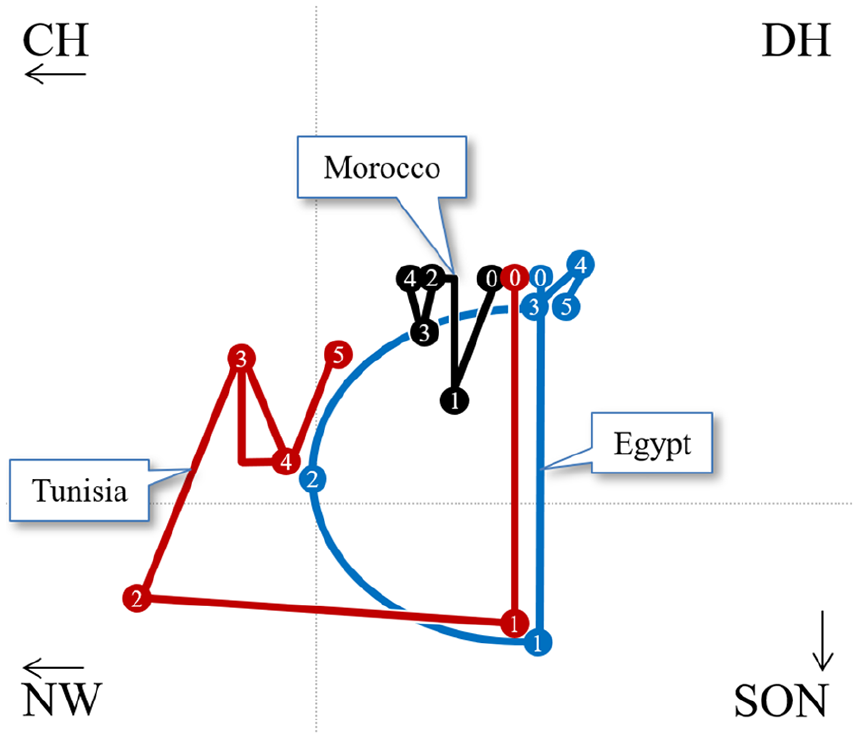
The figure shows the SBD and Northern Africa in the aftermath of the Jasmine Revolution. Meanwhile Tunisia and partly Egypt experienced heavy alterations in sociality and verticality, Morocco was relatively stable.
One remarkable aspect of Tunisia in that period was the horizontal move from (1) to (2). This was not a result of the elected Ennahda government. It followed from the emergence of civil dialogue and transitional justice initiatives (Gall, 2015), which caused a strong horizontal move toward pro-sociality. One was the Constituent assembly that was established in October 2011 by free elections. It was intended to formulate a new constitution (adapted in February 2014) and, based on that, to draft the respective institutions.
Another initiative was the Tunisian National Dialogue Quartet. This was driven by four Tunisian social groups, the General Labor Union (UGTT), the Confederation of Industry, Trade and Handicrafts (UTICA), the Human Rights League (LTDH), and the Order of Lawyers (Melhem, 2015). Their objective was to foster a broad social debate about Tunisia’s democratic future. A further initiative was the Commission for truth and dignity (Instance de vérité et dignité, IVD), which was created to investigate the crimes and corruption of the former regime. For its proximity to Ennahda, the commission was continuously labeled to be revenge-motivated what made its legitimation hard (Cavaillès, 2014). The three initiatives gave the post-revolutionary Tunisia a strong 9 o’clock drive (1 to 2) on peer level right after the breakdown of the old regime. This step was very important as it brought the society into pro-sociality (NW) before creating power asymmetries by establishing political institutions (12 o’clock move).
In the following time, the country was hit by violent shocks (4). In February 2013 Chockri Belaid and the following July Mohamed Bahmis were assassinated. Both politicians were symbols for Tunisia’s democratic transition. These killings were followed by two terror attacks targeting the Bardo Museum in March and a tourist beach in July 2015. All violent chocks were prompted by mass demonstrations, which were forms of pro-social peer r&p—rewarding the murdered by honoring them and punishing the perpetrators by denouncing them. This generated a triangular move between (3) and (4); (3) to (4) is the violent shock and the manifestations caused a move back to (3). The people’s readiness to take the streets and the National Dialogue Quartet gave the country a strong intrinsic horizontal drive toward the left of the SBD. Nevertheless, the government (then the Nidda Tounes party) declared the State-of-Emergency (5) in November 2015.
Following the 2011 incidences in Tunisia, Egypt’s Mubarak regime was pushed out of power (Egypt 0 to 1). Unlike the pro-social initiatives in Tunisia (Tunisia 1–2), there was no such broad movement in Egypt. Just for the period of the election campaigns in 2012, some vague pro-social thoughts flourished. Hence, I illustrated (Figure 11) this move as a curve where (2) marks the elections themselves in which the country brushed the pro-social side of the SBD before turning back to the right. The elected Muslim Brotherhood (3) was not as tolerant as Ennahda; it promoted a constitution marked by religious intolerance and it appeared to be connected with torture (Trager, 2016). It was then overthrown by a military coup in July 2013 (4) followed by the Sisi government (5). As a coup d’état is anti-social institutional punishment the movement (3) to (4) goes to the upper right corner. All in all Egypt’s movements in the SBD were rather vertical since its first democratic elections did not bring the expected pro-social results.
The third country in this sample is Morocco which showed a fairly different move in the same period. When the uprisings in Tunisia (Morocco 0) started, they were echoed in Morocco by manifestations of the February 20 movement (Morocco 1; Lawrence, 2016). But the government of King Mohammed VI reacted quickly to the revolutionary threat. A new constitution with broader institutional power sharing (Boix and Svolik, 2013) was presented, elections were held, and economic reforms promoting investments where made (2). However, democratic reforms got stuck and political activists, journalists, and others came again under pressure (Alami, 2014). For parts of the Moroccan population, the reform steps were too slow that motivated the people several times to take the streets (3) (Bozonnet, 2015). All in all, Morocco showed a slow revolutionary threat-driven reform (De Mesquita and Smith, 2009) move which has repeatedly come to halt. This resulted in triangular movements between missing reforms (2), revolutionary threat (3), reform concessions (4), and slip-back to (2).
In the same period, other countries of the region also experienced variations in sociality and verticality. In Libya, the regime collapsed (DH to SON), but the country got stuck in an SON with mutual self-aggrandizement and deposal of rivaling political factions. In Syria (DH), the regime was heavily challenged by different groups. The country became increasingly anti-social. It moved to the far right of the SBD, but the Assad regime did not collapse (no move from DH to SON). In Saudi Arabia, the regime engaged in small reform steps moving within the DH slowly to the left. However, this process has shown to be slow and not free from setbacks.
Discussion
I argued that the degree of social hierarchies plays an important role in the analysis of democracies and authoritarianism. Hierarchies in pro-social societies are a result of bottom-up escalation of public goods coordination from the civil principals to their political agents. That was my point of departure for this article. On the contrary, in anti-social societies, hierarchies work top-down through the domination of the citizens by the politicians. Both, however, have power asymmetries between the weaker citizens and the stronger politicians which become bigger the stronger the social hierarchies are.
I introduced four basic society types: the NW society, the CH, the DH, and the SON, which, together, form the SBD. It differentiates on the x-axis between pro- and anti-social societies and on the y-axis between hierarchical and horizontal societies, meaning the existing power asymmetries. The SBD allows analyzing selected countries especially when proper empirical data are rare. I have shown this in the example of the Arab Spring. The movement toward democracy often comes along with changes in their social hierarchy. Sometimes it is the alteration of verticality itself, which enables a horizontal move between authoritarianism and democracy (e.g. Morocco in Figure 11).
In democratic societies, the public goods coordination creates long principal-agent chains. When hierarchies grow, the power asymmetries increase but the strength of the principal-agent chains decreases. If both are not in balance, the civil principals lose control over their political agents. I have shown that the level of hierarchical escalation (here: Government Spending in % GDP) correlates positively with their pro-sociality level (here: CATO’s PF Indicator). In other words, the level of vertical escalation, where power asymmetries and strength of principal-agent chains are in balance, increases with the societies’ pro-sociality. It seems that the citizens are (intuitively) aware of the latent fragility of the principal-agent chains. Hence, they escalate coordination in accordance with the trust they have in the political agents. However, despite of the positive correlation, there is a considerable spread between those societies who escalate many tasks (high Government Spending) and those who do not. This shows that other aspects like cultural differences, the constitutional and legal framework, civil participation, and other aspects need to be explored.
The empirical analysis has shown that there is a general trend to increase the escalation levels (here in the form of GS) and the low-GS countries show a higher growth catching up with the high-GS countries. Despite the long-term positive correlation between absolute PF and GS levels, there is no correlation between the short-term changes of PF and GS. The average changes of PF levels are lower than the GS changes, but there are some remarkable cases. Taiwan increased, meanwhile Nicaragua and the Philippines decreased their pro-sociality (PF) significantly without changing their verticality (GS). Argentina increased its GS and reduced its PF simultaneously. This indicates that it is not pro-sociality that follows from verticality but rather the imbalance between power asymmetries and principal-agent chains. Argentina continued this path during the years 2012–2016 (Figure 9) what led the Argentineans to ouster the Fernandez de Kirchner government from office in the 2015 elections.
There is no significant difference in the variance of escalation level changes (ΔGS) between countries with low power asymmetries (low GS) and those with high asymmetries (high GS). However, the shape of the distributions of the PF and GS changes is different for low-GS and high-GS societies, which reveal different behavior patterns between hierarchical and non-hierarchical societies. The skewness of the ΔGS/GS distribution is symmetric for low-GS countries and negative for high-GS countries. The negative skewness for high-GS countries means that most of the countries moderate variations in verticality (GS), meanwhile some countries experienced sharp declines in GS. This could result from the mentioned structural lock-in (Toelstede, 2019b), which, when breaking up, is followed by sudden and sharp declines in GS.
There is no significant difference in the variance of ΔPF/PF between high- and low-GS countries. This should question the people’s opinion that hierarchies are more stable (Demange, 2004; Friesen et al., 2014) and overcome social problems easier (Halevy et al., 2011) then non-hierarchical societies. Furthermore, the skewness of the ΔPF/PF distribution is positive for low-GS countries and negative for high-GS countries. This means for low-GS countries, most countries showed moderate variations in pro-sociality (PF) meanwhile some experienced strong improvements (2008–2011: Taiwan (+16%), Peru (+5%)). For high-GS countries it is the opposite, most countries showed moderate variations meanwhile some experienced strong PF declines (2008–2011: Nicaragua (–10%), Serbia (–5%)). If power asymmetries and principal-agent chains are in imbalance, politicians can act against the citizens and pro-social societies can drift into authoritarianism. On the contrary, horizontal societies have no power asymmetries. They can move easier to pro-sociality since there are no anti-social political actors inhibiting this move (Fracchia and Lewontin, 2005). This was also the case in post-revolutionary Tunisia where the temporary absence of strong anti-social political coalitions allowed the society to make a substantial step toward pro-sociality (Yildirim and McCain, 2019). So, I dare to say that the ΔPF/PF-skewness shows that significant pro-sociality gains are rather likely in countries with minor verticality. This is because of the lower power asymmetries and structural lock-ins (Toelstede, 2019b). In these countries, citizens have more influence on their destiny. However, these findings require further research.
A limitation of this empirical analysis is that the Government Spending related to GDP (GS) does not reflect how the hierarchical escalation process works, how it is checked, the separation of powers in the political systems, the civil participation, the constitutional frame, cultural differences, the available security forces, and the related legislation allowing or forbidding its use. The empirical model assumes these aspects to be equal for the examined countries. To overcome this restrictive assumption, I propose the development of a power asymmetries indicator that includes all the mentioned aspects. This would enable to include important political situations such as the state-of-emergency declaration (e.g. France 2015–2017), which is not properly reflected neither by the GS- nor by the PF-values. However, the used indicators, GS and PF, confirm the positive correlation between pro-sociality and the citizens’ readiness to escalate public goods coordination to the government—that is, the readiness to accept power asymmetries.
Finally, the examination period 2008–2011 is too short to make ultimate conclusions. However, it gives a first good insight into the theme. Further research could help to find other relationships between pro-sociality and power asymmetries. Those could be the point of maximum anti-sociality of authoritarian regimes, the point of authoritarian break down, or the transition between pro- and anti-sociality on different verticalization levels. Summarizing the findings, they suggest that we should not escalate too much coordination to political agents and regularly review the coordination we have already escalated. In other words, we should be careful with the Leviathan!
Footnotes
Appendix
The variation of PF and GS relative to GDP (2008–2011) split between societies with high and low Government Spending.
| ΔPF(2008–2011) | ΔPF/PF(2008–2011) | ΔGS(2008–2011) | ΔGS/GS(2008–2011) |
ΔPF(2008–2011) | ΔPF/PF(2008–2011) | ΔGS(2008–2011) | ΔGS/GS(2008–2011) |
ΔPF(2008–2011) | ΔPF/PF(2008–2011) | ΔGS(2008–2011) | ΔGS/GS(2008–2011) |
ΔPF(2008–2011) | ΔPF/PF(2008–2011) | ΔGS(2008–2011) | ΔGS/GS(2008–2011) |
R2(ΔPF/ΔGS, 2008–2011) |
ΔGS/GS, exGDP |
ΔGS/GS, exGDP |
ΔGS/GS, exGDP |
|
|---|---|---|---|---|---|---|---|---|---|---|---|---|---|---|---|---|---|---|---|---|
| Average | Variance | Skewness | Kurtosis | Regression | Average | Variance | Skewness | |||||||||||||
| All societies | 0.01 | 0.10% | 1.14 | 3.83% | 0.06 | 0.11% | 8.30 | 0.64% | 1.11 | 1.23 | −0.57 | −0.22 | 7.70 | 9.04 | 0.57 | −0.24 | 0.011 | 8.23% | 1.83% | 0.35 |
| Societies with 2008 GS values above the 2008 regression line | 0.02 | 0.26% | 0.58 | 1.28% | 0.05 | 0.09% | 11.58 | 0.62% | −1.16 | −1.30 | −0.25 | −0.08 | 3.17 | 4.27 | −0.24 | −0.27 | 0.001 | 2.30% | 1.50% | 0.96 |
| Societies with 2008 GS values below the 2008 regression line | −0.01 | −0.09% | 1.83 | 7.00% | 0.08 | 0.13% | 3.61 | 0.49% | 2.80 | 2.93 | −0.28 | −0.27 | 12.15 | 12.99 | 1.07 | 0.17 | 0.057 | 15.60% | 1.29% | 0.12 |
| t test a between high- and low-GS societies | 0.59 | 0.67 | 0.07 | 0.003 | 0.00003 | |||||||||||||||
| F test a between high- and low-GS societies | 0.26 | 0.20 | 0.002 | 0.53 | 0.69 | |||||||||||||||
GDP: gross domestic product; PF: Personal Freedom; GS: Government Spending.
I performed t and F tests. However, the skewness and kurtosis indicate that these tests are of limited validity.
Funding
The author(s) received no financial support for the research, authorship, and/or publication of this article.
