




Abstract
Employers are constantly seeking to improve employee performance by means of investing in employee training. The results of training are to a large extent dependent on employees’ willingness to behave productively in a cooperative manner. Yet, systematic evidence investigating the causal relation between training and employees’ cooperative behavior is rare. Here, we present results from a contextualized laboratory experiment in which subjects, who differ in terms of training participation, were asked to contribute resources to a team effort. We conclude that training promotes cooperative behavior, that is, voluntary contributions made to the team effort, in teams of employees working together for short periods of time. Training enhances cooperative behavior the most when provided to the higher skilled subjects. We also find that members in more stable teams act very cooperatively under all conditions, but their contributions do not increase further with training.
Introduction
Many organizations are investing in the training of their employees to increase their performance (Boselie et al., 2005; Dysvik and Kuvaas, 2008; Kraiger et al., 2004; Vogtenhuber, 2015; Zwick, 2006). Several leading scholars have suggested that the results of investments in training are partly determined by the willingness of employees to cooperate (Appelbaum et al., 2000; Sun et al., 2007). Employees’ cooperative behavior consist of voluntary behaviors such as helping coworkers and due to this voluntary nature are considered highly valuable to organizations (Pierce and Maurer, 2009). Results of investments in training are likely smaller when employees use the skills and knowledge acquired in training solely for finishing their own working tasks faster rather than also using these skills for helping their coworkers solve problems. The benefits of training are thus twofold when training not only improves individual productivity, but at the same time influences the willingness of employees to behave cooperatively. Yet, there is relatively little research focusing on whether training can enhance employees’ cooperative behavior. In this article, we focus on the role of training as a possible promotor for cooperative behavior.
The main objective of training is to learn new skills or update current skills related to, for example, an innovation in the organization. An employee who does not have the resources or skills to help a coworker is less able to behave cooperatively than an employee who does have these skills. At the same time, the social climate or cohesiveness of the team of employees can motivate employees to cooperate (Chen and Bachrach, 2003; Lamertz, 2005; Shen et al., 2013). When teams of coworkers are working together for longer periods of time, they are more likely to develop shared norms regarding cooperative behavior. In teams where employees are put together for single assignments, such norms are less likely to exist, which implies that there is more potential for training to increase cooperative behavior in these teams. In other words, the “cohesiveness” or “stability” of the team might influence how effective training is in promoting cooperative behavior. To know the expected effects of training is crucial for organizations as this often guides their human capital investment decisions. Therefore, in examining the effect of training on cooperative behavior, we additionally need to take employee differences in terms of ability to behave cooperatively and organizational differences in terms of team stability into account.
Previous research has mainly relied on cross-sectional data to examine returns from investments in training and for understanding the antecedents of employees’ cooperative behavior (Podsakoff et al., 2000). Cross-sectional data provide many valuable insights for understanding the association between training and employees’ cooperative behavior; however, the non-random selection of employees into training makes it difficult to distinguish the causal effect of training on cooperative behavior from other unobservable factors that drive participation in training as well as cooperation. It might be just as likely that cooperative behavior is an antecedent of training, rather than training being the antecedent of cooperative behavior (Dysvik and Kuvaas, 2008). In other words, with cross-sectional data, it is unclear whether employees behave more cooperatively after receiving training or whether they receive training because they are behaving cooperatively.
Laboratory experiments are especially well suited for studying causal relations. The experimental design allows researchers to exogenously determine which employee receives training. Therefore, the data do not suffer from questions regarding reversed causality. At the same time, experiments have the advantage that it is possible to exogenously determine variations and covariations in training, employees’ skills, and team stability. This allows researchers not only to investigate the causal effect of training on cooperation, but additionally to examine specific conditions under which training can be expected to have these effects in a systematic and concise manner. We contribute to the literature regarding the effects of training and employees’ cooperative behavior using an experimental approach to investigate the role of training for promoting employees’ cooperative behavior. In doing so, we respond to the call for more experimental research in understanding the antecedents of employees’ cooperative behavior (Podsakoff et al., 2000). We formulate the following research questions: “To what extent and under which conditions can training promote employees’ cooperative behavior?” and: “How does the effect of training on cooperative behavior depend on the skillfulness of the employee who received training and the stability of the employee’s team?”
An often heard criticism on laboratory experiments is that the decision situation is too abstract and differs too much from real-world decisions individuals have to make, which jeopardizes the external validity of the findings (e.g. Harrison and List, 2004; Murnighan and Wang, 2016). In this article, we contextualize our experiment to take place within an organization. This implies that we do not use abstract terms in the instructions of our experiment or in the experiment itself. For example, the terms “employee”, “skills”, and “team effort” are used rather than the terms “subject”, “endowment”, and “public good”. Contextualizing the experiment helps to increase the ecological validity of the experimental results by mimicking the substantive question at hand as close as possible, which results in a more robust application of the experimental approach (Harrison and List, 2008). Although it is difficult to assess how well student subjects can grasp the experimental setting, we also aim to increase subjects’ understanding of the experiment by making the experiment less abstract. Still we acknowledge that, although we are contextualizing the experiment, this does not solve these validity concerns completely, as we are still studying student decisions in relatively abstract situations. We get back to this in the conclusion.
Public Good Games are frequently used to study cooperative behavior of employees (e.g. De Cremer and Van Knippenberg, 2003; Gerhards and Heinz, 2017; Güth et al., 2010; Lambooij et al., 2009). We follow previous research and use contribution decisions in Public Good dilemmas as an indicator for employees’ cooperative behavior. In doing so, this article also contributes to the experimental literature focusing on cooperation in Public Good dilemmas. The experimental literature on cooperation in Public Good Games has predominantly focused on actors who are identical in terms of endowments or productivity. Because we want to study whether the effect of training is different for employees who have more or less skills (endowment), our workplace setting implements employees who are heterogeneous in terms of skills and training participation. How these differences affect cooperation in Public Good dilemmas is a question that has attracted minor attention so far, also in abstract experiments. The experimental studies that do investigate the effects of either heterogeneity in terms of endowment or productivity are not conclusive. Some studies conclude that contributions to the public good increase when actors have different productivity levels (Chan et al., 1999; De Cremer and Van Dijk, 2009; Ledyard, 1995), whereas others conclude that contributions are likely to decrease when actors have different productivity levels (Tan, 2008). Findings from studies on heterogeneity in terms of endowment do not converge either. Kölle (2015) found that this type of heterogeneity increases group level contributions, whereas others (Cherry et al., 2005; Fung and Au, 2014) conclude that heterogeneity in ability decreases group level contributions. Thus, in addition to posing a new question in the organizational literature, this article contributes to the experimental literature by studying cooperation in Public Good situations where actors are heterogeneous in terms of endowments and productivity.
Decision situation and predictions
Given that this article aims to contribute both to the organizational literature and to the experimental literature, we bring the organizational literature and the experimental literature together in providing arguments for our hypotheses. As we contextualized our experiment, we first elaborate on the link between the experiment and its contextualization before we deduce the hypotheses.
Cooperative behavior as contributions in Public Good Games
The decision situation
This study uses contribution decisions in Public Good dilemmas as an indicator for employees’ cooperative behavior. The following situation is used as the contextualized Public Good Game. A group of employees is working together in a team. The organization for which they are working is introducing a technical innovation. Employees are asked whether they are willing to help introduce this innovation using some of their resources (hereafter labelled skills and representing the endowment in abstract Public Good Games). In other words, employees are asked to divide their skills between their own working tasks and a team effort aimed at introducing the innovation. Properly implementing the innovation will benefit all employees equally regardless of their respective contributions.
Employees are not obliged to help introducing the innovation and can decide to use all their skills for their own working tasks. Yet, these employees will benefit equally from the innovation as coworkers who have contributed all their skills to introducing the innovation. This creates an incentive for individual employees not to contribute and profit from the contributions of others. Therefore, a rational employee would not contribute anything. However, employees might also consider other consequences of their choices. When nobody helps to introduce the innovation, the benefits of the innovation are not achieved and all employees are worse off than if all employees had contributed. Because each individual employee experiences a conflict between his own interest and the collective interest of the team, this situation resembles a Public Good dilemma (Hardin, 1968; Olson, 1965).
Introducing employee and team characteristics to the decision situation
In the decision situation described above, employees are characterized by (1) their resources in terms of skillfulness, (2) their training participation, and (3) the stability of their team. As outlined above, employees are asked to divide their resources between their own working tasks and a team effort. The resources employees have available are resembled by their skillfulness and differ between employees: some employees have more resources than others. This means we impose a heterogeneity in skills enabling us to examine the effect of employees’ skillfulness on cooperation. This heterogeneity in skills is introduced in the Public Good Game by imposing heterogeneity in the endowments (resources) of employees.
We introduce training to the decision situation by instructing employees that their boss is giving one of the employees in the team a training in which that employee will learn more about the innovation. Please note that we instruct employees that this training is a gift from the employer and that this training is something they would like to have. Which employee in the team receives training is based on the skillfulness of the employee and is varied systematically with sometimes the higher skilled employee receiving training and sometimes the lower skilled employee receiving training. Training is introduced to the Public Good Game by increasing the productivity level of the trained employee. Exactly how this plays out in the experiment is described below.
We introduce team stability to the decision situation by varying the number of assignments among the same team members. We compare teams in which employees work together in a series of assignments with the same coworkers with teams that do only one assignment together. 1 Team stability is introduced to the Public Good Game by varying the number of interactions between employees.
Although the effects of varying the skillfulness of the employees and the stability of the team in which they interact on contribution decisions are rarely studied together before, its influence on the decision situation is pictured easily. How training influences the decision situation in our case is a bit more complex. Training affects the decision situation in the following way: employees are assigned a level of skillfulness (endowment). Employees subsequently have to divide their skills between their own private working tasks and a team effort which benefits introducing the innovation. As in all Public Good Games, the skills contributed by actors are multiplied by a certain factor before they are added to the public good. In our experiment, we contextualize this multiplier as an employee’s productivity level. 2 Training increases an employee’s productivity level, meaning that the skills contributed by trained employees add more to the team effort than the skills contributed by their untrained counterparts. As only one employee in the team receives training, this introduces another form of heterogeneity to the experiment: heterogeneity in terms of productivity. To study the impact of training and the effects of skills, as well as the interaction between these two, we impose that training enhances the efficiency with which an employee uses his skills rather than the skills themselves. Therefore, training results in an increase in productivity rather than in an increase in skills for the employee receiving training. Examples of this type of training aim at communication, presentation, negotiation, or working efficiently.
The effect of training: the generalized reciprocity principle
In the organizational literature, social exchange theories (Blau, 1964; Cropanzano and Mitchell, 2005; Homans, 1974 [1961]) and, specifically, leader-member exchange models (Wayne et al., 1997) and mutual-investment models (Tsui et al., 1997) are frequently used for understanding cooperative behavior between employees and employers. These models are built on the premise that employers and employees are embedded in exchange relationships that are seen as interdependent. Actions of an employee are contingent on the actions of the employer and vice versa. When the employer provides a benefit to the employee, this will obligate the employee to repay that benefit. The underlying mechanism is Gouldner’s (1960) reciprocity principle or “the pattern of exchange through which the mutual dependence of people, brought about by the division of labor, is realized” (Gouldner 1960: 169). Assuming that receiving training is seen as a kind gesture from the employer, the reciprocity principle predicts employees to reciprocate to the training by increasing their cooperative behavior. In other words, they become more concerned with the outcome for the employer in addition to their own outcome.
In the experimental literature, the gift-exchange model as proposed by Akerlof and Yellen (1988) has been used to test the reciprocity principle that resides at the core of social exchange theory. In this model, the employer moves first and offers a wage to the employee. After receiving the wage, the employee has to decide how much effort he is willing to make. Findings often elicit a positive relation between wage and effort (Falk and Fischbacher, 2006; Fehr et al., 2002). In these experiments, the effort an employee is willing to make is seen as an indicator for cooperative behavior. Based on these findings, one conclusion particularly relevant to our study can be drawn: the extent to which employees are willing to cooperate can be increased by appealing to norms of reciprocity.
Theoretical arguments from the organizational literature as well as theoretical arguments from the experimental literature thus rely on reciprocity as the main mechanism in explaining why receiving training would increase employees’ cooperative behavior. Although we could argue that contributing to the team effort benefits the employer indirectly (the team effort benefits the team as a whole and thus the employer), we do not study this explicitly. Contributing to the team effort in our experiment mostly benefits the other team members. Therefore, it is important to specify the type of reciprocity underlying the relation between investments in training and cooperative behavior. Direct (or strong) reciprocity predicts that employees direct their cooperative behavior toward the employer after receiving training (I help you and you help me). Generalized reciprocity predicts that employees will not only be motivated to direct their cooperative behaviors toward the employer after receiving training, but will also be motivated reciprocate by directing their cooperative behaviors toward coworkers (Baker and Bulkley, 2014; Hyde, 2000).
Charness (2004) experimentally examined whether actors made different choices in a gift-exchange model when they were not able to reciprocate directly to the person from whom they received the gift. Although results showed that the relation between wage and effort was weaker in the condition where actors could not reciprocate to the person from whom they received the gift, compared to the condition in which they could, the relation was still significant. Charness’ results indicate that, although employees cannot reciprocate to the employer in our experiment, we could still expect employees to behave in a reciprocal manner by contributing to the public good profitable for all employees in the team. This type of reciprocity can be interpreted as generalized reciprocity. Based on the above and in line with previous research showing that individuals are reciprocally motivated in organizational settings (Ipe, 2003; Kampkötter and Marggraf, 2015; Kollock, 1994; Lambooij et al., 2007) as well as in experimental settings (for reviews see Balliet and van Lange, 2013; Ledyard, 1995; Ostrom and Walker, 2003), we expect:
Hypothesis 1. Training has a positive effect on cooperative behavior.
Training and skills
It is important to take employee differences in terms of skills into account when studying cooperative behavior as these skills are the resources employees have available for behaving cooperatively. For example, employees who have more skills are better suited to help colleagues solve work-related problems than others or, in case of our experiment, have a larger endowment to help introducing the innovation. In other words, there exists inequality between employees in their endowed skills to behave cooperatively. Teams of employees form exchange relationships among themselves based on a sense of social obligation (Blau, 1964; Mossholder et al., 2011). When employees are aware that they are endowed with more skills to behave cooperatively than others, this inequality is likely to motivate them to behave more cooperatively in an effort to reduce the inequality between them and their coworkers.
Related arguments are found and corroborated the experimental literature. Other-regarding preference models such as the Fehr and Schmidt (1999) model of inequity aversion and Becker’s (1974) altruism model are often used for understanding contribution decisions in groups where actors are heterogeneous in terms of resources. Both types of models converge on the perspective that actors with more resources will feel guilty, while actors with fewer resources will feel envious (Chaudhuri, 2011) in case of inequality between the group members. In order to make the outcome less inequitable, subjects with more resources are willing to increase their contributions. De Cremer and Van Dijk (2009) investigated contribution decisions in groups of four subjects in which two subjects had an endowment twice as high as the other two subjects. Results showed that subjects with higher endowments contributed more to the Public Good than subjects with lower endowments. In terms of our experiment, this would imply that higher skilled employees contribute more to the team effort than lower skilled employees:
Hypothesis 2. There exists a positive relation between skills and cooperative behavior.
Thus far, we have neglected that employers often select specific employees for training based on their skillfulness. According to Tanova and Nadiri (2005), such training selection methods are becoming an important aspect of the organizational strategy. However, selecting higher skilled employees for training might change the dynamics of the team in a different way than selecting the lower skilled employees for training. This might consequently influence the way employees react to training in terms of cooperative behavior. In the following paragraph, we provide an example that illustrates how.
Let us assume that the higher skilled employees are selected for training. Higher skilled employees are expected to behave more cooperatively than lower skilled employees because they have most resources to cooperate. Therefore, higher skilled employees are the best suited to behave cooperatively and feel socially obliged to do so because others are less capable of cooperation (i.e. due to the inequality between the employees). By providing training to the higher skilled employees, these employees become even better capable of behaving cooperatively. After receiving training, the higher skilled employees not only have more resources to behave cooperatively but in addition they can use their resources more productively. This implies that the inequality between employees has grown compared to the situation before training was provided. Contrastingly, although the productivity of lower skilled employees increases after training, they still have fewer resources to contribute to the team effort than the higher skilled employees.
In terms of inequality between the employees, providing training to the lower skilled employees decreases the inequality: trained lower skilled employees become more productive than their higher skilled coworkers which compensates partly for their lower level of skills they have available to contribute. Assuming that the inequality between employees serves as motivator for cooperative behavior (Falk and Fischbacher, 2006; Fehr and Fischbacher, 2002), we can expect that when the inequality between employees is larger the employees who are the best suited to behave cooperatively will increase their cooperative behavior in order to equalize outcomes more than when inequality is smaller. Thus, because providing training to higher skilled employees accentuates the inequality, while giving training to lower skilled employees reduces the inequality, the effect of training is expected to be more pronounced for higher skilled employees:
Hypothesis 3. The positive effect of training on cooperative behavior is larger for employees with more skills than for employees with fewer skills.
Training and team stability
Most research investigating antecedents of employees’ cooperative behavior has primarily focused on individual level predictors and has focused less on contextual factors. This is surprising as it has long been shown that the context can influence individual tendencies to cooperate (Heide and Miner, 1992; Lindskold et al., 1986). In this article, we explore the role of team stability on employees’ decisions to cooperate. We make a distinction between teams consisting of the same coworkers who work together for longer periods of time on various assignments and teams of employees put together for one assignment only. For simplicity, we label the former “stable teams” and the latter “altering teams.”
Employees who are working together for longer periods of time are more likely to identify as a group than employees who are only working together once. Coleman (1988, 1990) was among the first to stress the positive effect of identification as a group, or cohesion, on cooperative behavior. By working together for longer periods of time, employees create a strong social identity that fosters cooperative behavior by increasing the level of trust within the group and by reducing the risks of opportunistic behavior (Chen et al., 2009; Frenkel and Sanders, 2007; Gargiulo and Benassi, 2000). Cohesive teams of coworkers have higher levels of trust because in such teams employees are expected to reciprocate past behavior. In other words, employees who have benefited from the team effort in the past are expected to return the favor by contributing to the team effort themselves. In addition, the coworkers of an employee not returning the favor are more likely to sanction such opportunistic behavior when they form a cohesive team. This also enhances trust between employees, which subsequently affects their willingness to contribute to the team effort (see also Raub and Weesie, 1990).
In the experimental literature, effects similar to what we label “team stability” or “cohesion” are frequently studied by comparing one-shot games to iterated games. The rational behavior for employees in altering teams, or one-shot games, is not to cooperate and profit from the work of their coworkers. Contrastingly, the repeated game structure of the stable teams makes that employees have to take into account that their current behavior will likely affect the future behavior of their coworkers (Axelrod, 1984; Heide and Miner, 1992), making repetition of interactions crucial for fostering cooperation (see, for example, Güth et al., 2010). In stable teams, the rational behavior for employees is thus to behave cooperatively regardless of whether they receive training. Experimental research has shown that when the long-term benefits of behaving cooperatively outweigh the short-term benefits of free-riding, as is the case for employees in stable teams, contributions can be expected to increase (Buskens and Raub, 2013). Also focusing on the relation between employers and employees, Lambooij et al. (2009) illustrate that although risk-averse employees are less likely to cooperate in situations where the rewards from this cooperation are uncertain, the embeddedness of employers and employees in a long-term relationship will increase employees’ cooperative behavior. The underlying mechanism for this is conditional cooperation (Fischbacher et al., 2001; Keser and Van Winden, 2000) or weak reciprocity (Fehr and Schmidt, 2006). Note that this form of reciprocity is different from the reciprocity that enhances the contributions of employees after receiving training, which is in the literature often referred to as strong reciprocity. Weak reciprocity mechanisms appeal to individuals’ self-interests, whereas strong reciprocity mechanisms are triggered by other-regarding preferences (Buskens and Raub, 2013).
Employees working in stable teams can thus be expected to behave more cooperatively than employees working in altering teams. However, employees are also limited in the extent to which they can cooperate. They only have a given amount of resources (skills) they can utilize in order to behave cooperatively. Exactly to what extent training can be expected to increase an employee’s cooperative behavior depends on how cooperatively that employee was behaving prior to training. Employees in stable teams are expected to behave more cooperatively than employees in altering teams due to weak reciprocity mechanisms and indeed already contribute most of their skills. As a result, employees in altering teams likely have more resources left to increase their cooperative behavior, while for employees in stable teams there might be a “ceiling-effect.” Therefore, we expect:
Hypothesis 4. The positive effect of training on cooperative behavior is larger in altering teams than in stable teams.
Please note that we explicitly refer to absolute levels of cooperative behavior for this hypothesis and that we thus hypothesize stability of teams and investments of training as, at least partly, substitutes to promote cooperative behavior in firms.
Data and measurements
Experimental design
As outlined in section “Introduction”, we contextualized the experiment in an effort to increase subjects’ understanding of the experiment. One reason why laboratory experiments are usually so abstract is because they aim to test rather general theories on human behavior (Harrison and List, 2008). Using terms related to the field of study might reduce the generality of the behavior observed, but can help subjects overcome confusion about the decision task. In everyday life, the context of an individual provides heuristics guiding individual behavior in that specific situation (Harrison and List, 2008; Murnighan and Wang, 2016). These heuristics are often missing in abstract laboratory environments. For either of these reasons, a lack of understanding from the subjects or a failure to apply the relevant field heuristic, individuals might behave differently in the laboratory than in real life.
The decision situation
The decision situation underlying our experiment is a contextualized Public Goods Game played by three subjects. The subjects are told they represent a team of colleagues. At the start of each round, every subject i receives an amount of skills yi. These skills are the endowment this employee can use to contribute to the public good. Subjects have to decide how many of their skills yi they want to use in a team effort (i.e. the public good) and how many they want to use for themselves. Each subject can choose to contribute gi of their skills to the team effort (0 ≤ gi ≤ yi). All three subjects decide about the contributions gi simultaneously and independently. Every subject i is also assigned a multiplier
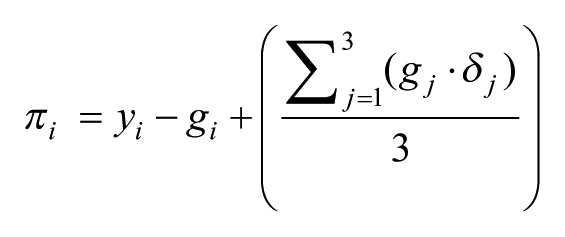
Employee and team characteristics: introducing the independent variables to the decision situation
We allow for heterogeneity in terms of skills and productivity. In order to create heterogeneity in terms of skills, we constructed three different teams, with different distributions of skills among its members. We include one (almost) homogeneous team and two more heterogeneous teams. There is one heterogeneous team with two higher skilled subjects and one lower skilled subject (2High1Low) and one heterogeneous team with two lower skilled subjects and one higher skilled subject (2Low1High). As can been seen in Table 1, we keep the total number of skills constant, while in the two heterogeneity teams also the variance in skills is the same. By varying the extent of heterogeneity in the teams, we can control for whether potential differences between more and less skilled employees depends on the distribution of the skills or resources within the team.
Overview of experimental conditions, the distribution of skills, and productivity levels within the different teams.
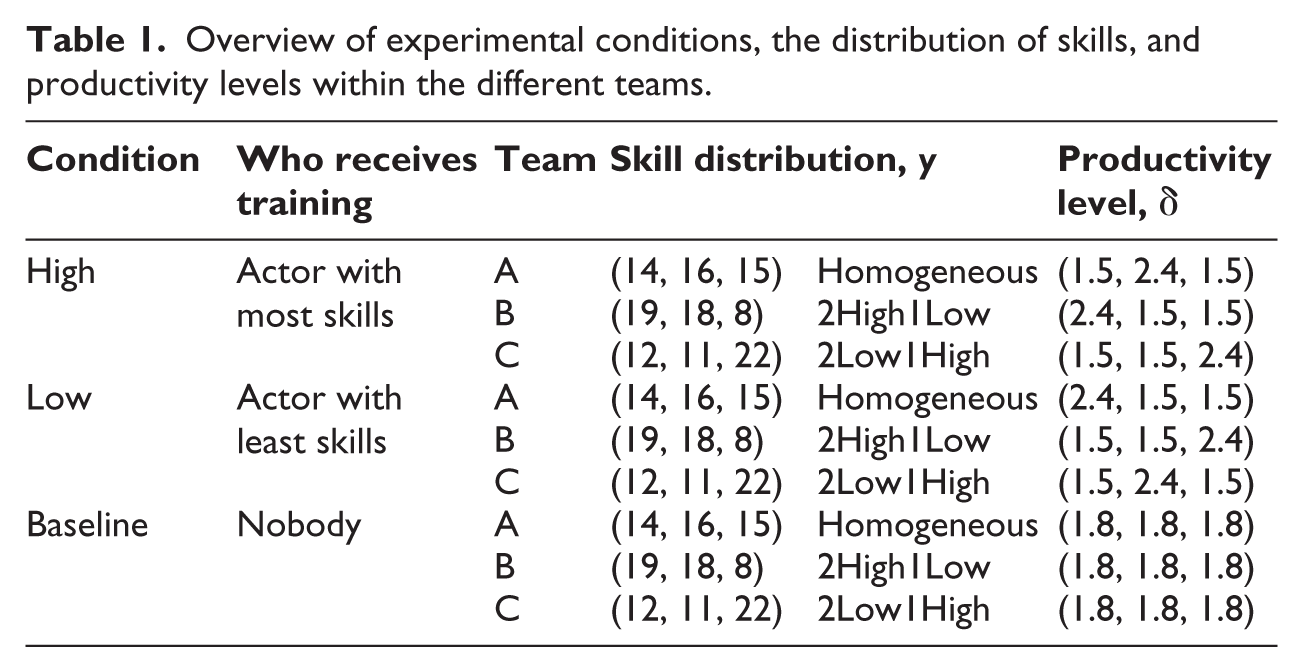
As outlined above, all subjects are assigned a multiplier
We created three experimental conditions in order to differentiate which employee receives training and thus to examine the interaction between employees’ skills and training: a condition “High”, a condition “Low”, and a condition “Baseline”. In the condition “High”, the employee with the most skills in each team receives training. In the condition “Low”, the employee with the least skills in each team receives training. For example, in the condition “High” and in team B in Table 1, the employee with 19 skills receives training. Alternatively, in the condition “Low” and in team C, the employee with 11 skills receives training. In the condition “Baseline”, nobody receives training and all employees have the same productivity level of 1.8. We choose the value of 1.8 in order to keep the average productivity level in the three conditions constant. Although the average productivity level is equal across teams, the maximum number of points that can be earned differs slightly depending on which employee receives training. Table 1 provides an overview of the experimental conditions. Note that these characteristics are all exogenously determined. We vary the experimental conditions “High”, “Low”, and “Baseline” between subjects, while the skill distributions of teams A, B, and C are varied within subjects.
The effects of team stability are tested by comparing contributions made in one-shot games to contributions made in iterated games. All subjects play one-shot Public Good Games (hereafter: altering teams) and iterated Public Good Games (hereafter: stable teams). More specifically, subjects interact on 18 altering teams in which they are randomly assigned to team A, B, or C for one round. After one round, subjects are randomly matched with two other subjects and again randomly assigned to team A, B, or C. In the stable teams, team composition is kept constant for six rounds using a partner-matching design. After six rounds, subjects are randomly matched with two other subjects and move on to the second team (A, B, or C). This procedure is repeated three times so subjects play six iterations in each of the three teams (18 rounds in total). Thus, subjects interact for one round in 18 different altering teams and for six rounds in three different stable teams.
Subjects are notified about their own skills and productivity level as well as about those of their team members throughout the experiment. Subjects were informed about the number of rounds they had to play and received information regarding their decisions and the decisions of their team members in previous rounds throughout the experiment. The order of the teams and the condition in which subjects interact is varied systematically in a balanced design.
Experimental procedure
The experiment was programmed and conducted with z-Tree software (Fischbacher, 2007). Subjects were recruited among students at Utrecht University using the Internet recruitment system ORSEE (Greiner, 2004). We conducted six sessions in March 2016 at the Experimental Laboratory for Sociology and Economics (ELSE) at Utrecht University. Subjects participated in one condition and each condition was tested in two different sessions. A total of 45 subjects participated in the condition “Baseline”, 42 in the condition “High”, and 42 in the condition “Low”. In total, 129 subjects participated in the experiment. All subjects received printed instructions in English. The instructions were the same for every subject (instructions with screenshots can be found in the supplementary material). After reading the instructions and before the start of the experiment, subjects had to answer some test questions, which they answered without difficulty. At the end of the experiment, subjects were asked to complete a short survey. There were 43 (33.33%) male subjects. The age of the subjects ranged from 18 to 53 with an average of 23. Furthermore, 55 (42.64%) of the subjects had followed a course in game theory before participating in the experiment. Subjects’ earnings were paid out anonymously when all subjects had completed the survey. A typical session lasted for approximately 1.5 hour in which subjects earned on average 13.07 Euros.
Measurements
In this article, we measure employees’ cooperative behavior by the contribution subjects make to the team effort, that is, the public good. At the beginning of each round, subjects receive an amount of skills yi. Subjects were asked to contribute gi of their skills to the team effort. The variable contribution was constructed measuring the amount of skills contributed by subjects. This variable ranges between 0 and yi. A dummy variable training was created equal to 1 for subjects receiving training in the conditions “Low” and “High”. There is a difference between subjects not receiving training in the conditions “Low” and “High”, that is, in the conditions were another subject receives training, and the subjects not receiving training in the condition “Baseline”, that is, the condition in which nobody receives training. Although we do not have hypotheses on whether these subjects behave differently, it is important to disentangle subjects that do not receive training in groups in which no one received training and in groups in which someone did receive training empirically. Therefore, we created a variable no training. This variable is 1 for the subjects not receiving training in the conditions “Low” and “High”. The subjects in the baseline conditions form the reference category for both training variables. The variable skills indicates the skills subjects could have contributed to the team effort. This variable ranges from 8 to 22.
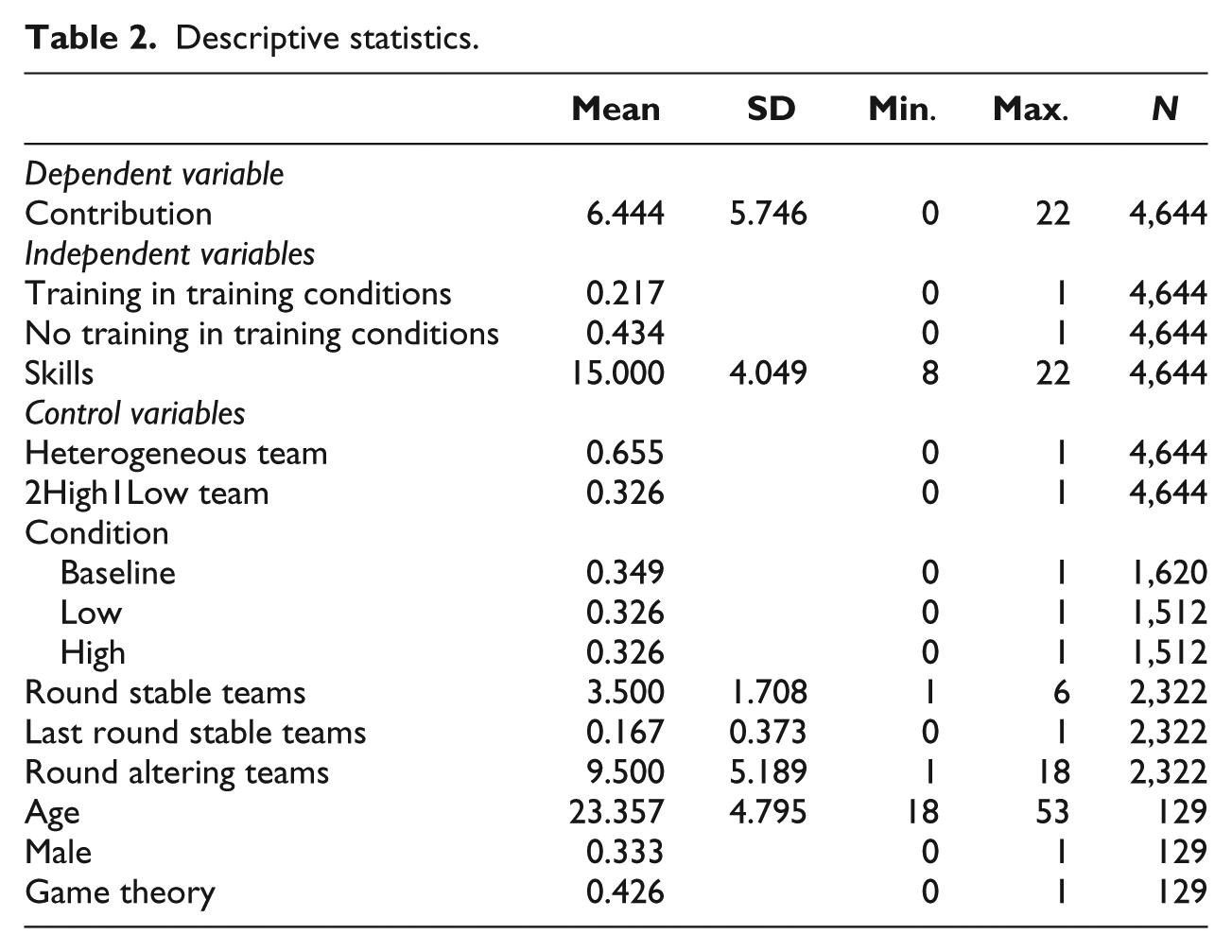
A number of variables were constructed to control for conditions of the experiment. We created two dummy variables controlling for the different teams: heterogeneous team, indicating 1 in team B and C and 0 otherwise, and 2High1Low, indicating 1 in team B and 0 otherwise. The different training conditions are represented by the dummies: Baseline, Low, and High. We constructed the variables round to control for the general tendency in cooperation over rounds and last round to control for possible end-game effects. The variable round ranges from 1 to 6 for the stable teams and from 1 to 18 for the altering teams. The variable last round was constructed for the stable teams only and indicates 0 in the first five interactions and 1 in the last interaction. Finally, we constructed the control variables age (range, 18–53), male (1 for males and 0 otherwise), and whether subjects have ever followed a course in game theory (1 if they did and 0 otherwise). Table 2 provides the descriptive statistics of the variables.
Descriptive statistics.
Method of analysis
Subjects’ contribution decisions are analyzed using multilevel regression analyses. The data for the stable teams have a cross-classified multilevel structure with observations nested not only within subjects but also within teams. We add random effects for each of these levels. Although subjects are also nested within teams in altering teams, we do not include a team level random effect for altering teams because subjects play only one round with the same team members. Subjects’ decisions in altering teams are not influenced by who the other team members are. Therefore, we only add a random effect for subjects in the analyses for altering teams. As we expect that subjects decide on their contributions differently in altering teams compared to stable teams and due to differences in the interdependence structure of the samples, we estimate separate models for subjects embedded in altering teams and subjects embedded in stable teams. The analytical strategy is the same for both types of teams: in the first model, we include the independent and control variables. In the second model, we add the interaction term between training and the skills of employees. Hypothesis 4 on the difference in the effect of training for stable and altering teams is tested by comparing the effects of training in the two models. We will first present the results for the altering teams before turning to the results for the stable teams.
Results
Bivariate results
Figure 1 shows the average contributions for subjects who received training as compared to subjects who did not receive training and subjects in the baseline condition. First, we look at the figure for the altering teams. In Figure 1, we see that the line representing the subjects who received training lies above both other lines. This seems to indicate that subjects receiving training contribute more to the team effort than subjects not receiving training. The lines for the subjects not receiving training and the subjects in the baseline condition are highly similar. The figure for the stable teams is less clear. The line for the subjects receiving training mostly lies above the other two lines. However, the differences are very small. Contributions of subjects not receiving training are in two-thirds of the observations higher than the contributions of the subjects in the baseline condition, although these differences are also very small. In the figure for the stable teams, we see the well-known pattern that in Public Good Games contributions start relatively high and slowly decrease over time, with a significant drop in the last round. When we compare the altering teams to the stable teams, Figure 1 clearly shows that the subjects in the stable teams contribute more than the subjects in the altering teams. Finally, Figure 1 seems to indicate that training promotes contributions more in the altering teams than in the stable teams.
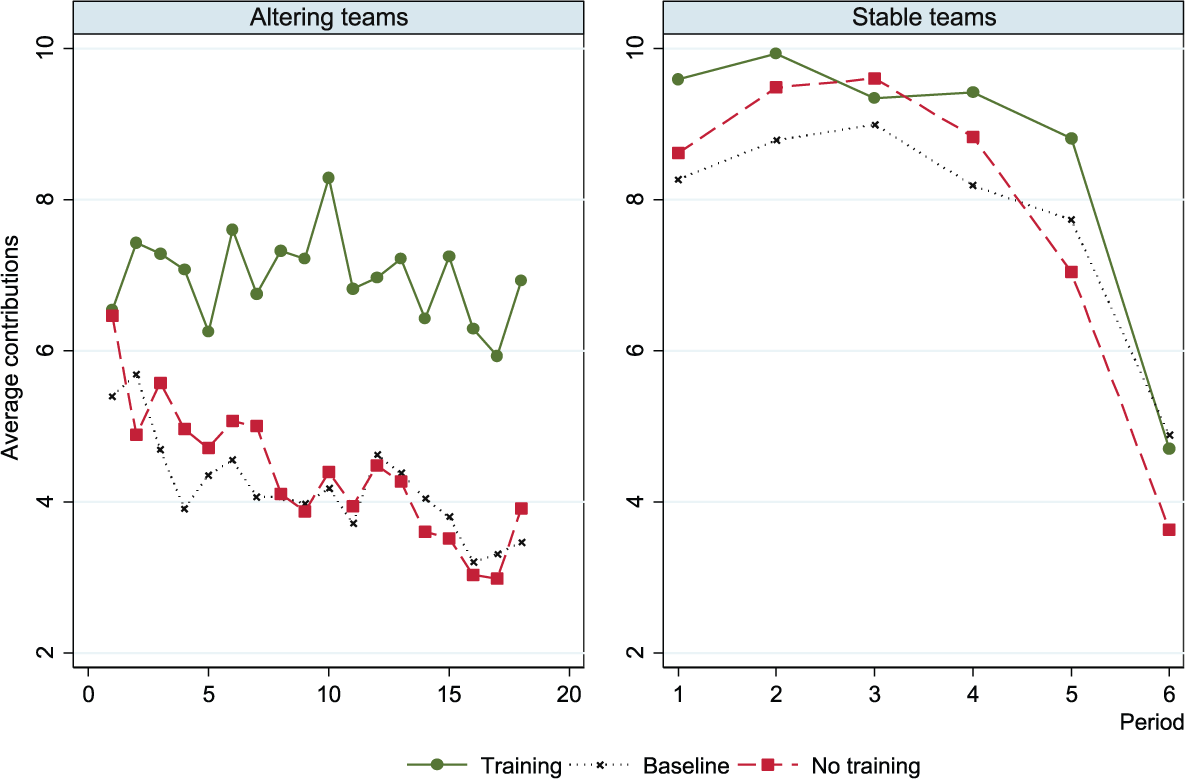
Average contributions for subjects receiving training and subjects not receiving training, by team stability.
Multivariate results
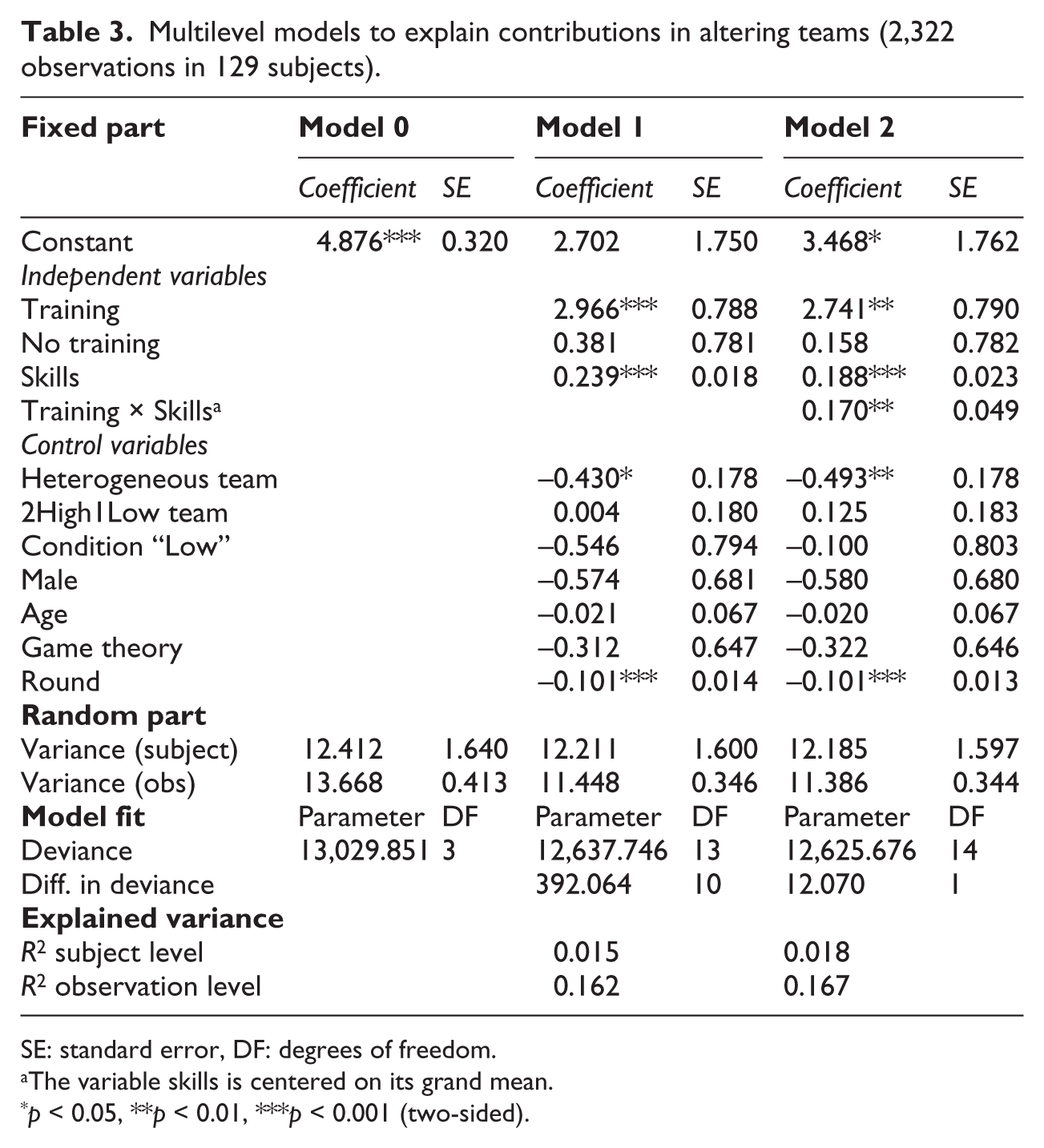
Table 3 presents the multilevel models estimated to explain cooperative behavior in altering teams. Model 0 presents the empty model including only the dependent variable and its variance components. Results show that approximately half of the variance is represented at the subject level (47%) and half of the variance is represented at the observation level (52%). This implies that the variance resides both within and between subjects. In Model 1, we add the independent and the control variables to our model. Results show that subjects who receive training contribute on average approximately three points more to the team effort than subjects who do not receive training. Therefore, we can confirm Hypothesis 1 for subjects in altering teams: there is a positive effect of training on cooperative behavior. Furthermore, subjects not receiving training in a training condition do not differ significantly in their contributions from subjects in the baseline condition (b = 0.381, p = 0.625). In Model 1, we see a significant effect of skills on contributions to the team effort. Subjects increase their contributions on average by approximately 0.2 points for each point increase in skills. Therefore, we can also confirm Hypothesis 2 for altering teams: there is a positive relation between skills and cooperative behavior.
Multilevel models to explain contributions in altering teams (2,322 observations in 129 subjects).
SE: standard error, DF: degrees of freedom.
The variable skills is centered on its grand mean.
p < 0.05, **p < 0.01, ***p < 0.001 (two-sided).
There are two control variables that significantly influence subjects’ contributions in altering teams: subjects embedded in heterogeneous teams contribute on average approximately 0.5 points less to the team effort than subjects embedded in homogeneous teams. However, the distribution of the skills within the heterogeneous teams does not significantly influence subjects’ contributions (b = 0.004, p = 0.980). The number of rounds does. With every round, subjects contribute on average 0.1 points less to the team effort. Subjects’ gender (b = −0.574, p = 0.339), age (b = −0.021, p = 0.757), and experience with game theory (b = −0.312, p = 0.629) do not significantly influence their contributions to the team effort.
In Model 2, we add the interaction between training and skills to the model. Results show that the positive effect of training increases with approximately 0.2 points per extra point of skills subjects can contribute to the team effort. Therefore, we can also confirm Hypothesis 3 for the altering teams that the effect of training on contributions is stronger for subjects with more skills.
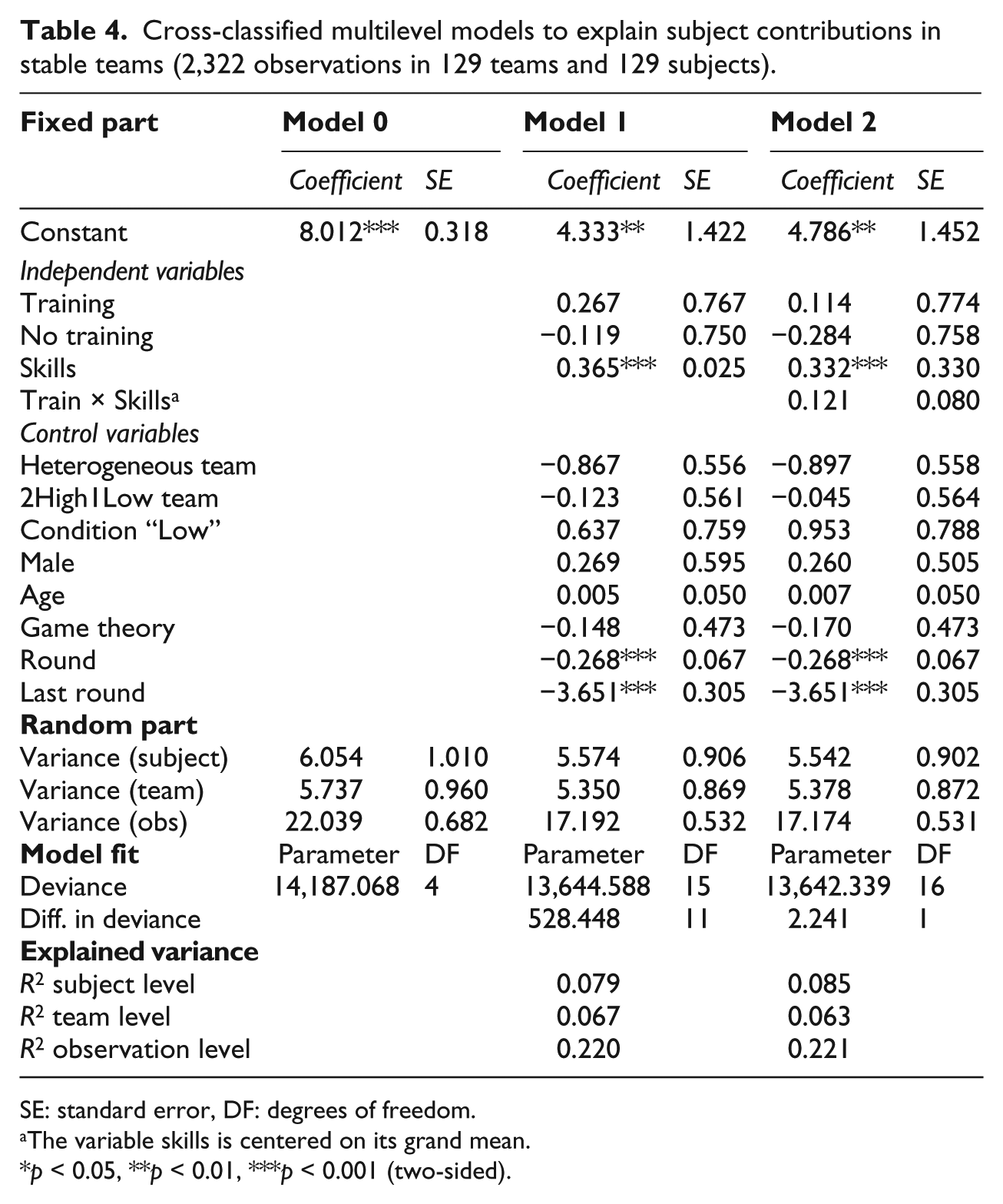
Table 4 presents the results for the stable teams. Model 0 presents the empty model including only the dependent variable and its variance components. Results show that approximately two-thirds of the variance resides at the observation level (65%). The remaining one-third is divided between the subject (18%) and team level (17%). This implies that most of the variance lies within subjects, while the remaining variance lies between persons and teams. In Model 1, we add the independent and control variables to our model. In contrast to the results for the altering teams, the results do not show a significant effect of training on contributions to the team effort. Subjects who receive training do not contribute significantly more to the team effort than the subjects in the baseline condition where training does not exist (b = 0.267, p = 0.728). In addition, there is no significant difference between the subjects not receiving training in a training condition and subjects in the baseline condition (b = −0.119, p = 0.874). Thus, we cannot confirm Hypothesis 1 for stable teams. An effect for skills is also found for the stable teams. Results show a positive relation between skills and contributions to the team effort. Subjects contribute on average approximately 0.4 points more to the team effort for each additional point of skills they are able to contribute. This confirms Hypothesis 2 for stable teams: there is positive effect of training on cooperative behavior.
Cross-classified multilevel models to explain subject contributions in stable teams (2,322 observations in 129 teams and 129 subjects).
SE: standard error, DF: degrees of freedom.
The variable skills is centered on its grand mean.
p < 0.05, **p < 0.01, ***p < 0.001 (two-sided).
In contrast to the results for the altering teams, subjects embedded in heterogeneous teams do not contribute significantly less to the team effort than subjects embedded in homogeneous teams (b = −0.867, p = 0.119). The distribution of skills does not influence cooperative behavior either (b = −0.123, p = 0.827). Furthermore, subjects’ gender (b = 0.269, p = 0.595), age (b = 0.005, p = 0.918), and experience with game theory (b =−0.148, p = 0.755) do not significantly influence their contributions to the team effort. Finally, Model 1 shows evidence for the well-known end-game effect: with every round, subjects decrease their contribution by on average approximately 0.3 point. In the last round, subjects contribute on average approximately 4 points less than in the previous rounds.
In Model 2, we add the interaction terms to our model. Results do not indicate that the effect of training is stronger for the higher skilled subjects (b = 0.121, p = 0.134). Therefore, we cannot confirm Hypothesis 3 for stable teams. To test the hypothesis on the difference in the effect of training between stable and altering team stability, we performed a Wald-test comparing the regression coefficients for the effects of training in Models 1 of Tables 4.1 and 4.2 (Paternoster et al., 1998). Results show a significant difference between the coefficients (z = 3.260, p = 0.001), indicating that the positive effect of training on cooperation is stronger in altering teams than in stable teams. This confirms Hypothesis 4.
Do teams perform better with investments in training?
So far, we have not addressed the question of whether investments in training promote the overall performance of the team. In other words, is there a positive relation between investments in training and aggregate cooperative behavior? Because we find that subjects receiving training contribute more in altering teams, and we do not have indication that subjects who do not receive training contribute less (although this might have been possible, because they have a lower productivity factor than subjects in the baseline condition and might feel neglected by not receiving training), we expect that teams in which someone is trained perform better than teams in the baseline condition and if the higher skilled employee receives training this should work even better. Still, we want to confirm this pattern at the team level looking at the total contributions to the team effort made within a team. Figure 2 depicts the average total contributions to the team effort by condition and team composition.
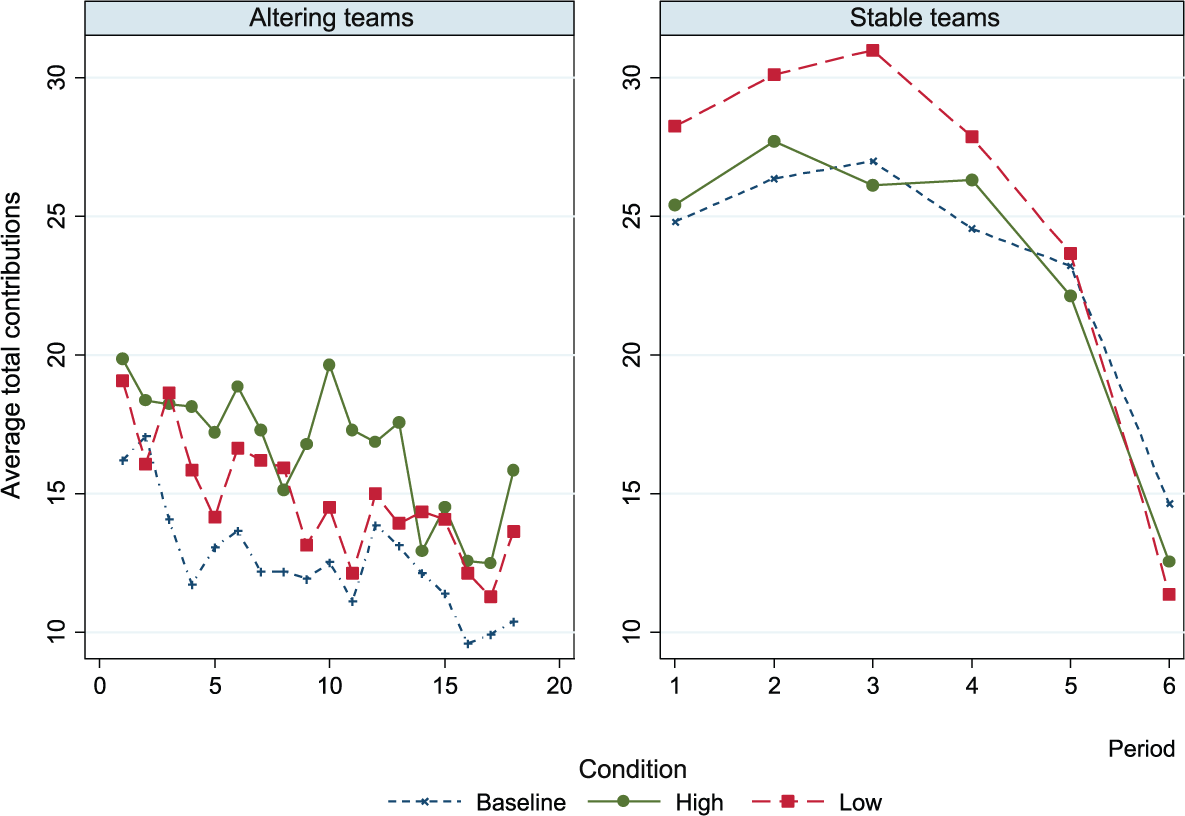
Average total contributions to the team effort by condition and team composition.
Figure 2 illustrates that for the altering teams, investments in training benefit group-level cooperative behavior. The lines representing the average total contributions to the team effort in the condition “High” and in the condition “Low” lie above the line representing the subjects in the baseline condition. Furthermore, Figure 2 illustrates that group-level contributions are almost always higher in the condition when the higher skilled subjects receive training than in the condition where the lower skilled subjects receive training. More specifically, when a higher skilled subject receives training, average contributions increase with three points and when a lower skilled subject receives training with two points, in contrast to the baseline condition. The differences are statistically significant and imply that training benefits aggregate contributions to the team effort in altering teams and that this effect is the strongest when training is provided to the higher skilled subjects.
Similar to the results at the individual level, the effects of training in stable teams are also not significant at the team level. Average contributions to the team account are almost always higher in teams in which a lower skilled subject receives training, compared to teams in which a higher skilled subject receives training or teams in which nobody receives training. The lines representing the conditions “High” and “Baseline” are highly similar. This suggests that contributions in stable teams benefit from training when it is provided to the lower skilled subject. However, these differences are small and not statistically significant. Finally, we see that the total contributions in the altering teams are lower than the total contributions in the stable teams (results from regression analyses can be found in the Supplementary Material).
Conclusion and discussion
This study addressed the question of whether investments in training can increase employees’ cooperative behavior. Using a contextualized laboratory experiment in which contributions to a team effort are seen as an indicator for cooperative behavior, we have combined theoretical perspectives typically used in the organizational literature and experimental literature. Our findings therefore contribute to both strands of literature.
In line with social exchange theory and previous research (Blau, 1964; Kampkötter and Marggraf, 2015; Lambooij et al., 2007), we found that training increases cooperative behavior in teams that collaborate incidentally. Subjects that received training contributed more to the team effort in these teams than their team members who did not receive training. Training increased cooperation the most when provided to the higher skilled subjects. In contrast, we did not find an effect of training on contribution in stable teams. This illustrates that the returns of investments in training strongly differ depending on who receives training and the stability of team. Results showed that in case of inequality between subjects in terms of resources, the higher skilled subjects contributed more than the lower skilled subjects. This is in line with Blau’s (1964) idea that employees form exchange relationships among themselves based on a sense of social obligation and other-regarding preference models such as Fehr and Schmidt’s (1999) inequality aversion model and Becker’s (1974) altruism model. Our finding that subjects behaved more cooperatively when working with the same team members for longer periods of time underlines Coleman’s (1988, 1990) notion that groups of employees can create a social identity that enables them to behave cooperatively. Our findings illustrate that training can thus motivate subjects to behave cooperatively in teams where cooperative norms are absent. Although we have to be careful in generalizing the results, for employers the findings of this study imply that there might be two ways in which they can motivate employees to behave cooperatively. First, by investing in team cohesion and ensuring that employees work with the same coworkers for longer periods of time. And, second, by giving employees a gift, such as training, triggering them to reciprocate and increase their cooperative behavior especially in situations in which behaving cooperatively is less self-evident. For example, in teams that only collaborate incidentally.
By adopting an experimental approach to study the relation between training and employees’ cooperative behavior, we contributed to the experimental literature on cooperation in Public Good Games. Our conclusion that training increases cooperative behavior in altering teams is in line with previous research studying whether contributions to a public good can be increased by appealing to actors’ reciprocity norms (Balliet and Van Lange, 2013; Charness, 2004; Falk and Fischbacher, 2006; Fehr and Fischbacher, 2002). A unique aspect of our finding is also that by giving the training we succeed in keeping one person in a specific role in the team rather cooperative over time even while others in the team decrease their contributions over time.
Our finding that aggregate contributions to the public good did not differ between homogeneous and heterogeneous teams in terms of endowments adds to the ongoing discussion in the literature regarding the effect of endowment heterogeneity on contributions to the public good. Contrasting results from previous research underline how little we know about contribution decisions in groups where actors have heterogeneous endowments. For example, research by Chan et al. (1999) concludes that endowment heterogeneity promotes contributions to the public good, whereas Cherry et al. (2005) and Fung and Au (2014) find detrimental effects of endowment heterogeneity on contributions to the public good. However, we must also note that these studies differ in how the endowments are distributed within the groups and in the degree of heterogeneity among the group members, making it hard to draw one conclusion. Our finding that aggregate contributions did not differ significantly between homogeneous and heterogeneous teams might be the result of keeping the total number of skills in the team constant across the teams. Given that many real-life situations modeled by Public Good dilemmas are aimed at studying actors who are heterogeneous along one or more dimensions, future research should focus on understanding the dynamics of cooperation within such groups.
Although the use of laboratory experiments to test the relation between two constructs has several advantages over using cross-sectional data designs, the extent to which the results from the laboratory are informative about behavior in the field can still be debated (Levitt and List, 2016). By contextualizing the experiment, this article has taken a step forward in addressing such validity concerns. Contextualizing the experiment might provide subjects heuristics guiding behavior that are often missing in abstract experiments and comprise the generalizability of the findings to other settings and samples. As such, contextualizing the experiment to take place in the setting to which we would like to generalize the results helps improving the ecological validity of the findings. Allowing for heterogeneity in terms of skills and productivity between actors also serves this cause as these aspects resemble the real-life decision situation more closely than traditional Public Good Games. At the same time, we hope that placing subjects in a decision situation highly similar to the real-life world helps improving the external validity of the results, because it is easier for subjects to imagine themselves in that situation. However, by contextualizing the experiment we face the risk that subjects interpreted the decision situation differently than they would have had in abstract Public Good Games. Given that the findings of this study align with previous research in abstract games, we do not think this to be a major issue for our experiment. Future research including a control group participating in an uncontextualized experiment could be informative regarding this question.
An important difference between our study and the population that we study lies in the use of students as subjects (Harrison and List, 2004). Our student subject pool is highly homogeneous regarding socio-demographic characteristics and therefore not representative of the employee population. It is important to acknowledge this difference and ideally this study should be replicated using an employee sample. However, according to Harrison and List (2004, 2008), the use of students as subjects does not necessarily have to result in an inadequate test of the theory. The theories can still be adequately tested when scholars can be to some extent certain that the behavioral response of students is the same as the behavioral response of employees. Future research could, for example, investigate the same research question by means of a contextualized laboratory experiment with employees, a vignette experiment among an employee sample, and using survey data responses from employees. By comparing the results from these different studies, researchers gain insights as to whether students and employees behave in a similar manner and increase the external validity of the results. Although there are several studies that have attempted to compare results from laboratory experiments with field experiments (Stoop et al., 2012) or with naturally occurring Public Good situations (Benz and Meier, 2008; Laury and Taylor, 2008), results of these studies are mixed underlining the importance of future research in this direction.
There are a number of simplifications we made keeping our experiment concise that might influence the generalizability of the results. First of all, we did not elaborate on the nature of the training. Becker (1962) distinguishes general training from firm-specific training. Whereas employees acquire skills and knowledge that are only useful for their current job in firm-specific training, general training increases the skills and knowledge of employees that are also relevant for jobs in other organizations (Loewenstein and Spletzer, 1999). Providing general training is thus riskier for the employer and as a result employees will perceive receiving general training as a more valuable gift than receiving firm-specific training. Research has shown that employees receiving general training behave more cooperatively than employees receiving firm-specific training (Benson, 2006). Given that we imposed that training resulted in an increase in productivity rather than in an increase in skills, we could argue that the type of training that we study is more similar to firm-specific training than to general training. Another difference between our experiment and actual teams of employees lies in the size of the team. Teams in our experiment consisted of three employees, while teams in organizations are often a lot larger. Although we do not believe that these simplifications have influenced our results to a great extent, future research incorporating different types of training in larger groups could inform the generalizability of our results.
Supplementary Material
Supplementary Material, Supplementary_material_771428 – Individual training and employees’ cooperative behavior: Evidence from a contextualized laboratory experiment
Supplementary Material, Supplementary_material_771428 for Individual training and employees’ cooperative behavior: Evidence from a contextualized laboratory experiment by Nikki van Gerwen, Vincent Buskens and Tanja van der Lippe in Rationality and Society
Footnotes
Funding
The author(s) disclosed receipt of the following financial support for the research, authorship, and/or publication of this article: The research leading to these results has received funding from the European Research Council under the European Union’s Seventh Framework Programme (FP/2007-2013) / ERC Grant Agreement n. 340045.
Notes
References
Supplementary Material
Please find the following supplemental material available below.
For Open Access articles published under a Creative Commons License, all supplemental material carries the same license as the article it is associated with.
For non-Open Access articles published, all supplemental material carries a non-exclusive license, and permission requests for re-use of supplemental material or any part of supplemental material shall be sent directly to the copyright owner as specified in the copyright notice associated with the article.
