




Abstract
Conflict in wage bargaining is affected by information about other bargaining units and information about the past of the bargaining unit. We develop a theoretical framework for such spillovers and detail four distinct mechanisms. Rational learning and social comparisons are reviewed as mechanisms for the influence of information about other bargaining units, and reputation and expectation effects are reviewed as mechanisms for the influence of information about the past of the bargaining unit. Building upon a previous experimental study, we implement an unstructured, time-limited, two-person bargaining game with asymmetric information and investigate the impact of reputation and expectation effects. The experimental treatments vary with respect to spillover-inducing information available to the participants. The results suggest that reputation effects decrease conflict, whereas expectation effects tend to increase conflict. Moreover, reputation effects diminish the influence of social comparisons but can augment the effects of rational learning.
Introduction
In recent decades, mounting empirical evidence has emerged for patterns of influence between negotiations in different bargaining units (e.g. Babcock et al., 1996, 2005; Kuhn and Gu, 1999; Lehr et al., 2015a) and between past and present negotiations within the same bargaining unit (e.g. Campolieti et al., 2005; Lehr et al., 2015a, 2015b; Mauro, 1982; McConnell, 1989; Schnell and Gramm, 1987; cf. Blinder and Choi, 1990; Agell and Lundborg, 1995, 2003; Bewley, 1999). We refer to patterns of influence between negotiations as “spillovers.” If spillovers occur between different bargaining units, we refer to them as “horizontal spillovers.” If spillovers occur between past and present negotiations within the same bargaining unit, we refer to them as “vertical spillovers.” This article studies the impact of these spillovers on conflict as indicated by the divergence between union demands and firm offers in wage bargaining.
Various theoretical mechanisms have been proposed as explanations for either type of spillover. These theoretical mechanisms are based on differing assumptions and yield strikingly contradictory predictions about the impact of spillovers on conflict in wage bargaining. Moreover, the different spillover mechanisms have predominantly been studied separately without taking into account their joint impact and potential interactions. What is lacking is (1) a coherent framework within which to study the horizontal and vertical spillovers resulting from different mechanisms and (2) adequate knowledge of the impact of spillovers resulting from different and possibly simultaneously operating mechanisms on conflict. This knowledge gap is aggravated by empirical difficulties in adequately identifying spillovers using traditional econometric data related to the inherently ambiguous choice of appropriate reference negotiations to investigate and the high potential for spurious correlations (see Heckman, 1991; Manski, 1993; Mitchell, 1982)
In this study, we present a theoretical framework for studying horizontal and vertical spillovers, each resulting from different mechanisms. Building on a previous study of horizontal spillovers (Lehr et al., 2016) taken in isolation, we then study the impact of vertical spillovers on conflict in an environment that also allows for horizontal spillovers using a bargaining experiment. Two causal mechanisms for vertical spillovers are investigated: reputation effects and expectation effects. We thus address the following research question: how do vertical spillovers resulting from reputation effects and expectation effects influence conflict in wage bargaining?
The experimental method allows for complete control over the information available to the negotiators and therefore offers three important benefits: (1) the choice of investigated reference negotiations becomes unambiguous, (2) spurious correlations are prevented, and (3) the ability to manipulate the information available to the negotiators enables us to identify different mechanisms as causes of spillover.
We implement a two-person (union and firm negotiator) unstructured bargaining game with asymmetric information using a 2 × 2 treatment design and a control condition. The treatment conditions provide subjects with information about the negotiations of others. One treatment condition varies whether the firm negotiator in the other negotiation has an unknown ability to pay or the other firm negotiator has an identical ability to pay. The other treatment varies whether subjects receive information about the firm negotiator’s relative earnings in the previous negotiation. We analyze the impact of the resulting horizontal and vertical spillovers on the level of conflict between the union and firm negotiators as indicated by the divergence between their proposals during the bargaining process.
In general, our findings suggest that reputation effects decrease conflict, whereas expectation effects increase conflict. Moreover, interactions exist between horizontal and vertical spillovers in their impact on conflict. More specifically, the presence of information to the union about the relative earnings of the firm in previous negotiations creates fairness reputations for firms that can decrease conflict, whereby firms that accept lower shares face less conflict. Such reputations also suppress the escalating impacts that may result from horizontal spillovers (caused by social comparisons), but reinforce horizontal spillovers that do not have an escalating impact (caused by rational learning). The findings also suggest that unions’ prior earning can create expectation effects which lead to increased conflict. Given that previous studies of spillovers have exclusively analyzed specific mechanisms for spillovers in isolation, our findings highlight the importance of understanding the joint impact of different mechanisms for vertical and horizontal spillovers.
Theoretical framework
Basic assumptions
We assume that wage bargaining can be modeled as the division of an economic surplus (Abowd, 1987), the value of which is known to the firm but not to the union. This information asymmetry entails that only a firm knows about its own state, that is, how much is “on the table” in the negotiation. There is abundant empirical evidence that this fundamental information asymmetry in wage bargaining is one of the chief causes of conflict (Card, 1990; Cramton and Tracy, 2003; Hayes, 1984; Kennan and Wilson, 1989; McConnell, 1989).
Second, we assume that in addition to uncertainty about the state of the firm, wage bargaining is characterized by negotiators’ uncertainty about the type of their opponent, who may be “greedy” or “fair.” Thus, wage bargaining takes place in a context of “state uncertainty” and “type uncertainty” due to private information about these aspects.
Behavioral assumptions
Theoretical mechanisms for spillovers rely on one of two possible assumptions. The first assumption would be that negotiators will use information that allows them to reduce each of these uncertainties. This entails that spillovers can result from a process of uncertainty reduction about private information aspects through the use of information about other negotiations. The second assumption would be that negotiators’ preferences are reference-dependent (see Kahneman and Tversky, 1979). Consequently, comparisons to reference points affect negotiators’ preferred outcomes. This entails that spillovers can result from negotiators’ reference-dependent preferences, which are affected by information about other negotiations.
Uncertainty reduction about private information: rational learning and reputation effects
The assumption that spillovers take place because negotiators use information about other negotiations to reduce uncertainty about private information is the basis for two mechanisms: (1) rational learning, which causes horizontal spillovers; and (2) reputation effects, which cause vertical spillovers (see Table 1).
Four mechanisms of spillover.
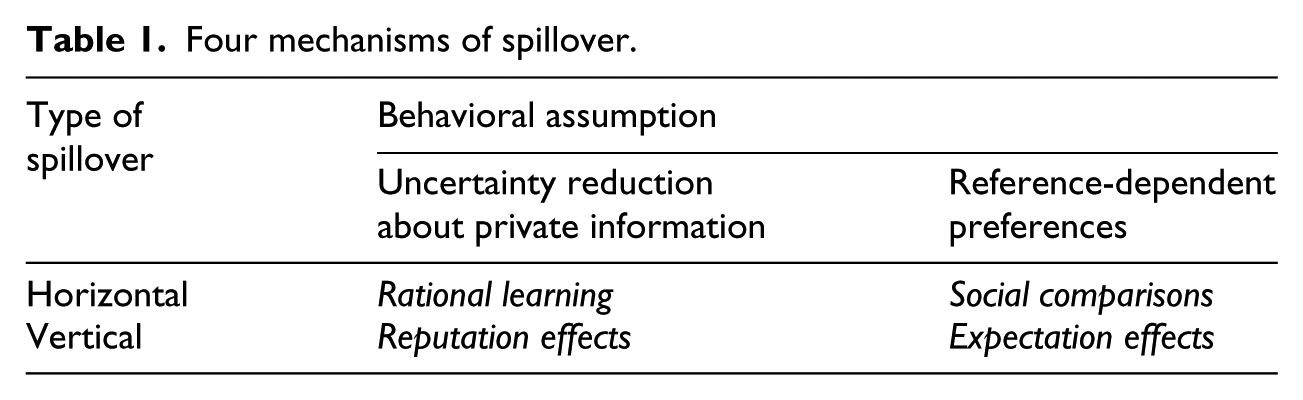
Horizontal spillovers due to rational learning occur when the ability of different firms to pay wages is positively correlated, such as when these firms operate in the same sector and therefore face identical product market conditions or technological shocks. When such a correlation is present, unions can reduce their uncertainty about the state of the firm they are bargaining with by observing negotiations in similar firms (Burgess, 1988; Kuhn and Gu, 1999). Unions then base their demands on the observed settlements (or strikes) in other bargaining units. Note that in this case, unions are only affected by information about other bargaining units because this allows them to reduce their uncertainty about the firm’s ability to pay; that is, the use of this information is strictly rational. This mechanism for horizontal spillovers may consequently be referred to as “rational learning.” Because the initial information asymmetry between the union and the firm about the firm’s ability to pay is an important cause of conflict, the rational learning mechanism leads to the prediction that horizontal spillovers reduce the level of conflict in bargaining.
Vertical spillovers due to reputation effects occur when negotiators have information about the past behavior of the opposing negotiator. Under the assumption that behavioral types are stable, this information allows negotiators to reduce their uncertainty about the behavioral type of the opposing negotiator, which is strictly rational in this sense. The effect of information about these stable behavioral patterns, or reputations (Abreu and Gul, 2000; Kreps and Wilson, 1982; Roth and Schoumaker, 1983), on other negotiators’ bargaining behavior thus constitutes a mechanism for vertical spillovers. Reputation effects become especially important when there exists some information asymmetry between actors that interact repeatedly (Milgrom and Roberts, 1982). These conditions are clearly present in wage bargaining, which occurs at regular intervals for any bargaining unit and in which firms know their behavioral type and their ability to pay, whereas unions are uncertain about these aspects of the negotiation. Conversely, firms are uncertain about the behavioral type of the union; hence, both sides of the bargaining table may build reputations. However, it is particularly the firm’s reputation that is of interest. The firm’s reputation not only conveys information about its behavioral type to the union but indirectly also conveys information about the firm’s state, namely, its ability to pay. Thus, “type uncertainty” is not independent from “state uncertainty” here. Although a firm’s offers may reveal its state to the union, the credibility that unions assign to these offers will depend on the type of firm it believes it is negotiating with based on the firm’s reputation.
We argue that the reputation mechanism offers a way of reducing the level of conflict in bargaining. In principle, firms can abuse their informational advantage by convincing unions to accept relatively low wages even when the firm’s ability to pay is actually high. However, at some time after the wage agreement is signed, the firm’s true ability to pay will be revealed, such as through accounting information in financial statements. Unions are then able to ascertain the fairness of past wage offers. The firm would consequently enter future negotiations with a reputation for greediness, and the union would no longer interpret the firm’s wage offers as an accurate representation of its ability to pay. However, when firms make wage offers or accept wage demands that represent a fair share of common economic surplus, they create a reputation that credibly signals their fairness to the unions. This reputation ensures that the unions will continue to take firms’ wage offers in future negotiations as reflections of the firms’ ability to pay and mitigate their demands or lowest acceptable offers in response to the firms’ bargaining behavior. Especially when economic circumstances adversely affect firms’ ability to pay, their reputations may help convince unions to accept a low offer or to lower their demands. The unions then interpret the firms’ offers as a credible signal of a low ability to pay rather than posturing. In the organizational literature, it is particularly well recognized that firms can benefit from investing in positive reputations (Lange et al., 2011), including reputations for being good employers (e.g. Turban and Cable, 2003). Indeed, a qualitative analysis of wage setting in the United States (Bewley, 1999) suggests that reputations that inspire trust in management among unions and employees are highly beneficial for firms seeking to peacefully restrain wage increases or even cut wages when they face economic adversity.
Reference-dependent preferences: social comparisons and expectation effects
The assumption that spillovers take place because negotiators’ preferences are reference-dependent is also the basis for two mechanisms: (1) social comparisons, which cause horizontal spillovers; and (2) expectation effects, which cause vertical spillovers (see Table 1).
Horizontal spillovers due to social comparisons occur when individuals compare themselves to relevant others (see Festinger, 1954). In the wage bargaining context, such comparisons entail that the wage rate in one firm influences what workers in another firm consider acceptable wages (Babcock et al., 2005; Bewley, 1999; Rees, 1993). Thus, bargaining outcomes in other firms become reference points (see Kahneman and Tversky, 1979) for the workers. Because union negotiators represent the interests of these workers, the result is that the union negotiators’ preferences in bargaining will be affected by information about bargaining outcomes in other firms.
Firm negotiators are less susceptible to making comparisons due to their superior information about their own ability to pay (see also Lehr et al., 2016). However, there is no a priori reason to believe that the firm negotiators are immune to making comparisons. However, union and firm negotiators are likely to take different negotiations as salient reference points. Although the union will perceive relatively high wages achieved elsewhere as more attractive reference points, the firm negotiator will prefer to be guided by relatively low wages elsewhere. This “self-serving bias” in the evaluation of reference points (Babcock et al., 1995; Babcock and Loewenstein, 1997) will increase the divergence between the union negotiators’ preferences and the firm negotiators’ preferences and hence the level of conflict in bargaining.
Vertical spillovers due to expectation effects occur when individuals compare their potential future outcomes to their past outcomes. In the wage bargaining context, past wage agreements become reference points against which workers and negotiators evaluate potential future wages. In this way, information about past negotiations and their outcomes leads to expectation effects.
As with social comparisons, there is no a priori reason to believe that firm negotiators are immune to expectations, but their knowledge of their own ability to pay limits the impact of such expectations. As with social comparisons, it is also important to recognize that the way negotiators evaluate past wages as reference points is guided by bias. The guiding bias in this case is loss aversion (Tversky and Kahneman, 1991), or the predisposition of human beings to avoid outcomes that entail a loss when compared to another situation deemed relevant. The importance of expectation effects is highlighted by empirical research. Wages are found to be history-dependent (Card, 1990); past wages are an important determinant of future wages. Extensive qualitative research (Bewley, 1999) indicates that workers have strong preferences to retain at least their previous wage level under a new contract. Previous wage levels thus become workers’ initial minimum acceptable new wage levels, and this is echoed by the union negotiators. These expectation effects lead to increasing levels of conflict in bargaining when firms are not able to meet expected wages due to economic setbacks.
The model
We model wage bargaining as a two-person unstructured bargaining game with asymmetric information. The common surplus to be divided has a value that is randomly drawn for each negotiation from a uniformly distributed set of possible values (see Lehr et al., 2016). Firm players know the exact value of the common surplus; union players only know the set of possible values and that each value has equal probability of being realized. Bargaining starts with a proposal by the union player, analogous to trade unions’ initial wage demands in wage bargaining. The bargaining process is time-limited, and bargaining time is common knowledge. At any moment within the allotted bargaining time, both players are free to wait, make (an unrestricted number of) proposals, or accept the other player’s most recent proposal. Proposals are bound between zero and the highest potential surplus value, and they represent the union players’ earnings if accepted (i.e. the “wage rate”). The firm players’ earnings are defined as the common surplus minus the accepted proposal (i.e. the residual profit after the cost of labor is deducted). Bargaining ends if a proposal is accepted or if the allotted bargaining time expires. If no proposal is accepted before the deadline, the two players earn the non-agreement payoff of zero points. The value of the non-agreement payoffs is common knowledge.
The bargaining model captures wage bargaining as an interactive process of decision making with a time-increasing risk of suffering the cost of not reaching an agreement. This reflects that in wage bargaining, both sides of the bargaining table have incentives to aim for the highest possible outcome for themselves but evaluate this outcome against the cost of potential conflict (such as strikes, lockouts, or the termination of the bargaining unit).
Experimental design
We implement a repeated bargaining game over the division of a common surplus that is defined as 24 points plus a number of additional points. The number of additional points can be any even number between −12 and 12 with equal probability and is randomly selected from the set of possible values in each period. The common surplus could consequently be as low as 12 points or as high as 36 points in any given period. The union player only knows that the total surplus will be 24 points plus the variable surplus. The firm player knows the number of additional points and therefore the actual value of the common surplus.
Each pair of players bargains by making proposals that represent the number of points that, if accepted, the union player will receive. Negotiations start with an opening proposal by the union player, after which both players are free to either make any number of proposals in the 0–36 range or accept the other player’s most recent proposal. Bargaining time is limited to 60 seconds. During bargaining, the history of proposals can be seen by both players. When a proposal is accepted, the union player earns the number of points represented by that proposal, whereas the firm player earns 24 points plus the additional number of points minus the proposal. After each completed negotiation, the players are privately informed about their own payoffs. There is no communication between the players other than through the proposals that they make.
The bargaining game is repeated for 15 periods. One set of 15 values for the additional points is randomly drawn before the first experimental session and subsequently used for all bargaining units in all sessions. The participants are randomly matched to a different opponent in each period.
We implement 2 × 2 experimental treatment conditions and a control condition. In the CONTROL condition, which was administered in the first session, the bargaining game is executed as described above. In the treatment conditions, which were administered in the subsequent sessions, the identical bargaining protocol is implemented but with additional information for the players. This additional information is used to induce horizontal and vertical spillovers. The complete experimental instructions and bargaining screens are reported in Appendix 1. An overview of the conditions is provided in Table 2.
Overview of treatments.
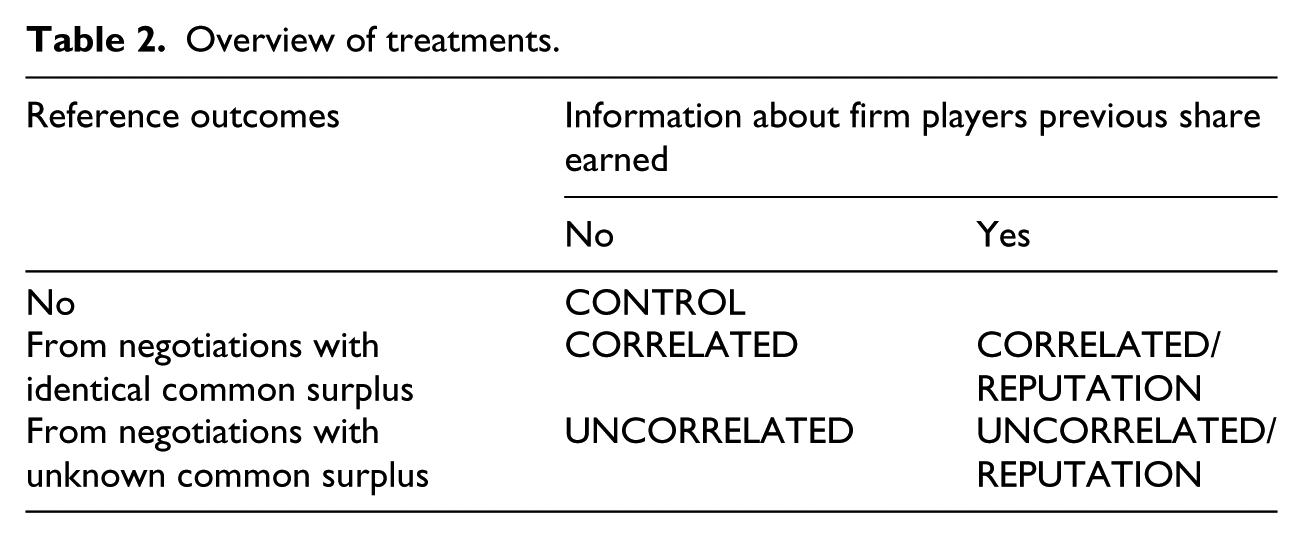
We induce horizontal spillovers that do not allow for rational learning in the UNCORRELATED treatment condition. We induce horizontal spillovers that allow for both rational learning and social comparisons in the CORRELATED treatment condition. In both treatment conditions, we provide the two players with information about a negotiation outcome of one other pair, which we refer to as the “reference outcome.” Both players receive the same reference outcome. This reference outcome informs players about the accepted proposal in one other negotiation (i.e. the number of points earned by the union player) or that there was no agreement if there was no proposal accepted in the other negotiation. The participants are truthfully informed that the reference outcomes are actually observed outcomes under the same bargaining protocol. 1 The reference outcome appears on the screen below a statement reading “Information about negotiation outcome of one other pair” and is visible throughout the bargaining process.
For the UNCORRELATED treatment condition, the reference outcome is taken from a negotiation in which the number of additional points was unknown to the negotiators receiving the reference outcome. The players received a statement below the reference outcome saying, “The number of additional points in this other pair was one of the numbers {-12,-10,-8,-6,-4,-2,0,2,4,6,8,10,12}, all equally likely.” In this treatment condition, the players cannot rationally improve their knowledge about the size of the common surplus with the aid of the reference outcomes. Horizontal spillovers are consequently assumed to be attributable to social comparisons exclusively in this treatment.
For the CORRELATED treatment condition, the reference outcome comes from a negotiation with an identical number of additional points. We inform the participants about this via a statement above the reference outcome that says, “The number of additional points in this other pair was EXACTLY THE SAME as it is now in your pair.” Because firm states are correlated in this treatment and the players are aware of this, the reference outcomes can inform about the size of the common surplus and thus enable rational learning.
In each treatment session, half of the players are randomly assigned to the UNCORRELATED treatment condition and the other half to the CORRELATED treatment condition. In both treatments, two randomly selected bargaining pairs in each period receive a non-agreement as a reference outcome, indicated by the statement, “There was DISAGREEMENT.” The remaining pairs receive information about an agreed outcome. To identify the impact of the value of the reference outcomes within each treatment, we systematically vary this value in both treatments by selecting the highest appropriate observed reference outcome for half of the pairs and the lowest appropriate observed reference outcome for the other half of the pairs.
Vertical spillover
Establishing the precise impact of expectations and reputations necessitates careful isolation of the impact of these mechanisms from confounding factors that would arise from repeated interactions between the same subjects, such as emotional dynamics. We therefore implement a random re-matching procedure after each period. In this way, the anonymously interacting subjects repeat the same bargaining game in every period but do not have a history with their opposing subject. This design departs from the stable bargaining units common in real-wage bargaining but offers a superior means to analyze the impact of information about previous bargaining periods on the behavior of individual subjects.
To incorporate the reputation mechanism, we provide the players with information about the firm player’s past behavior, specifically the percentage share of the common surplus the firm player earned in the previous period. If no proposal was accepted in the firm player’s previous negotiation, the information showed that there was disagreement. This information was provided in an otherwise identical replication of the UNCORRELATED and CORRELATED treatment conditions, yielding the UNCORRELATED/REPUTATION and CORRELATED/REPUTATION treatment conditions.
Expectation effects may occur in all five experimental conditions. This is because all union players bargain repeatedly (15 times in total), and thus the outcome of each negotiation may become a reference point against which subsequent outcomes are compared. It must be noted that the value of the additional number of points, and thus the value of the common surplus, is independently and randomly chosen for each period. Consequently, the union players cannot rationally improve their knowledge of the value of the common surplus with information about their outcomes in previous periods. If past outcomes have an influence on subsequent bargaining behavior, this would be attributed to the reference-dependent preferences of the players. 2
Summary of previous findings
This study builds upon the Lehr et al. (2016) study on the impact of horizontal spillovers on conflict that used data from the CONTROL, UNCORRELATED, and CORRELATED treatment conditions. We first summarize the findings of that study and then discuss the hypotheses about vertical spillovers we test with the current, more elaborate set-up.
In the previous study, we found that conflict is increased by horizontal spillovers resulting from social comparisons in the UNCORRELATED treatment condition compared to the CONTROL condition. In this condition, the more the reference outcomes deviate in either direction from the initial focal point (see Schelling, 1960) of 12 points, 3 the more union players raise their demands in this condition. This pattern reflects the impact of self-serving biases: union players take advantage of increasingly favorable reference outcomes, and try to prevent increasingly unfavorable reference outcomes from gaining salience in the negotiation by increasing their demands. This leads to a V-shaped relationship between reference outcomes and union proposals. Because firm players do not respond to the reference outcomes regardless of their value, this leads to increased divergence.
Furthermore, we found that conflict is lower in the CORRELATED treatment condition than in the UNCORRELATED treatment condition but not the CONTROL condition. In the UNCORRELATED treatment condition, horizontal spillover through the rational learning mechanisms is possible. This results in a linear relationship between reference outcomes and union demands, which now increase when the common surplus increases. However, the findings also suggested that, rather than decreasing conflict in its own right, making rational learning possible appears to prevent the conflicts that arise from horizontal spillovers driven by social comparisons and affected by self-serving biases.
Hypotheses
A particularly robust finding in the experimental literature analyzing structured games such as the ultimatum game is that subjects tend to deviate from the subgame-perfect equilibrium strategy (i.e. offer/accept the smallest possible amount) by settling on approximations of the equal split of the common surplus value (see Camerer and Thaler, 1995; Güth and Kocher, 2014; Güth and Tietz, 1990; Thaler, 1988). We assume that the tendency toward the equal split will also feature in our unstructured bargaining game. This tendency may be less prevalent when there is private information about the pie size (e.g. Croson, 1996; Rapoport et al., 1996; Straub and Murnighan, 1995), as is the case in our experiment. In contrast, the equal split tendency is reinforced when subjects’ fairness is visible to others because fairness is socially desirable (see Andreoni and Bernheim, 2009; Hoffman et al., 1994). Visible “fairness” is clearly a feature in our experiment under conditions in which firm players’ relative earnings in the previous period are known to the union player, namely, in the UNCORRELATED/REPUTATION and CORRELATED/REPUTATION treatment conditions. As we will show in the analyses of the data, the assumption that outcomes will tend to be equal splits of the pie is in fact strongly justified for all treatments by the observations in our experiment.
Reputation effects
The introduction of reputations by providing information about the firm players’ relative earnings in the previous period affects the level of conflict in bargaining. The assumption that accepted proposals will approximate the equal split implies that firm players’ visible reputations tend to show that they have agreed to proposals that reflect approximately half of the common surplus. In this way, they are signaling that they are fair and do not use their information about the common surplus to gain disproportionately large shares. This information allows the union players to reduce their uncertainty about the type of firm player they are bargaining with provided that they interpret the firm players’ fairness as stable over time. Firm players that are known to have been fair previously would be expected to be fair in the current negation and less likely to “hide” behind proposals that are far below the equal split of the current surplus. Union players are then more likely to consider the firm player’s offers to reflect the true state of the firm and more readily lower their proposals during the bargaining process. This reduces the divergence between the union and firm players’ proposals.
Further reasons to expect a reduction of conflict are related to the presence of horizontal spillovers. In the UNCORRELATED treatment condition, such horizontal spillovers are driven by social comparisons and increase conflict. The introduction of firm players’ reputations in the UNCORRELATED/REPUTATION treatment condition has two consequences. First, the relative salience of the reference outcomes that do not allow for any reduction of uncertainty is diminished by the availability of additional information in the form of reputation, which allows union players to reduce uncertainty about the type of firm player. Second, union players that believe that the opposing firm negotiator is fair are less likely to believe that firm players would abuse the presence of unfavorable (low) reference outcomes. Consequently, the union players are less likely to respond to such reference outcomes by raising their initial demands, which is a major source of increased divergence in the UNCORRELATED treatment condition. Hence, we expect that the introduction of information about firm players’ share earned in the previous period reduces conflict when reference outcomes are uncorrelated to the value of the common surplus:
Hypothesis 1. Divergence is lower in negotiations in the UNCORRELATED/REPUTATION treatment condition than in negotiations in the UNCORRELATED treatment condition.
In the CORRELATED treatment condition, horizontal spillovers can also result from rational learning and, as a result, do not increase conflict. Rational learning takes place because the value of the common surplus in the negotiation yielding the reference outcome is identical to the value of the common surplus in the players’ own negotiation. Union players may interpret the reference outcomes as equal splits of the common surplus, thus learning its value. Lower reference outcome values imply a lower value of the common surplus and should therefore lead to lower proposals by union players. However, unions cannot ascertain whether the reference outcome really reflects an equal split of the common surplus or whether the other union actually earned less than the equal split. Hence, some uncertainty about the value of the common surplus persists. Union players that lower their demands in response to low reference outcomes risk earning less than their “fair share” if the firm is willing to “hide behind” reference outcomes that are less than the equal split. When firm reputations are known, the union players are better informed about the firms’ willingness to be fair. Thus, whereas we expect horizontal spillovers due to social comparisons to diminish when firm players’ reputations are introduced, we expect horizontal spillovers due to rational learning to be augmented when firm players’ reputations are introduced. Therefore, union players’ proposals will be more closely conditioned on the reference outcome value in the CORRELATED/REPUTATION treatment condition than in the CORRELATED treatment condition, resulting in less divergence of proposals. Hence, we expect that the introduction of information about firm players’ share earned in the previous period reduces conflict when reference outcomes are correlated to the value of the common surplus:
Hypothesis 2. Divergence is lower in negotiations in the CORRELATED/REPUTATION treatment condition than in negotiations in the CORRELATED treatment condition.
So far, we have assumed that firms’ reputations tend to show that they have made or accepted proposals that approximate half of the common surplus in the previous period. However, there will be some variance associated with the accepted shares. Thus, the level of “fairness” of the firm players will vary. The higher the share, the greedier the firm players’ reputation in the next period is. Conversely, the lower the share, the more fair or benevolent 4 the firm players’ reputation in the next period is. We propose that firm players that are known to have agreed to higher shares of the common surplus for the union player previously will face less resistance in the form of high union proposals in the following period. Union players that believe that the firm is willing to offer them relatively large shares are expected to lower their own initial proposals and be more responsive to the initial (low) proposals of the firm. This decreases the divergence between the union players’ and firm players’ proposals. Hence, we expect that when the firm player’s share earned in the previous period is known to the union player, lower values for this share indicate fairer firms and, all else equal, are consequently associated with less conflict:
Hypothesis 3. In the CORRELATED/REPUTATION treatment condition and the UNCORRELATED/REPUTATION treatment condition, the lower the share earned by the firm player in the previous period is, the lower divergence is.
Expectation effects
In all experimental conditions, the players bargain for 15 consecutive periods and know their earning in previous periods. Under the assumption that the players are loss averse, expectations effects will occur even though the value of the common surplus varies randomly in each period. In this case, earnings in one period will become reference points in the next period. These expectation effects are particularly significant for union players, who, unlike firm players, cannot readjust their preferences to match the value of the common surplus in the current period because they do not know its value. Thus, we expect that higher earnings in one period will cause union players to make higher proposals in the next period and increase their minimum acceptable proposal. Hence, all else equal, we expect that the divergence between the union players’ and firm players’ proposals increases and that achieving convergence of the proposals will be more difficult, resulting in more conflict in bargaining:
Hypothesis 4. The higher the number of points earned by a union player, the more divergence he or she will experience during the following period.
Procedures
Our data collection took place in October 2012 in the Nijmegen School of Management (NSM) Decision Lab at the Radboud University Nijmegen, The Netherlands. We made use of z-Tree (Fischbacher, 2007) to program the experiment. In this study, 148 students participated in one of six experimental sessions. Each session consisted of 15 periods of interaction 5 and lasted approximately 1.5 hours, excluding the time needed to pay the participants.
All participants were randomly assigned to a cubicle when they entered the laboratory. The computer cubicles were associated with either the role of a firm (referred to as PLAYER A) or union player (referred to as PLAYER B) in the context-free experiment. In the treatment sessions, each computer cubicle was associated with either the UNCORRELATED (UNCORRELATED/REPUTATION) or CORRELATED (CORRELATED/REPUTATION) treatments.
All participants received written instructions for the experiment, which were read aloud by one of the experimenters at the beginning of the session. Following this, the participants were given the opportunity to ask questions for clarification. These questions were answered privately by the experimenters. After all questions were answered, the participants were asked to complete a questionnaire to ensure that all participants fully understood the rules and payoff structure of the bargaining game. These test questions were answered by all participants without difficulty. Prior to the 15 periods of interaction, two unpaid trial periods were used to ensure that all participants were fully acquainted with the procedure.
The participants were paid their earnings in cash immediately following the experiment. For each point earned by the participants during the experiment, they were paid 6 Euro cents. Average earnings in all experimental sessions combined, including the €3 show-up fee and payment for a short pen-and-paper experiment unrelated to the present study, were €14.00 (σ = 1.66).
Experimental evidence
We first analyze whether the assumption that accepted proposals will approximate the equal split of the common surplus is justified. Second, we present a graphic representation of the development of union and firm proposals during the allocated bargaining time to illustrate the nature of the bargaining process in the different treatments. We then proceed to test our hypotheses about conflict in bargaining. The unstructured bargaining design offers the important benefit of allowing the subjects to arrive at a bargaining outcome via a truly interactive decision-making process. This design more adequately reflects real-world bargaining situations than ultimatum bargaining, which is ubiquitous in experimental research. Importantly, the unstructured bargaining design reveals how the impact of spillovers on initial conflict is transformed by the process of interactive bargaining. This also entails that levels of conflict in the unstructured bargaining environment cannot simply be inferred from observed non-agreements (which would be referred to as “rejections” in the ultimatum game). Rather, the analysis of conflict in unstructured bargaining must take into account that the level of conflict will differ at different points in time during the 60-second bargaining process. The methods and specific estimated models are chosen in such a way that this process is accounted for.
Testing the equal split assumption
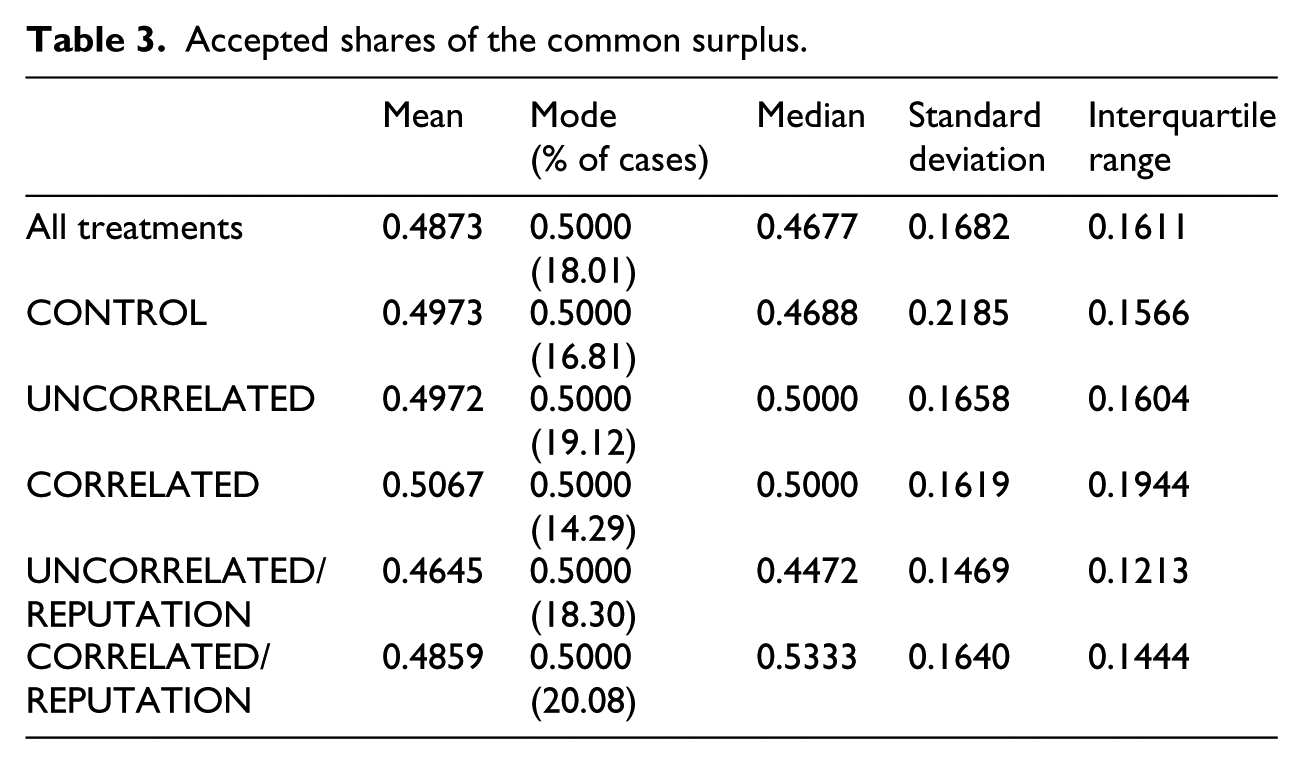
Table 3 provides descriptive statistics on the share of the common surplus represented by the accepted proposals for each experimental condition as well as for the pooled observations. These statistics strongly support the assumption that accepted shares approximate the equal split of the common surplus. We find that the modal accepted share is exactly 0.50 (50%) throughout. The mean and median shares also clearly show the equal split as the center of the distribution of accepted shares. Pooling all treatments, the interquartile range amounts to 16%, with similar distributions found in the five experimental conditions separately.
Accepted shares of the common surplus.
A related issue is our expectation that union players will assume that firm player types are stable, such that information about the share agreed to in the previous period by the firm player (i.e. its reputation) offers information about the firm player’s current willingness to settle on fair outcomes. To assess to what extent this assumption is justified, we graph the evolution of shares represented by the accepted proposals for each firm player in over the 14 periods under analysis for the UNCORRELATED/REPUTATION and CORRELATED/REPUTATION treatment conditions in Figure 1. Although most firm players show some variation 6 in the accepted share from period to period, there are few cases of truly erratic behavior. By and large, the accepted shares hover around the equal split throughout, suggesting that union players would be justified in assuming reasonably stable firm types.
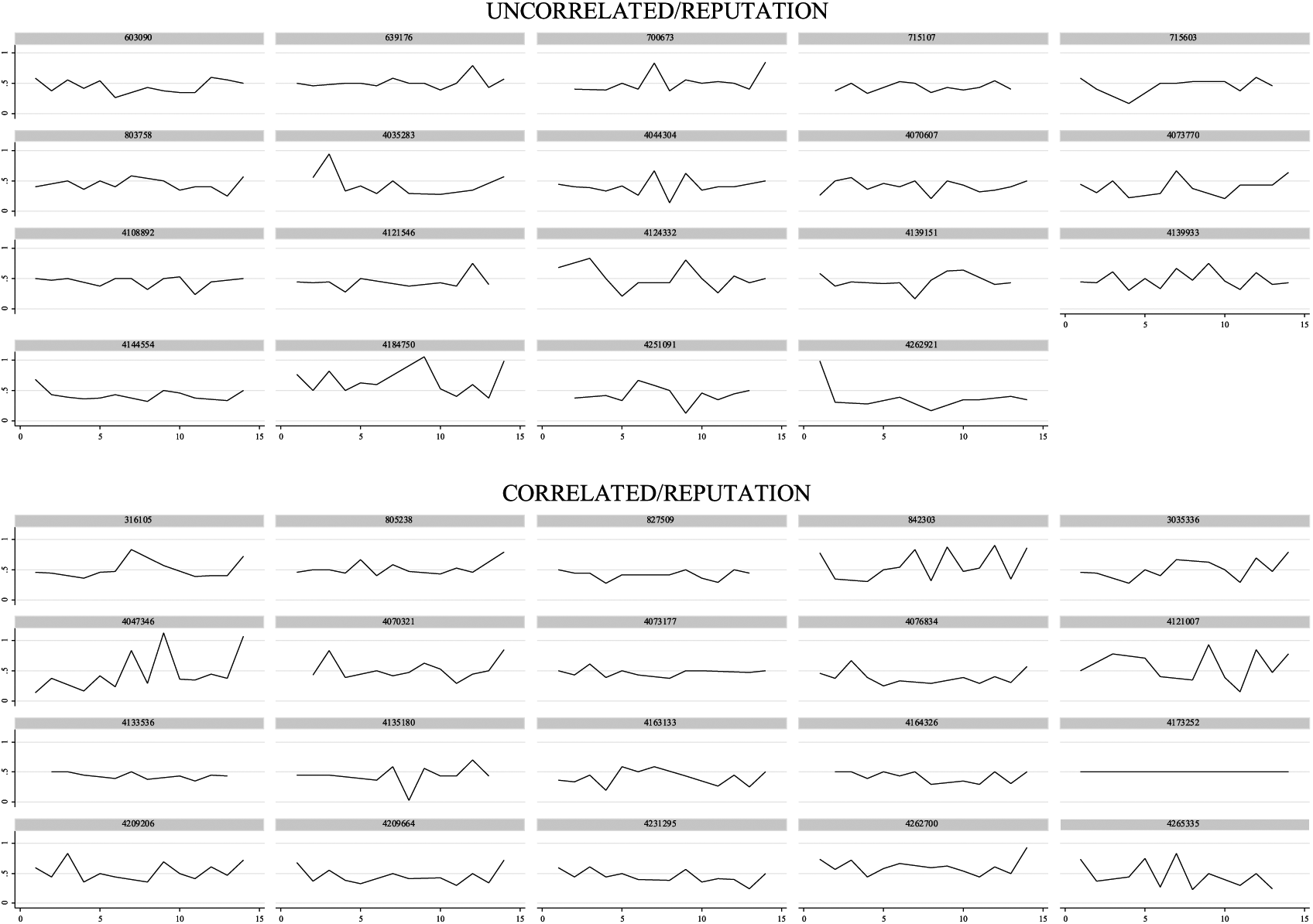
Accepted proposal as share of the common surplus over 14 periods for each firm player.
The bargaining process
Figure 2 illustrates how union and firm proposals change at the aggregate during the 60-second bargaining process in the five experimental conditions. Loess regression lines summarize the observed proposals, differentiating between union proposals (the downward-sloping lines) and firm proposals (the upward-sloping lines). To offer a fixed reference, both panels include these lines as observed in the CONTROL condition. The left-hand panel adds a depiction of the UNCORRELATED and UNCORRELATED/REPUTATION treatment conditions, whereas the right-hand panel adds a depiction of the CORRELATED and CORRELATED/REPUTATION treatment conditions.
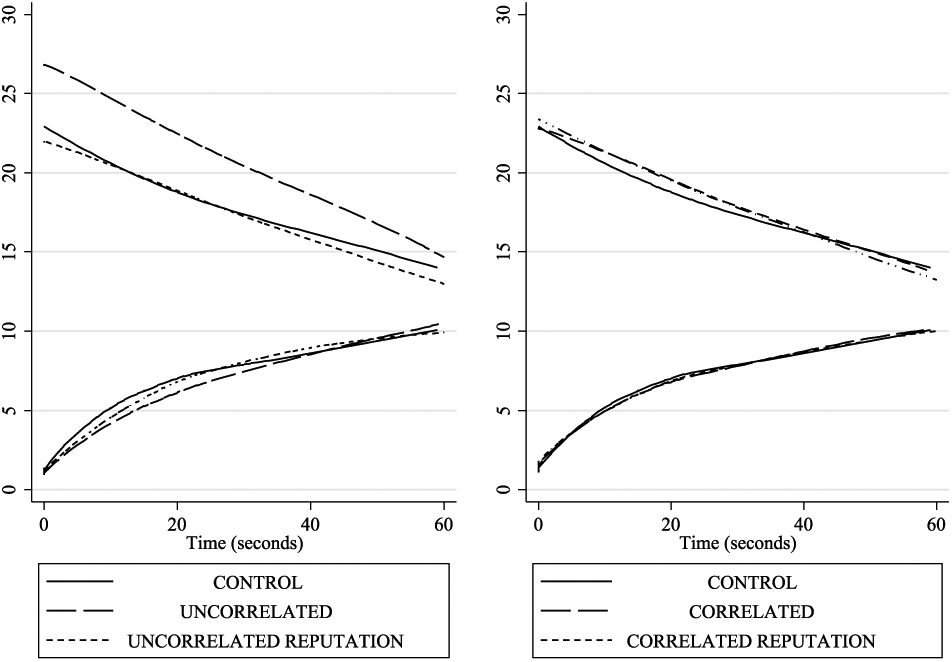
Union and firm player proposals over time, loess regression lines.
The process of convergence during the 60-second bargaining time is clearly visible in all conditions. Union proposals start high and are gradually revised downward over time. Firm proposals start low (just over zero points) and gradually increase as the deadline draws closer. Toward the end of the bargaining time, proposals approximately converge toward a five-point range centered at approximately 12 points, the equal split of the average expected common surplus value of 24 points.
Comparing the two panels, divergence between the players’ proposals increases as a result of inflated union proposals with the introduction of horizontal spillovers due to social comparisons (UNCORRELATED treatment condition) but not from horizontal spillovers that also allow for learning (CORRELATED treatment condition) (see Lehr et al., 2016). The introduction of reputation initially appears to have little impact when learning is possible, as evidenced by the similarity of the CORRELATED and CORRELATED/REPUTATION treatment conditions. However, a comparison of the UNCORRELATED and UNCORRELATED/REPUTATION treatment conditions suggests that divergence decreases substantially when reputations are introduced into an environment where horizontal spillovers arise purely from social comparisons.
Multivariate analyses
Our analysis, therefore, centers on the level of divergence between the union and firm players’ proposals during different stages of the bargaining process. Divergence is measured by subtracting the current firm proposal from the current union proposal for every proposal made in a negotiation by either player. The resulting value is the difference between union demands and firm offers for every given proposal, where each proposal may have been made at any time during the bargaining process. The observed divergences are subsequently analyzed in a multivariate model. To account for the timing of the divergences within each negotiation, we include a linear time effect on the right-hand side of the equation. The coefficient of this effect can be interpreted as the estimated rate of convergence expressed as a point decrease in divergence per second.
Two problems must be addressed. First, because there are multiple observations of divergences within each negotiation (12.66 on average), they are not independent. Moreover, the negotiations themselves are not independent. Due to the observation of the same randomly re-matched subjects over multiple periods, the negotiations are cross-classified within combinations of different union and firm players. To account for these dependencies, negotiation and crossed subject-specific random effects are estimated. Furthermore, we control for the period of interaction by including a linear period effect. Because the value of the common surplus randomly varies from period to period, we also control for this value by including a linear effect for the number of additional points in the negotiation. We estimate two models (full results are shown in Appendix 2, Table 4). Model 1 estimates conditional average differences in divergence between the five conditions by adding a dummy variable for each treatment condition. Model 2 makes these dummies to interact with the bargaining time effect. This allows us to establish the rate of convergence in each experimental condition.
Under Hypothesis 1, we expect that divergence will be lower in the UNCORRELATED/REPUTATION treatment condition than in the UNCORRELATED treatment condition. This hypothesis is strongly supported by our findings. The predicted average divergence at the beginning of a negotiation is much lower in the UNCORRELATED/REPUTATION treatment condition than in the UNCORRELATED treatment condition. Divergence was also hypothesized to be lower in the CORRELATED/REPUTATION treatment condition than in the CORRELATED treatment condition (Hypothesis 2). We find that divergence is identical in these two conditions, offering no support for this hypothesis. Model 2 shows that although divergence is initially high in the UNCORRELATED treatment condition, the rate of convergence, represented by the marginal effect of bargaining time on divergence, is also much steeper in this treatment. This is illustrated in Figure 3 by the larger negative coefficient for bargaining time in the UNCORRELATED treatment condition. Thus, although there is more conflict at the beginning of the negotiations due to social comparisons in the UNCORRELATED experimental condition, which does not allow for visible firm reputations, the bargaining process “washes out” the difference between this condition and the UNCORRELATED/REPUTATION treatment condition.
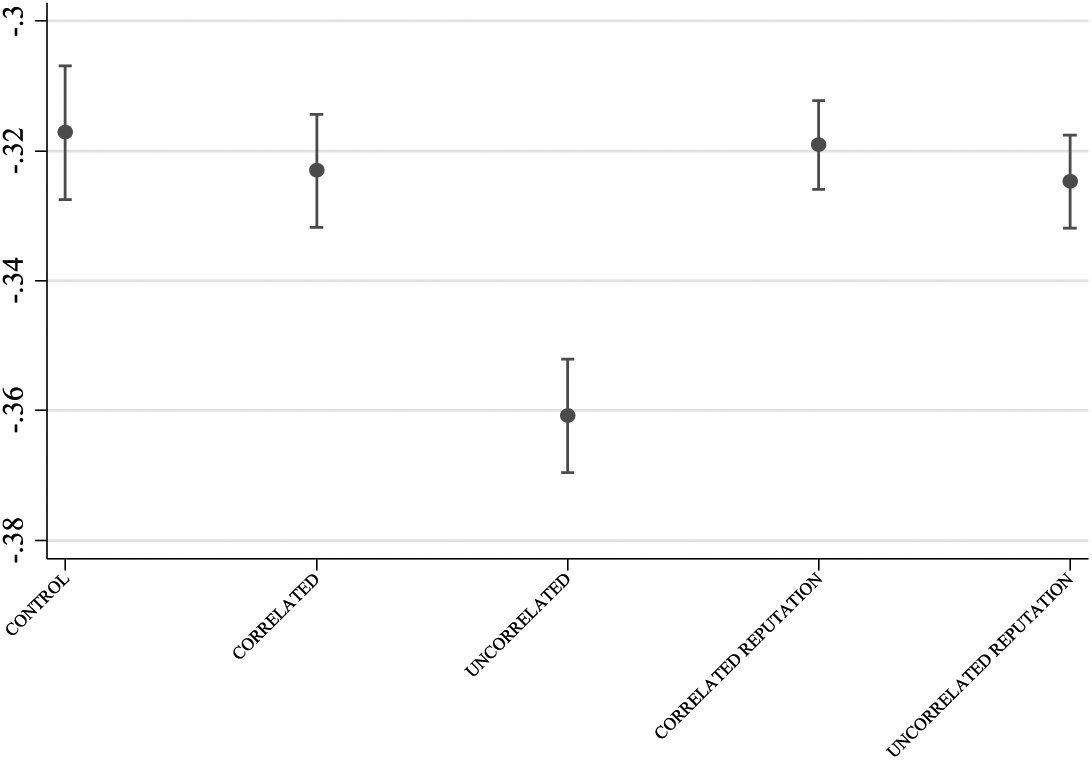
Marginal effects of bargaining time on divergence (rate of convergence per second) in five experimental conditions (95% CI).
Next, we estimate the impact of the specific horizontal and vertical spillovers on divergence during the bargaining process. All treatment conditions feature horizontal spillovers in the form of reference outcomes. The effect of the value of these references outcomes is linearly modeled for the CORRELATED, CORRELATED/REPUTATION, and UNCORRELATED/REPUTATION treatment conditions. In line with our previous findings (Lehr et al., 2016), the effect is allowed to vary depending on its position relative to the initial focal point 12 in the UNCORRELATED treatment condition. This non-linearity initially manifests in the union players’ opening proposals as a V-shaped relationship between the reference outcome value and the value of the opening proposal with a kink at 12 points, and carries over to the divergence during the bargaining process. A dummy signifying that reference outcomes are non-agreements is included in all models. To account for the dynamics of spillovers with the bargaining process itself, each model makes the modeled spillover effects to interact with bargaining time.
For each experimental condition, we estimate the effect of the union player’s earnings in the previous round (i.e. the “expectations-effect”) and the firm’s share of the common surplus earned in the previous period (i.e. the “reputations-effect”). A dummy variable controls for non-agreements in both cases. The effect of the share of the common surplus earned by the firm player in the previous period is estimated in all conditions to prevent the attribution of potentially spurious effects to the impact of reputation. For ease of interpretation, the evolution of the marginal effects of all spillovers during the bargaining process is graphically represented in Figures 4 to 6 (full results are shown in Appendix 2, Table 5).
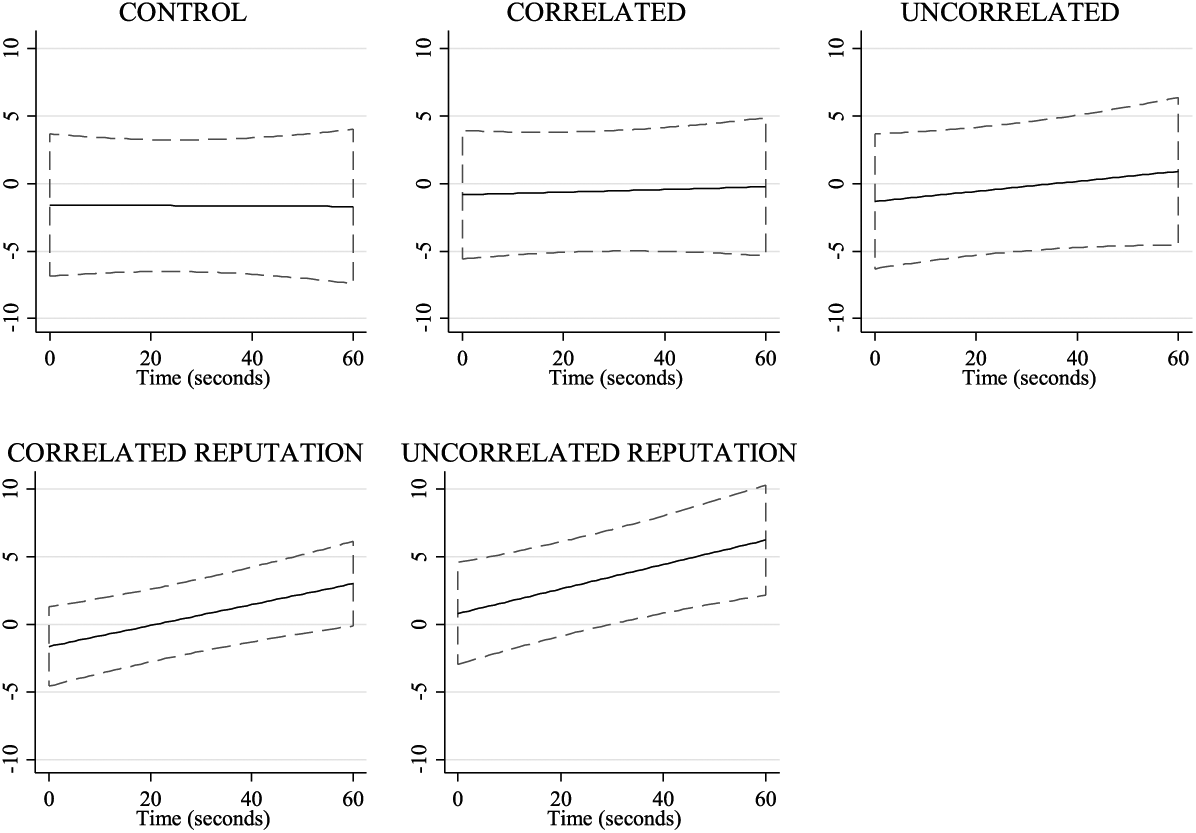
Average marginal effects of the share earned by the firm player in the previous period on divergence during the bargaining process (95% CI).
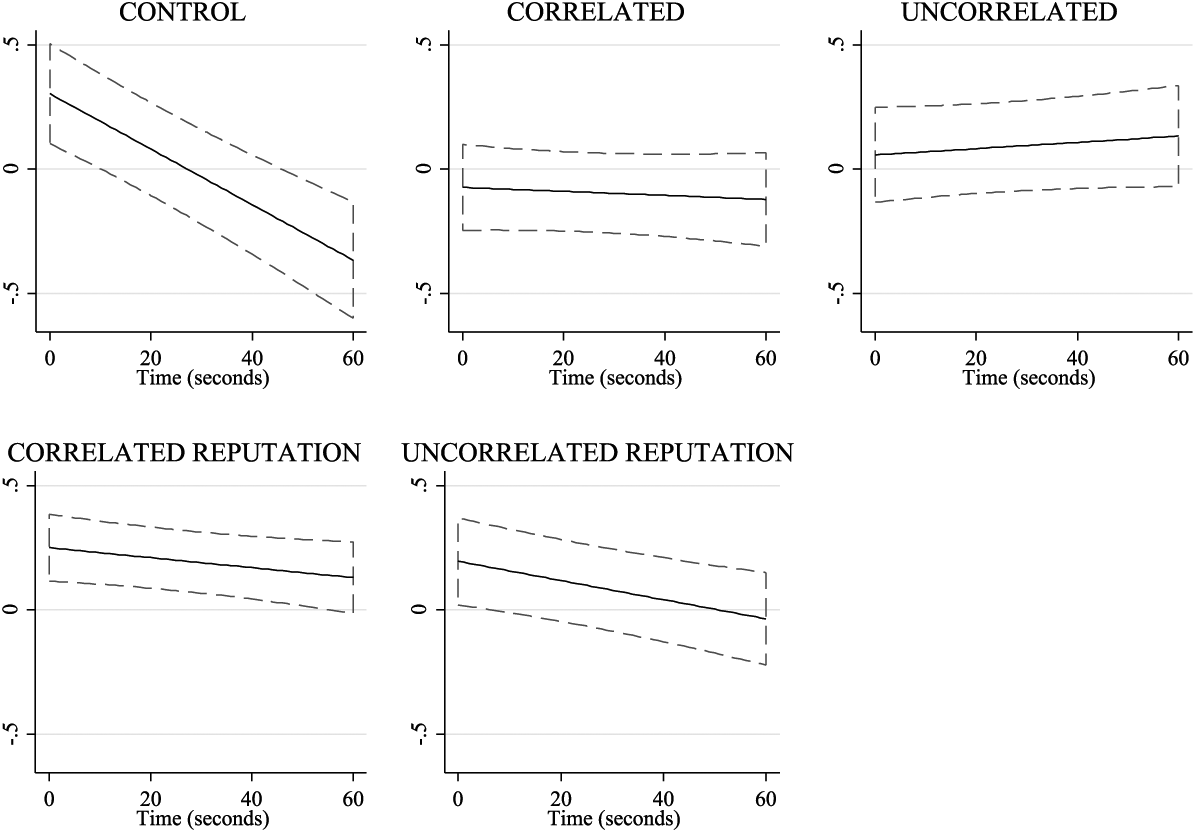
Average marginal effects of the points earned by the union player in the previous period on divergence during the bargaining process (95% CI).
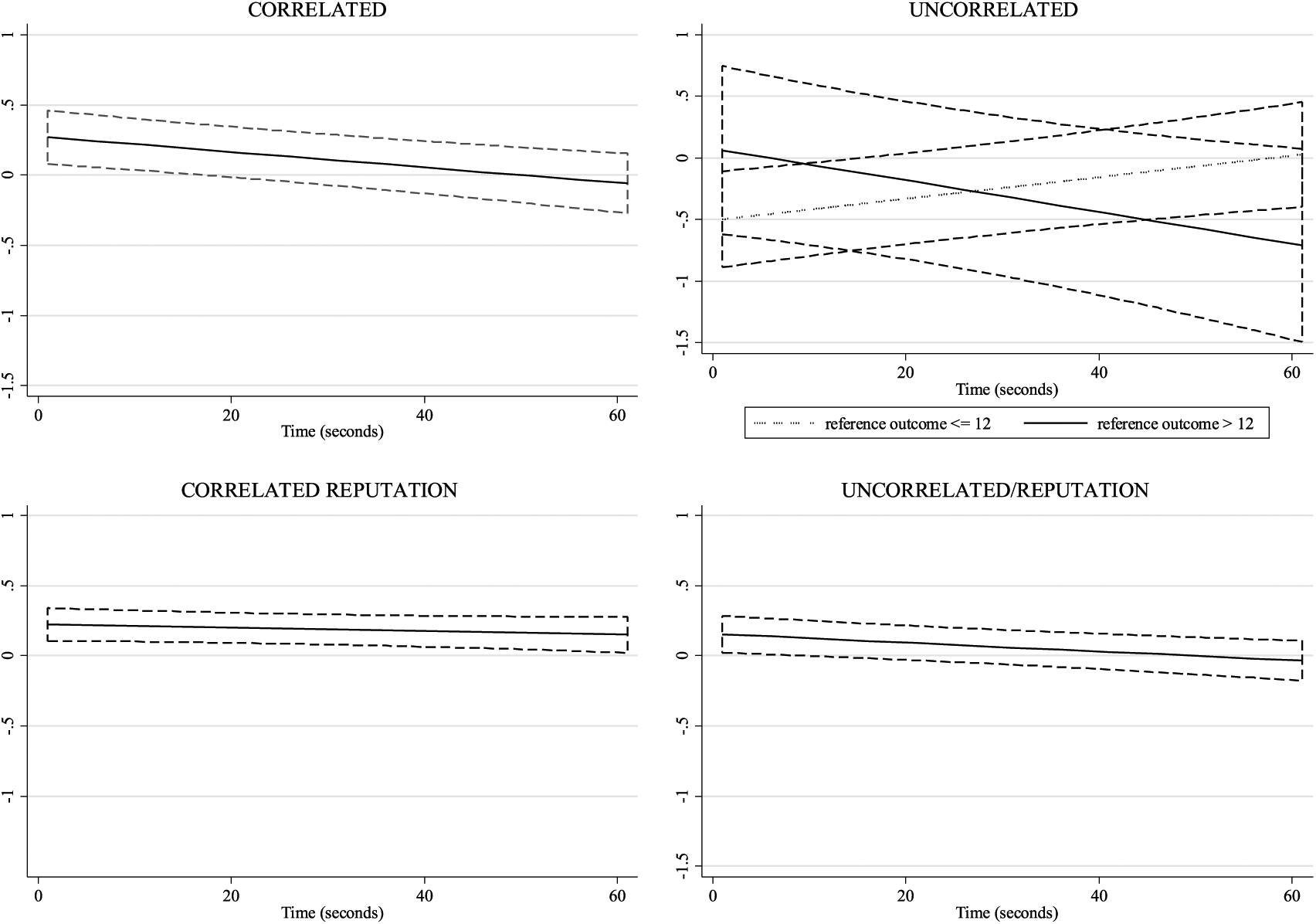
Average marginal effects of the value of reference outcome on divergence during the bargaining process (95% CI).
Hypothesis 3 predicts that in the UNCORRELATED/REPUTATION treatment condition and the CORRELATED/REPUTATION treatment condition, the lower the share earned by the firm player in the previous period, the lower the divergence will be. The results, illustrated in Figure 4, support this hypothesis, but only for the UNCORRELATED/REPUTATION treatment condition. Strikingly, the impact of reputation in this treatment only manifests in the second half of the bargaining process, with increasingly greedy firms facing increasingly high levels of divergence.
We hypothesized that high union expectations would increase conflict, resulting in an increase in divergence with higher union player earnings in the previous period (Hypothesis 4). Our analyses, illustrated in Figure 5, suggest that absent any other spillovers in the CONTROL condition, this is indeed the case. However, the initial increase in divergence is transformed by the bargaining process, even to the point of the effect changing signs as the deadline approaches. The introduction of horizontal spillovers in the UNCORRELATED and CORRELATED treatment conditions prevents any impact of union expectations on divergence. However, when firm reputations are also present, the effect re-emerges. Especially in the CORRELATED/REPUTATION treatment condition, high union expectations have a lasting escalating impact on the bargaining process.
Our reasoning for the existence of conflict-decreasing effects of reputations is partly based on the expectation that reputations alter the impact of horizontal spillovers. Specifically, we argue that social comparisons diminish and are less likely to lead to escalating union player demands when the reference outcome is unfavorable, whereas rational learning is augmented. We find support for both of these arguments. The impact of horizontal spillovers on divergence changes with the introduction of firm reputations, as seen in Figure 6. Comparing the UNCORRELATED treatment condition with the UNCORRELATED/REPUTATION treatment condition, we find that the escalating effects of reference outcomes that are increasingly unfavorable to the union (≤12 points) are indeed prevented in the UNCORRELATED/REPUTATION treatment condition. Moreover, although the effect of horizontal spillovers is very similar in the CORRELATED and CORRELATED/REPUTATION treatment conditions in terms of effect size, this effect is much less diminished during the bargaining process in the CORRELATED/REPUTATION treatment condition.
Conclusion
In this study, we investigated the impact of spillovers on conflict in bargaining. Our analysis offers two general insights. First, spillovers that allow for a reduction of uncertainty about private information tend to decrease conflict in bargaining, whereas spillovers that result from reference-dependent preferences tend to increase conflict in bargaining. Second, different sources and different mechanisms of spillovers can interact and may strengthen or weaken each other.
The findings suggest that allowing firms to build reputations by offering unions information about the fairness of firms’ past bargaining behaviors decreases conflict in bargaining when horizontal spillovers arise exclusively from social comparisons. Two complementary processes explain this finding. First, “good reputations,” evidenced by firms offering or agreeing to larger shares for unions in the past, help to reduce conflict in current negotiations, whereas more “greedy” firms face more conflict. Second, when firm reputations are known, the impact of horizontal spillovers resulting from social comparisons is altered. Without knowledge about a firm’s past, unions anticipate the firm’s potentially self-serving use of reference outcomes and respond to unfavorable reference outcomes with escalating demands (Lehr et al., 2016). Knowing that the firm is fair based on its reputation prevents such escalation. We find that knowledge about the fairness of firms’ past bargaining behavior does not decrease conflict in bargaining where horizontal spillovers can be caused by rational learning. However, the evidence suggests that firms’ reputation may augment the impact of rational learning by decreasing the risk of concession making for the union players. Furthermore, we find that the unions’ expectations based on their previous bargaining outcomes under some conditions affect bargaining, with high expectations leading to more conflict. Somewhat surprisingly, these expectation effects are particularly pronounced when the firms’ past behavior (i.e. their reputations) is known. A potential explanation for this finding is that horizontal spillovers by themselves shift the union’s focus to the present, whereas information about the firm’s reputation, and therefore its past, makes the union’s own past a salient reference point again.
Our study has practical implications for wage bargaining and distributive bargaining under asymmetric information in general. Our study suggests that the past plays a specific role in bargaining conflicts. Managing reputations and expectations can have direct influences but also affect how bargaining units respond to information about what occurs in other bargaining units. This implies, for instance, that changes in the composition of bargaining units (e.g. bargaining with a different trade union/employer) may disrupt the impact of both vertical and horizontal spillovers. Such compositional changes may decrease not only the escalating impacts of expectation effects but also the de-escalating impacts of (the informed party’s) reputations. Compositional changes can also shift the salient mechanism for horizontal spillovers from rational learning to conflict-increasing social comparisons.
Our study also provides a potential behavioral basis for scientific arguments suggesting the benefits of positive reputations of employers (e.g. Bewley, 1999; Turban and Cable, 2003) and the potential risks of trade union expectations (e.g. Bewley, 1999). More in general, our study suggests that current studies of wage conflicts and experimental bargaining that analyze horizontal and vertical spillovers in isolation may produce misleading results—neglecting interactions between the mechanisms. Future research should address these interactions more explicitly, for example, by including them in the specification of econometric models for strike data.
Footnotes
Appendix 1
Appendix 2
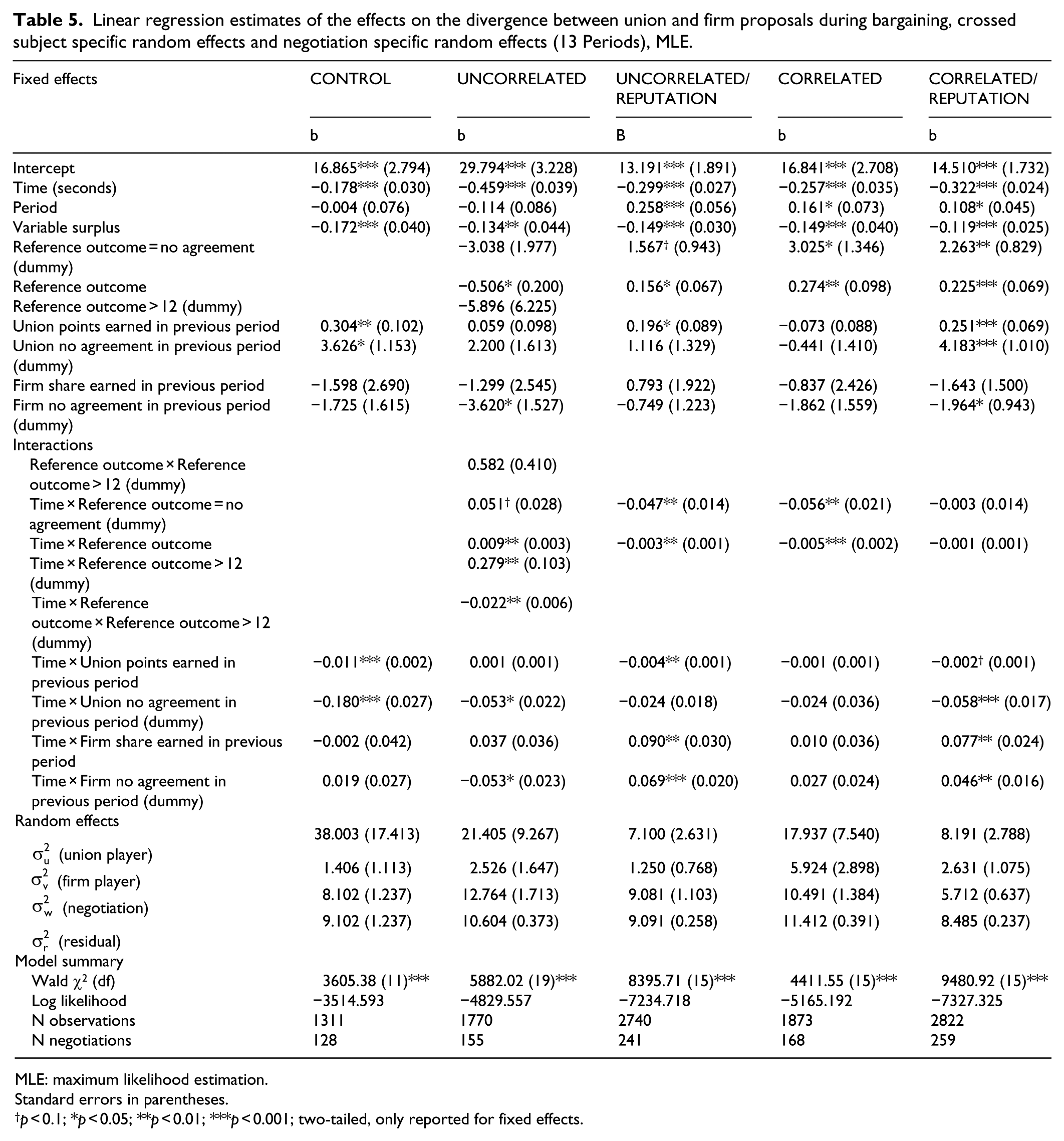
Linear regression estimates of the effects on the divergence between union and firm proposals during bargaining, crossed subject specific random effects and negotiation specific random effects (13 Periods), MLE.
| Fixed effects | CONTROL |
UNCORRELATED |
UNCORRELATED/REPUTATION |
CORRELATED |
CORRELATED/REPUTATION |
|---|---|---|---|---|---|
| b | b | B | b | b | |
| Intercept | 16.865*** (2.794) | 29.794*** (3.228) | 13.191*** (1.891) | 16.841*** (2.708) | 14.510*** (1.732) |
| Time (seconds) | −0.178*** (0.030) | −0.459*** (0.039) | −0.299*** (0.027) | −0.257*** (0.035) | −0.322*** (0.024) |
| Period | −0.004 (0.076) | −0.114 (0.086) | 0.258*** (0.056) | 0.161* (0.073) | 0.108* (0.045) |
| Variable surplus | −0.172*** (0.040) | −0.134** (0.044) | −0.149*** (0.030) | −0.149*** (0.040) | −0.119*** (0.025) |
| Reference outcome = no agreement (dummy) | −3.038 (1.977) | 1.567 † (0.943) | 3.025* (1.346) | 2.263** (0.829) | |
| Reference outcome | −0.506* (0.200) | 0.156* (0.067) | 0.274** (0.098) | 0.225*** (0.069) | |
| Reference outcome > 12 (dummy) | −5.896 (6.225) | ||||
| Union points earned in previous period | 0.304** (0.102) | 0.059 (0.098) | 0.196* (0.089) | −0.073 (0.088) | 0.251*** (0.069) |
| Union no agreement in previous period (dummy) | 3.626* (1.153) | 2.200 (1.613) | 1.116 (1.329) | −0.441 (1.410) | 4.183*** (1.010) |
| Firm share earned in previous period | −1.598 (2.690) | −1.299 (2.545) | 0.793 (1.922) | −0.837 (2.426) | −1.643 (1.500) |
| Firm no agreement in previous period (dummy) | −1.725 (1.615) | −3.620* (1.527) | −0.749 (1.223) | −1.862 (1.559) | −1.964* (0.943) |
| Interactions | |||||
| Reference outcome × Reference outcome > 12 (dummy) | 0.582 (0.410) | ||||
| Time × Reference outcome = no agreement (dummy) | 0.051 † (0.028) | −0.047** (0.014) | −0.056** (0.021) | −0.003 (0.014) | |
| Time × Reference outcome | 0.009** (0.003) | −0.003** (0.001) | −0.005*** (0.002) | −0.001 (0.001) | |
| Time × Reference outcome > 12 (dummy) | 0.279** (0.103) | ||||
| Time × Reference outcome × Reference outcome > 12 (dummy) | −0.022** (0.006) | ||||
| Time × Union points earned in previous period | −0.011*** (0.002) | 0.001 (0.001) | −0.004** (0.001) | −0.001 (0.001) | −0.002 † (0.001) |
| Time × Union no agreement in previous period (dummy) | −0.180*** (0.027) | −0.053* (0.022) | −0.024 (0.018) | −0.024 (0.036) | −0.058*** (0.017) |
| Time × Firm share earned in previous period | −0.002 (0.042) | 0.037 (0.036) | 0.090** (0.030) | 0.010 (0.036) | 0.077** (0.024) |
| Time × Firm no agreement in previous period (dummy) | 0.019 (0.027) | −0.053* (0.023) | 0.069*** (0.020) | 0.027 (0.024) | 0.046** (0.016) |
| Random effects | |||||
| |
38.003 (17.413) | 21.405 (9.267) | 7.100 (2.631) | 17.937 (7.540) | 8.191 (2.788) |
| |
1.406 (1.113) | 2.526 (1.647) | 1.250 (0.768) | 5.924 (2.898) | 2.631 (1.075) |
| |
8.102 (1.237) | 12.764 (1.713) | 9.081 (1.103) | 10.491 (1.384) | 5.712 (0.637) |
| |
9.102 (1.237) | 10.604 (0.373) | 9.091 (0.258) | 11.412 (0.391) | 8.485 (0.237) |
| Model summary | |||||
| Wald χ2 (df) | 3605.38 (11)*** | 5882.02 (19)*** | 8395.71 (15)*** | 4411.55 (15)*** | 9480.92 (15)*** |
| Log likelihood | −3514.593 | −4829.557 | −7234.718 | −5165.192 | −7327.325 |
| N observations | 1311 | 1770 | 2740 | 1873 | 2822 |
| N negotiations | 128 | 155 | 241 | 168 | 259 |
MLE: maximum likelihood estimation.
Standard errors in parentheses.
p < 0.1; *p < 0.05; **p < 0.01; ***p < 0.001; two-tailed, only reported for fixed effects.
Funding
The author(s) disclosed receipt of the following financial support for the research, authorship, and/or publication of this article: This work was supported by the Conflict and Security Program of the Netherlands Organization for Scientific Research (NWO), Grant #432-08-022.