



Abstract
Mainstream entrepreneurship has traditionally focused on the human behaviors involved in the exploitation, innovation, and transformation of human-centric systems. However, this anthropocentric view is inadequate in addressing today’s grand challenges. Assuming human superiority in solving Earth’s problems can be misleading. We challenge this assumption by adopting an ecocentric perspective that incorporates natural non-human actors (NNHAs). Using actor-network theory, we take a relational approach to explore how entrepreneurial behaviors can be theoretically advanced from inclusive, distributed, mutualistic, and co-creative relationships between human and NNHAs. We advance ecocentric entrepreneurship by redefining entrepreneurial agency, interactions, places, and ecosystems.
“We often forget that we are nature. Nature is not something separate from us. So, when we say that we have lost our connection to nature, we’ve lost our connection to ourselves.”
– Andy Goldsworthy (quoted in Elgin, 2022, p. 24), Artist and Environmentalist
Introduction
The prevailing paradigm within entrepreneurship scholarship exhibits a fundamentally anthropocentric orientation, privileging human agency and market-centered solutions as the primary units of analysis. This theoretical positioning is often justified in entrepreneurship theory and practice, which studies the creation of economic and non-economic value across individual, organizational, and societal dimensions (Gartner, 1990; Shane & Venkataraman, 2000; Shepherd, 2015; Wiklund et al., 2019). Anthropocentric contributions in the realm of entrepreneurship encompass new venture creation, market transformation, economic development, and broader societal advancement, establishing entrepreneurship as a critical mechanism for addressing human needs and development (Corner & Ho, 2010; Johnson & Schaltegger, 2020; Wiklund et al., 2011).
Within the anthropocentric framework, specialized research streams have emerged, notably environmental and sustainable entrepreneurship. This literature posits that entrepreneurs can identify and correct market failures related to environmental degradation via the development and commercialization of environmentally superior products and services, thereby replacing less sustainable alternatives (Dean & McMullen, 2007; Pacheco et al., 2010; York & Venkataraman, 2010). While this approach acknowledges environmental considerations, it fundamentally maintains human-centered assumptions about agency, including opportunity discovery, venture development, and value creation.
However, the anthropocentric perspective imposes significant theoretical and empirical limitations, thereby limiting the field’s analytical capacity with respect to wider ecological systems. Specifically, existing scholarship systematically overlooks the agency of natural non-human actors (NNHAs), including living species (e.g., non-human animals, plants, fungi, microbiota) (Hunt et al., 2022) and non-living components (e.g., air, minerals, water) that have the potential to shape entrepreneurial behaviors (Vlasov, 2021). The persistent marginalization of NNHAs represents a fundamental blind spot that undermines the ability of the entrepreneurship field to comprehensively address pressing grand challenges that endanger human and non-human actors, including biodiversity loss, climate change, and the degradation of ecological systems (Thomsen et al., 2024; York & Venkataraman, 2010).
Notably, there is a limitation in recognizing alternative forms of agency and relational dynamics in ecocentric entrepreneurship, particularly in defining the role of NNHAs as something resembling entrepreneurial behavior. This is not a merely theoretical limitation, it also restricts our capacity to account for the complex, interdependent dynamics that increasingly characterize entrepreneurship in socio-ecological systems, such as the interactions and dependencies between people and nature when dealing with escalating environmental crises (Gatzweiler, 2014; Liu et al., 2007; Ostrom, 2009). Therefore, a comprehensive theoretical reframing of ecocentric entrepreneurship is needed—one that treats nature as an active participant and co-creator in entrepreneurial processes.
Emerging scholarship in regenerative organizing has begun to challenge the anthropocentric perspective (Muñoz & Branzei, 2021; Muñoz & Hernandez, 2024; Vlasov, 2021), highlighting how wildlife, plants, and other natural actors can serve as more-than-human collaborators in mutualistic, co-creative venturing. Currently, there is a small but promising body of research suggesting the serious consideration of non-human entrepreneurial behavior (Hunt et al., 2022) and the distribution of agency between human and non-human actors (Melin & Gaddefors, 2023). These developments call for a comprehensive understanding of NNHAs in advancing entrepreneurship theory and maintaining the entrepreneurialism and openness of our research field (Shepherd, 2015).
Our core framework and ensuing conceptual development are grounded in actor-network theory (ANT). Rooted in a flattened ontology, ANT distributes agency across a heterogeneous network of actors, including human, technological, 1 and ecological (Latour, 1996, 2005). Based on previous research (Dziak, 2022; Ehrnström-Fuentes et al., 2025; Hunt et al., 2022), we define NNHAs as biotic (living) and abiotic (non-living) components of ecosystems, such as non-human animals, plants, fungi, micro-organisms, minerals, water, and air, which exhibit or shape entrepreneurial behavior. This definition builds on ecological understandings of NNHAs as organisms that interact and evolve within ecosystems (Dziak, 2022; Sullivan et al., 2017), and on the ANT recognition of non-human agency in networks (Latour, 2005).
Building on Pidduck and Tucker’s (2022) call to explore meaningful heterodoxies in entrepreneurship, we engage with NNHAs in support of extending our theorizing beyond conventional human-centered assumptions. This heterodoxy invites novel conceptualizations by situating entrepreneurial behaviors within ecological concepts that are rarely foregrounded in the field (Vlasov, 2021; Whiteman & Cooper, 2000). It allows us to probe phenomena that are unconventional but theoretically generative, in service of challenging assumptions and expanding the field’s conceptual boundaries. Rather than viewing NNHAs as mere context or passive resources to be exploited, we frame them as relational agents that exhibit and shape entrepreneurial behavior through dynamic interactions and mutualistic relationships. This perspective emphasizes entrepreneurship as an emergent process shaped by the ongoing development of roles, interactions, and networks between humans and NNHAs.
Accordingly, we raise two key questions for the advancement of ecocentric entrepreneurship: (a) How are the roles of NNHAs conceptualized in entrepreneurship research? and (b) How can entrepreneurial behavior emerge through the relational interactions and networks between humans and NNHAs? We define entrepreneurial behavior as “novel action to generate reproducible benefits” (Hunt et al., 2022, p. 3). We address the first question by reviewing how NNHAs are positioned in the existing literature. To answer the second research question, we explore how deeper consideration of, and closer engagement with, NNHAs can advance our understanding of entrepreneurial behavior through a relational shift toward ecocentrism across four research themes: entrepreneurial agency, entrepreneurial interactions, entrepreneurial places, and entrepreneurial ecosystems.
Our paper makes two main contributions to entrepreneurship theory and practice. First, we offer researchers a salient and detailed foundation upon which to investigate NNHAs within entrepreneurship research. We observe a subtle, gradual shift in the representation and understanding of NNHAs—moving away from the common interpretation of NNHAs as passive resources (Dean & McMullen, 2007; Muñoz & Cohen, 2018; Parrish, 2010) or beneficiaries (Hörisch, 2018; Iakovleva et al., 2012; Vesalon & Anghel, 2024), towards a perspective where NNHAs are regarded as influencers (Fernhaber & Stark, 2019; O’Neill et al., 2006; Shi et al., 2021) or partners (Melin & Gaddefors, 2023; Thomsen et al., 2024; Vlasov, 2021).
Second, we strengthen the relevance of ecocentric entrepreneurship through the study of NNHAs and elucidate the potential implications for future research of NNHAs in four distinguishable research themes. We begin by emphasizing co-agency in our reconceptualization of entrepreneurial agency between humans and NNHAs, framing it as distributed and cooperative. We suggest that entrepreneurial interactions are co-creative and mutualistic, shaping both venture formation and development. We expand the understanding of entrepreneurial places to include the ecological and material spaces that are co-constituted by humans and NNHAs. Finally, we extend entrepreneurial ecosystems beyond human-centered networks to incorporate ecological interdependencies with NNHAs.
Our approach resonates with Shepherd and Sutcliffe’s (2015) nuanced treatment of anthropomorphizing, that is, as an inferential process wherein people assign human characteristics, emotions, or intentions to non-human agents or phenomena. Importantly, we view anthropomorphism not as a literal claim about non-human intentionally, but as a heuristic for extending theoretical insight. In our case, entrepreneurial behavior is treated as emergent within relational networks in which humans and NNHAs are entangled. Any references to non-human agency serve as heuristics to highlight interdependence and co-creation, rather than as claims about conscious non-human intentions. By incorporating NNHAs into entrepreneurial ecosystems in this way, it is our intention to advance ecocentric entrepreneurship by decoupling it from the mainstream anthropocentric views of NNHAs that dominate the field.
ANT: Bridging Anthropocentric and Ecocentric Ontologies
Anthropocentrism refers to the belief that humans are the most important and superior life forms (Boslaugh, 2016; Davis & Arnocky, 2024) and that nature is valued primarily by its utility for human purposes, emphasizing its instrumental value (Piccolo et al., 2022). From this perspective, nature is understood as a collection of entities governed by immutable laws, which science seeks to discover and exploit for human benefit (Purser et al., 1995). Even with the inclusion of moral and ethical considerations, nature often plays a passive role with human-centered entrepreneurial behavior contributing to the preservation of nature through sustainable entrepreneurship (Muñoz & Cohen, 2018; Shepherd & Patzelt, 2011; Wigger & Shepherd, 2020).
Contrary to anthropocentrism, ecocentrism denotes a nature-centered worldview and a different set of values (Leopold, 2012). It is the ethical belief that recognizes the intrinsic value of nature, independent of its utility to humanity (Piccolo et al., 2022). This perspective sees all species, including humans and NNHAs, as interrelated through evolutionary processes (Taylor et al., 2020; Washington et al., 2017). An ecocentric ontology denies the existential divisions between human and non-human actors. Rather, it stresses that humans are part of a larger interconnected web of life (Moore, 2015), where ecosystem health is vital to human well-being (Milstein & Castro-Sotomayor, 2020). Scholars argue that the sociological roots of entrepreneurial behavior are not exclusive to humans (Hunt et al., 2022). Therefore, we see the utility of further conceptual development in advancing ecocentric entrepreneurship that recognizes NNHAs as legitimate agents in entrepreneurial ecosystems.
In our study, ANT serves as a bridge between anthropocentric and ecocentric ontologies. According to ANT, all entities, whether human or non-human, are actors that have the potential to influence each other (Latour, 1996, 2005). The theory asserts that the natural world exists in constantly shifting networks of relationships (Law & Hassard, 1999; Muniesa, 2015). Additionally, it posits that nothing exists outside those relationships, and it rejects the notion that social relations are independent of the material and natural worlds (Latour, 1996, 2005). Therefore, social and material components should be treated symmetrically in socio-material descriptions, where human actors and NNHAs interact relationally (Whittle & Spicer, 2008). Thus, we cannot fully understand entrepreneurial behavior without considering the role of NNHAs.
By adopting ANT, agency is no longer confined to humans; it is distributed across networks that include both human actors and NNHAs. Inspired by Latour (1999, p. 179),
2
the following example of a gardener holding a plant illustrates a fundamental insight of ANT, which is how both the human and plant are transformed through their interaction:
You are different with the plant in your hand; the plant is different with you holding it. You are another subject because you hold the plant, and the plant becomes another object because it has entered into a relationship with you.
The point is that it is neither the plant nor the human alone, but rather their interaction that jointly achieves the act of planting. Thus, agency is not a privilege of reflexive humans or an inherent trait to NNHAs; it emerges dynamically through the interactions and networks formed between these actors. 3 The success of the endeavor does not depend solely on human expertise but on the entire network of relationships, illustrating a central principle of ANT—agency is exhibited, and outcomes are co-created by human actors and NNHAs. This framework helps us to understand how humans and NNHAs are entangled, and how NNHAs enable, constrain, and contribute to entrepreneurial behavior.
It is precisely this relational ontology offered by ANT, in which both human actors and NNHAs interact and can exhibit agency, that enables us to reconceptualize entrepreneurial processes and outcomes as the result of dynamic interactions between networks of humans and NNHAs. The relational ontology makes it particularly relevant for advancing ecocentric entrepreneurship. From a very fundamental level, ANT challenges the traditional, anthropocentric view of agency by emphasizing that both humans and NNHAs interact and shape entrepreneurial processes. This perspective is key to developing a more comprehensive understanding of ecocentrism in entrepreneurship behavior, viewing ventures not as solely human-driven but as emerging from complex, interdependent networks involving both human actors and NNHAs. A core strength of ANT is its conceptual pluralism 4 (Latour, 2005, 2014), which allows researchers to explore diverse approaches to conceptualizing and explaining entrepreneurial behavior.
However, ANT faces critique in relation to its application in entrepreneurship research. For instance, the term “network” may be misleading, as it suggests a fixed or structured web, whereas ANT refers to the fluid, dynamic, constantly evolving set of relationships and connections between actors. Additionally, ANT’s broad definition of “actor” can lead to ambiguities that complicate research design and interpretation in entrepreneurship studies. Nevertheless, ANT offers valuable perspectives for advancing an ecocentric view of entrepreneurship, which emphasizes the co-creation of opportunities between humans and NNHAs rather than exploitation and subordination. In the following sections, we review how NNHAs have been portrayed in the existing literature before turning to a more detailed elaboration of how novel “actor” and “network” perspectives of NNHAs can advance ecocentric entrepreneurship research.
NNHAs in Current Entrepreneurship Research
We conducted a comprehensive overview of the existing literature to better understand how NNHAs’ roles are conceptualized in entrepreneurship research. Our motivation was to classify and synthesize the literature via a thematic analysis of the following aspects: (a) representations of NNHAs; (b) human involvement; (c) forms of human–NNHA interactions; and (d) places of human–NNHA interactions. We used keywords including entrepreneurship, environment, ecology, non-human, animal, organism, plant, species, and interaction in various combinations to search multiple academic databases, and we found a total of 4,592 papers. Despite increasing attention to the natural environment and sustainability in entrepreneurship (Johnson & Schaltegger, 2020), existing research tended to offer only fragmented or superficial considerations of NNHAs. Thus, many of these papers were considered irrelevant for this review.
After reviewing the representations of NNHAs, forms of human–NNHA interactions, and places of human–NNHA interactions, we reduced the final sample to 91 papers that addressed the four aspects mentioned above. Interestingly, most of these papers could be labelled as sub-disciplines of entrepreneurship research, including ecotourism, environmental entrepreneurship, and sustainable entrepreneurship. By reading and analyzing these papers, we were able to organize the literature into four roles of NNHAs. These four roles progress from implicit assumptions that NNHAs are merely passive resources to serve human or economic interests towards explicit depictions of the intrinsic value and generative agency of NNHAs. The four roles we identified are: (a) NNHAs as resources (35 papers); (b) NNHAs as beneficiaries (35 papers); (c) NNHAs as influencers (10 papers); and (d) NNHAs as partners (10 papers). 5 We will continue by elaborating on these four roles with examples. Additionally, a more detailed overview of the individual papers can be found in the Supplemental Materials (see online Supplemental Appendix).
NNHAs as Resources
In this role, NNHAs are framed as instrumental resources, valued for their utility to human and economic systems. Even though the literature stresses that various species and non-living components (e.g., air, water) should be conserved through sustainable practices, they are largely positioned to serve human or economic interests, even when taking environmentally friendly considerations into account (Dean & McMullen, 2007; Parrish, 2010; Shepherd & Patzelt, 2011). From this anthropocentric orientation, NNHAs are not seen as active participants in entrepreneurial behavior, rather they are valued and managed for their utility, even if the goal is to sustain them in perpetuity (Parrish, 2010). In this orientation, they await corrective human intervention while playing a passive role, which is vulnerable to market failures, including externalities and imperfect information (Cohen & Winn, 2007; Dean & McMullen, 2007; Pacheco et al., 2010). According to this literature, the remedy lies in redirecting market forces to amend these failures in ways that ultimately benefit humans through wealth generation, competitive advantage, or social good (Cohen & Winn, 2007; Dean & McMullen, 2007).
Such an instrumental framing has pragmatic benefits. It can catalyze preservation and conservation efforts by tying nature’s value to business and financial outcomes. For instance, preserving a forest and all its inhabitants can enhance and sustain ecotourism (Matilainen & Lähdesmäki, 2014; Sunarta et al., 2019). However, this approach reinforces anthropocentrism by reducing NNHAs to instrumental assets, even when the goal is conservation or sustainability. It can obscure ecological agency and even risk greenwashing, especially when environmental value is exaggerated while unsustainable practices persist.
NNHAs as Beneficiaries
In this role, NNHAs are recognized as entities worthy of care, protection, or moral consideration for their own sake and not merely for their utility to humans. In more relational accounts, NNHAs are increasingly positioned as beneficiaries in the socio-ecological systems (e.g., farming, Indigenous communities, wildlife reserves) where human actors operate in close proximity to NNHAs. In these approaches, entrepreneurial endeavors attempt to mirror and support natural cycles, often aligning with the notion that sustainability means a flourishing ecosystem (Pastakia, 1998; Schaefer et al., 2015).
Such literature provides a meaningful departure from purely instrumental views of NNHA and introduces moral imperatives for respectful coexistence and environmental stewardship (Volery, 2002). It integrates biocentric ethics and rights-of-nature frameworks into entrepreneurial theory and practice. Notably, this approach creates the potential for ventures to act as enablers of ecological restoration through ecotourism, permaculture, and urban greening (Austin & Garnett, 2011; Galappaththi et al., 2017; Schaefer et al., 2015). While this perspective of NNHAs provides moral grounding, it still frames NNHAs as passive recipients of human benevolence rather than active participants. The agency of NNHAs typically remains implicit or symbolic, with nature depicted as a backdrop to human activity rather than as an independent actor.
NNHAs as Influencers
The literature demonstrates more dynamic understandings of how NNHAs can influence entrepreneurial behavior. Herein, NNHAs are seen as sources of inspiration and catalysts that shape human entrepreneurial behavior through ecological design, metaphors, or innovative frameworks like biomimicry and industrial symbiosis (Fernhaber & Stark, 2019; Shi et al., 2021). For example, Fernhaber and Stark (2019, p. 3) advocate “biomorphizing,” a biomimicry-based mode of entrepreneurial theorizing that builds on Shepherd and Sutcliffe’s (2015) treatment of anthropomorphizing. Here, biological insights via NNHAs can illuminate human-related problems (Fernhaber & Stark, 2019). Human actors are encouraged to learn from nature and redesign processes to align with natural cycles.
However, the primary focus is still on the role of human agency with instrumental benefits, rather than interactive or reciprocal relationships with NNHAs (Montagnino, 2018; Tripathi et al., 2015). As a result, the literature addressing NNHAs as influencers is unduly reliant on the anthropocentric aspects of innovation, venture growth, and development, while ignoring the capacity of NNHAs to engage in relational interactions with human actors (Montagnino, 2018). The ontological asymmetry persists—nature inspires, humans act.
NNHAs as Partners
This emergent role portrays NNHAs as enablers that co-create, shape, or even independently initiate entrepreneurial processes, especially within regenerative and relational paradigms. The rise of regenerative organizing is a cornerstone in the theoretical advancement (Muñoz & Branzei, 2021), where NNHAs are co-creators, enabling innovative business strategies through relational awareness and ecological learning. Vlasov (2021) emphasizes that nature can act as an enabler, leading the human actors through several key phases; for example, reconnecting with nature (existential enabler), learning from and increasing respect for nature (experiential enabler), or finding ways to work with nature as a partner (nature as an enabler). An essential part of regenerative entrepreneurship is to recognize “that there are many creative ways to work with nature as a partner” (Vlasov, 2021, p. 573). Similarly, Thomsen et al. (2024) adopt a multispecies lens, which further expands the concept of humans and NNHAs as equal partners by exploring how humans and NNHAs can participate in entrepreneurial interactions. This framing of NNHAs advocates for a redefinition of entrepreneurship to encompass these non-human agents.
This view is reinforced by relational and new materialist perspectives (Gaddefors & Anderson, 2017; Melin & Gaddefors, 2023), which challenge the division between subject and object. Melin and Gaddefors (2023) propose that the links between humans and NNHAs, as well as between agency and structure, can be viewed through a new materialist perspective (i.e., “context-as-co-constructor”). Muñoz and Cohen (2017) propose the notion of “venture synchronicity,” where entrepreneurial processes are understood as unfolding in alignment with broader social-ecological systems. This resonates with the idea of distributed agency, as it highlights how ventures are co-shaped by ecological dynamics rather than only by human intentionality. It presents a new way of viewing NNHAs, in which entities once considered mere indirect objects (e.g., forests, wildlife) can now be seen as an active agent. From this vantage point, context itself becomes a co-creative force, and agency is no longer fixed to individual actors but distributed across constellations of humans and NNHAs (Melin & Gaddefors, 2023). Such contributions help reimagine entrepreneurial behavior as an entangled, more-than-human phenomenon—where wildlife, plants, and ecological systems can act, provoke, and influence outcomes in ways that cannot be reduced to human intentionality alone. This shift opens new conceptual doors as NNHAs are not just beneficiaries of human decisions but co-contributors in the decision-making process.
Beyond these roles, we found one conceptual paper that explicitly studied the idea that NNHAs can be entrepreneurial in their own right (Hunt et al., 2022). This perspective moves beyond co-creation to envision NNHAs as generative agents, capable of instigating or directing entrepreneurial behavior on their own. Hunt et al. (2022, p. 3) frame this as “novel action to generate reproducible benefits,” suggesting that entrepreneurial behavior can emerge from NNHAs themselves, with humans as one node in a broader, interspecies network.
To summarize, we notice an evolving understanding of the role of NNHAs in entrepreneurship, moving from passive resources to active partners to entities that demonstrate entrepreneurial behavior. Building on this trajectory, we believe it is essential to explore NNHAs as active partners and generative agents initiating and co-shaping entrepreneurial behavior through distributed, relational forms of agency, and to theorize how entrepreneurial behavior emerges through relational interactions between humans and NNHAs in ecocentric entrepreneurship. This allows us to advance ecocentrism in entrepreneurship research by challenging anthropocentric assumptions and reconceptualizing entrepreneurial behavior as an entangled, more-than-human phenomenon.
Advancing Ecocentrism in Entrepreneurship Research
In this paper, we suggest that the advance of ecocentrism in entrepreneurship theory and practice would benefit from a worldview wherein the human actors and NNHAs have equal intrinsic value, possess entrepreneurial agency, and can be woven into entrepreneurial networks. Inspired by ANT, we propose a flattened ontology to understand how entrepreneurial behavior emerges through relational interactions between humans and NNHAs from the “actor” and “network” perspectives. From the “actor” perspective, we focus on the values of entrepreneurial agency as distributed between human actors and NNHAs, as well as the possible types of interactions. From the “network” perspective, we propose new insights into entrepreneurial places and entrepreneurial ecosystems, which are jointly constructed by human actors and NNHAs.
Our theorizing builds on Shepherd and Sutcliffe’s (2015) view of anthropomorphizing as a useful way to extend theory into less familiar domains. In a similar fashion, we have distinguished four mechanisms to explain the “why” of ecocentric entrepreneurship. By attributing entrepreneurial agency to NNHAs as well as including them in entrepreneurial ecosystems, we aim to generate novel insights while remaining attentive to epistemological boundaries. Additionally, our work aligns with Pidduck and Tucker’s (2022) understanding of meaningful heterodoxies, which are unconventional yet valuable directions that can broaden entrepreneurship research and invite new forms of theorizing.
The “Actor” Perspective
Distributed Entrepreneurial Agency Between Humans and NNHAs
Although mainstream entrepreneurship literature focuses on human actors, we propose a broader view of entrepreneurial agency that incorporates NNHAs into entrepreneurial behavior. Building on exceptional research (Hunt et al., 2022; Melin & Gaddefors, 2023; Thomsen et al., 2024), we suggest that NNHAs exhibit entrepreneurial behavior and can inspire, resist, shape, or redirect such behavior in humans. By introducing novel constraints and affordances, NNHAs can provoke humans to engage in creative responses, stimulating new actions, adaptations, and innovations. This view opens fresh conceptual territory for the exploration of entrepreneurial behavior and allows us to move beyond entrenched anthropocentric models toward a more relational and dynamic understanding of entrepreneurship.
To that end, we conceptualize entrepreneurial agency in ecocentric entrepreneurship as the distributed capacity of humans and NNHAs to influence and reshape entrepreneurial behavior in ways that transform social–ecological systems. This conceptualization builds on McMullen et al.’s (2021, p. 1,201) “five elements of entrepreneurial agency,” including ability, motivation, opportunity, institutional immunization, and process skills. This positioning proposes that these elements can be distributed and jointly enacted between humans and NNHAs to transform the structural context of entrepreneurship. For example, motivation may emerge through ongoing cohabitation with wildlife, where daily interactions with other species change humans’ emotional and ethical connections in a way that shifts entrepreneurial goals from exploitation to regeneration (Vlasov, 2021). Similarly, opportunity may arise through ecological signals, such as species decline or forest health, which invites new forms of enterprise aligned with ecosystem restoration. As Muñoz and Hernandez (2024) demonstrate, such interactions are not peripheral but central to regenerative entrepreneurship, demanding that agency be reframed as ecologically embedded. Ultimately, this broader view invites us to rethink entrepreneurial agency beyond its traditional, anthropocentric formulations towards a recognition that NNHAs play an active role in shaping entrepreneurial behavior.
Adopting an ANT lens, we treat entrepreneurial agency and the structural context as interconnected rather than separated. Distributed entrepreneurial agency may derive from the intricate networks of associations between humans and NNHAs. Hence, NNHAs are integral to exhibiting and shaping entrepreneurial behavior. To clarify the distinction between active and passive roles, ANT differentiates between intermediaries and mediators (Latour, 2005). Intermediaries, who have more passive roles, transmit forces without altering entrepreneurial networks, whereas mediators, with active roles, can influence or transform entrepreneurial outcomes. Thus, NNHAs can be viewed as mediators that possess agential properties in that they can resist, provoke, or even enable entrepreneurial behavior (Melin & Gaddefors, 2023; Vlasov, 2021). However, much of the existing literature has overlooked this distinction, often casting NNHAs as passive intermediaries (e.g., NNHAs as Resources or Beneficiaries).
We argue that as mediators, NNHAs can contribute to entrepreneurial vision and motivation, leading to the identification of opportunities, planning, and environmental stewardship that enhances entrepreneurial skills and new venturing (e.g., NNHAs as Partners). For example, Indigenous people living and working closely with nature understand that entrepreneurial processes must include NNHAs, both as intermediaries and as mediators (Austin & Garnett, 2011; Dana & Mallet, 2014; O’Neill et al., 2006). The distinction between NNHAs as intermediaries and as mediators does not rest solely on subjective interpretations or personal perceptions. In this conceptualization, NNHAs will continue to shape entrepreneurial behavior, even if it is not acknowledged (Melin & Gaddefors, 2023). Indigenous peoples’ knowledge emphasizes that entrepreneurial efforts can flourish by acknowledging NNHAs as active partners in stewardship and sustainability (Brubacher et al., 2024). This approach challenges the traditional anthropocentric view of entrepreneurship, which often overlooks the agency of non-human actors due to the perceived disconnection between ecological systems and human-centered economic systems.
While the debate continues over whether entrepreneurial behavior requires intentionality, there is growing support for a broader view that includes adaptive and value-generating behavior by NNHAs. From an interdisciplinary approach, by including sociobiology (Hunt et al., 2022), entrepreneurial behavior can be seen across many species rather than strictly limited to humans. Drawing inspiration from Callon’s (1984) concept of translation, 6 any collective influence is always passed through chains of mediators, who actively shape and translate that influence in ways that correspond to their own purposes (Elder-Vass, 2008; Latour, 2005). Hence, we can consider the value of conceptual pluralism to advance ecocentrism in entrepreneurship research. We emphasize the integration of multiple perspectives within a network and underscore the importance of recognizing diverse actor roles in shaping entrepreneurial behavior, including technological, economic, social, and ecological. Such a pluralistic approach allows for a richer understanding of entrepreneurial behavior, particularly when applied to ecocentric frameworks that seek to balance the interests of humans and NNHAs.
Hence, a fine-grained focus on how NNHAs exert agentic influence in entrepreneurial processes, and on how relational engagements between human actors and NNHAs shape entrepreneurial behavior and outcomes, can enrich our understanding of distributed human–NNHA agency. Exploring how ontological assumptions about nature shape the ways human actors engage with NNHAs in opportunity identification and development (Ardichvili et al., 2003) could illuminate the translation (Callon, 1984) or disconnection of entrepreneurial agency between human actors and NNHAs.
Concerning distributed human–NNHA agency, the inclusion of theoretical concepts from disciplines such as psychology and sociology, and particularly emerging constructs like NNHA agentic influence (i.e., the extent and ability of NNHAs to alter entrepreneurial pathways, [Bandura, 2008]) and adaptive intentionality (i.e., the capacity of both humans and NNHAs to respond to and shape unfolding conditions, [Tomasello, 2025]), could offer novel entry points for understanding these complex interactions. Exploring these constructs contributes to a richer understanding of how entrepreneurial behavior is co-emergent, relational, and ecologically situated. Additionally, entrepreneurship scholars should study relational intensity, referring to the frequency, duration, and embeddedness of interactions between entrepreneurs and specific NNHAs, with particular interest in shared or distributed entrepreneurial behaviors. By tracing how distributed entrepreneurial agency between humans and NNHAs unfolds, entrepreneurship scholars can move beyond anthropocentric assumptions and better account for the co-constitutive nature of entrepreneurial networks.
Shifting toward an ecocentric perspective on understanding of how entrepreneurial behavior emerges requires a recognition of NNHAs as generative agents that shape entrepreneurial processes alongside human actors. Research needs to highlight the mutual influence between humans and NNHAs in shaping entrepreneurial behavior, advancing a more inclusive and ecocentric view of entrepreneurship. Thus, we offer the first research theme:
Entrepreneurial Interactions Based on Mutualism and Co-creation
Current entrepreneurship research is dominated by interactions between human actors in social networks (Greve & Salaff, 2003) and among organizations engaged in business transactions (Larson & Starr, 1993). Guided by the flat ontology of ANT, we suggest a more inclusive exploration of entrepreneurial interactions between humans and NNHAs. The incorporation of ecological theories could further expand our understanding of how entrepreneurial behaviors emerge within the interconnected relationships between humans and NNHAs.
One relevant theory is the study of ecological symbiosis, defined as the persistent relationship between species (Egerton, 2015; Parmentier & Michel, 2013). Mutualism is one of the forms of ecological symbiosis that describes the relationship or interaction between two different species of biological organisms (Bronstein, 2015; Parmentier & Michel, 2013). Other forms of ecological symbiosis include commensalism, which refers to a relationship between biological organisms where one species benefits while the other species is neither harmed or benefited; and parasitism, referring to a relationship between biological organisms where one species (i.e., the parasite) benefits while the other species (i.e., the host) is harmed (Paracer & Ahmadjian, 2000). We suggest that commensalism and parasitism in human–NNHA interactions, whether intentional or unintentional, reflect a deeply rooted paradigm of human disconnection from nature and disregard for NNHAs. These asymmetric or exploitative relationships often reinforce anthropocentric practices that treat NNHAs as resources to be used without reciprocity. This perspective fosters widespread environmental harm, including unsustainable agricultural practices (e.g., use of hazardous pesticides and herbicides), overfishing, or the destruction of natural habitats (e.g., clear-cutting of rainforests). In turn, these outcomes exacerbate systemic ecological crises, like biodiversity loss and climate change, which contribute directly to the further degradation of natural systems that support life on Earth. Despite calls within the environmental and sustainable entrepreneurship literature to preserve and conserve NNHAs, the prevailing view of them as resources (see NNHAs as Resources) often neglects their intrinsic value.
While commensalism and parasitism assume “win-lose,”“lose-lose,” or at best “win-null” perspectives, mutualism implies a “win-win” approach to value co-creation between humans and NNHAs (Boucher et al., 1982; Bronstein, 2015). Mutualism refers to “an interaction between species that is beneficial to both” (Boucher et al., 1982, p. 315). Mutualistic interactions move beyond exploitation and lopsided benefits for one species (i.e., humans). Such interactions would involve cooperation and co-evolution, where both humans and NNHAs benefit from entrepreneurial activities.
Mutualism can occur either directly where species physically interact and co-benefit, or indirectly, where benefits emerge without direct contact (Boucher et al., 1982). Indirect mutualism is particularly relevant when humans and NNHAs are spatially or temporally distant, yet still contribute to each other’s well-being. For instance, humans can foster NNHA flourishing by maintaining or restoring protected areas such as wildlife reserves or natural corridors, which simultaneously preserve biodiversity and provide long-term ecological value (referring to NNHAs as Beneficiaries). Recognizing these diverse forms of mutualism is essential for reimagining entrepreneurship as a regenerative rather than extractive force in human–nature relations. However, mutualism alone does not automatically establish NNHAs as entrepreneurial partners. This requires the intentional recognition that NNHAs can be integrated into entrepreneurial behavior, respecting their roles and agency.
The recent work by Muñoz and Hernandez (2024) on direct mutualism aligns with our view that purposive, direct interactions between humans and NNHAs are vital for advancing ecocentric entrepreneurship. However, it should be noted that the authors used the lens of “human–animal mutualism” (Muñoz & Hernandez, 2024, p. 577), which neglects to directly acknowledge the fact that humans are also animals (Hunt et al., 2022). We propose that introducing mutualism as a theoretical lens foregrounds a shift from exploitative or symbolic interactions with nature to reciprocal, co-creative relationships between humans and NNHAs. An investigation is needed into what types of mutualistic relationships emerge between humans and NNHAs in entrepreneurial processes and how mutualistic relationships between humans and NNHAs differ from traditional resource-based or stewardship models. Moreover, we need to measure and operationalize mutualism to conceptualize new metrics to understand mutualistic relationships between humans and NNHAs.
Furthermore, emphasizing the co-creative potential between human and ecological systems, the social-ecological systems framework (Ostrom, 2009; Poteete et al., 2010; Partelow, 2018) offers a holistic lens to examine the interconnected interactions between humans and NNHAs in entrepreneurial processes. Applying the social-ecological systems framework, co-creation occurs when both human and NNHA stakeholders collaborate to create mutual benefits for nature and society. Applied to ecocentric entrepreneurship through an ANT lens, NNHAs are not merely passive or instrumental objects in a human-centered co-creation of value but are partners possessing agency in collaborative and transformative processes. For example, in regenerative agriculture enterprises, human actors do not simply exploit soil as a source of value for others; rather, they engage in co-creative processes with microbial life by responding to and aligning with ecological rhythms. Such materially embedded relationships highlight how NNHAs can co-determine entrepreneurial trajectories and support a reconceptualization of innovation and value co-creation as inherently multispecies processes.
Drawing from an ecological theory framework, mutualism and socio-ecological systems emphasize interdependence and reciprocal benefits, which repositions nature not only as a context or input but as an interactive collaborator in entrepreneurial behavior. We consider this as especially relevant for entrepreneurship studies tackling grand challenges, sustainability, and ecological problems. Thus, we frame the second research theme as follows:
Methodological Recommendations
The existing empirical work has laid a foundation for understanding distributed agency between humans and NNHAs (Melin & Gaddefors, 2023) and human–NNHA mutualism (Muñoz & Hernandez, 2024), wherein researchers immerse themselves within the natural and social environments to grasp the nuances of the agentic roles and interactions between both humans and NNHAs. To advance the “actor” perspective methodologically, we suggest future research to utilize multispecies ethnography (Ogden et al., 2013; Van Dooren et al., 2016) to better capture distributed agency (Theme 1) and interactions (Theme 2) as they unfold through time and space. This more-than-human approach is part of a broader movement in the social sciences and humanities to shift away from anthropocentrism and to recognize the meaningful roles that other species play in our world (Ehrnström-Fuentes et al., 2025; Kirksey & Helmreich, 2010). We consider multispecies ethnography to be invaluable in providing novel insights to our current understanding of the agentic role of NNHAs (Theme 1) and the human–NNHA interactions (Theme 2) in the shift from anthropocentric toward ecocentric entrepreneurship. This requires researchers to use a variety of methods to gather data, such as participant observation, interviews, and ecological surveys (Locke & Munster, 2015), while paying attention to the entrepreneurial agencies and interactions of both humans and NNHAs. To capture the complexity of interspecies relationships, it is vital to document and interpret the stories and experiences of the species involved (Kirksey & Helmreich, 2010).
To examine the distributed agency between humans and NNHAs (Theme 1), we recommend developing new variables that capture NNHAs’ agentic roles as both antecedents and outcomes in entrepreneurship research. New dependent variables, such as NNHA impact, could serve to quantify how NNHAs contribute to the success and adaptability of a new venture. For example, research could investigate how the use of polyculture plants improves natural pest control, reduces dependence on synthetic fertilizers/pesticides, enhances soil quality, and improves resilience to environmental challenges; thus, making these practices essential to regenerative agriculture enterprises. Similarly, in ecotourism enterprises, studies could explore how the presence of keystone species (e.g., wolves or beavers) enriches the ecosystem; thus, attracting more visitors, fostering community engagement, and potentially boosting revenue. Based on these examples, researchers could measure NNHA impact as an indicator of the enterprise’s environmental adaptability and potential long-term stability, capturing the mutualistic interplay that may safeguard entrepreneurial ventures against environmental and economic challenges.
To further investigate entrepreneurial interactions (Theme 2), we recommend introducing new variables that capture ecological dynamics between human actors and NNHAs, particularly co-benefit indices and NNHA-driven ecosystem health. Co-benefit indices could capture the mutual gains generated through human–NNHA interactions, allowing researchers to evaluate the value creation of ecocentric ventures by assessing the benefits for both humans and NNHAs. NNHA-driven ecosystem health could capture ecosystem outcomes directly influenced by the presence and activities of NNHAs, linking direct entrepreneurial behavior with broader environmental benefits. For example, in a reforestation project, researchers might evaluate how the activities of soil-enriching organisms like earthworms and mycorrhizal fungi influence soil health and plant growth rates, directly benefiting biodiversity in the ecosystem. In coastal restoration projects, the role of mangroves, whether cultivated or preserved through entrepreneurial initiatives, plays a crucial role in generating measurable economic benefits by improving water quality, sequestering carbon, and restoring fish populations (Walton et al., 2006). By tracking these indicators, researchers could gain insights into how NNHAs actively shape ecosystems, allowing the enterprise’s impact on environmental health to be evaluated by the mutual contributions of NNHA. Together, these enrich our understanding of the diverse roles NNHAs play and help to operationalize new metrics for mutualistic relationships in Theme 2.
The “Network” Perspective
Entrepreneurial Places Co-constructed by Humans and NNHAs
The current anthropocentric view of entrepreneurship has focused exclusively on the social aspects of entrepreneurial places, including history (Wadhwani et al., 2020), space (Müller & Korsgaard, 2018), culture (Kimmitt et al., 2024), corporate (Covin & Miles, 2007; Jeon & Maula, 2022), and institutions (Urbano et al., 2019). While this has advanced the contextualization of various forms of anthropocentric entrepreneurship (Ben-Hafaïedh et al., 2024), NNHAs are often excluded or relegated to a passive role.
The ANT suggests that both the social and natural worlds are shaped by dynamic, shifting networks of relationships involving humans and NNHAs. In entrepreneurship research, much of the focus has been on human actors and their support structures, including stakeholders within entrepreneurial networks (Hansen, 1995; Muñoz & Dimov, 2015; Neergaard & Ulhøi, 2006). To understand how entrepreneurial behavior emerges through relational interactions between humans and NNHAs, it is beneficial to explore how humans and NNHAs are involved in entrepreneurial places. Thus, we see a valuable opportunity to enrich the research on entrepreneurial places. These places represent the intersection of a geographic location, a “unique spot in the universe,” and a meaning structure, which refers to how a place is “interpreted, narrated, perceived, felt, understood, and imagined” within the entrepreneurial process (Gieryn, 2000, pp. 464–465).
To advance ecocentric entrepreneurship, we should explicitly address the role of NNHAs in the emergence, resilience, and decline of entrepreneurial places. Adopting a posthumanist philosophy (Melin & Gaddefors, 2023; Panelli, 2010) can help to envision entrepreneurial places as the creative organization of multispecies and more-than-human networks. In this way, we could gain a deeper understanding of how entrepreneurial ventures operate in harmony with NNHAs as part of a network, and how entrepreneurial activities contribute to maintaining the resilience and abundance of crucial global ecosystems.
Incorporating a posthumanism philosophy (Bhattacharyya, 2024; Blanco-Wells, 2021) could facilitate the examination of how NNHAs co-create entrepreneurial places together with humans. For instance, we can explore how specific NNHAs may contribute to local narratives and collective memory. By embracing an ecocentric perspective, human actors can better understand how NNHAs, like species residing in wetlands, savannahs, forests, and jungles, influence the evolution of entrepreneurial places. For example, wild roaming cattle could be viewed as entrepreneurial agents that shape the types of businesses that emerge in their vicinity, and not only for their symbolic or metaphoric values (Fernhaber & Stark, 2019). An interesting research opportunity would be to investigate how NNHAs contribute to the development of entrepreneurial places within communities, which often share geographic location, identity (e.g., culture, ethnic, or Indigenous heritage), fate, interest, and common practices (Bacq et al., 2022).
Examining how entrepreneurial places are co-shaped by the material agency of species and non-living components in conjunction with human narratives, practices, and institutions would enrich our existing knowledge. We suggest the concept of ecological place-shaping, which highlights how species behaviors and environmental rhythms of NNHAs actively contribute to both the symbolic identity and functional structure of entrepreneurial places. In addition, scholars could explore how ecological embeddedness, referring to situatedness within and sensitivity to local ecological dynamics, influences the perceived legitimacy, resilience, and adaptability of entrepreneurial activity (Kibler et al., 2015). Research on ecological embeddedness may coincide with venture synchronicity (Muñoz & Cohen, 2017), which studies how ventures attuned to ecological cycles and multispecies interdependencies are potentially more aligned with the temporal and spatial rhythms of their respective environments.
Place-based narratives that position NNHAs as co-creators of meaning and value may enhance ethical commitment, foster stronger community ties, and expand ecological legitimacy. A focus on the roles that non-living components, such as minerals, air, and water, can play in shaping entrepreneurial behavior, especially through narratives and legitimacy, and how the inclusion of NNHAs may alter the socio-economic construction of entrepreneurial places would provide novel insights into our current knowledge of place-based entrepreneurship. Exploring the entrepreneurial places that consist of both humans and NNHAs would offer valuable theoretical insights and practical implications for entrepreneurship and societal impact. Thus, we offer the third research theme:
Capturing Social-Ecological Systems in Entrepreneurial Ecosystems
Closely related to entrepreneurial places, the research domain of entrepreneurial ecosystems promises to advance ecocentrism, particularly through the “network” perspective of ANT. According to Spigel (2017, p. 50), entrepreneurial ecosystems are “combinations of social, political, economic, and cultural elements within a region that support the development and growth of innovative startups and encourage nascent entrepreneurs and other actors to take the risks of starting, funding, and otherwise assisting high-risk ventures.” This allows researchers to synthesize different theoretical constructs to study the relationships between individual agency and the social and economic structures present in economic activity (Stam, 2015). It emphasizes the interdependence of human actors in fostering entrepreneurship in a geographical territory (Wurth et al., 2022). However, the term “ecosystem” is often used metaphorically in entrepreneurship research to describe networks of businesses, investors, and institutions. Despite a few exceptional studies trying to link entrepreneurial ecosystems to sustainability principles like industrial ecology (Shi et al., 2021) and social business (Svirina et al., 2016), the “eco” is notably absent from the entrepreneurial ecosystem framework.
We argue that entrepreneurial ecosystems should incorporate ecological ecosystems (Noss & Cooperrider, 1994) in a way that demonstrates what ecosystems truly represent rather than just a metaphorical usage of the word. Networks that include both humans and NNHAs might be better positioned to foster regenerative practices, ensuring long-term sustainability and resilience. We suggest emphasizing the “eco” in entrepreneurial ecosystem research and introducing NNHAs to theorize the relationship between both social and ecological systems in entrepreneurial ecosystem research. In this way, entrepreneurial ecosystem research could capture social-ecological systems (Ostrom, 2009) through venture synchronicity (Muñoz & Cohen, 2017).
We can expand on entrepreneurial ecosystems as networks where entrepreneurial behavior emerges through the everyday ecological, social, cultural, and economic practices of humans and NNHAs. Conducting a nuanced investigation into the ways NNHAs shape the structure, boundaries, and resilience of entrepreneurial ecosystems, as well as how ecocentric entrepreneurial ecosystems can support regeneration and multispecies livelihoods, would advance ecocentric entrepreneurship research. More specifically, what ecological indicators (e.g., biodiversity, species co-existence, soil health) could be used to assess the vitality of ecocentric entrepreneurial ecosystems?
We recommend adopting the multispecies livelihoods framework to examine the networks and power relationships between both humans and NNHAs in the emergence and development of entrepreneurial ecosystems (Copeland et al., 2023; Thomsen et al., 2024). Multispecies livelihoods refer to “the diverse and particular practices of securing the necessities of life through sharing lifeworlds with human and non-human others” (Hyvärinen, 2019, p. 366). This framework prompts reflection on the critical inquiry of whether the entrepreneurial ecosystem concept suggests “a misleading overconfidence in our ability to ‘grow’ entrepreneurship” (Wurth et al., 2022, p. 759). Rather, ecocentric entrepreneurial ecosystems should promote the livelihoods of humans and NNHAs. Such an approach could benefit the integration of sustainable development goals into entrepreneurial ecosystem governance, targets, and action (e.g., Goal 3: Ensure healthy lives and promote well-being for all or Goal 15: Protect, restore, and promote sustainable use of terrestrial ecosystems).
Additionally, we suggest innovative ways to conceptualize the relationship between social and ecological systems within entrepreneurial ecosystems. One approach would be to examine parallel networks, which are social and ecological systems where humans and NNHAs coexist side by side (Guimaraes, 2020; Olff et al., 2009), each with their own dynamics yet interacting through entrepreneurial places. These parallel networks could be visually represented through a Venn diagram, where the overlapping networks would signify points of interaction, such as resource sharing, interspecies collaboration, and mutual interdependencies benefiting both networks. Another approach is to study embedded networks, which are social systems embedded within broader ecological ecosystems. Here, NNHAs in ecological ecosystems provide foundational resources and conditions that influence, promote, and sustain social ecosystems (Vlasov et al., 2018). This framework would emphasize how human-centered entrepreneurial activities are inherently dependent on ecological health and integrity, reinforcing that sustainability in social ecosystems is bound to a stable and thriving ecological environment. Adopting parallel and embedded perspectives would highlight how the presence of NNHAs in entrepreneurial networks can lead to more holistic ecosystem governance, fostering practices that prioritize ecological well-being and resilience alongside economic growth.
Using the ANT ontology, an entrepreneurial ecosystem is a complex network including agents, both humans and NNHAs, to foster entrepreneurship. Recognizing NNHAs as stakeholders and advocating for non-human species’ rights, agency, and welfare in entrepreneurial ecosystem governance would advance ecocentric entrepreneurship. This ecocentric approach would enable entrepreneurship research to engage more meaningfully with sustainable development goals, capturing the ecological system in entrepreneurial ecosystems. Thus, the fourth research theme is as follows:
Methodological Recommendations
Reflecting on the “network” perspective methodologically, case studies and ethnography can provide in-depth insights into the emergence and development of a specific entrepreneurial network, such as an entrepreneurial place (Theme 3) or an entrepreneurial ecosystem (Theme 4), highlighting the roles of NNHAs as elaborated in the previous section. We encourage future studies to adopt longitudinal approaches to capture the changes and evolution in NNHAs’ roles in entrepreneurial networks over time. Moreover, transdisciplinary approaches present research opportunities to integrate diverse perspectives and knowledge systems to study how entrepreneurial places are co-constructed by humans and NNHAs (Theme 3) and how entrepreneurial ecosystems are co-developed by social and ecological systems (Theme 4).
To further investigate the “network” perspective, researchers could utilize geospatial analysis (De Smith et al., 2007) to understand how physical and environmental factors influence entrepreneurial activities in entrepreneurial places (Theme 3). Additionally, future ecocentric entrepreneurship studies could incorporate ecological modeling (Jackson et al., 2000) to understand the interactions between humans and NNHAs within complex entrepreneurial ecosystems (Theme 4). This could transcend traditional, reductionist views of science to address complex real-world problems, which can be seen as a transition “from a science for society to a science with society [and the natural environment]” (Scholz & Steiner, 2015, p. 521).
Future research could also develop quantitative measures that reflect ecological dynamics within entrepreneurial networks. To this end, ecological vitality indices, such as biodiversity levels, species resilience, or ecological network strength, could serve as indicators of system-level entrepreneurial outcomes (Theme 4). Scholars could assess how variations in the presence and behavior of NNHAs affect the structure and function of entrepreneurial networks. By capturing these dynamics, researchers can shift the framing of ecological systems from static backdrops to co-constitutive forces determining entrepreneurial outcomes. We encourage scholars pursuing quantitative studies in this area to develop scales to measure the extent of ecocentrism in entrepreneurial networks.
Summarizing the Research Themes and Future Research Directions
To synthesize and advance our understanding of how entrepreneurial behavior emerges through relational interactions between humans and NNHAs in ecocentric entrepreneurship, we revisit four interconnected research themes. Our first research theme reconceptualizes entrepreneurial agency as emergent and distributed among both humans and NNHAs, thereby shaping entrepreneurial behavior. The second theme introduces mutualistic value creation as a distinct mode of entrepreneurial interaction, moving beyond extractive or symbolic relationships with nature. Our third research theme extends place-based entrepreneurship to include ecological co-shaping of entrepreneurial places via human intention and natural processes. The fourth theme reframes entrepreneurial ecosystems as hybrid socio-ecological systems and expands existing models by integrating ecological networks, feedback loops, and human–NNHA interdependencies. Table 1 provides a summary of the research themes, theoretical implications, potential research questions, future research suggestions, and methodological recommendations.
A Summary of Research Themes, Theoretical Implications, Potential Research Questions, Future Research Suggestions, and Methodological Recommendations.
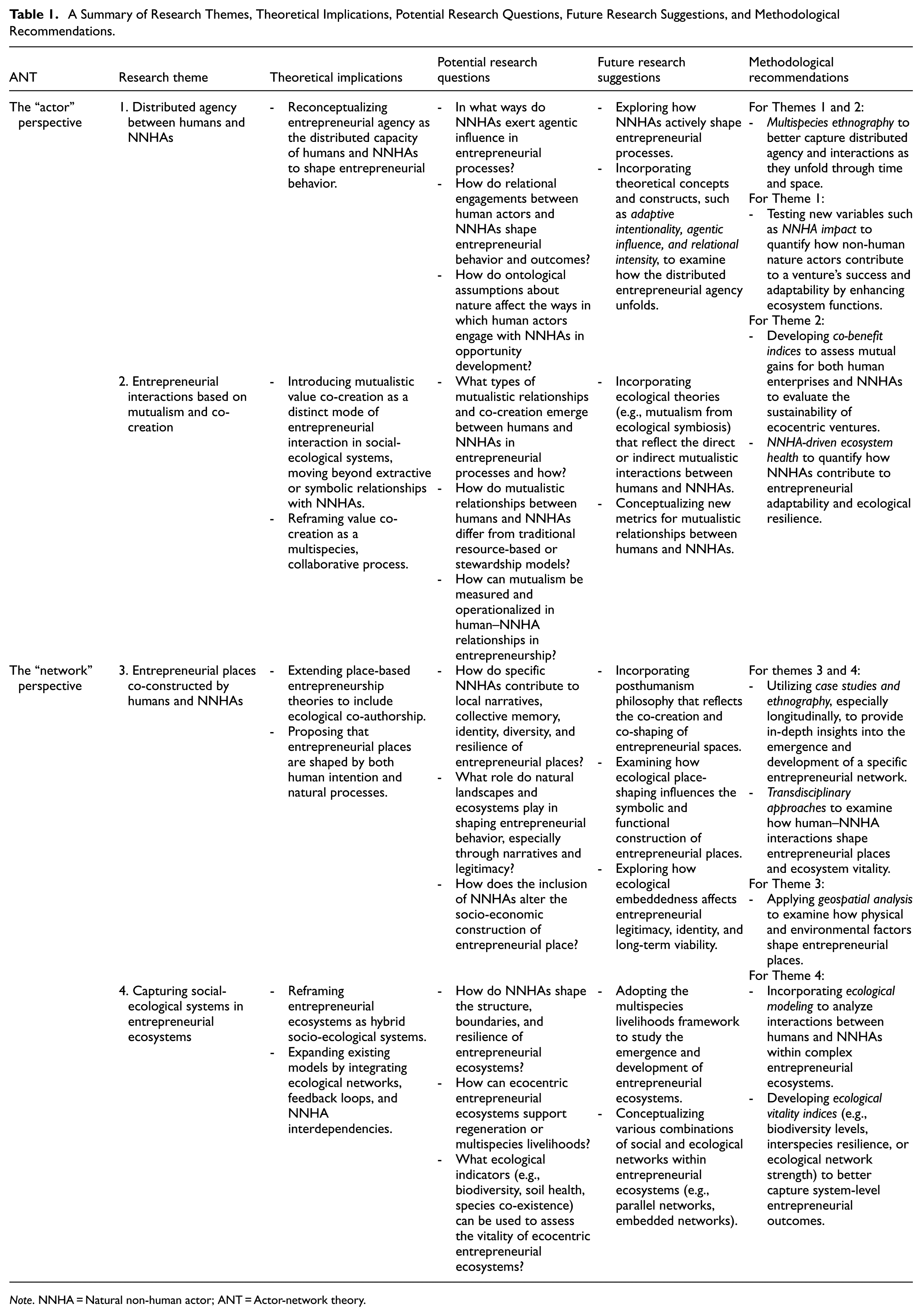
Note. NNHA = Natural non-human actor; ANT = Actor-network theory.
Discussion and Conclusion
As grand challenges such as climate change and biodiversity loss intensify, scholars might be compelled to rethink the dominant narratives of entrepreneurial behavior that have revolved exclusively around human agency and exploitative actions. However, the agentic roles of NNHAs have received significantly less attention (exceptions include Hunt et al., 2022; Melin & Gaddefors, 2023; Muñoz & Hernandez, 2024; Thomsen et al., 2024). Gaining a deeper understanding of ecocentric entrepreneurship calls for an investigation of NNHAs’ roles in current entrepreneurship literature and how entrepreneurial behavior can emerge through distributed agency and overlapping networks between humans and NNHAs.
As we have shown, the majority of existing entrepreneurship research has conceptualized NNHAs as having a passive role, including as resources (Dean & McMullen, 2007; Parrish, 2010), beneficiaries (Hörisch, 2018; Iakovleva et al., 2012; Vesalon & Anghel, 2024), or influencers (Fernhaber & Stark, 2019; O’Neill et al., 2006; Shi et al., 2021). Therefore, our current understanding of entrepreneurial behavior has remained largely anthropocentric. We hope our work can raise awareness and provide researchers with a comprehensive basis upon which to examine NNHAs in entrepreneurship research. We appreciate the current scholarship that underscores the active role of NNHAs as partners (Vlasov, 2021; Melin & Gaddefors, 2023; Muñoz & Hernandez, 2024) and as generative agents (Hunt et al., 2022). However, our work seeks to further advance the ecocentric entrepreneurship by better understanding entrepreneurial behavior.
The inclusion of NNHAs in theorizing about ecocentric entrepreneurship—while unconventional—aligns with calls for expanding the scope of entrepreneurship research by building meaningful heterodoxies (Pidduck & Tucker, 2022). Moreover, we are encouraged by Shepherd and Sutcliffe’s (2015) guidance in recognizing the potential of anthropomorphizing as a reflexive, theory-building approach. Taken together, these perspectives (Pidduck & Tucker, 2022; Shepherd & Sutcliffe, 2015) have inspired our efforts to advance ecocentric entrepreneurship, which repositions entrepreneurial behavior as a reoccurring interspecies, relational phenomenon embedded in entrepreneurial places and ecosystems.
Informed by ANT, we use a relational approach to place a greater focus on NNHAs in conceptualizing entrepreneurial behavior related to ecocentrism. Our work has several theoretical implications for entrepreneurship research. From the “actor” perspective, we reconceptualize entrepreneurial agency (McMullen et al., 2021) as distributed among both humans and NNHAs, thereby shaping emergent entrepreneurial behavior regarding ecocentrism. Recognizing the active agency role of NNHAs (Hunt et al., 2022) will align entrepreneurship behavior with the environmental challenges of our time. The distributed agency view challenges us to reconsider who or what is allowed to “act” in entrepreneurship. Going beyond the view that NNHAs are passive resources, we recognize that they have autonomous behaviors and ecological functions that materially shape entrepreneurial opportunities and constraints. Furthermore, building on the recent work on mutualism (Muñoz & Hernandez, 2024), we introduce mutualistic value co-creation as a distinct mode of entrepreneurial interaction in social-ecological systems (Ostrom, 2009; Partelow, 2018; Poteete et al., 2010). This advocates for entrepreneurship research moving beyond exploitative, instrumental, or symbolic relationships with NNHAs.
From the “network” perspective of ANT, we offer deeper meanings of ecocentric entrepreneurial behavior extending into entrepreneurial places and entrepreneurial ecosystems, by expanding the meaning of “ecosystems.” By placing nature at the core of entrepreneurial networks, our work offers a transformative lens for understanding entrepreneurship in an interconnected world. We extend place-based entrepreneurship theories (Kibler et al., 2015; Kimmitt et al., 2024) to include ecological co-authorship and propose that entrepreneurial places are shaped by both human intention and natural processes. Moreover, we reframe entrepreneurial ecosystems (Spigel, 2017; Stam, 2015; Wurth et al., 2022) as parallel or embedded socio-ecological systems, which expands existing models by integrating ecological networks, feedback loops, and NNHA interdependencies. Our ecocentric lens reveals how ecological ecosystems, such as forests, rivers, or wetlands, are not just physical settings but integral parts of entrepreneurial networks. Entrepreneurs in regenerative agriculture or ecosystem-based tourism do not merely use nature, they co-create with nature by responding to ecological signals, rhythms, and limits. This perspective reanimates the ecosystem metaphor, restoring its ecological substance and providing a more grounded model for resilience and sustainability.
While future research on ecocentric entrepreneurship would benefit from the research themes advanced in this paper, we do not suggest a complete disregard of anthropocentric perspectives. Anthropocentrism remains theoretically appropriate where research questions focus primarily on human actors, organizational processes, and market mechanisms with limited or indirect ecological implications. By contrast, the inclusion of NNHAs through an ecocentric lens becomes particularly salient in solving research questions on sustainability and grand challenges, where entrepreneurial activities are interconnected with ecological systems.
Furthermore, we recognize that other non-human interventions at the human–NNHA interface also hold promise beyond those described herein. For example, entrepreneurship scholars have already recognized the prominence of technologies (which are one type of non-human actor). There is a call for the explicit theorizing of digital technologies in entrepreneurship (Nambisan, 2017), highlighting the importance of digital innovations (George et al., 2021), and exploring the artificial intelligence-entrepreneurship nexus (Shepherd & Majchrzak, 2022). For instance, the Earth Species Project (2026) leverages artificial intelligence to help human actors interpret and respond to the needs and signals of wildlife. We encourage scholars to extend this perspective by exploring broader interactions between humans, NNHAs, and artificial non-human actors, thereby deepening our understanding of NNHA agency and interaction, especially with potential entrepreneurial implications.
Finally, we suggest expanding ANT by integrating ethical considerations, particularly the recognition of intrinsic, not merely instrumental, value in ecological participation. Advancing ecocentric entrepreneurship contributes to maintaining the web of life (Moore, 2015) and to more inclusive, sustainable understandings of entrepreneurial behavior. This paper builds on and contributes to the advancing stream of ecocentric entrepreneurship research (Hunt et al., 2022; Melin & Gaddefors, 2023; Vlasov, 2021), while expanding our theorizing of relational agency and interdependence between humans and NNHAs in entrepreneurial networks. Ultimately, we highlight the usefulness of a shift from anthropocentric to ecocentric entrepreneurship, enabling a more inclusive and dynamic understanding of entrepreneurial behavior that reflects the full spectrum of interspecies and ecological interactions. By advancing ecocentric entrepreneurship, we hope this paper can inspire entrepreneurship scholars and practitioners to rethink the boundaries of our field. The transition toward regenerative futures requires fundamental reimaginations of entrepreneurial agency, interactions, places, ecosystems, and the intricate interdependencies between humans and NNHAs.
Supplemental Material
sj-pdf-1-etp-10.1177_10422587261447791 – Supplemental material for Into the Wild: Advancing Ecocentric Entrepreneurship Through Natural Non-Human Actors
Supplemental material, sj-pdf-1-etp-10.1177_10422587261447791 for Into the Wild: Advancing Ecocentric Entrepreneurship Through Natural Non-Human Actors by Man Yang and Matthew Phillip Johnson in Entrepreneurship Theory and Practice
Footnotes
Acknowledgements
We are thankful to our editor, Richard A. Hunt, for his excellent editorial guidance and generous support. We thank the three anonymous reviewers for their constructive feedback. We also appreciate the constructive feedback provided by Karl Wennberg and Pablo Muñoz during the development of the original submission. We are grateful to Joakim Wincent and Jacob Hörisch for their friendly reviews during the revision process.

Author Contributions
The two authors have contributed to this manuscript equally.
Funding
The authors disclosed receipt of the following financial support for the research, authorship, and/or publication of this article: The authors gratefully acknowledge the financial support of the Research Council of Finland [grant number 322640].
Declaration of Conflicting Interests
The authors declared no potential conflicts of interest with respect to the research, authorship, and/or publication of this article.
Supplemental Material
Supplemental material for this article is available online.
Notes
Author Biographies
References
Supplementary Material
Please find the following supplemental material available below.
For Open Access articles published under a Creative Commons License, all supplemental material carries the same license as the article it is associated with.
For non-Open Access articles published, all supplemental material carries a non-exclusive license, and permission requests for re-use of supplemental material or any part of supplemental material shall be sent directly to the copyright owner as specified in the copyright notice associated with the article.
