



Abstract
We seek to make ethnography more intelligible and accessible to entrepreneurship scholars. We begin by defining ethnography and discussing the promises and challenges of conducting ethnographic studies in entrepreneurship. Next, we offer practical advice for entrepreneurship scholars interested in conducting ethnographic studies, including suggested standards for designing, executing, and writing ethnography. We conclude by outlining possibilities for future research, highlighting how ethnographic inquiry can facilitate theoretical and methodological contributions to the field of entrepreneurship.
Introduction
Over the past few decades, qualitative research has become increasingly prevalent in management scholarship, as reflected by a growing number of submissions to, and publications in, prestigious outlets (Bansal et al., 2018; Howard-Grenville et al., 2021). Such growth speaks to the strengths of qualitative research, especially its ability to unlock profound understandings of “how things work in the equivocal and enigmatic worlds of organizations” (Van Maanen, 2011a, p. 218), and to reveal new insights and explanations that honor an individual’s lived experience (Bluhm et al., 2011; Corbin & Strauss, 2014; Lee et al., 1999; Pratt, 2009).
These growth trends have triggered calls for the inclusion of more qualitative methods in entrepreneurship research. Indeed, recent editorials and special issues highlight the merits of qualitative research in capturing concepts at the heart of entrepreneurship theory as well as dynamic features of the entrepreneurial process (Baker et al., 2017; Hlady-Rispal et al., 2024; Welter & Baker, 2021). Suddaby et al. (2015), for example, emphasized the broad relevance and place of qualitative research in addressing fundamental questions specific to entrepreneurship theory, such as the origins of opportunities. Similarly, Van Burg et al. (2022) argued that qualitative research is well suited to reflect the particularity of various entrepreneurial contexts, the heterogeneity and volatility that distinguish launching and running new ventures, as well as the mundanity that is inherent in building a business.
Beyond such an increased interest in qualitative methods generally, entrepreneurship scholars have recently expressed a growing curiosity in ethnography more specifically as a promising methodology to unlock novel theoretical insights (Branzei & Fathallah, 2023; Crosina, 2018; Dumont, 2024; Fisher, 2024; Kim & Kim, 2022). Ethnography is “both a methodological approach to and an analytic perspective on social research” (Van Maanen, 2011a, p. 218) and comprises of “the study of people in naturally occurring settings or ‘fields’ by methods of data collection which capture their social meanings and ordinary activities, involving the researcher participating directly in the setting… in order to collect data in a systematic manner but without meaning being imposed on them externally” (Brewer, 2000, p. 6).
Interest in ethnography among entrepreneurship researchers stems from the recognition that ethnography can help illuminate various understudied aspects of entrepreneurship. These include the mundane activities in which founders and their successors engage to build and develop their ventures, the host of contextual influences and relationships that inform their actions, as well as, more fundamentally, the “hows,” “whys,” and “whats,” or the meanings that undergird their behaviors and the functioning of the organizations they create and inhabit (Crosina, 2024; Radu-Lefebvre et al., 2021). As an illustration, in 2017 Princeton University organized a conference entitled: “Expanding Understanding of Business Creation: Adding More Ethnography into the Research Mix.” In the words of one of the organizers, the goal was “…to change the face of entrepreneurship studies by advocating strongly for serious inclusion of ethnography. That is, research in which investigators spend time really getting to know social situations, communities or organizations—in this case, those relevant to business creation” (Plump, 2017).
The growing interest in ethnography has also coincided with methodological innovations in qualitative research that create new opportunities for scholars. Traditionally, ethnographies involved researchers being physically present with those whom they were studying. However, technological advancements have made possible the proliferation of additional types of ethnographic studies which may not require a scholar’s consistent personal presence in the field such as video ethnography and netnography (Pratt & Kim, 2012; Pratt, 2025; Smets et al., 2014). 1 In some rare circumstances, technology may even enable the study of one’s own experiences via autoethnography (De Rond et al., 2019; Fisher, 2024).
Yet, despite scholars advocating for and recognizing the merits of ethnography (Hlady-Rispal et al., 2024; Johnstone, 2007; Poldner, 2020; Pratt & Kim, 2012; Radu-Lefebvre et al., 2021), as well as the increasing availability of novel approaches and technologies for conducting ethnographic research (Pratt, 2025), we are not seeing a commensurate rise in ethnographic studies within entrepreneurship (Fletcher, 2011; Van Burg et al., 2022). Several factors limit scholars from fully leveraging ethnography’s potential (Mismetti et al., 2024). To begin with, there is a general lack of ethnographic training in entrepreneurship PhD programs, which discourages students from pursuing ethnographic work throughout their careers and hinders their ability to serve as informed reviewers. Once in employment, junior scholars may fear the substantive time commitments and uncertainty of an ethnographic project as it introduces risks to promotion and/or tenure realization. As a result of limited training and practice, there does not seem to be clear agreement among entrepreneurship faculty on the criteria for planning, executing, and publishing a high-quality ethnographic study (Pratt & Bonaccio, 2016; Pratt et al., 2020).
Field level and other issues that are specific to the entrepreneurial process may have also contributed to the paucity of entrepreneurship ethnographies. Gatekeepers in entrepreneurship research often favor quantitative methods that promise statistically generalizable findings and align with dominant positivist paradigms that marginalize the epistemological value of ethnographic approaches. Institutional pressures to match research with funding agency priorities may also devalue ethnographic methods due to their lower scalability and replicability. In addition, the unpredictable nature of entrepreneurial processes can make designing a traditional ethnographic study challenging, particularly if scholars lack training in this method. Finally, concerns about gaining access to entrepreneurial field sites—especially in high-stakes or proprietary environments—can discourage researchers from pursuing ethnographic endeavors.
In sum, various factors constrain the ability of entrepreneurship scholars to leverage a fuller range of qualitative methodological tools needed to uncover novel theoretical insights (Welter & Baker, 2021). This disadvantages those who recognize the potential of ethnographic research but are unsure where to begin (Pratt, 2009; Pratt & Kim, 2012), and it can hinder efforts to develop a shared understanding of what constitutes “high-quality” ethnographic work among authors, editors, and reviewers (Van Burg et al., 2022). Our primary objective in this article is to help demystify ethnography, and in so doing, make it more intelligible and accessible to entrepreneurship scholars ranging from novices to experienced researchers. We begin by defining ethnography and discussing promises and challenges associated with conducting ethnographic studies in entrepreneurship. Then, we proceed with offering practical advice for using ethnographic methods in entrepreneurship and conclude by discussing opportunities for future research.
What is Ethnography?
The term ethnography comes from the Greek ethnos (people) and graphia (writing). As a research tradition, ethnography traces its roots to the field of anthropology, and specifically to the early 1800s, when anthropologists became increasingly interested in exploring “the New World.” Important figures in developing ethnography as a research method include Bronisław Malinowski and Margaret Mead. Among others, Malinowski helped systematize participant observation, which became a cornerstone of ethnographic research; and Mead showed the importance of appreciating the cultural context for understanding human behavior (see Adler & Adler, 1987; Marcus, 1995; Ugwu, 2017 for a more extensive historical background). In organizational contexts, ethnography has been strongly influenced by the work of Van Maanen (2011b) and Barley (1986). These researchers have paved the way for other organizational scholars by taking “deep dives” into the work experiences and culture of various occupational groups, including police officers, funeral directors, radiologists, scientists, and engineers, among others.
Although definitions of ethnography vary (see Table 1 for a summary), there is broad agreement that ethnography is a method “concerned with the study and representation of culture as used by a particular [group], in particular places, at particular times” (Van Maanen, 2011a, p. 221). Through in-depth fieldwork that includes protracted observations and interviews, ethnography captures the often-overlooked cultural distinctions that drive the activities of individuals and organizations within a given context (Geertz, 1973; Langley et al., 2023; McKeever et al., 2015; Musante & DeWalt, 2010). As such, ethnography focuses on answering questions of “how” and “why” more than “how much” or “how many.”
Selected Definitions of Ethnography.
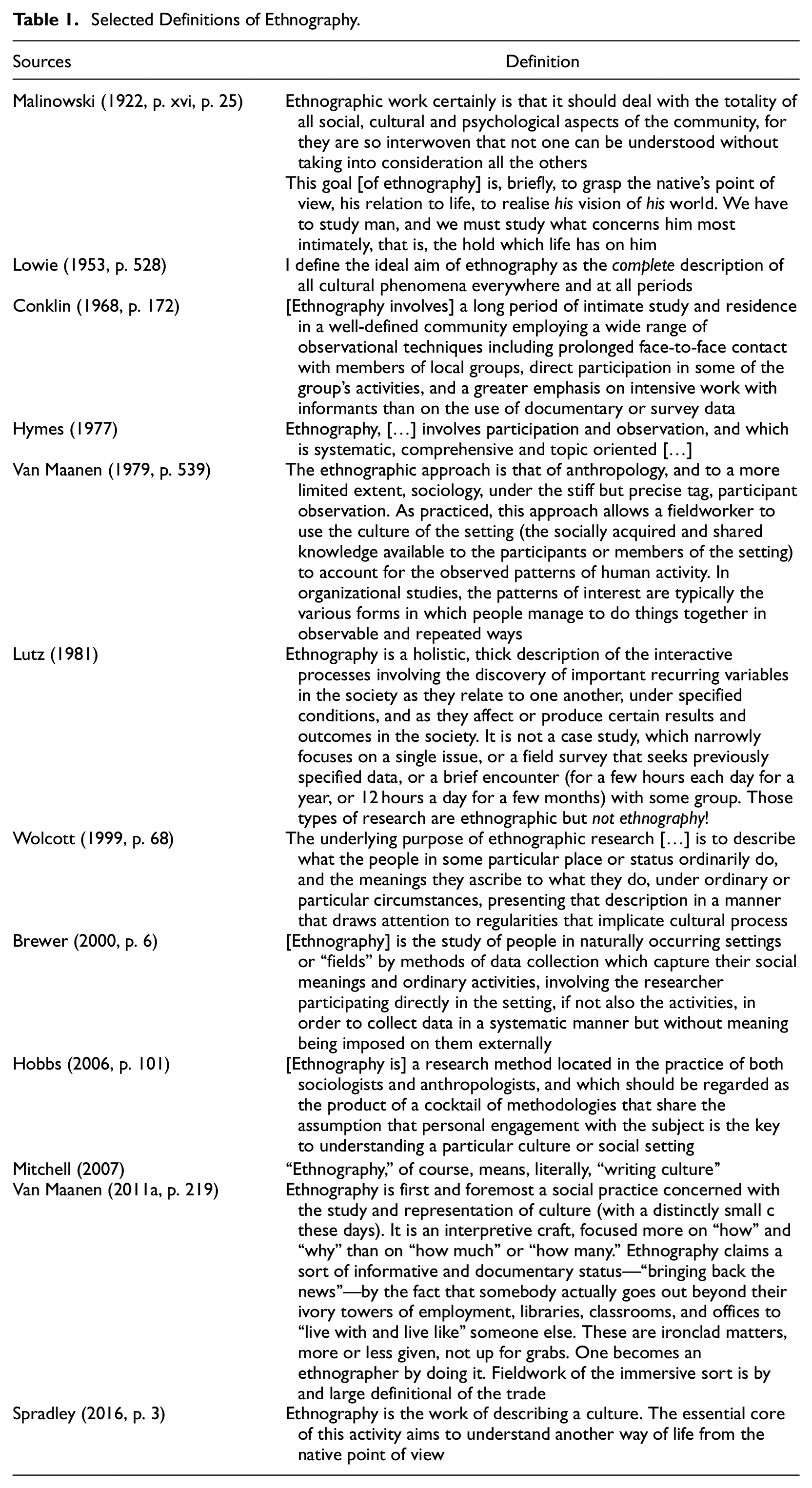
To uncover deeper meanings, ethnographers utilize different types of data sources common to other qualitative methods, such as interviews and archival documents. However, ethnography is unique in its heavy reliance on contextualized data collection, including observations, and in many cases, on participant observation—whereby researchers engage in some of the work performed by those they study. For example, Pratt (2000) examined processes of managing organizational identification by starting an Amway business, whereas Crosina (2024) worked from a coworking space amongst the entrepreneurs she studied, and Murphy (Murphy & Kreiner, 2020) studied identity legitimacy in an emerging occupation by becoming a certified health coach.
Ethnography also differs from other qualitative methods because it focuses on the entire research process—from study design through analysis (Spradley, 1980). Case studies, by contrast, are particularly helpful in facilitating study design, whereas grounded theory focuses primarily, although not exclusively, on analyzing data (Pratt, 2025). However, this does not mean that researchers must follow an ethnographic approach in its entirety when studying entrepreneurial (or other) contexts. Rather, they may more selectively adopt specific ethnographic techniques (Pratt & Kim, 2012) such as utilizing ethnographic interview questions (Spradley, 1979), or employing coding and analyzing data following ethnographic principles (Pratt, 2023; Spradley, 1980).
Promise of Ethnography in Entrepreneurship
Ethnography Can Help Unearth Implicit or Taken for Granted Meanings at the Heart of New Venture Creation
Entrepreneurship is a dynamic process (McMullen & Dimov, 2013) characterized by complex interpersonal relationships, tacit knowledge, and decision-making under conditions of uncertainty (Shepherd, Souitaris, & Gruber, 2021; Shepherd, Williams, & Patzelt, 2015). Specifically, research suggests that new venture creation is often iterative and winding (McMullen & Dimov, 2013), with individuals experimenting, and acting their way into unchartered territories (Valentine et al., 2024). As ventures emerge and grow, many entrepreneurs pivot in efforts to address unexpected setbacks and/or capture opportunities (Crosina et al., 2024; Hunt et al., 2024; Shepherd & Pollack, 2025). To navigate such ongoing ambiguity and fluidity, founders lean on others, developing critical, and in many cases multiplex, relationships with various stakeholders (Mathias & Wang, 2023).
We argue that ethnography comprises an especially helpful approach through which such complex and dynamic relationships may be identified and captured. Protracted engagement in the field, including through longitudinal interviews and observations, enables researchers to grasp both how entrepreneurs think and feel about their relationships, as well as how such relationships manifest in action. Although interviews are particularly well suited to capture entrepreneurs’ motivations and thoughts (Mathias & Williams, 2018; Rouse, 2016), observations can help unveil patterns of interaction (Williams & Fathallah, 2024) and how such patterns contribute to different trajectories of entrepreneurial venturing (Thorgren & Williams, 2023). At the heart of such patterns are often taken for granted meanings, which can lay outside an entrepreneur’s conscious awareness (Crosina, 2024).
Identifying the taken-for-granted, nonconscious, meanings underpinning entrepreneurial behavior is critical (Williams et al., 2024) because they also inform action (Dumont, 2024). To illustrate, in her ethnography of collocated founders, Crosina (2024) discovered that where entrepreneurs sat, and with whom they interacted over time, shaped their definitions of entrepreneurship, as well as “who they were” relative to their developing understandings. The founders in her sample did not connect that their patterns of interactions related to their evolving self-understandings. However, the author was able to trace this link by engaging with her informants over time, including by talking to them and observing them engaging in their “everyday” life as entrepreneurs.
In the context of entrepreneurship, such implicit understandings are likely to be especially salient and prevalent because, unlike the members of many other occupational groups who undergo protracted and standardized socialization (Pratt et al., 2006), founders are not subject to such socialization to learn what to do. As a result, their perceptions of what entrepreneurship means, and of their behaviors tend to be learned in the process of “doing” entrepreneurship (Shepherd et al., 2021). Ethnography offers an invaluable window for capturing such perceptions and meanings, which develop through acting and interacting.
As an additional example, in their study of a Silicon Valley accelerator, Krishnan et al. (2021) utilized protracted observations to understand the role of interaction rituals within social events in generating varying exchange expectations among founders and stakeholders. Such expectations led some founders to nurture affirming and stable connections, and others to form only weak ties and a sense of detachment from others within the accelerator. As the authors explain in their discussion, “unpacking the interaction dynamics within social events allowed us to identify the conditions under which accelerators evolve into a community of giving… versus degenerate into an “invitation to exploitation…’” (Krishnan et al., 2021, p. 700). In both cases, “context,” which tends to be assumed (see Welter & Baker, 2021 for a comparable critique), was closely related to critical outcomes including entrepreneurial identity (Crosina, 2024) and the development of distinct perceptions of “what this accelerator is” and “what it can do for me” (Krishnan et al., 2021).
Ethnography Can Help Bring the Multi-Level Nature of Entrepreneurship to the Fore, Highlighting the Interplay of Context and Individuals
Entrepreneurship is a multi-level phenomenon. It involves founders with their identities, imagination, emotions, and ambitions (Gartner, 1990); the pursuit of opportunities (Shane & Venkataraman, 2000); as well as the mobilization of an array of resources to make entrepreneurial aspirations a reality (Williams et al., 2024). To develop a business idea into an opportunity, founders draw from the context in which they are embedded (Ucbasaran et al., 2001). We argue that ethnography is a well-suited methodology to capture the dynamic interplay of these critical elements (people, ideas, and contextual resources) at the heart of entrepreneurship, and particularly how and why these various contextual and intrapsychic elements connect.
Attending to Context
The context where entrepreneurs start their businesses, and whom or what they have access to in relation to this “where,” informs the development of their organizations, and in some cases, of entrepreneurs themselves (Baker & Welter, 2018). Put simply, context matters. Attending to context, and to the situated nature of organizing, is thus critical to achieve a more grounded understanding of entrepreneurship (Welter, 2011). As Hlady-Rispal et al. (2024, p. 890) eloquently summarized, “Contextualization enables the researchers to show the situated nature of entrepreneurial routines and praxes (Chalmers & Shaw, 2017).” Thus, by helping researchers capture how behavior unfolds in situ, ethnography opens the possibility of better understanding the physical and social milieux in which entrepreneurs and their ventures are embedded. It also enables scholars to trace links between entrepreneur communities, their actions, and motivations, and thus to more systematically honor how context shapes, and is shaped by, how entrepreneurs think and act (De Massis et al., 2018; Welter & Baker, 2021).
Capturing Mundane Activities
Ethnography is also well suited to capture everyday language, meaning, and behavior, all of which are critical for making novel theoretical advancements (Bakker & McMullen, 2023). For example, Arshed et al. (2019) found that everyday interactions among actors within a local ecosystem informed the development of women’s enterprise policy (WEP). As the authors themselves noted, “through our ethnographic perspective, it becomes possible to observe the mundane reproduction of ‘WEP’ through meetings, coffee breaks, and other episodes of practical work where individuals adapt WEP within the constraints of their own local contexts and networks of relations” (Arshed et al., 2019, p. 575). Mundane interactions may seem unimportant; yet, when logged and analyzed systematically over time, they can help scholars unearth and explain overlooked patterns of behavior (Van Burg et al., 2022), and, in so doing, appreciate the role of everyday action in the entrepreneurial process.
Understanding Complex Systems
In addition to being well suited to capture the mundanity that developing and running a venture involves (Van Burg et al., 2022), ethnography can also help scholars shed light on the inner workings of particularly “complex systems.” Early-stage ventures and entrepreneurial communities are a primary example of such systems (Shepherd et al., 2021; Williams & Shepherd, 2016, 2021). For instance, in her study of emerging nanotech communities, Grodal (2018) showed that core and peripheral groups mobilized differently to manipulate social and symbolic field-level boundaries and articulated why and how these dynamics manifest. Specifically, her extensive observations, coupled with interviews and archival data, helped her narrow in on community identification as a primary mechanism (Grodal, 2018). This explanation, as the author makes evident, emerged only as she spent more and more time in the field.
In sum, ethnography can bring depth and richness to our understanding of the factors that influence how and why entrepreneurs and their businesses gain and maintain credibility, including by sensitizing scholars to bodily/physical, and other material influences.
Ethnography Can Help Shed Light on the Emotions that Manifest Throughout the Entrepreneurial Process
Venture development is a highly emotional process from the beginning (i.e., venture ideation and launch) to the end (i.e., venture harvest/closure; Cardon et al., 2012; Williams & Shepherd, 2025; see Portocarrero et al., 2024 for review). For example, scholars have frequently used the parenting metaphor (Cardon et al., 2005) as an illustration of the deeply emotional and personal nature of the relationship that ties entrepreneurs to their businesses. They have also expended considerable efforts toward articulating the emotions entrepreneurs experience when pursuing transformational opportunities (Williams & Shepherd, 2025) and facing setbacks and challenges (Crosina et al., 2024), including project and/or venture failure (Rouse, 2016; Shepherd & Williams, 2018).
Ethnographic fieldwork can help entrepreneurship scholars unearth how emotions manifest in entrepreneurs’ everyday lives, and how they inform the entrepreneurial process. Capturing entrepreneurs’ expressed emotions matters for three primary reasons. First, emotions tie to how entrepreneurs see themselves (Byrne & Shepherd, 2015; Radu-Lefebvre et al., 2021) and to entrepreneurial action more broadly (Delgado et al., 2015; Williams & Shepherd, 2025). Thus, to understand entrepreneurs’ identities, and the behaviors in which entrepreneurs engage, it is important to understand their emotions.
Second, emotions relate to entrepreneur well-being. As research on stress and coping indicates (Ahmed et al., 2022; Lerman et al., 2021; Nikolaev et al., 2023; Partanen et al., 2025), creating and building a new venture can be taxing due to the ambiguity involved in developing a business, the heavy workload, and the ongoing adversities that founders confront in bringing their ideas to market. Thus, how entrepreneurs manage the negative emotions involved in the entrepreneurial process is critical to their propensity of persisting, and of effectively mitigating the mental health risks associated with entrepreneurial pursuits (Shepherd & Williams, 2018; Williams & Murphy, 2022). Recent research in this area (see Wach et al., 2021) encourages scholars to better understand an entrepreneur’s interpretations and experiences of various stressors through qualitative research. We argue that ethnography offers an invaluable opportunity to capture both interpretations and lived experiences of stressors, and to link the two in ways that other methods may not permit—at least not as systematically or as seamlessly.
Finally, and more broadly, not all feelings and behaviors are fully deliberate or conscious (Pratt & Crosina, 2016; Petriglieri & Stein, 2012). As such, entrepreneurs may not be able to articulate their emotions, why they feel as they do, or if/how their emotions influenced their entrepreneurial decision-making (Delgado et al., 2015; Portocarrero et al., 2024; Shepherd et al., 2015). Relying solely on self-reported accounts, such as through interviews, seems therefore, limited to appreciate the role of emotions in the entrepreneurial process. To our best knowledge, ethnographic research in this area is very limited. Participant observation may be particularly helpful to explore the emotional side of entrepreneurial endeavors. For example, Pratt (2000) not only experienced the discomfort of recruiting family and friends into Amway, but by actively participating in building the business, he was able to observe emotional reactions in others. Similarly, Sasaki et al.’s (2024) ethnographic study of Funabashiya, a Japanese family business undergoing renewal, highlights how emotions permeate change implementation efforts.
Beyond emotions, scholars can appreciate more fully the “human side” of entrepreneurship through ethnographic fieldwork—such as how entrepreneurs experience the process of building their businesses, the development of team dynamics, managing successes and failures, etc. (Bakker & McMullen, 2023). The ability to capture these dynamics stems from ethnographers coming into repeated contact with their informants. Protracted exposure offers scholars a close-up window not only to describe “what happens,” but also to understand the values, biases, heuristics, and experiences of those involved in entrepreneurship, as well as to explain how and why things happen. As such, ethnographic studies have the potential to advance the psychological foundations of management in entrepreneurial ventures, which play a particularly important role in shaping certain types of ventures such as family-owned businesses (Humphrey et al., 2021; Picone et al., 2021).
Ethnography Can Help Researchers Become More Self-Aware and Reflexive
In addition to helping illuminate less explored and critical aspects of entrepreneurship, we believe that the practice of ethnographic fieldwork can help scholars become more self-aware in their own research practices and craft (Pratt, 2000; Zilber & Zanoni, 2022). This is because ethnographic fieldwork behooves the researcher to take a reflexive stand, and in doing so, to recognize “what the researcher brings to the field,” as well as how researcher and researched interact in the co-creation of knowledge (Anteby, 2013). As an example, one of the authors in our team is studying entrepreneurial individuals who have been previously incarcerated. Their protracted interactions with these individuals are helping them realize and interrogate their prior assumptions about street violence and gang affiliations, largely rooted in their own experiences growing up in distant, predominantly white and safe, neighborhoods. To date, we know little about researcher assumptions, the background and connections that brought them to their field site/s in the first place, and especially how these more “personal inputs” influenced their work (Beer et al., 2025). We believe that these are important aspects in the analytical process of gathering, synthesizing, and explaining qualitative data (Pratt, 2023) that ethnography can help a scholar bring to the fore. This is because when writing up their fieldwork, ethnographers “bring themselves” into the picture to explain what they did, their motivations, and approaches.
Taken together, ethnography brings bright promise to the study of entrepreneurship, including by sensitizing scholars to less obvious but central aspects of new venture creation and development that only protracted field engagement can help unveil. However, these opportunities are accompanied by important challenges related to the phenomenon of entrepreneurship itself and the structure of scholars’ careers, among others. We articulate salient challenges next and suggest practical tactics for overcoming them, focusing on preparing, designing and executing of field work, as well as writing for publication.
Challenges of Ethnography in Entrepreneurship
Conducting an Ethnography in Entrepreneurship Involves an Especially Deep Commitment to the Field
Entrepreneurs are well rehearsed in telling their stories. As research suggests, at the outset of their journeys, an entrepreneur’s ability to marshal resources hinges on whether they can convince potential financial backers and other stakeholders that their endeavors are legitimate (Mangiò et al., 2023; Navis & Glynn, 2011; Williams et al., 2024). As they continue building their businesses, they still compete for resources—media attention, talent, financing, etc. (Brush et al., 2001; McMullen & Dimov, 2013). Here too, what they say can matter to the very success or failure of their ventures (Ge et al., 2022; Lounsbury & Glynn, 2001). As a result, many entrepreneurs invest considerable time and effort curating their messaging and actions to persuade others of their worth, keeping their “front and backstage” purposely separate. Due to the ongoing precariousness that distinguishes their work (Shepherd et al., 2021), entrepreneurs are often guarded when it comes to trusting others, and they are especially guarded in sharing their challenges and tribulations (Jafari-Sadeghi et al., 2022). Thus, trust building for the purpose of obtaining rich and transparent data may require substantive effort on the part of scholars (Williams & Shepherd, 2018), especially on the part of ethnographers interested in studying entrepreneurs’ lived experiences.
Issues of trust are not unique to early-stage ventures or to growing businesses. To illustrate: in family firms, family members can be protective of one another and of their endeavors (Gersick et al., 1997)—which can make it difficult for a scholar to gain access (De Massis & Kotlar, 2014). Making matters worse, family firms are imbued with tacit knowledge and interwoven relationships, and decisions are often driven by ostensibly mundane interactions and taken for granted meanings and assumptions (Bettinelli et al., 2022; De Massis et al., 2016; Mismetti et al., 2023). Here too, protracted engagement in the field can help a researcher gain sufficient trust and openness to understand how things work (Johnstone, 2007; Van Burg et al., 2022).
Thus, capturing processes of entrepreneurship through ethnographic methods can be time-consuming and highly uncertain. For example, ethnographers may need to engage in “commitment acts”—actions that researchers take to show their informants that they are “one of the gang”—which take considerable time and effort (Feldman et al., 2004; Pratt & Kim, 2012). To illustrate, recounting his fieldwork in Bali with his wife, Geertz noted that, at first “We were intruders, professional ones, and the villagers dealt with us as Balinese seem always to deal with people not part of their life who yet press themselves upon them: as though we were not there… we were…invisible…” (Geertz, 2005, p. 56). Only after an unexpected police raid, to which the researchers responded as the villagers did (i.e., by fleeing and lying) rather than using their position of privilege, they were “in.” In his words, “The next morning the village was a completely different world for us. Not only were we no longer invisible, we were suddenly the center of all attention, the object of a great outpouring of warmth, interest, and, most especially, amusement. Everyone in the village knew we had fled like everyone else” (Geertz, 2005, p. 58).
In our own field work, we routinely engage in commitment acts. To illustrate, in an ongoing project, one of authors in our team is learning how to play videogames—a common activity in which their informants engage as part of their membership in the organization. Commitment also takes the form of persistence. Indeed, as our examples suggest, entering the field—or being granted formal permission on the part of an individual and/or organization to start fieldwork—does not necessarily coincide with “being in” or having access. For example, another member of the author team has been working with Native American tribes and an Arizona Native American gaming official for several years to build relationships, establish common interests, and eventually receive permission to visit Native American Casinos and observe Tribal decision-making processes. While these ethnographic approaches hold promises to reveal novel insights, the time commitment and uncertainty associated with the endeavor may be misaligned with a typical scholar’s timeline to fulfill critical performance criteria.
Ethnographic Fieldwork is Ridden with Unexpected Events that Add Unpredictability to a Scholar’s Research Process
As in Geertz’s earlier example, unexpected events can turn out for the best, but it is also possible that access may become more restricted and, in the worst case, lost, due to events beyond one’s control. These dynamics can bring about additional stress, especially for junior scholars “on the clock,” seeking to complete their dissertations and/or to earn their tenure. For example, one of the authors travelled to the Dominican Republic with plans to observe a local organization for several weeks. However, upon their arrival, the founder of the organization proposed driving to Haiti, which required adaptation to the new context, openness to novel and uncertain experiences, and additional time to gather and make sense of the data. Similarly, Thorgren and Williams (2023) studied refugee entrepreneurship in Sweden longitudinally. However, as their study unfolded, they found that many individuals did not launch ventures—demonstrating the risk of conducting longitudinal, ethnographic studies on entrepreneurship processes.
Uncertainty About Which Social Dynamics to Observe
At the outset of an ethnography, or any study involving intensive observations, there is uncertainty regarding questions such as: what should I observe exactly? Where should I observe? When should I start observing and for how long? (Pratt & Sala, 2021). The answers to these questions are rarely straightforward (Barley, 1990) but may be especially unclear for ethnographic studies in entrepreneurial contexts. To illustrate, early in the life of a venture, when a business is just an idea, founders may not have a dedicated location from which they work. Instead, they may move from one place to another, meeting individuals formally and informally for the purposes of networking and gathering resources. These challenges are only magnified by the fact that for many entrepreneurs a large part of the entrepreneurial process happens online, through digital means. Devising a comprehensive field strategy, including observation and interview protocols, may thus be especially challenging.
In addition to confusion around where, when, and how to best observe, ethnographers can be unsure about how to take notes, or how to systematically record their observations (Pratt & Sala, 2021). In this regard, Wolcott (1994, p. 159) acknowledged that different people attend to different things depending on their experience with the context, as well as their research question. As a result, their observations may be guided by different principles, spanning from “observe and record ‘everything’” to “observe and record nothing in particular,” to focusing on paradoxes or key problems confronting a group.
Compounded Risks of Combining a Methodology that Lacks Standardization with a Fluid Phenomenon
Ethnography lacks standardized practices particularly when compared to other qualitative methodologies such as grounded theory or case study research (Pratt, 2025). As Giardina and Donnelly (2024) eloquently stated: “There is no one ‘right’ or ‘correct’ way to do ethnography… The challenge for the researcher is understanding not only which approach is best for them and how to execute that approach, but why” (Giardina & Donnelly, 2024, p. 365). Due to this overarching lack of methodological standardization, it can be daunting for someone new to the methodology to get started (Pratt & Kim, 2012).
When the context of study is an entrepreneurial setting, the challenges associated with lacking methodological standardization are amplified by the fluidity that distinguishes entrepreneurial environments. In the case of early-stage entrepreneurial ventures, in particular, there are generally only very few pre-existing organizational structures upon which a scholar may rely to anchor his/her observations (e.g., clearly defined roles or routines). Such lack of pre-defined structure can yield disorientation, particularly when commencing fieldwork. To capture this disorientation, Spradley (1980) used the metaphor of map makers: “In commencing filed work, an ethnographer is like a mapmaker who sets foot on an unchartered island. Because the terrain is unknown, the map maker cannot set out to locate deposits of iron ore” (Spradley, 1980, p. 81). Thus, there can be days in the field that seemingly yield little data of lasting value. It simply takes time “to fit into the scene, adjust to people, gain acceptance, and begin to understand what was going on” (Whyte, 1984, p. 27).
Pathways for Conducting Ethnographic Research
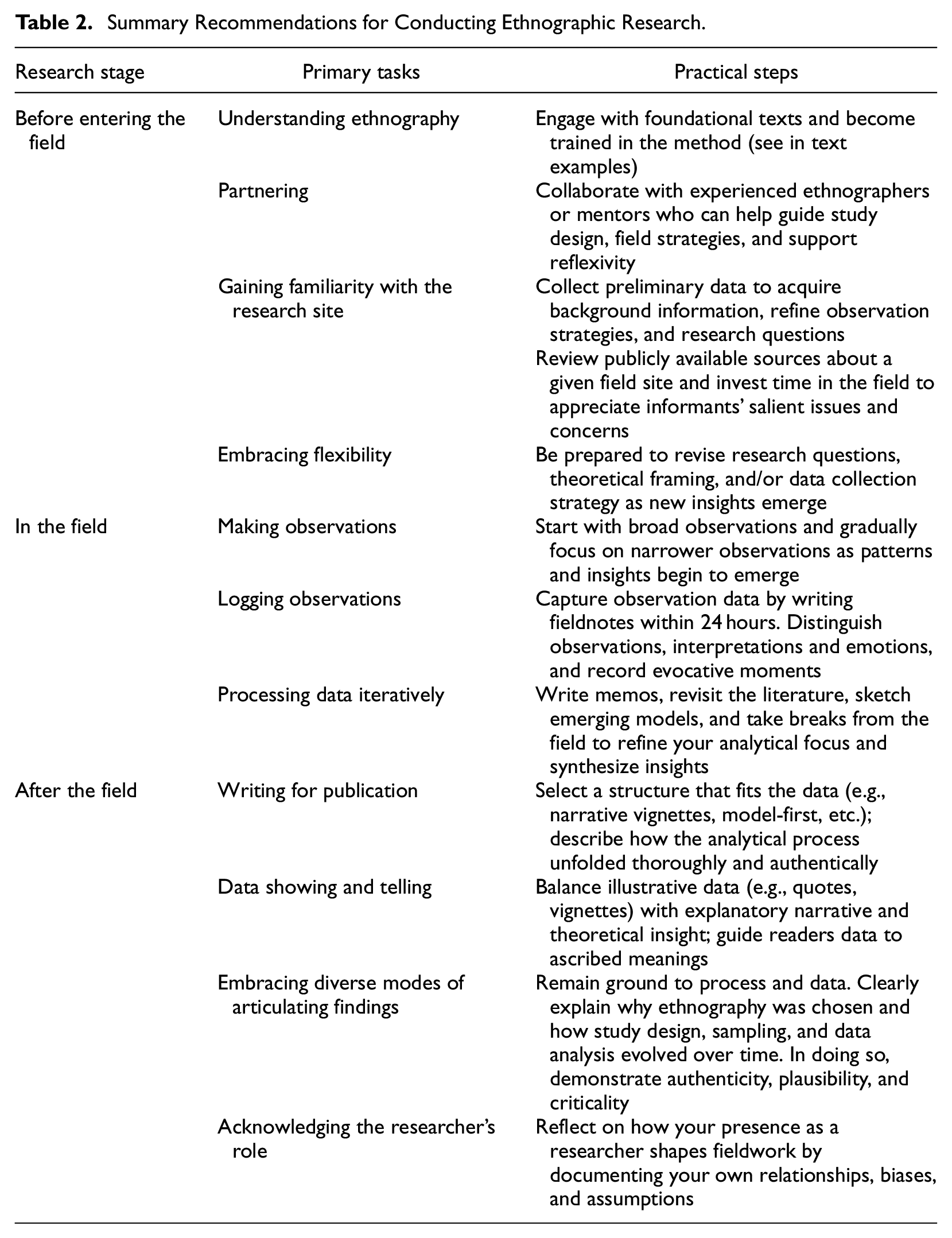
As daunting as they may appear, the challenges inherent to undertaking an ethnography in entrepreneurship are not insurmountable. In the paragraphs that follow, we offer practical recommendations that can help scholars mitigate these challenges through thoughtful study design and execution. We organize our recommendations across stages common to any research project: from before data gathering to writing for publication. These recommendations are summarized in Table 2. Although we have neatly delineated these temporally, some of these recommendations (e.g., embracing flexibility and acknowledging one’s role in the field) may carry over from “before entering the field” to “in the field” and “after the field.”
Summary Recommendations for Conducting Ethnographic Research.
Before Entering the Field
Understanding the Method Prior to Gathering Data
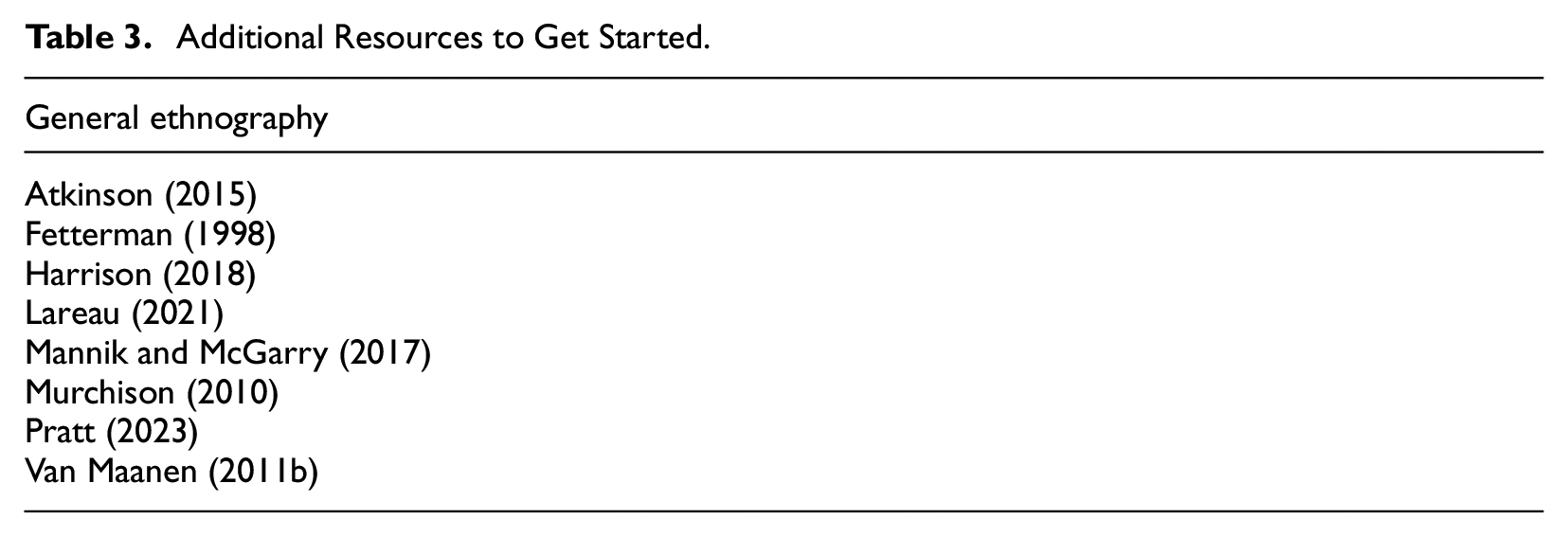
Beyond considering classic texts such as Spradley (1979, 1980), as well as newer sources—some of which we list in Table 3—individuals can also seek training in courses both within their own universities as well as online (see e.g., courses by the Consortium for the Advancements of Research Methods and Analysis, or CARMA).
Additional Resources to Get Started.
Such training may go beyond “book learning.” To sensitize PhD candidates toward some of these critical practices, two of the authors on our team, who teach a qualitative methods class, require students to watch Donnie Brasco, a film that tells the story of undercover FBI agent Joseph Pistone as he infiltrates a prominent New York mafia family. After the film, they invite students to write about what Donnie does as he prepares to infiltrate the Mafia, about the phases of immersion he undergoes, as well as about how his participant observation affects his own identity, and ultimately about the opportunities and challenges that his approach as a participant observer unlocks. If you have not seen this film, you may consider watching it: it might elicit helpful reflection on how to prepare psychologically, physically, and emotionally to enter the field, and possibly it may even help you envision some of the challenges and trade-offs you may encounter during fieldwork! If you are looking for a less-violent alternative, you may consider Avatar—which was recommended to the last author by a student in his class.
Familiarity with the method is critical. As with all research, the design of an ethnographic study should fit with its intended focus. Researchers should be clear about why they believe ethnography is an appropriate option to address the research question, and they should articulate their logic in the methods sections of their articles (Pratt et al., 2022). They should also motivate their choice of a given group, organization, occupation, or other collective, and of their specific informants. Training helps with articulating such important motivations.
Partnering
Although learning about best practices is essential, one of the best ways to learn the method is by doing it. We therefore highly recommend to those contemplating an ethnographic study for the first time to consider partnering with someone with expertise or, at a minimum, with someone who has successfully conducted and published an ethnography before. This does not necessarily mean planning to be in the field with someone else. It means having someone to rely upon and to act as a “guide” to discuss study design before entering the field, and to lean on during fieldwork to (re)assess design, including observation and interview protocols, as well as to process data and emerging insights.
We are fond of small teams of researchers that involve an “insider” and an “outsider” (Crosina & Pratt, 2019; Strike & Rerup, 2016; Williams & Shepherd, 2016, 2021) because in this configuration one person can remain “anchored” primarily to the field site, whereas the other to the field more broadly, including to the theoretical perspectives that inform data synthesis and interpretation. In doing so, each collaborator contributes to the development of insights, bringing data or process/theory expertise to detect and explain salient patters. This perspective is consistent with how ethnographers in other disciplines learn how to do ethnography: by doing, and often as apprentices—working side-by-side experts to develop their skills and sensitivity.
Getting Familiar with the Research Site
It is also beneficial to collect some data on one’s research site prior to committing to an in-depth study to see if the dynamics of interest may indeed be observable (Pratt & Kim, 2012). This is particularly important when researchers have limited familiarity with the context in which they want to immerse themselves (Sampson, 2004). Sometimes, gaining familiarity involves in-person data collection. Pratt (2000), for example, attended an Amway “family reunion”/conference prior to committing to his study. Furthermore, such preliminary data gathering can help scholars acquire the knowledge and background information needed to iteratively design the study, including what or whom to observe, and how. It also aids in refining research instruments, such as protocols for participant/nonparticipant observation and interviews, as well as in (re)framing the research questions.
Some preliminary in-person data gathering may also be helpful to learn how to best gain access, as well as to determine the type of commitment acts one may be willing to take in gathering data. Regarding the latter, Peshkin (1984), a Jewish scholar, decided that he would attend events at his conservative Christian college, but that he would not convert. Pratt (2000) established that he would recruit people into Amway, but that he would not serve as their upline sponsors (he would introduce them to other distributors) because he had plans to leave the field.
Another way to gain familiarity with a research site is to review publicly available data sources (Pratt & Kim, 2012). These secondary data can help researchers develop a rudimentary understanding of salient issues and concerns that they may leverage as bases for initial conversations with their informants. For example, Williams and Murphy (2022) collected secondary data on former professional athletes’ careers trajectories post-retirement. These efforts revealed that many professional athletes struggle shifting careers leading them into financial crisis. Furthermore, this secondary data prepared the researchers to ask more informed questions upon entering the field.
We recognize that in some entrepreneurial settings there may be little/no publicly available information. Examples include entrepreneurs operating in informal or underground markets like street performers, vendors (Mathias, Solomon, & Hutto, 2024; Solomon et al., 2025), unregistered small businesses (Williams & Shepherd, 2016, 2021), early-stage startups, or ventures operating in closed/niche industries like defense contracting, just to mention a few. In such settings, spending unstructured time in the field is especially important.
Embracing Flexibility in the Focal Phenomenon, Research Question, and Data Collection
To faithfully represent the context under study, which is a key tenet of ethnographic fieldwork (Pratt, 2000), scholars may need to change their initial research question, and/or data gathering strategy. Remaining flexible from a study design standpoint is critical for entrepreneurship scholars interested in the early-stage emergence processes of new ventures because behaviors and structures are inherently precarious and fluid (McMullen & Dimov, 2013). Importantly, rather than shying away from disclosing possible design/data collection changes, scholars should describe them. As such, they will increase their openness to informants, while simultaneously making the research process more transparent for readers.
Flexibility with respect to research focus and types of data/process for data gathering does not however, mean the absence of a solid data collection plan. Rather, it means having a robust and working plan and remaining open to changing it in response to new information. Indeed, although approaches for gathering data vary (LeCompte & Schensul, 2012; Pratt & Kim, 2012; Pratt et al., 2022), devising a structured/systematic process helps orient the ethnographer, and helps with data robustness and trustworthiness down the line.
In the Field
When in the field, there are several practices researchers can adopt to capture data in a systematic way that upholds a “close” but sufficiently “dispassionate” perspective (Golden-Biddle & Locke, 2007, p. 10). In the paragraphs that follow, we unpack three primary practices that are consistent across ethnographies: making and logging observations and processing data.
Making Observations
Ethnographers generally start their fieldwork with “grand tour observations.” As Spradley defined them (Spradley, 1980, p. 77), grand tour observations seek to capture the most general features of a series of events, offering a descriptive overview of what occurred. Beginning with these observations can be beneficial because no matter how prepared one is for an ethnographic study, a researcher does not completely understand what he/she will learn until entering the field. With respect to ethnography in entrepreneurial settings more specifically, making and logging “grand tour” observations is likely even more essential than other contexts, given the fluidity that distinguishes many entrepreneurial contexts (McMullen & Dimov, 2013) and the general reservedness of entrepreneurs (Ajay et al., 2024).
As a study progresses, researchers should iterate on observations, which should become more granular and specific with an emphasis on what the researcher identifies as important dynamics. Spradley (1980) defined these types of observations as “mini tour” to denote their narrower focus. Getting to this analytical shift (from more general to more focused observations) requires the researcher to take stock of the data as he/she is gathering it. To the extent that it is possible, taking periodic breaks from the field can help scholars systematize the process of engaging in ongoing analyses (Emerson et al., 2011; Hammersley & Atkinson, 2019; Wolcott, 1994), which is critical to (re)direct the focus one’s fieldwork.
Logging Observations
From the outset of a study, it is critical that researchers establish an approach to systematically capture observation data. Although there is not one right way to record observations, there are guiding principles and best practices (Pratt & Sala, 2021). For example, best practices suggest taking notes within 24 hours of being in the field (Emerson et al., 2011). This is because memory can fade in a short time, and only writing fieldnotes in a timely manner can help mitigate this challenge (Barley, 1990). In their fieldnotes, researchers should write not only what they see, but also their interpretations of what they see—and clearly separate these two (Pratt & Sala, 2021). Although observations (what we see) and reflections (what we think of what we see) are critical, it is also important to record one’s feelings because feelings inform perceptions and can direct attention toward, or away from, certain issues (Van Maanen, 2011a).
Rather than shying away from how they feel, scholars may more fully honor and process their emotions by logging them along with their observations and reflections. Logging one’s emotions can have personal benefits to the researcher; at a minimum, it can serve as a form of release or coping with information or a field context that is potentially distressing (e.g., De Rond et al., 2022; Shepherd et al., 2022; Williams & Fathallah, 2024). In addition, having a systematic log of one’s emotions alongside one’s observations can assist scholars in making “theoretical leaps”—moving from describing to explaining their data—by (re)sensitizing researchers to especially evocative (e.g., puzzling, exciting, funny, disturbing, etc.) moments in their fieldwork (see “memoing,” below).
It is important to acknowledge that, because there is not “one right way” to gather and log observation data, the experience can be disorienting at first. Moreover, because the self serves as a central instrument in the research process, it is likely that different individuals will attend to different things, even when observing the same context (Wolcott, 1994). We invite scholars to embrace their personal vantage points, explore and explain the intuitions that drove their observations, and chronicle shifts in their approaches.
Processing Data and Other Field Experiences
In addition to detailed and consistent fieldnotes, ethnographers write analytical memos (Anthony, 2021; Bechky, 2020; Pratt, 2000), which tend to encapsulate their emerging insights and the patterns they see in their data. Such memos are important sensemaking or “navigation” tools that help reduce large bodies of data into “smaller,” and more manageable, “chunks.” Additional analytical strategies vary considerably when it comes to processing and making sense of ethnographic data based on factors such as context of study, research question, and a researcher’s idiosyncratic preferences (see e.g., De Rond et al., 2019, 2022; Fisher, 2024; Pratt et al., 2019).
Common activities that facilitate data processing include engaging with existing literature throughout fieldwork, drawing (and re-drawing) provisional models, and taking breaks from the field. These approaches can be helpful in making sense of the data one has already collected, or that he/she is collecting. Specifically, reading literature throughout one’s time in the field can help the researcher place his/her own data and insights within existing theoretical conversations (Coffey & Atkinson, 1996; Emerson et al., 2011). Sketching various models and sharing them with one’s colleagues or co-authors can unlock new ways of seeing and synthesizing the data (Williams & Shepherd, 2016, 2021). Periodic breaks can help mitigate the risk of creative burnout (Hammersley & Atkinson, 2019; Van Maanen, 2011b) and, in doing so, help the researcher maintain a fresh perspective on the data.
In addition, for some, it can be beneficial to enlist a co-author/mentor familiar with the context and/or with the theories upon which one intends to draw. This second person can help through data collection and theorizing by playing the role of devil’s advocate, asking questions and clarifications with the intention of helping elevate one’s developing insights and theorizing (Shepherd et al., 2022; Strike & Rerup, 2016).
After the Field
Writing for Publication
As our discussion hereto alludes, there is no one “standard,” or generally accepted way for designing an ethnographic study, which includes approaches to gathering, analyzing, and writing up ethnographic data. A simple but evident illustration of this lack of standardization is that, in presenting their findings, scholars adopt widely different approaches. For instance, some start by introducing their theoretical models and then bring to bear the data that helped them elaborate such models in the first place (Fisher, 2024; Branzei & Fathallah, 2023). By contrast, others kick off and develop their findings diving into the experiences of given informants as illustrative vignettes (Bøllingtoft & Ulhøi, 2005; Drori et al., 2009). Some researchers even choose to start their papers with such vignettes, catapulting the reader into the social settings and issues under study. Consider, for instance, the following initial paragraphs from Bechky’s (2006) ethnography on temporary organizations. In less than 200 words, she brings readers into the theoretical puzzle at the heart of her study, while giving a crisp sense of the rhythm of the work of temporary film crews.
It is 6 a.m. when I arrive in Rittenhouse Square for the first scene of the shoot, as instructed by the location manager. Two people with their hoods up against the pouring rain are waiting at the edge of the pavement in front of a seafood restaurant: a woman on her cell phone and a tall man with a walkie-talkie in his hand. As I introduce myself, two trucks pull up to the curb and with a quick apology, the location manager and her assistant head off in opposite directions—one toward the trucks to tell them where to park, the other into the restaurant to talk with the owner. The back of the truck opens and purposeful-looking people equipped with headphones pour out. “Watch your back!” someone yells at me as they pass by, carrying wheeled equipment carts, lights and directors’ chairs into the restaurant… A day later, they have finished filming the commercial, and I comment to the location manager, “Yesterday morning seemed amazingly orderly for the first day of shooting.” “We only have 2 days to do it,” she replied, “We need to get things done right away.” (Excerpted from field notes, March 17–18, 2000). The above excerpt characterizes an important problem for temporary organizations: On what basis can they organize swiftly to accomplish their work?” (Bechky, 2006, p. 3)
Data Showing and Telling
Writing in such a way that vividly reflects the culture and behaviors of those under study can be challenging, especially in an article for publication that has length limits and seeks to make a theoretical contribution. As such, ethnographers need to be particularly careful in balancing “showing” their data and “telling” the reader about it (Golden-Biddle & Locke, 2007). In other words, in writing their findings, ethnographers need to remember that displays of data (i.e., direct quotes) should be balanced with explanations (i.e., descriptive summaries of data and theorizing). Pratt (2008) used the metaphor of a “hands-on museum” to discuss the interplay between showing data and telling the reader how it fits within their larger theoretical narrative. At the heart of the museum are its exhibits: the data from the field.
Because ethnography focuses on in-depth fieldwork to understand the lived experiences, behaviors, and cultural practices of a specific group, it involves extensive descriptive data. Such descriptive data may include information about the physical and social environment, informant’s rituals and other behaviors, as well researcher interactions with those in the field. Displaying ethnographic data helps to “ground” the study in the lived realities of participants, offering a holistic understanding of the phenomena that are being considered.
However, data need to be tied to broader theoretical insights and provide a clear “chain of evidence” linking data to theory (Pratt, 2008). Indeed, showing too much data and not explaining it is problematic as one cannot build theory this way. Conversely, by only telling about their data, scholars run the risk of “doing violence to experience,” whereby they do not honor the wisdom and insights of those they studied (Pratt, 2008). Put differently, the reader should not only metaphorically be brought into the world that is being studied, but he/she should also be able to trace the theoretical explanations the researcher offers back to the data. To help readers grasp these critical connections, authors should meticulously explain the types of data they collected, and how various data relate to their research questions and emerging theoretical insights. Thus, researchers need to move beyond merely documenting data (i.e., producing evidence) by weaving theoretical explanations that point to more theoretically generalizable insights.
Embracing Diverse Modes of Articulating Findings
As interest grows in qualitative research (generally) and ethnography (specifically), we have noticed a tendency for scholars to mimic the language used in published studies or follow so-called templates that do not always align with what they have done (Pratt, et al., 2022; Zilber & Zanoni, 2022). We invite authors to remain grounded in their own process and data. The work of others should be taken as a building block and inspiration, but not as a blind prescription. Ethnographers should demonstrate authenticity, plausibility, and criticality in their writing and in their broader research process (Golden-Biddle & Locke, 2007). This means that readers should become convinced that the researcher was in the field, that the findings are plausible, and that such findings challenge or extend taken-for-granted assumptions in some way. To this end, once again, describing in detail one’s research process is critical.
Acknowledging the Researcher’s Role in the Field
Researchers should also note the role they, themselves, played in the field when processing ethnographic data and other field experiences. At the most basic level, researchers should articulate, both in their field notes and in their manuscripts for publication, how they interacted with their informants, such as through participant, non-participant observations, or both. They should also reflect on how their presence and biases might have influenced data collection and analyses, and on the personal perspectives and assumptions that might have informed their ethnographic process. Although journals vary in the degree to which they require authors to disclose this kind of information, acknowledging the impact of personal experiences throughout one’s time in the field is important because a scholar’s prior knowledge and experiences influences how they collect and analyze data (Anteby, 2013; Crosina & Pratt, 2019; Flick, 2022; Lareau, 2021; Myers, 2019).
In sum, the freedom that ethnography affords invites scholars to be especially attentive and clear about the logic that links their research questions to study design, data collection, and analyses. Seeing from a different perspective, when approaching ethnographic studies, readers should understand clearly the host of choices in which researchers engaged as they gained access to their field sites, gathered, analyzed, and eventually wrote up their data.
Closing Reflections Looking to the Future
We return to where we started: the promise of ethnography to advance our understanding of the entrepreneurial process is bright. Hereto we have outlined this promise looking to the past, warning entrepreneurship scholars of challenges, underscoring opportunities associated with ethnographic field work, and suggesting how to fence possible issues when preparing to enter the field, while in the field, and subsequently when writing for publication.
Looking to the future, we believe that the field of entrepreneurship would benefit from more ethnographic studies. Ethnography brings a rich perspective to our understanding of entrepreneurial thought and action. In Johnstone’s (2007) words, “ethnographic studies of entrepreneurship could reveal understandings about a society and its values that cannot be easily expressed or interpreted in numerical form, and that therefore cannot be pursued with the statistical tools of science and physics but instead require the different and challenging tools of narrative and art” (Johnstone, 2007, p. 118). As this recognition becomes more mainstream, we envision scholars opening toward learning more about ethnography and increasingly doing it.
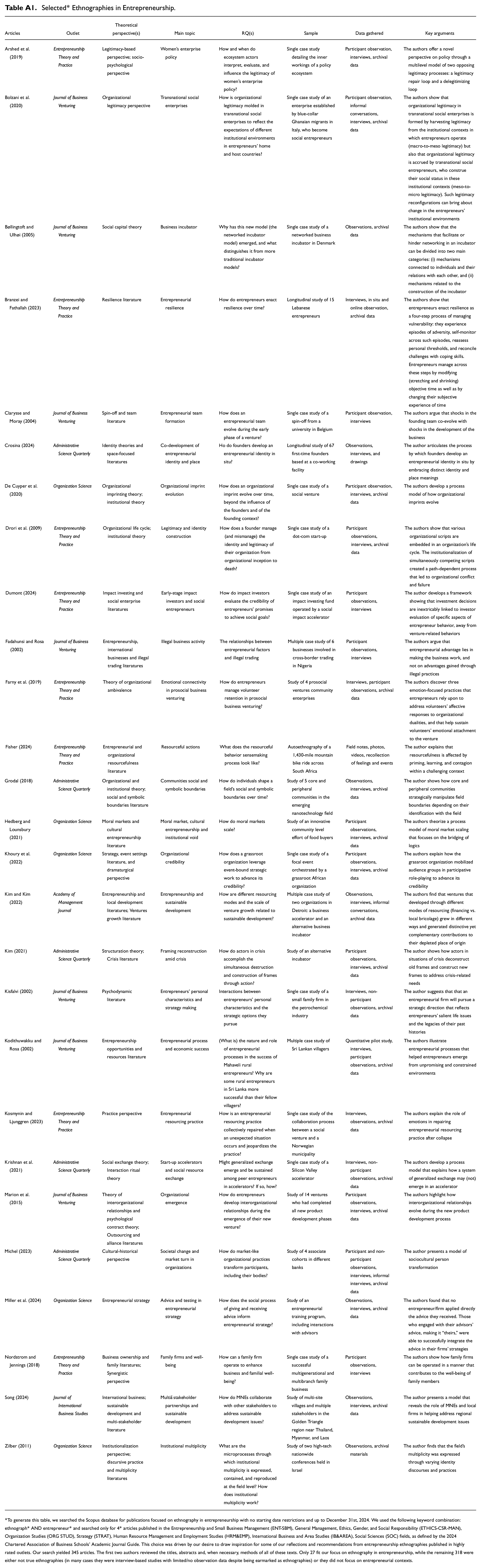
Our plea for more ethnographic research is underscored by our recent review of entrepreneurship ethnographies published to date in top-tiered entrepreneurship and management outlets. Our search yielded fewer than 30 articles (see in the Appendix Table A1). In addition to substantiating a paucity of published ethnographies, the 27 articles in Appendix Table A1 suggest that ethnography can cover an array of issues, and contribute to various theoretical conversations, as evidenced by the remarkable variation in topics and contexts addressed (e.g., entrepreneurial identity, resourcefulness, and storytelling, across settings spanning family firms, accelerators, and start-ups).
In considering these ethnographies more closely, we noticed a prevalence of nontraditional entrepreneurial settings. For example, scholars immersed themselves in entrepreneurial environments including farms and gardens (Nordstrom & Jennings, 2018), cafes, bars, smoking rooms (Bøllingtoft & Ulhøi, 2005; Kosmynin & Ljunggren 2023), and even remote mountains and deserts (Fisher, 2024). Future ethnographic research would benefit from capturing organizational life in ostensibly more “traditional” entrepreneurial contexts, such as by studying everyday behavior and patterns of interaction in various types of ventures, including social and for-profit enterprises, as well as in increasingly common entrepreneurial spaces such as accelerators and coworking facilities.
In addition to more ethnographic field work, we believe that technology is likely to have an increasingly important role in helping entrepreneurship scholars design their ethnographic studies, gather, and analyze their data. To this date, advancements in technology have made it possible for various types of additional ethnographic studies, including video ethnography, netnography (Pratt & Kim, 2012; Pratt, 2025; Smets et al., 2014), and autoethnography (De Rond et al., 2019; Fisher, 2024). Researchers have used cameras to systematically video-record and photograph interactions, including in some cases their own, as well as to log their field notes. We envision the use of technology for the purposes of gathering and analyzing data to grow.
This increasing prevalence of technology raises questions, possibilities, and concerns, including about the composition of future research teams (Jarzabkowski et al., 2015; Smets et al., 2014). Traditionally, ethnographers have conducted their work alone or in collaboration with others who share similar training and research interests. However, as technology becomes an increasingly significant “research companion,” ethnographers may begin partnering with technologists who can assist with algorithms and other tools throughout the research process—potentially in addition to, or even instead of, collaborating with similarly trained colleagues.
More specifically, as generative AI continues to develop and inform life in and around organizations, including the very creation of new types of firms and industries, we expect that it will also become an increasingly important tool for entrepreneurship scholars conducting ethnographic research. We see AI as a potentially helpful thought companion for idea generation, assisting scholars in retrieving background information on given contexts, issues, and literatures, as well as in visualizing and analyzing their data (Bechky & Davis, 2025).
However, there are also important limitations and risks, including possible breaches of anonymity and confidentiality as AI programs may capture data that may be seen or used by others. These issues are especially sensitive in ethnographic research involving personal and organizational experiences and narratives. Furthermore, AI tools carry their own assumptions and algorithmic biases (Pratt, 2025), which may skew interpretations and/or reinforce dominant narratives. Additionally, because ethnography is grounded in deeply contextualized and embodied understandings of one’s research site, ethnographers tend to know more than what is written in an interview transcript. For example, they sense mood, observe the unspoken, and build trust over time. These subtle dynamics are difficult, if not impossible, for AI to capture. There is also the risk of technology overreliance, whereby scholars might defer too readily to AI-generated interpretations, and thus potentially compromising the reflexivity and critical sensitivity central to ethnographic practice. Thus, although AI is likely to shape the future of ethnographic research, we call for more thoughtful research into the ethical, epistemological, and practical implications of integrating AI into ethnographic work.
Taken together, we believe that the future of ethnography in entrepreneurship will be shaped by a growing appreciation for deep, immersive, inquiry in tandem with evolving technological possibilities. As entrepreneurship itself becomes more complex, global, and digitally mediated, ethnography offers the tools to uncover the nuanced, lived, realities behind entrepreneurial action. We foresee a future where ethnographers not only adapt to new tools, but also play an active role in shaping thoughtful, context-sensitive, methodologies that preserve the richness of human experience. The challenge—and opportunity—will be to remain grounded in the core ethos of ethnography while embracing innovation with curiosity.
Over 30 years ago, Gartner et al. (1992, p. 21) pleaded for an increase in the use of “…ethnographic methods” because they “would add valuable and unique insights to understanding entrepreneurship” including descriptions of “what entrepreneurs do.” Their plea is as relevant today as it has ever been. We hope that our article not only motivates entrepreneurship scholars to consider ethnography as a methodology but also equips them with the courage and resources to get started.
Footnotes
Appendix
Selected* Ethnographies in Entrepreneurship.
| Articles | Outlet | Theoretical perspective(s) | Main topic | RQ(s) | Sample | Data gathered | Key arguments |
|---|---|---|---|---|---|---|---|
| Arshed et al. (2019) | Entrepreneurship Theory and Practice | Legitimacy-based perspective; socio-psychological perspective | Women’s enterprise policy | How and when do ecosystem actors interpret, evaluate, and influence the legitimacy of women’s enterprise policy? | Single case study detailing the inner workings of a policy ecosystem | Participant observation, interviews, archival data | The authors offer a novel perspective on policy through a multilevel model of two opposing legitimacy processes: a legitimacy repair loop and a delegitimizing loop |
| Bolzani et al. (2020) | Journal of Business Venturing | Organizational legitimacy perspective | Transnational social enterprises | How is organizational legitimacy molded in transnational social enterprises to reflect the expectations of different institutional environments in entrepreneurs’ home and host countries? | Single case study of an enterprise established by blue-collar Ghanaian migrants in Italy, who become social entrepreneurs | Participant observation, informal conversations, interviews, archival data | The authors show that organizational legitimacy in transnational social enterprises is formed by harvesting legitimacy from the institutional contexts in which entrepreneurs operate (macro-to-meso legitimacy) but also that organizational legitimacy is accrued by transnational social entrepreneurs, who construe their social status in these institutional contexts (meso-to-micro legitimacy). Such legitimacy reconfigurations can bring about change in the entrepreneurs’ institutional environments |
| Bøllingtoft and Ulhøi (2005) | Journal of Business Venturing | Social capital theory | Business incubator | Why has this new model (the networked incubator model) emerged, and what distinguishes it from more traditional incubator models? | Single case study of a networked business incubator in Denmark | Observations, archival data | The authors show that the mechanisms that facilitate or hinder networking in an incubator can be divided into two main categories: (i) mechanisms connected to individuals and their relations with each other, and (ii) mechanisms related to the construction of the incubator |
| Branzei and Fathallah (2023) | Entrepreneurship Theory and Practice | Resilience literature | Entrepreneurial resilience | How do entrepreneurs enact resilience over time? | Longitudinal study of 15 Lebanese entrepreneurs | Interviews, in situ and online observation, archival data | The authors show that entrepreneurs enact resilience as a four-step process of managing vulnerability: they experience episodes of adversity, self-monitor across such episodes, reassess personal thresholds, and reconcile challenges with coping skills. Entrepreneurs manage across these steps by modifying (stretching and shrinking) objective time as well as by changing their subjective experience of time |
| Clarysse and Moray (2004) | Journal of Business Venturing | Spin-off and team literature | Entrepreneurial team formation | How does an entrepreneurial team evolve during the early phase of a venture? | Single case study of a spin-off from a university in Belgium | Participant observation, interviews | The authors argue that shocks in the founding team co-evolve with shocks in the development of the business |
| Crosina (2024) | Administrative Science Quarterly | Identity theories and space-focused literatures | Co-development of entrepreneurial identity and place | Ho do founders develop an entrepreneurial identity in situ? | Longitudinal study of 67 first-time founders based at a co-working facility | Observations, interviews, and drawings | The author articulates the process by which founders develop an entrepreneurial identity in situ by embracing distinct identity and place meanings |
| De Cuyper et al. (2020) | Organization Science | Organizational imprinting theory; institutional theory | Organizational imprint evolution | How does an organizational imprint evolve over time, beyond the influence of the founders and of the founding context? | Single case study of a social venture | Participant observation, interviews, archival data | The authors develop a process model of how organizational imprints evolve |
| Drori et al. (2009) | Entrepreneurship Theory and Practice | Organizational life cycle; institutional theory | Legitimacy and identity construction | How does a founder manage (and mismanage) the identity and legitimacy of their organization from organizational inception to death? | Single case study of a dot-com start-up | Participant observations, interviews, archival data | The authors show that various organizational scripts are embedded in an organization’s life cycle. The institutionalization of simultaneously competing scripts created a path-dependent process that led to organizational conflict and failure |
| Dumont (2024) | Entrepreneurship Theory and Practice | Impact investing and social enterprise literatures | Early-stage impact investors and social entrepreneurs | How do impact investors evaluate the credibility of entrepreneurs’ promises to achieve social goals? | Single case study of an impact investing fund operated by a social impact accelerator | Participant observations, interviews | The author develops a framework showing that investment decisions are inextricably linked to investor evaluation of specific aspects of entrepreneur behavior, away from venture-related behaviors |
| Fadahunsi and Rosa (2002) | Journal of Business Venturing | Entrepreneurship, international businesses and illegal trading literatures | Illegal business activity | The relationships between entrepreneurial factors and illegal trading | Multiple case study of 6 businesses involved in cross-border trading in Nigeria | Participant observations, interviews | The authors argue that entrepreneurial advantage lies in making the business work, and not on advantages gained through illegal practices |
| Farny et al. (2019) | Entrepreneurship Theory and Practice | Theory of organizational ambivalence | Emotional connectivity in prosocial business venturing | How do entrepreneurs manage volunteer retention in prosocial business venturing? | Study of 4 prosocial ventures community enterprises | Interviews, participant observations, archival data | The authors discover three emotion-focused practices that entrepreneurs rely upon to address volunteers’ affective responses to organizational dualities, and that help sustain volunteers’ emotional attachment to the venture |
| Fisher (2024) | Entrepreneurship Theory and Practice | Entrepreneurial and organizational resourcefulness literature | Resourceful actions | What does the resourceful behavior sensemaking process look like? | Autoethnography of a 1,430-mile mountain bike ride across South Africa | Field notes, photos, videos, recollection of feelings and events | The author explains that resourcefulness is affected by priming, learning, and contagion within a challenging context |
| Grodal (2018) | Administrative Science Quarterly | Organizational and institutional theory; social and symbolic boundaries literature | Communities social and symbolic boundaries | How do individuals shape a field’s social and symbolic boundaries over time? | Study of 5 core and peripheral communities in the emerging nanotechnology field | Observations, interviews, archival data | The author shows how core and peripheral communities strategically manipulate field boundaries depending on their identification with the field |
| Hedberg and Lounsbury (2021) | Organization Science | Moral markets and cultural entrepreneurship literature | Moral market, cultural entrepreneurship and institutional void | How do moral markets scale? | Study of an innovative community level effort of food buyers | Participant observations, interviews, archival data | The authors theorize a process model of moral market scaling that focuses on the bridging of logics |
| Khoury et al. (2022) | Organization Science | Strategy, event settings literature, and dramaturgical perspective | Organizational credibility | How does a grassroot organization leverage event-bound strategic work to advance its credibility? | Single case study of a focal event orchestrated by a grassroot African organization | Participant observations, interviews, archival data | The authors explain how the grassroot organization mobilized audience groups in participative role-playing to advance its credibility |
| Kim and Kim (2022) | Academy of Management Journal | Entrepreneurship and local development literatures; Ventures growth literature | Entrepreneurship and sustainable development | How are different resourcing modes and the scale of venture growth related to sustainable development? | Multiple case study of two organizations in Detroit: a business accelerator and an alternative business incubator | Observations, interviews, informal conversations, archival data | The authors find that ventures that developed through different modes of resourcing (financing vs. local bricolage) grew in different ways and generated distinctive yet complementary contributions to their depleted place of origin |
| Kim (2021) | Administrative Science Quarterly | Structuration theory; Crisis literature | Framing reconstruction amid crisis | How do actors in crisis accomplish the simultaneous destruction and construction of frames through action? | Study of an alternative incubator | Participant observations, interviews, archival data | The author shows how actors in situations of crisis deconstruct old frames and construct new frames to address crisis-related needs |
| Kisfalvi (2002) | Journal of Business Venturing | Psychodynamic literature | Entrepreneurs’ personal characteristics and strategy making | Interactions between entrepreneurs’ personal characteristics and the strategic options they pursue | Single case study of a small family firm in the petrochemical industry | Interviews, non-participant observations, archival data | The author suggests that that an entrepreneurial firm will pursue a strategic direction that reflects entrepreneurs’ salient life issues and the legacies of their past histories |
| Kodithuwakku and Rosa (2002) | Journal of Business Venturing | Entrepreneurship opportunities and resources literature | Entrepreneurial process and economic success | (What is) the nature and role of entrepreneurial processes in the success of Mahaveli rural entrepreneurs? Why are some rural entrepreneurs in Sri Lanka more successful than their fellow villagers? | Multiple case study of Sri Lankan villagers | Quantitative pilot study, interviews, participant observations, archival data | The authors illustrate entrepreneurial processes that helped entrepreneurs emerge from unpromising and constrained environments |
| Kosmynin and Ljunggren (2023) | Entrepreneurship Theory and Practice | Practice perspective | Entrepreneurial resourcing practice | How is an entrepreneurial resourcing practice collectively repaired when an unexpected situation occurs and jeopardizes the practice? | Single case study of the collaboration process between a social venture and a Norwegian municipality | Interviews, observations, archival data | The authors explain the role of emotions in repairing entrepreneurial resourcing practice after collapse |
| Krishnan et al. (2021) | Administrative Science Quarterly | Social exchange theory; Interaction ritual theory | Start-up accelerators and social resource exchange | Might generalized exchange emerge and be sustained among peer entrepreneurs in accelerators? If so, how? | Single case study of a Silicon Valley accelerator | Interviews, non-participant observations, archival data | The authors develop a process model that explains how a system of generalized exchange may (not) emerge in an accelerator |
| Marion et al. (2015) | Journal of Business Venturing | Theory of interorganizational relationships and psychological contract theory; Outsourcing and alliance literatures | Organizational emergence | How do entrepreneurs develop interorganizational relationships during the emergence of their new venture? | Study of 14 ventures who had completed all new product development phases | Participant observations, interviews, archival data | The authors highlight how interorganizational relationships evolve during the new product development process |
| Michel (2023) | Administrative Science Quarterly | Cultural-historical perspective | Societal change and market turn in organizations | How do market-like organizational practices transform participants, including their bodies? | Study of 4 associate cohorts in different banks | Participant and non-participant observations, interviews, informal interviews, archival data | The author presents a model of sociocultural person transformation |
| Miller et al. (2024) | Organization Science | Entrepreneurial strategy | Advice and testing in entrepreneurial strategy | How does the social process of giving and receiving advice inform entrepreneurial strategy? | Study of an entrepreneurial training program, including interactions with advisors | Observations, interviews, archival data | The authors found that no entrepreneur/firm applied directly the advice they received. Those who engaged with their advisors’ advice, making it “theirs,” were able to successfully integrate the advice in their firms’ strategies |
| Nordstrom and Jennings (2018) | Entrepreneurship Theory and Practice | Business ownership and family literatures; Synergistic perspective | Family firms and well-being | How can a family firm operate to enhance business and familial well-being? | Single case study of a successful multigenerational and multibranch family business | Participant observations, interviews | The authors show how family firms can be operated in a manner that contributes to the well-being of family members |
| Song (2024) | Journal of International Business Studies | International business; sustainable development and multi-stakeholder literature | Multiãstakeholder partnerships and sustainable development | How do MNEs collaborate with other stakeholders to address sustainable development issues? | Study of multi-site villages and multiple stakeholders in the Golden Triangle region near Thailand, Myanmar, and Laos | Observations, interviews, archival data | The author presents a model that reveals the role of MNEs and local firms in helping address regional sustainable development issues |
| Zilber (2011) | Organization Science | Institutionalization perspective; discursive practice and multiplicity literatures | Institutional multiplicity | What are the microprocesses through which institutional multiplicity is expressed, contained, and reproduced at the field level? How does institutional multiplicity work? | Study of two high-tech nationwide conferences held in Israel | Observations, archival materials | The author finds that the field’s multiplicity was expressed through varying identity discourses and practices |
*To generate this table, we searched the Scopus database for publications focused on ethnography in entrepreneurship with no starting date restrictions and up to December 31st, 2024. We used the following keyword combination: ethnograph* AND entrepreneur* and searched only for 4* articles published in the Entrepreneurship and Small Business Management (ENT-SBM), General Management, Ethics, Gender, and Social Responsibility (ETHICS-CSR-MAN), Organization Studies (ORG STUD), Strategy (STRAT), Human Resource Management and Employment Studies (HRM&EMP), International Business and Area Studies (IB&AREA), Social Sciences (SOC) fields, as defined by the 2024 Chartered Association of Business Schools’ Academic Journal Guide. This choice was driven by our desire to draw inspiration for some of our reflections and recommendations from entrepreneurship ethnographies published in highly rated outlets. Our search yielded 345 articles. The first two authors reviewed the titles, abstracts and, when necessary, methods of all of these texts. Only 27 fit our focus on ethnography in entrepreneurship, while the remaining 318 were either not true ethnographies (in many cases they were interview-based studies with limited/no observation data despite being earmarked as ethnographies) or they did not focus on entrepreneurial contexts.
Declaration of Conflicting Interests
The author(s) declared no potential conflicts of interest with respect to the research, authorship, and/or publication of this article.
Funding
The author(s) received no financial support for the research, authorship, and/or publication of this article.
