



Abstract
While Knightian uncertainty (KU) has been central to entrepreneurship research for over half a century, there remains a lack of consensus on how to define, apply, and learn from the concept. We argue that, despite the apparent fragmentation of views and theories, there has been significant and valuable knowledge accumulation around KU that can inform entrepreneurship research. Reviewing 238 articles published over the past 60 years across seven disciplines, we find that (1) there is considerable congruity in how KU is discussed within, but not across, disciplines and at micro, meso, and macro levels of analysis; (2) cross-fertilization and integration of interdisciplinary insights exist but are insufficiently explored by entrepreneurship researchers; (3) progress in understanding and analyzing uncertainty may come primarily from multi-level, interdisciplinary analysis; and (4) entrepreneurship researchers may benefit from engaging the definitions and theories of uncertainty from neighboring fields like economics and decision science. We suggest a variety of research questions to unite different disciplines across levels of analysis to create a more integrated research agenda for KU in entrepreneurship studies.
Introduction
Uncertainty, conventionally understood as a lack of knowledge about the future that goes beyond probabilistic risk, has long been central to entrepreneurship research, from the earliest writings on the subject (e.g., Cantillon, 1755; Knight, 1921) to contemporary research (e.g., Arend, 2024b; Foss & Klein, 2012; McMullen & Shepherd, 2006; Packard et al., 2017; Townsend, Hunt, McMullen, et al., 2018; Townsend, Hunt, Rady, et al., 2022; Townsend, Hunt, & Rady, 2024). Since Schmalensee (1974), who coined the concept (if not the insight), the established terminology for this kind of uncertainty has been “Knightian uncertainty” (henceforth, KU). 1 The term is often taken to refer to the inability of decision-makers to assign probabilities to a given set of known potential outcomes, an understanding inspired by Frank Knight’s (1921) pathbreaking exposition in his aptly titled Risk, Uncertainty and Profit. Thus understood, KU has had a significant impact on entrepreneurship research (e.g., Casson, 1982; Foss & Klein, 2012; McMullen & Shepherd, 2006; Bhidè, 2021; see also Arend [2024a] for a magisterial review and discussion of KU in strategy research). Indeed, Townsend, Hunt & Rady (2024, p. 453) argue that “Knight’s theory of uncertainty has substantially shaped and informed the development of virtually all of the field’s most prominent theories and literatures.”
Other conceptualizations of uncertainty from Keynes (1921), Von Mises (1949), and Shackle (1955), as well as models of ambiguity from decision theory (e.g., Ellsberg, 1961; Gilboa & Schmeidler, 1989), have also had some influence on entrepreneurship research (e.g., Gartner, 2014). More generally, KU belongs to a family of concepts that highlight the knowledge problems (i.e., how to act in situations of less than full knowledge) experienced by entrepreneurs and includes concepts such as asymmetric information and bounded rationality (Mitchell et al., 2022; Townsend, Hunt, McMullen et al., 2018). As Arend (2024b, p. 119) puts it, KU “occurs because standard parts of a decision—the options, the outcomes, the probabilities of the outcomes, the goals, the values of the outcomes, and so on—are not fully known nor knowable prior to the focal decision having to be made.”
KU itself has been defined in partly overlapping, but often inconsistent ways, and is described using a variety of labels. 2 Thus, there is a need for greater clarity and consistency in the use of uncertainty language. A broad reading of the scholarly literature motivates several questions that, while hinted at and partly addressed in previous studies (e.g., Arend, 2024a, 2024b; Foss & Klein, 2012; Packard et al., 2017; Townsend, Hunt, McMullen, et al., 2018), have not yet been fully addressed and resolved. First, how is KU defined and operationalized, not just in the entrepreneurship literature, but also in other social science disciplines? Second, how does KU relate to other, neighboring concepts, and what is the value for entrepreneurship scholars of awareness of the relevant conceptual boundaries? Third, what are the explanatory functions of KU, and Can entrepreneurship scholars learn from other fields about how such uncertainty is used to explain and predict phenomena? Fourth, what are the loci of KU, that is, is it only a property of individual decision-making, or Can we also talk about KU at the levels of firms, industries, and even countries?
Charting existing knowledge accumulation can help eliminate superficial fragmentation between competing answers to these questions, letting researchers make sense of existing rifts, bridge gaps, and increase or restore the relevance of KU to theorists and practitioners alike (Alvarez, Afuah & Gibson, 2018). For this to occur, we must take stock of the accumulated knowledge that exists across various methodological toolkits, “beyond the boundaries of what is already known and available for use” (Chrisman et al., 2022) in top-level management research publications—which may suffer from similar analytical and methodological limitations as KU research itself (Kim et al., 2016).
Accordingly, this article provides an overview of current progress and develops a positive roadmap for future work by conducting a systematic review (Rauch, 2019) of research on KU. This review covers a longer period and includes a more comprehensive selection of literature than previous reviews either of KU or of neighboring concepts, as these reviews typically focus on a snapshot of published outputs (Townsend, Hunt, McMullen, et al., 2018) or analyze only specific methods such as experimental studies (Georgalos, 2018). Other reviews also provide only partial answers, with summaries of the existing literature used as a foil for the creation of new typologies or analytical schemes (Packard et al., 2017) or to highlight uncertainty arising only in specific entrepreneurial and strategic contexts (Arend, 2024a, 2024b). For example, Townsend, Hunt, McMullen, et al. (2018) emphasized the management and entrepreneurship literatures, finding an increasing number of definitions and variety of interpretations of uncertainty, which they viewed as a lack of progress and a failure of knowledge accumulation—leading them to suggest abandoning the term “uncertainty” altogether. While their argument is intriguing, the omission of KU treatments from economics, finance, decision theory, and other disciplines makes it difficult to draw conclusions about how uncertainty is used in the broader social-science literature.
The value added of our review and analysis is therefore twofold. First, we draw on a broad set of journals and academic disciplines, reviewing treatments of KU not only in entrepreneurship and management (as in previous reviews) but also in economics, decision theory, finance, public policy, and the history of economic thought. In doing so, we identify conceptualizations and applications of KU from adjacent disciplines that have not previously come to the attention of entrepreneurship scholars, and we draw out interdisciplinary insights that can inform theorizing and empirical work in entrepreneurship (itself an interdisciplinary field). For example, a recent article in the Journal of Institutional Economics by two historians of economic thought charts connections between Knight’s understanding of the psychology of uncertainty (based on the work of William James) and Knight’s theory of firm-level organization (Dold & Rizzo, 2021). The authors show how then-contemporary philosophical arguments informed Knight’s belief that cognitively diverse entrepreneurial teams (micro level) can mitigate problems of groupthink or “monoculture” (meso level), with venture capitalists contributing to that cognitive diversity (macro level). Linking to Foss and Klein’s (2012) idea of employees with delegated decision authority, or “proxy-entrepreneurs,” the authors present a model of entrepreneurship in teams that—while implicit in Knight’s (1921) book—has not received much attention in the entrepreneurship literature. Our review brings this and other examples from the literature to the attention of entrepreneurship scholars and identifies new research questions that can be explored in tandem with these disciplines. While our analysis confirms the presence of multiple interpretations of uncertainty, which may at first appear as fragmentation in the literature, we mainly find congruity in how KU is discussed within research streams in these different disciplines, and within micro, meso, and macro levels of analysis, as well as some agreement on the multi-level implications of KU, that is, how entrepreneurs and firms cope with uncertainty, and how KU impacts entrepreneurial, organizational, and societal outcomes.
Second, while previous reviews sometimes cover a broad set of concepts related to “unknowingness” about the future, they emphasize conceptual distinctions and disagreements rather than a clear path to uniting and interpreting the literature. In contrast, we reexamine the literature in relation to Knight’s classic conception of the lack of a rational basis for assigning probabilities to outcomes, and in contrast to models of “rational” decision-making under risk in which individuals simply maximize the expected value by choosing the action that is associated with the highest (uncertain) payoff. This lets us provide a more conceptually unified and organized review than previous works, and which can help entrepreneurship scholars venture into these other disciplines and concepts by deciphering and clarifying some of the jargon surrounding KU in economics, decision science, finance, and other fields. This also enables us to trace the integration of cross-level, cross-disciplinary insights between the surveyed disciplines, and chart past and present achievements in KU research that can serve as a blueprint for future work in entrepreneurship.
The findings in our review summarize streams of research that we identify in the 238 articles in our sample, and that seek to answer the above-mentioned questions. We find that KU is defined and operationalized across entrepreneurship and other social sciences disciplines with a view to reconstructing what Knight really meant and to emphasizing the conceptual boundaries between KU and neighboring concepts such as ambiguity and ignorance. Entrepreneurship scholars can use these conceptual disagreements to bring to light forgotten insights to further understand entrepreneurial and firm behavior, and therefore to signal progress rather than fragmentation. We also find that the explanatory functions of KU are effectively used in non-entrepreneurship fields to illuminate individual behavior, firm formation and decision-making, internal organization, and how individuals and firms mitigate KU. Moreover, our findings also show that KU can be understood not only as a context for individual decision-making but also as a condition that affects firms, industries, markets, and governments as the individuals and groups that constitute those organizations and institutions cope with KU, affecting market outcomes, macroeconomic variables, and other issues relevant for public policy.
We thus argue that entrepreneurship and management can expand beyond their analytical boundaries in conceptualizing and operationalizing KU by engaging with other disciplines, and we call attention to these yet unexplored paths. Our purpose is not to narrowly focus on definitional issues, but to facilitate greater communication and interdisciplinary dissemination of results.
Knight on Uncertainty, Profit, and the Entrepreneur
Before turning to our literature review and analysis we provide a brief discussion of Knight’s own take on what later came to be called “Knightian uncertainty” in the broader context of his own views on profit and entrepreneurship, and in view of some important later interpretations of uncertainty. Although Knight’s (1921) book Risk, Uncertainty and Profit is today known mainly for its conceptualization of risk and uncertainty, the significance of the third element in its title, profit, is often downplayed relative to the first two. In fact, Knight’s account of uncertainty is at the center of a wide-ranging study of the nature of incomes in a market economy, as well as entrepreneurship and economic organization, institutional development, and the nature of social science, all beginning with the concept of profit and its place in economics. In taking up this project, Knight was attempting to answer crucial questions in economic theory that had often been overlooked in classical economics and were in Knight’s time still imperfectly understood in neoclassical economics. The central issue was the question of the source of entrepreneurial profit, an income distinct from wages, interest, and land rent. These other incomes were recognized as determined by marginal productivity or time preference, yet it was easy to see that real-world profit defied these strict rules of determination and could fluctuate wildly according to no obvious rule. As a result, it was absent in the perfect competition model, which assumed perfect knowledge and thus excluded any notion of uncertainty from the start. However, as Knight argued, in the real world of time and change, in which knowledge is highly imperfect, the problem of uncertainty cannot be ignored, and neither can the question of entrepreneurial profit.
Having described the basic perfectly competitive model in the earlier chapters of Risk, Uncertainty and Profit, Knight then outlined an ontology of non-determinism and an epistemology of an “inherently unknowable” future, arguing that human cognitive faculties have evolved as tools of prediction in such a world (Foss, 2023, p. 626). One such faculty is classification, which allows for forming probability estimates and thereby helps us cope with an inherently open-ended future. We form an “image” of the future that informs our actions, but that also gets revised under the impact of “experiments.” These ideas anticipate contemporary ideas on entrepreneurs forming “theories” (Felin & Zenger, 2017) and engaging in “experimentation” (Camuffo et al., 2023). However, Knight argues that entrepreneurial decision-making involves unique situations when “the ultimate logic… is obscure” and which are therefore “scientifically unfathomable” (Knight, 1921, p. 227). The reason is that entrepreneurial decisions involve “situations which are far too unique … for any sort of statistical tabulation to have any value for guidance” (Knight, 1921, p. 231).
This is the origin of the now dominant interpretation of “uncertainty” as referring to situations in which probabilities cannot be assigned to outcomes (even if the set of possible outcomes is known to the decision-maker). On Knight’s argument, if situations cannot be placed in classes of instances (and analogical reasoning is ruled out; Scoblic, 2020), the basis for calculating probabilities (implicitly understood either as frequencies or propensities) is non-existent. Hence, the dichotomy between situations characterized by “risk” and those characterized by “uncertainty” (Townsend, Hunt, & Rady, 2024), in which intuitive “judgment” shapes behaviors in a way that is, in Knight, essentially a residual, unexplained category. 3 Conceptually, such “judgment” may be seen as an instance of asymmetric information, but the key point is that such information is not objective but highly subjective. As Casson (1982, p. 14) notes, “[t]he entrepreneur believes he is right, while everyone else is wrong. Thus, the essence of entrepreneurship is being different… because one has a different perception of the situation.” Profits can only emerge under conditions of uncertainty, in which these differing judgments result in using scarce resources in different ways. Profits are a result of entrepreneurs successfully anticipating future market conditions and successfully organizing resources to capitalize on those anticipations. Profits reflect the difference between correct calculations about the future by successful entrepreneurs, and the errors of unsuccessful entrepreneurs on the other (e.g., Hébert & Link, 2009, p. 65).
While the risk-uncertainty distinction applies to decision-making in general, Knight introduced it to make room for entrepreneurship within the confines of economic theory (Foss & Klein, 2012; Townsend, Hunt, & Rady, 2024), and it contains a host of implications for entrepreneurship, management, the theory of the firm, and other topics, at most of which Knight could only hint. 4 Perhaps the most crucial of these in terms of entrepreneurship is the idea that entrepreneurs confront uncertainty in a special way because they exercise ultimate decision authority in their firms. According to Knight (1921, p. 310), bearing the “unique uncertainty resulting from an exercise of ultimate responsibility [i.e., resource ownership] which in its very nature cannot be insured nor capitalized nor salaried” is the source of economic profit, and the essence of entrepreneurship. In Knight’s explanation, therefore, entrepreneurs perform a unique role in society that explains profit and the performance of firms and carries important implications for income distribution, the size and boundaries of organizations, their governance, and more broadly for the institutional and political environment. Thus, he proposed a theme to which we will return below: the possibility of the multi-level implications of KU. This was, however, an insight that was largely lost in the increasingly formalized general equilibrium economics of the mid-20th century, particularly when it relied on the perfect competition model associated with economists like Marshall (1890).
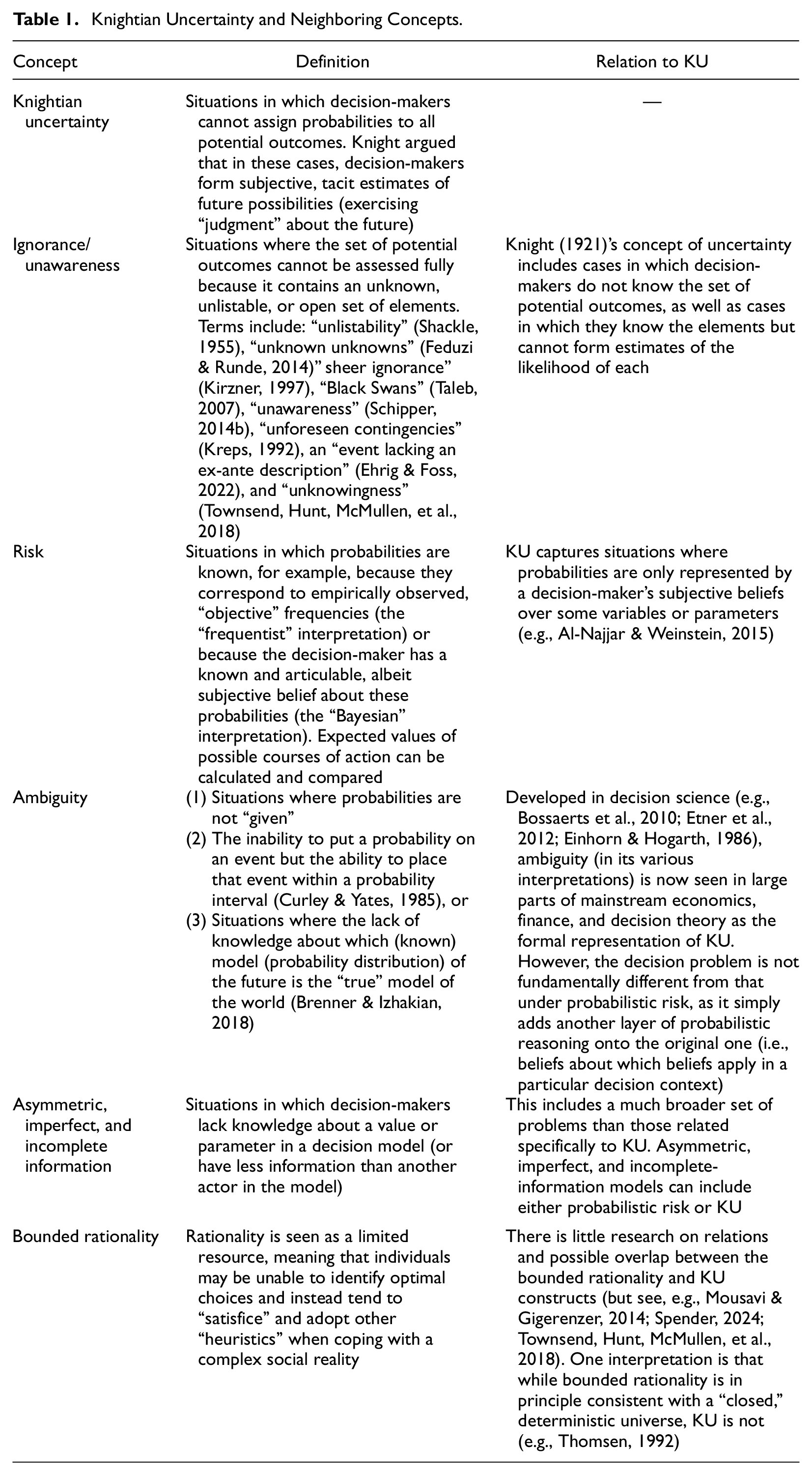
Knight’s introduction and grounding of his distinction between risk and uncertainty—building on the work of earlier economists like von Thünen (1966)—is often described as obscure and difficult to follow (e.g., Brooke & Cheung, 2021; Hands, 2023). It would be more charitable to say that Knight’s ideas were ahead of their time. Regardless of what we think of the clarity of Knight’s distinction though, it has profoundly influenced research in entrepreneurship, finance, strategy, and other fields, and there are many different views on the nature, causes, and implications of KU. Thus, recent works have defined uncertainty in Knightian terms as situations when “decision makers [know] neither the possible outcomes nor their probability of occurring when a decision was made” (Alvarez, Afuah & Gibson, 2018, p. 169), or when “both option and outcome sets are open” (Packard et al., 2017, p. 6), or even “any departure from absolute determinism… unpredictability… a lack of information or ambiguous information in relation to a task” (Griffin & Grote, 2020, p. 747). In other words, in the subsequent literature, KU has become intertwined with other notions and neighboring concepts such as uniqueness, subjective probability, ignorance, the creation of new states of the world, and even bounded rationality (cf. also Townsend, Hunt, & Rady, 2024). To take only one example, the above definition in which decision-makers know neither outcomes nor probabilities is explicitly equated with the notion of “unknown unknowns” (Lampert, et al., 2020, p. 848). Table 1 summarizes some key differences between KU and neighboring concepts to help guide readers through our review and analysis, when we return to these issues in more detail.
Knightian Uncertainty and Neighboring Concepts.
Method and Sample Overview
We follow standard literature review methods (e.g., Hinojosa et al., 2017; Hoskisson et al., 2016; Saebi et al., 2018), adopting the systematic review approach defined by Denyer and Tranfield (2009). Our search period is 1960 to 2024. While Knight’s book attracted considerable attention after its publication in 1921, by the late 1950s the risk-uncertainty distinction had mostly fallen out of the economics literature, such that Daniel Ellsberg and others felt the need to “revive” it (e.g., Ellsberg, 1961; Feduzi, 2007, p. 546; Alvarez, Afuah, & Gibson, 2018, p. 170). In addition, prior to the growth of entrepreneurship as a research discipline, the concept mainly influenced research by Austrian and post-Keynesian economists such as Lachmann (1937) and Davidson (1991, 2010) (although the latter mainly refers to uncertainty in the Keynesian sense). Wider interest in uncertainty has grown sharply over the last 2 decades, however.
Within the years 1960 to 2024, we excluded reprints, non-English sources, and non-journal article publications (e.g., monographs, magazine essays, book reviews, book chapters, PhD theses, etc.). To obtain a broad and multidisciplinary sample, we did not limit our search to a list of specific journals or disciplines. Using these criteria, we searched both the Scopus database (containing more than 36,000 journals, books, and conference proceedings from over 11,000 publishers) and the Web of Science database (containing more than 22,000 journals, books, and conference proceedings, and seven different citation databases) for peer-reviewed journal articles containing knight* and uncertain* in their titles, abstracts, or keywords (as well as in the “keywords plus” included in Web of Science searches). This resulted in 565 hits in Scopus and 562 hits in Web of Science. We combined these two sets of results and removed all duplicates, resulting in a united list of 671 hits.
Two of the authors then independently classified each of the 671 articles as relevant, possibly relevant, and not relevant, consolidated the results, and over the course of four iterations, sorted possibly relevant articles into the other two groups, until all articles were either included or excluded. Decisions were reviewed and confirmed by the other two authors as part of each iteration. Selection criteria were as follows: we excluded articles in which KU was clearly identified erroneously (sorted into not relevant) or was used trivially or tangentially (sorted into possibly relevant). Examples of the first type included articles on “Knight shifts” in physics (e.g., Schumacher & VanderVen, 1966) or the uncertain stratigraphical position of the Chudleigh Knighton Clay in the north-east Bovey basin in south Devon (Edwards, 1976).
The second type of article, “possibly relevant,” required the authors’ (partly subjective) judgments of the articles’ relevance for the research questions outlined in the introduction. In the context of these questions, we aimed to include articles that would yield significant results, be “accessible and usable to [entrepreneurship] scholars” (Chrisman et al., 2022) and be tractable for the purposes of a qualitative literature review. More specifically, we reviewed the abstracts of each article to determine whether KU was central to the theoretical discussion, or peripheral (did the article investigate or find anything about KU? Was KU only one variable among many?). A notable type within this group consisted of articles that contained only what Townsend, Hunt, and Rady (2024, p. 453) describe as “ceremonial” references to KU, that is, citations in which it is an extraneous or vestigial concept (cf. also Townsend, Hunt, Rady, et al., 2022; and DiMaggio, 1995). We also considered how the articles contribute to knowledge creation connected to entrepreneurial processes and dealt with decision problems relevant for real-world entrepreneurs (i.e., how does KU affect individuals or markets, how do we cope with KU, or how do we model or measure KU?). Here, we looked at whether the findings or implications were directly relevant to entrepreneurship scholars; and if not directly relevant, whether the disciplinary jargon could be made sufficiently accessible to entrepreneurship scholars to be indirectly relevant. We made these judgments of relevance as part of the iterative process of reviewing and coding articles, rather than making them exclusion criteria per se.
We used the above process through four iterations of article selection. In the first iteration, from the initial group of 671 articles, we identified 168 as not relevant, 251 as potentially relevant, and 252 as relevant. Subsequent iterations refined each group, especially to sort the potentially relevant articles into the relevant and not relevant groups. In a second iteration we excluded an initial 105 articles from “relevant” and “potentially relevant,” sorting them into “not relevant.” A third iteration resulted in a further 145 articles being excluded from the sample of “possibly relevant” articles, 14 articles being excluded from the “relevant” articles, and a further 16 being moved from “possibly relevant” into “relevant.” The last iteration and verification removed one more article from the final sample of relevant articles. This resulted in a final list of 238 articles reviewed and approved by all authors. We then analyzed and coded this sample. We identified the core message of each article, focusing on how it approached the study of KU and what key research question it posed. We also identified the main level of analysis of each article—micro, meso, or macro level, or a combination of these (multi)—and the discipline or field of study to which the article belongs (see Online Appendix Table A for a full overview of the reviewed sources).
The 238 journal articles in our sample span almost half a century from 1977 to 2024. With only 21 publications before 2000, KU research saw an 80% increase in publications between 2000 and 2009, and an impressive 147% increase in publications in the following decade 2010 to 2019. In the 5 years since 2020, at least 86 articles focusing on KU have been published, and this previously niche field is thus on track to double its number of publications in the current decade over the previous one. These publications span at least seven major disciplines, including economics, finance, entrepreneurship, general management, decision science, policy and institutional research, and history of economic thought.
While research on KU is flourishing in disciplines such as economics (e.g., Dibiasi & Iselin, 2021; Ferrari et al., 2022; Nishimura & Ozaki, 2004), there is little effort at cross-disciplinary knowledge accumulation and integration with entrepreneurship per se. Only a small portion of the articles in our sample are direct or explicit contributions to the entrepreneurship literature as such (about 10%), some published in entrepreneurship journals (9), and others in high-ranking general management journals or leading outlets in related disciplines (6). However, even though the bulk of work on KU is being done outside the entrepreneurship field as such, it has had a recent resurgence in the latter, with 13 articles in our sample published after Townsend, Hunt, McMullen, et al.’s (2018) review of the uncertainty literature.
In the following sections, we synthesize our findings across the micro, meso, and macro levels of analysis, examining how articles across different disciplines explore the interplay between uncertainty and individuals (71 studies), firms, platforms or ecosystems (48 studies), and markets, industries and economies (101 studies), respectively. Another 18 multi-level studies, those that examine KU in either two or three levels of analysis, are discussed within whichever level of analysis section aligns most with their findings and implications. A small group of articles that span these levels, but belong thematically and methodologically to the history of economic thought (28), are discussed separately in the first section on doctrinal history, as a way of charting the history of KU as a useful springboard for evaluating its present and future.
This method of organization is useful because it brings together separate disciplines, unifying lines of analysis in KU research beyond entrepreneurship or strategy (Arend, 2024a, 2024b). It thus creates analytical links that unearth past and recent knowledge accumulation, adding theoretical clarity about the way uncertainty is conceptualized and seen as operating across entrepreneurial outcomes, firm outcomes, and high-level macroeconomic outcomes, illuminating connections missed in previous reviews (Townsend, Hunt, McMullen, et al., 2018). This allows us to outline future research questions for entrepreneurship research to work in tandem with these disciplines to identify causal mechanisms (Kim et al., 2016), that is, how KU shapes the context of entrepreneurial action as well as how entrepreneurial action in turn transforms contexts under KU. Because our discussion below summarizes general themes and trends, in some cases the categorizations of levels of analysis, topics, findings, and causal influences blend or overlap, but this only helps highlight the sheer number of possibilities available for cross-pollination in KU research.
KU in Doctrinal History: Key Findings
We use the label “doctrinal history” to indicate research that looks to the past to examine the roots of modern concepts of KU and to chart the process of past knowledge accumulation in these disciplines. Such history can serve as a “living laboratory” for examining theories, constructs, and frameworks, recognizing that prior work features an “intermingling of insight and error” and that our understanding of a concept progresses only when we “grapple with its doctrinal antecedents and the inherent difficulties, contradictions, achievements and shortcomings it may have thus inherited” (McCaffrey et al., 2025, p. 14; also Bylund & Packard, 2022). The three main findings below show how this group of articles provides a solid foundation for a forward-looking research agenda for entrepreneurship.
Finding #1: Reconstructing “What Knight Really Meant”
Research in the history of economic thought discusses the conceptual foundations of KU in their historical and theoretical context, 5 seeking to understand Knight’s “original intent” for discussing it (Townsend, Hunt, & Rady, 2024, p. 452). Various writers have pointed to Knight’s (1921) “zig-zag way” of reasoning (Hands, 2023, p. 342), have described his writing style as “rambling, repetitive, [and] digressionary” (Brooke & Cheung, 2021, p. 903), and tried to offer greater clarity by analysis of Knight’s own words. Such articles also emphasize the cohesion between his views on uncertainty and the viewpoints of other scholars (i.e., Keynes, de Finetti, Savage, Shackle). For example, Knight is sometimes seen as a proto-subjective probability theorist, even a Bayesian (e.g., Leroy & Singell, 1987) because he writes about “estimates” or even “probability” under situations of uncertainty (while denying that there is any scientific basis for forming such estimates or probabilities; Knight, 1921, p. 210). This can provide a novel reconstruction of the Knightian distinction between risk and uncertainty, that is, “between conditions in which profit cannot exist [the future is subject to risk] and conditions in which profit can exist [the future is uncertain]” (Brooke, 2010, p. 222). This distinction is not just between foreseeable and unforeseeable outcomes, but also “a difference between objective and subjective beliefs about the future” (Brooke, 2010, p. 222).
Finding #2: Disagreement on KU as a Sign of Progress
History of economic thought articles on KU sometimes use knowledge accumulation as their main tool to stress test theories. Vigorous debate can be seen as a sign of healthy interest and a promising hope that consensus may emerge, rather than the end of scholarly progress. Some compare KU with Keynesian approaches (O’Donnell, 2021), or Schumpeterian and Weberian conceptualizations of entrepreneurship and innovation (Brouwer, 2002; Henrekson et al., 2024) and use their often-conflicting views to bring out the strengths as well as the shortcomings of KU. Others analyze links between Knight’s approach and those of Savage (Feduzi et al., 2012, 2014, 2017), John Hicks (Hirsch, 2021), Ludwig von Mises (Gerrard, 2022), Terence Hutchinson (Hart, 2010; Hutchison, 2009), and John Locke (Nash & Rybak, 2022). Despite focusing on semantic or ontological nuances in these different interpretations, these articles place KU in the context of broader debates about knowledge, decision, and action from a variety of disciplinary perspectives, sometimes unearthing surprising links—for example, how the Knightian conceptualization of the entrepreneur might enrich the Foucauldian analytical framework of neoliberalism (Christiaens, 2020). Other works look back at the philosophical foundations of Knight’s views in William James’s pragmatism (Dold & Rizzo, 2021), which is also being explored in recent work on entrepreneurs as scientists (Zellweger & Zenger, 2023).
Finding #3: KU as an Example of How Important Insights May be (Temporarily) Forgotten
Several articles use KU as a case study to show how progress and knowledge accumulation can be stifled or even eliminated by an insular methodological approach while being likely to thrive in a more interdisciplinary academic climate. They argue that the development of modern economic method unfairly “pushed aside…Knightian objections that uncertainty was incalculable” (Hodgson, 2011, p. 164) and KU largely dropped out of the economics and decision-theory literatures not because it was substantively deficient, but because the move from verbal theorizing to mathematical modeling made it difficult to incorporate Knight’s concept into the exposition. DeMartino et al. (2024, p. 3) argue that modern economics, with its desire for objective, “heroic epistemic predictions”—Robert Lucas argued that economic reasoning is of no value under conditions of uncertainty (Lucas, 1981)—has lost track of how important uncertainty is conceptually to development economics and to other disciplines. This shows KU research cannot aim to successfully develop solely within the bounds of one discipline: because KU is relevant across disciplinary boundaries, it is in the interest of entrepreneurship studies to bridge this gulf with other disciplinary fields.
Micro-Level KU: Key Findings
At the micro-level of analysis, KU is invoked in different ways and on different sides of debates that span economics, decision science, and entrepreneurship. Here, research on what KU is and how it affects individuals is one of the fastest-growing themes. Studies in disciplines such as economics and decision science also look at the broader impact of micro-level KU on firms and markets, how we can measure and model KU, and why understanding KU matters for building good theory.
Finding #1: KU and the Unit of Analysis in Entrepreneurship Research
KU is a key element in the “opportunity wars” debate in entrepreneurship studies, that is, if and how opportunity should serve as the defining construct of entrepreneurship theory (Ramoglou & Gartner, 2023). Uncertainty is used conciliatorily by some researchers to extend the opportunity construct (Arikan et al., 2020) and as a complement to it (Chandra et al., 2009), but also by others as a criticism of the centrality of opportunity (Foss & Klein, 2020; Klein, 2008; McCaffrey, 2016). Some scholars leverage KU to distinguish entrepreneurship as a field that offers a richer view of decision-making by taking account of both calculative and emotional behavior and recognizing the importance of biases and heuristics (Alvarez & Barney, 2020), while others argue for greater construct clarity, and especially for clearer and more actionable views of entrepreneurial opportunity (Ramoglou, 2021).
Finding #2: KU and Entrepreneurial Judgment
A related debate in entrepreneurship research explores the close connection between (the level of) uncertainty and the use of judgment. Does KU enable judgment, thwart it, or somehow do both, and in any case, what methods can entrepreneurs use to mitigate, reduce, or remove uncertainty? While the conventional view of KU focuses on objectively existing uncertainty in the external environment (Miller, 2012, p. 60n1), it ascribes it a somewhat paradoxical role: it is “both the raison d’être for entrepreneurs and the source of entrepreneurial rewards” (Montanye, 2006, p. 565), both exogeneous and endogenous to entrepreneurial action (Frølund, 2021), allowing for arbitrage and serving as a barrier to effective action through entrepreneurial ignorance of opportunities (McKelvie et al., 2011; Miller, 2012), all exacerbated by equivocal and complex environments (Townsend, Hunt, McMullen, et al., 2018, pp. 663–664, 676). In other words, “uncertainty is a double-edged sword: while it essentially enables entrepreneurial action… it is also the major challenge facing entrepreneurs” (Rapp & Olbrich, 2023, p. 189) that must be solved—or not (McGoey, 2012; Ramoglou, 2021). Along the same lines, deep (or “true”) uncertainty “enables entrepreneurs to act autonomously and creatively, but these actions, at the same time, endogenously generate or reinforce the unpredictability of the future actions of others.” Since “the plans that entrepreneurial managers formulate are contingent upon the actions of others, then deep uncertainty makes the foresight of entrepreneurial managers almost impossible and thereby, obstructs their processes of formulating and acting upon plans” (Kano, 2021).
Finding #3: Mitigating KU
Scholars tend to agree that KU can be mitigated through individual action, specifically through entrepreneurial judgment. The judgment-based approach to entrepreneurship (Foss & Klein, 2015; Klein, 2008; McCaffrey, 2016; Rapp & Olbrich, 2023) seeks to address the challenge of KU harmoniously alongside other alternative solutions such as effectuation and effectual logic (Sarasvathy et al., 2008, p. 339). A distinct feature of this line of research is that definitional issues are minor, and there is a general convergence taking place around the central issues, such as the boundaries of KU (what can and cannot be known by entrepreneurs) and what entrepreneurs can do about it. Judgment is defined as “the process of creating frameworks of interpretation and decision” (Langlois, 2007, p. 1114). While this process seeks “common attributes” across similar circumstances to inform decision-making (Dold & Rizzo, 2021, p. 928), individuals nevertheless “make decisions about the future without access to a formal model of decision rule, as would apply to situations of ‘rational’ behavior under probabilistic risk” (Foss & Klein, 2015, p. 590). Judgement is therefore “the (largely tacit) ability to make, under conditions of structural uncertainty, decisions that turn out to be reasonable or successful ex post” (Langlois, 2007, pp. 1112–1113; cf. also Andersson, 2017, p. 420). This view is consistent with approaches such as case-based decision theory, which focuses on an individual’s ability to ability to link solutions drawn from past analogical cases to solve current and future problems (Gilboa & Schmeidler, 1995). Entrepreneurs navigate a spectrum between too much uncertainty, which can be too complex to handle, and too little uncertainty, which can be demotivating, and make profitable decisions about investment (Izhakian, Yerman, & Zender, 2022) and the boundaries of their firms, using their judgment to deal with problems of dispersed knowledge, tacit knowledge, and undiscovered knowledge (Dold & Rizzo, 2021; Langlois, 2007; Montanye, 2006). In practice, judgment thus concerns entrepreneurs’ appraisals of “prices, costs, and other economic variables” (Westgren & Holmes, 2022, p. 212), of “supply and demand conditions, both present and future… [and] the ‘particular circumstances of time and place’” (Dold & Rizzo, 2021, p. 932).
Finding #4: Defining and Formalizing KU
Discussions about the nature of probability and the basis of beliefs as well as formal models for operationalizing KU are thriving in decision theory and economics. Here too we find more general convergence across researchers concerning central definitional issues, particularly in relation to understanding KU as either ignorance or ambiguity. However, the reliance on mathematical formalism in these types of articles most likely explains the limited engagement between these disciplines and entrepreneurship research. The emergence of decision theory (aka“decision analysis” or “decision science”) as a distinct field of inquiry related to and building on economics (Hirshleifer & Riley, 1992), statistics (Savage, 1954), management (Raiffa, 1968), and analytic philosophy (Thagard, 2009) may, at least initially, have dampened post-war interest in KU in general. Indeed, decision theory is sometimes defined as the study of decisions that involve assigning probabilities to outcomes and numerical values to such outcomes (Parmigiani & Inoue, 2009)—which would seem to exclude KU by most definitions. As such, decision theory revolves around what may be called the “standard model of decision making,” sometimes called the “expected utility maximization model.” 6 That model contains four key elements, namely, (1) an account of the possible actions a decision-maker can take, (2) the consequences of such actions in (3) different possible states of the world that (4) are associated with probabilities. If KU is understood as situations in which decision-makers lack rational grounds for putting probabilities on outcomes, including not knowing all members of the set of possible outcomes, it seems that such uncertainty lies outside the reach of decision theory. However, this conclusion is not warranted, and decision theorists have later come up with many creative attempts to “tame” KU in terms of reconciling it with the basic decision-making model (cf. Dimand, 2021; Nishimura & Ozaki, 2017).
Much discussion in decision theory is taken up with similar philosophical issues as those that intrigued Knight, notably, the nature of probability (e.g., aleatory, frequentist, epistemic, etc.) and the basis of beliefs (e.g., logical, personalist, or rationalistic views). In particular, the subjective nature of probability is recognized, and one basic approach to KU within decision theory is basically Bayesian: risk is thought of as situations when probabilities are objective and known, while KU captures situations when probabilities are only represented by a decision-maker’s subjective beliefs over some variables or parameters (e.g., Al-Najjar & Weinstein, 2015). This brings KU entirely within the orbit of the standard expected utility model of decision-making (with subjective probabilities) and conforms to Savage’s (1954) key result that the decision-maker’s behavior can be represented as the expectation of some utility function, computed by means of a single probability measure, since the behavior conforms to a few seemingly innocuous axioms.
Finding #5: KU as Ambiguity
Decision theorists are aware of the challenges of decision situations that fall outside the confines of the standard model, and which are here associated with KU. 7 The famous “Ellsberg paradox” (anticipated by Keynes, 1921) implies a rejection of Savage (1954) based on experimental evidence that people tend to prefer choices with quantifiable risks over those with unknown, incalculable risks (Ellsberg, 1961), the latter of course representing KU. Starting with Ellsberg, much research within decision theory on KU has conceptualized such uncertainty as “ambiguity” (Brenner & Izhakian, 2018; Curley & Yates, 1985) and applied it to investment behaviors (Nishimura & Ozaki, 2007), incomplete contracts (Mukherji, 1998), financial markets (Mukherji & Tallon, 2001), and general equilibrium theory (Beissner & Riedel, 2019), typically focusing on the effects of ambiguity aversion rather than on the epistemic conditions underlying ambiguity. Equating uncertainty with Ellsberg’s (1961; also Gilboa & Schmeidler, 1989) account of ambiguity (Amoroso et al., 2017, p. 334) may, however, lead to conflating Knightian risk and KU (e.g., Dana & Riedel, 2013; Ilut & Saijo, 2021). Thus, one implication of this approach is that the unknown information can in principle be discovered and incorporated into expectations. So even when ambiguity is more clearly distinguished from risk, ambiguity still ends up being operationalized in looser and less radical ways that are easier to formalize or measure empirically (e.g., Dibiasi & Iselin, 2021; Hansen, 2014; Hassett & Zhong, 2021; Izhakian, 2020; Ohtaki & Ozaki, 2015). Likewise, some articles maintain a strict distinction between risk and ambiguity, with no third option or gradations (Epstein & Zhang, 2001) and wind up developing new concepts of ambiguity closer to Knight’s original notion of true uncertainty (Epstein & Halevy, 2019).
Finding #6: KU as (Also) Ignorance
While these “ambiguity” interpretations of KU remain dominant in decision theory, economics, and finance, they are arguably also somewhat narrow interpretations of “what Knight really meant.” Knight (1921) also included ignorance under his notion of uncertainty (see Scoblic, 2020), or what has alternatively been called “unknown unknowns” (Feduzi & Runde, 2014), “unawareness” (Schipper, 2014a), or events “lacking an ex-ante description” (Ehrig & Foss, 2022). Here again multiple interpretations emerge from the literature. Something may be unknown to one (set of) actor(s) but not to others, for example, actors may be only partly ignorant (i.e., they expect that the unexpected may happen). Thus, ignorance comes in different forms (Schipper, 2014b; Zabell, 1992), and as knowledge is distributed in society so is ignorance (Kirzner, 1997). Interestingly, even in the case of ignorance, Bayesian interpretations have been offered. For example, Karni and Vierø (2013) offered a model of “reverse Bayesianism” that models growing “awareness,” and the same authors (Karni & Vierø, 2017) modelled situations when decision-makers are aware of their unawareness. Another fruitful line of research was initiated with Gilboa and Schmeidler’s (1995) model of the role of analogy in decision-making in their “case-based decision theory”: A “similarity function” links current “problems” to analogical “cases” in the decision-maker’s memory. While the analysis is still cast within a maximization framework, there is no presumption that, for example, decision-makers know the full set of consequences of their actions (i.e., it is consistent with notions of ignorance).
Meso-Level KU: Key Findings
At the meso level of analysis, there is a growing interest in understanding how organizations are shaped by managerial decision-making and entrepreneurial judgment under KU (Spender, 2013) and an ongoing call to take uncertainty seriously and understand the impact of KU on organizational processes and outcomes (Alvarez, Afuah & Gibson, 2018). We find that research on organizations in management and economics takes a practical approach and ask how uncertainty affects behavior, examining the implications of entrepreneurial decision-making under KU for firm organization. Studies also use definitional issues around KU more strategically as exploratory tools, as well as an essential conceptual link across strategy, marketing, entrepreneurship, and management, both in domestic and international environments, and across varied organizational contexts.
Finding #1: A Distinct Knightian Theory of the Firm
Research on KU that closely follows Knight argues that firms exist because judgment about future uncertain conditions cannot be exchanged and must therefore be borne by entrepreneurs as ultimate decision-makers (Boudreaux & Holcombe, 1989; Foss, 1993; Langlois & Cosgel, 1993). This explanation of firm origin (the non-tradability of judgment under KU means that entrepreneurs start firms to exploit their judgment) differs fundamentally from Coase’s explanation of the existence of the firm (Boudreaux & Holcombe, 1989). Foss and Klein (2012) extended Knight’s points about the non-tradability of judgment to the issue of the boundaries of firms and their internal organization (the two other key questions in the theory of the firm). They argued that judgmental decision-making may involve assets that are currently not owned by the firm and that ownership of such assets may be necessary when it is not possible to communicate asset uses with sufficient clarity to outside asset owners. Foss et al. (2021) embedded this reasoning into a theory of “ownership competence,” while Foss and Klein (2012) showed how judgment lends insight into the delegation of decision-making inside firms. Picking up on these ideas, Kaul (2013) linked judgment to appropriation risk to build a theory of the determinants of firm boundaries, and Kaul et al. (2024) showed how allowing the tradability of judgment to vary lends insight into spin-offs.
Finding #2: KU Impacts Firm Behavior
Some of the exploration versus exploitation literature uses a non-Bayesian understanding of KU to look at what uncertainty does to organizational outcomes, managerial motivation, and managerial intentionality (Chanda & Ray, 2015). This work finds that uncertainty affects organizations indirectly—influencing managerial decisions through its impact on consumer decisions (Song & Jiang, 2018)—or directly—being a force that increases motivation and intentionality rather than deterring it (Roy, 2020). Uncertainty (and moral hazard) are in fact central to the creation of organizations as such, as Knight himself recognized; because entrepreneurs navigate an uncertain environment rife with principal-agent problems, it is their responsibility to create a unified system of incentives in the firm to avoid such conflicts (Barzel, 1987; Bylund & McCaffrey, 2017; Emmett, 2021b; Finch & Dinnei, 2001; Leroy & Singell, 1987), an explanation largely parallel with and complementary to Coase’s transaction costs approach (Vozna et al., 2023).
It is interesting to note that at the meso level of analysis, disagreements on what uncertainty is do not appear to be a significant stumbling block for scholars. This holds particularly true for work in the general management and economics literature on the theory of the firm, when definitional nuances are judiciously employed as explanatory and exploratory tools. For example, Dangol and Kos (2014, p. 337) deployed two types of uncertainty to streamline the capabilities literature. They argue that operational capabilities “produce outcomes that can be predicted using probability distribution,” while dynamic capabilities “produce outcomes that cannot be predicted using probability distribution” (Dangol & Kos 2014, p. 337). KU is also used to refresh current work in strategy in emerging economies, which assumes “historical inevitability” and is “blind to human agency” (Zhu, 2018), to redefine the context of business strategy research as forecasting and illuminate new research areas in the context of managerial selection (Norton, 2021), and to enrich the analysis of complementary asset configuration, technological innovation (Jalonen, 2012), and innovation ecosystems (Lampert et al., 2020). Innovation and firm growth also bear an interesting link to KU: novel ideas (Manne, 2014) influence firms’ investment and expansion decisions (Bonilla & Cubillos, 2021; Niu et al., 2019) and build up to “innovation waves” used to hedge against uncertainty (Dicks & Fulghieri, 2021), which also allow for open-ended technological applications (Brouwer, 2000; Dew et al., 2004).
Finding #3: KU Shapes Internal Organization
Studies looking at entrepreneurial action under KU at the organizational level look at entrepreneurs’ decision and design processes (Sarasvathy et al., 2008) and ability to appraise the future performance not only of assets and investments but also of individuals and groups within an organization. Research in this area therefore turns attention away “from errors in human agents’ opinions of things [and toward] errors in their opinions of other people” (Yu, 2002, p. 459). For example, entrepreneurs’ judgment is in fact judgment of the different interests of individuals in the organizational hierarchy and how these can be harmonized. This involves the optimal delegation of decision rights inside the hierarchy, given that the entrepreneur’s judgment of what to do with relevant assets (and how and when) cannot be fully communicated to hierarchical inferiors (Foss & Klein, 2012).
Macro-Level KU: Key Findings
KU at the macro level is studied in various contexts relevant to entrepreneurial decision-making, such as the external environment in which entrepreneurial action takes place, and which further shapes firms and organizations, and could thus prove a useful foil for knowledge accumulation in entrepreneurship research. However, because studies in finance, macroeconomics, and policy and institutional analysis typically lack microfoundations in entrepreneurial action, they often fail to bridge the gap with entrepreneurship research.
Finding #1: KU and Institutions Interact
A growing body of research studies the place of KU in the emergence of social phenomena and the interplay between the institutional environment, KU, and decision-making. Multi-level studies on these issues can be found in economics, management, and policy literatures. Scholars tend to agree that the relationship between KU and institutions is bidirectional (Frølund, 2021)—institutions reduce uncertainty by structuring human action and closing option or outcomes sets but can also create new uncertainties that disrupt entrepreneurial action. For example, institutions such as regulatory bodies and monetary authorities shape market structures and define the boundaries of competition and monopoly (Asano & Shibata, 2011; Salerno et al., 2021), and through this can also shape how uncertain or hazardous economic or financial environments appear to entrepreneurial decision-makers (Barzel, 1987; Nelson & Katzenstein, 2014). When “entrepreneurial managers are embedded in institutional rules or norms” (Kano, 2021), they find it easier to peer through the fog of uncertainty and make more precise forecasts and follow-up decisions.
Nevertheless, different institutional contexts and organizational blindness can affect entrepreneurial foresight (Logan et al., 2024), and this carries implications for how entrepreneurs make decisions and the resultant organizational outcomes. Scholars find that decision-makers overcome KU using a host of tools, especially probability calculations, heuristics—which may perform better the more uncertain the environment (Mousavi & Gigenzer, 2014), or a combination of the two. Managers also use more prediction when uncertainty is seen as a threat, and more control when uncertainty is seen more as an opportunity (Smit, 2023, p. 1302). They can leverage collective decision-making (Raginsky & Nedic, 2016), transfer and mitigate sources of risk (Müllner, 2016), shape or adapt strategies through experimentation, learning, and resource investments (Rindova & Courtney, 2020) or use global niche strategies to cope with uncertain internationalization strategies (Liesch et al., 2011; Magnani & Zucchela, 2019).
KU can also give rise to social institutions, as the latter create knowledge structures that provide stability and regularity to action (Loasby, 2001) and allow for KU to be transformed into economically calculable risk (Guseva & Rona-Tas, 2001). Prime examples include law, money (Hodgson, 2013), and the system of monetary prices (Julián et al., 2022). In the market economy, profit-seeking entrepreneurs bear the burden of the uncertain future (Hirsch, 2022), whereas other systems, such as socialist economies, lack an institutional basis for coping with radical uncertainties (Julián et al., 2022). Societies that ignore KU and model key social phenomena as risks can undermine the legitimacy of key institutions, which are often replaced by a bureaucratic and scientistic rule of experts (Reddy, 1996). Some limited economics (and entrepreneurship) research focuses on the incentives that institutions create and assumes that relative rewards are clearly established, stable, and known to entrepreneurs (e.g., Baumol, 1990; McCaffrey, 2018). Yet both incentives and the higher-level institutions that create them are often characterized by deep uncertainties that add complexity to entrepreneurs’ decision problems (Bylund & McCaffrey, 2017). Acknowledging KU and complexity adds new dimensions to a growing literature studying the way entrepreneurs abide by, evade, alter, or exit the institutional framework (Douhan & Henrekson, 2010; Elert & Henrekson, 2016).
Finding #2: KU is Also Coped With at the Macro Level
A recent strand of entrepreneurship research draws on Knight’s proposed list of five methods for coping with uncertainty at a macro level: “(1) consolidation or grouping of uncertain events, (2) specialization vis-à-vis types of uncertain events, (3) diffusion of potential losses across numbers of underwriters, (4) increased power of prediction, and (5) control of the future” (Westgren & Holmes, 2022, p. 212). The implication of these methods is that uncertainty is mitigated through formal and informal institutions (e.g., insurance and futures markets), conventional ways to protect against probabilistic risks. For example, actuarial institutions are not mutually exclusive from entrepreneurship, and insurance does not simply obviate judgment or eradicate entrepreneurial profit (Eabrasu, 2021). Instead, entrepreneurs convert uncertainties to risks, and in doing so they can hedge to protect themselves using parametric (index-based) insurance, which indemnifies policyholders according to variations in an index rather than based on a damage assessment. This dovetails well with the suggestion of Townsend, Hunt, McMullen, et al. (2018, p. 679) that organizations should be seen as “portfolios of knowledge problems” that exist to mitigate uncertainty. Within firms, monocultures hinder decision-making, while team-based entrepreneurship aids it (Dold & Rizzo, 2021). Venture capital firms are another example of institutional structures to mitigate KU (Westgren & Holmes, 2021).
Finding #3: KU Affects Market Outcomes
A third strand of macro-level research looks at how markets react to, cope with, and are structurally affected by KU regarding, for example, asset pricing, market microstructure, corporate finance, tax policy, and financial regulations. Here, finance and economics are the two central disciplines, and the treatment of KU in finance largely tracks its treatment in economics. Core mechanisms and findings such as the Modigliani–Miller model of firms’ optimal capital structure, the capital-asset pricing model for securities, the Black–Scholes formula for pricing derivatives, the efficient markets hypothesis, and more recent work in behavioral finance incorporate probabilistic risk in the usual way: decision-makers are assumed to act based on their own (subjective) probability estimates over known distributions, updating these beliefs according to new information following Bayes’s rule.
We find that until recently, the mainstream finance literature largely ignored the distinction between risk and uncertainty, whether the latter was understood in Keynesian or Knightian terms (Basili, 2001; Findlay et al., 2003). When uncertainty is treated specifically, it is modeled as ambiguity, in very similar terms to what is being discussed in decision theory, that is, agents are uncertain which probability model to use, but this uncertainty can itself be captured by a higher-level, “meta” probability model. Like the proverbial turtles, it’s probabilistic risk all the way down. Further nuances to ambiguity in this literature include model uncertainty, when agents know the set of possible models of the world, but not which model obtains (Caballero & Krishnamurthy, 2008) or, “in which states of the world included in the model do not exhaust the actual ones” (Basili, 2001). Treating subjective probabilities as “non-additive,” means that the sum of a series of probabilities is not equal to their joint probability plus their union probability as in the usual case, and the difference captures the degree to which the decision-maker is “uncertain” about one of the events (Dow & Werlang, 1992, 1994). These ambiguity measures also permit a measure of ambiguity aversion reflecting the degree to which the decision-maker prefers situations with less ambiguity, other things equal (cf. Dicks & Fulghieri, 2019).
These studies present a streamlined theoretical understanding of KU as ambiguity and contain attempts to measure these constructs empirically across varying levels of analysis. Olsen and Troughton (2000) measured uncertainty as the degree of analyst disagreement about the risk associated with a given financial asset. They suggest that higher risk premiums for small-cap stocks (the “small-firm effect,” often described as an anomaly for mainstream finance theories) is explained by greater ambiguity about the distribution of these stocks’ returns. Baker et al. (2016) and Yao et al. (2024) constructed uncertainty indexes, measures of aggregate KU, through text analysis of news reports. These models of ambiguity explain various outcomes and phenomena not well captured by conventional, risk-based financial models, such as the small-firm effect (Olsen & Troughton, 2000) or “portfolio inertia” in which actors hold on to financial assets even when the price is below the risk-adjusted expected return (Basili, 2001; Dow & Werlang, 1992). Ambiguity aversion is also applied to hedging strategies (Lien, 2000), the impact of financial crises modeled as “uncertainty shocks” rather than liquidity shocks (Caballero & Krishnamurthy, 2008), insurance regulation (Chen & Su, 2009), and corporate earnings management (Yao et al., 2024). Other research on KU in economics-adjacent fields such as game theory, financial economics, actuarial science, econometrics, stochastics, and mathematics treats KU as ambiguity and focuses on the dynamics of financial markets (Cincibuch & Hornikova, 2008), stock option decisions (Izhakian & Yermack, 2017), bond yields (Zhao, 2020), radical innovation and stock returns (Grieco, 2018), asset trading (Shi, 2019), hedging decisions (Lien & Yu, 2017), and other corporate financial policies (Friberg & Seiler, 2017). While perhaps less accessible to the typical entrepreneurship scholar due to the use of specialized jargon and mathematical theorizing, these studies nevertheless show how interaction with other disciplines is paramount and can thus serve as a starting point and a fertile proving ground for how to engage in multidisciplinary work.
Finding #4: KU Influences Macroeconomic Variables
Research on macro-level KU is also growing in areas such as macroeconomic theory and policy, fields that traditionally neglect the individual and firm levels of analysis in favor of aggregate or system-level problems. Here, KU is utilized as a criticism of some fundamental assumptions, such as rational expectations (Frydman et al., 2015) and poses “a direct challenge to time-series econometrics” and to the assumption that the future will be like the past (Hansen, 2014, p. 973; Ilut et al., 2020). Because of these tensions, macroeconomists typically model uncertainty as a type of ambiguity, and KU research has flourished alongside many different kinds of macro-level research including work on labor markets (Nishimura & Ozaki, 2004), economic growth (Fukuda, 2008), monetary policy (Ben-Haim & Demertzis, 2016; Kantur & Özcan, 2022), business cycles and financial crises (Carbonari & Maurici, 2023; Ilut & Saijo, 2021; Wang, 2022), and ecological issues (Mayumi & Giampietro, 2006). Naturally, different models generate diverging predictions about the effect of uncertainty on economic stability and growth, some optimistic (Carbonari & Maurici, 2023) and others pessimistic (Fukuda, 2008). In the latter case, KU is said to produce price rigidities or misleading signals to market speculators, while financial agreements like credit default swaps cause financial turmoil because they are assumed to reflect conditions of Knightian risk rather than uncertainty (Brown & Hao, 2012; also, Sjol, 2022). Such results are used as evidence of market failures or as justifications for regulatory interventions (Fukuda, 2008; Wang, 2022).
Finding #5: KU is Empirically Relevant for Macroeconomic Policy
Research on macro-level KU has also developed toward offering possibilities for applied empirical work, including on entrepreneurial behavior, in the context of grand challenges and appropriate policy responses. Literature on the implications of KU at a national or societal level include many widely discussed public issues: health care (Asano & Shibata, 2011), food systems security (Taylor, 2003), pandemics (Claveria & Sorić, 2023), economic and political equality (Hirsch, 2022), and climate change (Mayumi & Giampietro, 2006). These studies argue that grand social challenges cannot be understood, let alone solved in any serious way, without mapping KU in the environment (both business and ecological), in institutions, and in human actions and preferences.
Policy research is also an example of successful interdisciplinary discussion of KU, where economic and decision science models are applied and practical implications explored. Most studies begin by assuming that “a rational policy process must be Bayesian in order to avoid paradoxical, even absurd, recommendations” (Al-Najjar & Weinstein, 2015) and hold firm to this assumption even when probabilities have low epistemic credentials (Roser, 2017). Studies then look for the impact of KU (subjectively held probabilities) in many contexts, from taxation (Lemoine & Traeger, 2016), climate change (Xepapadeas, 2015, 2024), and populism and anti-elitism in politics (Kishishita, 2020), to robust policy selection (Ben-Haim & Demertzis, 2016) and defense resource allocation (Ben-Gad et al., 2020). The same topics are explored considering KU even when Bayesian methods are not available: policy avenues are discussed, particularly in relation to the precautionary principle (Al-Najjar, 2015) in environmental regulation (Aldred, 2013) or financial regulation (Chen & Su, 2009; Clarke, 2021), systemic risk and macro-prudential policies (Mao et al., 2023), the foundations of the welfare state as an uncertainty insurer (Feduzi & Runde, 2011), and international relations (Jarvis, 2011). When policy research looks at how uncertainty impacts growth prospects (Aizenman, 1997), it comes to be directly relevant to entrepreneurship, finding that if entrepreneurs lack experience, then a stable, less uncertain environment leads to lower losses.
KU as Sui Generis
The purpose of this review is to chart knowledge accumulation around KU, not to propose new definitions or typologies. However, it can be argued that part of the reason for the existing confusion between KU and other neighboring concepts, and the proliferation of the latter in the literature, is Knight’s own discussion, which contains core arguments that may be hard to defend, and which does not meticulously explain how we distinguish between what is knowable and what is unknowable. It may, for example, be questioned (on Bayesian grounds) whether there are truly unique events, that is, events that inherently cannot be placed in a relevant class of instances. Is KU a unique, distinct concept?
As prior reviews (Arend, 2024b; Packard et al., 2017; Townsend, Hunt, McMullen, et al., 2018; Townsend, Hunt, & Rady, 2024) have indicated, recent analyses of decision-making under uncertainty embrace a variety of constructs, frameworks, and typologies. Work in management and entrepreneurship tends to categorize uncertainty as a particular type of knowledge problem (unknowingness) that renders prediction difficult. Uncertainty relates to the inability to assign probabilities to future events. But the future can also be hard to anticipate because of challenges of sensemaking or interpretation (ambiguity), an overly complex set of potential causal relationships, or problems in reconciling inconsistent expectations. In fact, even if the future was in principle “knowable,” problems of assigning probabilities to outcomes still exist because of such problems of “bounded rationality.”
We find the approach in economics and finance to be different than in the management literature: the former assumes that decision-makers know the set of possible outcomes and can assign probabilities to each, but that these probabilities are not objectively given but subjectively perceived (and adjusted “rationally” to new information using Bayes’s rule; e.g., Eliaz & Ok, 2006; Gilboa, 1987; Savage, 1954). It has sometimes been argued (e.g., Leroy & Singell, 1987) that Knight anticipated subjective probability theory, but Knight was emphatic that the formation of “estimates” (subjective probabilities) under uncertainty cannot be formalized in any “scientific” way. Bayesian decision theorists seem to disagree.
While prior treatments and assessments of KU provide useful background, context, and interpretations, they still leave some gaps in our understanding. We agree with Townsend, Hunt, McMullen, et al. (2018), Mitchell et al. (2022), and Arend (2024a, 2024b) that KU can be understood as a type of knowledge problem. However, our reading of the primary and secondary sources in this review suggests that Knightian uncertainty is unique in that it refers, not to knowledge or information currently unknown but potentially knowable, but to situations when estimates of future contingencies can only be understood as subjective conjectures.
As such, KU remains conceptually distinct from the economics notions of incomplete or imperfect information, the finance understanding of ambiguity, or the concept of bounded rationality. KU is also distinct from ignorance or unawareness, although admittedly Knight (1921) muddied the water here by invoking ignorance along with KU (Scoblic, 2020). We remain agnostic on the issue of whether KU should be reserved for decision situations when there is no “scientific” ground for putting subjective probabilities on outcomes. What arguably matters here is whether such subjective probabilities can be communicated to others (Foss & Klein, 2012); if they cannot (i.e., only at prohibitive cost), uncertainty cannot be insured or contracted on, and this is what matters to the outcomes that entrepreneurship is taken up with (the existence of the entrepreneur, profit, and the entrepreneurial firm). We are also agnostic on the issue of whether KU inherently must mean uncertainty that cannot be remedied by experimentation; for example, if experimentation is too costly, the entrepreneur will have to stick to her subjective “estimates” rather than Bayesian posteriors.
Prospects for Future Research
In this section, we translate the extant research streams around KU into a more specific and constructive plan for future entrepreneurship research that takes stock of the fact that different definitions and parameters for discussion can appear contradictory when in fact they are more complementary, that is, versions and interpretations of KU, that there is more to be done to integrate research on the ontology of KU with its implications for entrepreneurial action. Despite these shortcomings, the field is well-positioned to continue to unpack the black box of uncertainty by deepening existing research strands and by picking up the “slack” left by other disciplines. For example, entrepreneurship researchers are deeply interested in topics like development, which, as mentioned above, have often been dominated by mainstream macroeconomic models lacking both KU and entrepreneurship. We thus believe cross-disciplinary and multi-level studies will prove most fruitful in the future.
To help chart a course for this line of research, we propose in Table 2 some sample research questions on KU that can be addressed by the collaboration between entrepreneurship and other disciplinary streams. Of course, neither the levels of analysis nor the disciplinary boundaries are always neatly defined in practice: our groupings here are intended to connect our findings to future research and illustrate some key distinctions and overlaps, without aiming to be comprehensive.
Future Research Questions in Entrepreneurship by Stream of Research and Interdisciplinary Collaboration.
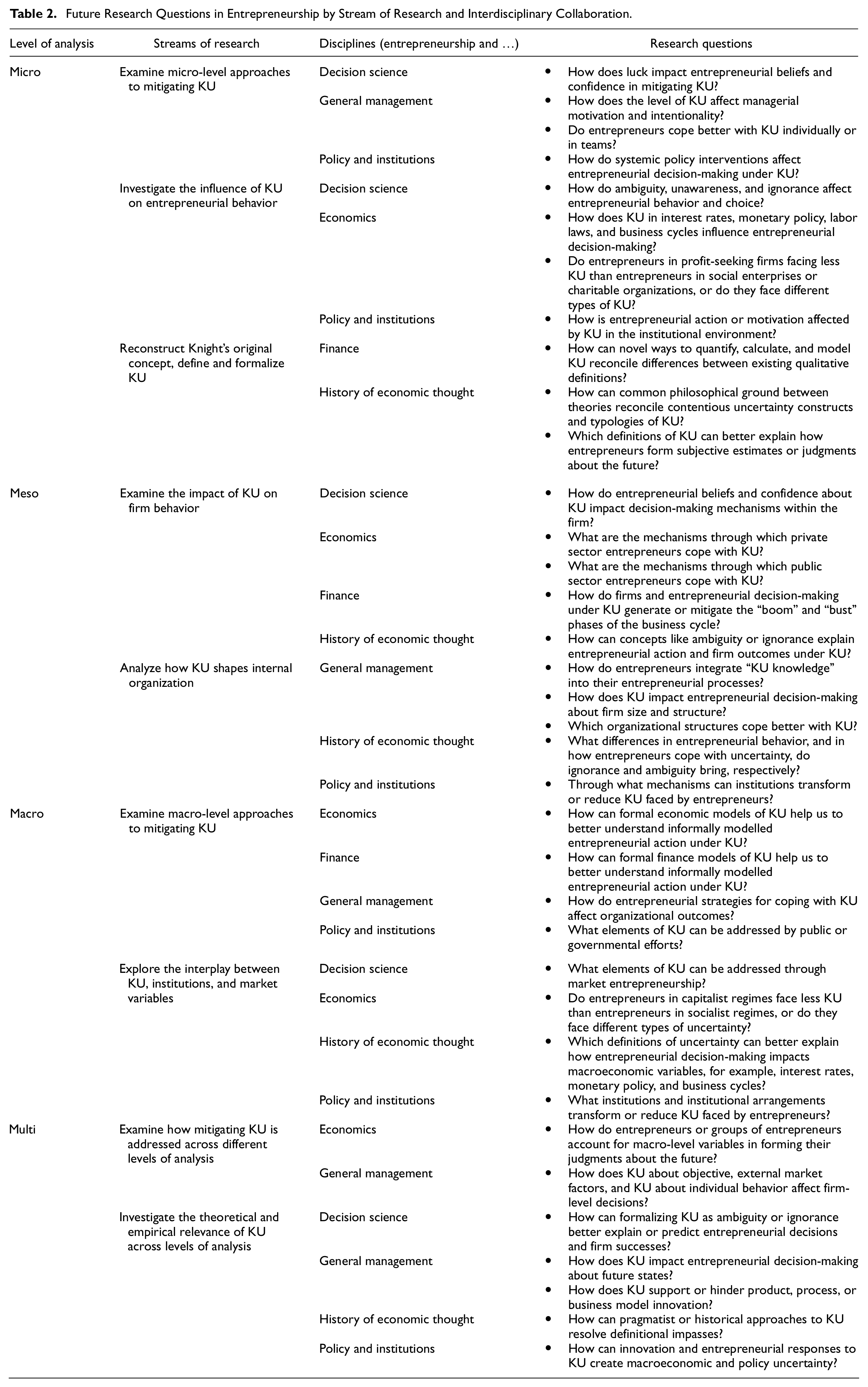
Micro-level studies at the crossroads of entrepreneurship, decision science, and economics can investigate the influence of KU on entrepreneurial behavior, for example, what differences in entrepreneurial behavior does KU as ignorance bring, and how do entrepreneurs cope with KU as ambiguity? Ignorance (rather than ambiguity or asymmetric information) is central to Kirzner’s (1973) notion of the “alert” entrepreneur who discovers “pockets of ignorance” in the market and underlies the influential opportunity discovery approach in entrepreneurship studies (Shane & Venkataraman, 2000). Ignorance and unawareness link naturally to the entrepreneurial creation of future states through the exercise of judgment (Foss & Klein, 2012). If we are ignorant about the future because it is uncreated and therefore unknowable (Shackle, 1955), entrepreneurial decisions are largely about state space creation (Machina, 2003). Equally, entrepreneurs do indeed confront decision situations that are “ambiguous” in the various senses of that word: while entrepreneurs may be confident that their chances of succeeding in the market “lie between 50% and 80%,” they cannot get closer to a precise estimate. Their behavior will reflect such subjective probabilistic assessments. Various behavioral reactions to ambiguity, notably ambiguity aversion, are also likely to manifest in entrepreneurial behaviors (Bonilla & Cubillos, 2021). Future research could also investigate whether there is a necessary trade-off between rigor and relevance in applying ambiguity and ignorance to entrepreneurship studies.
Second, although entrepreneurial action and the formation and governance of organizations are naturally and closely related, there also remains relatively little integration of these spheres. One particularly fruitful area to explore at the meso level are entrepreneurial mechanisms, that is, how KU shapes the context of entrepreneurial action as well as how entrepreneurial action transforms contexts under KU. The actions, judgments, and mechanisms entrepreneurs use to cope with KU can provide a bridge to unite these bodies of research, and link entrepreneurship with economics, finance, and policy research. Entrepreneurship research can prove particularly useful to other disciplines here because it can provide a realistic and cognitively informed account of why and how entrepreneurs form their organizations. Such an account is currently lacking from economics, for instance, which sets up the incentive problem but gets bogged down in formalistic microeconomic models that leave no room for creativity, spontaneity, or other non-deterministic features of choice. This would also require turning entrepreneurship “inward” to focus on firm organization, rather than focusing on external opportunity recognition.
Third, work on KU at the macro level can open the way for studies on entrepreneurial decision-making outside the individual and organizational levels of analysis, as well as beyond the market economy. The problems studied by economics, finance, and policy and institutions are vital for understanding entrepreneurial action at a societal level, and the mutual influence between entrepreneurs and the economy. Entrepreneurship research can learn from the interdisciplinary approach that many macro-level studies on KU put forward in these disciplines and can further develop the implications of KU at the macro -level by looking at the impact of decision-making under KU in different macroeconomic settings. At the same time, entrepreneurship offers microfoundations for studying behaviors that other disciplines aggregate and measure, thereby leading to a loss of nuance. This can also help macroeconomics and policy disciplines wade through recent controversies over the return of industrial policy and emphasis on the “entrepreneurial state” (Mazzucato, 2013; Mingardi, 2015; Murtinu et al., 2022; Wennberg & Sandström, 2022), and question the relative role played in addressing these problems by traditional monetary profit seeking entrepreneurship and social or institutional entrepreneurship (Douhan & Henrekson, 2010; Dorobat et al., 2024; Saebi et al., 2018). By working together, these disciplines can develop lasting solutions to grand challenges free of unintended policy consequences.
Multi-level studies could further investigate the theoretical and empirical relevance of KU across levels of analysis, the role of entrepreneurial estimates of uncertainty across levels, and how micro- and macro-level KU affect meso-level firm outcomes. For example, can formalizing KU as ambiguity or ignorance at the micro level better explain or predict entrepreneurial decisions and firm success at a meso level? How do innovation and entrepreneurial responses to KU create macro-level economic and policy uncertainty?
Finally, conceptual and historical exegesis, at the intersection of entrepreneurship and history of economic thought studies (what we above refer to as doctrinal history), can also be used as a concentrating lens, or a scalpel, for distinguishing what is and what is not a productive path for KU research. This could further tie into alternative methods of reconstructing Knight’s original concept at different levels of analysis and into efforts to define and model KU for entrepreneurship, helping to demarcate the boundaries of entrepreneurship research on KU.
Conclusion
That disagreement still exists about exactly what uncertainty consists of, or what makes it “Knightian” is not a barrier to future work, but an opportunity for it. Our review shows the—perhaps surprising—extent to which knowledge accumulation around KU is taking place in entrepreneurship, management, and social science literatures. Yet these research agendas are often ships passing each other in the (K)night, with relatively little multidisciplinary engagement. This is not what Knight himself intended: in fact, one reason that his larger approach to institutions and uncertainty has been difficult to pin down (Bylund, 2021) is because it was meant to straddle multiple disciplines and levels of analysis, in which the study of entrepreneurship itself “belong[ed] to an intermediate category, between instinct and intelligence” (Knight, 1947, p. 224). And just as for Knight, the problem of KU research currently is not a lack of knowledge creation, as hinted by Townsend, Hunt, McMullen, et al. (2018), but rather a lack of effective knowledge communication, one that exaggerates definitional disagreements and minimizes existing congruities.
As we have shown, KU can unlock a vast, integrated research agenda in entrepreneurship and management, and provide insights for entrepreneurship education, practice, and public policy, as a foundation and a bridge between stores of accumulated knowledge. Work in the history of economic thought, economics, decision science, finance, and policy and institutions can directly add insights to, or provide opportunities for, applying entrepreneurship research beyond its existing analytical boundaries. Equally, entrepreneurship can offer indispensable and realistic microfoundations in individual action for these disciplines. We believe the research questions highlighted in this review will promote engagement across disciplines, integrate previously isolated branches of research on KU, and bring together two vital types of research: work on the nature and meaning of uncertainty, and work on the implications of uncertainty for entrepreneurial action.
Although entrepreneurship is well suited for embracing insights across a variety of construct interpretations and levels of analysis, such integration may not occur organically. Research areas such as stakeholder management and governance, transaction cost economics, and nonmarket strategy emerged through the production and distribution of canonical texts and the establishment of organized communities of practice with the explicit aim of knowledge exchange and accumulation across interdisciplinary boundaries. We are not aware of many such efforts in the analysis of uncertainty, but we firmly believe that conferences, workshops, special issues, and collective volumes dedicated to the multidisciplinary and interdisciplinary study of KU are likely to bear important fruit.
Supplemental Material
sj-docx-1-etp-10.1177_10422587251347062 – Supplemental material for Knightian Uncertainty in Entrepreneurship Research: Retrospect and Prospect
Supplemental material, sj-docx-1-etp-10.1177_10422587251347062 for Knightian Uncertainty in Entrepreneurship Research: Retrospect and Prospect by Carmen-Elena Dorobat, Matthew McCaffrey, Nicolai J. Foss and Peter G. Klein in Entrepreneurship Theory and Practice
Footnotes
Acknowledgements
We gratefully acknowledge the constructive comments of the editor and three anonymous reviewers on previous drafts of this paper.
Declaration of Conflicting Interests
The author(s) declared no potential conflicts of interest with respect to the research, authorship, and/or publication of this article.
Funding
The author(s) received no financial support for the research, authorship, and/or publication of this article.

Supplemental Material
Supplemental material for this article is available online.
Notes
Author Biographies
References
Supplementary Material
Please find the following supplemental material available below.
For Open Access articles published under a Creative Commons License, all supplemental material carries the same license as the article it is associated with.
For non-Open Access articles published, all supplemental material carries a non-exclusive license, and permission requests for re-use of supplemental material or any part of supplemental material shall be sent directly to the copyright owner as specified in the copyright notice associated with the article.
