



Abstract
Social network theory suggests that social networks, particularly diverse ones, are crucial for entrepreneurial resource acquisition and success. However, previous research has found that entrepreneurs do not necessarily develop diverse networks but tend to associate with similar others and develop closed networks. Building on problemistic search theory and perceptual control theory, we propose that as developing diverse networks consumes cognitive and time resources, entrepreneurs are more likely to do so when they face failure threats and do not evaluate themselves as able to address the threats. An experiment with 155 entrepreneurs in China found that failure threat increases entrepreneurs’ network diversity and that this effect is attenuated by self-affirmation. A longitudinal survey of 153 entrepreneurs in China showed that entrepreneurs whose self-worth is contingent upon business success develop social networks rich in structural holes in the short term and dense networks in the long term, and these effects are attenuated by entrepreneurial self-efficacy. These findings highlight the motivational and cognitive factors driving entrepreneurs’ social networks and contribute to social network theory, problemistic search theory, and perceptual control theory.
Introduction
Social network theory suggests that social networks positively affect entrepreneurial outcomes by facilitating entrepreneurs’ access to information and resources and locating potential business partners (Aldrich & Kim, 2007). In particular, diverse networks—in terms of the background and characteristics of alters (contacts) (Marsden, 1990)—provide access to a broader range of resources, relative to cohesive networks, and enhance new venture creativity and success (Kerr & Coviello, 2020). A related type of network is rich in structural holes—defined as an absence of a link between two alters connected to the ego—which facilitate new venture creation and growth (Batjargal et al., 2013; Burt, 2019). Meta-analysis shows that diverse networks and structural holes have higher correlations with firm performance than cohesive networks (Rauch et al., 2016), particularly for young firms (Stam et al., 2014).
Despite the importance of diverse networks for entrepreneurial success, the literature on entrepreneurial networking suggests that entrepreneurs—and individuals in general—tend to associate with similar others and develop closed networks (Ingram & Morris, 2007; McPherson et al., 2001; Melamed et al., 2020; Phillips et al., 2013). Indeed, strong ties and closed networks may help entrepreneurs access resources timely and launch their businesses under certain circumstances (Kerr & Coviello, 2020; Klyver & Arenius, 2022). For instance, Chinese entrepreneurs rely heavily on strong ties that involve high trust and particularistic favors (Xin & Pearce, 1996)—called guanxi—because these ties provide material and financial resources, as well as social support (Burt & Batjargal, 2019). This type of network is developed by starting with whom one knows and relying on their referrals, because venture goals and entrepreneurs’ networking objectives are ambiguous (Engel et al., 2017; Kerr & Coviello, 2019). In this context, common backgrounds and shared language facilitate interaction and collaboration (Hallen et al., 2020; Ter Wal et al., 2016). For instance, Chinese entrepreneurs seek family funding because they expect low transaction costs (Au & Kwan, 2009). However, relying on strong ties and referrals restricts opportunities to gain new knowledge (Hasan & Koning, 2019) and initiates fewer new economic exchanges (Vissa, 2012), undermining venture survival and growth (Arregle et al., 2015; Marion et al., 2015). As a result, although a closed network provides a safety cocoon in the early stage of venture creation, beyond that stage, diverse networks and weak ties become important and predict entrepreneurial success (Burt, 2019; Klyver & Arenius, 2022). Therefore, it is important to explore what factors drive entrepreneurs to develop diverse networks, mitigating the strong tendency to associate with similar others and build closed networks (Hallen et al., 2020).
The network agency literature has been investigating where social networks come from (Stuart & Sorenson, 2007) and identified several factors enabling entrepreneurs to develop diverse networks (Tasselli & Kilduff, 2021). For instance, entrepreneurs with superior networking and political skills develop more extensive networks and structural holes (Batjargal, 2010; Fang et al., 2015), and their technical, industry, and startup experiences also help broadening their networks (Stam, 2010; Zheng et al., 2020). In addition, entrepreneurs with high self-monitoring personality, that is, those who adapt their self-presentations according to situations, bridge more structural holes (Oh & Kilduff, 2008). However, there is much less research on what drives entrepreneurs to develop diverse networks, except macro factors like industry competition (Eisenhardt & Schoonhoven, 1996), technological dynamism (Tatarynowicz et al., 2016), market uncertainty (Ozcan, 2018), and institutional transition (Zhang et al., 2016).
In this article, we focus on the micro situation and motivation of entrepreneurs to investigate when they are more likely to construct diverse networks. We view diverse networks as a distant search for information and solutions and draw on problemistic search theory (Posen et al., 2018) to explain entrepreneurs’ search behaviors (Duke et al., 2022; Lenz et al., 2021; Piening et al., 2021). According to this theory, organizations are more likely to search for alternative solutions when their performance falls short of goals (Gavetti et al., 2012). Since the primary goal of entrepreneurs is to ensure venture survival, we argue they are more likely to develop diverse networks under failure threats—the salience and psychological impact of the prospect of not meeting the survival goal—which call for the need to search for new solutions.
In addition, we open the black box underlying problemistic search by investigating the cognitive factors that moderate entrepreneurs’ reactions to failure threats. According to perceptual control theory (Vancouver et al., 2008), individuals’ perception of their distance from goals depends on their self-evaluations—the perceived level of one’s worth and competence (Brief & Aldag, 1981). Building on this theory, we argue that entrepreneurs’ self-evaluations—including self-esteem and self-efficacy—shape their perceived capability to combat failure threats and decisions to expand networks. We test the arguments with two studies: an experiment manipulates the situational salience of failure threat and self-esteem; a survey measures entrepreneurs’ chronic sensitivity to business failure—their contingency of self-worth (CSW) on business success—and their self-efficacy.
This article contributes to social network theory by investigating the motivation that drives entrepreneurs to bridge structural holes (see Kwon et al., 2020; van Burg et al., 2022 for reviews) and overcome habitual localism in their networks (Hallen et al., 2020). Furthermore, we take a proactive perspective and examine a dispositional predictor of problemistic search—entrepreneurs’ CSW, which extends previous research treating problemistic search as a post hoc reaction to performance shortfalls (Baum et al., 2005; Tyler & Caner, 2016) and venture distress (Lenz et al., 2021; Piening et al., 2021).
In addition, we introduce perceptual control theory to reconcile the inconsistent findings in organizational reactions to failure threats in previous literature (see Posen et al., 2018 for a review). Some studies find that proximity to bankruptcy decreases search intensity (Chen & Miller, 2007; Iyer & Miller, 2008), while others find that perceived threat increases information-seeking and exploration (Chattopadhyay et al., 2001; Lang et al., 1997). In this article, we propose a cognitive factor—entrepreneurs’ self-evaluations—that moderates the effect of failure threats on their search behavior. It also highlights when self-evaluations may have negative effects (See Chen & Zhang, 2024 for a review) and makes a novel contribution to perceptual control theory.
Theory and Hypotheses
Our article focuses on entrepreneurs’ ego networks—contacts directly related to the focal entrepreneurs (Batjargal et al., 2013) because these networks are crucial to acquiring various resources to establish and develop new ventures (Aldrich & Kim, 2007; Hallen, 2008). Entrepreneurs’ ego networks overlap with venture networks at the founding and growth stages and provide direct indicators of new ventures’ search activities (Ostgaard & Birley, 1994; Zhao & Aram, 1995). In the next section, we build on problemistic search theory to predict when entrepreneurs will mobilize diverse networks to search for information.
Problemistic Search Theory and Social Networks
Entrepreneurial networking, particularly constructing diverse networks, involves high uncertainty and consumes significant cognitive and time resources. Since venture goals are ambiguous, entrepreneurs do not know what they need, whom to know, or where to search (Engel et al., 2017). Therefore, they often start with what they have and whom they know and embrace contingencies to make new contacts, who contribute needed resources to the new venture (Galkina & Jack, 2022). Compared to relying on existing contacts for referrals, approaching new exchange partners consumes more effort (Vissa, 2012). For instance, one needs to identify new contacts and assess the potential information and resources they can bring to the new venture (Hallen & Eisenhardt, 2012; Vissa & Bhagavatula, 2012), and identifying multiple partners requires a holistic view of the entire industry (Ozcan & Eisenhardt, 2009). To establish ties with diverse contacts, entrepreneurs need to adapt their narratives to construct comprehensible identities of their ventures (Martens et al., 2007), highlight personal credibility and organizational achievement (Zott & Huy, 2007), and emphasize shared values and interpersonal similarities to obtain contacts’ trust (Grossman et al., 2012; Phillips et al., 2013). All these activities require systematic information processing and consume cognitive and time resources.
Given the tremendous resource required for developing diverse networks, organizations tend to search in the familiar knowledge domain—called local search—to find a satisfying solution (Cyert & March, 1963). For instance, CEOs seek advice from friends or similar executives under low firm performance, which ironically leads to less strategy change (McDonald & Westphal, 2003). Only when the performance deviates away from goals do firms shift to a distant search (Baum & Dahlin, 2007). For instance, investment banks are more likely to develop nonlocal ties when they perform far below their aspirations (Baum et al., 2005), and high-technology companies form more R&D alliances as their new product performance falls farther below historical aspiration levels (Tyler & Caner, 2016). This also applies to new ventures, which have limited financial, time, and human resources for distant search, that is, developing diverse networks (Ravasi & Turati, 2005).
Building on problemistic search theory, we argue that entrepreneurs are more likely to diversify their networks when necessary. Since new ventures have ambiguous goals (Engel et al., 2017), we argue that their distant search is triggered when their venture survival is threatened. Because new ventures are in the early stages of developing new products, exploring new markets, and establishing new business models, the primary goal of new ventures is to survive, even though some experienced entrepreneurs adopt high valuation as a networking goal (Zheng et al., 2020). Anecdotal evidence suggests that crises and the need to solve immediate problems are important drivers of entrepreneurial networking, especially at the early stage of venture development (Elfring & Hulsink, 2019). Because the threat of business failure questions the effectiveness of existing solutions, it signals the need to reach out to people with diverse knowledge and backgrounds to search for alternative solutions. Previous research has shown that even though people search locally under success, they engage in a more distant search under failure (Billinger et al., 2014). This applies to new ventures especially because they have less stock of organizational knowledge than established organizations (Posen & Chen, 2013), and diverse information helps them confront failure threats (Anderson & Nichols, 2007). Previous research finds that business distress leads resource-constrained entrepreneurs to search via seeking sponsorship (Lenz et al., 2021), and severe failure leads them to search distantly for their next crowdfunding project (Piening et al., 2021). Therefore, we hypothesize that:
Beyond the situational threat of business failure, we also examine individual differences that shape the psychological implication of business failure. An important disposition that makes the prospect of business failure loom large is entrepreneurs’ CSW. Individuals differ in the domains on which they base their self-worth—called CSW (Crocker & Wolfe, 2001). When individuals’ self-worth is contingent on a domain, they only feel good about themselves when they perform well in that domain and feel worthless when they fail in that domain (Crocker & Wolfe, 2001). Therefore, individuals whose self-worth is contingent on a domain are more sensitive to failure in that domain and are chronically worried about failure in that domain (Crocker & Park, 2004). For instance, individuals whose self-worth is contingent upon financial success make more financial social comparisons and experience more financial hassles, stress, and anxiety (Park et al., 2017).
In this article, we use the extent to which entrepreneurs’ self-worth is contingent on their ventures’ success as an indicator of individual differences in sensitivity to business failure. We argue that for entrepreneurs whose self-worth is contingent on venture success, the impact of business failure looms larger. For these entrepreneurs, the entrepreneurial role is a central identity (Cardon et al., 2009; Farmer et al., 2011) and an important source of entrepreneurial passion (Cardon et al., 2009). Accordingly, they attribute their business outcomes to themselves (Brandstätter, 1997) and want to see themselves as distinctive (Shepherd & Haynie, 2009). When entrepreneurs’ self-worth is contingent on venture success, even a small prospect of failure may loom large and take a toll on their self-worth. Thus, they will be chronically concerned about business failure and highly motivated to avoid it, so we hypothesize:
Although the threat of business failure or CSW provides motivation to search and explore, individuals differ in search preferences (Banerjee et al., 2019). Previous research has explored organizational factors, such as size and slack, that moderate how organizations react to failure threats (Sarkar & Osiyevskyy, 2018). In this study, we focus on entrepreneurs’ self-evaluation, which plays a central role in individuals’ resource allocation, and investigate how it moderates entrepreneurs’ reactions to failure threats.
The Moderation Effects of Self-Evaluation
In the face of perceived threats, organizations change their resource allocation (Gilbert, 2005), and executives play an important role in how to change resource allocation (Hu et al., 2023). According to perceptual control theory, individuals’ self-evaluation concerning their competence and worth plays a central role in their resource allocation and reactions to failure (Dutton & Brown, 1997; Kanfer & Ackerman, 1989). The first self-evaluation concerns individuals’ capability in a specific domain (i.e., self-efficacy; Bandura, 2001). In the entrepreneurial setting, entrepreneurial self-efficacy denotes entrepreneurs’ beliefs about their capability to perform a series of entrepreneurial activities (Chen et al., 1998). The second self-evaluation involves self-esteem, the overall evaluation of one’s worth and general feelings about oneself (Rosenberg et al., 1995). Although self-esteem and self-efficacy reflect different aspects of self-evaluation, they are highly correlated and have been regarded as indicators of a common factor (Erez & Judge, 2001; Judge et al., 2002). It is important to note that self-evaluation is different from CSW. Self-esteem is one’s overall evaluation of one’s worth (Rosenberg et al., 1995), while CSW refers to the basis of that overall evaluation (Crocker & Wolfe, 2001). There is no or only a weak relation between CSW and self-esteem (Crocker et al., 2003). As an evaluation of one’s competence in a domain, self-efficacy has been found to be independent of CSW both in the academic (Rosenberg et al., 1995) and work domains (Ferris et al., 2010).
In this study, we argue that high self-evaluation leads entrepreneurs to believe in their capabilities to address failure threats by themselves and perceive less need to search broadly. High self-evaluation develops from successful role performance and boosts a sense of personal control (Judge & Bono, 2001; Ross & Broh, 2000). Higher self-esteem buffers individuals from negative situations and maintains normal functions when facing disruption and stress (Cast & Burke, 2002; Rector & Roger, 1997), whereas low self-esteem people are more reactive to situational influences (Brockner, 1988; Kernis et al., 1989). Perceptual control theory suggests that individuals with higher self-evaluation perceive less gap from goals and allocate less effort and resources to a task (Kanfer & Ackerman, 1989; Vancouver et al., 2008), particularly when resources are scarce (Beck & Schmidt, 2018) and feedback is ambiguous (Schmidt & DeShon, 2010). Since expanding networks consumes the limited resources of entrepreneurs, when facing a threat of failure, entrepreneurs with high self-evaluations believe in their capability to address failure threats without reliance on diverse networks. Prior research has found that overconfident CEOs react less (in terms of risk-taking) to negative performance near bankruptcy (Schumacher et al., 2020), and higher self-efficacy leads to less information search (Cooper et al., 1995; Stevenson et al., 2018). On the contrary, entrepreneurs with low self-evaluation believe that their existing strategies and resources cannot address the failure threat and are more likely to search for diverse information and advice. Thus, we hypothesize that:
Similarly, how entrepreneurs with self-worth contingent on business success mobilize their networks also depends on their self-evaluation. Previous research has found that when individuals with high contingent self-worth face difficult tasks, lower self-esteem leads to more effort and higher performance (Crocker et al., 2006). Facing failure in the contingent domain, individuals with high self-esteem desire to be perceived as competent (Park et al., 2007) and seek to connect with close others to restore their self-worth (Park & Maner, 2009). Based on these studies, we argue that entrepreneurs whose self-worth is contingent on business success, if they have low self-evaluation in their entrepreneurial capability, will spend more effort to expand their networks because they do not perceive their competence and resources as sufficient to combat failure (Stevenson et al., 2018). If their self-evaluation is high, however, they may not develop diverse networks but rely on themselves to prove their competence.
In summary, we propose that because networking consumes significant attention and time, entrepreneurs are more likely to enact diverse networks when they face failure threats or when their self-worth is contingent on business success. These tendencies can be attenuated by positive self-evaluations, including self-esteem and self-efficacy in the entrepreneurial domain. We test these hypotheses through two studies. In Study 1, we manipulate the situational failure threat and observe how it influences entrepreneurs’ intention to develop diverse networks (H1). We employ the self-affirmation paradigm to manipulate individuals’ state self-esteem and test its moderating effect (Sherman & Cohen, 2006) (H3a). In Study 2, we conduct a longitudinal survey to capture the relationship between entrepreneurs’ dispositional sensitivity to failure threat and their actual ego networks (H2). In the survey, we measure entrepreneurs’ CSW on business success and associate it with the structural holes and density of entrepreneurs’ ego networks—two commonly used indicators of network diversity (Marsden, 1990). In addition, we measure a widely studied self-evaluation in the entrepreneurial setting, entrepreneurial self-efficacy, and test its moderating effect (H3b). The mixed-method design examines both the situational and dispositional failure threat, utilizing the advantages of different methods. In addition, Study 1 tests the causal effect to ensure internal validity, while Study 2 measures entrepreneurs’ actual networks to establish external validity.
Study 1: An Experiment on Entrepreneurs’ Network Diversity
In Study 1, we conducted an experiment to establish the causal effects of failure threat and self-evaluation on entrepreneurs’ network diversity. To test H1 concerning the situation of failure threat, we followed the example of previous research (Kollmann et al., 2017) and presented threatening failure information to some participants. Then, we applied the self-affirmation paradigm to directly manipulate the self-esteem of entrepreneurs. This paradigm has been widely established in social psychology to study how individuals cope with various threats, such as health threats (Sherman & Cohen, 2006), and the manipulation affirms their global self-esteem (Steele, 1988). With this paradigm, we test H3a: for entrepreneurs who face a salient failure threat, affirming self-esteem will weaken their tendency to build diverse networks. We measured the diversity of activated networks in the experiment—the subset of potential networks that come to mind in a given situation (Smith et al., 2012). Activated networks have shown consistent results with mobilized networks that people solicit resources from (Shea & Fitzsimons, 2016).
Sample and Procedure
We recruited 155 entrepreneurs in China to participate in the experiment. We visited them in two incubators in Ningbo, East China, and through online entrepreneur groups and invited them to complete the experiment online. Participants who completed the study received 20 yuan as compensation. We reported results based on firms of 6 years old and younger (N = 103) as a sample of new ventures. This restricted sample comprised 49.5% women, and the average age was 24.39 years (SD = 5.49). About 70.9% of the sample obtained bachelor’s degrees, 8.7% – Master’s, and 2% – PhDs. Industries were 3% in manufacturing, 12% in transportation and communication, 15% in trade, 7% in finance, and 27% in service. The average firm age was 2.06 years (SD = 1.63).
In the experiment, we adopted a 2 (failure threat: no vs. yes) *2 (self-affirmation: no vs. yes) between-subject design. Participants were randomly assigned to one of four conditions. Under the failure threat condition, participants read information about research showing that the failure rate of new businesses in China is around 80%. To make the manipulation personal, participants were required to write down three reasons that might lead to the failure of their company. Under the self-affirmation condition, participants wrote about three things that make them feel proud of themselves. In the control condition (no failure threat, no self-affirmation), they wrote about what they had eaten in the past 48 hours. After answering these questions, they were asked how likely they would contact different sources for business information or advice.
Measures
Manipulation Checks
We used fear of failure to check the failure threat manipulation and measured it by asking participants the extent to which they were afraid of failure in their own business at that moment along a continuous bar (from 0 to 5). To check the self-affirmation manipulation, we adopted three items from the global self-esteem scale to measure how they felt about themselves at that moment (Rosenberg, 1979): (1) “I feel that I have a number of good qualities.” (2) “I am able to do things as well as most people.” (3) “On the whole, I am satisfied with myself.” (1 = strongly disagree; 5 = strongly agree; α = .78).
To measure network diversity, we asked participants: “After answering the above questions, how likely will you contact the following sources for business information or advice?” We adopted the established measures of information sources used in previous research (Kaish & Gilad, 1991): (1) customers/clients, (2) bankers, (3) accountants or bookkeepers, (4) other business owners, (5) subordinates, (6) lawyers or attorneys, (7) suppliers, (8) personal friends, and (9) family members or relatives. Participants reported their probability of contacting each source given in a random order. Following previous research (Leiponen & Helfat, 2010), we calculated network diversity by the count of sources with a higher than 50% probability of being contacted.
Results
Participants under the failure threat condition had significantly higher fear of failure (M = 2.86, SD = 1.46) than participants under the no threat condition (M = 2.12, SD = 1.26, t(79) = 2.40, p = .009), so the failure threat manipulation was effective. The state self-esteem of participants under the self-affirmation condition (M = 3.99, SD = .75) was higher than those who did not receive the manipulation (M = 3.79, SD = .62, t(89) = 1.39, p = .084). Given the stability of global self-esteem, we consider the manipulation of self-evaluation to be effective.
Since the dependent variable was a count variable, we used generalized linear models to analyze the data. Although random assignment of participants could alleviate the influence of confounding factors, we still explored whether demographic variables could influence our outcome. Industry (p = .489), firm size (p = .102), entrepreneur education (p = .451) and management experience (p = .727), or the proportion of external starting fund (p = .283) had non-significant effects on network diversity, whereas the effects of female (b = .26, SE = .10, χ2(1) = 6.69, p = .010), entrepreneur age (b = .02, SE = .01, χ2(1) = 3.74, p = .053), and firm age (b = −.08, SE = .04, χ2(1) = 3.88, p = .049) were significant. After controlling for these three factors, failure threat had a positive effect on network diversity (b = .36, SE = .13, χ2(1) = 7.69, p = .006), supporting Hypothesis 1. The manipulation of self-affirmation did not influence network diversity (b = .08, SE = .14, χ2(1) = .30, p = .582). The interaction effect of failure threat and self-affirmation was significant (b = −.38, SE = .19, χ2(1) = 3.94, p = .047, η2 = .04). The effect size achieved the medium level according to Cohen’s standard (Cohen, 1992). The pattern of interaction effect is displayed in Figure 1. Simple slope analysis found that without self-affirmation, failure threat had a positive effect on network diversity (b = .21, t = 2.08, p = .039). After self-affirmation, the effect of failure threat decreased (t(81) = 1.98, p = .05) and became non-significant (b = −.13, t = −1.26, p = .211). This finding suggests that self-affirmation reduces individuals’ tendency to build diverse networks under failure threat, supporting H3a.
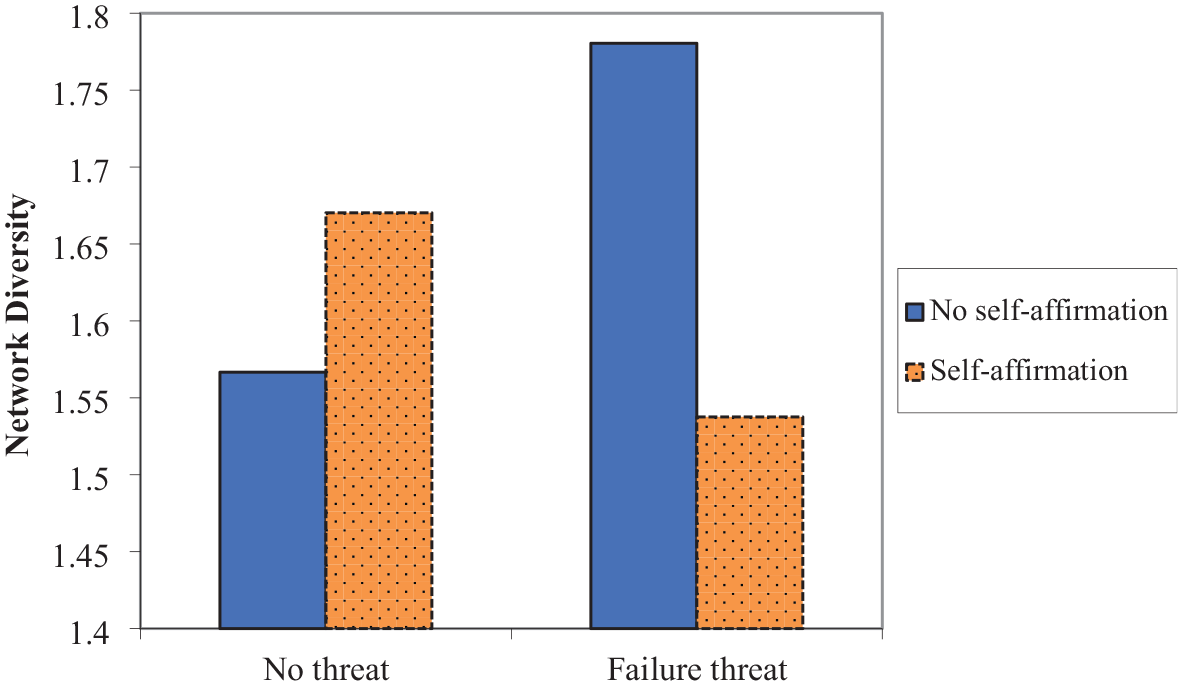
The interaction of failure threats and self-affirmation on network diversity.
Supplementary Analyses
We also replicated the analyses with the full sample and obtained consistent and significant results. The main effect of failure threat (p = .049) and its interaction with self-affirmation remained significant (p = .019) when no control variables were included. In order to account for pre-existing differences in entrepreneurs’ networking abilities, we controlled for perceived accessibility of information from external and internal sources, which had non-significant effects on network diversity, and the main effect of failure threat (p = .041) and its interaction effect remained significant (p = .019). In addition, we also tested whether entrepreneurial self-efficacy as a self-evaluation relevant in the entrepreneurial setting moderates entrepreneurs’ reaction to failure threats. Consistent with H3a, entrepreneurial self-efficacy significantly weakens the effect of failure threat on networking diversity (b = −.25, SE = .10, χ2(1) = 6.33, p = .012), showing that different aspects of self-evaluations have similar effects as expected. Finally, we measured the chronic sensitivity to failure threat via CSW on business success to explore how it interacts with situational failure threat. Their interaction effect (b = −.15, SE = .08, χ2(1) = 3.82, p = .051) is plotted in Figure 2. CSW motivates people to network broadly even when there is no failure threat (b = .11, t = 1.89, p = .061), but the failure threat condition creates a strong situation for everyone to network broadly, regardless of their CSW (p = .486). Thus, CSW can substitute the situational failure threat, and Study 2 will examine how it relates to entrepreneurs’ actual networks.
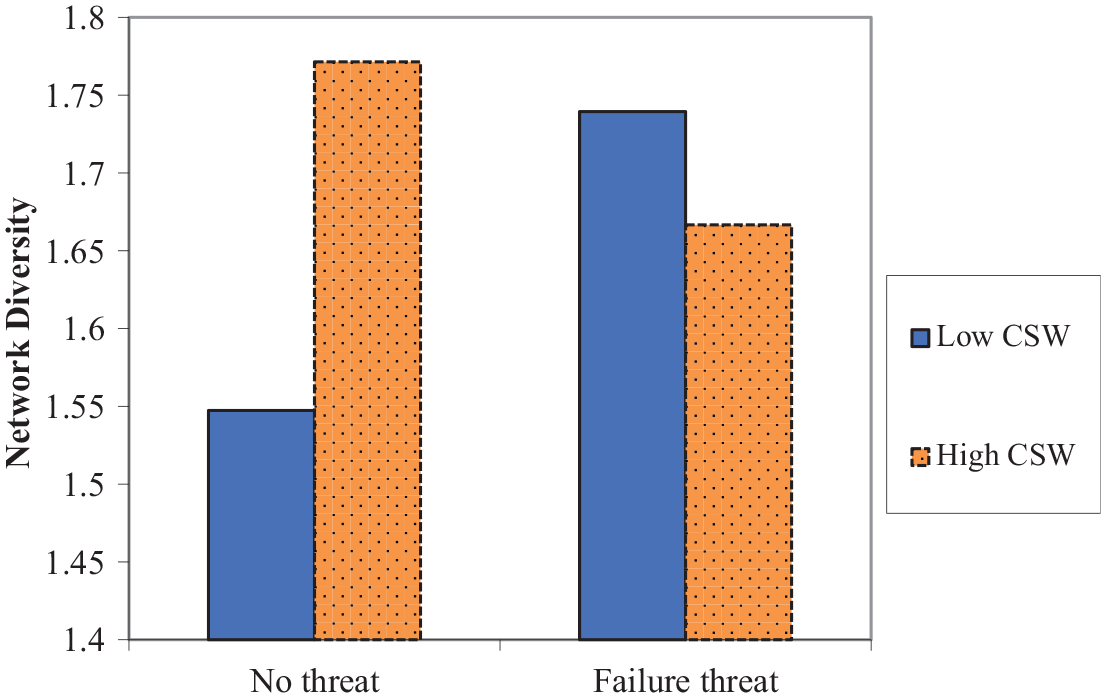
The interaction of failure threats and contingency of self-worth on network diversity.
Study 2: A Survey of Entrepreneurs’ Ego Networks
In order to test Hypotheses 2 and 3b, we measured entrepreneurs’ contingent self-worth and explored how it interacts with entrepreneurial self-efficacy to influence the ego networks of entrepreneurs. An important type of social network that brings diverse information is one that is high in structural holes (Burt, 1992). Therefore, we test Hypothesis 2 by relating entrepreneurs’ CSW to the structural holes of their ego networks. Another reverse proxy of network diversity is network density, which measures the proportion of close relationships between contacts within one’s ego network (Dubini & Aldrich, 1991; Hoang & Antoncic, 2003). Dense networks are less diverse because contacts know each other well and share similar information. We test Hypothesis 3b by examining whether entrepreneurial self-efficacy weakens the effect of contingent self-worth on structural holes and network density.
Sample and Procedure
To test our hypotheses, we surveyed 153 entrepreneurs from 42 incubators (other than those in Study 1) in Ningbo, China. The average firm age was 3.29 years, and the average age of founders was 34. The sample was 23% female. About 67% held a bachelor’s degree, and 24% had a Master. In terms of industry, 22% were in trade, 24% in service, 28% in IT, 7% in manufacturing, 6.5% in biotech, and 6% in education.
We visited the entrepreneurs at the incubators and explained the purpose of the study to obtain their consent to participate. The founders were given the questionnaire in paper format, which contained measures of entrepreneurial self-efficacy and contingent self-worth. Following standard procedure in network research (Marsden, 2005), we asked participants whom they have contacted for business advice and information in the past 6 months, their relationships with these contacts, and relationships between different contacts. We focused on business advice and information because this type of network is most useful and important for entrepreneurs (Kim & Aldrich, 2005) and aligned with our theorizing, but it is less studied compared to resource networks (Hallen et al., 2020). Well-trained research assistants explained the questions and collected the questionnaires after participants completed the survey. Based on the responses, we calculated structural holes and density following previous procedures (Burt, 1992). Having different formats to measure predictors and outcome variables alleviates concerns about the common method bias (Podsakoff et al., 2003).
Previous research finds that current structural holes rather than past ones help current network performance because their benefits dissipate quickly (Soda et al., 2004), so we used cross-sectional data to test our hypotheses on network diversity. In addition, we followed up with participants for a second wave 1 year later to observe the long-term impact on their networks. With the contact information provided in the first wave, only 70 responded to our second survey online.
Measures
We adapted the measure of contingent self-worth from the previous scale on workplace contingent self-worth to the entrepreneurial setting (Ferris et al., 2010). The five items were: “My opinion about myself is tied to how well my new venture works”; “My new venture’s success gives me a sense of self-respect”; “I feel better about myself when I know my new venture is doing well”; “My self-esteem is influenced by my new venture’s performance”; and “I feel bad about myself whenever my new venture’s performance is lacking” (1 = “strongly disagree,” 7 = “strongly agree,”α = .81).
Entrepreneurial self-efficacy was measured with an established scale (Zhao et al., 2005), which asked participants to indicate the degree of certainty they feel in performing four entrepreneurial tasks, including identifying new business opportunities, creating new products, thinking creatively, and commercializing an idea or new development (1 = “completely unsure,” 5 = “completely sure,”α = .82).
To measure ego networks, we used the name generator method (Burt, 1992), which is less likely to suffer from social desirability bias than other methods (Marsden, 1990). Respondents provided the surnames of up to five individuals (alters) from whom they obtained business advice, information, and suggestions in the last 6 months. Five contact names is a cost-effective number to measure ego networks (Merluzzi & Burt, 2013), as the typical number of contacts Chinese entrepreneurs generate is 4.46 (Burt & Burzynska, 2017). If entrepreneurs had more contacts to name, we provided extra space in the questionnaire and trained the research assistant to offer it if needed. For each contact, respondents also answered: “How close do you feel to this person?” as “very close,”“close,”“neither close nor distant,” or “distant.” Additionally, respondents reported their perception of the relationship between each pair of contacts as “close,”“neither close nor distant,” or “distant.” We used UCINET 6 software to calculate network constraint:

where pij is the proportion of time that i directly allocates to j (1/Ni, N is the number of contacts), pik is the proportion of time that i devotes to k, and pkj the proportion of time that contact k devotes to contact j. Structural Holes are measured as one minus network constraint (Burt, 1992), with larger scores denoting more structural holes.
Network density measures the average strength of ties among the contacts (alters) in the ego network (Marsden, 1990). This variable is calculated by dividing the total number of tie strengths among one’s contacts by the total possible number of ties, as indicated below:

where aij = 1 indicates the existence of a close relationship between i and j, 0.5 indicates the existence of neither a close nor distant relationship, 0 indicates the absence of a relationship.
Control Variables
We included firm age, measured as years since the date of founding, and firm size, measured as the number of full-time employees because these variables may influence ventures’ resources and needs for networking. We also included the entrepreneur’s age, gender, and human capital, including their education and managerial experience, which was measured through the number of years they worked as a manager before starting the new venture because these variables may influence entrepreneurs’ networking abilities. We also controlled for entrepreneurs’ startup experience, measured by whether they created new ventures before the current venture, as well as entrepreneurs’ years of industry experience, which have been found to influence their networking behavior (Zheng et al., 2020). We controlled for network size (number of contacts in the network), which was correlated with structural holes (Burt, 1992).
Results
Descriptive analysis results are presented in Table 1. In Table 1, the correlation between contingent self-worth and entrepreneurial self-efficacy was non-significant (r = −.05, p = 546), reinforcing the independence between the motive to avoid failure and entrepreneurs’ belief about their entrepreneurial capabilities. Correlations between contingent self-worth and dependent variables (r = .14, p = .08 for structural holes; r = −.13, p = .10 for density) were consistent with our hypothesis H2 and between the small (.10) and medium (.20) effect sizes based on individual difference research (Gignac & Szodorai, 2016). Since network size and industry experience were significantly correlated with structural holes and network density separately, we controlled for these variables in the regression analyses and presented the results in Table 2. In Model 2, contingent self-worth is positively associated with structural holes (p = .056), providing support for H2. To test the moderating effect of entrepreneurial self-efficacy (H3b), we standardized contingent self-worth and entrepreneurial self-efficacy and calculated their interaction terms to avoid multicollinearity in Model 3. Their interaction effect was significant (p = .033) and explained an additional 2% of variances of structural holes. The simple slopes test in Figure 3 shows that contingent self-worth was positively associated with structural holes when entrepreneurial self-efficacy was low (b = .05, t = 2.96, p = .004). This effect became non-significant when entrepreneurial self-efficacy was high (b = −.00, t = −.09, p = .93), supporting Hypothesis 3b that self-evaluation weakens the effect of contingent self-worth on network diversity. The effect remained significant when no control variables were included in Model 4, and the additional variance explained (.04, p = .011) reflected a medium effect size (Gignac & Szodorai, 2016). The main effect of contingent self-worth (p = .074) and its interaction effect with entrepreneurial self-efficacy (p = .081) remained robust when all the control variables were included in Model 5.
Means, Standard Deviations, and Correlations of Variables in Study 2.
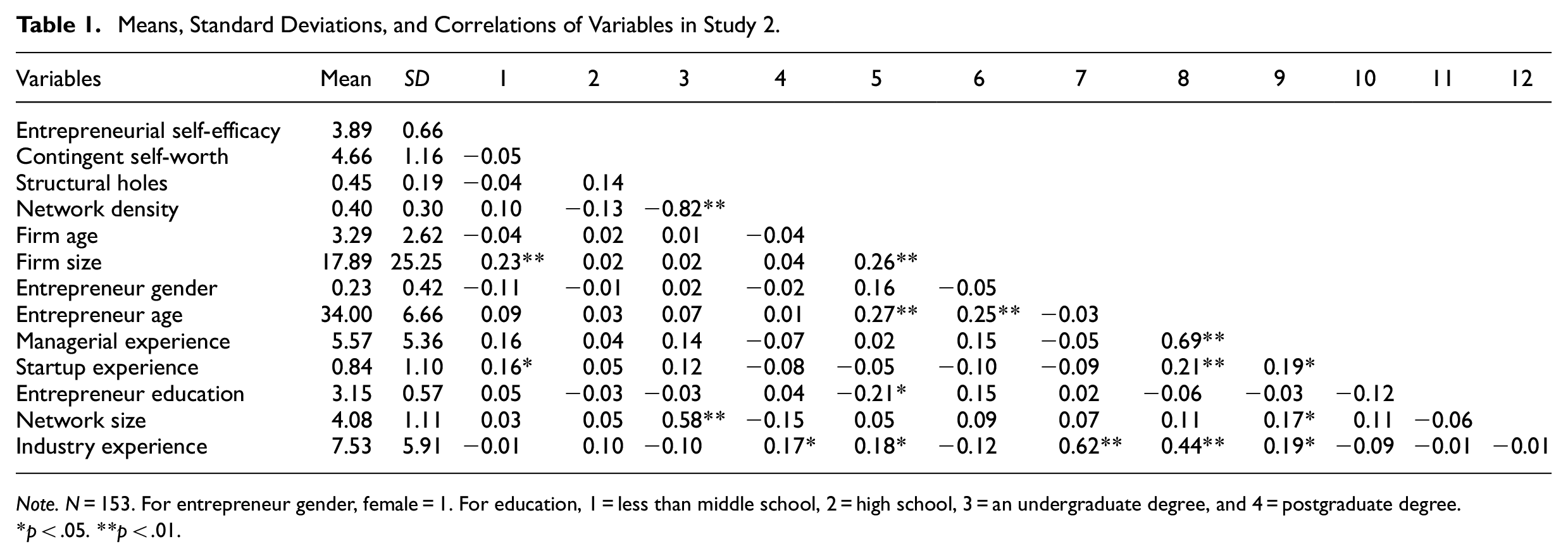
Note. N = 153. For entrepreneur gender, female = 1. For education, 1 = less than middle school, 2 = high school, 3 = an undergraduate degree, and 4 = postgraduate degree.
p < .05. **p < .01.
Regression Analysis of Structural Holes and Network Density in the First Wave (Study 2).
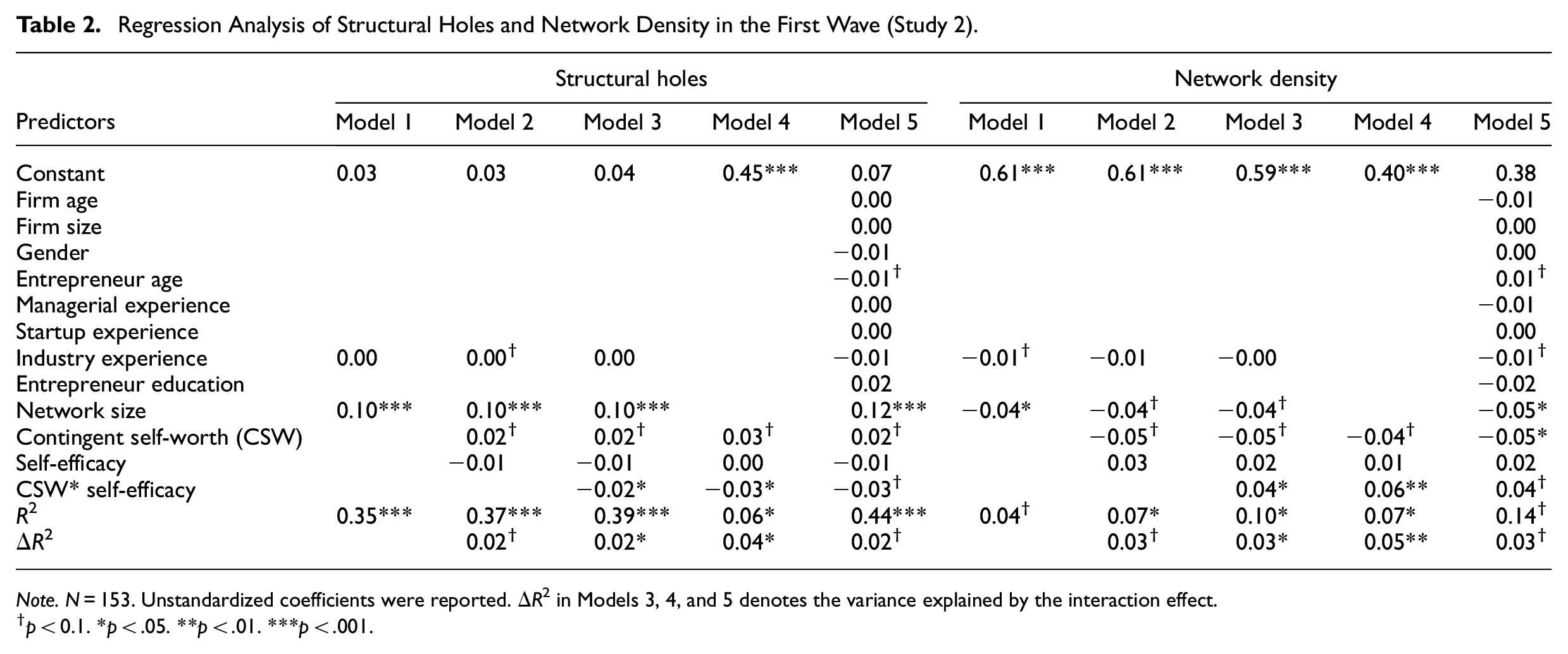
Note. N = 153. Unstandardized coefficients were reported. ΔR2 in Models 3, 4, and 5 denotes the variance explained by the interaction effect.
p < 0.1. *p < .05. **p < .01. ***p < .001.
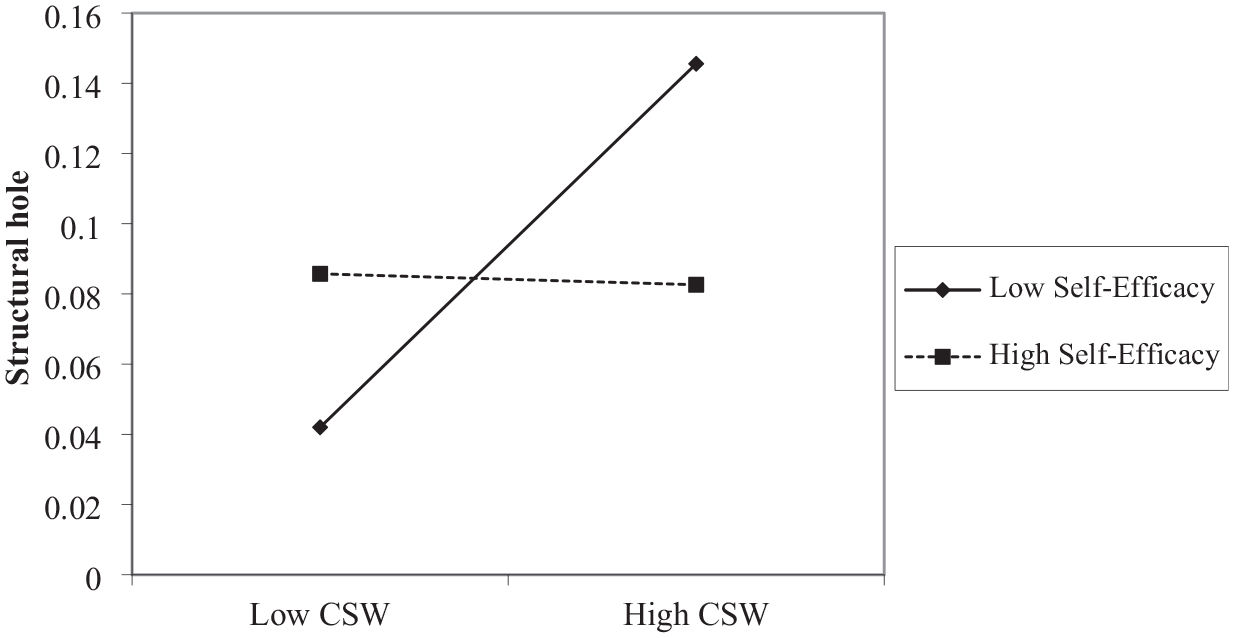
The interaction effect of self-efficacy and CSW on structural holes in the first wave.
Next, we tested our hypotheses on the density of social networks and presented the results in Table 2. After controlling for industry experience (p = .219) and network size (p = .047) in Model 2, contingent self-worth had a negative relationship with network density (p = .056) and explained 3% of its variance, supporting H2 that entrepreneurs who are sensitive to business failure build more diverse (less dense) networks. In Model 3, the interaction effect of contingent self-worth and self-efficacy was significant (p = .043) and explained an additional 3% of the variance. We plotted the interaction effect in Figure 4. Contingent self-worth had a significant and negative association with density when entrepreneurial self-efficacy was low (b = −.10, t = −3.00, p = .003). The effect of contingent self-worth was non-significant when entrepreneurial self-efficacy was high (b = −.00, t = −.09, p = .93), consistent with Hypothesis 3b, that self-evaluation weakens the effect of contingent self-worth on network diversity. The results were consistent when no control variables were included in Model 4, and the additional variance explained (.05, p = .008) reflected the medium level of effect size (Gignac & Szodorai, 2016). When all the control variables were included in Model 5, the main effect of contingent self-worth (p = .059) and its interaction effect with entrepreneurial self-efficacy (p = .088) remained robust.
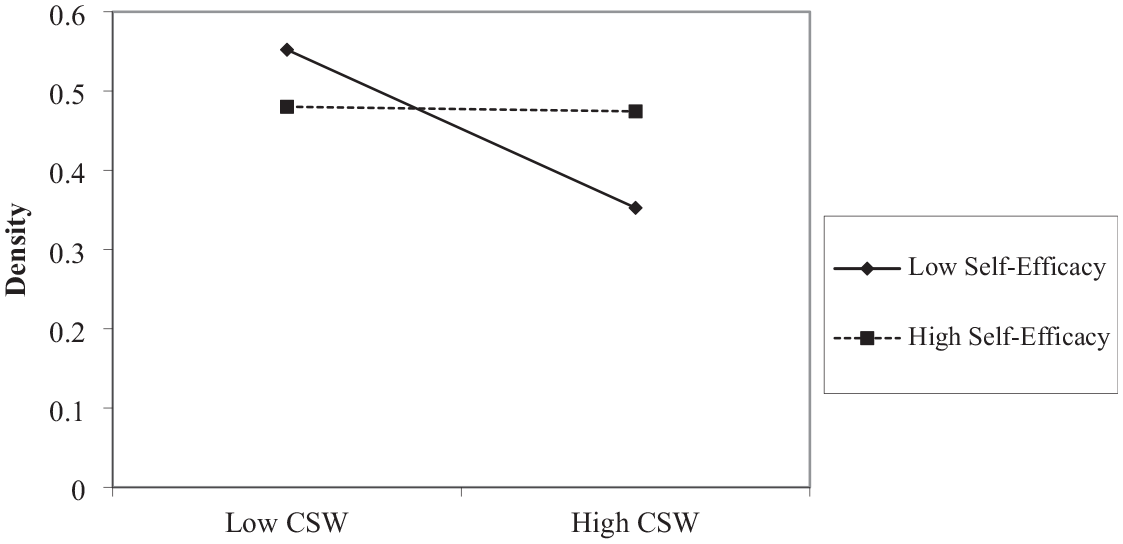
The interaction effect of CSW and self-efficacy on network density in the first wave.
Robustness Checks
We controlled for industry dummies, which did not have a significant effect on network structures, and hypothesized effects remained significant. Besides the chronic salience of failure threat, we also test the hypotheses with a proxy of situational failure threat. We measured the new ventures’ profit in the previous year (0 = negative profit, 1 = positive profit, N = 60) and tested its interaction with entrepreneurial self-efficacy on the networks of wave 1. Negative profit in the previous year was associated with less dense networks (b = −1.04, SE = .60, p = .083), providing support for problemistic search. Its interaction with entrepreneurial self-efficacy (p = .096) was like the pattern based on CSW. As shown in Figure 5, negative profit in the previous year is associated with less dense networks than positive profit when entrepreneurial self-efficacy was low, and the effect was attenuated by high entrepreneurial self-efficacy, which had a significant and positive association with network density (b = .34, SE = .15, p = .009). In addition, we controlled for networking ability with a measure, “How much confidence do you have in your ability to network-i.e., make contact with and exchange information with others” (McGee et al., 2009), and the interaction between contingent self-worth and self-efficacy remained as expected and significant on both structural holes (p = .042) and network density (p = .033). Finally, we also excluded the firms older than 6 years, and the results stayed consistent. We reported results based on the full sample to retain higher statistical power in our analysis.
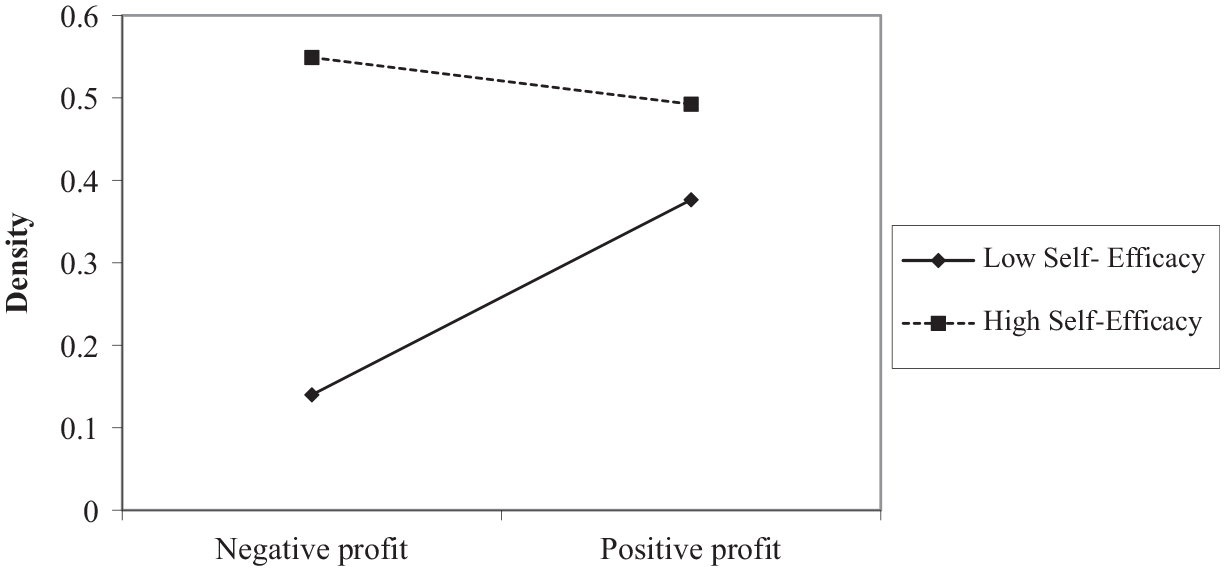
The interaction effect of previous profit and self-efficacy on network density in the first wave.
Supplementary Analyses
We tested the interaction effect of self-efficacy and CSW on network structure 1 year later to explore their long-term effect on social networks (N = 70). Neither the main effect of CSW (b = .03, SE = .03, t = .95, p = .34) nor its interaction effect with entrepreneurial self-efficacy (b = .02, SE = .03, t = .57, p = .57) on structural holes 1 year later was significant. None of the demographic variables had any significant effects on network density 1 year later. After controlling for network size in the second wave, the interaction effect of entrepreneurial self-efficacy and CSW on network density was significant (b = −.06, SE = .03, t = −2.36, p = .02) and explained an additional 8% of the variance. The simple slope analysis shows that contingent self-worth was positively related to network density at wave 2 when entrepreneurial self-efficacy was low (b = .09, t = 2.41, p = .019), but its effect turned non-significant when entrepreneurial self-efficacy was high (b = −.03, t = −.76, p = .452). The pattern of interaction effect is presented in Figure 6, and it remained consistent when baseline density was controlled for. This indicates that when entrepreneurial self-efficacy is low, entrepreneurs’ contingent self-worth is associated with more dense networks 1 year later.
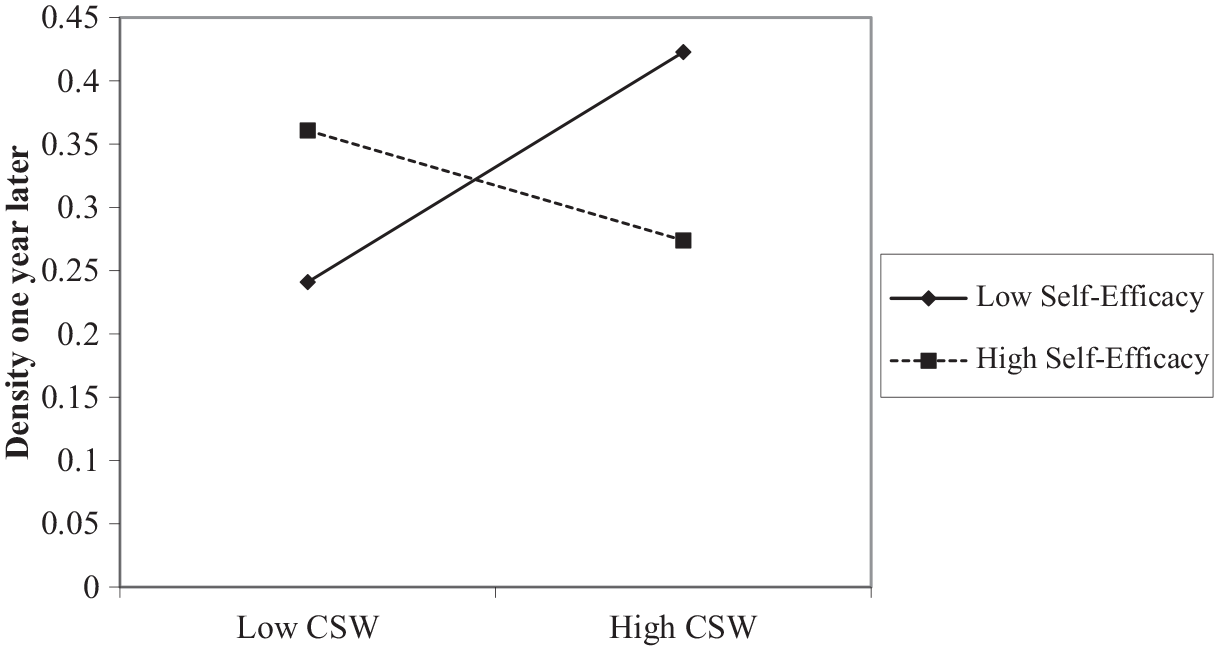
The interaction effect of CSW and self-efficacy on network density in the second wave.
General Discussion
In this article, we investigate what factors motivate entrepreneurs to build diverse networks. In the experimental study, we found that entrepreneurs are more likely to develop ties with different types of contacts when facing failure threats and that this effect is attenuated by self-affirmation that restores their global self-esteem. In the survey study, we found that entrepreneurs whose self-worth is contingent on business success employ networks high in structural holes and low in density, especially when their entrepreneurial self-efficacy is low. Taken together, when entrepreneurs confront failure threats or when their business failure holds important implications, they are more likely to activate diverse networks and mobilize networks of high structural holes and low density. These tendencies are attenuated by high entrepreneurial self-efficacy and self-affirmation intervention that reinforces entrepreneurs’ self-esteem.
Based on our supplementary results, we infer that entrepreneurs with low self-efficacy mobilize different networks to address failure concerns dynamically: diverse networks in the first wave and dense networks in the second wave. 1 Previous research has shown that stability in ego network structure reduces innovation performance (Kumar & Zaheer, 2019), and individuals who oscillate between closed and open networks achieve better advantage (Burt & Merluzzi, 2016). We show that the benefits of shifting networks manifest in entrepreneurs’ deployment of ego networks to reap the advantages of different kinds of networks. Since diverse networks help individuals address crisis situations (Wu et al., 2021), they are employed first. However, open networks are less supportive of the cooperation and commitment needed to implement the ideas and solutions generated (Kerr & Coviello, 2020), so entrepreneurs resort to dense networks later, which provide support and resources (Perry-Smith & Mannucci, 2017). This answers the call for more research on the dynamics of social networks (Ahuja, Soda, & Zaheer, 2012).
These findings make important theoretical contributions to previous literature. First, this article contributes to social network theory by identifying novel motivational antecedents (failure threat and CSW) of diverse entrepreneurial networks. Prior research investigated such antecedents of entrepreneurial networks as personalities, experiences, and abilities (Baron & Tang, 2008; Oh & Kilduff, 2008; Zheng et al., 2020). We reveal the motivational antecedents of entrepreneurial networks and complement network activation research (Shea & Fitzsimons, 2016; Smith et al., 2012). We show that CSW substitutes the situational failure threat to motivate diverse networks, highlighting the individual agency in network construction (Tasselli & Kilduff, 2021). Future research can explore how dispositional factors interact with situational factors to shape entrepreneurs’ social networks.
Second, our finding about CSW also discovers a dispositional driver of entrepreneurs’ search and makes a novel contribution to problemistic search theory, which has typically considered situational predictors (Posen et al., 2018). We further suggest that whether actors broaden or restrict search under failure threats depends on their self-evaluations: they broaden search under low self-evaluation and restrict search under high self-evaluation, reconciling the inconsistency in individual reaction to failure threats (Sarkar & Osiyevskyy, 2018). The seemingly rigid reactions (e.g., restricted search) might be driven by elevated confidence, rather than timidity. Maybe the threat of business failure is not as serious and shocking as crises that induce rigid reactions (Staw et al., 1981). Future research should explore whether different types of networks are employed to address different kinds of threats (e.g., self-caused failure vs. crisis-caused adversity).
Finally, we introduce CSW to the entrepreneurship literature and identify a boundary condition for perceptual control theory. Previous research suggests that the negative effect of self-efficacy emerges when enough motivation has been accumulated (Chen & Zhang, 2024). Our findings suggest that when failure threats or entrepreneurs’ CSW provide the motivation to search, perceptual control theory applies: self-evaluations play an informational function and suggest needs for resources and change (Kowalzick & Appels, 2023; Schumacher et al., 2020). Thus, self-evaluation is more likely to serve this informational function when the motivation for action is provided by other factors. Future research can explore conditions under which high self-evaluation is a liability for learning as opposed to an asset for resilience as assumed in previous literature (Williams et al., 2017).
Practical Implications
Our findings hold important implications for entrepreneurship practices and education. First, although social networks with structural holes are particularly important for entrepreneurial success, we found that entrepreneurs do not always develop this type of network. Entrepreneurship support organizations should draw entrepreneurs’ attention to networking by including networking and information search as key tasks of business creation rather than activities that divert resources and attention away from their main tasks (Engel et al., 2017). Second, we found that entrepreneurs are more likely to expand their networks when confronting failure threats. Educators should emphasize the high chance of failure in new ventures to make it salient and activate entrepreneurs’ motives to develop social networks to secure venture survival. This practice should be targeted towards those whose self-worth is not contingent on venture success, as entrepreneurs with self-worth contingent on business success are innately motivated to bridge more structural holes. Finally, we found that high self-evaluation prevents entrepreneurs from networking broadly. Mentors should provide accurate feedback to entrepreneurs to replace the informational function of self-evaluation.
Limitations and Future Research
The study has some limitations. First, both studies were conducted in China, raising questions about the generalizability of findings. Chinese entrepreneurs have lower structural holes with a more restricted range and variance than Western executives (Burt & Batjargal, 2019), providing a conservative test of our hypotheses. Given that we found the hypothesized effects in this context, future research should be able to replicate them in countries with larger variances in ego networks.
In addition, although the name generator method generated valid and reliable network data, the limit of five contacts may not capture the full range of entrepreneurs’ contacts. If one can detect reasonable scores for structural holes in these rather small networks, one can find even greater ones in larger networks surrounding the entrepreneur. Therefore, our social network measure is a conservative test for structural holes and diversity. Furthermore, the anonymous names reported in the survey cannot distinguish between pre-existing and newly developed ties. Future research could employ different methods, such as the event name generator (Burt & Burzynska, 2017), to track the dynamic development of entrepreneurs’ networks.
Finally, our reliance on problemistic search theory leaves other factors that influence entrepreneurs’ networks untested. For instance, since we focus on new ventures, which are usually restrained in their resources, we did not test whether success or the availability of slack resources may motivate entrepreneurs to develop diverse networks. Our supplementary analysis provided preliminary evidence against the effect of positive profit. Nonetheless, future research may loosen this assumption and test whether new ventures search broadly when they have slack resources, for example, after obtaining a large amount of funds.
Conclusion
We argue that as a strategic action, developing diverse networks consumes cognitive attention and time resources. Therefore, entrepreneurs are more likely to develop diverse networks under failure threats or concerns and when they hold low self-evaluations concerning their capability to address them. Under these situations, entrepreneurs first employ social networks rich in structural holes and resort to dense networks in the long term. Thus, different network structures are dynamically deployed to satisfy the salient needs of entrepreneurs, and the need to confront failure threats triggers the mobilization of diverse networks.
Footnotes
Acknowledgements
We appreciate the help of Jiaosha Chen, Xueqian Liu, Hejia Qiu, Wen Xu, Jack Xu, and Yuling Jiang with data collection.
Declaration of Conflicting Interests
The author(s) declared no potential conflicts of interest with respect to the research, authorship, and/or publication of this article.
Funding
The author(s) disclosed receipt of the following financial support for the research, authorship, and/or publication of this article: The authors received financial support from University of Nottingham Ningbo China and Ningbo Bureau of Science and Technology (project code 2017A10004).
