




Abstract
Entrepreneurs have been promoted as a main engine of progress. However, recent scandals and questionable behavior have led to increased discussion of entrepreneurs’ ethics. The purpose of this paper is to conceptualize entrepreneurial responsibility throughout the entrepreneurial process from an ethical viewpoint. We model entrepreneurial responsibility based on normative ethics (deontology and teleology), enabling us to better understand entrepreneurs’ active and conscious responses to their ethical duties and the consequences thereof. Our theorizing opens new avenues for scholarly research related to the ethical nature of opportunities, the interconnection of entrepreneurial intentions and outcomes from a moral perspective, and potential societal impact.
Keywords
Introduction
While entrepreneurship is celebrated in society as an engine of social and economic progress, the moral and ethical underpinnings of how entrepreneurs engage in entrepreneurial activities in relation to the potential value they provide are important emerging topics (e.g., Anderson & Smith, 2007; Hannafey, 2003; Harris et al., 2009; Vallaster et al., 2019; Zhang & Arvey, 2009). However, many unaddressed areas of work have become increasingly problematic and evident as the popular press provides frequent reports of ethically questionable behavior by entrepreneurs, such as fraudulent behavior (FTX Trading Ltd. and Sam Bankman-Fried), maltreatment of employees (Twitter and Elon Musk), and dishonest actions (Fyre Festival and Billy McFarland). We argue that to achieve the espoused societal benefits of entrepreneurship, entrepreneurs need to be aware of and navigate issues of a moral and ethical nature—that is, they need to be entrepreneurially responsible. However, while practically relevant, the notion of entrepreneurs’ ethical responsibility has not been fully addressed in academic research. Thus, in this paper, we define and conceptualize entrepreneurial responsibility. In doing so, we expand existing scholarship at the intersection of ethics and entrepreneurship (e.g., Bosse et al., 2022; Shir & Ryff, 2022; Vallaster et al., 2019).
We focus on the concept of entrepreneurial responsibility from an individual perspective (McClelland, 1961) and capture moral and ethical reasoning throughout the entrepreneurial process (Shir & Ryff, 2022). The existing literature has shed some light on moral and ethical considerations by mapping the possible intersections and discrepancies of morals, ethics, and entrepreneurship (e.g., Ahsan, 2018; Dey & Steyaert, 2016; Harris et al., 2009; Shir & Ryff, 2022). Moreover, discussions of business ethics generally tend to appear in debates on corporate social responsibility and ethical leadership (Card, 2005; Constantinescu & Kaptein, 2015; Dempsey, 2015; Kaptein, 2019). However, as Friedman (1970, p. 17) famously argues: The discussions of the “social responsibilities of business” are notable for their analytical looseness and lack of rigor. What does it mean to say that “business” has responsibilities? Only people can have responsibilities. A corporation is an artificial person and in this sense may have artificial responsibilities, but “business” as a whole cannot be said to have responsibilities, even in this vague sense.
In line with Friedman, we treat individual entrepreneurs as being in a unique position to make long-term ethical decisions that not only impact themselves but also the potential business they develop (Zhang & Arvey, 2009). The importance of entrepreneurial responsibility is particularly visible in the popular press, especially in relation to aspiring unicorn ventures attempting to become market disruptors and achieving high levels of scale (Hägg & Kurczewska, 2021; Kuckertz et al., 2023) and to some highly covered events, such as the rise and fall of Elizabeth Holmes and Theranos (fraud) and Martin Shkreli’s handling of Daraprim (price gouging). This press coverage has underscored the importance of responsibility in the entrepreneurial process when exploring and exploiting business opportunities. However, limited attention has been given to entrepreneurs’ responsibility to make ethical considerations as part of different stages of the entrepreneurial process (Hannafey, 2003; Shir & Ryff, 2022). This lack of attention is further captured by Vallaster et al. (2019, p. 235), who conclude that “ethics—in the context of entrepreneurship—is an integral part of responsibility. Ethics build the framework for behaviors and actions for individual entrepreneurs … and serve as a basis for the justifications of actions.” In addition, Bosse et al. (2022) highlight the importance of not only seeing responsibility as a passive liability but also seeing it as an active perspective that focuses on a focal opportunity rather than applying it to all firms. Hence, the purpose of this paper is to conceptualize entrepreneurial responsibility throughout the entrepreneurial process from an ethical viewpoint.
To develop a conceptual framework for entrepreneurial responsibility, we draw on normative ethics and its two fundamental views—deontology and teleology (Frankena, 1973). Although these ethical theories appear in business ethics discussions, they are rarely combined (e.g., Hunt & Vitell, 1986). Combining these views allows us to follow entrepreneurs’ behavior and decision-making throughout the entrepreneurial process. By emphasizing the intention to act, the acts themselves, and the outcomes of the acts, we capture a wide range of planned and emergent behavior related to duties based on deontological ethics (Donaldson & Dunfee, 1994) and to consequentialism based on teleological ethics (Takala & Pallab, 2000). Drawing from the literature on business ethics and moral philosophy, we contribute to the emerging discussions around entrepreneurship and responsibility (Bosse et al., 2022; Harris et al., 2009; Vallaster et al., 2019) by arguing why responsibility is central throughout the entrepreneurial process. We enrich these discussions by building a conceptual model anchored in normative philosophy that enhances our understanding of the dualistic nature of moral reasoning that entrepreneurs face throughout the entrepreneurial process as they explore and exploit potential opportunities. Furthermore, based on our conceptualization, we develop and visualize a trajectory to uphold entrepreneurial responsibility that depends on an entrepreneur’s moral evaluations at different stages of the entrepreneurial process, thus providing a more dynamic view of how ethical decisions may change over time. By emphasizing both deontology and teleology, we illustrate how responsibility can be understood within the field of entrepreneurship and hope to provide a fruitful ground for further research at the intersection of ethics and entrepreneurship (see e.g., Bosse et al., 2022; Shir & Ryff, 2022; Vallaster et al., 2019).
Responsibility in Entrepreneurship
The existing literature has generally concluded that entrepreneurs are in a unique position regarding ethical issues compared to established business managers (Hannafey, 2003; Morris et al., 2002, Vallaster et al., 2019). Fisscher et al. (2005) and Fassin (2005) argue that the ethical issues faced by entrepreneurs and managers overlap, but as entrepreneurs are situated in continuously novel contexts when introducing new goods and services, they face additional challenges related to ethical behavior. While entrepreneurs are often associated with doing good and creating value for society (Baumol, 1996), research at the intersection of ethics and entrepreneurship shows that they are not always primarily ethical (Brenkert, 2009; Hannafey, 2003; Harris et al., 2009; Vallaster et al., 2019). Instead, entrepreneurs are associated with cleverly maneuvering and creatively overcoming limitations to ensure the success of their businesses, which may lower their ethical standards (Morris et al., 2002). Potential explanations for these lower ethical standards include scarce resources, dependency on and lack of support from suppliers, limited legitimacy, and limited market presence (Harris et al., 2009). Other explanations may include dealing with ambiguity and external pressures for achievement leading to higher risk-taking and unethical actions (Brenkert, 2009; Hannafey, 2003; Morris et al., 2002; Zhang & Arvey, 2009) such that the importance of pursuing opportunities may challenge entrepreneurs’ moral behavior (Harris et al., 2009; Vallaster et al., 2019). These moral dilemmas give rise to the need for guiding principles for acting responsibly (e.g., Bosse et al., 2022) as entrepreneurs often lack an established code of conduct when making ethical decisions because their organizational cultures are still emerging (Buchholz & Rosenthal, 2005).
An entrepreneur’s ethical considerations and moral responsibility are present at every stage of the entrepreneurial process—from idea generation to opportunity exploitation to venture management—regardless of the entrepreneur’s mission (Shir & Ryff, 2022). In this sense, entrepreneurial responsibility implies a natural and integral attitude that guides entrepreneurs in their moral choices throughout the entrepreneurial process. Moreover, entrepreneurial responsibility has mainly been connected to entrepreneurial outcomes and has been analyzed less in relation to the intent to act. This focus on outcomes has skewed how entrepreneurial responsibility is viewed, with ethics only being addressed in the event of some negative outcomes from business activities and usually being analyzed retrospectively (Bosse et al., 2022). In addition, when the term “moral entrepreneur” appears in scholarly discussions, it is often understood as a person running a social enterprise (Bornstein, 1998; Catford, 1998; Cornelius et al., 2008; Wallace et al., 2009). Indeed, discussions of responsibility are frequently found in the literature devoted to social entrepreneurship (e.g., Brown et al., 2023; Zahra et al., 2009) or sustainable entrepreneurship (Dean & McMullen, 2007). In general, social entrepreneurship research assumes that social ventures are ethical by nature due to their aim to solve particular social problems (Bruder, 2021; Dey & Steyaert, 2016). Responsibility is primarily discussed from a social responsibility perspective, where “social” translates to social outcomes stemming from the adoption of a social mission that leads to social value creation (Chell et al., 2016; Dees, 1998). However, while Vallaster et al. (2019) find in their literature review that there is an emerging consensus that social entrepreneurs create social value, that consensus may lead to a hasty conclusion that social value creation universally equals ethical behavior. Their review also reveals that research thus far fails to conceptualize the ethical side of social entrepreneurship. We assert that ethical behavior and its conceptualization should be expanded to include all venturing activities regardless of the mission. Furthermore, we suggest that ethical discussions should not solely focus on the ethicality of the consequences of entrepreneurial actions but should also include the ethicality of intentions to act.
Entrepreneurial Responsibility as a Dualistic Act
Being responsible refers to being accountable for something within one’s power, control, or management. It concerns taking action based on one’s sense of connection and answerability to oneself and others. Responsibility relates to the social forces that bind an individual to the courses of action demanded by those forces (Cook-Sather, 2010). A similar view is adopted by Anderson and Smith (2007) when they introduce the moral space concept in entrepreneurship and argue for its position between the individual and the social. In line with Cook-Sather’s (2010) and Anderson and Smith’s (2007) views, responsibility is shaped by social forces. Entrepreneurial responsibility manifests as the outcomes of entrepreneurial actions and is socially evaluated based on these outcomes. However, factors beyond the outcomes of exploited business opportunities need to be considered to develop a comprehensive understanding of entrepreneurial responsibility. In particular, entrepreneurs’ intentions, including both their evaluations and explorations of business opportunities, represent an essential part of the entrepreneurial process and thus also need to be considered.
Thus, there are two sides to entrepreneurial responsibility. The first is present as an entrepreneur forms an intention and explores a potential business opportunity, marking the initial stage of engaging in the entrepreneurial process. In this sense, entrepreneurial responsibility implies a moral obligation to both evaluate and explore an entrepreneurial opportunity that may lead to responsible venture creation. The second area of responsibility is reflected in the executed actions corresponding to an entrepreneur’s identity, values, and morals, implying that the entrepreneur takes responsibility for these actions and their consequences when exploiting the focal opportunity. We address these areas below.
Duties and Consequences of Entrepreneurial Responsibility
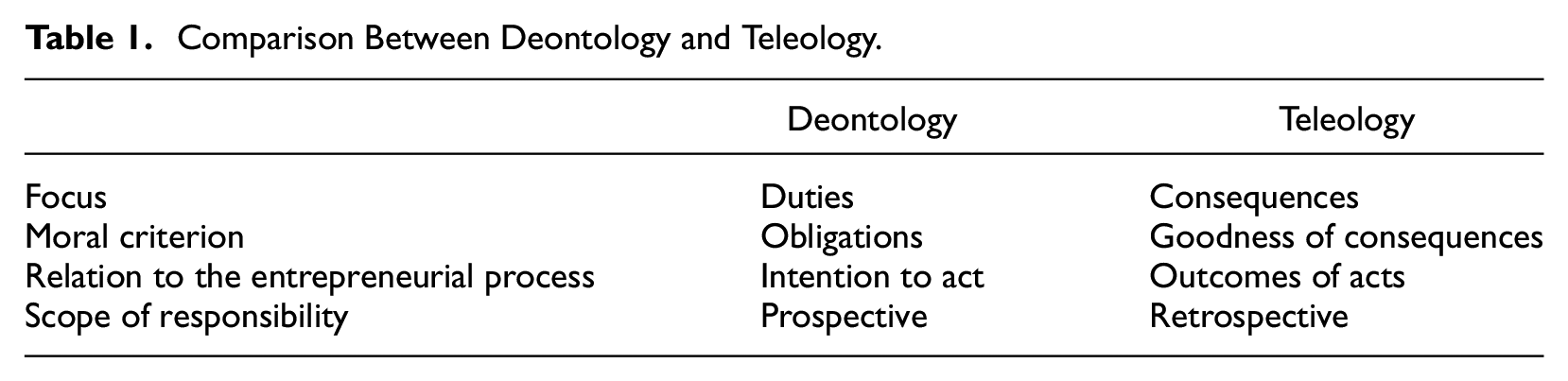
Moral theories are traditionally divided into two main ethical views—deontological and teleological (Frankena, 1973; Hunt & Vitell, 1986; Takala & Pallab, 2000). These two ethical views differ in terms of how they conceive the relationship between moral obligations and moral values. Deontological ethics derives moral values from obligations (Hunt & Vitell, 1986; Kant, 1785/1997). By contrast, teleological ethics places moral values first and derives moral obligations from them (Häyry, 1999; Takala & Pallab, 2000). In teleological ethics, the value of an action or a rule is the non-moral value that emerges as a consequence. An act is “right” if it produces more positive consequences than negative consequences (Frankena, 1973). Deontological ethics rejects the principle of maximizing positive consequences as a moral criterion and takes a negative view of consequences as the basis for moral values (Kant, 1785/1997). To illustrate, deontological ethics concerns following one’s inner moral compass and being aware of the possible outcomes of one’s entrepreneurial actions, while, if followed strictly, teleological ethics implies acting altruistically and objectively maximizing goodness for the majority regardless of whether doing so has a negative impact on one’s own business. Table 1 illustrates the difference between deontology and teleology in relation to entrepreneurial responsibility.
Comparison Between Deontology and Teleology.
Deontological Ethics—Prospective Responsibility
Kant represents deontological ethics through his moral theory that strictly rejects consequences as grounds for moral values (Takala & Pallab, 2000). At the center of Kantian moral theory is the assumption of a self-governing individual whose rational reasoning ability enables them to act morally (Häyry, 1999). Kant’s (1785/1997, p. 38) categorical imperative—to “act only in accordance with that maxim through which you can at the same time will that it become a universal law”—is a moral law that holds without exception and is always unconditional. Kant does not provide an objective moral criterion for moral imperatives because, as an autonomous moral individual, one ought to know. Moral behavior is based not on external rules but on one’s moral consciousness; it creates a moral criterion and authority (Kant, 1785/1997; MacIntyre, 1998). Kant’s view may seem strict, but it is still appealing as it corresponds to current ideals of autonomy and personal fulfillment (Smith & Dubbink, 2011). This view embraces moral sovereignty and autonomy, which allow individuals to freely pursue what they want, but it remains the responsibility of the agent to make moral decisions and take moral actions (MacIntyre, 1998).
In line with deontological ethics, an entrepreneur represents an intentionally acting agent whose inner sense of morality, values, and sense of duty guide their entrepreneurial behavior. Kant’s a priori moral theory shifts the focus to the entrepreneur’s will, motives, and intentions rather than to what they actually do (MacIntyre, 1998; Takala & Pallab, 2000). Accordingly, the entrepreneur’s goals should correspond with the categorical imperative. The entrepreneur is responsible for their will, motives, and intentions when acting on an opportunity, which becomes a prerequisite for acting morally in the entrepreneurial process. These a priori moral evaluations of an opportunity form prospective responsibility.
Teleological Ethics—Retrospective Responsibility
Ethics in modern society is mainly derived from utilitarianism (e.g., Appelbaum, 1975; Mäkinen, 2013; Renouard, 2011; Sen, 2009). Based on teleological ethics, utilitarianism focuses on consequences rather than obligations as grounds for value judgments (Frankena, 1973; Sen, 1979). In a utilitarian society, the aim is to maximize utility, which is often defined as well-being for the maximum amount of people (Rawls, 1971; Roberts, 1903). Taxation, wealth distribution, and competitive markets are examples of utilitarian institutions (Mäkinen, 2013). From the classical utilitarianism (e.g., Bentham and Mill) of the late 18th and early 19th centuries to more recent views (Rawls, 1971; Renouard, 2011; Sen, 1979, 2009), utilitarianism has accommodated economic growth needs while aiming for more positive consequences than negative consequences (MacIntyre, 1998). By definition, a utilitarian standard of right, wrong, and obligation is the principle of utility (Rawls, 1971).
A utilitarian perspective based on the consequences of actions taken only reflects the outcomes of the entrepreneurial process and thereby “obscures the creative springs of the actual moral situation” (Appelbaum, 1975, p. 12). Hence, according to teleological ethics and the utilitarian view, an entrepreneur represents a moral agent who is responsible for the consequences of their entrepreneurial actions, with moral evaluations being made based on the potential goodness of the expected outcomes. This is, in effect, retrospective responsibility, based on consequences of entrepreneurial actions. In accordance with Constantinescu and Kaptein (2015), our adoption of retrospective responsibility bears similarities to previously addressed concepts, such as backward-looking responsibility (Gilbert, 2006) and passive responsibility (Bovens, 1998). Here, moral evaluations are intended to determine whether positive consequences outweigh negative ones—in other words, moral evaluations of alternative actions believed to produce a relatively higher amount of good with respect to its desirability and probability. In reality, evaluations of alternatives are seldom straightforward, and the question of goodness for whom is highly complex and even deceptive. Therefore, a combined ethical theory offers new insights and is the foundation of our dualistic construction of entrepreneurial responsibility.
A Combined Ethical Theory to Grasp the Dualism of Entrepreneurial Responsibility
Neither deontological nor teleological ethics alone is sufficient when discussing entrepreneurial responsibility. Deontological ethics has been criticized for the idealistic view of a complete set of moral rules that would be applicable in any given situation, whereas teleological ethics has been questioned on the feasibility of measuring the amount of positive versus negative consequences. On the other hand, deontological reasoning is insufficient on its own as actions taken by an entrepreneur will create new conditions that they will have to consider when moving forward in the entrepreneurial process. An example of deontological reasoning is Elizabeth Holmes’ initial idea for her Edison blood-testing machine to bring affordable healthcare to the masses. Despite knowing the machine’s problems (e.g., conducting multiple tests on a single drop of blood), she persisted with her initial belief while disregarding the machine’s actual testing capacity and lying to investors to push forward. She has since been convicted of fraudulent acts. On the other hand, an example of teleological reasoning is Blake Mycoskie (the founder of TOMS Shoes) and his “one for one” business model. His altruistic idea of giving away shoes to people in developing countries ended up destroying local shoe markets (Hessekiel, 2021). Hence, this example illustrates the questionability of whether maximizing the total good always equals the most moral outcome (Hunt & Vitell, 1986). It also shows that well-intentioned entrepreneurial actions seldom produce only goodness as the notion of competition implies that some will lose when others win (Amable, 2011). Faced with this dilemma that neither view is impeccable, some scholars have advocated a mixed system of deontological and teleological ethics (e.g., Frankena, 1973; Hunt & Vitell, 1986; Takala & Pallab, 2000).
Understanding entrepreneurial responsibility through a dualistic lens that combines both deontological and teleological ethics allows us to consider an entrepreneur as a morally acting agent throughout the entire entrepreneurial process, which takes account of a priori (i.e., prospective) and a posteriori (i.e., retrospective) entrepreneurial responsibility. Based on the framework by Hunt and Vitell (1986), it can be assumed that throughout the entrepreneurial process, two types of evaluations take place that shape entrepreneurial responsibility. Deontological evaluation is based on the entrepreneur’s moral compass associated with personal norms (e.g., will, motives, and intentions) and obligations, which guide the explorative opportunity stage of the entrepreneurial process. Teleological evaluation is focused on the consequences of the entrepreneurial actions that take place in the exploitative stage of the entrepreneurial process. The complementary combination of these two views of normative ethics provides fruitful grounds for further conceptualizing entrepreneurial responsibility.
The dualistic perspective of moral evaluations, including both prospective and retrospective responsibility, means that the entrepreneur considers the morality of their business as a whole from the very beginning to the outcomes. These moral evaluations thus guide the entrepreneur’s behavior when they initiate the entrepreneurial process, making them responsible for the entire entrepreneurial process. Prospective responsibility is associated with the will, motives, intentions, and exploration of a recognized opportunity based on moral duties, whereas retrospective responsibility is associated with the outcomes in the exploitative stage. Together, prospective and retrospective responsibility illustrate the moral duality throughout the entrepreneurial process. As an example of entrepreneurial responsibility, the founder of Patagonia (Yvon Chouinard) has developed a corporate culture around environmental activism based on his personal beliefs and values. He has continuously adapted the company’s operations to match the company’s mission statement, “We are in business to save our home planet” (Patagonia, 2023). Chouinard’s initial intention in the 1970s was to make a living by developing climbing equipment and clothes that generated as little environmental damage as possible. An example illustrating entrepreneurial irresponsibility is the Fyre Festival and the main founder Billy McFarland. McFarland’s initial intent for the festival seemingly lacked any moral evaluation in terms of prospective responsibility, and he failed to address any retrospective responsibility regarding the negligent decisions made throughout the course of action. McFarland’s pursuit of the opportunity resulted in a 6-year prison sentence for wire fraud, including consideration of a second wire fraud charge from selling New York City VIP access tickets (Guerrasio, 2019).
It could be argued that combining a prospective view with a retrospective view opens novel research avenues that could further explain whether, when, and how entrepreneurs engage in morally justifiable actions. Making moral evaluations based merely on the possible goodness or badness of the consequences, as suggested by the prevailing utilitarian moral theory, largely overlooks the uncertainty of the future and the difficulty of predicting the outcomes of entrepreneurial actions (e.g., Sarasvathy, 2001). Hence, deontological ethics complements teleological ethics by making entrepreneurial responsibility a dualistic concept with a process perspective. In turn, the dualistic approach helps to explain and strengthen our understanding of how entrepreneurs make responsible decisions and judge how to act despite facing uncertainty (Knight, 1921). Combining these two complementary perspectives, we define entrepreneurial responsibility as an entrepreneur’s active attitude toward social reality and their conscious response to the outcomes of the entrepreneurial process, implying both a prospective moral stance based on duties when intending to act and retrospectively responding morally to the consequences of the actions taken.
Conceptualizing Entrepreneurial Responsibility
By combining deontological and teleological ethics, our model helps to capture how entrepreneurial responsibility exists throughout the entrepreneurial process. It therefore makes it possible to analyze how entrepreneurial agents act responsibly over time. Model 1 visualizes the importance of entrepreneurial responsibility in the entrepreneurial process from a dualistic ethical perspective. The model focuses on two ethical considerations that an entrepreneur faces in two distinct stages of the entrepreneurial process: (1) when identifying and morally evaluating an explored opportunity and (2) when exploiting the opportunity and morally evaluating its consequences. We rely on March’s (1991) well-established argument related to exploration and exploitation, and while acknowledging the breadth of process studies in entrepreneurship, we seek to avoid the multi-threaded discussion on the dynamics and interplay of particular stages that previous scholars have engaged in without fundamental consensus (e.g., Bhave, 1994; Bruyat & Julien, 2001; Gartner, 1985; Moroz & Hindle, 2012). Instead, we focus our conceptualization on the transition from exploration (before any actions have taken place) to exploitation (visible when an entrepreneur acts on a recognized business opportunity). Model 1 builds a normative framework for understanding the moral space in the entrepreneurial process. The framework conceptualizes how entrepreneurial responsibility unfolds with respect to deontological and teleological ethics.
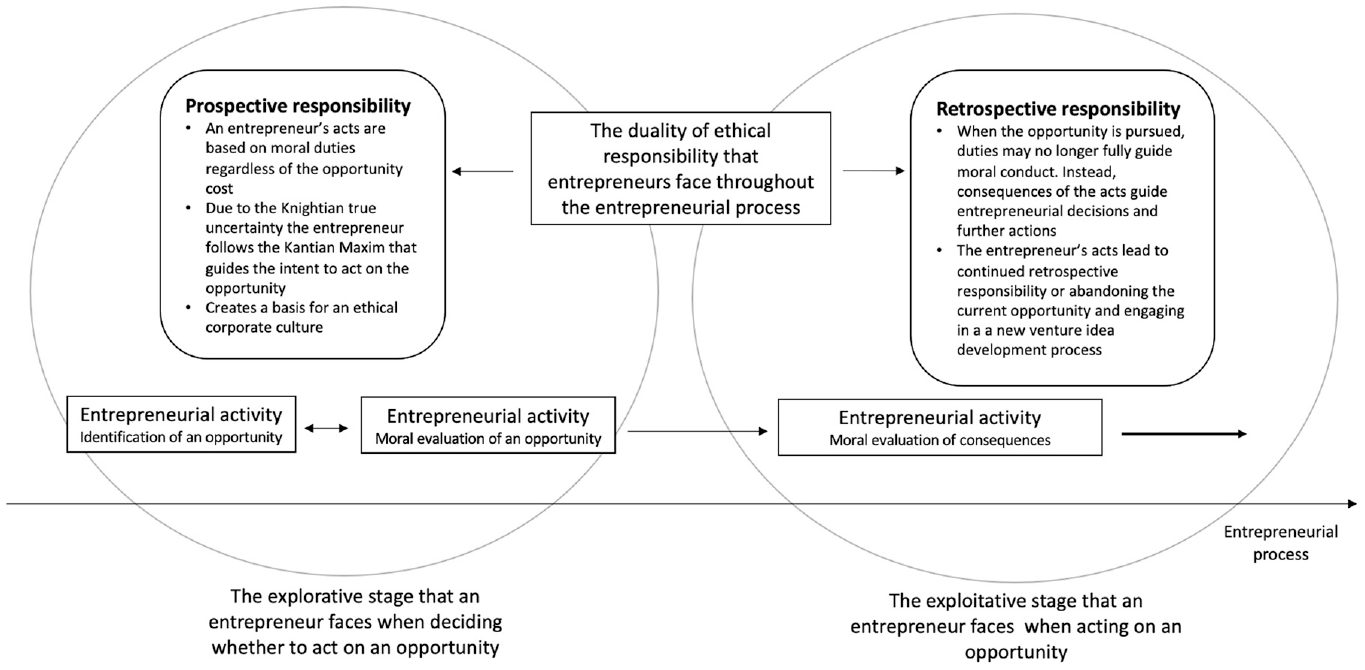
Conceptualizing entrepreneurial responsibility.
When engaging in the entrepreneurial process, an entrepreneur is faced with uncertainty, which makes it impossible to predict all the possible consequences of entrepreneurial actions after acting on an opportunity. Hence, the entrepreneur cannot make moral judgments based on the potential outcomes of their intentions. Accordingly, in the explorative stage (left side of Model 1), the entrepreneur should take a deontological perspective for opportunity identification and evaluation, relying on moral duties as a guide when making the initial decision to pursue and act on an opportunity. An entrepreneur is guided by the categorical imperative such that they take prospective responsibility for their entrepreneurial intentions and follow their inner moral compass when evaluating the opportunity. In the exploitative stage, the entrepreneur is guided by a teleological perspective, and the focus shifts to the balance between the goodness and badness of the consequences instead of moral duties (right side of Model 1). Here, the entrepreneur takes action to exploit the explored opportunity. As the consequences of the acted opportunity become perceptible, the entrepreneur’s moral evaluation of them guides decisions for future actions. This retrospective responsibility requires a moral evaluation of the entrepreneurial outcomes, which guides the entrepreneur to continue exploiting the opportunity or abandoning it if the negative consequences exceed the positive ones. If the outcomes of the exploited opportunity cause more harm than good, the entrepreneur engages in a new explorative process involving a new moral evaluation based on deontological ethics (moving back to the left side of Model 1).
Discussion
We argue that entrepreneurial responsibility should be given a more prominent position in entrepreneurship research. However, it should not be based solely on the prevailing utilitarian perspective with its underlying teleological ethics focusing on the outcomes of entrepreneurial activities. In terms of responsibility, a predominantly teleological standpoint is problematic because a significant part of the entrepreneurial process occurs before any actions take place and thus before any outcomes emerge. The probable lack of prior experience or exemplary cases on which to base the anticipated outcomes leaves the entrepreneur in a position that forces them to rely on a personal moral code and sense of moral duty. Hence, complementing teleological ethics with deontological ethics, such as Kant’s (1785/1997)categorical imperative, provides a theoretical foundation for understanding entrepreneurial responsibility throughout the entrepreneurial process. To outline our conceptualization of entrepreneurial responsibility and to illustrate its dynamics, we present Model 2. Model 2 depicts a trajectory of moral evaluations to maintain entrepreneurial responsibility throughout the entrepreneurial process and shows how the process may also potentially lead to entrepreneurial irresponsibility. The model reinforces the dynamic nature of entrepreneurial responsibility by showing the recursive and temporal aspects of responsible decisions. As an example, we use the case of Elizabeth Holmes as it has been settled in court.
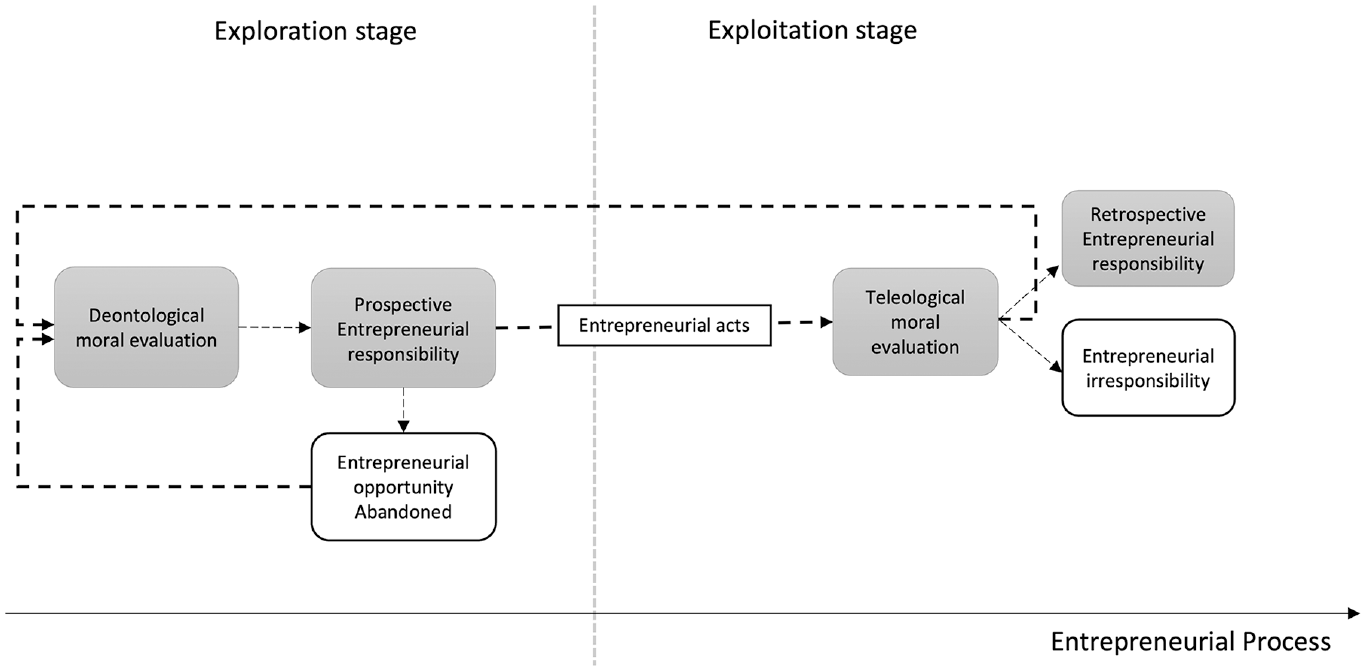
Moral evaluation trajectory for upholding entrepreneurial responsibility.
Starting from the left side of Model 2, an entrepreneur engages in a deontological moral evaluation of an opportunity based on their intent, will, and motives. In turn, this evaluation leads to the entrepreneur adopting prospective entrepreneurial responsibility for the opportunity. In this explorative stage of the entrepreneurial process, the entrepreneur can decide to either pursue the opportunity or abandon it if they determine it is impossible to uphold entrepreneurial responsibility. At this stage, multiple influences may come into play. Using our illustrative example, Elizabeth Holmes’ (stated) intent was to provide affordable healthcare for the masses with a highly advanced blood-testing machine. However, given the technology involved, there were mixed expert assessments as to the feasibility of doing so. Nevertheless, from a deontological moral standpoint, it appears (based on public press reports) as though her intentions were good at this stage, and she took prospective responsibility for the opportunity.
In the exploitation stage, again shown in Model 2, concrete entrepreneurial actions have been taken to pursue the opportunity. These entrepreneurial actions have consequences (both positive and negative), so the entrepreneur needs to conduct a teleological moral evaluation of the consequences. If the consequences are negative, the entrepreneur is faced with three potential outcomes: abandon, adjust, or engage in irresponsibility. The entrepreneur can conclude that the adjustments needed to continue acting morally are insurmountable and therefore decide to abandon the opportunity and do something else. Hypothetically, if Elizabeth Holmes had followed medical experts’ early advice concerning the feasibility of developing the Edison blood-testing machine based on employing data from only a drop of blood (Hartmans et al., 2023), she would have abandoned the opportunity. The second possible outcome of a teleological moral evaluation is that the entrepreneur makes the adjustments needed to continue acting responsibly, thus engaging in retrospective entrepreneurial responsibility. When Elizabeth Holmes decided to pursue the opportunity and left the explorative stage, a series of challenges began to converge. It became apparent that the Edison machine was unable to conduct the espoused analyses for different diseases (Carreyrou, 2015). For this outcome, Holmes could have hypothetically taken a step back and re-evaluated the consequences of using a malfunctioning blood-testing machine on actual patients. In turn, this scenario might have resulted in Holmes retreating from clinical trials, thereby maintaining entrepreneurial responsibility. The last potential outcome is that the entrepreneur does not adjust in accordance with the outcomes but instead engages in entrepreneurial irresponsibility. In our Elizabeth Holmes example, this was the outcome as she ignored the medical experts’ views and persistently forged ahead to create the Edison machine, thereby putting patients at risk due to the malfunctioning blood-testing machine and fraudulently misleading investors and other stakeholders. As a result, Holmes was convicted of wire fraud and conspiracy and is serving a prison sentence as a consequence of her unethical behavior (Hartmans et al., 2023).
Our trajectory of how to uphold entrepreneurial responsibility in Model 2 provides a simple, but not simplistic, understanding of the moral evaluations that every entrepreneur should consider in the explorative and exploitative stages of the entrepreneurial process to act responsibly. This dynamic trajectory represents an iterative process whereby actual experiences and market information may change an individual’s initial perceptions of their business opportunity. Although one’s intent (prospective entrepreneurial responsibility) should be based on moral duties (Kant, 1785/1997), the potentially changing circumstances based on new knowledge gained from experience warrant re-assessment and new decisions about how to act (retrospective entrepreneurial responsibility). Together, these elements constitute our argument for entrepreneurial responsibility as a dynamic interplay throughout the entrepreneurial process. Taking entrepreneurial responsibility within the entrepreneurial process thus entails both prospective and retrospective responsibility. Our conceptualization of entrepreneurial responsibility (Models 1 and 2) includes two stages of moral evaluation and opens up future research avenues directly related to both the nascent stage of the entrepreneurial process and the later stage after a venture has come into existence.
Implications for Theory
Our study contributes to the emerging body of research at the intersection of entrepreneurship and ethics (e.g., Bosse et al., 2022; Shir & Ryff, 2022; Vallaster et al., 2019). It provides a conceptual framework for understanding entrepreneurial responsibility in relation to the entrepreneurial process. By connecting prospective and retrospective responsibility, Models 1 and 2 address the importance of a dualistic ethical perspective and demonstrate how deontology becomes key in the exploration stage and teleology in the exploitation stage. This study offers several implications for understanding the role of entrepreneurial responsibility. Future research could focus on empirically testing and validating the framework and the role entrepreneurial responsibility plays in opportunity development, such as whether it hinders or enhances entrepreneurial activities. We approach entrepreneurial responsibility across the two stages of exploration and exploitation, including the early stage, in which opportunities are formed, developed, and evaluated and a venture lacks an existing organizational culture and an established code of conduct. Entrepreneurs therefore need to rely on their moral ability to make ethical evaluations and decisions (Buchholz & Rosenthal, 2005). It also includes moving into the exploitation stage, in which ventures establish a corporate culture that involves responsible conduct. Here, we see the importance of empirically investigating how established entrepreneurs consider what possible impact their existing and new products or services may have on individuals, their ventures, and the environment (Harris et al., 2009). Both nascent and established entrepreneurs often face risks and uncertainty and cannot only rely on experience when evaluating the consequences of their decisions (Buchholz & Rosenthal, 2005), implying that they also need to rely on their inner moral compass and sense of responsibility (Bosse et al., 2022). Furthermore, we foresee important research endeavors focusing on the need to integrate ethics into entrepreneurship research due to the uncertainty associated with the phenomenon. Despite streams of research beginning to explore the relationship between ethics and entrepreneurship, more integration and interplay between the fields are needed.
Implications for Practice and Education
From a practical perspective, we argue that it is essential to cement the role of ethics when discussing entrepreneurial behavior. A main implication for practitioners addressing how to explore and exploit opportunities is found in our conceptualization of ethical dualism since it underlines the deficiency of adopting a single ethical perspective. Espousing only a teleological view makes it impossible for entrepreneurs to make morally informed decisions because they cannot anticipate all the effects of their entrepreneurial actions ex-ante, while a deontological perspective may lead to limitations in the exploitation stage due to new market information and changed conditions. Our conceptualization can thus be applied to entrepreneurs’ continuous evaluations of business opportunities and practices in terms of responsibility. The framework can act as a tool on both the strategic and operative levels to assist in decision-making from a moral perspective.
The framework also provides some implications for entrepreneurship education. For example, educators could use Models 1 and 2 when designing teaching interventions aimed at deepening nascent entrepreneurs’ and students’ moral understanding of the role they play when exploring and exploiting opportunities in society and the effects they might have on the economy. Moreover, when entrepreneurial responsibility is included in educational curricula, the moral and ethical aspects that guide decisions before taking entrepreneurial actions and those related to the consequences of such actions would provide students with a deeper understanding of the social level of engaging in the entrepreneurial process. Here, the importance of actively engaging students in reflective practice could aid in developing a deeper sense of individual entrepreneurial responsibility. Accordingly, responsible conduct becomes built into the central process of starting and managing a business instead of only being addressed as an add-on. The role of entrepreneurial responsibility also precedes that of corporate social responsibility, a topic that has received a natural place in higher education and business ethics.
Limitations and Future Directions
The complexity of philosophical inquiry poses several challenges to conceptualizing the ethical behavior of entrepreneurs. It is imperative to emphasize that one cannot separate moral concepts from social life, which is determined by culture and history (MacIntyre, 1998). Indeed, as MacIntyre (1998) contends, moral concepts are formed and embedded within social life, encompassing a range of cultural variations, such as the tension between individuality and community and between liberty and loyalty. Consequently, moral conduct and responsibility take different forms and hold diverse meanings across the globe and among individual institutions and industries. Our proposed framework offers one lens based on a Western normative understanding that is relatively vague in terms of what is implied by moral duties and what is considered “good” or “bad,” which are always normative understandings based on cultural values and thus vary across the globe. Even though our theorizing adheres to Western normative philosophy, it does not claim any sort of ethical universalism nor that all ought to act according to the same moral code. Nevertheless, non-Western perspectives deserve more scholarly attention when building a holistic understanding of entrepreneurial responsibility. Furthermore, it is important to note that the illustrative examples referred to in this study are not representative of all entrepreneurs and do not reflect the diversity of entrepreneurs.
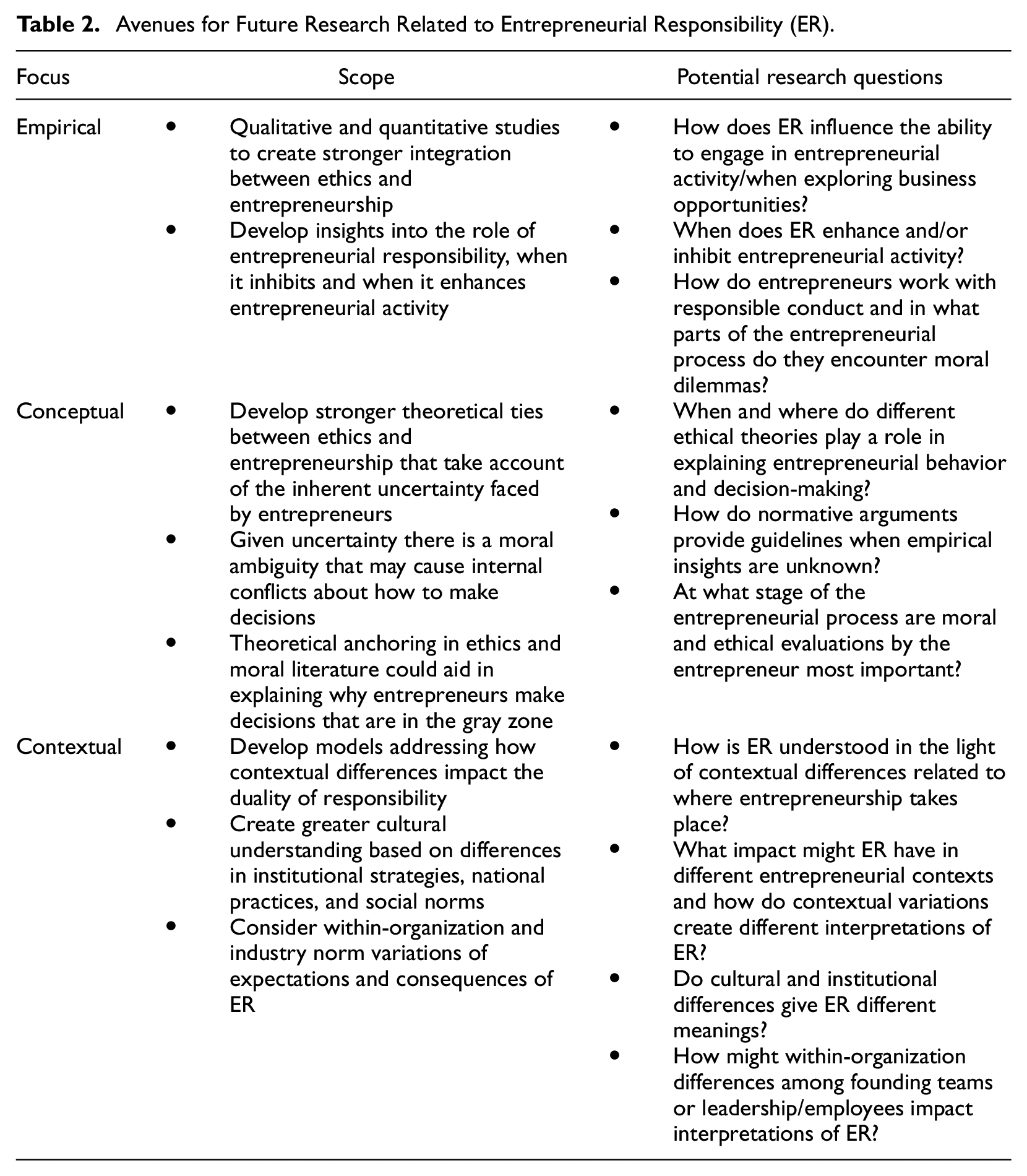
The above implications and limitations also open future research directions. As there is high contextual variation in entrepreneurship, the role of entrepreneurial responsibility will be understood differently depending on the type of business activities studied. In the case of hyper-growth, profit-oriented activities, responsible conduct may perhaps be more closely tied to business considerations related to issues such as fair pay, equality and inclusion, and trust. Ethical boundaries may be pushed to quickly achieve firm goals. By contrast, social and green entrepreneurial activities may place greater emphasis on planetary and humanitarian boundaries that are central to opportunity evaluation (Siqueira et al., 2023). Given the variety of new potential areas for future research directions, we have summarized some key research questions in Table 2.
Avenues for Future Research Related to Entrepreneurial Responsibility (ER).
Conclusion
This paper responds to the calls for applying ethical lenses to entrepreneurship and extends the discussion on entrepreneurial responsibility. These calls have recently accelerated given the unabated tales of unethical issues among entrepreneurs relayed in the popular press. We conceptualize entrepreneurial responsibility by combining the deontological and teleological views underlying normative ethics. Our approach considers moral duties (deontological ethics) and consequences (teleological ethics)—that is, both the inner unconditional moral obligations of entrepreneurs and the potential goodness of the expected outcomes of their actions. The dualistic ethical perspective applied in Models 1 and 2 provides a better understanding of the responsible entrepreneurial process. Our dualistic approach to responsibility grounded in normative philosophy is applicable in a variety of entrepreneurial contexts. Regardless of whether an entrepreneur’s main vision is to engage in a social, sustainable, or for-profit pursuit, the moral evaluations based on duties and consequences create a foundation for responsible conduct that guides the entrepreneur toward what Baumol (1996) terms productive entrepreneurship. We hope our framework and related research questions inspire greater attention to the importance of entrepreneurial responsibility, which will consequently lead to higher-quality support for entrepreneurs facing moral dilemmas in each phase of the entrepreneurial process.
Footnotes
Declaration of Conflicting Interests
The author(s) declared no potential conflicts of interest with respect to the research, authorship, and/or publication of this article.
Funding
The author(s) disclosed receipt of the following financial support for the research, authorship, and/or publication of this article: Agnieszka Kurczewska and Gustav Hägg are grateful for the financial support by the National Science Centre in Poland (OPUS, 2019/35/B/HS4/01580).
