




Abstract
The extant theory posits that ethno-racial diversity promotes entrepreneurship by increasing the novelty of information and perspectives available for recombination in a region. This view presupposes the flow of novel information among potential entrepreneurs. Yet, we know comparatively little about how regional social structures (e.g., collective social capital) that affect information flows condition this relationship. We build on the sociological literature to theorize how the interplay between collective social capital and residential segregation moderates the relationship between ethno-racial diversity and entrepreneurship. We test, and find empirical support for, our hypotheses among all registered new ventures started in the United States between 1990 and 2018.
Entrepreneurship involves social processes that often unfold in local contexts, and its economic and creative output typically drives local growth and innovation. As a result, local determinants of startup activity have emerged as an important area of study in entrepreneurship (e.g., Coomes et al., 2013; Lewis et al., 2021; Wang & Tan, 2019) and organizational sociology (e.g., Kwon et al., 2013; Samila & Sorenson, 2017).
An important determinant of entrepreneurship is the diversity of ideas, knowledge, perspectives, and skills present in a region (Karlsson et al., 2021). Past research has demonstrated that the diversity of local skills (Zhang, 2020), education (Marino et al., 2012), and ethnicity (Sobel et al., 2010) all have a positive relationship with new venture founding. This latter type of diversity is especially important because of the general increase in racial/ethnic diversity in Western societies (Putnam, 2007), the role of entrepreneurship as a means through which immigrants integrate into and contribute to their local economies (Light & Gold, 2000; Mickiewicz et al., 2019), and the role of entrepreneurship as a means through which racial/ethnic minorities can escape workplace marginalization (Heilman & Chen, 2003).
The existing literature posits that the positive relationship between local diversity and entrepreneurship depends on the flow and integration of novel information through social interaction (Audretsch & Keilbach, 2007; Samila & Sorenson, 2017). However, relative to other types of diversity, racial/ethnic diversity poses a theoretical puzzle. Ethnic diversity can endow a region with novel information and a variety of perspectives that can encourage entrepreneurship. However, ethnicity often segregates interaction (Diprete et al., 2011), and increases in the racial/ethnic diversity of a region can encourage insularity and generate racial tensions (Putnam, 2007; Quillian, 1995, 1996). As a result, though higher local racial/ethnic diversity generally increases entrepreneurship (Mickiewicz et al., 2019; Sobel et al., 2010), it also generates social forces capable of undermining this effect. Understanding when and how this occurs requires attention to the structures that pattern individual and group interactions associated with regional diversity.
To provide this understanding, we examine new venture founding (i.e., the creation of independent, incorporated new firms) in 3,046 counties in the United States between 1990 and 2018. We hypothesize and find that the positive relationship between local racial/ethnic diversity and new venture founding is attenuated by ethnic/racial residential segregation; counter to our expectations, we also find that community bridging social capital—that is, associational organizations encouraging heterophilic, for example, between ethnic group, interactions (Qureshi et al., 2016)—attenuates this relationship as well. We further hypothesize that bridging social capital will offset the attenuating effect of segregation on the diversity–entrepreneurship relationship and that bonding social capital will exacerbate it. We find empirical support for bridging social capital offsetting the effect of segregation so that even in the most segregated regions, diversity is a powerful driver of entrepreneurship. Bonding social capital does not have its expected exacerbating effect.
These findings advance scholarly understanding of the local determinants of entrepreneurship by emphasizing the role of the structures that pattern information flow in the relationship between regional racial/ethnic diversity and entrepreneurship. The significance of the structures that we examine is such that they are capable of eliminating the generally positive relationship between diversity and entrepreneurship while also providing the means to redress this effect. These findings also help illustrate the complex relationship between social capital and entrepreneurship, particularly as it relates to race (Bruton et al., 2022). Broadly, we demonstrate the need to distinguish types of social capital, especially within regions. This is particularly important in light of findings such as those of Kwon et al. (2013), who find that general community social capital is less beneficial for racial/ethnic minority entrepreneurship than it is for non-minority entrepreneurship.
Entrepreneurship, Diversity, and Segregation
Entrepreneurship and Racial/Ethnic Diversity
Entrepreneurship—the discovery, evaluation, and exploitation of business opportunities (Shane & Venkataraman, 2000)—is a socially embedded process (Cordero, Montiel & Sanz, 2011; Cordero, Montiel, Sanz, Severino, 2011; Granovetter, 1985) and largely a local one (Audretsch et al., 2012; Coomes et al., 2013; Karlsson et al., 2021), making localized determinants of entrepreneurship particularly significant (Coomes et al., 2013). Such determinants include regional norms (Perez & Cordero, 2010; Sine et al., 2022; Vedula & Kim, 2018), the presence of entrepreneurial support organizations (Spigel, 2017), and the availability of financial capital (Samila & Sorenson, 2017). An important predictor of regional entrepreneurship is diversity, which increases the local availability and variety of knowledge and perspectives that, in turn, generate entrepreneurial activity (Karlsson et al., 2021). Forms of diversity that have demonstrated a positive effect on regional entrepreneurship include skills diversity (e.g., Zhang, 2020), education (e.g., Marino et al., 2012), and racial/ethnic diversity (e.g., Sobel et al., 2010).
Racial/ethnic diversity features prominently in research examining the effect of diversity on entrepreneurship. The attention given to this form of diversity is a product of both its strength as a predictor of entrepreneurship (e.g., Audretsch et al., 2010) and the ethical element of the entrepreneurship of disenfranchised racial/ethnic minorities and migrant entrepreneurs (i.e., Bruton et al., 2022; Harris et al., 2009). Like other forms of diversity, racial/ethnic diversity drives entrepreneurship by increasing the diversity of ideas, perspectives, and skills available for recombination in a region (i.e., differentiated stocks of information), encouraging entrepreneurship (Qian, 2013; Samila & Sorenson, 2017). Because past research has found ethnic diversity to increase entrepreneurship (e.g., Audretsch et al., 2021; Rodríguez-Pose & Hardy, 2015; Sobel et al., 2010), we predict as a baseline that:
Residential Segregation and the Flow of Information
The positive relationship between regional racial/ethnic diversity and entrepreneurship is driven by informational effects associated with diversity (Qian, 2013; Samila & Sorenson, 2017). However, this mechanism is contingent on flows of information between the different groups, which are, in turn, patterned by the social structures of the region. Of particular importance here is residential segregation, the “spatial clustering by race” (Fairchild, 2009: 376). Segregation fundamentally affects what diversity looks like in a region, such that two similarly diverse regions can appear dramatically different with respect to the spatial distribution of diversity (see Figure 1). As a construct, segregation is strongly associated with racial/ethnic diversity (Laurence et al., 2019) both because diversity is a precondition for segregation (i.e., an ethnically homogeneous region cannot be segregated by ethnicity) and because segregation dramatically affects the experiences of different ethnicities in a region (Ezcurra & Rodríguez-Pose, 2017; Mouw & Entwisle, 2006; Ruef & Beezer, 2023) as well as the economic well-being of the region as a whole (Buchholz, 2021; H. Li et al., 2013; Samila & Sorenson, 2017; Tammaru et al., 2020).
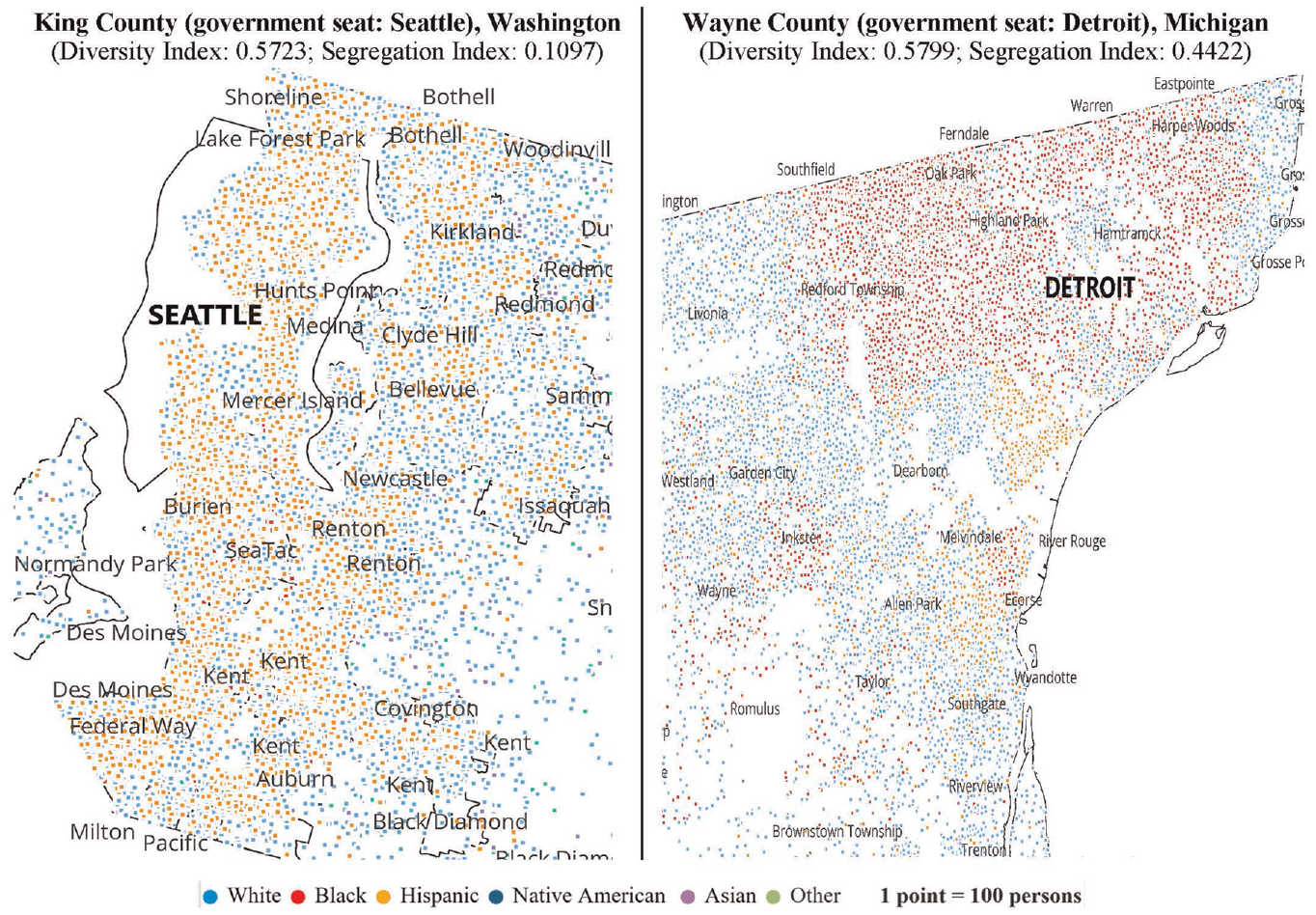
Comparison of two similarly racial/ethnic diverse counties with different residential segregation.
Segregation depresses the flow of information between communities of different racial/ethnic backgrounds within a region (Buchholz, 2021; Samila & Sorenson, 2017), creating a cross-race informational divide (Fairchild, 2008b). That is, because much social interaction is determined by spatial proximity (Echenique & Fryer, 2007; Tóth et al., 2021), the spatial separation of racial/ethnic groups diminishes the flow of information between them (Charles, 2003). Residential segregation reduces interethnic interaction while learning in school (Mouw & Entwisle, 2006), shopping (Kwate et al., 2013), working (Hughes & Madden, 1991), eating out (Davis et al., 2019), and engaging in a host of other everyday activities within a regional social system. Thus, for example, due to its negative effect on information flows, racial/ethnic segregation in the United States depresses the effect of available venture capital on regional patenting, inventing, entrepreneurship, and growth (Samila & Sorenson, 2017). Similarly, racial/ethnic segregation depresses the relationship between immigrant diversity and worker productivity in the United States by reducing exposure to new ideas and opportunities to collaborate with people from different backgrounds (Buchholz, 2021). In each example, segregation restricts the flow of information between racial/ethnic groups to the detriment of the region. Thus, for a given level of informational diversity deriving from the ethnic diversity of a region, the level of segregation will influence the degree to which that information is accessible such that:
Social Capital and Entrepreneurship in Diverse Regions
Meso-Level Structures Within Regions
When considering racial/ethnic diversity and segregation as features of a regional system, differences in meso-level structures play an important role in patterning how these features will affect entrepreneurship. Meso-level structures are structures operating to either mediate or moderate the effect of a higher (macro) level structure on individual (micro-level) action (Kim et al., 2016). Examples of meso-level structures include the digital infrastructure that allows female entrepreneurs to break through the highly gendered socioeconomic system of Saudi Arabia (McAdam et al., 2020), state-level policies that offset the effect of national regulations on job creation (Lucas & Boudreaux, 2020), and regional norms of pace of life that influence the levels of entrepreneurial effort in US cities (Vedula & Kim, 2018). Fundamentally, variation in meso-level structures alters how those embedded in a system experience a system’s qualities. Thus, for example, the presence of digital infrastructure in a region creates differences in the capacity of women (individuals) to pursue entrepreneurship within Saudi Arabia (the broader system) (McAdam et al., 2020).
In the previous section, Figure 1 provides the maps of two comparably diverse regions with visibly different patterns of segregation, with Wayne County being both very diverse and very segregated. Other regions in the United States are similarly both diverse and segregated, and differences in entrepreneurial activity in these regions might be explained by the meso-level structures comprised in their respective regional systems. In the following section, we introduce community social capital as an important meso-level structure with clear implications for how information flows between different racial/ethnic groups, particularly where these groups are spatially separated.
The Effects of Community-Level Social Capital on the Consequences of Diversity and Segregation on Entrepreneurship
The social capital of a region is an essential structure for the flow of novel information and perspectives stemming from racial/ethnic diversity to affect entrepreneurial action (e.g., see Westlund & Bolton, 2003). Social capital refers to the resources available through relatively stable social ties (Adler & Kwon, 2002; Bourdieu, 1986) and is an important antecedent to entrepreneurship (De Carolis & Saparito, 2006; Gedajlovic et al., 2013). Social capital prompts entrepreneurial entry by serving as a source of information about opportunities (Ozgen & Baron, 2007) and as a valuable resource in the exploitation of opportunities (Kalnins & Chung, 2006).
As meso-level structures within regions, the associational networks, such as voluntary membership organizations (P. H. Kim et al., 2016), comprise preexisting patterns of affiliation and social interaction (Kwon et al., 2013; Malecki, 2012; Putnam, 2000) into which people join, gaining access to durable relationships through which they can access resources (Adler & Kwon, 2002). Social capital scholars describe these meso-level structures as community or regional social capital (Kwon et al., 2013; Malecki, 2012), and these networks pattern interaction (Alesina & La Ferrara, 2000) and facilitate the transmission of information valuable in entrepreneurial processes (Kleinhempel et al., 2020). Because social capital is an important antecedent to individual entrepreneurship (Gedajlovic et al., 2013), the availability of these networks within an area drives entrepreneurship at individual (e.g., Kleinhempel et al., 2020), regional (e.g., Kwon et al., 2013), and national levels (e.g., Kwon & Arenius, 2010). However, there are different forms of regional social capital, bridging and bonding, and each has a distinct bearing on racial/ethnic diversity and entrepreneurship.
Bridging Social Capital Enhancing the Effect of Diversity and Attenuating the Effect of Segregation on the Diversity–Entrepreneurship Relationship
Networks that generate patterns of heterophilic interactions—interactions between dissimilar individuals and groups—are particularly important for entrepreneurship (Light & Dana, 2013; Malecki, 2012). These networks are an important element of the social capital of a region, and we describe such networks as regional bridging social capital, comprising those networks that “bring together people who are unlike one another” (Putnam & Goss, 2002: 11). Bridging social capital refers to social capital that entails external relations between different groups (Adler & Kwon, 2002; Putnam, 2000), and this type social capital facilitates entrepreneurship by exposing people to novel ideas, perspectives, and other resources (Aldrich & Kim, 2007; Cao et al., 2015).
Succinctly, the availability of bridging networks allows information to flow between groups with differentiated informational stocks (Malecki, 2012). Civic organizations, co-operatives, religious organizations, and sports leagues are examples of associational networks often understood as serving a bridging function (Putnam, 2000). These networks typically have incentives to increase membership numbers and the diversity of membership (e.g., Dougherty & Mulder, 2009). For example, the Young Men’s Christian Association emphasizes inclusion and openness for its members (Siciliano, 1996) and has a history of being a space for intergroup ethnic interactions (Mjagkij & Spratt, 1997).
The interaction facilitated by these networks creates opportunities for informational diversity to manifest when people from different backgrounds encounter each other. Thus, the racial/ethnic diversity of a region is reflected in the variety of information represented among entrepreneurs and potential entrepreneurs who may interact with each other, and the availability of bridging social capital facilitates the exchange of this information between these differentiated individuals, so that:
Furthermore, the availability of bridging social capital will likely play a particularly important role in regions that are diverse yet highly segregated. In regions with low levels of segregation, people from different racial/ethnic groups may encounter and interact with each other as neighbors, while walking a dog, or at the grocery store or drug store. These everyday interactions provide an opportunity for information to be exchanged, increasing the variety of information available to the average individual (Samila & Sorenson, 2017). Opportunities to interact with different racial/ethnic groups are abundant in integrated regions, meaning that people will be exposed to the differentiated information stocks associated with ethnic diversity regardless of the presence of associational networks encouraging heterophilic interaction. However, in regions that are highly segregated, bridging social capital may be a necessary meso-level structure for information to flow between individuals with differentiated informational stocks. In these regions, available bridging social capital may serve as the primary structure through which interethnic interaction occurs. Thus, we expect that:
Bonding Social Capital Attenuating the Effect of Diversity and Enhancing the Effect of Segregation on the Diversity–Entrepreneurship Relationship
While regional bridging social capital has an external emphasis, facilitating the flow of information among individuals with differentiated informational stocks, regional bonding social capital has an internal one, emphasizing strong connections, trust, and reciprocity within collectives (Adler & Kwon, 2002; Putnam, 2000). Bonding social networks tend to bring “together people who are like one another in important respects (ethnicity, age, gender, social class, and so on)” (Putnam & Goss, 2002: 11).
The relationship between bonding social capital and entrepreneurship is unclear. On the one hand, bonding social capital facilitates trust within a collective or region, an important foundation for entrepreneurship (Gedajlovic et al., 2013; Kwon et al., 2013). On the other hand, bonding social capital can foster exclusion because of its internal orientation (Adler & Kwon, 2002), and at a regional level, bonding social capital reinforces in-group social boundaries and suppresses out-group interaction (Malecki, 2012) as well as generating informational redundancy (Callois & Aubert, 2007), prompting some scholars to describe it as “entrepreneurship-inhibiting” due to it hindering the flow of new knowledge and perspectives, both key antecedents to entrepreneurship (e.g., Malecki, 2012; Westlund & Bolton, 2003). Examples of networks that encourage this sort of homophilic interaction include political organizations, professional organizations, and labor unions. Such organizations are exclusive in nature (Alesina & La Ferrara, 2000) and focus on fostering the narrow interests of their members, reinforcing in-group boundaries (Knack & Keefer, 1997; Muringani et al., 2021; Rupasingha et al., 2006).
At a minimum, this dynamic suggests that bonding social capital may not be relevant to the relationship between a region’s diversity and its entrepreneurship, as they do not provide the type of informational flow most conducive to new venture creation. However, high levels of bonding social capital may encourage more intra-ethnic networking (Kopren & Westlund, 2021) or even be a structure through which ethnic minorities are excluded from opportunities (Liu et al., 2017). Consequently, although a region may be ethnically diverse, high levels of regional bonding social capital can promote insular interactions rather than interactions with diverse individuals. Because this quality of bonding social capital acts directly on the flow of information through which diversity facilitates entrepreneurship, we expect that:
Whereas bridging social capital has the potential to have a compensatory effect for the influence of segregation on the diversity–entrepreneurship relationship, bonding social capital is more likely to exacerbate it. In other words, because the availability of regional bonding social capital can encourage insular networking (Kopren & Westlund, 2021; Putnam, 2000), in segregated regions where day-to-day interaction between people of different races and ethnicities is already spatially restricted (i.e., Buchholz, 2021; Samila & Sorenson, 2017), an abundance of bonding social capital may completely stifle information flowing among the diverse set of groups in an area:
Figure 2 depicts our theoretical model.
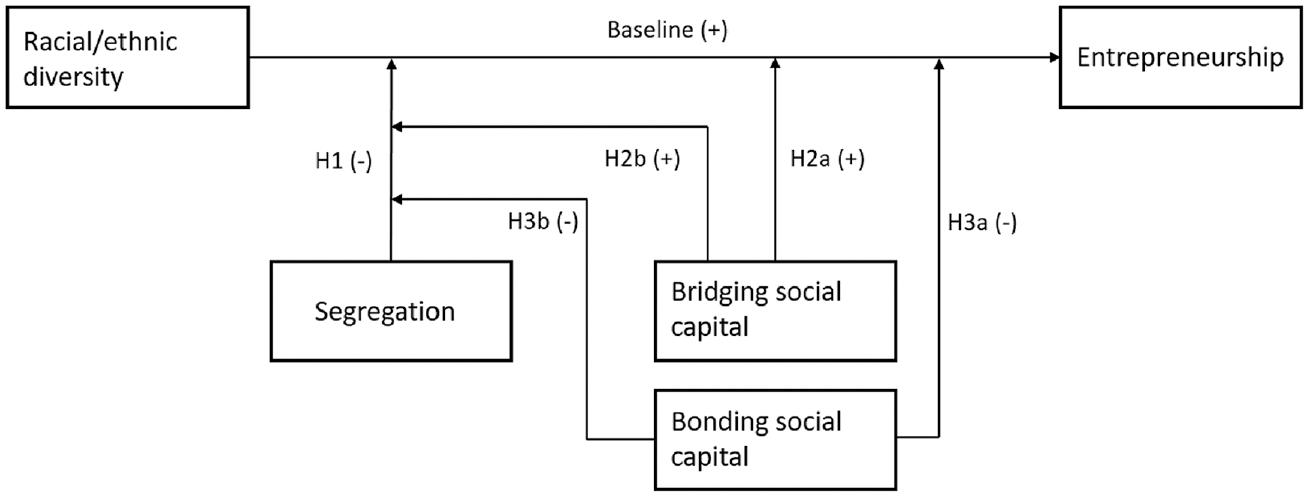
Theoretical model.
Methods
Empirical Context: United States of America
The United States has a long and complex history of multiethnicity. At its founding, the United States comprised primarily settlers and the descendants of settlers from Northern Europe, particularly from the United Kingdom. The indigenous population of what would become the US geographic range shortly after its founding was approximately 600,000 (Pritzker, 2000). Black slaves, numbering around 500,000, represented about one-fifth of the US population (Rothman, 2007). The US expansion South and Westward in the early and middle parts of the 19th century also brought large populations of Spanish speakers into US citizenry, 1 with numerous waves of immigration from Latin America over the last century and a half making the Hispanic population of the United States the largest ethnic minority in the country by early in the 21st century.
Latin America is not the only source of large-scale immigration to the United States. The latter half of the 19th century is noted as the start of significant immigration from South and Central Europe (Anderson, 2021), with their descendants largely assimilated into the white racial/ethnic racial group over the next century and a half (Alba, 2017; Anderson, 2021; Devos & Mohamed, 2014). Thus, in the US Census, the only white ethnic group with the option of selecting an ethnicity other than “white” are Americans of Hispanic or Latin American ancestry (Mora, 2014). The late 19th century saw the first waves of immigration from Asia, principally settling along the US West Coast, with a second major wave in the second half of the 20th century (Anderson, 2021). As of the 2020 US Census, white Americans remain the ethnic majority at 60.1% of the population. Hispanic or Latino population accounts for 18.5%, African Americans 12.5%, Asian Americans 6%, and Indigenous Americans just under 1% (Frey, 2020). Furthermore, the United States is predicted to lose its white ethnic majority in the next 25 years (Frey, 2018).
However, though ethnically diverse as a political entity, the United States as a geographic space is not particularly ethnically integrated (Iceland et al., 2014). As seen in Figure 3, though the United States has gotten much more diverse over the last 30 years, racial/ethnic residential segregation has remained high. For instance, there has been little change in the degree to which Hispanic and Asian Americans residentially integrated between 1980 and 2010, with African Americans becoming slightly (albeit steadily) more integrated in that time (Iceland et al., 2014). Our own data suggest a trend of low levels of integration even as diversity continues to increase. The causes of this clustering are manifold, but include past real estate regulations (e.g., redlining, deed clauses) (Ray, 2019), enclave effects tied to social networks and support (Steil et al., 2015), active forms of social closure (Blanchard, 2007), and other housing regulations (Rothwell, 2011). The consequences of residential segregation are then such that though many regions in the United States are multiethnic, they do not foster the interaction and flow of ideas associated with the positive effects of diversity (Samila & Sorenson, 2017), necessitating attention to meso-level structures that facilitate information flow across space.
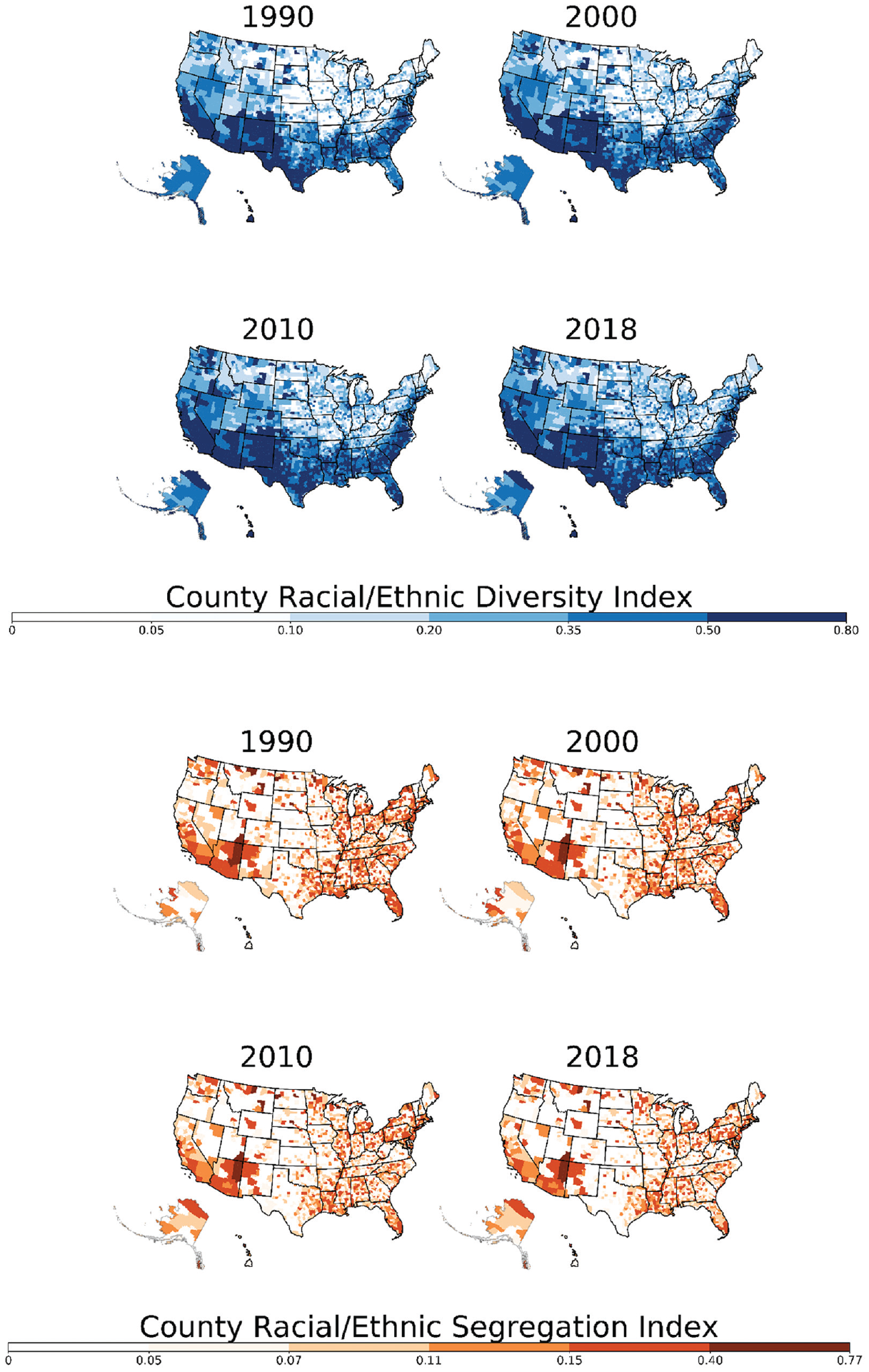
Evolution of racial/ethnic diversity and residential segregation.
The second moderator of interest in this study is social capital, specifically bridging and bonding social capital. As already discussed, our interest in these meso-level structures rests on their ability to attenuate or reinforce, respectively, segregation’s patterning of racial/ethnic information flows. Figure 4 depicts the evolution of bridging and bonding social capital in US counties of over the last three decades. Both sets of maps portray within-regional variations over time, albeit more so for bridging than for bonding social capital. The figure shows that while bonding social capital is more or less equally distributed across the United States, bridging social capital is much more concentrated in the Midwest. These geospatial patterns are rooted in the institutional legacies left by early settlers in the different regions of the country. For instance, Portes and Vickstrom (2011) show that regions initially settled by Norwegians, Swedes, Finns, and Icelanders—who originally established closely knit, egalitarian, and self-sufficient communities in the northern US—have historically exhibited high participation in voluntary membership associations.
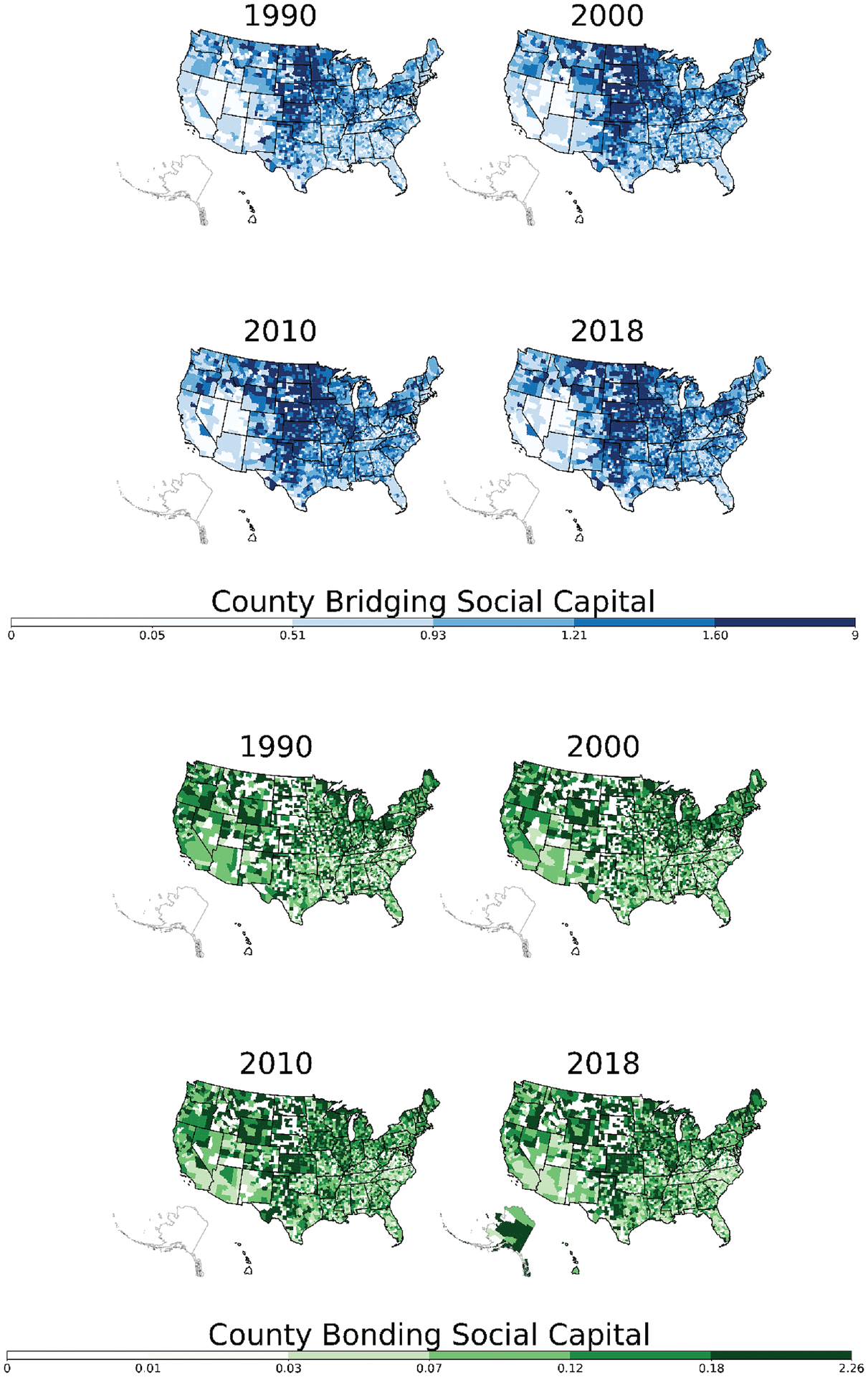
Evolution of bridging and bonding social capital.
Data
We test our theoretical predictions in the context of all new ventures started in the United States between 1990 and 2018. To examine regional new venture founding, we obtained county-year counts of new venture creation from the US Census Bureau’s Business Dynamics Statistics (BDS) (US Census Bureau, 2021a). Yearly data for our county-level independent variable (racial/ethnic diversity) came from the US Census’s Population and Housing Unit Estimates (US Census Bureau, 2021b). Calculating county-level racial/ethnic residential segregation necessitates data on sub-county divisions (i.e., census tracts); this data came from the US Decennial Censuses (US Census Bureau, 1990, 2000, 2010, 2020) and the American Community Survey (ACS) (US Census Bureau, 2021c). Data for our final two moderator variables (bonding and bridging social capital) came from Rupasingha et al. (2006, with updates), available from Penn State University. We obtained data on a host of control variables from the US Bureau of Labor Statistics (BLS) (US Department of Labor, 2021) and the US Bureau of Economic Analysis (US Department of Commerce, 2021).
Dependent Variable: New Venture Founding
We measure this variable with the count of new ventures founded in a particular county in a given year. We use the actual number of newly started independent formally registered firms and not the startup rate (newly started firms per inhabitant) because our independent, moderator, and control variables (except for the total adult population in a county) are already measured per thousand inhabitants. Consequently, using the rate as the dependent variable would likely cause “a pseudo correlation with the start-up rate, suggesting that the number of start-ups is more appropriate” (Bird & Wennberg, 2014: 426).
Data on the number of new firms come from the US Census Bureau’s BDS (US Census Bureau, 2021a), which provides a count of incorporated firms started in a county in a year.
Independent Variables: Ethnic Diversity
We constructed this variable following the methodology implemented by the US Census Bureau for its racial diversity index, which “measure[s] the probability that two people chosen at random will be from different racial and ethnic groups” (Jensen et al., 2021). The index ranges from 0 to 1, where 0 indicates low diversity and 1 indicates high diversity. The index is a reverse-coded Herfindahl–Hirschman Index defined as:
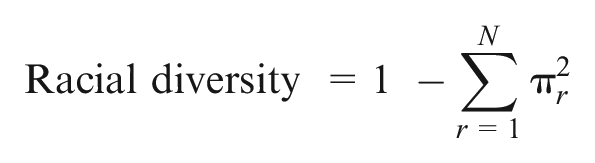
where
Moderator Variables
Residential Segregation
Following recent research, we measure racial/ethnic residential segregation by calculating the Theil Index for every county each year (Samila & Sorenson, 2017; Theil, 1972; Theil & Finizza, 1971). The Theil Index is constructed in two steps. The first step separately calculates the overall racial entropy for a county and then the racial entropies for each individual census tract located in that county using the formula:
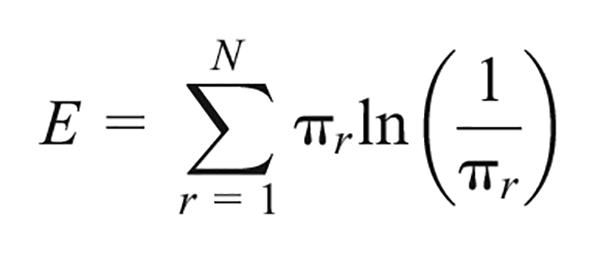
where
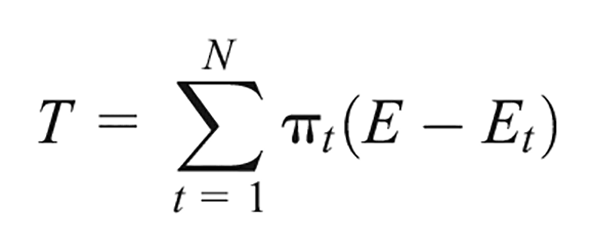
where
Essentially, the Theil index compares the racial/ethnic composition of a county with that of its component subunits, that is, census tracts. For instance, when the racial/ethnic composition of all census tracts within a county is the same as that of the county, the index would be 0, indicating low residential segregation. Conversely, when members of the different racial/ethnic categories clump together without overlapping census tracts within a county so that the racial composition of these tracts differs substantially from that of the overall county, the index would be 1, indicating high residential segregation (Iceland et al., 2014). The Theil Index is the US Census Bureau’s indicator of choice for residential segregation because it is the only measure to exhibit the transfer property, that is, the index declines in value when individuals of a given ethnicity move from areas with high concentration to areas with lower concentration of that ethnicity (Reardon & Firebaugh, 2002; Samila & Sorenson, 2017).
We calculated this measure for every county each year following the US Census Bureau’s methodology (Iceland, 2004; Iceland et al., 2014). County-level population data by race and ethnicity for each year (including estimates for intercensal years) come from the US Census’s Population and Housing Unit Estimates (US Census Bureau, 2021b). Tract-level population data by race and ethnicity come from the US Decennial Censuses (US Census Bureau, 1990, 2000, 2010, 2020). Intercensal tract-level population data by race and ethnicity came from the ACS starting in 2005 (US Census Bureau, 2021c).
Regional Social Capital
We operationalize this variable with the county-level measure of regional social capital developed by Rupasingha et al. (2006, with updates), also known as the Penn State Data. While not perfect, this measure is one of the most promising extant indicators of regional social capital, captures elements of both bridging and bonding social capital (Vâlsan et al., 2023) and is widely used across a variety of disciplines (e.g., Hasan et al., 2017; Holtkamp & Weaver, 2018; Hwang & Lee, 2023; Jensen & Ramey, 2020), including entrepreneurship (e.g., Conroy & Deller, 2020; Cordero, 2023; Vedula & Kim, 2019). 3 The Penn State measure is based on the density (per 1,000 inhabitants) of “horizontally ordered groups (like sports clubs, co-operatives, mutual aid societies, cultural associations, and voluntary unions)” (Putnam et al., 1993: 175) in a county in a year. These associations are important meso-level network structures because they facilitate face-to-face interaction within and between groups (Alesina & La Ferrara, 2000; Coleman, 1988; Putnam, 1995a, 1995b). The Penn State measure divides these associations into two categories, Putnam-type associations, which foster trust and cooperation between people, and Olson-type associations (i.e., Olson, 1982), which pursue the narrow self-interest of its members (Knack & Keefer, 1997; Rupasingha et al., 2006). This distinction was empirically validated by Alesina and La Ferrara’s (2000) study of social capital at the state level (Rupasingha et al., 2006), which found that Putnam-type organizations are more inclusive in membership while Olson-type organizations are more exclusive. For years not covered by the Penn State measure, which offers data for all US counties for selected years, we supplemented this dataset with data from the US Census Bureau’s County Business Patterns (US Census Bureau, 2021d), the original source used by Rupasingha et al. (2006) measure. This allowed us to obtain measures of regional social capital for all US counties for every year in our observation window.
Bridging Social Capital
Although associational networks are rarely purely bridging or purely bonding in nature, their function may often emphasize one type of social capital over another and thus may have the effects associated with one type over the other (Putnam, 2000). In this vein, scholars use Putnam-type associations to operationalize bridging social capital (e.g., Han, 2017; M.-S. Kim et al., 2020; Muringani et al., 2021; Smiley, 2020). These associations include civic organizations, bowling centers, golf clubs, fitness centers, sports organizations, and religious organizations. Although there are exceptions (e.g., country clubs), these organizations do not generally seek to maintain exclusive membership (Alesina & La Ferrara, 2000), allowing them to function as bridging networks for groups from different backgrounds. For example, although evangelism may be associated with racial segregation in the United States (Blanchard, 2007), churches themselves, and in particular evangelical churches, are typically welcoming of ethnic diversity (Wright et al., 2015) and respond to increasing ethnic diversity within their region with efforts of outreach (Dougherty & Mulder, 2009).
Bonding Social Capital
We operationalize bonding social capital using the Olson-type associations from the Penn State Data, as is consistent with prior studies (e.g., Muringani et al., 2021; Smiley, 2020). Olson-type associations comprise political organizations (e.g., local lobbying organizations), labor organizations (e.g., unions), business organizations (e.g., industry associations), 4 and professional organizations (e.g., local chapters of an accounting association). These organizations fulfill an important bonding function built around working towards shared self-interests (Smiley, 2020). Consequently, these associations have clear exclusive qualities; a non-farmer cannot join a farmer’s association and a retiree cannot join a union (Alesina & La Ferrara, 2000). Notably, Rupasingha et al. (2006) find that African-American participation in associations is consistently higher in Putnam-type organizations (bridging) than in Olson-type organizations, an indication of exclusive dynamics prevalent in the latter.
Control Variables
We control for a series of important factors that the literature suggests may influence new venture founding. We control for New Venture Density per 1,000 inhabitants and New Venture Density Squared per 1,000 inhabitants to account for the effect of density dependence (Carroll & Hannan, 2018; Hannan & Freeman, 1977). The linear term of density captures the validity, that is, the collective legitimacy (Bitektine & Haack, 2015; Carroll & Hannan, 1989) of entrepreneurship as a desirable career choice. The quadratic effect of density captures the competitive dynamics among new ventures (Carroll & Hannan, 1989, 2018). This variable came from the US Census Bureau’s BDS (US Census Bureau, 2021a).
Furthermore, we controlled for Personal Income per Capita in 1,000s of USD in every county each year to account for poverty. While not the focus of the present study, poverty levels may affect entrepreneurial entry decisions. This variable came from the US Department of Commerce’s Bureau of Economic Analysis’s Regional Data (US Department of Commerce, 2021). Similarly, we controlled for the Unemployment Rate in percentage in each county every year. This variable came from the US Department of Labor’s BLS’s Local Area Unemployment Statistics (US Department of Labor, 2021).
We also controlled for the Adult Population in a county, specifically the adult population (18–65 years old) in millions in a given county in a year to adjust for differences in the supply of and demand for entrepreneurs in a region. We concentrate on ages 18 through 65 because in the United States, the former is the earliest that individuals enter the workforce and the latter is the age of retirement. In addition, counties with larger adult populations may have a greater demand for the products and servies offered by new ventures. Finally, rural and urban counties may differ in their patterns of new venture entry, with this designation depending on population size. The data came from the US Department of Commerce’s Bureau of Economic Analysis’s Regional Data (US Department of Commerce, 2021). Table 1 presents descriptive statistics and bivariate correlations for these variables.
Descriptive Statistics & Bivariate Correlations.
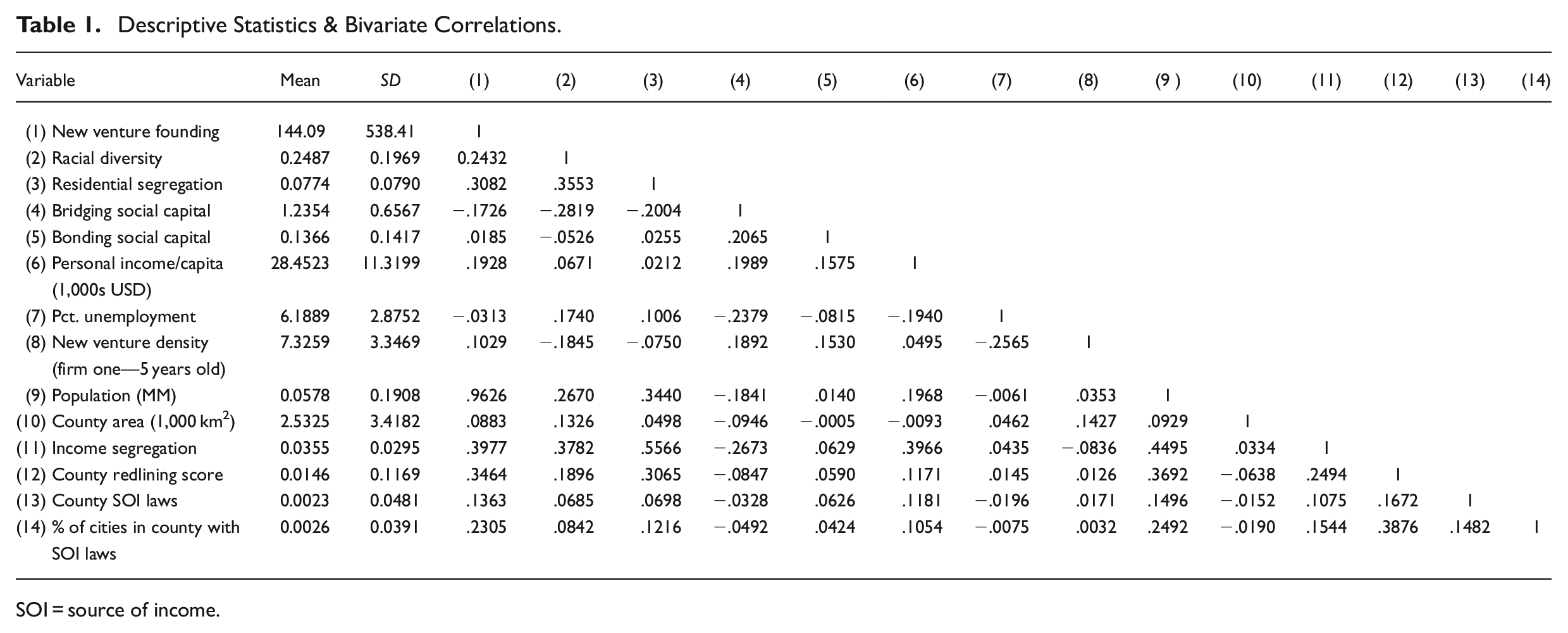
SOI = source of income.
Estimation Approach
Our dependent variable is the count of new ventures founded—newly started independent formally registered firms—in a county in a given year. Therefore, we test our hypotheses using the fixed-effects Poisson Quasi-Maximum Likelihood estimator (QMLE; Wooldridge, 1999), as recommended by Silva and Tenreyro (2006, 2011, 2022) and Wooldridge (2010: 723–776). 5
Moreover, all of our models control for year-specific shocks and the time trend by including year-fixed effects. All control variables are lagged (t − 1). Finally, standard errors are clustered at the county level to account for the lack of independence, serial correlation, and heteroscedasticity among multiple observations from the same county over time. The estimation was implemented using the “xtpoisson, fe robust” command in Stata 17.
Results
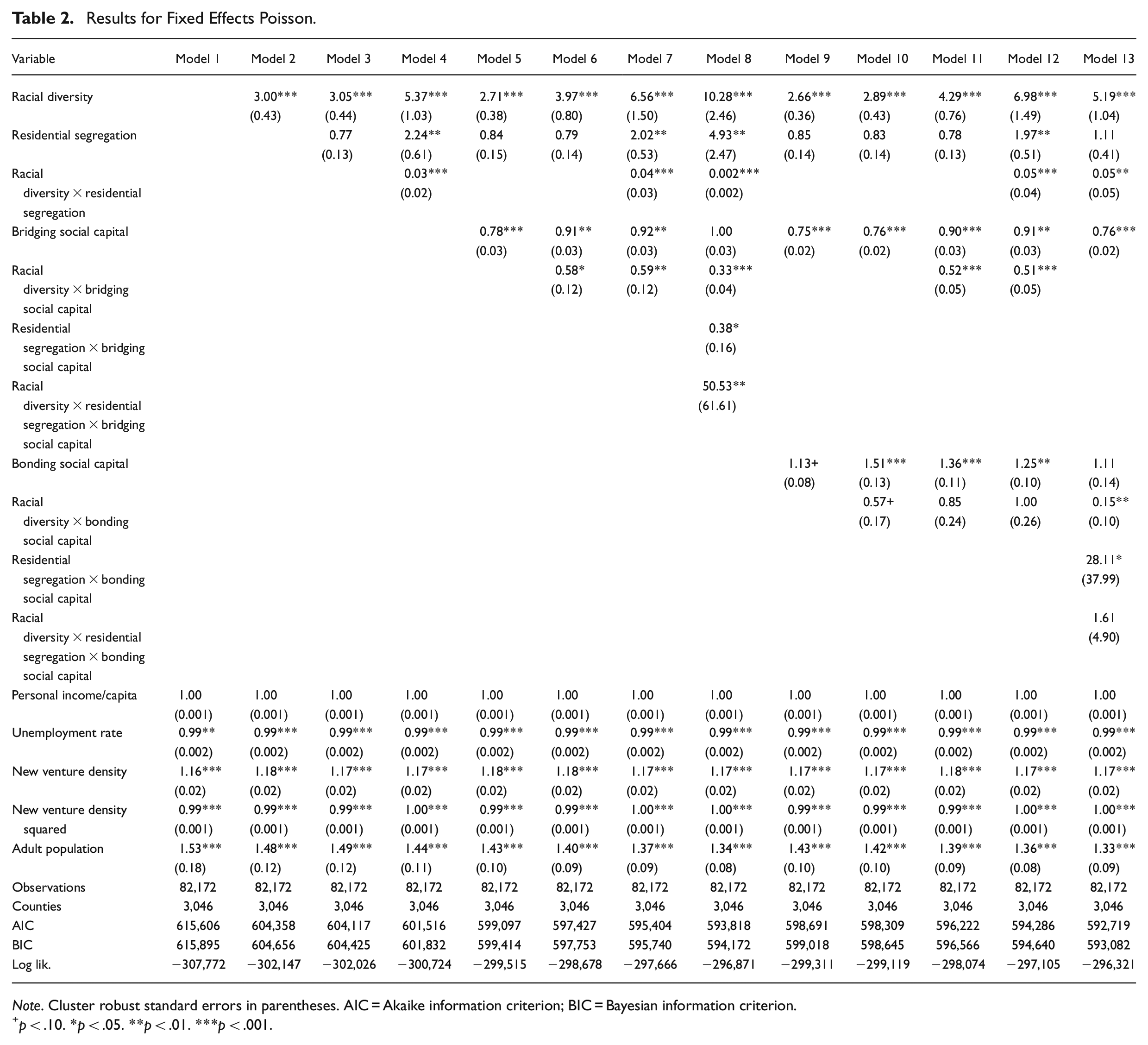
Table 2 presents the results of the analysis. Each coefficient in Table 2 is an incidence rate ratio (IRR), which is a multiplicative factor that describes the percentage increase or decrease in new venture founding for each one (1) unit increase in a covariate of interest (Cameron & Trivedi, 2010: 576). Specifically, to obtain the percentage (%) change in new venture creation associated with a one (1) unit increase in the independent variable, holding all else constant, simply take the IRR in Table 2, subtract one (1) and multiply by 100, that is (IRR − 1) × 100. 6 The use of IRRs is common because it facilitates the interpretation of coefficients from log-linear models (Cameron & Trivedi, 2010: 567–613; Wooldridge, 2010: 727–736). Model 1 in Table 2 presents the results for the baseline model including only controls. Several control variables are associated with the rate of new venture founding. While a county’s unemployment rate is negatively associated with the dependent variable, the adult population is positively associated with it. Furthermore, new venture density and new venture density squared have the expected positive and negative relationship with new venture founding, respectively, which is consistent with density dependence theory.
Results for Fixed Effects Poisson.
Note. Cluster robust standard errors in parentheses. AIC = Akaike information criterion; BIC = Bayesian information criterion.
p < .10. *p < .05. **p < .01. ***p < .001.
Turning to our main points of interest, Model 2 tests our baseline prediction that racial/ethnic diversity would be positively associated with new venture founding. The baseline prediction is supported by the coefficient of the variable Racial/Ethnic Diversity in the expected positive direction and highly statistically significant (200%, 7 p < .00001). For the typical US county, transitioning from no diversity at all (Racial/Ethnic Diversity of 0) to full diversity (Racial/Ethnic Diversity of 1) is associated with a 200% increase in new venture founding.
Model 3 introduces the main effect of residential segregation, and Model 4 tests Hypothesis 1 that residential segregation would weaken (i.e., negatively moderate) the positive relation between racial/ethnic diversity and new venture founding. Hypothesis 1 is supported with the coefficient of the two-way interaction Racial/Ethnic Diversity × Residential Segregation in the predicted negative direction and highly statistically significant (−97%, 8 p < .00001). For the typical US county, transitioning from no residential segregation (Residential Segregation of 0) to full residential segregation (Residential Segregation of 1) is associated with a 97% reduction in the positive relation between racial/ethnic diversity and new venture founding. To gain further insight, Figure 5(a) graphs the predicted percentage change in new venture founding over the observed values of racial diversity and residential segregation in our sample. High residential segregation nullifies the positive relationship between racial/ethnic diversity and the new venture founding. Specifically, when residential segregation is low, racial/ethnic diversity exhibits the expected positive and statistically significant relationship with the new venture founding, but not when residential segregation is high.
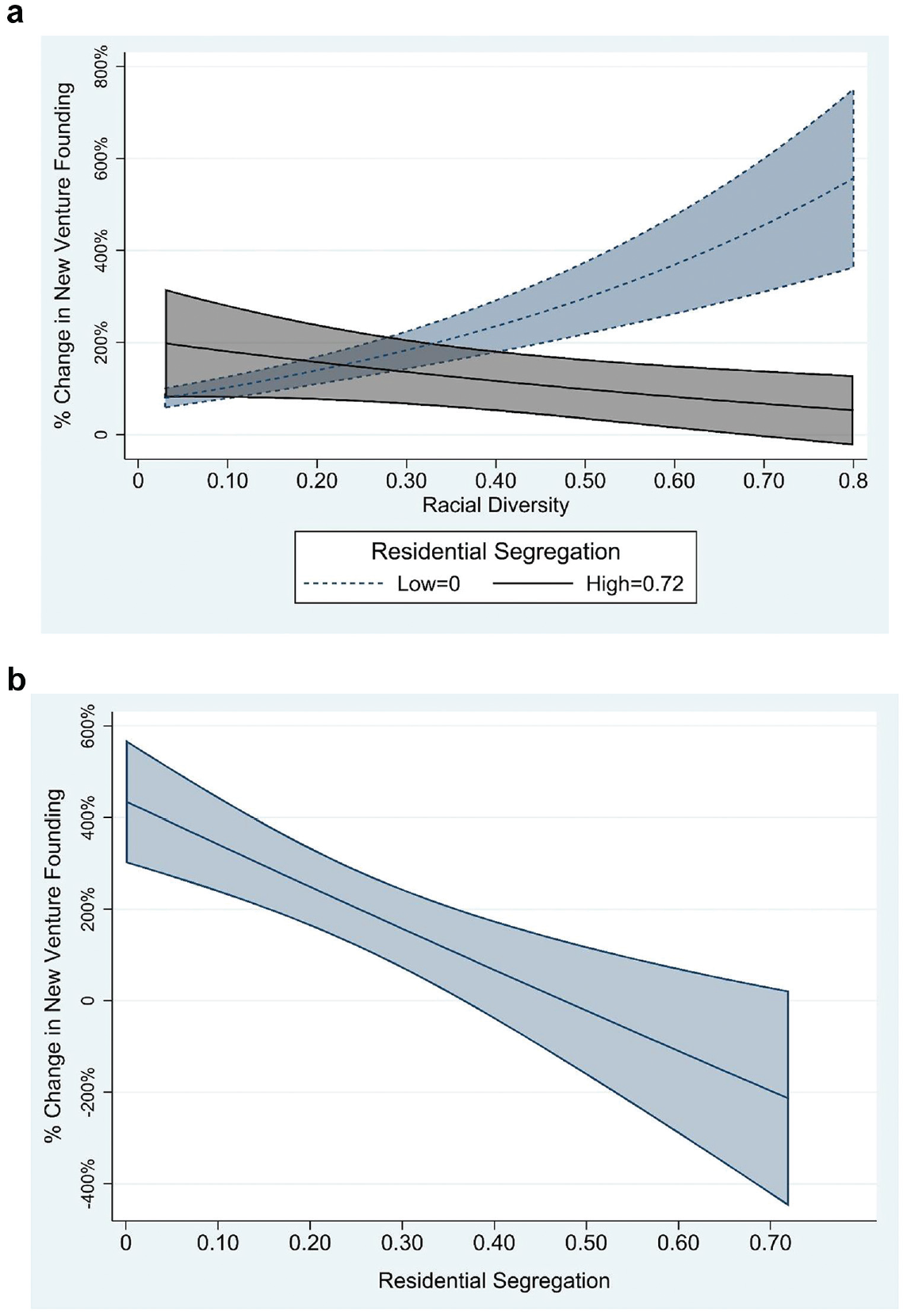
(a). Predictive margins for racial diversity by residential segregation (95% Cls). (b). Average marginal effects for racial diversity by residential segregation (95% Cls).
Figure 5(b) depicts the average marginal effects for Racial/Ethnic Diversity over the observed values of Residential Segregation. These results confirm that when residential segregation is low, racial/ethnic diversity and new venture founding have a positive and statistically significant relationship, but this relationship progressively weakens as residential segregation increases until it ceases to have an effect.
Model 5 introduces the main effect of bridging social capital, and Model 6 tests Hypothesis 2(a) that bridging social capital would strengthen (i.e., positively moderate) the positive relation between racial/ethnic diversity and new venture founding. Hypothesis 2(a) is not supported. The coefficient of the two-way interaction Racial/Ethnic Diversity × Bridging Social Capital is in the opposite (i.e., negative) direction of what we predicted and statistically significant (−42%, 9 p < .05), suggesting that a 1 unit increase in Bridging Social Capital negatively moderates the positive relation between racial/ethnic diversity and new venture founding by 42%. We consider potential reasons for this result later in the discussion section.
Model 7 tests Hypothesis 1 and Hypothesis 2(a) simultaneously by including the interaction terms Racial/Ethnic Diversity × Residential Segregation and Racial/Ethnic Diversity × Bridging Social Capital, respectively. The results do not change. Model 8 tests Hypothesis 2(b), which predicted that bridging social capital would offset the negative moderation of residential segregation on the positive relation between racial/ethnic diversity and the new venture founding. This hypothesis is supported, with the coefficient for the three-way interaction Racial/Ethnic Diversity × Residential Segregation × Bridging Social Capital being in the theorized positive direction and statistically significant (4,953%, 10 p < .0013). A one-unit increase in bridging social capital weakens the negative moderation of residential segregation on the positive relation between racial diversity and new venture founding by 4,953%.
To gain further insight into the results for Hypothesis 2(b) and the associated three-way interaction Racial/Ethnic Diversity × Residential Segregation × Bridging Social Capital, we graph in Figure 6(a) the percentage change in new venture founding over the observed values of racial/ethnic diversity, residential segregation, and bridging social capital. Figure 6(a) shows that when bridging social capital is low (left panel), high residential segregation negatively and statistically significantly moderates the relation between racial/ethnic diversity and new venture founding. Focusing on the left panel (low bridging social capital), the otherwise positive and statistically significant relationship between racial diversity and new venture creation (the light-colored graph with dashed lines) reverses, becoming negative and statistically significant when residential segregation is high (the dark-colored graph with solid lines). 11 However, when bridging social capital is high (the right panel), that is no longer the case. This latter result supports Hypothesis 2(b) that bridging social capital mitigates the attenuating effect of residential segregation on the positive relationship between racial diversity and new venture creation.
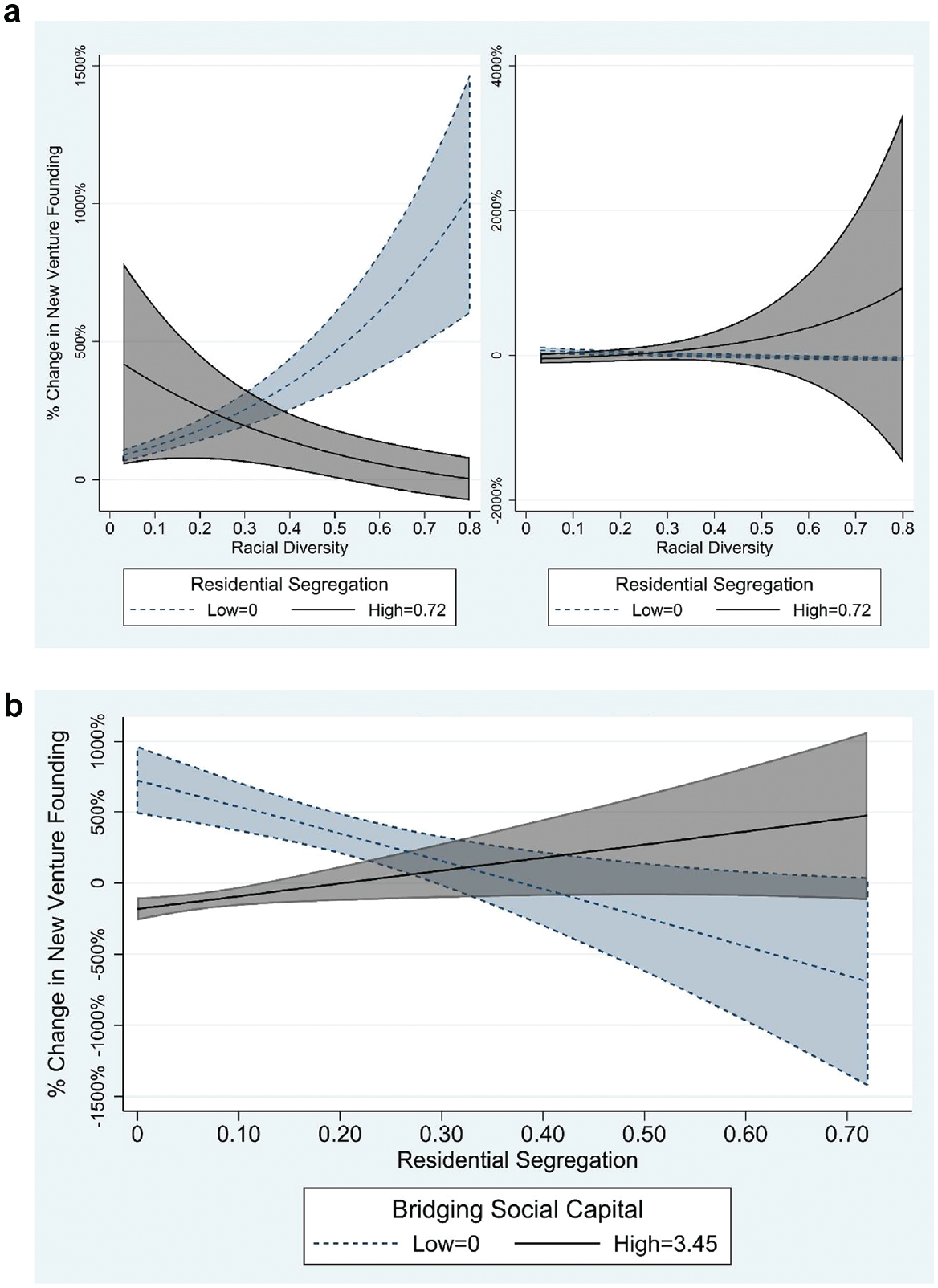
(a). Predictive margins for racial diversity × residential segregation by bridging social capital (low = 0) and bridging social capital (high = 3.45). (b). Average marginal effects for racial diversity by residential segregation and bridging social capital.
Figure 6(b) provides further graphical support for Hypothesis 2(b) by depicting the average marginal effects for Racial/Ethnic Diversity over the observed values of Residential Segregation and Bridging Social Capital. The figure shows that when bridging social capital is low, residential segregation negatively moderates the relationship between racial/ethnic diversity and new venture founding. However, when bridging social capital is high, residential segregation positively and statistically significantly moderates that relationship. 12 In other words, high levels of bridging social capital not only offset, but reverse, the otherwise negative moderating effect of residential segregation on the positive relationship between racial/ethnic diversity and new venture founding.
Model 9 introduces the main effect of bonding social capital, and Model 10 tests Hypothesis 3(a) that bonding social capital would weaken (i.e., negatively moderate) the positive relation between racial/ethnic diversity and new venture founding. Hypothesis 3(a) is partially supported in this model. The coefficient of the two-way interaction Racial/Ethnic Diversity × Bonding Social Capital is in the predicted negative direction but only marginally statistically significant (−43%, 13 p < .053). Just shy of statistical significance at conventional levels, this result suggests that a 1 unit increase in Bonding Social Capital negatively moderates the positive relation between racial/ethnic diversity and new venture founding by 43%. Model 11 simultaneously includes both interactions of Racial/Ethnic Diversity × Bridging Social Capital and Racial/Ethnic Diversity × Bonding Social Capital, but only the coefficient for the former is statistically significant while that of the latter is in the predicted negative direction but not of statistical significance. Model 12 includes all the two-way interactions involving racial/ethnic diversity, specifically Racial/Ethnic Diversity × Residential Segregation, Racial/Ethnic Diversity × Bridging Social Capital and Racial/Ethnic Diversity × Bonding Social Capital, with similar effect. Overall, the results do not support Hypotheses 3(a).
Finally, Model 13 tests Hypothesis 3(b), which predicted that bonding social capital would exacerbate the negative moderation of residential segregation on the positive relation between racial/ethnic diversity and the new venture founding. Hypothesis 3(b) is not supported either. The coefficient for the three-way interaction Racial/Ethnic Diversity × Residential Segregation × Bonding Social Capital is not statistically significant (61%, 14 p < 0.875).
Supplemental Analysis
Causal Inference
An important issue to address is whether the effect of residential segregation and consequently of its interaction with racial diversity are truly causal or are spurious correlations due to endogeneity. We address this issue by estimating fixed-effects two-stage least squares panel instrumental variable models—using the “xtivreg2, fe cluster(panelid)” command in Stata, where the dependent variable was the natural logarithm of the count of new venture foundings (plus one to account for zero counts) and “panelid” the id for each county—in Supplemental Appendix Table 3. We obtained three different instruments for residential segregation.
First, we looked for policy discontinuities that affect segregation without directly affecting new venture founding. We found one set of policy discontinuities in the federal Housing Choice Voucher program, the largest rental housing assistance program in the United States. The program was originally established in the 1970s to help low-income families (often racial/ethnic minorities) to move into high-income (often white) neighborhoods by providing housing vouchers issued by the federal government and redeemable in cash by landlords (property owners). However, some landlords discriminate against the holders of these vouchers, often reflecting racial biases. This has prompted local jurisdictions (cities and counties) to adopt source of income (SOI) laws that provide legal remedies in case of discrimination. We obtained data from the Urban Institute, a think-tank in Washington D.C., that compiled a database of city and county-level SOI laws (Greene et al., 2021). Specifically, we obtained two yearly (i.e., time-variant) measures that we used as instruments: (i) the percentage of cities in a county that have adopted such laws and (ii) whether a county government itself has adopted a similar law.
We also obtained redlining scores for all counties in the United States each year. Redlining refers to a federal policy that was in place between 1935 and 1940. According to this policy, federal housing loans (to buy or renew a residence) were based on the classification of neighborhoods into four different risk categories, with the riskiest category being assigned the color red (hence the term redlining). While in theory these categories were supposed to reflect objective default risks, in practice these often reflected racial/ethnic bias. The presence of even a single minority-owned house could cause an entire neighborhood to be classified in the highest risk category (Faber, 2020). Although redlining was prohibited by the Fair Housing Act of 1968, by then racial/ethnic minorities were already concentrated in previously redlined neighborhoods. We exploit the fact that the US Census Bureau makes minor adjustments to the official borders of census tracts every decennial census, causing minor portions (typically only tens of meters squared) of previously redlined neighborhoods to change from one census tract to another. These border changes are typically very minor border corrections, e.g., driven by the construction of new streets. Because by 1968 the previously redlined neighborhoods already concentrated racial/ethnic minorities, the minor changes in the borders of census tracts that occur every 10 years affect the racial/ethnic entropy measure of census tracts. However, because each census tract is typicaly contained within the same county over time, changes in the border of census tracts will not affect the racial/ethnic entropy of a county or the count of firms started in that county. We obtained county-level redlining scores for the 2010 and 2020 decennial censuses from Meier and Mitchell (2021) and created our own redlining scores for 1990 and 2000 following their methodology.
In short, we used three different instrumental variables for the linear term of Residential Segregation: (i) the percentage of cities in a county that had adopted SOI laws by a given year, (ii) whether a county government itself has adopted SOI law by a given year, and (iii) the decennial census redlining score in a county. We also instrumentalized the interaction term Racial/Ethnic Diversity × Residential Segregation. Specifically, we followed Wooldridge (2010, 2020:133) and instrumentalized this interaction term with the three interaction terms of racial diversity with each of the three instruments used for the linear term of residential segregation (the presumably endogenous variable). Table 3 contains two different models.
Following Wooldridge (2010, 2020:133), Model 1 instrumentalizes for Residential Segregation only while Model 2 does so for both Residential Segregation and the interaction term Racial/Ethnic Diversity × Residential Segregation. Post-estimation diagnostics of the instrumental variable assumptions (bottom of Table 3) suggest that for both models, the instruments are valid instruments (i.e., they are not weak instruments and both models are over-identified). In other words, in both models, the instruments are jointly relevant (strongly correlated with the presumably endogenous variables) and excluded (uncorrelated to the residual terms in the main equation modeling new venture founding). Moreover, the endogeneity tests in both models suggest that the (presumably) endogenous variables are in fact not endogenous. These sets of results, particularly the last one, are important because they suggest that our main analysis and robustness tests, which assumed that the variable Residential Segregation was exogenous, are appropriate.
Moreover, Model 2 in Table 3 shows that even using the instrumental variable estimator yields a qualitatively similar result to that in the main models in Table 2. Specifically, Racial/Ethnic Diversity × Residential Segregation is in the expected negative direction and statistically significant (−13.4008, p < .05).
Succinctly, the results of the fixed-effects two-stage least squares instrumental variable model give qualitatively similar results for the Diversity × Residential Segregation interaction to those in our main analysis in Table 2, giving us confidence in our results. Importantly, post-estimation diagnostics of the instrumental variable assumptions (bottom of Table 3) suggest that the three selected instruments are valid: the instruments are jointly relevant (strongly correlated with the presumably endogenous variables) and excluded (uncorrelated with the residual terms in the main equation modeling new venture founding). Finally, the endogeneity tests in these models suggest that the presumably endogenous variables (both Residential Segregation and its interaction Diversity × Residential Segregation) are in fact not endogenous. This gives us further confidence in our main results presented in Table 2.
Additional Robustness Tests
We reran all the models in Table 2 using several different estimators to ensure the robustness of our results. First, Supplemental Appendix Table 4 shows the results of rerunning all models using the Poisson QMLE (with year fixed-effects and cluster robust standard errors) often used in innovation studies (Kleinbaum et al., 2013). We used the Stata command “xtpqml, i(panelID)” developed by Simcoe (2007). The results are qualitatively similar to those presented in Table 2. Second, we reran all models using a simple fixed-effects ordinary least squares panel estimator (with both county and year fixed-effects). We used the “xtreg, fe vce(cluster panelid)” command in Stata 17, where the dependent variable was the natural logarithm of the count of new venture foundings (plus one to account for zero counts) and “panelid” the id for each county. Supplemental Appendix Table 5 shows results similar to those presented in Table 2. Third, we re-estimated all models using a pooled Poisson model with cluster-robust standard errors and year-fixed effects. The results, provided in Supplemental Appendix Table 6, are also qualitatively similar to those presented in Table 2. Fourth, we reran these models using the random effects (gamma) Poisson estimator. The results presented on Supplemental Appendix Table 7 are also qualitatively similar to those in Table 2. Fifth, we reran the models using the random effects (normal) Poisson estimator. The results presented in Supplemental Appendix Table 8 are similar to those in Table 2. Finally, we reran all models using the population–averaged generalized estimating equations (GEE) Poisson estimator; and the results, presented in Supplemental Appendix Table 9, are qualitatively similar to those in Table 2.
Discussion
Examining county-level patterns of new venture creation, we find a positive relationship between regional ethnic/racial diversity and startup activity. Noting that this relationship relies on the flow of information among individuals of different racial/ethnic backgrounds, we hypothesize that racial/ethnic residential segregation, as a feature of a region, will attenuate this effect. The effect of segregation is both practically large and statistically significant, so much so that high segregation wipes out the positive relationship between racial/ethnic diversity and new venture creation.
We also theorize that the bridging and bonding social capital of a region operate as meso-level structures influencing racial/ethnic diversity’s effect on entrepreneurship. Specifically, we theorize that regional bridging social capital magnifies the relationship between diversity and entrepreneurship by serving as a conduit for interethnic informational flow, while regional bonding social capital diminishes the relationship by providing structures encouraging more insular networking, reducing informational flow. We find that bridging social capital had a statistically significant negative moderating effect on that relationship, being in the opposite direction of what we had hypothesized. Notably, post hoc analysis—see Supplemental Appendix Figures 7(a) and 7(b)—shows that this finding is consistent with a substitutive effect between bridging social capital and racial/ethnic diversity, in which the lower levels of informational diversity associated with an ethnically homogeneous region can be offset by high levels of intergroup connectivity allowing the informational diversity present in a region to have greater effect (for a similar finding with human capital rather than diversity, see Muringani et al., 2021).
Most significantly, we hypothesize and find that bridging social capital offsets the negative effect of segregation on the diversity–entrepreneurship relationship, so that even in highly segregated counties, diversity is a strong driver of entrepreneurship. We theorize this effect is a product of bridging social capital’s function of bringing together different types of people. Thus, even in segregated regions where interethnic interactions occur less in day-to-day life, bridging social capital provides an opportunity structure through which informational diversity can diffuse through a region. This finding is significant given the extent of racial/ethnic residential segregation in our context, and it reflects structural complexities that warrant the attention of entrepreneurship and development scholars.
Contribution to Regional Entrepreneurship
Our study contributes to research on regional entrepreneurship, which fundamentally seeks to understand the antecedents of productive entrepreneurship and its consequences for regional growth and development (Del Monte et al., 2020). These studies focus on aspects of regional environments such as government involvement (e.g., Bennett, 2019; Cordero & Miller, 2019; Parker, 2008), funding availability (e.g., Lee, 2018; Samila & Sorenson, 2017), and even histories of disease (e.g., Bennett & Nikolaev, 2021). Specifically, our findings are germane to knowledge-spillover approaches to the study of regional entrepreneurship, which examine the relationship between the information available in a region, the structures enabling entrepreneurs to act on that information, and regional entrepreneurship (Audretsch & Lehmann, 2005). Our findings contribute to robust streams in this vein examining the relationships between ethnic diversity and regional entrepreneurship (e.g., Audretsch et al., 2021; Rodríguez-Pose & Hardy, 2015; Sobel et al., 2010), which serve as a source of informational diversity, and the relationship between a region’s networks and its entrepreneurship (e.g., Fotopoulos, 2023; Malecki, 2012; Spigel, 2017), which serve here as structures through which information flows.
Our findings are consistent with prior studies on the positive effect of racial/ethnic diversity on regional entrepreneurship. However, we also uncover important structural contingencies of this relationship. Notably, segregation eliminates this relationship. This finding is consistent with, though more dramatic than, the findings that segregation attenuates the effect of ethnic diversity on regional worker productivity (Buchholz, 2021) and the effect of venture capital on economic growth (Samila & Sorenson, 2017). Furthermore, we introduce regional social capital—associational networks—into this dynamic. In segregated counties, the available bridging social capital strongly countervails the effect of segregation on the diversity–entrepreneurship relationship. This finding underscores the significance of meso-level structures to research examining the role of context in shaping entrepreneurial action (i.e., Kim et al., 2016).
Although these structures may be particularly sensitive to ethnicity, they are potentially relevant to most, if not all, social categories informing people’s identities (e.g., education, occupation, gender, sexuality). For example, occupations demonstrate spatial clustering (Simkus, 1978; van Ham et al., 2020) and are frequent basis of social networks (Putnam, 2000), suggesting that similar dynamics may play out for occupational diversity. More broadly, the dramatic moderating effect of segregation and bridging social capital underscores the significance of social structures that shape information flow to theories of entrepreneurship and innovation that emphasize the role of information exchange, such as the knowledge spillover theory of entrepreneurship (Audretsch & Lehmann, 2005), entrepreneurial ecosystem theories (Wurth et al., 2022), and regional theories of absorptive capacity (Miguélez & Moreno, 2015).
Contribution to Social Capital and Entrepreneurship
Social capital is an important antecedent to entrepreneurship at the individual level, but its effects on entrepreneurship at the regional level are complex (Malecki, 2012). We shed light on the specific complexity arising from social capital and ethnicity (Iyer et al., 2005; Lin, 2000; Putnam, 2007), responding to the recent call of Bruton et al. (2022) to carefully examine the role of social capital in dynamics of entrepreneurship and race or ethnicity. For example, Light and Dana (2013) find that though the Indigenous American community they studied possessed significant social capital, it did not lead to entrepreneurship due to the composition of the community’s cultural capital. Similarly, Kwon et al. (2013) find that though the level of social capital available in a region drives entry, this effect is weak for minority entrepreneurs, leading the authors to speculate that minorities are less likely to acquire and leverage available social capital.
Our findings add a layer to this complexity, underscoring the importance of examining the types of social capital in studying entrepreneurship of historically marginalized groups—for example, underrepresented minorities, women, and people from working-class backgrounds. Our findings point to the significance of the function of bridging social capital for these groups, that is, of developing structures that facilitate intergroup interaction so that ethnic/racial minorities increase their access to information, ideas, and people. Coupled with the findings of Kwon et al. (2013), our findings demonstrate a need to study social capital as it pertains to the entrepreneurship of racial/ethnic minorities (and of non-majority/non-dominant social categories, broadly; see Ruef et al., 2003). Such research is essential because entrepreneurship is an increasingly networked process (Leyden et al., 2014; Stam & Van de Ven, 2021), and inattention to the complexity of these dynamics risks greater bifurcation between dominant/majority and non-dominant/minority entrepreneurs (e.g., Harrison, Leitch, & McAdam, 2020).
Contributions to Research on Ethnic Entrepreneurship
Related to the above, we also contribute to research on ethnic entrepreneurship. Although immigrant and minority entrepreneurship are separate phenomena (Bruton et al., 2022), in regional studies of entrepreneurship they are often grouped together under the label “ethnic entrepreneurship” due to the salience of ethnicity and the disadvantage of being a structural outsider (Light & Gold, 2000). The former of these qualities speaks directly to the theoretical underpinnings of this paper, while the latter speaks to its implications. Research on ethnic entrepreneurship often adopts the view that entrepreneurship is a means of socioeconomic mobility for ethnic groups excluded from traditional labor markets (Bruton et al., 2022; Light & Gold, 2000). However, this view is also subject to intense scrutiny from scholars, who note that the structures disadvantaging groups in labor markets and organizations are also present in entrepreneurship (Bruton et al, 2022; Martinez Dy et al., 2017).
The social environment plays an important role in this scholarship (e.g., Bruton et al., 2022; Griffin-El & Olabisi, 2018; C. Li et al., 2018), as this environment comprises the structures that both push and pull ethnic entrepreneurs into business (Bruton et al., 2022). For ethnic entrepreneurs, resource constraint is a major barrier to launch and grow their business (Bates et al., 2018), and our research highlights bridging associational networks in the region as an opportunity structure through which such entrepreneurs are able to access venture-relevant informational resources. We thus complement other research examining the structures that increase or decrease the disadvantage ethnic entrepreneurs face (e.g., Basu & Werbner, 2001; Somashekhar, 2019).
Policy Implications
Our findings have implications for policymakers, particularly those in diverse but segregated regions. Segregation is a major impediment to a region’s ability to make the best use of its resources. For example, Samila and Sorenson (2017) find segregation negatively moderates the degree to which the available venture capital of a region converts into entrepreneurship and innovation. Replacing available venture capital as a resource with racial/ethnic diversity, we find a similarly grim effect. Fortunately, we also find that bridging social capital offsets this effect. Not only does this suggest that bridging social capital is a viable means for highly segregated regions to make better use of their racial/ethnic resources and to increase regional well-being, but it also highlights the responsiveness of this problem to structural solutions, a quality of interest to policymakers.
Limitations
Because of our level of analysis, we can only infer the individual-level mechanisms driving the effects that we find. Chiefly, we assume that if community social capital is available, individuals will make use of it and acquire information, either intentionally or haphazardly. Similarly, we make the weak, implicit assumption that the tendency to draw on community social capital is similar across ethnicities, and this is not necessarily the case. However, because both assumptions likely overestimate the degree to which ethnic minorities use community social capital in the United States (see Kwon et al., 2013), making these assumptions in our empirical setting constitutes a conservative test of our hypotheses. Regardless, there is potential for future research to examine how community social capital functions at the individual level (e.g., Kleinhempel et al., 2020). For example, we wonder to what degree spillover effects relative to the strategic use of social capital drive the effect of community social capital on entrepreneurship, a question requiring attention to individual-level behavior and cognition.
Similarly, our measure of social capital is not without dispute. First, scholars have voiced concerns that Putnam’s approach to regional social capital neglects the presence of national membership organizations and their potential to displace local organizations (Skocpol, 1996, 1997). However, participation in such large-scale membership organizations often entails little more than mailing a check to pay membership dues (Putnam, 1996) and does not directly affect the flow of information within a region. Second, we assume that the presence of these organizations in a region implies their use, but as noted by Putnam (2000), participation in these organizations is generally in decline in the United States. Although this decline in participation does not necessarily affect our findings—indeed, it suggests their robustness as discussed above—it does have a bearing on the implications of our findings, particularly the potential for associational networks to continue to serve as bridging social capital capable of overcoming the effect of segregation in ethnically diverse regions. Third, we treat voluntary membership organizations as dichotomous with regard to their bridging and bonding properties, but in reality, associational networks have both bridging and bonding properties (Putnam, 2000), and so our measure reflects which of these functions tend to predominate in the type of membership organization. In light of these limitations, future research needs to examine patterns of participation in these membership organizations, specific types of associational networks to understand their role in facilitating (or inhibiting) the flow of information between groups, and other forms of regional bridging networks that may serve a similar function as information conduits.
Our research context, the United States, is also exceptional in regard to ethnicity. Not only is its “melting pot” nature a central feature of the American identity, but its racial/ethnic diversity reflects both a long history of immigration and the enslavement of African Americans. This warrants future research in other diverse countries and regions, particularly those outside of the developed West. In addition, ethnicity itself is a complex construct, and in examining it in terms of regional diversity, we lose both intraethnic and interethnic differences. For example, within-ethnicity variance in generations removed from the first-generation immigrant affects entrepreneurship (e.g., Peroni et al., 2016), and different minority ethnicities encounter different social realities in their entrepreneurship (e.g., Neville et al., 2018). Attention to these differences is clearly important (e.g., Kwon et al., 2013), and future research may consider how variation in status and assimilation might affect the dynamics of social capital, ethnicity, and entrepreneurship.
Finally, and although our data represent an improvement over most existing datasets—in that it allows us to examine actual startups (i.e., newly created independent firms) as opposed to merely new establishments (which may be from established businesses)—due to confidentiality issues, the data do not allow us to identify the startup’s industry. However, this implies that our models provide a conservative test of our theory, which focuses on the flow of novel information and perspectives within a region, suggesting that our theory should apply more strongly, but not exclusively, to knowledge-based startups (Audretsch & Keilbach, 2007; Audretsch & Lehmann, 2005). The fact that we find support for our hypotheses in the overall population of new ventures, and not just in the subset of knowledge-based startups, gives us confidence that the theorized relationships operate more broadly.
Supplemental Material
sj-pdf-1-etp-10.1177_10422587231198450 – Supplemental material for How Does Regional Social Capital Structure the Relationship Between Entrepreneurship, Ethnic Diversity, and Residential Segregation?
Supplemental material, sj-pdf-1-etp-10.1177_10422587231198450 for How Does Regional Social Capital Structure the Relationship Between Entrepreneurship, Ethnic Diversity, and Residential Segregation? by Arkangel M. Cordero and Alexander C. Lewis in Entrepreneurship Theory and Practice
Footnotes
Acknowledgements
We are thankful for the outstanding developmental guidance provided by Senior Editor Karl Wennberg and two anonymous reviewers.
Declaration of Conflicting Interests
The author(s) declared no potential conflicts of interest with respect to the research, authorship, and/or publication of this article.
Funding
The author(s) received no financial support for the research, authorship, and/or publication of this article.

Supplemental Material
Supplemental material for this article is available online.
Notes
Author Biographies
References
Supplementary Material
Please find the following supplemental material available below.
For Open Access articles published under a Creative Commons License, all supplemental material carries the same license as the article it is associated with.
For non-Open Access articles published, all supplemental material carries a non-exclusive license, and permission requests for re-use of supplemental material or any part of supplemental material shall be sent directly to the copyright owner as specified in the copyright notice associated with the article.
