



Abstract
Women-led startups are evaluated less favorably than men-led startups, but the reasons for this require further investigation. Drawing on ambivalent sexism theory, we posit that benevolent sexism undermines gender equity in startup evaluation. We initially expected benevolent sexism to be negatively related to evaluations of women-led startups. Surprisingly, we found that benevolent sexism is unrelated to evaluations of women-led startups but is positively related to those of men-led startups—a finding that was replicated in two additional studies. Our work demonstrates benevolent sexism as an advantaging mechanism of inequity in entrepreneurship that boosts men’s outcomes without directly harming women’s outcomes.
Startups founded by women tend to be judged less favorably than those founded by men (Bigelow et al., 2014; Lee & Huang, 2018). Indeed, evidence of gender bias in evaluations of startup quality and potential has been documented among a wide range of stakeholder groups, including investors (Kanze et al., 2020), accelerator selection committees (Dutt & Kaplan, 2018), job applicants (Campero & Kacperczyk, 2020), and early users (Cao et al., 2021). This is troubling given that perceptions of a startup’s viability can significantly impact the willingness of stakeholders to support it with much needed resources (Davidsson et al., 2021; Fisher et al., 2017). More broadly, this undermines gender equity at work—a moral imperative (van Dijk et al., 2012) and a key challenge for social development (Bolzendahl & Myers, 2004)—and harms the economy by preventing a significant number of entrepreneurs from pursuing their full potential (Hechavarria et al., 2019; Koning et al., 2021).
Given the severity of this problem, much attention has been devoted to understanding why women-led startups are judged less favorably than men-led startups. A mechanism often evoked in the entrepreneurship literature is the prevalence of gender stereotypes that link entrepreneurial competence with men but not women and thus lead startup evaluators to hold negative attitudes toward women entrepreneurs (Balachandra et al., 2019; Malmström et al., 2017). In support of this argument, research has found that evaluators (e.g., investors) often express doubt about women’s ability to grow a viable business (Kanze et al., 2018) and perceive founders who display feminine-typed behaviors as incompetent and unprepared (Balachandra et al., 2019). This focus on gender stereotypes and their role in disadvantaging women-led startups points to traditional sexism as a culprit for gender inequity in startup evaluation—that is, gender stereotypes lead to hostile perceptions of women as incompetent and inferior to men in this context.
Notwithstanding the valuable insights offered by past work, the exclusive focus on traditional (hostile) sexism overlooks the existence of another type of sexism—benevolent sexism, which refers to subjectively positive attitudes toward women characterized by a sense of affection, idealization, and protectiveness (Glick & Fiske, 1996, 1997). Studying the effects of benevolent sexism in entrepreneurship is important because it is more socially acceptable, widely endorsed, and often not recognized as sexism at all (Hideg & Shen, 2019; Hopkins-Doyle et al., 2019). This difference in social acceptability has become even more pronounced in the wake of major social movements such as the United Nations’“HeForShe” campaign, the #MeToo movement, and the recent protests over women’s rights in Iran. Given the social pressure against overt hostile sexist attitudes, more subtle forms of gender prejudice like benevolent sexism might quickly become the dominant form of sexism encountered in today’s startup ecosystem. This is critical because, despite its ostensibly positive tone toward women, benevolent sexism has been shown to erode gender equity (Hideg & Ferris, 2016; King et al., 2012). Moreover, given that benevolent sexism is different from traditional sexism, it likely also differs in its influence on the evaluation of women-led startups and therefore invites consideration of different solutions.
To address this, we draw on and integrate research on benevolent sexism with entrepreneurship research on startup evaluation to develop and test a theory explaining how evaluators’ benevolent sexist attitudes affect their assessments of men- and women-led startups. We initially hypothesized that because benevolent sexists view women as gentle and fragile for the demands of entrepreneurship, the more evaluators endorse benevolent sexism, the less they would perceive women-led startups as viable (i.e., more likely to fail), whereas benevolent sexism would be less likely to affect men-led startups. We tested this hypothesis in three experimental vignette studies. In Study 1, which presented a gender-neutral startup with either a men or women founder to a sample of Canadian students who had experience with the startup evaluation context, we found that benevolent sexism shaped startup evaluation but not in the expected manner. That is, evaluators’ levels of benevolent sexism were unrelated to their evaluation of women-led startups but were positively related to their evaluation of men-led startups. This unexpected finding led us to return to the literature, revise our theory, and test whether this effect holds with full-time employees in the United States and a gender-neutral startup (Study 2), and people in the United States and the United Kingdom with startup investing experience and a masculine startup (Study 3).
Our research stands to make significant contributions to multiple literatures. Contributing to the entrepreneurship literature, we identify and test benevolent sexism as a novel explanation for the persistent gender gap in startup evaluation. Benevolent sexism manifests differently than, and independently from, previously documented mechanisms (e.g., hostile sexism), such that it has no apparent effects on women-led startups while men-led startups receive an unfair boost in evaluation. This finding is important as different mechanisms call for different solutions. We also contribute to the ambivalent sexism literature, which tends to focus on the effects of benevolent sexism on women. We instead show that benevolent sexism can also manifest itself through evaluations of men rather than of women, making it harder to detect and combat this subtle bias. Finally, we contribute to the broader gender equity and diversity literature, which tends to attribute the gender gaps at work to disadvantaging mechanisms that create unfair barriers against women. By contrast, our work identifies an advantaging mechanism rooted in benevolent sexism. In doing so, we contribute to growing efforts highlighting that gender inequity is also caused by advantaging mechanisms that lift men up without directly pushing women down (Jun et al., 2022; Phillips et al., 2022).
Gender Gap in Startup Evaluation
Startups are evaluated by a diverse crowd of stakeholders, including investors, accelerators, incubators, job applicants, suppliers, distributors, the media, and customers (Davidsson et al., 2021; Engel et al., in press; Fisher et al., 2017). For many entrepreneurs, success depends on how viable their startup is in the eyes of these stakeholders, as such assessments impact their resource allocation decisions (Fisher et al., 2017). In particular, stakeholders’ perceptions of a startup’s quality and potential can influence whether that startup can receive financing and mentoring from investors (Balachandra et al., 2019; Kanze et al., 2020), enroll in accelerators and incubators (Dutt & Kaplan, 2018; Yang et al., 2020), attract job applicants (Abraham & Burbano, 2021; Engel et al., in press), gain pilot customers (Blank, 2013; Newbert et al., 2020), and form alliances with suppliers, distributors, and other business partners (Luo et al., 2020; Vissa, 2012). Stakeholders’ evaluation of startup potential is especially critical in the early stages of a venture when it lacks the resources needed to sustain its development and growth without external support (Huang & Pearce, 2015; Lee & Huang, 2018).
However, judging the potential of early-stage startups is an inherently uncertain process, as objective information about startup quality is incomplete (Cao et al., 2021), making it susceptible to the influence of biases based on ascriptive characteristics such as entrepreneurs’ gender (Kanze et al., 2020). Indeed, a large body of research has demonstrated that even with similar startup ideas and founder qualifications, ventures founded by women are judged to be less viable than those founded by men (Bigelow et al., 2014; Lee & Huang, 2018). Given the importance of stakeholders’ judgment of a startup’s viability for its success (Davidsson et al., 2021), it is not surprising that women continue to lag behind men on multiple metrics of startup performance, even after accounting for key startup features such as growth potential (Guzman & Kacperczyk, 2019). It is thus urgent to investigate the root causes of gender inequities in startup evaluation, as greater clarity on mechanisms is critical to finding solutions to such inequities.
One mechanism often discussed in the entrepreneurship literature is negative stereotypes about women (Ewens & Townsend, 2020; Guzman & Kacperczyk, 2019). This work argues that there is an incongruence or lack of fit between the attributes believed to be typical of women and the attributes believed to be necessary for entrepreneurship, and it is this perceived mismatch that gives rise to negative perceptions of women’s competence and credibility as entrepreneurs (Balachandra et al., 2019; Kanze et al., 2020; Lee & Huang, 2018). Indeed, in both academic and popular discourse, masculine attributes are often used to describe entrepreneurs (Ahl, 2006). Moreover, stories about entrepreneurs in the media and textbooks often have a men protagonist while women are either side characters or entirely absent (Ahl, 2007; Ahl & Marlow, 2012). In addition to their competence being questioned, women may be disadvantaged by perceptions of their commitment as well. That is, evaluators may think that women are not serious about the venture and simply start it as a hobby (Eddleston et al., 2016), leading them to doubt women’s passion and commitment to growing their ventures (Carter et al., 2007; Malmström et al., 2017).
In line with these notions, research shows that investors ask women entrepreneurs more prevention-focused than promotion-focused questions, reflecting the expectation that women will underperform and their venture will incur a loss rather than advancing and making a profit (Kanze et al., 2018). Furthermore, in closed-room discussions investors tend to describe women as having questionable experience, education, and passion for entrepreneurship, again reflecting negative views of women’s competence and credibility (Malmström et al., 2017). Investors also tend to perceive entrepreneurs who display feminine-typed behaviors as incompetent and unprepared, and they are less likely to select such entrepreneurs as finalists in pitch competitions (Balachandra et al., 2019). Together, these findings show how negative attitudes toward women, exemplified by beliefs in women’s lack of entrepreneurial competence and credibility, contribute to gender inequity in entrepreneurship.
Benevolent Sexism
Notwithstanding the importance of these insights, the emphasis on negative attitudes toward women overlooks the fact that prejudices against women are not uniform in valence—some are blatantly derogative while others are more subtle and ostensibly positive (Czopp et al., 2015; Ewens, 2022). This idea was first formalized in Glick and Fiske’s (1996) work on ambivalent sexism. Their theory posits that cultural attitudes about women reflect both antipathy and affection, which correspond to two distinct types of sexism: hostile and benevolent. Hostile sexism refers to the negative perception of women as incompetent and inferior to men, which is what most people consider sexism to be, as evidenced by popular culture frequently linking gender discrimination to aversion and animosity toward women (Czopp et al., 2015; Jun et al., 2022). Benevolent sexism appears more positive in its affective tone toward women. Specifically, people endorsing benevolent sexism believe that (a) women have a delicate nature and men should protect and take care of them; (b) women possess unique strengths and weaknesses that complement those of men (e.g., women are pure and warm yet weak and fragile, while men are strong and competent yet aggressive and insensitive); and (c) women fulfill men’s romantic needs and are essential to men’s happiness, and vice versa (Glick & Fiske, 1996).
Due to this ostensibly positive valence, benevolent sexism is more socially acceptable, endorsed by both men and women (Czopp et al., 2015; Glick et al., 2000), and less likely to decrease with age than traditional (hostile) sexism, especially among men whose endorsement of benevolent sexism follows a positive linear trajectory with age (Hammond et al., 2018). In this respect, the effects of benevolent sexism may be particularly profound because men, whose endorsement of benevolent sexism remains high across age, comprise most of the resource providers and gatekeepers in entrepreneurship (Ewens & Townsend, 2020; Guzman & Kacperczyk, 2019). Furthermore, individuals displaying benevolent sexism are often not considered sexist and are even viewed positively (Barreto & Ellemers, 2005). For example, benevolent sexists are often perceived by others as warmer toward women and more supportive of women’s empowerment than hostile sexists and even non-sexists (Hopkins-Doyle et al., 2019).
Yet despite the ostensibly positive tone, benevolent sexist attitudes have been shown to undermine gender equity in the workplace. For example, people endorsing benevolent sexism tend to support the hiring of women into jobs perceived to be feminine but not jobs perceived to be masculine, thus reinforcing occupational gender segregation (Hideg & Ferris, 2016). Furthermore, benevolent sexist managers are less likely to assign challenging developmental tasks to women, which are needed for promotion and other workplace rewards and advancements (King et al., 2012). Benevolent sexism has also been theorized to decrease career support for women aspiring to leadership roles (Hideg & Shen, 2019). Taken together, past research suggests that while positive in tone and not recognized as discriminatory in nature, benevolent sexism erodes gender equity in the workplace.
Benevolent Sexism in Startup Evaluation
Given the negative effects discussed above, benevolent sexism might be a powerful mechanism driving gender inequity in entrepreneurship. Indeed, there are several features of the entrepreneurship context that make it a particularly fertile ground for benevolent sexism to manifest and for its effects to accumulate. First, whereas evaluation processes in traditional organizations (e.g., hiring, promotion) are more structured and formalized, the conditions under which startups are evaluated are far less structured and formalized, especially early in the lifespan of these new firms (Huang, 2018). This is critical as research shows that the effects of stereotypes and prejudice are most prevalent when there is a lack of structure (Bohnet, 2016; Kunda & Thagard, 1996). Furthermore, women are more underrepresented in entrepreneurship than in traditional organizations and yet there is a heightened awareness that such rarity is not desirable (Bittner & Lau, 2021; Hassan et al., 2020). Startup evaluators may therefore become more attuned to concealing blatant negative sexist attitudes and more prone to acting on subtle sexist attitudes like benevolent sexism. Furthermore, whereas in the past the fate of a startup rested in the hands of a few expert investors, new technologies now enable entrepreneurs to reach a much larger pool of potential stakeholders, including seasoned and amateur investors; incubators and accelerators; suppliers and distributors; job applicants; the media; and early users (Davidsson et al., 2021; Fisher et al., 2017; Mollick & Nanda, 2016). Given the sheer number of people evaluating startups, benevolent sexism—a form of prejudice that is widely endorsed and rarely viewed as problematic—can create major obstacles for women as its effects can accumulate across a large and diverse group of decision-makers while not being recognized as harmful.
To examine the effects of benevolent sexism in entrepreneurship, we develop and test a theory of how such attitudes affect evaluators’ assessment of the viability of startups led by women and men. We propose that the more evaluators endorse benevolent sexism, the less viable they will expect women-led startups to be. That is, while benevolent sexists do not have negative feelings toward women nor do they demean women’s ability and character like hostile sexists, we still expect higher endorsement of benevolent sexism to be negatively associated with evaluations of the viability of women-led startups. This is because entrepreneurship is viewed as a masculine domain where success requires not only competence but also agency (e.g., being bold, competitive, and aggressive; Ahl, 2006; Balachandra et al., 2019), which stands in stark contrast to benevolent sexists’ view of women as kind, gentle, and in need of protection. Benevolent sexists may therefore deem the entrepreneurship environment too harsh for women. Furthermore, benevolent sexists’ endorsement of traditional gender roles for women such as homemaker may lead them to assume that women entrepreneurs are responsible for most care-taking responsibilities at home. As such, they may believe that women will struggle to fulfill their domestic duties and run a business at the same time. Collectively, these reasons suggest that benevolent sexist evaluators may expect startups founded by women to be less viable. As such, we put forward the following hypothesis:
Hypothesis 1: Evaluators’ benevolent sexism is negatively related to perceptions of viability for women-led startups, whereas this association is weaker for men-led startups.
Research Design
To test this hypothesis, we conducted three experimental vignette studies where participants were instructed to put themselves in the role of an investment firm employee and evaluate the viability of an early-stage startup. With this research design, we randomly assigned participants to evaluate a men- or women-led startup while holding constant the startup idea and the founder’s qualifications. Subsequently, we measured participants’ evaluations of the startup and then separately measured their endorsement of benevolent sexism. Although our focus is on testing the effect of benevolent sexism on startup evaluation, these evaluations are likely to have downstream consequences such as startup funding (Davidsson et al., 2021). Thus, for exploratory purposes we also included a measure of funding allocation and tested whether benevolent sexism indirectly affects funding allocations through its effect on startup viability evaluation. By embedding our evaluation task within the common context of startup investing, we also make it easier for participants to imagine themselves in the role of a startup evaluator, thus heightening the realism and the external validity of our study (Aguinis & Bradley, 2014).
We conducted the first test of our hypothesis with a sample of business students at a Canadian university who had participated in a new startup competition and thus were familiar with the startup evaluation context. To find out whether our initial findings could be replicated, we conducted two additional studies with full-time employees in the United States with limited investing experience (Study 2) and people in the United States and the United Kingdom with relevant (mostly crowdfunding) investing experience (Study 3). In addition to testing our hypothesis with different groups of participants, we also tested if it is supported across different types of industries, namely home energy (i.e., a gender-neutral industry; Studies 1 and 2) and high-tech (i.e., a men-dominated industry; Study 3).
The experimental vignette design and the samples with limited startup evaluation experience were chosen for several reasons. First, they allow us to rule out two factors that have been featured predominantly in existing explanations for the gender gap in startup evaluation: hostile sexism and homophily (Guzman & Kacperczyk, 2019). As discussed previously, hostile sexism—the traditional form of sexism reflecting negative attitudes and evaluations of women—has been proposed as a factor underlying biased judgments of women-led startups. Moreover, hostile sexism tends to be correlated with benevolent sexism (Glick & Fiske, 1996), and thus to parse out the unique effects of benevolent sexism we measured participants’ endorsement of hostile sexism and included it as a control in all analyses.
Research has also implicated homophily, an in-group preference for similar others based on demographics such as gender, as a potential reason for the gender gap in entrepreneurship (Campero & Kacperczyk, 2020; Guzman & Kacperczyk, 2019). However, given that a vast majority of experts in startup evaluation (e.g., investors and early users) are men (Cao et al., 2021), it is difficult to tease apart the effect of homophily from that of prejudice. To circumvent this issue, we sampled participants with less startup evaluation experience, which gave us more gender-balanced samples so that we could disentangle the impact of homophily from that of prejudice. That is, if the gender gap is driven by homophily, men evaluators would be expected to favor men entrepreneurs and women evaluators to favor women entrepreneurs. If, on the other hand, startup evaluation is affected by benevolent sexism, an attitude that both men and women can endorse, the gender of evaluators should not be related to their evaluation.
Lastly, whereas in the past startup evaluations often depended on a small number of expert evaluators (Mollick & Nanda, 2016), today’s startups are assessed by many potential resource providers who bring to the table a variety of startup evaluating experience (Davidsson et al., 2021; Fisher et al., 2017). Hence our research sought to examine how benevolent sexism affects the decision-making process of the general population of startup evaluators rather than just experienced investors who represent a small portion of all evaluators. Given this focus on the effects of benevolent sexism as a psychological process that should apply to all stakeholders, we sampled participants from three different groups of potential stakeholders and used a generic startup evaluation task in our research design.
Study 1
Method
Participants and Procedure
We recruited 395 business undergraduate students using a business school’s research participation system, who completed the study for a course credit and a chance to win a $50 gift card. 1 We excluded seven participants who could not identify the startup idea presented in the stimuli. As such, the final sample consisted of 388 participants (age: M = 19.74 years, SD = 1.43). In terms of gender, 57% identified as men, 42% as women, and the rest (1%) indicated they belonged to other gender groups or preferred not to answer. In terms of race, 48% identified as White, 17% as South Asian, 17% as East Asian, 9% as mixed, 5% as Southeast Asian, 4% as Middle Eastern, 1% as Black, 1% as Hispanic, 1% as West Indian, and the rest (3%) indicated they belonged to other racial groups or preferred not to answer. By the time of the study, all participants had participated in a startup competition in which they worked in teams for an academic year to develop a business plan for a new startup idea and presented it to experienced investors and their peers for a chance to win scholarship funds. Thus, participants were familiar with the context of early-stage startups and how the evaluation process works.
Participants completed the study in a laboratory. To create psychological separation between the experimental task of evaluating startup ideas and subsequent measures of benevolent sexism, participants were informed that the study consisted of two ostensibly unrelated parts: Part 1 is about startup evaluation and Part 2 is about personality. In Part 1, we asked participants to imagine they work for an investment firm where their task is to evaluate and make funding decisions for an early-stage startup. Following Tinkler et al. (2015), participants were informed that the startup presented had been evaluated by experienced investors and that four participants whose evaluations are closest to those of the investors would receive a $50 gift card. This was done to make the purpose of the study (i.e., examining sexism in startup evaluation) less salient and to motivate participants to maximize profit, thus reducing social desirability bias. In reality, all participants were entered into a random draw to receive one of the four $50 gift cards.
Next, participants were randomly assigned to either a men or women entrepreneur condition where they read a biography of an entrepreneur and a summary of a startup idea. The entrepreneur biography and the startup idea were identical in the two conditions; the only difference was the gender of the entrepreneur. After reading these materials, participants completed measures assessing their perceptions of the proposed startup’s viability and their funding decision. Participants then proceeded to Part 2 where they completed measures of self-esteem, 2 benevolent and hostile sexism, and demographics.
Materials and Manipulations
The biography described the entrepreneur as having an undergraduate degree and an MBA degree, as well as five years of managerial experience in the energy industry—the same industry their startup is in (see Appendix A). Participants then read a summary of a startup idea providing home energy solutions adapted from Lee and Huang’s (2018) study (see Appendix B). This startup idea was chosen because it was perceived as a gender-neutral startup, as shown in the work by Lee and Huang (2018) and our own pilot study (see Supplemental Materials). Having a gender-neutral startup is important for the first test of benevolent sexism in startup evaluation because such a test should assess the baseline effects of benevolent sexism, and the industry type (i.e., men- or women-dominated) of the startups may exacerbate or attenuate these effects.
Both the entrepreneur biography and the startup idea were identical across the two conditions; the only difference was the gender of the entrepreneur. Following Bigelow et al. (2014), we manipulated the entrepreneur’s gender via names (i.e., Jennifer Wilson vs. Robert Wilson) and pronouns (she vs. he; her vs. his). To make the entrepreneur’s gender more salient, we followed past research (Ikram, 2018; Plaza et al., 2017) and included a silhouette of a woman or a man in the entrepreneur’s biography (see Appendix A).
Measures
Benevolent and hostile sexism were measured using the 22-item Ambivalent Sexism Inventory developed by Glick and Fiske (1996). Using a response scale from 1 (strongly disagree) to 6 (strongly agree), participants rated the extent to which they agree with 11 benevolent sexism statements (e.g., “Women should be cherished and protected by men.”) and 11 hostile sexism statements (e.g., “Many women are actually seeking special favors, such as hiring policies that favor them over men, under the guise of asking for equality.”).
Perceptions of startup viability were measured with two items developed by Lee and Huang (2018). Participants rated the extent to which they agree that the startup will “grow to have 100+ employees at some point in the future” and “be successful in getting the financial investment it needs to grow” on a scale ranging from 1 (strongly disagree) to 7 (strongly agree).
Finally, for our exploratory analysis, we followed Kanze et al. (2018) and measured funding allocation by asking participants to indicate the amount they would like to invest in the startup out of $100,000 in total available funds.
Results
Preliminary Analyses
Table 1 presents descriptive statistics including means, standard deviations, Cronbach’s alpha, and correlations. In line with past research (Glick & Fiske, 1996), there was a positive correlation between benevolent and hostile sexism, r = .41, p < .001.
Means, Standard Deviations, Cronbach’s Alphas, and Correlations (Study 1).
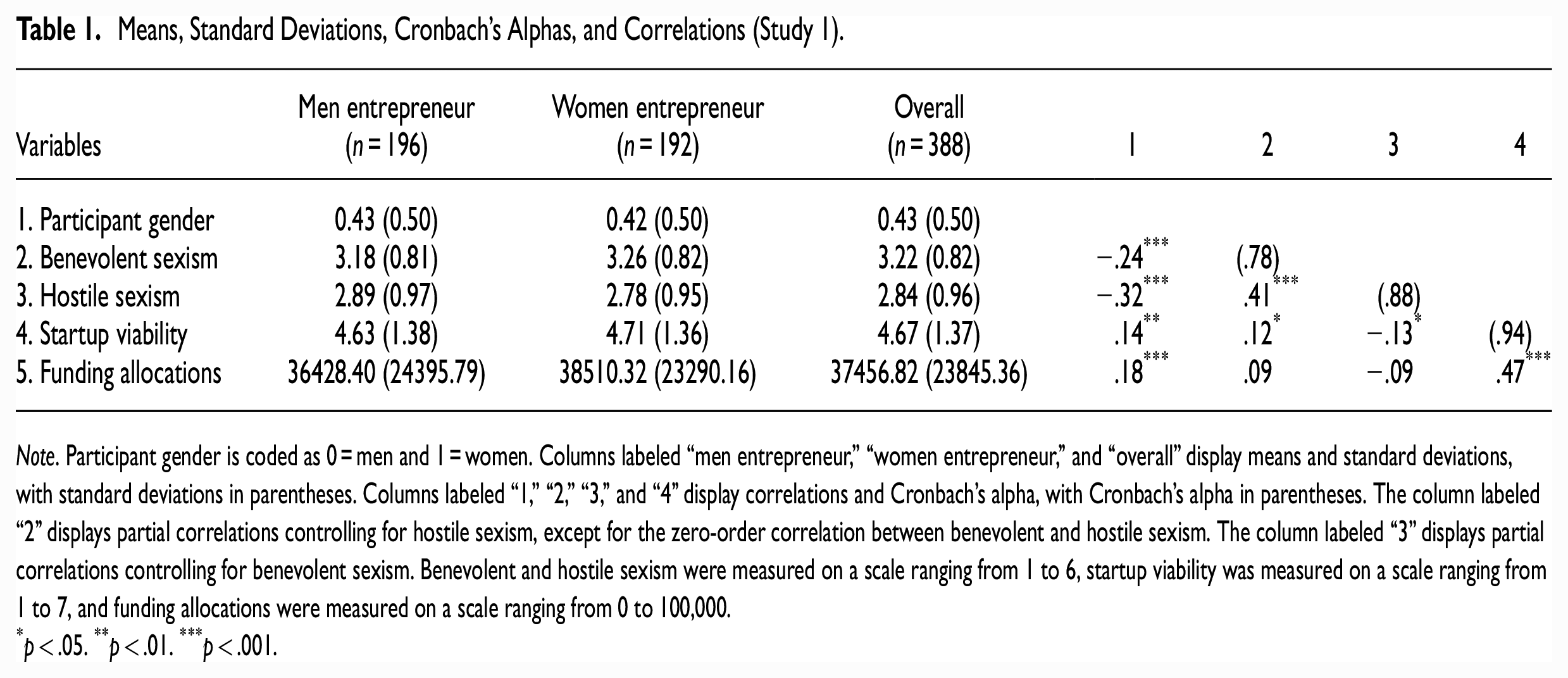
Note. Participant gender is coded as 0 = men and 1 = women. Columns labeled “men entrepreneur,”“women entrepreneur,” and “overall” display means and standard deviations, with standard deviations in parentheses. Columns labeled “1,”“2,”“3,” and “4” display correlations and Cronbach’s alpha, with Cronbach’s alpha in parentheses. The column labeled “2” displays partial correlations controlling for hostile sexism, except for the zero-order correlation between benevolent and hostile sexism. The column labeled “3” displays partial correlations controlling for benevolent sexism. Benevolent and hostile sexism were measured on a scale ranging from 1 to 6, startup viability was measured on a scale ranging from 1 to 7, and funding allocations were measured on a scale ranging from 0 to 100,000.
p < .05. **p < .01. ***p < .001.
Before proceeding to test our hypothesis, we examined gender differences in endorsement of sexism. We found that compared to women, men endorsed more hostile sexism (men: M = 3.09, SD = .93; women: M = 2.47, SD = .87), t(383) = 6.66, p < .001, d = .69; and benevolent sexism (men: M = 3.38, SD = .80; women: M = 3.00, SD = .79), t(383) = 4.74, p < .001, d = .49. We also observed an effect of participant gender on perceptions of startup viability with women rating startup viability higher than men across the two experimental conditions (women: M = 4.88, SD = 1.20; men: M = 4.49, SD = 1.45), t(383) = −2.83, p = .005, d = .29.
Given the correlation between benevolent and hostile sexism, we control for participants’ hostile sexism in our analyses to parse out the unique effects of benevolent sexism. We also control for participants’ gender given gender differences across all variables. Benevolent and hostile sexism scores were mean-centered to improve interpretability (Cohen et al., 2013).
Hypothesis Testing
To test the interaction between benevolent sexism and entrepreneur gender in predicting startup viability (Hypothesis 1), we conducted a hierarchical moderated regression analysis, with participant hostile sexism and participant gender entered in step 1 as controls, followed by the main effects of participant benevolent sexism and entrepreneur gender in step 2, and the interaction between participant benevolent sexism and entrepreneur gender in step 3 (see Table 2).
Regression Analyses Predicting Perceptions of Startup Viability (Study 1).
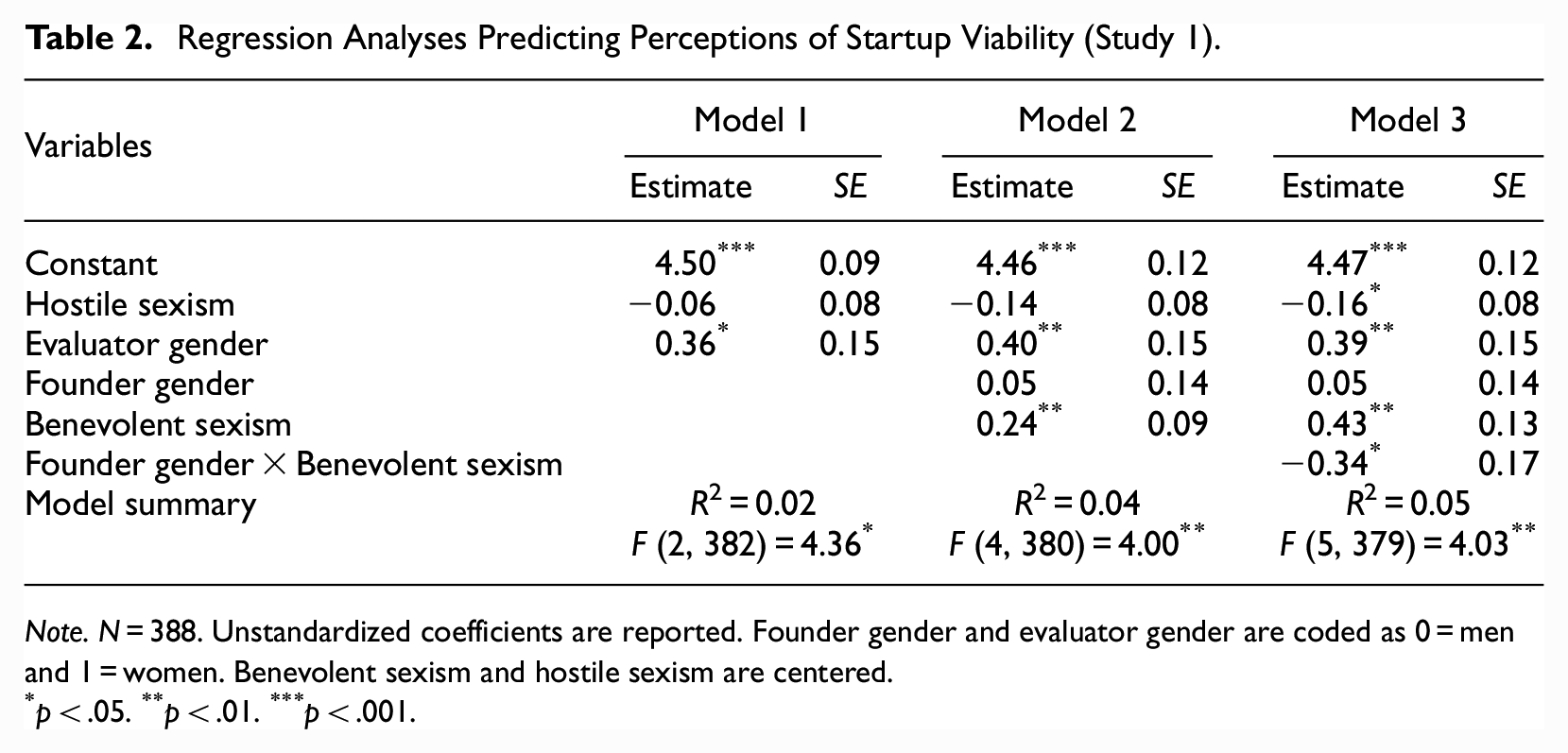
Note. N = 388. Unstandardized coefficients are reported. Founder gender and evaluator gender are coded as 0 = men and 1 = women. Benevolent sexism and hostile sexism are centered.
p < .05. **p < .01. ***p < .001.
The results indicated a significant interaction between benevolent sexism and entrepreneur gender in predicting perceived startup viability, b = −.34, p = .045, f2 = .011. 3 Following up on this finding with simple slope analyses, we found a positive relationship between evaluators’ benevolent sexism and their perceptions of viability for the men-led startup, b = .43, p = .001; but not for the women-led startup, b = .09, p = .485 (see Figure 1). That is, the more evaluators endorsed benevolent sexism, the more viable they perceived the men-led startup to be, whereas benevolent sexism was unrelated to viability perceptions of the women-led startup. 4 This pattern of findings was not the one described in Hypothesis 1, where benevolent sexism was expected to operate through its influence on evaluation of women-led startups rather than men-led startups. We return to these findings in our discussion of Study 1 and set-up for Study 2. 5
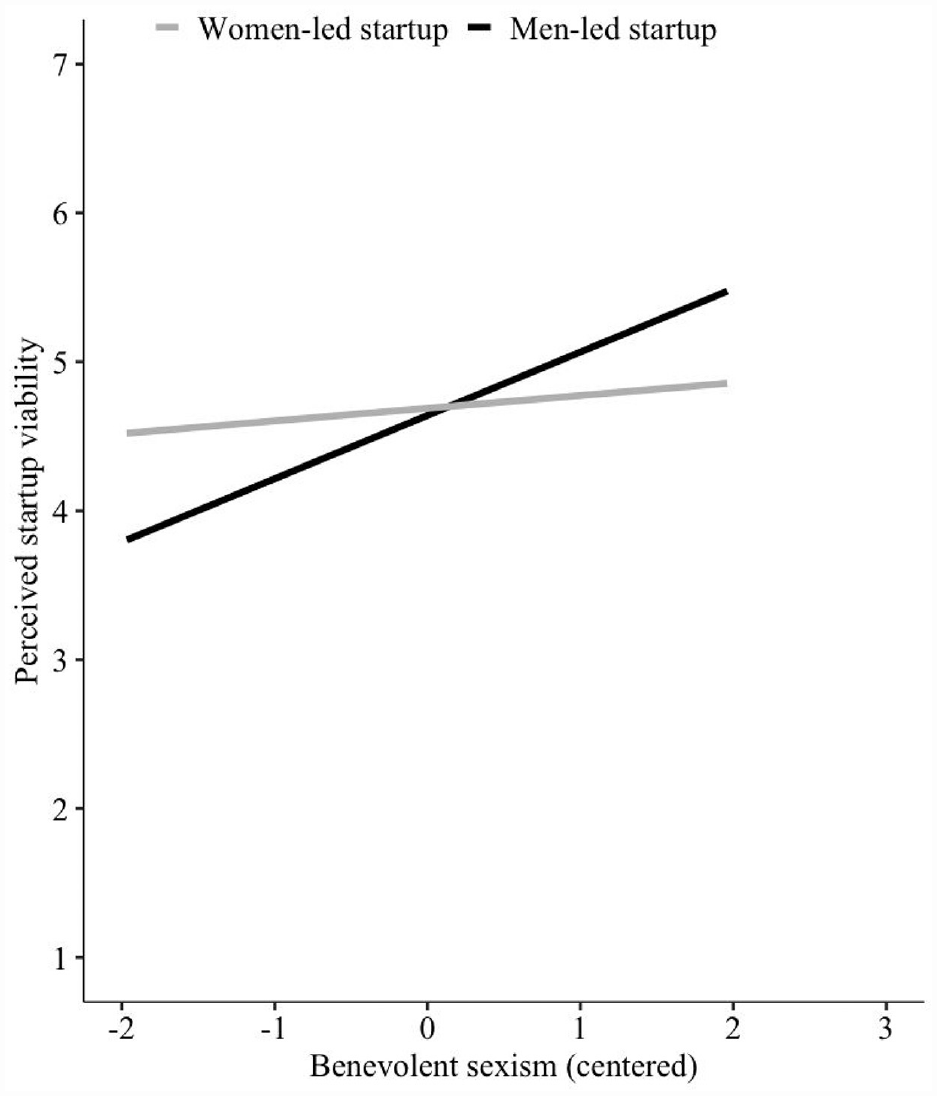
An interaction between participant’s benevolent sexism and entrepreneur’s gender in predicting perceptions of startup viability (Study 1).
Exploratory Analyses
Next, we conducted an exploratory analysis of the indirect effects of benevolent sexism and entrepreneur gender on downstream support for startups via perceptions of startup viability. To this end, we tested a moderated mediation model using PROCESS macro (model 7 with 10,000 bootstrap samples; see Figure 2 for the conceptual diagram of this model; Hayes, 2017), which assesses the conditional indirect effect of benevolent sexism on funding allocation in two regression models. The first regression model estimates the interactive effect of participant benevolent sexism and entrepreneur gender on perceptions of startup viability. The second estimates the effect of perceived viability on funding allocation, controlling for participant benevolent sexism, entrepreneur gender, and their interaction.
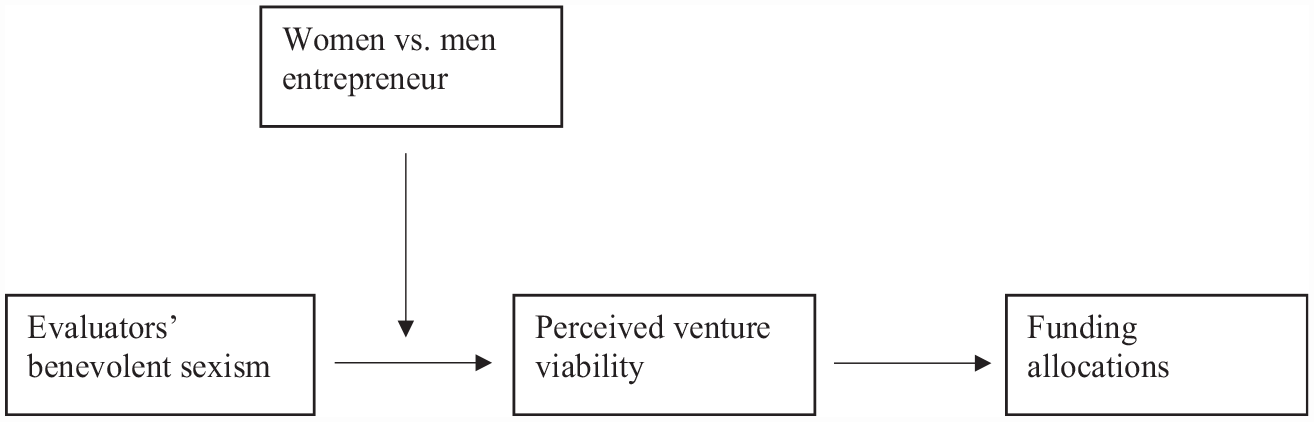
Moderated mediation model tested in exploratory analyses across three studies.
As noted above, there was an interactive effect of benevolent sexism and entrepreneur gender on perceptions of startup viability, and perceived startup viability was related to funding allocation, b = 7945.54, p < .001. Moreover, the indirect effect of participant benevolent sexism on funding allocations via perceptions of startup viability was significant in the men-led startup condition (conditional indirect effect = 3444.41, 95% confidence interval [CI] = 1608.02, 5396.52), but not in the women-led startup condition (conditional indirect effect = 669.78, 95% CI = −1263.81, 2579.09). Finally, the significant index of moderated mediation indicates that the indirect effects in the men- and women-led startup condition are significantly different (index = −2774.62, 95% CI = −5360.18, −288.11). Thus, the more evaluators endorsed benevolent sexism, the more they perceived men-led startups as viable, and in turn provided these startups with more financial resources, while there were no such effects for women-led startups.
Discussion
In Study 1, we found that the more evaluators endorsed benevolent sexism, the more viable they perceived men-led startups, whereas evaluators’ benevolent sexism was unrelated to their perceptions of the viability of women-led startups. These results did not support our hypothesis in which we expected benevolent sexism to be negatively related to perceptions of viability for women-led startups, whereas such a relationship would be weaker for men-led startups. These findings are thought-provoking—they suggest that the effects of sexist attitudes might be more complex than previously anticipated. Specifically, our findings point to the role of benevolent sexism as an advantaging mechanism of gender inequity. That is, inequity is not only a product of unfair disadvantages that underrepresented groups face (i.e., disadvantaging mechanisms) but is also a product of unfair advantages that dominant groups enjoy (i.e., advantaging mechanisms; Greenwald & Pettigrew, 2014; Phillips et al., 2022).
In a recent review of the literature on gender and race inequity, Phillips et al. (2022) show that scholars have primarily applied a disadvantage lens to identify the mechanisms and solutions to inequity, which may result in misspecifying or entirely missing some root causes of inequities because advantaging mechanisms have not been considered. The advantaging mechanism documented in our study, in which men are given more benefit than merited while women are seemingly not affected, is fundamentally different from previously identified mechanisms of inequity in entrepreneurship in which women are directly affected (e.g., negative stereotypes about women lead them to be unfairly deemed as incompetent and untrustworthy entrepreneurs; Malmström et al., 2017). Guided by our unexpected findings, we returned to the literature to consider why this may be the case and followed up on these findings in two subsequent studies.
Before we discuss Study 2, it is worth noting that although the magnitude of the observed effect is small by conventional standards (f2 = .011), this effect may have critical implications for startup survival. Exploratory analyses indicated that one-unit increase in endorsement of benevolent sexism was indirectly associated with a corresponding increase by around 10% of the average amount of financial resources allocated to men-led startups in the current sample, yet it was not associated with a significant increase in financial resources allocated to women-led startups. The interpretation of this figure has an important caveat: because our participants are not professional investors, and our experimental setting is hypothetical, we should not expect such an effect size to generalize with regard to the funding amount experienced investors would provide. However, the overarching point suggested by these findings is that benevolent sexism may be driving downstream support for startups by impacting stakeholders’ evaluations of startup viability. This is problematic as any small advantage in external support could mean the difference between success and failure for a new startup, which has an extremely high failure rate and heavily depends on external resources for survival and growth (Josefy et al., 2017; Lee & Huang, 2018).
Study 2
Study 1 provides initial evidence for benevolent sexism as an advantaging mechanism of gender inequity in entrepreneurship such that it boosts evaluation of men’s startups while leaving evaluation of women’s startups unchanged. While the mechanics of the effects of benevolent sexism were unexpected, these findings are in line with past research showing an apparent lack of effects of benevolent sexism on women working in men-dominated fields. For example, benevolent sexism was found to be unrelated to expectations of women’s success in politics (Cassidy & Krendl, 2019) or to support for women’s employment in managerial and other men-dominated jobs (Hideg & Ferris, 2016; Johnson et al., 2014; Masser & Abrams, 2004). This lack of effects is likely due to several factors. First, benevolent sexists have subjectively positive attitudes toward women and therefore may be unlikely to engage in behaviors that directly undermine women. Moreover, because overt gender discrimination is frowned upon, benevolent sexists may be careful not to discriminate against women directly. More specific to our study, we created scenarios in which the startup founder was portrayed as highly competent, which may have decreased benevolent sexists’ tendency to judge a startup founded by such a competent woman as less viable. Collectively, these factors may explain why benevolent sexism does not exert a blatant negative effect on women. Rather, it is associated with inaction and lack of engagement when it comes to supporting women in domains where they face the most challenges—men-dominated fields such as entrepreneurship.
Our findings in Study 1 also reveal an unfounded advantage for men-led startups. This is surprising but logical, because while research on benevolent sexism tends to focus on women’s experiences and outcomes, attitudes about women are inextricably tied to those about men. So just as benevolent sexism speaks to expectations and views about women, it inevitably speaks to those about men as well (Connor et al., 2017). For example, benevolent sexists believe that men and women have unique strengths and weaknesses that complement each other: women are communal but not particularly agentic, whereas men are agentic but not particularly communal (Glick & Fiske, 1996). In this sense, if benevolent sexists believe women to be wonderful yet fragile and thus in need of protection from men, it follows that they must also believe men to have the traditionally masculine attributes that enable them to act as protectors and providers for women. These perceptions very much align with the stereotypical image of a successful entrepreneur—bold, competitive, and aggressive (Ahl, 2006). Thus, benevolent sexists are likely to perceive a stronger fit between men and the entrepreneur role, leading them to believe that men-led startups are more likely to succeed. Following this line of reasoning, in our subsequent studies, we examine the following updated hypothesis:
Hypothesis 2: Evaluators’ benevolent sexism is positively related to perceptions of viability for men-led startups, whereas this association is weaker for women-led startups.
In Study 2 we sought to test our hypothesis with a sample of working adults. This is a critical step in establishing the robustness of our effects (Nosek et al., 2012) because although the students in our sample had experience with the context of startup evaluation, they likely lacked experience and encounters with prejudice in the workplace, which could have influenced their reactions. Moreover, full-time employees are more representative of people applying for jobs in startups—a population whose evaluations of startup quality are critical to startup survival and success (Engel et al., in press; Honoré & Ganco, 2020). Thus, in Study 2 we sought to replicate our initial findings with a sample of full-time employees in the United States.
Method
Participants and Procedure
We recruited 704 U.S. employees via Prolific, an online crowdsourcing platform designed to recruit participants for scientific research (Peer et al., 2017), to complete the study in exchange for 1.25 GBP and a chance to win a $50 bonus payment. 6 We chose Prolific for several reasons. First, it was designed for the recruitment of research participants and thus has no deception regarding what participants are recruited for, which is in line with ethical principles for research with human participants. Second, Prolific enforces ethical treatment of participants, part of which involves adequate compensation for their participation. Third, it has a demographically diverse pool of participants, which is more representative of the population than undergraduate students. It also has several built-in pre-screen questions that researchers can use to recruit specific populations, which allowed us to recruit a sample of full-time employees for the current study and a sample of people who had some investing experience for the third study. Therefore, we followed previous entrepreneurship research with online studies (Butticè et al., 2022; Engel et al., in press; Engel et al., 2021; Gunia et al., 2021) and used Prolific to recruit our participants.
In line with recommendations for accounting for inattention rates in online data collection (Meade & Craig, 2012), we excluded 103 participants who failed attention checks (e.g., took less than 10 minutes to complete the study and therefore were likely to not pay attention to stimuli). Additionally, we excluded 29 participants who were not workers, as we explicitly requested participants who were full-time employees. This resulted in a final sample of 572 participants (age: M = 34.18 years, SD = 11.08). In terms of gender, 52% identified as men, 48% as women, and the rest (1%) indicated they belonged to other gender groups or preferred not to answer. In terms of race, 76% identified as White, 9% as Hispanic, 6% as Black, 5% as East or South Asian, 2% as Native American, and the rest (4%) indicated they belonged to other racial groups or preferred not to answer. In terms of entrepreneurship experience, 16% reported experience in founding startups, 13% reported experience investing in startups, and 17% reported having taken entrepreneurship courses.
The procedure was identical to that of Study 1, except that Study 2 was completed online instead of in a laboratory. Participants were presented with the same entrepreneur and startup profile as in Study 1, except that we used American instead of Canadian universities to describe the entrepreneur’s education to fit the US context (see Appendix A). We used the same scales as in Study 1 to measure benevolent and hostile sexism, 7 and perceptions of startup viability.
Results
Preliminary Analyses
Table 3 displays the means, standard deviations, Cronbach’s alpha, and correlations. As in Study 1, benevolent and hostile sexism were positively correlated, r = .47, p < .001.
Means, Standard Deviations, Cronbach’s Alphas, and Correlations (Study 2).
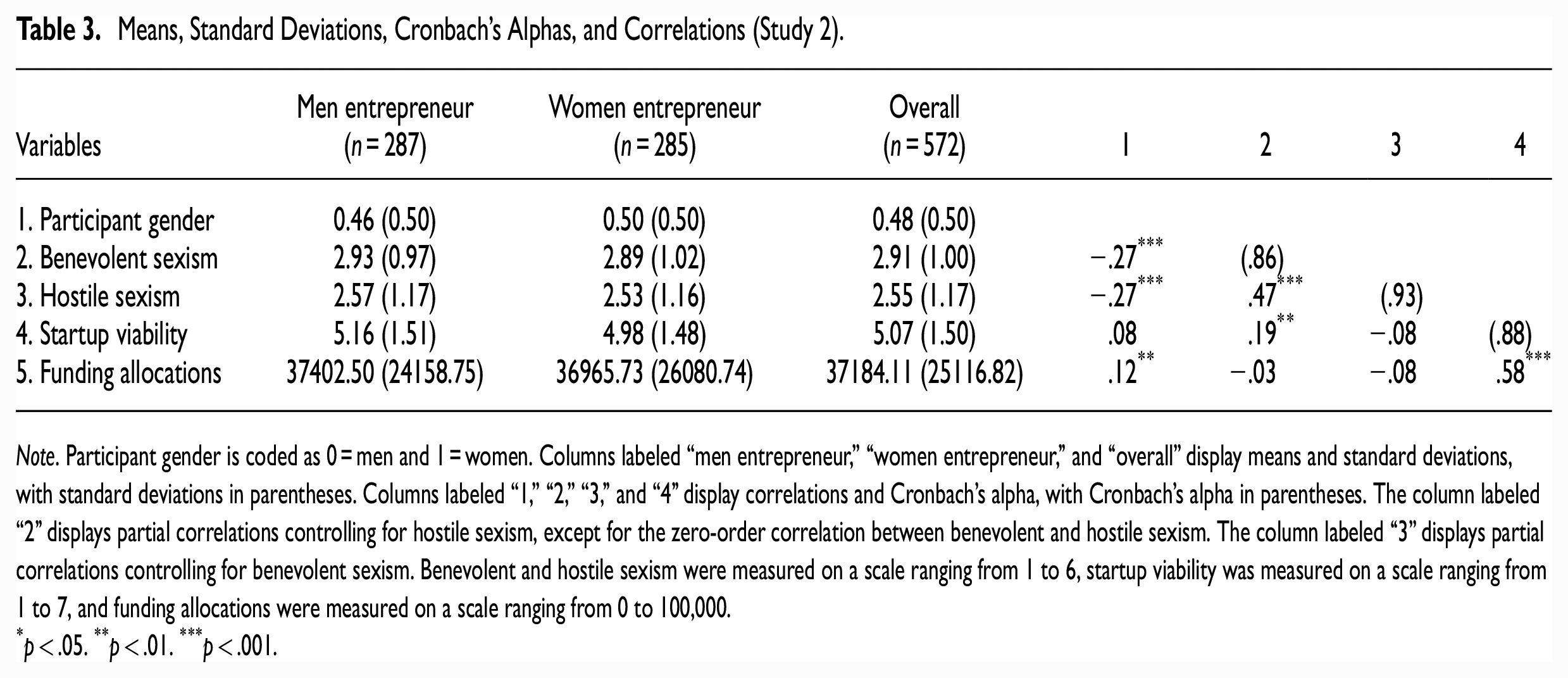
Note. Participant gender is coded as 0 = men and 1 = women. Columns labeled “men entrepreneur,”“women entrepreneur,” and “overall” display means and standard deviations, with standard deviations in parentheses. Columns labeled “1,”“2,”“3,” and “4” display correlations and Cronbach’s alpha, with Cronbach’s alpha in parentheses. The column labeled “2” displays partial correlations controlling for hostile sexism, except for the zero-order correlation between benevolent and hostile sexism. The column labeled “3” displays partial correlations controlling for benevolent sexism. Benevolent and hostile sexism were measured on a scale ranging from 1 to 6, startup viability was measured on a scale ranging from 1 to 7, and funding allocations were measured on a scale ranging from 0 to 100,000.
p < .05. **p < .01. ***p < .001.
Similar to Study 1, men, compared to women, endorsed more hostile sexism (men: M = 2.86, SD = 1.13; women: M = 2.22, SD = 1.11), t(566) = 6.77, p < .001, d = .57; and benevolent sexism (men: M = 3.17, SD = .94; women: M = 2.64, SD = .98), t(567) = 6.61, p < .001, d = .55. Also similar to Study 1, women perceived the startup to be more viable than men (women: M = 5.20, SD = 1.43; men: M = 4.96, SD = 1.55), t(566) = −1.94, p = .052, d = .16, across both experimental conditions. As such, in line with Study 1, we controlled for participant hostile sexism and participant gender in our analyses (with an exception when we tested a three-way interaction with participant gender; see below).
Hypothesis Testing
We tested the proposed interaction between benevolent sexism and entrepreneur gender in predicting startup viability (Hypothesis 2), using the same analyses as in Study 1. However, this interaction was not significant, b = −.14, p = .273, f2 < .001 (see Table 4).
Regression Analyses Predicting Perceptions of Startup Viability (Study 2).
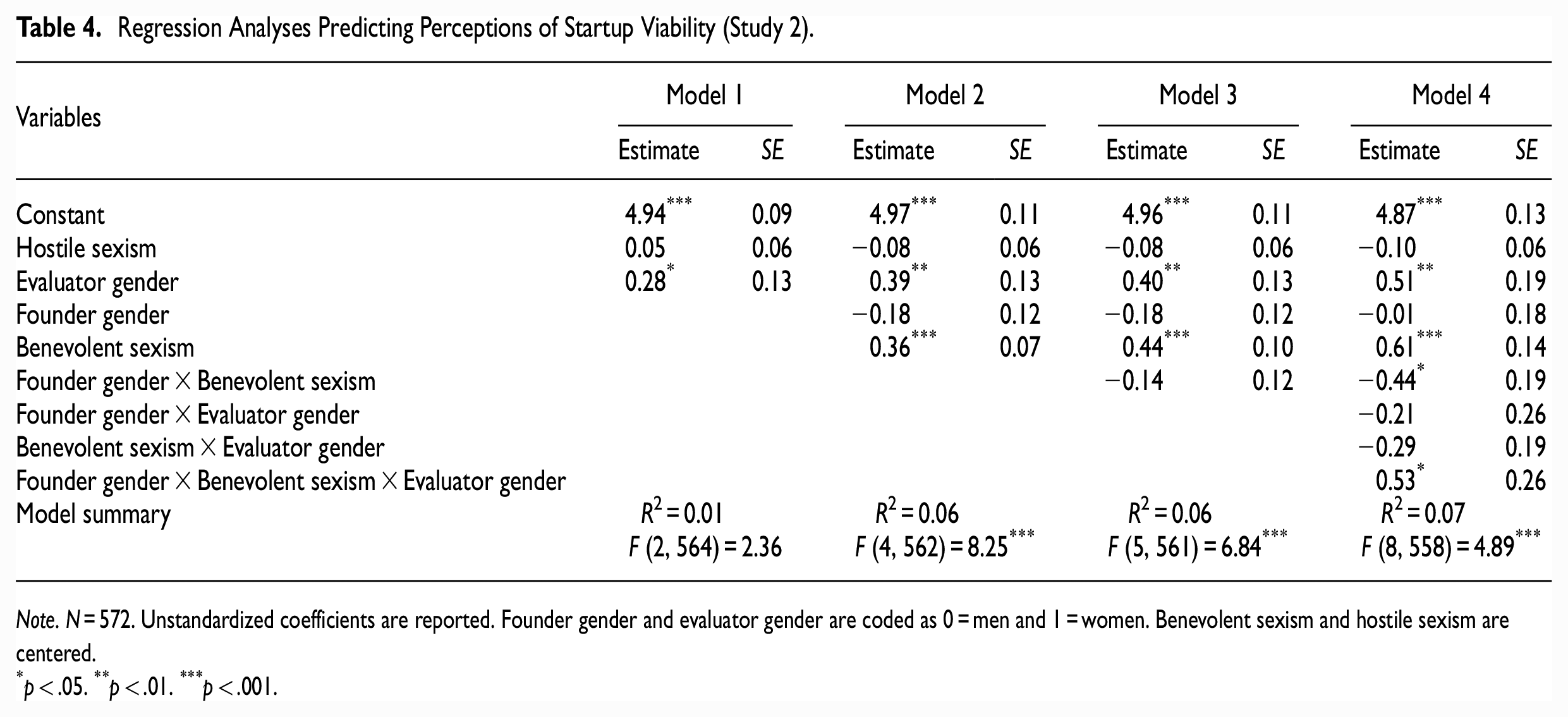
Note. N = 572. Unstandardized coefficients are reported. Founder gender and evaluator gender are coded as 0 = men and 1 = women. Benevolent sexism and hostile sexism are centered.
p < .05. **p < .01. ***p < .001.
Exploratory Analysis
Given that we found participant gender differences across all variables, we also tested a three-way interaction between participant benevolent sexism, entrepreneur gender, and participant gender in predicting startup viability (see Table 4). Unlike Study 1, this three-way interaction was significant, b = .53, p = .043, f2 = .007. To de-compose this three-way interaction, we examined the interactive effect of participant benevolent sexism and entrepreneur gender on perceptions of startup viability for men and women participants separately. A two-way interaction between benevolent sexism and entrepreneur gender was significant for men participants (b = −.44, p = .023, f2 = .019), but not for women participants (b = .09, p = .618, f2 < .001). Following up on the significant two-way interaction for men participants, simple slope analyses revealed a significant positive relationship between men’s endorsement of benevolent sexism and their perception of the viability of men-led startups (b = .63, p < .001), but not women-led startups (b = .18, p = .154) (see Figure 3). This pattern of results is in line with Study 1, although in Study 2 it was observed for men participants but not for women participants (we return to this point below in our discussion).
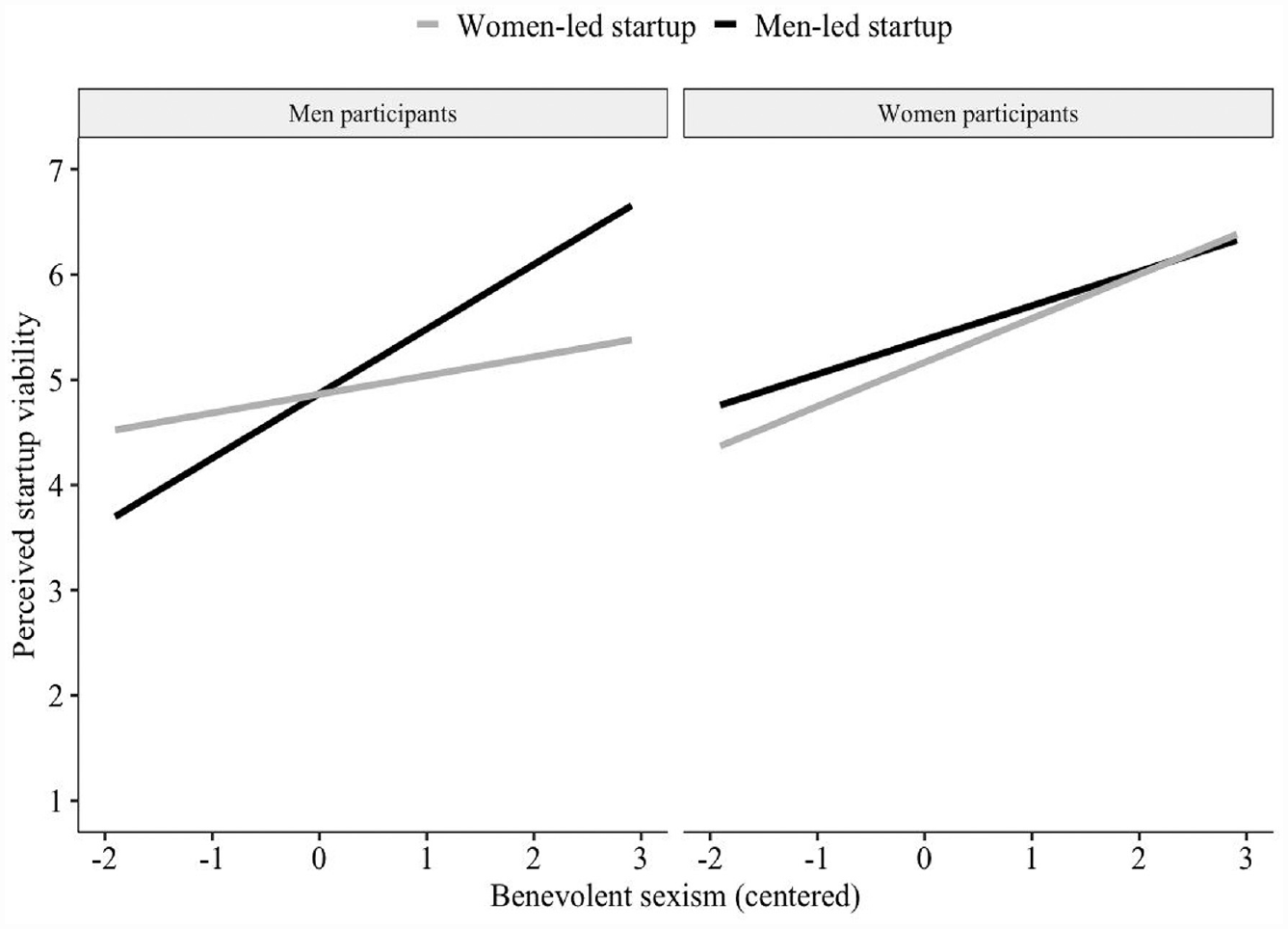
An interaction between participant’s benevolent sexism, entrepreneur’s gender, and participant’s gender in predicting perceptions of startup viability (Study 2).
As in Study 1, we also tested a moderated mediation model exploring the potential downstream consequences of benevolent sexism on financial support for men- and women-led startups. Given a significant three-way interaction (participant benevolent sexism × entrepreneur gender × participant gender) showing that the more men participants endorsed benevolent sexism the more viable they perceived men-led startups, whereas such an effect was not significant for women participants, we tested the moderated mediation model with men participants only.
As discussed above, the interactive effect between men participant benevolent sexism and entrepreneur gender was significant in predicting perceptions of startup viability in the first stage; and perceived startup viability was related to funding allocation in the second stage, b = 9724.05, p < .001. In addition, the indirect effect of benevolent sexism on funding allocations via perceptions of startup viability was significant for men-led startups (conditional indirect effect = 5840.60, 95% CI = 2588.55, 8985.89), but not for women-led startups (conditional indirect effect = 1763.88, 95% CI = −577.78, 3941.31). Finally, the index of moderated mediation was significant (index = −4076.72, 95% CI = −7887.18, −240.45).
Discussion
In Study 2 we observed a similar pattern of results as in Study 1 but only with men participants. That is, the more men participants endorsed benevolent sexism, the more viable they perceived men-led startups to be, whereas there were no effects of men participants’ benevolent sexism on their perceptions of women-led startup viability. In addition to the hypothesized relationships, exploratory analyses again suggested a substantial economic significance. Specifically, a one-unit increase in men evaluators’ endorsement of benevolent sexism was indirectly associated with an increase of 16% of the average amount of financial resources allocated to the men-led startup in this sample, but it was not associated with a significant increase in financial resources allocated to the women-led startup. Thus, similar to Study 1, Study 2 suggests an economically meaningful impact of benevolent sexism.
In contrast to the men participants, the women participants in Study 2 evaluated men- and women-led startups similarly regardless of their endorsement of benevolent sexism. This nonsignificant finding could be due to random variation between samples, as it is not uncommon to find inconsistencies in a set of studies when the effect does exist (Lakens & Etz, 2017). Alternatively, given that women employees have more experience with sexism in the workplace either by experiencing it personally or observing how it affects other women, this increased awareness of workplace discrimination may make them more careful to avoid acting on their benevolent sexist attitudes when evaluating startups. It is also possible that the effects of benevolent sexism are weaker for women evaluators on average than for men evaluators and that the effects become more pronounced for women evaluators under certain circumstances such as in the context of masculine-typed startups, as we examine in Study 3.
Study 3
In Study 3, we sought to test our hypothesis with a startup in a men-dominated industry (i.e., high-tech). There were several reasons for this choice of startup. First, building on the differential effects of benevolent sexism in Study 2 for men and women evaluators, we expected that while women evaluators may deem men- and women-led startups in a gender-neutral industry equally viable, those effects may be attenuated when they evaluate startups in a men-dominated industry. This is because while a gender-neutral startup may not deviate substantially from societal expectations of women and hence may be deemed suitable for both men and women entrepreneurs by women evaluators, a masculine-typed startup may highlight men’s suitability for entrepreneurship even among women evaluators. Indeed, research shows that women-led startups in men-dominated industries face additional difficulties in acquiring needed resources (Kanze et al., 2020; Micelotta et al., 2018). Moreover, women entrepreneurs are particularly underrepresented in high-tech, which often has higher growth potential and generates higher revenues than other industries (Balachandra et al., 2019). As such, addressing the lack of women entrepreneurs in high-tech is crucial for gender equity in entrepreneurship overall.
For this study we recruited a sample of participants from the United States and the United Kingdom who had at least some form of startup evaluation experience. In doing so we were able to test if the effects hold among stakeholders with more startup evaluation experience than the samples in Studies 1 and 2, thus increasing the external validity of our study.
Method
Participants and Procedure
We recruited 368 participants in the United States and the United Kingdom via Prolific who indicated they have experience in at least one of three types of investing: angel investing, startup capital investing, and crowdfunding. 8 Participants completed the study in exchange for 1.25 GBP. In line with Study 2, we excluded 35 participants who failed attention checks and 21 participants who were not workers. This resulted in a final sample of 312 participants (age: M = 38.35 years, SD = 10.63). In terms of gender, 57% identified as men, 43% as women, and the rest (1%) indicated they belonged to other gender groups or preferred not to answer. In terms of race, 83% identified as White, 4% as Asian, 4% as mixed, 4% as Hispanic, 3% as Black, and the rest (2%) indicated they belonged to other racial groups or preferred not to answer. In terms of investing experience, 98% reported having crowdfunding experience, 11% reported having venture capital investing experience, and 3% reported having angel investing experience.
The procedure was identical to that of Study 2, except that in Study 3 we presented participants with an artificial intelligence startup instead of a home energy solution startup (see Appendix B and Supplemental Materials). For the UK sample, we adjusted the founder’s education by using UK instead of US universities (see Appendix A). We used the same scales as in Studies 1 and 2 to measure benevolent and hostile sexism, 9 and perceptions of startup viability.
Results
Preliminary Analyses
Table 5 presents means, standard deviations, Cronbach’s alpha, and zero-order correlations. Consistent with Studies 1 and 2, there was a positive correlation between benevolent sexism and hostile sexism, r = .43, p < .001.
Means, Standard Deviations, Cronbach’s Alphas, and Correlations (Study 3).
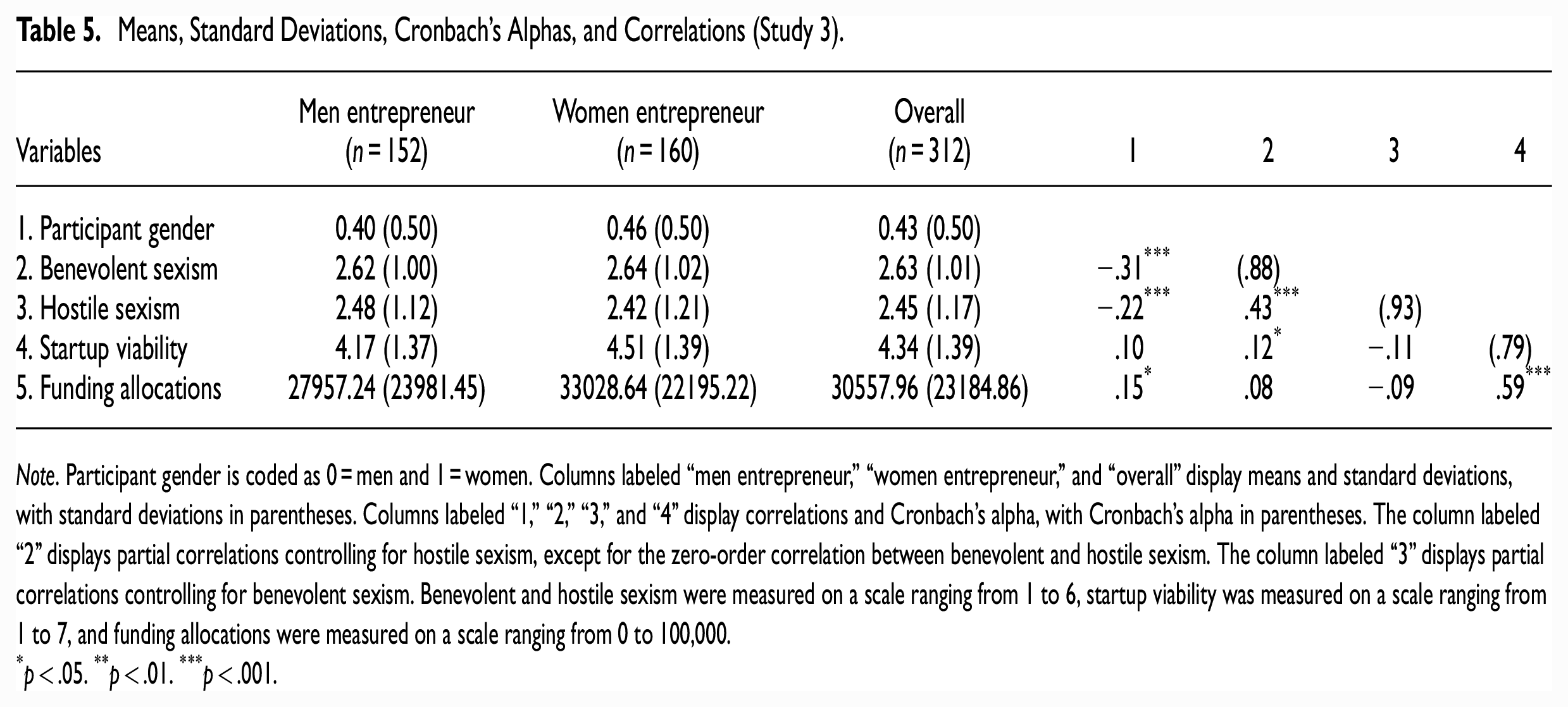
Note. Participant gender is coded as 0 = men and 1 = women. Columns labeled “men entrepreneur,”“women entrepreneur,” and “overall” display means and standard deviations, with standard deviations in parentheses. Columns labeled “1,”“2,”“3,” and “4” display correlations and Cronbach’s alpha, with Cronbach’s alpha in parentheses. The column labeled “2” displays partial correlations controlling for hostile sexism, except for the zero-order correlation between benevolent and hostile sexism. The column labeled “3” displays partial correlations controlling for benevolent sexism. Benevolent and hostile sexism were measured on a scale ranging from 1 to 6, startup viability was measured on a scale ranging from 1 to 7, and funding allocations were measured on a scale ranging from 0 to 100,000.
p < .05. **p < .01. ***p < .001.
Also consistent with Studies 1 and 2, men scored higher than women on benevolent sexism (men: M = 2.90, SD = .97; women: M = 2.28, SD = .96), t(308) = 5.64, p < .001, d = .65, and hostile sexism (men: M = 2.67, SD = 1.14; women: M = 2.16, SD = 1.14), t(308) = 3.90, p < .001, d = .45. Women and men did not differ in startup viability ratings (women: M = 4.51, SD = 1.40; men: M = 4.22, SD = 1.38), t(308) = −1.83, p = .069, d = .21. As in Studies 1 and 2, we controlled for participant hostile sexism and participant gender in our analyses.
Hypothesis Testing
The interaction between benevolent sexism and entrepreneur gender was significant in predicting viability, b = −.31, p = .045, f2 = .013 (see Table 6). Simple slope analyses indicated a positive relationship between benevolent sexism and perceptions of viability for the men-led startup, b = .40, p = .001; but not the women-led startup, b = .09, p = .441 (see Figure 4). 10 Thus, the more evaluators endorsed benevolent sexism, the more viable they perceived men-led startups, yet benevolent sexism was unrelated to viability perceptions of women-led startups.
Regression Analyses Predicting Perceptions of Startup Viability (Study 3).
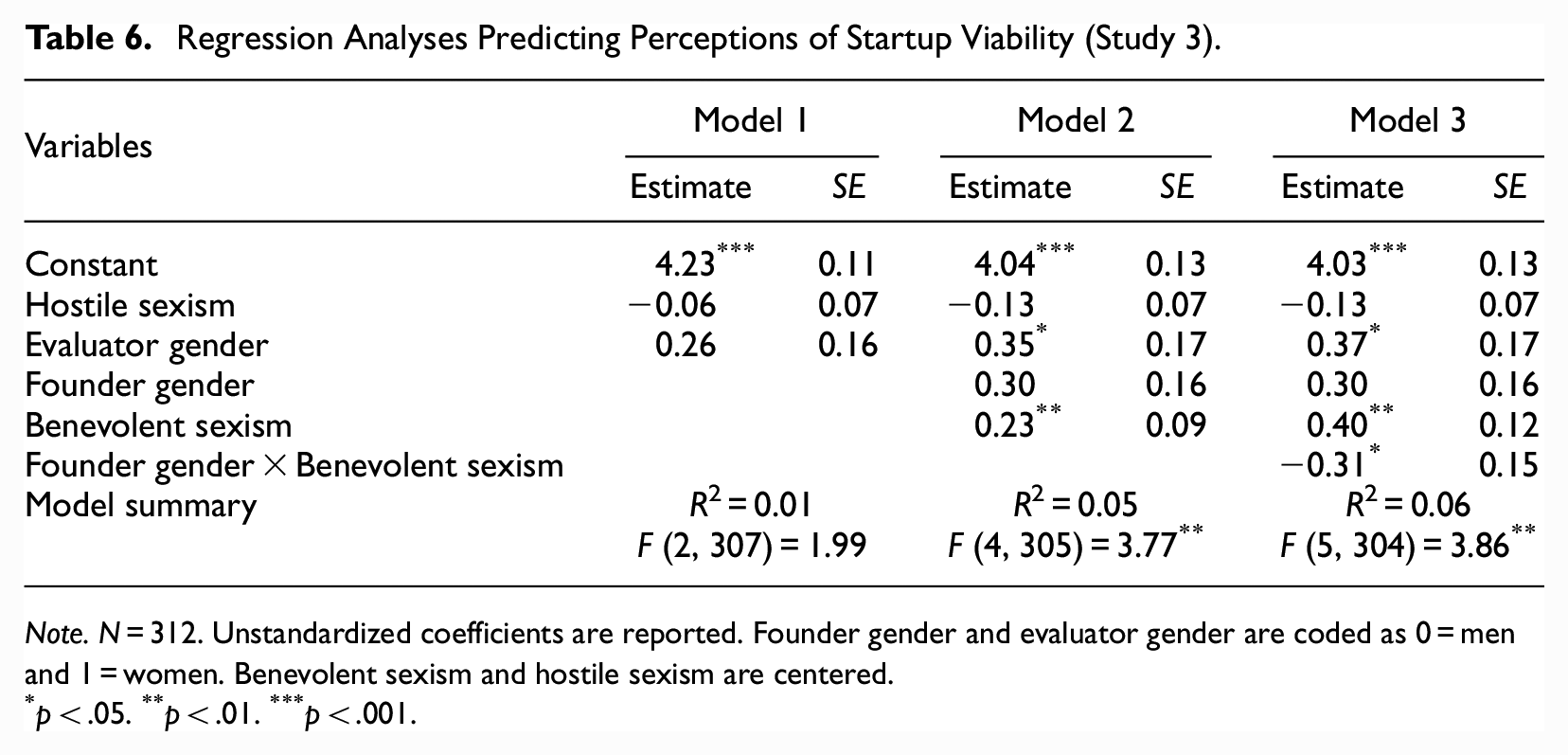
Note. N = 312. Unstandardized coefficients are reported. Founder gender and evaluator gender are coded as 0 = men and 1 = women. Benevolent sexism and hostile sexism are centered.
p < .05. **p < .01. ***p < .001.
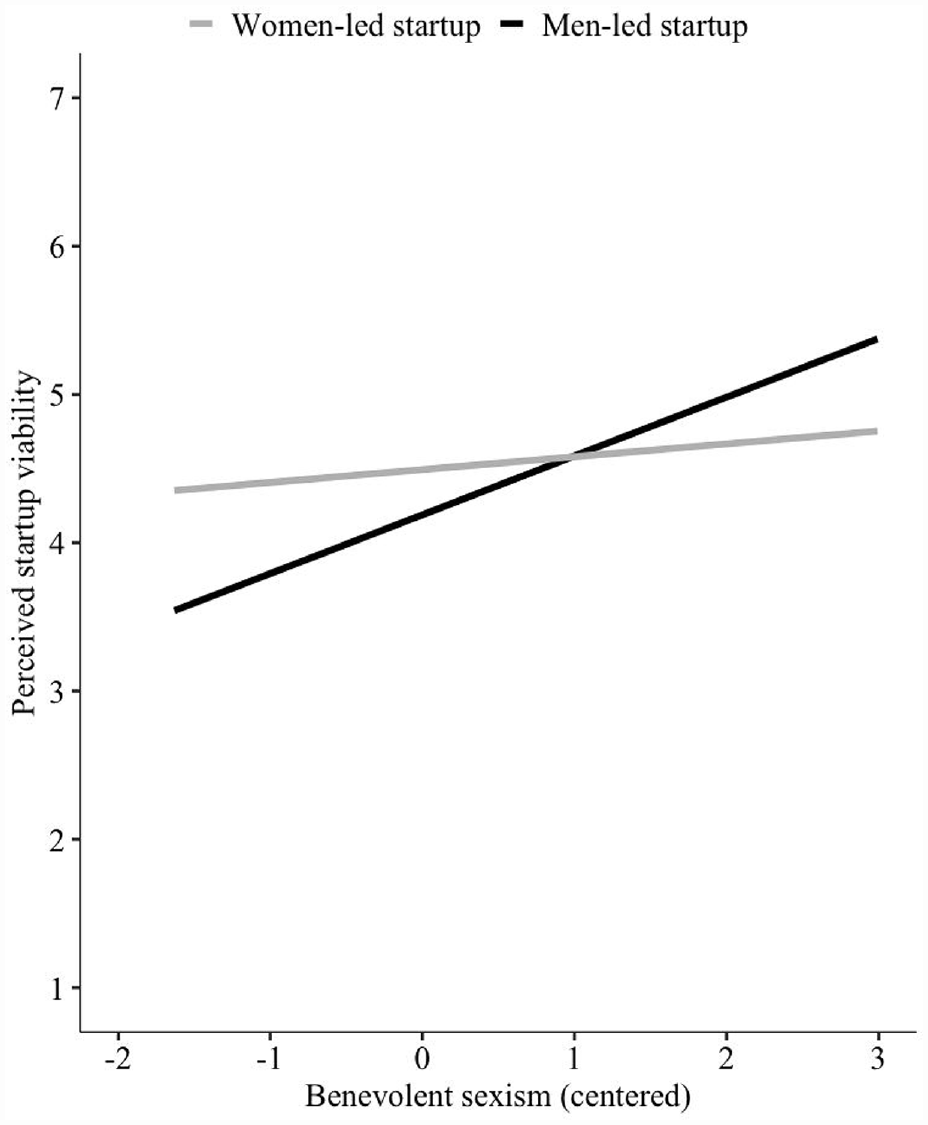
An interaction between participant’s benevolent sexism and entrepreneur’s gender in predicting perceptions of startup viability (Study 3).
Exploratory Analysis
As in Studies 1 and 2, we tested the potential downstream consequences of benevolent sexism on funding for men- and women-led startups by running a moderated mediation model. As discussed above there was an interaction between benevolent sexism and entrepreneur gender in predicting perceptions of startup viability in the first stage; and startup viability was related to funding allocation in the second stage, b = 9647.06, p < .001. In addition, the indirect effect of benevolent sexism on funding allocations via perceptions of startup viability was significant for men-led startups (conditional indirect effect = 3824.03, 95% CI = 1455.97, 6262.93), but not for women-led startups (conditional indirect effect = 834.96, 95% CI = −1459.50, 3345.36). However, the index of moderated mediation was not significant (index = −2989.07, 95% CI = −6099.52, 254.75) indicating that the indirect effects of benevolent sexism between the men-led startup condition and the women-led startup condition were not significantly different from each other at the .05 level (we return to this point below in our discussion).
Discussion
In the context of a masculine-typed startup, we found that benevolent sexism was related to enhanced perceptions of startup viability when the founder was a man, but not when the founder was a woman. Our results here thus replicated those of Study 1, where benevolent sexist attitudes of evaluators, regardless of their gender, were related to higher viability ratings for men-led startups, whereas in Study 2 these effects were observed only for men evaluators. Furthermore, our exploratory analyses showed that benevolent sexism indirectly influenced financial support for startups via enhanced viability perceptions for the men-led but not the women-led startup. That is, on average a one-unit increase in evaluators’ benevolent sexism translated to an increase of 13% of the average financial resources allocated to men-led startups in this sample, yet it was not related to a significant boost in financial resources allocated to women-led startups.
Although the indirect effect of benevolent sexism on funding allocations via viability perceptions was significant for men-led startups and nonsignificant for women-led startups, the difference between these two indirect effects was not statistically significant at the .05 level, as indicated by the inclusion of 0 in the 95% CI for the moderated mediation index. This nonsignificant result might be due to our sample size as a sample of n = 312 might be insufficient to detect an ordinal interaction (i.e., effects of the same direction but of different magnitude) which is more difficult to detect than a crossover interaction (i.e., effects of the opposite directions) (McClelland & Judd, 1993; Strube & Bobko, 1989). However, the pattern of this moderated mediation model is consistent with our theory and the findings in Studies 1 and 2.
General Discussion
In this paper, we examined the effects of benevolent sexism on evaluation of startups led by women and men. In line with our general expectations, benevolent sexism contributes to the gender gap in startup evaluation. However, it operates in a different manner than originally hypothesized. That is, we expected that the more evaluators endorse benevolent sexism, the more negatively they would evaluate women-led startups, yet we found no apparent effects of benevolent sexism on evaluation of women-led startups. However, the more evaluators endorse benevolent sexism, the more positively they evaluate men-led startups. This effect was observed for both men and women evaluators in Studies 1 and 3, while in Study 2 this effect was observed only for men evaluators. This suggests that women evaluators are potentially less affected by benevolent sexism, at least in the context of gender-neutral ventures as used in Studies 1 and 2. However, when a masculine venture was used in Study 3, both men and women evaluators rated men-led startups more positively the more they endorsed benevolent sexism. It is worth noting how striking our findings of men’s advantage are given that the women founders in our study were portrayed as highly qualified and their qualifications and startup ideas were identical to those of the men founders. In uncovering this insight, our study contributes to the literatures on entrepreneurship, ambivalent sexism, and more broadly gender diversity and equity.
Contributions to the Entrepreneurship Literature
The current research contributes to the study of the gender gap in entrepreneurship in several ways. First, we identify a novel explanation as to why women continue to be underrepresented in entrepreneurship despite numerous efforts by practitioners and policy-makers to close the gap: the role of benevolent sexism in startup evaluation. By studying this subtle and seemingly benign type of sexism, we complement past work on negative stereotypes about women’s entrepreneurial competence and credibility (Ewens, 2022; Guzman & Kacperczyk, 2019), which is suggestive of traditional (hostile) sexism at play. While traditional sexism certainly drives part of the gender gap in entrepreneurship as discussed in our literature review, it has become less accepted in today’s society, while subtle prejudices like benevolent sexism are still widespread. Our study thus addresses a type of sexism that is more likely to be encountered in today’s startup ecosystem than traditional sexism.
Furthermore, by studying the effects of benevolent sexism, our work uncovers a fundamentally different manifestation of gender inequity in entrepreneurship. Namely, past research has focused on the blatant disadvantages that women face, such as having their entrepreneurial competence and credibility unfairly questioned. By contrast, our work documents an advantage that is given to men while there is no obvious disadvantage for women. This is important as inequities are not only the product of unfair barriers that disadvantaged groups face but are also the product of unfair privileges that advantaged groups enjoy. Critically, addressing inequities stemming from advantages conferred to men requires different solutions from addressing inequities stemming from disadvantages against women (Phillips et al., 2022).
One other study documenting an advantaging mechanism in entrepreneurship is a study by Brooks et al. (2014), in which founder attractiveness is unrelated to evaluators’ assessments of startups founded by women, but is positively related to assessments of startups founded by men. Our study builds on this nascent work on advantaging mechanisms in entrepreneurship but differs in focus by examining the characteristics of evaluators rather than of entrepreneurs. In doing so, our work addresses the broader system rather than focusing on or suggesting what women entrepreneurs need to do to overcome the unfair barriers they face. This is aligned with calls in the broader management literature where most work has focused on how to “fix women” (e.g., examining their confidence, negotiation styles, and risk tolerance, and suggesting that women need to become more confident, negotiate more, and be less risk aversive) rather than how to fix an inequitable system and startup evaluators are part of such a system.
It is also worth noting that while most work on gender in entrepreneurship has invoked or explicitly examined stereotypes, our work examines prejudice. Stereotypes and prejudice are related, but they are not the same thing. Stereotypes refer to cognitive representations and beliefs about a group, whereas prejudice refers to feelings and attitudes toward a group (Devine, 1989; Dovidio & Gaertner, 2010; Rosette et al., 2018). Thus, they can operate independently. For instance, people can be aware of stereotypes about certain groups but not personally endorse them and hence are low on prejudice. As such, stereotypes and prejudice can have different consequences for women entrepreneurs. For example, the belief that entrepreneurship is aligned with masculine but not feminine stereotypes may not necessarily lead one to favor men-led startups. Indeed, those low on prejudice may work hard to counter existing stereotypes that they are aware of.
Finally, understanding the effects of benevolent sexism on the gender gap in entrepreneurship is critical for the broader entrepreneurship literature, which has not recognized the insidious effects of benevolent sexism. For example, Johnson et al. (2018) found that in crowdfunding settings where the average funding is low (around $50), women are seen as more trustworthy than men, which in turn increases investors’ willingness to fund women-led ventures. This finding was framed as a funding advantage for women. However, by adopting a benevolent sexist lens, these findings may suggest otherwise. Namely, in line with benevolent sexists’ seemingly positive attitudes toward women, they are seen as trustworthy and hence encouraged for small asks (whereas men are not), which in turn may lead women to ask for and consequently receive less money even when seeking to finance more ambitious ventures. In other words, these seemingly positive findings may ultimately undermine women by constraining them to small funding amounts while on the surface they appear to be at an advantage.
Contributions to the Ambivalent Sexism Literature
This work contributes to research on ambivalent sexism in several ways. First, we complement and extend past work on benevolent sexism that has largely been situated in the social psychology realm. Namely, while scholars have examined the effects of benevolent sexism in contexts such as personal relationships (Cross et al., 2016; Hammond et al., 2016) and collective action (Becker & Wright, 2011; Radke et al., 2016), empirical research on its effect in the workplace is rare (Hideg & Shen, 2019). By studying how benevolent sexism manifests in entrepreneurship, our study, along with the emerging work on benevolent sexism in traditional organizations (e.g., King et al., 2012; Hideg & Ferris, 2016), provides empirical evidence for the role of benevolent sexism in undermining gender equity in the workplace.
Second, research on ambivalent sexism, and sexism in general, has focused on the effects of sexist attitudes on women. For example, studies have documented the tendency of benevolent sexists to assign less challenging tasks to women (King et al., 2012) and to show support for women in feminine, but not masculine, jobs (Hideg & Ferris, 2016). However, given that attitudes about women and men are interwoven rather than independent (Connor et al., 2017), benevolent sexism is likely to affect men as well. Indeed, by studying benevolent sexism in the context of entrepreneurship we found that this form of sexism can manifest itself in positive outcomes for men rather than negative outcomes for women. In doing so, we complement past work on the tendency of benevolent sexists to reward women working in feminine jobs (Hideg & Ferris, 2016) by showing that benevolent sexists reward men working in masculine jobs as well.
Finally, our findings on the lack of effects of benevolent sexism on women’s startups are in line with an emerging body of work suggesting that the negative effects of benevolent sexism are subtle and easily overlooked as this type of sexism does not seem to directly undermine women working in men-dominated fields (Hideg & Ferris, 2016; Johnson et al., 2014; Masser & Abrams, 2004). Thus, along with these studies, our work highlights the insidious nature of benevolent sexism that does not manifest itself in a straightforward negative way making its effects much harder to detect and combat.
Contributions to a Broader Gender Diversity and Equity Literature
As mentioned above, our work identifies a novel advantaging mechanism of gender inequity rooted in benevolent sexism. In doing so, we complement and extend the literature on gender diversity and equity, which has almost exclusively examined inequity mechanisms that directly undermine women (Phillips et al., 2022). That is, while the processes by which women are unfairly disadvantaged are well established, we still have scant knowledge about the processes by which men receive unfair benefits. As a consequence, we may be missing out on important opportunities to eradicate gender inequity at work. Critically, advantaging mechanisms such as benevolent sexism are especially hard to detect as they seemingly do not influence women, while at the same time giving men an unfounded advantage. In uncovering this insight, we contribute to the growing efforts to draw attention to advantaging mechanisms—a subtle yet powerful class of mechanisms contributing to inequities (Phillips et al., 2022).
We also contribute to an emerging body of research that takes a men-centric approach to studying gender diversity and equity. While most work on gender has examined women’s outcomes, scant attention has been paid to men, although they experience powerful gender dynamics that differ from those women experience (e.g., manhood is seen as more precarious than womanhood; Mazei et al., 2021). However, recent work has started focusing on men’s experiences and outcomes at work, which have important implications for gender equity. For example, scholars have examined how men are evaluated when they take parental leave (Krstic & Hideg, 2019), cry in reaction to negative feedback (Motro & Ellis, 2017), or advocate for women (i.e., be men allies; Bosak et al., 2018; Hardacre & Subasic, 2018). Indeed, a recent review of research on gender equality at work by Hideg and Krstic (2021) has called for greater focus on men, such as how men’s experiences or changes in social roles affect gender equity in the workplace. Our work answers this call by showing that the effects of sexist attitudes can manifest by influencing evaluations of men rather than of women.
Strengths, Limitations, and Future Directions
The strength of our research includes replicating our findings across three different studies, with three different samples of participants in the United States, Canada, and the United Kingdom. Furthermore, our research design using experimental vignettes allows us to establish the causal role of entrepreneur gender and show that benevolent sexists favor men over women with identical educational and professional backgrounds. This approach complements past research using archival data to study gender in entrepreneurship where concerns about omitted variables are more salient (Barnes et al., 2018). Furthermore, it allows us to measure the sexist attitudes of evaluators and empirically examine how such attitudes affect evaluation of startups. As such, we extend past work which has mostly inferred the role of sexist attitudes from the observed gender gaps in startup outcomes rather than directly testing this role. In doing so, we respond to a recent call to collect data on the proposed mechanisms of the observed gender gaps in entrepreneurship and tease out their unique contribution to such gaps (Ewens, 2022). In addition, although the use of experiments might raise questions about whether our findings can be generalized to real-life evaluation contexts, we used a highly immersive vignette methodology to create a realistic scenario and thus increase external validity (Aguinis & Bradley, 2014).
Another strength is our ability to gain a deeper understanding of our phenomenon of interest through updating our initial theories following unexpected findings and testing our revised hypothesis in two subsequent studies. More than 30 years ago, Sutton and Rafaeli (1988) published their classic work on displayed emotions in organizations that entailed revising theories based on unexpected results in their initial study. The authors concluded their paper by advocating for reporting management research that more accurately reflects the process of conducting scientific studies. Despite such advice, in recent years scholars have expressed concerns about the widespread practice of presenting surprising findings as if they were hypothesized a priori, which has serious negative consequences for knowledge creation and consolidation (Aguinis et al., 2018; Fisher & Aguinis, 2017). As such, there have been many calls for more transparency and openness in reporting the research process. Responding to these calls, we strove to give an authentic account of how our research evolved.
Notwithstanding these strengths, our work also has several limitations. First, in contrast to past research on gender in startup evaluation (e.g., Bigelow et al., 2014; Lee & Huang, 2018), we did not find a main effect of founder gender on evaluator assessments of the startup; that is, on average the men- and women-led startups in our study are perceived as similarly viable. A potential reason is that we presented participants with viable startup ideas and competent entrepreneurs, thus creating situations with unambiguous information about founder quality. Research has shown that when information about individual quality is available, biased evaluations of women are reduced and sometimes even reversed (Botelho & Abraham, 2017; Rosette & Tost, 2010). As such, our research design represents a type of “inauspicious” context (Cortina & Landis, 2009) in which gender bias is unlikely to manifest in a straightforward manner in evaluation decisions. The fact that we still observed an effect of benevolent sexism in such a context makes our findings particularly striking and speaks volumes to the insidious role played by benevolent sexism in undermining gender equity in entrepreneurship.
Second, our measure of startup viability in terms of potential for growth and financing may not capture other aspects of viability such as product innovation and founder competence. Our choice of viability measure was guided by calls to use less gendered measures in entrepreneurship (Ahl, 2006). Thus, with this measure, we hoped to reduce invoking blatant negative stereotypes portraying women as less competent and innovative than men. Moreover, these competence and innovation stereotypes are rooted in traditional negative stereotypes about women, so theoretically we do not expect benevolent sexist attitudes to necessarily affect those perceptions. However, we acknowledge that our measure, while not blatantly stereotypical and based on male norms of entrepreneurship, may still be related to some pre-existing stereotypes about women’s performance.
Third, our use of Prolific to recruit participants for Studies 2 and 3 may raise concerns about rapid response bias and WEIRD bias (i.e., bias from having Western, Educated, Industrialized, Rich, and Democratic samples; Henrich et al., 2010). To alleviate issues with the former, we embedded attention checks throughout our study and removed participants who failed those checks. With regards to the latter, while Prolific recruits participants in developed countries, this type of sample is in line with research questions centering on benevolent sexism—a subtle and seemingly benign type of sexism. Namely, scholars have noted that the prejudice women face in developed countries is more subtle and covert, whereas in developing countries it is more blatant and overt (Hideg & Shen, 2019; Metz & Kulik, 2014). Thus, while our study, like most online studies conducted in Western contexts, suffers from certain biases noted above, the severity of these issues is reduced with our research question and design.
Fourth, our samples of undergraduate business students (Study 1), full-time employees (Study 2), and people with at least some startup investing experience (Study 3) may call into question whether those samples lack startup evaluation experience and hence whether those studies lack external validity. As discussed previously, our choice of samples was motivated by our desire to achieve gender-balanced samples that allow us to disentangle the effects of benevolent sexism from those of homophily. Moreover, our goal is not to draw conclusions about the specific population of stakeholders with high startup evaluation experience, but rather about the effects of benevolent sexism as a psychological process that should apply to all relevant stakeholders. Because benevolent sexism is deeply rooted in cultural attitudes and norms, highly endorsed by both men and women, and rarely seen as problematic, we do not expect its effect to vary substantially with investing experience. As such, having a sample with limiting investing experience is unlikely to decrease the generalizability of our findings. To build on our results, we encourage future work to examine the effects of benevolent sexism with other startup evaluators such as accelerator program selection committees, venture capitalists, angel investors, bank loan officers, startup employees, and early users.
Future research can also explore the potential moderating role of founder competence in the relationship between benevolent sexism and evaluation of women-led startups. Since our participants evaluated a highly competent woman, it would be interesting to examine whether benevolent sexism would still be unrelated to evaluation of women-led startups when women’s competence is more ambiguous. Indeed, we might observe different results because these situations may evoke feelings of protectiveness in benevolent sexist evaluators who believe women should be shielded from hardship. Another interesting avenue would be to examine the effects of benevolent sexism in entrepreneurship from an intersectional lens. Past theorizing suggests that benevolent sexism may be mostly directed toward women who fit certain criteria (e.g., young, white, attractive), whereas other women may be deemed less worthy of protection (Glick & Raberg, 2018). For example, senior entrepreneurship is becoming more popular (Stypińska et al., 2019; Zhu et al., 2022), yet given the perception that only young women are worthy of protection, the barriers senior women face in entrepreneurship may be even greater.
Another promising research avenue would be to study how entrepreneurs’ benevolent sexism affects their behaviors. Recent research has started to investigate how benevolent sexism affects women’s intentions to start their own business (Stedham & Wieland, 2017). As benevolent sexism has been shown to undermine women’s confidence and self-efficacy (Barreto & Ellemers, 2005; Dardenne et al., 2007), it may also affect other entrepreneurial decisions, potentially leading women to start their business in less risky industries or to ask for less funding in fear of failure. A related avenue would be to study the effects of benevolent sexism on women whose startups are in feminine industries where benevolent sexist views of women and the traits perceived to be needed for success may be more aligned. Finally, although sexism is often theorized as a mechanism underlying the gender gap in entrepreneurship, empirical evidence for this proposition is scarce given the lack of data on the sexist attitudes of decision-makers. As such, we encourage future research to collect such data to disentangle sexism from other mechanisms, thus moving toward a greater understanding of the extent to which sexist attitudes create and reinforce gender inequity in entrepreneurship.
Practical Implications
Addressing traditional sexism and blatant negative stereotypes about women alone is insufficient to eradicate gender inequity in entrepreneurship as benevolent sexism confers unfair advantages on men’s startups, while seemingly having no effect on women’s startups. Thus, traditional interventions which address the unfair barriers that women face may overlook the unfair advantages that men receive. Other common solutions such as training women to communicate their ideas and qualifications effectively and encouraging women to start their business in more profitable and masculine industries may also not be effective in addressing benevolent sexism, because, as shown in our study, even when women have identical ideas, experiences, and education as men, and even when their business is in a masculine industry, men are still getting a leg up. Moreover, even the most well-intended initiatives designed to address gender gaps in entrepreneurship may backfire since they signal that women need help (Leslie, 2019), thereby propagating a benevolent sexist tone among resource providers and entrepreneurs.
As such, addressing benevolent sexism is a critical part of closing the persistent gender gap in entrepreneurship. Our paper provides the first step in this endeavor by empirically establishing the existence of the bias rooted in benevolent sexism. The next step is to raise awareness of such bias among resource providers and entrepreneurs. This type of intervention is crucial because benevolent sexism is often not recognized as sexist and even less recognized as harmful (Hopkins-Doyle et al., 2019). Also problematic is the nature of the inequity created by advantaging mechanisms like benevolent sexism, as people are less likely to recognize such inequity as discriminatory and therefore feel more comfortable making inequitable decisions that favor men without directly undermining women (Phillips & Jun, 2022). As long as awareness of such problems remains limited, gender inequity in entrepreneurship is likely to persist.
Initiatives to promote gender equity should first focus on providing education about benevolent sexism and advantaging mechanisms to various stakeholder groups in the entrepreneurship ecosystem. Supporting this notion, past work shows that raising awareness about the negative effects of benevolent sexism can reduce endorsement of such attitudes (Becker & Swim, 2012). Specifically, we need to communicate to stakeholders that although benevolent sexism may seem well-intentioned and chivalrous, it is still harmful; and that inequities in entrepreneurship are not only about the blatant barriers and obstacles that women face but are also about the unfair advantages that men are afforded even when on the surface women do not appear to be negatively impacted.
This knowledge could be promoted in multiple ways. First, awareness-building interventions could target educational programs that train future entrepreneurs, mentors, and investors such as those in business schools, as well as other programs where women are underrepresented such as those related to science, technology, engineering, and math. Such interventions could also be incorporated into existing professional training for investor groups (e.g., angel investors, venture capitalists, and bank loan officers), entrepreneurial support organizations (e.g., incubators, accelerators, and science parks), and other stakeholder groups in the startup ecosystem (Bergman & McMullen, 2022; Wurth et al., 2022). Furthermore, we encourage organizers of entrepreneurship events to invite speakers who can speak to these issues and have a diverse body of entrepreneurs share their experiences. These initiatives would give decision-makers more opportunities to learn about the harms of benevolent sexism and the advantaging mechanism through which it operates, thus increasing their motivation to combat it.
Another possible path toward mitigating the effects of benevolent sexism would be to redesign the startup evaluation process. As discussed above, startup evaluation decisions may be particularly vulnerable to the influence of subtle forms of prejudice like benevolent sexism as these decisions are made under highly ambiguous and unstructured conditions. Thus, introducing more structure into the startup evaluation process could be an effective strategy to combat benevolent sexism. For example, individuals in charge of evaluation and reward decisions can establish beforehand the questions they will ask entrepreneurs and the criteria they will use to evaluate startups, as well as provide justifications for the decisions they make about a startup. Supporting these approaches, studies have shown that increasing structure, transparency, and accountability in evaluation processes can mitigate the influence of the biases existing in the minds of decision-makers (Bohnet, 2016; Castilla, 2015; Levashina et al., 2014). With these procedures and policies in place, even when evaluators endorse benevolent sexism, such attitudes may be less likely to manifest in their assessment of startups.
More broadly, we advocate for fixing the system rather than fixing women. Namely, we depart from the “fix the woman” approach by examining evaluators’ attitudes and behaviors, thus aiming to provide solutions that make the system more equitable for women. Accordingly, we advocate for raising awareness among startup evaluators about the effect of their sexist attitudes as well as increasing transparency and accountability in the startup evaluation process. In doing so, we join other scholars (e.g., Ahl, 2006; Ahl & Marlow, 2012) in challenging the notion that women need to be fixed or changed to succeed in entrepreneurship, and instead advocate for changes on the part of evaluators and the institutions evaluators are a part of.
Finally, our results suggest that both men and women may exhibit biased startup evaluations in line with their benevolent sexist attitudes, especially when they evaluate startups in men-dominated industries. These findings are consistent with the broader gender diversity and equity literature showing that both men and women are susceptible to behaving in line with sexist attitudes (Hideg & Krstic, 2021). This is concerning given that a commonly proposed solution to address gender inequity in entrepreneurship is to have more women decision-makers (Abraham & Burbano, 2021; Geiger, 2020). While women are less likely than men to subscribe to traditional (hostile) sexism, gender differences in endorsement of benevolent sexism are much smaller. Thus, while having more women decision-makers is critical for gender equity in entrepreneurship, it may not be a panacea for solving the issue of gender bias in startup evaluation. Rather, greater awareness of the harmful effects of benevolent sexism and advantaging mechanisms is needed among both men and women decision-makers.
Conclusion
We examined how evaluators’ benevolent sexist attitudes impact their assessments of men- and women-led startups. We found that while endorsement of these attitudes is not related to evaluations of women’s startups, it is related to more favorable evaluations of men’s startups. Thus, while at first glance benevolent sexism may appear harmless to women’s ability to succeed as entrepreneurs, it ultimately undermines women by giving men an unfair boost in evaluation of their startups. Our work thus broadens understanding of the reasons behind the persistent gender gap in entrepreneurship by identifying an advantaging mechanism that confers unfair benefits to men, thus complementing existing insights on unfair barriers against women.
Supplemental Material
sj-pdf-1-etp-10.1177_10422587231178865 – Supplemental material for Benevolent Sexism and the Gender Gap in Startup Evaluation
Supplemental material, sj-pdf-1-etp-10.1177_10422587231178865 for Benevolent Sexism and the Gender Gap in Startup Evaluation by Nhu Nguyen, Ivona Hideg, Yuval Engel and Frédéric Godart in Entrepreneurship Theory and Practice
Footnotes
Appendix A
Appendix B
Acknowledgements
We thank Anand Bhardwaj, Quan Nguyen, Hanieh Mohammadi, Masoomeh Kalantari, Victoria Daniel, Anna-Maria Broomes, Yoojin Lee, Alyson Gounden Rock, Lisa Cohen, Brian Rubineau, Ingrid Chadwick, and Roderick Swaab for their feedback on previous versions of this article. We also thank the participants of the seminar series at the Business and Management Research Centre at McGill University, the Saïd Business School at the University of Oxford, the Worker Wellbeing Lab at the Claremont Graduate University, and the Jindal School of Management at the University of Texas at Dallas. Finally, we thank Janice Lam, Liam Nicoll, and Jessie Kim for their help with data collection.
Authors’ Note
Part of this article (Study 1) was based on Nhu Nguyen’s master’s research project conducted at Wilfrid Laurier University. An earlier version of this article was presented at the 2020 annual meeting of the Academy of Management. The paper received the 2020 Kauffman Foundation Best Student Paper Award from the Diversity, Equity, and Inclusion (DEI) division of the Academy of Management.
This study was approved by the ethics board at Wilfrid Laurier University (REB #5905). Study materials and code are available at OSF ( ). Data cannot be shared publicly because we do not have consent from our participants to do so; however, data are available on an individual basis and can be requested from the first author.
Declaration of Conflicting Interests
The author(s) declared no potential conflicts of interest with respect to the research, authorship, and/or publication of this article.
Funding
The author(s) disclosed receipt of the following financial support for the research, authorship, and/or publication of this article: This research was supported by the following research grants: the Ontario Graduate Scholarship awarded to Nhu Nguyen; the Social Sciences and Humanities Research Council of Canada Insight Grant (#435-2019-0154), Early Researcher Award from the Ontario Ministry of Research, Innovation and Science (ER15-11-169), and the Lazaridis Seed Grant awarded to Ivona Hideg; and The Netherlands Organization for Scientific Research (NWO) VENI grant awarded to Yuval Engel (016.Veni.195.133).
Supplemental Material
Supplemental material for this article is available online.
Notes
Author Biographies
References
Supplementary Material
Please find the following supplemental material available below.
For Open Access articles published under a Creative Commons License, all supplemental material carries the same license as the article it is associated with.
For non-Open Access articles published, all supplemental material carries a non-exclusive license, and permission requests for re-use of supplemental material or any part of supplemental material shall be sent directly to the copyright owner as specified in the copyright notice associated with the article.
