




Abstract
This paper develops a new concept, entrepreneurial political activity based on corporate political activity to understand when an entrepreneur, representing both the firm and the individual simultaneously, will engage in political activity. The case of petty traders in Kumasi, Ghana generates grounded theory of entrepreneurial political activity. Faced with an existential threat, informal entrepreneurs had to decide whether to try to influence government policy by engaging in political activity. Findings from over 200 interviews demonstrated entrepreneurs carefully considered the state’s willingness to allow for the extra-legal economic activity in the informal economy to continue, and if they had trust in the leadership of the collective action before engaging in political action. Policy saliency motivating action was determined by growth orientation and dependency on the venture for household survival, both driven by the entrepreneur’s social role in the social system.
Over 60% of all entrepreneurs in the world—over 2 billion people—run their endeavors outside their country’s legal and regulatory structure (C. K. Lee & Hung, 2014; ILO, 2015). Firm actions in this “informal economy” are not necessarily socially unacceptable or illegitimate (Webb et al., 2009); they are, however, extra-legal because they are “unregulated by the institutions of society, in a legal and social environment in which similar activities are regulated” (Castells & Portes, 1989, p. 12). Thus, these firms—even when they collectively constitute a large percentage of a country’s GDP—are typically unlicensed, unregistered, and do not pay taxes (P. Godfrey, 2011; La Porta & Schliefer, 2008; Maloney, 2004; D. North, 1990). Even though informal firms can make up a substantial percentage of a country’s economy, they are often not included in debates about changes in economic policy—even when those changes could have a direct impact on these informal firms (P. C. Bhattacharya, 1996; Eaton et al., 2017; Nataraj, 2011).
However, in some settings, entrepreneurs operating in the informal economy engage in activities designed to influence government policy they are excluded from (J. C. Cross, 1998; Eaton et al., 2017; Larsen, 2013; Tripp, 1997). Such actions can be called entrepreneurial political action. Entrepreneurial political action expands current theory on corporate political action theory (Cook & Fox, 2000; Hillman & Hitt, 1999; Hillman et al., 2004; Vogel, 1996), originally developed in relatively mature economic and political systems (T. Lawton et al., 2013) to understand when an entrepreneur, representing both the firm and the individual simultaneously, will engage in political activity. The purpose of this paper is to introduce this new concept of entrepreneurial political action and build grounded theory on why informal entrepreneurs would engage in political activity. It does so via an inductive case study of informal entrepreneurial responses to government policy in Kumasi, Ghana.
In 2015, the Ghanaian government announced a decision to replace the traditional Kumasi Central Market with a large, multistory indoor market. 1 Entrepreneurs who were formally registered with the local government operating in the current outdoor market could apply to be in the new indoor market, but entrepreneurs that were not formally registered with the government could not. Instead, they were to be forcibly moved to a smaller, less attractive, informal market on the other side of the city. In this context, informal entrepreneurs could choose to accept the government’s decision, remain informal, and move to the new informal market—even though, in many cases, they and their ancestors had occupied spaces in the original market for generations—or try to influence the announced government policy, and in so doing, engage in entrepreneurial political activity.
This study examined the decision to engage in entrepreneurial political activity through the analysis of over 220 in-person semi-structured interviews with entrepreneurs and government officials in Kumasi. Findings from these interviews showed that to many informal entrepreneurs, the policy surrounding stall allocation in Kejetia was salient and justified the extreme costs of engaging in political activity and challenging state leniency for their extra-legal ventures. Those who did engage in risky entrepreneurial political activity were those who expressed growth aspirations and/or dependency on the venture for household survival, both driven by the entrepreneur’s social role, and determined largely by gender.
This paper begins by integrating the theoretical foundations of corporate political action and the informal economy to introduce the concept of entrepreneurial political activity in the context of the informal economy. The paper uses original field data from the Kumasi Central Market ecosystem to build grounded theory on the exercise of entrepreneurial political activity for informal entrepreneurs. The paper then concludes with a discussion of the implications of its findings for existing theory and for a greater understanding of the informal economy.
Theoretical Foundations
This section establishes a theoretical foundation for entrepreneurial political activity by exploring prior work explaining when corporations in politically and economically developed nations engage in political activities designed to influence government policies (Cook & Fox, 2000; Hillman & Hitt, 1999; Hillman et al., 2004; Schlozman et al., 2012). The section opens with the theoretical foundations of corporate political activity (CPA). It then explores the unique context of the informal economy and its implications for political activity, setting the stage for theorizing from the qualitative data collected in Kumasi, Ghana. By integrating these two fields, we set the groundwork for theorizing on the novel concept of entrepreneurial political activities in the context of the informal economy.
Corporate Political Action Theory
Corporate political action (CPA) theorizes when and why firms engage in political action to advance their own interests (Bonardi & Keim, 2005; Hillman & Hitt, 1999). The current literature posits that firms engage in political activities when issues are salient to the firm’s objectives, and that this action is (1) dependent upon the degree of issue saliency, (2) resource availability of the firms, and (3) managerial capabilities to engage in such action (Bonardi & Keim, 2005; Getz, 1997; Schuler & Rehbein, 1997).
Firms are motivated to engage in political activity by strong private interests, or “policy salience” (Schuler & Rehbein, 1997; Vogel, 1996). The degree of salience is determined by how a policy impacts the firm’s competitive performance and strategy (Schuler & Rehbein, 1997). Firms are motivated by salient issues to pursue private interests, alter public policy that are at odds with the firm’s strategic goals, and/or maintain the benefits of the status quo (Baines & Viney, 2010; Baysinger, 1984; Keillor et al., 2005). Salience not only motivates political action, but also the intensity of such action (Bonardi & Keim, 2005; Getz, 1997). When issues are more salient to the firm, then the firm will dedicate more resources to actions attempting to influence public policy (Bonardi & Keim, 2005). In addition to considering resources, scholars also consider the managerial capabilities of the firms to understand if and how these firms engage in political activity (Wood, 1991; Dahan, 2005; Rajwani & Liedong, 2015). Specifically, previous work has explored the role of managerial prior experience and/or expertise as main factors contributing to the decision of the firm to engage in political activity (Helfat & Peteraf, 2003; Lawton & Rajwani, 2011; Lawton et al., 2014; Woll, 2007). These competencies allow a firm to use and leverage their strategic resources to improve chance of successful political activity (McWilliams et al., 2002).
In addition to policy salience, the current literature points to firm size as one of the most influential factors in determining if and how a firm will engage in CPA (Bhuyan, 2000; Boddewyn & Brewer, 1994; Keim & Baysinger, 1988; Masters & Keim, 1985). Firm size is directly related to the resources at the firm’s disposal, and the resources that can, therefore, be utilized in CPA (Schuler & Rehbein, 1997). Furthermore, firm size can also be related to managerial capabilities with larger firms being more likely to have the resource to either cultivate or obtain the necessary managerial competencies to engage in such action (Dahan, 2005). Larger firms that have greater financial and intangible resources tend to engage in CPA individually (Hillman & Hitt, 1999). However, small and medium-sized firms can also be politically active, albeit they tend to engage in collective action rather than acting individually (Cook & Fox, 2000; Hillman & Hitt, 1999). Collective action is an attractive alternative to individual action, particularly in high risk/cost situation as it diffuses not only costs to the individual entrepreneur, but also liability for repercussions from the state (e.g., Hannon & Freeman, 1989; see Wry et al., 2011).
Corporate political action theory thus far has focused primarily on when firms engage in political action within developed countries, specifically the United States (T. Lawton et al., 2013). Salience of political issues and policy are therefore only investigated in this context of developed economies with strong, established institutional frameworks. Yet, what creates salience in a developed context may be different than what creates salience in a developing, Sub-Saharan African context. Furthermore, CPA theory has only been applied to the firm level of analysis focused on medium-to-large corporations (Cook & Fox, 2000). In many cases, specifically in entrepreneurial endeavors, the firm is equated with the individual entrepreneur (S. Alvarez & Sachs, 2021; Gartner, 1990). In the informal economy, most entrepreneurial endeavors are limited to the person in micro-firms, with the vast majority of firms limited to three total persons (Amin & Huang, 2014). This distinction is important when considering the risks and associated costs of participating in political activities and the calculation of saliency. This intimate level of firm conflating with the entrepreneur may alter resource commitment toward political action. Furthermore, the salience of policy may be different for the organizational level of the firm versus the personal level of the individual.
We expand on CPA theory to focus on a unique event: when entrepreneurs—simultaneously representing themselves and their firm—engage in political activities with the novel concept of entrepreneurial political activity. We do so by exploring an extreme context—the informal economy. Within the informal economy, the entrepreneur and the firm are generally conflated due to the small size of the firm, making it an ideal setting to begin theorizing on the novel concept of entrepreneurial political activity.
The Informal Economic Context
The formal economy consists of “regulated economic units and protected workers” operating in and monitored by the formal regulatory environment, which consists of “government policies, laws, and regulations” (Chen, 2006, p. 6). This requires businesses to register with the government authority and act in accordance with the legal and regulatory environment that specifies how business is to be conducted, employees treated, contracts enforced, taxes paid, and so forth (Chen, 2006; Guha-Khasnobis et al., 2006). In return, formalization provides a variety of protections which can allow entrepreneurs to grow and expand their enterprises (Benjamin & Mbaye, 2012; La Porta & Schleifer, 2008; London & Hart, 2004; Marcouiller & Young, 1995; D. North, 1990).
However, many entrepreneurs may choose to forgo the rights and protections guaranteed in the formal economy when (1) the costs of becoming formal are high (De Castro el al., 2014; De Soto, 1989, 2000), (2) the costs of operating formally (i.e., taxes and costs of conforming to regulations) are high (De Castro et al., 2014; Kistruck et al., 2015; Williams et al., 2016), and (3) if the probability of actually obtaining the benefits of formalization is perceived as low due to institutional voids and or lack of rule of law (Bhattacharyya & Ghose, 1998; P. Godfrey, 2011; Ihrig & Moe, 2001; Kistruck et al., 2015; Kus, 2010). 2 Indeed, some informal entrepreneurs are so far removed—geographically, economically, and institutionally—from government rules and regulations, that joining the formal economy is not a realistic option (Khanna & Palepu, 1997; Puffer et al., 2010; Webb et al., 2019). This is especially the case in many emerging economies, particularly in rural areas.
The concept of institutional voids, defined as contexts lacking “market-supporting and contract-enforcement institutions to efficiently facilitate exchange between firms” (Pinkham & Peng, 2017, p. 1), oftentimes go hand in hand with the concept of the informal economy. Many emerging economies where informality is the dominant form of transaction, Ghana included, may indeed be missing key market-supporting institutions including contract enforcement, property rights, financial access, and general rule-of-law (Khanna & Palepu, 2010). In many cases, the state is unable to enforce institutional constraints, allowing for informality to occur (Kus, 2010). While this inability to enforce does deprive the state agency in allowing or disallowing illegal, informal activity, sometimes it is not a question of capability to enforce, but the political will to enforce. Entrepreneur’s actions in the informal economy, while considered legitimate and socially acceptable, are still extra-legal (Webb et al., 2009). States, specifically in emerging economies, largely choose to allow for the informal economy to exist as it is economically more profitable to permit this activity to occur rather than to enforce the laws regarding business registration, licensing, and permissions (Holland, 2016). However, in principle, the state could, at any time, strategically enforce the law and legally close these informal ventures and penalize the entrepreneurs. This strategic enforcement of the rule of law due to political concerns is called political forbearance (see Holland, 2016).
In developed economies, where businesses typically transact in the formal economic sector, the entrepreneurs have legal rights to property and protection from others, and the state, regarding this property (D. North, 1990). In many developed economies, the state therefore cannot arbitrarily decide to confiscate legally recognized inventory, or imprison an entrepreneur for engaging in her legal, daily, normal activities without facing a lawsuit. Yet this is the very real danger faced by informal entrepreneurs—the state could arbitrarily decide to enforce the law and these informal entrepreneurs can face dire consequences (Holland, 2016).
It is within this context that we explore when entrepreneurs in the informal economy, representing themselves and their firms simultaneously, engage in political activity challenging the state to improve conditions for themselves and their entrepreneurial enterprises. We do so via the case study of informal entrepreneurs operating in Kumasi, Ghana.
Research Context
In this study, the motivations of individual informal entrepreneurs to engage in entrepreneurial political activity is examined using the case of the petty traders in Kumasi, Ghana employing a grounded theory approach (Glaser & Strauss, 2017; Strauss & Corbin, 1994, 1998, 2017). A case study can give scholars contextual richness that can help unpack theoretical nuances, allowing the data to take center stage (Eisenhardt, 1989; Pettigrew, 1990; Yin, 2009). Context is critically important to the analysis, and this case study allows us to utilize the rich context to expand on existing theory (c.f., Welch et al., 2011, 2021). This work utilizes an extreme case, which can be fertile ground to build new theory because the temporal dynamics being examined tend to be more visible than they might be in other typical cases (Pratt et al., 2006). The informal entrepreneurs studied were actors on the periphery of society, with low levels of resources, social influence, and therefore power. Unlike CPA theory, which was created to examine behavior in developed economies with strong institutional protections for firms in the formal economy, this work builds new theory on entrepreneurial political activity in an empirical context that vastly differs from prior work. This contrast is demonstrated in the extreme case of entrepreneurs in the informal economy, where we can clearly see the temporal dynamics at play theorize on entrepreneurial political activity.
Triangulation of various forms of data including newspaper articles, press releases, naturalistic observation, and semi-structured interviews with relevant stakeholders in the marketplace were used to develop an in-depth understanding of the phenomena. This adds rigor and breadth by providing multiple perspectives to reduce the likelihood of misinterpretation while also adding to both the internal and external validity of the project (Mäkelä & Turcan, 2007; Patton, 1999). Before describing the data, its collection, and analytical approaches, it is necessary to briefly describe the broader institutional context of Ghana, and the specific attributes of the markets in Kumasi.
Ghana
In 2015, Ghana was ranked as “free” with a score of 1.5 from Freedom House and while political corruption continues, there are robust legal and institutional frameworks, as well as the political will to investigate and counter corruption (Freedom House, 2015). Most importantly, freedom of expression, and the right to peaceful assembly and association are constitutionally guaranteed and generally respected in Ghana (Freedom House, 2015). Public meetings and demonstrations are commonly used to criticize societal failings (Freedom House, 2015). Police in Ghana have a history of using excessive force and taking bribes; however, overall, there is little history of repression of political activity (Freedom House, 2015). This creates an overall conducive social environment for political activity to occur as participants would be legally able to engage in political activity, and while reprisals from police and corrupt local government officials is a consideration, the stability of the democratic institutions in Kumasi opens the opportunity for political activity to occur.
In this context, formalization is defined as registering the business with the Kumasi Metropolitan Assembly Registrar General’s Department. This requires the individual entrepreneur to fill out the legal business incorporation forms and pay associated fees. Once formally registered with local municipalities, businesses register with federal agencies and pay into social welfare and federal taxes. In an ideal situation, it would take an entrepreneur 16 days and cost a minimum of 518 cedis (∼$86 USD) in addition to other filing and incorporation charges to formalize (World Bank Group, 2019). However, high levels of corruption and bribery in the formalization process in combination with the high cost of both financial resources and time to register a business are traditional barriers for Ghanaian entrepreneurs to enter the formal economy (Pring, 2015). Yet, the once-in-a-generation opportunity to purchase a permanent stall presented by the Kumasi Central Market Reconstruction Project in 2015 convinced many informal entrepreneurs that this tangible benefit was incentive enough to undergo the costly process of formalization to secure this asset.
The Kumasi Central Market Reconstruction Project
The Kumasi Central Market was one of the oldest and largest open-air markets in Western Africa with over 25,000 traders operating in various levels of economic formality (Owusu-Sekyere et al., 2016). In the Kumasi markets, there are three main levels of economic status—hawkers, petty traders, and registered stall owners. Hawkers are mobile traders selling wares from baskets on their heads and are mostly necessity-based entrepreneurs seeking to fulfill basic needs for survival (Dencker et al., 2021). Petty traders on the other hand exhibit a large variance in capital investment, profitability, and scale. The social definition of petty traders includes those who trade from semi-permanent structures in the marketplace, namely kiosks, tabletops, and tarps. Petty trading requires a higher capital investment in the semi-permanent structures, as well as a greater investment in inventory than hawkers. Indeed, successful hawkers often “graduate” to become petty traders when their ventures prove successful. Additionally, petty traders are also distinctive because they have informally recognized property rights in the marketplace. Fellow traders in the marketplaces recognize petty traders’ “rights” to trade in these informally claimed spots; however, what separates successful petty traders from the stall owners is the government-recognized right to a permanent stall.
At the top of the economic ladder are the registered stall owners, those that formalized their businesses, giving them recognized property rights from the local government to own a stall. This permanency is a benefit that leads to the growth and scaling of ventures. However, stalls are extremely limited in quantity, are handed down through families, and there has not been an open market to purchase stalls for many decades. Due to the severe shortage of permanent stall space in the market, most petty traders had little incentive to register with the government and therefore remained informal, despite economic achievements.
The satellite Kejetia market—located on the Northeast side of the Kumasi Central Market—thrived due to the heavy foot traffic outside the main Central Market and the car traffic from a lorry station (Asante & Helbrecht, 2018). In 2015, Kejetia had 700 formal stalls with thriving ventures as well as over 5,000 informal petty traders operating their ventures. All petty traders in Kejetia paid a daily tax to the Kumasi Market Authority (KMA), the local government. In 2015, this tax ranged from 50 pesewas to 2 cedis (∼$22–$50 USD). In exchange for this money, traders were entitled to trade in the Kejetia Marketplace that day. On average, petty traders traded in Kejetia 6 days a week, meaning they paid an annual tax of 156 to 624 cedis (∼$26–$103 USD) to the government for rights to operate their entrepreneurial ventures in Kejetia. These daily taxes from informal entrepreneurs in Kumasi contributed to 70% of the local government’s operating budget (Owusu-Sekyere et al., 2016). Stall owners in comparison paid a monthly tax of 12 cedis (∼$3 USD), for an annual tax of only 144 cedis (∼$24 USD).
In February 2015, the government announced that the first phase of the Kumasi Central Market Reconstruction Project (KCMRP) would commence with the demolition of the Kejetia Market. After demolishing Kejetia, the government would build a new, modern marketplace that would only permit formal, registered businesses to operate. The government’s policy was created without representation from the Kejetia Marketplace, although important marketplace leaders within the Central Market were invited to meetings from 2013 to 2015 to discuss the KCMRP. There would be approximately 10,000 new stalls in this modern marketplace—8,000 of these stalls would be given directly to the Kumasi Central Market stall owners (in accordance with negotiations with Central Market representatives), 700 would be given to the formal stall owners in Kejetia (in accordance with Ghanaian law requiring compensation of destroyed property due to development projects to formal businesses), and the remaining 1,300 stalls would be sold to formal businesses from outside the Central Market and Kejetia. Registration entitled entrepreneurs to be included in the New Kejetia, those who were not registered would not be considered. Prior to 2015, there were no stalls available to build or purchase in Kejetia or the Central Market. Development programs such as the KCMRP occurred once in a generation. Therefore, the opportunity to gain access to a permanent stall was greatly desired by many informal petty traders to secure prosperity for themselves and their posterity.
The 5,000 petty traders in Kejetia, those who had paid daily taxes for over 50 years to support Kejetia, were not allowed to even apply to purchase a stall, even if they had the financial means to pay for both formalization procedures and the stall at the proposed market price of 100,000 cedis (∼16,600 USD, to be paid in installments). This government policy instead excluded them from even potential participation in the New Kejetia, putting outsiders above the very entrepreneurs who had built and sustained Kejetia through their taxes for decades. Instead, the informal traders would be forced to relocate to a less appealing marketplace on the outskirts of town. Based on this government policy, petty traders continuing in business had three choices: (1) comply and relocate; (2) individually petition the government for a stall in the new marketplace; or (3) join the Petty Traders’ Association (PTA) and engage in collective political action to petition for a stall.
Accepting Government Policy: Remaining in the Informal Market
Some petty traders complied with the government edict and moved, or planned to move, from Kejetia to the Racecourse Market on the edge of Kumasi, far outside the main thoroughfare without any foot traffic. Not only was Racecourse more isolated, but it was also extremely undeveloped compared to Kejetia. Traders frequently referred to the Racecourse Market as the “Bush Market”—referring to the lack of paved roads and modern structures in, or near the area. Many traders felt that their ventures would fail at Racecourse.
Individual Political Activity: Applying for a Stall
Some petty traders individually petitioned local leaders in the KMA to apply for a stall in the New Kejetia despite their informal status. These entrepreneurs typically sought to obtain the necessary formal licenses and to then use those licenses as the basis for obtaining the right to apply for a stall in the new market. These entrepreneurs felt that because they had traded in Kejetia for many years and paid their taxes, and were attempting to formalize, they should be allowed to purchase a stall.
Collective Political Activity: Joining the PTA
The final option for the Kejetia petty traders was to join a collective action movement called the Kejetia Petty Traders’ Association, or PTA, which petitioned the government to alter its policy on who could apply to purchase stalls in the New Kejetia. The PTA fought for their members to have the opportunity to apply for a stall based on their history of trading in and paying taxes to support Kejetia, not based on their registration status with the government. From February to June 2015, the PTA actively recruited members to their organization from the original Kejetia Marketplace to a total of 2,283 members.
After the marketplace was razed in August of 2015, the majority of the Kejetia petty traders remained and operated their ventures on the streets adjacent to the construction zone, waiting for the decision of the government as to where they would go next.
Research Methods and Analysis
Data
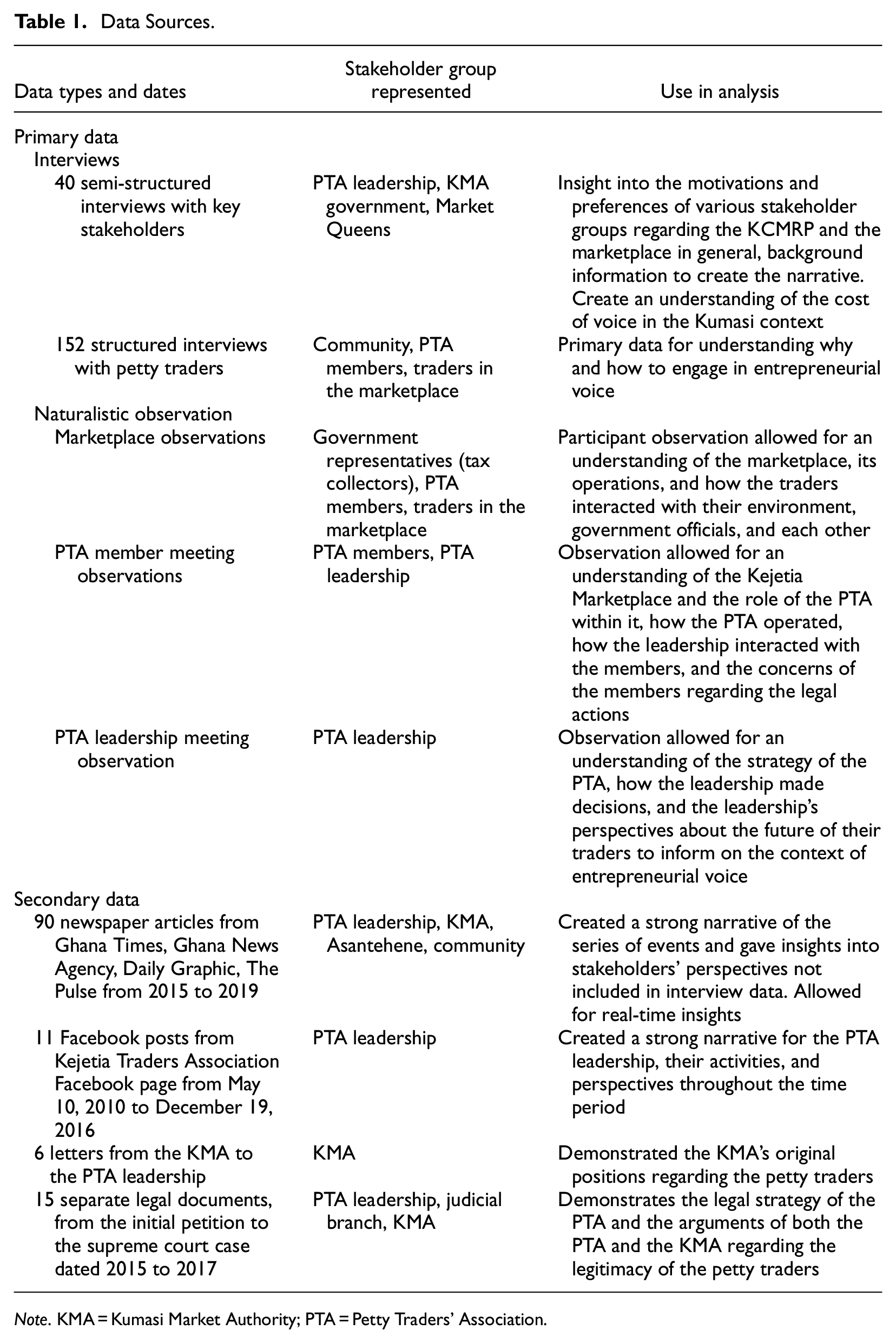
The data used come from multiple rounds of data collection and a variety of sources: semi-structured interviews throughout 2017, naturalistic observations in the marketplace and during PTA meetings, and the retrieval of documentary data including newspaper articles, legal briefs, court decisions, and social media posts. These data are summarized in Table 1 below.
Data Sources.
Note. KMA = Kumasi Market Authority; PTA = Petty Traders’ Association.
Initial Data Collection
In the initial trip to Kumasi, in-depth interviews were conducted with important stakeholders for the KCMRP including the leaders of the PTA, government officials, other trade association leaders, and marketplace administrators. Altogether, there were 40 of these interviews lasting 20 to 120 minutes in length and they served as an important source of information about the background of the KCMRP. Interviews were conducted in English or in Twi with a Kumasi native research assistant providing simultaneous translation into English. All interviews were recorded and transcribed.
A draft interview protocol for petty traders was also pilot-tested on a sample of 11 petty traders operating on the streets surrounding the Kejetia construction zone and 9 stall owners in Kejetia. The petty traders were selected for this pilot study based on the following criteria: (1) they had to be the “shop” owner, and (2) they had to have been operating in the original Kejetia Marketplace in 2014 to 2015, ensuring that participants surveyed had the opportunity to join the PTA in 2015. These semi-structured interviews were recorded and conducted in the local language—Twi—with simultaneous translation provided by the native research assistant who then transcribed these interviews. The semi-structured nature of the interviews with petty traders allowed the team to capture emerging themes in field research (Spradley, 1979; Strauss & Corbin, 1998). Discussions were had in country with the native research translators to provide contextual information and to probe for clarifying information when needed.
The sample for the pilot test employed a modified snowball technique: the research team selected a new section of the construction zone area to go to each day and then would arbitrarily select a petty trader within that section to interview. The team conducted three to four interviews in that section and then would move to a new section and repeated the process. The research team utilized theoretical sampling, seeking out both those who engaged in political activity and those who did not to purposefully compare the two groups’ responses. Additionally, the team attempted to vary industries to get a full representation of the various goods sold in Kejetia. Gender was also taken into consideration, with the sample being 70% female and 30% male to represent the actual population of the marketplace. 3
Subsequent Data Collection
After the initial trip, the research team held several meetings to discuss emerging patterns and themes from the transcribed interviews. The researchers also consulted with existing literature and theory, and eventually amended the interview protocol to allow for a fuller exploration of emerging trends. The new protocol was administered in October 2017 to 152 petty traders in the same construction zone area. A copy of this interview protocol is available in the Supplemental Appendix. The same criteria for participation and selection were used as in the initial visit. Industry, gender, and membership rates were also varied in the same fashion as the initial trip to create a representative sample of the marketplace. Whenever possible (e.g., when the same question was asked in both surveys), data collected in the first round of interviews was merged with data collected in the second round.
Documentary Data
Documentary data included newspaper reports confirming the events and specific dates of the KCMRP. It also allowed for quotes from important stakeholders that refused in-person interviews. The Ghanaian Times and The Ghanaian Chronicle were the main sources of newspaper articles. Both are local newspapers published in English and were accessed online utilizing their native databases using keyword searches based on local knowledge. These articles were used to construct the narrative and to verify data gathered in interviews. Other documentary data included court documents, notes from PTA meetings, social media posts from the PTA’s Facebook account, and press releases gathered by the research team while in Kumasi. All documentary data helped to create a timeline of events and provide important background information on the KCMRP as shown in Figure 1 (found in the Supplemental Appendix).
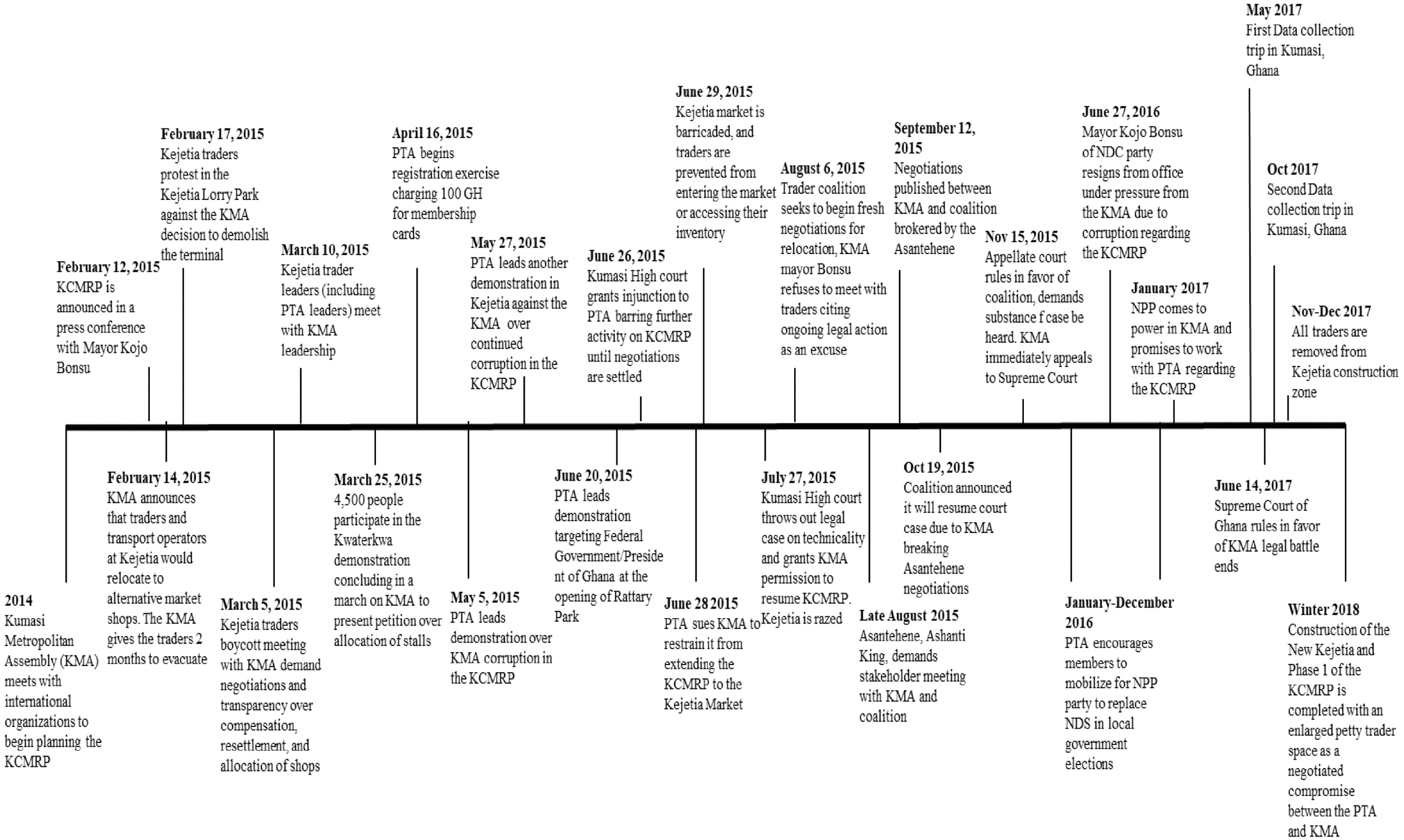
Timeline of events for the Kumasi Central Market Reconstruction Project.
Analytical Strategy
According to the tenets of grounded theory building, the research team utilized a constant comparative method of qualitative analysis (Glaser & Strauss, 1994, 1998, 2017). Therefore, the data were coded in three distinct phases: an open coding phase, an axial coding phase, and a selective coding phase. During the first open coding phase, the research team read through the transcripts of the interviews, reflected on field notes and newspaper articles, and searched for patterns in the data. This required constant comparison between those who engaged in the phenomenon and those who did not (Glaser & Strauss, 1998, 2017). Discussions were held during this time to identify the core themes that were dominant throughout the data, allowing the data to lead the analysis (Mäkelä & Turkin, 2007). Consistent with constant comparative analysis, conversations between the research team took place periodically to discuss codes, their dimensions, the conditions under which each code was likely to be more pronounced or minimized, the consequences of the code, and most importantly the relationships between codes (Glaser & Strauss, 2017).
During the second phase of axial coding, the researchers sought to lift the analysis away from description toward theory development by focusing on the relationships between emerging categories (Bollingtoft, 2017). This led to subcategories investigating the prevailing role of state behavior, the importance of trust in the organization’s leaders and capabilities, growth aspirations, and dependency on the venture as the primary patterns surrounding the phenomenon of entrepreneurial political activity. The research team held meetings to discuss possible relationships between these emerging patterns to understand how they were connected, how they were impacted by one another, and what underlining explanations were possible (Locke et al., 2022). During the third phase of selective coding, the research team systematically recoded all data focusing on these core categories, seeking to answer how did these core categories identified in axial coding relate to the central research question, why would informal entrepreneurs engage in entrepreneurial political activity? This phase focused on the dynamic interrelationships between the identified core categories to begin building theory on entrepreneurial political activity, leading to our data structure depicted in Figure 2 (Bollingtoft, 2017; Glaser & Strauss, 2017). The findings are presented below.
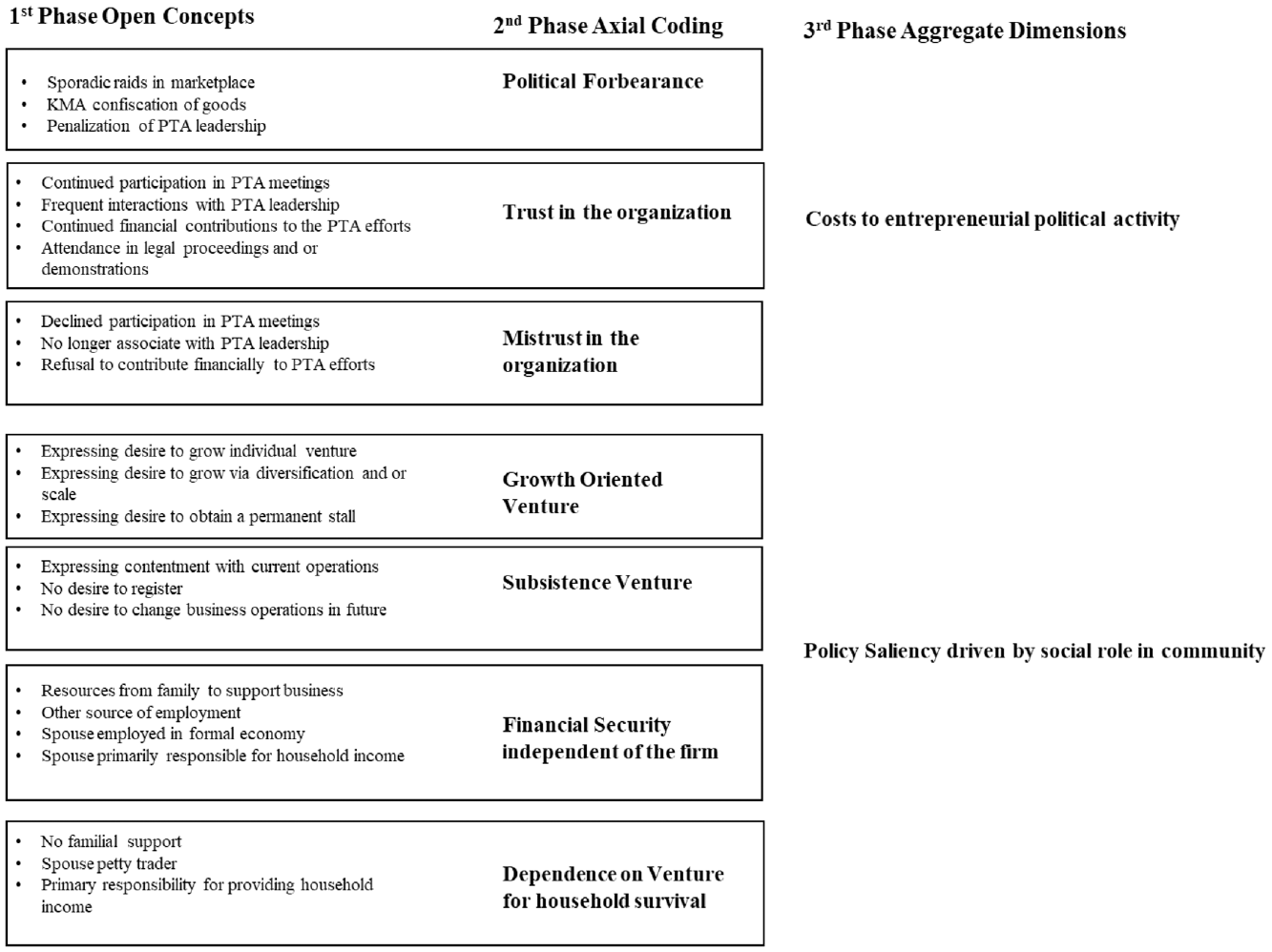
Data structure.
Findings
In this section, we first explore the costs associated with engaging in political activity for informal entrepreneurs, and then explore the two primary determinants for policy salience to justify these costly actions: growth aspirations and dependency on the venture for household financial survival. The findings are summarized in our data structure—Figure 2.
Costs to Entrepreneurial Political Action
Political forbearance
The potential risks and costs associated with political activity in the Kumasi social system were important factors for many entrepreneurs contemplating political activity. While street trading without government registration is illegal in the Kumasi civil code, in general, the KMA allows for this informal economic activity to persist (Owusu-Sekyere et al., 2016). However, the KMA does strategically utilize enforcement of local ordinances against informal trading via police raids, confiscation of goods, and imposition of steep fines when politically expedient. In fact, 67% of the interviewees reported that at some point, the KMA had confiscated their goods and 39% of the participants reported that threats from the KMA was the greatest challenge they faced as a petty trader: “I have been threatened by the KMA to move out of this space…my goods have been confiscated three times.” “My greatest challenge as a trader is the threat I get from the KMA day-in-day-out to sack me from this place of trade. I do not get a peace of mind to trade!” “One time the KMA had seized my products from selling along the roadside and so I had to go to their office to plead with them to release my goods.”
While the petty traders and their informal economic activity are generally tolerated by the local government and the police, the threat of the KMA and its enforcement of the law to punish informal traders in the marketplace is omnipresent. Many who did not engage in political activity expressed either the futility in challenging the all-powerful government, and or the fear of state retaliation against themselves and their ventures through the enforcement of the civil codes: “The KMA do not listen to our concerns, it always proves futile to try [referring to engaging in political activity].” “I feel the KMA do not listen to our concerns as traders because they take decisions without consulting or putting us into consideration. They just do what they think would be good for the country without thinking about what the traders truly want.” “The KMA do not listen to us at all. I pleaded with them when they confiscated my products during the ejection even though I was heavily pregnant, it is sad.”
In many newspaper articles, the government representatives referred to petty traders as “illegal squatters.” In an interview with the government-appointed administrator, this same terminology was utilized, justifying the taxes as “fines” for the government to clean up the rubbish left by the “illegal squatters” in Kejetia. It was this treatment from the local government, combined with the uncertainty regarding the future of Kejetia that inspired the creation of the PTA.
A prominent leader of the PTA in personal interviews stressed how important it was for the petty traders to fight for their rights—just because they were “petty,” they should not be ignored. The PTA argued that the monetary support from their members via daily taxation entitled them to first consideration for any stall allocations in the New Kejetia Marketplace. As he stated, “They should consider us before any outsider. That’s why we came together to form the association to fight for them to get some of the stalls. We don’t like anybody to trade on the table while stalls are there.”
The PTA members wanted the once-in-a-generation opportunity to gain a permanent stall and therefore a more secure future for themselves and their posterity. When large-scale demonstrations against the KCMRP and repeated attempts to negotiate failed to achieve their objectives, the PTA decided to use the courts and engage in a litigation battle with the KMA. After the PTA membership roster was made public via the numerous court cases, many individual members endured ramifications from the state. Members of the leadership were labeled as “troublemakers” by the local government and reported discrimination from the police and KMA against their businesses due to their names being made public. For example, a prominent member of the PTA executive council was relocated by the government to the top floor of a shopping center due to his leadership status, effectively strangling his business venture. His colleague in the PTA leadership explained, “When they relocated us, they sent him to the top of the sky, you see this story building on the top floor? He has a problem with his legs too...you see all the shops are locked.”
Other members faced similar punishments for engaging in political activity. This risk of being associated with the PTA and facing ramifications from the government was also evident in the organization’s attempt to find legal representation. A member of the legal team hired to represent the cases further asserted the danger of participating: “Threats are made sometimes to the clients. I’m sure if you ask, they will tell you that some people have said, ‘Look you and your lawyer, you will find yourself in adversity or physical violence.’ But none has actually been carried out. Threats, several have been made, but we don’t mind. We see them as an occupational hazard.”
In direct reaction to the PTA’s legal strategy, the government mobilized the military to barricade the marketplace on June 29, 2015. As a leader of the PTA recalled in an interview, “When we came, they had barricaded the entire terminal. You could see fire service cars, the army, the police with their armed cars at every terminal. They are all captured, we have got all the pictures. It was as if they were going to fight ISIS.”
During this barricade, PTA members documented instances of police/military brutality of their members during a counter-demonstration to the barricade, and videos of hostility from the military were posted on the PTA’s Facebook account. A Facebook post dated July 13, 2015, stated, “Do our leaders (traditional and political), really care about the MASSES…? What’s actually happening to the shop owners at Kejetia… entry and exit points at Kejetia been barricaded, just to undermine them of their daily activities… Oh! What an ungodly practice… What are our members of parliament saying, our traditional leaders does it mean, you are all part of this wicked act against your own people… remember God is watching…. FIRE! FIRE!! FIRE!!!”
Members of the PTA also reported that the police targeted them and confiscated their goods, requiring steep fines to get their wares back during this counter-demonstration.
These examples demonstrate that in Kumasi, the state was a self-motivated actor utilizing the law and its enforcement to strategically punish those entrepreneurs who engaged in political activity. This exemplifies the concept of “political forbearance” defined as, “intentional and revocable government leniency toward violations of the law” (Holland, 2016, p. 233). This concept of political forbearance encapsulates the likelihood of the state ignoring the existence of the extra-legal informal sector and allowing this activity to continue without enforcement of the law (see Holland, 2016). Informal entrepreneurs had to consider the potential ramifications of challenging political forbearance when contemplating political activity. These observations lead to our first proposition regarding entrepreneurial political activity for informal entrepreneurs: P1: Entrepreneurs in the informal economy must consider the state’s level of political forbearance to determine if there may be potential punitive actions that could endanger themselves and their ventures before engaging in political activity.
Informal entrepreneurs, such as the petty traders in Kumasi, face unique costs of challenging the status quo—the potential enforcement of previously ignored laws and stringency rather than leniency in enforcement as punishment for challenging the state. In Kumasi, there are several local ordinances requiring business registration and the taxation of goods, which the petty traders do not adhere to. This is a logical conclusion for these petty traders to not pay into a system with no returns, as the main benefit of formalization, property rights to a permanent stall, was not available (c.f., P. Godfrey, 2011).
Prior to the KCMRP, the KMA allowed the extra-legal activities in the informal sector and even profited from the taxes imposed on these entrepreneurs. Yet, when the PTA and other entrepreneurs challenged the state and the KCMRP, the local government strategically utilized police raids, confiscation of goods, fines, and even imprisonment to punish these traders and in particular, their leaders. The individuals were not arrested for engaging in the demonstrations or other activities typical of political action, as these are constitutionally protected and respected rights in Ghana. Rather, the government punished these actions by enforcing the law for unregistered firms—these individuals had no business licenses and therefore no legal protections from the state for their property or ventures. The choice to enforce these laws was politically motivated to penalize those who challenged the state via political activity.
The costs of political forbearance had ramifications for the PTA as a collective organization. Namely, those that risked the costs associated with the state enforcing rule of law against the unregistered petty traders had to trust in the leadership of the organization and that their efforts would have the desired return on investment.
Trust in the organization: Mitigating the costs of political activity
The unregistered, extra-legal petty traders had to determine if risking political forbearance would be worth the potential reward of a permanent stall in the New Kejetia. In making this decision to engage in political activity, individual entrepreneurs had to weigh the risks associated with forbearance, and then additionally, determine if they would have a greater chance of success by engaging individually, or through the collective action of the PTA.
Initially, the PTA organized large-scale demonstrations in Kejetia. Engaging in this and other large-scale demonstrations risked very little for the individual petty traders, as there is strength in large numbers and it cost relatively little to participants (e.g., Hannon & Freeman, 1989). However, after these initial tactics failed to alter KMA actions, the PTA created a paid membership model to fund their litigation efforts, and to also privatize the public good of policy change for stall allocation. While participation in the large demonstrations reached over 4,500 participants, only 2,283 paid the membership fee of 100 cedis (∼16 USD) to join the PTA. Of those who did not join the PTA efforts, the financial costs and time costs were the primary reason identified: “I don’t join such groups [PTA] because I wouldn’t have the time to attend meetings and I feel it’s not worth my money too.” “I have not considered going to such associations because this is my only source of income and so I wouldn’t leave my business to attend meetings. Besides they are always paying for dues and I wouldn’t use my money for that.”
Of those who joined the organization, the overwhelming majority stated that they joined to get a stall, and that they saw a united front with the organization as their best chance to gain this asset: “I joined the PTA because they always intercede on our behalf with the KMA to get a place in New Kejetia.” “I joined because I wanted to be a part of a body where we will be represented properly and gain a stall once the construction is finished.”
Out of the PTA members, over half of them also engaged in individual political activity. Those who did both, individual (extremely costly) and paid collective political activity (moderately costly) were strongly incentivized to do so. Our findings demonstrate that these individuals were generally more active in the PTA organization, communicating frequently with the leadership and being involved with decision-making for the organization compared to other members who did not engage in individual political activity. This subset of PTA members were generally men, who had more pressure to provide income for their household and were, therefore, more willing to devote resources to obtain a stall (these gendered impacts are discussed further in subsequent sections). These dynamics lead to the second proposition: P2: When issues are very highly salient to informal entrepreneurs, they are more likely to pay higher costs to engage in collective and individual political activity.
Yet, time and increasing costs ebbed away the initial support of the PTA for members. When interviews were conducted in 2017, it had been 2 years since the PTA was initially founded. While many expressed continued support for the organizers, other members expressed feelings of fatigue due to the drawn-out fight and had left the organization. Being a member of the PTA required significant time commitments, meaning time away from business ventures and the loss of potential sales in addition to the membership fees that varied over time. After two long years and no tangible results, it became difficult for many who initially had hope in the organization to continue contributing scarce resources to the various efforts, specifically for women.
The data demonstrated that women who left the organization stated that they no longer wished to pay the fees, they could no longer afford the fees, and/or they no longer trusted the PTA leadership with their money. The men who left the organization only mentioned a lack of trust in the PTA leadership, never concerns regarding the financial burden of participation: “I stopped going for the meetings of this group because the leaders squandered our monies and so I did not have faith in them anymore.” (Male) “I was a part of the Kejetia Traders Association, but I have stopped because I didn’t trust the leadership.” (Male)
Those who only engaged in individual political activity rather than engaging with the collective PTA also discussed mistrust of the leaders and their intentions, preferring to act alone in attempts of securing a stall rather than trusting the PTA leadership. These respondents were again primarily male. The current literature suggests that smaller firms come together to share resources as well as leverage shared managerial competencies (Dahan, 2005; Wood, 1991). Yet, these data demonstrate that although there were some competencies gained by joining the PTA, for those who did choose to initially engage in collective political activity, trust was a powerful motivator for either continued participation, or abandoning the organization. Those that remained in the PTA expressed this trust in the leadership to represent them and to achieve their goals of gaining a stall in the New Kejetia: “They lead us, they are our mouthpiece to the governmental bodies. We came together as one body to air our grievances to the government and the leaders are helping us to gain our place in the new marketplace. We follow our leaders.”
The idea of trust remains an important concept and leads to our next proposition: P3: When issues are salient to informal entrepreneurs, trust in the leaders of collective action organization is an important determinant for participation in collective entrepreneurial political activity.
With this understanding of the costs facing those informal entrepreneurs who engage in political activity, we can explore policy saliency to understand why the petty traders would risk incurring these costs, and how the cultural expectations for traders impacted this decision.
Policy Salience
Overall, men rather than women were far more likely to engage in both individual and collective political action. In the Kumasi social system, the purpose of ventures is drastically different for males versus females (see A. B. Newman & Alvarez, 2022). Women are expected to contribute supplementary income to the household, often referred to as “little monies” while men are primarily responsible for providing or being a “breadwinner.” This strict demarcation in domestic financial responsibilities impacted the policy salience for female versus male entrepreneurs. Overall, because women were not expected to grow their ventures and because households were less reliant on this auxiliary female generated income for survival, the government policy regarding stall allocation was not as salient for women. These findings are further explored below.
Growth aspirations
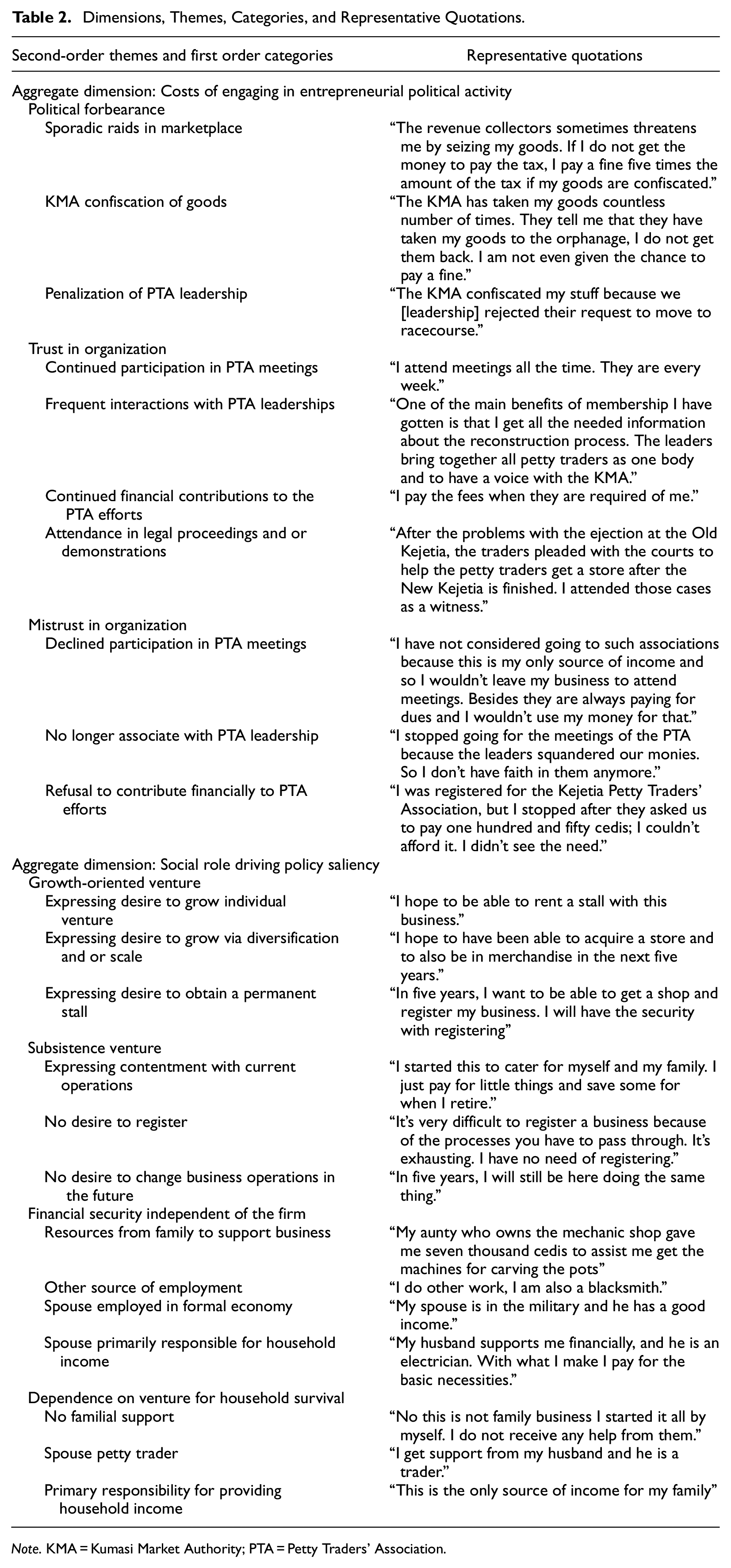
When considering those who engaged in political activity, what surfaced most clearly in the interview data was the expressed desire for the petty trader to grow their venture. This idea of growth aspirations was captured by stated future aspirations such as obtaining a stall, becoming a wholesaler, diversifying the venture, or other methods expanding the venture (see Table 2 for exemplars). The predominant reason stated by members for entrepreneurs to join the PTA was to gain a stall, which would enable them to grow their venture. In the marketplace, stalls were considered a productive asset to enable growth not only for the entrepreneur occupying it, but for his family after him. Having a permanent space creates recognizability, allowing for clients to frequent the stall themselves and direct others to the permanent location, culminating in street recognition and branding amongst shoppers and a larger population of loyal clients. Furthermore, a permanent structure could provide protection from the elements, and ensure enough space to store excess inventory safely and securely. Access to a stall and therefore permanency was seen as an essential factor for growing in Kejetia, making the new open market for stalls following the reconstruction project extremely valuable to enable venture growth.
Dimensions, Themes, Categories, and Representative Quotations.
Note. KMA = Kumasi Market Authority; PTA = Petty Traders’ Association.
However, owning a stall in Kumasi generally requires formalization with the government, with its associated taxes and costs. Without the benefits of the permanent stall space, there was little to no incentive to formalize the business venture. This was epitomized by the following responses: “There’s no security when it comes to space, we are being threatened all the time by KMA to be moved. My only reason [for not registering] is space. If I’m able to get space or a shop, I will register. I think if I register my business, I stand a chance of being granted huge loan offers to support my business. The government comes around and urges us to register, but I always tell them I will register once I get a permanent location to trade.” “I have considered registering my business, but I want to have a stable place and a bigger shop first. Our space of business here is not permanent. Once you register you must be paying taxes to the government and if KMA evict us now, I wouldn’t be able to pay those taxes. I’d register when I get a shop.”
To justify the perceived expense of formalizing, the traders wanted assurances of the benefit—permanency. However, to gain access to stalls, the local government requires formalization first and disbursement of stalls after the fact. Prior to the KCMRP, there was no opportunity to gain a permanent space. Yet, with the market for stalls now available, many petty traders engaged in political action to gain this tangible benefit. With a stall, the costs of formalization were perceived as worthwhile. Furthermore, having a permanent stall and therefore being a part of the formal economy allowed an entrepreneur to access a myriad of benefits including access to loans and credit, and most importantly, insurance against fires or natural disaster. Traders also mentioned the ability to travel outside of Ghana (which requires legal registration or formal employment) and the potential to import goods directly. There is a general perception of benefits associated with formalization, as is summarized in the following quotes: “When registered you would be able to access loans from the banks very easy.” “When registered you would be recognized by the government, and it’s also a form of security by the government. I have thought of registering. Yes, I have thought of it, but I am too small. I would register if I should get a store. I have the hope of acquiring a store at the New Kejetia.” “You would be recognized by the government as a formal trader and would get help from the government in times of emergency.”
These observations regarding the perceived opportunities for growth that only formal registration would provide leads to our next proposition: P4: Informal entrepreneurs who aspire to grow their ventures are more likely to engage in entrepreneurial political activity than informal entrepreneurs who do not aspire to grow their ventures.
In the current literature, entrepreneurs who are growth-oriented looking to expand their ventures beyond the capacity allowed in the inefficient informal economy should be the ones most likely to transition to the formal economy (De Castro et al., 2014; Maloney, 2004). Proposition 4 logically follows this assertion, those who were most likely to want to transition (i.e., growth-oriented entrepreneurs) would be the ones most concerned with the government’s policy regarding stall allocation in the New Kejetia. If they were intending on growing and formalizing their venture, they would want to decrease the costs of doing so to maximize the potential benefits of formalizing. Despite their petty trader status and small scale, many of the petty traders had innovative strategies such as horizontal growth via diversification in Kejetia (both via industry and geographically). Yet, if petty traders wished to continue to grow vertically and scale their individual enterprises beyond petty trading rather than pursue limited horizontal growth through a portfolio of enterprises, they eventually need to gain a stall and transition to the formal economy (Marcouiller & Young, 1995; D. North, 1990; Rakowski, 1994).
In the Kumasi social system, we found differences in growth aspirations based primarily on gender due to the social expectations for male versus female owned ventures. Despite these expectations for women to only provide auxiliary income, by and large, women had more profitable shops in the marketplace. Therefore, economic success and profitability was not necessarily correlated with growth orientation. Instead, it was the expectation to grow and register their businesses because of one’s gender in the marketplace: “The men are more invested traders than the women because they are the breadwinners for their homes and so take their businesses more seriously. The men register their businesses to secure their homes and families.”
For many of these growth-oriented entrepreneurs, they were also the primary income for their families, especially males. Therefore, those who were growth-oriented oftentimes were those who were also more dependent on the venture for household survival. This finding is further explored in the following section analyzing the purpose of and dependency on the venture for household survival.
Resources and dependency on firm for household survival
Due to their extra-legal status, informal firms are unable to access and build resources in the same way formal firms can and are therefore often resource-constrained (La Porta & Shleifer, 2008; Sutter et al., 2017). We found that traders with comparatively low-valued resource bundles were more dependent on their firm for household survival, and consequently, were more likely to engage in political activity. This section explores the resource stocks of the petty traders to understand how resource constraints related to entrepreneurial political activity.
In terms of financial resources, most of the petty traders earned similar gross sales in the marketplace from a single store—the average daily gross sales from petty trading were equal to 244 cedes (approximately $42 USD). While earnings from individual ventures were not explanatory in policy salience, overall household income was—those with another source of household income were less likely to engage in political activity, specifically women traders. When looking at the gendered breakdown of the sample, only 23% of men did not engage in political activity, and of those, the overwhelming majority (82%) had other employment. These men were therefore not as dependent on the venture for income as they had other sources of personal income to contribute to the home—trading was seen as a side hustle in-between other jobs. Almost all men who engaged in full-time trading engaged in political activity. 4 To these men, they wanted to grow their ventures by obtaining a stall, which was seen as the best way to provide for their households.
Women, on the other hand, were mostly full-time petty traders with no other forms of employment. Despite their full-time work, men, and women both responded that male spouses were responsible for the primary sources of income, and the proceeds from female endeavors were only to account for the “little monies” used on food and education for the children: “My wife provides for the food and basic necessities. I provide for everything else.” “I pay for the school fees all by myself, my husband pays for everything else.”
Households were generally not dependent on female-owned ventures for survival—female income was perceived as supplementary to male providers. In Ghana, husbands and wives generally run separate businesses and do not normally work for each other, even if they both operate in the same marketplace. Furthermore, the expectations for the financial contributions to the household is different for a woman versus a man. Each spouse has separate responsibilities for financial contributions to the household—for women, the government policy on the allocation of stalls was less salient overall because of these gendered expectations. Women did not feel the need to have a stall, as their families were not dependent on them for income, leading to a stark decrease in female participation in entrepreneurial political activity. For example: “Men register their businesses more than the women because they are the breadwinners of the homes and so secure their businesses by registering.”
Considering these gendered expectations for income, for women, the spouses’ employment situation ultimately proved to be an important determinant in whether she engaged in political activity. Overall, if the woman had a family partner who was earning a stable income to support the household—either through formal employment or having a large, successful store—then the existential threat created by the government policy was simply not as salient to her as a petty trader. For example: “My husband is in the military and has a good income.” “My husband supports me financially and he is a senior supervisor in a company.” “My husband supports me financially and has a great income. He is a watchman in the police.”
Single women and women with spouses in the informal economy—who were also likely to face the same barriers to growth, low gross sales, and financial uncertainty as they did—were more likely to engage in political activity: “I get assistance from my husband; he sells sandals here in Kejetia.” “I get financial support from my husband, and he is also a trader.” “Yes, my husband supports me, and he is a driver.”
These women saw a stall as an asset to guarantee stability within their household, since they could not rely on their husbands to provide consistent income. They stepped outside of gender norms to engage in political activity to secure financial stability for their households. This gendered difference in dependency on the business for financial contributions to the household was an important determinant in entrepreneurial political activity. These findings are intrinsically intertwined with earlier findings on growth aspirations—both are contingent upon socialized, gendered expectations for the entrepreneurial endeavor. Men are more likely to be growth-oriented as well as dependent on the venture for household survival. Women, however, are less likely to be growth-oriented, and primarily consider engaging in political activity if their spouses are unable to provide a stable income for the household.
In addition to spousal support, we also found that those without social support from family or friends, translating into fewer resources for the firm via their social networks, were more likely to participate in political activity. In Ghanaian culture, familial welfare is reinforced by an obligation of individuals to assist their ethnic members and for successful members to help family members by providing opportunities, favors, and assistance (Zoogah & Akoto, 2018). If the entrepreneur had a family business, and/or a familial social safety net built into their venture, the entrepreneur was less likely to engage in political activity because they could rely on this support for needed resources. Those without this familial social net, however, were more likely to participate because they did not have anyone else to rely on to assist them with their businesses, particularly males who were viewed as the primary providers for their family: “No one helps me with this business. I started this business all by myself. I joined [the PTA] because they promised to help us get spaces on the New Kejetia was done.” “All is for himself, only God is for us all. I joined [the PTA] because they unite us, they fight for us the traders.”
If the entrepreneurs without family businesses or without familial support for their venture wanted financial stability via a permanent stall to support themselves and their household, engaging in political activity was their best opportunity. Traders who joined the PTA specifically saw the advantages of having a uniting force, and for a sense of belonging. The PTA offered social support to these entrepreneurs that were lacking in their immediate network. “I joined to unite with other traders, so we can bring our problems to the authorities together.” “I joined with the hope of being relocated to a new stall, but also to feel belonged in the marketplace.”
In this case, political activity may in fact be a second-best option that matters when entrepreneurs do not have alternative opportunities due to a lack of resources. When lacking in options, these entrepreneurs engage in political activity as a means of survival. However, when entrepreneurs do have resources, especially within their near family, and thus opportunities, they may be less likely to rely on political activity and instead utilize their own resources to achieve their objectives. In Kumasi, the variation in resource levels led to differences in salience for informal entrepreneurs—those with higher levels of financial and/or social capital responded to policy initiatives differently than those without these resources. Therefore, despite the advantages of moving to the formal economy, entrepreneurs may still find it in their self-interest to not make this move—especially when these entrepreneurs have resources and capabilities that enable them to realize their financial objectives despite government policy regarding the informal economy. This leads to our final proposition: P5: When policies threaten the existence of informal firms, informal entrepreneurs who are more dependent on their firm for household survival are more likely to engage in entrepreneurial political activity than informal entrepreneurs who have other resources to depend on for household survival.
All this makes policy about how to join the formal economy less salient—entrepreneurs can depend on their resources to ensure firm survival and achieve their objectives despite policy regarding the informal economy.
Discussion
Despite very real risks, informal entrepreneurs in Kumasi did challenge the government by engaging in political action. Those who had trust in the leadership of the organization, and those who were growth-oriented and/or dependent on the venture for household survival engaged in political activity. This unique case led to the creation of a new concept: entrepreneurial political activity and with it, new grounded theory on entrepreneurial political activity for informal entrepreneurs. Entrepreneurial political activity generalizes the foundational theory from CPA (Cook & Fox, 2000; Hillman & Hitt, 1999; Schuler & Rehbein, 1997; Vogel, 1996) to a situation where an entrepreneur tries to influence government policies in a way that improves the context within which he operates. Entrepreneurs are individuals representing themselves and yet, simultaneously their firm, necessitating this new concept to investigate this phenomenon of when entrepreneurs engage in political action. 5
Furthermore, entrepreneurial firms often face constraints in political action that are not faced by corporations. Entrepreneurial firms are typically new, small, and resource-constrained (Baker & Nelson, 2005), especially in comparison to corporations engaging in corporate political action (Cook & Fox, 2000; Yoffie, 1988). Specifically, entrepreneurial firms in the informal economy lack the size, experience, capabilities, and state approval to favorably shape their institutional environment (La Porta & Shleifer, 2008). Most notably, informal firms lack not only the financial resources required to use the traditional tools of influence available to established formal firms, but also the legal rights and recognitions from the state that traditionally allow for protection when engaging in political activity against the state. This extreme context of informal entrepreneurs enabled us to develop grounded theory on entrepreneurial political activity. We now explore the implications of this new theory for scholars and practitioners.
Challenges to CPA Theory
CPA has previously been developed in more advanced economies that generally have stable institutional environments and rule of law (T. Lawton et al., 2013). This new empirical context in an emerging economy with institutional voids brings not only a novel empirical setting, but nuance to the understanding of CPA theory. Informal entrepreneurs operating in an extra-legal manner face an additional challenge when considering when and how to engage in political activity to meet their objectives: they are potentially subject to government actions that could drive them out of business, that could force them to join the formal economy (despite the high cost of doing so), or—in the extreme—that could lead to fines or imprisonment (Eaton et al., 2017; Holland, 2016). Those who engaged in political activity in Kumasi were penalized by the enforcement of previously ignored civil codes regarding unregistered firms—strategic raids were used to confiscate inventory, ventures were locked up, and some of those who demonstrated even faced police brutality. The integration of political forbearance from political science adds a new reality for calculating policy salience—if the law will be enforced to penalize political action, as was the case in Kumasi, then this added cost impacts the decision to engage in political action. Future research on entrepreneurs in the informal economy could investigate the impact of political forbearance on entrepreneurial activity, decision-making, and behaviors of informal ventures.
Furthermore, the current literature posits that the level of salience, and therefore resource expenditure on political action differentiates those who engage in individual versus collective political activity as individual political activity requires greater resource investment and has higher risks (Cook & Fox, 2000). Initially, when the PTA began, they organized the traders in Kejetia to march in demonstrations. Engaging in this and other large-scale demonstrations risked very little for the individual petty traders, as there is strength in large numbers, and it cost relatively little to participate (e.g., Cross, 1998; Cross & Morales, 2007; Hannon & Freeman, 1989; Tripp, 1997). However, when the PTA moved to a pay-to-participate model, the number of participants significantly decreased. This follows current theory on CPA regarding collective versus individual action—the more salient the issue, the more willing a firm is to incur costs and the more likely firms will dedicate more resources to the cause.
Yet, this work challenges CPA theory by demonstrating that individual and collective political activity are not necessarily mutually exclusive. Out of the PTA members, over half of them also engaged in individual political activity. Those who did both, individual (extremely costly) and paid collective political activity (moderately costly) were strongly incentivized to do so. Those who engaged in both individual and collective action were generally men who had more pressure to provide income for their household and were therefore more willing to devote resources to obtain a stall. This work demonstrates the complementary aspects of individual versus collaborative strategies hinted at in previous work (c.f., Dorobantu et al., 2017). By highlighting the unique situation of the entrepreneur acting as an individual and the firm, with more at risk and therefore heightened saliency for the entrepreneur, we can begin to explore the complementary nature of collective and individual political action. Future research studying entrepreneurs, both formal and informal, can continue to explore the complementarity of individual and collective political action.
Furthermore, this work extends current CPA theory to consider not only managerial capabilities and competency, but the trust that other actors have in the leaders and their competency. The PTA originally came together to share resources, diffuse potential ramifications from the state, and utilize the managerial capabilities of the leaders. However, this study points to the central role of trust in joining, and then sustaining commitment to the collective political action. Future research can examine the role of trust in sustained collective action and its impact on entrepreneurial political action.
Conflation of Entrepreneur and Venture: The Importance of Social Roles
When exploring motivation to engage in corporate political activity, a firm’s resources are seen as pivotal in determining if and how the firm will engage (Hillman & Hitt, 1999). However, by expanding CPA to consider the unique context of the entrepreneur, we can gain important insights into how an entrepreneur—both representative of the firm as well as their person—would choose to engage in political activity beyond mere resource stocks.
Nascent entrepreneurs are often conflated with the venture (S. Alvarez & Sachs, 2021; Gartner, 1990) and in the case of micro-firms in the informal economy (La Porta & Schleifer, 2008), even more mature micro-firms can be conflated with the entrepreneur. In practice, this conflation means that the entrepreneur’s social role and identity within the community will be intrinsically tied to what resources are available to them, and further, to what actions and behaviors are legitimate for them to undertake.
Culture dictates appropriate social roles for individuals in a society, and to be accepted by other members in society, individuals must adhere to the behavioral expectations of their social role (Scott, 2013). Specifically, one’s gender constitutes the foundation of this social role (Zhao & Yang, 2020). In this marketplace, we saw women and men making vastly different calculations regarding entrepreneurial political activity due to the social expectations of male versus female-owned endeavors (see A. B. Newman & Alvarez, 2022 for further discussion). Men were heavily invested in both the PTA and in individual action as they are responsible to provide for their households. This same rationale explains why men were more growth-oriented and dependent on the venture for household survival than their female counterparts. These culminated in greater overall policy salience for men than women, who face entirely different expectations for their role and venture and were therefore not as motivated to engage in political action. This personal level of appropriateness based on one’s social role brings in a further nuance of complexity into the decision to engage in political action besides a mere calculation of firm resources and policy salience to the “venture.”
In the context of the informal economy, the social costs of actions are extremely high for entrepreneurs as the individual must act according to prevailing social norms, even if it may be contrary to their economic interests. Yet, the socialized norms of female versus male-run ventures created far greater reputational costs than the potential economic benefits of pursuing entrepreneurial political activity. Successful businesswomen who exit the informal economy and enter the formal in Kumasi are met with special condemnation (Clark, 1994). Women who disregard these traditional cultural norms are ostracized from society as well as threatened with reputation damage that could destroy their business ventures (Amoako & Matlay, 2015). Indeed, worldwide we see that women who defy gender conventions face hostility and threat (Butler, 2004; Marlow & Martinez Dy, 2018).
The novel concept of entrepreneurial political activity allows us to understand this decision of how individuals, judged by their social system based on who they are as well as what they do, determine if they will engage in political activity. This challenges the current field of CPA theory—policy salience for entrepreneurs is not just about firm objectives or resources. Rather, saliency is also driven by the individual entrepreneur’s social role and need for acceptance from her community. Further research into the role of reputation and social stratification on engaging in entrepreneurial political activity is needed. Additionally, we call for continued focus on the context of entrepreneurs in examining their decision-making and behaviors.
Limitations and Conclusions
There are several limitations to the research. First and foremost, the data collected in 2017 was retrospective, asking participants to reflect on events that had happened 2 years previously. Furthermore, the traders were only interviewed once in 2017. The author team attempted to mitigate this limitation with documentary data and multiple interviews with the leadership of the PTA from 2017 to 2021; however, most of the findings and propositions are built from these one-time interactions with traders in 2017. Future research could use longitudinal data to see what caused initial motivation to engage in entrepreneurial political activity as well as what led to sustained motivation to continue such action. Secondly, the author team was not Ghanaian and thus not native to the context being studied. The team attempted to mitigate against this limitation by partnering with Ghanaian academics to ask questions, develop interview protocols and ask for feedback on analysis to ensure cultural accuracy. Yet the limitation remained. Similarly, the norms, values, and understandings were idiosyncratic to our setting in Kumasi, Ghana. For example, the opportunity to join the formal economy in this setting was economically beneficial to the petty traders; however, the value of formalization varies depending on the context (Graeber, 2015; Redding, 2005). Additionally, the gendered roles and expectations for female versus male ventures was unique to this context that ultimately influenced policy saliency and engagement in entrepreneurial political activity. Future research can examine what other social roles impact this decision to engage in entrepreneurial political activity. And finally, the context of the informal economy in and of itself has different prescriptions (e.g., considering political forbearance) than formal firms. Future research can build upon these basic propositions to test and see if and how they hold in different contexts, including investigating entrepreneurial political activity in formal markets and or in developed markets.
This work builds grounded theory on a new concept—entrepreneurial political activity—utilizing the case of the petty traders in Kumasi, Ghana. This context challenges traditional boundaries of CPA by introducing a new empirical context, the informal economy in Ghana, while also a new level of analysis the entrepreneur who represents their firm and self simultaneously. This new concept allows for the understanding the complexity within the informal sector regarding state leniency for extra-legal behavior, as well as the bind of social reputation in this space. These findings can help bring more nuanced understanding to participants in the informal economy worldwide, and their role in society.
Supplemental Material
sj-docx-1-etp-10.1177_10422587221136075 – Supplemental material for Entrepreneurial Political Action in the Informal Economy: The Case of the Kumasi Petty Traders
Supplemental material, sj-docx-1-etp-10.1177_10422587221136075 for Entrepreneurial Political Action in the Informal Economy: The Case of the Kumasi Petty Traders by Arielle Badger Newman and Jay B. Barney in Entrepreneurship Theory and Practice
Footnotes
Declaration of Conflicting Interests
The author(s) declared no potential conflicts of interest with respect to the research, authorship, and/or publication of this article.
Funding
The author(s) received no financial support for the research, authorship, and/or publication of this article.

Supplemental Material
Supplemental material for this article is available online.
Notes
Author Biographies
References
Supplementary Material
Please find the following supplemental material available below.
For Open Access articles published under a Creative Commons License, all supplemental material carries the same license as the article it is associated with.
For non-Open Access articles published, all supplemental material carries a non-exclusive license, and permission requests for re-use of supplemental material or any part of supplemental material shall be sent directly to the copyright owner as specified in the copyright notice associated with the article.
