



Abstract
Rent-seeking entrepreneurship occurs whenever an entrepreneur expends resources on activities that benefit their firm while reducing overall economic efficiency. Since rent-seeking ultimately makes nations poorer, we need to know more about how institutions can discourage rent-seeking entrepreneurship. Using historical data from the Unites States, we explore how changes in judicial thinking altered individuals’ incentives to engage in rent-seeking entrepreneurship. Traditionally, entrepreneurship researchers interested in policy issues have paid little attention to changes in judicial thinking. We argue that entrepreneurship researchers who are interested in why levels of entrepreneurial dynamism vary over time should pay more attention to how judges think.
Rent-seeking occurs whenever individuals invest in activities that benefit themselves while reducing overall economic efficiency (Krueger, 1974; Tullock, 1967). Rent-seeking entrepreneurship occurs whenever an entrepreneur expends resources on activities that benefit their firm while reducing overall economic efficiency (Baumol, 1990; Boettke & Piano, 2016; Bosma et al., 2018; Choi & Storr, 2019; Dong et al., 2016; Du & Mickiewicz, 2016; Lucas & Fuller, 2017; McCaffrey, 2018; Smallbone & Welter, 2006; Sobel, 2008). In recent years, popular awareness of the problem of rent-seeking entrepreneurship has increased (CATO Institute, 2019; Matamala, 2019). In the United States, the controversies over subsidies to Foxconn and Amazon united libertarians, neoliberals, and even socialists in indignation (Democracy Now, 2018; Farren, 2020). America now appears to have too much rent-seeking entrepreneurship and too little socially productive entrepreneurship (Litan & Hathaway, 2017). As rent-seeking reduces “productivity and living standards,” it is important for us to think about “antidote[s]” that inhibit rent-seeking and encourage profit-seeking entrepreneurs to channel their energies into socially productive behavior (Parker, 2018, p. 476).
We know that the pursuit of profits by entrepreneurs can, provided it occurs in the right institutional context, result in considerable improvements in human well-being (McCloskey, 2010; McMullen, 2011; Murphy et al., 1993; Ryff, 2019; Schumpeter, 1942; Chowdhury et al., 2019; Wiklund et al., 2019). Only productive entrepreneurship drives higher levels of eudaimonic wellbeing: so, tilting the balance toward this form of entrepreneurship, and away from rent-seeking, offers economic benefits (McMullen, 2011; Ryff, 2019; Wiklund et al., 2019; Zahra & Wright, 2011). We also know that there are more impediments to rent-seeking entrepreneurship in nations with “inclusive” political institutions than in authoritarian countries with unelected and unaccountable governments (Acemoglu & Robinson, 2019; Audretsch & Moog, 2022; Goel & Saunoris, 2019; Wegner, 2019). Similarly, there is a large body of literature that strongly suggests that common-law legal systems more effectively discourage rent-seeking entrepreneurship and thus promote normative socio-economic outcomes, such as economic development, than do other legal systems (Bradford et al., 2021; La Porta et al., 1997).
However, the existence of widespread rent-seeking entrepreneurship in countries that have both inclusive political institutions and common-law legal systems, such as the United States, suggests that merely having the right type of formal political and legal institutions is, by itself, insufficient to eliminate all rent-seeking entrepreneurship from a society. Indeed, we know that rent-seeking behavior has been engaged in and encouraged by democratically elected politicians from at least the 19th century (Martin &Thomas, 2013). We can therefore conclude that democracy and common-law legal systems are only moderately effective at discouraging rent-seeking entrepreneurship and that we need to learn much more about which other types of variables influence the incentives of entrepreneurs to engage in rent-seeking entrepreneurship (Antony et al., 2017; Zywicki, 2016). As scholars of constitutional political economy have recently noted, changes in informal institutions such as norms and ideas can influence individuals’ incentives just as profoundly as changes to its constitution and other formal institutions (Foss et al., 2019; Voigt, 2020). However, our understanding of precisely how norms and values influence the incentives to engage in rent-seeking remains underdeveloped. The core research question informing this paper is, therefore: how do changes in the norms, beliefs, and similar informal institutions that shape judicial decision-making moderate the effectiveness of written constitutions and laws in discouraging rent-seeking entrepreneurship?
To help answer this question, we use the historical data and research methodology described below. Features of the United States Constitution, such as its explicit protection for property rights and the requirement that all taxes must be approved by elected officials, have discouraged rent-seeking entrepreneurship since the Constitution was ratified in 1788. The common-law legal system that the United States inherited from England also discourages rent-seeking. The potential of common-law systems to discourage rent-seeking is a function of the ability to common-law judges to declare illegal actions by the state that violate what judges consider to be fundamental legal principles.
In the model we use to understand why the incentives of entrepreneurs to engage in either rent-seeking entrepreneurship or socially productive entrepreneurship have varied over time, the key variable is the belief systems or bundles of norms that shape how the judges interpret the constitution. We assume that many entrepreneurs will succumb to the temptation to engage in rent-seeking behavior if they believe that an investment in rent-seeking will have a positive payoff in their institutional environment. An entrepreneur might rhetorically commit to free enterprise and laissez-faire, but if they see an opportunity to engage in rent-seeking by, say, extracting a subsidy from a friendly politician, they will try to take it. We also assume that policymakers, such as the state legislators who write regulations and distribute subsidies, are self-interested actors will also collude with rent-seeking entrepreneurs whenever they calculate that doing so will advance their own interests. If facilitating rent-seeking entrepreneurship will benefit a policymaker, for instance through a contribution to a re-election campaign, a policymaker will tend to do so irrespective of whatever anti-rent-seeking moral principles they have previously articulated (Buchanan, 1987; Ngo & McCann, 2019; Russell & Shelton, 1974).
Within our model, the key issue is whether judges will allow the rent-seeking policies that emerge from collusion between politicians and rent-seeking entrepreneurs to stand. If entrepreneurs and policymakers know that there is a significant probability that the courts will deem such a policy unconstitutional, as was the case in the Lochner Era (Anderson et al., 1989; Rogers & Vanberg, 2007), that probability will influence the calculus of entrepreneurs and legislators about whether it is worth engaging in rent-seeking. In societies in which appellate judges enjoy complete job security and freedom from coercion and in which bribing of judges is extremely rare, as in our case study, appellate courts’ decisions tend to reflect the personal philosophical commitments of judges (R. A. Epstein, 1990), which are themselves influenced by the wider culture. Precisely, why U.S. Supreme Court decisions tend to follow public opinion continues to be debated (L. Epstein & Martin, 2010; Flemming & Wood, 1997; Giles et al., 2008). However, the theory of the public opinion–judicial decision relationship we use here (Bartels & Johnston, 2020; Casillas et al., 2011;) posits that a judge with lifetime job security will care more about gaining the respect of the wider community by following trends in public opinion than will politicians who are focused on obtaining the resources needed to remain in office.
As we show below, the ways in which American judges interpreted the constitution in the late 19th and the early 20th century had the net effect, at least for several decades, of creating additional impediments to rent-seeking entrepreneurship. In other words, the prevailing judicial philosophy in the United States had a chilling effect on proposals for government intervention in the economy. One of the outcomes of the prevalence of this judicial philosophy was a political environment in which it was relatively hard for incumbent firms with political links to gain competitive advantage via lobbying for subsidies or favorable regulation. Other researchers have shown that high levels of regulation tend to favor incumbent firms and to discourage the formation of new ventures (Bailey & Thomas, 2017; Chambers et al., 2022). By checking the growth of regulation and government intervention more generally, the dominant philosophy in American courts in this period thus helped to create a policy environment in which socially productive entrepreneurship, such as the establishment of new ventures that promote consumer welfare through Schumpeterian creative destruction, was encouraged.
This period of American history is one that economists and economic historians regard as one of unusually rapid economic and technological progress (Chandler, 1977; Gordon, 2016) and mass flourishing (Phelps, 2013). We show that while the relevant parts of the constitution remained unchanged, there was a profound shift in the climate concerning norms that informed how judges interpreted the constitution. This shift in judicial thinking began around 1915. In a 1937 ruling that remains famous, the Supreme Court signaled that it would no longer use its powers to strike down regulations of the type that correspond to the category of rent-seeking entrepreneurship. The result of the post-1915 shift in judicial thinking was that the parts of the constitution that had previously checked rent-seeking entrepreneurship became markedly less effective, even though the relevant parts of the Constitution’s text remained unchanged. One consequence of this change in judicial thinking was the proliferation of the types of anti-competitive regulation that the economics literature associates with rent-seeking entrepreneurship, slower innovation, and less economic dynamism (Parker, 2018; Sobel, 2008) as well as with higher income inequality (Melo & Miller, 2022). It is therefore important for us to understand how and why this shift in the thinking of American judges came about.
Theoretical Considerations
Defining Rent-Seeking Entrepreneurship: Toward Greater Precision
Rent-seeking often involves the state, although it can also take non-governmental forms (Arruñada, 2009; Ekelund & Thornton, 2020; Ekelund et al., 1989; Hillman, 2013; Morck & Yeung, 2004; Tollison, 2012; Tullock, 1967). As Tullock (1997) noted, the theoretical analysis of rent-seeking has often been hampered by a lack of conceptual clarity. A breakthrough paper by Laband and Sophocleus (2019) establishes much-needed clarity. They distinguish between natural rents, such as those that flow to someone with the abilities needed to be an NBA player, from contrived rents, which involve exclusivities that involve socially unproductive rent-seeking. According to these authors, while the pursuit by individuals of natural rents may be socially productive, the seeking of contrived rents is wasteful because it involves the expenditure of valuable resources in activities that actually reduce overall economic efficiency (Laband & Sophocleus, 2019, p. 52). What Laband and Sophocleus call “contrived” rent-seeking is the major focus of the existing literature on rent-seeking. Henceforth, all references to rent-seeking in this paper denote the pursuit of contrived rents. Laband and Sophocleus further distinguish between two types of contrived rent-seeking, governmental and non-governmental. Laband and Sophocleus (2019, p. 53) observe that while some attention has been paid to non-governmental rent-seeking, “the overwhelming focus in the scientific literature” on rent-seeking has been on publicly arranged forms of rent-seeking that involve the government. Our paper is solely about governmental rent-seeking by entrepreneurs.
A subset of the literature on governmental rent-seeking is about rent-seeking entrepreneurship, which is the rent-seeking activities of the owners and managers of firms (Boettke & Piano, 2016; Choi & Storr, 2019; Coyne et al., 2010; Dong et al., 2016; McCaffrey, 2018; Munemo, 2021; Sobel, 2008). Typically, rent-seeking entrepreneurship involves harming the interests of rival firms and/or consumers in ways that allow a small group of firms to capture contrived economic rents. Rent-seeking entrepreneurship takes forms that include: lobbying the government for regulations that protect incumbent firms from competitors (MacKenzie, 2017; Peterson et al., 2014; Tollison, 2004); efforts by inefficient domestic firms to secure tariff protection (Reynolds, 2006); requests for taxpayer subsidies by firms otherwise unable to compete (Boudreaux, 2015, 2017; Henrekson & Sanandaji, 2011).
How Institutions Constrain Rent-Seeking Entrepreneurship
A high ranking on the economic freedom (EF) index is associated with more socially productive entrepreneurship and higher GDP per capita. Low levels of EF are associated with widespread rent-seeking entrepreneurship and inferior economic outcomes (Boudreaux & Nikolaev, 2019; Boudreaux et al., 2019; Bradley & Klein, 2016; McMullen et al., 2008; Prados De La Escosura, 2016;). EF is defined “as a situation in which individuals are free to engage in any voluntary transaction, and where contractual and judicial institutions effectively enforce these transactions” (Foss et al., 2019, p. 1201). In a jurisdiction in which policymakers have a strong commitment to EF, rent-seeking entrepreneurship faces higher barriers than in a jurisdiction in which this commitment is weak or non-existent. This political reality affects the decisions of entrepreneurs about whether they should engage in rent-seeking.
One set of explanations for why EF levels vary between countries and over time is focused on legal systems. There is a large body of literature in economics and entrepreneurship that argues that common-law legal systems that derive from that of England are uniquely effective at promoting EF and economic growth and at discouraging rent-seeking behavior, particularly rent-seeking behaviors that involve state action and collusion between entrepreneurs and policymakers (Hayek, 1960; La Porta et al., 1997; Mahoney, 2001; Posner, 1973). While the precise historical reasons why English common law acquired these beneficial properties in the medieval and early modern periods continue to be debated by the respective followers of Hayek and Posner (see discussion in Mahoney, 2001), it is now widely acknowledged that common law discourages rent-seeking more effectively than the other major types of legal systems, such as civil law (Bradford et al., 2021).
The sources cited in the previous paragraph suggest that the relative returns to rent-seeking and socially productive entrepreneurship will differ according to a country’s legal origins. However, the existence of flagrant examples of state-sanctioned and state-enabled rent-seeking entrepreneurship in common-law jurisdictions tells us that simply having a legal system based on English common law will not be enough to ensure a country is free of the scourge of rent-seeking entrepreneurship, even when common law is complemented by inclusive political institutions such as representative democracy. In our view, the distinction between formal and informal institutions (Bylund & McCaffrey, 2017; North, 1990; Williamson, 2000), can help us to understand the persistence of rent-seeking entrepreneurship in countries whose political institutions are inclusive and which have common law legal systems. In an effort to encourage research to improve our understanding of the relationship between institutions and entrepreneurship, Foss et al. (2019, p. 1210) encourage us to develop a more “complex” understanding, which goes beyond EF or legal origins indices, of how legal rules and other formal institutions “interact with social and demographic factors, local political conditions, geography, and other conditions to produce an environment that is more or less favorable to long-term economic activity.” Our research on the impact of shifting norms and values on American judicial interpretations and decisions presented below responds to their call for more research on this topic.
Research Methods: Case Study Selection, Data Collection, and Data Analysis
As noted above, our central research question is: how do changes in the norms, beliefs, and similar informal institutions that influence judicial decision-making moderate the effectiveness of formal institutions in discouraging rent-seeking entrepreneurship? We focused our research on a set of court cases in which the legitimacy of various government interventions in the economy (typically regulations and subsidies) were contested on constitutional grounds. In this section, we describe how we went about learning about how shifts in the norms, values, and beliefs influenced how judges decided these court cases.
We knew from the existing scholarly literature that there was a lengthy period in which American judges routinely struck down as unconstitutional competition-limiting regulations and other government interventions into the economy. We also knew that scholars in law schools generally call this period, which ended in 1937, the “Lochner Era” (Barnett, 2013; Bernstein, 2005; Cushman, 2017b; Ely, 2006; Phillips, 2001). These publications tell us that American judges in the so-called Lochner Era believed that while it was sometimes legitimate for governments to abridge freedom of contract in the interest of for instance health and safety, they were more skeptical of laws that restricted freedom of contract than were American judges in previous or subsequent historical periods. We also knew that many judges in this period were hostile to taxpayer subsidies to companies and occasionally deemed them unconstitutional (Pinsky, 1962). According to these researchers, contemporary judges were only willing to allow policymakers to intervene in the economy by limiting entrepreneurs’ freedom of contract via regulation or by granting a subsidy to a firm if the policymakers presented convincing evidence that the regulation or subsidy served a genuine public interest (Ely, 2006). We knew from this literature that while American entrepreneurs certainly did not cease to attempt to engage in rent-seeking entrepreneurship during the Lochner Era, there was widespread awareness among politicians and businesspeople that Supreme Court and other judges were in the habit of striking down state and local government policies they considered to be excessive government intervention in the economy. Indeed, contemporary observers reported that the courts’ actions tended to “inhibit” the introduction of interventionist economic policies by state governments (Gillman, 1993, p. 61, 137). According to Fishback (2008, p. 315), the knowledge that judges might act in this way “chilled” government intervention in the economy, which meant that the overall amount of state intervention in the American economy was lower in the period before 1937 than it would otherwise have been.
We used the aforementioned legal scholarship on the Lochner Era and two leading databases of case law (Westlaw and Google Case Law) to identify court cases in which judges were asked to pronounce on whether specific government interventions were unconstitutional and in which the regulation, subsidy, or other government policy at issue appeared to us to represent rent-seeking entrepreneurship (see table in our methodology and data Supplemental Appendix for full list of cases). We analyzed the 52 court cases using a multi-step procedure described in detail in the Supplemental Appendix. Our procedure for analyzing a case began with the collection of court documents (primarily the texts of majority and dissenting opinions) and contextual documents. We used a spreadsheet to record basic factual details about each case. We used dummy variables to record whether the regulation was struck down and whether we concluded, on the basis of our review of the documents, whether desire to engage in ethnic or racial discrimination was a motivation for the regulation or other government policy at issue. Other columns identified the specific provisions of the constitution cited by the judge and any authors (e.g., Herbert Spencer) that the judges mentioned in the course of explaining why they regarded a particular regulation abridging freedom of contract was either constitutional or unconstitutional. We then summarized the nature of the court’s reasoning for its decision in the case in a few pithy sentences that quoted from the text of the majority decision. In the next stage of our analysis, second-order coding, we identified and summarized the norm or norms that were part of the court’s core arguments about whether or not a given intervention was legitimate and constitutional. We found that while they were expressed using different language, just five basic norms or moral principles were invoked by judges in decisions about whether a given regulation should be regarded as constitutional or unconstitutional. These norms are discussed below in our findings section. One the basis of our analysis of court decisions over the period studied, we suggest that the three norms that pushed judges to strike down rent-seeking entrepreneurship were strongest in the late 19th century and then weakened after about 1915. In contrast, the two norms that helped to legitimate regulations that enrich rent-seeking entrepreneurs appear to have increased in strength over this period.
In the final stage of our analytical process, we sought to understand why the relative strength of these five norms in the court documents we studied fluctuated over the course of the period we studied. This analysis required putting/placing the judicial system in a broader socio-political context and considering the broad trends in American political thought and culture that have been identified in the secondary literature about American history in this period. To identify these trends, we reviewed literature that included a wide range of peer-reviewed works by legal historians, historians of public policy, economic historians, and historians of American political thought. How we selected for review and then systematically reviewed the literature on these topics is discussed in detail in our Methodology and Data Appendix. Our goal in reviewing this literature was to learn about the relative strength in American society as a whole of specific norms and general worldviews so that we can understand why the influence of the norms on the thinking of the key decision-makers in our case study, judges, varied.
Analytic Narrative: U.S. Constitutional Restraints on Rent-Seeking Entrepreneurship, 1791 to 1940
Constitutional Constraints on Rent-Seeking Entrepreneurship, 1788 to 1868
Although rent-seeking may have motivated some of its creators (McGuire, 2003), the net effect of the 1788 U.S. Constitution was to discourage rent-seeking entrepreneurship and to incentivize socially productive entrepreneurship. One way in which the constitution did so was by establishing a system of representative government based on the English constitutional principles that were established in the 17th century (Skinner, 1998) and which North and Weingast (1989) associate with the Glorious Revolution of 1688, a year they regard as a constitutional watershed. While the degree to which the events of 1688 were truly a constitutional watershed continues to be debated (G. W. Cox, 2012), there is agreement that by the 18th century, the “eve of the Industrial Revolution” the English constitution protected private property and constrained the power of the monarch by requiring that all taxes be approved by parliament (Koyama & Rubin, 2022, p. 146). These features of the English constitution encouraged socially productive entrepreneurship relative to the less inclusive political systems of contemporary continental Europe (Koyama & Rubin, 2022). As the 1788 U.S. Constitution provided for a similar system of representative government, it also promoted socially productive entrepreneurship in that country as well (Zywicki, 2016). However, the American founding fathers went further than the 1688 English constitution in providing antidotes to rent-seeking entrepreneurship. Novel and beneficial features of the 1788 constitution included an elaborate system of checks on executive authority and the Dormant Commerce Clause, which prohibited inter-state tariffs within the United States, thus creating a single internal market (Stearns, 2003). By protecting property rights, the 1791 Bill of Rights, further promoted EF, thus discouraging rent-seeking entrepreneurship (Mittal & Weingast, 2011; Weingast, 1997).
The Constitution had the net effect of discouraging the rent-seeking entrepreneurship that were rampant in the absolutist monarchies of continental Europe and in the Iberian New World colonies (Acemoglu et al., 2001). Nevertheless, the ways in which the text of the Constitution and its early amendments were subsequently interpreted by the courts still permitted extensive rent-seeking, particularly at the expense of non-whites. The stated constitutional guarantees of personal liberty and property were not applied universally due to the influence of racist norms in contemporary culture. These norms encouraged common-law judges to countenance policies that benefited rent-seeking white entrepreneurs at the expense of African American workers (Magness, 2018) and Native American property owners (Vahabi, 2016), respectively. The forms of rent-seeking entrepreneurship associated with the mistreatment of these groups were extreme. Less extreme forms of rent-seeking entrepreneurship can be seen in many of the regulations that governed economic exchange among members of the white population of the United States and between American whites and the outside world (Hall & Witcher, 2018). However, in the decades after the ratification of the Constitution there was a general move toward greater EF that saw the dismantling of many colonial-era regulations (Ely, 2008, p. 703; Lamoreaux & Wallis, 2020; Peart, 2018; Pincus, 1975).
It was in this period that we start to see the first court cases in which Americans tried to persuade judges to strike down regulations that correspond to our concept of rent-seeking entrepreneurship. For instance, in a celebrated 1824 court case, the Supreme Court had declared as unconstitutional a New York State law that had conferred the exclusive right to operate steamboats to a single individual. This individual had obtained this monopoly through lobbying members of the state legislature, a classic case of rent-seeking entrepreneurship. This precedent-setting decision is now widely regarded by historians as having helped to make the U.S. economy more competitive and to have unleashed entrepreneurial energy in many sectors, not just transportation (T. H. Cox, 2009). Moving in step with popular opinion, American judges in this period increasingly espoused freedom of contract and minimal state interference in business, invoking various provisions of the Bill of Rights to support these values (Fox, 2007; Horwitz, 1977). The result was a policy environment in which it became harder for ambitious entrepreneurs to enrich themselves through socially harmful forms of entrepreneurship (such as rent-seeking). Instead, the policy environment encouraged the entrepreneurs to pursue wealth through socially productive entrepreneurship.
The Heyday of Judicial Activism in Restraining Rent-Seeking Entrepreneurship, 1868 to 1937
The end of the Civil War in 1865 marked the beginnings of a period in which judges used their power more actively to strike down regulations that restricted EF. According to a legal scholar (Hovenkamp, 1991, p. 177) the subsequent age of “liberty of contract” was an “unprecedented period of judicial activism and creativity.” The increasing willingness of American judges to strike down regulations followed the ratification of the Fourteenth Amendment in 1868. This amendment was motivated, in part, by a desire by Northern liberals to protect the rights of formerly enslaved African American individuals and the growing influence of a set of classical liberal ideas that scholars have variously described as “free labor” ideology (Foner, 1995) or “laissez-faire constitutionalism” (McCurdy, 1975). The Privileges or Immunities Clause (PIC) of this amendment prevents states from making and enforcing laws that abridge the “privileges or immunities of citizens of the United States” or deprives them of “life, liberty, or property, without due process of law.”
Over the next six decades, the PIC would be creatively used by judges to invalidate a wide range of laws and regulations that interfered with entrepreneurs’ freedom of contract. In 25 of the 52 cases we examined, the courts referred to the Fourteenth Amendment in the course of pronouncing on the constitutionality of a regulation. In other court cases we reviewed, judges used older parts of the constitution, such as the contract clause of the Bill of Rights, to strike down regulations they regarded as illegitimate restrictions of EF. In five of the court cases, the judges’ decisions about whether to strike down a regulation were informed by the provisions within a state constitution.
The case of the Citizens Savings and Loan Association v. the City of Topeka is one example of judicial interpretation that discouraged government assistance to politically connected entrepreneurs. This case concerned the constitutionality of an 1872 decision by municipal politicians in Kansas to give $100,000 to a group of entrepreneurs who had promised to establish a factory for the manufacture of bridges in their city (Leavenworth Weekly Times, 1873). In reviewing this decision, a majority of justices on the U.S. Supreme Court declared that it was unconstitutional for a government to use taxpayers’ funds to support a purely private enterprise. In this celebrated case, the court ruled that the manufacturing enterprise that municipal politicians in Topeka had sought to assist could not claim to be a public work and that subsidies for such a venture was therefore outside “the purpose for which governments are established” (Supreme Court, 1875).
The Supreme Court’s influential declaration in 1875 that most subsidies to private firms were unconstitutional and illegitimate was widely reported at that time and thus likely inhibited politicians and prospective rent-seeking entrepreneurs who were seeking to advance their own interests by lobbying for similar government interventions in the economy (Hollander, 1964). Decades later the decision was cited as a precedent by people in other states when other government interventions in the economy were being discussed. For instance, it was mentioned causally by a speaker in a commercial convention in Chicago in 1901 and in terms that suggested many of his listeners would have previously heard of the case (Morton, 1901). Awareness that the Supreme Court had previously squashed an effort by entrepreneurs to extract subsidies from politicians appears to have discouraged this and similar forms of rent-seeking entrepreneurship.
In 36 of the 52 cases in our data set, the courts struck down regulations that limited freedom of contract and which correspond to our concept of rent-seeking entrepreneurship. Five of these court cases relate to systems of occupational licensing, which is of particular interest to us as we now know that that the public welfare justifications for occupational licensing regimes are sometimes a mere cover for rent-seeking entrepreneurship (Kleiner & Krueger, 2010; Powell & Vorotnikov, 2012). One occupational licensing case from our data set is the 1901 decision by the Illinois Supreme Court that the state’s new system of occupational licensing for horse-shoers did not serve a valid public purpose, such as promoting public safety, and was therefore an unconstitutional violation of the freedom of contract for both horse-shoers and their customers. In making this decision, the judges quoted the Declaration of Independence’s statement about the individual’s right to “life, liberty, and the pursuit of happiness” which included, in their view, “the right to follow any of the ordinary callings of life.” The 1901 decision by the Illinois Supreme Court was, therefore, a blow to one form of rent-seeking entrepreneurship, namely attempts by entrepreneurs to enrich themselves by having friendly politicians introduce anti-competitive occupational licensing requirements.
Judicial adherence of the principle of freedom of contract was not absolute. For instance, the Supreme Court agreed with abridgement of entrepreneurs’ freedom of contract in the famous Slaughterhouse Case of 1873, in which the Supreme Court allowed a regulation that limited freedom of contract to be constitutional because it demonstrably benefited public health. One factor that influenced judges’ decisions about whether to strike down a regulation was whether the general public considered the affected category of firm to have a quasi-public character. If the firm had such a character, for instance operating a grain elevator or a stockyard, the state could legitimately regulate it and the prices it charged (Munn v. Illinois, 1877; Tyson & Brother v. Banton, 1927). In general, however, the courts favored the free play of market forces.
In five of the court cases we examined, a desire by policymakers to protect entrepreneurs from the country’s dominant ethnic group, White Anglo-Saxon Protestants, appears to have been among the motives that impelled policymakers to introduce a regulation that curtailed the EF of entrepreneurs. For instance, the case of State v. Moore revolved around an 1891 North Carolina law that imposed a tax on all agents who recruited laborers for employment outside of the state. The clear motive for this legislation was to slow the outflow of African American workers to the northern states in which wages were higher, thereby preserving a pool of inexpensive agricultural labor for local employers, the white plantation owners who had formerly used slave labor (Blackmon, 2009; Upchurch, 2014). The introduction of this licensing regime was a form of rent-seeking entrepreneurship by the former slaveholding class who wanted to suppress African American wages. An entrepreneur named Moore challenged the license regime and in 1893, the Supreme Court ruled it unconstitutional, thereby allowing Moore to recruit African Americans for better paid work out of state. The court ruled that the occupation of “emigrant agent… does not belong to that class of trades or occupations which are so inherently harmful or dangerous to the public” that their restriction or regulation via professional licensing could be permitted (State v. Moore, 1893). Another example of a regulation whose passage was motivated by racial prejudice was the municipal ordinance in California whose constitutionality was contested in the 1885 case of Soon Hing v. Crowley. Researchers have concluded that the ordinance imposed a seemingly race neutral limitation of working hours was designed to protect white business owners from Asian competitors (Bernstein, 2008).
In some cases, policymakers imposed a seemingly neutral regulation that was actually designed to protect native-born Anglo-Saxon entrepreneurs from competition by white immigrant entrepreneurs. The 1905 Supreme Court decision in the case of Lochner v. New York had such an ethnic dimension. The bakery industry in New York at this time included large bakeries owned and managed by native-born Americans whose largely Anglo-Saxon employees had a work pattern that involved spending less than 60 hours per week on the premises. These firms faced competition from upstart bakeries run by “Italian, French, and Jewish immigrants” in which the workers slept on the premises during down times and were thus technically at work for longer periods (Bernstein, 2005, p. 1483).
New York State law passed in 1895 that limited the time a baker could spend within a bakery’s premises to 60 hours per week. Because of the aforementioned culturally specific working practices, this law disadvantaged the immigrant-run bakeries. One of the immigrant bakery owners thus disadvantaged, Joseph Lochner, contested the constitutionality of the law and the Supreme Court ruled in 1905 that the regulation was a violation of Fourteenth Amendment’s protection of the “liberty of contract.” The Court’s majority decision held that while it was legitimate for the government to abridge freedom of contract so as to protect workers via regulations such as those that cover “underground mining and work in smelters,” the Bakeshop Act was simply not a genuine health and safety regulation and was thus unconstitutional (Bernstein, 2005). The court’s ruling in this highly-cited case inspired judges across the country to strike down other regulations that abridged freedom of contract, resulting in the eponymous Lochner Era.
Courts Cease to Discourage Rent-Seeking Entrepreneurship, 1937 Onwards
American judges continued to strike down regulations that we have classified as examples of rent-seeking entrepreneurship well into the interwar period. For instance, in the 1928 case of Foster-Fountain Packing Co. v. Haydel, judges struck down a 1926 Louisiana law that forbade the export of shrimp unless the heads and hulls had been removed in a factory within the state. The government of Louisiana had justified the regulation as a measure necessary for environmental protection, but the court concluded that this was a “feigned purpose” and that “the real purpose of the legislation is to prevent the raw shrimp from being moved, as heretofore, from Louisiana” to rival packing plants in Biloxi, Mississippi. The court declared the law an unconstitutional violation of freedom of contract and gift to a small group of in-state plant owners rather than a genuinely environment-protecting regulation.
American courts abruptly ceased to invalidate regulations associated with rent-seeking entrepreneurship during the New Deal era. The Supreme Court’s 1937 decision in West Coast Hotel Co. v. Parrish, is now widely regarded by legal scholars as the key moment in which the court signaled to policymakers, and to business people who were considering whether to engage in rent-seeking entrepreneurship, that it would no longer subject regulations that abridged freedom of contract to the same rigorous scrutiny as it has previously done (McKenna & McKenna, 2002). The Washington State regulation that was contested in that case was one that was ostensibly about protecting chambermaids from being underpaid and thus “the vigor of the race” (Hughes, 1937) but which actually appears to have been designed to advance the interests of the three hotel companies whose representatives had helped the state’s Industrial Welfare Commission to write the regulation (Washington State, 1914, p. 98). The report of the state’s Industrial Welfare Commission makes it clear that it used its power to make regulations to protect favored firms from rival firms, particularly those run by racial minorities (Washington State, 1914). The three firms that had helped to design the regulation at issue in the West Coast Hotel case would have benefited from it because it raised their competitors’ costs. By upholding this regulation, the Supreme Court was effectively announcing that it would no longer seek to block rent-seeking entrepreneurship.
The motives for the Supreme Court’s 1937 reversal of its position were debated extensively by contemporaries and have continued to be discussed by researchers. One common view at the time was that the judges dropped their commitment to laissez-faire because continued opposition to the interventionist New Deal policies of President Roosevelt would have risked their own salaried positions. Historical researchers who have closely examined the personal papers of the judges have concluded that the judges were themselves losing faith in the classical liberal socio-economic doctrines to which courts had previously adhered (Cushman, 2017a; Glock, 2019; Price, 2019). In other words, the change in the court’s behavior was due to a shift in the climate of thought that in turn influenced the thinking of the judges.
At various points since the 1930s, academics concerned about the growth of excessive regulation have intermittently proposed that American courts revive the use of the PIC of the Fourteenth Amendment to strike down regulations that excessively interfere with entrepreneurs’ freedom of action (Barnett, 2018). However, American appellate courts have consistently adhered to the position stated by the Supreme Court in the 1955 case of Williamson v. Lee Optical of Oklahoma, when the majority decision declared that “[t]he day is gone when this Court uses the Due Process Clause of the Fourteenth Amendment to strike down state laws, regulatory of business and industrial conditions, because they may be unwise, improvident, or out of harmony with a particular school of thought. Similarly, in its 1963 ruling in the case of Ferguson v. Skrupa, which concerned a Kansas statute that Kansas made it a misdemeanor for any unlicensed person to engage in debt adjusting, the Supreme Court reinforced the message that the Fourteenth Amendment provides no protection at all for freedom of contract. The Court stated that “it is now settled that the states have power to legislate against what are found to be injurious practices in their internal commercial and business affairs, so long as their laws do not run afoul of some specific federal constitutional prohibition.”
Since 1937, American judges have deferred the precedent set in the West Coast Hotel case and have consistently refused to use their powers of judicial review to block attempts by entrepreneurs to extract rents from society through regulation and subsidies (Mayer, 2008; Sohoni, 2018). Legal textbooks now tell students (i.e., future lawyers) that the Supreme Court decision in the West Coast Hotel is unlikely to be overturned (e.g., Barnett & Blackman, 2019). Today’s conservative judges have publicly reiterated that they disagree with the classical liberal doctrines that informed the court’s decision in the 1905 Lochner case (Mayer, 2008). These judges have affirmed that the Supreme Court ruled correctly in the West Coast Hotel case and that there are no Fourteenth Amendment restraints on the ability of legislatures to intervene in the economy with regulations of or subsidies to private firms (Bork, 2009; Root, 2022). As McBride (2006) reported “West Coast Hotel’s position on economic regulations remains settled law today.” Faced with judges who are unanimous on this particular issue, notwithstanding their profound differences on other questions, American lawyers have, logically, largely ceased trying to use the courts to block rent-seeking by entrepreneurs by invoking the Fourteenth Amendment or other parts of the constitution. To sum up, in the Lochner Era, the attitudes of judges had a chilling effect on proposals for government intervention in the economy. Since the end of the Lochner Era in 1937, the courts have no longer inhibited government intervention in the economy. In our view, this change in judicial behavior has encouraged the diversion of entrepreneurs’ energies into rent-seeking entrepreneurship.
Operative Norms and Values
We found that while they were expressed in various ways, one of three basic norms or moral principles were consistently invoked by lawyers and judges in decisions in the course of arguing that a given policy should be regarded as unconstitutional. We call these norms: the freedom to manage principle, the no-bailouts principle, and the freedom of contract principle. We also found in reviewing the documents in our dataset that whenever people were defending constitutionality of a policy that we regard as enabling rent-seeking entrepreneurship, they invoked one of two basic ideas, the public utility exception to the freedom to manage principle or an idea that we call the ethno-racial bias exception. An ethno-racial bias arguments in favor of a particular regulation went as follows: while the free play of market forces might be good in theory, the particular regulation in question under was necessary because it was needed to protect the interests of entrepreneurs who were the country’s dominant ethnic group (White Anglo-Saxon Protestants) who might otherwise suffer from the unregulated actions of either white immigrant (e.g., Jews or southern Europeans) entrepreneurs or by non-white individuals (e.g., African Americans or the Chinese). In Table 1, we list the five norms or moral principles that influenced judges’ decisions about whether a given government intervention in the economy was legitimate.
Five Norms or Beliefs That Informed How the Courts Judged the Constitutionality of Regulations That Limited Entrepreneurs’ EF.
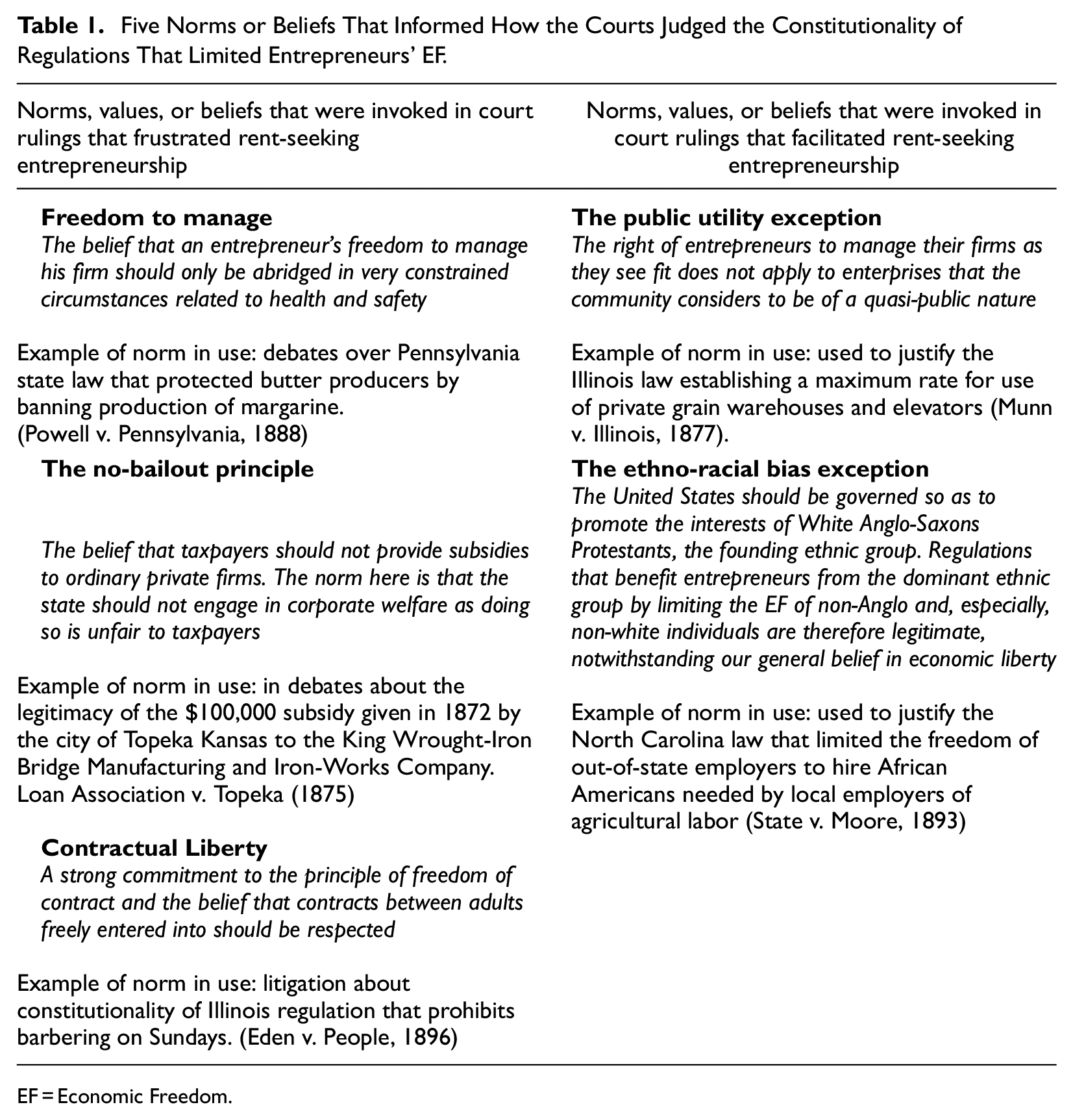
EF = Economic Freedom.
Why Did the Norms and Values Expressed in the Court Documents We Examined Change?
As observed above, we examined court cases in which judges were asked to pronounce on the constitutionality of a regulation or other government policy that had, in our view, been put in place to benefit rent-seeking entrepreneurs at the expense of the broader society. We identified and summarized the norm or norms that informed the court’s decision about whether or not a given regulation was legitimate and constitutional. We show that three of these norms encouraged/pushed judges to declare regulations to be unconstitutional, while two of these norms encouraged judges to regard the regulation under review as acceptable, even if it appeared to violate a particular provision of the constitution. On the basis of our analysis of court decisions over the period studied, we suggest that the three anti-rent-seeking norms were strongest in the late 19th century and then weakened after about 1915. In contrast, the two norms that judges invoked in the course of arguing why a given regulation was legitimate appear to have increased in strength over this period.
We now venture an explanation for why the relative strengths of these five norms in the court documents we studied fluctuated over this period. Doing so involves stepping back from the analysis of the court documents and placing the judicial system in a broader socio-political context. From reviewing the second literature on American legal culture, political culture, economic thinking, and public policy in this period, we identified four broad trends or changes in the ideas that informed how most Americans viewed the world that are relevant to understanding the documented shift in judicial thinking and behavior described above. These trends are: the growing popularity of ideologies that researchers describe as “collectivist” at the expense of classical liberal or “individualist” ideologies (Balogh, 2009; Postell, 2016; Sawyer, 2013; Schiller, 2016); growing confidence in the ability to expert planners to produce better socio-economic outcomes than those provided by spontaneous order systems such as the market (Horwitz, 1997; Leonard, 2017); growing acceptance in American culture of militarism, overseas military action, and historically unprecedented levels of military spending; and intensification of the already high levels of prejudice against minorities, be they non-whites or white immigrants from countries from outside of north-western Europe.
According to the secondary literature, all of these trends in the climate of thought were very pronounced in the Progressive Era of the early 20th century, the very period in which we observed a shift in the norms that informed judicial decisions. The secondary literature also told us that these four trends in American thinking resulted in real changes in public policy that included a marked increase in defense spending as a share of GDP and drastic cuts in the number of immigrants allowed into the country each year. We also learned from reviewing the work of legal academics that while the anti-subsidy or “anti-aid” sections that were part of a majority of state constitutions were not repealed in the Progressive Era, an apparent relaxation of the judicial norm against public bailouts of companies encouraged courts to invent “new doctrines that have in many places vitiated these provisions” of state constitutions, which thus became dead letters (Mitchell et al., 2020, p. 28). The courts thus gave the green light to taxpayer subsidies to firms.
Our review of the secondary literature showed that while not all Americans shifted their thinking during the Progressive Era, the shift in the overall climate of thought meant that the intellectual center of gravity and thus the thinking of the median American changed considerably. In our view, the changes in the overall climate of thought documented in the literature we reviewed helps explain why the three norms that had previously informed how judges thought about the constitutionality of regulation disappeared from the majority decisions of courts. The literature we reviewed strongly suggests that the four trends discussed above weakened the grip of the freedom to manage principle and the freedom of contract principle over the American judges who adjudicated disputes about the constitutionality of business regulation. Belief in laissez-faire as a general principle became weaker, particularly after the entry of the United States into the First World War contributed to a permanent resetting of the typical American’s beliefs about which types of actions by the state were legitimate. This shift in the climate of thought appears to have influenced the thinking of judges.
Long-Term Consequences of the Shift in Judicial Philosophy for American Entrepreneurship
During the so-called Lochner Era, courts struck down some, although admittedly not all, of the government interventions in the economy that politicians had made so as to benefit rent-seeking entrepreneurs. The fact that courts frequently deemed as unconstitutional government interventions in the economy such as occupational licensing laws or taxpayer subsidies to firms appears to have been common knowledge, as the relevant court cases were covered in the press and the most famous of them were remembered long after the decisions were rendered (e.g., Morton, 1901). Awareness that there was a good chance a judge might deem a particular government intervention in the economy to be unconstitutional had a chilling effect on proposals for government interventions (Bernstein, 2005; Phillips, 2001). The precise magnitude of this chilling effect is impossible to estimate but the existing literature on policymaking prior to 1937 strongly suggests it was substantial (Gillman, 1993).
The tendency of American courts to block attempts by entrepreneurs to extract rents through bargaining by policymakers produced an environment in which it was harder than it would have otherwise been for an incumbent firm with ties to policymakers to gain a competitive advantage by lobbying for a subsidy, asking for a favorable regulation to be written, or some other rent-seeking action. Another outcome of this judicial behavior was a stronger incentive to engage in socially productive entrepreneurship and to establish new ventures with the potential to increase overall social welfare. It is notable that this period is also one that economic historians associate with rapid economic and technological progress and an effloresce of Schumpeterian creative destruction (Gordon, 2016), although it would be extremely difficult to prove conclusively using econometric methods that the hostility of American judges to rent-seeking contributed to the high rate of economic progress seen in this period.
After 1915, the philosophy of U.S. judges changed in a fashion whose consequences soon became observable to legislators and entrepreneurs. As a result of this change in judges’ economic philosophy, courts ceased to discourage rent-seeking entrepreneurship by scrutinizing economic-freedom limiting regulations as rigorously as they had done previously. As a result, it became much easier for entrepreneurs to enrich themselves at the expense of the general welfare by lobbying for such measures as special subsidies and, especially, regulations that restrict competition. The 1937 decision of the high court in a high-profile case (West Coast Hotel) gave the green light to forms of rent-seeking entrepreneurship that had previously been inhibited by the courts. Since 1937, American judges have consistently followed the precedent set in 1937 and have consistently refused to use their powers of judicial review to block attempts by entrepreneurs to extract rents from society through regulation and subsidies.
Somewhat predictably, the volume of regulation has increased steadily since the Supreme Court’s 1937 signal that it would not block regulations that benefit rent-seeking entrepreneurs. We have data about the number of pages in the Code of Federal Regulations for the period from 1936 onwards. The number of pages in the Code of Federal Regulations increased from about 10,000 in 1950 to over 180,000 in 2019 (George Washington University’s Regulatory Studies Center, 2020). A historical study found that the rate of increase in the volume of federal regulatory text was particularly pronounced in the 1960s but that every decade has witnessed an increase. The only years the Code shrank in length were immediately after 1945, when the wartime controls were partially repealed (National Archives, 2016). We know that while such regulations are justified by invoking the public interest and the need to protect the environment, workers, or consumers, many such regulations are actually designed to benefit incumbents at the expense of rival firms (Litan & Hathaway, 2017; McWilliams et al., 2002).
Researchers continue to debate the social consequences of the growing volume of regulation. Scholars argue that the post-1978 decline in labor’s share of national income is a result of political rent-seeking by firms that have successfully influenced the legislative and regulatory process in ways that make the economy less dynamic and more unequal (Barkai, 2020). For our purposes, what is significant is the regulatory burden seems to have increased steadily since a shift in the climate of opinion induced American judges to stop striking down regulations that represent rent-seeking by entrepreneurs. This change has had economic implications as economists have argued that a thicket of regulations produced at the behest of rent-seeking entrepreneurs have reduced American economic growth (Dawson & Seater, 2013; Kleiner & Vortnikov, 2017).
Rethinking the Relationship Between Institutions and Entrepreneurship
We now step back from the details of our case study to discuss the wider implications of our research findings for our understanding of the relationship between institutions and the incentives to engage in rent-seeking entrepreneurship. Our research, which has shown that changes in the ideas, norms, and beliefs of judges changed the effectiveness of formal political institutions in discouraging rent-seeking entrepreneurship should encourage entrepreneurship scholars to rethink the relationship between institutions and entrepreneurship by paying more attention to changes in the norms and beliefs that inform judicial decision-making than they have hitherto appear to have done. In our view, the key variable is how judges in a particular time and place will interpret the text of the national constitution and the existing case law. One lesson entrepreneurship scholars should take from our findings is that judicial decision making and the judicial philosophies that inform that thinking should be discussed more extensively in the entrepreneurship literature than has previously been the case.
Another lesson that entrepreneurship researchers can take from our study is that they should pay more attention to war and militarism in thinking about why the policy environment for entrepreneurs varies between different times and places. Warfare seems to encourage judges to believe that extensive government control over much of the economy is legitimate. We suggest that a country that plunges into overseas military adventures will, ceteris paribus, see more rent-seeking entrepreneurship than one that pursues a pacific foreign policy similar to that traditionally favored by classical liberals (Coyne, 2020). However, we would nevertheless concede that the net economic benefits of overseas military action of the type the U.S. has pursued since the mid 20th century may outweigh these downsides, particularly if the U.S. uses its military power to protect from conquest countries whose political and economic institutions are those that literature causally associates with socially productive entrepreneurship and economic development. For instance, institutionalist authors cite South Korea as an example of a country that is more prosperous than North Korea because it has superior institutions (Acemoglu & Robinson, 2019). The same researchers acknowledge that South Korea was only able to benefit from this superior set of institutions because of American military assistance both during and after the Korean War. This pattern which suggests that some form of militarism, particularly those associated with the extension of liberal institutions or what some writers call “counter-power” (Wenar, 2015), can have net positive effects for socially productive entrepreneurship, at least in certain cases. Further research on this complex question is clearly required.
Intellectuals would also seem to have an important, albeit indirect, effect on the policy environment of entrepreneurs and thus the incentives of entrepreneurs to engage in rent-seeking behavior. We suggest that intellectuals play a crucial role in shaping the policy environment in which entrepreneurs operate that is not yet acknowledged in the entrepreneurship literature. As we noted above, some of the court decisions that struck down regulations that had benefited rent-seeking entrepreneurs included references to classical liberal thinkers such as Smith and Spencer. As long as the ideas of these writers influenced the thinking of American judges, the ideas of these writers promoted, albeit indirectly, restraints on rent-seeking entrepreneurship and an environment in which it was relatively hard for incumbents to use regulation to restrict competition by upstart firms. Our findings are thus congruent with Hayek’s theory that the production of ideas by original thinkers can gradually transform a society, provided their ideas come to influence the decision-making of policymakers, judges, and other practical people via the “second-hand dealer in ideas” (Hayek, 1949). Entrepreneurship scholars who want to understand variation in the policy environment for entrepreneurs should thus pay more attention to the intellectual climate and the role of intellectuals in shaping it.
Our findings also suggest that entrepreneurship scholars should think about the relative strength of racial, ethnic, and other collective identities when trying to understand why entrepreneurs can get away with rent-seeking entrepreneurship in some socio-political contexts but not in others. Other scholars (Roback, 1989; Vahabi, 2016) have noted that racism and other forms of ethnic prejudice are often used to legitimate forms of rent-seeking. This observation leads us to theorize that whenever a nation’s culture shifts so that the perceived moral and political significance of an individual’s racial and ethnic background increases, we would expect to find more rent-seeking entrepreneurship, ceteris paribus. The principle that all citizens regardless of ethnicity should have equal rights before the law would seem to discourage rent-seeking: ceteris paribus we would expect to find less rent-seeking entrepreneurship and more socially productive entrepreneurship in society in which all individuals are legally equal and the prevailing habits of thought encourage “colorblind” thinking. Future empirical research in both relatively ethnically homogenous and relatively diverse societies could allow us to determine the impact of such identities on the ability to entrepreneurs to engage in rent-seeking entrepreneurship.
Directions for Future Research
Our research findings suggest several lines of additional research. First, entrepreneurship researchers should consider the relative importance of changes in different types of ideas, norms, and values on the institutional environment in which entrepreneurs operate. Novel techniques of historical investigation such as historical big data and the analysis of large dataset of texts might allow us to track how the dissemination of new ideas from the ivory tower into the wider society changes the intellectual climate in ways that shape how formal institutions affect entrepreneurs’ incentives about whether or not to engage in rent-seeking.
Our study has focused on the interplay of norms and values and formal political institutions in a democratic country whose political system has long corresponded to the category of “the narrow corridor of liberty” (Acemoglu & Robinson, 2019). Acemoglu and Robinson argue that socially productive entrepreneurship and economic growth are most likely to occur under political systems that occupy the narrow corridor between “Despotic Leviathans” (i.e., overly powerful government such as Imperial China) and “Absent Leviathans” (i.e., the excessively weak governments one finds in tribal societies). We need more research on how shifting norms and values interact with political institutions in non-democratic countries so as to influence the incentives to engage in different types of entrepreneurships (Johansson & Feng, 2016).
Supplemental Material
sj-docx-1-etp-10.1177_10422587221134926 – Supplemental material for Informal Institutions as Inhibitors of Rent-Seeking Entrepreneurship
Supplemental material, sj-docx-1-etp-10.1177_10422587221134926 for Informal Institutions as Inhibitors of Rent-Seeking Entrepreneurship by Andrew Smith and Graham Brownlow in Entrepreneurship Theory and Practice
Footnotes
Declaration of Conflicting Interests
The author(s) declared no potential conflicts of interest with respect to the research, authorship, and/or publication of this article.
Funding
The author(s) received no financial support for the research, authorship, and/or publication of this article.

Supplemental Material
Supplemental material for this article is available online.
Author Biographies
References
Supplementary Material
Please find the following supplemental material available below.
For Open Access articles published under a Creative Commons License, all supplemental material carries the same license as the article it is associated with.
For non-Open Access articles published, all supplemental material carries a non-exclusive license, and permission requests for re-use of supplemental material or any part of supplemental material shall be sent directly to the copyright owner as specified in the copyright notice associated with the article.
