



Abstract
This article explores how women entrepreneurs enact identity work to construct their identities at the intersection of gender and entrepreneurship while facing challenges to their legitimacy as entrepreneurs. These legitimacy challenges trigger reflections into who they are as entrepreneurs, and where they belong within entrepreneurial contexts. We draw on 24 focus groups with women entrepreneurs and 30 interviews with enterprise support organizations. We present a model which advances our understanding of the complex identities of women entrepreneurs and how their use of identity work enables them (or not) to become legitimate members of an entrepreneurial community.
Introduction
Entrepreneurial identity construction is a dynamic process central to the meaning, motivation, and work of entrepreneurial action (Gur & Mathias, 2021; Mmbaga et al., 2020; Radu-Lefebvre et al., 2021). This is particularly so for women who aspire to become entrepreneurs (Arshed et al., 2019; Marlow & McAdam, 2015) since the process of identity construction presents personal identity and support challenges to nascent women entrepreneurs who often feel a need to seek legitimacy when laying claim to an entrepreneurial identity (Radu-Lefebvre et al., 2021; Swail & Marlow, 2018). Consequently, policy-makers in numerous countries have established gender-specific support initiatives (e.g., women’s business centers [WBCs] and network groups) as places of learning and assistance for women entrepreneurs to realize their personal ambitions and sense of self (Lindberg & Johansson, 2017). Gender-specific support initiatives, however, have been criticized for reproducing gendered stereotypes of women entrepreneurs (Marlow & McAdam, 2015; Mmbaga et al., 2020), for neglecting the multiple influences of advantage and disadvantage such as class and ethnicity that go beyond the female-male divide (Marlow & Martinez Dy, 2018), and for restricting their access to wider networks and other sources of social capital required for these successful entrepreneurial identity claims to be realized (Harrison et al., 2020).
Yet, we feel such critiques typically stop short of contributing significantly to enable women’s enterprise policy to address these criticisms. We argue there is a lack of useful theory incorporating the backgrounds, identities, and identity motives of women entrepreneurs, thus inhibiting the formation of inclusive evidence-based policy (Coleman et al., 2019; Jayawarna et al., 2021). Consequently, we ask the question: how do women entrepreneurs’ identities shape their perception of gendered support places? This article explores our empirical research by bringing together ideas from the literature on entrepreneurial identities and the emerging literature on the role of place and space in creating meaning-making and identity construction in entrepreneurship (Anderson et al., 2019; Marlow & McAdam, 2015; Mmbaga et al., 2020; Radu-Lefebvre et al., 2021). These two bodies of literature help us frame and understand our findings from an extensive qualitative study of women entrepreneurs who have engaged with enterprise support agencies in the case of Scotland.
Our findings and analysis advance existing literature on shifting attitudes to enterprise support by showing how women entrepreneurs’ identities shape their perceptions and understanding of gendered support spaces. Thus, on the one hand, gendered spaces are interpreted as empowering by women who are in the early stages of a start-up entrepreneurial career and face challenges often associated with a lack of experience and confidence. On the other hand, gendered spaces are interpreted as disempowering by more experienced women entrepreneurs who are more confident in their abilities and who seek wider affirmation of their claim to an entrepreneurial identity. Both categories of women entrepreneurs, however, can be seen as highly agentic by actively seeking spaces in tempered and strategic ways that align with their identity motives and sense of self. These findings have important implications for women’s enterprise policies on gendered spaces, such as WBCs, by showing how they can both enable and disable women entrepreneurs’ sense of role identity.
Identity and Place in Entrepreneurship
Identity Motives and Identity Work in Women Entrepreneurs’ Identity Construction
The concept of identity has become a popular analytical tool among entrepreneurship scholars (Mmbaga et al., 2020; Radu-Lefebvre et al., 2021; Swail & Marlow, 2018). In the entrepreneurship literature, entrepreneurial identity is often used as a catch-all notion that draws on several different forms of answers to the “who am I” and “who do I want to be” questions, including social identity, professional and occupational identity, role identity, personal identity, and identity work (Radu-Lefebvre et al., 2021). In this article, we focus on role identity because it can provide a more nuanced understanding of a key question many entrepreneurs ask of themselves—“what do, or should I do?”—when faced with competing societal and situational expectations (Powell & Baker, 2014).
Role identity is typically seen as a specific form of social identity or sense of self in relation to others, and is often deeply embedded in multiple societal, institutional and national cultural factors such as religion, class, and ethnicity that create unique experiences, opportunities, and barriers for individuals (Essers et al., 2013; Marlow & Martinez Dy, 2018). Thus, we draw on Mathias and Williams (2017) to define entrepreneurial role identity as the differences in societal and situationally-influenced perceptions and actions that accompany an entrepreneurial role in specific circumstances. This view of role identity transcends the assumption that entrepreneurs have a dominant role identity that influences how they make sense of opportunities and make decisions. On the contrary, the founders of a business often assume different roles within their organization in different situational contexts, such as the entrepreneurial founder, the manager, and the investor. These within-role identities have been found to lead to differences in their sense of opportunity and decision-making according to the role identity features they assume (Mathias & Williams, 2017), and to whether and when they give up their “hats” (Mathias & Williams, 2018). We know something of these entrepreneurial within-role identity responses to different circumstances through the identity work they undertake to create and maintain an identity, but less about why they respond as they do.
A key influence on role identity is personal identity, which has received less attention in the entrepreneurship literature (Gur & Mathias, 2021). Personal identity matters for two reasons. First, personal identity refers to the individual motives, values, and beliefs that entrepreneurs bring to their entrepreneurial roles across different contexts and situations (Wagenschwanz, 2021) . Personal identities are meanings attributed by the self rather than being socially defined like role identities. So, personal identification focuses on individuals (“I want to be like her”) rather than role identification targets, which are typically social groups, such as occupations, professions, and organizations (Tajfel & Turner, 1986). Ashforth et al. (2016) argue that the core of such identification is self-definition (e.g., “I am, for example, an entrepreneur”), importance (e.g., “I value, for example, entrepreneurial activity”), and affect (e.g., “I feel strongly about/connected to, for example, this entrepreneurial network”). Second, personal identity and identification connect to role identity through the identity work they engage in to “to create, present, and sustain personal identities that are congruent with and supportive of their self-concept” (Snow & Anderson, 1987, p. 14). In turn, personal identity work is reciprocally related to entrepreneurs’ identity motives (Shepherd & Patzelt, 2018), which refer to the pressures to accept certain identities and reject others when individuals construct their roles (Vignoles et al., 2006).
Research by social psychologists on identity motives across a range of occupations has shown individuals are motivated to hold personal identities that: (1) enhance their culturally defined ideas of self-esteem, (2) provide continuity across time and situation, despite life changes, (3) ensure their own distinctiveness from others, (4) enhance their belongingness, inclusion, and acceptance with others in certain social contexts, (5) affirm their efficacy regarding their competence and control over their environments, and (6) create meaning or purpose for themselves (Vignoles, 2011). These motives, all of which are potentially relevant to women entrepreneurs’ personal identities and their perception of gendered support places, are reflected in their sought for and feared future selves as well as in constructions of who I/we currently are. Consequently, they often produce internal tensions according to the different situations they find themselves in. For example, entrepreneurs may seek distinctiveness from their work colleagues in being a leader when making decisions over key investment choices, while simultaneously seeking to create a sense of belongingness with these same colleagues, or indeed family members, during normal conditions (Shepherd & Patzelt, 2018).
Different identity motives generate, and are generated by, different types of identity work (Lepisto et al., 2015). Lepisto et al. (2015) see identity work comprising three basic processes: retaining identities through maintaining, strengthening, affirming, or stabilizing work; adding new identities by adopting, enhancing, embellishing, or enriching work; and subtracting identities by deleting, losing, or revising work. Bringing these ideas together with work by Mathias and Williams (2018), we offer a definition of entrepreneurial identity work as the cognitive, affective, and social processes and tactics used by entrepreneurs to add new identities, retain existing identities, and abandon unwanted identities to form a dynamic and contextually bound self-concept. So, for example, when entrepreneurs face identity threats arising from insecurities (Brown, 2019), they will often draw on “retaining” identity work to maintain continuity with the past, provide a continued sense of meaning or purpose, and build self-esteem (Shepherd & Haynie, 2018). They may also use “adding” and “letting go” identity work (Brown, 2015) when negotiating their way through complex family issues that threaten their entrepreneurial ambitions (Essers et al., 2013).
Complicating this picture of identity motives and identity, in the case of women entrepreneurs, are the masculine assumptions underpinning most of the literature (Garcia & Welter, 2013; Marlow & McAdam, 2015). Thus, for example, given stereotypical gendered beliefs about entrepreneurs, women entrepreneurs are likely to draw on cultural associations of status-worthiness and competence as cues for self-definition (Bullough et al., 2022; Greene & Brush, 2018). Such gendered theories are highly applicable in the entrepreneurial domain because the process of starting and growing ventures is not the same for men and women (Murnieks et al., 2020). This issue is explored more fully in discussions of intersectionality in women’s entrepreneurship, which points to the multiple influences on the personal and role identities of women entrepreneurs, including race, ethnicity, and class, in shaping their identity motives and the identity work they do (Essers et al., 2013; Marlow & Martinez Dy, 2018). So, for example, Essers et al. (2013) show how female Turkish and Moroccan entrepreneurs operating in the Netherlands used various cultural repertoires to legitimize their position when faced with multiple, conflicting demands from families and religion.
Finally, and directly related to our line of enquiry is the notion of legitimacy as a form of identity work in entrepreneurship. For example, Glaser and Lounsbury (2021) portray entrepreneurs as skilled designers of stories in their pursuit of legitimacy with different audiences. Tost’s (2011) work is helpful here in defining three types of individual-level legitimacy judgments—instrumental, relational, and moral. When applied to the identity work of women entrepreneurs in relation to gendered places: (a) an instrumental judgment could be when women entrepreneurs judge gendered places as appropriate in promoting their own, self-defined material interests or outcomes, (b) a relational judgment could be when gendered places affirm women entrepreneurs’ social identity and self-worth, and ensure they are treated with respect and benefit from outcomes they believe they are entitled to receive, and (c) a moral judgment could be when women entrepreneurs judge the gendered places such as WBCs behavior or reputation to be consistent with their moral and ethical values. These types of judgments are not mutually exclusive and can exist independently or interact and overlap with each other. What is particularly interesting for us in this line of enquiry in the extant literature on women’s entrepreneurial identities is that they suggest women use different strategies from male entrepreneurs to gain legitimacy and make legitimacy judgments (Essers & Benschop, 2009; Garcia & Welter, 2013). Existing literature argues that women use different strategies to illustrate different ways in which they seek legitimacy and various forms of identity (Stead, 2017) with men and women using different mindsets when evaluating their organizational legitimacy (Díez-Martín et al., 2022).
Place and Identity Construction
Identities are often embedded in the concept of place (Cresswell, 2004). Geographical places can provide the raw material for identity construction and the claims and grants associated with such a process. Gieryn (2000) sets out three ground rules defining places. The first is that places occupy a unique geographical location, ranging from someone’s room in a house, to a region or, indeed, a whole country. Such differences in the scale of locations have distinctive features but also one in common in that they are structures that emplace people in them. Second, and following from the structural element, a place has a material or physical form, comprising things and objects. Third, places are also socially constructed and invested with meaning by people. Places only exist when people interpret, make sense of, perceive and narrate stories about them, real or imagined. Thus, a place is different from a space. Spaces are abstractions, “detached from material form and cultural interpretation,” while places are more than locations, either physical or virtual—they are “spaces filled up by people, practices, objects and representations” (Gieryn, 2000, p. 465). They are sites of material location, meaning and values, which are socially constructed by people who “arrive” at existing spaces and revise and reconstruct them through their actions and cognitions (Guthey et al., 2014). For women entrepreneurs in particular, these spaces create a “safe place” for their learning, building relationships, and the pursuit of their entrepreneurial goals (Braidford et al., 2013).
Place can be extremely important in the process of entrepreneurial identity construction by excluding and including social groups (Anderson et al., 2019; Knox et al., 2021; Marlow & McAdam, 2015). Restricting physical and social access to social networks is simultaneously an inclusive and exclusive process that enhances and limits the social capital formation of entrepreneurs. Entrepreneurs’ social capital, which derives from strong networks or “ties that bind” them together is typically seen as essential to overcome the “liability of newness” (Stinchcombe, 1965). At the same time, however, “ties that bind can be ties that blind” (Cohen & Prusak, 2001, p. 14) and, thus, a barrier to change, especially when communities become closed and clannish. In the wider organizational studies literature, place has been used to analyze societal and community institutions that are sites of social exclusion, such as those designed to reproduce claims by professionals to a particular status (Siebert et al., 2018). Such places are sometimes highly gendered, with a “woman’s place” traditionally seen as local, that is, the home while a “man’s place” is more global, that is, work (Powell & Greenhaus, 2012).
In the entrepreneurship literature, place has been used to analyze the creation of inclusive regional identities such as the Silicon Valley model (“siliconia”) (Gill & Larson, 2014) and to illustrate opposition to the heroic narrative associated with entrepreneurial success (Anderson et al., 2019). Thus, as Carter et al. (2019) argue, place in the form of WBCs is an important concept in the formation of women entrepreneurs’ identities, especially those women at an early stage in their entrepreneurial career. WBCs bring together the notion of gendered identity and place because women entrepreneurs’ sense of role and personal identity can influence their instrumental, relational, and moral legitimacy judgments, and the identity work they do to confirm their identities (Tost, 2011). In the USA, WBCs are widely accepted as places to assist socially and economically disadvantaged women in starting and building their businesses, and much of the evidence shows WBCs have been successful regardless of the WBC age, location, and colocation status (Carter et al., 2019). Studies have found that WBCs recognize different client needs and focus on forming interpersonal connections with business owners (Langowitz et al., 2006). Furthermore, women business owners perceive value in gender-specific training offered, particularly in developing social (e.g., connection with other women business owners), managerial (business skills), and feminine (focus on women’s needs) capital (Orser & Riding, 2006). Carter et al.’s (2019) international study argues the key to the success of all business centers is the ability to offer multiple services and to tailor services to the needs of the local community. Furthermore, WBCs can cater specifically to a local community or sector-based businesses. This enables them to meet the needs of local entrepreneurs whose support needs—as well as their opportunities and challenges—are often spatially bound. Locality of place is key to WBCs and women entrepreneurs because it ensures the needs of a specific target population are met to help develop new and existing businesses (Lindholm & Politis, 2013).
In summary, by bringing together insights from the literature on entrepreneurial identity motives, identity work, and the role of place and space in creating meaning-making in entrepreneurship (Anderson et al., 2019; Marlow & McAdam, 2015; Mmbaga et al., 2020; Radu-Lefebvre et al., 2021), we hope to develop a more in-depth understanding of our qualitative case study data of women entrepreneurs’ interpretations of gender-specific support initiatives as places of learning and assistance.
Methods
To explore our research question as to how women entrepreneurs’ identities shape their perception of gendered support places, we undertook an interpretative and inductive methodology designed to generate the concepts and mechanisms that form the foundation for theory building (Eisenhardt, 1989; Grodal et al., 2020). We did so in the context of a specific country whose institutional and cultural context is becoming more encouraging of entrepreneurial activity, especially with respect to women’s enterprise whereby the government is taking specific measures to provide an encouraging environment for women entrepreneurs (Arshed & Knox, 2020; Carter et al., 2019).
Research Context
Pre-COVID, women-owned businesses in Scotland accounted for 13% (231,390 jobs) of the private sector total of employment (Federation of Small Businesses, 2018). According to research undertaken by the Federation of Small Businesses in 2018, women-owned businesses contribute £8.8 billion into the Scottish economy every year, an increase of 76% from £5 billion in 2012. As a sector, women-owned businesses contribute more than sustainable tourism (£4.1 billion), food and drink (£5.6 billion), and the creative industries (£4.6 billion). Yet, less than 16% of SMEs in Scotland are women-owned employer businesses. Over the years, the Scottish Government has been working toward raising the profile of women entrepreneurs. In March 2014, Scotland’s Framework and Action Plan for Women’s Enterprise was published; its aim was to increase the contribution of women’s enterprise to the Scottish economy and outline actions that need to be taken to address the gender gap in entrepreneurial activity. The actions outlined in the framework focused on mentoring and networks, ambassadors and role models, markets and finance, and gender-specific support. A Women in Enterprise Action Group was also established in 2017 with the remit to deliver on the commitments made in the Audit Scotland, 2016 to realize untapped economic potential by tackling the gender gap across start-ups and growth companies. Furthermore, to assess the women’s entrepreneurial ecosystem in Scotland and to seek recommendations to ensure more effective support to increase women entrepreneurs, two independent studies were commissioned by the Scottish Government (Arshed & Knox, 2020; Carter et al., 2019). In 2021, the Scottish Government announced their commitment with £50 million to establish a WBC and have been working toward remedying the current women’s entrepreneurial ecosystem.
Currently, on-the-ground support to women entrepreneurs is provided through both gender-specific and non-gender programs. Gender-specific spaces include business networking and community support groups directly targeted at women (e.g., Harrison et al., 2020). These are typically run by third sector organizations with the support of a small amount of public funds. They deliver peer-networking, training programs, mentoring, and organize business award events. Non-gender-specific programs typically involve public sector business advising (e.g., Arshed et al., 2021), and larger business network groups. While these programs do not have specific gender targeting, the majority of beneficiaries are usually men.
Data Sources
Our study is built on insights into the role of identity for women entrepreneurs in understanding space and place with respect to support and encompasses a wide range of data sources—semi-structured interviews, focus groups, and archival data—which were designed to empirically mobilize two fundamental stakeholder groups (policy implementers and users). The study was undertaken between April and October 2019.
Semi-structured interviews: To understand the women’s enterprise landscape from a grassroots level, we began by seeking out organizations who were delivering support services for women and pursued discussions as to why, where, when, and how these organizations delivered services and support to women entrepreneurs (Table 1).
Snapshot of Delivery to Women Entrepreneurs in Scotland.
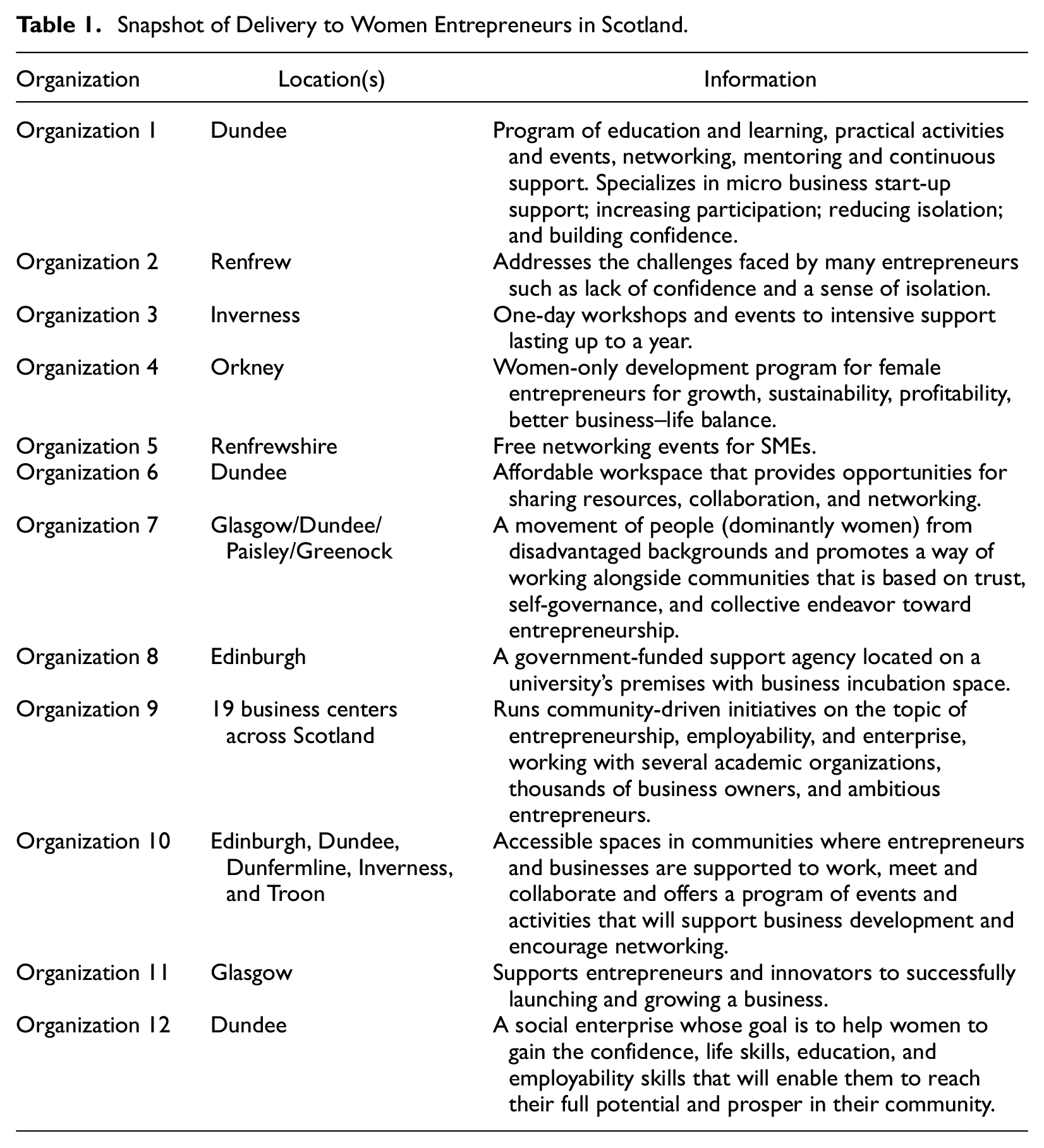
We conducted in-depth semi-structured interviews during April and June 2019 with 30 stakeholders. The interviews were undertaken in two phases: the first phase involved interviewing 18 stakeholders from a government group which consisted of those who delivered women’s enterprise support initiatives (in some shape or form) and in phase two we undertook further interviews with 12 stakeholders (who also delivered enterprise support) in the wider women’s enterprise support ecosystem in Scotland from various regions across the country . The first phase involved employing purposeful sampling, followed by snowball sampling via our wider networks. The interviews lasted between 1.5 and 2 hours, and the semi-structured scripts were broadly devised under the following themes: the delivery of women’s enterprise support; the current best practices of women’s enterprise support; challenges facing women’s enterprise support; their contributions to the wider landscape of women’s enterprise support; and, the future of women’s enterprise support. These broad themes explored the stakeholder’s roles, resources, capabilities, motivations, and ways forward for women’s enterprise in Scotland.
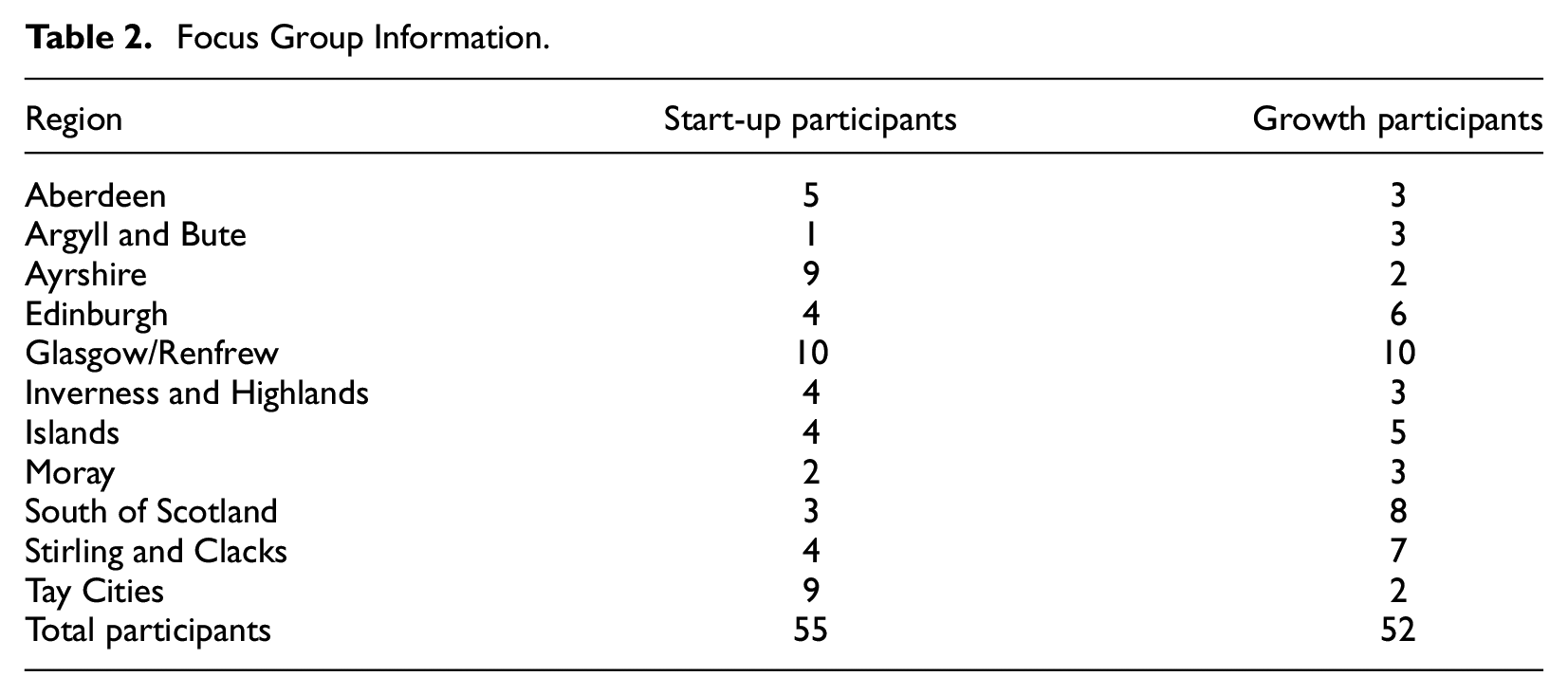
Focus groups: We conducted focus groups involving women entrepreneurs from 11 regions in Scotland between July and September 2019. The purpose of the focus groups was to ensure the study reflected the experiences and expectations of women entrepreneurs in Scotland. There were 24 focus groups organized (12 concentrated on start-up and 12 on growth businesses, 55 and 52 women entrepreneurs, respectively) (Table 2).
Focus Group Information.
One of the largest enterprise agencies in Scotland was approached to assist in the logistics of the focus groups and also supported in promoting the event and sending out invitations to women entrepreneurs and to local enterprise agencies. The focus groups were also promoted via social media (Facebook and LinkedIn) and the local press.
The focus groups were conducted in accordance with the methodological procedures outlined by Krueger (1988). The focus groups ran as follows: (1) they were undertaken by the same researchers to ensure rigor and consistency; (2) on arrival the women entrepreneurs were welcomed and given a participant sheet, consent form, and discussion sheet; and (3) they were given 10 minutes to read and complete the participant sheet and the consent form. The focus groups lasted an estimated 90 minutes and the discussions were centered on the questions which they were asked to think about prior to the group discussion. The themes discussed in the focus groups involved: the challenges and opportunities of business support in Scotland; what they would like to see in terms of support for their businesses; how they identify themselves; how they construct their identities through their public and private lives; and whether gender plays a role in their business and in the business support on offer. All focus groups were recorded, and the same format was applied for both the start-up and growth groups which were independently analyzed by all the members of the research team to ensure consistency, rigor, and validity.
Archival data: Finally, we collected a range of documentary evidence, including relevant policy proposals such as white papers, published reports on women’s enterprise in Scotland, and also historical data on women entrepreneurs in Scotland. The collection of archival data served two main purposes. First, it allowed examination of both the past and present landscape of women’s enterprise policy in Scotland, allowing us to build a picture of the changes over the years, if any, to the discourse. Second, it served as a means of data triangulation, particularly with respect to investigating the links between individual women entrepreneurs, their identities and their responses to their motives and work as well as to the wider entrepreneurial ecosystem.
Data Analysis
We carried out inductive data analyses by systematically following a series of steps to move back and forth between our data, the relevant literature on identity work, and our emerging theoretical framework (Gioia et al., 2013). Our process involved three steps and our data structure is presented in Figure 1.
Step 1: The first step involved analyzing stakeholder semi-structured interviews and background policy documents to understand the context of women’s enterprise support in Scotland. This shaped our understanding of the environment in which women entrepreneurs operated, how enterprise policy positioned women’s enterprise regarding other policies, and the extent of support networks and infrastructure that were available to women entrepreneurs. This was an important step as it provided background information and insight into the legitimacy challenges that women face within the wider institutional context. This informed the iterative process of reading and categorizing focus group transcripts into initial open codes. These empirical codes typically contained participants’ descriptions of the challenges they faced with enterprise support, their thoughts, feelings, and responses to these challenges. The codes were then discussed between authors, who iterated between focus group data, stakeholder interview data, and extant theory to refine them in the manner advocated by Charmaz (2006).
Step 2: The second step involved moving from first-order codes to more abstract second-order categories that began to theoretically explain participants’ motives for accepting or rejecting gendered enterprise support spaces. We did this in consultation with the existing literature to gain additional analytical insight and connect our concepts to extant work (Van Maanen et al., 2007).
Step 3: The final step involved distilling our second-order categories into aggregate theoretical dimensions, paying attention to how they addressed our research question. Our five dimensions were: (1) identity legitimacy accounts; (2) identity motives for acceptance; (3) identity work for acceptance; (4) identity motives for rejection; and (5) identity work for rejection. Finally, we analyzed the background of our participants and their businesses to understand demographic differences contributing to variances in identity motives and identity work.
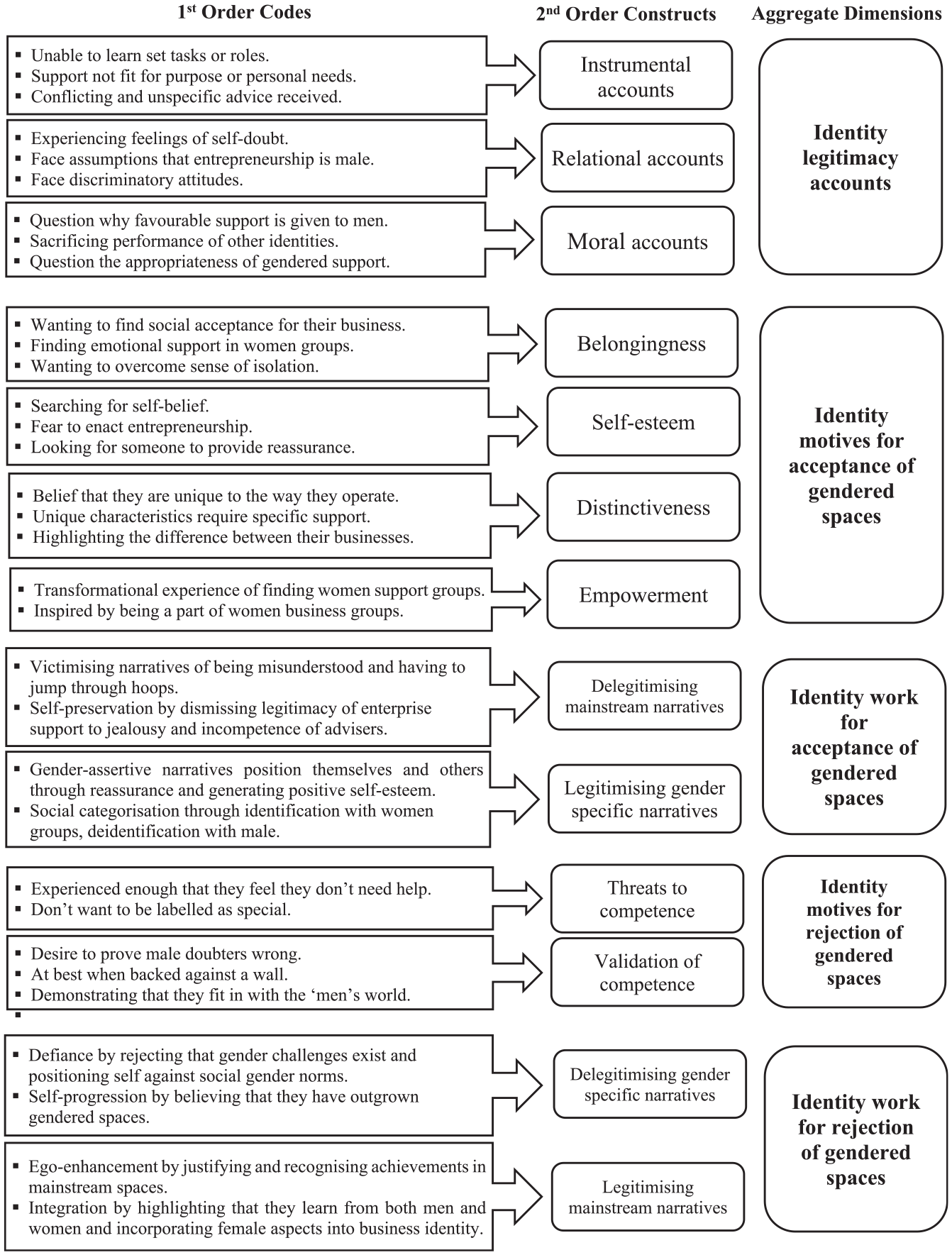
Data structure.
Findings
In the following sections, we elaborate on the second-order categories presented in Figure 1. We explain how navigating enterprise support spaces challenged the legitimacy of women entrepreneurs’ identities which, in turn, triggered different identity motives and identity work. Our findings indicate a clear difference in preference regarding the spaces that women entrepreneurs interpret as enabling, which can be accounted for by the legitimacy challenges they face to their entrepreneurial identity at different business stages and their personal circumstance and environments. On one hand, inexperienced and typically younger start-up entrepreneurs display identity motives and undertake identity work to create socially validated identities as women entrepreneurs by advocating gendered spaces and approaches to enterprise support. On the other hand, more experienced women operating growth businesses display identity motives and undertake identity work to create integrated and resilient entrepreneurial identities by advocating their preference for non-gender-specific spaces.
Identity Legitimacy Accounts
Approximately three-quarters of our focus group participants referred to facing significant challenges in male-dominated spaces when seeking support for their ventures. Both start-up and growth entrepreneurs recounted examples of interactions during which they experienced disdain, stigma, and, in some cases, overt discrimination. These challenges prompted a different kind of reflection by some respondents concerning the legitimacy of their identities as entrepreneurs. Drawing on the work of Tost (2011) and Taeuscher et al. (2021), we categorize these as instrumental, relational, and moral (or normative) accounts of legitimacy. Example quotes for these categories are presented in Table 3 (Online Supplemental File). Illustrations of how these legitimacy accounts relate to gender and non-gender-specific support are presented in Table 4 (Online Supplemental File).
Instrumental Accounts of Legitimacy
These accounts were most prevalent when participants reflected on experiences with enterprise advisory services that did not address their instrumental needs. They often received conflicting advice, sometimes delivered in a transactional manner that did not address their personal identity needs. Participants often sensed that by not receiving the correct type of support their development as entrepreneurs would be severely restricted, as the following extract illustrates:
Now from that planning stage I’m three years down the line. I still don’t have a company structure because I’m getting conflicting advice…it’s having somebody there who could provide you sort of mentorship, guidance, somebody to bounce off would be useful (Islands, start-up).
Growth participants and more experienced start-up participants were even more trenchant in criticizing enterprise support, particularly existing advisory services, for its lack of help in growing their business. The following quote illustrates how they dismissed the expertise levels among support services staff:
I just think they’re f…ing idiots, but because I was moving into this big arena I was thinking [to myself], “you [they] don’t know enough…” (Argyll and Bute, start-up).
Relational Accounts of Legitimacy
Relational legitimacy was expressed when participants referred to self-doubt and instability while engaging with enterprise support. Women entrepreneurs sometimes questioned their own abilities as entrepreneurs, exemplified in the following extract:
I think that women… as a woman you sort of lack the confidence that you can get there, whether it is the imposter syndrome… I know I have that because I’m like, “Yikes. How did I get here? Am I the right person to be talking about this? Somebody else knows more than me, I’m sure” (Edinburgh, growth).
Participants also expressed feelings of dismissal as legitimate entrepreneurs in mainstream support spaces. This triggered a form of “self-stigma” which impacted their self-belief. Most participants’ narratives referred to a male norm as the benchmark. These reflections typically portrayed women entrepreneurs as a category who were restricted, dismissed, and frustrated by the way they were treated. Despite successfully starting businesses, most growth participants’ accounts were redolent of facing, usually unspecified or generalized, judgment, and stigma. Growth participants saw themselves constantly having to validate their identities against societal standards as both women and as entrepreneurs. This created pressure for participants to justify their success and verify who they were as entrepreneurs:
I’ve constantly got to be validating what I do to, like, reflect, well, you do that but look at my business it’s really, really big but we’re not taking in as much money as him. You kind of feel like you’re constantly trying to validate your time away from your kids because really you are… it is time away from your kids when you’re working (Aberdeen, growth).
Moral or Normative Accounts of Legitimacy
Entrepreneurs’ accounts of their experiences can function as moral or normative legitimation narratives, whereby they seek to align with the normative or moral expectations of their institutional environment (Suchman, 1995; Tost, 2011). Thus, participants sometimes questioned the morality or normative expectations of the enterprise support they received. Their stories drew on experiences during which they felt the nature of enterprise support was unfair and led them to feel frustrated. Mostly, their feelings expressed exclusion. For example, one participant expressed her dissatisfaction with being excluded from enterprise support because she worked from home, which is particularly pertinent to the post-COVID world where many will do the same:
They tapped into the local shops, so people that were in business, [but] they weren’t tapping into the people working from home. They still don’t know they’re there! (Ayrshire, start-up).
This perceived lack of justice with the way enterprise support was delivered also created a type of moral conflict with their other competing role identities, such as the role of a mother. This moral conflict occurred when accessing enterprise support required them to make sacrifices in other role enactment promoting them to reflect on the worth of their various identities. Their perceptions of unfairness also overlapped with their relational judgments as it triggered a form of self-doubt over their legitimacy as entrepreneurs:
I think: is it because I’m a woman? Is it because I’m English? Why can’t I tap into this… why will nobody involve us? We’ve proved with the number of people that we bring into the Borders that we’re a viable business, why is nobody interested in us? (South of Scotland, start-up).
Frustration also arose because many growth entrepreneurs regarded access to enterprise support as inconsistent, with targets and procedures often disadvantaging women more than men.
Identity motives for acceptance of gendered spaces
Start-up, inexperienced, and younger entrepreneurs often felt excluded and threatened, motivating them to affirm their identities in gender-specific spaces rather than seeking mainstream enterprise support services. Evidence of these identity motives and their identity work is presented in Table 5 (Online Supplemental File). There were several identity motives for accepting gendered space by the women entrepreneurs, including: belongingness, self-esteem, distinctiveness, and empowerment, which are all discussed in this section.
Belongingness
A need to belong is central to studies of women’s identification as entrepreneurs (e.g., Essers & Benschop, 2009; Stead, 2017). Unsurprisingly then, it was also the most prominent identity motive expressed in our research. Most women entrepreneurs voiced a need for closeness and acceptance from the other entrepreneurs with whom they interacted. They found this sense of belonging by seeking enterprise support in gender-specific spaces to interact with other women entrepreneurs. Such acceptance helped to overcome the isolation often experienced in non-gender-specific spaces, enabling participants to feel part of a community:
A: One of the core differences I see in that programme and why it really works is it also looks at you as a person and what your needs are as a person, and not just as a business owner… it also looks at how are you coping as an individual. Do you need personal support, emotional support, how can we help each other?… There may be other people in the network who are willing to help each other out a little bit and give each other their own services at discount rates and so on. It becomes like a community, everybody helping each other… B: I think it’s absolutely paramount. It really is very, very important to feel like you belong to something… That it just feels like you have people at your back saying you’ve got this (Tay Cities, start-up).
Participants felt that belonging to women’s self-help groups provided them with emotional support and helped them to find affiliations, guidance, and closeness with women entrepreneurs. Acceptance provided a sense of security to women entrepreneurs, enabling them to identify spaces in which they could express themselves without being subjected to judgment and stigma.
Self-esteem
Strongly linked to relational legitimacy and the need for belongingness was the need to enhance a positive conception of oneself (Vignoles et al., 2006). Participants were motivated through their search for enterprise support to discover belief in their entrepreneurial self. This was particularly evident in the self-doubt redolent in early career entrepreneurs’ narratives that articulated self-doubt concerning their motivations and abilities to become entrepreneurs:
I’m still sitting pondering whether I want to do this. I’m building a business case to try and persuade myself as much as anybody else this is what I want to do (Tay Cities, start-up).
Thus, finding a secure space in which they could overcome these challenges was a strong motive for early-stage entrepreneurs. Participants recounted how interactions within gender-specific support groups enhanced their self-belief. This self-belief was expressed through a sense of “team spirit” and camaraderie within certain spaces, ascribing a role to members to boost morale and reassure others.
Distinctiveness
Distinctiveness from others is important to have a meaningful sense of identity, which is important for the development of entrepreneurial identities (Shepherd & Haynie, 2009; Taeuscher et al., 2021). Thus, we found participants seeking to relationally legitimize their claims to being distinctive from their male counterparts to affirm their self-worth as an entrepreneur. Participants often narrated stories of being misunderstood and mainstream support not understanding them as entrepreneurs. Often their business ventures’ identities would be indistinguishable from their sense of self: It’s a different kind of [business]… this was just like an extension of myself really” (Argyll and Bute, start-up). For example, one start-up participant claimed that women have a distinctive means to interact with each other and a desire to help each other:
I think there’s just something so special about women in business because you do, you want to help each other, and you want to…I think [challenge] was overcome by helping each other (Renfrewshire, start-up).
Empowerment
This motive refers to a need to increase the control one has over their identity construction and the power to expresses themselves as they see fit (Ashforth & Schinoff, 2016). Related to instrumental and moral legitimacy accounts, gender-specific support helped individuals to find the strength to enact their desired entrepreneurial selves. This motive was triggered by the restrictions experienced with non-gender-specific support and led to participants looking for spaces in which they were socially empowered. The need to feel empowered as women entrepreneurs was a key motive for some participants to seek gender-specific support. For example, one start-up entrepreneur recounted her experience of belonging to a women’s network group as transformational. Membership allowed many to develop their self-knowledge, and enhance their self-image as an entrepreneur without restrictions of wider enterprise support spaces:
I think that in like standard business groups like yes it’s all business but this like sort of female group of just amazing women, like it literally changed my life because it gave me the knowledge, it gave me the support, it gave me like advice; everything that I needed to run my business and probably without that support network I wouldn’t have come as far as I have (Renfrewshire, start-up).
Identity work for acceptance of gendered spaces
Participants engaged in legitimizing and delegitimizing identity work to create socially validated identities as women entrepreneurs by advocating gendered spaces and approaches to enterprise support. Legitimizing and delegitimizing identity work comprised four narrative forms that sought to discredit “mainstream” enterprise support and male stereotypes of entrepreneurs while giving support for gender-specific approaches to such support. These took the form of self-preservation, victimization, gender-assertiveness, and social categorization.
Delegitimizing Mainstream Narratives
The self-preservation narrative strategy was used to preserve the entrepreneurial identity of participants when they faced instrumental legitimacy challenges from mainstream enterprise support spaces. Participants would often dismiss the legitimacy of mainstream enterprise support or the individuals delivering this support, often by questioning the credibility of business advisers:
They actually might resent or feel jealous because they couldn’t do that…they should be able to understand that that’s how these things start. Like one little seedling, just an idea, I have got a solution to that problem that has to grow from… instead of, no I don’t think you’ve got a viable business there (Ayrshire, start-up).
It was also common for participants to dismiss challenges by claiming their adviser was not able to understand them because they were engrained in “masculinized” ways of thinking:
He was helping me but very aggressive, very confrontational…that’s the masculine model but women don’t respond to that… instead of asking for explanations, what they do is they pick holes in the proposal due to not having full understanding (Argyll and Bute, start-up).
The victimization strategy was used to portray start-up and inexperienced women as victims of poor enterprise support, which prevented them from attaining their ideal entrepreneurial identities. For example, one start-up participant felt that the “hoops she had to jump through” were the cause of her lack of progress compared to her brother’s experience:
My brother, he’s my twin, he also is self-employed, he’s about four years ahead of me just financially, growth-wise, and it’s quite, God, I’ve still got all this to [do] and he’s done it in the same time as me (Aberdeen, start-up).
Participants would justify who they were, currently, by emphasizing the struggles they faced in accessing mainstream enterprise support services. By doing so, they legitimized their identities as entrepreneurs, attributing the perceived gap between the current and future self to external factors rather than their own strengths and weaknesses.
Legitimizing Gender-Specific Narratives
The gender-assertive narrative strategy enabled women entrepreneurs to relationally and morally legitimize themselves as “just” or “right and proper.” They would either draw on their superior qualification compared with men, or by drawing on women as a form of “superior social class.” Such a strategy is akin to one of claiming optimal distinctiveness, which seeks to balance the requirements of institutional actors to be simultaneously legitimate with their reference group but also distinctive from it (Taeuscher et al., 2021). One such approach was to seek justification of their distinctiveness by listing their achievements and qualifications:
I’d done a lot of training and development personally in my mature years, getting two degrees in my forties, so I was on that learning journey anyway so I threw myself into gaining a huge array, I mean I literally, I’ve got a list the length of your arm of qualifications with sector-specific qualifications (Inverness, start-up).
Another approach invoked the collective achievements of women, legitimizing their entrepreneurship by drawing on claims about the impact of women on society. This form of identity work sought to assert themselves, and other women entrepreneurs of their claims to credibility:
Women in particular, even around this table, do make a fantastic contribution to how our community is shaped, how it looks, and how it functions, from looking after the children, to uplifting the face of the high street, to looking after people with mental health (Ayrshire, start-up).
A social categorization strategy was also used to assert participants’ identities in terms of who they were not (Ashforth & Schinoff, 2016). Drawing on the distinctiveness motive, such claims were evident when participants distinguished between women and men entrepreneurs’ traits. This strategy was used to create boundaries through which participants made sense of their individual social identities but, at the same time, formed a social identity by moving from “I am” to “we are.” Their narratives frequently classified women into one group with shared attributes and men into another group with different attributes:
I mean, yes, you can go and speak to local businesses but the majority who run those are all men and they’re like, yeah, well, if you can’t handle it get out, kind of attitude, around us. Whereas networking for women it’s almost like the emotional support as well, because you go through a day and it’s tough and you speak to another woman, and they sympathise with you (Aberdeen, start-up).
Participants often identified with the female traits and characteristics and de-identified with the characteristics of the men’s group. This boundary work determined who they were and who they were not, giving a sense that their identities were situated, coherent, and socially validated within gender-specific enterprise support spaces.
Identity motives for rejection of gendered spaces
Our more experienced growth entrepreneurs typically found gender-specific enterprise support spaces to be restrictive, which motivated them to create integrated and resilient identities within mainstream non-gender-specific support spaces. Evidence of these identity motives and their identity work is presented in Table 6 (Online Supplemental File). Typically, we found their identity motives to be different from those who sought gendered spaces, referring to their own competence and desire to prove others wrong.
Threats to Competence
Competence is seen by many professionals as a key identity motive (Vignoles et al., 2006). This was reflected by the growth entrepreneurs who sought to be seen as professionally competent entrepreneurs with a track record of success as distinct from being seen as “amateurs,” start-ups with no record of success. This motive was frequently articulated in their frustration with being considered as less competent than men and in need of “specialist” support: “I’m very conscious of the fact that okay, I’m female, a business owner, but I don’t want… I’m not a special interest” (Glasgow, growth).
This was a sense shared by other participants, who would highlight their experience and competence as business owners, rejecting any need for extra help or attention because of their gender. Gendered enterprise support spaces were deemed to be threats to their sense of competency as experienced and successful entrepreneurs. Thus, many growth participants felt that if they were to develop further as entrepreneurs they would need to integrate into male-dominated spaces.
Validation of Competence
This strong desire to be seen as competent was associated with a further identity need to prove others wrong. This was done by seeking validation of their expertise from significant others who did not view them as legitimate entrepreneurs. For example, one growth participant expressed a strong desire to prove her husband wrong which she felt she achieved when receiving acclaim for her business:
I think the more recognition we get it’s more like all right, okay. Like when we first won the award, I think our husbands were like okay, I get it now. They knew we were quite good but then when we started winning awards and stuff they were like, okay (Aberdeen, growth).
Growth participants typically expressed motivation, in contrast to the dejection often felt by start-up entrepreneurs, from the legitimacy challenges they faced from enterprise support and the wider environment.
Identity work for rejection of gendered spaces
Growth participants engaged in legitimizing and delegitimizing narratives to create a coherent and resilient sense of self, advocating the use of non-gender-specific spaces and approaches to enterprise support. Legitimizing and delegitimizing identity work was underpinned by four narratives that sought to discredit gender-specific support and promote mainstream narratives.
Delegitimizing Gender-Specific Narratives
The defiance strategy was aimed at resisting gender expectations, with participants looking to position themselves against gendered norms. Several participants professed an aversion to notions that women and men were different, rejecting suggestions that gender challenges exist in enterprise support:
…in terms of setting the business up there was no issues, no challenges. I think in terms of growing our business we faced the same challenges anyone would face, male or female. It’s the same as anyone would face. Winning clients, winning regular clients, getting paid, getting paid on time. These are the challenges that any business owner faces so it’s not really unique to being a woman (Glasgow, growth).
Many growth participants narrated their defiance toward “taken-for-granted” conceptions of entrepreneurship being a male phenomenon, expressing their own characteristics and traits as just and legitimate (Taeuscher et al., 2021). One experienced participant expressed her resistance toward sacrificing the qualities that she believed made her a women entrepreneur:
You can still be a woman and also run a business and be effective. I think that the structure that we’re in, in the business world, of everything being designed around this stereotypical male businessperson is what’s making it so challenging. Women so often have to compromise themselves so that they don’t show weakness. I just think its rubbish. Why have we ended up that way? (Islands, start-up).
Self-progression looked to discredit gender-specific support by highlighting how participants had grown beyond needing gender-specific support groups. Their narratives sought to belittle the need for gendered spaces, and those who sought them, which no longer served a purpose for their developmental needs as growth entrepreneurs:
I like events where there’s a specialist topic in it. So, you do a bit of networking, but you actually learn something (Edinburgh, growth).
Many growth participants denigrated the need for women’s support groups, dismissing their nature and de-identifying with their delivery approaches. The narratives reflect that gender-specific support spaces had a purpose early-on in the entrepreneurial careers of participants, but to progress they needed to move into non-gender-specific spaces:
I think what you need is networking with people that are going to grow your business…I need to meet people that are going to help progress my business (Edinburgh, growth).
Legitimizing Mainstream Narratives
Ego-enhancement, in contrast to the gender-assertive narratives of start-up entrepreneurs, growth entrepreneurs used identity work to build their sense of self using mainstream enterprise support spaces as a point of reference. This identity work built upon their need to feel competent by reflecting inward on their achievements and projecting out positive reputation-building narratives:
I think that instils confidence in your audience. And I say this to my team a lot, because we’re not cheap, we’re not overly expensive and we all go on reputation before reward (Stirling, growth).
These narratives were important not only for validating their success but in highlighting how their progress was achieved by drawing on mainstream business support spaces, such as non-gender-specific business competitions in which they won awards.
The final narrative strategy advocated integration with men into mainstream support spaces. This strategy sought to legitimize the benefits of interaction with both men and women, as exemplified by one growth participant: “you can learn just as much from men as women and men can learn from women as well” (Glasgow, growth). There was a sense that participants would embrace their femininity in mainstream support spaces, breaking down the social and self-stigma that was associated with being a women entrepreneur, as one extract from a growth focus group shows:
A: I don’t think I’ve ever called myself an entrepreneur. I think it’s the vocabulary I use… B: I massively agree with that. I think if everybody was honest, they play to their femininity. We do. I don’t think it should be shied away from, I don’t think you should be embarrassed (Stirling, growth).
Another means to integrate was through the depersonalization of category labels. Referring to or labeling themselves as “business owners” as opposed to “women entrepreneurs” was seen as a way to negotiate their identities in mainstream spaces. Typically, participants would not identify with gendered labels:
I think there’s a lot of the issues with being women, perhaps…I hate when they have the women entrepreneurs or women this, women that, and you’re like, well, actually, we’re all businesspeople, does it matter that we’re women? (Stirling, growth).
These narratives illustrate the work that women do to challenge gender norms and “re-do” their identities at the intersection of gender and entrepreneurship (Garcia & Welter, 2013). Perseverance and resilience were required to navigate challenges and integrate their identities, with participants working to be regarded as legitimate businesspeople in mainstream enterprise support services.
A Model of Identity Motives and Work of Women Entrepreneurs in Response to Enterprise Support
Our data shed light on the challenges women experience when navigating enterprise support and how these challenges generated two divergent paths among women entrepreneurs concerning their role identities. Figure 2 depicts the process we found to occur. By drawing predominantly on our focus groups with women entrepreneurs, we offer a model showing how women entrepreneurs’ identity work to address their different legitimacy challenges takes two divergent paths. These different paths lead to diverse constructions of a situated entrepreneurial identity—a clear sense of who they are in their local context (Ashforth & Schinoff, 2016). On the one hand, start-up participants sought to create socially validated identities as women entrepreneurs by advocating gendered spaces and approaches to enterprise support. On the other hand, growth participants sought to create a coherent and resilient sense of self, advocating integration into mainstream enterprise support environments. Thus, one group of women entrepreneurs viewed gender-specific enterprise support as places of empowerment (start-up), while the other viewed them as places of constriction (growth businesses).
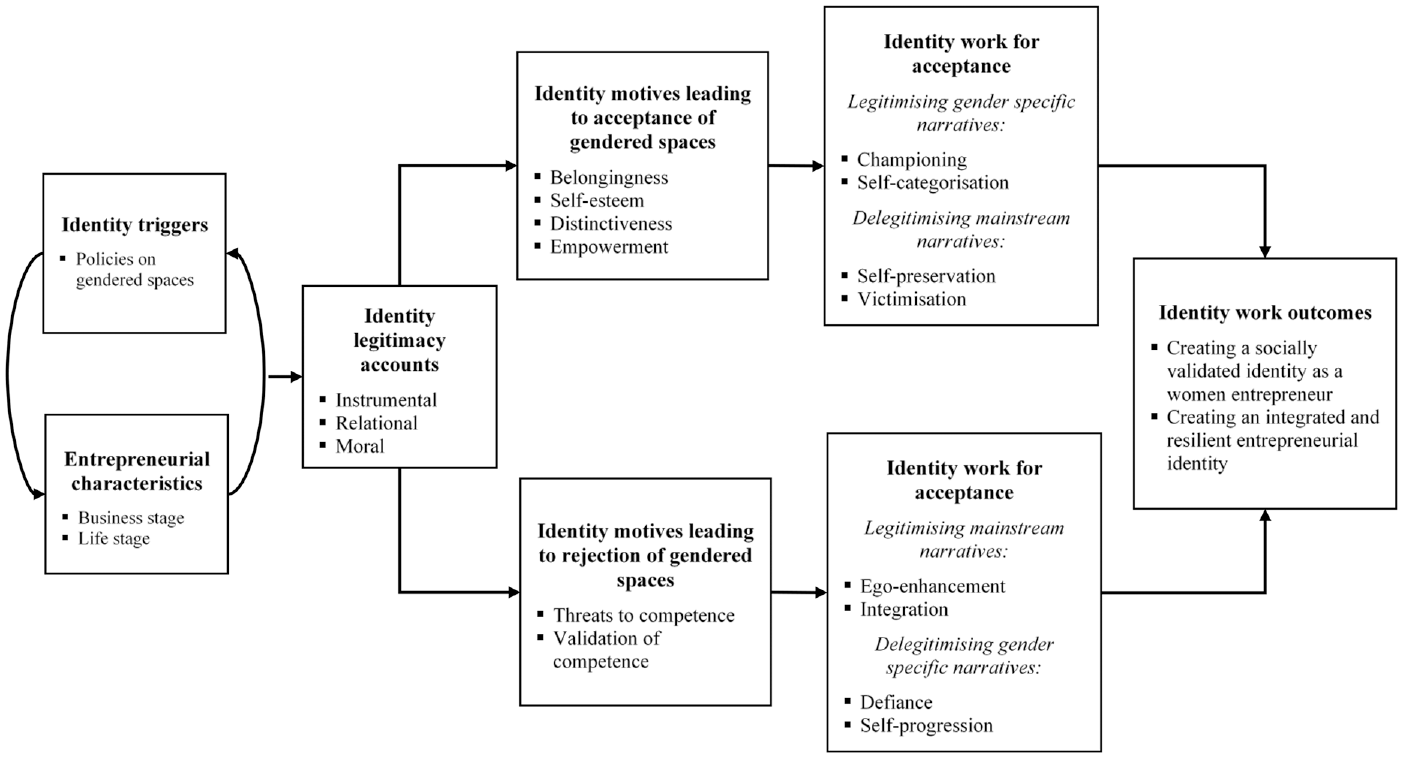
A model showing how women’s entrepreneurial identities, identity work, and identity motives are triggered by engagement with enterprise support.
Discussion
The purpose of our study was to explore how women entrepreneurs’ identities shape their perceptions of gendered support places. In doing so, we were able to expand our understanding of the identity motives and identity work of women entrepreneurs in constructing their sense of place in the context of entrepreneurial development. Central to this process was the notion of entrepreneurial legitimacy in shaping their interpretations of WBCs, which we have represented in a model (Figure 2). By developing this conceptual model, we have sought to bridge identity legitimacy accounts (instrumental, relational, and moral) with the identity motives and work of women entrepreneurs. Their identity work to legitimize or delegitimize enterprise support led to either acceptance or rejection of gendered spaces through positively or negatively impacting the women’s enterprise support ecosystem which created the narrative for their identities.
Contributions to Theory
Our study addresses the limitations of past identity research on women entrepreneurs which has focused on their marginalization or the role of gender (Berglund et al., 2018; James et al., 2021). This work has tended to neglect how social structures shape women entrepreneurs’ identity and behaviors (Crosina, 2018). Thus, our first contribution lies in providing a deeper understanding of women entrepreneurs’ personal and role identities and how they draw on their identity motives and use identity work to legitimize their self-concepts and sense of what it means to be an entrepreneur. We also contribute to theory by showing how women entrepreneurs are highly agentic in working to reposition themselves by actively opening up spaces that disrupt gendered norms and to manage resistance to the role of women entrepreneurs in tempered and strategic ways. Consequently, more experienced women entrepreneurs, whose self-concept and identity motives can be characterized by the desire to be seen as competent and legitimate, are more likely to seek out business-specific, non-gendered support. Less-experienced women entrepreneurs, who experience doubts of their competence and legitimacy, are equally strategic in seeking out and flourishing in gendered places and spaces. For many entrepreneurs, gender-specific support spaces are a legitimate place to develop a social validated identity as an entrepreneur. More experienced women entrepreneurs, however, often need to “fly the nest” to more mainstream places to develop integrated and resilient identities. In summary, our study sought to understand the differential impact of place and space on the formation of women entrepreneurs’ identities, which has significant implications for women’s enterprise policy and the role of women entrepreneurs in both being shaped by it and shaping it (Arshed et al., 2019).
Our second contribution sheds light on the importance of context and the importance of the social setting of women entrepreneurs receiving support when they are starting their business. There is a distinct lack of research that considers gender or women entrepreneurs when understanding the shaping of their role identities and the support available to them (Berglund et al., 2018). Henry et al. (2021) argue that one of the directions to strengthen the quality and relevance of research on women entrepreneurs is the influence of context on how women enact entrepreneurship and construct their identities. The gendered support spaces and the implications of place and context of such support mechanisms for women have implications for the types of institutional barriers that women face, how they can circumvent these barriers and how they can establish legitimacy for their businesses as well as their identities. Although, nascent and start-up women entrepreneurs were in favor of gendered support initiatives, this did not stop those growing their businesses to consider their understanding of how place and space would allow their business to grow. Thus, our research shed light on how the notions of place and emplacement influence how women legitimize their entrepreneurial identities given the frequent challenges they face (Swail & Marlow, 2018), which we considered as a limitation in relation to the policy support that is on offer for women entrepreneurs.
Our third and final contribution adds to the existing literature that debates the various motives which drive entrepreneurial identity work (Knox & Casulli, 2021; O’Neil et al., 2022). Researchers have framed entrepreneurs as being driven by a need to belong (Stead, 2017), a need to demonstrate authenticity (O’Neil et al., 2022), or a need for optimal distinctiveness (Shepherd & Haynie, 2009). We found several other motives present that drove entrepreneurs’ identity work, including self-esteem, a need to feel empowered, and a need to feel competent. These findings highlight the heterogeneity of identity motives and work present, not just within entrepreneurial settings and across social groups (e.g., Garcia & Welter, 2013; Knox et al., 2021), but also within social groups. Thus, entrepreneurship is not only a complex lived experience but also a diverse one (Shepherd & Haynie, 2009).
While we found evidence of multiple identity motives in our sample, the predominant motive driving identity work in early-stage, start-up entrepreneurs was a need for belonging, in which they validated self-concepts in gendered spaces. However, for later-stage, growth entrepreneurs, the predominate driver of identity work was a need to be seen as competent. Consequently, they sought validation for their abilities as entrepreneurs in non-gendered-specific spaces. These findings partly align with the notion that individuals need to develop authentic identities in “safe spaces” (Caza et al., 2018; O’Neil et al., 2022). However, these spaces became limiting for women entrepreneurs as they developed and, ultimately, restricted self-progression. This implies that early-stage entrepreneurship is, indeed, a pursuit driven by belonging and distinctiveness (Shepherd & Haynie, 2009), while the development and growth of a business is driven by a need to be seen as competent and legitimate. The challenges to the legitimacy of early-stage entrepreneurs, therefore, is framed by the question “who they are as an entrepreneur” at a social level, while the question asked of later-stage entrepreneurs is “who they need to become as an entrepreneur,” a challenge more focused on their ability to succeed at a personal level. This finding contests the notion that a key feature of identity motives is to provide continuity across time and situation, despite life changes (Vignoles, 2011), and thus has important policy and practical implications, to which we now turn.
Policy and Practical Considerations
There has been no shortage of policies and programs for women entrepreneurs over the years but, in many economies, women still lag behind their male counterparts in starting and growing their businesses (Dean et al., 2019). To understand the importance of the role and personal identities assumed by women entrepreneurs and how they are influenced in their views, our study shows just how they shaped their perspectives on gendered spaces. Gendered spaces are places for women to feel “safe” and to acknowledge the challenges they face when starting and growing their business, in the hope that the challenges unique to women entrepreneurs could be addressed with the introduction of some form of WBCs. WBCs are seen as a strategic use of spatial contexts which can provide a unique set of resources in entrepreneurial processes and allow them to legitimize their entrepreneurial identity claims (Müller & Korsgaard, 2018).
However, as we show, gendered spaces are not found to be enabling by all, especially those more experienced, self-confident growth women entrepreneurs. Thus, a key insight from our analysis is that the support on offer for women entrepreneurs should align with the stage of their business, their sense of self and how their identity motives and identity work can change over time. Bergman and McMullen (2021, p. 16) argue that “entrepreneurial support involves an ever-changing, bi-directional relationship between entrepreneurs and ESOs [enterprise support organisations].” Many women’s environments change through “other” commitments, for example, having a family, looking after elderly parents, etc.; consequently, their identities evolve over time. Thus, family policies and women’s enterprise policies need to work hand in hand because of the role of women as primary carers for their children and elderly family members. A holistic approach would be much more effective as women, at times, find entrepreneurship as a way to reconcile family and professional demands to normalize their roles as carers and mothers in their business lives and embrace their multi-roles rather than dismissing them. Hence, we endorse policy-makers developing women’s enterprise policies to consider the social infrastructure and by building such policies in a holistic manner rather than separately, that is, economic versus social challenges.
A final consideration that needs to be acknowledged is the impact of major events such as the COVID-19 pandemic. We know that the pandemic has exacerbated societal inequalities and highlighted the vulnerability of women in widening the gender gap despite the 30 years of progress previously made (Georgieva et al., 2020). Women entrepreneurs faced the same historical challenges which were amplified: the industries where most women operated were disproportionately affected by the effects of COVID; women were more likely to run many of the newest, the smallest and, thus, most vulnerable businesses; with schools closed and elderly family members under threat, women were more likely to be juggling primary care-giving and homemaking, while they were struggling to save their businesses; furthermore, women were less likely to seek external finance to bolster their cash flows (Arshed, 2021; Manolova et al., 2020). Thus, policy-makers and governments may need to move away from the previous high-growth elitist policies to think about a reorganization from top-down policy dictation and delivery to more collaborative approaches, working with specific interest groups and stakeholders to better fit the needs of the wider business base.
Limitations and Future Research
As with any research project, there are limitations to our study. First, our sample was based on one country and, therefore, our results may not be generalizable to other countries, cultures, and contexts. However, this research calls for cross-country comparisons where identity and women entrepreneurs vary given their culture and entrepreneurial ecosystems. Second, our study was a snapshot in time, where focus groups were held over 3 months and, therefore, did not probe how and why women entrepreneurs change their identities over longer periods of time and what triggers them to do so. For example, women who were starting a business or were nascent entrepreneurs were keen on the idea of gendered support spaces but as businesses grew women entrepreneurs withdrew from the gender-segregated element of support and often diminished such initiatives. Future studies could consider how women entrepreneurs’ identities are shaped by the support systems by using a narrative technique. Such research would offer more nuanced understanding of the socio-cultural and political knowledge that women accumulate to help them in their efforts to belong (Stead, 2017). Furthermore, future research may need to adopt an inter-sectional approach to women entrepreneurs, in which “within group” comparisons consider the effect of interconnecting socio-demographic factors on the entrepreneurs’ process (Owalla et al., 2021). Moreover, future studies could further explore the personal identity characteristics and identity motives of women entrepreneurs’ identity changes over time in relation to their personal circumstances. Finally, to understand the identity of women entrepreneurs, the move from the women themselves and encompassing the wider entrepreneurial ecosystem to offer a more detailed and constructive understanding of how certain support measures can assist and support them in not only legitimizing themselves as businesswomen but also their businesses is called for (Arshed et al., 2019).
Conclusion
Given that the topic of women’s entrepreneurship continues to grow in academia with governments investing heavily in enterprise development and support for women, there is very little understanding of how identity, motives, and work align with space and place, particularly for gendered support like WBCs. Women entrepreneurs have often voiced unmet needs, difficulty obtaining resources, and challenges establishing their entrepreneurial identities and networks (Motoyama et al., 2021). Our study responds by providing new insights into the identities of women entrepreneurs and how women’s identities shape their response to gendered support spaces, especially as they change over time. In turn, there are significant implications for policy-makers when formulating enterprise support for women. There is research within the domain of entrepreneurship that specifies women-focused support, networks, and programs are effective in generating change and unsettling the masculine norm (Grandy & Mavin, 2020), but we still do not fully understand how women entrepreneurs can consolidate their entrepreneurial identities legitimately to create advantages for themselves while minimizing institutional barriers (Henry et al., 2021). As Forrester and Neville (2021, p. 3) argue “gender operates as a core component of one’s identity since it signals self-awareness of one’s membership within a particular social category and is continuously reinforced through social markers and relationships” and that “women must face the unique challenge of having to prove themselves as legitimate.”
Supplemental Material
sj-pdf-1-etp-10.1177_10422587221134786 – Supplemental material for Ties That Bind or Blind? The Role of Identity and Place in Understanding Women Entrepreneurs’ Support Needs
Supplemental material, sj-pdf-1-etp-10.1177_10422587221134786 for Ties That Bind or Blind? The Role of Identity and Place in Understanding Women Entrepreneurs’ Support Needs by Norin Arshed, Graeme Martin and Stephen Knox in Entrepreneurship Theory and Practice
Footnotes
Declaration of Conflicting Interests
The author(s) declared no potential conflicts of interest with respect to the research, authorship, and/or publication of this article.
Funding
The author(s) received no financial support for the research, authorship, and/or publication of this article.

Supplemental Material
Supplemental material for this article is available online.
Author Biographies
References
Supplementary Material
Please find the following supplemental material available below.
For Open Access articles published under a Creative Commons License, all supplemental material carries the same license as the article it is associated with.
For non-Open Access articles published, all supplemental material carries a non-exclusive license, and permission requests for re-use of supplemental material or any part of supplemental material shall be sent directly to the copyright owner as specified in the copyright notice associated with the article.
