




Abstract
Skeptical of prevailing depictions and recommendations regarding the gender gap in entrepreneurial self-efficacy (ESE), our aim is to raise and examine alternative interpretations and inferences. We question the common belief that women are under-confident with respect to entrepreneurship and whether this is a “problem” that needs fixing. The findings from two distinct datasets indicate, instead, that women are as likely as men to possess accurate entrepreneurial confidence, which is less likely than over-confidence to be associated with proclivities potentially detrimental to business venturing. Our analysis therefore calls for revised portrayals of—and suggestions for—the ESE of both women and men.
Of all the potential gender differences relevant to entrepreneurship that have been examined to date, one of the most pervasive and persistent is the tendency for women to possess a lower level of confidence than men in their entrepreneurial ability; that is, lower entrepreneurial self-efficacy (ESE). The 2020 Global Entrepreneurship Monitor (GEM) data are telling in this regard, revealing that: “Women globally report an average 20% lower confidence than men in their capability to start a business” (Elam et al., 2021: 37). Other research indicates that the ESE gender gap is evident not only amongst members of the general adult population but also amongst adolescents (Wilson et al., 2007), university students (Dempsey & Jennings, 2014), and even active entrepreneurs (Thébaud, 2010).
Although the above-noted findings simply indicate that women’s ESE is lower than men’s on average, the differential tends to be interpreted and depicted as a “female deficiency.” Men are implicitly presumed to exhibit an appropriate level of entrepreneurial self-confidence, whereas women are typically portrayed as either lacking such self-assurance, or, at best, as exhibiting under-confidence in their start-up ability (De Laat & Hellstern, 2020; Kirkwood, 2009). Accordingly, women are often counselled to correct this “problem” by taking steps to strengthen their ESE (Gagnon et al., 2021; Marlow, 2020). Although such portrayals and prescriptions suggest that the prevailing discourse would benefit from a gender critique (Ahl, 2004; Ahl & Marlow, 2021; Harquail, 2020), a rigorous reappraisal of this nature has not yet been conducted. In our view, it is important to address this gap to help ensure that the findings from scholarly research are represented as accurately as possible—and that seemingly well-intended efforts to “fix” women’s lower ESE are not misguided.
We structure our critique around two key questions: Do women tend to be under-confident in their entrepreneurial potential? And, should women be counselled to exhibit greater entrepreneurial confidence? As is typical within gender critiques and other forms of theoretical provocation (Cornelissen et al., 2021), we first surface and assess the implicit assumptions that underlie prevailing portrayals of—and prescriptions regarding—the ESE gender gap. We then raise alternative interpretations and inferences, grounding our arguments using theory and evidence from prior work on the cognitive biases exhibited by entrepreneurs (Zhang & Cueto, 2017) as well as women’s entrepreneurship research (Hughes & Jennings, 2021; Jennings & Brush, 2013). We assess the veracity of our proposed re-conceptualizations using data collected from two distinct studies: a laboratory study completed in 2010/11 by 237 students at a major university in Canada; and, an online survey completed in early 2021 by 819 adults living in the United States (US) or United Kingdom (UK).
Our analysis offers compelling evidence for questioning predominant beliefs about women’s (and men’s) entrepreneurial confidence. Counter to common depictions of women as under-confident with respect to entrepreneurship, we show that they are just as likely as men to possess accurate self-assessments of their entrepreneurial potential. We further show that individuals who possess an accurate level of entrepreneurial confidence tend to exhibit less proclivity than entrepreneurially over-confident individuals to engage in behaviors that are potentially detrimental for business venturing. Combined, these findings provide an important empirical foundation for future work aimed at challenging—and correcting—what we think we know about the ESE gender gap.
A Theoretical Provocation to Reinterpret the ESE Gender Gap
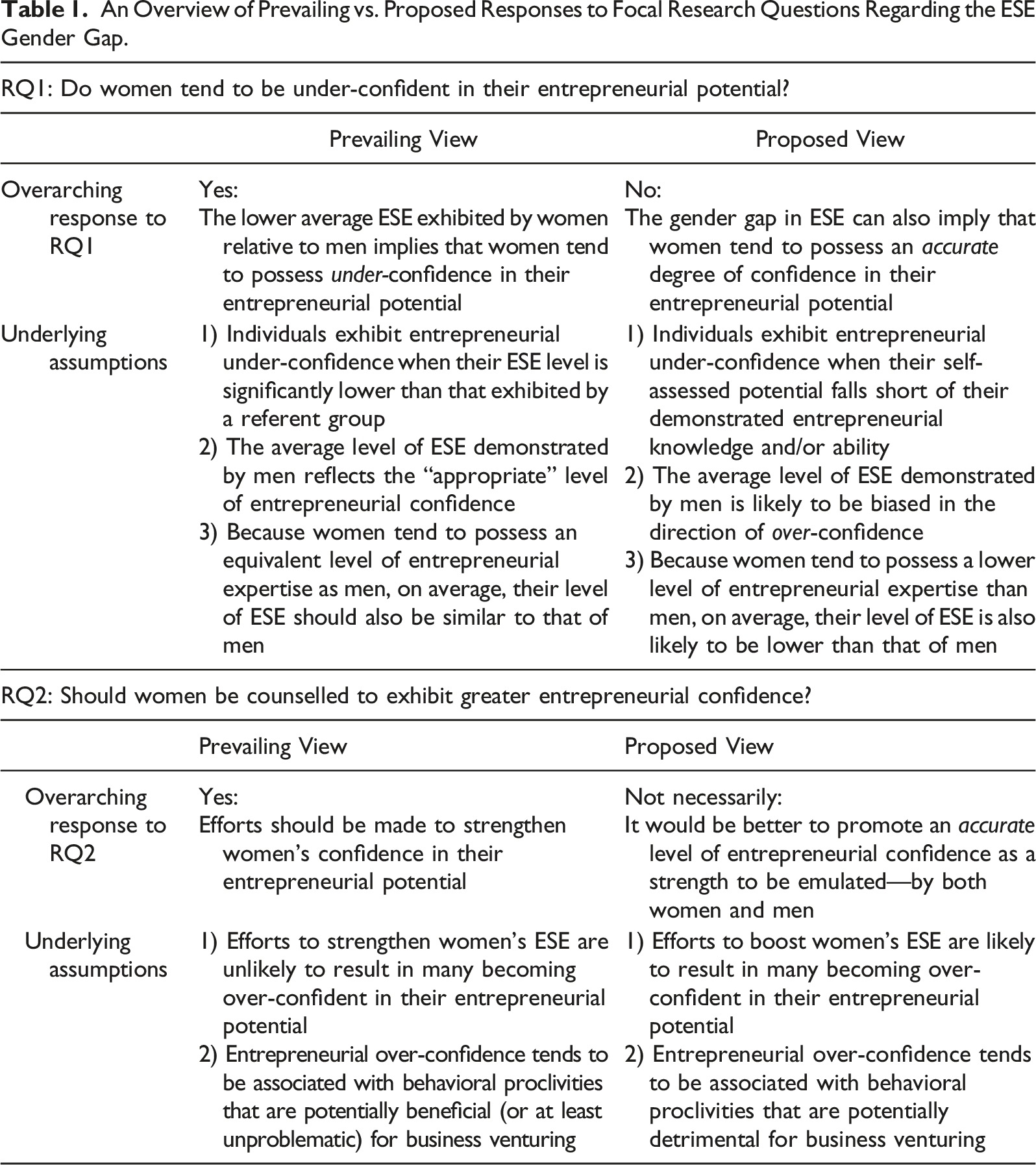
An Overview of Prevailing vs. Proposed Responses to Focal Research Questions Regarding the ESE Gender Gap.
The Need for a Revised Interpretation and Portrayal of the ESE Gender Gap
With respect to RQ1, the predominant view is that the lower average ESE exhibited by women relative to men implies that women are under-confident about their entrepreneurial potential (Gagnon et al., 2021; Kirkwood, 2009; Marlow, 2020). As we elaborate below, however, this interpretation rests on three taken-for-granted—yet problematic—assumptions: 1) that the average ESE exhibited by another group is the appropriate referent for determining under-confidence; 2) that men exhibit an appropriate level of ESE; and, 3) that women tend to possess equivalent entrepreneurial expertise to men. By raising alternative underlying premises, we contend that women’s lower ESE scores are not invariably indicative of under-confidence, but can also reflect accurate confidence. “Accurate confidence” is the level of confidence exhibited by individuals whose self-assessed knowledge, ability, and/or performance within a certain domain aligns highly with an independent evaluation of the same attribute (Forbes, 2005; Hogarth & Karelaia, 2012; Zacharakis & Shepherd, 2001). 1
Consider the first implicit assumption that underlies the prevailing view that women tend to be under-confident with respect to entrepreneurship. By utilizing the level of ESE typically exhibited by men as the basis for comparison, the presumption is that individuals exhibit entrepreneurial under-confidence when their self-assessed entrepreneurial ability falls below the average demonstrated by another group. We find this implicit assumption problematic because it does not accord with the established referent within broader scholarship on common cognitive biases in entrepreneurship (Zhang & Cueto, 2017). Within this line of research, the typical referent is an external assessment of the focal individual’s actual entrepreneurial ability, with this independent evaluation typically ascertained through the individual’s performance on an entrepreneurship-related task (Hayward et al., 2010; Hayward et al., 2006). The notion of entrepreneurial under-confidence, then, refers much more precisely to situations in which beliefs about one’s entrepreneurial potential fall short of one’s demonstrated knowledge/ability—rather than to instances in which one’s ESE falls below the average level exhibited by a referent group (Hayward et al., 2006, 2010).
The second implicit (and in our view problematic) assumption underlying the contention that women tend to be under-confident with respect to entrepreneurship pertains to the gendered nature of the referent against which their ESE is typically compared. By unquestioningly adopting men’s ESE as the comparator, the default assumption is that males, on average, “naturally” tend to possess an appropriate level of confidence in their entrepreneurial potential. Mounting evidence exists, however, for questioning the validity of this presumption. Numerous studies indicate that entrepreneurs tend to overestimate their venture creation knowledge, ability, or likely performance; that is, to exhibit an over-confidence bias (Arend et al., 2016; Forbes, 2005; Invernizzi et al., 2017; Lee et al., 2017; Simon & Houghton, 2003). Indeed, the fact that the samples within many of these studies were predominantly comprised of men (specifically, 82.0% in Forbes, 2005; 69.5% in Invernizzi et al., 2017; and, 97.0% in Lee et al., 2017), combined with the fact that men tend to be over-represented in entrepreneurial activity within most countries around the globe (Elam et al., 2021), suggests that the implicit referent against which women’s ESE tends to be compared is known to be biased in the direction of over-confidence. In light of such evidence, it is plausible that a smaller portion of women possess entrepreneurial under-confidence than previously considered.
The belief that women’s lower average ESE invariably implies that they are under-confident with respect to entrepreneurship rests on a third questionable assumption: that women possess equivalent levels of entrepreneurial potential, on average, as men. Although this implicit premise is admirable, it is problematic because it ignores evidence to the contrary within prior research on female entrepreneurs. Multi-country data indicates, for instance, that women’s labor market experiences tend to thwart their preparedness for business ownership in comparison to those of men (Tonoyan et al., 2020). Perhaps unsurprisingly, prior work has shown that women are less likely than men to possess start-up experience before founding their own ventures (Fairlie & Robb, 2009). Moreover, other research has revealed that female entrepreneurs score lower than male entrepreneurs on generalist “jack-of-all-trades” skills that are of demonstrated value for entrepreneurial activity (Strohmeyer et al., 2017). A plausible alternative interpretation, then, of the ESE gender gap is that women’s lower ESE simply mirrors documented gender differentials in entrepreneurship-related preparation and capabilities—rather than reflecting entrepreneurial under-confidence.
The Need to Consider Alternative Approaches for Addressing the ESE Gender Gap
In regards to RQ2, the predominant advice for addressing the ESE gender gap calls upon women to strengthen their confidence in their entrepreneurial potential. As elaborated below, however, this prevailing prescription is premised on two additional implicit assumptions that we also find problematic. The first (unspoken) belief is that boosting women’s ESE is unlikely to result in many becoming over-confident. Recall, however, that the notion of over-confidence refers to situations in which an individual’s self-assessed knowledge, ability, and/or performance in a certain domain exceeds that determined through an independent evaluation (Zhang & Cueto, 2017). As suggested by the above-summarized findings from prior research on women’s preparation and capabilities with respect to entrepreneurship, most women are unlikely to possess a high level of entrepreneurial expertise. A key implication, then, is that initiatives dedicated to strengthening women’s ESE are likely to result in a sizeable proportion who are now over-confident about their potential to perform well as an entrepreneur.
The preceding plausible consequence links directly to the second additional taken-for-granted assumption that we find concerning. By imploring women to strengthen their entrepreneurial confidence, advocates of such advice implicitly assume that it is unproblematic if some end up overplaying their potential to excel as entrepreneurs. This presumption is premised, however, on the unstated belief that it is “better” to exhibit over-confidence than under-confidence (or even accurate confidence) when it comes to entrepreneurship—a premise that we find dubious. In the case of women, it is plausible that displays of entrepreneurial over-confidence will be perceived as a breach of widely-held stereotypical beliefs that women should be modest and downplay their competence (cf. Eagly et al., 2020; Heilman, 2012). The violation of this prescription is likely to detract from a female entrepreneur’s resource acquisition ability, ultimately hampering the venture creation process. These consequences seem all the more probable for those who possess minimal startup knowledge and ability, as such women are especially likely to be viewed as transgressing the expectation of female humility.
There is also reason to believe that over-confidence can be problematic for male and female entrepreneurs alike. Although the accumulated evidence indicates that over-confidence tends to be positively associated with the creation of new ventures (Cassar, 2010; Hayward et al., 2006; Lee et al., 2017; Trevelyan, 2008), other research has also shown that this cognitive bias can come at the cost of reduced venture performance (Arend et al., 2016) and an increased likelihood of business failure (Artinger & Powell, 2016; Hogarth & Karelaia, 2012; Koellinger et al., 2007). These outcomes are likely to be at least partially attributable to the tendency for over-confident individuals to be less willing to seek or heed business advice—and more willing to introduce highly innovative (yet riskier) products, to pursue opportunities without adequate resources, and/or to escalate commitment to poorly performing initiatives (cf. Zhang & Cueto, 2017). Accordingly, we offer the following alternative response to RQ2. Instead of viewing women’s lower ESE as a deficiency to be corrected, perhaps it is more apropos to promote an accurate level of entrepreneurial confidence as a strength to be emulated—by men and women alike.
The Need for an Empirical Resolution to the Preceding Critique
In sum, the preceding theoretical analysis surfaced several competing assumptions and claims pertaining to the gender gap in entrepreneurial confidence, thereby raising the need for an empirical resolution. In the following section, we describe the two studies that we conducted with this objective in mind. Within our descriptions, we also present and assess the degree of empirical support provided by each study for the prevailing versus proposed responses to our guiding queries about whether women tend to be under-confident in their entrepreneurial potential and whether they should be counselled to exhibit greater entrepreneurial confidence.
Empirical Evidence for Reinterpreting the ESE Gender Gap
The empirical component of our analysis features a two-study research design. For the first study, we utilized a pre-existing dataset that had initially been assembled by the first and third authors for other purposes, but which nonetheless contained measures relevant to the current paper. In light of the promising findings, the first and second authors then designed and implemented a second study to (potentially) confirm and extend the results. Our resultant empirical analysis thus features data collected during two distinct decades, from different types of populations within three countries, and on different measures of entrepreneurial expertise, entrepreneurial confidence, and entrepreneurship-related behavioral proclivities. These design choices provide reassurance that the emergent findings are not sample or measure specific. We summarize the methods and findings for Study 1 first, followed by those for Study 2.
Methods and Findings for Study 1
Design and Sample
The pre-existing data from Study 1 were collected during the 2010/11 academic year, as part of an investigation into the factors that contribute to the ESE gender gap (Dempsey and Jennings, 2014). The study was conducted in a research lab located within the business school of a major public university in Canada. After eliminating the responses from 13 faculty/staff members, our analytic sample for the current study was comprised of 237 university students (143 women and 94 men). The proportion of student participants who were women (60%) was very close to the 58% reported for students enrolled in Canadian postsecondary institutions overall during the 2010/11 academic year (Statistics Canada, 2021).
The participating students ranged in age from 18 to 41 years old, with 20.3% in the first year of their university degree, 24.5% in their second, 24.5% in their third, 23.2% in their fourth, and 7.6% in their fifth or more. Although the majority were majoring in business (61%), sizeable proportions were majoring in science (11%), engineering (8%), or other disciplines (20%). At the time of the lab study, the participating students had taken an average of 1.45 entrepreneurship courses at the high school, college, and/or university level (with 41.8% having taken none). As for entrepreneurial experience, 6.8% were involved in founding/managing a new venture at the time of participating in the lab study, with another 15.2% having done so in the past.
Entrepreneurship-Related Task
The entrepreneurship-related task featured in Study 1 assessed a participant’s knowledge with regards to entrepreneurial opportunity evaluation. More specifically, the task required the participant to sort 10 plausible entrepreneurial opportunity evaluation criteria (e.g., novelty of the idea and ability to generate revenues quickly) into those typically used by novice versus expert entrepreneurs. The overall task and the specific evaluation criteria were derived from the findings reported by Baron and Ensley (2006). The use of an opportunity evaluation activity is consistent with the argument that measures of an entrepreneur’s confidence should be task-specific (Hayward et al., 2010).
Measures
The participants had been asked to identify their gender prior to completing the experimental task. We coded the gender (woman) indicator variable as 1 for those who had specified their gender as female; 0 if they had indicated male.
Prior to completing the opportunity evaluation task, the participants had also completed the widely utilized 10-item ESE scale developed by Cox et al. (2002). The prompt for this scale is, “How confident are you, at present, in your ability to,” with an example item being, “convince others to invest in your business.” Each item was rated on a Likert-type scale ranging from “1 = not at all confident” to “5 = completely confident.” The scale exhibited a very high level of internal consistency (α = .93). We used the mean ESE scores in our analysis as a check on the representativeness of the Study 1 sample; specifically, to confirm that the women, on average, expressed significantly lower ESE than the men.
To assess the prevailing versus proposed responses and underlying assumptions for RQ1, we utilized measures of self-assessed and demonstrated entrepreneurial expertise specific to the task featured in Study 1. Because this task focused upon opportunity evaluation knowledge, we selected the one item from the Cox et al. (2002) scale that captured the participant’s self-confidence in his/her ability to “identify a market opportunity for a new business.” Although this single-item measure of perceived opportunity evaluation knowledge was highly correlated with the overall ESE measure (r = .79), the two variables did not appear within the same model in our regression analysis. As for a participant’s demonstrated opportunity evaluation knowledge, we measured this construct by the number of opportunity evaluation criteria correctly identified as being utilized by expert rather than novice entrepreneurs. The expert versus novice criteria were determined from the distinctions reported within prior work by Baron and Ensley (2006). A participant could score between 0 and 5 on this measure.
To determine a participant’s entrepreneurial confidence category, we first calculated the discrepancy between his/her perceived versus demonstrated opportunity evaluation knowledge scores, subtracting the latter from the former. We implemented the subtractive approach described within some studies of entrepreneurial confidence (Forbes, 2005; Hogarth & Karelaia, 2012), rather than the ratio approach used in others (Invernizzi et al., 2017; Zacharakis & Shepherd, 2001) in order to avoid the possibility of dividing by zero. Following the established practice within these studies, we used the discrepancy scores to assign a participant to a particular category of entrepreneurial confidence. For our main analyses, we deemed discrepancy scores less than –1.0 to reflect under-confidence, those between –1.0 and +1.0 (inclusive) to reflect accurate confidence, and those greater than +1.0 to reflect over-confidence. This was a fairly conservative protocol for assigning participants to the accurate confidence category, in particular, as it meant that their perceived versus demonstrated opportunity evaluation knowledge scores had to be within one point of each other. As described in the robustness check section, we nevertheless assessed the degree to which our findings were sensitive to an even more conservative set of cut-points for the accurate confidence category.
For our empirical assessment of RQ2, we required measures of behavioral proclivities that possess the potential to be detrimental for business venturing. Two such indicators were available in the Study 1 dataset, both of which were sourced from questions posed at the very end of the survey. The first captured a participant’s interest in learning more about his/her task performance, coded 1 for those who had replied that they wanted to view the criteria utilized by expert entrepreneurs (0 if not). The second captured a participant’s trust in the performance feedback received, coded 1 for those who considered the score that they had received to be at least “somewhat believable” (0 if not). We summed the two indicators for the behavioral proclivity measure of performance feedback search/acceptance. Given that only 8% had a total score of 0, we recoded the aggregated responses dichotomously, coded 1 for those who exhibited a proclivity to both search for and accept performance feedback (0 otherwise).
The Study 1 dataset also contained a number of variables that could serve as relevant controls in our multivariate models. For our primary analyses, we selected a participant’s age (in years), amount of entrepreneurship education (the total number of entrepreneurship courses taken at the high school, college, and/or university levels), entrepreneurship experience (current and/or prior involvement in founding/managing a new venture), and general self-efficacy (the mean of Chen, Gully, & Eden’s [2001] eight-item scale; α = 0.87). General self-efficacy denotes people’s beliefs in their abilities to perform across situations. An example item from the Chen et al. (2001) scale is, “I am confident that I can perform effectively on many different tasks.” All but the age variable had been measured after completing the opportunity evaluation task. Descriptive statistics and correlations for all variables can be found in Appendix Table A1.
Findings and Interpretations Pertaining to RQ1
To assess our first guiding question about whether women tend to be under-confident in their entrepreneurial potential, we followed Greve’s (2018) general advice by first producing and analyzing simple data displays. Given the categorical nature of our focal dependent variables pertinent to RQ1 (i.e., under-confidence, accurate confidence, and over-confidence), we constructed the histograms depicted in Figure 1. This figure not only shows how the Study 1 participants were distributed, by gender, across the confidence categories, but also summarizes the statistical findings from our within-group and between-group comparisons of the various bivariate proportions. Entrepreneurial Confidence Category Histograms by Gender for Opportunity Evaluation Knowledge (Study 1). a, b, c Proportions for women with different letters are statistically different at p < .05.i, ii, iii Proportions for men with different Roman numerals are statistically different at p < .05. Note: None of the between-group comparisons are statistically different at p < .05 (under-confidence for W vs. M: χ2 = 0.766, p = .381; accurate confidence for W vs. M: χ2 = 0.962, p = 0.327; over-confidence for W vs. M: χ2 = 0.301, p = .583).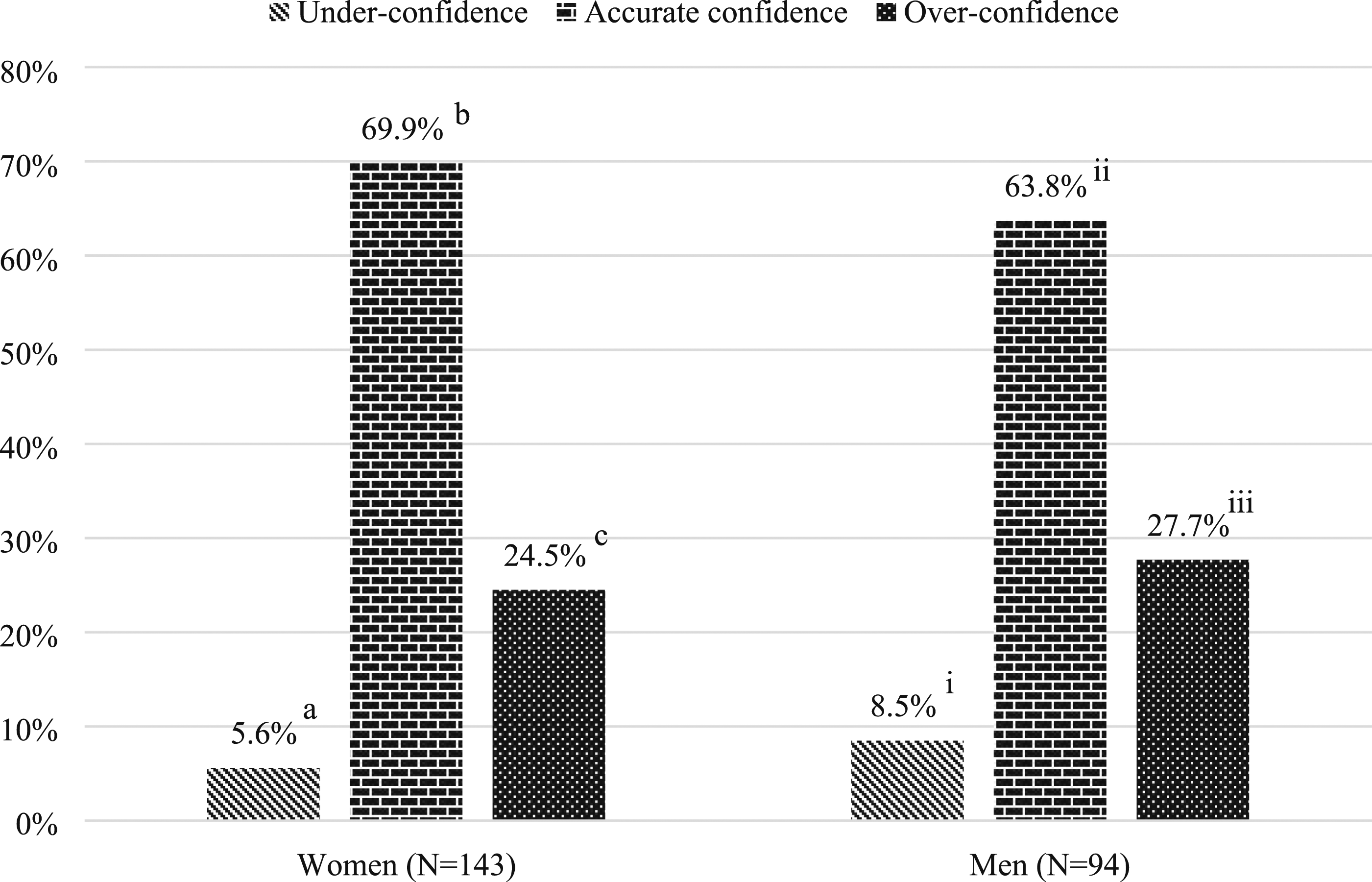
The results presented in Figure 1 provide initial descriptive evidence for challenging the predominant belief that women tend to be under-confident in their entrepreneurial potential. This is because the majority of the women in Study 1 (69.9%) exhibited accurate confidence in their opportunity evaluation knowledge, with only a very small minority (5.6%) exhibiting under-confidence (and 24.5% exhibiting over-confidence). It is also noteworthy that we observed no statistically significant differences between the proportion of women versus men classified into each confidence category (under-confidenceW = 5.6%, under-confidenceM = 8.5%, χ2 = 0.766, p = .381; accurate confidenceW = 69.9%, accurate confidenceM = 63.8%, χ2 = 0.962, p = 0.327; over-confidenceW = 24.5%, over-confidenceM = 27.7%, χ2 = 0.301, p = .583).
Study 1 Regression Results for Task Assessing Opportunity Evaluation Knowledge.
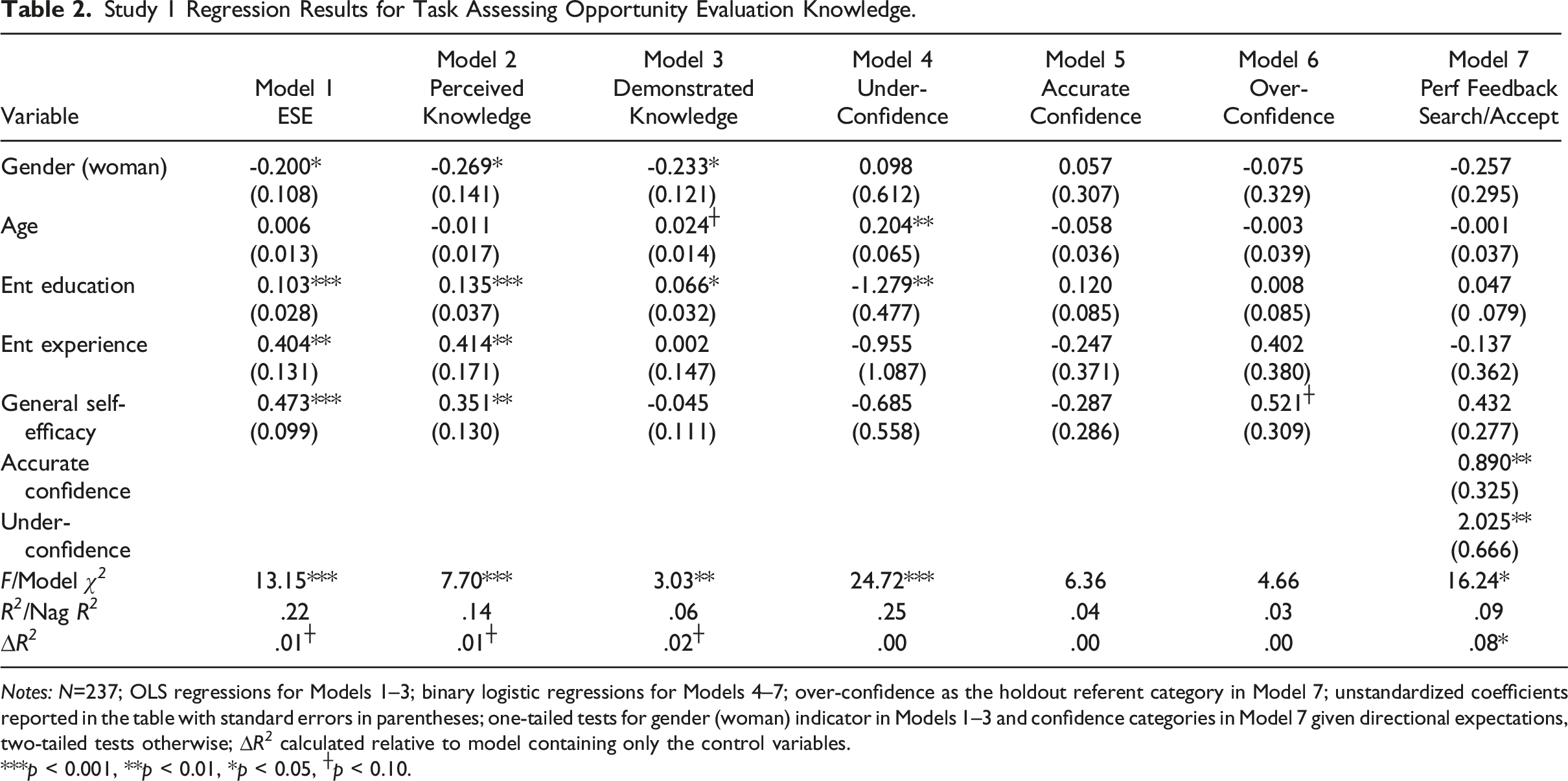
Notes: N=237; OLS regressions for Models 1–3; binary logistic regressions for Models 4–7; over-confidence as the holdout referent category in Model 7; unstandardized coefficients reported in the table with standard errors in parentheses; one-tailed tests for gender (woman) indicator in Models 1–3 and confidence categories in Model 7 given directional expectations, two-tailed tests otherwise; ∆R 2 calculated relative to model containing only the control variables.
***p < 0.001, **p < 0.01, *p < 0.05, ┼p < 0.10.
Model 3 indicates that the women also exhibited a significantly lower average level of demonstrated opportunity evaluation knowledge relative to the men (B = -0.233, s.e. = 0.121, p = .027). Although the men correctly identified an average of 2.79 of the five evaluative criteria used by expert entrepreneurs, the women correctly identified an average of only 2.50. These findings thus offer empirical support for one of the key assumptions underlying our proposed response to RQ1—that women tend to possess lower levels of actual entrepreneurial expertise than men.
The multivariate results reported in Models 4, 5, and 6 corroborate the bivariate findings summarized in Figure 1. Net of the controls, the women in Study 1 did not differ significantly from the men, on average, in terms of being classified into the entrepreneurial under-confidence (B = 0.098, s.e. = 0.612, p = .873), accurate confidence (B = 0.057, s.e. = 0.307, p = .853), or over-confidence (B = -0.075, s.e. = 0.329, p = .820) categories. These multivariate findings thus lend additional support for our core contention related to RQ1; that is, that it is not appropriate to interpret and portray the lower average ESE exhibited by women relative to men as an indication that women tend to be under-confident in their potential to perform well as entrepreneurs.
Findings and Interpretations Pertaining to RQ2
The findings from our empirical analysis also offer insight into the two assumptions underlying our proposed response to RQ2. The first of these assumptions was that efforts to simply strengthen women’s ESE are likely to result in many becoming over-confident in their entrepreneurial potential (unless steps are also taken to increase women’s entrepreneurial expertise). The fact that most women in Study 1 possessed accurate confidence (Figure 1), combined with the finding that the women demonstrated less opportunity evaluation knowledge than the men on average (Model 3 of Table 2) points to the plausibility that many women will become over-confident with respect to entrepreneurship if their entrepreneurial expertise is not strengthened in parallel to their ESE.
In the second assumption underlying our proposed response to RQ2, we had called attention to the likelihood that entrepreneurial over-confidence will be manifested in proclivities that are potentially detrimental for business venturing. Model 7 of Table 2, which features performance feedback search/acceptance as the dependent variable, offers suggestive evidence in this regard. As indicated, the coefficients for accurate confidence (B = 0.890, s.e. = 0.325, p = .003) and under-confidence (B = 2.025, s.e. = 0.666, p = .001) are both positive and statistically significant. These findings indicate that those who over-estimated their opportunity evaluation knowledge tended to be less willing to engage in behaviors that are arguably beneficial for business venturing; that is, seeking and accepting additional information related to entrepreneurial performance (cf. Zhang & Cueto, 2017). In sum, these results offer suggestive evidence consistent with our proposed response to RQ2—that there is merit in promoting an accurate level of entrepreneurial confidence as a strength to be emulated.
Robustness Checks and Inferences
We conducted a number of checks to assess the robustness of the above-noted findings. For the first, we re-ran our analyses on the subsample of 192 participants (123 women and 69 men) who did not possess any current or prior involvement in starting/operating their own business, as a way of isolating the potential effects of a participant’s gender even more strongly. The frequency distributions reported in Figure 1 remained quite stable, with 6.5 (vs. 10.1) percent, 69.1 (vs. 66.7) percent, and 24.4 (vs. 23.2) percent of the women (vs. men) coded into the categories of under-confidence, accurate confidence, and over-confidence, respectively. We also observed a highly similar pattern of coefficients for the gender and confidence category indicators across revised versions of the Table 2 models that no longer required entrepreneurship experience as a control.
As a second check, we constructed an even more restrictive subsample comprised by the 138 participants (93 women and 45 men) who possessed neither current/prior entrepreneurship experience nor high entrepreneurial intentions (EI). We deemed a participant to possess high EI if she/he scored at least 5.0 (out of 7.0) on Liñán and Chen’s (2009) six-item scale (0 otherwise). This shifted the Figure 1 frequency distributions slightly, such that 6.5 (vs. 15.6) percent, 76.3 (vs. 68.9) percent, and 17.2 (vs. 15.6) percent of the women (vs. men) were now classified into the categories of under-confidence, accurate confidence, and over-confidence, respectively. The pattern of coefficients for the gender and confidence category indicators nevertheless remained highly similar across variants of the Table 2 models.
For our third sensitivity check, we utilized the full sample of 237 participants but created even more conservative cut-off values for accurate confidence, restricting inclusion in this category to those for whom the discrepancy between their perceived versus demonstrated opportunity evaluation knowledge scores lay above –1.0 and below 1.0 exclusive (as opposed to inclusive). Not surprisingly, this shifted the Figure 1 frequency distributions much more noticeably, such that 18.2 (vs. 22.3) percent, 29.4 (vs. 21.3) percent, and 52.4 (vs. 56.4) percent of the women (vs. men) were now classified into the categories of under-confidence, accurate confidence, and over-confidence, respectively. That being said, the pattern of coefficients for the gender and confidence category indicators remained highly similar across the regression models with all of the Table 2 controls included.
As a final robustness check, we re-estimated the Table 2 models with the age control replaced by the participant’s program year (first year of university through fifth or higher). We once again observed a highly similar pattern of coefficients for the gender and confidence category indicator variables. The full set of robustness check results is available upon request.
Although the above-noted sensitivity checks attest to the robustness of the Study 1 findings, certain design limitations inherent in this pre-existing investigation suggest that the empirical component of our critique would benefit from the collection and analysis of additional data. One such limitation stems from the fact that the pre-existing sample was restricted to students from a single university, which raises concerns about the extent to which the findings generalize to a broader population. Addressing this issue is important for greater comparability with recent research on the ESE gender gap (Elam et al., 2021; Thornton & Klyver, 2019). Moreover, the measure of demonstrated entrepreneurial potential was derived from a task that assessed an individual’s knowledge—but not necessarily skill—with respect to venture creation. Obtaining a measure of actual ability on an entrepreneurship-relevant task would help establish the veracity of the Study 1 findings. Finally, the pre-existing dataset contained only one behavioral proclivity measure, thereby delimiting the conclusions that can be drawn for RQ2 in particular. We designed Study 2 to address these issues.
Methods and Findings for Study 2
Design and Sample
We collected the data for Study 2 in early 2021, via an online survey administered to members of the general adult population living in either the US or the UK. We specified these countries for comparability with extant research on gender differences in ESE, much of which has been conducted in these regions (as is the case for women’s entrepreneurship in general; Deng et al., 2020). Given the broad nature of our sampling frame, we followed the approach implemented by Kier and McMullen (2018) by retaining Qualtrics, a reputable online survey software and market research firm, to secure participants. We contracted this organization to solicit participation from individuals who met the following additional eligibility requirements: (a) minimum education level of a high school diploma; (b) willing to specify their gender; and, (c) able to complete the survey on a computer rather than a cell phone. The first was important because the survey included two cognitively demanding tasks. The second was critical for investigating our research questions. The third was added in response to pilot testing feedback, which revealed difficulties in completing the survey via cell phone due to the complex formatting of certain elements.
Qualtrics initially secured 1179 participants who met all of the above-noted eligibility criteria. We ended up screening out 360 (31%) of the cases for one or more of the following reasons: failing either of the two attention-check questions, completing the online survey in less than half the median time reported by the other participants, listing the same idea more than once in response to the entrepreneurship-related task, and/or writing gibberish in response to the open-ended questions. This data-quality screening process resulted in 819 usable cases. 2 Of these, 359 (43.8%) were from the US and 460 (56.2%) were from the UK. Approximately half (52.7%) were women. The retained cases were fairly evenly distributed across six ordinal age categories ranging from “18–24 years” to “65 or older,” with 20.3% in the modal category of “35–44 years.” Just over half (52.5%) possessed a 4-year college/university degree. As for entrepreneurship experience, 25.6% were currently involved in founding/operating their own business, and 26.7% had done so in the past (these proportions are not mutually exclusive).
Entrepreneurship-Related Task
Consistent with the argument that assessments of entrepreneurial confidence should be domain-specific (Hayward et al., 2010), Study 2 featured a business idea generation activity. Following Kier and McMullen (2018), we asked the participants to view a short description and accompanying diagram of a technological innovation (facial recognition software), generate as many ideas as possible for potential business ventures based upon the technology, and select the one idea that they considered to be the “best” in terms of novelty and feasibility. We had deliberately selected the same technological innovation as Kier and McMullen (2018) because these researchers had not observed any statistically significant gender differences with respect to their participants’ self-reported level of familiarity with the facial recognition software.
Measures
The Study 2 participants had been asked to identify their gender in the set of preliminary screening questions. For consistency with Study 1 as well as the phrasing of our guiding research questions, we once again coded the gender (woman) indicator variable as 1 for those who had selected female; 0 if male.
We also used the same measure of ESE as in Study 1; that is, the mean of Cox et al.’s (2002) 10-item scale, with each item rated on a Likert scale ranging from “1 = not at all confident” to “5 = completely confident.” The scale had been completed prior to the idea generation task and exhibited a very high level of internal consistency (α = .95).
Study 2 contained two self-assessments pertinent to the ability to generate business ideas. For the first, perceived idea quantity, the participants rated the number of ideas that they had generated “relative to other members of a general adult population who have already completed the activity.” The response scale ranged from 1 = “very much lower...” to 10 = “very much higher…than the average number generated by others.” For the second, perceived idea quality, the participants rated the relative quality of their self-selected best idea on a scale ranging from 1 = “very much lower…” to 10 = “very much higher…than the average quality of the best ideas generated by others.” By asking the participants to rate their idea generation ability relative to others, the confidence category measures for Study 2 correspond to the over-placement form of over-confidence (Hogarth & Karelaia, 2012; Zhang & Cueto, 2017). We divided the perceived scores by two so that they would be comparable with the measures of demonstrated performance.
We constructed two measures of demonstrated performance on the idea generation task. For the first, demonstrated idea quantity, we initially removed any ideas listed by the participants that were either unclear or highly irrelevant. Following Kier and McMullen (2018), we then compared the total number of (remaining) ideas generated by the focal participant relative to the number generated by all Study 2 participants (mean = 1.80, sd = 1.96, min = 0, max = 12). Based on the sample statistics for the idea count variable, we assigned each participant an ordinal score as follows: 1 (well below average) for 0 ideas, 2 (below average) for 1 idea, 3 (average) for 2 ideas, 4 (above average) for 3–4 ideas, or 5 (well above average) for 5 or more ideas. In the robustness check section, we assess the sensitivity of our findings to different cut-points for the “above average” and “well above average” categories. 3
For the second measure of exhibited task performance, demonstrated idea quality, we also implemented a procedure similar to Keir and McMullen (2018). This involved the use of two external raters to assess the novelty and feasibility of the ideas that the participants had self-selected as their best. Both raters were upper-year Bachelor of Commerce students with prior involvement in launching more than one business venture. Each was blind to the study’s purpose and theoretical arguments, and conducted their assessments independently. They rated the novelty of each idea using the same four-point scale utilized by Kier and McMullen (2018), which ranged from 1 = “a common, mundane, or boring business idea” to 4 = “an ingenious, imaginative, rare or surprising business idea.” They rated feasibility by an extended version of the scale used by these scholars, with the revised endpoints ranging from 1 = “translating the idea into a commercial product will likely be very difficult” to 4 = “translating the idea into a commercial product will likely be very easy.” We instructed the raters to assign zeros to any idea that lacked sufficient information or seemed irrelevant to the focal technology; these cases were excluded from further analysis for idea quality. The scores assigned to the remaining 395 cases exhibited acceptable levels of interrater reliability (ICC = .75 for novelty and ICC = .79 for feasibility). 4 Following Kier and McMullen (2018), we added the novelty and feasibility scores together to create a formative measure for each rater, and then calculated the mean of their overall scores. We then multiplied the mean demonstrated idea quality score by 5/8 so that it was on the same scale (max of 5) as the participant’s perceived idea quality score.
To calculate the discrepancy between the perceived versus demonstrated scores, we once again subtracted the latter from the former to avoid dividing by zero. We used the discrepancy scores to assign participants to a particular entrepreneurial confidence category for idea generation quantity and quality separately. For the primary analyses reported below, we used the same cut-points as Study 1, deeming discrepancy scores below –1.0 to reflect under-confidence, those between –1.0 and +1.0 inclusive to reflect accurate confidence, and those above +1.0 to reflect over-confidence. In the robustness check section, we report the findings from a sensitivity analysis with more conservative cut-points for the accurate confidence category.
We included three measures in Study 2 to tap behavioral proclivities that are potentially detrimental for business venturing. When developing these measures for our investigation, we had relied on prior operationalizations for relevant content. For instance, we measured propensity to launch a business in an unfamiliar context using a scenario similar to that used by Keh et al. (2002), in which the participants indicated the (fictional) amount of USD $50,000 is personal savings that they would be willing to invest in a startup within an industry in which they possessed no first-hand experience and lacked sufficient resources for conducting in-depth market research. We measured propensity to base a venture on a highly-novel product/service offering by the mean of a participant’s responses to the following three items, each with endpoint values of 1 [versus 7]: “I would prefer to base my company on a well-established [highly innovative] business model,” “I would try to make my company’s product or service as similar [as different] as possible to others,” and, “I would prefer to offer a product or service that is very typical [very novel] for the industry in which my business operates,” Although we did not source these items from a pre-existing measure, they nevertheless exhibited an acceptable level of internal consistency as a scale (α = .75). We measured propensity to escalate commitment through a follow-up scenario to the one developed by Keh et al. (2002). More specifically, we asked the participants to indicate the (fictional) amount of USD $100,000 in startup funding that they would invest in “speeding up the launch of,” rather than “making substantial changes to,” a product concept that external feedback suggested was no longer as promising.
Finally, we ensured that Study 2 contained a number of relevant control variables. Location was measured as a dummy variable coded 1 for participants in the UK (0 for those in the US). Age was measured by six ordinal categories ranging from “18–24 years” to “65 or older.” Education level was measured by six ordinal categories ranging from “high school diploma” to “doctoral or professional degree.” General self-efficacy was once again measured by the mean of Chen et al.’s (2001) eight-item scale (α = 0.91). Entrepreneurship experience was coded 1 for those who indicated that they were currently involved or had previously been involved in founding or operating their own business (0 otherwise).
Within the models featuring a dependent variable derived from the idea generation task, we also controlled for the amount of time spent generating ideas (as calculated by the online survey program) as well as the participant’s self-reported level of familiarity with the facial recognition technology. Tech familiarity had been measured by a sliding scale ranging from “1 = not at all familiar” to “10 = completely familiar,” which had been posed after the participants had rated their perceived performance on the idea generation task. It was important to include these additional controls in the relevant models because a preliminary check had revealed that the women in Study 2 had not only spent a slightly longer amount of time than the men generating ideas (meanW = 130.36 seconds, meanM = 108.49 seconds; t = 1.871, p = .062) but also reported (unlike in Kier & McMullen, 2018) a significantly lower average level of tech familiarity (meanW = 4.80, meanM = 5.77; t = -5.201, p = .000). 5 Descriptive statistics and correlations for all variables can be found in Appendix Table A2.
Findings and Interpretations Pertaining to RQ1
For our Study 2 statistical analyses, we implemented a procedure similar to that for Study 1. We started by producing separate histograms by gender to show the proportion of participants that had been classified into each confidence category. Figure 2a contains the frequency distributions and associated bivariate for idea generation quantity. Figure 2b displays a parallel set of findings for idea generation quality. (a) Entrepreneurial Confidence Category Histograms by Gender for Idea Generation Quantity (Study 2).a, b, c Proportions for women with different letters are statistically different at p < .05. i, ii, iii Proportions for men with different Roman numerals are statistically different at p < .05. Note: Between-group comparisons revealed significant gender differences in under-confidence (χ2 = 12.482, p = .000) and over-confidence (χ2 = 22.802, p = .000), but not accurate confidence (χ2 = 0.354, p = .552). (b) Entrepreneurial Confidence Category Histograms by Gender for Idea Generation Quality (Study 2). a, b, c Proportions for women with different letters are statistically different at p < .05.i, ii, iii Proportions for men with different Roman numerals are statistically different at p < .05. Note: Between-group comparisons revealed significant gender differences in under-confidence (χ2 = 11.139, p = .000) and over-confidence (χ2 = 7.391, p = .007), but not accurate confidence (χ2 = 1.903, p = .168).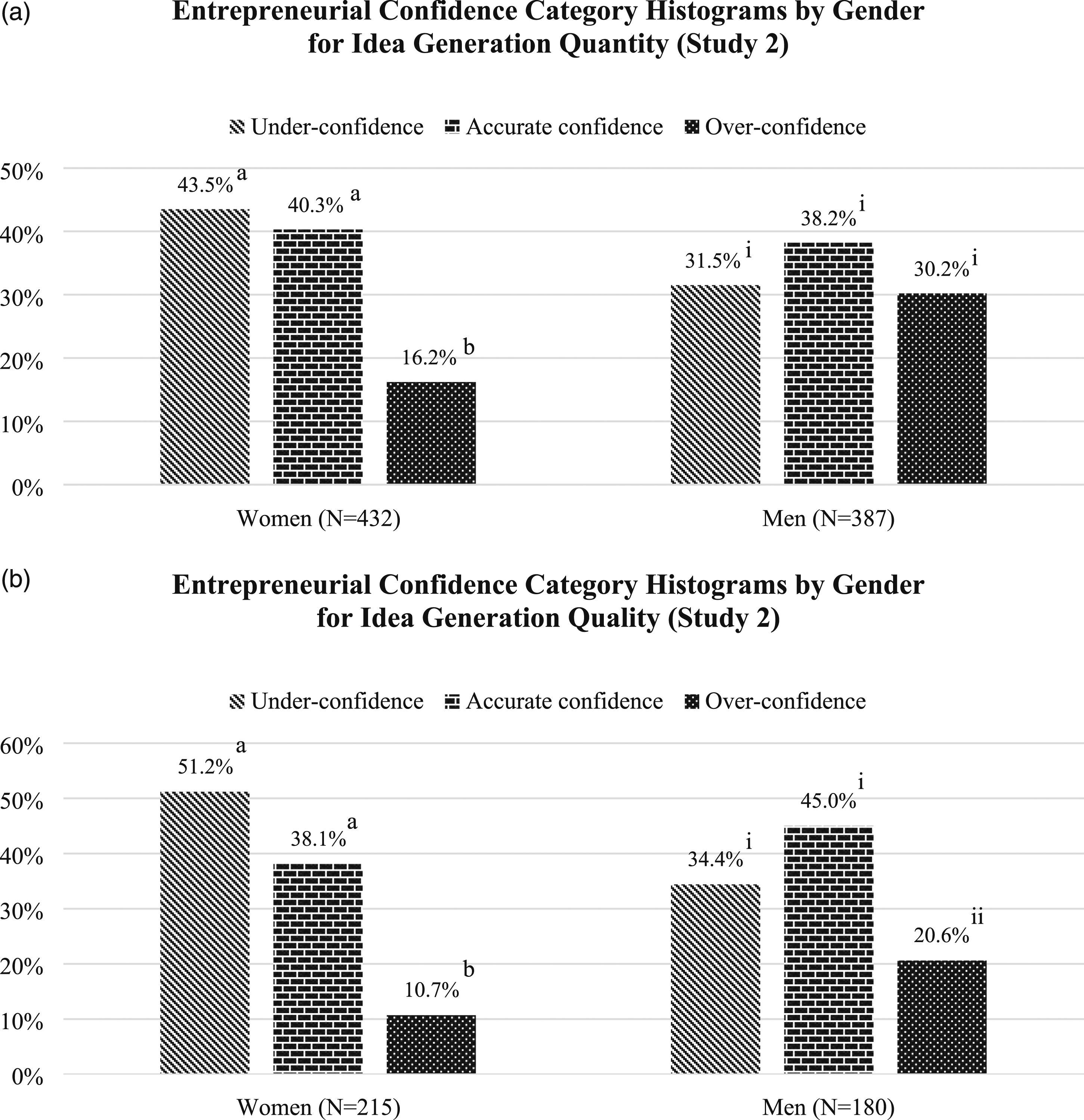
With respect to RQ1, the descriptive evidence presented in these figures can be summarized as follows. In the Study 2 sample, the women were significantly more likely that the men to exhibit entrepreneurial under-confidence with respect to both idea quantity (W = 43.5%, M = 31.5%, χ2 = 12.482, p = .000) and idea quality (W = 51.2%, M = 34.4%, χ2 = 11.139, p = .000). The women in Study 2 were also significantly less likely than the men to exhibit entrepreneurial over-confidence with respect to both idea quantity (W = 16.2%, M = 30.2%, χ2 = 22.802, p = .000) and idea quality (W = 10.7%, M = 20.6%, χ2 = 7.391, p = .007). That being said, however, no statistically significant gender differences were observable for accurate entrepreneurial confidence, in terms of either idea quantity (W = 40.3%, M = 38.2%, χ2 = 0.354, p = .552) or idea quality (W = 38.1%, M = 45.0%, χ2 = 1.903, p = .168). Moreover, although a marginally greater proportion of women were classified into the under-confidence category than the accurate confidence category for idea quality (51.2% vs. 38.1%, respectively, z = 7.457, p = .051), the proportions classified into the under-confidence versus accurate confidence categories did not differ significantly for idea quantity (43.5% vs. 40.3%, respectively, z = 0.683, p = .494). On balance, then, the descriptive evidence for Study 2 lends support for the gist of our proposed response to RQ1, which is that women are just as likely to possess accurate confidence in their entrepreneurial potential as they are to be under-confident in this regard.
Study 2 Regression Results for Task Assessing Idea Generation Quantity.
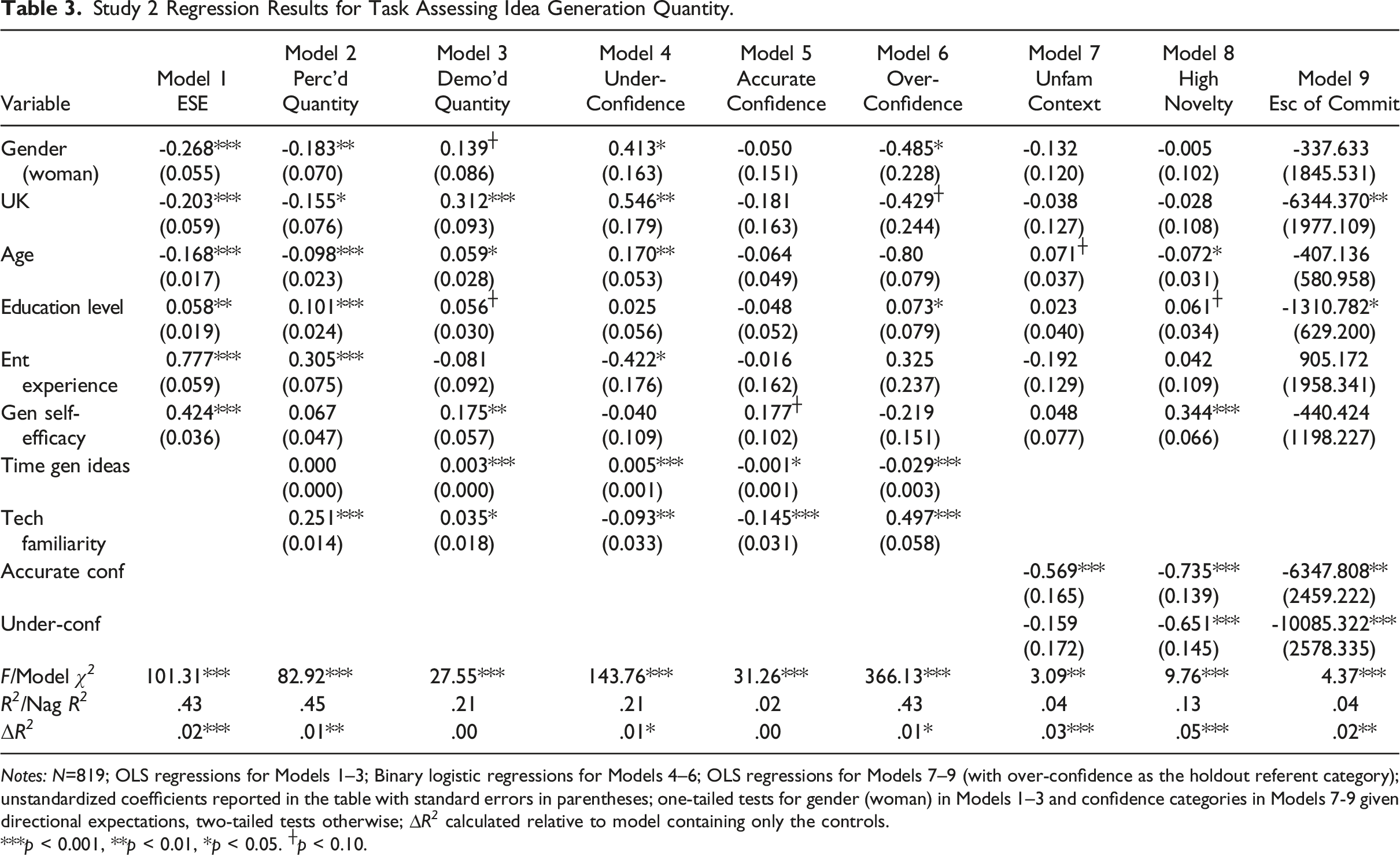
Notes: N=819; OLS regressions for Models 1–3; Binary logistic regressions for Models 4–6; OLS regressions for Models 7–9 (with over-confidence as the holdout referent category); unstandardized coefficients reported in the table with standard errors in parentheses; one-tailed tests for gender (woman) in Models 1–3 and confidence categories in Models 7-9 given directional expectations, two-tailed tests otherwise; ∆R 2 calculated relative to model containing only the controls.
***p < 0.001, **p < 0.01, *p < 0.05. ┼p < 0.10.
Study 2 Regression Results for Task Assessing Idea Generation Quality.
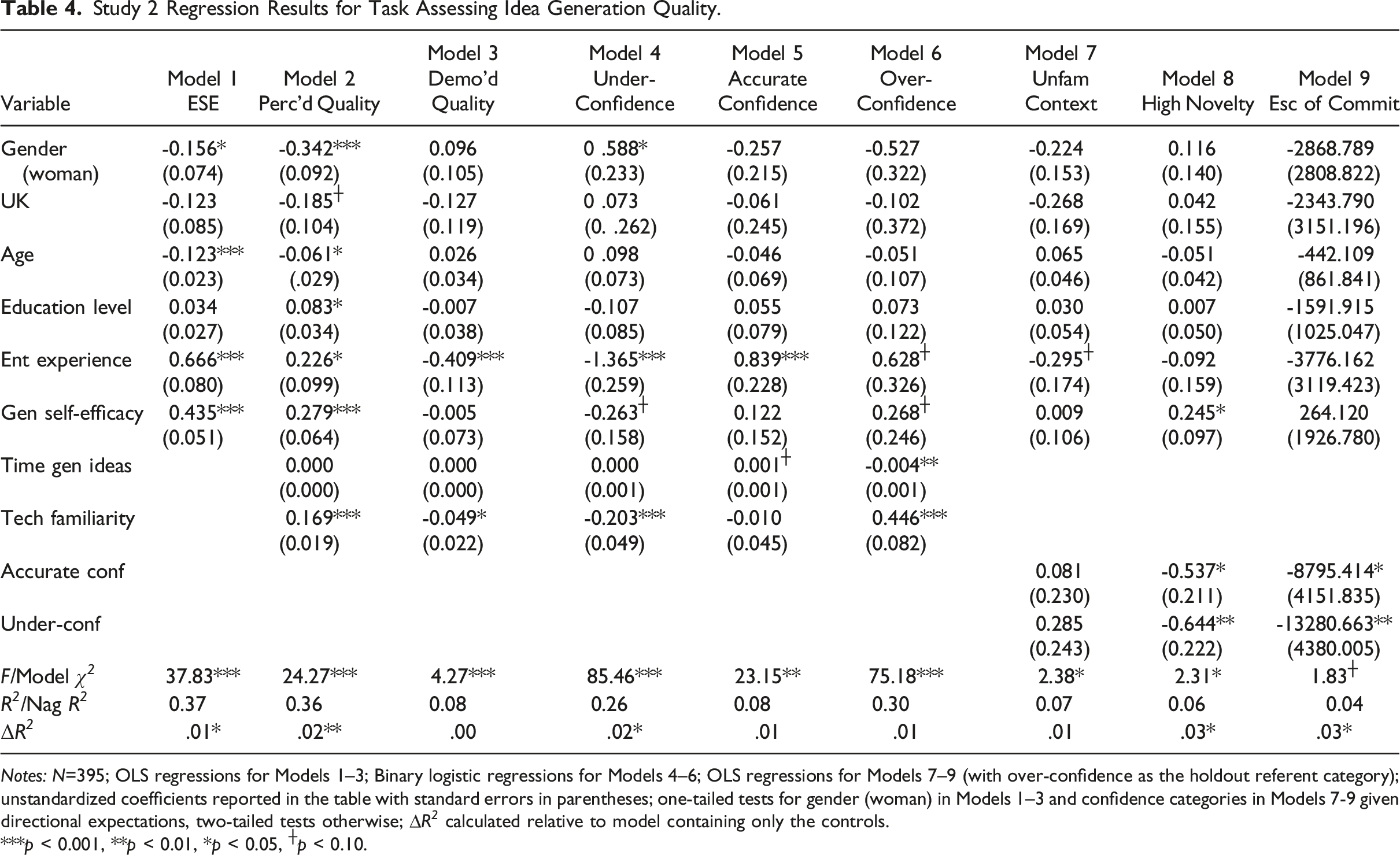
Notes: N=395; OLS regressions for Models 1–3; Binary logistic regressions for Models 4–6; OLS regressions for Models 7–9 (with over-confidence as the holdout referent category); unstandardized coefficients reported in the table with standard errors in parentheses; one-tailed tests for gender (woman) in Models 1–3 and confidence categories in Models 7-9 given directional expectations, two-tailed tests otherwise; ∆R 2 calculated relative to model containing only the controls.
***p < 0.001, **p < 0.01, *p < 0.05, ┼p < 0.10.
The dependent variable for Model 3 of Tables 3 and 4 corresponds to the demonstrated levels of idea quantity and quality, respectively. The gender indicator variable is positive and marginally significant in Table 3 (B = 0.139, s.e. = 0.086, p = .054) and non-significant in Table 4 (B = 0.096, s.e. = 0.105, p = .186). Counter to one of the assumptions underlying our proposed response to RQ1, we thus found no evidence that the women in Study 2 generated a lower quantity or quality of business ideas, on average, than the men (net of the controls). Instead, the Model 3 results are more consistent with a key assumption underlying the prevailing response to RQ1; that is, that women possess a similar level of entrepreneurial ability as men, on average.
Models 4 through 6 of Tables 3 and 4, respectively, feature the indicators for the under-confidence, accurate confidence, and over-confidence categories as the focal dependent variable. The findings for a participant’s gender corroborate our prior interpretations of the bivariate results summarized in Figures 2a and 2b. More specifically, the positive and statistically significant coefficient for the gender (woman) indicator variable in Model 4 of both tables indicates that, net of the controls, the women in Study 2 were more likely than the men to exhibit under-confidence with respect to both the quantity (B = 0.413, s.e. = 0.163, p = .011) and quality (B = 0.588, s.e. = 0.233, p = .011) of the business ideas they had generated. Conversely, the fact that the gender (woman) indicator variable is negative and statistically significant in Model 6 of Table 3 (B = -0.485, s.e. = 0.228, p = .034), and negative but not quite significant in Model 6 of Table 4 (B = -0.527, s.e. = 0.322, p = .102), provides some evidence that the women in Study 2 were less likely than the men to exhibit over-confidence in their business idea generation ability.
Notably, however, the non-significant coefficient for the gender (woman) indicator variable in Model 5 of both Table 3 (B = -0.050, s.e. = 0.151, p = .740) and Table 4 (B = -0.257, s.e. = 0.215, p = .233) suggests that the women in Study 2 were just as likely as the men, net of the controls, to exhibit an accurate level of confidence in their ability to generate business ideas. In sum, when considered in light of our above-noted interpretation of the bivariate findings, the overall pattern of multivariate results reported in Tables 3 and 4 lends additional support for our proposed response RQ1; that is, that the documented gender gap in ESE can also imply that women are as likely as men to possess accurate confidence in their entrepreneurial potential.
Findings and Interpretations Pertaining to RQ2
Models 7 through 9 of Tables 3 and 4 contain the multivariate results pertinent to RQ2. In our proposed response to the question of whether women should be counselled to simply exhibit greater confidence in their entrepreneurial potential, we had asserted that it would be more beneficial if efforts were made to promote an accurate level of entrepreneurial confidence as a strength to be emulated by both women and men. On balance, the findings reported in the final three models of both tables offer suggestive empirical support for our contention.
Consider those in Table 3 for idea generation quantity. The coefficient for accurate confidence is negative and significant in all three models (M7: B = -0.569, s.e. = 0.165, p = .000; M8: B = -0.735, s.e. = 0.139, p = .000; M9: B = -6347.808, s.e. = 2459.222, p = .005). These findings indicate that the participants who possessed an accurate level of entrepreneurial confidence were less likely than those who exhibited entrepreneurial over-confidence to express behavioral proclivities that are potentially detrimental to business venturing; that is, launching in an unfamiliar context, starting with a highly novel (and thus typically riskier) product/service, and escalating commitment in the face of negative feedback. The findings reported in Table 4 for idea generation quality are similar, with the exception that the accurate confidence indicator is not statistically significant in Model 7 (M7: B = 0.081, s.e. = 0.230, p = .362; M8: B = -0.537, s.e. = 0.211, p = .006; M9: B = -8795.414, s.e. = 4151.835, p = .018).
Robustness Checks and Inferences
We conducted numerous checks to assess the robustness of the Study 2 findings. For the first, we re-ran the Table 3 and 4 analyses on the subsample of 503 participants (291 women and 212 men) who did not possess any current/prior entrepreneurship experience at the time of completing the online survey. As a second check, we constructed an even more restrictive subsample comprised by the 429 cases (249 women and 180 men) who possessed neither current/prior entrepreneurship experience nor a strong interest in becoming an entrepreneur. A participant’s interest in “starting [their] own business in the near future” had been rated on a scale from 0 = “not at all interested” to 10 = “extremely interested” (we deemed responses of at least 8 to reflect a high degree of interest). Our third check utilized the full sample of 819 participants but featured more conservative cut-off values for the accurate confidence category (i.e., discrepancy scores for perceived vs. demonstrated idea generation quantity/quality between –1.0 and +1.0 exclusive). Our fourth check was also run on the full sample, but with different cut-points for the demonstrated idea quantity variable (i.e., 3 ideas coded as “above average,” and, 4 or more ideas coded as “well above average”).
Overall, the Study 2 robustness checks offer corroborating evidence that supports our proposed responses to the research questions that guided our critique. With respect to RQ1, we observed a non-significant coefficient for the gender indicator variable across six of the seven Model 5 variants, which is consistent with the finding from our primary analysis that women are just as likely as men to possess an accurate level of entrepreneurial confidence. It is important to note, however, that bivariate analyses for the subsample of women revealed that a significantly higher proportion were classified into the under-confidence rather than accurate confidence category for sensitivity checks based on: (a) the subsamples that excluded prior/current entrepreneurs or those with a strong interest in starting a business in the future (for idea quality only); and, (b) the more conservative cut-points for accurate confidence. In regards to the latter, the fact that a statistically higher proportion of the men were also coded into the under-confidence category suggests, however, that the stricter coding protocol does not possess as much face validity as the original. The proportion of women classified into the under-confidence and accurate confidence categories remained statistically equivalent across the remaining checks.
As for RQ2, we noticed that the coefficient for the accurate confidence indicator remained negative and statistically significant (at p < .05) across 11 of the 21 variants for Models 7 through 9. In three of the remaining variants, the coefficient was negative and marginally significant (at p < .10). These results thus offer primarily confirmatory support for our prior finding that an accurate level of entrepreneurial confidence is less likely than over-confidence to be associated with behavioral tendencies that are potentially detrimental to business venturing. The full set of robustness checks for Study 2 is available upon request.
Discussion
We set out in this paper to critically examine the prevailing beliefs that: (a) women tend to be “under-confident” with respect to their entrepreneurial potential; and, (b) steps should be taken to correct this apparent “deficit.” Our analysis of two distinct datasets provides empirical evidence for questioning this predominant portrayal and recommendation, offering greater support for the alternative conjectures surfaced through our theoretical critique. Below we elaborate the key contributions and implications that can be drawn from our investigation, organized according to the two overarching research questions that guided our analysis.
Contributions and Implications Related to Portrayals of the ESE Gender Gap
Our study’s most fundamental contribution lies in demonstrating that the lower average ESE typically exhibited by women relative to men does not necessarily imply that women tend to be under-confident with respect to entrepreneurship. Instead, we offer evidence to suggest that women are just as likely to possess accurate assessments of their venture creation knowledge and ability—that is, self-perceptions close to demonstrated expertise—as they are to underplay their potential. Our analysis further indicates that the proportion of women exhibiting accurate entrepreneurial confidence does not differ significantly from that of men.
In our view, the key implication of these findings is as follows. When thinking, writing, and/or talking about the gender gap in entrepreneurial confidence, it is critical for those who produce, disseminate, and/or consume scholarly research on the topic to refrain from portraying women’s lower average ESE as a “deficiency” (Gagnon et al., 2021; Kirkwood, 2009; Marlow, 2020). Instead, our findings imply that it is more appropriate to re-construe women as being just as likely as men to possess accurate perceptions of their venture creation knowledge and ability. Being as precise as possible in our discourse about women’s entrepreneurial confidence is of utmost importance for countering persistent perceptions (Gupta et al., 2009; Gupta et al., 2019) and portrayals (Achtenhagen & Welter, 2011; Ahl & Nelson, 2015) of entrepreneurship as a stereotypically “male” endeavor.
Other notable contributions of our research stem from the findings unearthed through our examination of key underlying assumptions about the ESE gender gap. We found little evidence for the conjecture that women’s lower average ESE mirrors their lower average level of entrepreneurial ability relative to men. Although the women in the 2010/11 Canadian university lab study demonstrated less opportunity evaluation knowledge than the men, the women members of the general US and UK adult populations who participated in the 2021 online study generated an equivalent quantity and quality of business ideas as the men. The lack of gender differences observable in the 2021 study is particularly noteworthy considering that the women had expressed a significantly lower level of familiarity, relative to the men, with the facial recognition technology featured in the idea generation task.
We found greater support, however, for the contention that men are more prone than women to exhibit an entrepreneurial over-confidence bias (i.e., self-perceived expertise that exceeds demonstrated knowledge/ability with respect to entrepreneurship). Although this tendency was not evident amongst the Canadian university students in the 2010/11 lab study, it was so amongst the broader population of US and UK participants in the 2021 online study. Although it is possible that the high-tech nature of the innovation featured in the idea generation task for Study 2 played a contributing role, our findings are nevertheless consistent with prior research that points to the existence of an over-confidence bias amongst male entrepreneurs (Forbes, 2005; Invernizzi et al., 2017; Lee et al., 2017). Our findings extend this body of work by demonstrating that this bias is also more prevalent amongst men than women in general.
These findings possess additional implications for discourse about the ESE gender gap. By showing that men are more susceptible than women to over-estimating their entrepreneurial expertise, our analysis suggests the need for greater questioning of the taken-for-granted assumption that men tend to exhibit an “appropriate” level of confidence with respect to entrepreneurship. Interestingly, emergent anecdotal evidence suggests that female entrepreneurs themselves are starting to express skepticism in this regard, with those in a recent qualitative study set in Canada describing the “displays of bravado” and “big claims” of many male entrepreneurs as “misguided” (De Laat & Hellstern, 2020: 17). Such an inference is buttressed by the findings, interpreted below, for the second research question that guided our critique.
Contributions and Implications Related to Recommendations for the ESE Gender Gap
The findings pertinent to our second guiding query contribute suggestive evidence that individuals who possess accurate confidence in their entrepreneurial potential tend to be less likely, relative to those who are over-confident, of exhibiting behavioral proclivities that are potentially detrimental for business venturing. The specific tendencies examined herein are consonant with those raised within prior research on the cognitive biases exhibited by entrepreneurs; namely, a reluctance to seek and accept feedback yet a lack of recalcitrance to launch a business in an unfamiliar context, base a business on a risky highly-novel product/service offering, and/or escalate commitment to an initial concept that no longer shows as much promise (Zhang & Cueto, 2017). By showing that such tendencies are more pronounced amongst those with an inflated sense of their entrepreneurial expertise, our study joins others in questioning whether over-confidence is beneficial for outcomes beyond the start-up decision (Arend et al., 2016; Artinger & Powell, 2016; Hogarth & Karelaia, 2012).
These findings point to the need for analysts, advocates, and activists to reconsider the common belief that the ESE gender gap is an “issue” that can—and should—be “fixed” through efforts to strengthen women’s entrepreneurial confidence (Gagnon et al., 2021; Marlow, 2020). If women without a high degree of actual venture creation knowledge and ability were to heed such advice, then it is likely that many will develop an over-confidence bias, which, as our analysis has shown, is likely to manifest in behavioral proclivities that are potentially detrimental to their ventures. Given that entrepreneurial over-confidence tends to be associated with such proclivities regardless of an individual’s gender, the key implication that we draw from this component of our analysis is the need for greater discourse promoting an accurate level of entrepreneurial confidence as a strength to be emulated—by women and men alike. This inference echoes remarks shared by female entrepreneurs interviewed for a recent qualitative study in Canada. Viewing honest self-appraisals as “a strength, not a weakness,” these enterprising women asserted that a realistic sense of one’s entrepreneurial potential “is not something [society] should discourage” (De Laat & Hellstern, 2020: 17–18).
Study Limitations
The preceding contributions and implications need to be interpreted in light of our study’s limitations, one of which is the rather homogeneous set of countries from which our data were collected (i.e., the US, UK, and Canada). These nations all possess well-developed economies, relatively high levels of gender egalitarianism, and strong institutional frameworks for promoting and supporting entrepreneurship, which raise intriguing questions about the extent to which our findings will generalize to different socio-economic environments. We wonder, for example, about the combined effects of a country’s patriarchy and poverty levels. Although we suspect that women [men] will be more likely to exhibit entrepreneurial under [over]-confidence in highly patriarchal societies, it is also plausible that women in poorer regions will be less under-confident with respect to venture creation (cf., Shinnar et al., 2012), because these are the contexts specifically targeted by NGOs for entrepreneurship training, funding, and support programs geared towards females in particular. Additional insights are likely to be uncovered within future research set in different contexts than those featured herein.
It is also important to interpret our findings in light of the nature of the technological innovation featured in the business idea generation task completed by the Study 2 participants. We had selected the same innovation as Kier and McMullen (2018), noting that these scholars had reported a non-significant correlation between a participant’s gender and his/her familiarity with the technology. Although the women in our study expressed significantly less familiarity than the men, we observed no statistically significant gender differences for the quantity of ideas generated or the quality of a participant’s self-selected best idea (as assessed by two independent coders). Nevertheless, it is likely that the women’s lower familiarity negatively affected their self-assessments. An interesting direction for future research would be to examine the effects of a male-versus female-typed product/service offering or industry context on the level/type of entrepreneurial confidence exhibited by men versus women.
We also acknowledge the limitations of our Study 2 measures pertaining to idea quality. Due to budget constraints, we were only able to assess the quality of the single idea that each participant had self-selected as best (i.e., novel and feasible), rather than the overall quality of all the ideas that each participant had listed and/or the quality of the idea that our external raters deemed as each participant’s best. Indeed, the discrepancy (or lack thereof) between a participant’s self-selected best idea and that identified by expert raters could serve as another means by which future researchers could assess the rather difficult-to-operationalize distinctions between over-, under-, and accurate entrepreneurial confidence. Another acknowledged limitation of our measures pertaining to idea quality is that these ended up being calculable for only a subset of the Study 2 participants. The decreased sample size for these measures stemmed from the fact that many of the best ideas selected by the participants were deemed by one or both of our external raters as possessing either insufficient relevance to the technology presented in the idea generation prompt or insufficient detail to make a novelty/feasibility assessment. To help attenuate this issue in future investigations, we encourage the use of more engaging data collection approaches than anonymous online surveys.
Finally, we acknowledge the limitations of our methods for examining whether entrepreneurial over-confidence tends to be associated with behavioral proclivities that are potentially problematic for business venturing. For one, it is important to recall that we did not utilize previously validated measures to operationalize these proclivities; instead, we had relied on indicators that were either available within the pre-existing Study 1 dataset, or, created by us for Study 2. As such, the findings pertinent to our second guiding query (RQ2) should be interpreted with greater caution than those for our first (RQ1). Second, given the cross-sectional nature of both studies, we cannot conclude that individuals who possess a certain type of entrepreneurial confidence tend to make certain types of decisions related to business founding. Relatedly, we are also unable to draw any conclusions about the consequences of certain types of entrepreneurial confidence and behavioral proclivities for a venture’s subsequent performance or survival. We look forward to future research that addresses these issues.
Conclusion
Despite the above-noted limitations, we are confident that the following conclusions can be drawn from our research (at least for countries such as the US, UK, and Canada). The lower level of ESE typically exhibited by women does not necessarily imply that they are under-confident in their entrepreneurial potential. Instead, women are just as likely as men to possess accurate assessments of their venture creation expertise. Our study further indicates that an accurate level of entrepreneurial confidence is less likely to be associated, relative to over-confidence, with behavioral proclivities that are potentially detrimental for business venturing. In light of these insights, we hope that our work provokes others to question common depictions of—and recommendations regarding—the documented gender gap in ESE.
Footnotes
Acknowledgement
We would like to thank Neil Brigden, Etebom Ekuere, Hannah Kraus, Philip Miheso, and Sissi Wang for their research assistance, We would also like to acknowledge Sue Marlow, Lindy Greer, Natalie Eng, Dev Jennings, Rongrong Zhang, and our anonymous reviewers for their very helpful comments and suggestions.
Declaration of Conflicting Interests
The author(s) declared no potential conflicts of interest with respect to the research, authorship, and/or publication of this article.
Funding
The author(s) disclosed receipt of the following financial support for the research, authorship, and/or publication of this article: The first author received financial support from the from the Social Sciences and Humanities Research Council of Canada; a University of Alberta McCalla professorship; and, most recently, a Tier 1 Canada Research Chair in Entrepreneurship, Gender and Family Business.
