



Abstract
Research is not merely report-writing; it also involves elements of storytelling. In this essay, we reflect on two narrative archetypes in entrepreneurship research: the stories of entrepreneurship as a road to salvation and means to emancipation. We outline a framework to analyze research from a storytelling perspective, apply this framework to identify implicit assumptions and methodological biases in mainstream research, and discuss how a storytelling framework can be used to generate alternative stories. We argue for a more empirically grounded research agenda that continues the development of entrepreneurship research into a rich and diverse field.
Introduction
If research were to be conveyed only as reports without any elements of storytelling, it would substantially reduce our understanding of the phenomena we study (Merton, 1959). The stories we tell are shaped by our explicit and implicit assumptions, and they shape the explanations we propose (Flyvbjerg et al., 2012). At the beginning of a study, stories help to capture and formalize research problems. By setting a plot and defining characters, stories enable researchers to foreground certain aspects of the empirical world and background others (Swedberg, 2012). In this way, stories help to identify implicit assumptions (Alvesson & Karreman, 2007). Stories enable abstraction, help to relate empirical observations to generalizable experiences, and facilitate explanation (Pollock & Bono, 2013; Shepherd & Wiklund, 2019). Storytelling also helps to communicate our research, and readers tend to accept those stories that they find most plausible (Weick, 2012).
Despite its importance, academic storytelling is seldom the explicit focus of scholarly debate in entrepreneurship research (Shepherd & Wiklund, 2019). As writers and reviewers, we often debate assumptions and concepts, or data and methods; the story being told, however, is rarely discussed, scrutinized, or criticized. In this essay, we seek to place entrepreneurial storytelling center-stage. We believe that doing so helps to uncover implicit assumptions, address methodological biases, and broaden the range of stories we tell about entrepreneurship in academic research. The essay outlines a framework to analyze research from a storytelling perspective. We apply this framework to identify implicit assumptions and methodological biases in two stories that are very typical in entrepreneurship research: the story of entrepreneurship as a road to salvation, and the story of entrepreneurship as a means to emancipation. We then discuss how a storytelling framework can be used to generate alternative stories that entrepreneurship scholars could tell, in addition to these mainstream ones. In doing so, we seek to foster a more empirically grounded research agenda that advances the development of entrepreneurship research into a rich and diverse field.
A Storytelling Framework
Why Focus on Storytelling?
As entrepreneurship has become a mainstream field of research, the mainstream view of entrepreneurship is also being increasingly criticized, nuanced, and debated. Entrepreneurship research has been criticized for neglecting contextual variations (Welter, 2011), ignoring the role of gender in shaping entrepreneurial situations, processes, and outcomes (Ahl & Marlow, 2012; Yang & Aldrich, 2014); and grossly simplifying processes and complex dynamics (McMullen & Dimov, 2013). The field has also been criticized for dwelling on positively laden outcomes, overlooking the potential dysfunctional consequences of entrepreneurship (Shepherd, 2019). In addition, entrepreneurship research has benefited from the growing literature on entrepreneurship-as-practice (Gartner et al., 2016); narrative approaches (e.g., Gartner, 2007); and critical-discursive approaches (please merge to one paragraph Al‐Dajani et al., 2015; Ogbor, 2000), all of which offer ontological perspectives and insights that are distinct from the mainstream.
By adopting a storytelling perspective on entrepreneurship, we offer a framework to help mainstream scholars understand and take on board this type of critique, which does not necessarily demand changing ontological assumptions, or even the dependent or independent variables. Thus, we offer a storytelling perspective as a tool for reflection, rather than as an alternate method for interpretation (Gartner, 2007) or an entirely alternative research agenda (Ogbor, 2000).
Stories are important because they focus the attention of both authors and readers, bringing some issues to the foreground while placing others in the background. In this way, stories direct our choices in terms of the phenomena we choose to study and read about, as well as the plausible explanations we put forward (Flyvbjerg et al., 2012). Stories also come with a moral: a lesson or inference that tells the reader how to achieve a particular desired outcome, or avoid an undesirable one. Therefore, stories direct us to look for certain patterns, even though none may be present (Swedberg, 2012). In methodological terms, this means that stories embody implicit assumptions about the unfolding of events, and about causal relationships. Since stories shape what research we do and how we conduct it, they also have performative implications, shaping entrepreneurship policy and practice (Hartmann et al., 2020). In this way, certain stories are admitted to the mainstream entrepreneurial canon, while others are rarely told. If we are to be reflective scholars, it is also important that we reflect on the stories we tell.
Analyzing Storytelling in Terms of Moral, Hero, Setting, and Plot
To enable critical reflection, we break down storytelling into four core elements: (1) The moral: a lesson or inference that tells the reader how to achieve a particular desired outcome, or avoid an undesirable one. (2) The hero: the main character, who overcomes adversity and whose actions drive the story forward (Shepherd & Suddaby, 2016). (3) The setting in which the story takes place. The setting helps the reader understand the message by giving context and meaning to events (Czarniawska, 1999; Swedberg, 2012). (4) The plot, which is the foundation of a story. A plot comprises a beginning, an action, and a reversed state (McCloskey & McCloskey, 1990) In most stories, the plot also features an element of tension—some type of adversity or challenge that must be overcome before the desirable outcome is reached.
We propose that breaking down academic storytelling in terms of moral, hero, setting, and plot is useful because it helps to (1) identify taken-for-granted assumptions in research; (2) identify and understand potential biases in mainstream stories; and also (3) reflect on the potential of alternate stories that could be told based on more or less the same dependent and independent variables. Thus, by offering a storytelling perspective on entrepreneurship research, we hope to allow entrepreneurship scholarship to collectively construct a richer narrative of what entrepreneurship is, how it unfolds, and what it leads to.
In the following, we apply this storytelling framework on two stories that dominate mainstream entrepreneurship research: the story of entrepreneurship as a road to salvation, and the story of entrepreneurship as a means to emancipation. We think of these stories as archetypical, meaning that they are very typical of how entrepreneurship is being implicitly or explicitly described in research. Although these are certainly not the only stories that are being told, they are sufficiently prevalent in research to warrant some critical reflection. By discussing the basic elements of these stories, we identify taken-for-granted assumptions and their associated methodological issues. We also offer some ideas for how those assumptions can be nuanced, and methodological issues may be addressed, so as to broaden the story of entrepreneurship.
The Stories We Problematize: Entrepreneurship as Salvation and Emancipation
While entrepreneurship has grown into a field embracing a range of phenomena, methods, and theories, many studies continue to tell variations on two basic storylines.
1
In the first, entrepreneurship is depicted as a road to salvation. Traditionally, the story was one of technological salvation, where entrepreneurship is the source of technological change and progress. A typical example is opening statements in research articles such as the following:
Small firm growth is the most important source of new jobs (Wiklund & Shepherd, 2003: 247).
More recently, the story has come to also encompass institutional salvation, where entrepreneurship is depicted as a source of positive institutional change. As an example, consider the research agenda of George et al. (2021), which is currently one of the most read articles in Entrepreneurship Theory and Practice: We explore how digital technologies are helping address grand challenges to tackle climate change and promote sustainable development. With digital technologies, entrepreneurial organizations have adopted innovative approaches to tackle seemingly intractable societal challenges. (George et al., 2021: 999)
In the second story, entrepreneurship is depicted as a means to emancipation. The story told is primarily one of individual emancipation, where an individual’s entrepreneurship allows them to attain self-realization. As an example, consider the introduction to the already-influential special issue on entrepreneurship and well-being in the Journal of Business Venturing: Entrepreneurship is also a potential source of personal development, growth, and well-being (Shir, 2015; Stephan, 2018). Unlike most traditional occupations, entrepreneurs enjoy a level of freedom and control that can enable them to derive more meaning from their work, fulfill their innate talents and skills, and engage in purposeful activities through self-directed tasks (Wiklund et al., 2019: 580).
Increasingly, this story is also told as one of collective emancipation, where a collective (e.g., a deprived village) ascend through entrepreneurship to increase their self-sufficiency. As an example, consider the eye-catching description of the research context of Williams and Shepherd’s (2018) study on how compassionate ventures leverage network relationships in their process of resource acquisition: …the context for this study is the Black Saturday bushfire disaster, which occurred in February 2009 when bushfires tore through most of the Australian state of Victoria, with the greatest amount of damage occurring on Saturday, 7 February. …a government inquiry into the disaster and its recovery found that many of the most influential actors in the aftermath of Black Saturday were those who were themselves victims of the disaster (Teague et al., 2010). Specifically, these locals created compassionate ventures focused on alleviating the suffering of others. (Williams & Shepherd 2018: 921).
The stories of salvation and emancipation.
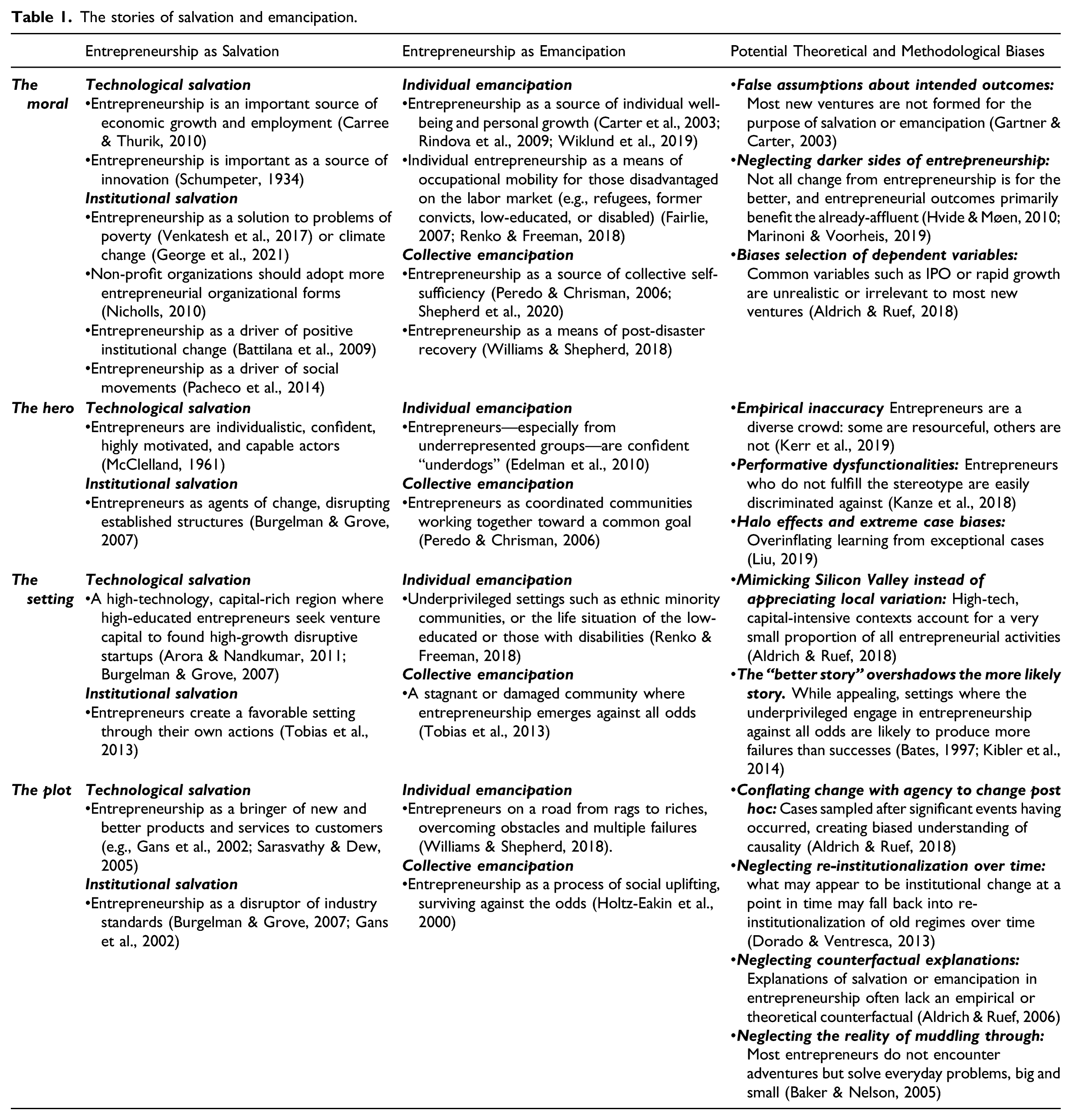
The Moral of the Salvatory and Emancipatory Stories
The Moral of Salvation
When the story of entrepreneurship as salvation is told from a technological perspective, the moral is that entrepreneurship should be encouraged and studied because of its positive impact on the economy. For example, it can help in terms of job creation (Audretsch & Thurik, 2001), innovation (McKelvie et al., 2018), or economic growth (Delmar et al., 2003; McKelvie et al., 2017).
When the story is one of institutional salvation, the moral is similar, yet broader, encompassing institutional as well as economic change. Examples include welfare (Nicholls, 2010), poverty and rural development (Venkatesh et al., 2017), or climate change (York et al., 2016). The moral of this story has been impactful. Policymakers have made large investments in supporting entrepreneurship based on the assumption of its salvatory power. It has stimulated NGOs to implement entrepreneurial methods to address the grand challenges of our time. It has also helped to generate research funding, and to construct entrepreneurship as an important field of research (Aldrich, 2012).
The Moral of Emancipation
In the story of entrepreneurship as emancipation, entrepreneurship is described as a means for individual or collective self-realization or self-sufficiency. It is salient in entrepreneurship research, teaching, and public policy, where entrepreneurship is encouraged as a tool for individual well-being (Carter et al., 2003; Rindova et al., 2009; Wiklund et al., 2019), or as a way to earn a living for those who are disadvantaged within the labor market (Fairlie, 2007; Renko & Freeman, 2018). We can trace the origin of this moral in political and social ideals of individualism, where the pursuit of personal dreams, aspirations, self-sufficiency, and individual enquiry is emphasized (Tedmanson et al., 2012).
When told as a story of collective emancipation, the moral is that groups of individuals, whose joint engagement in entrepreneurship can bring about collective self-worth and self-sufficiency, often in settings such as deprived villages (Peredo & Chrisman, 2006) or refugee camps (Shepherd et al., 2020). This moral is strongly rooted in social science theories of positive social change (Spinosa et al., 1999) and theories of institutional change as stemming from individual or collective agency (Dorado & Ventresca, 2013). It has also been influential. For example, in public policies encouraging the unemployed or disadvantaged on the labor market to start businesses, and in policies seeking to restore wealth and self-sufficiency for declining rural areas (West et al., 2008).
Moral Biases in Entrepreneurship as Salvation or Emancipation
There is no doubt that entrepreneurship can hold both salvatory and emancipatory power. However, by presenting entrepreneurship as inherently desirable and good, research risks introducing theoretical and methodological biases, as well as ignoring assumptions regarding the motivations and intended outcomes of venturing efforts.
Simplified Assumptions About Intended Outcomes
The story of entrepreneurship as an activity purposely pursued to achieve technological or institutional change is intriguing—but overall, not empirically correct. The vast majority of new businesses do not seek to make it big, and even among those that do seek growth, founders are reluctant to accept outside investments (Aldrich & Ruef, 2018). While many ventures claim novelty, genuinely new business ideas are few and far between (Samuelsson & Davidsson, 2009). Even among those innovative ventures that do have grand goals of industrial disruption or social change, most fail—and few are able to address the grand challenges they set out to solve (Aldrich, 2015).
Neglecting the Darker Side of Entrepreneurship
It is important to recognize that not all change is for the better, and that not all change benefits everyone (Shepherd, 2019). Take the gig economy. Its story can be told as one of technological salvation. The gig economy has brought wealth to platform owners, enhanced utility to customers, and created jobs for groups previously unemployed. However, it is also criticized for exploiting workers, and for shirking legislature facing established companies. So does the gig economy represent productive or destructive entrepreneurship (Baumol, 1990)?
Similar problems arise in the story of entrepreneurship as emancipation. We readily recognize that entrepreneurship can be pursued for the purpose of emancipation (Rindova et al., 2009), economic independence (Fairlie, 2007), self-realization (Carter et al., 2003), or well-being (Wiklund et al., 2019). However, such good intentions are rarely fulfilled. Most entrepreneurs never get to cash in, and instead earn less than comparable employees in paid work (Åstebro, 2012), as do their employees (Burton et al., 2017). Instead of enjoying improved well-being, many entrepreneurs, as well as their family members, experience negative stress and anxiety, including reliance on psychosomatics (Dahl et al., 2010; Hessels et al., 2017). Among those that do depart from the status quo and seek to initiate change, many end up disappointed or depressed (Jennings et al., 2016). Entrepreneurs are also exposed to weaker social security and need to save for retirement and healthcare (Hessels et al., 2006; Marlow, 2006). As entrepreneurs grow older, fall ill, or have children, or as the demand for their products or services wanes, many discover that self-realization comes at a greater cost than they thought.
In stories of collective emancipation, which typically describe entrepreneurship in deprived conditions, studies similarly tend to focus on positive outcomes, and ascribe those outcomes to both individual and collective agency during the entrepreneurial process. Rarely, however, are counterfactual examples provided, or comparisons with differences in agency or entrepreneurial outcomes in alternate contexts (Safford, 2009).
Biases in the Selection of Dependent Variables
The stories of entrepreneurship as salvation and emancipation also come with methodological problems, in that they risk sampling on the dependent variable, or failing to consider alternate outcomes (Shepherd et al., 2019). Much research continues to provide minor variations on the same old stories of new venture creation, entry into self-employment, or firm growth (Berglund & Wennberg, 2016). Along similar lines, there tends to be a primary focus on the entrepreneurial afterparty of selling the venture for profit or conducting an initial public offering (IPO).
The over-emphasis on variables such as new venture creation, self-employment entry, IPOs, or capital investments may partly be a function of data access or data availability. Finding new ventures or startup attempts at a particular point in time is easier than studying entrepreneurial behavior or the evolution of startups in any great depth (Davidsson, 2004). Many studies sample ventures that have conducted an IPO, since they can be identified in public data, and trace back their histories. This is problematic, because such outcomes are not relevant for most new ventures. IPOs are dependent on the ebbs and flows of financial markets and are also becoming less prevalent (Cumming, 2012). Moreover, because most new venture will not get anywhere near the scale required to consider an IPO, this approach embodies survivorship bias.
To understand the multifaceted nature of entrepreneurship, its predictors, processes, and outcomes, we believe research would benefit from paying less attention to spectacular (but rare) events. Instead, we encourage research to pay attention to the broader set of plausible outcomes from the processes being studied.
The Hero in Entrepreneurship as Salvation and Emancipation
The Salvatory, Emancipatory Hero
The hero figure of the salvatory and emancipatory stories is highly motivated, capable individuals (McClelland, 1961), or a collective with similar qualities whose heroic efforts help the group rise from a dire situation (Johnstone & Lionais, 2004). They act with confidence and superior judgment (Foss & Klein, 2012), and they challenge the status quo (and, surprisingly often, change it too). In more contemporary research, this image prevails in stories of entrepreneurs as “disruptors” (Burgelman & Grove, 2007) relying on a quick “burn rate” (Block et al., 2018) and on “rare foresight” (Mosakowski, 1998).
The salvatory, emancipatory hero aligns strongly with liberal and individualistic ideals. In the early words of (Schumpeter, 1934), the entrepreneur is a “man of action” (Mann der Tat). Even though this image has been criticized in research (e.g., Nicholson & Anderson, 2005; Ogbor, 2000), it is still widely adopted outside academia. In the popular press, entrepreneurs are celebrated as potential saviors who project novel visions and bring new technology. The same image is also frequently adopted by governments and NGOs seeking to enhance economic vibrancy or rejuvenate civil society.
Heroic Biases in the Story of Entrepreneurship as Salvation and Emancipation
Empirical Inaccuracy
Despite decades of attempts to identify common personality traits among successful entrepreneurs, they have turned out to be a rather diverse crowd (Kerr et al., 2019; Rauch & Frese, 2007). Some are brilliant, others not (Levine & Rubinstein, 2017). Some are determined, others easygoing. Some are meticulous, others are action-oriented (Yu et al., 2021).
The salvatory, emancipatory hero certainly represents a positive image of human beings and their capacity. We believe, however, that it is too simplistic. Not only are most entrepreneurs average—that is, not exceptional—individuals, but they also operate under constrained agency (Lounsbury & Glynn 2019) in that they are highly dependent on support from external actors. This includes partnership organizations, potential investors, and—at least in the initial stages—unpaid help from family and friends (Kim et al., 2013). This dependence constrains the agency of individual founders, since each of these different actors comes with particular objectives and perspectives to which the entrepreneur needs to adapt (Marlow, 2006). Collapsing the heterogeneity of entrepreneurs, including whom they depend on, into a single narrative persona may create more problems than it solves. In particular, it may contribute to attribution errors by inferring outcomes from selective stable dispositions or traits (being male, having a specific personality profile, etc.).
Performative Dysfunctionalities
The hero figure in the salvatory, emancipatory story has problematic performative implications. Entrepreneurs are dependent on whether external stakeholders perceive them as legitimate, trustworthy, and authentic (Chen et al., 2009; Garud et al., 2014; Gino et al., 2020). Without a proven track record, nascent entrepreneurs need to fulfill stakeholders’ expectations of how entrepreneurs should look, talk, and act: being the Man of Action that stakeholders expect. This easily leads to problems of statistical discrimination, whereby stakeholder support is weakened for individuals who do not fulfill expectations in terms of gender (Ahl & Marlow, 2012; Kanze et al., 2018), communication style (Gino et al., 2020), or demographic group (Blanchflower et al., 2003).
At the individual level, problems of discrimination lead to personal losses and broken dreams. At the societal level, this means opportunities lost. The Man of Action hero-figure also leads to crowding-out effects: Entrepreneurs who happen to fit the Man of Action image are readily over-supported by media, investors, and public support systems alike (e.g., Lounsbury & Glynn, 2019; Malmström et al., 2017).
Halo Effects and Extreme Case Biases
By depicting entrepreneurial actors as independent, heroic figures, the salvatory and emancipatory stories risk overinflating learnings from exceptional cases where luck may be a strong explanatory variable (Liu, 2019). In qualitative work, this creates potential halo effects in inferring observations from one case to other, even when they are not related. In quantitative studies, a focus on extreme cases often introduces biased inference.
The Setting in the Story of Entrepreneurship as Salvation and Emancipation
The Setting of Technological Salvation
In the story of entrepreneurship as technological salvation, the setting is typically a high-technology, capital-rich region where highly educated entrepreneurs seek venture capital to found high-growth disruptive startups. For example, the Stanford Project on Emerging Companies (SPEC) in Silicon Valley is often used as a role model for entrepreneurship research. The specificities of Silicon Valley at large have also had major impact on entrepreneurship teaching and policy (Finkle, 2012). More recent research in “The Valley,” however, shows that strong venture capital infusion not only increases entrepreneurship in non-tradable goods and services but also simultaneously decreases entrepreneurship in other industries, and sharply exacerbates income inequality (Sorenson & Kwon, 2021).
The Silicon Valley type of setting in the story of technological salvation is a context portrayed in business magazines, blogs, movies, and books describing “people who prosper in ambiguity, innovation, and risk taking” (Finkle, 2012:874). It is a type of cultural ideal that has become global (Saxenian, 2007). We do not contend the validity of this representation; it may describe this type of context quite accurately. Yet, it is well established that Silicon Valley is quite a unique setting for entrepreneurship, and not easily generalizable to other contexts (Scheidgen & Brattström, 2021; Welter & Gartner, 2016).
The Setting of Institutional Salvation and Individual or Collective Emancipation
The setting of the other story variants is often an underdog setting. In the story of individual emancipation, it concerns individuals with some sort of labor-market disadvantage, such as those with (often milder) psychological disorders (Cooney, 2012; Wiklund et al., 2016), ethnic minority groups, former convicts, or the low-educated (Fairlie, 2007; Renko & Freeman, 2018; Yu et al., 2021).
In the stories of entrepreneurship as institutional salvation and collective emancipation, the setting is an unfavorable context which entrepreneurs themselves improve through their actions. For example, in stories of institutional entrepreneurship, entrepreneurial actors create new types of institutions (Battilana et al., 2009). In stories of entrepreneurship as collective emancipation, actors rise from the ashes through entrepreneurship to create a more favorable context for themselves and their kin (Williams & Shepherd, 2018).
In contrast to the setting of technological salvation, the settings of stories of collective salvation or individual or collective emancipation are not cultural ideals, as they often describe post-catastrophic zones or deprived communities. Instead, stories emanating from such settings tend to draw inspiration from themes in narrative and written culture characterized by “gloom but in need of hope and salvation,” such as those often found in religion and popular culture. These are settings of despair and resource scarcity where somehow people need to “get their act together” and work together for a common cause.
Setting Biases in the Story of Entrepreneurship as Salvation and Emancipation
Mimicking Silicon Valley Instead of Appreciating Local Variation
The Silicon Valley setting is mimicked across the globe in public policy, research, and entrepreneurial practice. Policymakers assume education, technology, venture capital, and US-based social institutions as necessary and sufficient ingredients of success (Hwang & Powell, 2005; Pfeffer, 2001). In entrepreneurship research, scholars assume venture capital funding and technological novelty as common ingredients (Aldrich, 2009; Welter, 2011). In entrepreneurship practice, entrepreneurs adapt blueprints of cultural behavior they think are functional in nature, but often have limited correlation to success (Lounsbury & Glynn, 2019). In lieu of alternative settings, Silicon Valley thus performatively shapes the expectations of policymakers, scholars, and entrepreneurs alike (Welter & Gartner, 2016).
While undoubtedly important, Silicon Valley and similar regions around the world account for only a tiny fraction of entrepreneurial activities, even among high-growth businesses (Aldrich & Ruef, 2018). By adopting the Silicon Valley story in other contexts, research is at risk of ignoring local variations in types and prevalence of local forms of entrepreneurship, as well as its predictors, processes, and outcomes (McKelvie et al., 2021; Scheidgen & Brattström, 2021).
The Better Story Stands in the Way of the More Likely Story
The setting of entrepreneurship as institutional salvation, or of individual and collective emancipation, faces a different problem. Here, the setting of the underdog is so appealing from a storytelling perspective that we forget to tell the stories that are perhaps more likely to emerge from these types of settings. The vast majority of successful entrepreneurs are those with high education and who were quite wealthy to begin with. Others tend to do worse, or at least no better (Hvide & Møen, 2010; Marinoni & Voorheis, 2019). The underprivileged, stagnant, or otherwise problematic settings of underdog entrepreneurs rarely produce the success stories that we like to read about (Webster & Haandrikman, 2022). Instead, these settings produce precisely those types of groups that are overrepresented among impoverished and failed entrepreneurs (Delmar & Wennberg, 2010; Fairlie, 2007).
Stories of positive social change and enhanced self-sufficiency are indeed important and may generate practical insights into how such change may come about. However, they ignore the fact that post-catastrophe zones and deprived communities tend to suffer from decreased social capital and out-migration, and that downward spirals predominate over positive change (Putnam, 2001; Safford, 2009).
The Plot in Entrepreneurship as Salvation and Emancipation
The Salvatory and Emancipatory Plots
In both the salvatory and emancipatory stories, the plot is one where a new venture is created and expands (ideally rapidly), and the entrepreneur eventually cashes out or lives happily ever after (Arora & Nandkumar, 2011). Often, new ventures are depicted as disruptors of industry standards and as bringers of new and better products and services to customers (e.g., Gans et al., 2002; Sarasvathy & Dew, 2005). This plot typically unfolds according to two interrelated narrative patterns. One is where the entrepreneur moves “from rags to riches” (Fairlie, 2004), including studies that accentuate the hardship of entrepreneurship and how it is overcome through ingenuity and hard work (Williams & Shepherd, 2018). The other is “progression through adversity,” where entrepreneurs have to overcome severe obstacles on their way to success. Examples include work on serial entrepreneurship and learning from failure (Toft-Kehler et al., 2014), including popularized theories of “fail fast” (Ries, 2011).
The plots of rags to riches and progression through adversity are as old as storytelling itself. We recognize them in a diversity of settings, from the Grimm brothers’ Cinderella to David’s fight with Goliath the giant. The plot is intriguing, prompting the reader’s interest and engagement with the story, which helps to emphasize the moral (work hard and fortune will come). The story of rags to riches can also be recognized in modern cultural ideals, such as the American Dream. As Sarachek (1978) pointed out, the popular view of American entrepreneurship has been intimately connected with the Horatio Alger myth, where courageous and hard-working young men create a respectable position for themselves (Smith & Neergaard, 2007).
Biases of the Salvatory, Emancipatory Story Plots
Conflating Change with Agency to Change Post Hoc
The “progression through adversity” plot has a strong causality problem: it risks conflating change with agency to change post hoc (Kalantaridis & Fletcher, 2012). For example, in the story of entrepreneurship as institutional salvation, researchers highlight a plethora of conditions under which entrepreneurs and their ventures enact moral-emotional strategies (Barberá-Tomás et al., 2019), fight illegitimate institutions (Sutter et al., 2013), or act collectively to make institutions more prosocial or sustainable (Thompson et al., 2015). Such stories often sample cases after some change in the institutional context has been observed (but not always its outcomes), relying on archival or field data to backtrack those changes as emanating from new ventures’ networking strategies (Sutter et al., 2013) or their institutional work (Thompson et al., 2015).
Similar problems exist in the technology perspective of entrepreneurship as salvation, where the “the Davids” (new ventures) take on “the Goliaths” (current rules, regulations, and taken-for-granted conditions of exchange that favor incumbent organizations) and thereby enact some type of change. Scholars have long criticized such stories of institutional change, which portray institutional entrepreneurship in heroic terms (Suddaby et al., 2010)
Neglecting the Possibility of a Return to the Status Quo
What further accentuates this causality bias is that published work tends to document the successful enactment of change in some dimensions, neglecting dysfunctionalities in other dimensions of time or space. For example, in studies of collective salvation, whereby entrepreneurs or groups of entrepreneurs bring about positive changes in the institutional context, research depicts some identified change as “the end” of the story. However, what may seem at institutional upheaval or change at a snapshot in time may often become re-institutionalized in extant regimes when investigated over time (Khavul et al., 2013).
Neglecting the Counterfactual
The progression through adversity plot also brings problematic causal assumptions, in the sense that it often lacks a scientific or narrative counterfactual and creates bias in variable selection. Some claim that failure is a good thing, since there is learning from failure. When scrutinized systematically, however, it is hard to distinguish who learns and who does not, under what conditions, and how many failed ventures are needed for someone to eventually learn (Parker, 2013; Toft-Kehler et al., 2014; Yin et al., 2019). For every rag to riches tale, there are many more highly educated, upper-middle-class entrepreneurs who become much more successful (Halvarsson et al., 2018; Hvide & Møen, 2010; Levine & Rubinstein, 2017). For every prosocial venture, there is an unknown number of ventures taking the chance to exploit others (Stark, 1996; Tonoyan et al., 2010). For every serial entrepreneur claiming they have learned from past failures, we lack alternative stories of the prevalence and costs of failure of those who never make it back on to the playing field. The majority of serial entrepreneurs run erratically performing firms (Parker, 2013), and those who do improve performance over time seem to be dependent on slowly accumulating knowledge about industries and social settings that they gradually learn to call their home turf (Toft-Kehler et al., 2014; Yin et al., 2019). Within every conflict in an entrepreneurial story, there is often a counterfactual story to be told.
Neglecting the Mundane Reality
The plot in the stories of entrepreneurship as salvation or emancipation is more exciting than empirically accurate. Most new ventures do not overcome great adversity, battle giant competitors, or break through major obstacles. Neither do they spectacularly “crash and burn”. Instead, they develop quite erratically (Daunfeldt & Halvarsson, 2015). They solve some problems, most of which are small. They experience small-scale successes and setbacks. They take two steps forward and one step back. Instead of cashing out, they continue. Instead of achieving stratospheric growth, most new ventures—even well-funded hi-tech ones—reach a plateau, and must seek new pathways to move forward (Garnsey et al., 2006).
Research Agenda: Alternative Stories to Tell
Alternative stories and their theoretical and methodological implications.
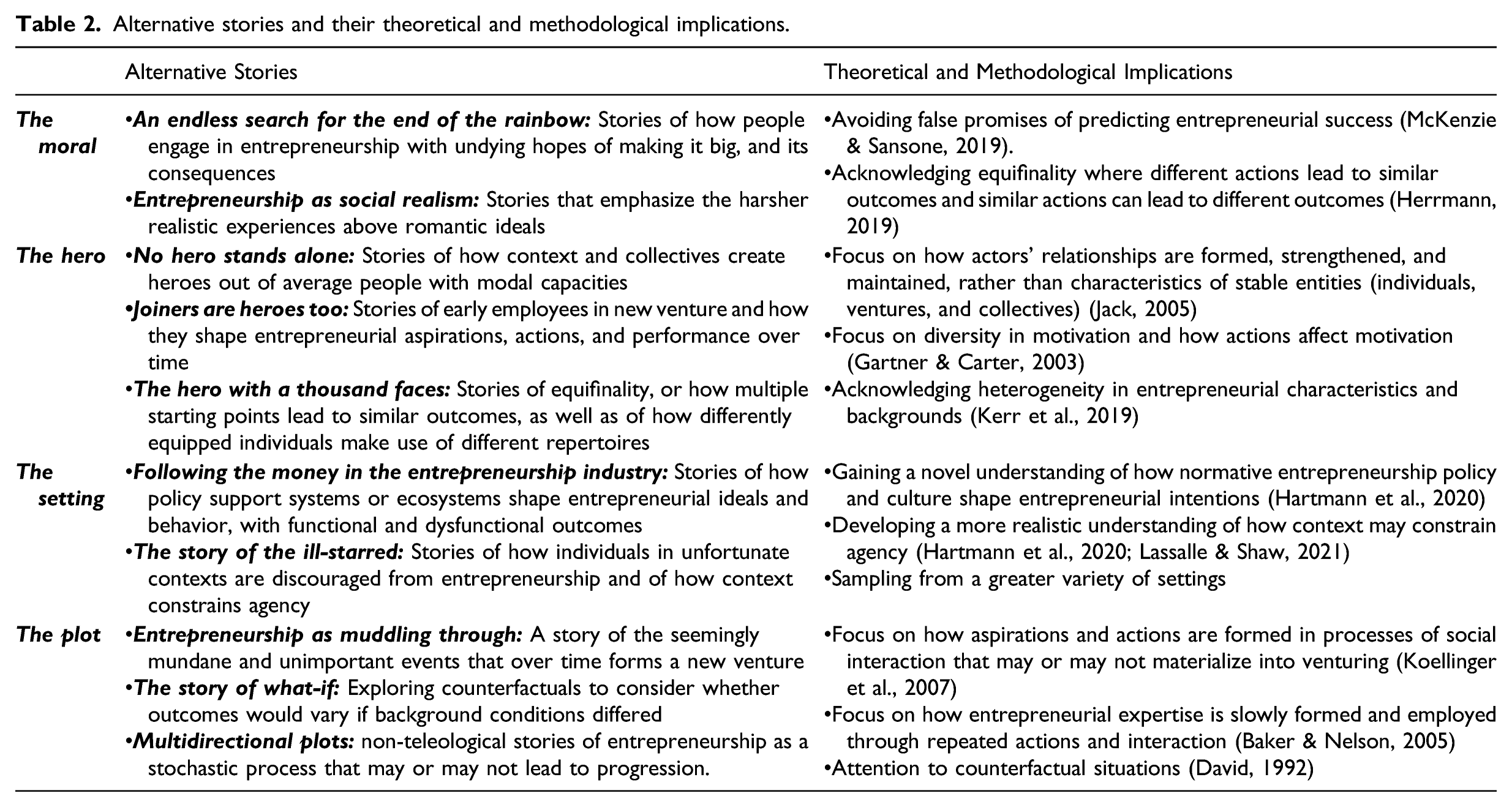
Alternative Morals
The story of salvation and emancipation frames entrepreneurship as a noble quest that exalts both entrepreneurs themselves and the society in which they are embedded. By proposing a different moral, we encourage the telling of two alternative stories.
An Endless Search for the End of the Rainbow
What happens to entrepreneurs who never attain the well-being and personal growth they initially intended, but still dream of making it big one day? Where do they find hope? How do they cope with failure? Telling their story would be different from telling the story of either success or failure, because it would be a story of endless trials. This would be a story that acknowledges that the road to success is paved with a great deal of luck. This means that entrepreneurs who fit the criteria and who do everything right might nevertheless fail, simply because they lack the stroke of luck of their more successful counterparts. The moral of this story would be one of entrepreneurship as a gamble: a risky game that some cannot stop playing, despite mounting losses. What keeps entrepreneurs at the table?
Entrepreneurship as Social Realism
The stories of entrepreneurship as salvation and emancipation are romantic. They offer an escape from our everyday situations, whether that is the stagnation of incumbent companies or the starvation of poor communities. They inspire organizations and individuals to think: What if that was me? What if this miracle happened in my context? The problem, as pointed out, is twofold. The variables offered are simply irrelevant to most new ventures; and we need stories that tell us more about the darker, destructive, and more depressing sides of entrepreneurship.
In place of escapist romance, we suggest telling more realistic stories of entrepreneurship—those where the moral is “look before you leap,” or “be careful what you wish for”. Such stories would acknowledge the everyday struggles and obstacles faced by entrepreneurs, in both favored and unfavored institutional contexts—and point out that such struggles are rarely overcome. This could include, for example, stories of entrepreneurship not as a choice, but as a necessity for individuals who are discriminated against in other sectors of the labor market. In these cases, a positive performance variable would be entrepreneurial exit and employment entry. These could also be stories of entrepreneurs who fail to save for retirement, and end up poor and forgotten; those who suffer burnout due to their hard work, but have little social security; or those who start families but cannot take parental leave. Telling these stories would involve taking an honest look at the long-term consequences of engaging in entrepreneurship for the individuals involved, beyond the more immediate success or failure or their ventures. Undoubtedly, these stories would be less entertaining and inspiring—but they would perhaps be more genuinely edifying, by offering a more realistic understanding of plausible entrepreneurial outcomes over time.
Alternative Heroes
The salvatory, emancipatory hero figures are confident, agentic, and coordinated individuals or collectives. By proposing alternative hero figures, we encourage the telling of different stories.
No Hero Stands Alone
Studying the Man of Action implies focusing on stable entities—individual traits or the composition of new venture teams—implicitly assuming correlations between variables identified ex ante. If we acknowledge that most entrepreneurs are average people with average capabilities, and that they seldom work alone but in collaboration with helpers, joiners, or co-founders, the focus shifts: from stable entities to dynamic relationships (Brattström et al., 2020). Instead of identifying entrepreneurial traits, we could tell the story of how actors’ relationships are formed, strengthened, and maintained. How are entrepreneurs collectively created? Whom do they draw upon for social and material support, and why (Hite, 2005; Jack, 2005)? How are entrepreneurial aspirations formed in a process of social interaction? How do social norms governing what is seen as socially desirable and appropriate shape our view of the entrepreneurial hero? We believe that such an approach could generate a better explanation of entrepreneurship and be open to more unpredictable or counterintuitive outcomes, instead of making false promises of predicting entrepreneurial success on the basis of stable characteristics (McKenzie & Sansone, 2019).
Joiners are Heroes Too
The story of how collectives create heroes would also imply paying increased attention to joiners. Joiners are those who work for a startup but do not qualify as founders—that is, individuals with decision-making authority over the new venture. Joiners are often forgotten. In the most common definition of new venture teams (i.e., Klotz et al., 2014), joiners are not even considered to be relevant members of the team even though for most new ventures, joiners are vital. They bring valuable skills, experiences, and expertise. They come with aspirations and dreams. Joiners have often accepted working at a lower salary for a new venture because they are attracted to the idea of working in an entrepreneurial context (Roach & Sauermann, 2015). We suggest it is time to tell their story. Who are they? What do they aspire to? Why do they work so hard in pursuit of someone else’s entrepreneurial dream? Why do they stay with the new venture over time, despite having no substantial equity share, a low salary, and a high likelihood of failure? By telling the story of the joiners, we can learn new things about new venture teamwork, new venture team composition, and new venture team performance. Importantly, we can also learn important things about the joiners themselves.
The Hero With a Thousand Faces
Instead of assuming a Man of Action, we suggest that entrepreneurship scholars embrace the assumption that entrepreneurial action and entrepreneurs are highly heterogenous. Moreover, the complexity of social processes such as entrepreneurship often means that there may be multiple starting points leading to similar outcomes—that is, equifinality (Douglas et al., 2020). This implies that differentially equipped individuals may use different repertoires when engaging in entrepreneurship, yet they may end up in similar situations or reach similar accomplishments.
When telling the story of the hero with a thousand faces, scholars would look for individual variation, instead of ideal types. Scholars might choose to draw attention to individuals who fall outside the social norms of what and who an entrepreneur is supposed to be (Kerr et al., 2019). For example, how do introverts or individuals with low-self efficacy pursue entrepreneurship? Perhaps in a more cautious and meticulous way than extroverts or individuals with high self-efficacy?
Breaking free of the Man of Action also implies a focus on gender in mainstream research—in addition to the important work being done in the domain of female entrepreneurship research (Ahl & Marlow, 2012; Yang & Aldrich, 2014). For example, much economic entrepreneurship research simply samples men since they are disproportionally active as entrepreneurs (Folta et al., 2010). In doing that, assumption of entrepreneurship as a masculine activity is recreated. Entrepreneurship research at large could problematize the Man of Action storyline by, for example, looking at variability in gender-related leadership styles and behaviors among both men and women, and how differences and commonalities in identity and identity construction among nascent entrepreneurs propagate (or not) masculine norms of behaviors (Leitch & Harrison, 2016) or affect the division of labor in mixed-sex ventures (Yang & Aldrich, 2014).
Alternative Settings
Much scholarship of late has articulated the need to better contextualize entrepreneurship research (Welter & Gartner, 2016; Zahra, 2007). Building on this prior work but focusing specifically on storytelling, we were able to identify specific problems in terms of how the settings of salvation and emancipation narratives are portrayed. In stories of technological salvation, the setting is most often the world of the privileged: high-technology, capital-rich, and urban. In the stories of institutional salvation, as well as individual and collective emancipation, the setting is primarily that of the underdog: areas populated by the underprivileged, such as prisons, post-catastrophe zones, or stagnant communities. By proposing other settings, we identify alternate stories.
Following the Money in the Entrepreneurship Industry
As we have pointed out, a problem with the Silicon Valley type of setting is its performative implications. As a consequence of policymakers mimicking Silicon Valley, we have seen the growth of an entrepreneurship industry: “the goods and services explicitly intended for opportunity discovery and development by current and prospective entrepreneurs” (Hunt & Kiefer, 2017: 231). Given its significance, it is time we tell more stories of the entrepreneurship industry. Which individuals are attracted to the promises of the entrepreneurship industry? What types of cultural norms are fostered in the entrepreneurship industry, and why? How do cultural norms, incentives, and policy instruments shape entrepreneurial tools, entrepreneurship education, and entrepreneurs’ aspirations (Hartmann et al., 2020)? Who is making money off entrepreneurs, and ideas about entrepreneurialism? Are ideas being perpetuated because they make money for people who are not even “real” entrepreneurs themselves (that is, their only product is advice for entrepreneurs)?
Such questions are important, because they imply a shift in analytical focus on cause and effect: from how to create favorable entrepreneurial conditions by mimicking entrepreneurial context, to how such mimicking shapes entrepreneurial activities and outcomes.
The Story of the Ill-Starred
The salvatory, emancipatory story assumes agency over context. By strong will and hard work, individuals can overcome the most unfortunate conditions. In reality, though, those unfortunate enough to be situated in unfavorable conditions are more likely to fail than to succeed, no matter how hard they work. We suggest telling the story of entrepreneurship in unfavorable conditions, without ignoring those frequent non-happy endings. For example, instead of telling the story of how minority entrepreneurs overcome problems of discrimination through hard work, we suggest telling the story of how problems of discrimination discourage minorities from even trying (Neville et al., 2018). At what point do less advantaged people give up their entrepreneurial dreams? How do collective illusions or disillusions emerge and become established in populations over time?
We do not suggest telling this story because we are particularly gloomy about the capacity of individuals and collectives to break free from constraining conditions. But unless we fully acknowledge the constraints of structure on agency, our understanding of entrepreneurship as a salvatory, emancipatory force will be inherently incomplete.
Alternative Plots
The story of entrepreneurship as salvation and emancipation offers an inspiring plot of entrepreneurs rising from rags to riches, often through adversity and against all odds. Altering this plot could imply telling the following alternate stories.
Entrepreneurship as muddling through. In a famous essay, Lindblom (1959) formulated “the science of muddling through” as a critique to an over-rational view of managerial action. He argued that managers are primarily occupied with attending to everyday problems, goals, and outcomes, rather than making long-term strategic plans and root-cause analyses. In everyday problem-solving, means and ends are closely intertwined. If entrepreneurship research would also invoke stories of muddling through, the perspective would be on everyday action: the modal and often mundane, rather than the exceptional (Gartner et al., 2016). For example, how are aspirations formed over time, through everyday action and interaction? How do social norms emerge in new venture teams over time, and how do such norms shape emergent states and team processes?
A focus on the everyday and seemingly mundane does not mean a lack of theoretical or practical importance. Expertise is known to develop from repetitious action and problem-solving (Yin et al., 2019). Yet, knowledge of entrepreneurial expertise, how it is formed and employed successfully or unsuccessfully through repeated action and interaction remains by and large unexplored.
The Story of What-If
Considering whether events could turned out differently given some minor variation in background conditions is a basic argument of any counterfactual reasoning (Durand & Vaara, 2009). What if the entrepreneur in our study had been female instead of male? Old instead of young? Would she have encountered the same obstacles, and made the same decisions? Since a common problem in the salvatory, emancipatory stories of entrepreneurship is that they often lack a counterfactual reasoning, we suggest telling the story of what-if.
Multidirectional Plots
The plot of “rags to riches” is a unidirectional one. Entrepreneurs start low and progress to a higher state of being. They move from poor to rich; from unhappy to happy; from victimhood to empowerment. We suggest telling plots that go in other directions too. What about entrepreneurs who start out rich, but end up poor? Who maintains the status quo? Who oscillate between periods of well-being and periods of depression? In short, we encourage telling stories that are less teleological. For every rags to riches tale, we need to tell the story of another entrepreneur who struck out or went broke. For every triumph over adversity, we need to tell the story of someone who sailed through—and someone else who never left the harbor.
Conclusion
We offer a framework to analyze research from a storytelling perspective by breaking down academic storytelling in terms of moral, hero, setting, and plot. Applying this framework to two narrative archetypes that dominate mainstream entrepreneurship research (entrepreneurship as technological/institutional salvation, and entrepreneurship as individual/collective emancipation), we identify implicit assumptions and theoretical biases that non-reflective usage of such stories may easily generate in the research field of entrepreneurship. We use the storytelling framework to articulate alternative stories that entrepreneurship scholars could also tell.
Our purpose is not to suggest that the mainstream stories are irrelevant, nor that all entrepreneurship research confirms to one of these archetypes. No single study, and no single storyline, can provide an encompassing view of the complex predictors, processes, and outcomes of entrepreneurship. However, we believe that because the stories of salvation and emancipation are so prevalent, they demand critical reflection. We have advanced the argument that these mainstream stories are problematic because they come with epistemological assumptions (e.g., the role of agency), methodological biases (related to sampling and inference), and problems of inferred causality (choice of context and consideration of counterfactuals). We hope that the researchers who tell these stories will find our framework useful in reflecting on what research they do, and how they do it. Much of the work we have criticized is research in the same tradition to which we ourselves belong. The storytelling perspectives we describe helped us see the biases in this research, as well as the potential for future improvements. We hope that others will find them useful too.
We also do not intend to suggest that the alternative stories we propose are without biases, nor that they represent an exhaustive list of stories that should be told. Indeed, many of the storylines we suggest are inspired by existing scholarship in the fields of entrepreneurship-as-practice, entrepreneurship and context, or the darker sides of entrepreneurship. We hope that with the help of our framework, mainstream scholarship will be in a position to more easily identify the value and benefits of non-mainstream perspectives on entrepreneurship, so that entrepreneurship research can continue its development into a diverse, rich, and multifaceted field.
Footnotes
Acknowledgments
We are grateful to Mats Alvesson, Frederic Delmar, Dimo Dimov, Sarah Jack, the editor, and the anonymous referees for constructive comments on prior drafts. Generous funding was provided by Ragnar Söderberg Foundation. Potential errors and lapses are ours alone.
Declaration of Conflicting Interests
The author(s) declared no potential conflicts of interest with respect to the research, authorship, and/or publication of this article.
Funding
The authors disclosed receipt of the following financial support for the research, authorship, and/or publication of this article: Generous funding was provided by Ragnar Söderberg Foundation. Potential errors and lapses are ours alone.
