



Abstract
In the context of the external disruption presented by the COVID-19 pandemic, we investigate (1) how individual-level resilience and inter-functional coordination relate to organizational resilience and (2) the link between organizational resilience and firm performance. We view organizational resilience as a resource-based capability and draw on insights regarding psychological capital and relational resources to inform our hypotheses. Our hypotheses are tested with a time-lagged, multi-level study of young technology ventures. The results show that when such firms are resilient, they tend to perform significantly better in a crisis. Further, organizational resilience is positively influenced by the individual resilience of top management team members, as well as inter-functional coordination. We discuss implications for theory and practice and suggest avenues for research on resilience in entrepreneurship.
Keywords
Introduction
Organizations can sometimes be exposed to external disruptions that are difficult to anticipate or prepare for (Williams & Shepherd, 2016). One such event occurred in early 2020, when the novel coronavirus disease (COVID-19) was declared a pandemic, spreading rapidly and triggering a global crisis (Giones et al., 2020). This quickly led to efforts to better understand how resilient individuals, organizations, and even nations might cope more effectively with, and recover from, adversity. Our interest lies with young ventures because they are highly likely to be impacted by external events (Doern et al., 2019), and COVID-19 has the potential to be particularly disruptive for such organizations (Brown & Rocha, 2020; Giones et al., 2020).
As explained by Williams et al. (2017), resilience is the process by which either an individual or organization develops and leverages its capability endowments to interact with adverse disruptions. Consistent with this view, we follow Ortiz-de-Mandojana and Bansal (2016) to define organizational resilience as a set of capabilities that equip it with tendencies that can facilitate its reaction to unexpected disruptions. Conceptually, resilience can be developed by capitalizing on the cumulative psychological strengths of human capital in the firm (Lengnick-Hall et al., 2011). One example of this psychological strength or capital is individual-level resilience. Surprisingly however, there is little empirical evidence to support Lengnick-Hall et al.’s (2011) multi-level argument, with Linnenluecke (2017, p. 25) observing there are “few insights into how these different levels of analysis are linked to each other.”
Discussions on resilience also tend to emphasize positive adjustments made by the firm under adversity; adjustments involving effective coordination and knowledge integration (Lengnick-Hall & Beck, 2005; Williams et al., 2017). This reflects the potential role of a firm’s internal relational resources (De Clercq et al., 2016) and in particular, relational coordination. Relational coordination entails effective communication and integration across roles and functions and is argued to be central to an organization’s resilient response to adversity (Gittell, 2008). Yet, although some entrepreneurship scholars explore the role of relationships in addressing challenges at the community level (Grube & Storr, 2018; Shepherd & Williams, 2014), there is limited understanding of how relational, that is, inter-functional, coordination might benefit young firms during a crisis.
Following from the above, our research is guided by two questions set in the context of the COVID-19 pandemic. First, do resource endowments in the form of individual resilience and inter-functional coordination make young ventures more resilient? Second, does organizational resilience influence the performance of young ventures during a crisis? Our view of organizational resilience follows Chandler and Hanks (1994) arguments regarding the capabilities of new ventures. We therefore conceptualize organizational resilience as a resource-based capability, driven by psychological capital and relational resources. Specifically, we first propose that individual-level resilience—one form of psychological capital—is central to the development of firm-level resilience. To then account for within-firm communication and relationships (Gittell, 2008; Gittell et al., 2006), or relational resources, we argue that inter-functional coordination enhances organizational resilience. Finally, we reason that organizational resilience enables young ventures to mitigate the performance impact of an external adverse disruption.
Our research reports on data collected from 111 top management team (TMT) members in 65 young technology ventures based in Canada. It was collected over two time periods: (1) in the year before the initial emergence of COVID-19; and (2) in the first year of the pandemic. Our findings show that both individual resilience and inter-functional coordination have a significant and positive effect on organizational resilience. Further, organizational resilience significantly and positively affects firm performance. These findings, as well as our conceptualization and testing of organizational resilience as a resource-based capability, help advance entrepreneurship research on resilience. We also build on single-level studies with a multi-level and time-sensitive analysis, contextualized by a significant external shock.
Theoretical Background
Linnenluecke (2017) argues that the concept of resilience is inconsistently conceptualized and operationalized. Resilience also pertains to both individuals and organizations, yet prior research tends to emphasize the former, that is, “individual” resilience. For example, studies show that individual-level resilience can help navigate uncertainty (Bullough & Renko, 2013), and it has a positive influence on the perceived success of entrepreneurs (Santoro et al., 2018). Individual resilience also develops entrepreneurial intentions even under conditions of war (Bullough et al., 2014). It can help to better manage grief related to firm failure (Jenkins et al., 2014), and resilient nascent entrepreneurs tend to cope better with initial stressful circumstances (Chadwick & Raver, 2020).
If we consider the firm level, Doern et al. (2019) review entrepreneurship research on crisis management. Yet, although crisis management and resilience work together in practice (Doern, 2021), prior studies do not appear to investigate “organizational resilience” per se. One possible exception is Herbane’s (2019) operationalization of “resilience formalisation,” defined as the degree of preparedness that enables effective response to challenges. More typically however, researchers tend to study how various types of organization respond to a crisis. Examples include how local community members engage in venture creation after a natural disaster (Williams & Shepherd, 2016) or how young technology firms leverage their slack and technological resources to deal with significant setbacks (De Carolis et al., 2009). Pertinent too is that rather than operationalize “organizational resilience” as a construct, there is a tendency to use performance outcomes as a proxy measure (e.g., Ortiz-de-Mandojana & Bansal, 2016; Smallbone et al., 2012).
Drawing these levels together, entrepreneurship research on resilience rarely considers the link between individuals and the broader entities within which they are nested. A similar argument is made by Williams and Shepherd (2016), while Lengnick-Hall et al. (2011) note the limited understanding of individual-level characteristics that develop the organization’s capacity to deal with adversity. Given the central importance of human capital to young firms (Jin et al., 2017; Shrader & Siegel, 2007), we reason that individual resilience, as a resource, will contribute to the firm’s capability for resilience.
Further, although we find arguments that relational resources are key to a resilient response (Gittell et al., 2006; Sutcliffe & Vogus, 2003; Williams et al., 2017), there is a notable dearth of insight on how efforts to coordinate and integrate areas within an organization might support firm-level resilience. This means that we overlook the heterogeneity that may exist among organizational groups, such as functional units (Arregle et al., 2007). As a consequence, we argue that during an external adverse disruption, higher levels of inter-functional coordination (cf. Atuahene-Gima, 2005) will facilitate the access and exchange of knowledge and internal resources within the firm. We expect the role of inter-functional coordination to be particularly pronounced during the pandemic, given most organizations switched to a “work-from-home” policy. Finally, it is important to understand how young ventures survive through crises (Davidsson & Gordon, 2016; Kuckertz et al., 2020). This makes pertinent any research on the relationship between organizational resilience and performance.
Theory
We view organizational resilience as a resource-based capability, that is, the capacity of a firm to leverage its resources to survive and grow (Chandler & Hanks, 1994; Grant, 1991). Further, this capability is embedded in both individual and organizational-level resources (Rodríguez-Sánchez et al., 2019). In this study, we view individual resilience and inter-functional coordination as two such resources. Our interest in individual resilience reflects Lengnick-Hall et al.’s (2011) position that the relationship between individual and organizational resilience can be understood in terms of how systems and subsystems interact. Thus, in the same way that individual abilities (e.g., managerial cognitions) are key organizational resources (Volberda et al., 2010), individual-level attributes related to resilience can collectively influence organizational resilience (Lengnick-Hall et al., 2011). So too can relationships given they facilitate the access to and exchange of resources (Williams et al., 2017). This leads to our interest in inter-functional coordination of relationships internal to the organization. Our central thesis is that a young venture’s resilience, and its performance under adversity, is driven by the resilience of those managing it, as well as the degree of inter-functional coordination within the firm (see Figure 1 for our conceptual model). Conceptual model.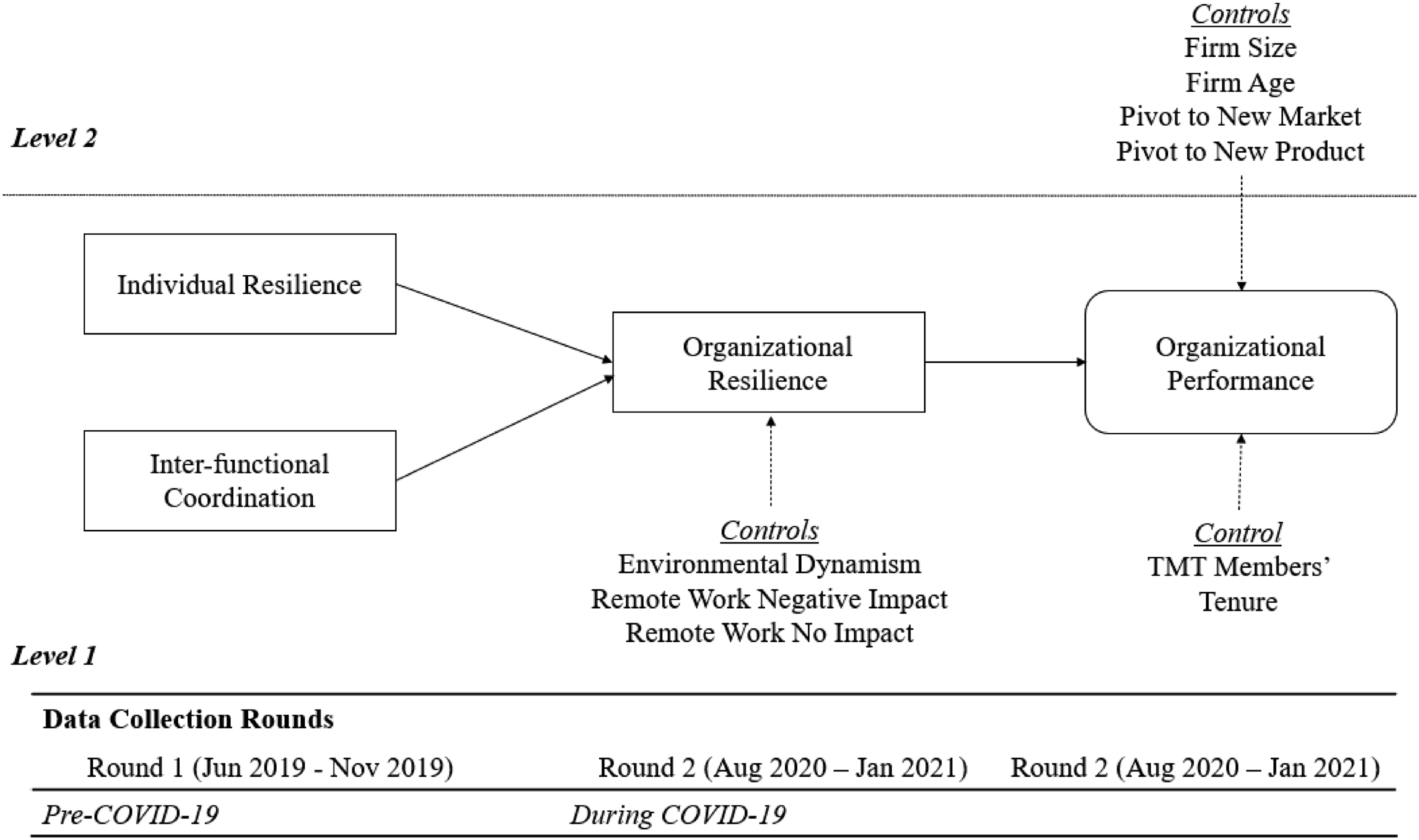
Hypotheses
The resilience of any organization is embedded in the various resource endowments that it possesses; resource endowments that facilitate a firm’s ability to adjust and respond to adversity (Bonanno et al., 2010; Sutcliffe & Vogus, 2003; Williams et al., 2017). These resources, such as the personnel in the organization (Lengnick-Hall et al., 2011), enable positive adjustments to disruptive challenges. They can also enhance organizational resilience (Williams et al., 2017). In this study, we use one dimension of psychological capital from Luthans and Youssef (2007) and Luthans et al. (2010): individual resilience. We reason that the individual resilience of TMT members is instrumental to organizational resilience given their leadership role in a young firm (cf. Jin et al., 2017; Shrader & Siegel, 2007).
Individual resilience is a process through which individuals cope with and come back from adversity (Luthans & Youssef, 2007; Vanhove et al., 2016). Resilient individuals tend to maintain positive functioning when faced with difficulties and can even use those setbacks as opportunities for development (Bonanno, 2004; Reivich & Shatté, 2002). Because resilient managers are more adept at regulating, expressing, and appropriately using their emotions in line with the given situation (Bonanno, 2004; Fredrickson, 2001; Tugade et al., 2004), they can provide their venture with the capability necessary to respond to external change (Wooten & Crane, 2004). Furthermore, their flexibility during a crisis (Tugade et al., 2004) can be helpful in terms of making sense of, and assigning new meaning to, the changing environment (Weick et al., 2005). This is because resilient individuals tend to use creativity and problem-solving to navigate challenges (Lengnick-Hall et al., 2011; Lengnick-Hall & Beck, 2005). Together, these arguments suggest that young ventures with resilient TMT members may be better equipped to cope with a crisis than those without. Resilient TMT members may be quicker to anticipate and accept the gravity of the situation and find creative strategies for the firm to adapt to a changing environment. Our first hypothesis is as follows:
: High levels of individual resilience in TMT members will have a positive effect on the organizational resilience of young ventures. Relational resources also influence the outcomes of entrepreneurial ventures (Kellermanns et al., 2016; Yli-Renko et al., 2001). Because organizations differ in their levels of integration and coordination across areas (Han et al., 1998), one such variation can come from the relationships among different groups within the firm (Morgan & Hunt, 1999). Inter-functional coordination entails the interaction, communication, and coordination across an organization’s functional areas (Jaworski & Kohli, 1993; Narver & Slater, 1990). Pertinent here is that it can make task integration and resource exchange easier. Inter-functional coordination is therefore a mechanism of knowledge integration (Atuahene-Gima, 2005) and is positively associated with the innovativeness-related outcomes of young ventures (Renko et al., 2009). We consider inter-functional coordination particularly relevant in times of crisis, that is, when a firm requires sense-making in a fluid environment, and must be able to combine and deploy knowledge to creatively address its challenges (Lengnick-Hall et al., 2011; Weick, 1995; Weick et al., 2005). The firm also needs the ability to coordinate across the organization in the form of frequent, timely, and accurate information sharing (Brandon-Jones et al., 2014; Gittell, 2008). This is further emphasized during COVID-19 given its implications for remote work. We therefore argue that if the young venture’s internal areas are coordinated to interact, communicate, and integrate across functional boundaries, it is likely to be more resilient and thus, better equipped to cope with a major disruption. We hypothesize:
: High levels of inter-functional coordination will have a positive effect on the organizational resilience of young ventures. Finally, we consider the performance impact of organizational resilience. Recall that in this study, we view organizational resilience as a process whereby the young venture utilizes its resource endowments (here, individual resilience and inter-functional coordination) to positively adjust and continue performing at acceptable levels when confronted by crisis (as per Williams et al., 2017). Considering organizational resilience as a process, rather than outcome (cf. Sutcliffe & Vogus, 2003; Williams et al., 2017), is consistent with how capabilities are understood; that is, they are firm processes that leverage firm resources to gain a competitive advantage (Teece et al., 1997). Thus, we regard organizational resilience as a resource-based capability. Like other capabilities discussed by Chandler and Hanks (1994), it can benefit various aspects of a young firm, including performance. In the context of a crisis, Sutcliffe and Vogus (2003) suggest that developing resilience as a capability could help firms become less vulnerable to adversity, and others argue that resilient firms are more likely to survive disruptions (Ortiz-de-Mandojana & Bansal, 2016) and are quicker to recover from major crises (DesJardine et al., 2019). Therefore, the young venture that is resilient can be expected to be more adept at weathering COVID-19. This leads to our final hypothesis:
: During an external disruption, higher levels of organizational resilience will have a positive effect on the performance of young ventures.
Method
Sample and Data Collection
We study a panel of young technology ventures headquartered in Canada. Our interest in young firms reflects arguments that such organizations are likely to be impacted by external disruptions (Brown & Rocha, 2020; Doern et al., 2019; Giones et al., 2020). Further, we know there is a practical need to understand how firms recover from a crisis like COVID-19 (Reeves & Whitaker, 2020; Shepherd, 2020). This might be especially so for technology ventures given their economic and societal potential (Kuckertz et al., 2020).
Consistent with prior entrepreneurship research (Yli-Renko et al., 2001), the sample comprises independent technology ventures. Our data collection process is part of a larger, long-term project that involved building a unique dataset using online surveys administered through Qualtrics. Various data were collected at the firm and individual levels at different points in time. For the current study, we use data from two periods, temporally separated by the advent of the COVID-19 crisis in early 2020. Round 1 data were collected in June–November 2019. Round 2 data were collected from August 2020–early January 2021.
To identify participants for the larger project, we built a list from the websites of accelerator and incubator centers in Ontario, Canada. Our focus was firms in the “Toronto-Waterloo Region Corridor” (the geographical span between Toronto and Kitchener–Waterloo) given it has a similar technology talent density to Silicon Valley. This search was augmented and checked with data from lists generated through the Hockeystick, Business Development Corporation, and PitchBook databases. To meet our initial selection criteria, firms needed to be (1) founded no earlier than 2009, (2) independent, (3) generating revenue, and (4) with at least five full-time employees. This ensured we would study young ventures with infrastructure and market traction.
We initially identified 372 firms, but this number was reduced to 206 after ensuring all four selection criteria were met. Using data collection procedures similar to others (e.g., Domurath et al., 2020), we personally contacted individuals at each organization, by telephone and email, to explain the study and invite the participation of their firm. Participants were emailed a link for the survey, followed by weekly reminders to those who had not yet completed. From the base of 206 potential firms, 103 agreed to participate (involving 268 TMT members). At the firm level, this is an initial response rate of 50%. This is quite high given we needed firms and their employees to participate over a 2-year time frame. However, individuals were incentivized with the opportunity to win US$100 Amazon gift cards, and we provided each firm with customized results after every round of data collection.
In Round 1 (2019, pre-COVID-19), we had usable responses from 217 TMT members in 98 ventures. In Round 2 (2020, during COVID-19), we had responses from 141 TMT members in 67 ventures. For the current sample, we then considered the two data pools and excluded any firm that withdrew, went out of business, or was acquired during the data collection periods. We also excluded individual respondents who did not participate in the second round of data collection, for any reason. Finally, we excluded any respondent who did not provide data for any of the four focal constructs in our research model. As a result, the final data set includes responses over two data collection periods from 111 TMT members in 65 ventures. At the firm level, this is a final response rate of 31.5%.
At the start of data collection in 2019, the average age of participating firms was 6.5 years. 97% of the firms were 10 years old or less and they had an average of 32 employees. They are a mix of hardware (9%), software (26%), hardware plus software (28%), SaaS (28%), and marketplace (9%) firms. Our respondents include a variety of members of each firm’s TMT, that is, founders and members of the C-suite. 21% of the respondents were female. 33% of the respondents were 34 years old or younger, 28% between 35 and 44 years old, and 39% were 45 years and older. They represent a range of educational fields, with 42% from engineering, software, or other technical area, 38% from business, and 20% from other educational backgrounds.
Given the nature of our sampling process, it is important to rule out concerns of survivorship bias. We therefore ran six group comparison tests. As shown in Appendix A, we compare the final sample used in our study (Group 1, N = 111) against groups of respondents that were excluded from the final sample because, for example, they withdrew from the study and/or there were missing data. For example, rows 5 and 6 in Appendix A compare our sample with the group for which we had data for the independent variables (Round 1), but not for the mediator and dependent variable measured after the advent of COVID-19 (Round 2). None of the group comparison results were statistically significant (p > .05), indicating that a survivorship bias is unlikely to be present in our data set.
Measures
All constructs were assessed with established scales or minor adaptations thereof. The details on our measures can be found in Appendix B.
Dependent variable
The dependent variable is firm performance. It is measured with TMT perceptions of performance relative to objectives, for three outcomes: sales revenue, sales revenue growth, and customer retention. We take this multi-item approach because in entrepreneurship research, firm performance is a multidimensional construct measured with various indicators (Stam et al., 2014). It is also beneficial to incorporate different aspects of performance (Wiklund & Shepherd, 2005). We included perceived performance of sales revenue and sales growth (relative to objectives) because such measures are common in entrepreneurship research (Covin et al., 2006; Rutherford et al., 2008) and highly pertinent to technology ventures. We also measured TMT perceptions regarding customer retention given it is a key market-based outcome (Coviello et al., 2006; Walter et al., 2006). Young firms are unlikely to have publicly available data (Flatten et al., 2015), and that is the case here. As such, we had no access to objective performance data. Nevertheless, we reason that in the context of resilience, using perceptions of firm performance relative to objectives is suitable when indicating a response to adversity. As Sutcliffe and Vogus (2003, p. 95) note: “…to ascertain resilience requires both a judgement that an entity is ‘doing okay’ or ‘better than okay’ with respect to a certain set of expectations for behavior.”
Independent Variables
We measured the two independent variables in 2019, the year prior to COVID-19. Individual resilience is assessed with Sinclair and Wallston’s (2004) four-item brief resilience coping (BRC) scale. This is an established measure of individual resilience used in prior entrepreneurship studies (e.g., Bullough & Renko, 2013; Bullough et al., 2014). Our measure for relational resources is inter-functional coordination. This firm-level variable is captured with the six-item scale from Atuahene-Gima (2005). We made minor modifications to the scale to suit our sample because it is comprised of young technology ventures that may or may not be manufacturers. Given their importance to technology firms, we also focused specifically on the marketing, sales, and product development (R&D) areas within the firm.
After COVID-19 emerged in 2020, we measured organizational resilience with an adapted version of the scale from Brandon-Jones et al., (2014). Because the original was developed for a supply chain management context, we modified it, as necessary. For example, we replaced “the supply chain” with “our firm.” This four-item scale is aimed at measuring an organization’s ability to recover from external disruptions by maintaining its operational and functional flows.
Control variables
We control for environmental dynamism, that is, the degree of uncertainty in the environment in which new ventures operate (Baron & Tang, 2011; Miller, 2007). This is an important consideration when studying venture outcomes (McKelvie et al., 2018) and the effectiveness of managerial responses may be influenced by it (Ensley et al., 2006). Environmental dynamism is assessed with an adapted version of Miller and Friesen’s (1982) five-item scale.
Given the potential performance implications of TMT experience in new ventures (Ensley et al., 2002), we control for the TMT members’ tenure in their firm. At the organizational level, we control for firm age and firm size. Firm age is measured as the number of years since foundation (Ensley et al., 2006) and firm size by the number of employees in the venture (Domurath et al., 2020). Both measures were log transformed to make the firm age and size data more interpretable, and to meet the assumptions of inferential statistics.
Given the second round of our data collection was conducted while the potential impact of COVID-19 was unfolding, we control for a set of context-relevant variables that could potentially influence our proposed relationships. First, every firm in our sample was impacted by government-mandated remote work (RW) policies. Accordingly, we control for the impact of remote work on firm productivity. Because remote work is a direct implication of COVID-19, we reason that its negative impact on productivity (or a lack of impact) may influence the TMT’s perceptions of organizational resilience. This categorical variable had three possible responses: no impact, negative impact, and positive impact. With the expected outcome of such disruptive policies being generally negative, we used “positive impact” as a reference point.
We also learned prior to the second round of data collection that some firms were reacting to the pandemic by pivoting to sell new products or serve new markets. Although studying the ability and/or decision to pivot are beyond the scope of our investigation, we expect that pivoting is likely to have a positive impact on performance in the context of COVID-19. We therefore control for both “pivot to new market” and “pivot to new product,” operationalizing them as dummies (0 or 1).
Data Analysis
We conducted a confirmatory factor analysis (CFA) using AMOS 27 to assess construct adequacy. With our small sample size, we do not rely heavily on model fit indices to establish the adequacy of the measures given they tend to over-reject true-population models with small samples (Hu & Bentler, 1999). Nonetheless, the CFA indicates that for our data, the model fits well: X2df = 142 = 195.79 (p = .002), comparative fit index (CFI) = .943, standardized root mean residual (SRMR) = .075, and all the factor loadings are significant (p < .0001).
Descriptive Statistics, Construct Validity, and Correlations.
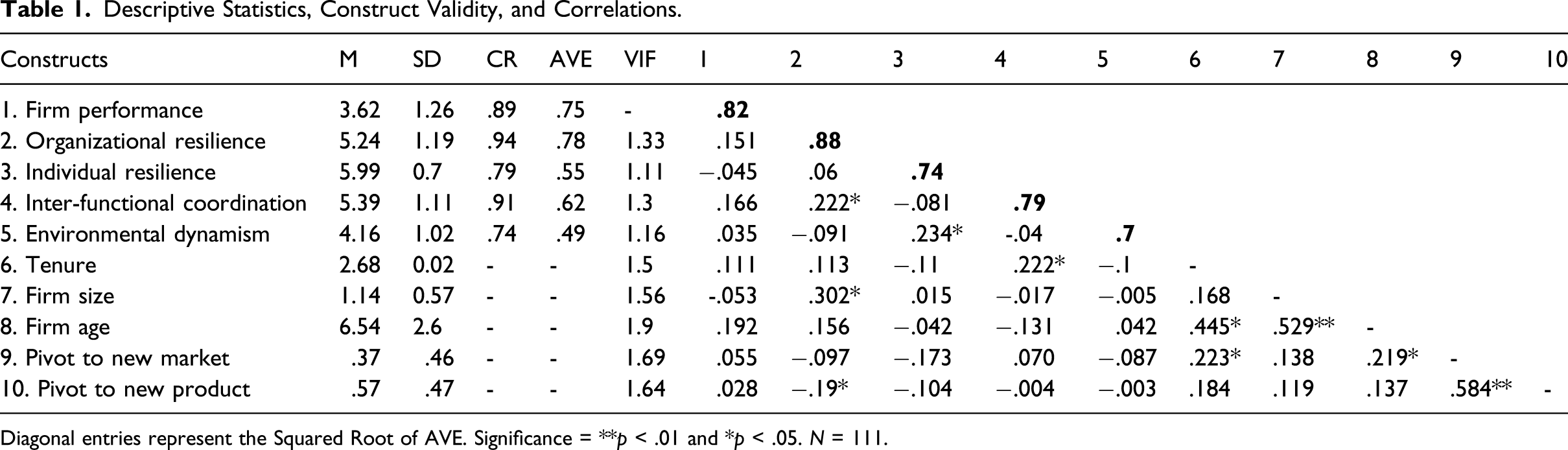
Diagonal entries represent the Squared Root of AVE. Significance = **p < .01 and *p < .05. N = 111.
The constructs appear to be orthogonal; none of our independent variables are highly correlated with each other. In addition, the diagnostic measures (VIF) are substantially below the suggested cut-off (e.g., VIF values of 3–5). This rules out multicollinearity issues (Hair et al., 2010). Given we measured our constructs using self-reported data, we conducted Harman’s single factor test (Podsakoff et al., 2003) to rule out the possibility of common method bias. According to this test, if a substantial amount of variance is present, a single factor emerges from the factor analysis. Our results reveal that the variance explained by a single factor is about 24% (i.e., less than 50%), indicating a lack of common method bias in our data. In addition, data collection was temporally separated, and most firms had multiple members of the TMT as respondents. If single respondents were present, this was accommodated by our use of hierarchical linear modeling (HLM)—see next section.
Model Development
The 111 respondents in our sample are all TMT members and nested in 65 different young technology ventures. Thus, we use HLM because it is appropriate for analyses involving nested data (Raudenbush & Bryk, 2002). In samples like ours, where different levels of analysis exist simultaneously, HLM is particularly useful because it enables analysis of the hypothesized relationships by isolating the effects of the different levels (Covin et al., 2018; Maula & Stam, 2020) and increases insight into the sources of variation (Autio et al., 2013). Additionally, research in model simulations from McNeish (2017) shows that multi-level models such as HLM are more trustworthy with smaller samples than is multi-level structural equation modeling.
Our unit of analysis at Level 1 (L1) is the TMT members’ perceptions of individual and organizational constructs. This accounts for individual-specific heterogeneity. The second level of analysis (L2) includes constructs measured at the firm level (e.g., firm size, firm age, pivot to new market, and pivot to new product). This accounts for firm-specific heterogeneity. The first set of analyses examines the two paths leading to organizational resilience: (1) individual resilience and (2) inter-functional coordination. The second set of models examines the effect of organizational resilience on firm performance. It is worth noting that although the first set of models (i.e., the antecedents of organizational resilience) do not include predictors measured at the firm level (L2), HLM accounts for the nesting of TMT respondents in different firms.
Testing the Paths to Organizational Resilience
All the constructs in our first analysis are individual perceptions (L1) and subscribed ij to indicate that each measure is from individual i working in firm j. The coefficients β are firm-specific having a j subscript. Aside from the intercept term which varies by firm, we model the other coefficients as fixed effects. Therefore, to test Hypotheses 1 and 2, controlling for environmental dynamism, the negative impact of remote work, and no impact of remote work, we estimate the following HLM model: Level 1 Level 2
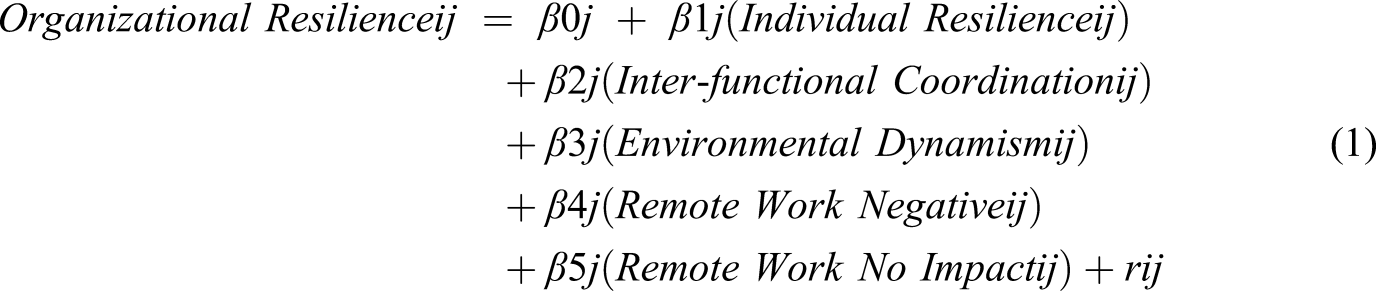


Equation (2) describes the coefficient β0j as a function of γ00 and a firm-specific random error component. As the fixed effects HLM approach dictates, the mean value of organizational resilience varies by firm, allowing us to control for the effects of firms’ heterogeneity. Equation (3) indicates that the slopes for the effects of the remaining variables are the same for all individuals and firms. The mixed model (which combines the equations above to include both individual-specific variance term (r ij ) and firm-specific variance term (u0j)) estimates the effects of individual resilience, inter-functional coordination, and the control variables of environmental dynamism and remote work impact (negative, no impact). Thus, it accounts for both individual- and firm-specific differences.
Testing the Effect of Organizational Resilience
To test Hypothesis 3, we estimate a second set of HLM models in which we evaluate the influence of organizational resilience on firm performance. We control for TMT tenure in the firm and include the four control variables measured at the firm level (L2): firm size, firm age, pivot to new market, and pivot to new product. Equations (4–6) describe the examined model. Level 1 Level 2



Results
As noted earlier, we evaluate the null model using HLM, that is, a multi-level model with no predictors, intended only to dissect the variance accounted within firm (L1) and between firms (L2). Our results show that 80% of the total variance in organizational resilience (first set of analyses) resides at the within-firm level, with 20% residing at the between-firms level. 63% of the total variance in firm performance (second set of analyses) resides at the within-firm level, with 37% residing at the between-firms level. In addition, the intraclass correlation coefficients (ICCs) denote the proportion of variance related to between-firm differences (L2) (Aguinis et al., 2013). The ICCs in this study are .20 for the first set of analyses and .37 for the second set of analyses, both above the .05 threshold for multi-level analysis. These results provide compelling justification for our use of HLM (Raudenbush & Bryk, 2002) because each level of analysis contributes significant variance to our mediator (organizational resilience in the first set of models) and our dependent variable (firm performance in the second set of models).
Paths Leading to Organizational Resilience.
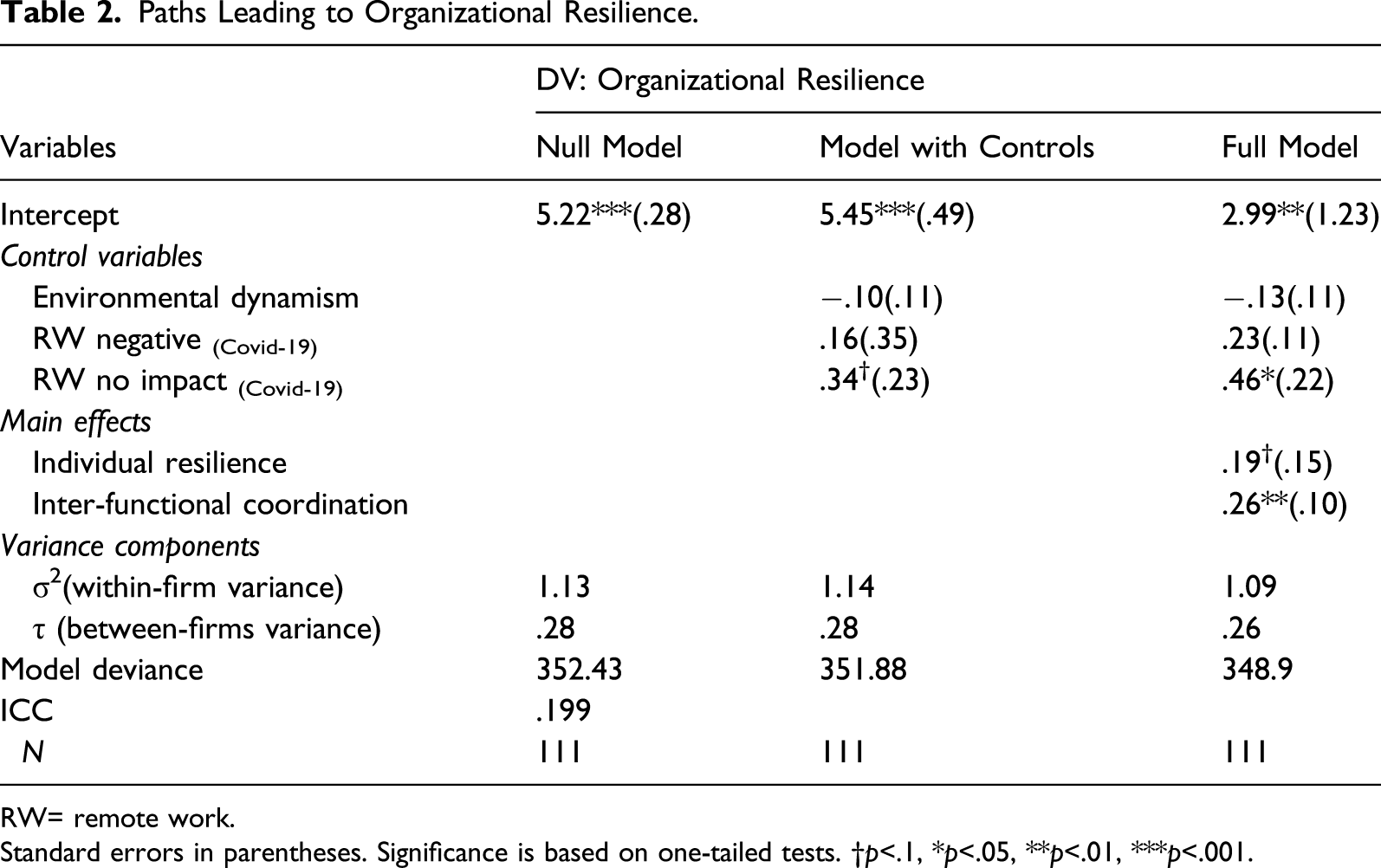
RW= remote work.
Standard errors in parentheses. Significance is based on one-tailed tests. †p<.1, *p<.05, **p<.01, ***p<.001.
Effects of Organizational Resilience on Firm Performance.
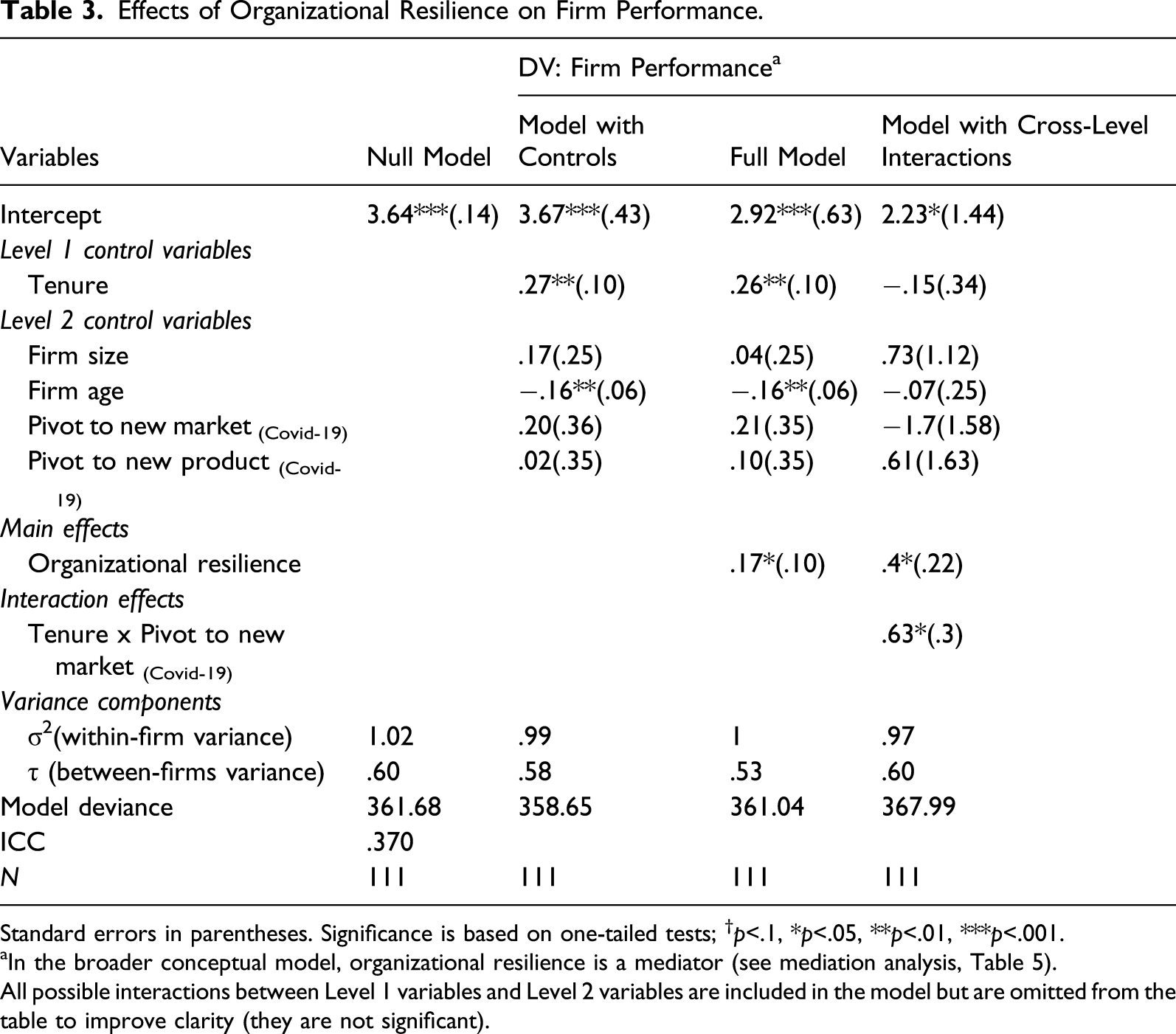
Standard errors in parentheses. Significance is based on one-tailed tests; †p<.1, *p<.05, **p<.01, ***p<.001.
aIn the broader conceptual model, organizational resilience is a mediator (see mediation analysis, Table 5).
All possible interactions between Level 1 variables and Level 2 variables are included in the model but are omitted from the table to improve clarity (they are not significant).
As an extension to the main model, analyzing cross-level interactions can generate additional informative findings. Interaction effects should be based on theoretical rationale (Aguinis et al., 2013) and given the important role of entrepreneurial ventures’ size and age in shaping performance outcomes (Arend, 2014), we expect firm size and age will influence the strength of the proposed L1 relationships. Similarly, our context-relevant L2 variables (“pivot to new market” and “pivot to new product”) are likely to modulate the performance outcomes amidst potential challenges posed by COVID-19. Thus, although we did not hypothesize for these effects, we tested an additional model to account for the interactions between the L1 variables (organizational resilience and tenure in the firm) and L2 variables (firm size, firm age, pivot to new market, and pivot to new product). HLM provides the ability to check for cross-level interactions and the results are reported as “Model with Cross-level Interactions” (Table 3). The results reveal a positive and significant interaction between TMT members’ tenure and the firm’s pivot to a new market in response to COVID-19 (β = .63, p < . 05). Figure 2 illustrates the cross-level interaction. Cross-level interaction between TMT tenure and firm pivot to new market.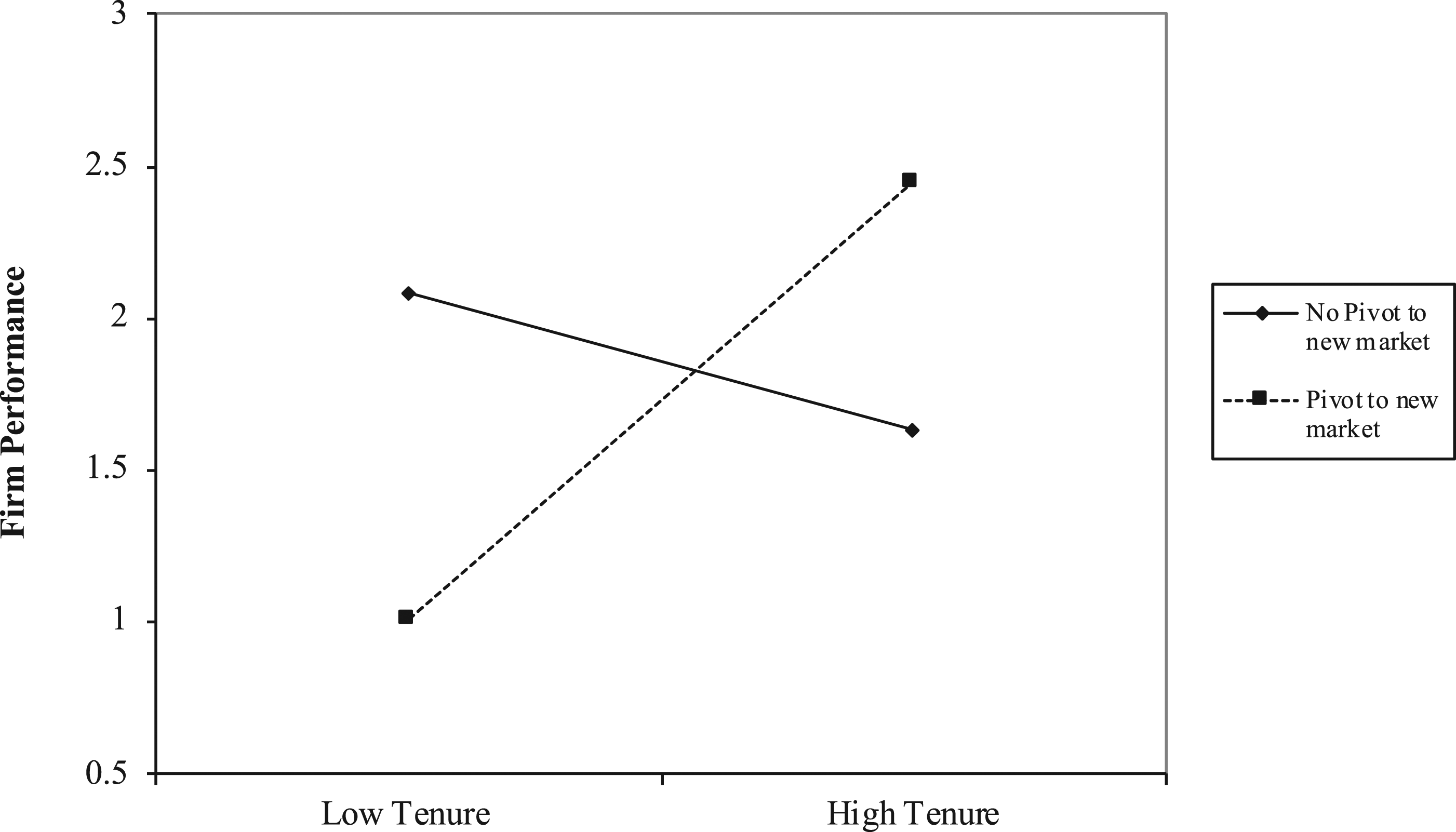
Supplementary Analyses
Mediation Analysis
We hypothesized that TMT member resilience and inter-functional coordination will lead to organizational resilience in young firms. In turn, organizational resilience will lead to higher levels of firm performance. Therefore, based on our conceptual model, organizational resilience also serves as a mediator. This led us to conduct a mediation analysis. We followed Zhang et al.’s (2009) recommendations regarding HLM mediation to implement Baron and Kenny’s (1986, p. 1176) three conditions for establishing mediation: (1) “variations in the levels of the independent variable significantly account for variations in the presumed mediator”, (2) “variations in the mediator significantly account for variations in the dependent variable,” and (3) “when step 1 and 2 have been controlled, a previously significant relation between the independent variable and dependent variable is no longer significant, with the strongest demonstration of mediation occurring when step 3 is zero.” The models are previously specified by equations (1–3) for the first step and equations (4–6) for the second step. Accordingly, the third step involves the integration of steps 1 and 2, resulting in the following equations (7–9): Level 1 Level 2
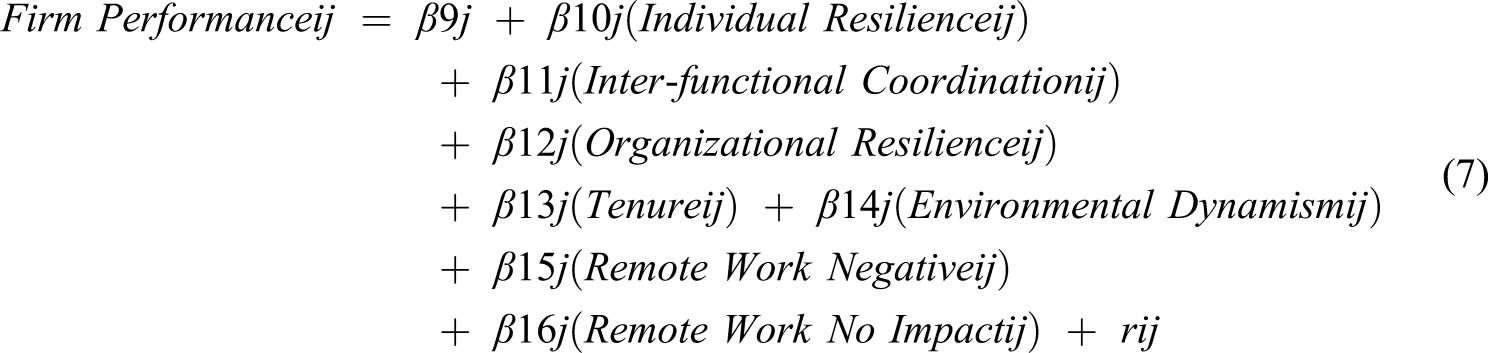


Mediation effect: γ 10 * γ 160 or γ 10 − γ 160 (L1 effect confounded with L2 effect).
Mediation Analysis for HLM Paths.
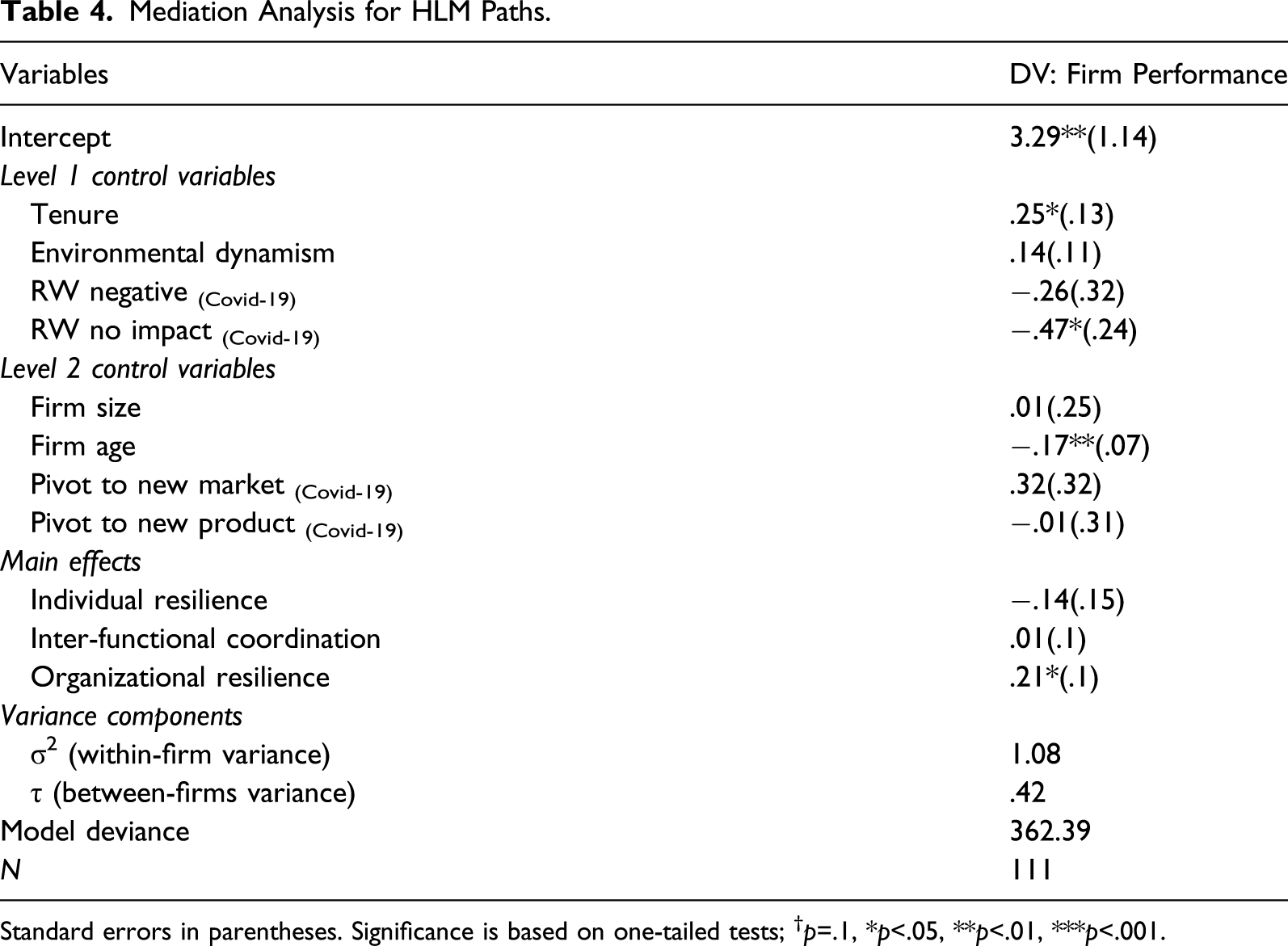
Standard errors in parentheses. Significance is based on one-tailed tests; †p=.1, *p<.05, **p<.01, ***p<.001.
Given potential confounding in such models often arises, we replicated the mediation analysis by differentiating the between- and within-firm mediation relationships (Zhang et al., 2009). This differentiation, using “centered within context with reintroduction of the subtracted means” variables (i.e., CWC(M)) sheds light on the mediation mechanism at each level of analysis. This includes the possibility of completely equivalent effects across both within- and between-firm levels. None of the results at L2 are significant and thus, given our sample size, we rely on the simpler analysis as described earlier.
Replication Analysis: Bayesian Inference
HLMs are estimated with maximum likelihood (ML) methods that produce asymptomatically unbiased estimates as the sample size approaches infinity (McNeish & Stapleton, 2016). Keeping in mind the risk of drawing biased conclusions due to a small sample, we followed Brinkerink and Rondi’s (2021) additional examination of their nested data to conduct a Bayesian inference analysis.
Bayesian analysis typically provides unbiased estimates with small sample sizes (Rouziou & Dugan, 2020) and is particularly valuable where more conventional statistical techniques fail to provide an answer, such as non-significant results (Dienes, 2014). Considering that our H1 was only supported at a relaxed threshold of statistical significance (i.e., p < .1), conducting additional analysis may be worthwhile. We therefore respecified our multi-level models (equations (1–6)) relying on Bayes’ theorem, according to which the likelihood and prior distributions determine the posterior distributions of our predictors. Once again, we modeled our parameters as fixed effects (aside from the intercept which varies per firm) using non-informative priors (0, var = 1e4). We executed 50,000 draws, the first 40,000 of which were model training estimates, yielding 10,000 draws of the Markov Chain Monte Carlo (MCMC) chain, obtained for every parameter. In the end, the convergence diagnostic checks indicated that the chains reached their stationary distributions.
Replication Analysis Using Bayesian HLM Model with Unknown Priors.
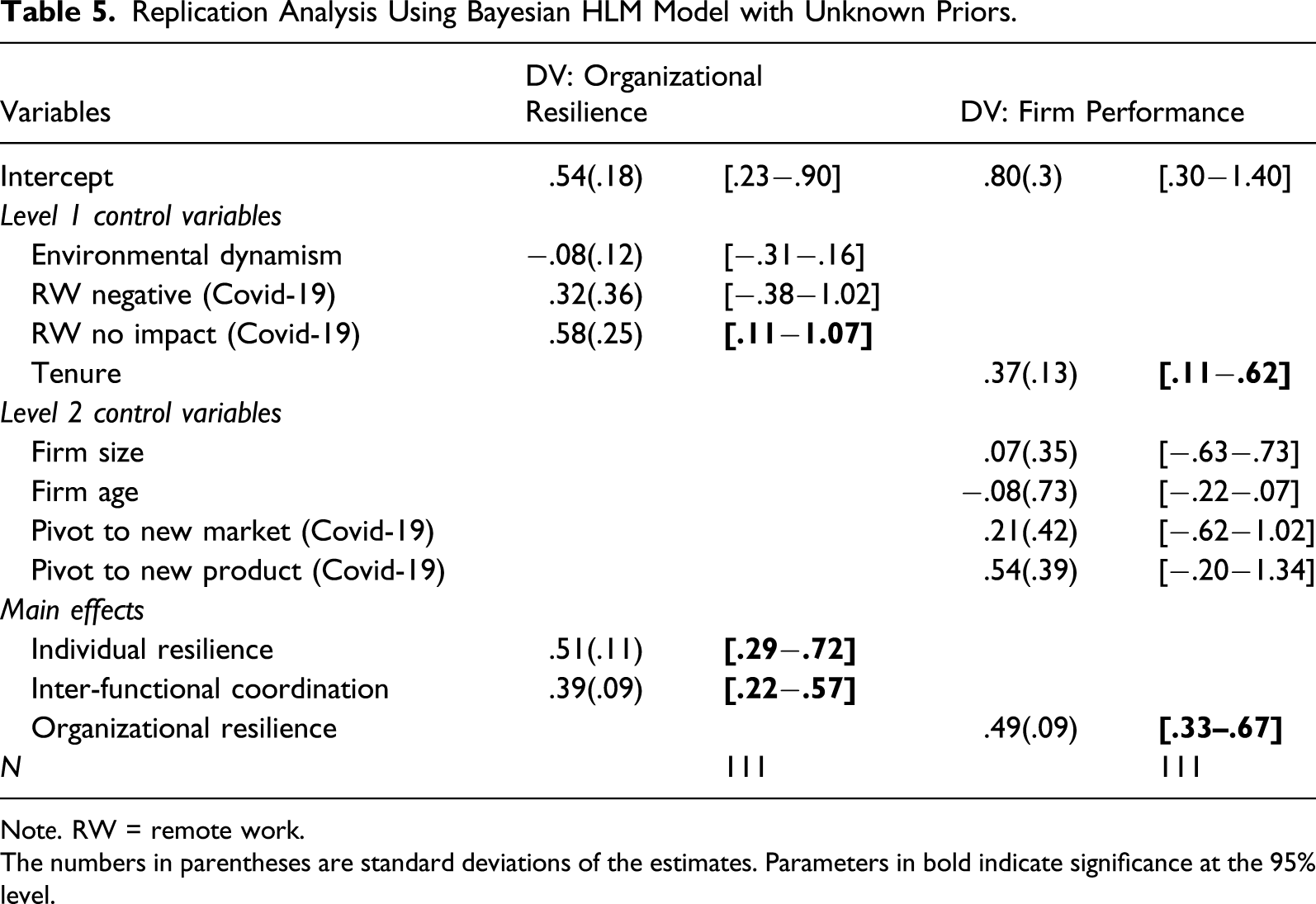
Note. RW = remote work.
The numbers in parentheses are standard deviations of the estimates. Parameters in bold indicate significance at the 95% level.
Endogeneity Analysis
Finally, endogeneity is an increasing concern in academic research that aims to draw causal inferences from analysis of non-experimental data (Lehmann et al., 2011). It arises when an explanatory variable correlates with the error term of a specified model (Rutz & Watson, 2019). There are three main sources of endogeneity: omitted variables, simultaneity, and measurement error (Wooldridge, 2010). Simultaneity is not an issue in our data (we collected data at different points in time) and given our analysis accounts for potential survivor bias (see Appendix A), measurement error can be ruled out. However, the omitted variables issue (due to data unavailability) may signal potential endogeneity in our statistical analysis.
To address this, we use the instrumental variables approach. Our analysis (see Appendix C) indicates that our predictor variables are not correlated with the error term, and we can safely conclude that our original HLM and Bayesian models are unbiased. A plausible explanation for the exogeneity of our models stems from the unexpected exogenous shock presented by COVID-19, given it occurred naturally between our two waves of data collection. Indeed, we note that econometricians recommend non-random exposure to exogenous shocks (as part of the randomization protocol in true experiments) to avoid omitted variables bias in models (Borusyak & Hull, 2020). In this study, COVID-19 acts as a random exogenous shock that does not originate from the economic system (i.e., endogenously).
Discussion
If Shepherd (2020, p. 1751) is correct in his observation that the emergence of COVID-19 suggests that the “magnitude and frequency of adverse events—as disruptions—are on the rise, and there will be a series of ‘new normals’ rather than an extended period of a new normal,” then we need to understand the antecedents and outcomes of organizational resilience. Accordingly, in the context of the COVID-19 pandemic, we (1) propose and test two different paths to organizational resilience and (2) examine how organizational resilience influences the performance of young technology ventures.
Our findings show that both individual resilience and inter-functional coordination underpin organizational resilience. Further, organizational resilience positively impacts organizational outcomes pertaining to sales revenue, sales growth, and customer retention. In addition to the main findings, there is an interaction effect for TMT “tenure in the firm” and “pivot to a new market” (as a response to COVID-19) on performance. All findings are supported by both HLM and Bayesian analyses.
Theoretical Implications
Following from the above, we offer a number of contributions. At a general level, by building on the idea that resilience occurs at multiple levels (Sutcliffe & Vogus, 2003), and showing relationships across levels, we begin to offer a better understanding of the multi-level nature of resilience called for by Linnenluecke (2017) and Williams et al. (2017). This benefits entrepreneurship research given scholars tend to emphasize individual-level resilience alone (e.g., Bullough & Renko, 2013; Chadwick & Raver, 2020; Jenkins et al., 2014).
We conceptualize and operationalize resilience as a resource-based organizational capability and then demonstrate that it enables young ventures to cope with external disruptions. This provides new insights for two reasons. First, our approach differs from those using performance as a proxy for resilience (e.g., Ortiz-de-Mandojana & Bansal, 2016; Smallbone et al., 2012). Second, despite organizational resilience being considered vital when a firm encounters unexpected adversity (Doern et al., 2019; Linnenluecke, 2017; Williams et al., 2017), it is often approached rather abstractly in entrepreneurship research. Perhaps the fragmented (Linnenluecke, 2017) and metaphorical operationalization of organizational resilience has inhibited its empirical investigation to date. As a result, our empirical validation of this capability’s antecedents and outcomes is informative.
Following from Gittell et al.’s (2006) argument about the importance of relational coordination for organizational resilience, we show that when core functional areas of young technology ventures are better integrated and coordinated, the firm tends to be more resilient. This finding allows us to contribute to entrepreneurship research on the role of internal relational resources as related to venture outcomes (e.g., De Clercq et al., 2016). In particular, we acknowledge the group heterogeneity and complexity of interconnections among different functional groups (Arregle et al., 2007), and draw on research from marketing (Atuahene-Gima, 2005; Kohli & Jaworski, 1993; Narver & Slater, 1990) to consider inter-functional coordination as a resource for organizational resilience. This reflects arguments that relational resources are associated with resilient responses to adverse challenges due to their potential to enable the flow of information and resources during crises (Gittell, 2008; Lengnick-Hall et al., 2011; Williams et al., 2017). However, although prior entrepreneurship literature demonstrates the efficacy of relational resources in dealing with adversity at a broader level (Williams & Shepherd, 2016), research exploring intraorganizational mechanisms of integration and coordination remains scant. With this study, we show that stronger internal relationships across functional areas help develop organizational resilience and strengthen the performance of young ventures amidst an environmental shock.
At the individual level, we theorize and find support for a relationship between TMT members’ individual resilience and organizational resilience. Although the results of our HLM analysis are only marginally significant, we are mindful of not excessively relying on significance thresholds to form our conclusions (Maula & Stam, 2020), especially when they contradict theory. Consequently, we add to the robustness of this result with additional analysis using Bayesian techniques. Our results reinforce early findings (D'Aveni & MacMillan, 1990) that TMT members’ ability to respond to a crisis is central to how a firm will fare through it. That is, we demonstrate that managers’ resilience—a core component of their psychological capital—contributes to their venture’s capability to effectively cope with adversity.
The controls in this study also provide new insight to our research questions. Given the notable context of COVID-19, we account for the impact of remote work—one of the most salient consequences of the pandemic for organizations. When remote work did not influence firm productivity, there was a significant and positive impact on organizational resilience. This is understandable, as managerial perceptions of organizational resilience can be expected to be higher when COVID-19 is not perceived as a threat to productivity. Further, when TMT tenure in the firm is high, pivoting to a new market leads to higher levels of perceived performance. In contrast, when TMT tenure is low, not pivoting benefits performance. This can be explained by Unger et al.’s (2011) argument that experience may be more instrumental to success when the relevance of entrepreneurial tasks is high.
Finally, Doern et al. (2019) observe that prior survey-based studies on responses to crises in entrepreneurship tend to be cross-sectional. As a result, much of the extant research on the effects of external disruptions is ex post. This is despite the argument that “backward looking studies fail to yield much in the way of explanatory insights on how policy could proactively deal with and mitigate the impact of these crisis periods as they actually unfolded” (Brown & Rocha, 2020, p. 2). Accordingly, investigations of resilience that temporally separate antecedents from causes may be particularly insightful (cf Chadwick and Raver’s (2020) time-lagged approach to study individual resilience). Our study contributes to such efforts with a unique dataset that tracks young ventures before and during a significant global and external disruption.
Practical Implications
COVID-19 and other macro-level events show that external disruptions are inevitable. Our findings demonstrate that by developing organizational resilience as a capability, young technology ventures can not only survive but perform well through a crisis. The goal for TMT members in such firms should be to develop organizational resilience such that functional operations and the flow of daily systems and processes quickly return to normal, even under adversity.
Our findings highlight two specific paths for doing so: (1) developing the individual resilience of the firm’s TMT members and (2) inter-functional coordination. Compared to more stable personality traits, resilience is relatively malleable and thus susceptible to change and development (Luthans & Youssef, 2007; Vanhove et al., 2016). Further, Masten (2001) suggests resilience can be changed through process-focused strategies. Examples include workplace training programs aimed at building personnel resilience with regard to key health- and performance-related outcomes. Given individual resilience is directly and positively related to organizational resilience, investing in it provides a pre-emptive strike that can help the firm face unexpected external disruptions.
One way to develop individual resilience is to help managers frame a disruption positively. Managers should also be encouraged to try and address disruptions using creative and novel ways. For example, a crisis might provide the TMT with an opportunity to implement ideas that have been held on the back-burner. Related to this is the idea of allowing managers to explore new actions or different paths to deal with challenges they encounter in a crisis situation. For example, if a crisis is viewed as a learning opportunity, managers can work together to accept the new reality, learn from the change process triggered by the situation, and identify ways to offset adverse effects. This could range from quickly modifying their product offer, to adding new revenue streams, or reconsidering their business model.
The second path to building organizational resilience is through inter-functional coordination. This calls for proactive facilitation of cooperation among functional areas (in our study: marketing, sales, and R&D). A firm’s inter-functional coordination pertains to a number of activities. One example is shared acquisition and use of market information about customers, technologies, and competitors. Similarly, members from different functions should work together in setting firm priorities and strategic decision-making. In young technology ventures like those studied here, inter-functional coordination across sales, marketing, and R&D is particularly important for innovation creation. We also add that well-coordinated functional areas become even more relevant given the limited physical interactions resulting from the work-from-home policies associated with COVID-19.
In addition to the above, the results for our control variables provide new insight regarding a young technology firms’ decision to pivot to a new market when confronted by an environmental shock. Pivoting to a new market plausibly requires a profound understanding of the firm and the environment it operates in, and this may be provided by TMT members’ tenure in their firm. Accordingly, in cases where TMT members’ tenure in firm is high, pivoting to a new market is advisable. On the other hand, a lack of tenure comes with relatively less insight about the firm and the implications of changing direction. For these TMT managers, maintaining the status quo appears more beneficial.
Finally, our results offer suggestions for accelerators and investors supporting young ventures. These stakeholders should acknowledge the importance of developing organizational resilience in such firms and provide appropriate support. For example, they could offer training to help build TMT resilience, or workshops to assess and improve cross-functional information and resource exchange. Another approach could be to help TMT members audit their firm’s organizational resilience and the factors supporting it.
Limitations and Future Research
Our unique, multi-level, time-lagged data allowed us to study resilience by temporally separating exogenous variables from endogenous ones. At the same time, our sample size for this study is quite small due to our selection criteria. We recognize that this impacts the explanatory value of our model and consequently, we used Bayesian inference to help address this limitation. Also, we were unable to ensure a temporal lag between measuring organizational resilience and firm performance. Future work could therefore investigate the long-term performance of resilient young ventures, after they have had a chance to absorb the pressures of the crisis. This is particularly relevant given our data is not “before and after” a crisis but “before and during.” In a related vein, we note that as per Brandon-Jones et al., (2014), short-term vs. long-term differences in performance could potentially involve a distinction between organizational resilience (the ability to return to the original state) and organizational robustness (the ability to maintain functioning despite disruptions). Future research could explore the contexts where such a distinction is meaningful.
In studying two paths to organizational resilience, we recognize that there are other potential antecedents to consider. Future research could investigate the effects of the other components of psychological capital (optimism, hope, and self-efficacy) discussed by Luthans et al., (2007). As a potentially interesting extension of individual resilience, we note that because TMT members face adversity in a collective manner, they may start to identify more strongly with each other or may develop “collective resilience” (King et al., 2016). Given Stoverink et al., (2020) indicate that team resilience is distinct from individual and organizational resilience, research on how the TMTs of young ventures collectively cope with setbacks could provide valuable insight. Future research on resilience in entrepreneurship should also extend our findings regarding relational resources. It likely, for example, that relationships external to the firm are beneficial. Regardless of whether relational resources are internal or external, they will also vary in, for example, strength, durability, and trust. Research incorporating these characteristics could provide further understanding of how young firms can prepare for, and weather the storm presented by an external crisis.
Conclusion
In this study, we use the COVID-19 pandemic as a context to study the drivers and performance outcomes of organizational resilience in young technology firms. We show that the individual resilience of TMT members and the level of inter-functional coordination among key areas are positively linked to organizational resilience. In turn, organizational resilience strengthens performance in the face of an adverse environmental shock. Such findings provide a basis for future work in entrepreneurship that explores organizational reactions to adversity and generates meaningful practical insights.
Footnotes
Acknowledgements
We are grateful to the research support and insights provided by Anne Domurath, Sarah Wilner, Chatura Ranaweera, Asfiya Taji, and Andrea Reaume. This paper draws on research funded by the Social Sciences and Humanities Research Council, Grant 435-2017-1377.
Declaration of Conflicting Interests
The author(s) declared no potential conflicts of interest with respect to the research, authorship, and/or publication of this article.
Funding
The author(s) received no financial support for the research, authorship, and/or publication of this article.

Appendix A. Analysis to Address Survivorship Issues.
Notes. Variables that are compared between groups are highlighted with ‡; Group 1 represents the sample used in this study. ✓ = variable answered by the respondents in the group; X = variable not answered by the respondents in the group.
Individual Resilience
Inter-Functional Coordination
Org Resilience
Org Performance
Group Size, Mean and standard Deviation
T-Test
1
Group 1
✓
✓
✓‡
✓
Group 1 (N = 111) = 5.24 (1.19)
t (121) = 1.4, p = .164
Group 2
✓
X
✓‡
✓
Group 2 (N = 12) = 5.73 (.69)
2
Group 1
✓
✓
✓
✓‡
Group 1 (N = 111) = 3.62 (1.26)
t (121) = 1.52, p = .131
Group 2
✓
X
✓
✓‡
Group 2 (N = 12) = 4.22 (1.68)
3
Group 1
✓
✓
✓‡
✓
Group 1 (N = 111) = 5.24 (1.19)
t (120) = .46, p = .65
Group 2
X
X
✓‡
✓
Group 2 (N = 11) = 5.41 (.91)
4
Group 1
✓
✓
✓
✓‡
Group 1 (N = 111) = 3.62 (1.26)
t (120) = 1.72, p = .09
Group 2
X
X
✓
✓‡
Group 2 (N = 11) = 4.33 (1.77)
5
Group 1
✓‡
✓
✓
✓
Group 1 (N = 111) = 5.91 (.65)
t (215) = −1.3, p = .18
Group 2
✓‡
✓
X
X
Group 2 (N = 106) = 5.79 (.72)
6
Group 1
✓
✓‡
✓
✓
Group 1 (N = 111) = 5.39 (1.11)
t (215) = −.23, p = .82
Group 2
✓
✓‡
X
X
Group 2 (N = 106) = 5.35 (1.13)
Appendix B. Measures.
Note. [R] = reverse-coded item. * = item dropped due to low factor loading.
Construct
Items
Original Loadings
Improved Loadings
Individual resilience
If you think about yourself at work, what is your level of agreement with each of the following statements?
I look for creative ways to alter difficult situations.607
.751
*Regardless of what happens to me, I believe I can control my reaction to it
.541
-
I believe I can grow in positive ways by dealing with difficult situations
.751
.821
I actively look for ways to replace the losses I encounter in life
.655
.652
Inter-functional coordination
To what extent do you agree/disagree with these statements about your firm?
.761
.771
In the innovation process, R&D, marketing, and sales are tightly integrated as cross-functional teams
.808
.824
R&D, marketing, and sales regularly share information about customers, technologies, and competitors
.875
.873
There is a low level of cooperation among functional units in setting the priorities for this firm. (R)
.827
.744
Top management promotes cooperation among R&D, marketing, and sales when acquiring and using market information
.823
.814
People from marketing, R&D, and sales play important roles in major strategic market decisions
.709
.703
Organizational resilience
Please think of major disruptions that your firm has faced. Given such a disruption, please indicate the extent to which you agree with the following statements about your firm:
.863
.863
It does not take long to recover normal operational performance
.900
.901
Our firm can easily recover to its original functional state
.910
.917
Disruptions can be quickly dealt with
.873
.860
Environmental dynamism
If you think about the main industry you compete in, to what extent do you agree with the following statements?
.684
.679
*The rate at which our products/services become obsolete in this industry is very high
.414
-
*The actions of competitors are quite easy to predict. [R]
.208
-
Demand and user tastes are difficult to forecast
.644
.799
The core technology(s) we use for production or service delivery is not subject to very much change. [R]
.648
.603
Firm performance
Sales revenue
.882
.956
Growth in sales revenue
.884
.962
Customer retention
.722
.631
Appendix C. Endogeneity Analysis.
We address potential issues of endogeneity with the well-established Instrumental Variables (IV) technique (Anderson et al., 2019; Antonakis et al., 2010). To select our instrumental variables, we leverage other variables in our data, considering that a potential instrumental variable first, must be correlated with the endogenous variable, and second, must not be correlated with the error term (ε) (Rutz & Watson, 2019). We need at least as many instruments as the maximum number of parameters in any equation (equations (1) and (4) in the manuscript). Thus, we initially identify two instrumental variables for the equation where individual resilience and inter-functional coordination are the predictor variables (equation (1) in the manuscript), and one instrumental variable for the equation where organizational resilience is the predictor variable (equation (4) in the manuscript).
We identify three variables to operate as IVs for the above. First, learning goal orientation is an individual’s orientation of enhancing his/her ability and competency by acquiring and mastering new skills (Vandewalle, 1997). This is conceptually relevant to the notion of individual resilience because it leads to minimizing threats to self-esteem and enhances persistence and the tendency to learn from failure (Niiya et al., 2004). Second, strategic flexibility refers to a firm’s ability to reallocate and reconfigure its organizational resources in order to respond to changes (Zhou & Wu, 2010, p. 549). It is inherently related to inter-functional coordination (Atauhene-Gima, 2005; Saini & Johnson, 2005). Third, we note that conceptually, organizational robustness and organizational resilience are distinct concepts with the former referring to an entity’s ability to maintain its functioning despite disruptions or pressure (Brandon-Jones et al., 2014). On the other hand, resilience is a broader concept and entails using resource endowments to interact with the environment and perform positively before, during, and after adversity (Williams et al., 2017). In this regard, the quality of robustness may be a prerequisite for organizational resilience. We measure learning goal orientation using the scale provided by Vandewalle (1997), strategic flexibility in line with Zhou and Wu (2010), and organizational robustness using Brandon-Jones et al.’s (2014) scale.
Learning goal orientation serves as an IV for individual resilience (r = .524, p < .01), strategic flexibility serves as an IV for inter-functional coordination (r = .248, p < .01), and organizational robustness serves as an IV for organizational resilience (r = .525, p < .01). Therefore, they meet the relevance criterion (i.e., IV should be correlated with the endogenous predictors). Moreover, they meet the restriction criterion, relating to each of the dependent variables only through the endogenous predictors (Rutz & Watson, 2019). Indeed, their correlations with the dependent variables of organizational resilience (IV: learning goal orientation r = .073, n.s.; strategic flexibility r = .114, n.s.) and firm performance (IV: organizational robustness r = .140, n.s.) are low and not significant.
To employ the IV method effectively, we need strong theoretical reason or empirical evidence that one (or more) explanatory variables are actually correlated with the error term (i.e., are endogenous) (Rutz & Watson, 2019). We perform the Hausman Test (Hausman, 1978) to identify which predictors are endogenous. Specifically, we regress the predictor variables of individual resilience and inter-functional coordination on the instruments of learning goal orientation and strategic flexibility. We also regress the predictor variable of organizational resilience on the instrument of organizational robustness. The residuals (v) from these regressions are saved and used as explanatory variables in the main equations (1) and (4).
We hypothesize that H0: our predictor variables are exogenous, while H1: our predictor variables are endogenous. The effects of residuals are v 1 = .55, p = .88 for individual resilience, v 2 = −.17, p = .66 for inter-functional coordination, and v 3 = −.17, p = .45 for organizational resilience. The results of the Hausman Test indicate that none of our independent variables are endogenous. This is because we do not reject the null hypothesis of exogeneity given the parameter estimates of the residuals are not significant. Thus, our predictor variables are not correlated with the error term and we can safely conclude that our original HLM and Bayesian models are unbiased.