




Abstract
The enabling influence of environmental changes—be they technological, regulatory, demographic, sociocultural, or otherwise—on emerging ventures receives a growing interest from researchers and practitioners. To support knowledge accumulation in this important area, we systematically review and integrate research that is dispersed across disciplines, nominal types of change, and theoretical approaches. Under a unified terminology within a cross-level (environment to agent), process-aware framework, we examine what has been done and learnt. On this basis, we develop an agenda for further, future accumulation of knowledge about the strategic and serendipitous influence of environmental changes throughout and beyond the venture creation process.
Keywords
While there is no entrepreneurship without creative agency, entrepreneurs do not create new ventures out of thin air. Therefore, it has long been argued that various changes to the business environment create important “raw material” for entrepreneurs to work on (Davidsson, 2015; Drucker, 1985; Shane, 2012). Accordingly, studies address how new technologies (Grégoire & Shepherd, 2012), regulatory changes (Eberhart et al., 2017), sociocultural trends (Hiatt et al., 2009) and changes to the natural environment (Dutta, 2017) enable new ventures. However, these studies are dispersed across disciplines, nominal types of change, and theoretical approaches. As a result, we lack unified understanding of what makes external changes more and less enabling; what the precise mechanisms of enablement are; how entrepreneurs activate such mechanisms, and where in the venture creation process enablement occurs.
Therefore, our goal is to enhance knowledge accumulation about how changes to the business environment enable new venture creation, with a special emphasis on strategically actionable knowledge. That is, we aim to further knowledge on how entrepreneurial agents can identify and actualize the potentials provided by external changes. To this end, we undertake a systematic literature review across disciplines, nominal types of change, theories, and methods within a unifying structure and terminology, namely the External Enabler (EE) Framework (Davidsson et al., 2020) which was developed for analysis of entrepreneurial responses to external change. We thus accumulate knowledge from past research by integrating and highlighting previously dispersed studies. Further, we critically assess the reviewed literature’s collective delivery of the strategically actionable type of knowledge that we seek to further. This provides the basis for our most important goal: to enhance knowledge accumulation in future research. We pursue this goal by (1) developing a research agenda based on commonalities, gaps and exemplars identified in our review, and (2) testing and refining the EE Framework.
We believe highlighting and enhancing the reviewed type of research is of great theoretical and practical importance. The COVID-19 pandemic, including the regulatory and sociocultural changes it brings, is a stark reminder of the immense influence environmental changes have on business. Apart from spelling disaster for some established businesses (Bartik et al., 2020), the pandemic is a strong enabling force for emerging ventures across a range of industries (Donthu & Gustafsson, 2020). Another contemporary demonstration of the need for attention to external change is the growing entrepreneurial responses to climate change and related sociocultural and regulatory changes (e.g., Hiatt & Carlos, 2019). These responses often leverage new, digital technologies (Berger et al., 2021; Nambisan, 2017) which represent another type of change that is an obvious basis for many recent, entrepreneurial successes.
Shane and Venkataraman’s (2000) notion of objective opportunity has not been effective in addressing these phenomena (Davidsson, 2015; Dimov, 2011; Korsgaard, 2013). At the same time, the crucial role of external change in the above examples makes active neglect of the external environment in theorizing new venture creation (e.g., Alvarez & Barney, 2007; Arikan et al., 2020) increasingly absurd. Accordingly, our review reveals an emerging surge of interest in the reviewed type of research, albeit still at a moderate absolute level (cf. Davidsson, 2020).
We make the following contributions to knowledge accumulation. First, we highlight and integrate an important but previously scattered literature, thereby increasing the studies’ reach beyond the narrower streams from which they originate. Second, based on commonalities, gaps and exemplars in past research, we develop an agenda for future research. This agenda can guide theory development and effective designs for accumulation of actionable insights into how entrepreneurial agents can leverage external changes. Third, we test and refine the EE Framework based on the facets of enablement identified in past research. Considering that its original development was not informed by a systematic review of past research, our test and refinements should increase the framework’s validity as a conceptual tool for future knowledge accumulation.
In the next section we introduce the EE Framework in more detail. We then turn to a brief description of our review method, with more detail provided in the Appendix. This is followed by review findings regarding descriptive characteristics of the reviewed research stream; how it addresses elements of the EE Framework, and what the review suggests about how the EE Framework captures the research and what revisions it might need. Based on review findings we then outline our agenda for future research.
The External Enabler Framework: Conceptual Basis of the Review
Similar to Tharenou and Kulik (2020) we use an existing conceptual framework to connect previously scattered research. Specifically, we apply the structure and unified terminology of Davidsson et al.’s EE framework—developed for analyzing external changes that enable new venture creation—to identify commonalities and gaps across a heterogeneous set of studies. 1
EEs are significant changes to the business environment that have the potential of playing an important role in enabling a variety of entrepreneurial endeavors by several (potential) agents. Davidsson (2015, p. 683) exemplifies with “Changes to technology, demography, culture, human needs and wants; institutional framework conditions, macro-economic conditions, and the natural environment.” The status as EE is based on the theoretical assumption—aligned with historical experience—that by disequilibrating some part of the economy, any environmental change improves the prospects for some conceivable new ventures. This justifies the “enabler” label without evidence of entrepreneurial action and success. 2 EEs are thus aggregate-level external changes that provide partial enablement, in contrast to the “complete success recipe” notion of “objective opportunity” (Shane & Venkataraman, 2000). The enablement can take many different forms; occur at various points of the new venture creation process, and with varying levels of entrepreneurial agency. That is, the enablement may be fortuitous or strategically considered. Often, several EEs are interrelated and/or interactive in their overall enabling impact.
The EE Framework provides structure and terminology for the forms and functions of EEs under the notions of EE-level characteristics and venture-level mechanisms and roles, as depicted in Figure 1. All of these are considered strategically important because they are assumed to affect what type of agent is likely to benefit and how EEs can improve performance and competitive advantage. Explicit definitions and subcategories are provided in Table 1.
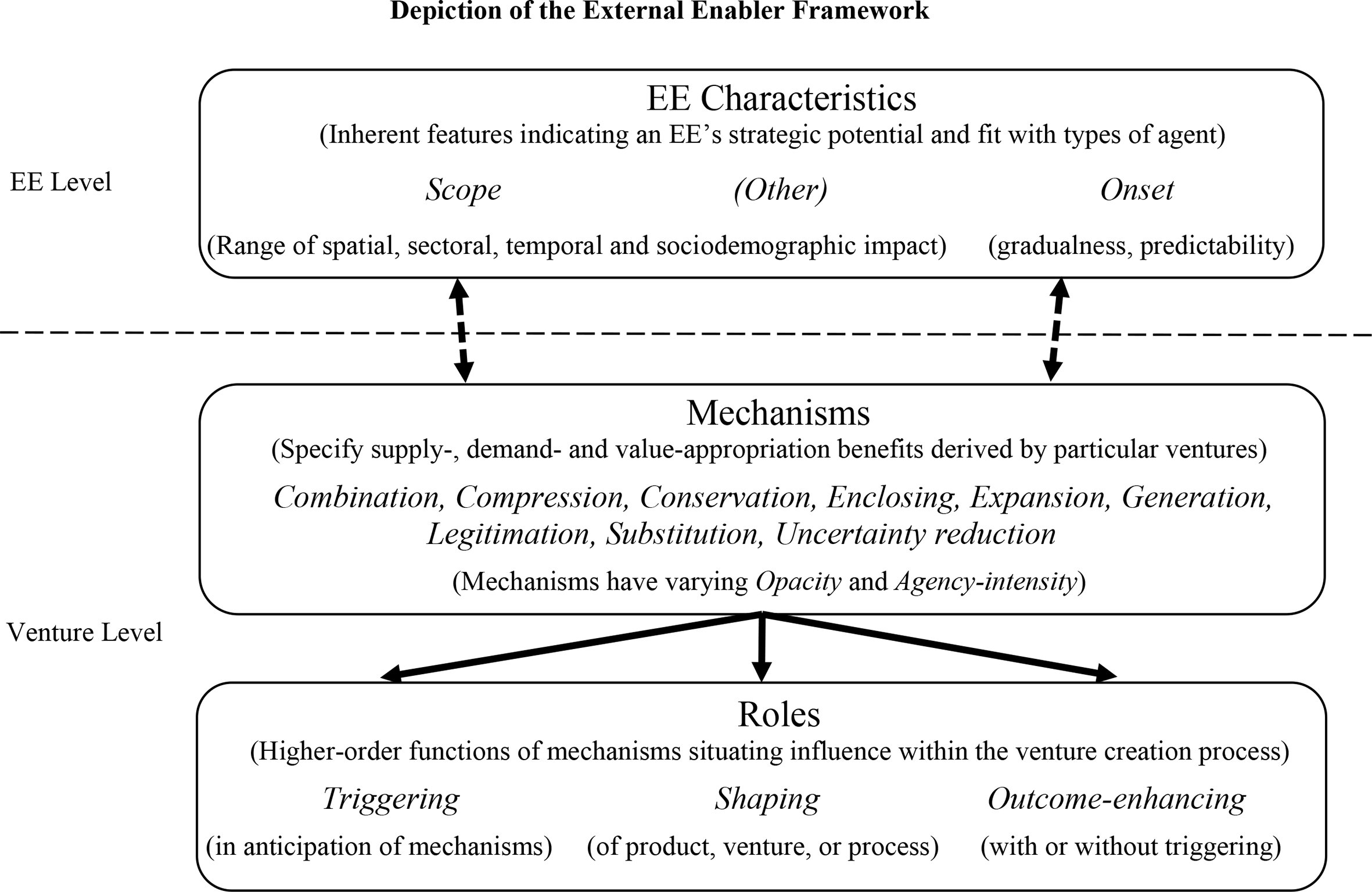
Depiction of the External Enabler Framework.
List of External Enabler Terms (including our revisions).
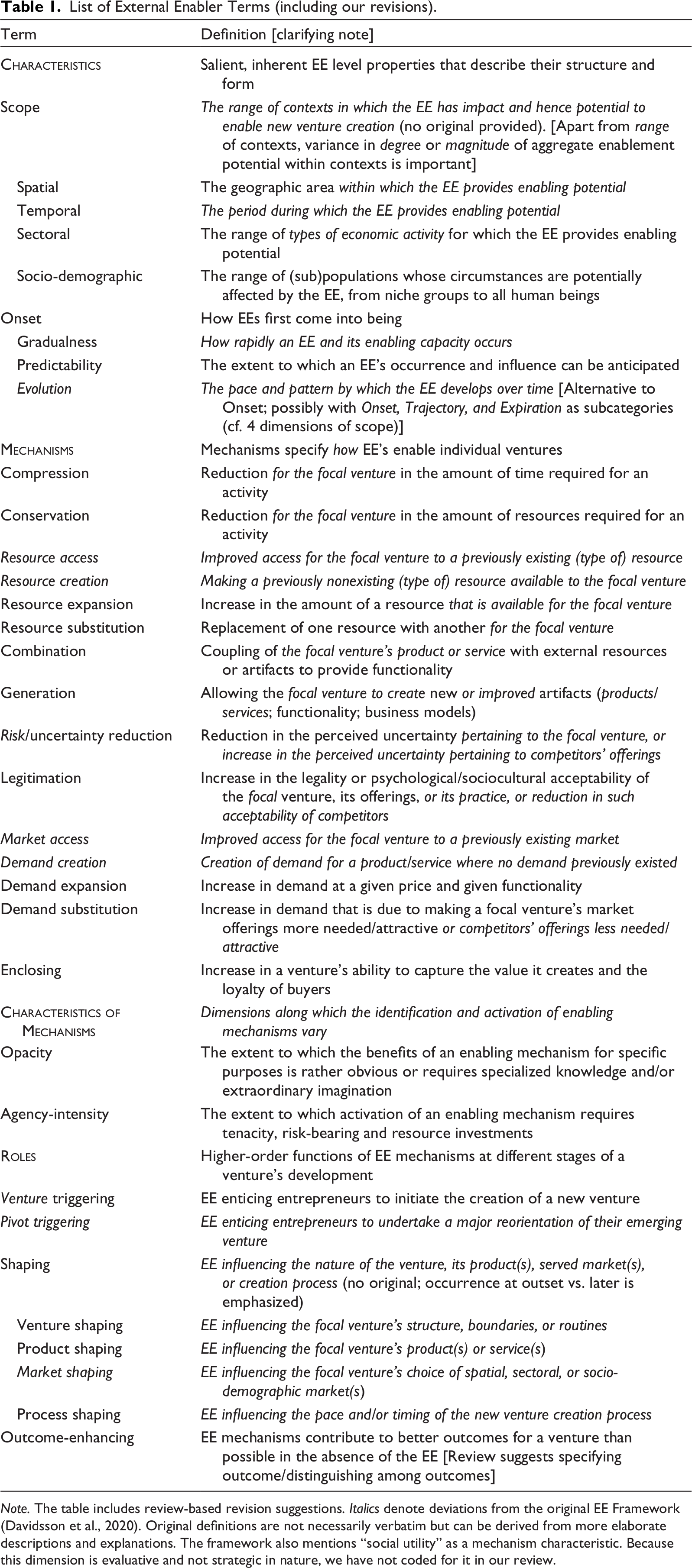
Note. The table includes review-based revision suggestions. Italics denote deviations from the original EE Framework (Davidsson et al., 2020). Original definitions are not necessarily verbatim but can be derived from more elaborate descriptions and explanations. The framework also mentions “social utility” as a mechanism characteristic. Because this dimension is evaluative and not strategic in nature, we have not coded for it in our review.
EE characteristics are intrinsic properties reflecting how EEs vary in contextual boundaries of enablement (scope) and initial emergence (onset). Enabling mechanisms indicate venture-level benefits—potential to improve supply, demand, or value appropriation—provided by aggregate-level EEs. The ability to derive specific mechanisms depends on the EE as well as the venture; there are inherent limits to what mechanisms an EE can provide, and among those it can provide there are inherent limits to particular ventures’ ability to activate them. Further, the EE characteristics–mechanisms relationship is bidirectional: scope and onset may determine what mechanisms an EE can offer but its scope can also depend on its ability to provide these mechanisms. Apart from varying in type and amount of enablement (e.g., cost-saving or resource-provision), mechanisms vary in opacity (difficulty of identifying) and agency-intensity (difficulty of activating; cf. Ramoglou & Tsang, 2016). Roles denote higher-order influences of EE mechanisms across a venture’s creation process: triggering, shaping and outcome-enhancement. We provide further explication of EE terms in their respective result sections.
It is important to note what the EE Framework focuses on (i.e., elements of the framework) versus what else it acknowledges. It fully recognizes the key role of agents and the important influence of context beyond the EE itself. The intention is for the EE Framework to complement agent-focused theories on organizational and individual levels as well as insights on the role of context developed elsewhere (e.g., Johns, 2006; Welter, 2011; Zahra et al., 2014). The framework also acknowledges that not all new ventures draw heavily on external change, and that such changes can have both positive and negative effects on incumbents’ current activities and on the economy overall. However, the framework focuses on the enabling side for (independent or corporate) new ventures because all changes are assumed beneficial for some ventures and because not-yet-existing ventures are attracted by facilitation, not hindrances. This being said, no changes are EEs in general for all ventures and agents. Finally, the framework acknowledges that entrepreneurs can change environmental structures by collectively creating new markets and individually as inventors or lobbyists (Davidsson et al., 2020, p. 322–323). However, this phenomenon is not a focus of the framework. Hence, by adopting the EE Framework, this review accepts both “natural” and “manmade” EEs while regarding these changes as occurring independently of the focal agent (Davidsson et al., 2020).
Review Method
Guided by Tranfield et al. (2003), our review process was necessarily iterative due to the challenging fragmentation of the reviewed literature. Below, we briefly describe our literature search and selection strategies, criteria, and review processes. In the interest of transparency and reproducibility we provide further details in the Appendix.
Due to the lack of common terminology across types of environmental change, we employed a principle-based search strategy for the main literature search. The four principles of EE are: (1) aggregate-level instance of (2) change(s) focusing on (3) enablement of (4) new venture creation (Davidsson et al., 2020; Davidsson, 2015). Based on these, we developed inclusion and exclusion criteria (Table 2) and specific search terms (Table A1). We used the keyword ‘external enabl*’ in a supplementary search to capture research explicitly using the EE concept. Recognizing the cross-disciplinary appeal of the EE phenomenon, we searched all journals listed on Financial Times 50 (FT50). To increase total coverage of new venture creation we added another five entrepreneurship journals of high standing. 3 We used combinations of search terms developed for each principle in Elsevier’s Scopus® database. The review covers the 2000–2020 (September) period. This yielded 791 candidate articles from our main (766) and supplementary (25) searches.
Inclusion and Exclusion Principles.
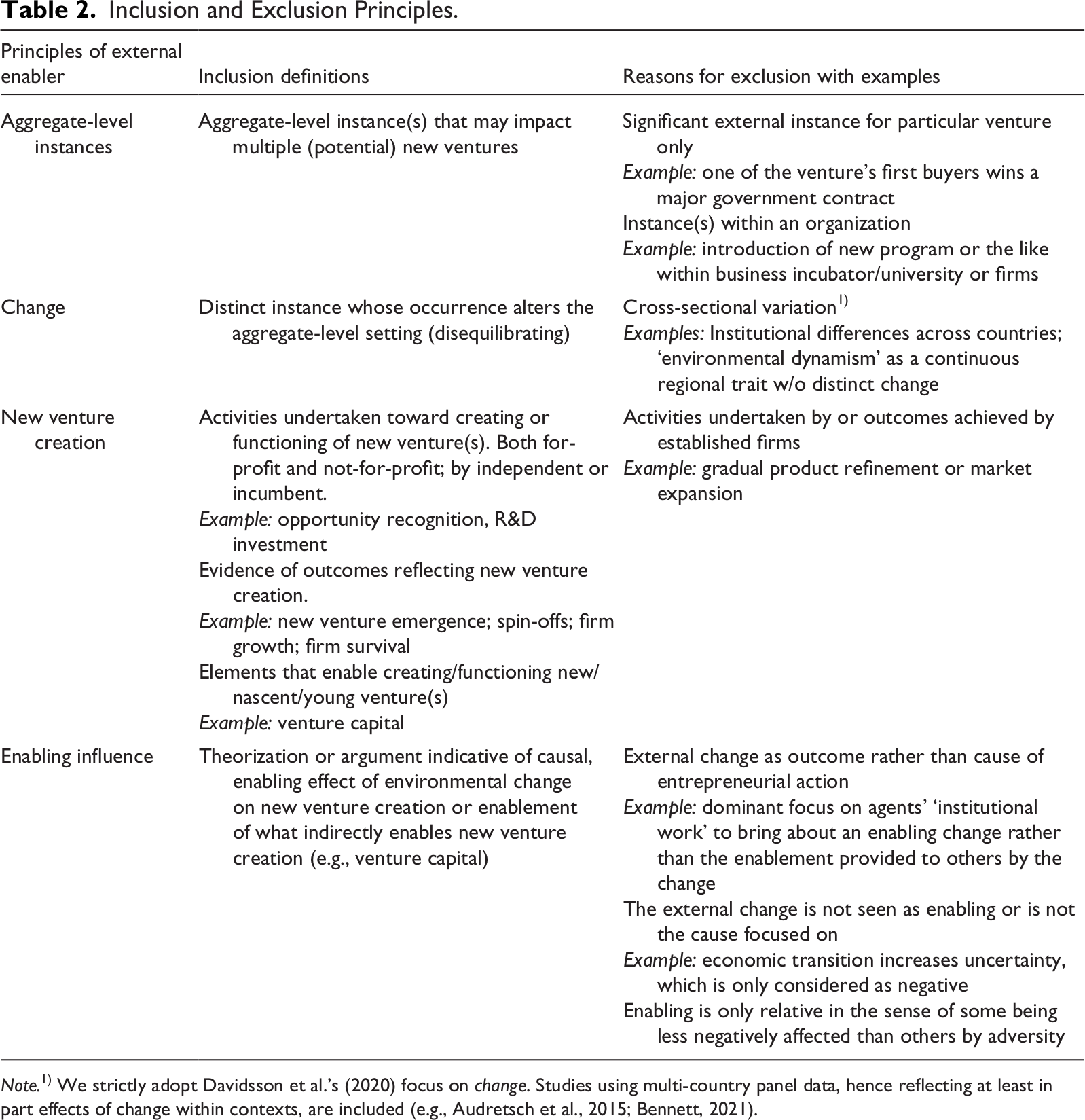
Note.1) We strictly adopt Davidsson et al.’s (2020) focus on change. Studies using multi-country panel data, hence reflecting at least in part effects of change within contexts, are included (e.g., Audretsch et al., 2015; Bennett, 2021).
We identified a final set of articles for review through the following selection steps against the four principle-based criteria: (1) title and abstract examination; (2) full-text examination; and (3) initial coding of EE features (e.g., characteristics, mechanisms, and roles). All three rounds involved iterative processes of independent examinations, cross-checks, re-inspections, and reconciliation in case of disagreement or doubt. This led to the identification of 94 (90 + 4) papers as well as further refinement of inclusion and exclusion criteria (see Appendix for further details, including summaries of each article through an EE lens in Table A2).
Using the EE Framework helped resolve some concerns pertaining to systematic reviews noted by Rauch (2020, p. 851-852). Clearly defined elements of the framework provided a basis for systematic coding and analysis of what is heterogeneously described and labelled in the literature. In addition to counts of occurrences, we undertake bibliometric cross-citation analysis 4 to formally evaluate knowledge integration (the technical term indicative of knowledge accumulation). Cross-citation analysis assesses linkages between articles, revealing patterns among journals, articles and/or authors (Gomezelj, 2016; Howey et al., 1999). A selective set of cross-citation results is provided in Appendix (Figure A1 (a-i)).
Using the EE Framework as a basis draws also on another advantage of systematic reviews noted by Rauch (2020), namely that it allows combining evidence across qualitative and quantitative studies. Systematic reviewing is less suited for assessing how the cumulative evidence weighs on substantive matters (cf. meta-analysis); a problem aggravated in our case by the diversity of issues addressed in the reviewed literature. Therefore, our systematic review aims mainly at giving a fair and informative portrayal of ‘what has and has not been done, and how?’
Rauch (2020) also notes that a systematic review “often highlights gaps in the literature, helps to develop and advance theoretical models, and presents new perspectives on emerging issues leading to valuable suggestions for future research.” Accordingly, we identified papers to engage with more deeply in identifying, validating and refining ideas for a future research agenda, beyond ideas that can be derived directly from our quantitative results. In the interest of transparency, we cite the individual exemplars when synthesizing patterns across works that guide research agenda suggestions and proposed refinements of the EE Framework.
Review Findings
Before reporting our findings, we reiterate that because of the broad range of aspects of enablement addressed in the reviewed research, our review’s main foci are “What has (and has not) been done, and how?” as input to inform future research. We do not focus on conclusions or the weight of evidence regarding particular variable relationships. Further, we selected studies that address influence of external change on new venturing to some extent and for various purposes and critically assess their delivery on a goal imposed by us: accumulation of strategically actionable knowledge about how disequilibrating external changes enable new venture creation. Our reporting does not aim to critique their ability to achieve their own, respective goals. All papers in our review were published in highly ranked journals and often exemplify excellent scholarship regardless of the extent to which they contribute strongly to the kind of knowledge we emphasize.
The first half of our review findings presents observations based on publication outlets, theory usage, research design, and the types and instances of environmental change that are investigated (Table 3). This summarizes what has been addressed and how, and helps identifying gaps in the literature. Although we apply the EE label for the studied environmental changes, we do not use any other terminology from the EE Framework in this initial part of the results. By contrast, we base the second part of our review findings on the structure and terminology of the EE framework (Table 4). 5 In this part we formally estimate the extent of knowledge integration through cross-citation analysis (cf. Mingers & Leydesdorff, 2015; Stewart, 2018). In the last part, we assess the EE Framework’s ability to represent the reviewed work and suggest some refinements.
A Modestly Sized (But Growing) Literature with Limited Focus on Strategic Action
An important, first finding in Table 3 is that despite the broad set of external changes covered, the number of articles qualifying for our review is small. This highlights the limited attention that has been given to this essential area of research. However, interest is growing as more than half of the studies (49) were published in the last 5 years. This said, the proportion appearing in the three FT50-listed journals in entrepreneurship is modest (22 articles). The non-FT50 entrepreneurship journals account for 34 articles, primarily found in the more aggregate-level oriented journals Small Business Economics (15) and Entrepreneurship & Regional Development (11).
Table 3 shows that quantitative studies are dominant, often using secondary data sets. Most of these studies relate a single, aggregate-level change to effects on the new firm start-up rate. Despite the strategic potential EEs offer to the micro-level (entrepreneurs, firms, ventures), only nine studies empirically link the aggregate-level change to venture- and agent-level action (e.g., type of venture to initiate, the amount of investment, decision to start a firm). The neglect of EEs in contemporary strategy research is reflected in the two FT50 journals run by the Strategic Management Society only contributing four articles combined, across 20 years (cf. Davidsson, 2020). We observe that the qualitative studies often better link EEs and micro-level action by combining aggregate-level data collected through publicly available sources such as newspapers and governmental documentation to the micro-level data from interviews and observations covering extended periods of time, albeit often retrospectively (e.g., Weber et al., 2008; York et al., 2016). We return to this in our research agenda.
Dominance of Empirical Research Lacking a Coherent Theoretical Basis
Table 3 shows that the reviewed articles are predominantly empirical and either phenomenon-focused or eclectic in their use of theory. The former approach may be justified when addressing new phenomena such as crowdfunding and fintech (e.g., Burtch et al., 2013; Huang et al., 2017; Roma et al., 2017). The ‘eclectic’ category reflects the pulling of concepts and arguments from multiple theories that researchers arguably resort to when they find that no application of only one or two theories would suffice for their theorization. Only the various branches of institutional theory (North, 1990; Powell & DiMaggio, 1991; Scott, 1995) are used repeatedly in this literature. Another 19 studies rely on a named theoretical perspective, but each represents a one-off effort within our set of 94 studies. In all, the results indicate a real or perceived shortage of conceptual tools fit for the purpose of this type of research. In our research agenda, we will return to the dominance for phenomenon-oriented or theoretically eclectic research as related to long term knowledge accumulation.
Considerable Interest in Regulatory Change and an Absence of Research on Demographic Transition
The second last panel in Table 3 demonstrates that regulatory change is the most frequently addressed type in this literature. On top of these 36 instances there is the Economic Transition category, which typically involves a confluence of inter-related regulatory, political, economic and sociocultural developments. Most studies of regulatory change empirically verify that the intended effects of initiatives specifically designed to stimulate business activity actually materialize (e.g., deregulations related to the business registration process or employment laws [21 studies] and regulations providing monetary subsidies and the like [7 studies]).
Other studies address enablement drawn from a) failure of, b) seemingly unfavorable, and c) non-business regulatory changes. For example, initial failure—due to the prevalent misconduct of government entities—of deregulations to create private firms in China and Russia instead fostered new venturing efforts that help to overcome the problems (Ahlstrom & Bruton, 2010; Smallbone & Welter, 2012; Welter & Smallbone, 2011). Similarly, stringent regulation on information disclosure and on business advisors led to creation of new ventures by inducing venture capital activities and by creating new demand (Cumming & Knill, 2012; David et al., 2013). Further, regulatory change for “non-business” purposes (e.g., environment, social liberalization, prohibition, and digital use) offer a variety of nonobvious, yet effective enablement for new venture creation (Hiatt et al., 2009; Song, 2019; Vakili & Zhang, 2018; York & Venkataraman, 2010). These findings support that disequilibrating environmental changes enable some emerging ventures regardless of their initial intentions and overall effects on the economy.
Technological change has the second highest frequency in Table 3 although a substantial literature on this topic in non-FT50 specialty journals is excluded (see note to Table 3). Studies on sociocultural EEs often focus on social movements (e.g., Hiatt et al., 2009), while the natural-environmental category often concerns social venturing in response to natural disasters (e.g., Dutta, 2017). A perplexing observation in Table 3 is the complete absence of studies of entrepreneurship in response to demographic change, whether based on ageing or migration. 6
Outlets, Theories, Approaches, Type of Data, and Type of Environmental Change.
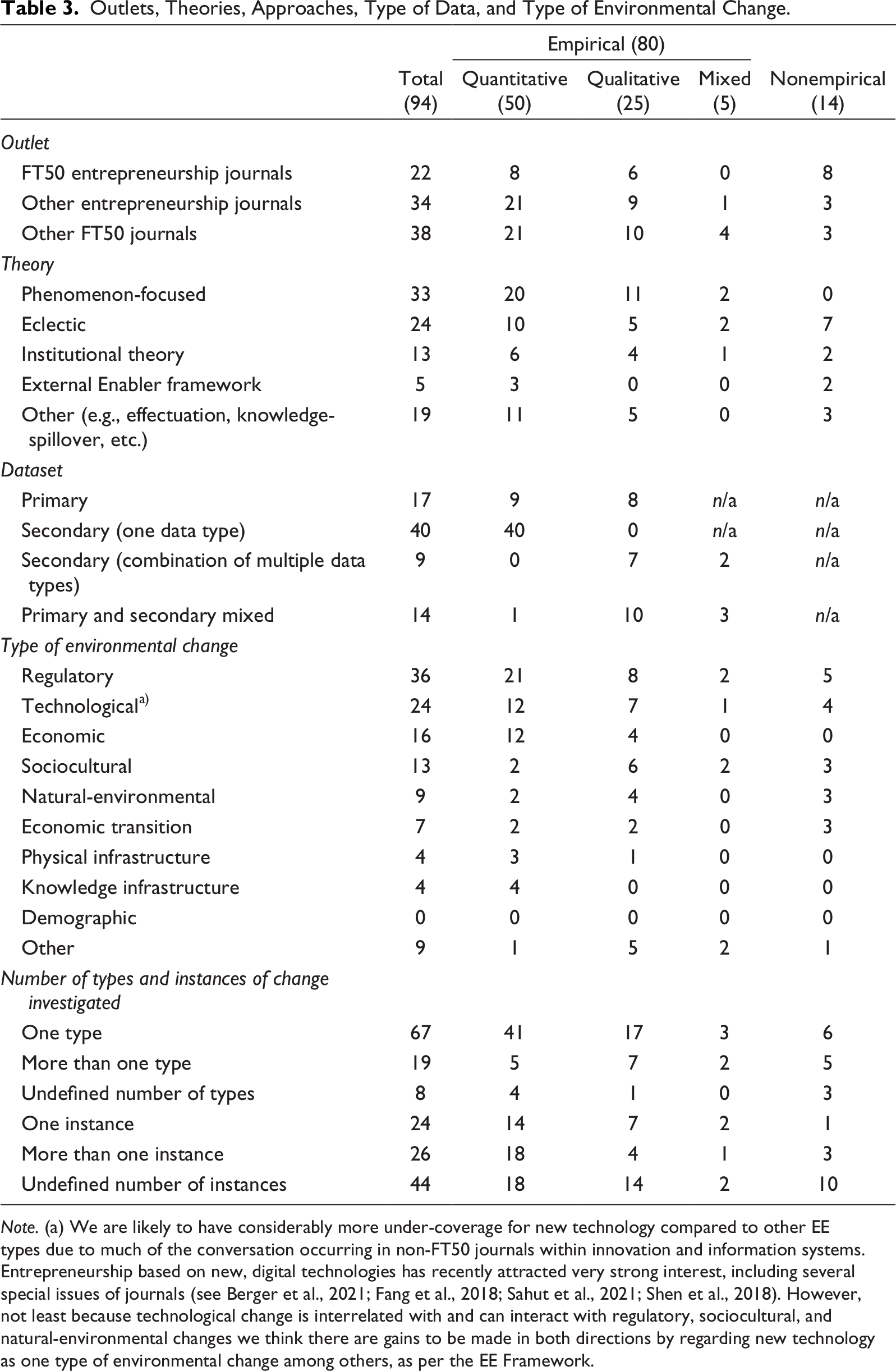
Note. (a) We are likely to have considerably more under-coverage for new technology compared to other EE types due to much of the conversation occurring in non-FT50 journals within innovation and information systems. Entrepreneurship based on new, digital technologies has recently attracted very strong interest, including several special issues of journals (see Berger et al., 2021; Fang et al., 2018; Sahut et al., 2021; Shen et al., 2018). However, not least because technological change is interrelated with and can interact with regulatory, sociocultural, and natural-environmental changes we think there are gains to be made in both directions by regarding new technology as one type of environmental change among others, as per the EE Framework.
Interrelations and Interactions Among Environmental Changes
A minority of papers address more than one type (19) and/or instance of EE (26). Some of them imply causal interrelations among multiple EEs as well as interaction effects on particular ventures. Examples of causal interrelations include (1) changes such as social movements, environmental degradation, and economic crisis that lead to regulatory change (Hiatt et al., 2009; Sine & David, 2003; York & Venkataraman, 2010; York et al., 2016), and (2) fundamental political change in transition economies leads to several institutional changes (Ahlstrom & Bruton, 2010; Hu et al., 2020; Nasra & Dacin, 2010; Smallbone & Welter, 2012; Tan & Tan, 2017; Tan, 2001; Welter & Smallbone, 2011). While the former focuses on a single resulting EE (the particular regulation enacted) the latter tends to cover multiple, interrelated EEs such as formal and informal institutions. However, while the interrelations are noted or implied, the analysis rarely pursues them in depth.
Papers capturing multiple EEs highlight two types of interaction effects: (1) a supplementary EE enhances the impact of what is construed as the main EE, and (2) the enabling influence of one EE is contingent on the occurrence of another environmental change that may not yet have occurred. An example of the former is fintech development (main) enabling new product offerings while erosion of trust in the traditional financial industry due to the Global Financial Crisis (supplementary) increases legitimacy and expands demand for the new alternatives (Cojoianu et al., 2020). As an example of the latter, papers on economic transition emphasize the lack of sociocultural acceptance and legal infrastructure, suppressing the enabling impact of another environmental change (e.g., legalization of private new ventures; Ahlstrom & Bruton, 2010; Smallbone & Welter, 2012; Welter & Smallbone, 2011). This means that a realization of the intended enabling outcome depends on successful interactions among multiple EEs.
Papers that investigate multiple EEs shed light on within- and cross-type variance of EEs. Within-type variance is investigated for different kinds of infrastructure (e.g., rail, broadband, highways etc.), regulation (e.g., legalization of intra- and inter-state banking), and economic factors (e.g., gross domestic product, income per capita; Chen et al., 2020; Kerr & Nanda, 2009; Wang, 2006). Empirical evidence for within-type variance cautions against over-generalization regarding the enabling power of particular types of EE. On the other hand, cross-type variance receives relatively little empirical attention. In all, observations from our review call for improved understanding of EE interdependence. We return to this in the research agenda.
Results Pertaining to EE Characteristics
EE characteristics are conceptualized as salient EE level features that influence the economic and strategic potential of an EE (Davidsson et al., 2020). The four dimensions of EE scope are sectoral, socio-demographic, temporal, and spatial. Some EEs’ impact may be local, highly specific and of short duration whereas others have global and all-encompassing scope (like the introduction and evolution of the Internet). The two dimensions of onset are gradual-sudden and predictable-unpredictable. For example, environmental disasters are sudden while environmental degradation is gradual, and patent expiry is predictable while introduction of new, disruptive technology is less so. About half the reviewed papers (49 studies) provide causal statements about EE characteristics.
Scope
Table 4 confirms that variance in scope is a factor that attracts researchers’ interest across all types of EE. In the reviewed articles, the sectoral scope is mostly reflected as a particular industry or industry type where the impact of an EE occurs (e.g., Audretsch et al., 2015; Sine & Lee, 2009) while some studies go beyond “industry” scope examining EE’s impact on categories of new venture like social (Lehner, 2014), hybrid (Schulz et al., 2016) and formal vs. informal ventures (Dau & Cuervo-Cazurra, 2014).
Selected Coding Based on the EE Framework (Characteristics, Mechanisms, and Roles).
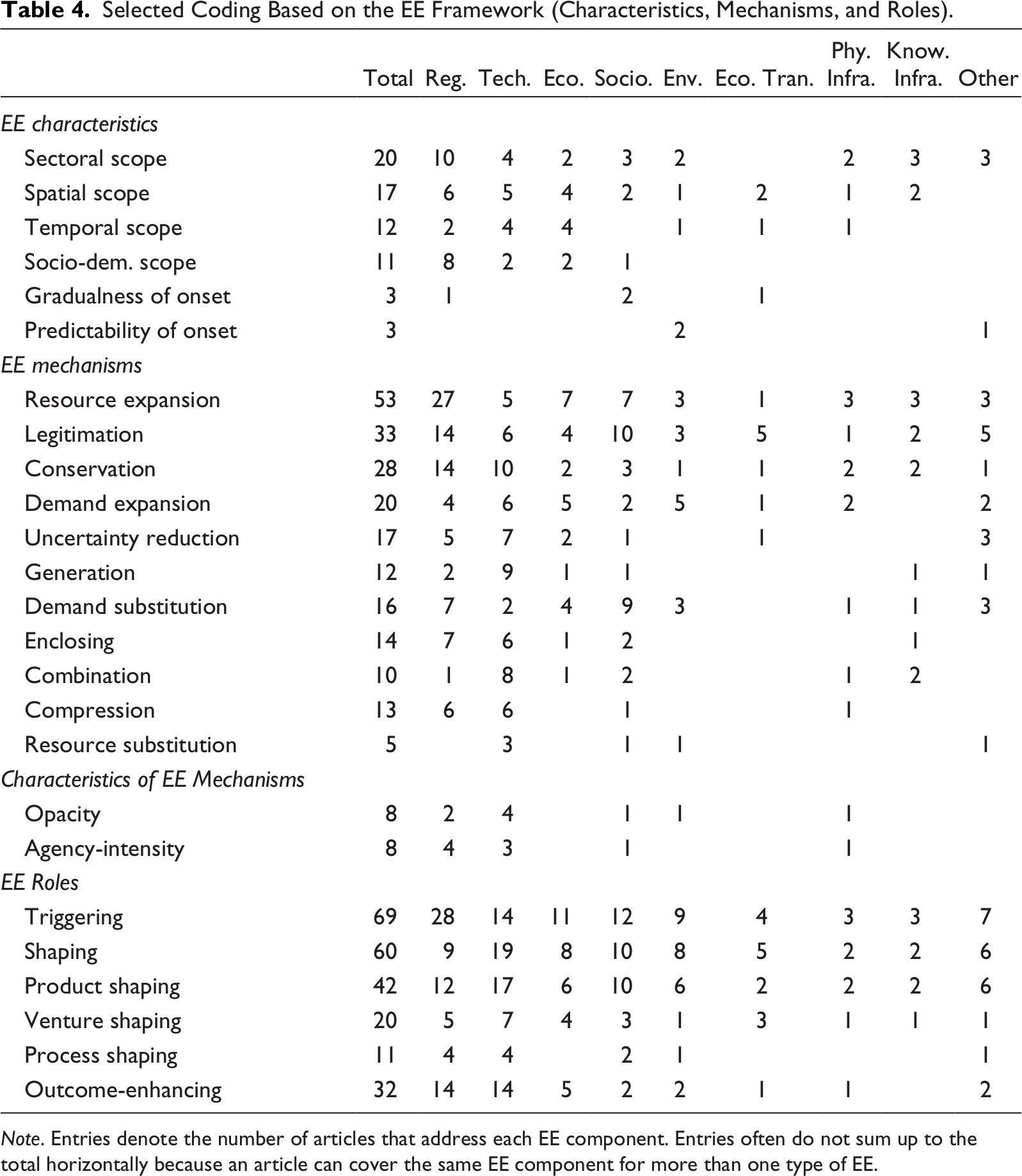
Note. Entries denote the number of articles that address each EE component. Entries often do not sum up to the total horizontally because an article can cover the same EE component for more than one type of EE.
Several studies feature a sector as a significant moderator of EE effects. For example, industry categories and industry attributes (e.g., maturity and fragmentation) determine the influence of EEs (e.g., Audretsch et al., 2015; Chen et al., 2020; Meoli et al., 2019; Pan & Yang, 2019; Shane, 2001; Wang, 2006). The left-hand side of Figure A1 (a) indicates nontrivial knowledge integration about sector-specific influence on venture emergence and growth across various types of EEs (e.g., sociocultural, knowledge infrastructural, regulatory, and natural environmental EE). All these cross-citing papers refer to ‘institutional theory’ whereas none of the non-linked papers on the right-hand side do so and only a few make any mention of ‘institution’. This demonstrates the knowledge-integrating power of common theory and terminology.
Socio-demographic scope reflects an EE’s impact on particular groups of people (e.g., by educational attainment, ethnicity, gender) in terms of who would strategically respond (Chatterji & Seamans, 2012; Eberhart et al., 2017) or who would be the likely users or customers (e.g., young individuals, see Gomber et al., 2018). In several cases, regulatory EEs receive stronger response from particular socio-demographic groups in a manner not intended in the design of the regulations (Castellaneta et al., 2020; Chatterji & Seamans, 2012; Cueto et al., 2017; Schulz et al., 2016). Also, the Global Financial Crisis enhanced the influence of particular socio-demographic attributes, such as gender and human capital, on creating new ventures (Cao & Im, 2018; Giotopoulos et al., 2017). Although cross-cited, the context of cross-citation among the studies to the left in Figure A1 (b) only weakly reflects the focus on socio-demographic scope. Instead, articles are cross-cited for the impact of regulatory EEs on entrepreneurial activity. This confirms segregation by type of change although institutional theory is also a common denominator across four of the five studies.
Spatial scope specifies geographical boundaries, for instance, physical distance from an EE’s ‘epicenter’ (e.g., regions close to new infrastructure and to top financial clusters, see Chen et al., 2020; Pan & Yang, 2019). It also reflects natural geographical features that make an EE variously enabling (e.g., the conditions for certain types of energy production, see Sine & Lee, 2009) or ‘acquired’ regional features (e.g., level of regional economic development; agglomeration economies of major cities, see Pan & Yang, 2019; Zhou, 2011). An EE’s influence is often highly localized due to these geographical features. Like for socio-demographic scope, the limited cross-citation among articles featuring spatial scope seems driven by a shared EE type (banking deregulation) rather than shared scope dimension (Figure A1 (c)).
Temporal scope specifies the timing and duration of an EE’s impact (Burtch et al., 2013; Hunt & Fund, 2016). Studies support stronger enabling impact of EEs in the earlier period than later (e.g., Bayus & Agarwal, 2007). Although our review integrates knowledge on EE’s temporal scope across types of EE, Figure A1 (d) indicates a total absence of knowledge integration across studies.
Finally, while the original EE Framework portrays scope as a matter of an EE being either present or not within a context, a nontrivial number of studies across all scope dimensions emphasize varying (aggregate) degree or magnitude of enablement within an EE’s scope (see Bayus & Agarwal, 2007; Dutta, 2017; Song, 2019; York & Venkataraman, 2010).
Onset
Although the review confirms the relevance of onset (Ahlstrom & Bruton, 2010; Mezias & Kuperman, 2000; Williams & Vorley, 2017), few studies address variance in gradualness and predictability of onset (Table 4) and there is limited depth when they do. For example, some studies anecdotally note gradual trends in technology as a within-venture tool for entrepreneurs and also its prevalent impact on the user base (Browder et al., 2019; Song, 2019) without theorizing or empirically testing this onset characteristic. Further, the review suggests that the continued trajectory and eventual expiration of EEs are also important (Bayus & Agarwal, 2007; Branzei & Abdelnour, 2010). This suggests expanding onset to evolution of EEs, which would allow more detailed attention to the pace and manner of EEs’ development over time (see Chalmers et al., 2020; Smallbone & Welter, 2012; Williams & Vorley, 2017).
Results Pertaining to EE Mechanisms
Mechanisms are venture-level manifestations of EEs, specifying cause-effect relationships pertaining to what supply-, demand- or value-appropriation improvement an EE offers (Table 1). Apart from being strategically important in themselves, mechanisms vary on two strategically important characteristics: opacity, referring to how difficult they are to identify, and agency-intensity, referring to how demanding is their realization.
In support of the rationale behind our review, the columns and rows in Table 4 confirm that a given type of EE can offer many different mechanisms and that a given mechanism can be derived from several different types of EE. Causal effects of four mechanisms—resource expansion, legitimation, conservation, and demand expansion—are argued in 20 studies or more. Below we specify prominent types of enablement under each of these four mechanisms.
Resource Expansion and Conservation
The reviewed research often refers to provision and saving of three types of enabling resources. Financial resources are the most prevalent (e.g., governmental subsidies and reduced interest rate as obvious enablement; Black & Strahan, 2002; Colombelli et al., 2020; Kromidha & Robson, 2016 vs. reduced cost for acquiring customers and technologies as non-obvious enablement; Gomber et al., 2018; von Briel et al., 2018). Expansion of and reduced cost for acquiring knowledge/information (e.g., Kolympiris et al., 2014) and human resources (Wang, 2006 & Vakili & Zhang, 2018) are also recurring key enablement offered by EEs for new venturing. In some cases, the enablement concerns access to rather than expansion of resources (e.g., Roma et al., 2017).
Legitimation
Two main types of legitimacy provided by EEs are: (1) toward venturing activity in general and (2) toward particular market offerings and business practices. Examples of the former include legalization and increased social acceptance for profit-seeking activity (Tan & Tan, 2017; Williams & Vorley, 2017). Social movements that increase legitimacy by heightening customer awareness and appreciation of new products and production practices illustrate the latter (Sine & Lee, 2009; Sine & David, 2003, Sebastiani et al., 2013). This includes legitimacy offered by other stakeholders, such as investors (Akemu et al., 2016).
We found dense cross-citation linkages for resource expansion, conservation, and legitimation mechanisms, indicating potential knowledge integration for these mechanisms (Figure A1 (e) for legitimation). However, the context of citation is often a common type of EE (e.g., regulatory change and social movements) and a shared theoretical basis (institutional theory).
Demand Expansion
Demand expansion often refers to increase in total demand driven by (accessible) population (Bennett, 2019; Chen et al., 2020; Song, 2019); improved economic status of the population (Partridge et al., 2020; Wang, 2006), and increase of unfilled niches (Cohen & Winn, 2007; Tan, 2001). Other instances concern increases in demand for specific product categories due to natural disasters (Dutta, 2017; Grube & Storr, 2018; Nelson & Lima, 2020; Williams & Shepherd, 2016) and increase in the user base of internet/mobile-based financial services (Gomber et al., 2018). Some of this should perhaps be seen as demand substitution instead, although it is often hard to identify what is sacrificed to make room for the increased demand. In some cases, the expanding demand could more accurately be seen as demand creation (e.g., David et al., 2013) or improved market access (e.g., Chen et al., 2020).
We found an absence of cross-citation across studies addressing the demand expansion mechanism while relatively strong knowledge integration emerges for the demand substitution (Figure A1 (f)). Although this may be driven also by shared type (social movement) and theory (institutional), the context of citation reflects what the demand substitution mechanism specifically refers to (existing demand is replaced through the emergence of the EE) rather than other or general enabling influence of sociocultural changes.
Characteristics of Mechanisms
Few studies address the opacity and agency-intensity of mechanisms (Table 4) and then usually not in much depth. We address future research on the strategically important issue of characteristics of mechanisms in our research agenda.
Results Pertaining to EE Roles
Derived from mechanisms, EE roles are higher-order functions of EEs at different stages of a new venture’s development (Davidsson et al., 2020). The EE Framework outlines three distinct but non-exclusive roles: triggering, outcome-enhancing and shaping. An EE can trigger new venture creation due to anticipation of one or more enabling mechanisms. Both anticipated and unanticipated mechanisms can enhance the outcomes. Further, EE mechanisms can contribute to shaping the product (e.g., social movements creating demand for particular products); the venture (e.g., new technologies shaping the business model); and/or the process (e.g., deregulation making the venture creation process easier and faster).
While roles can be discerned from the manuscripts (Table 4) they are usually not expressed with the clarity and precision that is assumed by the framework’s terminology. Articles sometimes rely on concepts that do not denote the exact influence of an EE (e.g., effects on entrepreneurial ‘opportunity’ or ‘activity’) and rarely specify when in the new venture creation process the enablement occurs. Our coding is thus based on explicit theoretical arguments but also inferred from implicit or imprecise arguments, and operationalizations.
Triggering
Table 4 shows that triggering is the most studied role. However, we coded half of the instances (38) as ambiguously operationalized, confounding triggering with outcome-enhancement. This is because the operationalization as increase in national, regional, or sectoral entry rates does not distinguish between increase in attempts to start ventures (triggering) and a larger share reaching successful emergence (outcome-enhancing; cf. von Briel et al., 2018). Only four studies use a completely unambiguous, individual or venture-level measure of triggering (e.g., decision to start a new venture; Castellaneta et al., 2020; Eberhart et al., 2017; Giotopoulos et al., 2017; Schulz et al., 2016). Similarly, only six articles develop separate hypotheses or propositions for triggering and outcome-enhancing effects (Cueto et al., 2017; Cumming & Knill, 2012; Eberhart et al., 2017; Giotopoulos et al., 2017; Mezias & Kuperman, 2000; von Briel et al., 2018).
Regarding the triggering role, cross-citation patterns indicate a level of knowledge integration arguably driven by the use of a shared dependent variable (start-up rate). Moreover, cross-citation tends to occur much more within than across types of EEs (Figure A1 (g)).
Outcome-Enhancing
While accepting a broader range of outcomes, Davidsson et al. (2020, footnote 7) hold that “under the view that entrepreneurship is about new venture creation, the most relevant outcome is whether or not the process leads to a viable new venture.” Few articles in the review actually address such ‘emergence success’, Gozman et al. (2018), Viotto da Cruz (2018) and Song (2019) being among the exceptions. Instead, the articles mostly focus on survival (Bayus & Agarwal, 2007; Conti, 2018; Partridge et al., 2020), financial performance (Burtch et al., 2013; Cohen & Winn, 2007), and growth (Eberhart & Eesley, 2018; Kobeissi, 2009) beyond that point.
Through cross-citation analysis, we found segregation of knowledge by different type of EE and also limited integration of knowledge within types as the context of cross-citation reflects general impact of a particular EE type on new venturing activity rather than whether or how it enhances the outcome of new ventures (Figure A1 (h)).
Shaping
Table 4 reveals that many articles address product and venture shaping to some extent. However, the treatment of shaping is not always deep or central. Only 18 articles represent any type of shaping in formal hypotheses or propositions. In the remaining cases the coding is based on reported observations, examples, theoretical arguments, or rather implicit suggestions.
Interestingly, attention to product- and venture shaping is much more prevalent in qualitative and conceptual (27 papers; 69%) than quantitative papers (15 papers; 29%). This arguably reflects the challenge of compressing shaping to a few quantitative variables; that such information (consequently) is absent in secondary data sets, and that close-up study may be necessary to effectively capture shaping phenomena. Grandy and Hiatt (2020) is a quantitative exception by empirically testing the process-shaping role as time taken for regulatory approval.
Different varieties of product shaping were identified through our review. First, the examined EE—for instance, a social movement or natural disaster—can narrowly specify the type of increased demand, thereby determining what to offer the market in the first place (Hiatt & Carlos, 2019; Hiatt et al., 2009). Second, the EE may constitute the core or components (e.g., big data and artificial intelligence) of the product or service (e.g., automation of credit applications; Mohsen et al., 2019; Toms et al., 2020). Third, an EE can facilitate stakeholder interaction guiding improvement of attributes of the offerings (e.g., Lehner, 2014, about crowdfunding). Further, influence on the choice of market to address can be independent of product shaping (e.g., Mohsen et al., 2019). Such market shaping is currently not covered in the EE Framework.
The notions ‘organizational form’ and ‘business model’ appear sporadically in the coding for venture shaping (e.g., Hunt & Fund, 2016; Lehner, 2014; Song, 2019). Other papers address a diverse set of venture shaping indicators. Except for Hunt and Fund’s (2016) ‘sustainability shaping’ and Welter and Smallbone’s (2011) elaboration on six management practices driven by economic transitions, there is only passing mention of possible venture-shaping effects.
We found relatively strong knowledge integration for the shaping role within and across EE types (Figure A1 (i)). Cross-citation occurs across articles addressing each of the four dimensions of the shaping role (e.g., within EE type: Grégoire et al., 2010; Grégoire & Shepherd, 2012; Shane, 2000, 2001 and across EE types: Akemu et al., 2016; Sine & David, 2003; Williams & Shepherd, 2016; York & Venkataraman, 2010). Again, institutional theory is well represented among cross-cited articles.
Assessment and Revision of the External Enabler Framework
Overall, our review confirms broad applicability of the EE Framework (Davidsson et al., 2020) as a vantage point for investigation of multi-faceted external enablement of new venture creation. The summary of our findings in Table 4 clearly supports the premise that there is variance within and commonalities across types of EEs regarding how they enable new venturing. Further, our cross-citation analyses often indicated either limited, or narrow integration within types of EE except when common theory drives integration more broadly across types. This suggests that the EE Framework’s shared conceptualizations have considerable knowledge accumulation potential.
The EE Framework (1) invites integration across a broad range of types of change while providing bases for identifying similarities and differences between instances of change within and across types (scope, onset), (2) emphasizes enabling impact for new ventures, and (3) provides detailed terminology for functions of enablement (mechanisms; roles). Across these criteria, the framework arguably offers an alternative for analyzing enabling impact of external change on new venturing that is superior to other integrative terms like external shock, environmental jolt, disruption, and entrepreneurial opportunity as well as frameworks like SWOT, PEST[EL/LE], Porter’s Five Forces, and the like.
This being said, although the current structure and terminology of the EE Framework largely captures the variance and commonalities—relevant to enablement of new venture creation—that the reviewed research addresses, the review work yielded some observations that can motivate further refinements and revisions of the EE Framework. We have mentioned above that apart from EE scope, the degree or magnitude of enablement within an EEs scope needs to be considered. A liberal interpretation of sectoral scope makes room for effects on categories like social, hybrid, and informal ventures. The notion of onset should possibly be expanded to EE evolution. We should caution, though, about potentially problematic overlap with the temporal scope concept. For some purposes, access vs. creation vs. expansion to/of resources and demand may be useful distinctions in the mechanism category. Though observed in the review, we advise against adding mechanisms like incentivizing of founders (Cao & Im, 2018; Cumming & Knill, 2012; Eberhart et al., 2017; Sine & Lee, 2009) and signaling to stakeholders (Roma et al., 2017) because they are already represented by the triggering role and/or underlying, favorable circumstances covered by current EE mechanisms. Market shaping—influence on what market to serve—can be added as a fourth type of shaping role. For process-oriented studies, there may be reason to consider Pivot triggering (e.g., Lehner, 2014) alongside the original category re-labeled as Venture triggering. We also found definitions of some concepts missing or wanting. Table 1 summarizes our revision suggestions and provide definitions for all concepts in the (revised) EE Framework.
Agenda: Future Research Directions
Our review demonstrates that changes to the business environment benefit many new ventures in numerous, significant ways. The overall goal for this literature review is to enhance knowledge accumulation about how such changes enable new venture creation, with a special emphasis on strategically actionable knowledge. Our most important means for this is the research agenda outlined below. This agenda has primarily been informed by the following review observations, which were reported above. First, the literature addressing effects of external change on new venture creation is small. This motivates a strong call for 1) more research in this area. We also found limited, recurring use of particular theories, indicating 2) a need for theoretical development in this domain. This was further reinforced by our cross-citation analyses, which suggest that common theory and terminology integrates research addressing different nominal types of change.
Further, the review demonstrates that the forms of enablement-relevant variance are shared across different types of external change, while most studies focus on a single type. This supports a call for 3) more research and theorizing across nominal types of environmental change. The predominant focus on a single type (and often single instance) of change further indicates 4) a need for research on interrelationships and interactions among external factors that enable new venture development. Our cross-citation analysis reinforced this point by indicating narrow knowledge integration, occurring within rather than across types of change. Further, the single instances studied frequently represent sudden, external shocks. This calls for (5) more attention to variance in the onset of the changes as well as to gradual changes such as demographic trends.
We also found that change in the firm start-up rate is the most common effect assessed and that the research often appears in journals with an aggregate-level orientation but infrequently in strategy journals. Studies rarely assess venture-level mechanisms empirically, nor do they often address strategically important variance in opacity and agency-intensity. This strongly motivates (6) strengthening the emphasis on developing knowledge that is strategically actionable on the level of entrepreneurial agents and ventures. Moreover, effects on triggering of venture creation efforts are rarely separated from effects on the outcomes of such efforts, and process shaping is the least frequently addressed role. This calls for (7) more process-oriented research on the role of environmental change in new venture creation. Further, many studies are limited to verifying enabling effects of changes that are designed or widely believed to have enabling effects for new ventures. In addition, the predominant “single [type of] change increases the start-up rate” approach only captures main tendencies. There is thus a need for 8) research addressing non-obvious enabling effects of environmental change and enablement of deviant forms of venturing that break new ground and arguably signify the most interesting forms of entrepreneurship.
There are thus many interesting and important aspects of external enablement of entrepreneurship that are still largely unexplored territory, providing exciting opportunities for entrepreneurship scholars. In the following, we elaborate on these either under separate headings or integrated under others.
Theory Development
Our review found extensive use of eclectic and phenomenon-focused approaches in empirical research as well as much one-off use of theories (76 studies). The only example of recurring use are the various branches of institutional theory, which have been employed across theoretical as well as quantitative, qualitative, and mixed-method studies. This demonstrates two things. First, institutional theories are a promising theoretical basis for future work in this area. Our cross-citation analyses gave repeated indications of its knowledge-integrating potential, confirming that key anchoring theories facilitate knowledge accumulation (Shepherd & Wiklund, 2009; Singh et al., 2003). We believe institutional theories are especially fruitful if augmented with elements of the EE Framework, such as variance in EE characteristics, and attention to mechanisms beyond legitimation and demand substitution. However, not all environmental changes can comfortably be cast as institutional change, and institutional theories have limitations as a basis for explaining micro-level action (Aldrich, 2010), especially deviant action that breaks norms and disrupts the status quo, as high-end entrepreneurship tends to do (Bylund & McCaffrey, 2017; Gozman et al., 2018). Hence, other alternatives are also desirable.
Second, the absence of recurring use indicates that other agent- or cross-level theories currently do not seem fit to fill that void. We therefore call for knowledge accumulation through indigenous theoretical development tailored to explaining entrepreneurship’s core phenomenon: new venture creation. The EE Framework—which is not yet full-blown theory—is one possible vantage point. This can take at least two forms: 1) elevating some facets of the EE Framework to theory status, and 2) using the EE Framework to augment existing, agent-centric theories.
The former would involve the development of propositions, typologies or process models (Cornelissen, 2017) concerning the inter- and cross-relationships among EE characteristics, mechanisms and roles; elements which are currently merely defined, structured, and listed within the framework (with some speculations about relationships). For example, theorizing could take aim at explaining how EE characteristics relate to particular mechanisms; how mechanisms interact and interrelate; how mechanisms and the shaping role pan out across stages of the venture creation process, and why certain mechanisms should be expected to have an exaggerated influence on triggering compared to their influence on outcomes, and vice versa, to mention but a few examples (cf. Cueto et al., 2017; Eesley, Li, et al., 2016; von Briel et al., 2018).
Using the EE Framework to augment existing, agent-centric theories implies theory elaboration (Fisher & Aguinis, 2017). There is no shortage of theories and concepts pertaining to the effects of variance among agents, and some of them concern how agents can deal with external change. However, it seems unlikely that the full potential in agent-focused theories about, for example, individual-level creativity, attributions, and regulatory focus, or firm level theories of absorptive capacity, dynamic capabilities or managerial attention can be realized without systematic attention to variance in the changes to which the agents respond (cf. Davidsson, 2020). 7 The EE Framework provides suitable material for such theory elaboration by specifying several types of enablement-relevant variance among environmental changes on different levels, which can be combined with the variance among agents already highlighted in these theories.
Such matching of agent and enabling conditions in theorizing could lead to realization of the intent behind Shane and Venkataraman’s (2000) entrepreneurship nexus. The EE concept and framework offer an alternative that bypasses the problematic assumptions in the nexus idea (Shane, 2012): that all the relevant conditions exist at the outset; that these conditions by definition make the difference between certain failure and potential success, and that successful entrepreneurs correctly perceive the relevant confluence of conditions and their potential at the start of the journey. By focusing on a delimited set of conditions—environmental changes—and partial enablement, the EE Framework makes the theorizing task manageable. It also invites process-oriented theorizing (see von Briel et al., 2018) which Shane and Venkataraman’s (2000) focus on discovery of pre-existing opportunities came to downplay (Korsgaard, 2013). This can induce process-oriented theorists’ attention to external conditions despite their active aversion to conceptualization of objective opportunities (Alvarez & Barney, 2007, p. 15; Arikan et al., 2020). One type of theory elaboration would be to add not only EE variance but also a temporal dimension (see Davidsson & Gruenhagen, 2020) to otherwise static, agent-centered theories.
Interrelated and Interacting Environmental Changes
Although our review demonstrates potential knowledge integration on interactions of varying environmental changes, past research has mostly focused on a single type—and often a single instance—of EE, and cross-citation analysis confirms the segregation of research by type of change. Research has thus asked “What are the new venturing effects of environmental change X?” This approach risks exaggerating the importance of a single source of enablement and downplaying EE interactions. One important strategy for future work is therefore to start instead from the question “What enables the observable surge in new venturing activity (in context X or by agents of type Z)?” This gears attention to interaction among several enabling circumstances. For example, had Hiatt et al. (2009) started from the question “What was driving the surge in soft drink start-ups in the early 1900s?” they might have considered enablement beyond the mechanisms provided by the temperance movement and prohibition, such as electrified refrigeration (technological change; combination mechanism) and the economic boom of the 1920s (economic change; demand expansion mechanism).
Similarly, Davidsson (2020) suggests that a range of technological, infrastructural, natural-environmental and sociocultural changes help explain the appearance and rapid growth of electric scooter sharing businesses. Some of these changes appear to be causally linked, as with climate change and the evolution of the Internet driving improved battery technology and the prevalence and functionality of smartphones, both of which are leveraged in the business model. Others appear to be interactive or additive, like new bikeways infrastructure adding further to the product’s utility. These patterns of interrelatedness and interaction are likely to be commonplace. Working backwards from known increases in new venturing activity seems to be a good strategy for gaining further insights into such interactions among enabling conditions (cf. von Briel et al., 2018).
Environmental changes interact with the (construed as) stable characteristics of spatiotemporal contexts as well. Although we cannot outline the research implications and opportunities in full detail here (cf. Johns, 2006; Welter, 2011; Zahra et al., 2014), we highlight one possibility of particular interest for developing policy-relevant insights. Regulatory change is undoubtedly the most directly actionable type of change for policy makers. To gain insight into how best to use this instrument to boost spontaneously occurring enablement, studies can cross-sectionally compare the entrepreneurial response to one or more environmental changes across countries or regions with varying regulatory frameworks, culture, demographic structure, or economic development. Differences attributed to dissimilar regulatory arrangements would inform how policies can be designed to enhance the entrepreneurial leverage of spontaneously occurring changes. Effects of variance in other context conditions would moderate such conclusions by indicating challenges that might limit the efficacy of the considered regulatory changes (Greene et al., 2008; Hoppmann & Vermeer, 2020; Mohsen et al., 2019) as well as the conditions under which policy initiatives may be particularly effective.
Strengthening the Emphasis on Strategically Actionable Knowledge, Including About the Deviant and Non-Obvious
Our review established that change in the firm start-up rate without direct attention to the micro-level mechanisms is the most common effect assessed and that the research often appears in journals with an aggregate-level orientation but infrequently in strategy journals. Viewing the issue of entrepreneurial responses (and non-responses) to environmental changes through the lens of micro-level strategic action triggers a range of relevant questions, most of which have been sparsely addressed in the reviewed research. For example: How does the gradualness and predictability of an EE’s onset (or evolution) influence who (else) will act and who is likely to be successful? What type and strength of EE mechanisms can be expected from EEs depending on their scope and onset? What mechanisms are likely associated with lower and higher opacity and agency-intensity, respectively? How do opacity and agency-intensity relate to aggregate triggering (competitive intensity) and venture-level outcome-enhancement (potential reward for taking the less trodden path)? How does the efficacy of EE mechanisms vary across outcomes such as becoming an operational venture vs. growth vs. profitability? How can EE mechanisms be strategically used at different stages of the venture development process? Finally, what does the (successful) deviant minority do differently in deriving strategic benefits from EEs?
Developing strategically actionable knowledge by addressing these and similar questions requires research that goes beyond linking aggregate change to aggregate effects on start-up rates. This can take the form of mixed-method studies that add venture-level data to analysis of aggregate-level data sets or as separate, agent and venture-level projects that stay connected with the overall insights about enablement from aggregate-level research. We discuss four approaches to increased strategic insights: 1) better aggregate-level data sets guided by more effective conceptualizations; 2) using qualitative, case-based data; 3) simulations linking macro patterns to micro-level behavior; and 4) scenario-based experimentation.
Better Aggregate Data Sets Guided by More Effective Conceptualizations
We found that the more strategically insightful studies relying on aggregated data typically use a purpose-built data set compiled by the researchers from various sources. For example, Chen et al.’s (2020) application of the EE Framework from data compilation onward led to interesting insights concerning spatial and temporal scope and even a credible, empirically supported case for ventures leveraging specific mechanisms offered by China’s high-speed rail infrastructure expansion.
The point here is not application of the EE Framework as such, but the use of conceptualizations that capture variance in the environmental changes and that the conceptualization guides the creation of the data set. Candidates for this approach beyond the EE Framework include, for example, institutional theories as discussed above, the notion of affordances (Autio et al., 2018; Gibson, 1977) and the literature on strategic issues (Dutton & Jackson, 1987; Gartner et al., 2008).
Using Qualitative, Case-Based Data
Our review indicated that qualitative and mixed-method studies often capture the link between aggregate-level change and micro-level action more explicitly, addressing issues like product- and venture shaping influenced by external change. Studies using qualitative, case methodology as main method can reach further and deeper into the strategic use of environmental changes (Eisenhardt, 1989; Langley, 1999). Although we side with Davidsson and Gruenhagen (2020) in not equating process research with qualitative methods, the case method is no doubt productive for gaining processual insights, as well as for capturing minority cases of deviant, yet successful entrepreneurial behavior. Challenges include identifying and gaining access to entrepreneurs or investors who specialize in exploiting environmental change for entrepreneurial purposes; making bold and effective, transferable abstractions beyond description of interesting cases (Davidsson & Gruenhagen, 2020); and staying connected with the discourse based on large-scale, quantitative studies of enablement. Weber et al. (2008) make a good example by investigating the process of new venturing for the grass-fed meat production enabled by a grassroots coalition. Based on extensive qualitative data, they unveil varying forms of enablement that play a role at different points in the process of new venture creation.
Qualitative, case-based data can also be used as supplementary evidence in studies using the above type of data set. An example is Hiatt et al. (2009). Like Chen et al. (2020), they combine quantitative data from multiple sources in creating a custom-built data set to analyze the effects of the temperance movement on soft drink venturing (and the demise of breweries). In addition, they use archival, qualitative data to support the existence and strategic use of conservation, resource expansion, legitimation and demand expansion mechanisms.
Simulations Linking Macro Patterns to Micro-Level Behavior
Like Hunt and Fund (2016) within our review, we see clear potential in the simulation method. In particular, Agent-Based Modeling and Simulation (ABMS) is regarded well suited for investigating the micro-processes that may underlie observed aggregate-level patterns (Macy & Willer, 2002). This makes it an interesting avenue toward building better knowledge on external enablement of new venture creation. ABMS can be applied as supplementary method to investigate alternative micro-level explanations for the study’s aggregate results or do the latter as main method in relation to received views in the literature regarding aggregate-level relationships. It may also find productive application where aggregate-level conclusions cannot yet be drawn. This might apply, for example, to examining the effects of varying degrees of discrepancy between which mechanisms trigger many start-up efforts and which have the greatest impact on successful outcomes. Mauer et al. (2018) and Smith and Rand (2018) provide exemplars of linking aggregate patterns to strategic action with ABMS in other areas of strategy research.
Scenario-Based Experimentation
Although few experimental studies qualified for our review, scenario-based experimentation—with conjoint- and other designs—has been prominent in related “opportunity identification/evaluation” research (see Davidsson, 2015; Grégoire et al., 2019). Grégoire and Shepherd (2012; included in our review) is a particularly relevant application (see also Wood et al., 2016). Originating from a re-conceptualization of the idea of “objective opportunity,” the EE Framework readily lends itself to augmenting this research approach. For example, designs can systematically manipulate scope and onset of EEs, or opacity and agency-intensity of mechanisms. Beyond an overall assessment of the attractiveness of the situation, identification and/or evaluation of specific mechanisms and roles can be used as dependent (or mediating) variable. If data on real-world relationships between mechanisms and outcomes can be obtained or approximated, experiments can address cognitive biases leading to over- and under-emphasis of particular mechanisms in venture- and pivot triggering. Experimentation also lends itself to combinations of interacting environmental changes.
The notions of opacity and agency-intensity are of particular interest for studying agent-enabler interactions in assessing the entrepreneurial potential of enablers. Traditionally, this type of variance has been attributed solely to the agent as variance in knowledge and resources at hand. Grégoire and Shepherd (2012) is a forerunner and exemplar in this regard by manipulating superficial vs. structural alignment of technology-market combinations—theorized as representing opacity in EE terminology—while using the evaluator’s prior knowledge about markets and technologies as moderator. In a different topical domain, Gielnik et al. (2015) exemplify how experimentation can be used as supplementary method to gain evidence on causal mechanisms that could not be tested in an observational main study as well as how experimental design can be applied to processual research questions.
Conclusion
A swimmer who tries to make waves in the ocean will not achieve much, while surfers who know how to ride the ocean’s waves can amaze the world while enjoying themselves and reaching their own goals. Although not all ventures are based on environmental changes, the influence of such changes on entrepreneurial action and outcomes is no doubt vital in many cases. The rebounding interest in this previously neglected and dispersed topic of research is a positive sign and is likely to be further boosted by COVID-19, the climate change challenge, continued development of digital technologies, and other changes still unknown to us. We hope that our review and agenda can inspire and guide pathbreaking new work in this domain, accumulating knowledge on how environmental changes strategically—and sometimes fortuitously—benefit entrepreneurs as they conceive new ventures and successfully navigate the process of making them become real.
Footnotes
Appendix. Systematic literature review: Process,criteria and procedures
Failing to meet any of the four principles leads to exclusion of a paper. For example, changes that are helpful only to a particular venture do not qualify. The same goes for helpful circumstances that do not represent change. Studies that also consider detrimental effects of external change are included if there is at least some consideration of enabling effects in the theorizing or empirical assessment. Positive effects only on established firms’ current activities do not qualify.
Title and abstract based examination led to a set of 154 papers for full text inspection. Again, both authors inspected each paper making suggestions for inclusion or exclusion. In case of disagreement or doubt, both authors re-inspected the articles and discussed until agreement could be reached. As a result, the authors decided to retain 94 papers for review.
One important exclusion decision was made for research on science parks; incubators; accelerators; universities; educational programs, and ecosystems. Although these may meet the definition of EE when they clearly represent change, we decided to exclude this category for two reasons. Firstly, these ‘institutions’ are specifically created or transformed with the purpose of furthering new venture creation. They are not broad societal changes that can have different effects in many domains while this review aims to develop knowledge about the often non-obvious benefits that not-yet-existing ventures might find by turning attention to environmental changes. Secondly, the research in this category mostly seems to have other main foci than the enabling mechanisms by which these institutions can provide benefits to particular ventures. They typically seemed ‘marginally relevant’ at best.
It should be noted that the article inclusion and EE-specified coding involve subjective interpretation to some extent. This is due to the challenge of reviewing literature that predated the EE concept and framework and thereby applied varying terminologies to describe elements of the framework. Other coders would likely not arrive at exactly the same coding, but we are confident that the main thrust of our results would be replicated by other researchers.
Note. 1) Each node represents one paper (with the name of first author) and a linkage between two articles indicates the cross-citation from later published article to the one published earlier. Types of EE investigated are indicated in parentheses with the same acronyms used in Table A2 (see note); 2) Two articles dropped from the analysis are Chalmers et al. (2020) and Mohsen et al. (2019). At the time of retrieval (March 1, 2021), these were not yet available from Thomson Reuter’s Web of ScienceTM Core Collection which provides bibliometric information for CitNet Explorer.
Note. Figure A1(g) shows only nodes and linkages of cross-cited papers excluding nodes of 30 non-cross-cited papers due to limited space.
Note. Figure (i) shows only nodes and linkages of cross-cited papers excluding nodes of 38 non-cross-cited papers due to limited space.
Declaration of Conflicting Interests
The author(s) declared no potential conflicts of interest with respect to the research, authorship, and/or publication of this article.
Funding
The author(s) received no financial support for the research, authorship, and/or publication of this article.
