




Abstract
In many markets, there are mediators whose public evaluations mark that a new entrepreneur has gained legitimacy. Their decision may be influenced by third-party sources signaling about the entrepreneur. We quantitatively study these micro-level processes in the art market, where the artist is the entrepreneur and the art gallery is the mediator. Our results show that it is not the quantity but the diversity of signaling sources, especially highly credible ones, that influence a mediator’s decision. This allows entrepreneurs full access to the market under the consensus that “proper” legitimacy has been gained. Our conclusions are maintained under alternative analyses.
Keywords
New entrepreneurs need to gain legitimacy in order to compete on equal footing with incumbents in a focal market. Entrepreneurs that are perceived to be legitimate, that is, “appropriate in a social system in terms of rules, values, norms, and definitions” (Deephouse et al., 2017) have greater access to resources that are essential to their long-term survival (e.g., Delmar & Shane, 2004; Newbert & Tornikoski, 2013; Tornikoski & Newbert, 2007). While being recognized as legitimate has been linked to an entrepreneur’s ability to acquire financial capital, know-how and entry into professional networks (Lounsbury & Glynn, 2001; van Werven et al., 2015; Zimmerman & Zeitz, 2002), the process of how legitimacy is gained is much less studied and understood, either at the level of individuals, firms (Drori & Honig, 2013) or institutions (Bitektine & Haack, 2015).
In this paper, we focus on the crucial point of a new entrepreneur achieving a state of “proper” legitimacy through actual and deliberate evaluations of propriety (Bitektine & Haack, 2015; Tost, 2011). While there are different kinds of legitimacy (Díez-de-Castro et al., 2018) conferred by different kinds of sources (Deephouse et al., 2017) in different ways (Bitektine & Haack, 2015; Bitektine, 2011; Tost, 2011), a state of proper legitimacy is reached when a source carefully assesses a new entrepreneur’s propriety and then makes a judgment about the appropriateness of that entrepreneur in a social system. This kind of legitimacy is noticeably different from having a state of accepted legitimacy, which is rooted in passive evaluations that reflect a taken-for-granted approval (Bitektine & Haack, 2015; Suchman, 1995; Tost, 2011).
Some sources also act as mediators who not only make and validate other evaluations of propriety as well as grant the new entrepreneur full-fledged entry into a market, but they also unambiguously communicate the focal entrepreneur’s proper legitimacy in a social system (Deephouse et al., 2017). Some straightforward examples are certification and licensing boards (Rao, 1994; Rindova et al., 2005) whose explicit authorization permits entry into a regulated market. In other entrepreneurial settings, there are different kinds of mediators whose participation substantially increases the likelihood of an entrepreneur’s survival, for example, highly reputable venture capitalist and angel investors (Gulati & Higgins, 2003; Pollock et al., 2010) prestigious underwriters (Higgins & Gulati, 2003) and venture development organizations (Plummer et al., 2016). Yet, in other settings, there is one kind of mediator whose judgment is crucial in the process of gaining proper legitimacy. In our study, we focus on such a setting, namely the contemporary visual arts market, where the art gallery is the mediator and the artist is the entrepreneur (Woronkowicz & Noonan, 2019). The market characteristics of this empirical domain facilitate generalizability to other industries with high levels of uncertainty about quality—especially due to high rates of innovation—oversupply or, in other words, a greater number of (potential) entrepreneurs than an actor on the demand side can systematically evaluate, and a clearly identifiable mediator governing market access to new entrepreneurs.
Precisely in markets with high uncertainty about quality and oversupply, mediators need to deal with the cognitive demands of navigating these conditions. Decision-makers often respond by using heuristics that incorporate bounded rationality, privileging information that is easily accessed and processed to reduce uncertainty (Kahneman, 2011; Tversky & Kahneman, 1973). Quality signals—such as reviews and awards—are publicly observable indicators that straightforwardly reflect propriety judgments made by third-parties about an entrepreneur. While the number of signals has been shown to positively influence legitimacy perceptions (Bitektine & Haack, 2015), understanding the effects of diversity and credibility of third-party sources as drivers of the process of gaining proper legitimacy has not yet been studied. In this paper, we fill this gap in the literature by focusing on the extent to which diversity and source credibility influence a mediator whose role vis-à-vis the new entrepreneur is to confer a proper state of legitimacy.
We focus on self-employed artist-entrepreneurs active on the primary market for contemporary visual arts, where artworks, such as paintings, photographs, and sculptures, are sold to a first buyer (Singer and Lynch, 1994). This economically important yet relatively under-investigated empirical domain is known to have a high churn of artists moving in and out of self-employment (Woronkowicz & Noonan, 2019). An affiliation with an art gallery is fundamental for artists to be taken seriously on this market (Ertug et al., 2016; Janssen & Verboord, 2015; Prinz et al., 2015; Velthuis, 2003; Wijnberg & Gemser, 2000; Yogev, 2010). Contemporary artworks require considerable explanation and evaluation from third-party sources with specialized knowledge and expertise, making this a particularly suitable domain to study the influence of third-party signal source diversity and credibility. In this paper, we use unique and comprehensive data about 421 fine arts alumni, who graduated from a prestigious art school in the Netherlands between 1990 and 2010, to estimate the likelihood of their first affiliation with an art gallery using event history analysis.
Given our perspective, we contribute to the literature in three ways. First, we study how mediators make legitimacy decisions in markets where there is one kind of mediator who unambiguously grants a new entrepreneur full-fledged entry into the market under the collective-level assumption that proper legitimacy has been gained (Deephouse et al., 2017).
Second, we explore the micro-level processes of achieving proper legitimacy by focusing on the extent to which the diversity of third-party sources conveying signals about a new entrepreneur influence the cognitive processes and thereby, the decision of this powerful mediator. We argue that mediators pay close attention to diverse and highly credible third-party sources because the heterogeneous information they convey reflects not only different opinions in the focal domain but also provides additional, rather than substitutive information. Relying on the diversity of signaling third-party sources as a heuristic helps mediators reduce opportunity costs, and lower their cognitive load of having to conduct complete and systematic processing of information available about all entrepreneurs active in a market (Bingham & Eisenhardt, 2011).
Third, given that not all signaling sources are equally influential, we test the extent to which the diversity of third-party sources and their levels of credibility affect the decision-making process of a mediator. We build on the voluminous literature focusing on the impact of signals conveyed by third-parties on the performance of entrepreneurs (e.g., Gemser et al., 2008; Gulati & Higgins, 2003; Pollock et al., 2010) by paying close attention to the influence of the aggregate flow of signaling sources on a mediator’s decision to grant a new entrepreneur a state of proper legitimacy. In doing so, we provide a better understanding of the effect of particular combinatorics of signals conveyed by third-party sources about a new entrepreneur, over and above a signal’s individual effects (Bapna, 2017; Stern et al., 2014).
Theoretical Framework
The Artist as an Entrepreneur
Self-employed artists display traits—such as high risk-preference, innovative orientation, and internal motivation (Swedberg, 2006)—that are generally associated with entrepreneurs (Barry, 2011; Essig, 2015; Lindqvist, 2011; Poorsoltan, 2012; Scherdin & Zander, 2011; Woronkowicz & Noonan, 2019). The contemporary visual arts market with its skewed distribution of success (e.g., Caves, 2000; Menger, 2006), means, however, that artists often look for employment—art or non-art related—elsewhere (see Hartog & Kackovic, 2019 for a formal analysis). As Woronkowicz and Noonan (2019) point out, there is a constant high churn of artists moving in and out of self-employment. Against that background, as they argue, the decision to keep on trying as a self-employed artist is to be understood as an eminently entrepreneurial stance.
Earlier research has described a point “below which new entrepreneurs struggle for existence and probably will perish, and above which they can achieve further gains in legitimacy and resources” (Zimmerman & Zeitz, 2002). Crossing this point has been reported as an event that denotes and conveys to others that the entrepreneur is perceived to be legitimate in the eyes of a relevant market (Rutherford & Buller, 2007; Rutherford et al., 2009; Zimmerman & Zeitz, 2002). This is even more relevant to artists-entrepreneurs because of the high churn rate that characterizes this market (Woronkowicz & Noonan, 2019). An actor that does not achieve legitimacy or, in other words, “a feeling of relative permanence as opposed to a general feeling of impending failure” (Rutherford et al., 2009, p. 78) will most likely stop being a self-employed entrepreneur.
The Process of Achieving Legitimacy
Legitimacy, as mentioned earlier, can be understood to be a state of “perceived appropriateness to a social system in terms of rules, values, norms, and definitions” (Deephouse et al., 2017). However, to be able to compete on equal footing with incumbents in a market, the new entrepreneur must at least gain a state of proper legitimacy (Deephouse et al., 2017), which means that actual and deliberate evaluations of propriety have taken place (Bitektine & Haack, 2015; Suchman, 1995; Tost, 2011). Propriety refers to a source’s judgment of legitimacy (Dornbusch & Scott, 1975) in which the entrepreneur is perceived by that source to be appropriate in a social system (Tost, 2011).
A mediator’s decision to grant proper legitimacy to a new entrepreneur, however, does not occur in a vacuum. We argue that signals about the entrepreneur can substantially influence their decision, especially those that are conveyed by third-party sources. These sources are believed to possess specialized knowledge and expertise (Bitektine & Haack, 2015), compare and evaluate competing alternatives, and communicate their evaluations publicly to a relevant market (Sauder, 2006). Additionally, third-party sources—especially the highly credible ones—are subject to reputational and financial costs if they transmit misrepresentative information, and mediators are keenly aware that they would not jeopardize incurring such costs by signaling false or erroneous information (Bergh et al., 2014; Ippolito, 1990).
Diversity of Third-Parties
Bitektine and Haack (2015) proposed that the quantity of signals conveys an actor’s “share of voice”, which over time coalesces into a majority opinion about that actor’s legitimacy. Some studies have empirically demonstrated a positive relationship between the total number of signals conveyed about an actor and that actor’s performance outcome (Certo, 2003; Higgins & Gulati, 2003; Pollock & Rindova, 2003; Stuart et al., 1999), attributing this relationship partially to a “buzz” created about the focal actor (Dye, 1999). Nevertheless, other studies have found a less straightforwardly positive relationship between signal quantity and their aggregate effect, especially when the information conveyed by the signals is redundant (Higgins et al., 2011; Ozmel et al., 2013). For instance, Pollock et al. (2010) studied inter-organizational affiliations as signals and found that the value of additional signals of the same kind transmitted by third-parties, that is, venture capitalists, and to some extent underwriters, weakened over time. The explanation they suggest is that more of the same kinds of signals may decrease any additional value because these signals function as substitutes. This suggests that when one controls for the total number of signals of the same kind, the extent to which sources communicating signals that are more diverse increases the cumulative strength of these signals.
We argue that mediators are influenced by diversity not only because different kinds of third-parties transmitting different kinds of signals are more salient, and therefore, more likely to be noticed because they appear in different outlets, but also because diverse third-party signaling sources provide heterogeneous and non-overlapping information that is valuable to mediators to notice highly innovative entrepreneurial developments. Furthermore, on the level of aggregation, a mediator will gain more confidence in the combination of evaluations by diverse third-parties because they originate from sources using different cognitive filters or “mental templates that individuals impose on an information environment to give it form and meaning” (Walsh, 1995, p. 281). A mediator basing decisions on signals originating from only one kind of third-party risks that those sources use a type-specific cognitive filter (e.g., March & Simon, 1958). This, in turn, may lead those kinds of sources to disregard or undervalue information about the new entrepreneur, because only certain knowledge schemas guiding their type-specific cognitive filter have been activated (Cornelissen & Werner, 2014). Paying attention to only one kind of signaling source could successively hamper a mediator’s ability to notice a new entrepreneur’s innovative developments, which is essential to that mediator’s competitive success. Additionally, aggregating signals from diverse third-party sources into a common metric reduces a mediator’s opportunity costs and lowers their cognitive load of having to systematically process available information about entrepreneurs active in a market. Finally, the legitimacy granted by the mediator can be seen as making explicit or discovering an emerging community-based consensus. A greater number of signals from the same kind of source can cause suspicion that these sources signaling the same message about the same entrepreneur are engaging in isomorphic behavior (DiMaggio & Powell, 1983), while a diversity of signal sources is more likely to be interpreted by the mediator as a cue of collective-level acceptance. Having information from diverse third-party sources not only facilitates discounting for these specific biases but also helps the mediator infer the validity of these judgments. Thus, we hypothesize:
Source Credibility of Third-Parties
Not all third-party sources conveying signals about entrepreneurs are equally effective in communicating an entrepreneur’s appropriateness and desirability, as some have a disproportionately larger influence than others (Bitektine, 2011; Tost, 2011). Attribution theory (Kelley, 1967) describes why signals are not simply accepted at face value, but rather the level of credibility of the source conveying the signal is first considered before the quality information provided by the signal is accepted (Eagly & Chaiken, 1975; Kelley, 1967; Kirmani & Rao, 2000; Mizerski et al., 1979). Studies have shown that the credibility of the source is a determinant of the strength and impact of the signal (Pornpitakpan, 2004; Sternhal et al., 1978). Source credibility can be defined in terms of audiences’ perceptions about third-parties’ expertise and trustworthiness. Expertise refers to the extent to which a third-party is recognized as having knowledge and experience (Hovland et al., 1953; Ohanian, 1990), while trustworthiness refers to the extent to which the source is thought to be honest and dependable (Hovland et al., 1953; Meyer, 1988; Newell & Goldsmith, 2001).
Highly credible third-party sources will also be highly selective in choosing who they convey signals about, which is partly due to their incentive to maintain exclusivity (Podolny, 1994). Transmitting false or inaccurate signals may have far-reaching negative effects on their reputation (Bergh et al., 2014) and adverse financial impact (Ippolito, 1990). Hence, highly credible third-party sources are likely to exercise even more caution when their signaling concerns a new entrepreneur, precisely because of the uncertainty surrounding their underlying quality. Moreover, the fact that new entrepreneurs have high failure rates (Singh et al., 1986; Stinchcombe, 1965) further decreases the likelihood that a third-party source will pay attention to them. If the entrepreneurs have failed and disappeared, having evaluated them positively could reduce other actors’ confidence in the third-party sources’ expertise and trustworthiness. In this sense, the fact that highly credible third-parties take a new entrepreneur seriously enough into account to transmit signals about her or him could be interpreted that the focal entrepreneur is to be taken seriously by other market actors, such as a mediator.
Precisely because of these defensive mechanisms, if a highly credible third-party does signal about a new entrepreneur, a strong effect can be expected on the entrepreneur’s likelihood of being selected by a mediator. Thus, we hypothesize:
Empirical Setting
Mediator in the Art Market
In the contemporary visual art market, art galleries are fundamental to establishing artists’ careers because they render judgments about an artwork’s desirability and appropriateness to a relevant market (Janssen & Verboord, 2015; Prinz et al., 2015). Gallery owners are not merely salesmen selling artworks; they also select, interpret, and help generate awareness about the artist (Velthuis, 2003). An essential role of art galleries is to help articulate artists’ intent to the public. To do this, galleries employ many techniques to increase visibility, such as attending art fairs, encouraging purchases or loans to museums, private collectors and corporate collectors, and temporarily exchange artworks with galleries in other cities (Caves, 2000, Velthuis, 2003). They also provide information to their base of art collectors to help them better understand artworks they are selling.
However, an art gallery’s choice to affiliate with an artist can entail a considerable amount of risk. First, determining the quality of contemporary artworks is notoriously difficult because there are no objective measures for evaluations (Caves, 2000) and aesthetic evaluations as alternative measures are highly subjective and largely uninformative (Yogev, 2010). Second, by entering into an affiliation with an artist, a gallery usually commits financial and reputational resources by supporting the artist, for instance, at art fairs and granting them access to a network of collectors. Exactly for these reasons, third-party sources signaling about an artist are crucial in helping to reduce uncertainty about quality (Beckert & Rössel, 2013).
Third-Party Signals in the Art Market
Art galleries can observe a range of signals about artists and, as previous studies concerning this market show, the most important of these are reviews, awards, financial grants, and past sales history (Beckert & Rössel, 2013; Caves, 2000; Ertug et al., 2016; Jyrämä, 2002; Prinz et al., 2015; Velthuis, 2003; Yogev, 2010). Reviews are published either in art journals, or national/international newspapers and are broadly interpreted as anything from a discourse about an artist’s oeuvre to critiquing an exhibition. Awards range from national art awards such as the prestigious Prix de Rome to internationally recognized art awards, such as the Turner Prize.
Merit-based financial grants, such as the Mondriaan Fund and the Prins Bernhard Culture Fund, are awarded to outstanding visual artists based upon quality evaluations of artists’ artworks and their future potential. These assessments of artistic functioning are made by art experts and peers and often place explicit importance on the relationship between the artistic principles of the artist and how this is expressed in the artwork. Among other aspects, the substantive meaning of the art concept, the imagination of the artist, and the competence with the chosen techniques are evaluated. Furthermore, the extent to which the artwork and the views of the applicant relate to a historical and contemporary art context is taken into account (www.mondriaanfonds.nl; www.cultuurfonds.nl). Other kinds of financial grants may be based less upon merit and more on need. In the Netherlands, for instance, from 2005 through 2012, visual artists could apply for a financial grant once every ten years. This four-year grant was specifically meant to help artists maintain their art practice even if they were unable to sell their artworks.
A past sale is a signal that provides a deeper understanding of the persistence of performance across competitors (Waguespack & Salomon, 2015). Previous studies have shown that past sales signal quality (Erdem et al., 2008), especially in markets with uncertainty caused by informational gaps about quality (Erdem et al., 2002), such as in our empirical setting.
Methods
Data Collection and Sample
Our data originates from the Gerrit Rietveld Academie, an internationally renowned art school located in Amsterdam, the Netherlands. The Gerrit Rietveld Academie offers a four-year undergraduate program where students can earn a Bachelor of Fine Arts or Bachelor of Design degree. Annually, the total student body across both majors is around 850 students; more than 70% are international students and the average age of a freshman is 21. Approximately 1000 applicants apply every year, and about 250 are accepted of which 36.5% chose the fine arts program and 63.5% the applied arts program, e.g., graphic design, fashion architectural design,jewelry, ceramics (www.gerritrietveldacademie.nl).
To test our hypotheses, we first sent an online questionnaire to all alumni from the fine arts program who graduated between 1990 and 2010 (n = 1829), inquiring about their career trajectory since finishing art school. We followed up with two e-mail requests every 2 weeks after the first invitation. This resulted in a 35% response rate, amounting to 640 responses. Second, we verified all self-reported data by checking the respondents’ curricula vitae (CV) on their websites. Most artists use a CV to provide a comprehensive chronological listing of their professional history, including art education and achievements, such as awards, reviews, merit-based grants, and past sales to collectors. Third, we collected data about the respondents from Artfacts.net, which is a website that ranks contemporary visual artists based upon their annual exhibitions at galleries and museums worldwide. We then constructed our dataset for which we have complete records of reviews, awards, merit-based grants, and past sales that were received before the artist’s first affiliation with an art gallery or until the end of our observation period. We excluded fine arts alumni who indicated to be working as graphic designers (128) because they have considerably different career trajectories than visual artists. Furthermore, we excluded those who indicated they never sought an artistic career after graduation (91), resulting in a comprehensive and unique dataset consisting of 421 artists.
We are aware of possible non-response bias, which may, for instance, be due to outdated e-mail addresses. Following Podsakoff et al. (2003) and Sande & Ghosh (2018), we asked the Gerrit Rietveld Academie to draw a random sample of 10% fine arts graduates from the nonrespondents. Since their default set-up for web-based questionnaires allows them to identify nonrespondents, we were able to check the Internet history of their respective careers. We found that 92% of the non-respondents never practiced as visual artists after leaving art school, despite receiving a Bachelor’s degree in Fine Arts. Approximately ten individuals were active in an art-related field, for example, art teacher or curator, but not as a visual artist, and none had ever had an affiliation with an art gallery. Based on these findings, we conclude that mainly self-employed visual artists have responded to our survey. This is not problematic to our study because we are only interested in the alumni who practice as professional visual artists.
Dependent Variable
The dependent variable, first affiliation with an art gallery, is defined at the individual level; it is a dichotomous variable equal to one if an artist had an affiliation with an art gallery after graduation and zero for those who did not. We operationalize this variable as the first association with an art gallery hosting an exhibition for the artist at the gallery or an art fair. Earlier research has shown that affiliations signal quality (Rindova et al., 2005) by suggesting to buyers that the producer is worthy of the association (Khaire, 2010). We identified 71 international galleries that entered into an affiliation with our focal artists. It should be noted that the distribution of success among artists active on the primary market is skewed (Caves, 2000), with 27% (114) affiliating with an art gallery during our observation period. Of those that did affiliate, 81% (92) did so within the first five-years.
Explanatory Variables
Diversity of Third-Parties
We measure the diversity of third-party sources conveying reviews, awards, merit-based financial grants, and past sales after graduation and up to the artist’s first affiliation or the end of our observation period. As mentioned earlier, these individual signals have been shown to influence performance in the visual arts (Beckert & Rössel, 2013; Caves, 2000; Ertug et al., 2016; Jyrämä, 2002; Prinz et al., 2015; Velthuis, 2003; Yogev, 2010).
We use the Shannon-Weaver index (H) to create our diversity variable. This can be expressed as:
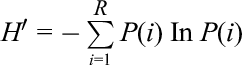
where p(i) is the ratio of signals of a particular kind to the total number of signals,
Where n(i) is the total number of signals of a particular kind received by an individual, and N is the total number of all signals received by that individual. We transformed p(i) to the natural log, adding one if no signals were received. A value closer to one indicates greater diversity in kinds of third-party sources conveying signals, while a value closer to zero indicates greater homogeneity. A value of zero indicates that the artist did not have any signals during our observation period.
Source Credibility of Third-Party Signals
We determine the credibility levels of 567 third-parties that convey each kind of signal. Each source is scored on a scale from one (low) to five (high) based on a multi-item validated scale underlying the source credibility construct (Ohanian, 1990). The scale consists of the following items: trustworthiness, honesty, dependability, experience, expertise, and how knowledgeable a source is (Ohanian, 1990). We asked three art experts to score the most frequently occurring sources (200) using the multi-item scale on a 5 point Likert measurement. If the expert did not know the source and could not provide a rating based upon a quick Internet search, then “do not know source” option could be checked. Two of the three experts had more than 18 years of experience in the art market as exhibition and museum curators; the third one has a fine arts degree and is also one of the authors.
We then estimated the Cronbach’s α and an intraclass correlation (ICC) model to measure the consistency of absolute agreement given to the same item by the three experts. The Cronbach’s α was 0.98, and the intraclass correlation (ICC 2,3) was 0.75 (p < .001). This ICC indicates low random and specific errors (Bravo & Potvin, 1991), and it is an acceptable absolute agreement among experts (Shrout & Fleiss, 1979). The third expert continued scoring the remaining 367 sources, of which the majority (83%) occurred only once. We then created the following explanatory variables: review credibility, award credibility, and financial grant credibility.
Lastly, we include the variable sales total to capture any past sales made directly by the artist to corporate collectors and art museums. Although a direct sale from the artist to one of these art buyers is rare, it does occur. These categories of art buyers are considered to be highly credible third-parties. Therefore, we do not include their level of credibility, but rather simply study the number of past sales after graduation that leads to an artist’s first affiliation with an art gallery.
Control Variables
In addition to the explanatory variables described above, we include several control variables. First, we create a continuous variable that controls for age at graduation. We do this because artists with longer careers have had more opportunities to receive signals compared to artists with shorter career trajectories. Second, we include a variable for gender where female is coded as one and male as zero. Third, we consider the main art disciplines for autonomous fine arts and create variables for visual art—a basket variable that includes painting, drawing, installation, sculpture—photography, and audiovisual. We use audiovisual as our base. The core disciple per artist is indicated by a value of one, otherwise zero. Fourth, we create a continuous variable that controls for the total number of signals before graduation. Fifth, we control for affiliation before graduation; if an artist had a pre-graduation affiliation a value of one was assigned, otherwise zero. Lastly, we create continuous variables that measure the total number of signals of each kind that an artist receives after graduation and up to the first affiliation or the end of our observation period. The variables named reviews total, awards total and financial grants total measure an artist’s “share of voice” (Bitektine & Haack, 2015) and function as indicators of quality (Bergh et al., 2014; Connelly et al., 2011).
Estimation Model
We estimate the likelihood of the first affiliation with an art gallery using Cox proportional semi-parametric hazard models (Cleves et al., 2010; Cox, 1972; Royston & Lambert, 2011). We opt for this model because it exempts us from specifying an underlying probability density function for the baseline hazard, which is unknown. Estimates from this model are consistent if the proportional hazards assumption is met. We check this with the Stata command “stphtest”; the result (χ2 = 15.87, p > χ2 = .39) shows that the proportionality assumption is valid. Furthermore, we introduce interactions between our independent variables and the logarithm of observation time to assess the risk of time dependence.
The hazard rate is given by the following formula:
where hi(t) is the hazard of not having an affiliation, h0(t) is the unspecified baseline hazard function, t is the time to affiliation, β is the vector of parameters associated with our predictor variables, and z is the vector of the predictor variables.
Summary Statistics
Our observation period extends from 1990 up to and including 2010. In that period, 27% of the artists (114) entered into a first affiliation with an art gallery. We observe that 41.8% of the artists (176) received at least one review, 30.2% at least one award (127), 19% at least one financial grant (80), and 3.6% sold at least one artwork to a corporate art collector or museum (15). With respect to the signals, on a 1 (low credibility) to 5 (high credibility) scale, the average score for review source credibility is 2.14, award source credibility is 2.16, and financial grant source credibility is 3.26, based only on artists who were recipients of these signals. In our dataset, the ratio of male to female is 0.373. Of those artists that affiliated for the first time, 38.6% (44) were male.
We foreshadow our estimations by plotting a Nelson-Aalen cumulative hazard function. First, in Figure 1, when we compare diversity and homogeneity of third-party signals to no signals, we see a steep increase in affiliations after graduation (t = 0) for artists with signals from diverse third-parties, this increase peaks at t = 10. While receiving the same kind of third-party signals increases the likelihood an artist will affiliate with an art gallery compared to not having signals. In sum, diversity in signals, that is, two or more different kinds of third-parties conveying signals, substantially increases the likelihood of entering into an affiliation earlier.
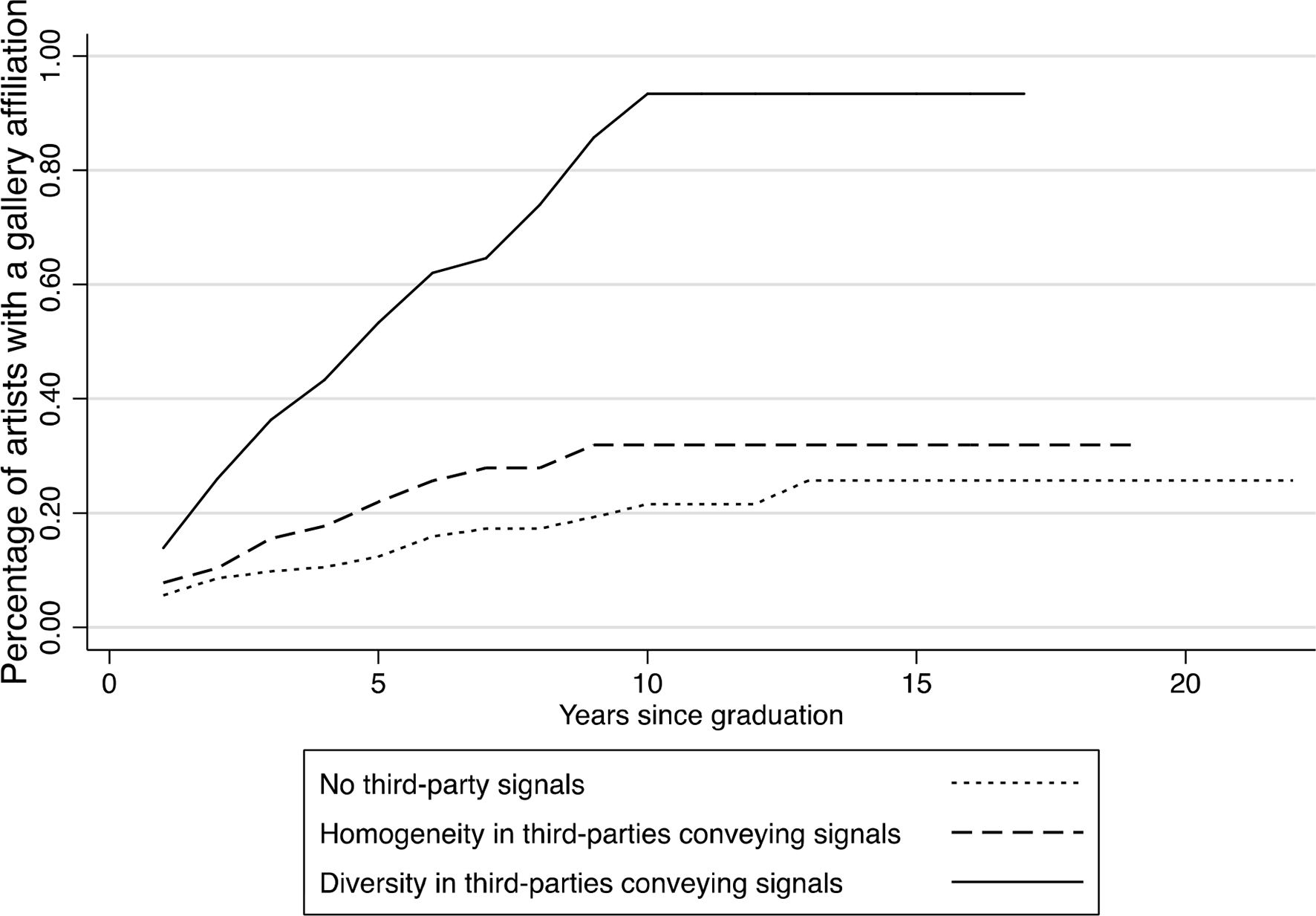
Nelson-Aalen cumulative hazard function (diversity of third parties).
Second, in Figure 2, we include the average level of source credibility. The data show that in the first or second year after graduation, diverse signals from third-party sources, regardless of their source credibility level, increase the likelihood of affiliation compared to receiving homogeneous signals or no signals at all. However, three-years after graduation, diverse and highly credible third-party signals seem only to matter.
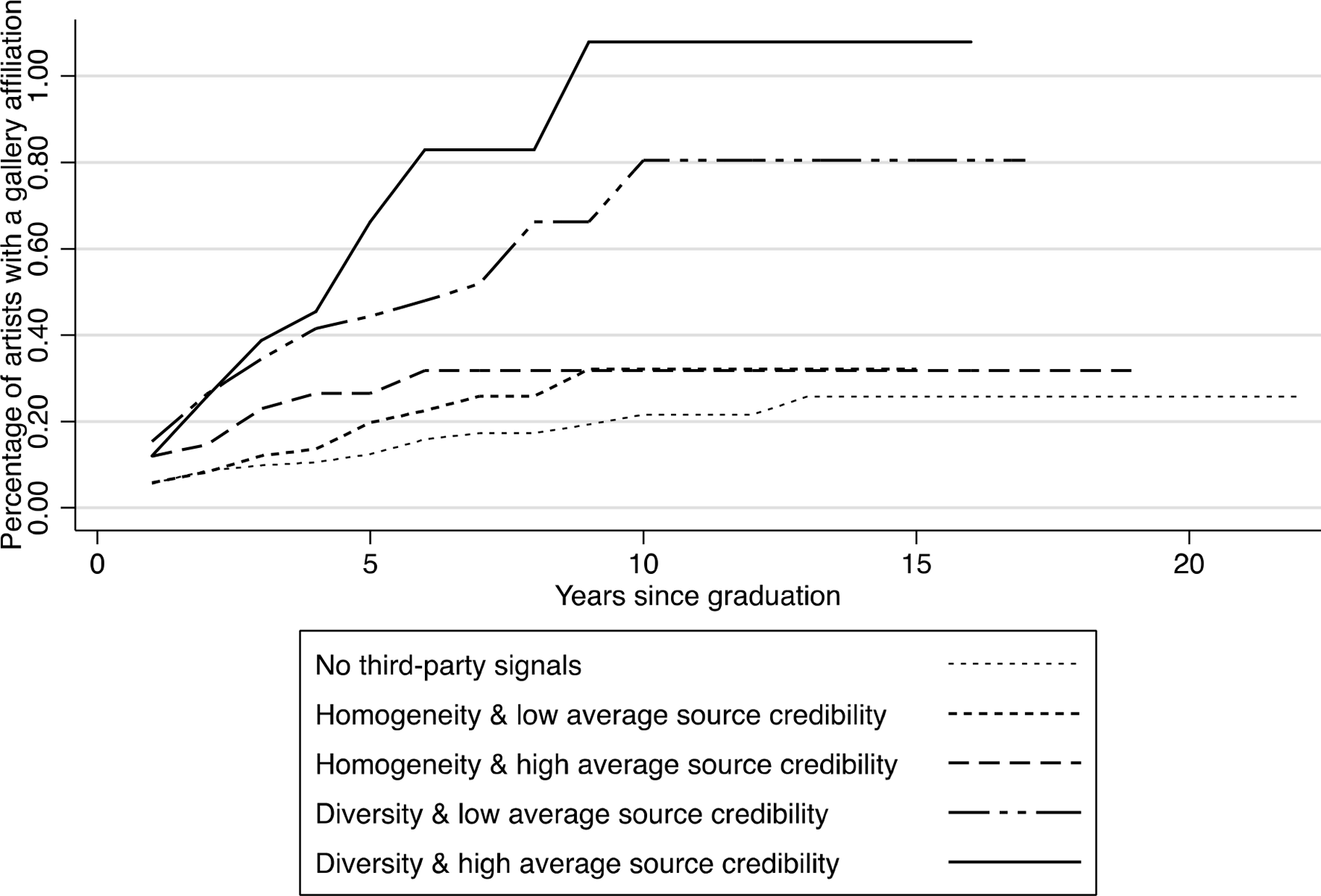
Nelson-Aalen cumulative hazard function (diversity and credibility of third parties).
Results
Table 1 presents the descriptive statistics and correlations. The variance inflation factors (VIF) indicate that multicollinearity is not likely a concern as all values are less than 5.0 (Hair et al., 2006). The mean VIF of our variables is 1.99; the diversity variable VIF is 3.80.
Correlation Matrix and Descriptive Statistics.
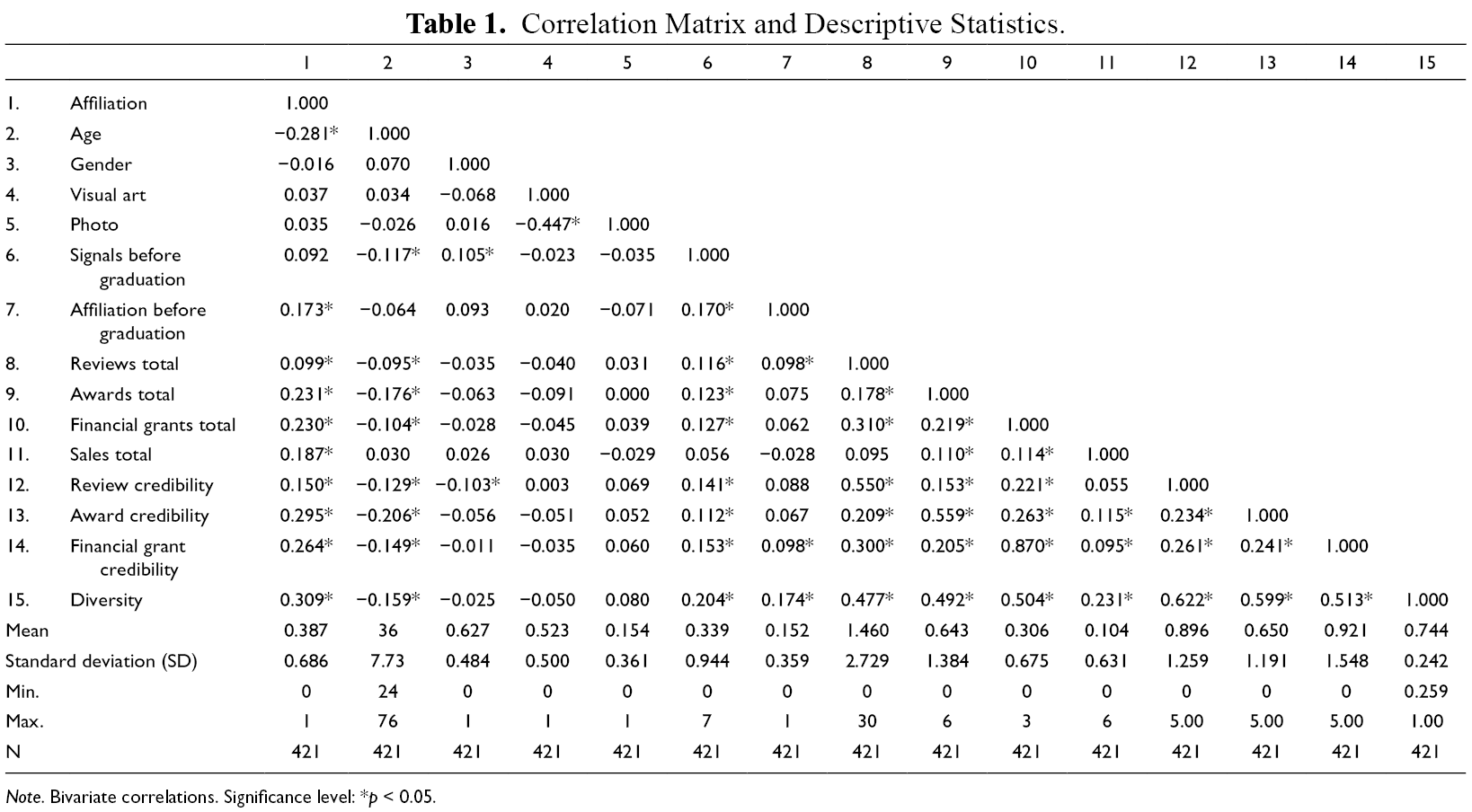
Note. Bivariate correlations. Significance level: *p < 0.05.
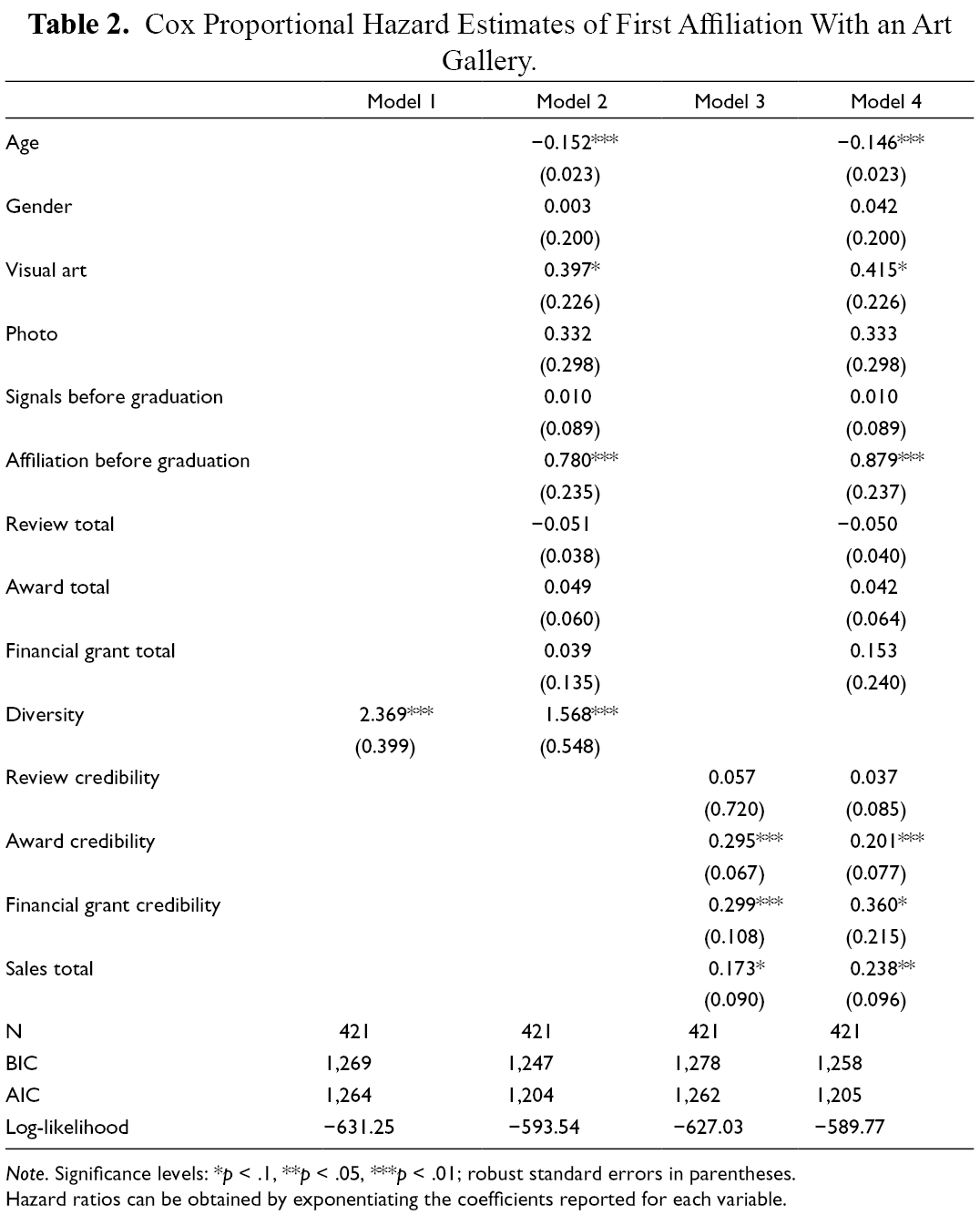
In Table 2, we report parameter estimates from the Cox proportional semi-parametric hazard model and model selection criteria. The reported coefficients can be exponentiated to obtain the hazard ratios. Model 1 in Table 2 includes the diversity variable without the control variables. Model 2 adds the control variables, which is beneficial. Specifically, Model 2 has the superior (lower) value of both the Akaike Information Criterion (AIC) and the Bayesian Information Criterion (BIC) compared to Model 1. The model selection criteria help to compare the explanatory power of nested models.
Cox Proportional Hazard Estimates of First Affiliation With an Art Gallery.
Note. Significance levels: *p < .1, **p < .05, ***p < .01; robust standard errors in parentheses.
Hazard ratios can be obtained by exponentiating the coefficients reported for each variable.
Next, we turn to Model 3 in Table 2, which includes the source credibility variable of third-parties conveying reviews, awards, merit-based financial grants as well as the total number of sales. In Model 4, we add the control variables. Again, we see that adding the control variables is beneficial, that is, Model 4 has the superior (lower) value of both AIC and BIC compared to Model 3. Based on the BIC and AIC model selection criteria, we report the results from Model 2 to Model 4.
In Model 2, we present the results of our model that estimates the diversity of third-parties to our list of predictors. Controlling for the total number of signals of each kind, age, gender, artistic discipline and pre-graduation signals, the regression estimations show that going from maximal homogeneity of third-party signals to maximal diversity significantly increases the likelihood that an artist will enter into an affiliation with an art gallery (1.568, p < 0.01). This result is consistent with our expectations cited in Hypothesis 1.
The results from Model 2 also show that younger artists enter into affiliations with an art gallery more compared to older artists (−0.152, p < 0.01), and that having an affiliation before graduation significantly increases the likelihood of an artist entering into an affiliation after graduation (0.780, p < 0.01).
In Model 4, we estimate the effect of the credibility levels of third-parties transmitting each kind of signal. Our results show that higher credibility levels of third-parties issuing awards (award credibility) positively affects the likelihood of an affiliation (0.201, p < 0.01). Similarly, highly credible merit-based grants (financial grant credibility) significantly increases the likelihood of affiliation (0.360, p < 0.1). Past sales (sales total), which can only be interpreted as highly credible signals, positively influence the probability of an affiliation with an art gallery (0.238, p < .0.05). However, the effect parameter estimating the level of credibility of third-parties transmitting reviews (review credibility) on the likelihood of affiliation while positive is not significant. These results are partially consistent with our expectations cited in Hypothesis 2.
Robustness Checks
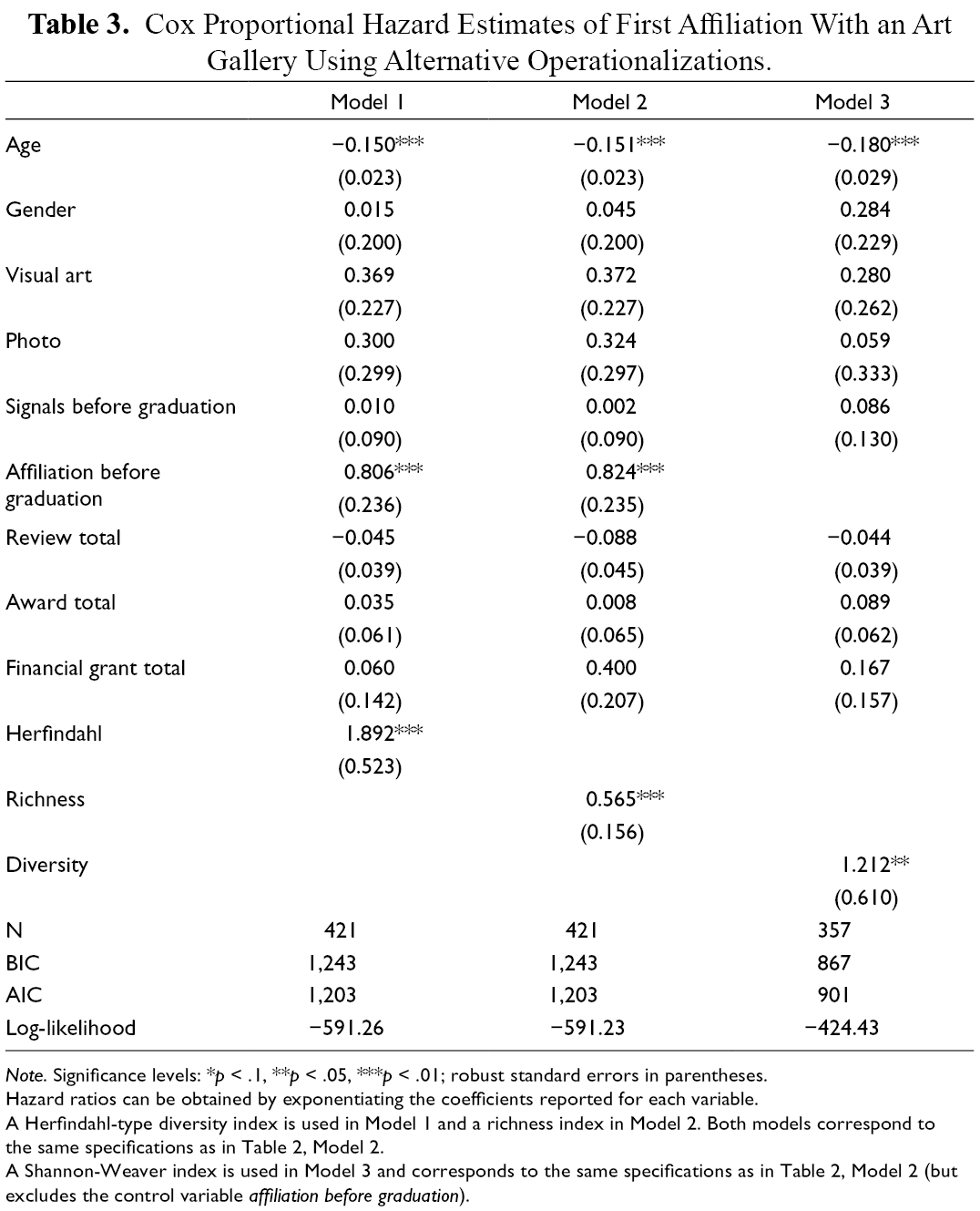
We conduct a number of robustness checks to examine if our results are sensitive to other operationalizations of our diversity variable and address possible issues related to unobserved heterogeneity. First, we create two different kinds of indices, namely, a Herfindahl-type diversity index and a richness index. The Herfindahl-type diversity index is created by taking the sum of the squares of the ratios of third-parties transmitting signals of each kind over the total number of signals transmitted by third-parties. The richness in diversity index is created by quantifying how many different kinds of signals there are in a sample. In Table 3, Model 1 and Model 2, we present these results. Second, we dropped the 64 artists who had a pre-graduation affiliation (affiliation before graduation). These results are presented in Table 3, Model 3. Controlling for signal quantity, age, gender, artistic discipline, and pre-graduation signals, we find that the results from the alternative operationalizations of the diversity variable and excluding the artists with a pre-graduation affiliation to be robust to our main results presented in Model 2 of Table 2. Our robustness checks do not show an endogeneity problem due to unobserved heterogeneity. However, care should be taken when interpreting the results as being causal since our data is observational.
Cox Proportional Hazard Estimates of First Affiliation With an Art Gallery Using Alternative Operationalizations.
Note. Significance levels: *p < .1, **p < .05, ***p < .01; robust standard errors in parentheses.
Hazard ratios can be obtained by exponentiating the coefficients reported for each variable.
A Herfindahl-type diversity index is used in Model 1 and a richness index in Model 2. Both models correspond to the same specifications as in Table 2, Model 2.
A Shannon-Weaver index is used in Model 3 and corresponds to the same specifications as in Table 2, Model 2 (but excludes the control variable affiliation before graduation).
Additional Analysis
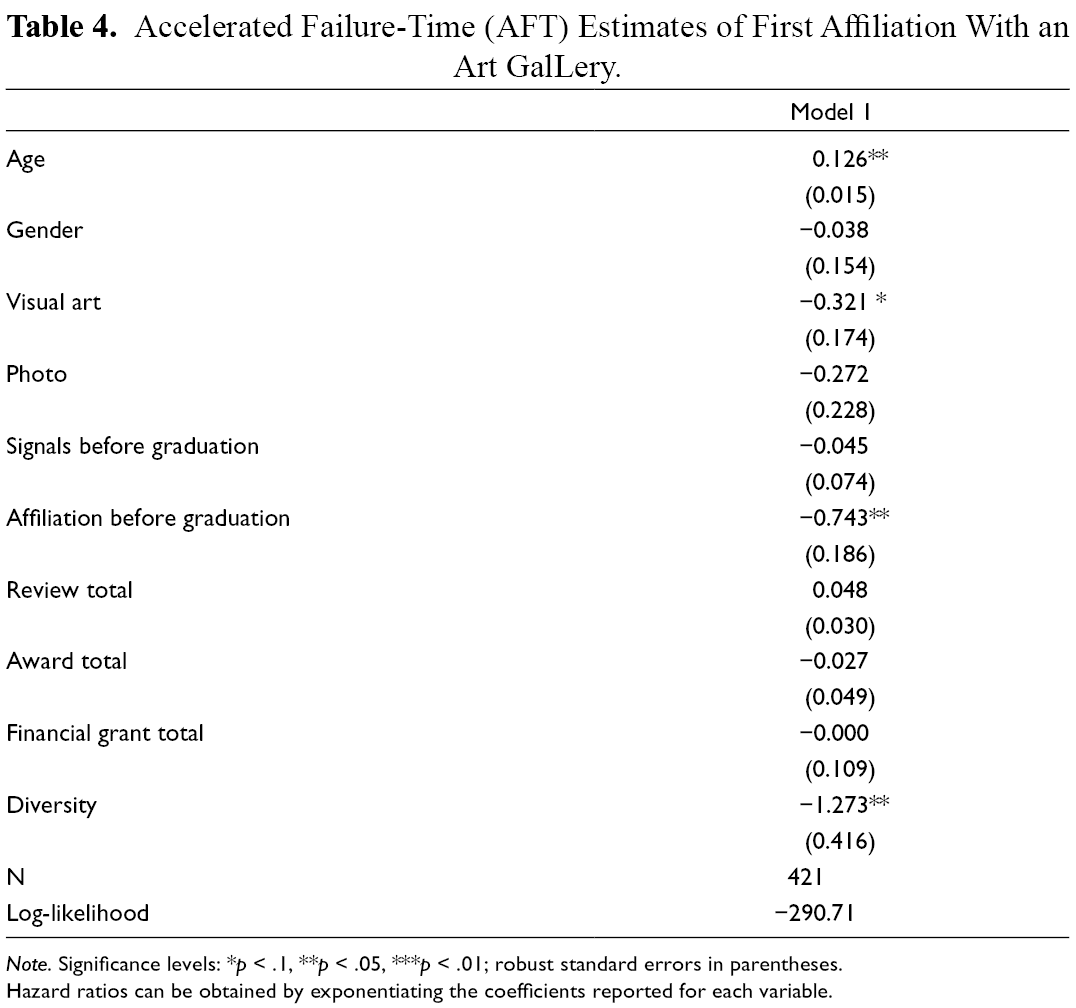
Table 4 reports the estimation result using a different functional form, namely an accelerated failure-time (AFT) model. In this parametric model, we estimate the effect of the predictor variables upon the time it takes to enter an affiliation. The non-parametric analysis of our dependent variable indicates that 81% of the artists that affiliate do so within five-years after graduation, and the rate of affiliations decreases as the observation time increases. A log-logistic distribution may be particularly suitable to model an event that is relatively likely to happen early, and progressively less likely to happen thereafter. We find that after controlling for the total number of signals of each kind, age, gender, artistic discipline and pre-graduation signals, the regression estimations show that going from maximal homogeneity of third-party signals to maximal diversity significantly decreases the time it takes for an artist to enter into an affiliation with an art gallery (−1.273, p < .0.05).
Accelerated Failure-Time (AFT) Estimates of First Affiliation With an Art GalLery.
Note. Significance levels: *p < .1, **p < .05, ***p < .01; robust standard errors in parentheses.
Hazard ratios can be obtained by exponentiating the coefficients reported for each variable.
Discussion
The first contribution of this research is that we study an economically important yet understudied phenomenon in the entrepreneurship literature, namely, how powerful mediators make legitimacy decisions about entrepreneurs who are not yet perceived as being appropriate in a focal social system. This is an important stage in an entrepreneur’s life-cycle that has not yet received sufficient attention in the entrepreneurship literature. We focus on a market with a clearly identifiable mediator, whose deliberate evaluation of propriety (Bitektine & Haack, 2015; Tost, 2011) about the new entrepreneur grants that individual full market access under the shared assumption that proper legitimacy has been achieved (Deephouse et al., 2017). This is important in markets with characteristics such as uncertainty about quality, oversupply, and high attrition rates. New entrepreneurs who gain unequivocal market access, especially at the beginning of their careers, will most likely remain active as self-employed entrepreneurs, effectively reducing the high churn (Woronkowicz & Noonan, 2019).
The second contribution of this research is that we empirically demonstrate that these mediators use the diversity of third-party sources, especially the highly credible ones, as heuristics when making their legitimacy decision about a new entrepreneur. Previous research has shown that a new entrepreneur must be perceived as being legitimate to access crucial resources (Newbert & Tornikoski, 2013), such as financial capital, know-how, and entry to professional networks (e.g., Lounsbury & Glynn, 2001; van Werven et al., 2015; Zimmerman & Zeitz, 2002). The entrepreneurship literature often focuses on angel investors or venture capitalists (Franke et al., 2006, 2008) who occupy the decisive role in this process. We build on this literature and establish that mediators—even those perceived to have high-levels of specialized knowledge and access to detailed information from their professional networks—have recourse to source diversity and credibility of publicly observable third-party signals when making their legitimacy decisions about a new entrepreneur. Moreover, using such heuristics helps reduce opportunity costs and lower the amount of cognitive processing of information about entrepreneurs active in a focal market.
The third contribution is that we add to a body of research focusing on the aggregate effects of combinations of signals as opposed to simply focusing on their individual effects (e.g., Bapna, 2017; Higgins et al., 2011; Stern et al., 2014). Previous studies have shown that third-party signals act as proxies of quality (for an overview see Connelly et al., 2011), the value of which is confirmed by others who, in the past, received the same signals and outperformed their rivals (Bergh et al., 2014). For instance, a reputable industry expert or trade journal provides additional assurance to investors observing the signal about a new high-tech company compared to others who have not received such endorsements. Although Bitektine and Haack (2015) suggest that the number of signals act as an indicator in conveying legitimacy, our results show that it is not the quantity but rather the quality and heterogeneity of signaling sources that matter. We empirically demonstrate that highly diverse and highly credible third-parties significantly influence a mediator’s decision to affiliate over and above the effects of the total number of signals. We argue that heterogeneous third-parties influence mediators because these sources convey broad-based propriety judgments about the new entrepreneur that also give the perception of a collective-level acceptance. More importantly, the information contained in these signals originates from sources using different cognitive filters. As such, they convey non-overlapping information that, when aggregated into a common metric, provide additional and unique information. Taken together, greater diversity and higher source credibility levels seem to give mediators additional confidence in their evaluations of a new entrepreneur by functioning as an even stronger aggregate indicator that conferring proper legitimacy is a justified decision.
While the particular industry we studied provides an excellent empirical setting to test our hypotheses, our results are not specific to only this particular market. We argue that they are generalizable to other settings with the same—and far from unusual—characteristics we mentioned in the introduction, namely: uncertainty about quality, oversupply, and the presence of a clearly identifiable mediator. Although the sources in our dataset are particular to the market we study, in other industries with the same core characteristics, the most important third-party sources can also be readily identified, making our arguments and results concerning source diversity and source credibility generalizable to settings with a clearly identifiable mediator. Examples of such mediators include supermarket chains (Kaufman et al., 2006) and distributors (Broekhuizen et al., 2013) whose acceptance and support is vital for an entrepreneur to achieve proper legitimacy and full-fledged market access.
At first glance, there seems to be a paradoxical aspect to these contributions because precisely when a judgment about a new entrepreneur’s proper legitimacy depends on one kind of mediator, this powerful actor is expected to make independent assessments instead of relying on the aggregate of evaluations made by others. However, this neglects a fundamental issue of theoretical importance. Such a mediator is uniquely powerful because their role in aggregating simple or complex information is broadly accepted—even socially legitimated—to stand for the common opinion in a particular domain. In this sense, gaining legitimacy is not a straightforward or direct effect of signals about a new entrepreneur. Instead, it is exemplary of what Bitektine and Haack (2015) refer to as a multilevel process. The mediator’s right to make judgments of proper legitimacy has to be socially validated too. Possibly, the fact that a mediator aggregates available third-party information in a simple and intuitively plausible way serves to strengthen or maintain their institutional position.
From a practical perspective, the value of our research is to make new entrepreneurs aware of the decision heuristics guiding a mediator’s cognitive processes in granting legitimacy. Our study suggests that there are specific actions that new entrepreneurs can take to gain a state of proper legitimacy. For instance, they can make strategic decisions to invest in eliciting signals from diverse and highly credible third-party sources. This is in line with Rutherford and Buller (2007), who describe “chasing awards and recognitions” (page 89) as a strategy mentioned by new entrepreneurs to influence powerful stakeholders and cross the so-called legitimacy threshold. A study by Kackovic et al. (2020) shows that in a market context similar to the one studied in this paper, third-party signals positively affect an entrepreneur’s financial performance, and this relationship lasts far beyond the time when the signals were first conveyed. Implementing such a strategy could provide additional long-term benefits because it may help initiate self-reinforcing feedback mechanisms, such as the so-called Matthew effect (Merton, 1968), that increase the focal entrepreneur’s competitive advantage ex ante (Azoulay et al., 2014; Merton, 1968), and in some cases ex post (Waguespack & Salomon, 2015).
Limitations and Suggestions for Future Research
This study’s findings should be considered in light of its limitations. First, as argued earlier, a practical advantage of our empirical setting is that there is one kind of mediator, who is clearly identifiable. Our theoretical arguments are also easily applicable to contexts where there is more than one kind of mediator, although data collection could be more difficult. Nonetheless, different kinds of mediators open up possibilities of studying the relative contribution of each kind of mediator. For instance, what could the consequences be on entrepreneurs active in the same industry being granted different kinds of legitimacy (see Díez-de-Castro et al., 2018) by different kinds of mediators. While our one-market study could not take industry dynamics into account, it could be interesting to investigate the moderating effect of the target industry itself, as being emerging, growing, or declining (e.g., Low & Abrahamson, 1997).
Second, while we analyzed the effects of the credibility of third-party sources conveying signals, we did not consider the valence of the signals. This is because, in our empirical setting, signals from third-parties are mainly positive. For instance, selling an artwork or receiving an award or a merit-based grant from an institution can only be interpreted as a positive third-party signal of quality. In this particular market, the same holds for reviews. The vast majority of reviews written by professional critics have a favorable tenor concerning the focal artist (Szántó, 2002) or provide factual information (Elkins, 2003). It could be of interest to explore the effects of negative signals on gaining legitimacy, taking into account both source credibility and source diversity. For instance, is there asymmetry between the negative effects of negative signals and the positive effects of positive signals if the signal sources are equally credible? Or are negative signals from low credibility sources neglected if there are also positive signals from highly credibility third-parties? Is a mix of signals from diverse sources less convincing if the valence correlates with the kind of source, some sources being consistently more positive than others? It would be interesting to frame the relation between negative signals and legitimacy in the light of recent discussions on the relationship between stigma and legitimacy (e.g., Patterson et al., 2019).
Third, we did not study the effects of signals conveyed directly by the entrepreneur. Previous studies have focused on signals originating from the entrepreneur—implicitly through the composition of start-up teams (Franke et al., 2006) or explicitly through the stories entrepreneurs tell about themselves (Aldrich & Fiol, 1994; Garud et al., 2014; Lounsbury & Glynn, 2001; Martens et al., 2007)—to predict affiliations. However, in the specific context of our study where we look at emerging artists entering the primary art market, we focus on alumni from a prestigious art school immediately after they graduate, so education, a first-party signal of quality (Spence, 1973), is the same for all individuals in our study. More fundamentally, as we have argued above, in a setting with an oversupply of self-employed artist-entrepreneurs, mediators usually do not pay attention to the stories new artists want to tell about themselves while they have not yet entered the market legitimately. This is comparable to, for instance, literary book publishers who famously pay little or no attention to unsolicited submissions from unpublished authors.
Apart from studies that overcome these particular limitations, our study invites future research to explore the effects of source diversity further. First, subsequent studies could analyze the sequences in which signals from diverse sources are received. For instance, precisely in the context of constructing legitimacy, it could be useful to study whether a sequence of signals that conforms to audiences’ expectations conveys more positive information about an actor than those that do not. In our dataset, the signals are ordered annually, but future investigations would benefit from a much higher level of granularity, enabling to study sequences over weeks or even days. Special attention could also be given to the role of particular simple sequences as constituent parts of a complex sequence, and differentiation could be made between recurrent or non-recurrent sequences (Abbott, 1995; Abbott & Hrycak, 1990).
Second, this paper classified the kinds of sources in a way that conforms to usual industry practice. However, there might be other ways in which diversity of signal sources could play a role in the decision making of mediators. Recent studies in marketing and organization theory have explored the effects of different audiences classifying the same entities in different ways (e.g., Kuijken et al., 2016; Pontikes, 2012). Taking into account possible other dimensions of source diversity, in turn, suggests that among mediators there could also be different subgroups who have a different perception of the relevant categories of these third-party sources. It would be interesting to study how different kinds (or groups) of mediators are most likely to categorize these sources and shed additional light on the nature of the relationship between source diversity and proper legitimacy.
Conclusion
Gaining a state of proper legitimacy is an indispensable condition for surviving as an entrepreneur. While the importance of critical resources to long-term survival is well-understood in the entrepreneurship literature, the process of how new entrepreneurs gain proper legitimacy to access such valuable resources is much less studied and understood. Our findings are promising as they clearly and empirically demonstrate that diversity and credibility of third-party sources conveying signals are important heuristics guiding a mediator’s decision to grant a new entrepreneur proper legitimacy and full-fledged access to a focal market.
In this paper, we focus on the primary market for contemporary visual art, which is a cultural industry with an identifiable mediator, the art gallery. In this empirical context, gaining proper legitimacy leads to unequivocal market access. This is especially important to early career self-employed artist-entrepreneurs because such access is instrumental in reducing strong selection pressures that often force these entrepreneurs out of self-employment (Woronkowicz & Noonan, 2019).
Footnotes
Acknowledgments
The authors thank Pia Arenius and three anonymous reviewers for their insightful feedback during the review process. We also thank the organizers and participants of the Creative Industries Conference hosted by the University of Edinburgh Business School, Cass Business School, and Imperial College Business School for their helpful comments on an earlier version of this paper and Michele Piazzai for his help during the initial analysis.
Declaration of Conflicting Interests
The author(s) declared no potential conflicts of interest with respect to the research, authorship, and/or publication of this article.
Funding
The author(s) disclosed receipt of the following financial support for the research, authorship, and/or publication of this article: The Netherlands Organization for Scientific Research (NWO) generously supports this research under the project number: 017.008.111.
